
how to reduce customer churn: Proven strategies for loyalty
You know that sinking feeling when your recurring revenue number dips? That’s customer churn, and it’s a quiet killer for growth. The only way to really reduce customer churn is to stop guessing and start digging: find out why customers are leaving, turn your entire customer experience into a retention machine, and use data to proactively keep them happy.
Why Your Business Is Leaking Revenue Through Churn
Customer churn is way more than just a lost sale. Think of it as a leak in your revenue bucket. Every time a customer leaves, you’re not just losing their subscription fee; you're losing future revenue, undermining growth, and even hurting team morale. It's a clear signal that there's a disconnect between the value you promised and the experience you're actually delivering.
While everyone loves the thrill of chasing new logos, the real path to sustainable, profitable growth is keeping the customers you already have.
The financial hit is staggering. Globally, businesses lose an estimated $4.7 trillion every single year because of bad customer experiences. That number should tell you one thing: there’s a massive opportunity for companies that get retention right. You can dig into the full findings on customer experience statistics to see the whole picture.
This flow chart breaks down the three core pillars of a solid churn reduction strategy: diagnosing the real problems, transforming the customer journey, and proactively keeping customers engaged.
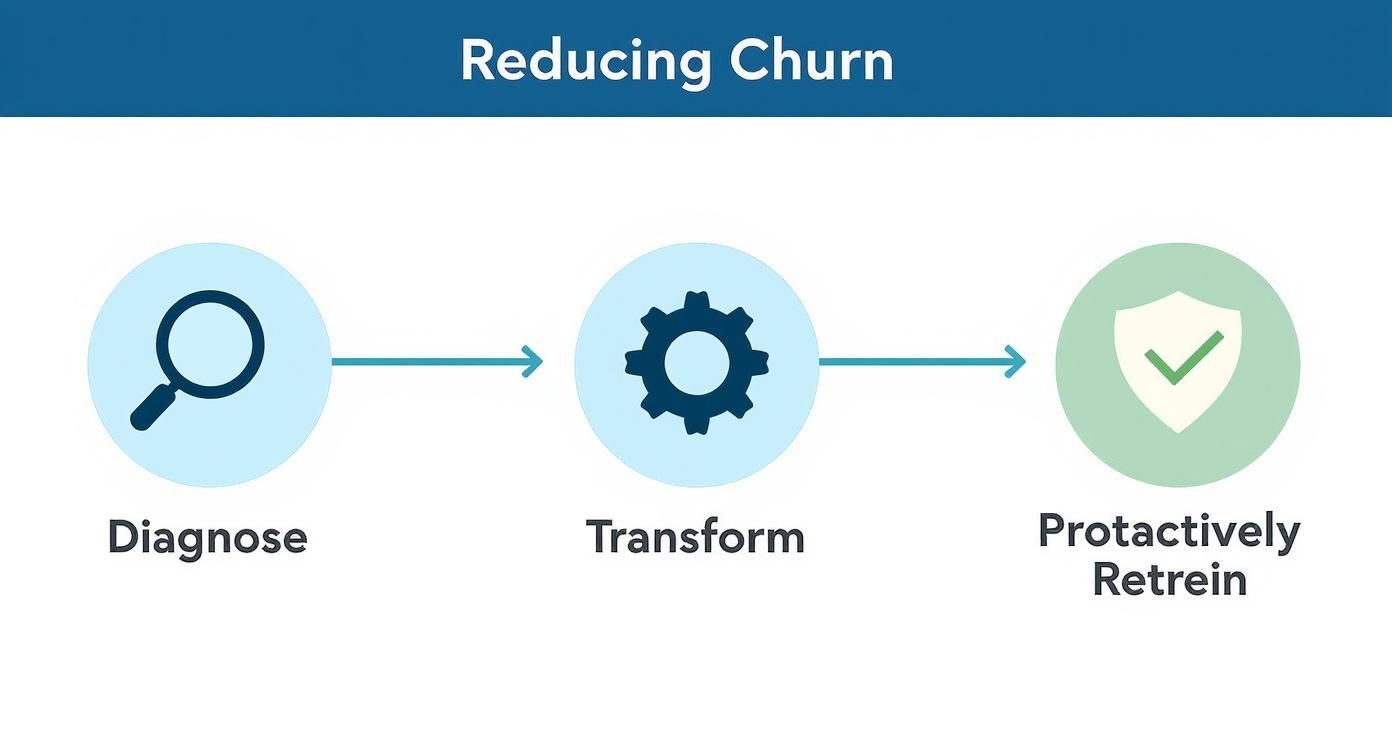
The key takeaway here is that fighting churn isn’t about panic-driven, one-off fixes. It’s a structured process. You have to understand the "why" before you can start implementing the "how."
For a quick reference, these pillars form the foundation of any effective retention strategy.
Key Churn Reduction Pillars At a Glance
| Pillar | Core Focus | Actionable First Step |
|---|---|---|
| Diagnose Root Causes | Understanding why customers are leaving. | Implement a simple multiple-choice exit survey the next time a customer cancels. |
| Transform Experience | Building loyalty into every customer interaction. | Review your last 20 support tickets for recurring themes and fix the most common issue. |
| Retain Proactively | Using data to predict and prevent churn. | Identify one key user action that signals engagement (e.g., creating a report) and track it. |
This framework isn't just theory; it's a practical roadmap for turning churn into a manageable—and shrinking—metric.
The True Cost of Losing a Customer
So many businesses track churn as a simple percentage, but that number barely scratches the surface. The real cost is hiding in plain sight.
It’s an old saying because it’s true: acquiring a new customer can cost five times more than keeping an existing one. That means for every customer you lose, you have to work five times harder on sales and marketing just to break even. It’s a hamster wheel you can’t afford to be on.
And the damage doesn't stop at your bank account. Churn also poisons:
- Team Morale: Nothing burns out a customer success team faster than constantly fighting fires and feeling like they’re in a losing battle.
- Brand Reputation: Unhappy customers don't just leave quietly. They post reviews and tell their friends, scaring away potential new leads before they even talk to you.
- Growth Momentum: High churn is like trying to drive with the emergency brake on. Even if your acquisition engine is firing on all cylinders, churn will always slow you down.
Let’s be blunt: You can’t out-sell a high churn rate forever. Eventually, the leak gets too big, the bucket runs dry, and growth grinds to a halt. Making churn reduction a priority isn't optional—it's essential for long-term survival.
Find the Real Reasons Your Customers Are Leaving
You can't fix a leaky bucket if you don't know where the holes are. Before you can slash your churn rate, you have to become a detective and figure out why customers are actually leaving—not just why you think they are. Guesswork leads to wasted effort. Data points you to real solutions.
The goal here is to get past the surface-level excuses. A customer might check the "price" box on their way out, but the real issue was probably that they never understood the product's value in the first place. When value is unclear, any price feels too high. This is where digging a little deeper pays off big.
Craft Exit Surveys That Get Real Answers
When a customer hits "cancel," it’s your last, best shot at getting unvarnished truth. But let's be honest, a generic "Why are you leaving?" survey usually gets ignored or a one-word, useless response. The trick is to make it specific and dead simple to answer. Ditch the open-ended text box. Instead, use a multiple-choice format with a few well-thought-out options and an optional comment field.
Here's a comparison between the old way and the actionable way:
| The Vague Way (Low Completion) | The Actionable Way (High Completion) |
|---|---|
| Question: "Please tell us why you're canceling." | Question: "What's the main reason you're leaving?" |
| Format: Large, open text box. | Format: Multiple choice options like: "Missing a key feature," "Found a better tool," "Price is too high for the value," "Temporary project ended." |
| Result: Vague, hard-to-quantify answers like "it didn't work" or no response at all. | Result: Clean, structured data you can put into a chart to spot trends immediately. |
This small tweak turns a chore into a simple click, boosting your response rate and giving you quantifiable data to work with.
Mine Your Support Tickets for Hidden Clues
Your support desk is a goldmine of churn signals hiding in plain sight. Stop seeing support tickets as just problems to solve; they are patterns waiting to be found. Are people constantly asking how to use the same feature? That isn't a user problem—it's an onboarding or design problem.
A Forrester study found that a staggering 70% of customers churn simply because they feel the company doesn't care about them. Analyzing support tickets is proof that you're listening. It lets you proactively fix the little frustrations that make people feel ignored.
Actionable Step: For the next two weeks, have your support team tag every incoming ticket with a category (e.g., 'Billing Issue', 'Feature X Confusion', 'Bug Report'). At the end, tally up the tags. The biggest pile is your top priority for a fix, whether it's a better help doc or a UX tweak. This is more than just counting tickets; it’s about tagging and categorizing them to spot recurring themes. For a masterclass on turning this raw feedback into strategy, digging into some voice of customer examples is a great next step.
Segment Your Churn Data to Find Hotspots
Not all churn is created equal. One of the most powerful things you can do is slice up your churn data by segment. Break down your churned users into groups and see if any one group is leaving at a higher rate than the others.
You might find, for instance, that customers who came in from a specific Google Ads campaign churn at twice the rate of your organic traffic.
That doesn't mean the ad is garbage. It probably means there’s a massive disconnect between the promise in your ad copy and the reality of your product experience. Maybe the ad over-promised a benefit that users couldn't find right away, leading to a wave of disappointed customers who bailed quickly.
By comparing acquisition channels, user personas, or pricing tiers, you can stop guessing and start taking precise, targeted action to fix the real leaks in your business.
Turn Customer Experience Into Your Best Retention Tool
Once you’ve figured out why customers are leaving, it's time to build a customer experience (CX) so good they wouldn't dream of going anywhere else. A great product might get them in the door, but it’s an exceptional experience that convinces them to stay.
This is where you stop thinking of support as a cost center and start seeing it for what it is: your single most powerful retention tool.
A huge part of that comes down to response time. This isn't just about speed for speed's sake; it's about showing up for customers when they're frustrated and need you most. When you dig into the numbers, it's pretty staggering: a whopping 68% of customer cancellations are tied directly to poor response times.
Flip that around, and the opportunity is clear. Businesses with an average first response time under a single minute see a 42% lower churn rate than their slower competitors. It’s a massive lever to pull.

To make this happen, you have to shift your entire support philosophy from being reactive to proactive.
From Reactive Fixes to Proactive Solutions
The difference between these two approaches is night and day. It fundamentally changes the customer relationship and is the key to actually reducing churn.
| Aspect | Reactive Support (The Old Way) | Proactive Support (The Better Way) |
|---|---|---|
| Trigger | Customer hits a wall and has to contact you. | You spot a potential issue and reach out first. |
| Customer Feeling | "Great, now I have to solve this myself." | "Wow, they're actually looking out for me." |
| Business Impact | Higher support costs, customer frustration, churn risk. | Lower churn, stronger loyalty, a direct line to product gaps. |
Getting proactive isn't as complicated as it might sound. It really starts with using your data to anticipate what your customers need before they even ask.
Actionable Step: Set up a simple alert. For example, if a user logs in 3 times in one day but doesn't perform a key action (like exporting a report), trigger an automated, personalized email. "Hey [Name], just wanted to check in. If you're looking to create your first report, here's a 2-minute video that walks you through it. Let me know if I can help!"
That single, timely outreach can be the difference between a customer who feels lost and one who becomes a lifelong advocate. You’re not just solving a problem; you’re preventing the frustration that causes churn in the first place.
Create a Seamless Omnichannel Experience
Another massive source of friction is a disjointed support journey. Nothing kills goodwill faster than making a customer repeat their entire story every time they switch from a chatbot, to an email, to a live agent. It's infuriating.
An omnichannel experience is the fix. It ensures the conversation flows seamlessly, no matter where it happens.
If a customer starts a chat and needs to escalate to a human, that agent should have the full transcript right in front of them. They should be able to jump in with, "Hi Alex, I see you were having trouble with the new reporting feature. Let's get that sorted out," instead of the dreaded, "How can I help you?"
This is where exploring some of the ultimate CX automation platforms can make a real difference, helping to unify all those conversations into a single thread.
By focusing on speed, proactivity, and seamless conversations, you build a support system that does more than just fix problems—it actively builds loyalty and turns your customer experience into a true competitive advantage.
Nail Your Onboarding to Stop Early Churn
You can win or lose a customer in the first few weeks. It’s a make-or-break period. They’re excited to get going, but they're also on a hair trigger to leave if they get confused, overwhelmed, or just don't see the value you promised.
A shaky onboarding experience is a fast track to churn. A great one, on the other hand, makes your product feel essential from the get-go.
Your goal isn’t to dump a pile of features on them. It’s to get them to their first “aha!” moment as fast as humanly possible—that instant where they see your product solve the exact problem they hired it for. Get this right, and their decision to choose you feels brilliant. In fact, research shows 68% of users stick with businesses that get onboarding and education right. It’s a huge leverage point.
Connect Onboarding to Their Goals
There’s a world of difference between a generic "Welcome!" email and a truly personalized onboarding flow. One is a monologue; the other is a conversation that builds real momentum.
Think about it this way:
| Aspect | The Generic Way | The Goal-Oriented Way |
|---|---|---|
| First Touch | "Welcome to our product!" email with a link to a help doc. | Asks, "What are you trying to accomplish?" and adapts the next steps. |
| Product Tour | A long, one-size-fits-all slog through every single feature. | A targeted in-app guide showing them exactly how to hit their stated goal. |
| The Result | The user is overwhelmed, unsure where to start, and gets frustrated. | The user gets a quick win, feels smart, and is hungry to explore more. |
This isn't just about being nice; it's a core part of any real customer retention plan. To see how this fits into the bigger picture, you can find a broader framework in this guide to building a customer success strategy.
Make Your In-App Guidance Actually Helpful
In-app tours and tooltips are fantastic when they’re relevant. But if they're not, they just become annoying pop-ups that people instinctively close.
The secret is context. Don't bombard a new user with a dozen pop-ups the second they log in. Instead, trigger your guidance based on what they're actually doing.
An effective in-app tour shouldn't feel like a lecture. It should feel like a helpful guide showing up at the exact moment you need directions. It anticipates what you need and gives you a shortcut.
Actionable Step: Map out the first key action a user must take to see value. For instance, if you're a project management tool, it might be 'Create First Project'. Build a single, contextual tooltip that only appears the first time they navigate to that page. Ignore everything else until they've completed that one crucial step. That’s infinitely more useful than a generic tour they clicked through three days ago and have already forgotten.
And don't forget the human element. For your high-value customers, a quick check-in call during that first week can uncover problems that no automated system will ever catch. It can be as simple as, "Hey [Name], just calling to see how you're settling in with [Product]. Anything I can help with to get you started?" It shows you care, and it lets you put out fires before they even start.
Use Data to Predict and Prevent Customer Churn
Trying to fix churn after a customer has already hit the "cancel" button is a losing game. It’s like trying to patch a hole in a boat that's already sinking.
The real shift happens when you stop reacting to cancellations and start proactively hunting for the warning signs that pop up long before a customer decides to leave. This is how you get ahead of the problem. You turn churn reduction into a systematic part of your business, not just a series of last-ditch heroics.

Instead of waiting for that dreaded "we're leaving" email, you have to look for the quiet signals that come first. These are the behavioral breadcrumbs that tell you a customer is slowly disengaging and becoming a flight risk.
Spotting the Early Warning Signs
At-risk customers almost always show their hand through their actions—or more often, their inaction. Your job is to learn how to read the room.
What are you looking for? It's usually a mix of these classic predictors:
- A Drop in Login Frequency: Someone who used to log in daily but now only shows up once a week is sending a very clear signal. They're drifting.
- Decline in Key Feature Usage: Are they ghosting the core features that once brought them value? This often means your product is no longer essential to their workflow.
- A Spike in Support Tickets: A sudden flood of support requests, especially about the same nagging issue, points directly to mounting frustration.
- Ignoring New Feature Announcements: When your best customers stop caring about your product's evolution, their long-term commitment is probably on the decline.
When you track these behaviors, you stop guessing and start making data-informed moves. And this is the fundamental difference between simply managing churn and actively preventing it.
Proactive vs Reactive Churn Management Strategies
| Aspect | Reactive Approach | Proactive Approach |
|---|---|---|
| Trigger | Customer submits cancellation request or complaint | Leading indicators (e.g., low usage, poor health score) are flagged |
| Timing | At the end of the customer lifecycle (often too late) | Early to mid-lifecycle (while there's still time to intervene) |
| Goal | "Save" the account with discounts or last-minute offers | Understand and resolve the root cause of disengagement |
| Tools Used | Cancellation surveys, support ticket escalations | Customer health scores, usage analytics, predictive models |
| Outcome | Low success rate, often results in temporary retention at best | Higher success rate, strengthens the relationship, improves the product |
As you can see, the proactive model is where the real leverage is. You're not just firefighting; you're building a more fire-resistant business.
A study by McKinsey found that companies using predictive analytics can slash customer churn by as much as 15%. The earlier you spot someone drifting away, the more time and options you have to bring them back into the fold.
From Raw Data to Actionable Health Scores
Tracking individual metrics is a good start, but the real magic happens when you combine them into a single customer health score. This gives your team a simple, at-a-glance way to prioritize who needs attention right now. Think of it as a credit score for customer loyalty.
A health score rolls up various data points—product usage, support history, survey responses—into a single metric or color code.
For example:
- A customer with high feature adoption and a recent positive NPS score is Green (Healthy).
- One with declining logins and an unresolved support ticket might be Yellow (At-Risk).
- A customer who hasn't logged in for 30 days and ignored your last three emails is squarely in the Red (Critical) zone.
This system turns a mountain of complex data into clear, undeniable action triggers. It’s no longer about who shouts the loudest; it’s about who truly needs your help the most. The insights you gain here are the foundation for using predictive analytics in marketing to not only keep customers but also spot future growth opportunities.
Personalizing Your Intervention
Once you’ve flagged an at-risk account, your response has to be tailored to the problem. A one-size-fits-all email blast just won't cut it.
Consider a tiered approach like this:
- Low Health Score (Yellow): This is perfect for an automated but personalized email. You could offer a helpful guide, a link to a tutorial for a feature they aren't using, or an invite to a 1-on-1 strategy session to help them get more value.
- Critical Health Score (Red): This demands a human touch. A red flag should immediately alert a dedicated customer success manager to pick up the phone. The goal isn't to sell them something; it's to listen, diagnose the friction, and actually solve the underlying problem.
By matching the intervention to the risk level, you use your resources far more effectively and show customers you’re genuinely paying attention. You’re not just trying to save a subscription—you're working to rebuild a valuable relationship.
Measure and Improve Your Retention Strategy
Launching a few initiatives to curb customer churn is a solid first move. But that's just the start. If you're not measuring the impact, you're essentially flying blind, guessing which efforts are hitting the mark and which are just wasting time and money.
The real goal is to get into a rhythm—a continuous cycle of testing, learning, and improving that’s fueled by real data.

This doesn't mean you need to track every metric under the sun. In fact, that's a great way to get overwhelmed. Instead, focus on a handful of critical numbers that tell the true story of your customer relationships.
Key Retention Metrics to Track
- Customer Churn Rate: This is your headline number. It’s the percentage of customers you lose over a given period (usually monthly or annually) and gives you the clearest signal of your overall retention health.
- Revenue Churn Rate: Often more telling than customer churn, this tracks the percentage of monthly recurring revenue (MRR) lost from existing customers. Losing one high-value account can sting a lot more than losing ten smaller ones, and this metric puts that into perspective.
- Customer Lifetime Value (LTV): This is the total revenue you can reasonably expect from a single customer throughout your relationship. As you get better at reducing churn, your LTV should climb right alongside it.
Churn benchmarks can be all over the map depending on the industry. Media and professional services often boast a healthy 84% retention rate. On the other hand, telecom and financial services might see churn closer to 25%.
Don't be fooled by small numbers, either. What looks like a low 5% monthly churn actually compounds to a staggering 46% annual loss—a quiet but devastating leak in your customer base.
Connect Your Actions to Outcomes
Once you have these core metrics on your dashboard, the next step is to draw a direct line between them and your retention efforts. Did that new onboarding flow you rolled out actually reduce churn in the first 30 days? Did your proactive support calls boost the LTV of at-risk accounts?
Actionable Step: Run a simple A/B test on your next retention campaign. For customers whose subscriptions are about to expire, send half of them a standard reminder email. Send the other half an email that includes a special offer or highlights a new feature they haven't used. Compare the renewal rates after 30 days. This gives you concrete data on what message resonates best.
The idea is to build a playbook of what actually works for your audience, not just what a blog post says should work. To get more ideas for your playbook and make sure your plan is solid, it’s always smart to review some of the top customer retention strategies that have proven successful for others.
Try our Lookalike Company Finder — find companies similar to your best customers in seconds. No signup required.
Got Questions About Cutting Churn? We've Got Answers.
We've walked through the big strategies, but the same handful of questions always pop up. Let's tackle them head-on with some quick, no-fluff answers.
What’s a Good Churn Rate to Aim For?
This is the million-dollar question, and the honest answer is: it depends. A "good" churn rate is completely relative to your industry and business model.
If you're a SaaS company selling to enterprise clients, anything around 1-2% monthly churn is fantastic. But if you're an e-commerce brand, you might see rates closer to 5-7% and still be in great shape.
The real goal isn’t to hit some magic universal number. It's to beat your number from last month. Focus on consistent, incremental improvement rather than chasing someone else’s benchmark.
How Often Should We Be Looking at Churn Metrics?
Don’t just glance at it during a quarterly review. By then, the damage is done.
Your team needs to be digging into churn metrics on a monthly basis, at a minimum. This is how you spot a dangerous trend before it turns into a five-alarm fire.
Even better? Look at leading indicators weekly—things like customer health scores, ticket volume, or product usage. The final churn rate is a lagging indicator; it tells you what already happened. Proactive checks on the early warning signs are what really prevent surprises.
What's the Fastest Way to Make a Dent in Churn?
If you want the biggest impact in the shortest amount of time, fix your onboarding process for new customers.
Early-stage churn is almost always the easiest to solve. It usually boils down to a new user getting confused, not finding that "aha!" moment quickly, or just failing to see the value they were promised. A few simple tweaks to your welcome emails, in-app guides, or initial check-in calls can produce a measurable drop in churn within a single quarter.
Can a Small Business Do This Stuff Without a Huge Budget?
Absolutely. You don't need a massive war chest to fight churn.
Some of the most powerful retention tactics are low-cost or completely free. Think about it:
- Personally calling a few customers who canceled to understand why.
- Sending out a simple feedback survey using Google Forms.
- Improving your help documentation and FAQ pages.
These things cost you time, not a ton of money. A small business might not have enterprise-grade predictive analytics, but you have something the big guys don't: the ability to build genuine, personal relationships. That's a massive competitive advantage.
Ready to turn customer insights into unstoppable growth? marketbetter.ai uses AI to help you create content, personalize engagement, and optimize campaigns at scale, so you can build loyalty and keep your best customers for good. Discover how our AI-powered marketing platform can transform your retention strategy at https://www.marketbetter.ai.