
2 posts tagged with "conversion rate optimization"

View All Tags

The Top 10 Best Practices for Landing Page Design in 2026

· 26 min read

In B2B marketing, a landing page isn't just a webpage; it's your digital sales pitch, working 24/7 to turn clicks into qualified pipeline. With buyer attention spans shrinking and competition intensifying, a generic design no longer drives meaningful results. The critical difference between a page that converts prospects and one that merely consumes ad spend lies in the deliberate, strategic application of proven design principles. A high-performing page anticipates user intent and guides them seamlessly to a single conversion goal, while a weak one creates friction, confusion, and ultimately, a bounce.

This guide moves beyond generic advice to provide a prioritized, actionable roundup of the 10 best practices for landing page design, specifically tailored for demanding mid-market and enterprise sales funnels. We will break down what works versus what falls flat, comparing high-impact elements like problem-centric hero sections against vague value propositions. You won't just learn what to do; you'll learn how to implement it.

Inside, you'll find A/B testing recipes, performance benchmarks, and clear implementation tips to help you build landing pages that don't just look good but consistently drive results. Whether you're a Head of SDR, a demand generation manager, or a VP of Sales, these principles will equip you to transform your landing pages from simple information hubs into powerful conversion machines. We will explore everything from structuring your value proposition and leveraging social proof to optimizing form fields and handling objections before they even arise.

1. Clear Value Proposition Above the Fold

A visitor should understand what you offer, who it's for, and why they should care within five seconds of landing on your page. This immediate clarity is achieved with a strong value proposition placed "above the fold," meaning it's fully visible without any scrolling. This isn't just a best practice for landing page design; it's the foundation upon which all other conversion elements are built. A visitor who is confused about your core offer will never reach your call-to-action.
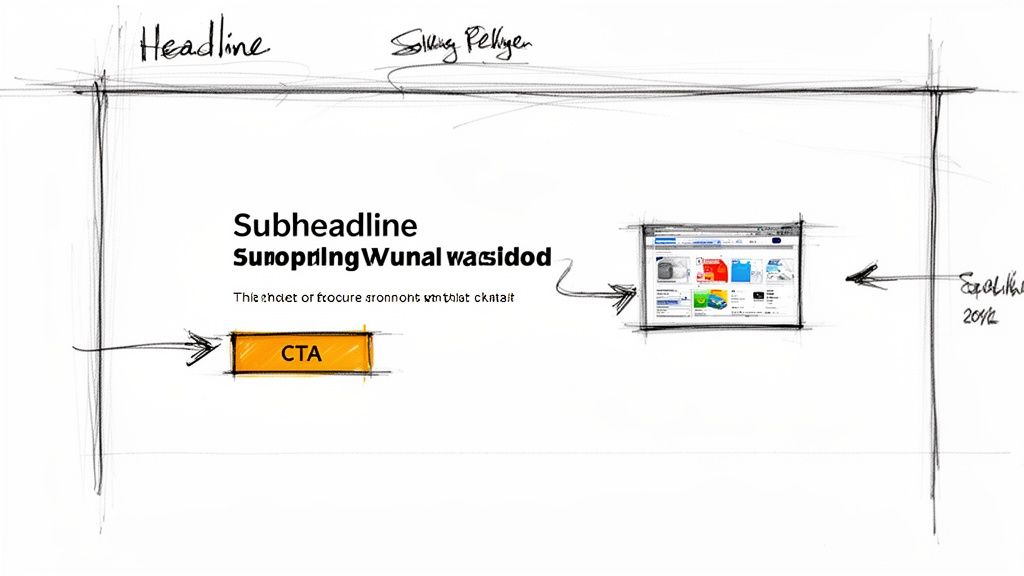
A hand-drawn wireframe sketch illustrating a landing page design with headline, subheadline, CTA, and content area.

Why It's Crucial

Your headline and subheadline are your one chance to make a first impression. They must immediately resonate with the visitor's pain point and promise a clear, desirable outcome.

  • Ineffective Comparison: A headline like "AI-Powered Sales Tool" is weak because it describes a feature. It forces the user to figure out the benefit.
  • Effective Comparison: A much stronger, outcome-focused headline is: "Turn Buyer Signals into Qualified Pipeline, Instantly." This version sells a result that every VP of Sales wants. This single element is often the highest-impact variable you can test to improve performance.

Actionable Implementation Steps

To craft a compelling value proposition, focus on your target audience's specific needs.

  • Action: Audit your current headline. Does it describe a feature or a benefit? Rewrite it to focus on the outcome your ideal customer profile (ICP) desires. For an SDR Manager, use phrases like "eliminate manual research" and "ensure CRM hygiene."
  • Action: Anchor your solution to a concrete workflow. Instead of a vague promise like "Improve Sales," be specific: "Prioritize SDR Tasks Inside Salesforce." This makes your solution tangible.
  • Action: Set up an A/B test today. Pit your new benefit-driven headline against a pain-point-focused one (e.g., "Stop Wasting Time on Bad Leads"). Allocate at least 20% of your paid traffic to the test to get statistically significant results quickly.

Crafting the perfect headline is a critical step in your conversion strategy. For a deeper dive into methodical testing and optimization, check out our comprehensive conversion rate optimization checklist.

2. Problem-Centric Hero Section (Before/After or Pain Validation)

Instead of leading with your solution, a problem-centric hero section immediately validates the visitor's primary business pain. It demonstrates a deep understanding of their challenges, building trust and credibility before you ever mention a feature. This approach shifts the conversation from "what our product does" to "we understand your world," which is a far more powerful opening for complex B2B sales cycles and a cornerstone of effective landing page design.
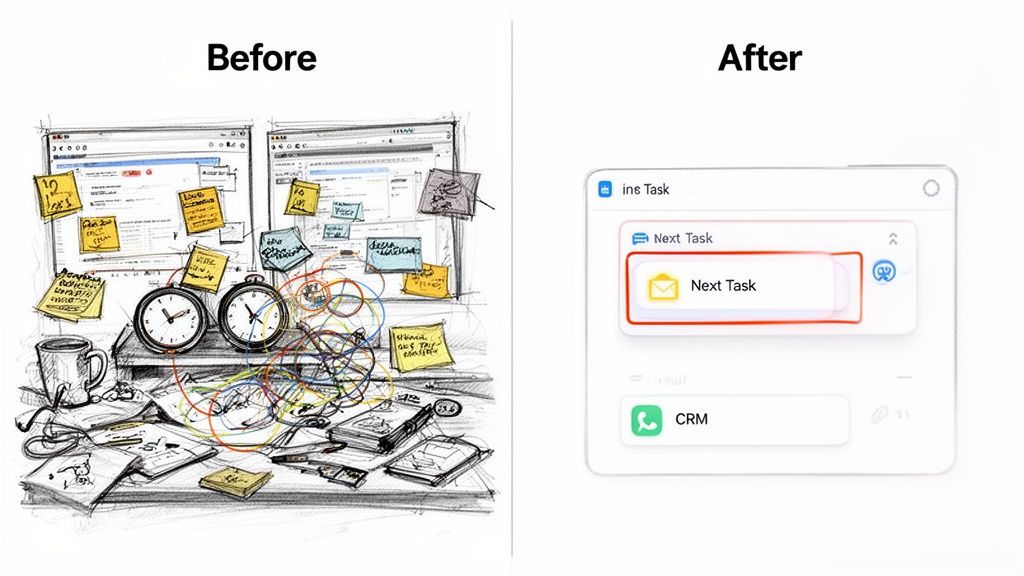
Before: chaotic desk with monitors, sticky notes. After: organized digital task management showing efficiency.

Why It's Crucial

Your value proposition resonates more strongly when it's framed as the direct answer to a well-articulated problem.

  • Ineffective Comparison: A landing page that simply states "AI-Powered Sales Dialer" is forgettable and competes on features alone.
  • Effective Comparison: A hero section leading with a stat like "SDRs spend 3+ hours daily on research and admin, not selling" immediately grabs the attention of any Sales VP. This pain validation technique, popularized by frameworks like StoryBrand, makes your solution feel less like a product and more like a necessary resolution.

Actionable Implementation Steps

To build a compelling problem-centric hero, immerse yourself in your customer's daily workflow.

  • Action: Create a "Before/After" visual. Show a graphic of an SDR juggling multiple tabs (LinkedIn, CRM, dialer) next to a clean interface of your tool. This makes the pain tangible and the solution clear.
  • Action: Add a quantified pain point to your hero copy. Use an industry stat or internal data like "67% of SDRs say poor dialer integration kills adoption" to add authority and validate the problem.
  • Action: A/B test different pain points. Run one hero section focused on wasted research time against another focused on low CRM adoption. This will reveal which problem is the most powerful motivator for your audience.

By first proving you understand the problem better than anyone else, you earn the right to present your solution. For more on creating narratives that drive action, explore Donald Miller's insights on the StoryBrand marketing framework.

3. Social Proof and Trust Signals (Logos, Reviews, Case Studies)

For B2B buyers, especially in the mid-market to enterprise space, skepticism is the default setting. A landing page must quickly overcome the "another tool that won't stick" objection. Social proof and trust signals serve as the most effective antidote, providing third-party validation that your solution is credible, adopted by peers, and delivers real-world results. This isn't just about adding a few logos; it's a strategic element of landing page design that directly addresses perceived risk.

Why It's Crucial

Your claims about turning "buyer signals into qualified pipeline" are just that: claims. They gain credibility only when backed by evidence from existing customers. For a sales leader evaluating a tool like MarketBetter, seeing logos of well-known, sales-driven organizations or a testimonial from a VP of Sales at a similar company instantly builds a bridge of trust.

  • Ineffective Comparison: A page with no trust signals feels like an empty restaurant; it creates doubt.
  • Effective Comparison: A page with strong, relevant proof feels like the most in-demand spot in town. It shifts the conversation from "Does this work?" to "This works for them, so it could work for us."

Actionable Implementation Steps

Strategically deploy social proof to build momentum as a visitor scrolls down the page.

  • Action: Replace vague testimonials ("We love the tool") with quantified outcomes. Reach out to a happy customer and ask for a specific metric: "MarketBetter reduced our SDRs' prep time by 2 hours a day."
  • Action: Segment your logo bar. If your landing page targets B2B SaaS companies, create a dedicated section showing only logos from that vertical. This demonstrates industry expertise.
  • Action: Prominently display your G2 or Capterra rating. Add a badge with your star rating (e.g., "4.7/5 stars on G2") near your CTA to act as an unbiased stamp of approval.
  • Action: A/B test social proof formats. Test a static logo bar against a rotating carousel of detailed, quote-based testimonials to see which format drives more conversions for your specific audience.

Building this layer of trust is a fundamental component of effective landing page design, transforming a simple marketing page into a compelling business case. For more insights on building a narrative with customer evidence, explore our guide on crafting high-impact case studies.

4. Feature-to-Benefit Translation (Show the Workflow, Not Just the Tech)

Prospective buyers don't purchase features; they invest in solutions that solve specific, often painful, problems within their daily workflow. Simply listing what your product does, such as "Salesforce Dialer" or "AI-written emails," forces the visitor to connect the dots themselves. Effective landing pages close this gap by translating technical features into tangible business outcomes and workflow improvements. This approach shifts the focus from "what it is" to "what it does for me."

Why It's Crucial

Your landing page must function as a bridge between your product's capabilities and the visitor's desired future state. A sales development representative (SDR) doesn't just want a dialer; they want to stop switching between browser tabs, log calls automatically, and make more dials per hour.

  • Ineffective Comparison: A weak feature description like "AI Cold Email" is a tool.
  • Effective Comparison: A stronger, workflow-focused benefit is: "Generate on-brand, context-specific cold emails that earn higher reply rates, eliminating hours of manual research and subject-line testing." This is a direct solution to a major productivity bottleneck.

Actionable Implementation Steps

To implement this principle, map your core features directly to the "job to be done" for your target audience.

  • Action: Restructure your features section around 3-5 core workflows. Instead of a feature grid, create sections like "Automate Task Prioritization," "Streamline Outreach," and "Improve CRM Hygiene."
  • Action: Use "Before/After" copy. For each workflow, describe the old, inefficient way ("Manually searching for prospect data") and contrast it with the new, streamlined process your tool enables ("Get AI-surfaced insights in one click").
  • Action: Convert a feature into an outcome. Take a feature like "Call Recording" and rewrite its description to focus on the benefit for a manager: "Allow sales coaches to QA rep calls asynchronously, providing targeted feedback without having to sit in on every single conversation."

By focusing on the workflow, you embed your product into the visitor's reality, making the value proposition both undeniable and immediately understandable. This is a key best practice for landing page design that directly addresses the user's core needs.

5. Friction Reduction: Single CTA, Clear Next Step, Minimal Form Fields

Every decision you ask a visitor to make introduces friction, a form of cognitive load that can stop a conversion dead in its tracks. Effective landing page design is a masterclass in reducing this friction. The goal is to create a seamless, intuitive path from visitor to lead by presenting one primary call-to-action (CTA), clarifying what happens next, and asking for the absolute minimum amount of information required. A visitor who feels the process is simple and transparent is far more likely to convert.

Why It's Crucial

Decision paralysis is real. Offering a visitor too many choices, like "Schedule a Demo," "Start a Trial," "Download Whitepaper," and "Watch a Video" on the same page, creates confusion. The visitor doesn't know which path is right for them and often chooses none.

  • High-Friction Comparison: A form with ten fields feels like a major commitment and an invasion of privacy. It screams "we're going to spam you."
  • Low-Friction Comparison: A form with just three fields feels easy and low-risk. Simplifying from eight fields to four can directly increase lead volume.

Actionable Implementation Steps

To minimize friction, streamline every element of the conversion process. Focus on making the desired action feel effortless.

  • Action: Unify your CTA. Choose the single most valuable action (e.g., "Schedule a Demo") and make it your primary CTA. If you must offer a secondary option ("Watch a 3-Minute Walkthrough"), make it a text link instead of a button to reduce its visual weight.
  • Action: Shrink your form today. Audit your form fields and remove at least one. Do you really need their phone number right now? Start with Name, Work Email, and Company. Use data enrichment tools later.
  • Action: Add expectation-setting microcopy. Below your form, add a simple sentence: "You'll receive a calendar link within 15 minutes. No sales call required to book." This builds trust and clarifies the next step.

Reducing friction is one of the most powerful levers you can pull to improve performance. For a step-by-step guide on applying these principles, you can learn more about how to create a high-converting landing page.

6. Mobile-First Responsive Design (Not an Afterthought)

In today's B2B landscape, treating the mobile experience as a secondary concern is a critical mistake. A mobile-first approach means you design the landing page for the smallest screen first, then adapt it for larger screens like desktops. This isn't just a technical detail; it's a strategic imperative. Many of your target buyers, from VPs of Sales checking emails between meetings to SDRs browsing on the go, will first encounter your brand on their phone. A clunky, slow, or broken mobile page immediately signals a lack of attention to detail and can kill a potential lead instantly.
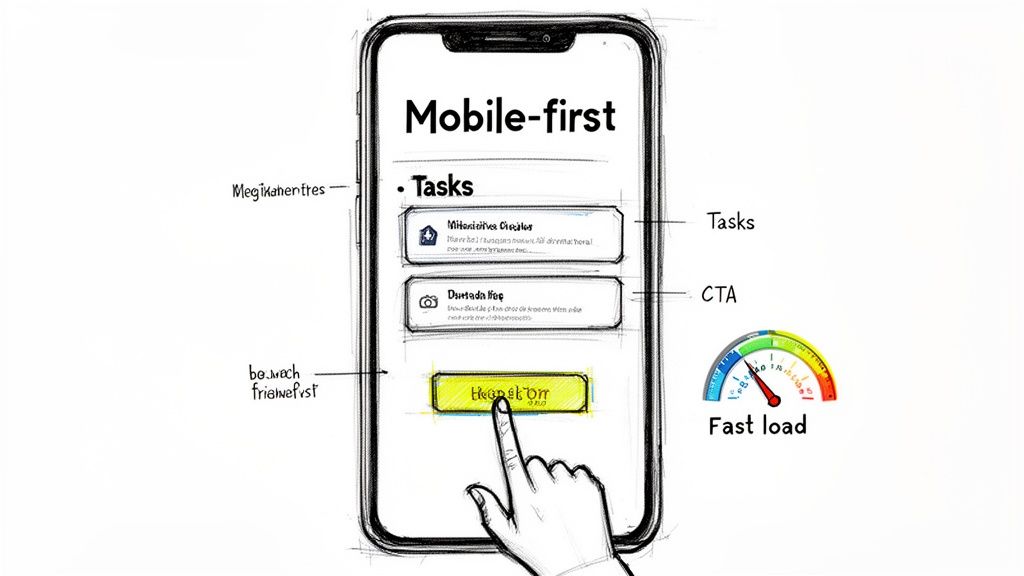
A mobile-first design sketch of a smartphone with tasks, a call to action, and fast load indications.

Why It's Crucial

Google's mobile-first indexing means your mobile page performance directly impacts your search ranking. Beyond SEO, however, is the user experience.

  • Ineffective Comparison: A desktop design shrunk down to mobile, requiring pinching and zooming to fill out a form, will be abandoned immediately.
  • Effective Comparison: Companies like Slack and HubSpot excel here; their mobile landing pages are clean, fast, and feature a single-column layout with a prominent, "thumb-friendly" CTA, ensuring the experience is seamless. This focus is a core part of effective landing page design.

Actionable Implementation Steps

Shifting to a mobile-first mindset requires practical changes to your design and development workflow.

  • Action: Test your mobile speed now. Use Google's PageSpeed Insights and aim for a score of 90+. Compress all images using a tool like TinyPNG and remove any non-essential scripts.
  • Action: Redesign UI for touch. Stack elements like CTAs vertically on mobile instead of placing them side-by-side. Ensure buttons are at least 44x44 pixels to create ample tap targets and avoid user frustration.
  • Action: Test on a real device. Open your landing page on your own phone. Try to fill out the form. If it's frustrating for you, it's a conversion killer for your prospects.
  • Action: Optimize media for mobile. Replace auto-playing videos with a static image thumbnail and a play button. This saves bandwidth, improves load times, and gives the user control.

A robust mobile experience is no longer optional. For guidance on optimizing every aspect of your funnel, explore our detailed lead generation strategy guide for advanced techniques.

7. Customer Testimonial and Case Study Depth (Specific Metrics and Quotes)

Generic testimonials like "Great product!" are easily ignored and do little to build trust. One of the most effective best practices for landing page design in a B2B context is to showcase social proof with verifiable depth. This means featuring testimonials and case study summaries that are packed with specific, quantifiable results, company context, and quotes from identifiable professionals. It transforms vague praise into a compelling, evidence-backed narrative that allows prospects to see a clear path to their own success.

Why It's Crucial

A vague testimonial is forgettable, but a specific, metric-driven outcome is persuasive. When a VP of Sales sees that a peer at a similar company increased their pipeline by 35% using your tool, it builds instant credibility and relevance.

  • Ineffective Comparison: A generic quote like "MarketBetter helped our sales team." is a platitude with zero impact.
  • Effective Comparison: A powerful, specific alternative is: "MarketBetter’s Salesforce integration helped our SDRs increase daily outreach by 40% while cutting prep time in half." The second is a business case that directly addresses a prospect's KPIs.

Actionable Implementation Steps

To leverage deep social proof, focus on weaving specific, persona-aligned results into your landing page.

  • Action: Add quantifiable outcomes to every testimonial. Go beyond percentages and include metrics like "generated $250k in new pipeline," "saved 10 hours per rep per week," or "improved data quality by 60%."
  • Action: Provide context and credibility. Add the person's name, title, a professional headshot, and their company logo to every quote. This is non-negotiable for building trust.
  • Action: Align case studies with page personas. If the page targets VPs of Sales, feature a case study summary focused on pipeline creation. If it targets SDR Managers, feature one focused on activity metrics and efficiency gains.

For a comprehensive guide on building a repository of customer stories that fuel your marketing efforts, explore our detailed resource on creating a customer evidence program.

8. Visual Hierarchy and Scannable Content (Not Dense Paragraphs)

B2B buyers are busy and goal-oriented; they don't read landing pages, they scan them. A wall of dense text is an immediate conversion killer. Implementing a strong visual hierarchy guides the visitor’s eye to the most critical information, making your page instantly digestible. This isn't just about aesthetics; it's a fundamental principle of user experience design that directly impacts whether a visitor understands your offer or bounces in confusion.

Why It's Crucial

A scannable layout allows prospects to quickly find the sections most relevant to their specific role or pain point.

  • Ineffective Comparison: A single, dense block of text forces all visitors—from a Sales Leader to a RevOps Manager—to parse the same information, much of which may be irrelevant to them.
  • Effective Comparison: Pages from SaaS leaders like Stripe and HubSpot use minimal copy, strong headings, and clear section breaks to direct attention. This respects the user's time and makes the solution feel more accessible.

Actionable Implementation Steps

To transform a text-heavy page into a scannable, high-converting asset, focus on structure and visual cues.

  • Action: Break up your content. Go through your page and ensure every section has a clear H2 or H3 heading. For MarketBetter, change a long paragraph about features into an H2 like 'How MarketBetter Works' with three distinct H3s: Prioritize Tasks, Automate Emails, and Log Calls.
  • Action: Convert prose to lists. Find any sentence that lists three or more items and convert it into a bulleted list. This simple format change can dramatically improve readability.
  • Action: Increase whitespace. Add 20-30% more vertical padding between sections. This reduces cognitive load and helps your calls-to-action stand out more effectively.

Testing different layouts, such as comparing a paragraph-based section to a bulleted one, is essential. For more insights on structuring these experiments, explore our guide on how to conduct A/B testing.

9. FAQ/Objection Handling Section (Preempt Buyer Doubts)

Even the most persuasive landing page can leave a high-intent prospect with lingering questions or doubts. A dedicated FAQ section strategically addresses these common objections head-on, reducing friction and preventing visitors from abandoning the page to seek answers elsewhere. This isn't just a list of questions; it's a critical conversion tool that builds trust and preemptively handles the "but what about..." thoughts that can derail a decision. A visitor who finds answers to their specific concerns is far more likely to convert.

Why It's Crucial

Your prospects are silently running through a checklist of potential deal-breakers: cost, implementation effort, compatibility with existing tools, and security. Failing to address these directly creates uncertainty.

  • Ineffective Comparison: Ignoring a key objection like “We already have Outreach/Salesloft. Why do we need this?” lets the prospect disqualify you on their own.
  • Effective Comparison: Addressing it head-on with an answer like, "MarketBetter isn't a replacement; it’s the decision engine that lives inside Salesforce, turning buyer signals into prioritized tasks that your existing sales engagement platform can then execute," re-frames your product from a competitor to a complementary, value-add layer.

Actionable Implementation Steps

To build an effective objection-handling section, source questions directly from your sales and customer success teams.

  • Action: Survey your sales reps for the top 5 questions they get on discovery calls. Common ones include: “Will our SDRs actually use this?” and “What if our Salesforce instance is messy?” Build your FAQ around these.
  • Action: Use a collapsible accordion format. This keeps the page clean and allows visitors to find the specific information they need without being overwhelmed by text. Place this section right before the final CTA to resolve last-minute doubts.
  • Action: Turn objections into benefits in your answers. For "How long does implementation take?", provide a phased timeline: "Start with core task management in under 2 weeks, then layer in our AI coaching module." This transforms a potential negative into a positive (fast time-to-value).

By proactively answering questions, you control the narrative and build the confidence a prospect needs to take the next step. For more on crafting persuasive copy that overcomes objections, explore our detailed guide on writing high-converting landing page copy.

10. Video or Animated Demo (Not Just Screenshots)

A static screenshot can show a feature, but a dynamic video or animated demo tells a story and demonstrates value. For complex products, showing the actual workflow in action is far more compelling than simply describing it with text and images. This approach builds trust by showcasing the real product, reduces the user's perceived complexity, and significantly boosts engagement by making your solution tangible and easy to understand.

Why It's Crucial

Words can be misinterpreted, but a well-executed video demo provides undeniable proof of your product's capabilities.

  • Ineffective Comparison: A static screenshot shows a single screen, forcing the user to imagine the workflow.
  • Effective Comparison: A short video shows exactly how an SDR transitions from receiving a prioritized signal to logging an AI-summarized call in Salesforce. This visual evidence of efficiency answers key questions before they're asked. Companies like Loom and Calendly master this by turning abstract benefits into concrete results.

Actionable Implementation Steps

To create an effective demo, focus on showcasing a high-value workflow rather than a generic product tour.

  • Action: Script a problem-solution story. Instead of clicking through menus, script a 90-second video that shows a user's complete workflow: starting with the problem (a messy task list) and ending with the solution (an AI-prioritized task executed and logged).
  • Action: Add on-screen captions. A significant portion of viewers watch with the sound off. Use clear text overlays or subtitles to ensure your message lands even without audio.
  • Action: Run an A/B test. Create two versions of your landing page—one with the video and one with a static hero image. Track form fill conversion rates to measure the video's direct impact on your pipeline. Ensure the video is user-initiated with a play button, as autoplay can be disruptive.

For more on this topic, explore these strategies for creating compelling product videos that convert.

10-Point Landing Page Design Comparison

Item🔄 Implementation Complexity⚡ Resource Requirements📊 Expected Outcomes💡 Ideal Use Cases⭐ Key Advantages
Clear Value Proposition Above the FoldLow–Medium — copy + design and iterative A/B testsSmall team: copywriter, designer, analyticsFaster visitor qualification; lower bounceTop-of-funnel pages, paid ads, first-touch trafficImmediate clarity; reduced cognitive load
Problem-Centric Hero Section (Before/After or Pain Validation)Medium — needs research-driven copy and visualsDesigner, copywriter, customer insight/researchHigher engagement and empathy; stronger relevance signalsPages targeting known pain points or persona-specific campaignsBuilds trust by validating buyer pain
Social Proof and Trust Signals (Logos, Reviews, Case Studies)Low–Medium — asset collection and placementCustomer success, legal approvals, designIncreased credibility; better enterprise conversionMid-market/enterprise targeting and late-stage buyersReduces perceived adoption risk with real proof
Feature-to-Benefit Translation (Show the Workflow)Medium — mapping features to workflows and visualsProduct, PM, copy, designer, UXBetter comprehension across personas; clearer ROI linksComplex products, multi-stakeholder buying processesShows how features drive real outcomes
Friction Reduction: Single CTA, Minimal FormsLow — design/form changes and copy tweaksCRO specialist, dev, analyticsHigher conversion rates; lower form abandonmentDemo/trial signups and high-intent landing pagesSimplifies path to conversion; faster user action
Mobile-First Responsive Design (Not an Afterthought)Medium–High — responsive build and performance workFront-end dev, QA, performance toolsHigher mobile conversions; SEO and load-time improvementsMobile-heavy audiences (SDRs on-the-go)Better UX on mobile; signals product maturity
Customer Testimonial and Case Study DepthMedium–High — interviews, write-up, designCustomer interviews, content team, design, approvalsStronger trust and faster sales decisions; proven ROIRevOps, VP Sales, procurement evaluationsSpecific metrics and contextual credibility
Visual Hierarchy and Scannable ContentLow–Medium — content restructuring and layoutCopywriter, designer, UX reviewerIncreased time-on-page and comprehension; easier scanningAny landing page where visitors skim contentReduces cognitive load; improves information discovery
FAQ/Objection Handling SectionLow — collating common objections into concise answersSales input, copy, UX, links to resourcesFewer pre-sale objections; faster qualificationConsideration-stage traffic and technical buyersPreempts concerns and reduces friction
Video or Animated Demo (Not Just Screenshots)Medium — production and periodic updatesVideo producer, product demo lead, hosting, captionsHigher engagement; lowers perceived complexityDemonstrating workflows to SDRs, RevOps, and execsShows product in action; reusable marketing asset
Free Tool

Try our Marketing Plan Generator — generate a complete AI-powered marketing plan in minutes. No signup required.

Putting It All Together: Your Blueprint for a Conversion-Focused Landing Page

We’ve journeyed through the ten pillars of high-performance landing page design, moving from the crucial first impression above the fold to the final, reassuring details in your FAQ section. But these are not just items on a checklist; they are interconnected components of a single, conversion-focused machine. The true power of these best practices for landing page design is unlocked when they are integrated into a cohesive and persuasive user journey.

Think of your landing page as your best digital salesperson. A top-performing sales development representative (SDR) doesn't just list product features; they listen to a prospect's pain points, validate their challenges, and then frame the solution in terms of tangible outcomes. Your landing page must do the same. A problem-centric hero section (Principle #2) hooks the visitor by acknowledging their specific struggle, while feature-to-benefit translation (Principle #4) shows them, step-by-step, how your solution resolves that pain.

From Good to Great: The Synthesis of Strategy

The difference between a landing page that gets a few leads and one that consistently fuels your pipeline lies in the synthesis of these principles. For example, robust social proof (Principle #3) and in-depth testimonials (Principle #7) are not just decorative elements. They are strategic tools that directly support your value proposition (Principle #1) and preemptively handle objections (Principle #9).

Let’s compare two approaches:

  • The "Good Enough" Page: This page has a clear CTA and lists features. It might get some conversions from high-intent visitors, but it fails to persuade those on the fence. It often relies on a single screenshot and generic testimonials like "Great product!" which lack credibility.
  • The High-Conversion Page: This page tells a story. It uses a video demo (Principle #10) to illustrate a workflow, not just a static interface. It features a testimonial with specific metrics like, "Reduced our manual data entry by 15 hours per week," providing concrete proof. This page is built with a mobile-first mindset (Principle #6), ensuring the experience is seamless for the 50%+ of users on mobile devices, and uses a scannable layout (Principle #8) to guide the reader’s eye.

By embracing this more holistic approach, you move beyond merely presenting information to actively persuading and guiding your audience.

Your Actionable Next Steps

Mastering the art and science of landing page optimization is an ongoing process, not a one-time project. Don’t get overwhelmed by trying to implement all ten practices at once. Instead, adopt an iterative, data-driven methodology:

  1. Audit Your Current Page: Score your primary landing page against the ten principles discussed. Where are the biggest gaps? Is your CTA singular and clear? Are your form fields minimal (Principle #5)?
  2. Prioritize and Hypothesize: Select two or three high-impact areas for improvement. A good starting point is often strengthening your value proposition and adding metric-driven social proof. Formulate a clear hypothesis, such as: "By replacing our generic hero image with a short video demo showing the 'before and after' workflow, we believe we can increase form submissions by 15%."
  3. Test and Measure: Run an A/B test on your changes. Let the data tell you what resonates with your audience. Track not just conversion rates, but also metrics like scroll depth and time on page to understand user behavior more deeply.

By continually testing and refining, you transform your landing page from a static digital brochure into a dynamic, intelligent conversion engine. For a deeper, step-by-step walkthrough that puts these ideas into practice, this guide on how to build landing pages that convert provides an excellent technical framework. Ultimately, a well-optimized landing page doesn't just generate leads; it delivers highly qualified prospects to your sales team, shortening sales cycles and accelerating revenue growth.


Ready to turn those hard-earned landing page conversions into qualified pipeline? marketbetter.ai automates the tedious SDR tasks that follow a form submission, so your team can focus on selling. See how our AI-powered engine can help you engage, qualify, and book meetings with leads instantly by visiting marketbetter.ai.
10 CRO Best Practices That Took Us From 1.2% to 4.7% Conversion Rate [2026]

· 28 min read

In the competitive B2B landscape, simply driving traffic isn't enough. The real challenge, and the greatest opportunity, lies in converting that traffic into meaningful business actions: qualified leads, scheduled demos, and ultimately, new revenue. While many marketers are familiar with the concept of Conversion Rate Optimization (CRO), the gap between theory and impactful execution remains vast. This guide is designed to close that gap.

We move beyond generic advice to provide a comprehensive roundup of the top 10 actionable conversion rate optimization best practices tailored specifically for mid-market and enterprise B2B teams. Before diving into advanced techniques, it's essential to understand what conversion rate is and why it's a critical metric for sustainable growth. This foundational knowledge ensures your optimization efforts are tied directly to business outcomes.

This article provides a blueprint for systematic improvement. We will compare different tactics, provide practical implementation checklists, and explore how to build a continuous optimization workflow. You will learn not just what to do, but how and why each practice works, with specific examples for:

  • A/B Testing & Experiment Design: Moving from random guesses to data-backed decisions.
  • User Experience (UX) Analysis: Using heatmaps and session recordings to uncover friction points.
  • Personalization & Segmentation: Delivering tailored content that resonates with high-value accounts.
  • Persuasive Copywriting & Social Proof: Building trust and creating urgency to drive action.

Each section is structured to be immediately applicable, helping you turn your digital properties into high-performance conversion engines. Our focus is on providing a prioritized framework that your marketing, sales, and product teams can implement to see measurable results. Let's begin.

1. A/B Testing (Split Testing)

A/B testing, also known as split testing, is the cornerstone of data-driven conversion rate optimization best practices. It's a methodical approach that compares two versions of a webpage or app element to determine which one performs better. In this controlled experiment, traffic is randomly split between the original version (the control, or "A") and a modified version (the treatment, or "B"). By analyzing user interactions, you can definitively identify which variant drives more conversions, whether that’s a signup, a download, or a purchase.

Two Apple iMac computers on a wooden desk, one displaying 'A/B Testing' text, with keyboards and mouse.

This method moves optimization from guesswork to a scientific process. For example, HubSpot famously tested the color of a call-to-action (CTA) button, discovering that a red button outperformed a green one by 21%. This wasn't based on a designer's preference; it was a statistically significant result proven with real user data. Compare this empirical approach to a simple design change made on a whim—the former provides a repeatable, data-backed win, while the latter is a shot in the dark that could even hurt conversions.

How to Implement A/B Testing Effectively

To get reliable results, your testing process must be rigorous. Avoid making assumptions and focus on isolating a single variable for each test. Instead of redesigning an entire landing page at once (which is better suited for multivariate testing), start with one high-impact element. For example, test your primary headline or your main CTA button text. Testing both simultaneously in a simple A/B test makes it impossible to know which change caused the result.

Actionable Steps for a Successful Test:

  • Establish a Strong Hypothesis: Don't just test randomly. Form a clear hypothesis like, "Changing the CTA button text from 'Learn More' to 'Get Your Free Demo' will increase form submissions because it is more specific and value-oriented." This is far more effective than a vague goal like "Test new button copy."
  • Calculate Your Sample Size: Before launching, use a sample size calculator to determine how much traffic you need to reach statistical significance. This prevents ending a test prematurely with misleading data.
  • Run for a Full Business Cycle: Let your test run for at least one to two full weeks to account for fluctuations in user behavior on different days of the week. Ending a test after three days could give you a skewed result based on weekday vs. weekend traffic.
  • Document Everything: Maintain a testing roadmap that logs every hypothesis, variant, result, and learning. This repository prevents re-testing old ideas and builds organizational knowledge.

2. Heatmaps and Session Recordings

While quantitative data from tools like Google Analytics tells you what users are doing (e.g., "70% of users drop off on the pricing page"), qualitative tools like heatmaps and session recordings show you why. This is a critical component of conversion rate optimization best practices, revealing the human behavior behind the metrics. Heatmaps create visual, aggregated representations of where users click, move their mouse, and scroll, while session recordings are like a DVR for your website, capturing individual, anonymized user visits.

These tools uncover user friction and reveal opportunities that quantitative data alone cannot. For instance, a Crazy Egg client discovered through a heatmap that users were frequently clicking on a non-interactive image, expecting a link. This insight led to a simple redesign that improved navigation and user experience. Compare this to only looking at bounce rate data; analytics would show the problem, but heatmaps pinpoint the exact cause. Tools like Hotjar and Microsoft Clarity make this analysis accessible.

How to Leverage Visual Feedback Effectively

The key to using these tools is to move beyond passive observation and actively look for patterns of user frustration or confusion. Instead of watching random sessions, focus your analysis on specific user segments or pages with high drop-off rates. This targeted approach turns raw behavioral data into a clear optimization roadmap, highlighting precisely where your user experience is failing to convert.

Actionable Steps for Meaningful Insights:

  • Analyze High-Exit Pages: Start by reviewing heatmaps and session recordings for your most critical pages with high bounce or exit rates, such as landing pages or checkout steps. This ensures your effort is focused on the biggest problems first.
  • Segment Your Data: Filter your insights by traffic source, device type, or user status (new vs. returning). A mobile user arriving from a social media ad will behave differently than a desktop user from an email campaign; analyzing them separately provides clearer insights.
  • Look for 'Rage Clicks': Identify areas where users are clicking repeatedly in frustration. These are high-priority UX issues that are likely costing you conversions and should be addressed immediately.
  • Combine with Other Data: Use your findings to form a hypothesis for an A/B test. If a heatmap shows users aren't scrolling to see your primary CTA, hypothesize that moving it "above the fold" will increase clicks and then test it.

3. Conversion Funnel Analysis

Conversion funnel analysis is a critical diagnostic tool in the arsenal of conversion rate optimization best practices. It involves mapping and measuring the user journey through a series of steps leading to a final conversion, such as a purchase or a sign-up. By visualizing this path, you can pinpoint exactly where users are "leaking" or dropping off, allowing you to focus your optimization efforts on the stages with the biggest impact on your bottom line.

This method transforms CRO from a series of disconnected tests into a strategic, problem-solving exercise. For instance, a B2B SaaS company might discover a massive 70% drop-off between viewing the pricing page and starting a trial. Compare this macro insight to randomly testing homepage headlines. The funnel data directs you to test new pricing models, add a comparison chart, or clarify feature limitations—actions that address the real bottleneck. Similarly, an e-commerce store could find that 80% of users who add an item to their cart abandon it at the payment selection step, indicating the clear solution is to integrate more payment options like PayPal or Apple Pay.

How to Implement Conversion Funnel Analysis Effectively

A successful funnel analysis relies on accurate data and a clear definition of each stage. Don't limit your view to the final macro-conversion; track the micro-conversions that lead up to it. Define key steps like "Viewed Product," "Added to Cart," "Initiated Checkout," and "Completed Purchase." Platforms like Google Analytics, Mixpanel, and Amplitude are essential for building and visualizing these funnels.

Actionable Steps for a Successful Analysis:

  • Define Key Stages and Micro-Conversions: Map out every critical step a user must take. For a lead-gen funnel, this could be: Landing Page Visit > Form View > Form Field Interaction > Form Submission. This granularity helps you pinpoint the exact moment of friction.
  • Segment Your Funnels: Don't analyze all users together. Create separate funnels for different traffic sources (organic vs. paid), device types, or user personas to uncover segment-specific friction points.
  • Prioritize the Biggest Leaks: Focus your initial optimization efforts on the stage with the highest drop-off rate. A small improvement at a major leakage point yields a much greater return than perfecting a step that already performs well.
  • Investigate the "Why": Once you identify where users drop off, use qualitative tools like heatmaps, session recordings, or exit-intent surveys to understand why. This insight fuels stronger A/B testing hypotheses.

4. User Testing and Feedback Collection

While quantitative data from A/B testing tells you what is happening, qualitative feedback from user testing reveals the crucial why. This approach involves observing real people as they interact with your website or product, providing direct insights into their thought processes, frustrations, and moments of delight. By collecting this feedback through moderated sessions, unmoderated tests, or surveys, you can uncover usability issues and psychological barriers that analytics alone will never show.

This method is fundamental to creating a user-centric experience. For instance, Dropbox used early user testing to discover that potential customers didn't understand the concept of a "file syncing" folder, leading them to create their famous explainer video which clarified the value proposition and dramatically boosted sign-ups. Compare this direct feedback approach to guessing what users want—one is based on evidence, the other on internal assumptions. To ensure your user testing provides valuable insights, it's crucial to understand how to efficiently collect customer feedback smarter.

How to Implement User Testing and Feedback Effectively

The goal of user testing isn't to get a statistically significant sample but to identify the most critical points of friction in the user journey. The Nielsen Norman Group famously states that testing with just five users can reveal around 85% of usability problems. The key is recruiting the right participants and asking the right questions to uncover genuine, unfiltered insights that inform your optimization roadmap.

Actionable Steps for a Successful Test:

  • Recruit Your Target Audience: Use screener surveys to find participants who accurately represent your ideal customer profile. Testing with the wrong audience yields irrelevant feedback that can lead you astray.
  • Ask Open-Ended Questions: Avoid leading questions like, "Was that button easy to find?" Instead, ask, "What are your thoughts on completing that task?" to encourage detailed, unbiased responses.
  • Observe More, Talk Less: Pay close attention to non-verbal cues like hesitations, sighs, or unexpected navigation paths. What users do is often more revealing than what they say.
  • Combine Feedback Methods: Integrate different data sources. Cross-reference insights from moderated testing sessions with data from on-site surveys and customer support tickets for a complete picture.
  • Create a Feedback Loop: Systematically use the insights gathered to form new A/B testing hypotheses. Test your proposed solution, validate the impact, and iterate. You can learn more about these voice of customer examples to see how this works in practice.

5. Landing Page Optimization

Landing page optimization is a critical component of any successful digital marketing campaign. It involves refining every element of a standalone webpage designed for a single, focused objective: to convert visitors. Unlike a homepage with multiple navigation paths, a landing page eliminates distractions to guide a user toward a specific action, such as signing up for a trial, downloading an ebook, or requesting a demo. Effective landing page optimization is one of the most direct ways to improve ROI on paid ad spend.

This focused approach delivers powerful results. For instance, Unbounce has documented numerous case studies where clients achieved 30-50% lifts in conversion rates through systematic testing of headlines, forms, and CTAs. Compare the performance of a dedicated, optimized landing page to sending paid traffic to a generic homepage. The landing page will almost always convert better because it's tailored to a specific audience and goal, whereas a homepage serves too many masters. This proves that treating landing pages as dynamic, testable assets is a core tenet of conversion rate optimization best practices.

How to Implement Landing Page Optimization Effectively

Successful optimization begins before a single test is run; it starts with message matching. Ensure the headline and core value proposition on your landing page directly reflect the ad copy or link that brought the user there. This creates a seamless, congruent experience that reduces bounce rates and builds immediate trust. From there, systematically test individual elements to identify friction points and opportunities for improvement.

Actionable Steps for a High-Converting Landing Page:

  • Aggressively Reduce Form Fields: Each additional field creates friction. Start with the absolute minimum information you need, as each removed field can boost conversions by 5-10%. For example, ask only for a work email instead of name, company, and phone number.
  • Focus on a Single, Clear CTA: Avoid decision fatigue by presenting only one primary call-to-action above the fold. Test specific, benefit-driven button copy like "Get Your Free Demo" versus a generic "Submit." The former tells users what they get; the latter tells them what they must do.
  • Leverage Social Proof Strategically: Place testimonials, customer logos, or user statistics directly beside your form or CTA. This placement reinforces trust at the critical moment of decision, reducing visitor anxiety.
  • Prioritize Headline Clarity: Your headline is the first thing visitors read. A/B test a creative, clever headline against a simple, direct headline that clearly states the benefit. Often, clarity beats cleverness. Leadpages has shown that a simple headline change can triple conversion rates.

6. Personalization and Segmentation

Personalization is the practice of tailoring the user experience to an individual's specific needs, behaviors, and context. Rather than presenting a one-size-fits-all website, you deliver dynamic content, offers, and messaging based on user data. This is achieved through segmentation, the process of grouping your audience into distinct clusters with shared characteristics, allowing for highly relevant and targeted communication. This approach transforms a generic user journey into a personal conversation, drastically improving engagement and conversions.

This tactic is one of the most powerful conversion rate optimization best practices because it directly addresses user intent. Amazon’s famous recommendation engine, which suggests products based on browsing history and past purchases, is a prime example of personalization driving massive revenue. Compare this to a generic retail site showing every visitor the same "Top Sellers." The personalized approach is far more likely to convert because it feels relevant. In B2B, this could mean showing case studies relevant to a visitor's industry or displaying pricing in their local currency.

How to Implement Personalization and Segmentation Effectively

Effective personalization goes beyond simply using a visitor's first name in an email. It requires a strategic approach to data collection and a clear understanding of your audience segments. The goal is to make the user experience feel more intuitive and helpful, not intrusive. Start by segmenting your audience based on high-value data points and then build personalized experiences for those groups before moving to one-to-one personalization.

Actionable Steps for a Successful Strategy:

  • Start with Broad Segments: Don't aim for hyper-personalization immediately. Begin by grouping users based on clear criteria like new vs. returning visitors, traffic source (e.g., organic search vs. paid social), or geographic location. Show returning visitors a "Welcome Back" message or content related to their last visit.
  • Leverage Behavioral Data: Use on-site actions to inform your strategy. For instance, if a user has repeatedly viewed your "Enterprise Plan" pricing page, serve them a CTA for a demo with an enterprise account executive instead of a generic "Contact Us" button.
  • Use Progressive Profiling: Instead of asking for 20 fields in one form, gather information over time. Ask for a name and email first, then on a subsequent visit, ask for company size or job title to enrich their profile without creating friction.
  • Test Your Personalization: Treat personalization like any other CRO effort. Form a hypothesis (e.g., "Showing industry-specific testimonials to visitors from the finance sector will increase demo requests") and A/B test the personalized experience against the generic one. Discover more by reading our guide to customer segmentation strategies on marketbetter.ai.

7. Form Optimization

Forms are the final gateway to conversion, whether it's for lead generation, a newsletter signup, or a purchase. Form optimization is the practice of strategically designing and structuring your web forms to minimize friction and maximize completion rates. By making forms easier, faster, and more intuitive to fill out, you directly address a major drop-off point in the customer journey and improve a critical component of your conversion rate optimization best practices.

This process is about more than just aesthetics; it's a science of user psychology and experience. For example, Unbounce famously increased conversions by 50% simply by reducing the number of fields in a form from ten to four. Compare the cognitive load of a 10-field form to a 4-field one. The shorter form feels less daunting and respects the user's time, making them far more likely to complete it. This proves that every additional field you ask for introduces another point of potential abandonment, making ruthless simplification a powerful tactic.

How to Implement Form Optimization Effectively

Effective form optimization begins with adopting a "less is more" philosophy. Scrutinize every field and ask if it is absolutely essential for the initial conversion. You can always gather more information later in the customer lifecycle using techniques like progressive profiling. Start by implementing changes that have the highest potential impact with the least user effort.

Actionable Steps for Better Forms:

  • Eliminate Optional Fields: If a field is marked "optional," remove it. This declutters the form and reduces cognitive load for the user. If the data isn't essential now, don't ask for it.
  • Use a Single-Column Layout: A single-column design is easier for users to scan and complete, especially on mobile devices. Compared to a multi-column layout, it provides a clear, linear path to completion without confusing eye movements.
  • Implement Inline Validation: Provide real-time feedback as a user fills out the form. A green checkmark for a correctly formatted email is far better than a single error message after they hit "submit" and have to re-enter data.
  • Add Trust Signals: Place trust badges, privacy policy links, or security seals near the submit button. This reassures users that their information is safe, which is particularly important when asking for sensitive data.

8. Social Proof and Trust Elements

Leveraging social proof is a powerful psychological tactic in conversion rate optimization best practices. It's the concept that people will conform to the actions of others under the assumption that those actions are the correct behavior. By strategically displaying testimonials, customer logos, security badges, and user reviews, you reduce purchase anxiety and build credibility, assuring prospects that they are making a wise decision by choosing you.

This principle is highly effective because it outsources trust-building to a third party: your existing customers. Slack famously showcases logos of well-known clients like NASA and Uber on its homepage to instantly establish enterprise-level credibility. Compare a landing page with client logos to one without. The former immediately communicates a level of trust and validation that self-promotional copy cannot achieve alone. For B2B software, embedding positive reviews from G2 or Capterra directly on a pricing or demo page can be the final nudge a prospect needs.

How to Implement Social Proof Effectively

The key to using social proof is relevance and placement. A generic testimonial is far less effective than a specific, metric-driven one from a customer in your target industry. Place these trust elements near key decision points, such as next to a call-to-action button, on a pricing page, or in the checkout process, to directly counter user hesitation.

Actionable Steps for a Successful Implementation:

  • Be Specific and Quantifiable: Prioritize testimonials with concrete results. A testimonial saying "Saved our team 20 hours per week" is far more compelling and believable than a generic one like "Saves us time."
  • Show, Don't Just Tell: Display logos of recognizable companies you work with. For B2B, include the reviewer’s name, title, and company to add layers of authenticity and relevance.
  • Use Different Formats: Combine static quotes with video testimonials, case studies, and user-generated content. A video testimonial from a happy customer is often more persuasive than a text quote because it builds a stronger emotional connection.
  • Place Trust Badges Strategically: Use security seals (like Norton or McAfee) and payment provider logos (Visa, PayPal) in your checkout flow to reassure users that their information is safe at the exact moment they are about to share it.
  • Test Placement and Type: A/B test a customer logo banner against a detailed testimonial on your homepage. The banner might be more effective for building initial brand trust, while the testimonial might convert better on a product page where users need specific validation.

9. Mobile Optimization and Responsive Design

With mobile traffic now accounting for over half of all web traffic, mobile optimization is no longer optional; it's a fundamental requirement for conversion. This practice ensures your website provides an intuitive, seamless experience on smartphones and tablets by prioritizing touch-friendly interfaces, fast load times, and simplified navigation. It’s a critical component of conversion rate optimization best practices, as a poor mobile experience is a direct path to a high bounce rate and lost revenue.

The impact of a mobile-first approach is well-documented. E-commerce giant Shopify, for instance, reported that merchants using its platform saw mobile conversion rates increase by over 50% after significant mobile checkout optimizations. Compare this to a "pinch-and-zoom" experience where users must struggle to navigate a desktop site on a small screen—the friction is immense, and abandonment is nearly guaranteed. Google's mobile-first indexing also means your mobile site's performance directly impacts your search engine rankings, making it a dual CRO and SEO priority.

How to Implement Mobile Optimization Effectively

True mobile optimization goes beyond simply making your site fit on a smaller screen. It requires rethinking the user journey from the perspective of someone on the go, with limited attention and a need for speed. Adopting a mobile-first design philosophy, where you design for the smallest screen first and then scale up, is the most effective way to ensure the core user experience is flawless.

Actionable Steps for Mobile Success:

  • Prioritize Performance: Aggressively compress images and minify code. Mobile users are less patient, and every second of load time increases abandonment. Use Google's PageSpeed Insights to diagnose and fix performance issues; aim for a load time under 3 seconds.
  • Design for Touch: Ensure all buttons and interactive elements have a minimum tap target size of 48x48 pixels to prevent frustrating mis-clicks. This is a small detail that has a massive impact on usability.
  • Simplify Forms and Navigation: Drastically reduce the number of form fields for mobile users. Use mobile-friendly input types (like a number pad for phone numbers) and a sticky, easy-to-access navigation menu to keep the interface clean and usable.
  • Test on Real Devices: Browser emulation is a good start, but nothing beats testing on actual iPhones and Android devices. This helps you catch device-specific rendering issues and truly understand the user's tactile experience.

10. Checkout Process Optimization

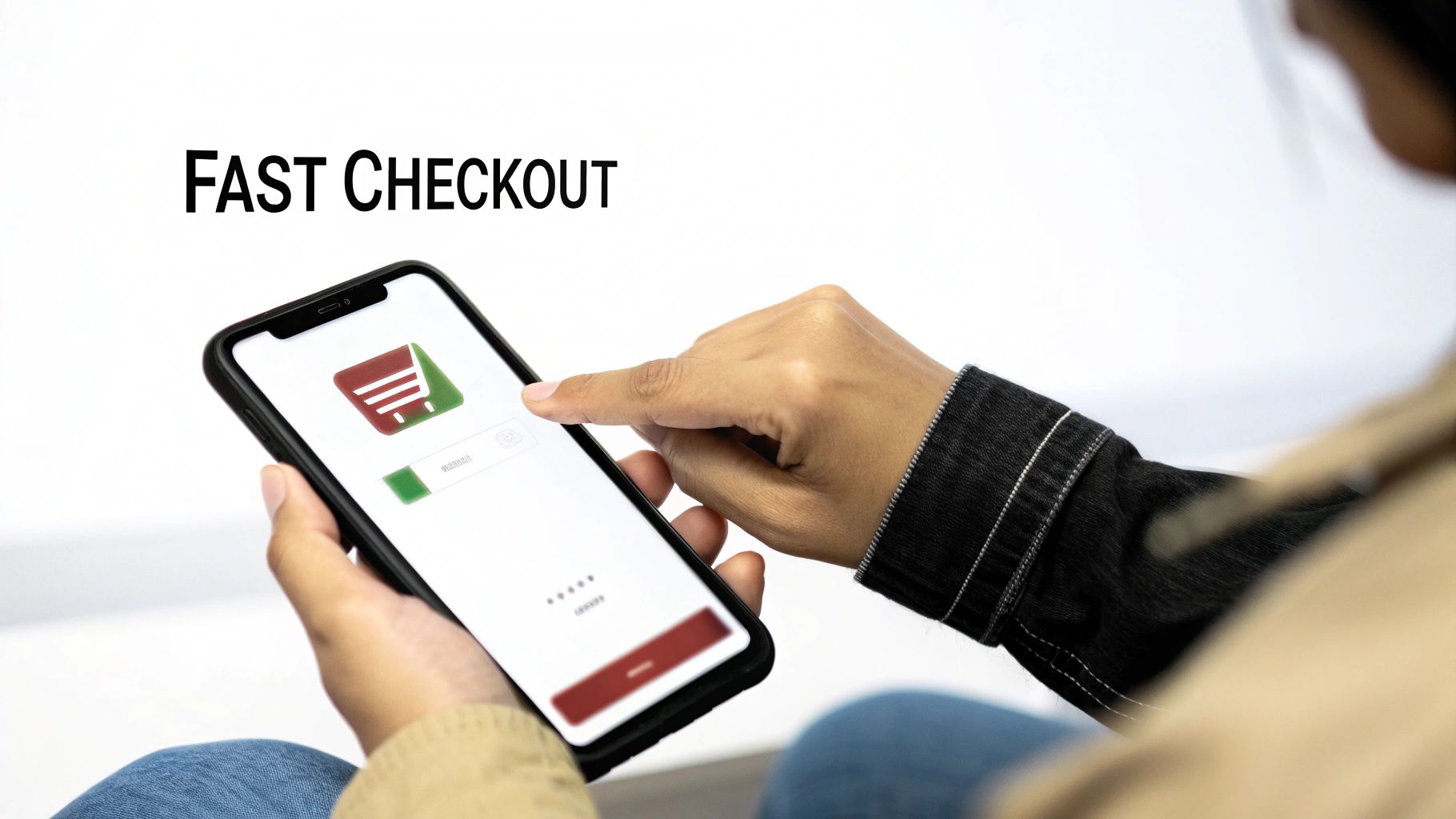
The checkout process is the final, most crucial step in a customer's journey, and it's where a significant portion of potential sales are lost. Checkout process optimization is the practice of systematically refining this flow to minimize friction, reduce cart abandonment, and maximize completed transactions. By simplifying forms, offering convenience, and building trust, you can convert more high-intent visitors into paying customers. This is one of the highest-impact areas for conversion rate optimization best practices because even small improvements can directly boost revenue.

A person's hands holding a smartphone, interacting with a fast checkout e-commerce app.

This principle was famously pioneered by Amazon with its patented "1-Click" checkout, which drastically reduced the steps needed to make a purchase. Compare that seamless experience to a checkout process that forces you to create an account, verify your email, and then re-enter your shipping information. The former encourages impulse buys and repeat business, while the latter encourages cart abandonment. E-commerce platforms like Shopify have built their success on providing merchants with streamlined, pre-optimized checkout experiences, understanding that a seamless final step is non-negotiable.

How to Implement Checkout Process Optimization Effectively

The goal is to make the payment process feel effortless and secure. Every extra field, unexpected cost, or moment of confusion creates an opportunity for the customer to second-guess their purchase and abandon their cart. Focus on removing barriers and reassuring the user at every stage of the checkout flow, from the initial cart view to the final confirmation page.

Actionable Steps for a Successful Checkout:

  • Offer a Guest Checkout: Forcing account creation is a major conversion killer. Make guest checkout the most prominent option and allow users to create an account after the purchase is complete.
  • Be Transparent with Costs: Display all costs, especially shipping and taxes, as early as possible. Surprise fees at the final step are the leading cause of cart abandonment. Show a complete order summary in the cart itself.
  • Simplify Form Fields: Only ask for essential information. Use tools like the Google Maps API to auto-populate address fields and set "billing address is same as shipping" as the default, pre-checked option.
  • Display Trust Signals: Prominently feature security badges (SSL certificates, Norton, McAfee), accepted payment logos (Visa, PayPal), and reassuring policies like a money-back guarantee or easy returns directly within the checkout flow.
  • Test Your Layout: Don't assume a one-page checkout is always better. Test it against a well-designed multi-step process with a clear progress indicator. For complex purchases, breaking the process into logical steps (Shipping > Billing > Review) can feel less overwhelming to users.

Top 10 CRO Best Practices Comparison

Method🔄 Implementation Complexity⚡ Resource Requirements⭐ Expected Effectiveness📊 Typical Outcomes / Impact💡 Ideal Use Cases / Tips
A/B Testing (Split Testing)Medium — needs experiment setup & statsMedium — traffic + testing tool⭐⭐⭐⭐ — reliable causal evidenceMeasurable conversion lifts; clear winner when significantTest high-impact elements first; calculate sample size
Heatmaps & Session RecordingsLow — simple install, review effortLow — affordable tools, time to analyze⭐⭐⭐ — strong qualitative insightReveals friction points and attention patternsFilter by device/segment; combine with analytics
Conversion Funnel AnalysisMedium–High — tracking & mapping eventsMedium — analytics setup and maintenance⭐⭐⭐⭐ — identifies bottlenecks fastHighlights biggest drop-offs; guides prioritizationDefine micro-conversions; segment by acquisition source
User Testing & Feedback CollectionMedium — planning, facilitation skillsMedium–High — recruiters, moderators, tools⭐⭐⭐⭐ — deep “why” insights (qualitative)Uncovers usability issues and feature ideasRecruit real users; run 5–8 sessions to surface major problems
Landing Page OptimizationLow–Medium — focused tests & design workLow — landing builders + traffic⭐⭐⭐⭐ — high ROI for single-purpose pagesFaster lift in conversion; clear attributionStart with headline and CTA; match ad messaging
Personalization & SegmentationHigh — data, rules, ML modelsHigh — data infra, tooling, maintenance⭐⭐⭐⭐⭐ — strong relevance and liftIncreased conversions, AOV, and retention when done rightStart simple segments; ensure privacy compliance
Form OptimizationLow — design & validation tweaksLow–Medium — dev effort for smart forms⭐⭐⭐⭐ — immediate reductions in abandonmentHigher completion rates and better data qualityMinimize fields; use inline validation and progressive profiling
Social Proof & Trust ElementsLow — content sourcing and placementLow — existing customer content often enough⭐⭐⭐⭐ — boosts credibility and reduces anxietyImproved conversion confidence, especially for high-consideration buysPlace near CTAs; use specific metrics and real photos
Mobile Optimization & Responsive DesignMedium–High — responsive build & testingMedium — dev + cross-device testing⭐⭐⭐⭐ — critical for mobile majority trafficBetter engagement, SEO lift, and mobile conversionsMobile-first design; optimize images and touch targets
Checkout Process OptimizationHigh — payment integrations & securityHigh — engineering, payment providers⭐⭐⭐⭐⭐ — direct, high-impact revenue gainsLower cart abandonment and increased completed ordersOffer guest checkout, transparent fees, multiple payment options
Free Tool

Try our Marketing Plan Generator — generate a complete AI-powered marketing plan in minutes. No signup required.

From Best Practices to Business Impact

Navigating the landscape of conversion rate optimization can feel like assembling a complex puzzle. You have all the pieces: A/B testing, heatmap analysis, user feedback, landing page design, form optimization, and social proof. The true challenge, however, isn't just knowing these pieces exist; it's understanding how they fit together to create a cohesive, high-performing conversion engine. This guide has provided a detailed roundup of conversion rate optimization best practices, but the ultimate goal is to move beyond a checklist and cultivate a strategic, data-driven mindset.

The journey from a static website to a dynamic, conversion-focused asset is a process of continuous, iterative improvement. It’s the difference between a marketer who simply implements a tactic, like adding a testimonial, and one who systematically tests three different testimonial formats on a key landing page to see which one resonates most with enterprise-level prospects versus mid-market leads. One is a guess; the other is a calculated business decision.

Synthesizing the Strategy: From Tactics to a Cohesive System

To truly harness the power of CRO, you must see the interconnectedness of the practices we've discussed. Your conversion funnel analysis (Practice #3) might reveal a significant drop-off on your pricing page. This is your starting point. From there, you can deploy other tactics in a targeted, strategic manner:

  • Heatmaps and Session Recordings (Practice #2): First, you watch session recordings of users on that pricing page. You notice they hesitate, scroll erratically, and often exit after clicking on a confusing feature comparison chart. This gives you a qualitative "why" behind the drop-off.
  • User Feedback (Practice #4): Armed with this insight, you launch a targeted survey on that page asking, "Is our pricing clear? What's one thing preventing you from moving forward?" The feedback confirms that the feature tiers are poorly explained.
  • A/B Testing and Landing Page Optimization (Practices #1 & #5): Now you have a clear hypothesis. You design two variations of the pricing page. Version A simplifies the feature chart into a scannable list. Version B introduces an interactive pricing calculator. You run a split test to see which solution most effectively reduces friction and increases "Request a Demo" clicks.

This methodical approach transforms isolated conversion rate optimization best practices into a powerful, problem-solving workflow. It’s no longer about random acts of optimization; it’s about a diagnostic process that leads to a quantifiable cure.

The Compounding Power of Incremental Gains

One of the most compelling aspects of a mature CRO program is its compounding effect. A 5% lift in conversions from form optimization might seem minor in isolation. However, when combined with a 10% increase from a personalized call-to-action and a 7% boost from improved mobile page speed, the cumulative impact on your lead generation and revenue is substantial.

Think of it this way: each optimization win doesn't just add to your success; it multiplies it. The improved form makes your paid search campaigns more profitable. The faster mobile site improves your SEO rankings, driving more organic traffic. This creates a positive feedback loop where your marketing efforts become more efficient and your customer acquisition cost steadily declines. Adopting these principles means you are building a sustainable growth engine, not just searching for a temporary lift in metrics. The real value is in creating a culture where every team member is empowered to ask, "How can we make this better?" and has the tools to find the answer.


Ready to move from manual testing to an intelligent, AI-powered optimization strategy? marketbetter.ai automates the entire CRO process, from identifying high-impact opportunities with predictive analytics to deploying personalized experiences at scale. Stop guessing and start converting by exploring how our platform can implement these conversion rate optimization best practices for you at marketbetter.ai.