
Marketing Chatbots in 2026: 8 Platforms Compared (+ the ROI Numbers Nobody Shares)
Think of a marketing chatbot as your website's always-on digital concierge. These are AI-powered tools that do more than just sit there; they turn a passive visit into an active conversation. They’re your 24/7 digital guides, ready to answer questions, capture lead details, and make each visitor's journey feel personal—all in the service of boosting sales and keeping customers happy.
Why Conversational Marketing Is Reshaping Business
Imagine your website is a silent, digital storefront. People browse, click around, but most walk out the door without saying a word. Now, picture a friendly expert greeting every single person who walks in, instantly answering their questions and pointing them exactly where they need to go.
That’s the heart of conversational marketing. It’s a fundamental shift away from one-way broadcasting (like ads and emails) toward genuine two-way dialogue.
Instead of forcing customers to dig through pages to find what they need, you bring the answers right to them in real-time chats. This simple change meets the modern buyer's demand for speed and personalization head-on, turning passive traffic into engaged prospects.
The Driving Force Behind Chatbot Adoption
This flood of chatbot adoption isn't just a fleeting trend. It's a direct response to sky-high customer expectations. In a world where you can get anything on demand, waiting hours for an email response or a callback just doesn't cut it anymore.
The market growth tells the story. Valued at roughly USD 7.76 billion in 2024, the global chatbot market is expected to explode to USD 27.29 billion by 2030. That incredible jump shows just how seriously businesses are taking instant, automated communication to stay in the game. You can dig into the full chatbot market analysis to see the numbers for yourself.
From Static Forms to Dynamic Conversations
For years, the go-to tool for capturing leads was the static contact form—a passive, often ignored box sitting on a webpage. Marketing chatbots completely flip that model on its head by proactively starting the conversation.
Conversational marketing isn't about replacing humans. It's about scaling the best parts of human interaction—helpfulness, immediacy, and personalization—to every single person who visits your site, day or night.
This proactive approach just plain works better. Here's a quick comparison:
| Feature | Static Form | Marketing Chatbot |
|---|---|---|
| Interaction | Passive (waits for user) | Proactive (initiates conversation) |
| Qualification | Delayed (done by sales team later) | Instant (asks qualifying questions in real-time) |
| User Experience | Impersonal and transactional | Interactive and personalized |
| Conversion | Lower (high friction, often ignored) | Higher (engaging, low friction) |
Ultimately, chatbots are the engine that makes conversational marketing possible, allowing you to have thousands of personalized interactions all at once. The powerful benefits of AI in marketing don't stop here, of course, but bots are often the most visible and impactful starting point.
How Chatbots Actually Drive Marketing Results

It’s easy to get excited about the idea of conversational AI. But let's be honest, cool tech doesn't pay the bills. The real value of a chatbot is in the results it puts on the board. The best chatbots for marketing aren't just website gadgets; they're growth engines that work across the entire customer journey.
They deliver a real-world impact by fundamentally changing how you capture, engage, and convert visitors into actual customers. Let’s get past the theory and look at the four concrete ways a chatbot becomes one of your hardest-working marketing assets.
Unlocking 24/7 Lead Capture
Your website is always open for business, but your sales team has to sleep. That disconnect means high-intent leads are slipping through the cracks simply because no one is there to greet them at the right moment. This is where a chatbot becomes your always-on digital concierge.
Picture this: it’s 2 AM your time, and a prospect from another time zone lands on your pricing page. Instead of leaving them to click around alone, a chatbot pops up: "Exploring our plans? I can help you find the perfect fit. What’s your biggest challenge right now?"
That simple, automated question does three things instantly:
- It stops the bounce. The visitor is immediately engaged.
- It qualifies the lead. You're gathering crucial info about their needs.
- It books the next step. It can schedule a demo or send a case study, capturing the lead while their interest is red-hot.
Compare that to a static "Contact Us" form. A form just sits there, waiting. A chatbot actively starts the conversation, turning after-hours traffic into a pipeline of qualified leads ready for your team in the morning.
Deepening Customer Engagement
Today's buyers have zero patience for slow answers or confusing websites. A chatbot acts as an instant guide, cutting through the friction that kills engagement. It’s all about providing immediate answers to build trust and keep the momentum going.
Action Step: Identify the top 5-10 most frequently asked questions your support or sales team receives. Program these into your chatbot as the first line of defense. This simple action can immediately reduce repetitive inquiries and free up your team.
For example, a visitor is on a product page and has a quick question about a specific feature. Without a chatbot, they're forced to hunt for an FAQ page or send an email into the void. With one, they get their answer on the spot, keeping them on the site and moving them closer to a decision.
By fielding all the routine questions instantly, chatbots free up your human team to focus on the complex, high-value conversations where they're needed most. It’s a win-win for efficiency and customer experience.
Achieving Personalization at Scale
Everyone talks about personalization, but delivering a unique experience to thousands of visitors at once is a huge operational headache. Chatbots solve this by using data to tailor every single conversation in real time.
A single bot can handle thousands of conversations simultaneously, each one customized based on that user's behavior. A returning visitor might be greeted with, "Welcome back! Last time you were looking at our enterprise solutions. Ready to see a personalized demo?"
This is a world away from the one-size-fits-all website experience most people are used to. By remembering past interactions and reacting to what a user is doing right now, chatbots for marketing create a feeling of individual attention that builds stronger relationships and, ultimately, drives more conversions.
Actionable Chatbot Use Cases for Marketers
Alright, enough with the theory. We know chatbots can drive results, but let's get into the how. The real magic happens when you stop thinking of a chatbot as a single tool and start seeing it as a specialist you can deploy at critical moments in the customer journey.
These aren't just clever ideas; they're proven, in-the-trenches strategies that turn passive website visitors into active conversations. A well-built bot can be your quiz master, personal shopper, scheduler, and content librarian—all at once.
Let's break down a few high-impact plays you can run right now.
Launch Interactive Quizzes for Audience Segmentation
Let's be honest: static lead forms are a drag. Nobody gets excited about filling one out. An interactive quiz, on the other hand, flips the script. It turns data collection into a genuinely engaging experience.
Action Step: Instead of a generic "Contact Us" form on your homepage, replace it with a chatbot that asks, "Trying to achieve [Goal A] or [Goal B]?" Based on the answer, route them to a specific sales rep or offer a tailored resource. This immediately segments your audience.
Imagine a SaaS company's chatbot popping up with, "What's Your Biggest Marketing Challenge?" Instead of a boring form, it guides the visitor through a few quick questions to diagnose their needs—lead gen, content, analytics, you name it.
Based on their answers, the bot doesn't just say "thanks." It instantly offers a relevant piece of content, like an ebook or case study, and tags that user in your CRM for a perfectly tailored follow-up.
Guide Visitors with Conversational Product Discovery
If you have a large product catalog, you know choice overload is a conversion killer. Visitors get overwhelmed and bounce. A chatbot can act as a personal shopper or a solutions consultant, cutting through the noise.
Action Step: Deploy a "product finder" bot on your main product category pages. Start with a simple question like, "What are you looking for today?" or "Help me find the perfect [product type]." Guide them with 2-3 questions to narrow down the selection and present them with the top 2-3 results.
Think of a skincare brand's bot asking, "What's your primary skin concern? Dryness, acne, anti-aging?" With each answer, it narrows the field, recommends specific products, explains why they're a good fit, and can even add them to the cart.
This isn't just a nice-to-have. The impact on core marketing metrics is real and measurable.
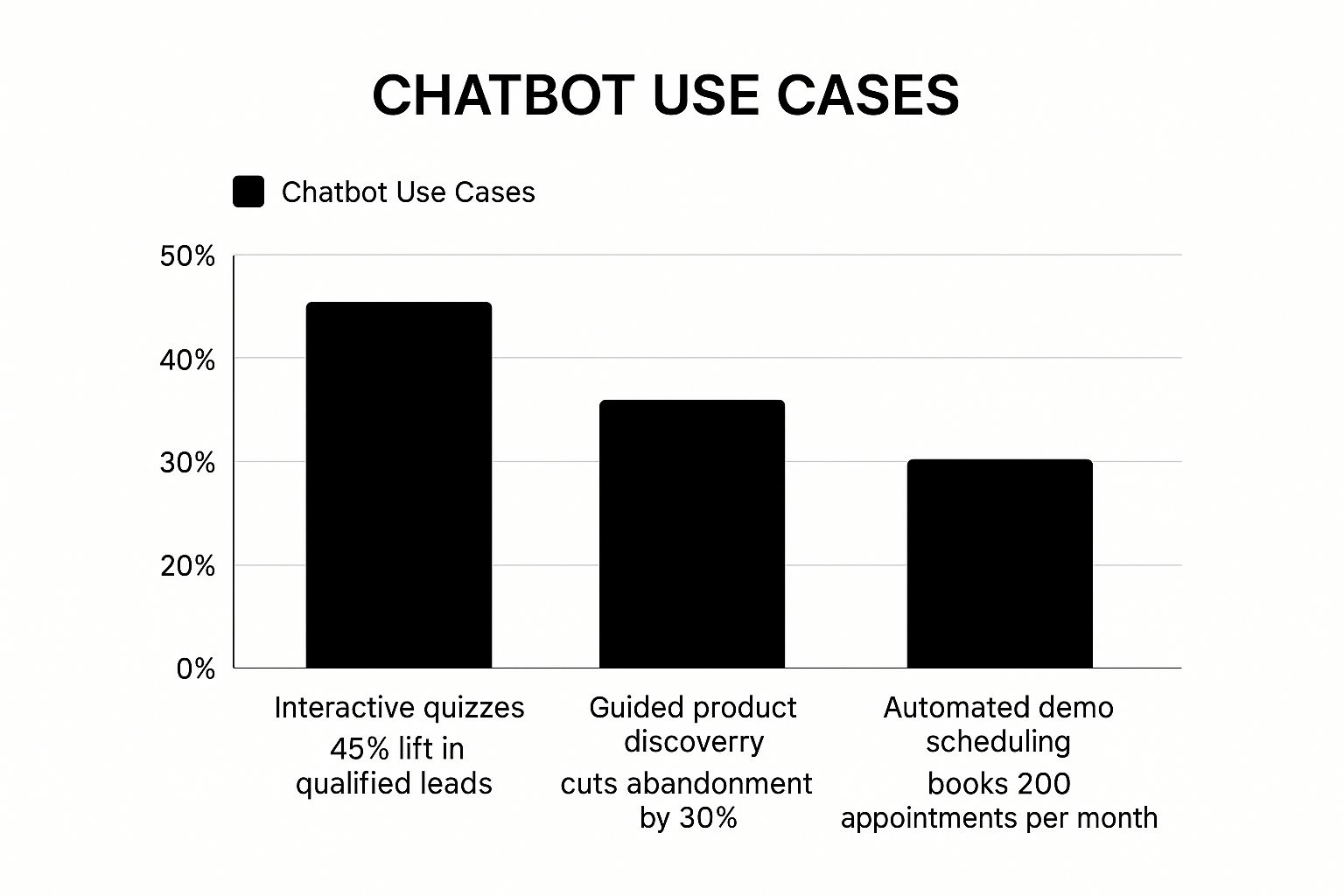
As you can see, applying bots to these specific tasks delivers a serious lift where it counts.
Automate Demo Bookings and Consultations
How many leads have you lost to the friction of scheduling? The back-and-forth emails, the calendar tag—it's a massive bottleneck. A marketing bot erases it completely by hooking directly into your team's calendars.
Action Step: Set up your chatbot to trigger on high-intent pages, such as your pricing or features page. After a user has been on the page for 15 seconds, have the bot proactively offer to book a demo. Integrate it directly with your sales team's Google or Outlook calendars to show real-time availability.
When a high-intent prospect hits your pricing page, the bot can jump in: "Ready to see how this works? Let's find a time."
It can ask one or two qualifying questions ("What's your company size?") and then display available slots right in the chat. The user books a meeting in seconds without ever leaving your site.
A chatbot’s ability to instantly move a conversation from initial inquiry to a scheduled meeting is one of its most valuable functions. It removes manual back-and-forth and ensures no high-intent lead ever falls through the cracks.
One of the most powerful ways to do this is with 24/7 support chatbots. They ensure that no matter when a prospect is ready to talk, your business is ready to book that meeting.
Deliver Hyper-Relevant Content to Nurture Leads
Not everyone shows up ready to buy. Most don't. A chatbot is a fantastic nurturing tool because it can act as a smart content concierge, building trust over time.
Action Step: Map your key blog posts or resources to specific website pages. When a user spends more than 60 seconds on a page about "email marketing," have your chatbot offer your "Ultimate Guide to Email Marketing" in exchange for their email address. This creates a highly contextual lead magnet.
For example, if someone has been reading blog posts about SEO, the bot can proactively offer your "Definitive Guide to SEO" or an invite to an upcoming webinar on the topic. It feels helpful, not salesy.
How to Choose the Right Chatbot Platform
Picking the right chatbot platform can feel a lot like choosing a car. Do you need a simple, reliable sedan for running errands around town, or a beast of an SUV for a cross-country trek? The right answer depends entirely on where you're going, who's driving, and what you can afford.
It’s tempting to jump straight to the most advanced, AI-powered system, but that's a classic mistake. It’s like buying that high-tech SUV just to drive it to the grocery store once a week. To avoid that, let your actual marketing goals—not a long list of shiny features—drive your decision.
The reality is, chatbots for marketing are becoming a core part of how people interact online. An estimated 987 million people are already using AI chatbots, and big players like Meta AI serve around 500 million users all on their own. This isn't a niche trend; it's a massive shift in communication that makes picking the right platform more important than ever. You can dig into more global chatbot usage stats on rev.com to see just how big this is.
Aligning Platforms with Your Marketing Needs
Before you even book a demo, you have to get the fundamentals right. Most platforms fall into one of three buckets, each built for different levels of complexity and technical skill. A mismatch here is a fast track to wasted money and a frustrated team.
The goal isn't to find the platform with the most features. It's to find the one with the right features that directly support your marketing goals, play nicely with your existing tools, and can grow with your business down the road.
Let's break down the main options so you can map what you need to the right tech.
Comparing Chatbot Platform Types for Marketing
Choosing a platform means taking a hard look at your team's skills and your budget. A small marketing team with zero coding experience has completely different needs than a large enterprise with a dedicated dev team. This table lays out the landscape to help you find your fit.
| Platform Type | Best For | Technical Skill Required | Key Feature | Example Price Range |
|---|---|---|---|---|
| Rule-Based Builders | Simple, linear jobs like FAQ bots, basic lead capture forms, and scheduling demos. | Low. Most are drag-and-drop, no coding required. | Pre-defined conversation flows based on "if/then" logic. | Free to $100/month |
| AI-Powered Platforms | Dynamic, personalized conversations, complex lead qualification, and product recommendations. | Medium. Setup is more involved, but you don't always need to be a coder. | Natural Language Processing (NLP) to understand what users actually mean. | $100 - $1,000+/month |
| Custom Development Frameworks | Highly specialized, enterprise-grade bots with unique branding and deep system integrations. | High. Requires a team of developers who are fluent in AI and machine learning. | Total control over the AI model, conversational logic, and user interface. | $5,000+ (for a custom build) |
As you weigh your options, browsing some of the top platforms for chatbots can give you a better feel for what's out there and help you make a smarter choice.
Critical Decision Factors to Consider
Beyond just the type of platform, a few other things will make or break your success. A chatbot doesn't work in a silo—it has to plug into the rest of your marketing machine to be truly effective.
Here are the non-negotiables to look for:
- Essential Integrations: Can it connect to your CRM (like Salesforce or HubSpot), email marketing software, and calendar apps? If not, you're creating data islands and manual work, which defeats the whole point of automation.
- Ease of Use: How quickly can your team actually build something useful with it? A platform that requires weeks of training will slow you down and discourage marketers from ever touching it.
- Scalability: Will this platform grow with you? Think about whether it can handle more conversations, support different languages, and add more advanced features as your strategy evolves.
Thinking through these points helps you choose a partner, not just a product. And keep in mind, many of these platforms are part of a bigger ecosystem of powerful AI marketing automation tools designed to work together from the start.
Building Your First Marketing Chatbot Campaign
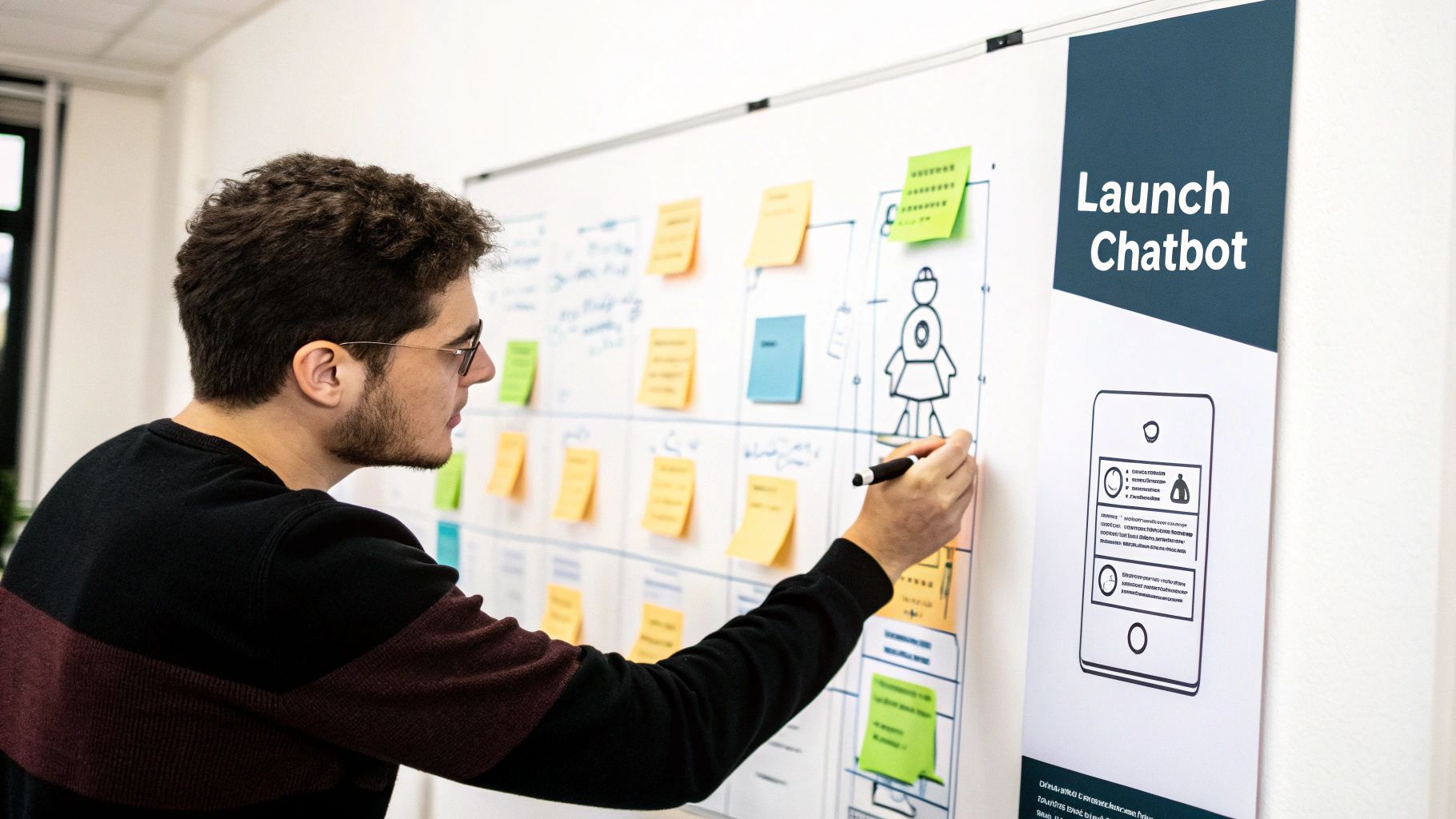
Jumping from idea to execution feels like a big leap, but building your first chatbot isn't about knowing how to code. It’s about having a good plan.
Think of it like planning a road trip. You wouldn't just get in the car and start driving aimlessly. You'd pick a destination, map your route, and check the tires first. Applying that same mindset here strips away the guesswork and sets you up for a chatbot that actually does its job from day one.
Let’s break it down into five clear stages.
Stage 1: Define a Single, Measurable Goal
Before you write a single welcome message, you need to know what winning looks like. A chatbot without a goal is just a fancy widget—it might look busy, but it isn't going anywhere.
One of the biggest mistakes people make is trying to have their first bot do everything. That’s a fast track to a confusing experience for your visitors and mushy, unclear results for you.
Instead, pick one specific, measurable thing you want to achieve. This laser-focus makes every other decision easier and gives you a clear benchmark for success.
Good goals sound like this:
- Increase qualified leads by 15% this quarter.
- Book 20 sales demos a month through the chat window.
- Cut down on support tickets about pricing by 30%.
Nailing this one objective will guide every decision you make, from the bot's tone of voice to the final call to action.
Stage 2: Map the Ideal Conversation Flow
Okay, you’ve got your destination. Now it’s time to draw the map. A conversation flow is just the script your chatbot will follow to guide a user from their first question to the goal you just set.
The best ones feel less like an interrogation and more like a helpful, natural chat.
Grab a whiteboard or a piece of paper and sketch it out. What's the very first thing your bot should say? What are the top three questions a visitor will likely ask? For every possible answer, map out the bot's next step.
A great conversation map anticipates what the user needs. It gives them clear options, quick answers, and always—always—has an escape hatch to talk to a real person if things go sideways.
This blueprint is your guardrail. It keeps the conversation on track and moving efficiently toward the finish line you defined in stage one.
Stage 3: Write a Compelling Script
The script is where your chatbot gets its personality. This is your chance to let your brand’s voice shine through. A playful ecommerce brand’s bot will sound totally different than one for a buttoned-up B2B financial firm, and that's exactly how it should be.
Action Step: Write two versions of your opening line—one straightforward and one with more personality. Run an A/B test (covered in the next section) for a week to see which one gets more engagement. This is a fast way to learn what your audience responds to.
Keep your language simple, clear, and human. Ditch the corporate jargon and long blocks of text. Stick to short sentences, ask questions, and don’t be afraid to use an emoji or two (if it fits your brand).
Stage 4: Build and Rigorously Test the Bot
Now for the fun part: bringing your script and flowchart to life. Most modern chatbot platforms have user-friendly, drag-and-drop builders, so you won't need to write a line of code.
But the most critical part of this stage is testing. And I don't just mean testing the "happy path" where the user clicks all the right buttons. You need to try and break it. Ask it weird questions. Give it typos. Go down every single conversational branch to hunt for dead ends or confusing loops.
Do all this testing internally before a single real prospect ever sees it. This is where you iron out all the wrinkles.
Stage 5: Deploy and Analyze Performance
Once you're confident your bot is ready for prime time, it's time to set it live. But your job isn't done. Be strategic about where you put it—high-intent pages like your pricing or services pages are perfect spots to make a big impact.
The second it’s live, start tracking its performance against that single goal from Stage 1. Is it actually booking those demos? Are leads getting qualified? Use the platform's analytics to see where people are dropping off in the conversation, then go back and tweak the script or the flow to make it better. A great chatbot is never truly "finished." It's always evolving.
Measuring and Optimizing Chatbot Performance
Launching your chatbot isn’t the finish line. It’s the starting gun. The real wins with chatbots for marketing come after you go live, when you start treating it like a living part of your team—something you constantly refine based on how real people are using it. This is how a good tool becomes a great one.
Think of it like tuning an engine. A stock car runs fine, but a tuned one performs at its absolute peak. To get there, you need to start tracking the right numbers to see what’s working and, more importantly, what’s falling flat.
Identifying Your Core Chatbot Metrics
You can't fix what you don't measure. While you could drown in data, focusing on a few crucial marketing KPIs will give you the clearest picture of your bot's actual impact. Forget vanity metrics; we're talking about the numbers that actually move the needle for your business.
These three give you a solid, balanced view of your chatbot's health:
- Conversion Rate: This is the ultimate test. Of all the people who chat with your bot, what percentage actually complete the goal? That could be booking a demo, signing up for a newsletter, or adding a product to their cart. A low conversion rate is a blaring alarm that there's friction somewhere in the conversation.
- Lead Quality Score: Let's be honest, not all leads are created equal. This metric gets right to the point: are the leads from your chatbot better or worse than leads from other channels? If bot-qualified leads are closing at a higher rate, you know your bot isn't just generating noise—it's generating revenue.
- User Satisfaction (CSAT) Score: A simple "Was this helpful?" at the end of a chat is gold. High CSAT scores mean you're delivering a positive experience, which is everything for brand perception and keeping people coming back.
The whole point is to create a feedback loop. Use hard data like conversion rates to spot a problem. Then, use the qualitative feedback from your satisfaction scores to understand why the problem is happening.
A Framework for Continuous Optimization
Once the data is flowing in, it's time to act on it. Optimization is a simple cycle: test, learn, and repeat. And your best friend in this process is A/B testing. It lets you systematically improve your chatbot's game.
Here’s a practical look at how you can test different parts of your bot's conversations:
| Element to Test | Version A (Control) | Version B (Variant) | What You'll Learn |
|---|---|---|---|
| Opening Message | "Hi! How can I help you today?" | "Ready to find the perfect solution? Let's start with your biggest challenge." | Which opener actually grabs attention and gets users talking. |
| Call-to-Action | "Book a demo." | "Schedule a 15-min call." | Which CTA feels less like a big commitment and gets more meetings on the calendar. |
| Conversation Path | Guide users through a multi-step quiz. | Offer a direct link to a resource page. | Whether your users want a guided tour or a fast pass to the information they need. |
By testing one thing at a time, you can make smart, data-backed decisions that really add up. Over time, this constant tweaking turns your chatbot from a simple tool into one of your most powerful marketing assets. To tie this all back to the bottom line, check out our guide on how to calculate marketing ROI and see how your bot's performance directly impacts revenue.
Try our AI Lead Generator — find verified LinkedIn leads for any company instantly. No signup required.
Common Questions About Marketing Chatbots
Even with a solid plan, it’s smart to have a few questions before you plug a new tool into your marketing stack. Getting clear, honest answers is the last step before you can really move forward with confidence. Here are a few of the big ones we hear all the time.
How Do I Manage the Handoff to a Human?
This is probably one of the most important parts of getting a chatbot right. The whole point is to make the jump from bot to human feel completely seamless—even intelligent. A well-built chatbot knows its own limits. It should be smart enough to proactively offer a human handoff the moment it senses confusion, frustration, or a high-value lead.
The process needs to feel like a warm transfer, not like hitting a brick wall.
- Trigger Points: You need to set clear rules for when a person takes over. This could be after a couple of misunderstood questions or when someone specifically asks to talk to sales.
- Context is Everything: The best platforms will pass the entire chat transcript over to your human agent. This way, the customer never has to repeat themselves. It's a massive pet peeve for a reason.
This setup lets the bot handle all the repetitive stuff, freeing up your team for the conversations that actually need a human touch.
Will the Chatbot Sound Like My Brand?
It absolutely has to. A chatbot is a direct extension of your brand’s personality and voice. Everything from the script and the tone to the emojis you use (or don't use) has to be perfectly aligned with how you communicate everywhere else.
Think of your chatbot's script the same way you think about any other piece of marketing copy. It needs to be written with the same care and attention to your brand's voice, whether you're buttoned-up and professional or fun and a little quirky.
A bot for a financial services firm is going to sound worlds different from one selling funny t-shirts. Always write the script in your brand’s voice to build a consistent and trustworthy experience for your users.
What’s the Real Difference Between Basic and AI Bots?
This is a really important distinction. A basic, rule-based chatbot is like an old-school phone tree—it follows a very strict, pre-programmed script. It’s perfect for simple, straight-line tasks like booking a meeting or answering a super basic FAQ.
An AI-powered chatbot, on the other hand, is more like a knowledgeable team member. It uses Natural Language Processing (NLP) to understand the intent behind what someone is typing, even if they have typos or phrase things weirdly. This allows for conversations that are way more dynamic, flexible, and human-like.
Here’s a quick breakdown:
| Feature | Rule-Based Bot | AI-Powered Bot |
|---|---|---|
| Conversation | Follows a rigid, pre-set path. | Understands context and intent. |
| Best For | Simple, repetitive tasks. | Complex questions and personalization. |
| Flexibility | Stuck with its pre-defined script. | Adapts to user questions on the fly. |
For most marketing goals today, an AI bot is going to give your customers a much better and more effective experience.
Ready to turn conversations into conversions? marketbetter.ai provides an integrated AI platform to build, manage, and optimize your marketing chatbots, ensuring every interaction drives real business results. Discover the future of customer engagement at https://www.marketbetter.ai.