
Inbound Lead Generation: The 5-Channel Framework That Replaced Our Outbound Spend [2026]
Inbound marketing isn't just a tactic; it's a fundamental shift in how you attract customers. Rather than interrupting people with ads, you pull them in with genuinely helpful content and experiences they're already searching for. You stop being an interruption and start becoming a trusted resource.
This shift creates a powerful, sustainable pipeline of high-quality leads who actually want to talk to you. This guide provides an actionable framework to build your own inbound marketing lead generation engine.
Rethinking Inbound Marketing Lead Generation
Let's move past the textbook definitions. Effective inbound lead generation is more than just avoiding spammy tactics. It’s a strategic philosophy built on making your business the exact solution your ideal customer is searching for.
Instead of shouting your message at a wide, mostly uninterested audience (outbound), you create a magnetic presence that draws in prospects who have already raised their hand and said, "I have this problem."

This is a fundamental departure from old-school outbound methods. Consider the difference between a cold call that interrupts someone's day versus a blog post they find on Google that perfectly answers their burning question. One creates friction and annoyance; the other builds instant trust and positions you as an authority. The first is a transaction; the second is the start of a relationship.
Inbound vs Outbound: A Clear Comparison
The power of inbound marketing becomes crystal clear when you compare it directly against outbound. Outbound is a constant grind—a numbers game that often feels like you're renting attention. Inbound, on the other hand, is about building assets that work for you 24/7, generating value long after you've hit "publish."
This table breaks down the core differences in a practical way.
Inbound vs Outbound Lead Generation Quick Comparison
| Metric | Inbound Marketing | Outbound Marketing |
|---|---|---|
| Approach | Pulls customers in with helpful content | Pushes messages out to a broad audience |
| Communication | Two-way, conversational, and permission-based | One-way, interruptive, and often unsolicited |
| Lead Quality | High-intent leads actively seeking solutions | Lower-intent leads who may not have a need |
| ROI | Builds over time as content assets mature | Often provides short-term spikes but lacks sustainability |
It boils down to two things: consent and value. With inbound, you earn the right to have a conversation by first offering something valuable. This simple act builds a foundation of trust that makes the entire sales process smoother and far more effective.
The Clear ROI of an Inbound Strategy
The numbers don't lie. Inbound tactics don't just feel better for your customers; they perform better for your bottom line.
Industry data consistently shows that inbound marketing generates 54% more leads than traditional outbound channels. Even better, it does so while costing 62% less per lead. For many businesses, that efficiency adds up to an average annual savings of around £12,000. It’s a smarter way to invest your marketing budget.
Ultimately, the leads you generate through methods like SEO are just plain better. They have a lead-to-close rate that is seven times greater than outbound leads because they’re already problem-aware and actively looking for a solution.
Actionable Takeaway: If you want to transform how you attract customers, mastering sustainable organic lead generation is non-negotiable. This approach doesn't just fill your pipeline; it fills it with prospects who are genuinely ready to engage.
Create Content That Actually Pulls in Your Ideal Customers
Let's get one thing straight: content is the engine of your entire inbound marketing program. This isn't about churning out generic blog posts or random social media updates. It's about methodically building a library of resources that acts as a powerful magnet for your ideal customers, pulling them in by solving their very specific problems.
Think of great content as your best salesperson. It works 24/7, answering questions, building trust, and gently guiding prospects toward your solution. It’s the difference between someone stumbling on a vague "marketing tips" article and finding an in-depth guide that speaks directly to the exact challenge their company is wrestling with right now.

Uncover Your Audience’s Real-World Problems
Before you write a single word, you have to know who you're writing for—far beyond basic demographics. You need to dig deep to uncover their true pain points, their motivations, and the exact language they use to talk about their challenges.
Stop guessing. Become an investigator. Here’s an actionable plan to get ground-level intelligence:
- Talk to Your Sales Team: They are on the front lines every single day. Action Step: Schedule a 30-minute meeting and ask them, "What are the top five questions you get on every sales call?" and "What are the biggest objections that completely kill deals?" Their answers are pure gold.
- Mine Your Customer Support Tickets: Your support team is sitting on a treasure trove of customer struggles. Action Step: Spend an hour reviewing the last month's support tickets. Look for recurring themes and questions that signal a gap in understanding—either about your product or the problem it solves.
- Lurk in Online Communities: Dive into forums like Reddit, Quora, and industry-specific LinkedIn Groups. Action Step: Search for keywords related to your business and just listen. You’ll find raw, unfiltered conversations about people's frustrations and goals. Document the exact phrases they use.
This research lets you create content that hits home because it’s based on real-world needs, not your team's internal assumptions. It’s the foundation of any inbound plan that actually generates leads.
Map Your Content to the Buyer’s Journey
Okay, you know their problems. Now what? The next move is to align your content with where they are in their decision-making process. Someone just realizing they have a problem needs something completely different from someone who's actively comparing vendors.
Here’s a practical breakdown of how your content should shift:
Top of Funnel (TOFU) - The Awareness Stage
- Your Goal: Attract a broad audience by educating them about their problem.
- Content to Use: Blog posts ("5 Signs Your Lead Nurturing is Broken"), short educational videos, infographics, and simple checklists.
- The Vibe: This content is 100% problem-focused, not solution-focused. You aren't selling anything here. You're building trust by being genuinely helpful.
Middle of Funnel (MOFU) - The Consideration Stage
- Your Goal: Nurture those early leads by showing them solutions and positioning your company as a credible authority.
- Content to Use: In-depth guides, compelling case studies, comparison whitepapers ("Our Software vs. The Competition"), and detailed webinars.
- The Vibe: Now you can start introducing your solution as a viable path forward. The content gets more detailed, more specific, and more targeted.
Bottom of Funnel (BOFU) - The Decision Stage
- Your Goal: Convert those qualified leads into paying customers by proving your value.
- Content to Use: Free trials, live demos, clear pricing pages, and powerful customer testimonials.
- The Vibe: The focus shifts entirely to your product or service and why it's the smartest choice they can make.
Actionable Takeaway: The single biggest mistake companies make is creating too much BOFU content (like product feature lists) and not nearly enough TOFU content (like helpful blog posts). Without a strong top of the funnel, your pipeline will eventually run dry. You'll simply have no one to nurture.
Build Topic Clusters to Dominate SEO
Creating great content is pointless if no one can find it. To get discovered, you have to think like a search engine. One of the most effective SEO tactics is building topic clusters. This strategy organizes your content in a way that signals deep expertise to Google, helping you rank for valuable, high-intent keywords.
The model is surprisingly simple:
- Pillar Page: A long, comprehensive piece of content on a broad topic central to your business. Think "The Ultimate Guide to Inbound Marketing Lead Generation."
- Cluster Content: Several shorter, specific blog posts that dig into subtopics related to your pillar, like "How to Create High-Converting Landing Pages" or "7 Lead Nurturing Email Templates That Actually Work."
- Internal Linking: This is the glue. Each cluster post links back up to the pillar page, and the pillar page links out to all the cluster posts.
This structure tells Google, "Hey, we are an authority on this entire topic." That signal can boost your rankings across a whole range of related search terms. It's a much smarter approach than just writing random, disconnected blog posts. For a more advanced look, you can even explore using https://marketbetter.ai/playbooks/ai-content-analysis to pinpoint these cluster opportunities.
Turn Anonymous Website Visitors into Qualified Leads
Getting traffic is a good start, but it's a vanity metric. Anonymous visitors don't pay the bills. Qualified leads do. This is where your strategy pivots from simply attracting an audience to actively converting them into real people you can build a relationship with.
The whole game boils down to a simple value exchange. You offer something so genuinely useful, so perfectly aligned with their problem, that a visitor is happy to give you their email address to get it. That single transaction is the magic moment a passive browser becomes an engaged lead.
Crafting Irresistible Lead Magnets
A lead magnet is that valuable item you offer. Forget the generic "sign up for our newsletter" CTA. A powerful lead magnet is a specific solution for a specific problem your ideal customer is dealing with right now. The value has to be so obvious that handing over their email feels like a no-brainer.
Compare these two approaches:
- Weak (Self-serving): "Subscribe to Our Weekly Newsletter for Updates." This is all about you, not them. It’s vague and the value is a total mystery.
- Strong (Customer-centric): "Download Our 5-Point Checklist for Reducing Customer Churn by 15%." Now that speaks to a real business pain point and promises a tangible result.
The best lead magnets are practical and immediately useful. These formats work time and time again:
- Checklists & Templates: Simple, actionable tools that cut through complexity.
- In-depth eBooks or Guides: The definitive resource that cements your authority on a topic they care about.
- Exclusive Webinar Access: Live or on-demand training that delivers expert insights they can't get anywhere else.
- Case Studies: Real-world proof that you've already solved this exact problem for someone just like them.
Designing High-Converting Landing Pages
Your landing page has one job: get the visitor to fill out the form. That's it. Anything that distracts from that goal—navigation menus, sidebars, social links—is friction that will tank your conversion rate. Strip it all away.
A high-performing landing page absolutely must have:
- A Killer Headline: It must instantly scream, "You're in the right place, and here's the valuable thing you're about to get."
- Persuasive Copy: Talk about benefits, not features. Don't just list what's in the eBook; explain what the reader will be able to achieve after reading it.
- Frictionless Forms: Only ask for what you absolutely need. Every extra field you add can slash conversions by up to 50%. You can always ask for more info later as you nurture the lead.
- A Clear Call-to-Action (CTA): The button needs to pop. Use action-oriented text like "Get My Free Checklist" instead of a boring, passive word like "Submit."
Actionable A/B Test Story: A B2B software company was testing their CTA button. The original said "Download Now." The new version said "Get Your Free Template." That simple change, which emphasized ownership ("Your") and the specific offer, boosted lead captures on that page by 22% in just one month.
Strategic Placement of Your CTAs
Where you put your CTAs is just as important as what they say. The goal is to make your offer feel like the logical next step, not a jarring interruption.
Actionable Example: A CTA for a guide on "Advanced SEO Tactics" belongs at the end of a blog post about keyword research—not slapped on your homepage. This contextual placement makes the offer feel helpful, not salesy. As you get more advanced, you can start digging into how technology is changing the game. Exploring concepts like person-level identification for inbound marketing can open up entirely new ways to personalize these offers before a visitor even fills out a form.
There’s a reason this is so critical. About 50% of marketers call lead generation a top priority. While businesses generate an average of 1,877 leads per month, it comes at a steep price, with the average cost per lead hitting $198.44. To keep those costs in check, 76% of marketers are leaning on content marketing to do the heavy lifting. You can discover more lead generation statistics and trends to see how your own efforts stack up.
Nurture and Qualify Leads with Smart Automation
Getting a new lead is just the starting line. The real work begins now, and it's where smart automation can turn your lead gen efforts from a leaky bucket into a high-pressure pipeline.
The goal is simple: deliver the right message to the right person at exactly the right time, all on autopilot.
Compare the manual approach versus automation. Without it, you’re stuck trying to personally email every new download, track their site visits, and guess when they’re ready for a sales call. It doesn’t scale, and opportunities are missed. Automation, on the other hand, creates a consistent, personalized experience for every single person who shows interest.
This flow shows how that journey typically unfolds, taking someone from their first interaction all the way to becoming a sales-qualified lead.
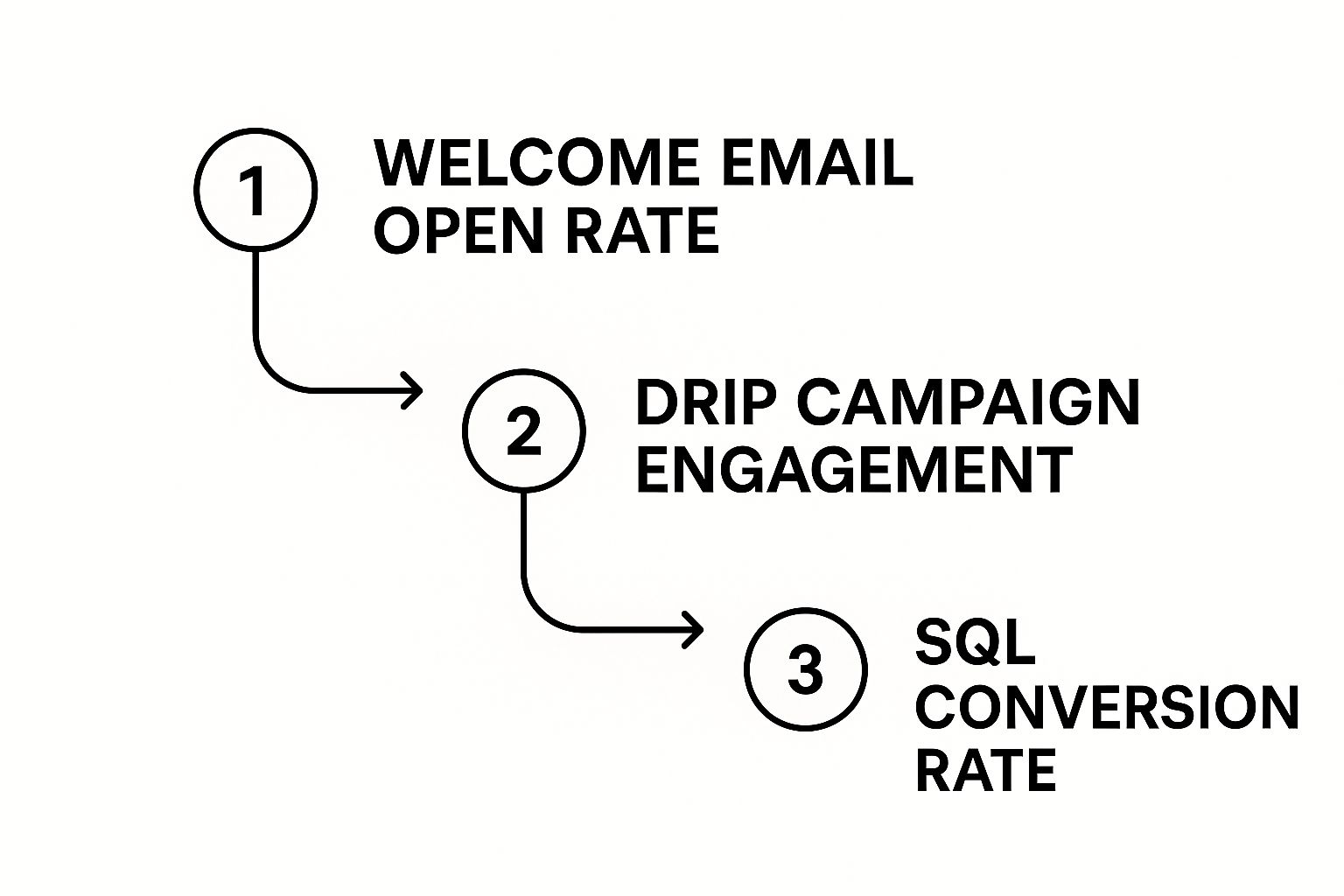
You can see how each stage builds on the last. Strong engagement early on directly fuels the success of your later conversion efforts.
Building Your First Nurturing Workflow
A lead nurturing workflow is an automated sequence of emails, usually triggered by a specific action, like downloading an ebook. The point isn’t to hammer them with sales pitches. It’s to provide more value, build trust, and gently guide them toward seeing you as the solution.
Let's compare two ways to handle a lead who downloaded "The Ultimate Guide to Social Media Marketing."
The Basic (and ineffective) Workflow:
- Email 1: "Thanks for downloading! Here's your guide."
- Email 2 (3 days later): "Did you read the guide? Want to book a demo of our tool?"
- Email 3 (7 days later): "Just checking in again about that demo..."
This feels abrupt and pushy. It rushes the sale and fails to build a relationship. It’s all about you.
The Smart (and effective) Workflow:
- Email 1 (Instant): "Here's your guide! In a few days, I'll send over a free post scheduling template that complements it."
- Email 2 (3 days later): "As promised, here's that social media template. It works great for planning out your content."
- Email 3 (7 days later): "I saw you visited our pricing page. If you're curious how our tool stacks up, here's a short video walkthrough."
- Internal Alert: Fire off a notification to a sales rep that this lead is showing high-intent behavior.
See the difference? The smart workflow delivers continuous value, uses behavioral data (like a pricing page visit) to personalize the message, and only triggers a sales interaction when the lead is clearly engaged.
Demystifying Lead Scoring
Not all leads are created equal. Some are just kicking the tires, while others are ready to have a serious conversation. Lead scoring is how you automatically separate the hot prospects from the curious researchers. You assign points based on who they are and what they do.
Here is an actionable starting point for your scoring model:
- High-Value Actions (+15 points): Requesting a demo, visiting the pricing page multiple times.
- Medium-Value Actions (+10 points): Downloading a bottom-of-funnel case study, attending a webinar.
- Low-Value Actions (+5 points): Opening an email, downloading a top-of-funnel ebook.
- Ideal Fit (+10 points): Their job title is "Marketing Manager," and the company size is 50-200 employees.
Once a lead hits a certain score—say, 50 points—they can be automatically flagged as a Sales Qualified Lead (SQL) and routed to the sales team. This simple system ensures your reps spend their precious time on the opportunities most likely to close.
You can get even more sophisticated with this. For a more detailed guide, it's worth exploring how to set up AI lead scoring systems that can refine these rules for you over time. You can learn more here: https://marketbetter.ai/playbooks/ai-lead-scoring.
The impact here is huge. It's no surprise that 76% of companies are now using automation. Nurtured leads produce, on average, a 20% increase in sales opportunities versus non-nurtured leads. By automating your lead generation, you're building a system that drives real, measurable growth.
Lead Nurturing Automation Workflow Examples
To bring this to life, here's a quick look at how you might structure automated workflows for different types of leads.
| Lead Segment | Trigger | Automated Action/Content |
|---|---|---|
| New Subscriber (ToFu) | Subscribes to newsletter | Send welcome email with links to top 3 most popular blog posts. |
| Ebook Downloader (MoFu) | Downloads "Guide to X" | 3-part email series: 1. Deliver the guide. 2. Send related case study. 3. Invite to a relevant webinar. |
| Pricing Page Visitor (BoFu) | Visits pricing page 2+ times | Send an email from a sales rep offering a personalized demo or consultation. |
| Webinar Attendee | Attends webinar on "Topic Y" | Send a follow-up with the recording, slides, and a link to a related case study. |
| Stale Lead | No engagement for 90 days | Trigger a re-engagement email with a new, high-value offer (e.g., a free tool or new research report). |
This table shows how you can tailor your follow-up based on a lead’s specific context and behavior, making every interaction more relevant. This structured approach is fundamental to scaling your inbound efforts effectively.
Measure and Optimize Your Lead Generation Engine
An inbound lead gen program isn't a crockpot—you can't just set it and forget it. The best ones are living engines that demand constant monitoring and fine-tuning. This is where you graduate from just creating stuff to actually proving its value to the business.
Launching campaigns is only half the battle. The other half is won in the data, where you discover what’s truly connecting with your audience, what’s falling flat, and where your biggest growth opportunities are hiding.
Moving Beyond Vanity Metrics
It's easy to get hypnotized by numbers that look impressive but don’t actually move the needle. These are vanity metrics. A big spike in website traffic or a jump in social media followers feels great, but it tells you nothing about whether you're generating qualified leads that turn into revenue.
You must shift your focus to Key Performance Indicators (KPIs) that directly measure the health of your sales funnel.
Here’s a comparison to reframe your thinking:
| Vanity Metric | Actionable KPI |
|---|---|
| Total Website Traffic | Traffic-to-Lead Conversion Rate: How well does your site turn anonymous visitors into real leads? High traffic with a low conversion rate signals a leaky bucket. |
| Social Media Likes | Lead-to-Customer Conversion Rate: What percentage of generated leads became paying customers? This is the ultimate bottom-line metric. |
| Email Open Rate | Cost Per Qualified Lead (CPQL): How much are you spending to get a lead that sales actually wants? This is the true measure of your campaign ROI. |
Focusing on these KPIs forces you to connect the dots between marketing activity and sales outcomes. You stop asking "How many people saw our content?" and start asking "How did our content help close a deal?"
Using Analytics to Pinpoint Bottlenecks
Your analytics platform is mission control for optimization. It’s where you can track the entire customer journey, from the first click to the final conversion, and see exactly where people are getting stuck.
Take this screenshot from a Google Analytics dashboard, for example, showing user acquisition by channel.
At first glance, you might see that 'Organic Search' drives the most users and call it a day. But look closer. 'Direct' traffic has a much higher engagement rate. That's a huge clue. Actionable question: "Why are direct visitors so much more engaged, and how can we improve the experience for our search traffic to match that engagement?"
Key Insight: Don’t just look at what channel brings the most traffic; analyze which channel brings the best traffic. A channel that brings fewer visitors who convert at a high rate is often far more valuable than one that brings thousands of visitors who just bounce.
An Actionable Framework for A/B Testing
Once you've found a weak spot—say, a landing page with a dismal conversion rate—it's time to experiment. A/B testing, or split testing, is a simple but powerful method for comparing two versions of a webpage to see which one performs better.
Here’s an actionable framework you can use right away:
- Identify Your Problem & Form a Hypothesis: Start with a clear hypothesis rooted in data. Example: "I believe changing our landing page headline to be more benefit-focused will increase form submissions because the current one is too generic."
- Create a Variation (Change Only One Thing): This is critical. If you change the headline, the CTA button color, and the main image all at once, you’ll have no clue which change actually made the difference.
- Run the Test: Use a testing tool to split your traffic evenly between the original version (the control) and your new version (the variation).
- Analyze the Results: Let the test run long enough to get a statistically significant result. Don't pull the plug after just a day or two.
- Implement the Winner & Repeat: If your new version shows a clear improvement, make it the new standard. Your new winner is now the control for your next test.
This cycle of continuous improvement is the secret to systematically growing your results. Small, incremental wins from consistent A/B testing can compound over time, leading to massive gains.
Try our AI Lead Generator — find verified LinkedIn leads for any company instantly. No signup required.
Common Questions About Inbound Lead Gen
Even the best-laid inbound marketing plans run into roadblocks. Theory is one thing, but execution is another. Let's tackle some of the most common questions from marketers on the ground.

How Long Until I See Real In-Demand Leads?
This is the big one. The honest, no-fluff answer is that inbound is a marathon, not a sprint. If you're looking for overnight clicks, you should be running paid ads. Inbound is about building a real asset—trust and authority—and that takes time.
Typically, you'll start to feel some momentum in the first 3-6 months. But to see a significant, predictable flow of qualified leads, you should plan for a 6-12 month runway.
Compare the two approaches: outbound ads are like a firework—a spectacular, short burst of attention, and then it's over. Inbound is like planting a tree. It takes a while to grow, but once it’s mature, it provides value for years with very little maintenance. Those blog posts become evergreen lead-generating machines working for you 24/7.
Should I Gate All My Content?
Gating content is a fantastic way to capture leads, but if you put a form in front of everything, you’ll just annoy people and torpedo your SEO. The key is striking a balance between growing your list and building your brand's reputation as a go-to resource.
Here’s an actionable framework to decide:
| Content Type | Gated or Ungated? | Why It Works |
|---|---|---|
| Blog Posts & Articles | Ungated | This is your top-of-funnel fuel. It powers your SEO, draws in the widest possible audience, and builds trust without asking for anything. |
| Checklists & Templates | Gated | These are high-value, practical tools. Someone is getting immediate utility, so asking for an email is a fair trade. |
| In-Depth eBooks & Guides | Gated | This is your premium stuff. Gating your most comprehensive content signals its value and filters for prospects with a higher level of interest. |
| Case Studies & Testimonials | Ungated | Make these as easy to find and share as possible. They are sales tools designed to build social proof and remove friction, not create it. |
Actionable Tip: Try a "hybrid" model. For a beefy guide, offer the first chapter or an executive summary for free (ungated) and then gate the full download. You give visitors a taste of the value before asking for their contact info.
What Is The Difference Between MQL and SQL?
Getting this right is absolutely critical for keeping your marketing and sales teams on the same page. When these definitions are fuzzy, you get internal friction, wasted effort, and leads that fall through the cracks.
Here’s a simple comparison:
-
Marketing Qualified Lead (MQL): This is someone who has engaged with your marketing content but isn't ready for a sales pitch. They’ve downloaded an ebook or subscribed to your webinar. They are problem-aware—they know they have a pain point, but they're still exploring.
-
Sales Qualified Lead (SQL): This is a lead who has signaled a clear intent to buy. They've requested a demo, spent a lot of time on your pricing page, or filled out a "contact sales" form. They are solution-aware—they're actively evaluating options, and yours is on the list.
The handoff from MQL to SQL is the most crucial moment in your entire funnel. Marketing’s job is to nurture MQLs with helpful content until they raise their hand. Once they show those buying signals, they become an SQL, and it’s time for sales to step in.
Ready to stop guessing and start growing? marketbetter.ai uses an integrated AI approach across your content and campaigns to drive measurable results. See how our platform can help you generate more qualified leads and prove your marketing ROI. Learn more about our AI-powered marketing platform.