
8 Actionable Benefits of AI in Marketing for 2026
The marketing landscape is in the midst of a seismic shift, powered by Artificial Intelligence. Gone are the days of manual segmentation, guesswork-driven campaigns, and one-size-fits-all messaging. Today, AI empowers marketers to operate with unprecedented precision, efficiency, and insight. The question is no longer if you should adopt AI, but how you can leverage it to gain a competitive edge. This article cuts through the hype to deliver actionable strategies.
We will explore the tangible benefits of AI in marketing, moving beyond theory to provide real-world comparisons, implementation steps, and data-backed proof. You will learn how to transition from traditional, reactive marketing to a proactive, predictive model. For instance, instead of analyzing campaign results after the fact, you can use AI to forecast outcomes and optimize in real time. This shift is made possible by the rapid evolution of sophisticated AI powered marketing tools that integrate directly into your existing workflows.
From hyper-personalizing customer journeys at scale to automating content creation and optimizing ad spend with unparalleled accuracy, each section is designed to be a practical guide. Prepare to see how AI is not just automating tasks but fundamentally transforming how brands connect with customers, optimize spend, and drive measurable growth.
1. Hyper-Personalized Customer Experiences
One of the most transformative benefits of AI in marketing is the ability to deliver hyper-personalized customer experiences at scale. Traditional marketing relies on broad segmentation, grouping customers by demographics like age or location. AI transcends this by analyzing vast, real-time datasets-including individual browsing behavior, purchase history, and in-app interactions-to understand each customer as a unique individual.
Traditional vs. AI-Powered Personalization:
- Traditional: A clothing retailer sends a generic 20% off coupon to all "female customers, ages 25-35."
- AI-Powered: The same retailer's AI analyzes an individual's browsing history and sends her a targeted offer for the specific blue dress she viewed three times, along with recommendations for matching shoes. This is a move from segment-level to one-to-one marketing.
This allows marketers to move beyond sending the same email to everyone in a segment and instead deliver dynamically generated content, product recommendations, and offers tailored to one person's specific interests and intent.
Real-World Impact and Implementation
The impact of this approach is significant. Companies like Amazon attribute as much as 35% of their total revenue to its AI-powered recommendation engine. Similarly, Netflix's system, which personalizes everything from recommended shows to the thumbnail art you see, is responsible for driving over 80% of viewer engagement. This level of personalization creates a more relevant and engaging user journey, directly boosting key performance metrics.
The infographic below highlights the tangible results marketers can expect from implementing AI-driven personalization.
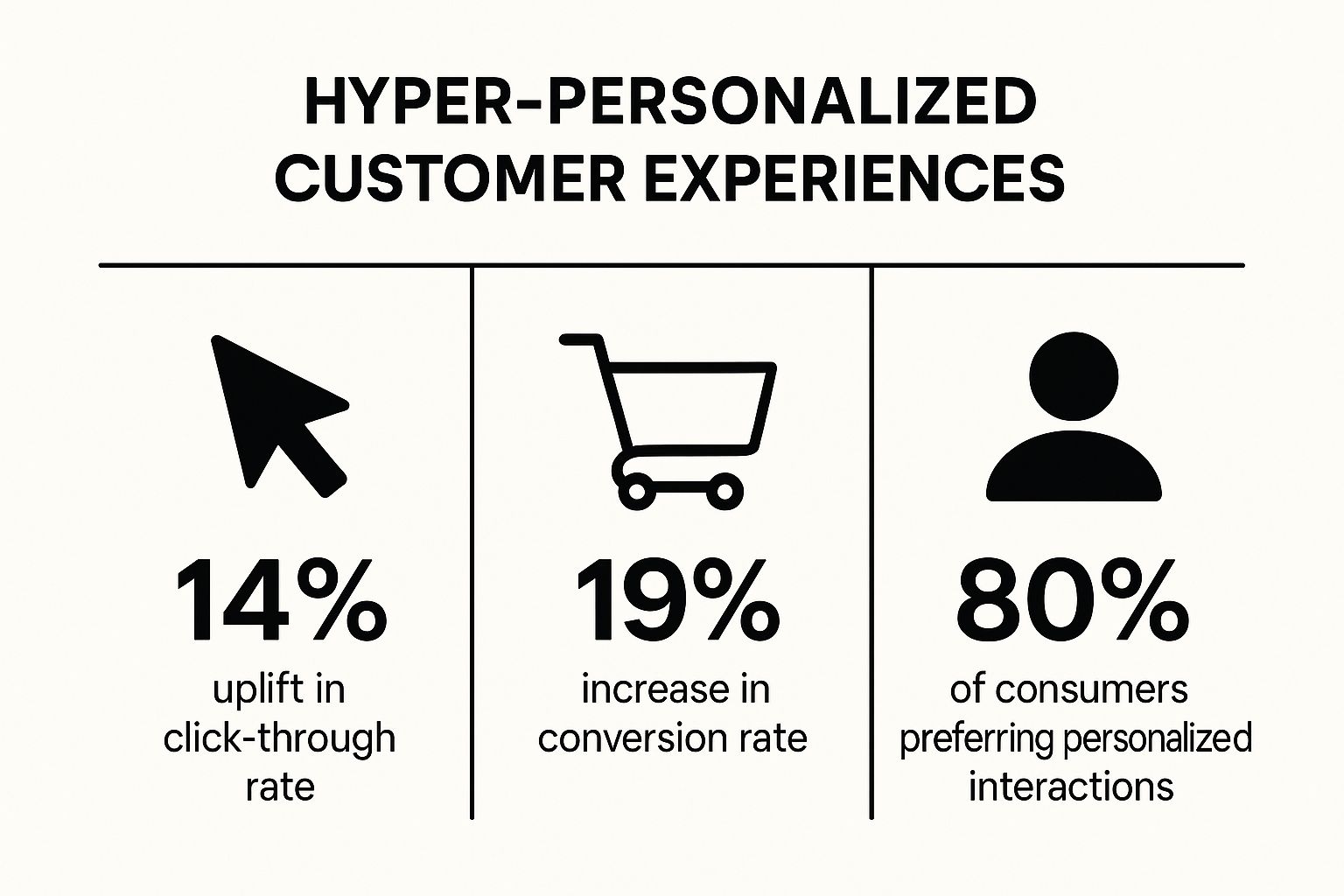
These statistics clearly demonstrate that consumers not only prefer personalized interactions but also act on them, leading to higher engagement and conversion rates.
Actionable Tips for Implementation:
To effectively leverage AI for personalization, start by focusing on data quality and a gradual rollout.
- Action Step 1: Unify Your Customer Data. Use a Customer Data Platform (CDP) to consolidate data from your CRM, website analytics, and e-commerce platform. This creates the single customer view necessary for true personalization.
- Action Step 2: Start with Dynamic Product Recommendations. Implement an AI tool on your e-commerce site to suggest products based on real-time user behavior. This is a high-impact, low-risk starting point.
- Action Step 3: Be Transparent and Offer Control. In your privacy policy and user settings, clearly explain what data you collect and how it's used for personalization. Give users control over their data to build trust.
2. Predictive Analytics and Customer Behavior Forecasting
Another of the core benefits of AI in marketing is the shift from reactive to proactive strategy through predictive analytics. While traditional analytics explains what has already happened, AI-powered predictive models use historical data, machine learning algorithms, and statistical modeling to forecast future outcomes. This capability allows marketers to anticipate customer needs, identify potential churn risks, and predict which leads are most likely to convert.
Traditional vs. AI-Powered Analytics:
- Traditional: A marketing team reviews a report showing that 15% of subscribers churned last quarter. They then plan a win-back campaign.
- AI-Powered: An AI model analyzes real-time user engagement (e.g., decreased login frequency, ignored emails) and flags at-risk subscribers before they churn. It can then automatically trigger a personalized retention offer to proactively prevent the loss.
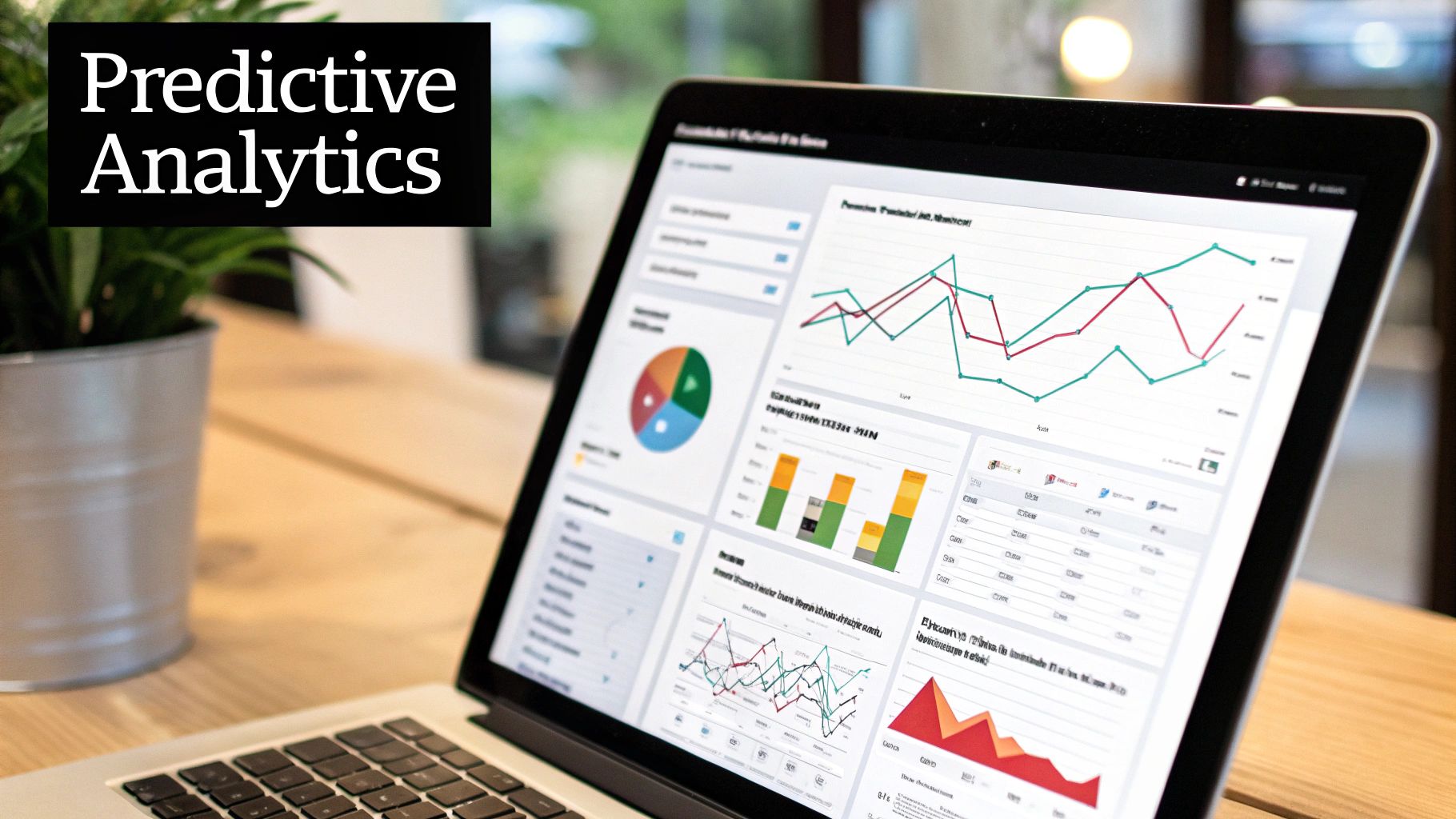
By analyzing patterns in customer data, AI can forecast everything from future purchase behavior to lifetime value.
Real-World Impact and Implementation
The strategic advantage of forecasting is immense. For example, Starbucks utilizes predictive analytics to determine ideal new store locations based on traffic, demographics, and consumer behavior patterns. Similarly, Uber’s surge pricing is a direct result of its AI forecasting demand in real-time to dynamically adjust prices and incentivize driver supply. These companies don’t just react to the market; they actively shape it based on data-driven predictions.
This foresight is crucial for optimizing everything from inventory management to campaign timing. Knowing which products will trend next season or which customer segments are primed for a new offer transforms marketing from a guessing game into a calculated science, significantly improving efficiency and return on investment.
Actionable Tips for Implementation:
To integrate predictive analytics effectively, focus on building a strong data framework and starting with clear, achievable goals.
- Action Step 1: Integrate Your Data Sources. Connect your CRM, website analytics, and sales data to a central repository. High-quality, comprehensive data is the fuel for accurate predictions.
- Action Step 2: Define a Specific Predictive Goal. Start with a clear question. For example: "Which of our current leads are most likely to convert in the next 30 days?" or "Which customers are at the highest risk of churning?"
- Action Step 3: Implement an AI-Powered Lead Scoring System. Use an AI tool to analyze lead behavior and firmographics, automatically scoring and prioritizing them for your sales team. This provides an immediate, measurable impact.
3. Intelligent Customer Segmentation and Targeting
Another significant benefit of AI in marketing lies in its ability to revolutionize customer segmentation and targeting. While traditional methods rely on static demographic or firmographic data, AI processes dynamic, multi-dimensional datasets to uncover deeper behavioral patterns. It analyzes everything from purchase frequency and browsing history to social media sentiment and real-time interactions, creating fluid, highly predictive customer segments.
Traditional vs. AI-Powered Segmentation:
- Traditional: A B2B software company targets "VPs of Marketing in the tech industry with 500+ employees." This segment is static and broad.
- AI-Powered: An AI platform identifies a dynamic micro-segment of "VPs who have recently visited pricing pages, downloaded a specific whitepaper, and whose companies are currently hiring for marketing roles." This segment is based on real-time intent signals, making it far more valuable.
AI-powered systems can identify these nuanced groups automatically and adjust them in real time as customer behaviors evolve. This ensures that marketing messages are not just personalized but also contextually relevant to a customer's current journey stage and intent.
Real-World Impact and Implementation
The impact of intelligent segmentation is profound, enabling brands to allocate resources more effectively and achieve higher engagement. For instance, Mastercard leverages AI to analyze vast transaction data, creating behavioral segments that help its merchant partners identify growth opportunities and tailor offers. Similarly, Unilever uses AI to segment consumers based on their expressed interest in sustainability, allowing the company to deliver targeted messaging that resonates with specific values.
These AI-driven segments are far more actionable than their traditional counterparts. They allow for precise targeting with customized creative and messaging, dramatically improving campaign performance and ROI by focusing efforts on the most receptive audiences. For more on how to identify these high-intent groups, discover how to use AI for lead scoring.
Actionable Tips for Implementation:
To deploy AI for smarter segmentation, focus on data integration and iterative refinement.
- Action Step 1: Integrate Behavioral Data. Ensure your website and app analytics are connected to your marketing automation platform so you can segment users based on their real-time actions, not just static profiles.
- Action Step 2: Use AI to Identify Your "Ideal Customer Profile" (ICP). Feed your existing customer data into an AI tool. It can analyze your best customers and identify common attributes, helping you build a data-driven ICP for better targeting.
- Action Step 3: Create Lookalike Audiences. Once AI identifies a high-performing segment, use the lookalike modeling features in platforms like Google Ads or Facebook Ads to find new prospects with similar characteristics, effectively scaling your reach.
4. Automated Content Creation and Optimization
Another significant benefit of AI in marketing lies in its power to automate and optimize content creation at an unprecedented scale. Traditional content marketing is resource-intensive, requiring significant time and human effort to produce everything from blog posts to social media updates. AI streamlines this entire process by generating high-quality, relevant content, freeing up marketing teams to focus on strategy and high-level creative tasks.
Traditional vs. AI-Powered Content Creation:
- Traditional: A content writer spends 4-6 hours researching and writing a single blog post. A social media manager spends an hour crafting five different tweets for the week.
- AI-Powered: A marketer provides an AI tool with a topic and keywords. Within minutes, the AI generates a detailed outline, a first draft of the blog post, and ten social media variations. The marketer then spends an hour refining and adding their unique perspective, cutting production time by over 70%.

AI tools can instantly draft product descriptions, write email subject lines, create social media captions, and even generate blog post outlines. This automation not only accelerates content velocity but also ensures brand consistency by adhering to predefined style and voice guidelines across all outputs.
Real-World Impact and Implementation
The impact of AI-driven content is already clear across various industries. For example, The Washington Post’s AI, Heliograf, has published thousands of data-driven articles on topics like election results and Olympic events. E-commerce giant Alibaba uses an AI copywriter that can produce 20,000 product descriptions per second, a task that would be impossible for a human team.
Platforms like Persado leverage AI to generate marketing copy that has been proven to outperform human-written alternatives by a significant margin. This technology allows marketers to rapidly test different messaging variations to find what resonates most effectively with their audience, directly improving campaign performance and ROI.
Actionable Tips for Implementation:
To implement AI content creation effectively, it's crucial to balance automation with human oversight.
- Action Step 1: Start with Short-Form Content. Use AI tools to generate ideas and drafts for social media posts, email subject lines, and ad copy. These are low-risk areas to test and refine your prompts.
- Action Step 2: Use AI as a Research Assistant. Instead of asking AI to write a full article, ask it to summarize research, identify key statistics, or create an outline. This speeds up the most time-consuming parts of content creation.
- Action Step 3: Develop a Brand Voice Prompt. Create a detailed prompt that includes your brand's tone, style, key messaging, and target audience. Use this "master prompt" to ensure all AI-generated content remains consistent and on-brand. Learn more about how AI can be used for comprehensive content analysis on marketbetter.ai.
5. Real-Time Customer Service and Engagement
Another of the core benefits of AI in marketing is the ability to offer real-time customer service and engagement around the clock. Traditional support models are limited by business hours and agent availability, creating frustrating delays for customers. AI-powered chatbots and virtual assistants eliminate this friction, providing instant, 24/7 support for routine inquiries, lead qualification, and personalized assistance.
Traditional vs. AI-Powered Customer Service:
- Traditional: A customer with a simple question ("What is your return policy?") has to wait in a phone queue or for an email response the next business day.
- AI-Powered: A chatbot on the website instantly answers the same question 24/7. It can also handle related queries like order tracking and even initiate a return process, resolving the issue in seconds without human intervention.
These AI systems can handle thousands of conversations simultaneously, freeing up human agents to focus their expertise on more complex, high-value issues that require a human touch.
Real-World Impact and Implementation
The impact of AI-driven engagement is proven and substantial. For instance, Sephora's chatbot helps customers find products and book in-store appointments, leading to an 11% higher conversion rate among users. Similarly, Bank of America's virtual assistant, Erica, has successfully handled over 100 million client requests, demonstrating the immense scale and efficiency AI can bring to customer interactions.
This technology directly improves customer satisfaction by providing immediate resolutions and enhances the marketing funnel by engaging potential leads the moment they show interest. Brands like H&M use chatbots for style advice and product recommendations, turning a simple query into a guided shopping experience.
Actionable Tips for Implementation:
To integrate AI for customer engagement effectively, focus on seamless integration and continuous improvement.
- Action Step 1: Identify Top 5-10 Customer Questions. Analyze your support tickets and emails to find the most frequently asked questions. Use these to build the initial knowledge base for your chatbot, ensuring it can handle the most common inquiries from day one.
- Action Step 2: Design a Clear Escalation Path. Program your chatbot with a clear and easy option to "talk to a human." This could be a live chat handover or a form to create a support ticket. This prevents user frustration.
- Action Step 3: Integrate with Your CRM. Connect your chatbot to your CRM so it can recognize existing customers, access their order history, and create new lead records for potential customers, making every interaction more valuable. Learn how to never miss a follow-up with a well-defined escalation strategy.
6. Advanced Marketing Attribution and ROI Tracking
One of the most critical benefits of AI in marketing is its ability to solve the complex puzzle of multi-touch attribution. Traditional models, like last-click, often oversimplify the customer journey by giving all credit to the final touchpoint before a conversion. AI algorithms, however, can analyze every interaction a customer has across channels, from the initial social media ad to the final email click, to accurately weigh the influence of each touchpoint.
Traditional vs. AI-Powered Attribution:
- Traditional (Last-Click): A customer sees a Facebook ad, reads a blog post, receives three emails, and finally converts via a Google search ad. The Google ad gets 100% of the credit.
- AI-Powered (Data-Driven): The AI model analyzes thousands of customer journeys and assigns fractional credit to each touchpoint. It might determine the Facebook ad contributed 20%, the blog post 15%, the emails 35%, and the final Google ad 30%, giving a much more accurate picture of what worked.
This data-driven clarity allows for smarter budget allocation, moving funds away from underperforming channels and doubling down on those that deliver the highest value throughout the entire sales funnel.
Real-World Impact and Implementation
The impact of AI-driven attribution is a significant increase in marketing efficiency and a more accurate understanding of ROI. For instance, Google's AI-powered attribution models in Google Analytics 4 help advertisers move beyond simplistic models to understand cross-channel impact. Similarly, B2B companies with long sales cycles use Salesforce's AI attribution tools to connect marketing efforts to eventual revenue, even when the journey spans months and multiple touchpoints.
This shift provides a more holistic view, revealing the true value of top-of-funnel activities that build awareness but might not get credit in a last-click world. By understanding the incremental lift provided by each marketing activity, businesses can optimize their entire strategy for maximum impact.
Actionable Tips for Implementation:
To leverage AI for advanced attribution, focus on comprehensive data collection and sophisticated analysis.
- Action Step 1: Ensure Consistent UTM Tagging. Enforce a strict, consistent UTM tagging policy across all your marketing channels (email, social, ads). This provides the clean data AI needs to connect the dots.
- Action Step 2: Switch to a Data-Driven Model in Your Analytics. If you use a platform like Google Analytics 4, switch your default attribution model from "last click" to "data-driven attribution" to immediately start leveraging Google's AI.
- Action Step 3: Connect Marketing Data to Sales Revenue. Use a CRM or CDP to link campaign touchpoints to actual sales data. This allows the AI to optimize for revenue, not just intermediate conversions like form fills.
7. Dynamic Pricing and Revenue Optimization
Another powerful benefit of AI in marketing is the ability to implement dynamic pricing and optimize revenue in real-time. Traditional pricing models are often static, set for long periods and based on historical data or simple competitor analysis. AI completely revolutionizes this by processing thousands of variables simultaneously, including competitor pricing, market demand, customer behavior, inventory levels, and even external factors like weather or local events.
Traditional vs. AI-Powered Pricing:
- Traditional: A hotel sets a fixed weekend rate for all rooms for the entire summer, based on last year's performance.
- AI-Powered: The hotel's AI pricing engine monitors flight bookings, a newly announced local concert, and competitor pricing in real-time. It automatically adjusts room rates multiple times per day to maximize occupancy and revenue, raising prices during peak demand and offering discounts during lulls.
This ensures pricing is always competitive and aligned with current market conditions.
Real-World Impact and Implementation
The impact of AI-driven pricing is profound across various industries. E-commerce giant Amazon famously changes prices on millions of its products multiple times a day, responding instantly to competitor moves and customer demand. Similarly, the airline industry has long used AI for revenue management, adjusting ticket prices based on seat availability, time until departure, and booking patterns. Ride-sharing companies like Uber use surge pricing algorithms to balance supply and demand, incentivizing more drivers to be available during peak hours.
This strategic approach moves pricing from a passive, cost-plus model to an active, value-based strategy that directly drives profitability and market responsiveness.
Actionable Tips for Implementation:
To effectively deploy dynamic pricing, a cautious and data-driven approach is essential to maintain customer trust.
- Action Step 1: Define Clear Pricing Rules and Boundaries. Before activating any AI, set non-negotiable price floors (the minimum you'll sell for) and ceilings (the maximum). This prevents the AI from making brand-damaging decisions.
- Action Step 2: Start with a Single Product Category. Test dynamic pricing on a limited set of products or services. Analyze the impact on both revenue and customer feedback before rolling it out more broadly.
- Action Step 3: Be Transparent Where Appropriate. For some business models (like events or travel), customers expect dynamic pricing. For others, transparency about why prices might fluctuate (e.g., "limited stock pricing") can help maintain trust.
8. Intelligent Ad Campaign Management and Optimization
Another of the key benefits of AI in marketing lies in its ability to automate and intelligently optimize advertising campaigns. Traditional ad management requires constant manual adjustments to bids, budgets, and targeting parameters, a process that is both time-consuming and prone to human error. AI transforms this by using machine learning to analyze performance data in real-time and make autonomous optimizations to maximize ROI.
Traditional vs. AI-Powered Ad Management:
- Traditional: A digital marketer manually reviews keyword performance each morning, adjusting bids based on the previous day's results. They might test two or three ad variations per ad group.
- AI-Powered: An AI bidding algorithm like Google's Smart Bidding adjusts bids in real-time for every single auction, using dozens of signals (device, location, time of day, etc.). It can simultaneously test hundreds of creative combinations (headlines, descriptions, images) to find the optimal mix automatically.
This moves campaign management from a reactive, manual task to a proactive, automated strategy, ensuring every ad dollar is spent with maximum efficiency.
Real-World Impact and Implementation
The impact of AI on ad performance is substantial and well-documented. Google's own data shows that its Smart Bidding strategies, which use AI to optimize for conversions, can increase conversion rates by an average of 20% at the same cost-per-acquisition. Similarly, platforms like Facebook's Advantage+ campaigns leverage AI to automate targeting and creative delivery, simplifying campaign setup and improving results across the entire sales funnel. Tools like Wordstream also use AI to drastically cut down on management time, claiming reductions of up to 80%.
This automation frees marketers from tedious, repetitive tasks, allowing them to focus on higher-level strategy, creative development, and market analysis.
Actionable Tips for Implementation:
To effectively integrate AI into your ad campaign management, a strategic approach is necessary to guide the machine learning process.
- Action Step 1: Ensure Your Conversion Tracking is Flawless. AI optimizes toward the goal you set. If your conversion tracking is inaccurate (e.g., double-counting conversions), the AI will make poor decisions. Audit and verify your tracking before activating AI features.
- Action Step 2: Switch from Manual Bidding to an Automated Strategy. On platforms like Google Ads or Meta, choose an automated bid strategy aligned with your goal (e.g., "Maximize Conversions" or "Target ROAS"). Feed it enough conversion data and let it run.
- Action Step 3: Use AI for Creative Testing. Implement features like Responsive Search Ads (Google) or Dynamic Creative (Meta). Provide multiple headlines, descriptions, and images, and let the AI determine the best-performing combinations for different audiences.
Benefits Comparison of 8 AI Marketing Strategies
| AI Marketing Solution | Implementation Complexity 🔄 | Resource Requirements ⚡ | Expected Outcomes 📊 | Ideal Use Cases 💡 | Key Advantages ⭐ |
|---|---|---|---|---|---|
| Hyper-Personalized Customer Experiences | High setup complexity and data needs | High-quality data and AI systems | Increased engagement & conversion; higher order values | Personalized cross-channel marketing at scale | Significantly higher engagement and loyalty |
| Predictive Analytics & Customer Forecasting | Moderate to high; requires data science expertise | Strong data infrastructure, ongoing model updates | Better ROI, retention, and planning; early trend ID | Strategic marketing and inventory management | Proactive decision-making and resource optimization |
| Intelligent Customer Segmentation & Targeting | Moderate; requires continuous tuning | Robust data integration | Higher campaign relevance, dynamic segments | Precise audience targeting & micro-segmentation | Discovery of new segments and improved engagement |
| Automated Content Creation & Optimization | Medium complexity; needs brand training | AI content generators, human oversight | Faster content production; cost reduction | High-volume, routine content creation | Massive time savings and consistent output |
| Real-Time Customer Service & Engagement | Medium; ongoing tuning and integration | AI chatbot platforms, CRM systems | 24/7 support; improved satisfaction and scalability | Customer support and lead qualification | Instant response with scalable support |
| Advanced Marketing Attribution & ROI Tracking | High complexity; multi-source integration | Comprehensive tracking systems | Accurate ROI, optimized budget allocation | Multi-channel campaign effectiveness tracking | Clear marketing impact insights |
| Dynamic Pricing & Revenue Optimization | High complexity; frequent updates | Real-time data feeds and AI models | Increased revenue and profit margins | Pricing strategy in e-commerce, retail, travel | Maximizes revenue with responsive pricing |
| Intelligent Ad Campaign Management & Optimization | Moderate; platform-dependent | Ad platforms with AI capabilities | Better campaign performance; cost reduction | Automated bidding and multi-platform ad management | Continuous optimization and improved ROI |
Try our Marketing Plan Generator — generate a complete AI-powered marketing plan in minutes. No signup required.
From Insight to Impact: Putting AI to Work in Your Marketing Strategy
We've explored eight transformative benefits of AI in marketing, moving from the broad strokes of theory to the fine details of execution. The journey has taken us from crafting hyper-personalized customer experiences that build loyalty to deploying predictive analytics that forecast market shifts with stunning accuracy. We've seen how AI dismantles traditional silos, enabling intelligent customer segmentation, automating content creation, and providing real-time support that meets customers exactly where they are. The common thread weaving through each of these advantages is a fundamental shift in operational philosophy: from reactive, assumption-based marketing to a proactive, data-driven, and highly efficient growth engine.
The implementation of AI is not a zero-sum game where technology replaces human talent. Instead, it’s a powerful partnership. The true value emerges when AI augments the strategic and creative capabilities of your marketing team. By automating the repetitive, data-heavy tasks like A/B testing ad copy or segmenting thousands of leads, AI liberates your people to focus on what they do best: building brand narratives, fostering genuine customer relationships, and innovating on a strategic level. This synergy is where the most significant competitive advantages are forged.
Your Action Plan: Moving from Theory to Reality
Translating these concepts into tangible results requires a deliberate and strategic approach. The most successful AI adoptions don't happen overnight with a massive, all-encompassing system. They begin with focused, high-impact initiatives that build momentum and demonstrate clear value.
Here is a practical roadmap to get started:
- Identify Your Biggest Bottleneck: Where do you lose the most time or money? Is it in manually scoring leads, struggling with content production, or deciphering attribution data? Pinpoint a single, significant pain point that AI is well-suited to solve. For example, if your sales team spends too much time on unqualified leads, an AI-powered predictive lead scoring model is an ideal starting point.
- Start Small, Prove ROI: Focus your initial efforts on that one identified area. Implement a targeted AI solution and meticulously track the results. Did lead quality improve? Did conversion rates increase? Did customer service response times decrease? Securing a clear win with measurable ROI will build the internal case for broader AI integration across your marketing functions.
- Select the Right Technology Stack: The market is filled with powerful platforms designed to simplify implementation. To effectively put AI to work in your marketing strategy, it's crucial to identify and utilize the best AI tools for marketing available. Evaluate solutions based on their ability to integrate with your existing systems (like your CRM), their ease of use, and their scalability.
Embracing the benefits of AI in marketing is no longer a futuristic vision; it's a present-day imperative for sustainable growth. By taking a measured, strategic approach, you can transform your marketing operations from a cost center into a predictable, revenue-generating powerhouse that is more intelligent, efficient, and profoundly customer-centric.
Ready to unlock these benefits without the complexity? marketbetter.ai integrates predictive analytics, content optimization, and intelligent automation into a single, intuitive platform. See how our AI can elevate your marketing strategy by visiting marketbetter.ai to start your journey.