The SDR Productivity Crisis: 83% Miss Quota While Selling Just 2 Hours a Day [2026 Data]

Here's the number that should alarm every sales leader: 83.4% of SDRs fail to consistently hit quota. Not occasionally miss — consistently fail.
That's not a talent problem. It's a systems problem.
We pulled data from seven major studies published in 2024–2026 — covering 170,000+ leads, 114 B2B companies, and millions of sales activities — to understand why SDR productivity has gotten worse despite a decade of increasingly sophisticated sales technology. The findings reveal a structural crisis hiding in plain sight.
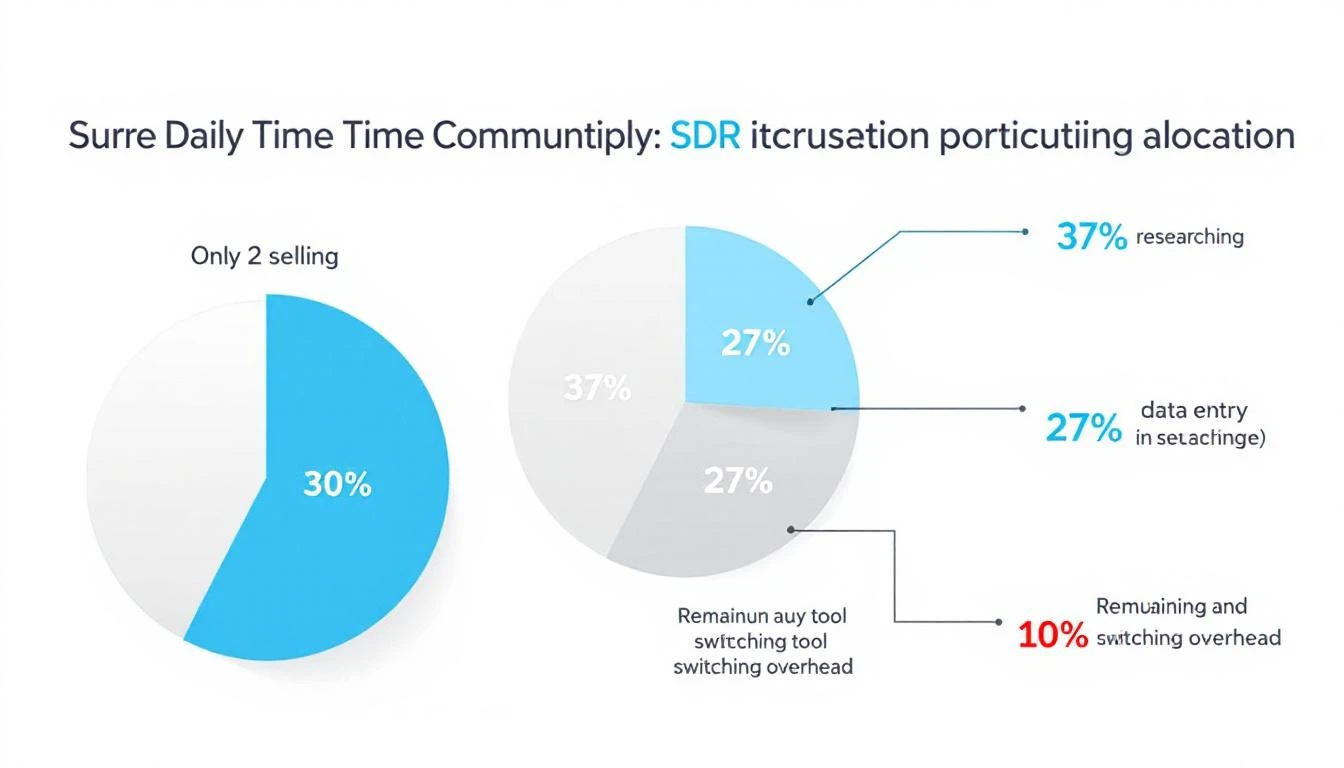
The average SDR sells for roughly two hours a day. The rest disappears into CRM entry, lead research, tool switching, internal meetings, and manual tasks that technology was supposed to eliminate. Meanwhile, the leads they do work sit unanswered for an average of 29 hours — and 63% never get a response at all.
This isn't a collection of disconnected statistics. It's a picture of an industry-wide failure to solve the core SDR problem: too many tools, not enough direction.
The Data: Where SDR Time Actually Goes
Salesforce's 2026 State of Sales report dropped the most sobering stat of the year: sales reps spend 60% of their time on non-selling tasks. That means in an 8-hour workday, your SDRs are actively selling for just over 3 hours.
But the reality may be worse. When you break down what "selling" means in practice — and remove time spent on call prep, pre-call research, and post-call logging that most teams still count as "selling" — the actual time spent in live conversations with prospects drops below 2 hours.
Here's how the average SDR day breaks down according to aggregated data from Salesforce, InsideSales, and Bridge Group reports:
| Activity | % of Day | Hours (8hr day) |
|---|---|---|
| Active selling (calls, emails, demos) | 40% | 3.2 hrs |
| CRM data entry and admin | 21% | 1.7 hrs |
| Lead research and preparation | 17% | 1.4 hrs |
| Internal meetings | 12% | 1.0 hrs |
| Tool switching and context changes | 10% | 0.8 hrs |
The 10% lost to tool switching is particularly insidious because it's invisible. Nobody tracks how many times an SDR alt-tabs between their CRM, email tool, dialer, LinkedIn, enrichment platform, and sales engagement software. But research on context-switching costs suggests each switch carries a cognitive penalty of 15–25 minutes to fully refocus.
If your SDRs use 7+ tools (the B2B average), they're paying that penalty dozens of times daily.
The Speed-to-Lead Collapse
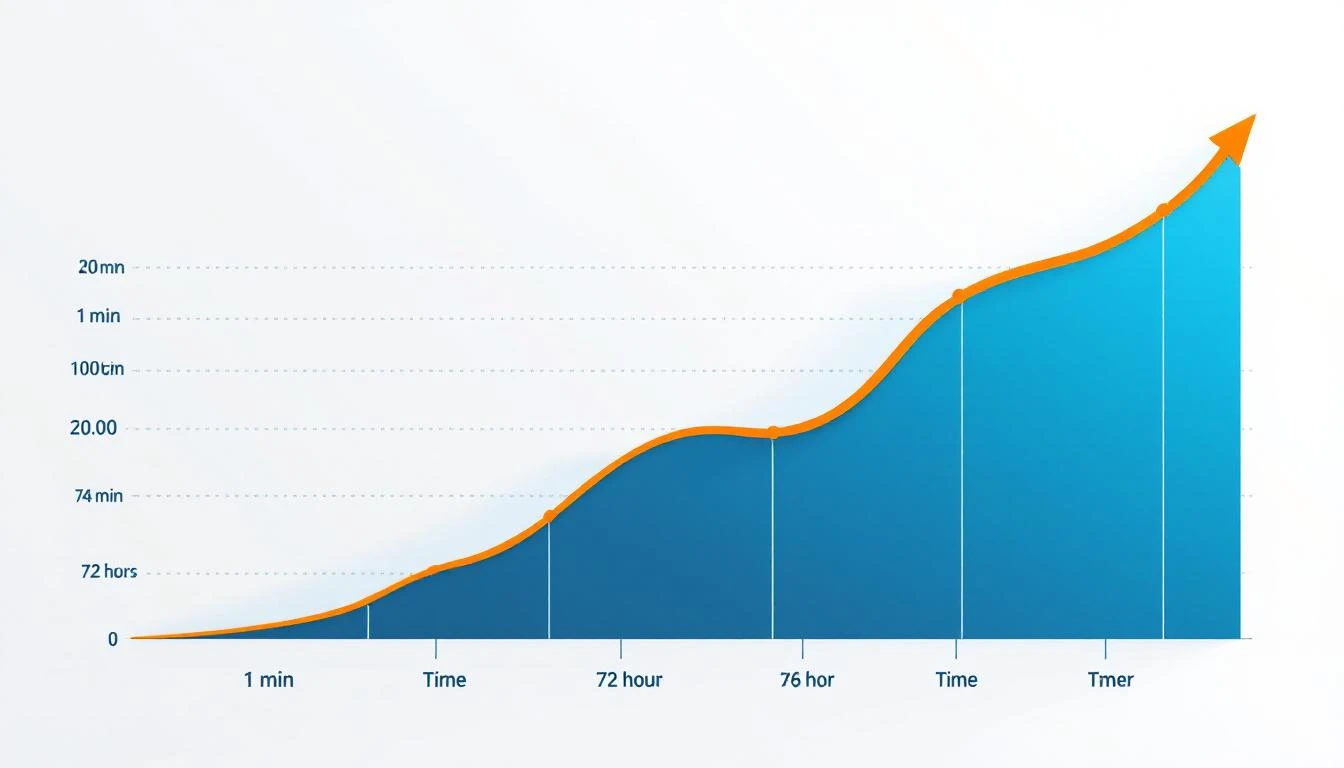
The data on lead response times tells a story of an industry moving backward.
The Timeline of Decline
| Study | Year | Key Finding |
|---|---|---|
| Harvard Business Review | 2011 | 42-hour average response time |
| Velocify | 2016 | Responding within 1 minute = 391% higher conversion |
| InsideSales | 2021 | Only 0.1% of companies respond within 5 minutes |
| RevenueHero | 2024 | 63% of companies never respond; 29+ hour average |
| Workato | 2025 | 99%+ fail the 5-minute test; 11h 54m average email |
Read that timeline again. In 2011, the average response time was 42 hours. In 2024, it's 29 hours for the companies that respond at all — but 63% don't respond at all. The non-response rate nearly tripled from 23% in 2011 to 63% in 2024.
More tools. More automation. Worse results.
Why It Matters: The Revenue Math
The conversion impact is not linear. It's a cliff.
- Within 1 minute: 391% higher conversion (Velocify)
- Within 5 minutes: 9x more likely to convert (InsideSales)
- Within 1 hour: 7x higher qualification rate vs. waiting longer (HBR)
- After 24 hours: You're cold-calling someone who's already moved on
And here's the stat that should end every debate about speed to lead: 78% of buyers purchase from the first company that responds. Not the best product. Not the cheapest option. The first one to show up.
When your average response time is 29 hours, you're not competing for the deal. You're already out of it.
The Hidden Bottleneck Nobody Blames
Here's what most teams miss. The Workato study broke response time into two components:
Lead Response Time = Lead Processing Time + Rep Response Time
Most companies blame slow reps. The data shows the opposite. The average SDR responds within minutes of seeing a lead in their queue. But the lead takes hours to get routed to them.
The processing pipeline — enrichment, lead-to-account matching, territory assignment, routing rules, round-robin logic — is where deals go to die. The average personalized email response takes 11 hours and 54 minutes (Workato), and most of that delay is processing, not rep laziness.
You can't coach your way out of a broken routing system.
The Quota Attainment Crisis
The headline number — 83.4% of SDRs miss quota — becomes less surprising when you see the underlying metrics:
- Average meetings booked per month: 15 (Bridge Group)
- Dials to connect: 18+ attempts per connection
- Call-back rate: Under 1%
- Cold email response rate: 1–2%
- Quality conversations per day: 3.6
That means your average SDR has fewer than 4 real conversations per day. To book 15 meetings from ~72 monthly connects, they need a 21% connect-to-meeting conversion rate. That's achievable for veterans. It's brutal for the 60% of SDRs in their first 12 months.
And tenure compounds the problem. Average SDR tenure is 6–23 months. Just as someone becomes proficient, they promote out or leave. The team is perpetually in ramp mode.
What Top Performers Do Differently
The data reveals a clear pattern separating the 16.6% who consistently hit quota:
1. They qualify ruthlessly. Companies with thorough qualification processes saw closing ratios jump from 11% to 40% (InsideSales). Top SDRs don't work more leads — they work the right leads.
2. They use signal-based prioritization. Instead of working leads alphabetically or by age, elite SDRs prioritize by intent signals — who's on the website right now, who just changed jobs, who's researching competitors.
3. They batch their day. The "Golden Hours / Platinum Hours" framework separates prime prospecting time (calls and outreach) from admin work. Top reps protect their selling time aggressively.
4. They hit 14.5% meaningful conversation rates with decision-makers — nearly 4x the average — through better targeting and personalization, not more volume.
The $2.7 Billion Waste Problem
Let's put a dollar figure on this crisis.
B2B marketers spend over $4.6 billion annually on advertising to generate leads. An estimated $2.7 billion of that is wasted due to slow or nonexistent follow-up (Credofy). You're paying to generate demand and then letting it rot.
At the individual company level, the math is just as ugly. Consider a mid-market B2B company:
| Metric | Value |
|---|---|
| Monthly inbound leads | 200 |
| Average deal value | $15,000 |
| Conversion rate (fast response) | 3% |
| Conversion rate (slow response) | 0.15% |
| Revenue lost monthly | $8,550 |
| Revenue lost annually | $102,600 |
That's $100K+ per year lost — not to bad marketing, not to a weak product, but to slow response. For most B2B companies, that's 1–2 SDR salaries that could be funded by simply responding faster.
The AI Inflection Point
The good news: the industry is finally addressing this structurally, not just incrementally.
AI adoption in sales has exploded from 39% to 81% in just two years (Salesforce). And the results are significant:
- 46% productivity increase for teams using AI-powered sales tools
- 20% increase in pipeline volume with AI implementation
- 30% improvement in lead conversion rates
- AI-powered personalization delivers 9.25% appointment rate — better than most manual outreach
Salesforce reported that their own AI SDR agent created 3,200 opportunities in four months by working the low-score leads that human SDRs couldn't justify spending time on.
But here's the nuance the "AI will replace SDRs" crowd misses: AI doesn't replace selling. It replaces the 60% of the day that isn't selling.
The best implementations aren't replacing human SDRs with AI agents. They're using AI to:
- Eliminate processing delay — Route, enrich, and prioritize leads in seconds, not hours
- Kill the research tax — Pre-populate account context so reps don't spend 17% of their day Googling prospects
- Automate admin — CRM updates, activity logging, and follow-up scheduling happen automatically
- Provide daily direction — Instead of "here are your 200 leads, figure it out," AI tells the SDR exactly who to call, what to say, and why now
This is the difference between an AI that replaces the SDR and an AI that makes the SDR 3x more effective. The former is a race to commoditized outreach. The latter is how you win.
The Consolidation Imperative
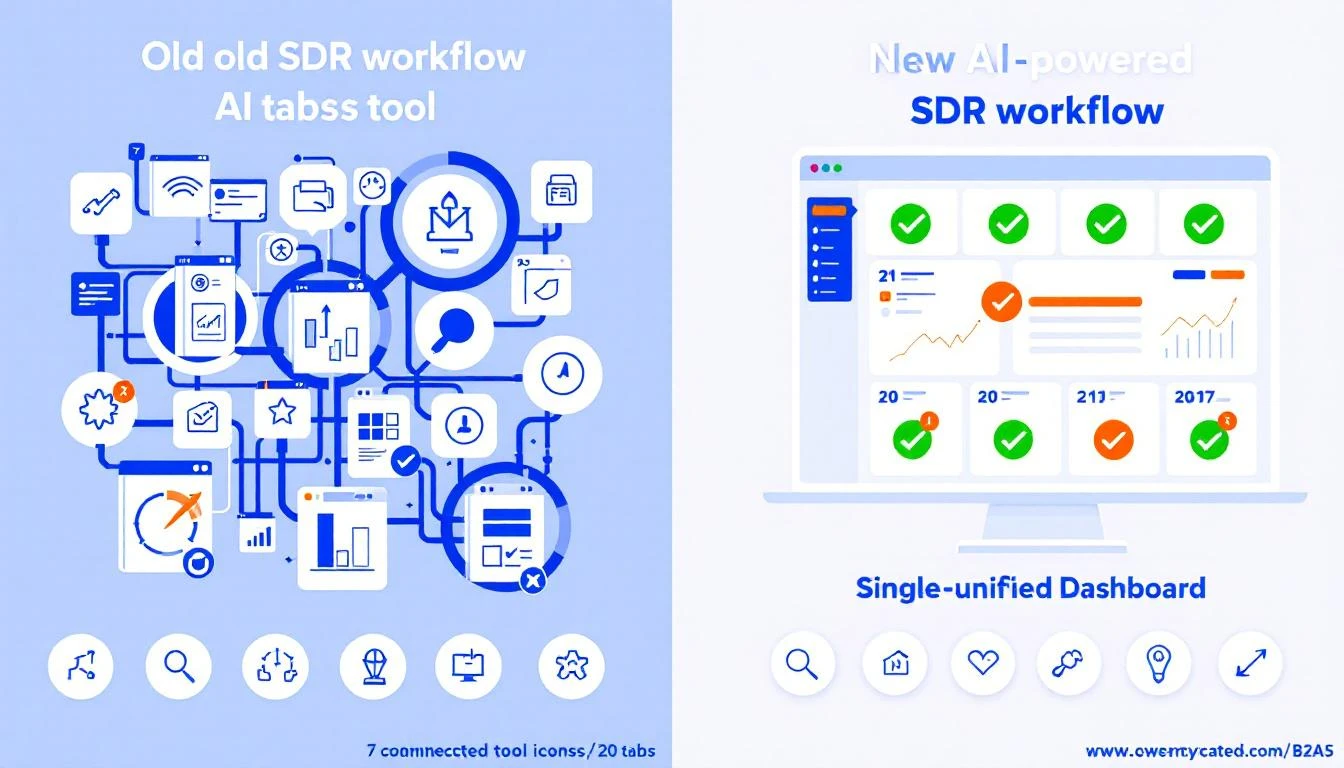
The average B2B sales team uses 7–12 tools across prospecting, enrichment, engagement, dialing, and analytics. At $1,500–$4,000 per user per month, that's an enormous expense delivering a 40% selling rate and 29-hour response times.
The answer isn't another tool. It's fewer tools that do more.
Organizations with well-integrated enablement tech stacks are 42% more likely to boost sales productivity (Highspot). Integration isn't a nice-to-have. It's the difference between 3-hour and 6-hour selling days.
What does the right consolidated stack look like?
- Signal layer: Website visitor identification, intent data, buying signals in one view
- Enrichment layer: Contact data, company data, and champion tracking without manual lookups
- Execution layer: Email, dialer, and multi-channel outreach from one interface
- Intelligence layer: AI that tells the SDR what to do next — not just shows data and makes them figure it out
This is what "from 20 tabs to one task list" actually means in practice.
What to Do About It
If you're a sales leader reading this data and recognizing your own team, here's the playbook:
1. Audit Your True Selling Time
Have each SDR log their actual activities for one week. Not what the CRM says — what they actually did. You'll likely find selling time closer to 2 hours than the 3.2 you assumed.
2. Measure Lead Processing Time Separately
Break your response time into processing (system) and rep response (human). Fix the system first — it's usually the bigger bottleneck and doesn't require behavior change.
3. Cut Your Stack, Don't Add To It
Every tool you add increases context-switching cost. Before buying tool #8, ask: can tool #3 do this if I configured it properly? Tool consolidation is the highest-ROI move in sales ops right now.
4. Move From Data Dashboards to Daily Playbooks
Your SDRs don't need more data. They need direction. A daily prioritized task list — who to call, what to say, and why today — eliminates the 17% research tax and dramatically improves response times.
5. Adopt AI for the Non-Selling 60%, Not the Selling 40%
The highest-impact AI use cases in sales aren't automated email blasts. They're lead routing in seconds instead of hours, automatic enrichment, CRM auto-updates, and intelligent prioritization. Keep humans on the conversations. Let AI handle everything else.
The Bottom Line
The SDR productivity crisis isn't caused by lazy reps. It's caused by:
- Tool sprawl that eats 10%+ of every day in context switching
- Processing delays that turn hot leads cold before reps ever see them
- Data overload without direction — dashboards instead of playbooks
- Constant ramp from 6–23 month average tenure
The teams solving this aren't buying more tools. They're consolidating into platforms that combine signals, enrichment, and execution into a single daily SDR workflow — and using AI to eliminate the 60% of the day that was never selling to begin with.
The data is clear: the gap between top-performing SDR teams and everyone else is no longer effort. It's architecture.
Want to see what an AI-powered SDR workflow looks like in practice? Book a demo →
Sources
- Salesforce State of Sales Report, 2026
- RevenueHero Lead Response Study, 2024 (1,000+ companies)
- Workato Lead Response Time Study, 2024–2025 (114 B2B companies)
- InsideSales.com Lead Response Study, 2021 (55M activities, 5.7M leads)
- Harvard Business Review (Oldroyd, McElheran, Elkington), 2011 (15K leads)
- Velocify Lead Response Analysis, 2016 (millions of records)
- Highspot State of Sales Enablement Report, 2025
- Bridge Group SDR Metrics and Compensation Report
- Credofy B2B Lead Response Framework