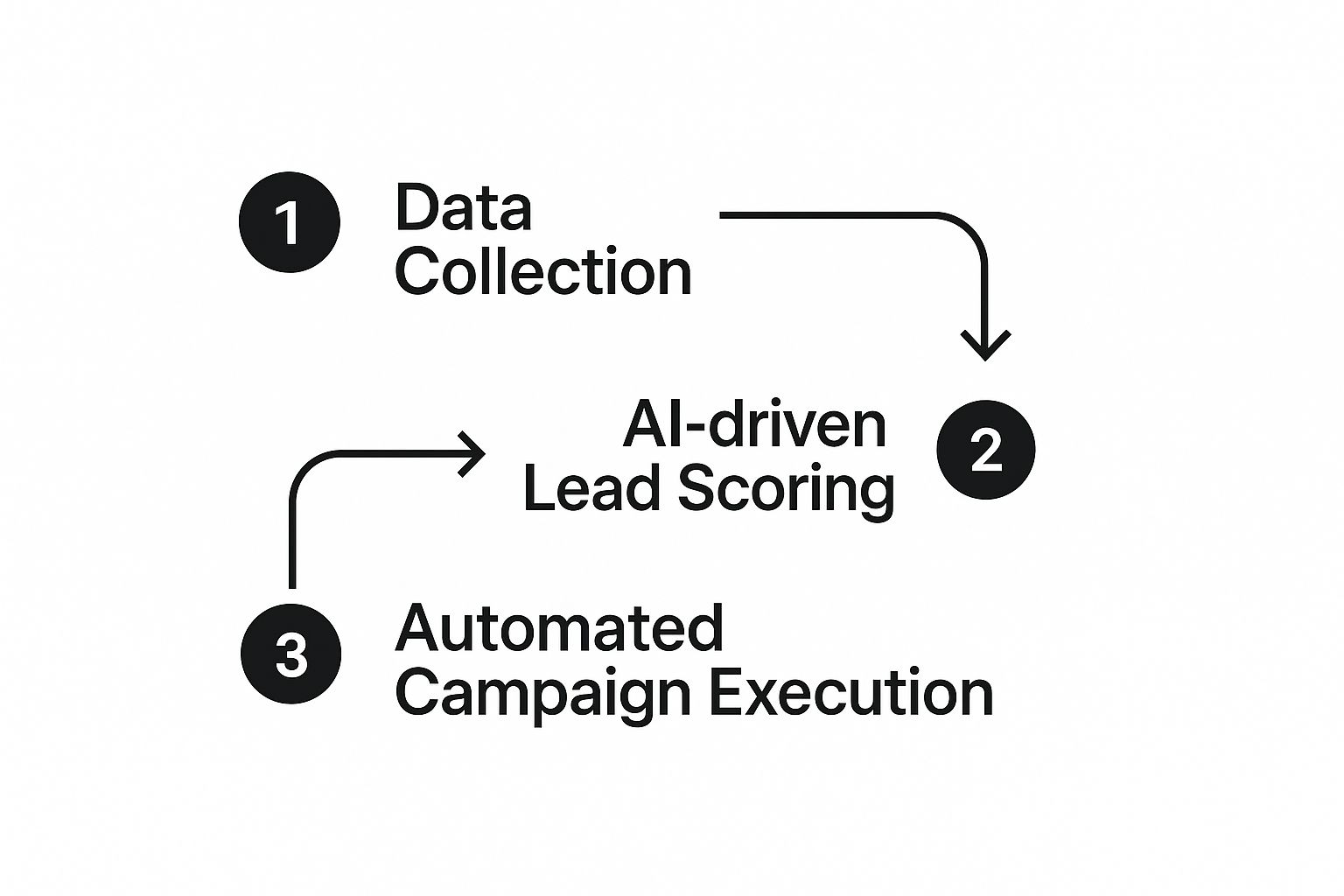
12 Best AI Tools for B2B Marketing to Scale Growth in 2026
In today's B2B landscape, staying competitive means moving faster, personalizing at scale, and proving ROI with data-driven precision. Manual processes and siloed tools just can't keep up with the demands of complex buying cycles. The solution? Artificial intelligence. AI is fundamentally changing how marketers identify target accounts, create compelling content, and engage buyers across the entire customer journey. But with a crowded market, how do you choose the right AI tools for B2B marketing to build a modern, effective tech stack?
This guide cuts through the noise. We provide an in-depth, comparative analysis of the 12 best platforms designed to solve core B2B challenges, from account-based marketing (ABM) execution to sales intelligence and campaign optimization. For B2B teams, the right AI can be the difference between hitting a quota and falling short, especially when integrated into a well-defined sales process. Understanding the fundamentals of outreach remains critical; for a deeper dive on this, A Modern Outbound Lead Generation Playbook provides a solid framework for structuring these efforts.
This resource is designed to be actionable. Instead of generic marketing copy, you'll find a detailed breakdown of each tool, covering:
- Primary use cases and ideal buyer personas.
- Key features, honest pros and cons, and pricing tiers.
- Actionable advice and comparisons to help you decide.
We'll help you navigate platforms like HubSpot, 6sense, and marketbetter.ai to select, pilot, and scale the technology that will drive measurable pipeline growth for your business this year.
1. marketbetter.ai
Best for: All-in-one revenue generation and pipeline acceleration.
marketbetter.ai positions itself not just as another tool, but as a comprehensive AI-native revenue engine designed to replace fragmented martech stacks. It’s a standout choice among ai tools for b2b marketing because it unifies intent data, AI-driven content generation, and multi-channel campaign automation into a single, cohesive platform. This integrated approach directly addresses a major pain point for B2B teams: managing multiple point solutions like Clay, Apollo, and n8n, which often leads to data silos and workflow inefficiencies. By consolidating these functions, it provides a single source of truth for go-to-market execution.
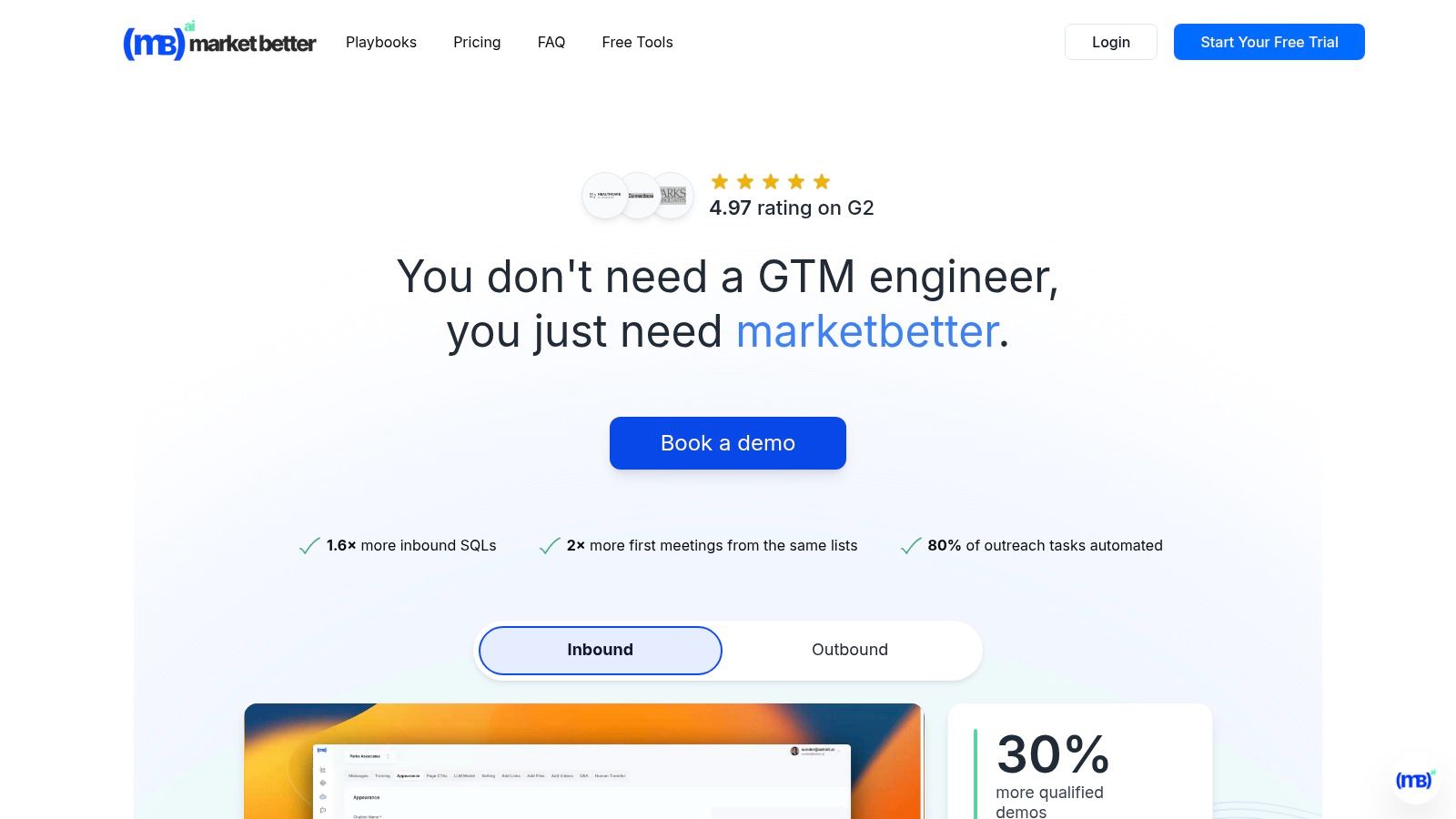
The platform automates the entire top-of-funnel process, from identifying anonymous website visitors and enriching account data to triggering personalized, multi-channel outreach sequences across email, LinkedIn, and even automated voice calls. Its AI continuously optimizes campaigns based on real-time analytics, ensuring that marketing efforts are always directed toward the highest-potential accounts.
Key Features and Differentiators
- Unified Revenue Engine: Combines intent data, account enrichment, AI personalization, and automated multi-channel sequences in one place. This holistic system replaces the need for separate tools for data, sequencing, and analytics.
- AI Content & Personalization: Generates hyper-personalized outreach content at scale, moving beyond simple mail-merge fields to create relevant messaging based on account fit, intent signals, and buyer personas.
- AI Voice Assistant: A unique feature that automates lead qualification and meeting booking over the phone, freeing up sales development representatives (SDRs) to focus on high-value conversations.
- Rapid Time-to-Value: Offers pre-built playbooks and no-cost, turnkey integrations with major CRMs (Salesforce, HubSpot) and collaboration tools (Slack, Teams), enabling teams to get started in minutes.
Actionable Use Case
A mid-market demand generation manager can use marketbetter.ai to instantly identify high-intent accounts visiting their pricing page. The platform automatically enriches these accounts with firmographic and contact data, scores their fit against the ideal customer profile, and triggers a personalized, multi-channel sequence. An AI-generated email is sent, followed by an automated LinkedIn connection request and a call from the AI voice assistant to qualify interest and book a demo, with every touchpoint logged back to Salesforce.
Pros and Cons
| Pros | Cons |
|---|---|
| Consolidated Platform: Replaces multiple point tools, reducing martech bloat and providing a single source of truth. | Opaque Pricing: No public pricing is available; tailored for mid-market and enterprise budgets, likely excluding smaller startups. |
| Proven ROI: Strong customer proof points report significant lifts in SQLs, booked meetings, and overall campaign ROI. | Requires Change Management: Implementation involves replacing existing workflows and tools, which requires team buy-in. |
| Deep Automation: Automates up to 80% of outreach tasks, including AI voice calls, freeing up significant team resources. | Compliance Considerations: Relies on IP tracking and automation, necessitating a thorough review of privacy and compliance policies. |
| Enterprise-Ready: Features enterprise-grade security, compliance controls, and strong customer validation (4.97 G2 rating). |
Website: https://www.marketbetter.ai
2. HubSpot Marketing Hub
Best for: SMB and mid-market teams seeking a unified CRM and marketing automation platform.
HubSpot Marketing Hub has evolved from a popular inbound marketing tool into a comprehensive platform where AI is deeply embedded across the entire marketing and sales funnel. Unlike standalone AI content generators, HubSpot integrates its AI features directly with its native CRM, allowing B2B teams to create, automate, and analyze campaigns within a single, unified system. This makes it one of the most practical AI tools for B2B marketing for teams seeking an all-in-one solution.

The platform's AI assists in everything from generating blog post ideas and drafting email copy to optimizing send times and predicting audience segments likely to convert. For B2B marketers, this means less time switching between tools and more time focusing on strategy, as the AI handles repetitive tasks while leveraging customer data for smarter decision-making.
Key Features and Use Cases
- AI Content Assistant: Draft blog posts, social media updates, and marketing emails directly within the editor. It's particularly useful for overcoming writer's block and generating first drafts that are already SEO-optimized.
- Predictive Lead Scoring: Automatically identifies and prioritizes high-quality leads based on behavioral data, helping sales teams focus their efforts where it matters most.
- AI-Powered Reporting: Build custom reports and dashboards by simply asking questions in natural language, uncovering insights without needing to be a data analyst.
- Smart Automation: The platform's AI optimizes marketing automation workflows by suggesting logical next steps and identifying engagement patterns. If you're looking to dive deeper, you can learn more about AI's role in marketing automation.
How it Compares & Actionable Advice
Compared to Salesforce (Pardot): HubSpot is generally considered more user-friendly and faster to implement, making it a better choice for teams without dedicated Salesforce administrators. Its all-in-one model with a native CRM contrasts with Pardot's reliance on a separate Sales Cloud instance.
Actionable Advice: If your team prioritizes ease of use and needs a single system for both marketing automation and CRM, HubSpot is your top contender. Start with the free tools to understand the ecosystem, and leverage HubSpot Academy's free courses to train your team before upgrading to a paid tier.
| Pro | Con |
|---|---|
| All-in-one platform with native CRM | Contact-based pricing can become expensive |
| Strong educational resources (HubSpot Academy) | Advanced AI features are locked in higher tiers |
| Excellent for teams needing quick time-to-value | Less customizable than some enterprise competitors |
Official Website: https://www.hubspot.com/products/marketing/professional
3. Salesforce Marketing Cloud Account Engagement (formerly Pardot)
Best for: Salesforce-centric organizations needing deep marketing and sales alignment.
Salesforce Marketing Cloud Account Engagement, widely known by its former name Pardot, is a B2B marketing automation powerhouse deeply embedded within the Salesforce ecosystem. Its core strength lies in leveraging Einstein AI to bridge the gap between marketing activities and sales outcomes. Unlike more content-focused AI platforms, Pardot excels at using AI to analyze prospect behavior, predict sales readiness, and provide actionable insights directly within the CRM, making it one of the most effective AI tools for B2B marketing for revenue-focused teams.
This tight CRM alignment means that every AI-driven insight is immediately actionable for the sales team. The platform moves beyond simple lead generation to focus on pipeline acceleration and proving marketing's contribution to revenue, a critical function for B2B organizations needing to justify their marketing spend. For companies already standardized on Salesforce, adopting Pardot is a natural extension that enriches their existing data with predictive intelligence.
Key Features and Use Cases
- Einstein Behavior Scoring: Moves beyond traditional scoring by using AI to analyze engagement patterns and identify which prospects are most likely to convert. This allows sales teams to prioritize their outreach with precision.
- Einstein Campaign Insights: Automatically monitors campaign performance and alerts marketers to significant trends or anomalies, such as an email performing better with a specific audience segment.
- B2B Marketing Analytics: Provides sophisticated, AI-enhanced dashboards that connect marketing efforts directly to sales pipeline and revenue, enabling true ROI attribution.
- Native Salesforce Integration: Ensures all data is unified between marketing and sales, eliminating data silos and creating a single source of truth for every customer interaction.
How it Compares & Actionable Advice
Compared to Marketo: Pardot offers tighter, more native integration with Salesforce Sales Cloud, making it the default choice for teams deeply invested in that ecosystem. Marketo provides greater flexibility to integrate with other CRMs and is often seen as more configurable for complex, non-linear nurture campaigns.
Actionable Advice: If "what's in Salesforce" is the ultimate source of truth for your business, Pardot is the most logical choice. Before purchasing, conduct an audit of your Salesforce data quality. Pardot's AI (Einstein) is only as good as the data it analyzes; clean data is a prerequisite for success.
| Pro | Con |
|---|---|
| Seamless Salesforce CRM alignment | Entry price is higher than many SMB tools |
| Mature analytics for revenue attribution | Requires Salesforce proficiency for best results |
| Strong governance for complex organizations | AI features are tied to specific, higher-cost editions |
Official Website: https://www.salesforce.com/products/marketing-cloud/pricing/b2b-marketing-automation/
4. Adobe Marketo Engage
Best for: Enterprise B2B teams with complex, multi-channel buyer journeys.
Adobe Marketo Engage is an enterprise-grade marketing automation platform designed for complex, long-cycle B2B sales processes. While known for its robust lead management and nurturing capabilities, its AI features, particularly in the Prime tier, elevate it into a powerful tool for large-scale personalization and journey optimization. Unlike platforms built around a central CRM, Marketo focuses on deep marketing automation that integrates with various CRMs, making it a highly configurable hub for sophisticated demand generation teams.

For organizations managing intricate buyer journeys across multiple segments, Marketo's AI provides predictive insights to streamline campaign strategy. It analyzes engagement data to forecast the best content for specific audience segments, moving beyond simple rule-based automation. This makes it one of the more advanced AI tools for B2B marketing for enterprises needing precise control and governance over their marketing programs.
Key Features and Use Cases
- Predictive Audiences: Utilizes AI to analyze behavioral and firmographic data to automatically identify and build high-potential audience segments for targeted campaigns.
- AI-Driven Personalization: Powers dynamic content and offers on websites and in emails, ensuring that each prospect receives the most relevant messaging based on their real-time behavior and predictive profile.
- Intelligent Journey Analytics: Moves beyond standard reporting by using AI to analyze customer journey maps, identifying bottlenecks and opportunities for optimization to accelerate the sales funnel.
- Account-Based Marketing (ABM) Automation: Combines lead and account-level data to orchestrate complex, multi-touch ABM campaigns, with AI helping to prioritize the most engaged accounts.
How it Compares & Actionable Advice
Compared to HubSpot: Marketo is a more powerful and customizable platform but comes with a significantly steeper learning curve and higher cost. It's built for large marketing operations teams that require granular control over every aspect of their campaigns, whereas HubSpot is designed for broader ease of use.
Actionable Advice: Choose Marketo if you have a dedicated marketing operations team and a need for highly sophisticated, multi-touch nurture programs that span months or even years. To justify the investment, map out your most complex customer journey and use it as a benchmark during the demo process to see if Marketo can truly automate and optimize it.
| Pro | Con |
|---|---|
| Highly configurable for sophisticated nurture programs | Pricing is sales-driven and can be significant |
| Strong ecosystem and enterprise-grade governance | Steeper learning curve than SMB-focused tools |
| Deep APIs for complex integrations | AI features are primarily in premium add-on packages |
Official Website: https://business.adobe.com/products/marketo/value-add-ons
5. 6sense Revenue AI
Best for: Mature B2B teams executing a sophisticated account-based marketing (ABM) strategy.
6sense Revenue AI positions itself as a central nervous system for B2B go-to-market teams, moving beyond simple analytics to proactively identify and engage in-market accounts. Unlike many tools that focus on a single marketing function, 6sense uses AI to unify marketing and sales efforts around a critical metric: revenue. This platform excels at uncovering the "dark funnel" of anonymous buyer research, making it one of the most powerful AI tools for B2B marketing for companies pursuing a sophisticated account-based marketing (ABM) strategy.

The platform's core strength lies in its ability to predict which accounts are ready to buy, often before they ever fill out a form. For B2B marketers, this means shifting from a reactive, lead-based approach to a proactive, account-centric model. Instead of waiting for hand-raisers, teams can use 6sense's intent data to orchestrate timely, relevant outreach across multiple channels, from targeted ads to personalized emails.
Key Features and Use Cases
- Predictive Intent and Account Discovery: The AI analyzes billions of data points to identify accounts actively researching solutions like yours. This allows teams to prioritize outreach and tailor messaging based on an account's specific stage in the buying journey.
- AI Email Agents & Conversational Outreach: 6sense can deploy AI agents to handle initial email conversations, qualify interest, and schedule meetings, freeing up sales development representatives to focus on high-value interactions.
- LinkedIn Ad Campaign Management: Directly activate and manage targeted LinkedIn ad campaigns based on 6sense's real-time intent data, ensuring ad spend is focused exclusively on accounts that are in-market.
- Broad Ecosystem Integrations: The platform connects seamlessly with major CRM and MAP systems like Salesforce, HubSpot, and Marketo, making it a powerful layer of intelligence on top of your existing tech stack. For those interested in the mechanisms behind this, you can explore the role of predictive analytics in marketing.
How it Compares & Actionable Advice
Compared to Demandbase: Both are leaders in the ABM space. 6sense is often praised for the accuracy of its predictive analytics and its focus on uncovering anonymous intent signals. Demandbase offers a more integrated B2B advertising DSP (Demand-Side Platform), giving teams more direct control over their ad campaigns within the platform.
Actionable Advice: If your biggest challenge is identifying in-market accounts before they contact you, 6sense is a top contender. To build a business case, ask your sales team for their top 10 dream accounts, then ask the 6sense team to show you the intent signals for those specific accounts during a demo. This makes the value proposition tangible.
| Pro | Con |
|---|---|
| Strong ABM results reported by users | No public pricing; enterprise-oriented sales motion |
| Clear focus on agentic AI to improve GTM efficiency | Requires solid data foundations for best performance |
| Broad integrations with existing martech stacks | Can have a steep learning curve for new users |
Official Website: https://6sense.com/solutions/
6. Demandbase One
Best for: Enterprise GTM teams wanting an integrated ABM and advertising platform.
Demandbase One is a comprehensive B2B go-to-market platform built around account-based marketing (ABM) and powered by deep AI-driven account intelligence. Unlike tools focused solely on content or lead generation, Demandbase provides a unified view of target accounts, identifying buying signals across the web and orchestrating actions across sales and marketing channels. This makes it one of the most powerful AI tools for B2B marketing for mature organizations executing sophisticated ABM strategies.
The platform's AI moves beyond simple lead scoring to map entire buying groups within target companies, tracking intent and engagement signals to pinpoint exactly when an account is ready to buy. For B2B teams, this means shifting from a broad, high-volume approach to a highly targeted, efficient strategy that aligns sales and marketing efforts on the accounts most likely to close.
Key Features and Use Cases
- AI-Powered Account Intelligence: Identifies in-market accounts by analyzing third-party intent data, website engagement, and CRM activity. It helps marketers discover net-new opportunities and prioritize existing ones.
- AI-Optimized Advertising: The platform’s B2B-native Demand-Side Platform (DSP) uses AI to target specific buying groups within accounts, optimizing ad spend to reach decision-makers, not just anyone at a target company.
- Cross-Channel Orchestration: Triggers automated, personalized actions across advertising, sales outreach, and website experiences based on real-time account behavior, ensuring a consistent message.
- Buying Group & Journey Mapping: AI automatically identifies key personas within a target account and maps their journey, giving sales and marketing teams a clear view of who to engage and when.
How it Compares & Actionable Advice
Compared to 6sense: Demandbase's key differentiator is its tightly integrated, B2B-focused DSP, providing a single platform for both identifying intent and activating advertising campaigns. Teams that want to manage their programmatic advertising in the same place they manage their account intelligence may prefer Demandbase.
Actionable Advice: If a significant portion of your marketing budget is dedicated to display advertising, Demandbase should be on your shortlist. During your evaluation, prepare a list of your top 20 target accounts and ask the vendor to demonstrate how their platform would build an audience and launch an ad campaign targeting the buying committee within those companies.
| Pro | Con |
|---|---|
| Full-funnel ABM platform with integrated B2B DSP | Custom pricing and discovery process required |
| Explainable AI with configurable scoring models | Best suited for teams with existing ABM maturity |
| Strong native integrations with Salesforce and HubSpot | Can be complex to implement without dedicated resources |
Official Website: https://www.demandbase.com/products/
7. ZoomInfo MarketingOS
Best for: Teams needing a premium data foundation to fuel their ABM and sales campaigns.
ZoomInfo MarketingOS positions itself as an activation layer built directly on top of its industry-leading B2B data foundation. Unlike platforms that require separate data procurement and activation tools, ZoomInfo combines AI-powered audience building, advertising, and website personalization into a cohesive system. This makes it one of the most powerful AI tools for B2B marketing for teams focused on account-based marketing (ABM) who need to activate intelligence at scale.
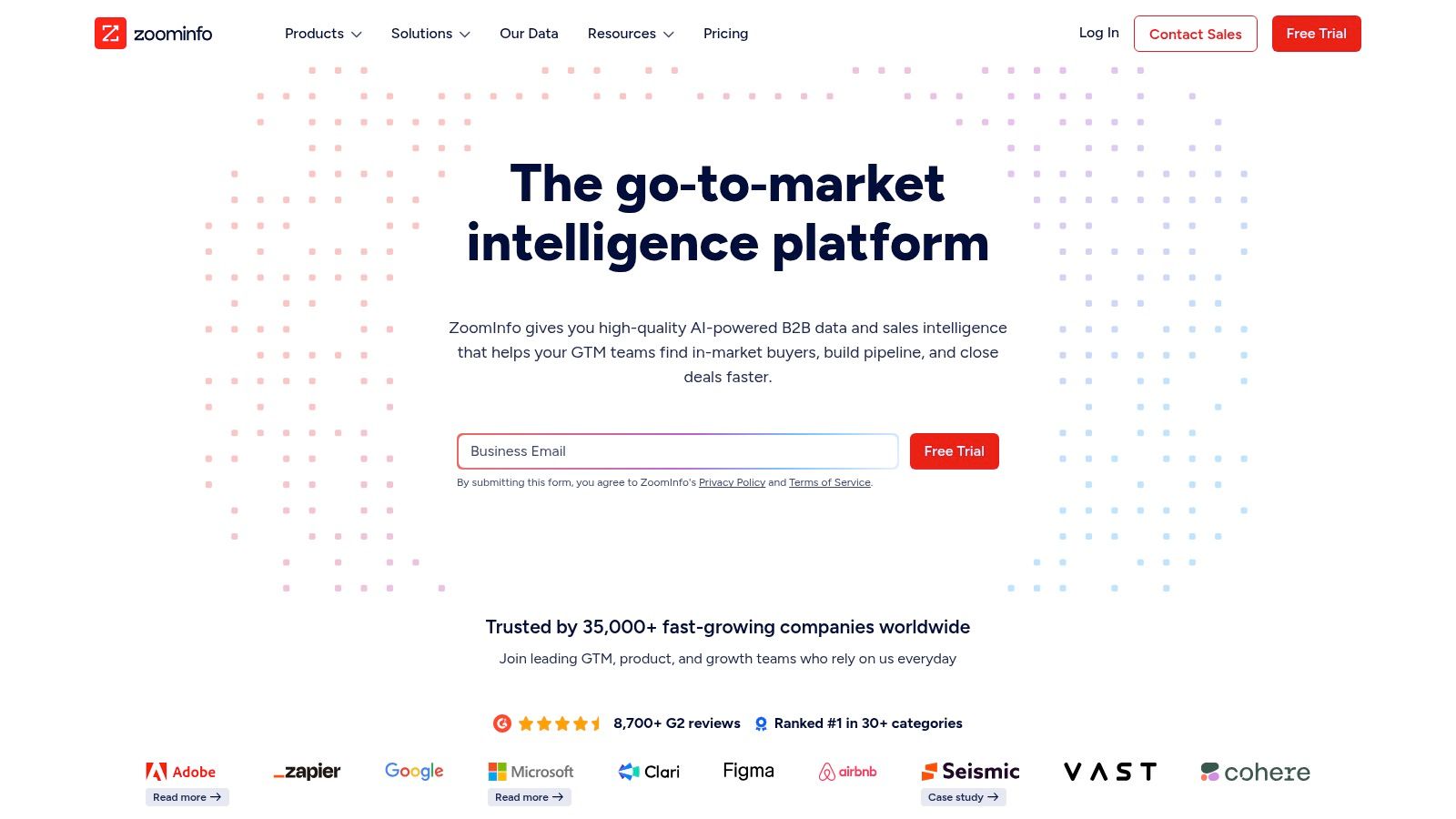
The platform leverages AI to analyze vast datasets, identifying companies and contacts exhibiting purchase intent signals. For B2B marketers, this means moving beyond static lists to dynamic, AI-curated audiences that are actively in-market. This data-first approach ensures that advertising spend and marketing efforts are focused on high-potential accounts, directly connecting intelligence to execution within a single workflow.
Key Features and Use Cases
- AI-Powered Audience Building: Uses buyer intent signals, predictive scoring, and website visitor tracking to automatically create and refine target account lists for campaigns.
- Multi-Channel ABM Activation: Natively launch display and social advertising campaigns targeting your AI-generated audiences, ensuring consistent messaging across channels.
- Website Personalization & Chat: Dynamically adapts your website content and chat experiences for visitors from target accounts, increasing engagement and conversion rates.
- Data Enrichment & Workflows: Automatically enriches inbound leads from forms with comprehensive company and contact data, enabling faster and more effective follow-up. ZoomInfo is a foundational tool for teams looking to supercharge their outbound lead generation.
How it Compares & Actionable Advice
Compared to Apollo.io: ZoomInfo is the enterprise-grade choice, offering more comprehensive data, particularly for North American markets, and a broader suite of ABM activation features. Apollo.io is the more accessible, SMB-friendly option with transparent pricing and a stronger focus on sales sequencing.
Actionable Advice: If data accuracy and depth are your absolute top priorities and your primary market is North America, ZoomInfo is the industry standard. Before signing a contract, provide a sample list of 50 target contacts or accounts to your sales rep and ask for an enrichment report to validate the data quality against your own records.
| Pro | Con |
|---|---|
| Vast U.S.-centric B2B data coverage | No public pricing; annual contracts can be costly |
| Single vendor for data and ABM execution | User feedback often cites strict contract terms |
| Strong integrations with major sales/marketing tools | Data accuracy can vary outside of North America |
Official Website: https://www.zoominfo.com/
8. Apollo.io
Best for: SMB and growth teams needing an affordable, all-in-one prospecting and engagement platform.
Apollo.io has positioned itself as an indispensable tool for B2B sales and marketing teams, integrating a massive contact database with powerful AI-driven engagement features. While primarily known for prospecting and data enrichment, its AI capabilities streamline the entire top-of-funnel process, from identifying ideal customers to crafting personalized outreach. This makes it one of the most effective AI tools for B2B marketing for teams focused on high-volume, data-driven outbound campaigns.
The platform's AI assists in writing personalized emails at scale, ensuring each message resonates without manual effort. For B2B marketers, Apollo.io consolidates prospecting, enrichment, and AI-powered sequencing into a single, affordable workflow. This integration allows growth teams to quickly build targeted lists, engage prospects with relevant messaging, and push qualified leads directly into their CRM.
Key Features and Use Cases
- AI-Assisted Email Writing: Generates personalized email copy based on prospect data, helping teams create effective outreach sequences quickly and overcome writer's block.
- Intent Data: Uses AI to identify accounts actively researching solutions like yours, allowing marketing and sales to prioritize outreach to the most engaged prospects.
- Automated Prospecting and Sequencing: Finds contacts matching your Ideal Customer Profile (ICP) and enrolls them into automated, multi-channel sequences that include AI-optimized emails.
- Data Enrichment and CRM Sync: Keeps your CRM data clean and up-to-date by automatically enriching contact and company records, ensuring your marketing campaigns are built on accurate information.
How it Compares & Actionable Advice
Compared to ZoomInfo: Apollo.io is the scrappy, high-value disruptor to ZoomInfo's enterprise dominance. It offers a very similar feature set (data, sequencing, enrichment) at a much more accessible price point, including a generous free tier. ZoomInfo generally has the edge on data quality, especially in the US, but Apollo is rapidly catching up.
Actionable Advice: If you are a startup or SMB, start with Apollo.io's free plan. It provides enough credits to test the data quality for your specific industry and persona. Use it to build a small, targeted list and run a test sequence. This no-cost pilot will tell you if the platform is a fit before you spend a dollar.
| Pro | Con |
|---|---|
| Excellent value for SMB and mid-market teams | Credit-based system can become costly at scale |
| All-in-one prospecting and engagement platform | Data accuracy can vary and requires ICP validation |
| Generous free tier for getting started | Less focused on inbound/content than HubSpot |
Official Website: https://www.apollo.io/
9. LinkedIn Marketing Solutions
Best for: Reaching specific B2B personas and decision-makers in a professional context.
LinkedIn Marketing Solutions has become an indispensable channel for B2B marketers, and its evolution into one of the most powerful AI tools for B2B marketing is driven by its deep integration of machine learning into its advertising platform. While not a standalone content tool, its AI optimizes ad delivery, audience targeting, and campaign bidding, making it essential for reaching professional audiences with unparalleled precision. The platform leverages AI to connect advertisers with the right buyer groups based on job titles, company data, and user behavior.
The core strength of LinkedIn's AI is its ability to learn from campaign performance in real-time. It automatically adjusts bids and audience delivery to maximize objectives like lead generation or brand awareness. For B2B teams, this means ad spend is more efficiently allocated to high-potential prospects, moving beyond simple demographic targeting to predictive audience optimization. This makes it a must-test paid channel for demand generation and account-based marketing (ABM) strategies.
Key Features and Use Cases
- Predictive Audiences: AI-powered feature that finds new audiences similar to your existing high-performing customer segments, expanding reach to relevant professionals who are more likely to convert.
- AI-Optimized Ad Formats: Includes Sponsored Content, Conversation Ads, and Lead Gen Forms. The platform’s AI determines the best ad format and placement to show each user to maximize engagement.
- Dynamic Bidding Strategies: Automatically manages bids to achieve campaign goals, such as maximizing clicks or conversions, by predicting the likelihood of a user taking a desired action.
- Creator Collaboration: The platform uses AI to help brands identify and collaborate with relevant industry creators and influencers through programs that enhance credibility and video inventory.
How it Compares & Actionable Advice
Compared to other ad platforms (Google/Meta): LinkedIn's primary advantage is its professional context and data. You can target users by job title, seniority, company size, and industry with a high degree of accuracy unmatched by other platforms. The trade-off is typically a higher cost-per-click (CPC) and cost-per-lead (CPL).
Actionable Advice: Don't just run ads; use LinkedIn's Matched Audiences feature. Upload a list of target accounts from your ABM platform (like 6sense or Demandbase) or your CRM. This allows you to focus your ad spend laser-precisely on the companies you already know are a good fit, dramatically improving your ROI.
| Pro | Con |
|---|---|
| Unmatched B2B targeting and native lead-gen forms | Higher CPMs/CPLs versus other social channels |
| Strong U.S. reach and brand-safe environment | Self-serve platform has a significant learning curve |
| AI-driven audience expansion finds new prospects | Managed services are limited to larger ad spends |
Official Website: https://www.linkedin.com/business/marketing
10. G2
Best for: Validating vendor claims with real-world user reviews and competitive analysis.
While not an AI tool itself, G2 is an indispensable resource for discovering, vetting, and comparing them. As the largest B2B software review marketplace, it serves as a critical first step for any marketing team building its tech stack. For those looking for AI tools for B2B marketing, G2 provides an aggregated view of the landscape, complete with user reviews, feature comparisons, and market presence grids that help teams shortlist vendors efficiently.
Instead of relying solely on vendor websites, marketers can use G2 to understand real-world user experiences and how different platforms perform in specific industries or company sizes. This peer-driven insight is invaluable for validating marketing claims and identifying potential drawbacks before committing to a demo or a purchase, making it a crucial due diligence platform.
Key Features and Use Cases
- Category Grids and Peer Reviews: Use the filterable grids to compare tools based on user satisfaction and market presence. The reviews provide honest, actionable feedback on implementation, support, and feature effectiveness.
- Price/Feature Summaries: Get a quick, high-level overview of a tool's capabilities and pricing tiers, which helps in creating an initial shortlist without visiting dozens of websites.
- Vendor and Market Analysis: G2's reports and market presence indicators offer a strategic view of who the established leaders are versus emerging challengers in the AI marketing space.
How it Compares & Actionable Advice
Compared to Capterra: G2's review process is often considered more in-depth, and its Grid reports provide a clearer visualization of a tool's market position (Leader, High Performer, etc.). Capterra has a very broad catalog and is excellent for discovering a wide range of options, particularly for small businesses.
Actionable Advice: Don't just look at the overall score. Use G2's filters to read reviews from users at companies of a similar size and industry to your own. Pay close attention to reviews that mention "Implementation" and "Support," as these are often the areas where a tool's true colors show. Use the "Compare" feature to see a head-to-head breakdown of your top 2-3 choices.
| Pro | Con |
|---|---|
| Up-to-date peer feedback and market indicators | Sponsored placements exist, so look beyond badges |
| Efficient research hub before contacting vendors | Pricing information may be incomplete; verify on vendor sites |
| Direct comparisons between competing solutions | Reviews can sometimes lack specific B2B context |
Official Website: https://www.g2.com/categories/account-based-marketing
11. Capterra
Best for: Discovering a wide range of software options and creating an initial longlist.
While not an AI tool itself, Capterra is an indispensable resource for discovering and vetting them. It serves as a comprehensive B2B software marketplace where marketers can find, compare, and read verified user reviews on hundreds of AI-enabled platforms. For B2B teams just beginning to build their tech stack, it provides a structured way to survey the landscape of AI tools for B2B marketing, moving from broad categories to specific solutions.
The platform’s real value lies in its detailed filtering system and side-by-side comparison features. Marketers can shortlist tools based on pricing models, specific features like lead scoring or content generation, and suitability for small businesses versus enterprise clients. This makes the initial research phase far more efficient than relying on general search engine results.
Key Features and Use Cases
- Advanced Filtering: Narrow down a vast catalog of AI tools by deployment type (cloud, on-premise), user rating, target business size, and specific marketing functions.
- Verified User Reviews: Gain insights from real-world users, helping you understand a tool's practical strengths and weaknesses beyond the vendor's marketing copy.
- Buyers Guides and Comparisons: Access curated reports and articles that break down software categories and directly compare leading products, helping you make an informed decision.
- Direct Vendor Links: Once you’ve identified a promising tool, Capterra provides direct links to request a demo, start a free trial, or view the vendor’s pricing page.
How it Compares & Actionable Advice
Compared to G2: Capterra's interface is very user-friendly for discovery and is particularly strong for SMB software. Its strength is in the breadth of its listings. G2 provides deeper competitive analysis through its proprietary Grid scoring and is often the go-to for mid-market and enterprise software evaluation.
Actionable Advice: Use Capterra at the very beginning of your search. Start with a broad category like "AI Marketing Tools" and use the filters for "Business Size" and "Key Features" to create a longlist of 5-10 potential vendors. From there, you can visit vendor websites or dive deeper into reviews on a platform like G2.
| Pro | Con |
|---|---|
| Broad coverage of AI marketing tools | Listings can skew toward vendors with active profiles |
| Verified reviews provide authentic user feedback | Technical detail varies significantly by listing |
| Useful for discovering niche or new AI solutions | Lacks hands-on testing or expert deep dives |
Official Website: https://www.capterra.com/ai-marketing-tools-software/
12. Salesforce AppExchange — Marketing Category
Best for: Salesforce customers looking to enhance their marketing capabilities with vetted, integrated apps.
For B2B teams already embedded in the Salesforce ecosystem, the AppExchange is less a single tool and more a curated gateway to hundreds of specialized applications. It functions as the official marketplace where marketers can find, vet, and install AI-powered apps that integrate seamlessly with Sales Cloud, Service Cloud, and Marketing Cloud. This makes it an essential resource for extending core Salesforce functionality with best-in-class AI tools for B2B marketing without complex integration projects.

Unlike discovering tools in the open market, the AppExchange provides a layer of trust and security, as apps undergo a Salesforce security review. Marketers can confidently add capabilities like predictive analytics, account-based marketing intelligence, or advanced content personalization, knowing the data flows directly into their central CRM. This allows for a highly customized marketing stack built around a single source of truth.
Key Features and Use Cases
- Curated and Vetted Apps: Discover marketing apps with detailed user reviews, ratings, and release histories. This is ideal for finding specialized AI solutions for lead scoring, data enrichment, or analytics that go beyond native Salesforce features.
- Seamless Integration: Install applications directly into your Salesforce instance, often with just a few clicks. This drastically reduces implementation time and ensures data alignment across sales and marketing teams from day one.
- Advanced Filtering: Users can filter apps by Salesforce edition, pricing models (including free trials), compliance standards, and specific cloud compatibility, making it easy to find solutions that fit both technical requirements and budget.
- Consolidated Vendor Management: Procuring apps through the AppExchange simplifies billing and vendor relationships, as many can be managed through your existing Salesforce account.
How it Compares & Actionable Advice
Compared to open market tools: The biggest advantage is guaranteed, pre-built integration with Salesforce. The trade-off can sometimes be a more limited selection or higher cost compared to standalone tools. However, the time and resources saved on custom integration often outweigh the price difference.
Actionable Advice: Before searching the AppExchange, clearly define the specific capability you're missing in your native Salesforce setup (e.g., "We need better lead-to-account matching" or "We need predictive lead scoring"). Use these specific keywords in your search. Always check the "Reviews" and "Last Updated" date to ensure the app is actively maintained and well-regarded by other users.
| Pro | Con |
|---|---|
| Trusted ecosystem with strong security alignment | Best value is exclusively for Salesforce customers |
| One-click installs simplify implementation | App overlap is possible; evaluate redundancy |
| Apps leverage existing CRM data for better ROI | Finding the right app requires careful research |
Official Website: https://appexchange.salesforce.com/category/marketing
Top 12 AI B2B Marketing Tools — Feature Comparison
| Product | Core Capabilities | Unique Strength ✨ | Target Audience 👥 | Pricing & Value 💰 | Quality ★ |
|---|---|---|---|---|---|
| marketbetter.ai 🏆 | AI content, multi‑channel automation, personalization, real‑time analytics | ✨ Integrated AI revenue engine; AI voice assistant; turnkey CRM writeback | 👥 Mid‑market → Enterprise B2B marketing teams | 💰 Enterprise pricing (no public); high ROI focus | ★4.97 (G2) 🏆 |
| HubSpot Marketing Hub | AI writing & SEO, automation, native CRM, reporting | ✨ CRM + marketing in one; large partner ecosystem | 👥 SMB → Enterprise B2B teams | 💰 Tiered plans + free tier; predictable pricing | ★4.5 |
| Salesforce Marketing Cloud Account Engagement (Pardot) | Einstein scoring, B2B analytics, lead nurturing | ✨ Tight Salesforce CRM alignment & governance | 👥 Salesforce‑centric mid → enterprise | 💰 Enterprise-priced; higher entry | ★4.3 |
| Adobe Marketo Engage | Lead management, advanced nurturing, personalization | ✨ Highly configurable for complex buyer journeys | 👥 Enterprise B2B with sophisticated nurture needs | 💰 Sales‑driven pricing; can be significant | ★4.1 |
| 6sense Revenue AI | Predictive intent, in‑market account discovery, AI email agents | ✨ Agentic AI for ABM & pipeline conversion | 👥 Midmarket & enterprise ABM teams | 💰 No public pricing; enterprise sales motion | ★4.2 |
| Demandbase One | Intent & engagement scoring, B2B DSP, orchestration | ✨ Full‑funnel ABM + integrated B2B DSP | 👥 ABM‑mature mid → enterprise teams | 💰 Custom pricing; discovery required | ★4.0 |
| ZoomInfo MarketingOS | Data enrichment, audience building, ad activation | ✨ Large U.S. B2B dataset + end‑to‑end ABM stack | 👥 Data‑driven sales & marketing teams | 💰 No public pricing; annual contracts common | ★4.1 |
| Apollo.io | Prospecting, sequences, enrichment, dialer, AI writing | ✨ Transparent, low‑entry pricing with free tier | 👥 SMB & growth/outbound teams | 💰 Low‑entry + free options; credit limits apply | ★4.3 |
| LinkedIn Marketing Solutions | Sponsored content, Conversation Ads, Lead Gen Forms | ✨ Unmatched B2B targeting & native lead gen | 👥 B2B demand gen & ABM advertisers | 💰 CPM/CPL higher; ROI depends on creative | ★4.4 |
| G2 | Peer reviews, category grids, vendor links, buyer insights | ✨ Real‑time peer feedback & 'Best Of' signals | 👥 Buyers researching software vendors | 💰 Free research (vendor promos possible) | ★4.6 |
| Capterra | Catalog, filters, buyer guides, vendor links | ✨ Easy shortlist & SMB‑friendly discovery | 👥 SMB buyers & tool evaluators | 💰 Free to use | ★4.5 |
| Salesforce AppExchange — Marketing | Curated marketing apps, filters, installs, compliance | ✨ Trusted Salesforce marketplace & governance | 👥 Organizations on Salesforce | 💰 Varies by app; many trials available | ★4.2 |
Try our Marketing Plan Generator — generate a complete AI-powered marketing plan in minutes. No signup required.
Making Your Choice: A Framework for Selecting the Right AI Marketing Tool
We've explored a comprehensive landscape of AI tools for B2B marketing, from all-in-one platforms like HubSpot and Salesforce Marketing Cloud to specialized powerhouses like 6sense and Demandbase. The sheer number of options can feel overwhelming, but the central takeaway is clear: AI is no longer a futuristic concept but a present-day necessity for driving B2B growth, efficiency, and revenue. The right tool doesn't just automate tasks; it elevates your strategic capabilities.
The key is to move from a general understanding of "what's out there" to a specific diagnosis of "what we need right now." The most successful AI adoption stories begin not with a fascination for technology but with a deep-seated business problem. By anchoring your search in a real-world challenge, you transform a feature comparison exercise into a strategic investment decision.
Your Actionable Selection Framework
Choosing the right AI partner is a critical decision that will shape your marketing team's effectiveness for years to come. Instead of getting lost in feature lists, follow this structured, three-step approach to make a confident and impactful choice.
-
Identify Your Single Biggest Bottleneck: Before you look at any more demos, look inward. Where is the most significant friction in your marketing funnel?
- Is it Content Velocity? If your team struggles to produce high-quality, relevant content at scale, platforms with strong generative AI capabilities should be at the top of your list. For more granular guidance, reviewing detailed comparisons of AI marketing tools can offer deeper insights into which platforms excel specifically at content creation.
- Is it Lead Quality and Intent? If your sales team is wasting cycles on unqualified leads, prioritize Account-Based Marketing (ABM) and intent data platforms like 6sense, Demandbase, or ZoomInfo. These tools are built to pinpoint in-market buyers with precision.
- Is it Campaign Personalization? If your engagement metrics are flat due to generic messaging, look to tools like Marketo Engage or a unified platform like marketbetter.ai that use AI to deliver hyper-personalized experiences across channels.
- Is it Proving ROI? If you struggle to connect marketing activities to revenue, you need a solution with robust analytics and attribution modeling, a core strength of integrated CRM and marketing automation platforms.
-
Audit Your Existing Tech Stack: A new tool must enhance, not complicate, your current workflow.
- Consolidate or Integrate? Does your team suffer from "tool fatigue"? An all-in-one platform like marketbetter.ai or HubSpot could consolidate costs and data, creating a single source of truth. Conversely, if you have a deeply embedded system like Salesforce, a specialized tool from the AppExchange that integrates seamlessly might be the smarter, lower-friction choice.
- Check for Native Integrations: Always prioritize tools with pre-built, native integrations for your critical systems (CRM, sales engagement, data warehouses). Custom API work is expensive, time-consuming, and adds a long-term maintenance burden.
-
Run a Focused Pilot Program: Avoid a full-scale, company-wide rollout from day one. Instead, design a small, controlled experiment to validate the tool’s value.
- Define Clear Success Metrics: What does success look like in 90 days? Is it a 15% increase in MQL-to-SQL conversion rate? A 20% reduction in content production time? A 10% lift in pipeline from a target account list? Make it specific, measurable, and tied to a business outcome.
- Select a Champion Team: Empower a small, motivated group of users to pilot the tool. Their feedback will be invaluable for identifying real-world challenges, refining workflows, and building a case for a wider rollout.
By methodically addressing your primary pain point, assessing your tech stack, and validating your choice with a disciplined pilot, you can confidently select and implement one of the powerful AI tools for B2B marketing from this list. This structured approach ensures your investment delivers tangible, measurable business impact and positions your marketing organization for a new era of intelligent growth.
Ready to unify your B2B marketing efforts and see how AI can drive real pipeline? marketbetter.ai integrates powerful AI across content creation, personalization, and analytics into a single, intuitive platform designed to eliminate tool fatigue and prove ROI. Discover how our solution can streamline your entire workflow by visiting marketbetter.ai today.