3 posts tagged with "audience segmentation"

View All Tags

What Is Audience Segmentation? A Practical Growth Guide

· 25 min read

Audience segmentation is the difference between shouting into a crowded stadium and having a real conversation. It's the actionable strategy that stops you from broadcasting one generic message to everyone and helps you start talking to smaller, specific groups about what they actually care about.

This shift ensures your marketing efforts land with the people who matter most, turning generic outreach into personalized, high-impact communication.

What Is Audience Segmentation and Why Does It Matter?

Imagine you run a high-end coffee shop. You've just sourced some incredible single-origin espresso beans and you need to sell them.

You could take out a generic ad targeting everyone in your city. That’s the "spray and pray" approach—a fantastic way to waste money. It's the equivalent of mass marketing, where the message is broad and the results are unpredictable.

Three business professionals discuss audience segmentation in a meeting room with a stadium view.

Now, what if you segmented your audience? This is where targeted marketing comes in. You could create a group called "Coffee Connoisseurs"—people who've bought premium beans before or attended your tasting events. Another group might be "Home Baristas," folks who recently bought an espresso machine.

You can now tailor your message. The connoisseurs get an email about a rare new bean. The home baristas get a guide on pulling the perfect shot. Suddenly, your marketing isn't just noise; it's genuinely useful. That’s the entire point of audience segmentation: treating different customers differently because you understand who they are.

The True Cost of Ignoring Segmentation

Skipping segmentation is like trying to fit a square peg in a round hole. You're blasting a one-size-fits-all message at diverse groups with unique problems and motivations. It doesn't just lead to poor results; it can actively annoy potential customers who feel like you don't get them at all.

This isn't just a theory; the numbers are staggering. Companies that get this right see a 760% jump in email revenue compared to those that don't. With 81% of consumers saying they're more likely to buy from brands that offer personalized experiences, the case is closed.

In fact, a massive 77% of marketing ROI comes directly from segmented, targeted campaigns. You can explore more data on audience segmentation's impact to see the full picture.

Audience segmentation isn't just a marketing tactic; it's a fundamental business strategy. It transforms your communication from a monologue into a dialogue, building stronger relationships and driving sustainable growth by showing customers you understand them.

Audience Segmentation At a Glance

To make this crystal clear, let's compare the before and after. This table sums up the core ideas behind audience segmentation and why it's a non-negotiable for any business that wants to connect with customers in a meaningful way.

ConceptDescriptionCore Benefit
WhoThe specific subgroups of your larger audience, defined by shared traits like behavior, location, or interests.Moves you from speaking to a faceless crowd to engaging with distinct groups of people.
WhatThe process of grouping these individuals using data from your CRM, website analytics, and customer feedback.Allows you to create targeted campaigns, content, and product offers that are highly relevant.
WhyTo deliver personalized experiences that increase engagement, boost conversion rates, and foster long-term loyalty.Improves marketing ROI by focusing resources on the most receptive and valuable customer segments.

At the end of the day, understanding audience segmentation means recognizing that relevance is the new currency in marketing. When you group your audience thoughtfully, you stop wasting time and money and start building real connections that drive your business forward.

The Four Core Segmentation Methods You Need to Know

Think of understanding your customers like getting to know a new friend. At first, you only know the basics—their name, where they live. That's surface-level stuff. To really get them, you need to understand how they think, what they care about, and what they actually do.

Audience segmentation works the same way. We start with the simple, observable facts and then layer on deeper insights to build a complete picture. These methods aren't just different ways to slice data; they're different lenses for seeing your audience. When you combine them, you move from guessing games to genuine, actionable understanding.

Demographic Segmentation: The "Who"

This is your starting point. Demographic segmentation is the most straightforward way to group people, answering the fundamental question: "Who, exactly, are we talking to?" It categorizes your audience based on objective, easily verifiable attributes.

It's like sorting a deck of cards by suit or number—clear, defined characteristics. For a business, that looks like:

  • Job Title: A B2B software company selling project management tools targets "Project Managers" or "Heads of Operations."
  • Company Size: An IT provider might create a segment for small businesses with 10-50 employees.
  • Age and Gender: A direct-to-consumer brand could target skincare products for women aged 45-60.
  • Income Level: A wealth management firm will focus on households earning over $250,000 annually.

Demographics are solid and easy to get, but they only tell you who is buying, not why.

Geographic Segmentation: The "Where"

Next up is geography, which answers the simple question: "Where are these people located?" This isn't just for brick-and-mortar stores. For digital businesses, location dictates everything from language and currency to cultural norms and legal rules.

Think about it: you wouldn't try to sell heavy winter coats to customers in Miami. And a global SaaS company knows that messaging that works in Silicon Valley might need a tweak for an audience in Berlin.

Common geographic data points include:

  • Country or Region: Crucial for localization, currency, and compliance.
  • Climate: Directly impacts demand for seasonal products.
  • Urban vs. Rural: A city-dweller's needs (food delivery, public transport) are wildly different from a rural customer's (gardening supplies, off-road vehicles).

Psychographic Segmentation: The "Why"

This is where it gets really interesting. If demographics are the skeleton, psychographics are the personality. This method digs into the why behind customer choices, grouping people by their values, attitudes, interests, and lifestyles.

Psychographics uncover what truly motivates someone to buy. You could have two people who look identical on paper—say, 35-year-old men with high incomes living in the same city. But one is a risk-averse saver who values security above all else, while the other is an adventurous thrill-seeker who spends his money on experiences. You can't reach both with the same message.

Key psychographic variables look at:

  • Values and Beliefs: A brand built on sustainability will naturally attract environmentally conscious consumers.
  • Lifestyle: A meal-prep delivery service is a perfect fit for busy professionals who value convenience.
  • Interests and Hobbies: A tech company knows to market its new gaming laptop to people who follow esports.

Behavioral Segmentation: The "What"

Finally, we have the most powerful method of all: behavioral segmentation. This one cuts through all the assumptions and focuses on what people actually do. It answers the question, "How is my audience interacting with my brand?"

This is pure, actionable data based on observed engagement. It’s the difference between what someone says they’ll do and their real-world actions.

There are many ways to approach advanced segmentation. While these four are the foundation, experts also look at things like technographic (what tech they use) or transactional data. The key is using the right lens for the job. You can learn more about these different segmentation approaches and see which ones fit your strategy.

Common behavioral data points include:

  • Purchase History: Separating frequent, high-value customers from one-time discount shoppers.
  • Website Activity: Creating a segment for users who abandoned their carts to send a targeted follow-up.
  • Feature Usage: A software company can identify power users of a specific feature and reach out for a case study.
  • Email Engagement: Rewarding your most engaged subscribers (the ones who open every email) with an exclusive offer.

Comparing The Four Core Segmentation Methods

To make it even clearer, here's a simple breakdown of how these four methods stack up against each other. Each one provides a different piece of the puzzle, and knowing when to use which is key to building a smart marketing strategy.

Segmentation TypeWhat It AnswersCommon Data PointsExample Use Case
DemographicWho are they?Age, job title, income, company sizeA B2B SaaS company targeting "Marketing Directors" at firms with 500+ employees.
GeographicWhere are they?Country, city, climate, urban/ruralA retailer promoting snow blowers to customers in the Northeastern US in October.
PsychographicWhy do they buy?Values, lifestyle, interests, beliefsA sustainable fashion brand targeting consumers who prioritize eco-friendly products.
BehavioralWhat do they do?Purchase history, website clicks, email opensAn e-commerce site sending a discount code to users who abandoned their shopping carts.

Ultimately, no single method tells the whole story. The real power comes from layering these approaches together to create a full, three-dimensional view of your customer.

The most effective strategies rarely rely on a single segmentation method. The magic happens when you layer them. A B2B company might target "Marketing Directors" (demographic) at "SaaS companies in North America" (geographic) who have "downloaded a whitepaper on AI" (behavioral). This creates a highly specific, relevant, and actionable audience segment.

Real World B2B Audience Segmentation Examples

Knowing the different ways to slice up an audience is one thing. Watching those slices turn into actual business results? That's another entirely. The real magic of segmentation happens when you stop thinking in theory and start applying it to solve tangible, everyday business problems. For B2B companies, especially, the shift away from generic, one-size-fits-all outreach can be dramatic.

So, let's get practical. I'm going to walk you through three real-world scenarios showing how B2B teams use segmentation to drive upgrades, sharpen their sales pitches, and find revenue hiding in plain sight.

Each example is broken down into a simple Problem, Solution, and Result. Think of it as a blueprint you can steal for your own challenges. They all build on the four core pillars of segmentation you see below—the different lenses we can use to understand who our customers are and what they need.
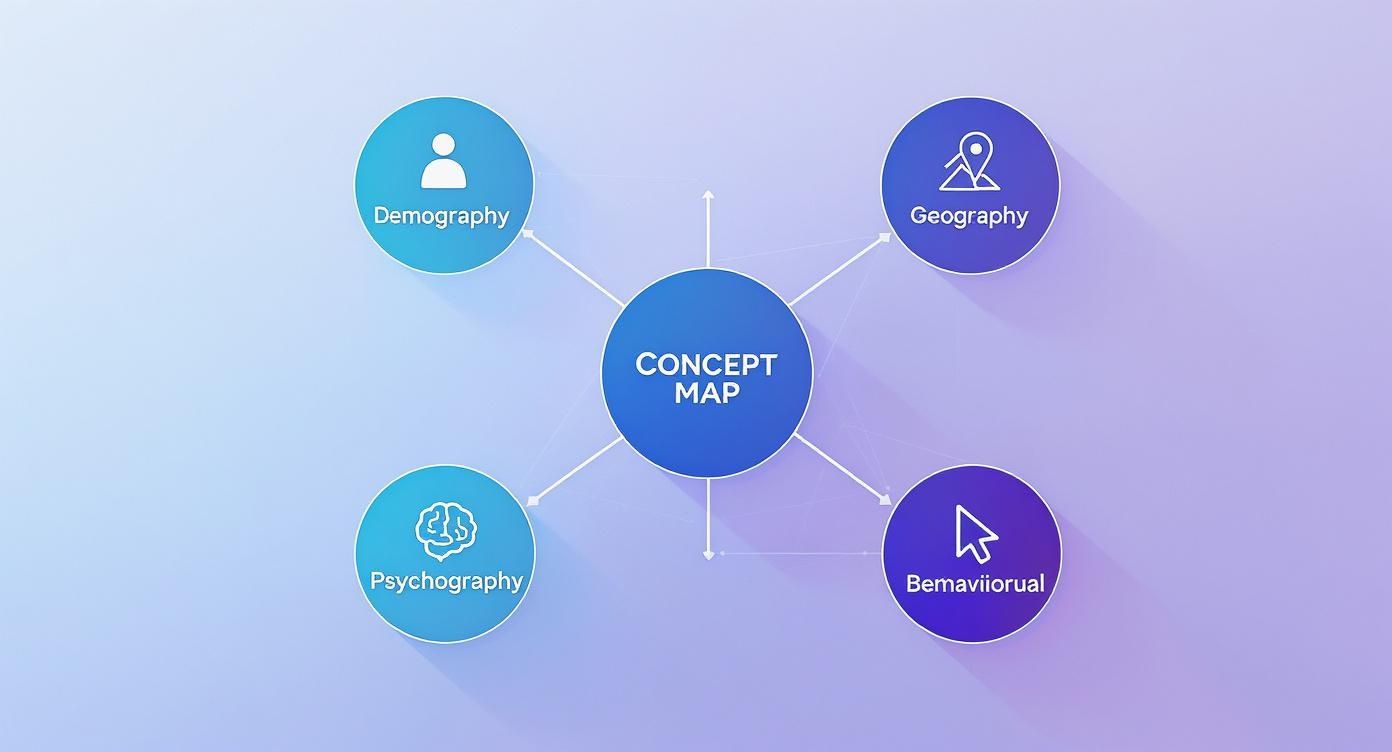
A concept map illustrating audience segmentation categories: demography, geography, psychography, and behavioral.

This map is a good reminder that you can view your audience through multiple lenses—from who and where they are to why and how they act.

SaaS Company Driving Upgrades with Behavioral Segmentation

The Problem: A mid-sized project management SaaS company had a problem. A huge chunk of their "Basic" tier users never even clicked on the more advanced features. This meant upgrade rates were flat, and worse, churn risk was high because these users weren't getting the full value. Their generic "Upgrade Now!" emails were going straight to the trash.

The Solution: They stopped blasting everyone and got smart with behavioral segmentation. They split their users into two simple, action-based groups right inside their platform:

  • "Power Users": These were the folks constantly hitting the limits of the Basic plan—running out of projects, maxing out storage. They were using every feature available to them.
  • "Under-Engaged Users": These customers logged in but stuck to just one or two basic functions, completely unaware of the more powerful tools they had access to.

"Power Users" got campaigns that felt like a secret handshake, showing them exactly how premium features would solve the bottlenecks they were already experiencing. Meanwhile, the "Under-Engaged Users" received gentle, educational content—like short video tutorials—highlighting a single advanced feature that would make their current workflow even better.

The Result: It worked. They saw a 35% increase in upgrades from the "Power Users" group in just three months. They also cut churn by 15% among the "Under-Engaged" segment, simply by helping them get more value from the product.

By focusing on what customers did (behavioral data) instead of just who they were, the company made every message feel relevant. They connected the dots between user actions and business outcomes.

Manufacturing Firm Tailoring Sales Pitches by Industry

The Problem: A manufacturer of industrial automation gear was spinning its wheels. Their sales team was pitching the same generic script to everyone, from car factories to pharmaceutical labs. The message wasn't landing because it failed to address the vastly different pain points and regulations in each sector.

The Solution: The marketing team switched gears to a firmographic segmentation strategy. They looked at their best customers and broke their target market into three core industries. Then, they built a completely separate playbook for each one.

  • The automotive segment saw case studies and emails all about boosting assembly line speed and cutting downtime.
  • The pharmaceutical segment got content that hammered on precision, FDA compliance, and sterile production—the things that actually keep them up at night.

The Result: By speaking each industry's language, the company boosted its marketing-qualified leads (MQLs) by a massive 50%. Even better, the sales cycle shrank by 20% because prospects were coming to the table already knowing the company understood their world.

Professional Services Firm Cross-Selling with Client History

The Problem: A digital marketing agency offered a full suite of services—SEO, PPC, content—but most clients only ever bought one. They knew they were sitting on a goldmine of cross-sell opportunities but had no systematic way to figure out who to approach and what to say.

The Solution: The agency dug into its own data, segmenting clients based on their transactional and behavioral history. They created a hyper-specific segment they called "SEO-Only Success Stories." These were clients who had seen a huge jump in organic traffic (a behavioral metric) from their SEO service (a transactional metric).

This group then received a highly personalized campaign. It showed them their own success and then explained how adding PPC could instantly capitalize on that newfound visibility to capture high-intent leads. They even wove in testimonials from similar clients, a tactic we break down in our guide on using voice of customer examples.

The Result: The campaign was a hit, converting 25% of those single-service clients into multi-service accounts. This dramatically increased their average client lifetime value without having to go out and find a single new customer.

How to Build Your Audience Segmentation Strategy

Alright, so we’ve covered the what and the why of segmentation. Now for the fun part: actually doing it. Moving from theory to a real, working strategy can feel like a huge leap, but it’s not. It's a step-by-step process, not some massive, all-at-once project.

Think of it like building with LEGOs. You don’t just dump the whole bin on the floor and hope a spaceship appears. You start with a plan, find the right pieces, and click them together thoughtfully. Let’s walk through the five essential steps to build your own strategy from the ground up.

A 'Segmentation Playbook' notebook on a wooden desk with a pen, plant, and laptop, showing a numbered list.

Step 1: Define Your Business Goals

Before you slice up your audience list, you have to answer one simple question: Why are we doing this? What's the business outcome you're trying to drive? Without a clear goal, you’ll end up with a bunch of interesting-but-useless segments.

This goal becomes your North Star. It guides every single decision you make from here on out. Are you trying to:

  • Increase customer lifetime value? Then you’ll probably segment based on purchase history to find juicy cross-sell opportunities.
  • Reduce churn? That means you'll want to segment by product usage to spot the accounts that are starting to drift away.
  • Improve lead conversion rates? Your focus would be on segmenting new leads by their industry or the specific pain point they came in with.

A well-defined goal—like "increase upgrade rates from our 'Freemium' user base by 15% in the next quarter"—provides the focus you need to build segments that actually move the needle. Start with the end in mind.

Step 2: Gather and Analyze Your Data

With your goal locked in, it’s time to find your LEGO bricks. This is all about pulling data from every place your customers interact with you. Good, clean data is the bedrock of any solid segmentation effort.

You’ll find gold in a few key places:

  • CRM: This is your home base for firmographics and basic account details like job titles, company size, and location.
  • Website Analytics: Tools like Google Analytics or Matomo are treasure troves of behavioral data. You can see which pages people visit, what features they click on, and how long they stick around.
  • Customer Surveys and Feedback: Don't be afraid to just ask. Direct feedback gives you rich psychographic insights into your customers' actual challenges, goals, and motivations that you can’t get anywhere else.

Once you have the data, you need to centralize it. For a deeper dive, there are great resources on building a data-driven customer segmentation strategy that can help you get this foundation right.

Step 3: Choose Your Segmentation Models

Now you get to decide how to group everyone. This is where you combine the different methods we talked about—demographic, behavioral, firmographic—to create segments that directly serve the goal you set in step one. A classic B2B starting point is to simply mix firmographics with behavior.

Actionable Comparison: Two Common Starting Models

Model NameDescriptionBest For
Value-Based SegmentationGroups customers by their economic value—past, present, or future. Think high-spend, mid-spend, and low-spend tiers.Businesses focused on maximizing revenue from existing customers and giving their high-value accounts the white-glove treatment.
Needs-Based SegmentationGroups customers based on the specific problems they're trying to solve or the benefits they want from your product.Companies with multiple products or features who need to make their marketing and sales messaging hyper-relevant.

The key is to start simple. Pick one or two models that make sense. You can always get fancier later.

Step 4: Develop Detailed Segment Profiles

Your segments can't just be rows in a spreadsheet. To be useful, they need to feel like real groups of people. This is where you build a simple profile or “persona” for each one, making it dead simple for your marketing and sales teams to know exactly who they’re talking to.

Give each segment a memorable name, like “Tech-Savvy Startups” or “Established Enterprise Accounts.” Then, flesh it out with their key characteristics, common pain points, and what motivates them. This is the step that turns raw data into a practical tool your whole company can rally around.

Step 5: Launch, Test, and Refine

Time to put your work into the wild. Pick one or two of your most promising segments and launch a targeted campaign. This could be anything from a tailored email sequence to a specific ad campaign on LinkedIn or even personalized content on your website.

And then? You measure everything. Track the metrics that matter for your goal—open rates, click-through rates, demo requests, conversion rates. Compare the results for each segment against your old, one-size-fits-all approach.

Segmentation isn't a "set it and forget it" project. It’s a living strategy. You’ll learn, you’ll tweak, and you’ll get better with every campaign. This is a cycle of continuous improvement.

How AI Is Reshaping Audience Segmentation

Manual audience segmentation has its place, but let's be honest—it has limits. It’s a bit like trying to sort a mountain of LEGO bricks by hand. You can group them by color and shape, but you'll miss the subtle patterns and the really interesting combinations.

AI is the supercomputer that sorts the entire pile in seconds, uncovering connections you never knew existed. It elevates segmentation from a static, rule-based chore into a dynamic, predictive engine. Instead of just looking at what customers have done, AI helps you see what they’re likely to do next.
A person in glasses views AI-powered data segments on a large interactive screen in a modern room.

This isn't just a minor tweak; it's a fundamental shift. We're moving beyond simple groupings to create fluid segments that adapt in real time as customer behavior changes.

And the market reflects this. The global AI market is on a trajectory to blast from $22.6 billion in 2020 to $190.6 billion by 2025. This explosive growth is driven by businesses like yours adopting AI-powered tools to make sense of overwhelmingly complex data.

From Reactive to Predictive Segmentation

The biggest change AI brings to the table is the move from being reactive to predictive.

Think about it. Machine learning algorithms can chew through massive datasets—purchase history, website clicks, support tickets, social media mentions—and spot hidden correlations a human analyst would almost certainly miss. The system learns which signals are most likely to predict a future action, like a purchase or, just as importantly, a cancellation.

This is the heart of predictive segmentation, a way of grouping customers based on their likelihood to do something.

  • Traditional Segmentation: "Let's pull a list of customers who haven't bought anything in 90 days." This is reactive. You're looking backward.
  • Predictive Segmentation: "Let's find customers who are showing the same behavioral red flags as the ones who churned last quarter—even if they just bought something yesterday." This is predictive. You're looking forward.

AI doesn't just categorize your audience; it forecasts their future needs. This lets you step in with the right message before a customer decides to look elsewhere or cancel their plan. It's a massive competitive advantage.

This analytical firepower is a game-changer for marketers. To see how this works under the hood, check out our guide on predictive analytics in marketing.

Hyper-Personalization at Scale

The other huge win from AI segmentation is hyper-personalization.

Traditional methods might let you personalize an email with a customer's name and recommend a product based on their last purchase. That’s a good start, but AI takes it leagues further. It can analyze an individual's entire journey with your brand and create a "segment of one."

This means the website content, product recommendations, and marketing messages can all change dynamically for each person. It’s the difference between a store clerk who remembers your last purchase and a personal shopper who knows your style, your budget, and what you’ll be looking for next season.

Comparing Personalization Approaches

AspectTraditional PersonalizationAI-Powered Hyper-Personalization
Data UsedBasic demographics, past purchasesEntire customer journey, real-time behavior, predictive scores
ExecutionManual, rule-based campaigns ("If this, then that")Automated, dynamic content that adapts to each user's actions
OutcomeRelevant content ("You bought X, you might like Y")Anticipatory experiences ("We know you like X, so here’s an exclusive look at Z before it launches")

This level of granular targeting used to be the exclusive domain of giants like Amazon or Netflix. Not anymore. Modern platforms are making it accessible for everyone.

For example, AI's impact extends well into lead generation, where it can dramatically improve how you segment and target prospects. It's why so many companies are now adopting AI-powered lead generation strategies to find high-value leads with far greater precision. This shift from broad targeting to individual engagement is how modern businesses build deeper, more profitable customer relationships.

Common Segmentation Mistakes to Avoid

So, you've decided to get serious about audience segmentation. That’s a huge step. But like any powerful strategy, there are a few classic ways it can go sideways. Knowing what segmentation is also means knowing where the landmines are buried.

Think of this as your field guide to sidestepping the traps that can turn a brilliant plan into a complicated mess. Nail these, and your segments will stay sharp, actionable, and tied directly to your business goals. Let's walk through the most common mistakes I've seen and a simple "Instead of This, Do That" fix for each one.

Over-Segmenting Your Audience

It’s tempting, I get it. You have all this data, and it feels productive to slice and dice your audience into a dozen or more hyper-specific groups. This is a classic rookie mistake. While it looks precise on a spreadsheet, you've just created a management nightmare. There's no way your team can create unique, meaningful campaigns for every single micro-segment.

Instead of: Creating 15 micro-segments that are impossible to manage. Do This: Focus on 4-6 high-impact segments that represent distinct, valuable groups. Prioritize quality and actionability over sheer quantity.

This approach lets you give each important segment the attention it deserves. It keeps you from letting the whole strategy collapse under its own weight.

Using Outdated or Stale Data

Your audience isn't frozen in time—people change, companies evolve, and priorities shift. A segment you built on data from six months ago might be completely useless today. Relying on old information is like navigating with an old map. You're going to get lost.

This is how you end up with misaligned messaging and wasted ad spend. The contact who was a "New Lead" last quarter might be a "Loyal Advocate" now. They need to be treated that way.

Stale vs. Fresh Data: The Bottom Line

MistakeThe Painful ConsequenceThe Simple Fix
Relying on old dataYour messaging feels tone-deaf and irrelevant, killing engagement and conversions.Refresh your data quarterly. Put a recurring reminder on your calendar to re-pull analytics and review your segment rules.
Ignoring real-time signalsYou miss golden opportunities to engage customers at critical moments, like right after a purchase.Integrate real-time behavioral triggers. Use marketing automation to move contacts between segments based on what they just did.

Creating Segments That Aren't Distinct

Here’s another common pitfall: building segments that bleed into each other. If your "Budget-Conscious SMBs" and your "Early-Stage Startups" groups are filled with mostly the same companies, your segments aren't different enough to matter. They lack clear lines.

Every segment should have unique DNA and require a distinct marketing angle. The sniff test is simple: if you can send the exact same email to two different segments, they probably shouldn't be two different segments.

  • Instead of: Having segments with 70% audience overlap.
  • Do This: Make sure each segment is clearly defined and mutually exclusive. Run a test on your criteria to confirm that less than 10% of your audience could reasonably fit into multiple segments. This clarity is what makes your targeting lethal.

By sidestepping these common errors, you're not just creating complexity. You're building a segmentation framework that’s tough, smart, and actually drives business results.

A Few Common Questions on Audience Segmentation

Jumping into segmentation usually brings up the same handful of questions. Let's tackle them head-on so you can move from theory to practice with confidence.

How Many Segments Should I Actually Create?

It’s easy to fall into the trap of creating a dozen hyper-specific segments, but that just creates noise and a ton of extra work. A good rule of thumb? Start with three to five high-impact segments.

Focus on the groups that will move the needle the most. Think "High-Value Repeat Customers," "At-Risk Churn Accounts," or "New Leads from Top-Tier Industries." You can always get more granular later, once you’ve nailed the process of targeting these core groups.

Audience vs. Market Segmentation—What’s the Real Difference?

This is a big one, and the distinction is crucial. The easiest way to think about it is with an analogy.

  • Market Segmentation: This is like looking at a map of the entire country. You're dividing the total potential market into logical groups, including millions of people who have never even heard of your company.
  • Audience Segmentation: This is like looking at your personal address book. You're focused on dividing your known contacts—the people already in your world, like existing customers, leads, and email subscribers.

The key difference is scope. Market segmentation is for high-level strategy, like product development or new market entry. Audience segmentation is for tactical marketing and communication with the people you can already reach.

How Often Should I Revisit My Segments?

Your segments aren't a "set it and forget it" project. People's needs and behaviors change, so your segments need to keep up. A good rhythm is to review them quarterly or right after any major marketing campaign.

When you do, ask yourself a couple of simple questions: Are these groups still distinct from one another? Are they still driving the results we expect? This regular check-in keeps your strategy sharp and prevents you from making decisions based on old, outdated assumptions.


Ready to stop guessing and start targeting with precision? marketbetter.ai uses AI to uncover your most valuable audience segments, automate personalized campaigns, and drive real growth. Discover how our AI-powered marketing platform can transform your strategy at https://www.marketbetter.ai.
what is behavioral targeting: A quick guide to targeted ads

· 18 min read

Think of it like a great shop assistant who remembers what you like. The one who doesn't show you sweaters when you're clearly looking for running shoes. That's what behavioral targeting does online. It's a strategy that looks at your digital footprint—the articles you read, the products you click on, the videos you watch—to show you ads that actually make sense for you.

Unpacking Behavioral Targeting

At its heart, behavioral targeting is about moving away from the old "spray and pray" method of advertising. Instead of blasting a single generic message to millions, it’s about listening to what people's actions are telling you and tailoring the experience accordingly. The whole idea is built on a simple truth: what you've done in the past is the best clue to what you'll do next.

This marketing strategy analyzes how users behave online—their search queries, the content they consume, their purchase history—to deliver personalized ads. It works by collecting data from websites and apps to group audiences based on things like buying intent and browsing habits. And it works. This kind of targeted advertising pulls in, on average, 2.7 times more revenue per ad compared to ads that aren't targeted. You can dig into more data on behavioral advertising results on Jake Jorgovan's blog.

Behavioral Targeting Compared to Other Methods

To really get what makes behavioral targeting unique, it helps to see it side-by-side with other common ad strategies. Each one uses different data to find an audience, but their aim and accuracy are worlds apart.

Targeting MethodWhat It TracksPrimary GoalActionable Example
BehavioralIndividual user actions (clicks, views, purchases)Personalize ads based on proven interests and intent.Showing ads for running shoes to a user who recently read articles about marathon training.
ContextualWebsite or page content (keywords, topics)Place ads alongside relevant content, regardless of the user.Displaying an ad for a new video game on a game review blog.
DemographicUser attributes (age, gender, location, income)Reach broad audience segments based on static characteristics.Advertising luxury cars to individuals in high-income postal codes.

As you can see, each method has its place, but they operate on fundamentally different assumptions about the user.

The Actionable Difference: From Guessing to Knowing

The real takeaway here is the level of personalization. Demographic targeting is basically an educated guess (“people in this age group probably like this”). Contextual targeting aligns with a topic (“someone reading about cooking might need new pans”). But behavioral targeting acts on proven interest.

Behavioral targeting doesn't just guess what you might like; it responds to what your actions have already told it you're looking for. This makes the ads you see less of an interruption and more of a helpful suggestion.

This direct line to user behavior is what makes the strategy so powerful. It lets brands connect with potential customers at the precise moment their interest peaks, turning a passive browse into a real chance to engage.

How Behavioral Targeting Technology Works

To really get what behavioral targeting is, you have to peek behind the curtain at the tech making it all happen. Think of it as a digital detective story. It follows clues—your clicks, your views, your time spent on a page—to solve the mystery of what you actually want. The whole thing is a slick cycle of data collection, analysis, and action that unfolds in milliseconds.

It all starts with data collection. When you land on a website, tiny text files called cookies get stored in your browser. These cookies are like digital breadcrumbs, remembering where you've been, what you looked at, and what you tossed in your shopping cart. Marketers also use pixels—basically invisible, single-pixel images embedded in web pages or emails—to track specific actions, like opening a message or finishing a purchase.

From Raw Data to Audience Segments

All this raw behavioral data is interesting, but its real magic is unlocked through organization. The next step is audience segmentation, where the system groups users with similar patterns into distinct buckets. At its core, behavioral targeting tech is all about analyzing and categorizing user actions, which requires a deep understanding of user segments and events.

For example, someone who’s constantly reading articles about marathon training and buying athletic gear might land in an "Active Runner" segment. Another person browsing mortgage calculators and local real estate listings? They could be flagged as a "Potential Home Buyer." This lets marketers ditch generic assumptions and instead target groups based on what they've proven they're interested in. It’s the engine that powers real personalization, something we dig into deeper in our guide to marketing personalization strategies.

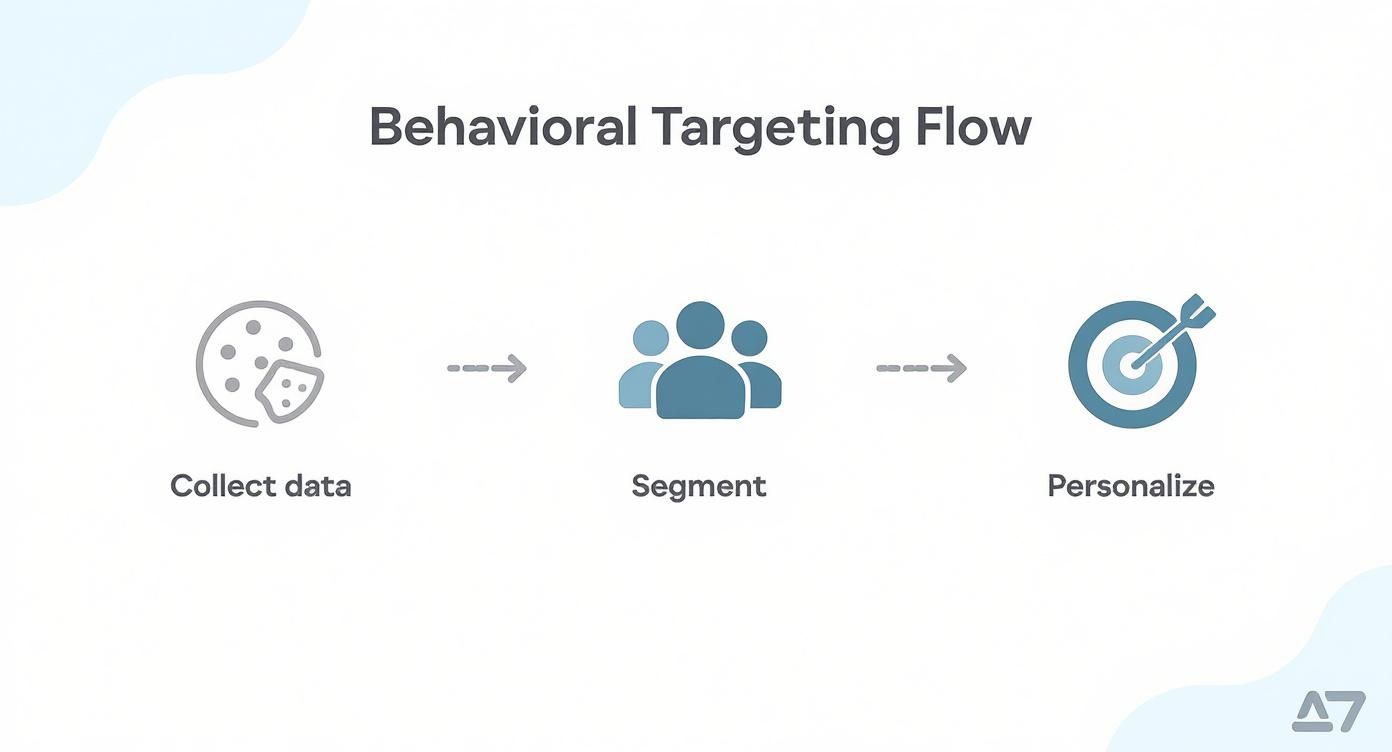
This flow chart gives you a bird's-eye view of how user data is collected, segmented, and ultimately used to show you ads that feel relevant.

Infographic about what is behavioral targeting

As you can see, the whole point is to turn a bunch of scattered actions into focused, actionable audience groups you can actually do something with.

Matching Ads and Optimizing Performance

Once those segments are defined, the ad platforms can start doing their ad matching in real-time. When a user from that "Active Runner" segment visits a website with ad space, an automated auction kicks off behind the scenes. Brands that want to reach this audience place bids to show their ad, and the winning ad—maybe for a new pair of running shoes—is displayed instantly.

Finally, the process comes full circle with campaign optimization. Marketers watch the performance data to see which ads are actually driving sales and which ones are falling flat. This constant feedback loop allows them to tweak their segments, test out new ad creative, and sharpen their targeting to get better results over time.

This explosion in targeting tech is tied to the broader behavior analytics market, which was valued at $1.10 billion in 2024. It’s projected to hit $10.80 billion by 2032, which shows just how much companies are betting on understanding exactly what their customers want.

Real-World Examples of Behavioral Targeting

The theory is one thing, but seeing behavioral targeting out in the wild is where it really clicks. You’ve run into it hundreds of times, probably without even noticing. It's woven so deeply into the fabric of the modern internet that it quietly shapes what you see on your favorite sites every single day.

From the running shoes that follow you from site to site to the next binge-worthy show that magically appears in your queue, behavioral targeting is the engine personalizing your digital life. It works by connecting a specific action you take to a tailored, automated response.

E-commerce Personalization

Online retail is where behavioral targeting really flexes its muscles. Think about the last time you landed on Amazon. That homepage wasn’t a generic storefront; it was a unique display built specifically for you based on your recent digital footprint.

  • Product Recommendations: If you spent Tuesday browsing for a new tent and a sleeping bag, you can bet that by Wednesday, your "Recommended for You" section will be filled with camping gear. Amazon's algorithm saw your interest and immediately adjusted its suggestions to match.
  • Abandoned Cart Reminders: Ever add something to your cart, get distracted, and leave? A few hours later, you’ll probably get an email or see an ad for that exact product on social media. That’s not a coincidence; it's a direct, automated nudge to bring you back and complete the purchase.

This kind of hyper-relevant experience is a core pillar of modern marketing personalization strategies, turning a generic shopping trip into a guided journey.

Travel and Hospitality Offers

Travel sites like Expedia are absolute masters of this. Booking a trip isn’t a single action—it’s a whole series of them. You research flights, then hotels, then maybe a rental car. Each step leaves a breadcrumb trail of intent, and these platforms are brilliant at following it.

Let's say you search for flights to Miami for the first week of December. The system doesn't just show you flights; it logs that intent. Over the next few days, you'll start seeing targeted ads on Instagram and other sites for hotels and car rentals in Miami for those exact dates. The system correctly read your flight search as a strong signal and responded with relevant, timely offers to help you build out the rest of your trip.

Entertainment and Content Curation

Streaming services have literally built their empires on sophisticated behavioral targeting. Platforms like Netflix and Spotify don't just dump a library of content on you; they meticulously curate it based on what you’ve watched and listened to before.

Netflix’s interface is a perfect example, showcasing personalized recommendations that are a direct result of analyzing your viewing habits.

Screenshot from https://about.netflix.com/en

This is your past behavior in action. If you watched three sci-fi thrillers in a row, the algorithm takes that as a cue and bumps similar titles to the top of your "Top Picks for You" row. It’s all designed to make sure the content you see is exactly what you’re likely to click next.

To see how this plays out in even more industries, check out these 7 powerful behavioral targeting examples.

With great targeting power comes great responsibility. Yes, behavioral targeting can create shockingly relevant experiences for users, but it also walks a very fine line. The difference between a helpful suggestion and an invasive ad is paper-thin, and crossing it is the fastest way to demolish customer trust.

Let's be clear: successfully using behavioral targeting means putting user privacy first. This isn't just a "nice to have"—it’s a legal minefield. Regulations like Europe's General Data Protection Regulation (GDPR) and the California Consumer Privacy Act (CCPA) have completely changed the rules of the game for how businesses collect and use consumer data.

These laws hand the controls back to consumers, giving them the right to know what's being collected and, crucially, the right to say "no." For marketers, that makes transparency non-negotiable.

Building Trust Through Ethical Practices: An Actionable Framework

Operating ethically here isn't about dodging fines. It's about building real, sustainable relationships with customers who feel respected, not tracked. It requires a proactive game plan.

Here’s an actionable framework to make your campaigns both effective and ethical:

  • Be Radically Transparent: Your privacy policy shouldn't read like a legal textbook. Clearly explain what data you're collecting and exactly how you plan to use it. No jargon, no excuses. Action: Create a simple, one-page summary of your data practices that users can easily find.
  • Make Opting Out Easy: A hidden unsubscribe link or a confusing preferences page is a dark pattern. Give users a clear, simple way to manage their data and opt out of tracking. Action: Place a "Manage My Data" link in your website footer and email footers.
  • Lock Down Your Data: You're the guardian of your customers' information. Invest in serious security to protect it. A data breach is a disaster for your customers and a potential death blow to your brand's reputation. Action: Conduct regular security audits and use encryption for all stored customer data.

When regulations use terms like "fundamental rights and freedoms," you know it's about much more than just ticking a compliance box. It’s about building your marketing on a foundation of respect.

The Future in a Cookieless World

This entire conversation around privacy is forcing massive technical changes, with the biggest being the death of the third-party cookie. As major browsers phase them out, marketers have to get smarter and move away from rented third-party data toward more sustainable methods.

The end of third-party cookies doesn’t kill effective targeting. It just kills lazy targeting. This is a massive shift toward higher-quality, consent-based data that actually strengthens customer relationships.

This new reality puts a huge spotlight on first-party data—the information you collect directly from your audience on your own website, app, or CRM. It's cleaner, more accurate, and gathered with explicit user consent, making it the most powerful and privacy-friendly asset you have for creating personalized experiences.

This isn't just a hypothetical shift; it's already shaping the market. For instance, North America is still the leader in behavioral targeting, but growth in Europe is slower precisely because of strict GDPR rules. Yet, European consumers still want personalized experiences—they just have to be delivered with privacy at the forefront. You can get more insights on how privacy is shaping the behavioral targeting market over on dataintelo.com.

How to Implement a Behavioral Targeting Strategy

A person working on a laptop, surrounded by data visualization icons, representing the implementation of a marketing strategy.

Alright, let's move from theory to action. Putting behavioral targeting into play isn't magic; it's a structured process of turning raw user data into real business results. Think of this as your playbook for launching a campaign that actually works.

It all starts with a simple question: What are you trying to accomplish? Are you fighting to slash abandoned cart rates, trying to boost repeat purchases from loyal customers, or hunting for brand-new users who are ready to buy?

Your answer to that question shapes every single decision that follows. It dictates the platforms you use, the audiences you build, and the ads you write. Without a goal, you're just hoarding data. With one, every click has a purpose.

Setting Your Technical Foundation

Before you can target a single soul, you need the right plumbing in place. This is the technical backbone of your entire strategy, and it starts with installing tracking pixels or tags on your website from platforms like Meta or Google Ads.

These tiny snippets of code are your eyes and ears. They anonymously track how people interact with your site—what pages they view, what they add to their cart, and what they ultimately purchase. This information is the fuel for your targeting engine.

Getting this setup right is non-negotiable. If your data collection is flawed, your targeting will be, too. That means wasted ad spend and missed opportunities.

Building and Activating Your Audience Segments

With your pixels firing and data flowing in, the real fun begins: audience segmentation. This is where you stop shouting at everyone and start having meaningful conversations with specific groups based on what they’ve done.

Instead of a one-size-fits-all message, you can create distinct buckets of users who have shown different levels of interest.

Here are a few essential segments every business should start with:

  • Website Visitors: This is your broadest group—everyone who stopped by your site in the last 30-90 days. It’s a solid choice for general brand awareness campaigns.
  • Product Viewers: These folks browsed specific product pages but never added anything to their cart. They’re curious but need a gentle nudge back.
  • Cart Abandoners: The holy grail of retargeting. This high-intent group added items to their cart but got distracted. They are your warmest leads, so don't let them get away.
  • Past Purchasers: Your existing customers. You can re-engage them with complementary products, special offers, or loyalty rewards to encourage repeat business.

To make this work across all your channels, you need a single source of truth. A deep customer data platform integration is often the key to ensuring your email, ads, and on-site messaging are all working from the same playbook.

Launching and Optimizing Your Campaigns

Once your segments are ready, it's time to craft ads that speak directly to each group. The ad you show a cart abandoner should feel completely different from the one you show a first-time visitor. Personalize your copy, images, and offers to reflect where they are in their journey.

For a cart abandoner, you might show them the exact product they left behind, maybe with a small discount to seal the deal. For a new visitor, you’d introduce your brand’s big-picture value or showcase your best-selling items.

But launching the campaign is just the beginning. The real work is in the continuous measurement and optimization. Keep a close eye on your key metrics, like conversion rate and return on ad spend (ROAS). This data is your feedback loop, telling you which segments are hitting the mark and which ads are falling flat. Use those insights to shift your budget and refine your approach for maximum impact.

Actionable Checklist for Your First Campaign

To tie this all together, here's a simple checklist to guide you through setting up your first behavioral targeting campaign.

StepKey ActionTool/Platform Example
1. Define GoalPinpoint a specific outcome (e.g., "Reduce cart abandonment by 15%").Your internal strategy document or project management tool.
2. Install PixelsAdd tracking tags to every page of your website.Google Tag Manager, Meta Pixel Helper (Chrome Extension).
3. Build SegmentsCreate core audiences like "Cart Abandoners (7 Days)" or "All Visitors (30 Days)."Google Ads Audience Manager, Meta Ads Audiences.
4. Create AdsDesign unique ad copy and visuals for each segment.Canva for creative, your ad platform's native ad builder.
5. Launch & MonitorGo live and track key metrics like ROAS and conversion rate daily.The analytics dashboards within Meta Ads or Google Ads.
6. OptimizePause underperforming ads and reallocate budget to winning segments.Use A/B testing features within your ad platform.

Following these steps provides a clear, repeatable process for turning user behavior into tangible growth. Don't overcomplicate it at first—just get the fundamentals right, and you'll be well on your way.

Got Questions? We've Got Answers

Once you start wrapping your head around behavioral targeting, a few questions almost always come up. Let's tackle them right now so you have a crystal-clear picture of how this all works in the real world.

Behavioral Targeting vs. Retargeting: What's the Real Difference?

This is a classic, and for good reason. It’s easy to get them mixed up, but the distinction is actually pretty simple. Think of retargeting as a specific tactic and behavioral targeting as the overall strategy.

  • Retargeting is about showing ads only to people who have already visited your website. It's a follow-up conversation.
  • Behavioral targeting is the entire playbook. It includes retargeting but also uses browsing habits across the wider web to find new audiences who have never heard of you but fit your ideal customer profile.

So, all retargeting is a form of behavioral targeting, but not all behavioral targeting is retargeting.

Is This Still a Thing Without Third-Party Cookies?

Absolutely, but the game is definitely changing. The slow fade of third-party cookies doesn’t kill the strategy; it just makes your first-party data—the information you collect directly from your audience—insanely valuable.

The end of third-party cookies isn't an obstacle. It's an upgrade—a shift toward higher-quality, consent-based marketing that builds real trust with customers.

Smart marketers are already leaning into this. They're using the data they own, combining it with contextual targeting, and exploring new privacy-first technologies that keep users in control. The actionable takeaway is to start building your first-party data assets now, through things like email newsletters, user accounts, and loyalty programs.

How Do I Know If It's Actually Working?

Clicks and impressions are easy to count, but they don't pay the bills. If you want to know if your campaigns are truly making a difference, you need to measure the metrics that tie directly to business results.

Instead of getting lost in vanity numbers, zero in on these three:

  • Conversion Rate: What percentage of people are actually taking the action you want them to take, like buying a product or signing up?
  • Cost Per Acquisition (CPA): Simple and powerful. How much does it cost you, on average, to win a new customer?
  • Return on Ad Spend (ROAS): For every single dollar you put into your advertising, how many dollars in revenue do you get back?

Focusing on these tells you the real story. They give you a clear, actionable picture of how your campaigns are impacting the bottom line.


Ready to turn user insights into measurable growth? marketbetter.ai provides an integrated AI platform to optimize your audience segmentation, content personalization, and campaign management. Discover how you can build more effective campaigns by visiting https://www.marketbetter.ai.

How to Improve Email Open Rates: Proven Tips & Strategies

· 24 min read

To get more people opening your emails, you have to nail three things: the subject line, who you're sending it to, and when you send it. Get those right, and you’ll cut through the noise of a crowded inbox every time. Instead of just sending emails, this guide will show you how to start strategic conversations that demand to be opened.

Why Your Email Open Rates Matter More Than Ever

Image

Before we get into the tactical weeds, let’s be clear about why this one metric is so important. A healthy open rate isn't just a number to brag about in a meeting; it's a direct signal of your audience's engagement and a huge factor in your sender reputation.

Internet Service Providers like Gmail and Outlook are always watching. When people consistently open your emails, it tells their algorithms your content is wanted. That's what keeps you out of the spam folder. Think of it as a comparison: a sender with a 40% open rate is seen as a trusted source, while a sender with a 5% open rate looks like a potential spammer.

The open is the first domino. No open means no click, no conversion, and definitely no sale. A higher open rate gives you a bigger pool of engaged people who might actually click your call-to-action, which is what really moves the needle on revenue.

What Is a Good Email Open Rate

There's no single "good" open rate. It's completely different depending on your industry and who you're talking to. The benchmark for a B2B SaaS company sending emails to warm leads looks nothing like a DTC e-commerce brand blasting out a holiday promotion. A B2B brand might be thrilled with a 35% open rate on a targeted campaign, while a retail brand might shoot for 20% on its weekly newsletter.

Understanding these differences is crucial. In 2025, we’re seeing huge variations across industries.

  • SaaS companies: often see rates from 15% to 45%.
  • DTC e-commerce: typically falls between 32% and 42%.
  • Nonprofits: can range from 25% to 32%.

Some brands with fiercely loyal followers and sharp segmentation are even hitting 50-60%. It all comes down to knowing your specific audience.

To help you get a handle on the core actions you can take, here's a quick summary of what works.

Quick Guide to Improving Email Open Rates

This table breaks down the key strategies we'll be covering and shows how each one directly contributes to getting more of your emails opened.

StrategyPrimary GoalKey Action
Subject Line OptimizationGrab attention immediatelyCraft short, intriguing, and personalized subject lines.
Audience SegmentationIncrease relevanceGroup subscribers by behavior, demographics, or purchase history.
PersonalizationCreate a one-to-one feelUse subscriber data (like their name or interests) in your content.
Send Time OptimizationLand at the top of the inboxAnalyze past data to find when your audience is most active.
A/B TestingMake data-driven decisionsTest one variable at a time (e.g., two different subject lines).
AI-Powered ToolsAutomate and refineUse AI to predict optimal send times or generate subject line ideas.

By focusing on these areas, you shift from simply sending emails to creating valuable touchpoints that your audience actually wants to engage with.

From Sending Emails to Building Relationships

The biggest leap you can make is a mental one. Stop thinking about "sending emails" and start thinking about creating communication that your subscribers genuinely look forward to. This simple reframe turns your email list from a broadcast channel into a real community.

The goal is to make every email feel like a valuable, one-to-one conversation. When subscribers anticipate value from your brand, they are far more likely to open your messages consistently.

This is how you build trust and turn passive subscribers into loyal fans. When you make relevance and value your top priorities, higher open rates just become the natural outcome of a strong relationship with your audience.

If you want to go deeper on this, check out these proven strategies to increase your email open rate.

Writing Subject Lines That Get Opened

Your subject line is the gatekeeper. It doesn't matter how brilliant your email is if nobody opens it. In a slammed inbox, you've got maybe three seconds to convince someone your message is worth their time over the 50 others begging for attention.

This is where a little psychology goes a long way. A great subject line isn't just a label for the email's contents; it's an invitation. It sparks an emotion or poses a question that makes someone need to know more.

Let's compare. A flat, corporate-speak subject line like "Our New Product Update" is begging to be archived. But something like, "A new way to tackle your biggest challenge," gets the gears turning. The first is a broadcast; the second is a conversation starter.

The Power of Curiosity and Urgency

Two of the most reliable tools in your subject line toolkit are curiosity and urgency. They come at the problem from different angles, but both are incredibly effective at driving opens.

Curiosity-driven subject lines create an "information gap." You hint at something valuable or unexpected inside, and people click just to scratch that mental itch. This is perfect for newsletters, content promotions, and anything educational.

Urgency, on the other hand, is all about FOMO—the fear of missing out. Time-sensitive language or the hint of scarcity pushes people to act now. This is your go-to for sales, webinar sign-ups, and limited-time offers.

Here’s a quick comparison of weak vs. strong subject lines:

TriggerGoalSubject Line Example (Weak)Subject Line Example (Strong)
CuriosityEncourage exploration and learning."New blog post available""The one marketing metric you're not tracking"
UrgencyDrive immediate action or decision."Sale happening now""Last chance: 40% off ends at midnight"

The key is using them strategically. Hammering the urgency button every day leads to burnout. Relying only on curiosity might not get you the immediate action you need for a flash sale. Your action item is to review your last five campaigns and categorize them. Are you over-relying on one trigger? If so, plan your next email to use the opposite approach.

Crafting Actionable Subject Lines

Beyond psychological triggers, the words you choose and how you structure them matter. Tiny tweaks can have a massive impact. I always focus on three things: clarity, relevance, and a human touch.

Here are a few actionable frameworks you can use right now:

  • Ask a Question: Questions demand a mental response. Instead of "New marketing tips," try "Are you making this common marketing mistake?"
  • Use Numbers and Data: Numbers feel concrete and make your claims more believable. Compare "5x your content output with this framework" to the weaker "Write content faster." The first is specific and powerful.
  • Incorporate Emojis (Carefully): The right emoji can make your email pop in a sea of text and convey tone in a split second. A plane ✈️ for a travel deal or a chart 📈 for a data report works well. Just don't overdo it, and make sure it fits your brand's voice.

A subject line's primary job is to make a clear promise about the value inside the email. Whether that promise is a solution, a discount, or an intriguing story, it must be compelling enough to earn the click.

Don't forget that your subject line and preheader text work as a one-two punch. The subject line grabs their eye, and the preheader—that little snippet of text right after it—gives them another reason to click. For a deeper dive, check out these 8 Email Subject Line Best Practices.

By ditching generic phrases and tapping into what actually makes people tick, you can write subject lines that not only get opened but start building a real connection with your audience.

Go Way Beyond First Names with Smart Segmentation

Image

If you're still sending one-size-fits-all email blasts, you're not just leaving money on the table—you're actively training your audience to ignore you. Let's compare two approaches. Approach A: Send one email to 10,000 people. Approach B: Send 10 different, targeted emails to 1,000 people each. Approach B will almost always win on open rates and revenue. Real connection, the kind that gets emails opened, starts with smart audience segmentation.

This is all about slicing your main list into smaller, more focused groups. The goal is simple: send people messages so relevant they feel like they were written just for them.

With global email users projected to hit 4.83 billion by 2025, the inbox is more competitive than ever. The data is screaming at us: segmented campaigns can boost revenue by a staggering 760%, and personalized emails convert up to six times better. The lesson here is crystal clear—relevance is your most powerful lever.

Demographic vs. Behavioral Data: Know the Difference

To segment effectively, you need to understand the two main approaches: demographic and behavioral. Both have their place, but one gives you a much sharper edge for boosting open rates.

Demographic segmentation is the old-school way. You group people by static attributes like their age, location, or job title. It's a decent starting point, but it forces you to make a lot of assumptions.

Behavioral segmentation, on the other hand, is all about action. It groups subscribers based on what they do—the pages they visit, the products they buy, the links they click. It’s dynamic, it’s specific, and it’s incredibly powerful because it’s based on proven interest, not guesswork.

Here's a quick comparison:

Segmentation TypeDemographic (Who they are)Behavioral (What they do)
Data PointsLocation, age, gender, job titlePurchase history, pages visited, videos watched, email clicks
NatureStatic and generalDynamic and specific
Primary UseBroad targeting (e.g., regional promotions)Hyper-relevant messaging (e.g., abandoned cart emails)
Impact on OpensModerateHigh

Sure, a B2B company might use demographics to send different content to a Marketing Director versus a CEO. But behavioral data lets you target the Marketing Director who just downloaded your whitepaper on SEO. See the difference?

High-Impact Behavioral Segments to Build Today

The best part is you can start building these powerful segments with the data you’re probably already collecting. This is where the magic happens, turning average email campaigns into revenue-driving machines.

Here are a few actionable segments you can set up right now in your email platform:

  • Recent Buyers: These folks are red-hot. Action: Follow up within 24 hours to ask for a review, recommend a complementary product, or just say thanks with a small discount on their next order.
  • Cart Abandoners: They were this close to buying. Action: Set up an automated 3-part email series that triggers one hour, 24 hours, and 72 hours after they abandon their cart.
  • Hyper-Engaged Fans: These are your loyalists who open and click everything. Action: Create a "VIP" segment and give them early access to sales, exclusive content, or a special loyalty reward.
  • The Unengaged: Find subscribers who haven't opened an email in 90 days. Action: Hit them with a 2-step re-engagement campaign using a punchy subject line like, "Should we say goodbye?" This either wins them back or helps you clean your list. Need to get serious about list hygiene? Our guide to automate email scanning can help keep it healthy.

The core idea is simple: message people based on their recent actions. Someone who just bought a product has a completely different mindset than someone who hasn't opened an email in six months. Your messaging must reflect that.

A Real-World Example: The Coffee Roaster

Imagine an online store selling high-end coffee beans. Sending a generic "20% off all coffee!" email is fine. But watch what happens when they use behavioral segmentation.

They start by splitting their list into three groups:

  1. New Subscribers: Signed up but haven't made a purchase yet.
  2. Espresso Lovers: Customers who consistently buy dark, espresso-style roasts.
  3. Light Roast Fans: Customers who only purchase light, single-origin beans.

Instead of one generic blast, they craft three hyper-targeted emails. New subscribers get a "Welcome! Here’s what makes our coffee special" email with an intro offer. Espresso lovers hear about a new Italian dark roast. Light roast fans get a notification about a rare Ethiopian bean that just landed.

The result? The subject lines are irresistible, the content speaks directly to each person's taste, and the open rates go through the roof. That’s how you stop broadcasting and start building real connections.

Nail Your Timing and Master the Mobile Experience

Image

This graphic says it all. The gap between generic and genuinely personalized emails isn't a small one—it's a chasm. Better opens, more clicks, and higher conversions. The proof is right there.

Now, let's talk about timing. Sending a brilliant email at the wrong moment is like showing up to a party after everyone’s gone home. Even the best message gets lost in the noise.

You’ve probably heard the generic advice: "Send emails on Tuesday mornings." That’s a decent starting point, but it's not a strategy. Your audience is unique, and your data holds the real answers.

Finding Your Audience's Sweet Spot

Stop guessing and start listening to what your subscribers are already telling you. Your email service provider's analytics are a goldmine. Action: This week, log into your ESP, pull the engagement report for your last 10 campaigns, and look for patterns. Is there a specific day or time with a clear spike in opens?

Better yet, let your tools do the heavy lifting. Most modern email platforms have send-time optimization features that do this for you. They analyze individual user behavior and deliver your email at the precise moment each person is most likely to be in their inbox. It’s a game-changer.

If you're handling it manually, A/B testing is your best friend. Send the same email to one segment at 9 AM and another at 2 PM. Run a few of these tests, and a clear winner will emerge. You’ll have a data-backed window for peak engagement.

The goal isn't to find the single "best" time to email everyone. It’s to understand the rhythm of your specific audience segments. A high-value customer in London operates on a completely different clock than a new lead in Los Angeles.

This is how you move from just blasting emails to running a coordinated communication plan that actually respects your subscribers' time. Layering this kind of timing with dynamic content, like we cover in our guide on video email automation, is where you start seeing serious results.

The Mobile-First Imperative

Okay, so timing gets your email to the top of the inbox. But what happens next? The mobile experience is what determines if it gets read or instantly deleted.

Let’s be blunt: a non-mobile-friendly email is a broken email. With 85% of users checking their inboxes on their phones, ignoring mobile isn't just a mistake—it's malpractice.

The numbers don't lie. Mobile email open rates hover around 41.9%, absolutely crushing the 16.2% on desktops. And for younger demographics, especially the 25-34 age group, it's pretty much mobile-only. This isn't a trend; it's the standard.

Here are the non-negotiables for making your emails look great on a small screen:

  • Single-Column Layout: This is the bedrock of mobile-friendly design. It keeps everything flowing in a logical, scrollable line. No pinching, no zooming.
  • Big, Tappable Buttons: Your calls-to-action need to be thumb-friendly. Aim for at least 44x44 pixels. Anything smaller is just asking for user frustration and missed clicks.
  • Optimized Images: Heavy images are the fastest way to get your email ignored. They kill load times and burn through data. Keep them light and compressed.
  • Readable Font: Use a font size of at least 16px for your body text. If someone has to squint to read your message, they won't. They'll just delete it.

Getting these two things right—smart timing and a flawless mobile design—solves more than half the battle of getting your emails noticed and acted upon.

Mobile vs. Desktop Email Optimization Checklist

Optimizing for email isn't a one-size-fits-all game. What works beautifully on a widescreen desktop monitor can fall apart on a phone screen. Use this actionable checklist to ensure you're covering your bases for both experiences.

Checklist ItemWhy It Matters for MobileWhy It Matters for Desktop
Responsive DesignAbsolutely critical. Content must reflow to fit a narrow, vertical screen without horizontal scrolling.Important for accommodating various window sizes and monitor resolutions, ensuring a clean layout.
Single-Column LayoutThe gold standard for readability. Ensures a logical flow and easy scrolling with a thumb.While multi-column layouts can work, a single column is often cleaner and focuses attention.
Concise Subject LinesMobile screens cut off long subject lines. Keep it under 40 characters to ensure the core message is seen.More space is available, but brevity is still key to grabbing attention in a crowded inbox.
Large, Tappable CTAsThumbs need a clear target. Buttons should be at least 44x44 pixels to prevent accidental clicks.Cursors are precise, but large, clearly defined buttons still improve click-through rates.
Readable Font SizeText must be legible without zooming. A minimum of 16px for body copy is a safe bet.Smaller fonts are readable, but 14px-16px remains a comfortable standard for legibility.
Image OptimizationEssential. Large files slow down loading on cellular networks, leading to high abandonment rates.Still important for quick loading, but less critical than on mobile due to faster, more stable connections.
Use of White SpaceBreaks up text and makes content scannable on a small screen, reducing cognitive load.Helps create a clean, professional, and uncluttered design that guides the reader's eye.
Minimalist NavigationLimit links to the essentials. Too many options create clutter and decision fatigue on a small interface.More room for navigation bars or footers, but the focus should remain on the primary call-to-action.

By thinking through these elements for both environments, you ensure every subscriber gets a great experience, no matter how they choose to open your email.

Using Data and A/B Testing to Drive Growth

Chasing higher open rates isn't a one-and-done project. It's a constant cycle of listening, testing, and tweaking your strategy based on what your audience actually does—not what you think they'll do. Think of your data as the compass and A/B testing as the engine pushing you forward.

Guesswork is the enemy of growth. You might be convinced that an emoji-filled subject line is a stroke of genius, but if the data says it bombs, your opinion doesn’t matter. This is where A/B testing, or split testing, comes in. It’s a beautifully simple method for comparing two versions of a single element to see which one gets the job done.

The golden rule is to isolate one variable at a time. This is non-negotiable. If you change the subject line and the sender name in the same test, you’ll have no clue which change moved the needle. The whole test becomes useless.

Setting Up a Meaningful A/B Test

Before you even think about launching a test, you need a solid hypothesis. A good hypothesis isn't just a vague idea; it's a specific, testable statement that explains your reasoning.

For instance, compare a weak hypothesis to a strong one. Weak: "I think shorter subject lines are better."

A strong, actionable hypothesis sounds like this: "A subject line under 40 characters will get a higher open rate than one over 60 characters because it’s fully visible on mobile email clients." See the difference? This gives your test a clear purpose and a measurable path to victory.

Once you have your hypothesis, focus your tests on the elements that have the biggest, most direct impact on opens.

  • Subject Lines: This is the obvious one. Test length, tone (curious vs. urgent), personalization, and whether adding numbers or emojis makes a difference.
  • Sender Name: Pit a real person's name ("Sarah from MarketBetter") against the company name ("The MarketBetter Team"). You'd be surprised how often a human touch builds more trust.
  • Preheader Text: That little snippet of text next to the subject line is prime real estate. Test a straightforward summary against a question that sparks curiosity.

The real goal of A/B testing isn't just to find a single winner. It's about building a deep, cumulative understanding of what makes your audience tick, one data-backed insight at a time.

This disciplined approach means you learn something valuable from every single send, whether you "win" or "lose" the test. You can see how this iterative process leads to serious gains by checking out some of our AI-powered marketing case studies.

How to Compare Variables Effectively

Getting actionable results is about more than just seeing which version got more clicks. You need to structure your tests to reveal genuine insights. Let’s compare a vague test setup with an actionable one.

Test VariableVague Approach (Less useful)Actionable Approach (More useful)
Sender NameTesting "Marketing Team" vs. "Sarah."Testing "[First Name] at [Company]" vs. "[Company] Newsletter" to see if personalization from a specific person builds more trust than a generic brand sender.
Subject LineTesting a "funny" subject line vs. a "serious" one.Testing a question-based subject line ("Making this SEO mistake?") against a benefit-driven statement ("Boost your SEO with this tip") to see which framework drives more curiosity.

The actionable approach zeroes in on a specific psychological trigger or format. This means that even if your hypothesis doesn't pan out, you’ve still learned something concrete about your audience that you can apply to every campaign from here on out.

Beyond Open Rates: What to Measure

Hold on, the open rate isn't the whole story. A clickbait-y subject line might get you a ton of opens but result in zero engagement and a flood of unsubscribes. You need a secondary metric to gauge the quality of those opens.

Enter the click-to-open rate (CTOR). It’s the perfect wingman for your open rate, measuring how many of the people who opened your email actually clicked a link inside.

Here’s why comparing these two metrics is so critical:

  • High Opens, Low CTOR: This is a red flag. It usually means your subject line made a promise that the email content couldn't deliver. You got them in the door, but they left unimpressed.
  • Average Opens, High CTOR: Now this is a fantastic sign. The people who opened were genuinely engaged, proving your subject line attracted the right people and set the right expectations.

By analyzing CTOR alongside your open rate, you get a much richer, more honest picture of your performance. It creates a data-driven feedback loop that is absolutely essential for sustainably improving your email open rates for the long haul.

Got Questions About Email Open Rates? We've Got Answers.

Even with the best game plan, a few tricky questions always seem to pop up when you're trying to nudge those open rates higher. Let's tackle some of the most common ones I hear from marketers, with straight-up, actionable advice to help you fine-tune your strategy.

Should I Resend Emails to People Who Didn't Open?

Absolutely, but you have to be smart about it. Just blasting the same email out a second time feels lazy and is a quick way to annoy your subscribers. The right move is to give it another shot 24-48 hours later, but only after you’ve changed a critical element.

Think of it as a second chance to make that first impression. Compare your original email with these resend tactics:

Original ElementResend TacticWhy It Works
Subject LineRephrase it. If the first one was a statement, make the new one a question. If you led with urgency, try sparking curiosity this time.You're hitting a different psychological trigger. The first one didn't work for this segment, so a new angle might be just what they need.
Sender NameChange it from "[Company Name]" to "[Your Name] from [Company]".This is a simple way to add a human touch. It cuts through the noise of corporate-sounding senders and can build a bit of trust.
Send TimeSend at a completely different time. If you sent at 9 AM, try 7 PM.You might have just missed their active window. An evening resend could catch them when they’re scrolling and less swamped with work.

Here's the key: only resend your most important emails. We’re talking about webinar invites, flash sales, or limited-time offers. If you overdo it, you'll just train your audience to ignore you or, even worse, send you straight to the spam folder.

How Often Should I Clean My Email List?

This isn't optional. Regular list hygiene is the bedrock of good deliverability, which is what gets you into the inbox in the first place. As a general rule, you should do a major list cleaning every 3 to 6 months.

But "cleaning" isn't just about mass-deleting contacts. It’s a deliberate, actionable process:

  1. Spot the Inactive Subscribers: First, build a segment of everyone who hasn't opened an email from you in the last 90-120 days.
  2. Run a Re-engagement Campaign: Send a targeted 2-3 email series just to this group. Use a punchy subject line like, "Is this goodbye?" or offer them something special to stick around.
  3. Let Go of the Non-Responders: If they don't bite after that win-back campaign, it's time to say farewell. Keeping them on your list actively hurts your sender reputation and throws off all your metrics.

A huge list full of unengaged contacts is just a vanity metric. Compare two lists: a 100,000-subscriber list with a 10% open rate vs. a clean 20,000-subscriber list with a 40% open rate. The smaller list gets fewer opens overall, but it has a much healthier sender reputation and higher engagement per subscriber.

Do Emojis in Subject Lines Actually Work?

They can, but their success really hinges on your brand and your audience. Emojis have the power to make your subject line pop in a sea of text-only emails, and they communicate emotion or context in a flash. A 🎁 for a special deal or a ⏰ for a deadline is understood instantly.

But there’s a razor-thin line between clever and cringey. The impact often comes down to context.

  • B2C E-commerce: Usually a big win. Emojis can signal promotions, new stuff, or holiday vibes, which fits perfectly with the casual, visual world of retail.
  • B2B SaaS: Tread carefully. An emoji in a webinar invite can work well, but it might feel totally out of place in a serious email about a security update.

My advice? A/B test it. It's the only way to know for sure. Send one version with an emoji and one without. Let your own data tell you what your audience responds to. Don't just follow a trend—find what works for your brand. Often, a single, relevant emoji is far more powerful than a string of random ones.


Ready to stop guessing and start making data-driven decisions? The marketbetter.ai platform uses predictive analytics to optimize your campaigns, from generating high-performing subject lines to identifying the perfect send time for every subscriber. Learn more and see how our AI can boost your ROI.