3 posts tagged with "ai tools"

View All Tags

A Guide to AI in Content Creation

· 24 min read

Let’s be real for a second. When you hear “AI in content creation,” it’s easy to picture robots churning out soulless blog posts. Forget that. The reality is far more practical and, honestly, more exciting.

Think of AI less as a replacement for your creativity and more as the ultimate co-pilot. It’s the tireless assistant that handles the grunt work—the endless research, the first-pass drafting, the mind-numbing data sifting. This frees you up to do what humans do best: focus on strategy, nail the nuance, and build a genuine connection with your audience.

The New Content Creation Playbook is Here

This guide isn't about sci-fi futures; it's about showing you exactly how artificial intelligence fits into your workflow today. We’re going to break down how the sharpest content teams are using AI to scale their output and stay ahead in a ridiculously crowded digital world.

The core idea is simple. Let the machine manage the repetitive, time-sucking tasks, while you steer the ship. A classic example is keyword research. The old way involved manually digging through spreadsheets for hours. The new, actionable approach? Use an AI tool to generate a list of high-potential topics with search volumes and difficulty scores in under five minutes. It’s a no-brainer.

Your Role is Shifting from Writer to Content Director

This is the most important change to grasp. Adopting AI fundamentally flips your job description on its head. Instead of spending 80% of your time on the nitty-gritty of drafting and only 20% on strategy, you get to reverse that.

Your expertise becomes the most valuable part of the equation. You're the one directing the AI, refining its output, and making sure every piece of content perfectly captures your brand’s voice and hits its strategic goals.

This shift is what makes true scalability possible. Compare these two scenarios: you need 100 unique product descriptions for a new launch.

  • Traditional Method: A human writer could be tied up for weeks, writing each one from scratch.
  • AI-Assisted Method: An AI generates the initial drafts for all of them in an afternoon, leaving you with the much faster job of reviewing, refining, and adding a human touch.

Before we go any further, it helps to know a little about the engine driving all this. If you want a quick primer, this simple guide explains What is Generative AI? and how the technology actually works.

The numbers don't lie, either. The generative AI market is on a tear, hitting a global value of $63 billion by 2025. With North America making up over 40% of that revenue and the market projected to grow at a compound annual rate of 42%, it’s clear this isn’t just a trend—it's a fundamental business shift.

The Real-World Benefits of Bringing AI into Your Workflow

This is about more than just moving faster. It's about creating smarter, more effective content. Here are the biggest wins, compared to traditional methods:

  • Serious Scalability: Instead of being limited by human hours, you can produce high volumes of content—from social posts to in-depth articles—without needing to hire an army of writers.
  • Off-the-Charts Efficiency: Automate tasks that drain your time, like research and outlining. This turns production timelines from days into hours, allowing you to react faster to market trends.
  • Data-Driven Decisions: Manually analyzing data is slow and prone to error. Use AI to chew through performance data and spot content gaps so your strategy is always guided by what your audience actually cares about.

Think of AI as your creative co-pilot. It crunches the data and draws the map, but you're still the one in the captain's chair, steering the ship to its final destination. This human-machine partnership is the future of content.

How AI Is Rewriting the Content Lifecycle

Let's get one thing straight: AI isn't just another tool you pull out for one part of the job. It’s a collaborator that plugs into every single stage of the content lifecycle. What used to be a slow, step-by-step march from idea to published piece is now a fast, dynamic cycle. This shift helps you move quicker, make smarter calls, and ultimately, create content that actually hits the mark.

The whole game changes before you even write a single word. Traditionally, topic research was a mix of guesswork and manual keyword tool analysis. With AI, tools can chew through massive amounts of data—search trends, what your competitors are doing, audience engagement—to find topic opportunities a human would almost certainly miss. This isn't about guesswork anymore; it's about focusing your energy on what your audience is already telling you they want.

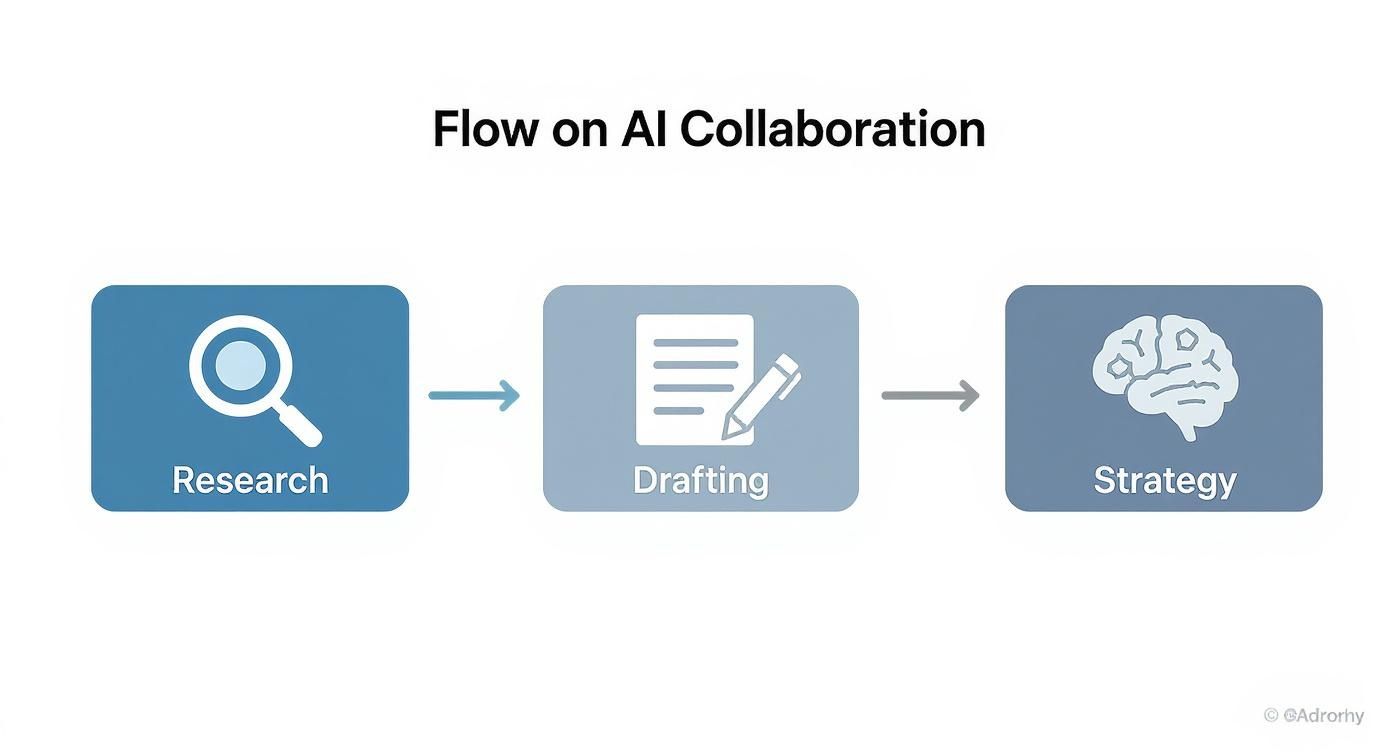
This new partnership between creator and machine is reshaping how modern content teams operate. This infographic gives you a good look at how AI jumps in to help with everything from research and drafting to optimization.

Infographic about ai in content creation

As you can see, AI acts like a force multiplier at every stage. It turns tedious manual tasks into automated processes, freeing up humans to focus on strategy and creativity.

From Blank Page To First Draft

Once you've landed on a winning topic, AI puts the drafting process into overdrive. The terror of the blank page? Gone. You can generate a structured outline in seconds, complete with H2s, H3s, and the main talking points you need to cover. This gives you a solid skeleton to build on, so you can pour your time into adding your own unique insights, telling great stories, and providing real expert analysis.

Let's compare the old way versus the new way:

  • Old: Spend hours researching and structuring an outline, then more hours writing a messy first draft from scratch.
  • New: Generate a data-informed outline in 60 seconds. Use that outline to prompt an AI for a first draft, handling the foundational work. Your job shifts from writer to strategic editor.

AI fundamentally changes the starting line for content creation. Instead of beginning with zero, you start with a structured, well-researched draft that’s ready for your expertise and refinement.

This isn't some future-gazing prediction; it's happening right now. In 2025, a massive 76% of marketers are using generative AI for content creation, with 71% leaning on it for creative inspiration. The proof is in the output, too, with 74.2% of new webpages published in 2025 including AI-generated content. But—and this is a big but—the human touch is still critical. 86% of marketers report editing AI outputs to match their brand voice and hit quality standards.

Optimizing And Repurposing At Scale

Once the draft is solid, AI slips into its optimizer role. These tools can scan your text for SEO, suggesting keywords, flagging readability issues, and even checking the emotional tone. This step is all about making sure every piece is fine-tuned to perform, whether that’s ranking on Google or connecting with a specific audience on social media.

But the real magic happens when it’s time to repurpose. This is where AI becomes a game-changer. It makes it almost ridiculously easy to spin one core piece of content into a dozen different assets.

  • Actionable Tip: Blog Post to Social Media. Feed your article to an AI with the prompt: "Create an 8-tweet thread from this article. Make the first tweet a strong hook and the last one a question to drive engagement."
  • Actionable Tip: Webinar to Email Series. Use an AI transcription tool on your webinar recording. Then prompt it: "Based on this transcript, write a 3-part email nurture sequence highlighting the most valuable takeaways."
  • Article to Audio: The tech is getting incredibly good at multimedia, too. Understanding models like OpenAI's Whisper AI for speech recognition shows just how far we've come in turning text into high-quality audio.

This ability to repurpose content on the fly is a massive win for any team trying to maximize its reach. By automating the grunt work of converting content from one format to another, you can scale content marketing without having to scale your team or budget. It’s about getting your message in front of your audience, wherever they happen to be.

Let's be honest, the real "aha!" moment with AI in content creation happens when you put it side-by-side with the old way of doing things. The difference is night and day. It’s not just about going faster; it’s a complete overhaul of the entire production line, turning a manual marathon into a strategic sprint.

This shift changes everything—it redefines roles, crushes timelines, and unlocks a scale that most teams could only dream of before.

Think about the classic process for writing a solid blog post. It always started with hours of grunt work: digging through SERPs, pulling stats, and vetting sources. Then came the slow, painful process of outlining, followed by the even slower staring contest with a blank page. After all that, you still had editing, proofing, and SEO optimization. It was a linear, exhausting slog that could easily eat up a full day (or more) for one quality piece.

Now, let's look at the AI-assisted workflow. Forget hours of research; an AI tool can analyze the top-ranking content and spit out a data-driven brief in minutes. That terrifying blank page? It’s gone, replaced by a solid first draft built from that brief.

This frees up the writer to do what they do best. Their role flips from assembly-line worker to strategic director—guiding the AI, injecting unique expertise, and polishing the final piece until it shines.

Image

The Creator’s Role Gets an Upgrade

When AI handles the heavy lifting, the content creator is suddenly free to focus on high-value work. Your brainpower is no longer wasted on basic drafting. Instead, you're refining, fact-checking, and adding the human insight that AI simply can't replicate. You become the editor, the strategist, and the final quality gatekeeper.

This isn’t about replacing creativity. It’s about amplifying it.

Imagine an e-commerce brand that needs to write 500 unique product descriptions for a new launch. Traditionally, that's a soul-crushing project. A human writer might get through twenty in a good day. With an AI partner, the first drafts for all 500 can be generated in the time it takes to write just a handful, leaving the team to focus on perfecting the copy that actually sells.

A Head-to-Head Workflow Comparison

The practical differences in speed, cost, and output are stark. What once took a full day can now be done in a fraction of the time, leading to a massive return on your investment.

To make this crystal clear, here’s a direct comparison that shows how the workflows stack up on key performance indicators.

AI-Assisted vs Traditional Content Workflow Comparison

MetricTraditional WorkflowAI-Assisted WorkflowImpact
Research Time2-4 hours15-30 minutesOver 85% reduction in manual research time
Drafting Time3-5 hours1 hourFrees up hours for strategic editing and refinement
Total Time-to-Publish8-12 hours2-4 hours3x faster content delivery and increased velocity
Cost Per ArticleHigh (based on hourly rates)Low (fixed subscription cost)Drastically reduces content production expenses
ScalabilityLimited by team sizeNearly unlimitedEnables mass content production without hiring more staff

The numbers don't lie. An AI-assisted approach doesn't just speed up the old process; it creates an entirely new, more efficient model for getting content out the door.

The real win here is how you reallocate your team's talent. Instead of spending 80% of their time on manual tasks like research and first drafts, creators can now invest that time in strategy, creativity, and adding unique value—the very things that make content great.

At the end of the day, bringing AI into your content process lets your team produce more, publish faster, and operate with a sharper strategic focus. It empowers creators to break free from the constraints of manual labor and hit a level of output and quality that was once completely out of reach.

Putting AI to Work in the Real World

Theory is great, but the real magic happens when you see how actual businesses are using AI in content creation to solve problems they face every single day. This is where the rubber meets the road.

These aren't just hypotheticals. We’re talking about marketing agencies doubling their output and SaaS companies finally getting a handle on their technical documentation. Let's dig into some concrete examples of companies winning with AI right now.

Scaling SEO Content for a Marketing Agency

Picture a boutique marketing agency hitting a wall. They're good at what they do—maybe too good. Their client list is growing, but their ability to produce high-quality SEO content isn't keeping pace. The manual grind of creating detailed content briefs and writing first drafts was a serious bottleneck, capping how many clients they could actually serve.

Their solution? Weave AI into their core workflow with these actionable steps:

  1. Automated Brief Generation: First, they used an AI tool to scope out the competition. It analyzed the top-ranking articles for a target keyword and, in minutes, spit out a comprehensive brief—complete with word count targets, key topics, semantic keywords, and a suggested outline.
  2. AI-Powered First Drafts: With that detailed brief in hand, a generative AI model knocked out a solid first draft. This handled all the heavy lifting of basic research and structure.
  3. Strategic Human Refinement: This is the key part. Their expert writers then stepped in to transform the AI draft into something great. They fact-checked, added unique insights, sprinkled in the client's brand voice, and polished it until it shined.

The results were immediate. The agency sliced its content production time by over 50%. Suddenly, they could handle twice the client work without hiring more people. This shifted their writers from content grinders to strategic editors, which not only improved job satisfaction but also the final product.

Automating Technical Documentation for a SaaS Company

For any fast-growing SaaS company, keeping technical docs up-to-date is a nightmare. Engineers are busy building the product; writing documentation feels like a chore. This common problem leads to outdated guides, frustrated customers, and a support team drowning in preventable tickets.

They got clever and built an AI-powered system that created documentation straight from developer notes.

By plugging AI directly into their development cycle, they saved hundreds of engineering hours each quarter and saw a 30% drop in support tickets related to documentation. The AI essentially became the translator between technical jargon and user-friendly guides.

The process was deceptively simple. Whenever a developer committed new code, their technical notes were automatically piped into a custom-trained AI. This model was taught to turn dense, technical language into clear, step-by-step instructions, perfectly formatted for their knowledge base. Just like that, their documentation was always in sync with the product—a feat that was nearly impossible to achieve manually.

Repurposing Content for a Media Publisher

A digital media publisher was creating fantastic long-form articles but struggling to get the most out of them. Manually turning one great article into a video script, a social media thread, and an email newsletter was a huge time sink. They were leaving a ton of audience engagement on the table.

So, they turned to AI to become a content repurposing machine. After publishing a big article, they would feed it into an AI tool with specific, actionable prompts:

  • For Video: "Create a 3-minute video script from this article, focusing on the most compelling points. Include visual suggestions."
  • For Social Media: "Turn this article into an engaging 8-part Twitter thread. Start with a strong hook and end with a question."
  • For Email: "Draft a concise email newsletter summarizing the key takeaways from this article for our subscriber list."

This simple change allowed them to spin a single piece of content into a full-blown multi-channel campaign in less than an hour. If you want to see this strategy in action, there are many social media content creation tools that can help automate the process. Their reach and engagement shot up across all platforms, all without adding to the team's workload. It’s a perfect example of how AI can amplify your best work.

Building Your AI Content Strategy From Scratch

Jumping into AI in content creation without a plan is like trying to build furniture without the instructions. You might end up with something, but it probably won’t be the sturdy, functional piece you imagined. A real strategy is what separates teams generating soulless, generic copy from those producing high-quality content that actually moves the needle.

The goal here isn't just "using AI." It's about weaving it so seamlessly into your workflow that it becomes a natural extension of your team's own talent. This means getting past the fun of just playing with prompts and taking a more deliberate approach. You need to spot the right opportunities, pick the right tech, and set up clear rules to protect your brand.

Here’s a practical, step-by-step roadmap to get you started without turning your content process upside down.

Start Small and Target High-Impact Areas

The single biggest mistake you can make is trying to automate everything all at once. That's a recipe for chaos. A much smarter approach is to find a low-risk, high-impact area to dip your toes in. This lets your team get comfortable with the tools and see some early wins before you go all-in.

Think about the most grinding, repetitive tasks in your current workflow. Those are your prime candidates for a first experiment. Here’s an actionable list to choose from:

  • Blog Topic Ideation: Instead of staring at a blank page, use an AI to analyze search trends and see what your competitors are ranking for. You'll get a list of data-backed ideas in minutes.
  • Social Media Captions: Ask an AI to generate 5 or 10 different captions for a single post. Test them out and see what your audience actually responds to.
  • Meta Descriptions: Automate the creation of SEO-friendly meta descriptions for your blog posts or product pages. It’s a small task that adds up to a ton of saved time.

Starting with these smaller tasks lets you prove the value of AI in content creation on a manageable scale. You build momentum and get team buy-in by showing results, not just making promises.

Choose the Right Tools for Your Team

Let's be clear: not all AI tools are created equal. The market is absolutely flooded with options, and each has its own strengths, weaknesses, and quirks. The "best" tool isn't the one with the flashiest features; it's the one that fits your team's specific needs, budget, and existing tech stack.

When you're kicking the tires on different platforms, use this actionable checklist to compare them:

  1. Functionality: Does this thing do one thing really well (like writing), or is it more of an all-in-one suite with features for SEO, image generation, and analytics?
  2. Ease of Use: How steep is the learning curve? A super-powerful tool is worthless if your team finds it too confusing to actually use.
  3. Integration: Can it talk to the tools you already rely on, like your CMS or project management software? You want to reduce friction, not create more of it.
  4. Cost: Does the pricing model—per-user, per-word, or a flat subscription—make sense for how much you'll use it?

Take the time to actually compare your options. For a deep dive, this guide on the best AI marketing tools is a great resource for seeing how different platforms stack up against each other. Making the right choice upfront will save you a world of headaches later on.

Create Your AI Rulebook

Before you hand over the keys and let your team run wild with generative AI, you need to establish some guardrails. Think of it as your "AI Rulebook"—a clear set of guidelines for maintaining your brand's voice, ensuring accuracy, and just generally using the tech responsibly.

Your AI rulebook isn't about restricting creativity; it's about protecting quality. It ensures that every piece of content, whether human- or AI-assisted, meets your brand's high standards.

This document should give clear, simple answers to the big questions. Here are actionable items to include in your rulebook:

  • Brand Voice: How do you make sure the AI's output doesn't sound like a generic robot? Provide it with concrete examples of your tone and build a style guide for it to follow.
  • Fact-Checking: What's the non-negotiable process for verifying every statistic, claim, and quote the AI produces?
  • Disclosure: Will you tell your audience when AI was used? If so, when and how?
  • Human Oversight: Which steps in the content process must have a human review and final sign-off? (Hint: it’s probably more than you think.)

This rulebook becomes the single source of truth for your team. It’s not set in stone, either. Treat it as a living document that you update as you learn what works and what doesn't.

The Future Is Human and AI Collaboration

A person and a robot collaborating on a project together

As we look at the horizon of AI in content creation, one thing is becoming crystal clear: this isn't about humans being replaced. Not even close. It's about collaboration—a powerful, symbiotic partnership between creator and machine.

The future belongs to the people who learn to treat AI less like a vending machine for words and more like a strategic partner. A partner that can amplify their vision and execute on ambitious ideas that were, until recently, just too time-consuming or complex to even attempt. It’s a shift from just generating text to building a sophisticated, AI-assisted workflow.

The real magic of AI won't come from letting it run wild. It comes from skillfully guiding it. Your expertise, your creativity, and your strategic oversight are what turn a generic AI output into something truly exceptional.

This partnership model is essential. Why? Because while AI crushes speed and scale, it has zero lived experience. It can't feel empathy or build a genuine connection with your audience. That’s your job. You provide the context, the nuance, and the storytelling that resonates. The AI provides the raw processing power to bring those ideas to life at a pace we've never seen before.

The Next Wave of Content Innovation

The evolution of AI in content is speeding up, pushing the boundaries of what’s possible every single day. There are two huge trends you need to have on your radar right now. Getting ahead of them will give you a serious advantage.

First up is hyper-personalization at scale. Think about tailoring every blog post, every email, every social update to the specific interests of each individual user. That's always been the dream, but it was manually impossible. AI makes it feasible. You can finally create content that feels uniquely personal to every single person in your audience.

Second, AI is moving way beyond just text. We're seeing the automation of video and audio creation, where AI can generate scripts, create visuals, and even produce shockingly realistic voiceovers.

The difference between the old way and the new way is stark.

TaskTraditional MethodAI-Assisted Method
Video ScriptingDays of writing and reviewMinutes to generate drafts
Voiceover RecordingHours in a recording studioSeconds with realistic AI voices
B-Roll SourcingHours searching stock sitesAutomated selection based on script

The message here is simple: the future is a partnership. The best way to prepare is to start experimenting with the tools available today. Get your hands dirty. Learn what works, sharpen your prompting skills, and position yourself at the front of this massive shift. The creators who embrace this collaborative spirit are the ones who will lead the next wave of content innovation.

Got Questions About AI in Content Creation?

Let’s be honest, jumping into AI feels a bit like stepping into the deep end. It's natural to have questions. The good news is the answers are usually simpler than you'd expect. Let's clear up some of the most common ones.

Will AI Replace Content Writers?

No, but it will absolutely change the job description. Think of it less as a replacement and more as a promotion.

Compare the roles: A traditional writer spends most of their time on research and drafting. An AI-powered writer spends most of their time on strategy, editing, and adding unique insights. AI handles the grunt work, freeing up human writers to focus on what really moves the needle. The future belongs to creators who learn to work with AI, not the ones trying to outrun it.

How Do I Make Sure My AI Content Is Actually Original?

Originality comes down to one thing: your oversight. AI models are trained on the internet, so there's always a chance they'll spit out something that sounds a little too familiar. The golden rule is to treat AI output as a starting point, never a finished product.

Here’s an actionable playbook:

  • Run it through a plagiarism checker. Always. No exceptions.
  • Inject your own secret sauce. Weave in your personal stories, proprietary data, and expert opinions that an AI could never dream up.
  • Rewrite and refine. Never just copy and paste. Your job is to take the clay the AI gives you and shape it into something that sounds like you.

What's the Best Way for a Small Business to Start?

Start small and solve one specific problem. Don't try to overhaul your entire content machine on day one.

A perfect first step is using an AI tool for ideation. Ask it to generate a list of blog topics or social media post ideas based on a few of your target keywords. It’s a low-risk, high-reward way to see the value immediately without getting bogged down in a steep learning curve. Actionable step: Sign up for a free trial of an AI writer and give it this prompt: "Generate 10 blog post ideas for a [your business type] targeting [your ideal customer]."

Can AI Really Capture My Brand Voice?

Not right out of the box, no. But with a little coaching, it can get surprisingly close.

The trick is to give the AI a crystal-clear "brand voice" brief. This isn't just a vague instruction; it's a detailed prompt that includes your tone (e.g., "witty and informative," "professional and authoritative"), who you're talking to, and specific words you love or hate. Actionable tip: Create a document with examples of your best-performing content and feed it to the AI as context before asking it to write. When you feed it this prompt consistently, you're effectively training the AI to mimic your style over time.


Ready to stop guessing and start building a smarter content engine? The marketbetter.ai platform puts powerful AI across your entire workflow, from first idea to final polish. See how you can scale your content strategy today.

10 AI in Marketing Examples to Drive Growth in 2025

· 23 min read

Artificial intelligence is no longer a futuristic concept; it's the engine powering today's most successful campaigns. Marketers are moving beyond basic automation to sophisticated AI that predicts customer needs, personalizes experiences at scale, and delivers measurable ROI. This paradigm shift is often realized through advanced marketing automation best practices, which leverage AI to streamline operations and enhance customer engagement. But how does this translate into real-world results?

This article moves past the hype to provide a strategic breakdown of what works. We are diving deep into 10 practical AI in marketing examples, dissecting the specific tactics behind them and showcasing the companies putting them to work. Instead of generic success stories, you will find a clear analysis of replicable strategies.

For each example, we will explore:

  • The Strategic Breakdown: What specific business challenge does the AI solve?
  • Actionable Takeaways: How can you implement similar tactics in your own campaigns?
  • Comparative Insights: What makes one approach more effective than another?

Our goal is to give you a clear roadmap for using these powerful tools to gain a decisive competitive edge. Let's get started.

1. Personalized Email Marketing Campaigns

Email marketing moves beyond generic blasts with AI, using customer data to deliver hyper-relevant messages at the perfect moment. This is a foundational example of AI in marketing, as it transforms a high-volume channel into a personalized conversation. Instead of one-size-fits-all campaigns, AI analyzes behavior, purchase history, and engagement patterns to customize content, subject lines, and send times for each recipient.

Platforms like HubSpot use machine learning to predict the optimal time to send an email to an individual, increasing the likelihood it gets seen. Similarly, Amazon’s recommendation engine emails users with product suggestions based on their browsing and purchase history, creating a highly effective and automated sales funnel.

Strategic Analysis & Actionable Takeaways

This approach is best used when you have a significant amount of customer data but struggle to scale your personalization efforts manually. It directly impacts key metrics by making each communication feel more relevant and less intrusive.

  • Tactical Insight: Use AI-powered dynamic content blocks, like those in Campaign Monitor or Klaviyo. This allows you to show different product recommendations or calls-to-action within a single email template based on a user's segment. A static, rule-based approach might segment users by "recent buyers" vs. "cart abandoners," but AI can create micro-segments on the fly, offering a far more granular and effective level of personalization.

  • Actionable Takeaway: Start by integrating your CRM and e-commerce data with an AI-enabled email platform. Activate a feature like Mailchimp’s "Send Time Optimization" on a small segment of your audience. Compare the open and click-through rates against a control group to measure the immediate impact before rolling it out company-wide. For a deeper dive into improving engagement, explore these strategies to boost your email open rates.

2. Chatbots and Conversational AI

Chatbots and conversational AI have evolved from simple Q&A bots to sophisticated assistants that provide instant, 24/7 customer service and sales support. These tools use natural language processing (NLP) to understand user intent, answer complex questions, qualify leads, and guide users through the purchase journey. They act as the first line of engagement, handling routine tasks and freeing up human agents for more complex issues, making them a cornerstone example of scalable AI in marketing.

Chatbots and Conversational AI

For instance, Sephora's Virtual Artist chatbot offers personalized beauty advice and product recommendations, mimicking an in-store consultation. Similarly, Domino's "Dom" chatbot allows customers to place orders via natural conversation on platforms like Facebook Messenger, streamlining the buying process. These examples demonstrate how AI can create frictionless, on-demand customer experiences that drive sales and loyalty.

Strategic Analysis & Actionable Takeaways

This approach is most effective for businesses with high volumes of repetitive customer inquiries or those looking to engage leads outside of standard business hours. It directly impacts lead conversion rates and customer satisfaction by providing immediate, helpful responses.

  • Tactical Insight: Compare a generic, rule-based "How can I help?" bot against a purpose-driven AI chatbot. A rule-based bot follows a strict script, which can frustrate users with complex queries. In contrast, an AI bot built with Intercom or Drift can understand intent, handle digressions, and proactively engage hesitant buyers on a pricing page with targeted offers, leading to higher conversion rates.

  • Actionable Takeaway: Start small with a rule-based FAQ chatbot for your website's support or contact page. Define 10-15 of your most common customer questions and build clear conversational flows. Ensure there is always a prominent "talk to a human" option to avoid user frustration. Monitor conversation logs weekly to identify where the bot fails and use those insights to refine its responses and expand its capabilities. For an in-depth guide on chatbot implementation, check out these best practices to build an effective chatbot strategy.

3. Predictive Analytics and Lead Scoring

AI moves beyond simple lead capture by analyzing historical data to predict which prospects are most likely to become customers. This is a powerful example of AI in marketing that bridges the gap between marketing and sales. Instead of treating all leads equally, AI algorithms score them based on demographic data, behavioral signals, and past conversion patterns, allowing sales teams to prioritize their efforts with surgical precision.

Salesforce Einstein, for instance, automatically analyzes customer data to create a predictive model unique to each business. It identifies key conversion factors and assigns a score from 1 to 99 to every lead, guiding reps to focus on the hottest prospects. Similarly, HubSpot’s Predictive Lead Scoring uses machine learning to identify common attributes among converted leads and uses those insights to rank new ones.

Strategic Analysis & Actionable Takeaways

This approach is best used when your sales team is overwhelmed with a high volume of leads and needs an efficient way to identify the most promising opportunities. It directly impacts sales cycle length and conversion rates by focusing resources where they will have the greatest effect.

  • Tactical Insight: Compare AI lead scoring to traditional, manual scoring. A manual system might assign points based on static criteria like job title or company size. An AI model, like those in platforms like 6sense, dynamically weighs thousands of signals, including website pages visited and email engagement, creating a more holistic and accurate score that adapts over time.

  • Actionable Takeaway: Begin by defining what a "conversion" means for your model. Is it a signed contract or a demo request? Next, integrate your CRM with a platform that offers AI lead scoring and run a pilot program. Have one sales pod use AI-scored leads while another uses the traditional method. Compare the conversion rates and time-to-close after 30 days to validate the model's accuracy. For a complete guide, review this playbook on AI-powered lead scoring strategies.

4. Dynamic Pricing and Revenue Optimization

AI revolutionizes pricing strategy by shifting from static, manually set prices to dynamic, automated adjustments. This is one of the most impactful AI in marketing examples for businesses with fluctuating demand and inventory. AI algorithms analyze market conditions, competitor pricing, demand patterns, and even customer behavior to set the optimal price in real-time, maximizing revenue and profit margins without constant human intervention.

Ride-sharing giant Uber is a prime example, with its surge pricing algorithm automatically increasing fares during peak demand to balance supply and demand. Similarly, airlines like Delta use AI to adjust ticket prices based on factors like booking time, seat availability, and historical demand data, ensuring each flight generates maximum possible revenue.

Strategic Analysis & Actionable Takeaways

This approach is best suited for e-commerce, travel, and hospitality industries where market factors change rapidly. It directly impacts profitability by capturing the maximum price a customer is willing to pay at any given moment, while also staying competitive to avoid losing sales.

  • Tactical Insight: Compare AI pricing to rule-based dynamic pricing. A rule-based system might simply lower prices when inventory is high. An AI-powered tool like SoftwareOne or Stripe can implement segmented pricing strategies, offering a slightly different price to a first-time visitor versus a loyal, repeat customer by factoring in their price sensitivity and lifetime value.

  • Actionable Takeaway: Start by defining clear pricing rules and boundaries (minimum/maximum price) within your AI tool to prevent brand-damaging fluctuations. Run a limited A/B test on a small product category, comparing the AI-driven dynamic pricing against your standard fixed price. Analyze the impact on conversion rates, revenue, and profit margins over a 30-day period before expanding the strategy. For an overview of AI pricing tools, you can explore resources on platforms like Gartner.

5. AI-Powered Content Creation and Optimization

AI is revolutionizing how marketing content is produced, moving from a purely manual process to a human-AI collaboration. This powerful example of AI in marketing uses natural language generation (NLG) to create ad copy, social media updates, product descriptions, and even first drafts of blog posts at incredible speed. Instead of staring at a blank page, marketers can now generate dozens of variations in seconds, freeing up time for strategy and refinement.

AI-Powered Content Creation and Optimization

Tools like Jasper and Copy.ai analyze vast datasets of existing content to produce human-like text that aligns with specific tones and marketing goals. For instance, HubSpot’s AI can suggest blog topics based on keyword data, while Grammarly uses AI not just for grammar but to optimize for clarity, tone, and engagement, ensuring the final piece resonates with the target audience.

Strategic Analysis & Actionable Takeaways

This approach is best used to overcome creative blocks, scale content production for different channels, and run A/B tests on messaging with minimal effort. It directly impacts productivity and allows for a higher volume of targeted, optimized content.

  • Tactical Insight: Compare using AI for ideation versus final draft creation. Using an AI to generate multiple headline and ad copy variations for a single campaign allows you to rapidly test messages on platforms like Facebook Ads. This is a low-risk, high-reward use case compared to using AI to write an entire article without human oversight, which risks factual errors and a lack of brand voice.

  • Actionable Takeaway: Select a specific, high-volume content need, such as product descriptions for your e-commerce site. Use a tool like Writesonic to generate five different descriptions for a single product. Have a human editor refine the best option to ensure brand voice and accuracy. Compare the engagement and conversion metrics of the AI-assisted content against a purely human-written control group. For more ideas, discover a curated list of AI tools for content marketing.

6. Image and Video Recognition for Ad Optimization

AI's computer vision capabilities are transforming how marketers approach visual content, moving beyond simple A/B testing to deep, automated analysis. This technology analyzes images and videos to identify objects, scenes, and even brand logos, allowing for unprecedented optimization of ad performance. Instead of guessing which visuals resonate, AI can tag, categorize, and predict which creative assets will perform best with specific audience segments.

Leading platforms showcase this powerful application. Facebook's ad platform automatically optimizes image cropping and placement based on what its algorithm predicts will get the most engagement. Similarly, Pinterest’s visual search tool allows users to find products just by taking a photo, a feature powered by sophisticated image recognition. Tools like Clarifai even help brands monitor user-generated content to find organic product placements and gauge visual sentiment.

Strategic Analysis & Actionable Takeaways

This is a key AI in marketing example for brands that rely heavily on visual advertising, such as those in e-commerce, travel, and fashion. It directly improves return on ad spend (ROAS) by ensuring the most compelling visual assets are automatically served to the right people, eliminating creative guesswork and fatigue.

  • Tactical Insight: Compare passive and active AI visual analysis. A passive approach is using AI to automatically tag your existing photo library for easier search. An active approach involves uploading competitor ads or popular organic posts into a tool like Google Cloud Vision. The AI will provide detailed data on the objects, colors, and themes that are trending, giving you a data-backed foundation for your own creative strategy.

  • Actionable Takeaway: Start by using the built-in AI optimization features within your primary ad platform, like Meta’s Advantage+ creative. Upload several distinct visual assets (e.g., product-focused shot, lifestyle image, user-generated content) for a single campaign. Let the platform’s AI determine the best-performing creative for different placements and audiences. Analyze the results to understand your audience’s visual preferences and inform future photoshoots and design work.

7. Customer Sentiment Analysis and Social Listening

AI-powered social listening moves beyond simple keyword tracking by using natural language processing (NLP) to understand the emotion behind customer conversations. Instead of just counting brand mentions, this technology analyzes social media posts, reviews, and support tickets to categorize sentiment as positive, negative, or neutral. This provides a real-time pulse on public perception and brand health.

Tools like Brandwatch and Sprout Social deploy sophisticated algorithms to sift through millions of online conversations, identifying emerging trends and potential PR crises before they escalate. For example, a brand could use sentiment analysis to gauge public reaction to a new campaign, allowing for rapid adjustments based on real-time feedback rather than waiting weeks for survey results. This is a powerful example of AI in marketing that provides invaluable strategic insights.

Strategic Analysis & Actionable Takeaways

This approach is most valuable for brands with a significant online presence that need to manage reputation, track campaign performance, and gather unfiltered product feedback. It transforms raw, unstructured data from social media into a clear dashboard of customer sentiment, enabling proactive rather than reactive strategies.

  • Tactical Insight: Compare AI sentiment analysis to manual monitoring. Manual monitoring is slow, prone to bias, and cannot scale. An AI tool can set up real-time alerts for significant shifts in sentiment. For instance, an alert for a sudden spike in negative mentions of a specific product feature can be sent directly to the product and support teams, enabling a coordinated and rapid response that would be impossible manually.

  • Actionable Takeaway: Start by using a tool like Mention or Hootsuite to track your primary brand name and one key competitor. For 30 days, monitor the overall sentiment score for both. Compare the data to identify your strengths and weaknesses in public perception. Use the negative sentiment drivers as a starting point for your next customer service training or product improvement discussion. This small-scale test provides a clear business case for broader implementation.

8. Programmatic Advertising and Bid Optimization

Programmatic advertising uses AI to automate the buying and placing of digital ads in real time, shifting the process from manual negotiations to instant, data-driven decisions. This is one of the most powerful examples of AI in marketing because it optimizes ad spend for maximum ROI on a massive scale. Instead of buying ad space on specific websites, AI algorithms bid on individual ad impressions based on audience data, context, and campaign goals, ensuring ads reach the right person at the right moment.

Platforms like Google's Performance Max and The Trade Desk leverage machine learning to analyze thousands of signals simultaneously. They determine the optimal bid for each impression, predict its likelihood to convert, and continuously refine targeting parameters. This automates not just the purchase but the strategic allocation of budget across channels, from display to video, to achieve the best results.

Strategic Analysis & Actionable Takeaways

This approach is essential for brands operating in competitive digital landscapes where speed and efficiency determine success. It directly impacts ROAS (Return on Ad Spend) by minimizing wasted impressions and focusing budget on high-converting audiences, a task impossible to manage manually at scale.

  • Tactical Insight: Compare proactive vs. reactive AI targeting. A reactive, keyword-based strategy targets users after they search for a term. A proactive AI approach, common in platforms like Amazon DSP, analyzes purchase signals to build predictive audiences of users likely to buy a certain product category soon, even before they start searching. This proactive targeting is far more effective for capturing demand early.

  • Actionable Takeaway: Start by defining a clear conversion goal in your chosen platform, such as a purchase or lead form submission. Launch a campaign using an automated bidding strategy like Google's "Maximize Conversions." Let the algorithm run for at least two weeks to gather sufficient data, then compare its cost-per-acquisition (CPA) against a campaign using manual bidding to quantify the performance lift. Always balance automation with human oversight by setting brand safety controls and regularly reviewing placement reports.

9. Recommendation Engines and Cross-Sell/Upsell

AI-powered recommendation engines are a cornerstone example of AI in marketing, transforming the customer journey by predicting what a user will want next. These algorithms analyze vast datasets, including past purchases, browsing behavior, and the actions of similar user profiles, to suggest relevant products or content. This not only personalizes the experience but also drives significant revenue through automated cross-selling and upselling.

Recommendation Engines and Cross-Sell/Upsell

The most recognizable examples are Amazon’s "Customers who bought this item also bought" and Netflix’s content suggestion algorithm, which reportedly influences 80% of content watched. Spotify’s "Discover Weekly" playlist uses collaborative filtering to introduce users to new music, fostering loyalty and engagement. These systems move beyond simple popularity-based suggestions to create a truly one-to-one interaction.

Strategic Analysis & Actionable Takeaways

This approach is highly effective for e-commerce, media, and content platforms with large catalogs where users might experience choice paralysis. It directly boosts average order value (AOV) and customer lifetime value (LTV) by surfacing relevant options that the customer might not have discovered on their own.

  • Tactical Insight: Compare generic "top-selling" recommendations against AI-driven "context-aware" suggestions. The former is a blunt instrument. The latter is a precision tool. For example, an AI engine can recommend winter coats to users in colder climates or suggest complementary accessories based on items already in the user's cart, making the recommendation far more timely and persuasive.

  • Actionable Takeaway: Start by implementing a product recommendation app or plugin on your e-commerce platform, such as those available on Shopify or WooCommerce. Configure a simple "frequently bought together" widget on your product pages. A/B test the page with and without the widget to measure its direct impact on AOV and conversion rate before investing in more complex, multi-layered recommendation strategies. For a more sophisticated approach, explore tools that can help you build a personalized customer journey.

10. Marketing Attribution and Multi-Touch Analysis

AI untangles the complex web of customer interactions, moving beyond simplistic "last-click" models to accurately assign value across the entire customer journey. This sophisticated example of AI in marketing analyzes every touchpoint, from the first ad view to the final purchase, to reveal what truly drives conversions. Instead of guessing, marketers can see how a blog post, a social media ad, and an email campaign work together to influence a sale.

Platforms like Google Analytics 4 use data-driven attribution models that apply machine learning to your conversion paths. It compares the paths of customers who convert to those who don't, identifying patterns and assigning credit to the most influential touchpoints. Similarly, Adobe Analytics and Salesforce provide advanced multi-touch attribution, allowing marketers to optimize their media mix based on what's genuinely effective, not just what happened last.

Strategic Analysis & Actionable Takeaways

This approach is crucial for businesses with long sales cycles or those investing across multiple digital channels who need to justify and optimize their marketing spend. It directly impacts budget allocation by providing clear evidence of which channels and campaigns deliver the highest ROI.

  • Tactical Insight: Compare a data-driven AI model to simpler models like linear or time-decay. A B2B company might find that a data-driven model gives more credit to early-funnel content like whitepapers, whereas a last-click model would completely ignore it. This comparison reveals critical biases and helps justify investment in top-of-funnel activities.

  • Actionable Takeaway: Start by ensuring your tracking is comprehensive, using tools like Google Tag Manager or Segment to capture data from every touchpoint. In Google Analytics 4, switch from the default "last click" to the "data-driven" attribution model in your settings. Monitor the "Model comparison" report for 30 days. Note how credit shifts between channels like Organic Search and Paid Social, and use this insight to reallocate a small portion (e.g., 10%) of your budget to the newly identified top performers. For more on optimizing your channel strategy, explore these tips for improving media mix modeling.

10 AI Marketing Examples Compared

SolutionImplementation Complexity 🔄Resource Requirements ⚡Expected Outcomes 📊Ideal Use Cases 💡Key Advantages ⭐
Personalized Email Marketing CampaignsMedium – data pipelines, model tuning, integration 🔄High – historical customer data, CRM integration, analytics ⚡Improved open & conversion rates (20–50% uplift); real-time analytics 📊 ⭐⭐⭐Customer retention, cart recovery, lifecycle campaigns 💡Highly targeted messaging; strong ROI; automated segmentation ⭐
Chatbots and Conversational AIMedium–High – NLU training, multi-channel integration, fallback routing 🔄Medium – training data, platform hosting, handoff systems ⚡24/7 support, faster response times; lower service costs (~30–40%) 📊 ⭐⭐⭐Customer support, lead qualification, FAQ automation 💡Scalable support; faster resolutions; lead capture ⭐
Predictive Analytics and Lead ScoringHigh – model development, CRM integration, retraining 🔄High – 12+ months historical data, data scientists, CRM sync ⚡Shorter sales cycles (20–30%); higher conversion efficiency 📊 ⭐⭐⭐B2B sales prioritization, enterprise lead workflows 💡Focuses sales effort; improves conversion ROI ⭐
Dynamic Pricing and Revenue OptimizationHigh – real-time feeds, guardrails, multi-system integration 🔄Very High – market data, inventory systems, legal/compliance review ⚡Revenue lift (2–25% depending on industry); margin protection 📊 ⭐⭐E‑commerce, travel, ride‑hailing, hospitality 💡Maximizes revenue; inventory-aware pricing; competitive agility ⭐
AI-Powered Content Creation & OptimizationLow–Medium – prompt engineering, editorial workflows 🔄Medium – content editors, SEO tools, review process ⚡Faster content output; cost reduction (40–60%); improved SEO 📊 ⭐⭐Blog production, ad copy, social posts, scaling content ops 💡Rapid draft generation; consistent brand voice at scale ⭐
Image & Video Recognition for Ad OptimizationHigh – CV models, labeled media, integration to ad systems 🔄High – large image/video libraries, compute for training ⚡Improved visual ad performance; reduced manual curation time 📊 ⭐⭐Visual ad scoring, brand safety, product detection in assets 💡Automates visual tagging; enhances targeting and safety ⭐
Customer Sentiment Analysis & Social ListeningMedium – multilingual NLP, pipeline for streams 🔄Medium – social data access, labeling, monitoring tools ⚡Early issue detection; trend insights; improved CX actions 📊 ⭐⭐Reputation management, campaign monitoring, product feedback 💡Real-time brand perception insights; competitive listening ⭐
Programmatic Advertising & Bid OptimizationMedium–High – RTB integration, fraud/safety controls 🔄Medium – DSP access, data feeds, budget controls ⚡Reduced ad waste (20–40%); better ROI and scale across channels 📊 ⭐⭐⭐Performance campaigns, cross-channel scaling, audience buying 💡Automated bid optimization; improved return-on-ad-spend ⭐
Recommendation Engines (Cross-sell/Upsell)High – algorithms, real‑time personalization, data pipelines 🔄High – transaction history, user behavior data, compute ⚡Increased AOV (15–35%); higher CLV; better discovery 📊 ⭐⭐⭐E‑commerce, streaming, personalized product pages 💡Strong uplift in revenue per user; personalized experience ⭐
Marketing Attribution & Multi‑Touch AnalysisHigh – cross-device tracking, data stitching, modeling 🔄High – comprehensive tracking, data warehouse, analytics teams ⚡Clearer channel ROI; improved budget allocation; reduced waste 📊 ⭐⭐Multi-channel campaigns, enterprise media planning, performance analysis 💡Holistic journey insights; better media mix decisions ⭐

Putting AI to Work: Your Next Steps for a Smarter Strategy

The diverse array of ai in marketing examples we've explored moves beyond theoretical concepts, showcasing a fundamental shift in how modern marketing operates. We’ve seen how leading brands are no longer just experimenting with AI; they are embedding it as a core strategic layer to drive tangible results across the entire customer lifecycle. From the granular personalization in email campaigns to the macro-level insights of multi-touch attribution, AI is the engine powering more intelligent, efficient, and customer-centric marketing.

The common thread connecting these successful implementations is a focus on solving specific, high-value problems. Instead of attempting a massive, all-encompassing AI overhaul, these companies pinpointed a clear pain point, whether it was improving lead quality through predictive scoring or boosting engagement with AI-driven content. This focused approach allows for measurable wins, builds internal confidence, and creates a foundation for broader adoption.

Key Takeaways and Strategic Next Steps

To translate these examples into your own strategy, it's crucial to move from observation to action. The journey doesn't require a team of data scientists from day one. It begins with identifying the most significant friction in your marketing funnel and mapping an AI solution to it.

Here is a simple framework to guide your first steps:

  1. Identify Your Biggest Opportunity: Where are you losing the most revenue or wasting the most resources? Is it in generating qualified leads (look at predictive analytics), creating content at scale (consider AI content creation), or personalizing the customer journey (explore recommendation engines)? Choose one area to start.
  2. Compare and Contrast Solutions: An AI-powered chatbot serves a different purpose than an AI attribution model. The former is a front-end, customer-facing tool designed for real-time engagement, while the latter is a back-end analytical tool for strategic planning. Define your goal first, then select the right tool for the job. To effectively put AI to work and refine your marketing strategy, consider exploring the 12 best AI powered marketing tools available today.
  3. Start Small and Measure Everything: Launch a pilot project with a clear success metric. For example, implement an AI lead scoring model and track the conversion rate of AI-qualified leads versus manually qualified leads over one quarter. Proving ROI on a small scale is the fastest way to get buy-in for larger initiatives.
  4. Integrate and Scale: Once you have a proven success, look for ways to connect your AI tools. Your sentiment analysis data can feed your content creation AI, which in turn personalizes the copy for your programmatic ad campaigns. This integration is where the true power of an AI-driven marketing ecosystem emerges.

The most successful ai in marketing examples reveal that this technology is not about replacing marketers but empowering them. It automates repetitive tasks, uncovers hidden patterns in complex data, and frees up your team to focus on what they do best: strategy, creativity, and building genuine customer relationships. By embracing this technology thoughtfully and strategically, you position your organization to not only keep pace with the competition but to define the future of customer engagement.


Ready to move from theory to execution? marketbetter.ai unifies content creation, campaign optimization, and personalization into a single, intuitive platform. Stop juggling disparate tools and start building a smarter, more cohesive AI-powered marketing strategy by visiting marketbetter.ai to see how you can implement these examples today.

Top AI Marketing Automation Tools to Boost Your Business

· 25 min read

Picture this: your marketing team is drowning. They’re swamped with manual tasks, trying to make sense of data from a dozen disconnected systems, and their attempts at "personalization" feel clumsy and generic. It's a common story, and it’s exhausting.

This is exactly the problem AI marketing automation tools are built to solve. Think of them less as software and more as a strategic partner—one that doesn't just execute tasks but actually learns, predicts, and adapts in real-time.

Welcome to the New Era of Smart Marketing

Traditional marketing automation is a lot like a pre-programmed robot on an assembly line. It’s reliable and efficient at doing the same thing over and over based on fixed rules. Someone signs up, they get a welcome email. Simple, useful, but incredibly limited.

AI marketing automation, on the other hand, is like a master craftsman who hones their technique with every single interaction. It takes the "automation" part (the system that sends emails or posts on social media) and bolts on an "artificial intelligence" brain to make every action smarter. This guide will cut through the noise and give you a practical playbook for putting these platforms to work.

From Manual Effort to Automated Success

The real shift here is in the decision-making. Instead of relying on rigid "if this, then that" logic, AI brings predictive analysis and machine learning into the mix. This lets the system make intelligent choices on the fly, turning a static workflow into a dynamic marketing engine that responds to customers as individuals.

The true power of AI in marketing isn't just about doing things faster. It's about turning a mountain of data into a single, decisive action. It’s the difference between following a paper map and using a GPS that reroutes you around traffic you can't even see yet.

This isn’t just a passing trend; it's a fundamental change in how businesses connect with people. And the market is moving fast. The AI marketing space is on track to hit $40 billion by the end of 2025—doubling from $20 billion in 2022. That growth is being driven by small and mid-sized businesses, which are cranking up their AI investments by 25% every year. You can dig deeper into what these marketing trends mean for the industry.

Why This Evolution Matters

Getting on board with AI automation isn't just about keeping up; it’s about gaining a serious competitive advantage. It tackles real, tangible problems that have been holding marketing teams back for years.

  • Solving Data Overload: AI can sift through oceans of customer data to spot meaningful patterns that a human team could never hope to find manually.
  • Enabling True Personalization: It’s about more than just slotting a first name into an email. We’re talking about dynamically changing your website content for every single visitor.
  • Boosting Team Efficiency: By taking over the repetitive analytics and grunt work, it frees up your team to focus on what they do best: high-level strategy and creative thinking.

This guide will show you exactly how these tools solve these problems, turning raw data into smart decisions and manual effort into automated success. It's all about connecting with customers in a more meaningful way.

What Exactly Are AI Marketing Automation Tools?

Image

To really get what makes AI marketing automation tools a big deal, you first have to understand what they aren't. They aren't just a faster, shinier version of the software you’re already using. This is a fundamental change in how marketing decisions get made.

Let's try a simple analogy. Think of your standard marketing automation as a basic sprinkler system you set with a timer. You program it to turn on at 7 AM every day, and it waters the whole lawn—rain or shine. It follows the command perfectly, but it’s completely rigid and has zero awareness of what's actually happening.

An AI marketing automation tool, on the other hand, is like a smart irrigation system. It has sensors in the soil checking for moisture, it pulls the local weather forecast, and it learns over time which spots in the yard need more water than others. It only waters when and where it’s needed, constantly adjusting its plan for the best possible result.

Moving Beyond Simple Rules

That jump from rigid to responsive is the heart of the matter. Traditional automation runs on simple, pre-written rules: "if this happens, then do that."

IF a user downloads our new ebook, THEN send them this specific 3-part email sequence.

It’s a linear, predictable workflow. And while it’s fine for basic tasks, it can’t adapt when a user does something unexpected or shows a subtle hint they’re ready to buy. It treats every single person who downloads that ebook exactly the same, which is a massive missed opportunity.

AI-powered platforms break out of that box by blending two key components:

  • Marketing Automation: This is the engine. It's the part of the system that actually does the work—sending emails, scheduling social posts, or managing ad campaigns.
  • Artificial Intelligence: This is the brain. It's the smart layer that analyzes data, spots patterns, and makes predictions to guide what the engine does next.

By folding in machine learning and predictive analytics, these tools can make sense of huge amounts of data—website clicks, email opens, purchase history, even social media comments. The goal isn't just to see what a customer did, but to predict what they’re likely to do next.

A Practical Comparison

Let’s put this into a real-world context to see how each system would handle a common marketing scenario.

ScenarioTraditional Automation ApproachAI-Powered Automation Approach
A User Visits a Pricing PageTriggers a generic follow-up email with a discount or a link to book a demo. Every single visitor gets the same message.Analyzes the visitor's entire history, scores their likelihood to buy, and triggers a specific action based on that score. A high-intent lead might get a personal email from a sales rep, while a low-intent browser sees a targeted ad on social media a few hours later.
Managing Ad SpendSpends a fixed budget across pre-defined audiences. To make any changes, a human marketer has to manually dig through performance data and shift the money around.Constantly monitors campaign performance in real-time. It automatically pulls budget from underperforming ads and pushes it toward the ones driving the highest ROI, often discovering valuable new audience segments all on its own.
Email NurturingA new lead gets a fixed, 5-email welcome series sent over two weeks, regardless of their actions.The AI dynamically adjusts the nurture sequence. If a lead clicks on a case study about a specific feature, the next email automatically focuses on that feature's benefits. If they don't open two emails, the system might pause the cadence and try re-engaging them on another channel.

At the end of the day, AI marketing automation tools change the game from a static set of rules into a dynamic, learning system. Instead of just running the playbook you wrote, they help you write a new, more effective one for every single customer, every single time. This is what lets marketers move from just managing campaigns to orchestrating intelligent, self-tuning customer journeys.

What AI Marketing Platforms Can Actually Do

If traditional automation is like a script—following a fixed set of "if-then" rules—then AI marketing automation tools are like improv actors. They learn, adapt, and react in real-time. They’re built with a set of core capabilities that change marketing from a series of rigid commands into a dynamic, intelligent conversation with your customers.

These aren't just minor upgrades. They represent a fundamental shift in how we can understand and interact with people. Instead of just reacting to triggers, these platforms start to anticipate needs, delivering experiences that feel genuinely personal.

Let's break down the most impactful capabilities you'll find under the hood.

Predictive Lead Scoring

In a standard system, lead scoring is simple math. Open an email? +5 points. Visit the pricing page? +10 points. It's a decent start, but it's a blunt instrument. It treats every action as if it has the same weight and misses all the nuance.

Predictive lead scoring, on the other hand, is more like a seasoned detective. An AI model sifts through thousands of data points all at once—company info, behavioral patterns, on-site engagement, and historical conversion data from customers who look just like your new lead. It doesn't just count the actions; it understands the pattern of actions that screams "this person is ready to buy."

For example, the AI might discover that prospects who download a specific whitepaper and then watch a demo video within 24 hours have a 90% higher conversion rate. It instantly flags these high-intent leads for your sales team, so they can stop chasing cold trails and focus their energy where it counts.

Hyper-Personalization at Scale

Basic personalization usually stops at dropping a {{first_name}} into an email subject line. Hyper-personalization powered by AI goes miles deeper. It gives platforms the ability to dynamically change website content, product recommendations, and special offers for every single visitor based on their real-time behavior.

Think about an e-commerce store. A brand-new visitor might see a homepage highlighting the overall best-sellers. But a returning customer who spent ten minutes browsing hiking boots last week? They’ll see a homepage featuring new outdoor gear and maybe a blog post about the "Top 5 Trails to Hike This Fall."

This isn't based on a handful of pre-set rules. It’s a fluid, one-to-one journey that changes with every click, which is a proven way to boost engagement and, ultimately, sales.

This image breaks down how these AI capabilities branch out into the marketing disciplines you already know.

Image

As you can see, core functions like email, social media, and advertising are all supercharged by the intelligent features we're talking about.

AI-Powered Content Generation

Let's be honest: content creation can be a massive bottleneck. AI helps break through that logjam by lending a hand with everything from brainstorming ideas to polishing the final copy. These tools can generate topic ideas based on what's trending, draft a dozen social media posts, create compelling ad copy variations, and even outline entire blog posts for you.

The goal here isn't to replace human creativity. It's to augment it. AI can handle the repetitive, formulaic parts of writing, freeing up marketers to focus on strategy, storytelling, and adding that human touch that truly makes a message connect.

By analyzing what's already working, these systems can even suggest headlines and article structures that are likely to resonate with your audience. To see how this really works, you can get a better sense of how to use AI content analysis to sharpen your strategy.

Intelligent Customer Segmentation

Traditional segmentation is a rearview-mirror approach. It groups customers based on what they've already done or on static info like their age or location. It's useful, but it's not forward-looking. AI introduces predictive segmentation, which groups audiences based on what they're likely to do next.

An AI model can spot a group of customers who are at high risk of churning long before they hit the "unsubscribe" button. It can also identify "lookalike" audiences of your best customers, finding new prospects who share subtle behavioral traits with the people who already love your product. This lets you run proactive retention campaigns and find new customers with startling efficiency.

Traditional Automation vs AI-Powered Automation

To really grasp the leap these tools represent, it helps to see a side-by-side comparison. The table below lays out the difference between what standard automation can do and what AI-powered platforms bring to the table.

FeatureTraditional AutomationAI-Powered Automation
Lead ScoringRelies on manual, point-based rules that treat most actions equally.Uses machine learning to analyze thousands of data points and predict conversion likelihood.
PersonalizationLimited to basic merge tags (like first name) and simple segmentation rules.Delivers dynamic, 1-to-1 experiences by altering content in real time based on user behavior.
SegmentationGroups audiences based on past actions and static demographic data.Creates predictive segments based on likely future behavior, such as churn risk or purchase intent.
Content CreationRequires 100% manual effort for brainstorming, drafting, and optimizing copy.Assists with ideation, generates drafts for ads and social media, and suggests optimizations.
OptimizationDepends on manual A/B testing and analysis performed by a human marketer.Automatically runs micro-tests, reallocates ad budgets, and optimizes campaign elements in real time.

When you put these capabilities together, you don't just get a more efficient marketing department. You get a smarter, more responsive engine for building real, meaningful relationships with your customers.

Measuring the Tangible Business Benefits

It's one thing to hear about flashy features like predictive analytics and hyper-personalization. It's another thing entirely to see how they actually move the needle. Let's get past the buzzwords and talk about what AI marketing automation tools do for your bottom line.

The real goal here is to build a rock-solid financial case for bringing one of these platforms into your world.

Image

These tools aren't just about doing things faster; they’re about doing things smarter. They draw a straight line from every marketing action to a result you can actually count—whether that’s saving time, making customers happier, or just plain growing revenue. That's how a marketing department stops being a cost center and starts becoming a predictable growth engine.

Increased Efficiency and Productivity

One of the first things you'll notice is that your team suddenly has more time. I mean, a lot more time. AI automation grabs all the repetitive, soul-crushing tasks that eat up hundreds of hours a month, freeing up your best people to think, create, and strategize.

Think about the old way of doing things. The manual A/B testing, the tedious audience segmentation, the late nights pulling performance reports. An AI tool can run thousands of micro-tests at once, find the perfect audience segments on its own, and spit out insightful reports in seconds. This isn't just a small step up; it's a total game-changer for your team's capacity.

Here’s how to make that tangible:

  • Actionable Step: For one week, ask your team to track time spent on manual data tasks (e.g., pulling reports, segmenting lists, A/B test setup). Multiply that weekly number by 52. This is the annual hour-cost you can directly reduce with an AI tool, creating a powerful ROI metric based on salary savings alone.

That saved time is a direct return on your team's salary. It lets your sharpest minds focus on innovation instead of administration.

Enhanced Customer Experience

A better customer experience isn't some fuzzy, feel-good metric. It's a direct line to revenue. When AI drives personalization, it creates a journey for each customer that actually feels relevant and engaging. And that has a clear, proven link to loyalty and lifetime value (LTV).

So, instead of blasting a generic "You left something behind!" email to every abandoned cart, an AI can figure out the right next step. A high-value customer might get a personal follow-up from a support agent. A price-sensitive shopper might get a unique, limited-time offer on the exact product they were eyeing.

This is the big shift: you move from broadcasting generic messages to having meaningful, one-to-one conversations at scale. That's what builds real brand affinity and turns one-time buyers into your biggest fans.

You can measure this impact directly with hard numbers:

  • Higher Engagement Rates: Personalized content gets more opens, more clicks, and more interaction. Period.
  • Increased Customer LTV: Relevant experiences keep people coming back, buying more, and churning less.
  • Improved Net Promoter Score (NPS): Customers who feel like you "get" them are far more likely to recommend you to others.

Improved Marketing ROI and Revenue Growth

At the end of the day, this is what it's all about: a stronger return on investment (ROI) and faster revenue growth. Predictive analytics lets you put your budget where it will have the biggest impact. The system can automatically pull ad spend from channels that are lagging and push it toward campaigns that are converting like crazy.

The result is a huge reduction in wasted ad spend and much more effective campaigns across the board. There's a reason AI-powered marketing automation has become a must-have. As of 2025, 91% of decision-makers see a growing demand for automation, and 77% of marketers are already using AI for personalized content.

The numbers back it up: businesses are seeing an average return of $5.44 for every $1 invested in this tech. If you want to dig deeper, these marketing automation statistics and their impact paint a very clear picture.

By connecting every feature to a financial outcome, you can show exactly how these tools pay for themselves and drive sustainable growth for the business.

How to Choose the Right AI Marketing Tool

With so many powerful AI marketing automation tools out there, picking the one that will actually move the needle for your business can feel overwhelming. But here’s the secret: you aren't looking for the "best" platform. You're looking for the best platform for you.

A structured, methodical approach can turn a complex decision into a series of manageable steps. This framework is designed to help you cut through the marketing fluff and evaluate tools based on what you actually need. The goal is to invest in a tool that becomes the engine of your growth, not just another line item on your credit card statement.

Audit Your Current Stack and Goals

Before you even think about booking a demo, you need to look inward. This is the most critical step. Jumping into vendor conversations without this clarity is like going to the grocery store hungry without a list—you’ll end up with a cart full of things you don’t really need.

First, map out your current marketing tech stack. What CRM, analytics platforms, and content management systems are you using? This exercise will immediately define your non-negotiable integration requirements.

Next, get brutally honest about the specific, measurable problems you need this new tool to solve. Are you drowning in low-quality leads? Is your team wasting hours on manual campaign setup? Do you lack the ability to truly personalize customer journeys at scale?

Frame these problems as concrete goals.

  • Bad Goal: "We need to get better at personalization."
  • Good Goal: "We need to increase customer lifetime value by 15% by delivering AI-driven product recommendations in our email campaigns."

This kind of specificity acts as your compass, keeping you on track through the entire selection process.

Evaluate Core Features and Integrations

Once you know your goals, you can start digging into features. It’s easy to get distracted by flashy AI capabilities, but you have to stay focused on the functions that directly solve your problems. Create a simple checklist that separates your "must-haves" from your "nice-to-haves."

  • Actionable Step: Create a comparison scorecard. List your top 3-5 potential tools in columns. In the rows, list your "must-have" features (e.g., predictive lead scoring, native Salesforce integration, AI ad copy generator). Score each tool from 1 to 5 on each feature. This creates an objective visual comparison instead of relying on memory from demos.

If improving lead quality is your primary goal, then predictive lead scoring becomes a must-have. You can get a deeper look into how AI-powered lead scoring works to understand how it could plug into your current process.

Integrations are just as important—maybe even more so. An AI tool that doesn’t talk to your existing systems, especially your CRM, will create more work than it saves. You'll end up with data silos and manual exports, completely defeating the purpose of automation.

Verify that the tool offers native, well-documented integrations with your core platforms. Don't just take the salesperson's word for it—ask for technical documentation or customer case studies that prove the integration works in the real world.

User review sites like G2 can give you a quick lay of the land.

This kind of grid is great for quickly comparing user satisfaction and market presence, but treat it as just one data point in your broader research.

Assess Scalability for Future Growth

The tool you choose today has to support your business two, three, or even five years from now. Think about where you're headed. Will your contact list double in the next 18 months? Are you planning to expand into new markets or launch new product lines?

Scalability isn't just about handling more data; it's about the platform's ability to evolve with you.

  • Pricing Tiers: Does the pricing model get crazy expensive as your database grows?
  • Feature Roadmap: What's on the vendor's roadmap? Does their vision for the future of AI in marketing align with where you want to go?
  • Support: As your needs become more complex, will the level of support you receive scale accordingly?

Picking a platform that can't scale with you means you'll be facing a painful migration down the road—a project far more costly and disruptive than making the right choice upfront.

Analyze the Total Cost of Ownership

Finally, look beyond the monthly subscription fee. The sticker price is rarely the whole story. The Total Cost of Ownership (TCO) includes all the hidden and associated costs required to actually get value from the tool. For those exploring options, a solid breakdown of the best marketing automation tools for e-commerce can shed some light on different pricing models.

To calculate the real cost, you need to factor in:

  1. Implementation Fees: Are there one-time setup or mandatory onboarding costs?
  2. Training Costs: Will your team need specialized training to use the platform effectively?
  3. Support Packages: Is premium support an extra fee, or is it included?
  4. Integration Costs: Will any of your must-have integrations require custom development or third-party connectors?
  5. Internal Resources: How much of your team's time will be dedicated to managing and running the platform?

Taking this complete view of the costs will help you make a financially sound decision that lines up with your budget and truly sets your team up for success.

An Actionable Plan for Successful Implementation

Image

So you've bought one of the top AI marketing automation tools. Great. But the real work starts now. Getting a real return on that investment isn't about the purchase—it's about a smart, well-planned rollout. Get this right, and your new software becomes a core part of your growth engine, not just another line item on the budget.

This roadmap will walk you through the process, making sure your team actually adopts the tech and gets the most out of it from day one. Avoiding the common screw-ups is just as important as following the rules.

Prepare and Cleanse Your Data

First things first: your data. Before you even think about importing a single contact, you have to get your data house in order. An AI is only as smart as the information it learns from. Feeding it messy, incomplete, or outdated data is like trying to cook a gourmet meal with rotten ingredients. It just won't work.

  • Actionable Step: Use a spreadsheet to perform a data audit. Pull a sample of 1,000 contacts from your database. Create columns for "Duplicate?", "Missing Key Info (e.g., job title)?", and "Standardized Format?". This gives you a tangible percentage of bad data to fix and a benchmark to measure against.

This cleanup job ensures your AI starts learning from a clean slate. The result? More accurate predictions, better personalization, and a foundation that pays you back for the entire life of the tool.

Launch a Focused Pilot Project

Don't try to boil the ocean with a company-wide, "big bang" launch. That's a recipe for chaos. Instead, start small with a focused pilot project. This approach lowers the risk and gives your team a safe space to learn the platform. Pick one specific campaign or workflow to test out the new tool.

A successful pilot project builds crucial momentum. It creates internal champions who have seen the benefits firsthand and can help drive broader adoption across the organization.

  • Actionable Step: Choose a pilot that is low-risk but high-impact. A good example is an AI-powered email subject line optimizer for your next newsletter. It's easy to implement, simple to measure (open rates vs. your baseline), and provides a quick, visible win for the team. To really nail this, it pays to dive into some core marketing automation best practices for extra guidance.

Train Your Team to Drive Adoption

A tool is useless if nobody uses it. But effective training is about more than showing people where to click. It's about explaining the "why" behind the new system. Show them how it will make their jobs easier, kill off repetitive tasks, and help them hit their numbers faster.

You need to connect the tool's features directly to their daily headaches. For the content team, show them how AI can smash through writer's block. For the demand gen folks, demonstrate how automated sequences mean they’ll never miss a follow-up again and can boost response rates.

Define Clear KPIs to Measure Success

Last but not least, you need to know what winning looks like before you start. Define your Key Performance Indicators (KPIs) from the get-go. These metrics should tie directly back to the business goals you had when you started looking for a tool in the first place.

Your KPIs might look something like this:

  • Increase marketing-qualified leads (MQLs) by 20%.
  • Cut down time spent on manual reporting by 10 hours per week.
  • Improve email campaign click-through rates by 15%.

Tracking these numbers gives you cold, hard proof of the tool's impact. It’s how you justify the investment and show everyone that this wasn't just another shiny object.

Got Questions About AI Marketing? We've Got Answers.

Jumping into AI marketing automation tools always stirs up a few good questions. It's smart to have clear answers before you move forward. Here’s a quick rundown of what we hear most often from marketing leaders.

Will AI Marketing Tools Replace Our Marketing Team?

Nope. Think of it this way: you're not replacing a skilled carpenter, you're just upgrading them from a handsaw to a full set of power tools. That's what AI does for your team. It handles the heavy lifting—sifting through mountains of data, automating repetitive tasks, and spotting patterns a human just can't see at that scale.

  • Comparison: A human marketer can maybe review 5-10 campaign variables to decide what worked. An AI can analyze 5,000 variables in seconds to find hidden correlations, like how the time of day combined with a specific customer segment affects conversion rates on weekends.

This frees your people up to do what they're truly great at: strategy, creativity, and relationships.

How Much Data Do We Need to Get Started?

Less than you probably think. While a massive, perfectly organized dataset is nice to have, it's not a must-have. Most modern AI platforms can start delivering value with a moderate amount of customer information.

What really matters is data quality over sheer quantity. A smaller, clean dataset is infinitely more valuable than a huge, messy one.

The best tools are designed to learn on the fly. They start with what you give them and get smarter with every single customer interaction they process. The key is to just start with the clean data you have and let the system grow alongside your business.

Are These Tools Difficult to Implement and Use?

The learning curve isn't what it used to be. The days of clunky, year-long enterprise software rollouts are fading. Today's top vendors get that usability is everything, so they’re building tools with intuitive interfaces and guided onboarding.

The smartest way to get going is to start small. Don't try to boil the ocean.

  • Actionable Step: During the sales process, ask for access to a sandbox or trial environment. Have the team members who will actually use the tool day-to-day spend an hour trying to build a simple workflow. Their direct feedback is more valuable than any sales pitch.

Launch a focused pilot project—maybe an AI-powered email campaign for just one customer segment. This lets your team learn the ropes in a low-pressure environment, build confidence, and prove the value before you go all-in.


Ready to see how a single AI platform can pull it all together for your business? marketbetter.ai combines content generation, campaign optimization, and deep personalization into one powerful engine. Get a demo today and start making smarter marketing decisions.