11 posts tagged with "ai marketing"

View All Tags

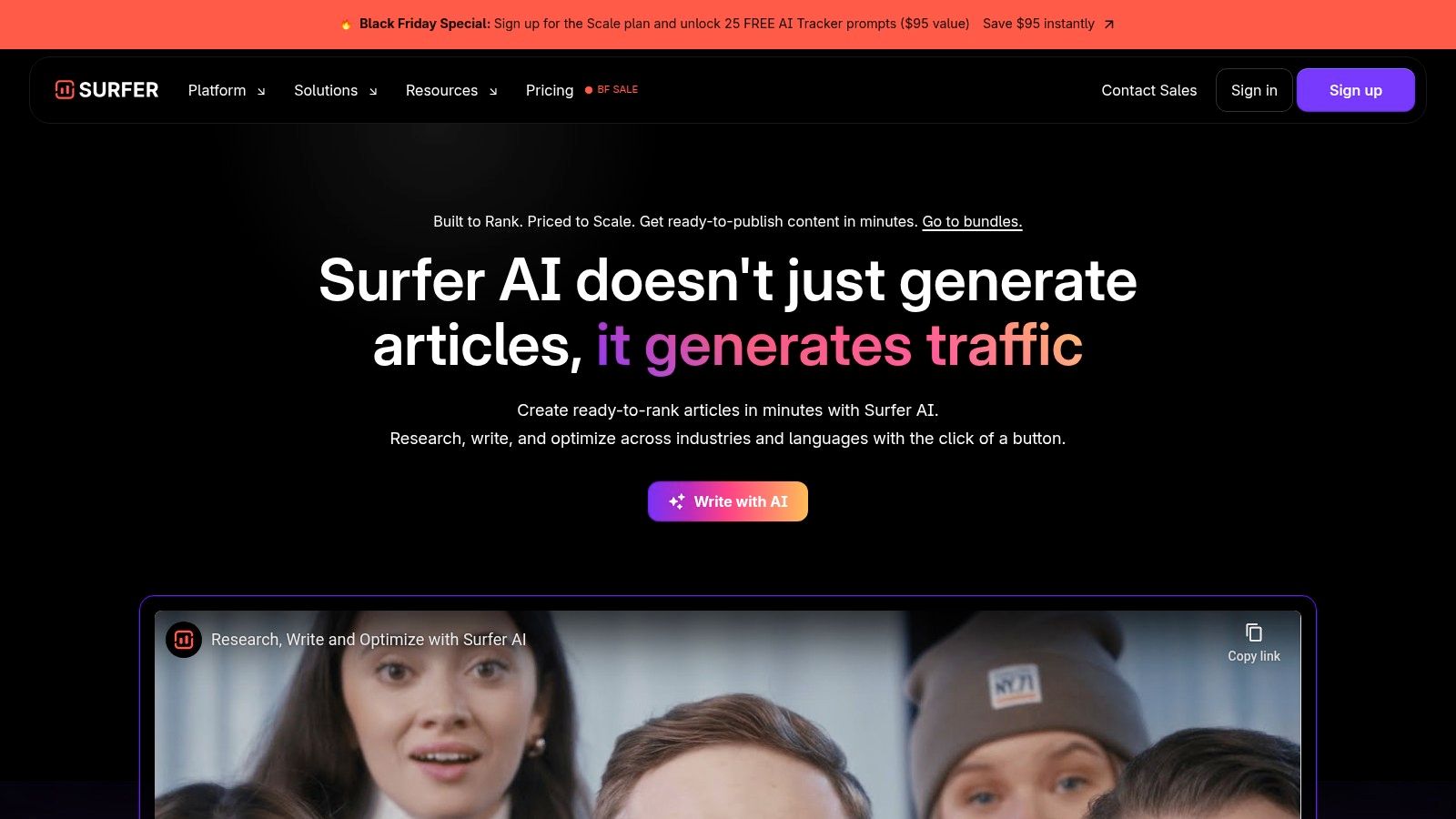
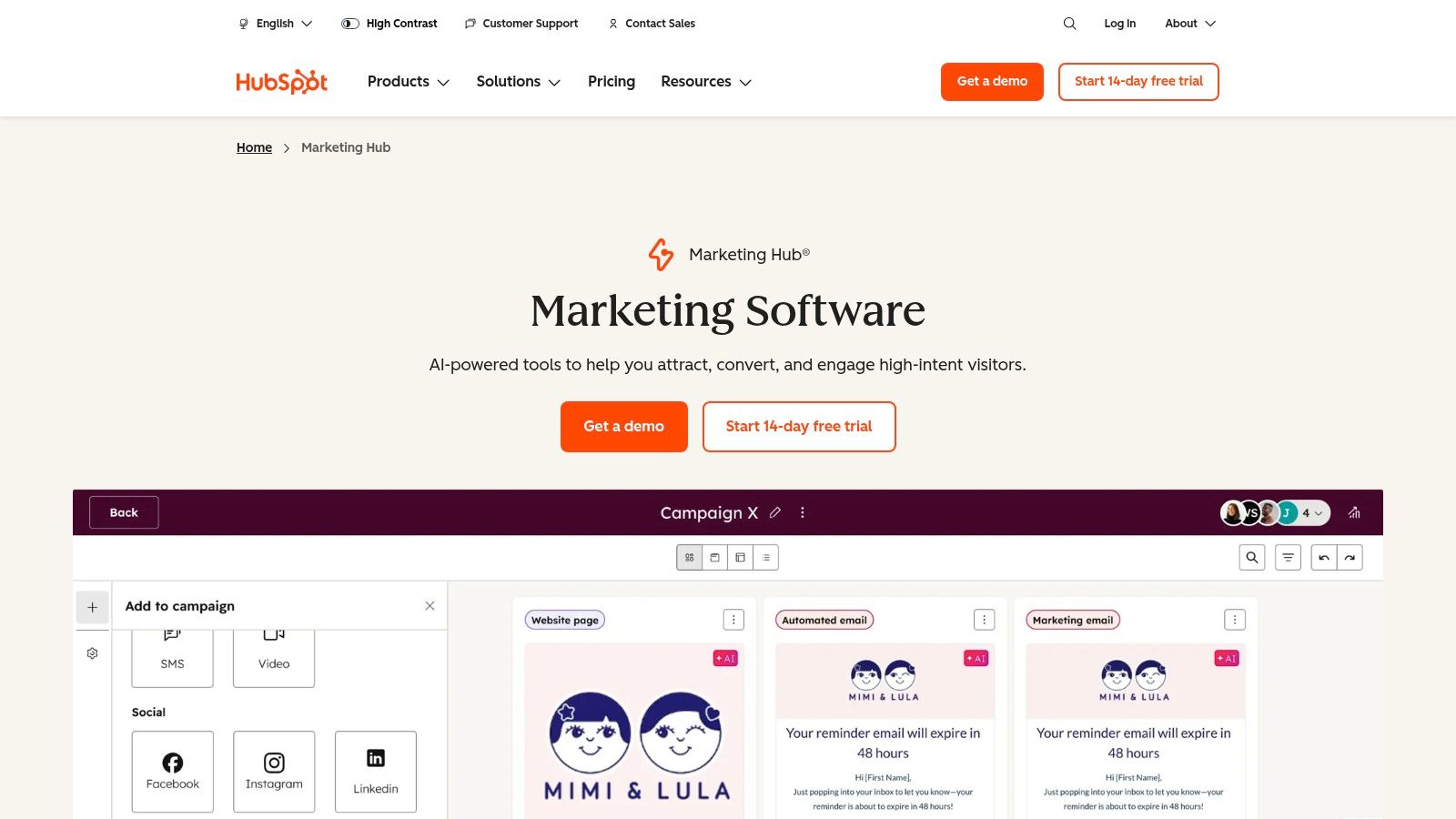
The 12 Best AI Tools for Content Creation in 2025 (Ranked & Reviewed)

· 33 min read

The right AI tools can dramatically accelerate your content creation process, transforming how marketing professionals, sales teams, and entrepreneurs produce everything from ad copy to video scripts. The challenge isn't a lack of options; it's navigating a crowded market to find solutions that genuinely match your team's workflow, budget, and specific content needs. Simply picking the most popular tool isn't enough. You need an actionable strategy to integrate these platforms effectively, avoiding the common pitfall of adopting software that gathers digital dust.

This guide moves beyond generic feature lists to provide a comprehensive analysis of the best AI tools for content creation. We offer an honest assessment of each platform's core capabilities, ideal use cases, and limitations. Before diving into specific tools, it's helpful to gain a clear baseline for understanding what AI-generated content is and how it's defined in practice. This context is crucial for evaluating which tools will best serve your strategic goals, whether you're a demand generation manager scaling campaigns or a VP of Sales equipping your team with better outreach materials.

Our goal is to help you make informed decisions quickly. For each tool reviewed, you will find:

  • Practical Use Cases: Real-world scenarios for marketing, sales, and operational tasks.
  • Strengths & Weaknesses: A balanced look at what each platform excels at and where it falls short.
  • Pricing & Enterprise Readiness: Clear information to help you evaluate scalability and budget fit.
  • Actionable Tips & Comparisons: Specific advice on how to use each tool effectively and how it stacks up against competitors.

We'll compare key players like Jasper and Copy.ai for text generation, evaluate visual content powerhouses such as Canva and Adobe Firefly, and explore video creation with Descript and Runway. Let's find the right AI content stack for your business.

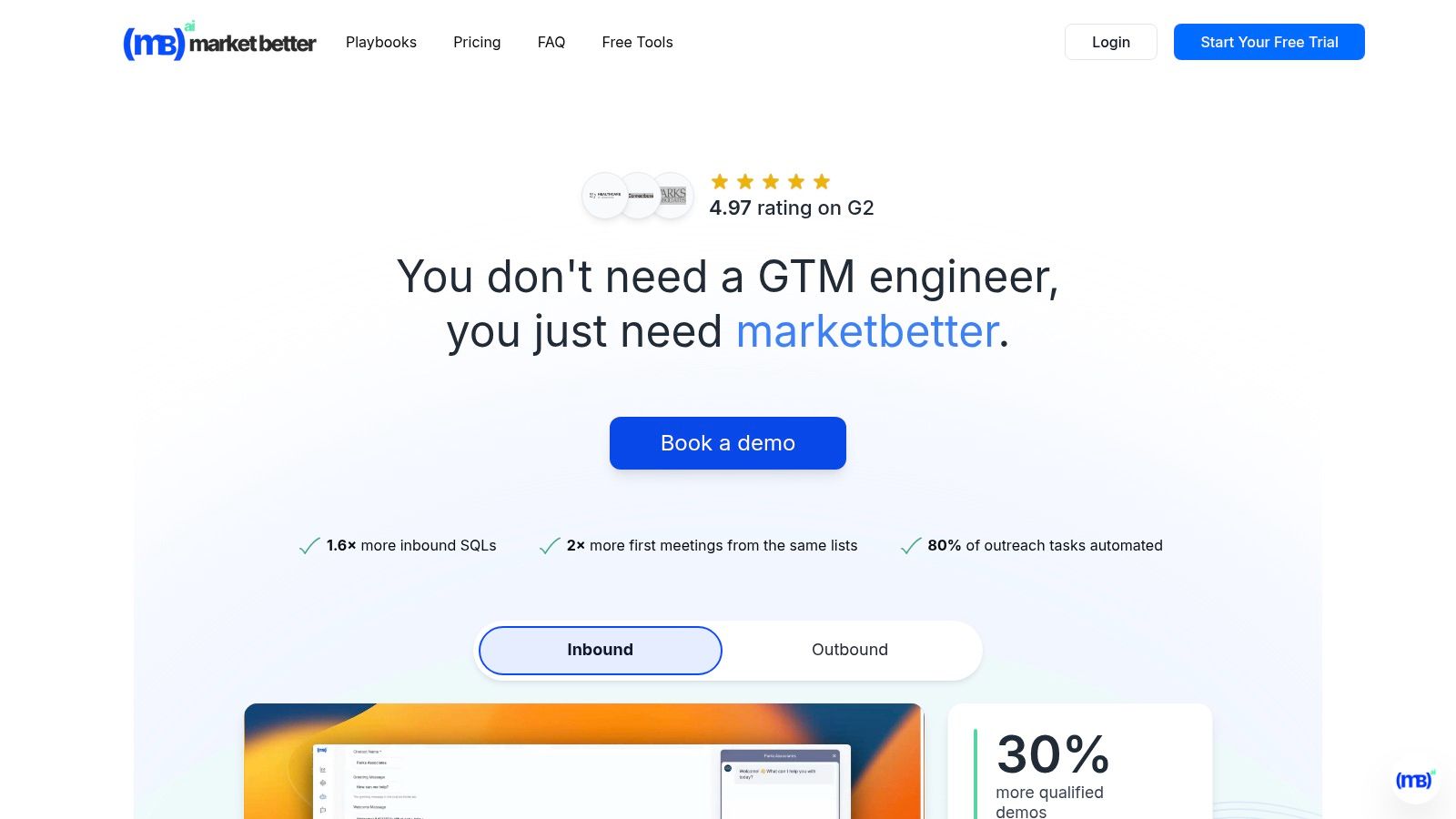
1. marketbetter.ai

Best for: Integrated GTM & Revenue Generation

MarketBetter.ai stands out as more than just a content tool; it's a comprehensive AI-native Go-To-Market (GTM) platform that unifies content creation with sales outreach, campaign optimization, and real-time analytics. While many of the best AI tools for content creation, such as Jasper or Copy.ai, focus solely on generating text or visuals, MarketBetter positions content as a core component of a unified "AI Revenue Engine." This makes it an exceptional choice for mid-market and enterprise B2B teams looking to eliminate tool sprawl and directly connect content efforts to pipeline and revenue.

The platform’s key differentiator is its integrated approach. Instead of using one tool for blog posts, another for social copy, a third for email sequences, and a fourth for analytics, MarketBetter combines these functions. It automates prospect research, generates personalized outreach sequences, and triggers touchpoints based on on-site user intent, dramatically reducing manual work. This holistic system provides a unified view of the customer journey, enabling clearer attribution and faster, more relevant follow-ups.

Key Features and Use Cases

  • AI-Powered Content & Outreach: Generate personalized email sequences, ad copy, and sales collateral tailored to specific accounts and personas. The system automates follow-ups, with users reporting up to 70% fewer manual outreach tasks.
  • Unified Analytics & Intent Detection: Its real-time dashboard connects content performance directly to pipeline metrics. The platform can identify anonymous website visitors, enrich account data, and trigger sales alerts based on buying intent signals.
  • Frictionless Integrations: MarketBetter offers no-extra-cost integrations with essential platforms like Salesforce, HubSpot, Slack, and LinkedIn Ads. Setup is fast, with a tracking code and CRM connection enabling live operation in minutes.
  • Enterprise-Ready Security: The platform includes robust security features, including data encryption in transit and at rest, detailed audit logs, and privacy compliance, making it suitable for enterprise-grade deployments.

Actionable Tip

To maximize ROI, connect MarketBetter to your CRM and primary ad platforms (e.g., LinkedIn Ads) during onboarding. Use the intent data to create a dynamic audience of high-fit, in-market accounts. Then, deploy an AI-generated, multi-touch campaign that combines automated email sequences with targeted ads for a unified, high-impact approach.

Pros & Cons

ProsCons
All-in-One Platform: Reduces tech stack bloat by combining content, outreach, and analytics.Opaque Pricing: Geared toward mid-market/enterprise; smaller teams must book a demo for cost details.
Proven ROI: Strong G2 ratings (4.9/5) and case studies show measurable lifts in SQLs, meetings, and campaign performance.Data Privacy Considerations: IP-based identification requires teams to validate compliance with regional regulations.
High Automation: Significantly cuts manual tasks for sales and marketing teams, freeing them up for strategic activities.
Rapid Implementation: Designed for quick time-to-value with seamless, out-of-the-box integrations.

Pricing: A free trial and demo are available. Pricing is customized for mid-market and enterprise teams, so contacting sales is required.

Website: marketbetter.ai

2. Jasper

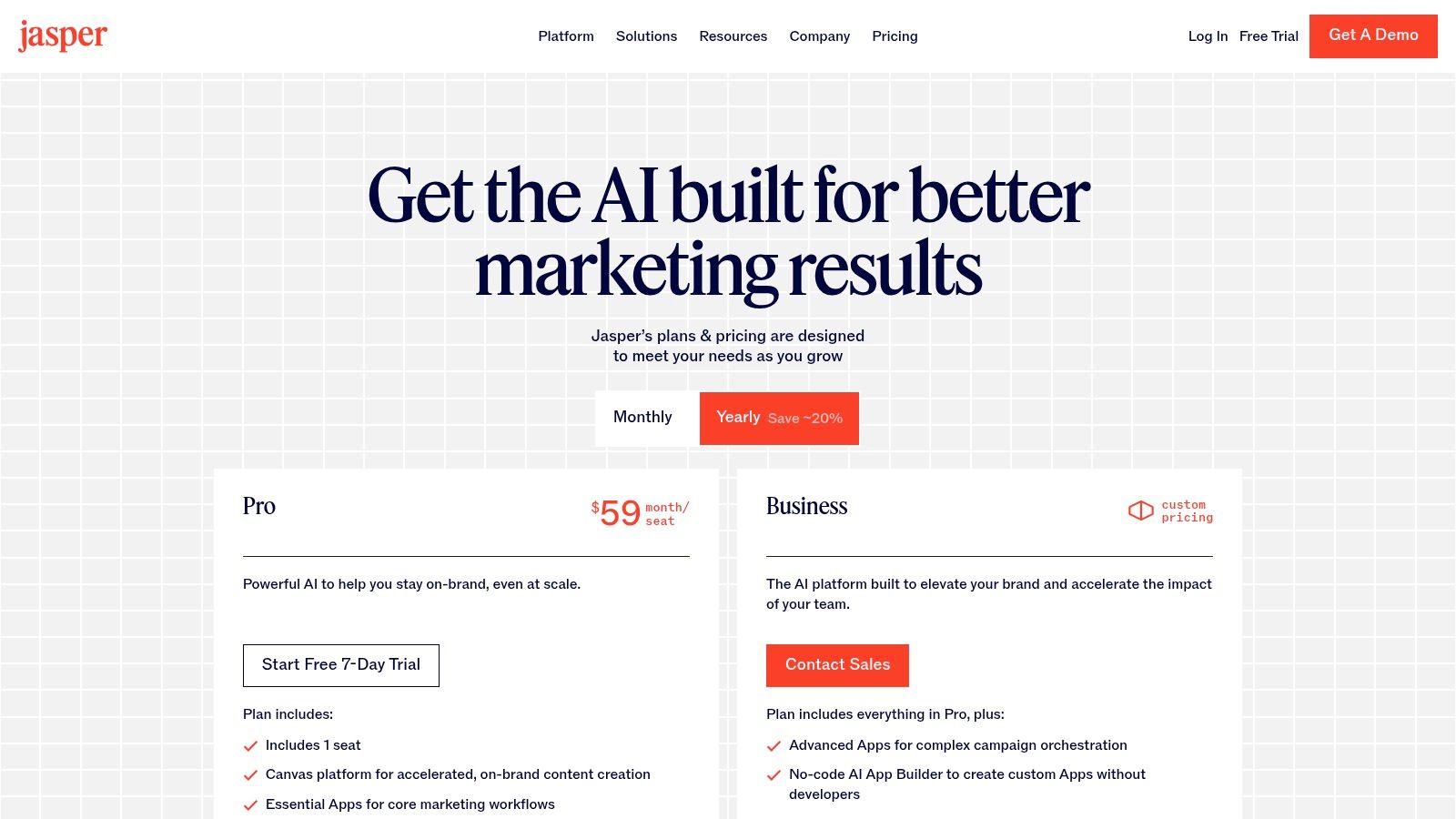
Jasper has carved out a significant niche as one of the best AI tools for content creation, specifically tailored for marketing teams aiming for brand consistency at scale. Unlike more generalist AI writers like Copy.ai that offer multi-model flexibility, Jasper's entire platform is built around a "Brand Voice" and "Knowledge" system. This allows you to upload style guides, product catalogs, and company facts, ensuring that every piece of content aligns perfectly with your established brand identity. It moves beyond simple prompt-and-response, functioning more like an in-house content assistant that already knows your rules.
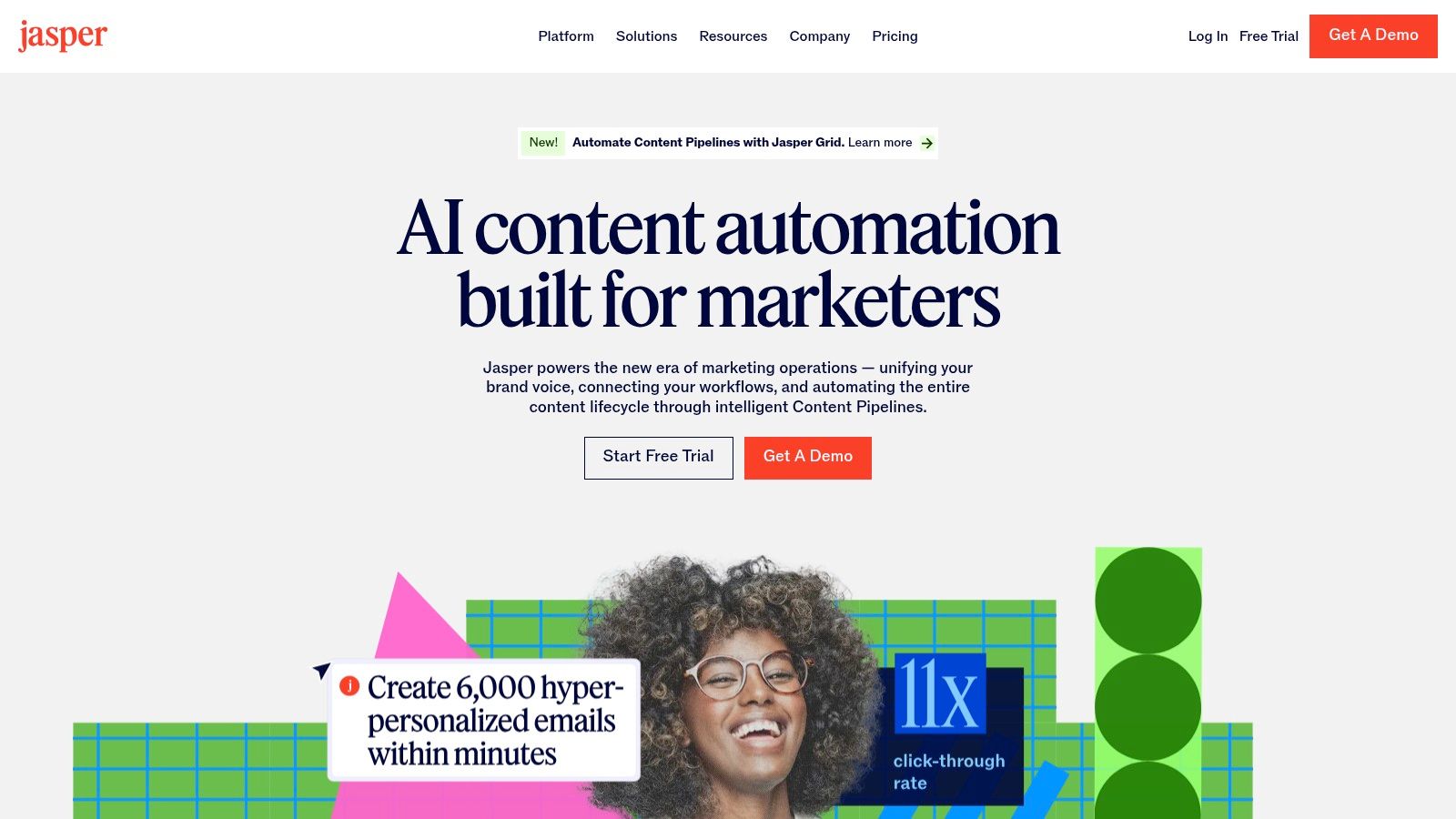
Jasper

The platform's standout feature is its campaign-centric workflow, which is a major differentiator from competitors. The "Canvas" feature lets teams collaboratively brainstorm and generate a suite of related assets for a single campaign in one interconnected space. This cohesive approach is ideal for demand generation managers and CMOs who need to orchestrate multi-channel marketing pushes efficiently. Its focus on team-based governance and workflows makes it a powerful choice for organizations looking to formalize their AI adoption.

Key Details & Use Cases

  • Best For: Marketing teams, demand generation managers, and enterprises needing strict brand governance and collaborative content workflows.
  • Pricing: Starts with the Creator plan at $49/month per seat. The Pro plan (starting at $69/month per seat) adds Brand Voices and collaboration features. The Business plan offers advanced features like API access and is based on custom pricing.
  • Unique Feature: The Brand Voice capability is exceptionally robust. You can train it by scanning your website or uploading documents, making it highly effective at capturing a specific tone and style.
  • Actionable Tip: To maximize Jasper's value, invest time upfront to thoroughly build out your Brand Voice and Knowledge Base. This initial setup is crucial for generating high-quality, on-brand content consistently. For your next campaign, use the Canvas to generate a blog post outline, then pull key messages from it to instantly create social media copy and ad headlines in the same document. You can explore this topic further and learn more about scaling your content marketing with Jasper on marketbetter.ai.
ProCon
Excellent for maintaining brand consistency.Per-seat pricing model can become costly for large teams.
Strong focus on collaborative workflows.Core enterprise features are gated behind custom pricing.
Purpose-built for marketing campaigns.Less of a "jack-of-all-trades" tool than some competitors.

Website: https://www.jasper.ai

3. Copy.ai

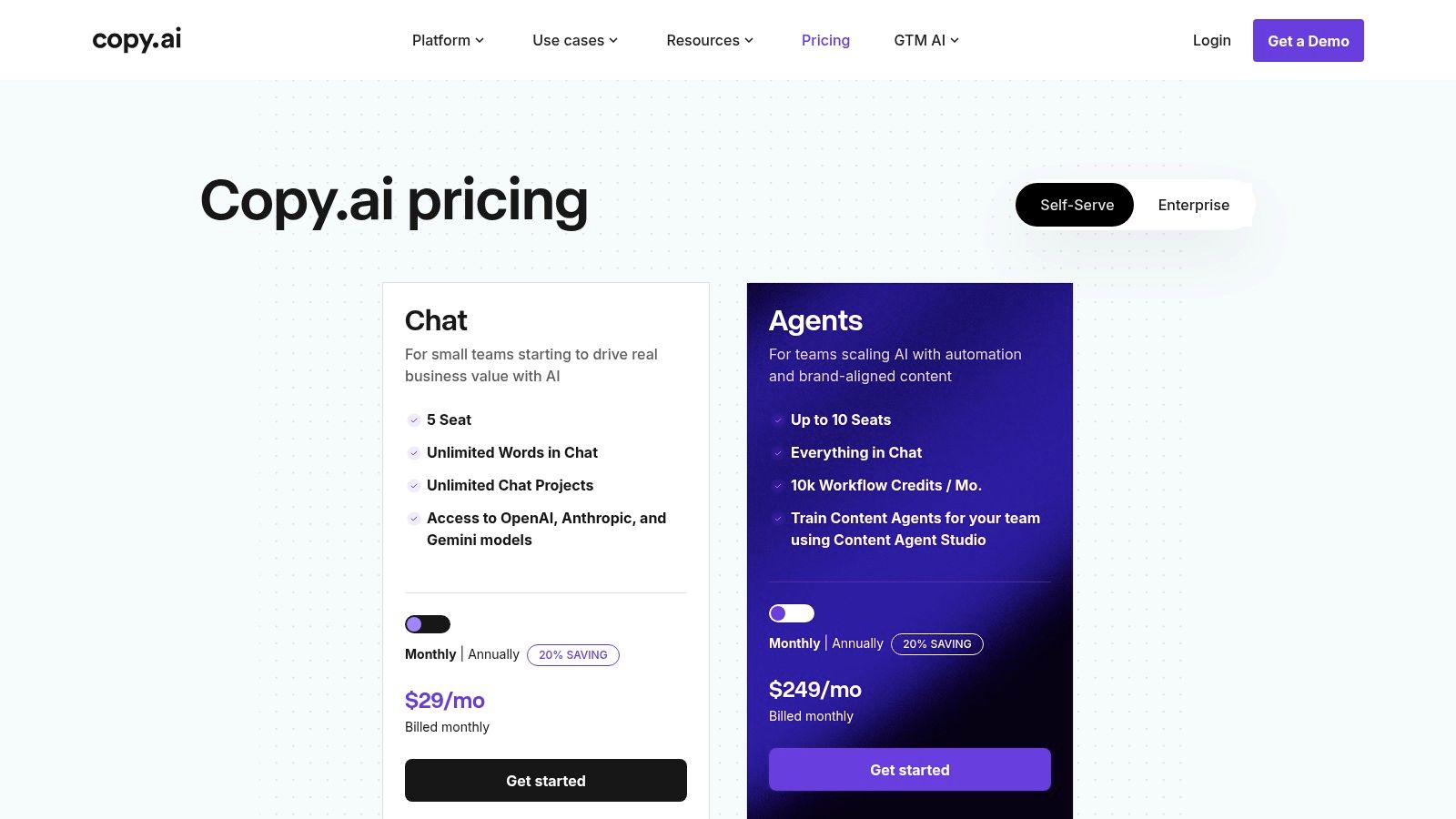
Copy.ai positions itself as a highly accessible and versatile AI content platform, making it one of the best AI tools for content creation for teams prioritizing speed and flexibility. Unlike platforms like Jasper that lock users into a single proprietary model, Copy.ai provides access to multiple leading LLMs, including models from OpenAI, Anthropic, and Google Gemini, all within one interface. This multi-model approach allows teams to select the best engine for a specific task, from generating creative marketing copy to drafting technical product descriptions, without needing multiple subscriptions.
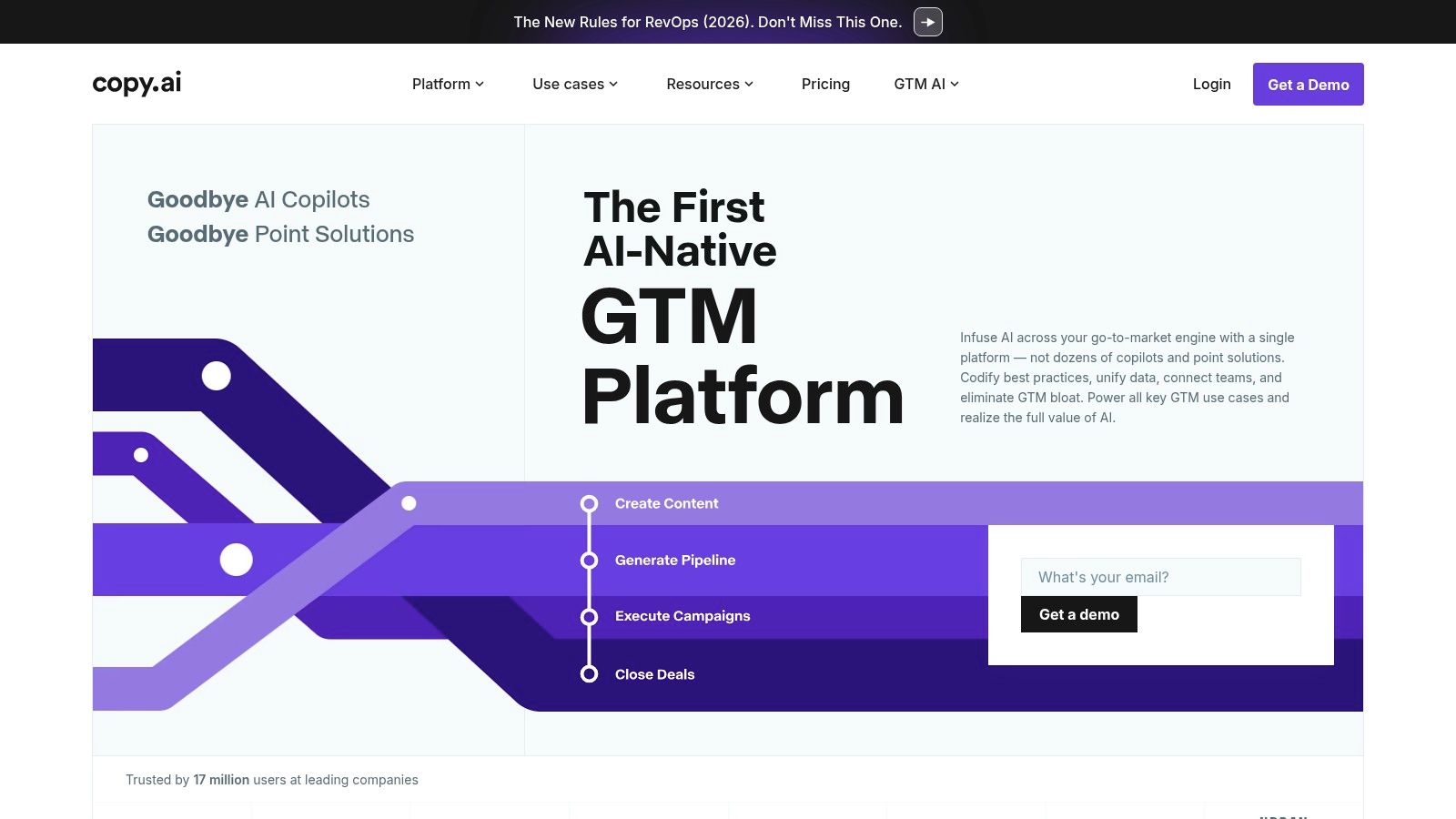
Copy.ai

The platform's strength lies in its approachable workflow builder and the innovative "Content Agent Studio." While other tools focus heavily on brand voice, Copy.ai empowers users to build and train custom AI agents for repeatable tasks. This is ideal for SMBs and marketing teams that need to automate content processes, like generating weekly SEO-optimized blog posts or repurposing webinar transcripts into social media content, with minimal technical overhead. This focus on user-built automation and model flexibility sets it apart from more structured, brand-centric platforms like Jasper.

Key Details & Use Cases

  • Best For: SMBs, startups, and agile marketing teams that need a fast, flexible tool for diverse content generation without a steep learning curve.
  • Pricing: Starts with a Free plan. The Pro plan is $49/month for 5 seats. The Team plan is $249/month for 20 seats and adds more workflow credits. Enterprise plans offer advanced features and custom pricing.
  • Unique Feature: The Workflow Builder combined with multi-model access is a key differentiator. It allows you to chain prompts and select different AI models for each step of a content workflow, offering unparalleled customization.
  • Actionable Tip: Start by identifying a high-volume, repetitive content task, such as writing product descriptions or social media updates. Use the Workflow Builder to create a simple, automated process for this task. For instance, create a workflow that takes a product name as input, generates a description using OpenAI's model, and then creates a promotional tweet using Anthropic's model for a different tone.
ProCon
Low entry price for small to medium-sized teams.Seat limits per plan can raise costs as the team scales.
Flexible access to multiple best-in-class AI models.Advanced automation (Agents) is locked into higher-tier plans.
Fast setup with guided onboarding and simple UI.Brand voice controls are less robust than enterprise-focused competitors.

Website: https://www.copy.ai

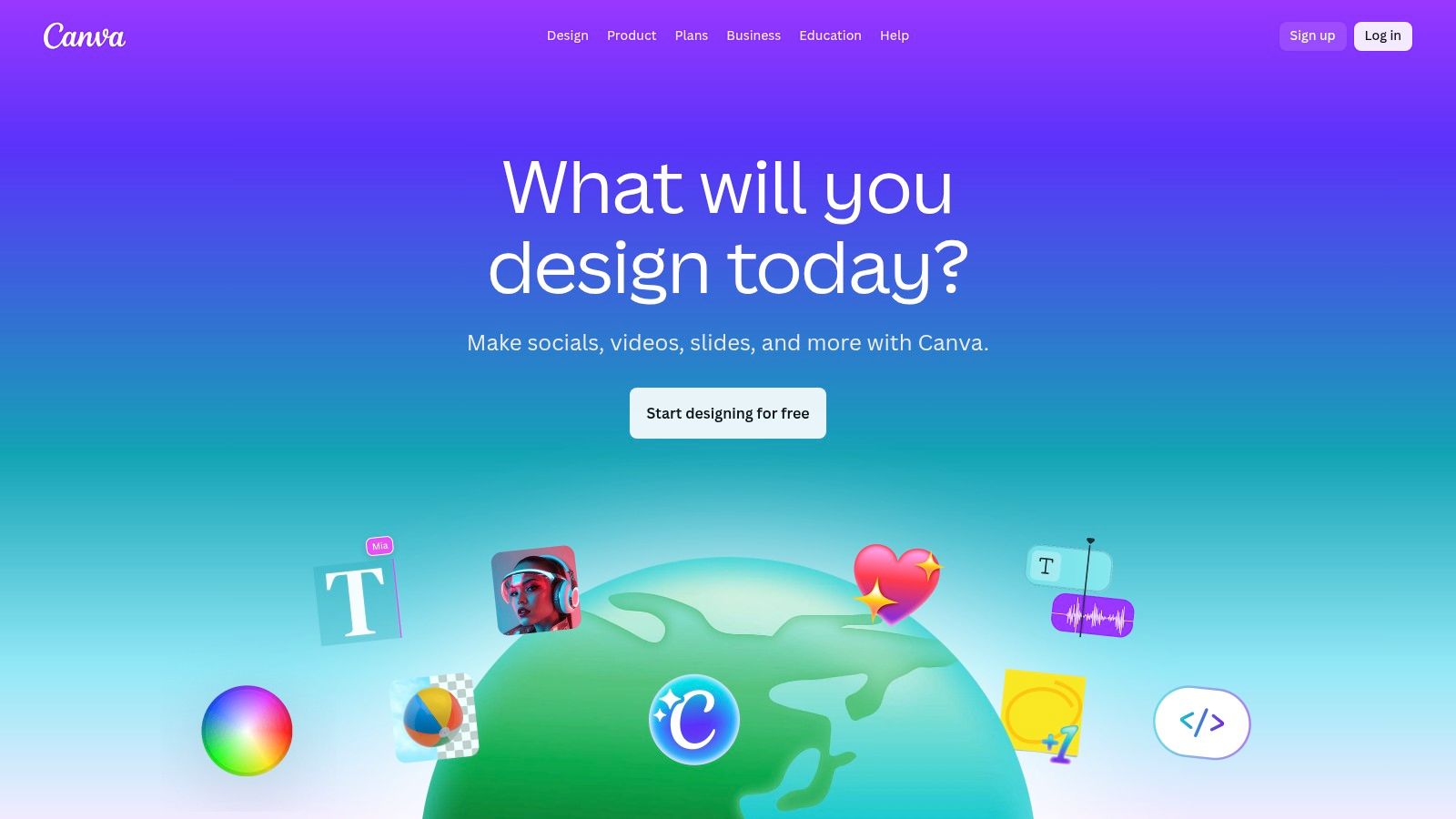
4. Canva (Magic Studio)

Canva has evolved from a simple design tool into an all-in-one visual communication platform, with its "Magic Studio" suite bringing powerful AI capabilities to the masses. Where a specialized tool like Adobe Firefly is built for professional designers, Canva excels at making AI accessible for creating a vast range of branded multimedia content quickly. It integrates text-to-image/video generation, AI-powered writing, and smart editing tools directly into its familiar, template-driven workflow, empowering non-designers to produce professional-grade marketing assets without a steep learning curve.
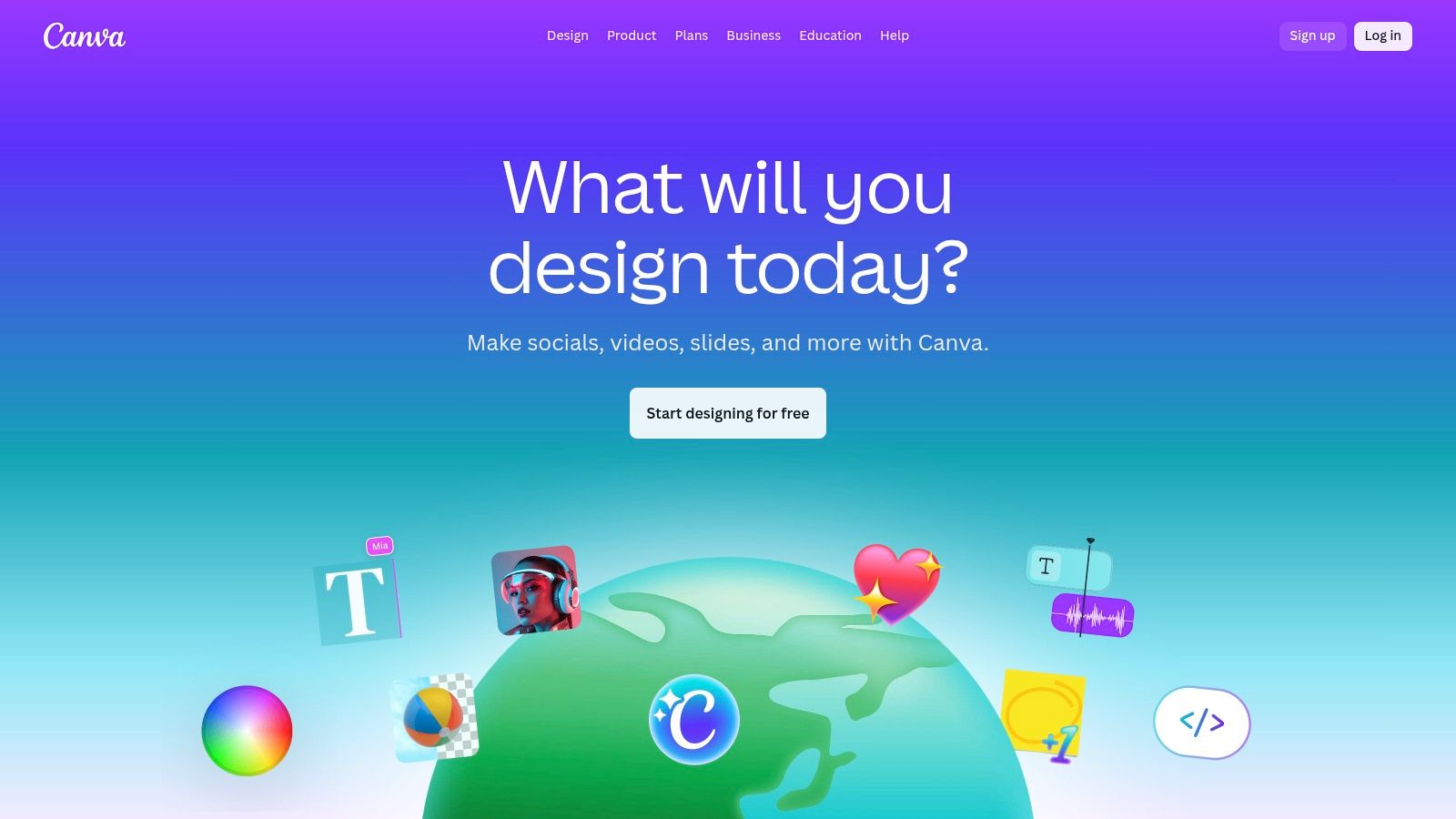
Canva (Magic Studio)

The platform's core strength lies in its seamless integration of AI features within an enormous library of templates and stock assets. A social media manager can generate an image with Magic Media, apply it to a branded post template, use Magic Write to create a caption, and schedule it for publishing, all within a single interface. This consolidated, user-friendly ecosystem makes it one of the best AI tools for content creation for teams who need speed and volume without sacrificing brand alignment.

Key Details & Use Cases

  • Best For: Social media managers, small business owners, and marketing teams who need to rapidly produce a high volume of visual content without specialized design skills.
  • Pricing: A robust free plan is available. Canva Pro is highly affordable for individuals and small teams. The Canva for Teams plan adds brand management and collaboration features, with custom enterprise pricing available.
  • Unique Feature: Magic Design allows you to simply upload an image or describe an idea, and Canva instantly generates a selection of fully-customizable templates (e.g., presentations, social posts) based on your input.
  • Actionable Tip: Use Canva's Brand Kit feature to its full potential by pre-loading your logos, brand colors, and fonts. Then, use Magic Design by providing a text prompt like "Instagram post for a new coffee blend launch." It will generate multiple on-brand templates instantly, which you can then refine and schedule directly from the platform. You can discover more about social media content creation tools on marketbetter.ai.
ProCon
Extremely user-friendly for non-designers with rich templates.Advanced AI and administrative controls are limited to Teams plans.
All-in-one platform for design, AI generation, and social scheduling.Past pricing and feature changes have caused confusion for some teams.
Extensive stock asset library and affordable Pro plan.AI image generation can be less nuanced than specialized tools.

Website: https://www.canva.com

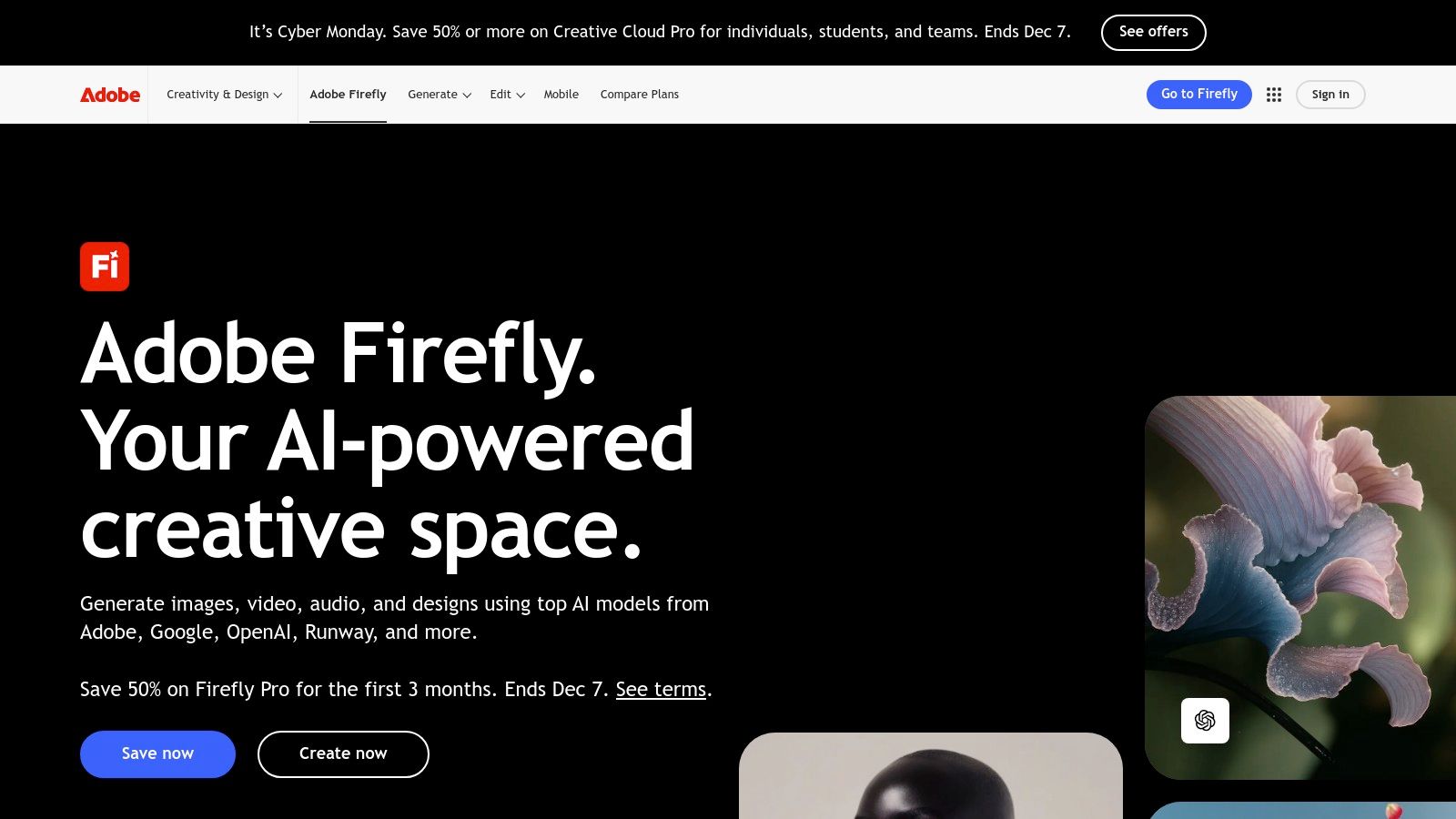
5. Adobe Firefly

Adobe Firefly enters the list of best AI tools for content creation not as a standalone writer, but as a powerful, integrated generative engine for visual content. Built directly into the Adobe Creative Cloud ecosystem, its primary advantage is its seamless workflow within industry-standard applications like Photoshop and Adobe Express. Firefly is designed for professional creatives, providing commercially-safe models trained on Adobe Stock and public domain content, which addresses major copyright concerns for enterprises.
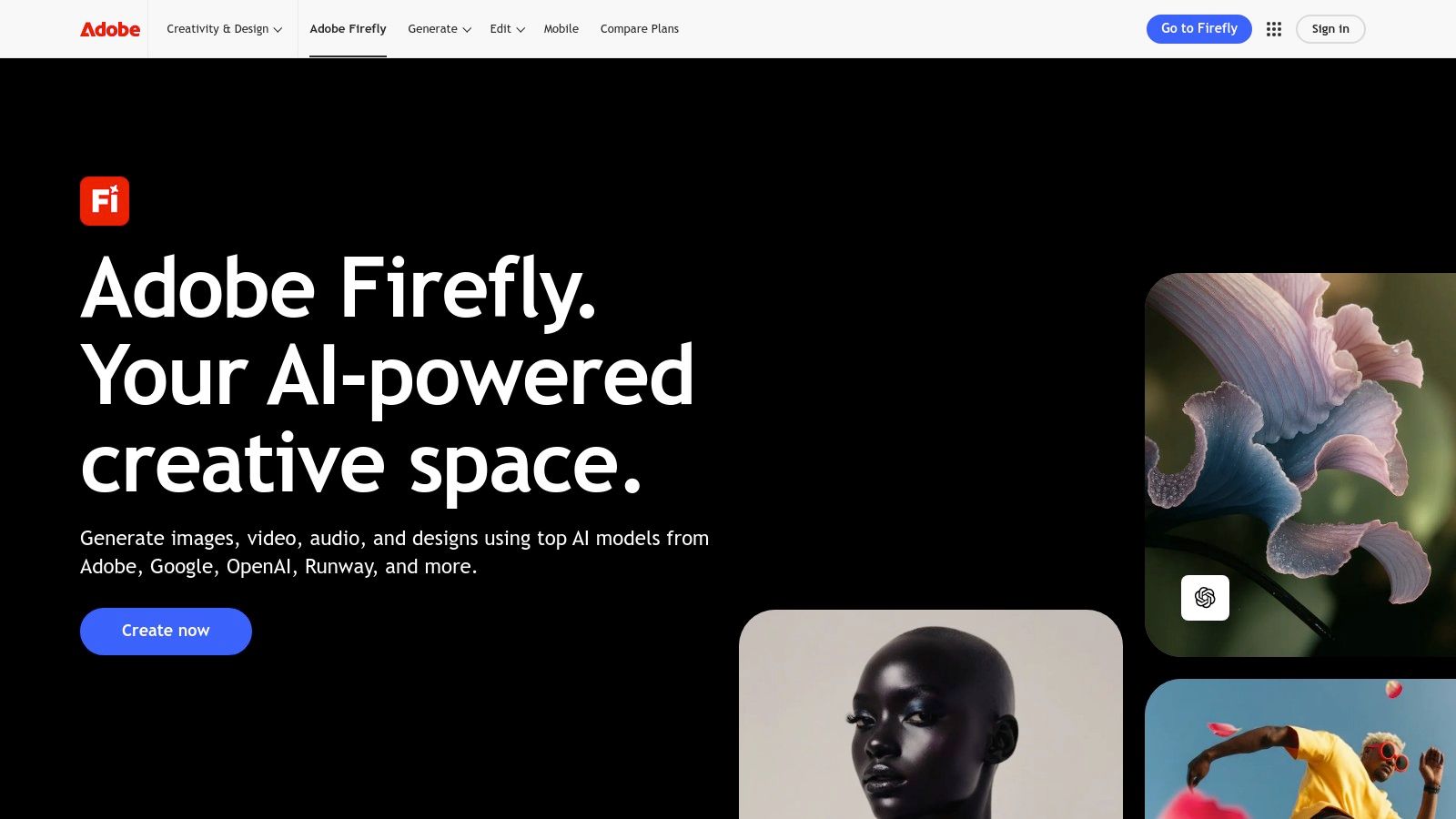
Adobe Firefly

Its core strength lies in features like Generative Fill and Generative Expand, which allow users to modify and extend existing images directly within their creative projects. While Midjourney is superior for generating entire, highly artistic images from scratch, Firefly excels at practical, in-workflow modifications. This integration makes it an indispensable tool for marketing and creative teams who need to produce high-quality, brand-aligned visual assets without disrupting established professional workflows.

Key Details & Use Cases

  • Best For: Creative professionals, marketing departments, and enterprises that are heavily invested in the Adobe Creative Cloud ecosystem.
  • Pricing: Access is included with most Creative Cloud plans, which start at $59.99/month for all apps. Usage is governed by a "generative credits" system, with plans allocating a specific number of credits per month.
  • Unique Feature: The Generative Fill in Photoshop is a game-changer. It allows you to select an area of an image and use a text prompt to add, remove, or replace content non-destructively, which is far more practical for professional use than generating entire images from scratch.
  • Actionable Tip: Use Generative Expand in Photoshop to quickly adapt a single creative asset for multiple channel formats. Take a square social media image, expand the canvas into a wide banner, and use the feature (with an empty prompt) to seamlessly fill the new space with matching background content. This turns a multi-step design task into a one-click action.
ProCon
Seamless integration with Photoshop and other CC apps.The credit-based system can be limiting for high-volume use.
Models are trained for safe commercial use.Creative Cloud subscription is required for deep integration.
Powerful for in-painting and out-painting workflows.Core value is tied to visuals, not text or other content types.

Website: https://www.adobe.com/products/firefly

6. Descript

Descript has fundamentally changed the landscape of audio and video production, making it one of the best AI tools for content creation for anyone working with spoken-word media. It operates on a revolutionary text-based editing model: your audio or video file is transcribed, and you edit the media simply by editing the text transcript. Deleting a sentence in the text automatically removes the corresponding audio and video segment. This approach dramatically lowers the barrier to entry for podcasting and video editing, making it as intuitive as editing a document.
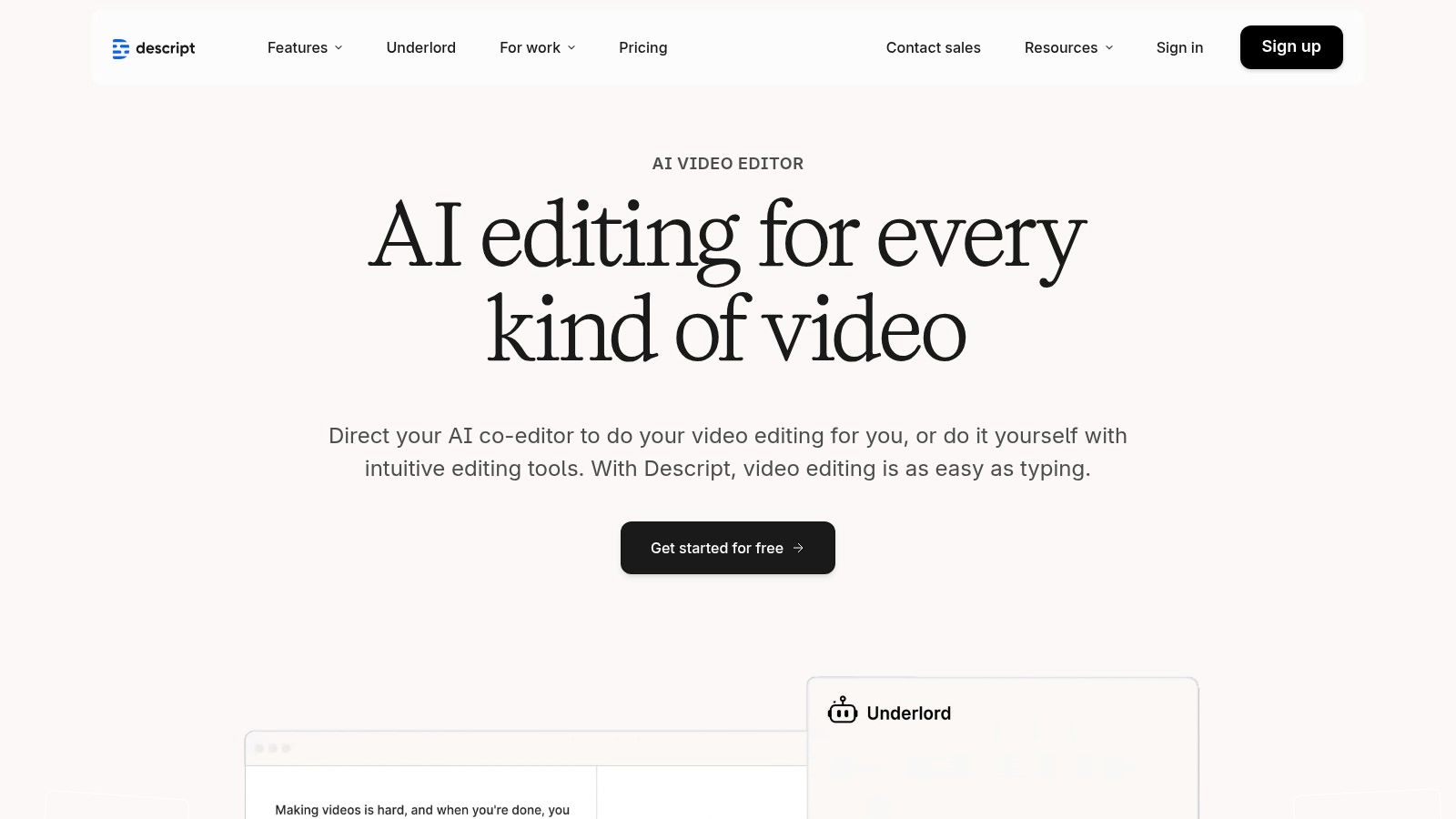
Descript

The platform’s power is amplified by its suite of AI-driven features designed to streamline post-production workflows. While a tool like Kapwing is built for quick social media repurposing, Descript is optimized for polishing long-form content. The "Studio Sound" feature can make amateur recordings sound professionally mastered with a single click, removing background noise and echo. Furthermore, its filler word removal tool ("ums," "ahs") and the "Overdub" AI voice cloning feature for correcting mistakes without re-recording are massive time-savers.

Key Details & Use Cases

  • Best For: Podcasters, video creators, marketing teams producing webinars or tutorials, and anyone who needs to edit spoken-word content efficiently.
  • Pricing: A free plan is available with limited features. The Creator plan is $15/month per editor, and the Pro plan is $30/month per editor, offering more transcription hours and advanced features like Overdub. A custom-priced Enterprise plan is also available.
  • Unique Feature: Text-based video and audio editing is the core differentiator. This transforms a technical, timeline-focused task into a simple, word-processing experience, making it accessible to non-editors.
  • Actionable Tip: After transcribing your video or podcast, use the "Find filler words" feature to highlight all instances of "um," "uh," and other repeated words. Instead of deleting them one by one, use the "Remove from transcript" option to clean up the entire recording in a single action, instantly making your content sound more professional.
ProCon
Dramatically speeds up podcast and video editing.Transcription hours and Overdub usage are metered per plan.
Powerful one-click audio cleanup with Studio Sound.Advanced team collaboration is limited to higher-tier plans.
Free tier is available to test core functionality.Not a full replacement for advanced video editors like Premiere Pro.

Website: https://www.descript.com

7. Runway

Runway has emerged as a leader among the best AI tools for content creation, specifically for video-first workflows. It offers a comprehensive suite of AI magic tools that go far beyond simple generation, positioning itself as a full-fledged creative studio for video editors and marketers. Unlike competitors that may specialize in a single function like text-to-video, Runway provides an integrated ecosystem for generating, editing, and refining video content, from initial concept to final polish. This makes it a go-to platform for producing social media clips, advertising drafts, and high-fidelity conceptual videos with incredible speed.
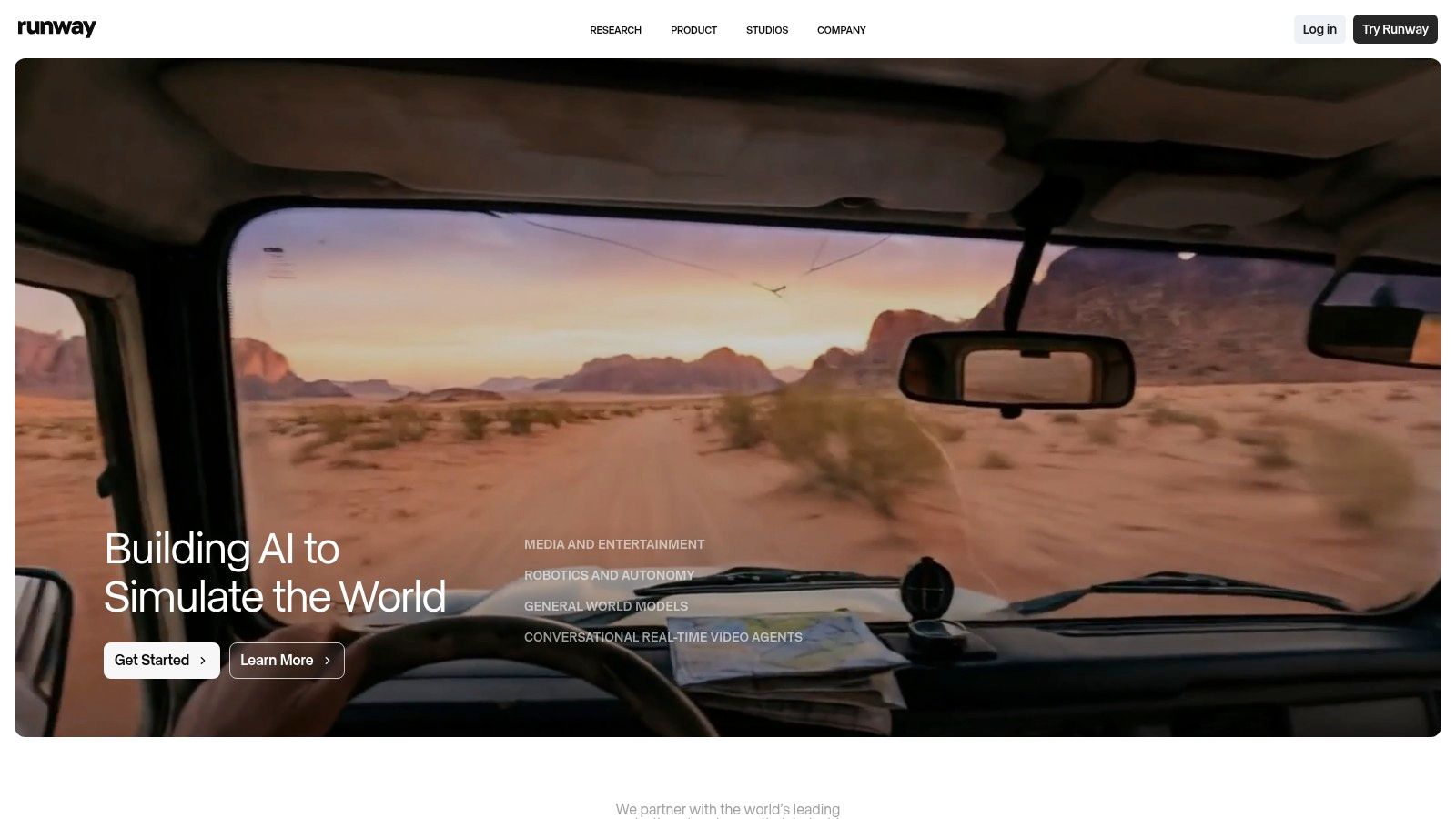
Runway

The platform's key differentiator is its combination of cutting-edge generation models (like Gen-3 Alpha) with a powerful in-browser video editor. While a tool like Synthesia focuses on avatar-led videos, Runway is built for more cinematic and abstract content creation. A user can generate a clip from a text prompt, immediately bring it into the editor to add effects, remove objects, or extend the scene, and then export it, all within the same interface. This tight integration is invaluable for marketing professionals who need to move from ideation to a usable asset quickly.

Key Details & Use Cases

  • Best For: Social media managers, video editors, and advertising agencies looking to rapidly prototype and produce video content.
  • Pricing: Offers a free Basic plan with limited credits. Paid plans start at $15/month per user for the Standard plan. The Pro plan ($35/month) adds more credits and advanced features, with custom pricing for Enterprise needs.
  • Unique Feature: The multi-modal AI system is a standout. It allows users to direct video generation with combinations of text, images, and existing video clips, offering a level of creative control that pure text-to-video models lack.
  • Actionable Tip: Use the "Image to Video" and "Video to Video" features to maintain visual consistency in your campaigns. Start with a key brand image or a previously approved video clip to guide the AI, ensuring new generations align with your existing marketing assets. For instance, upload a product photo and use the prompt "subtle panning motion" to create a simple, elegant video ad.
ProCon
State-of-the-art text-to-video and image-to-video models.Credit system can be consumed quickly on high-res outputs.
Integrated editor provides a seamless workflow.The most advanced features and models require higher-tier plans.
Generous free tier for experimentation and small projects.Annual billing is often required for the best value.

Website: https://runwayml.com

8. Synthesia

Synthesia has established itself as a leader among the best AI tools for content creation, specifically for generating professional, avatar-led videos at scale. Instead of requiring cameras, microphones, and actors, it allows users to produce high-quality training modules, marketing explainers, and product demos simply by typing text. While Runway is for creative, cinematic video, Synthesia excels in corporate and educational content, dramatically reducing the time and cost associated with traditional video production. This makes it an accessible solution for corporate communications and learning & development (L&D) teams.
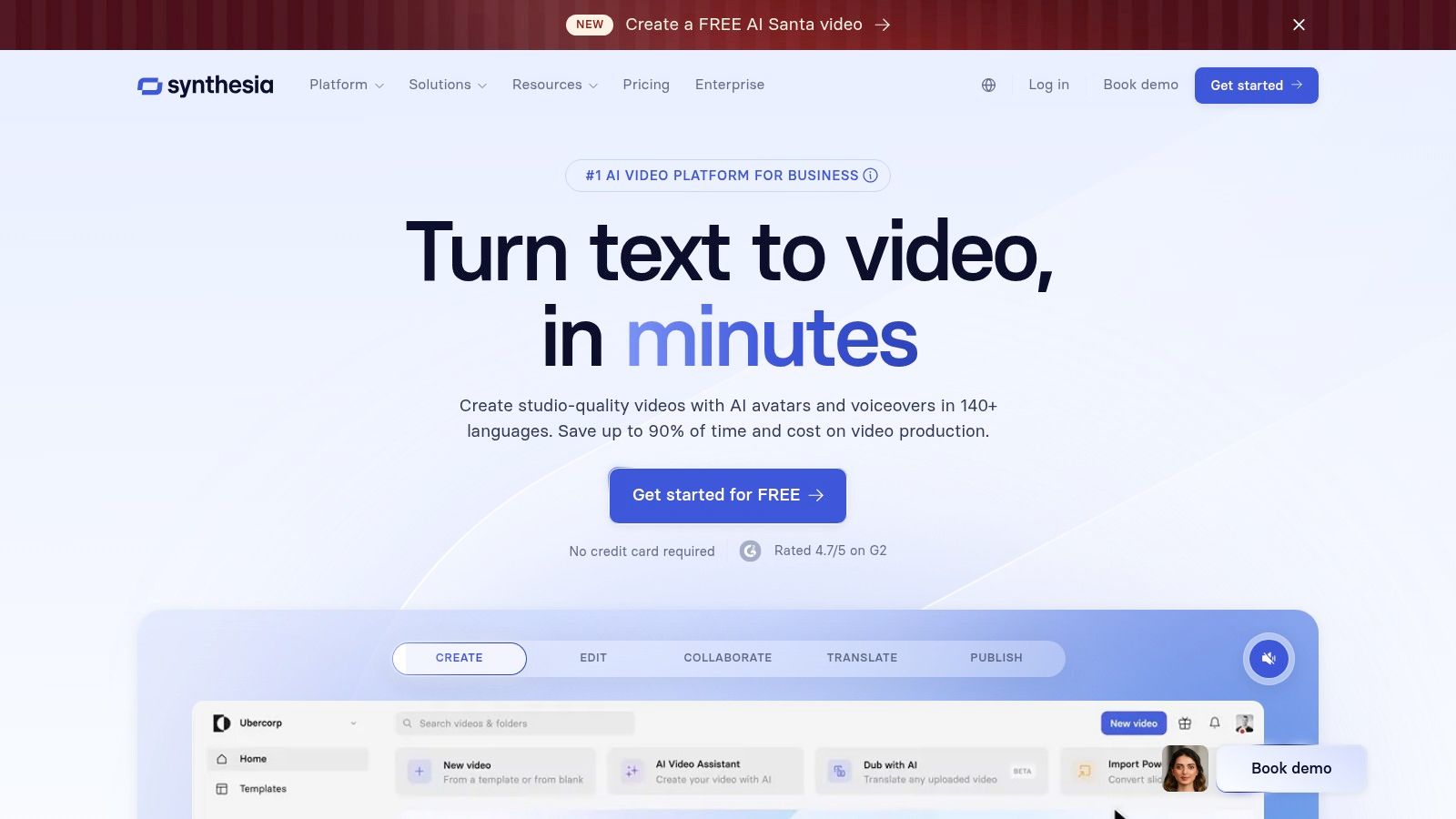
Synthesia

The platform’s core strength lies in its scalability and localization capabilities. With support for over 140 languages and a vast library of stock avatars, a single video can be effortlessly dubbed and adapted for global audiences. Enterprise-focused features like SCORM export for learning management systems, API access for bulk video personalization, and SSO integration make it a secure and powerful choice for large organizations. This moves it beyond a simple video maker into a comprehensive video communication engine.

Key Details & Use Cases

  • Best For: Corporate L&D teams, marketers creating explainer videos, and enterprises needing to localize video content efficiently.
  • Pricing: The Personal plan is $29/month for 10 minutes of video. The Enterprise plan is custom-priced and offers more avatars, API access, and advanced collaboration features.
  • Unique Feature: The AI Dubbing capability is a standout. It can automatically translate and create a voiceover for your video in a different language while attempting to match the original speaker's lip movements, which is a major time-saver for localization.
  • Actionable Tip: Use Synthesia’s API for personalized video campaigns. For example, you can automate the creation of hundreds of unique videos for sales outreach by connecting a spreadsheet of prospect names. Each video can feature an avatar addressing the prospect by name, dramatically increasing engagement. Discover how to integrate these videos by exploring our playbook on video email automation on marketbetter.ai.
ProCon
Extremely fast production of presenter videos.Avatar realism and expressiveness can vary.
Scales exceptionally well for L&D and multilingual content.Usage is capped by credits/minutes on lower-tier plans.
Strong enterprise-grade security and integration options.Less suited for creative or cinematic video styles.

Website: https://www.synthesia.io

9. Midjourney

Midjourney has established itself as a leader among the best AI tools for content creation, focusing exclusively on generating high-quality, artistic, and photorealistic images. It operates primarily through a Discord server, a unique approach that fosters a massive, collaborative community where users can share prompts and draw inspiration. While Adobe Firefly is integrated into a professional design suite for in-workflow editing, Midjourney is a standalone powerhouse for creating bespoke campaign visuals, mood boards, and unique digital art from a blank canvas.
Midjourney

Unlike competitors that are often embedded in larger content suites, Midjourney is a dedicated, specialized tool celebrated for its stylistic diversity and the cinematic quality of its outputs. Its prompt-based system allows for deep creative control, enabling marketing professionals and creators to translate abstract concepts into compelling visuals. The platform is continuously updated with new models and features, ensuring it remains at the forefront of AI image generation technology.

Key Details & Use Cases

  • Best For: Marketing teams, creative directors, and content creators who need high-quality, custom visuals for campaigns, social media, and conceptual work.
  • Pricing: The Basic Plan starts at $10/month, providing a limited amount of "Fast" GPU time. Higher-tier plans (from $30 to $120/month) offer more Fast hours, unlimited "Relax" mode generations, and private generation capabilities.
  • Unique Feature: The Discord-based community is a massive differentiator. It serves as a live gallery and learning hub, allowing users to see what others are creating in real-time and learn advanced prompting techniques organically.
  • Actionable Tip: To create a set of visually consistent images for a campaign, use the --sref (style reference) parameter. Generate one image that perfectly captures your desired aesthetic. Then, copy that image's URL and append --sref [URL] to all subsequent prompts to ensure they follow the same artistic style.
ProCon
Consistently produces high-quality outputs.The Discord-centric workflow can have a learning curve for new users.
Large, active community provides vast inspiration.Managing GPU minute usage is necessary on lower-tier plans.
Competitive pricing for high-volume creation.Less integrated into broader marketing workflows than some tools.

Website: https://www.midjourney.com

10. Notion (Notion AI)

Notion AI transforms the popular all-in-one workspace into a powerful hub for content operations. Instead of being a standalone application, its AI is deeply integrated within Notion's ecosystem of docs, databases, and project boards. This makes it one of the best AI tools for content creation for teams that want to consolidate their entire workflow—from initial brief to final draft—in a single environment. While a tool like Jasper is a dedicated writing specialist, Notion AI's strength is its ability to connect content creation directly to project management.
Notion (Notion AI)

The platform’s strength lies in its contextual awareness. When you invoke Notion AI on a page, it understands the surrounding content, making it excellent for summarizing meeting notes into action items, expanding on brainstormed ideas, or drafting content based on an existing creative brief. Features like AI Autofill for databases can automatically generate social media copy or meta descriptions for a list of blog titles, streamlining repetitive tasks and connecting different stages of the content lifecycle.

Key Details & Use Cases

  • Best For: Content operations teams, marketing managers, and organizations seeking a unified platform for content planning, creation, and project management.
  • Pricing: AI features are included in paid plans like Plus ($10/user/month), Business ($18/user/month), and custom Enterprise tiers. The free plan has limited AI access. Note that the standalone AI add-on is being phased out for new users.
  • Unique Feature: The AI Autofill for databases is a standout. It allows you to automatically populate columns based on content from other fields, perfect for generating summaries, extracting keywords, or creating social posts at scale from a content calendar.
  • Actionable Tip: Build a content calendar database in Notion with columns for "Title," "Brief," and "Social Copy." Use the custom AI Autofill feature on the "Social Copy" column with a prompt like "Write a tweet promoting the blog post in the 'Title' column, based on the 'Brief'." This creates a highly efficient, centralized content engine.
ProCon
Reduces app-switching by keeping content and ops in one place.Feature gating may force plan upgrades for full AI access.
Integrated AI streamlines the brief-to-draft workflow.Less specialized for pure long-form writing than dedicated AI writers.
Flexible and relatively affordable per-seat pricing model for teams.AI is not the core product, but rather an integrated feature set.

Website: https://www.notion.so

11. Kapwing

Kapwing positions itself as a collaborative, browser-based video editing studio supercharged with AI, making it a go-to for social media teams who prioritize speed and accessibility. Its core strength lies in repurposing content efficiently. While a tool like Descript is ideal for polishing the narrative of a single long-form piece, Kapwing is built to quickly turn that one video into dozens of social-ready assets. This makes it one of the best AI tools for content creation when your primary goal is maximizing content distribution across platforms.
Kapwing

The platform’s standout AI features are centered on making content more accessible and globally relevant. Its auto-subtitling tool is remarkably accurate and easy to edit, while the AI-powered translation and dubbing can instantly adapt a video for new audiences. For marketing teams managing multiple brand channels, the shared workspaces and brand kits streamline collaboration and ensure consistency without the need for exporting and re-uploading project files. It’s built for the fast-paced demands of modern social content workflows.

Key Details & Use Cases

  • Best For: Social media managers, content creators, and marketing teams focused on bulk video repurposing and enhancing content accessibility.
  • Pricing: A free plan is available with a watermark and export limits. The Pro plan is $24/month per user, unlocking 4K exports and removing watermarks. The Business plan at $64/month per user adds AI dubbing and increases AI credit limits significantly.
  • Unique Feature: The AI Dubbing with lip-sync technology (Business plan) is a powerful tool for localization, allowing you to translate your video's audio into another language while maintaining visual coherence, a feature not commonly found in browser-based editors.
  • Actionable Tip: Upload a long webinar or interview video. Use the "Smart Cut" AI feature to automatically remove silences. Then, use the AI-powered "Find Scenes" tool to identify key topic changes, allowing you to quickly clip out multiple short, shareable videos for platforms like TikTok and Instagram Reels.
ProCon
Excellent for bulk repurposing to multiple aspect ratios.Free plan includes a watermark and caps export length.
Strong subtitling and translation tools for accessibility.Heavy AI use requires a Business plan for the best limits.
Simple, browser-based interface is easy for teams to adopt.Less powerful than traditional desktop video editing software.

Website: https://www.kapwing.com

12. G2 (AI Writing Assistants Category)

Instead of a single tool, our next entry is an indispensable resource for discovering and comparing them. G2’s AI Writing Assistants category is a comprehensive software marketplace that aggregates verified user reviews, rankings, and comparison grids. For marketing professionals and entrepreneurs tasked with selecting the right AI, this platform provides a crucial, unbiased overview of the entire landscape. It allows you to move beyond vendor marketing claims and see how real users rate tools on features, ease of use, and support.

The platform's strength lies in its powerful filtering and comparison capabilities. You can segment the list of the best AI tools for content creation by company size, user satisfaction scores, or specific features, making it easy to create a shortlist tailored to your exact needs. The side-by-side comparison grids are particularly useful for demand generation managers and CMOs who need to build a business case for a new software investment, as they clearly lay out key differences between top contenders like Jasper and Copy.ai.

Key Details & Use Cases

  • Best For: Marketing leaders, entrepreneurs, and teams conducting due diligence before investing in an AI content creation tool.
  • Pricing: Free to access and browse for software buyers. Vendors pay for premium profile features and lead generation.
  • Unique Feature: The G2 Grid® is a standout visual tool that plots tools based on user satisfaction and market presence, giving you an at-a-glance understanding of which platforms are leaders versus niche players.
  • Actionable Tip: Don't just look at the overall score. Use the comparison feature to select your top three contenders and compare their feature ratings side-by-side for the specific capabilities you need most, such as "Brand Voice" or "Workflow Automation." Read both positive and negative reviews to understand each tool's real-world limitations before committing.
ProCon
Provides a broad market view beyond any single vendor.Rankings can shift frequently based on new review data.
Helpful for shortlisting tools by use case, budget, and rating.Some listings may emphasize sponsors or partners; always verify.
Aggregates reputation signals like scores and pros/cons.The sheer number of options can feel overwhelming initially.

Website: https://www.g2.com/categories/ai-writing-assistant

Top 12 AI Content Creation Tools Comparison

Product✨ Core features★ UX & Quality💰 Pricing & Value👥 Target audience🏆 Unique selling point
🏆 marketbetter.ai✨ Unified AI content, outbound/inbound automation, predictive campaign optimization, real-time analytics★★★★★ (G2 4.97) — fast implementation & dashboards💰 Mid‑market / Enterprise; demo & free trial; ROI-focused (1.6× SQLs, 2× meetings)👥 Mid-market & enterprise B2B marketing, CMOs, Ops🏆 Integrated “AI Revenue Engine” replacing martech sprawl; frictionless CRM + enterprise security
Jasper✨ Brand voices, Canvas, team workflows, no-code agents★★★★☆ — strong brand governance & collaboration💰 Per-seat pricing; can be costly at scale👥 Marketing teams, content ops, agencies✨ Best-in-class brand voice and marketing workflows
Copy.ai✨ Chat + multi-model access, workflow builder, Content Agents★★★☆☆ — fast setup and flexible models💰 Low entry price; pay-as-you-scale; agent features on higher tiers👥 SMBs, growth teams, fast test-and-learn squads✨ Unparalleled flexibility with multi-model access
Canva (Magic Studio)✨ Text-to-image/video, templates, brand kits, Magic Edit★★★★☆ — very fast for non-designers💰 Affordable Pro; Business for teams with advanced controls👥 Social teams, non-designers, SMBs✨ All-in-one design and AI for rapid multimedia content
Adobe Firefly✨ Text-to-image/video, Generative Fill, Creative Cloud integration★★★★☆ — pro-grade creative tools💰 Credit system; part of Creative Cloud (may raise costs)👥 Professional designers, creative teams, enterprises✨ Commercially-safe models with deep Photoshop integration
Descript✨ Text-based audio/video editing, Overdub, Studio Sound★★★★☆ — speeds podcast & video workflows💰 Free tier; paid tiers meter transcription hours👥 Podcasters, video editors, marketing content teams✨ Revolutionary text-based editing for spoken-word content
Runway✨ Advanced text-to-video/image models, Aleph editor, API★★★★☆ — fast iterative video drafts💰 Credit plans with monthly refresh; good Enterprise options👥 Social creators, video teams, agencies✨ State-of-the-art AI video models with an integrated editor
Synthesia✨ Avatar-led video, dubbing, templates, bulk personalization★★★☆☆ — very fast for presenter-style videos💰 Enterprise/credits model; scalable but costly for minutes👥 L&D, localization, marketing explainers at scale✨ Scalable avatar videos with excellent localization features
Midjourney✨ High‑quality image generation, stylistic diversity, community prompts★★★★☆ — excellent creative outputs (Discord workflow)💰 Creator tiers; competitive monthly pricing👥 Creatives, art directors, campaign designers✨ Unmatched artistic quality and stylistic breadth in images
Notion (Notion AI)✨ AI writing, research mode, meeting notes in centralized workspace★★★☆☆ — integrates content ops & briefs💰 Per-seat pricing; AI may require Business/Enterprise👥 Content ops, product & marketing teams✨ Deep integration of AI within a total content workflow
Kapwing✨ Auto-subtitles, dubbing, resizing, brand kits, shared workspaces★★★☆☆ — quick repurposing & subtitles💰 Free tier (watermark); Business for heavy AI use👥 Social teams, creators, repurposing workflows✨ The fastest way to repurpose long video into social clips
G2 (AI Writing Assistants)✨ Category pages, verified reviews, comparison filters★★★☆☆ — broad market view; dynamic rankings💰 Free to use; vendor-sponsored listings exist👥 Buyers researching tools, procurement teams✨ Unbiased, aggregated reviews for informed decision-making

Final Thoughts

Navigating the landscape of AI content creation tools can feel like exploring a new frontier. The sheer volume of options, each promising revolutionary results, makes it challenging to separate the genuine game-changers from the fleeting fads. As we've explored throughout this guide, the goal isn't to find a single, all-powerful AI to replace your team. Instead, the real power lies in strategically assembling a tech stack that augments your team's creativity, streamlines their workflows, and ultimately drives better business outcomes.

The journey from initial concept to published content is rarely linear. It involves ideation, drafting, visual design, video production, and collaborative refinement. The tools we’ve detailed, from Jasper's long-form writing prowess to Descript's intuitive video editing, are designed to slot into specific stages of this process. The key is to identify your most significant bottlenecks and apply the right AI solution to solve them.

Your Actionable Roadmap to AI Integration

Choosing the right tools requires a clear understanding of your team's specific needs, budget, and technical comfort level. Don't chase the trendiest new generator; focus on practical application and ROI. Here is a simplified framework to guide your decision-making process:

  • For High-Volume Written Content: If your demand generation strategy relies heavily on blog posts, white papers, and social media captions, a combination of a powerful writing assistant like Jasper or Copy.ai and a project management hub like Notion AI is a formidable stack. Jasper excels in long-form, nuanced content, while Copy.ai is brilliant for high-volume, templated outputs. Notion AI then serves as the central nervous system, keeping all assets organized and accessible.
  • For Visually-Driven Campaigns: Marketing and sales teams who need to create compelling visuals at scale should look to a pairing of Canva's Magic Studio and a specialized image generator like Adobe Firefly or Midjourney. Canva provides the accessible, template-driven platform for everyday assets, while Firefly offers enterprise-ready, commercially safe image generation that integrates seamlessly into the Adobe ecosystem. Midjourney remains the go-to for high-concept, artistic visuals that truly stand out.
  • For Engaging Video Content: To dominate video, a stack combining a video editor like Descript or Kapwing with an avatar generator like Synthesia covers nearly every use case. Descript's text-based editing revolutionizes the post-production process for interviews and tutorials. Synthesia, meanwhile, allows you to scale personalized sales outreach and training videos without ever stepping in front of a camera.

Key Considerations Before You Commit

Before you integrate any of the best AI tools for content creation into your workflow, consider the long-term implications. Think about scalability, data security, and the learning curve for your team. Does the tool offer robust enterprise-level support? How does it handle brand consistency with features like brand kits or custom templates?

For teams focused heavily on visual marketing, the nuances between different platforms are critical. Adobe Firefly prioritizes commercial safety by training on Adobe Stock, making it a reliable choice for corporate use. In contrast, tools like Runway offer a more experimental, cutting-edge suite for video manipulation that pushes creative boundaries. To explore more options and different perspectives on powerful AI tools for visual content creation, consider this guide: 12 AI content creation tools for enterprise visuals. This resource provides a deeper dive into platforms specifically tailored for enterprise-grade visual assets.

Ultimately, the most successful adoption of AI comes from a mindset of collaboration, not replacement. These tools are powerful co-pilots, not autopilots. Encourage your team to experiment, provide feedback, and find innovative ways to blend artificial intelligence with their unique human expertise. The true competitive advantage will belong to the teams that master this synergy, using AI to amplify their strategic vision and creative spark.


Ready to move from scattered content efforts to a unified, data-driven strategy? While the tools listed here excel at generating content, marketbetter.ai connects that content directly to revenue by analyzing your GTM strategy and providing actionable insights. Stop guessing and start building a content engine that demonstrably fuels your sales pipeline by visiting marketbetter.ai today.

10 Actionable Conversion Rate Optimization Best Practices for 2025

· 28 min read

In the competitive B2B landscape, simply driving traffic isn't enough. The real challenge, and the greatest opportunity, lies in converting that traffic into meaningful business actions: qualified leads, scheduled demos, and ultimately, new revenue. While many marketers are familiar with the concept of Conversion Rate Optimization (CRO), the gap between theory and impactful execution remains vast. This guide is designed to close that gap.

We move beyond generic advice to provide a comprehensive roundup of the top 10 actionable conversion rate optimization best practices tailored specifically for mid-market and enterprise B2B teams. Before diving into advanced techniques, it's essential to understand what conversion rate is and why it's a critical metric for sustainable growth. This foundational knowledge ensures your optimization efforts are tied directly to business outcomes.

This article provides a blueprint for systematic improvement. We will compare different tactics, provide practical implementation checklists, and explore how to build a continuous optimization workflow. You will learn not just what to do, but how and why each practice works, with specific examples for:

  • A/B Testing & Experiment Design: Moving from random guesses to data-backed decisions.
  • User Experience (UX) Analysis: Using heatmaps and session recordings to uncover friction points.
  • Personalization & Segmentation: Delivering tailored content that resonates with high-value accounts.
  • Persuasive Copywriting & Social Proof: Building trust and creating urgency to drive action.

Each section is structured to be immediately applicable, helping you turn your digital properties into high-performance conversion engines. Our focus is on providing a prioritized framework that your marketing, sales, and product teams can implement to see measurable results. Let's begin.

1. A/B Testing (Split Testing)

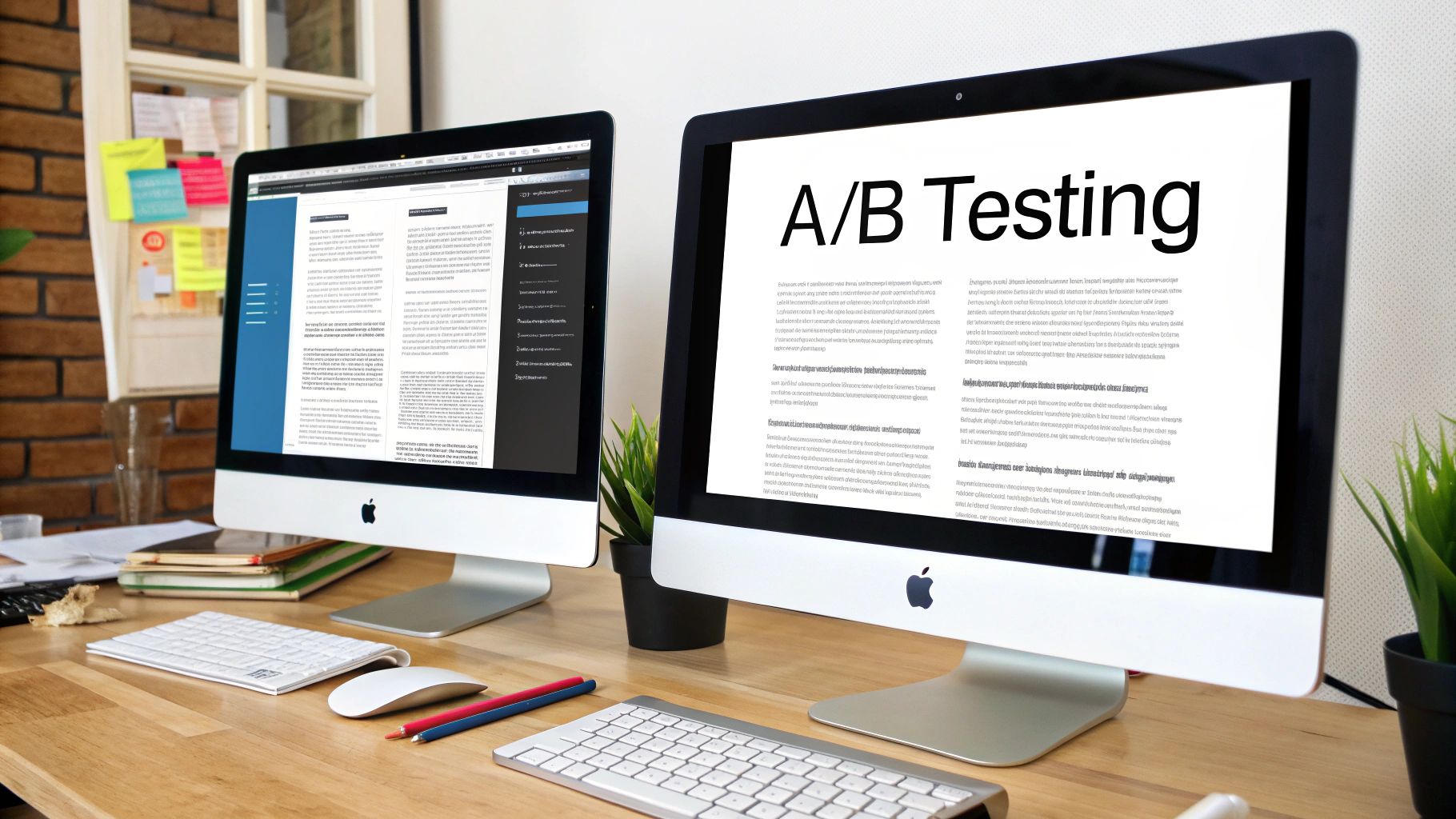
A/B testing, also known as split testing, is the cornerstone of data-driven conversion rate optimization best practices. It's a methodical approach that compares two versions of a webpage or app element to determine which one performs better. In this controlled experiment, traffic is randomly split between the original version (the control, or "A") and a modified version (the treatment, or "B"). By analyzing user interactions, you can definitively identify which variant drives more conversions, whether that’s a signup, a download, or a purchase.

Two Apple iMac computers on a wooden desk, one displaying 'A/B Testing' text, with keyboards and mouse.

This method moves optimization from guesswork to a scientific process. For example, HubSpot famously tested the color of a call-to-action (CTA) button, discovering that a red button outperformed a green one by 21%. This wasn't based on a designer's preference; it was a statistically significant result proven with real user data. Compare this empirical approach to a simple design change made on a whim—the former provides a repeatable, data-backed win, while the latter is a shot in the dark that could even hurt conversions.

How to Implement A/B Testing Effectively

To get reliable results, your testing process must be rigorous. Avoid making assumptions and focus on isolating a single variable for each test. Instead of redesigning an entire landing page at once (which is better suited for multivariate testing), start with one high-impact element. For example, test your primary headline or your main CTA button text. Testing both simultaneously in a simple A/B test makes it impossible to know which change caused the result.

Actionable Steps for a Successful Test:

  • Establish a Strong Hypothesis: Don't just test randomly. Form a clear hypothesis like, "Changing the CTA button text from 'Learn More' to 'Get Your Free Demo' will increase form submissions because it is more specific and value-oriented." This is far more effective than a vague goal like "Test new button copy."
  • Calculate Your Sample Size: Before launching, use a sample size calculator to determine how much traffic you need to reach statistical significance. This prevents ending a test prematurely with misleading data.
  • Run for a Full Business Cycle: Let your test run for at least one to two full weeks to account for fluctuations in user behavior on different days of the week. Ending a test after three days could give you a skewed result based on weekday vs. weekend traffic.
  • Document Everything: Maintain a testing roadmap that logs every hypothesis, variant, result, and learning. This repository prevents re-testing old ideas and builds organizational knowledge.

2. Heatmaps and Session Recordings

While quantitative data from tools like Google Analytics tells you what users are doing (e.g., "70% of users drop off on the pricing page"), qualitative tools like heatmaps and session recordings show you why. This is a critical component of conversion rate optimization best practices, revealing the human behavior behind the metrics. Heatmaps create visual, aggregated representations of where users click, move their mouse, and scroll, while session recordings are like a DVR for your website, capturing individual, anonymized user visits.

These tools uncover user friction and reveal opportunities that quantitative data alone cannot. For instance, a Crazy Egg client discovered through a heatmap that users were frequently clicking on a non-interactive image, expecting a link. This insight led to a simple redesign that improved navigation and user experience. Compare this to only looking at bounce rate data; analytics would show the problem, but heatmaps pinpoint the exact cause. Tools like Hotjar and Microsoft Clarity make this analysis accessible.

How to Leverage Visual Feedback Effectively

The key to using these tools is to move beyond passive observation and actively look for patterns of user frustration or confusion. Instead of watching random sessions, focus your analysis on specific user segments or pages with high drop-off rates. This targeted approach turns raw behavioral data into a clear optimization roadmap, highlighting precisely where your user experience is failing to convert.

Actionable Steps for Meaningful Insights:

  • Analyze High-Exit Pages: Start by reviewing heatmaps and session recordings for your most critical pages with high bounce or exit rates, such as landing pages or checkout steps. This ensures your effort is focused on the biggest problems first.
  • Segment Your Data: Filter your insights by traffic source, device type, or user status (new vs. returning). A mobile user arriving from a social media ad will behave differently than a desktop user from an email campaign; analyzing them separately provides clearer insights.
  • Look for 'Rage Clicks': Identify areas where users are clicking repeatedly in frustration. These are high-priority UX issues that are likely costing you conversions and should be addressed immediately.
  • Combine with Other Data: Use your findings to form a hypothesis for an A/B test. If a heatmap shows users aren't scrolling to see your primary CTA, hypothesize that moving it "above the fold" will increase clicks and then test it.

3. Conversion Funnel Analysis

Conversion funnel analysis is a critical diagnostic tool in the arsenal of conversion rate optimization best practices. It involves mapping and measuring the user journey through a series of steps leading to a final conversion, such as a purchase or a sign-up. By visualizing this path, you can pinpoint exactly where users are "leaking" or dropping off, allowing you to focus your optimization efforts on the stages with the biggest impact on your bottom line.

This method transforms CRO from a series of disconnected tests into a strategic, problem-solving exercise. For instance, a B2B SaaS company might discover a massive 70% drop-off between viewing the pricing page and starting a trial. Compare this macro insight to randomly testing homepage headlines. The funnel data directs you to test new pricing models, add a comparison chart, or clarify feature limitations—actions that address the real bottleneck. Similarly, an e-commerce store could find that 80% of users who add an item to their cart abandon it at the payment selection step, indicating the clear solution is to integrate more payment options like PayPal or Apple Pay.

How to Implement Conversion Funnel Analysis Effectively

A successful funnel analysis relies on accurate data and a clear definition of each stage. Don't limit your view to the final macro-conversion; track the micro-conversions that lead up to it. Define key steps like "Viewed Product," "Added to Cart," "Initiated Checkout," and "Completed Purchase." Platforms like Google Analytics, Mixpanel, and Amplitude are essential for building and visualizing these funnels.

Actionable Steps for a Successful Analysis:

  • Define Key Stages and Micro-Conversions: Map out every critical step a user must take. For a lead-gen funnel, this could be: Landing Page Visit > Form View > Form Field Interaction > Form Submission. This granularity helps you pinpoint the exact moment of friction.
  • Segment Your Funnels: Don't analyze all users together. Create separate funnels for different traffic sources (organic vs. paid), device types, or user personas to uncover segment-specific friction points.
  • Prioritize the Biggest Leaks: Focus your initial optimization efforts on the stage with the highest drop-off rate. A small improvement at a major leakage point yields a much greater return than perfecting a step that already performs well.
  • Investigate the "Why": Once you identify where users drop off, use qualitative tools like heatmaps, session recordings, or exit-intent surveys to understand why. This insight fuels stronger A/B testing hypotheses.

4. User Testing and Feedback Collection

While quantitative data from A/B testing tells you what is happening, qualitative feedback from user testing reveals the crucial why. This approach involves observing real people as they interact with your website or product, providing direct insights into their thought processes, frustrations, and moments of delight. By collecting this feedback through moderated sessions, unmoderated tests, or surveys, you can uncover usability issues and psychological barriers that analytics alone will never show.

This method is fundamental to creating a user-centric experience. For instance, Dropbox used early user testing to discover that potential customers didn't understand the concept of a "file syncing" folder, leading them to create their famous explainer video which clarified the value proposition and dramatically boosted sign-ups. Compare this direct feedback approach to guessing what users want—one is based on evidence, the other on internal assumptions. To ensure your user testing provides valuable insights, it's crucial to understand how to efficiently collect customer feedback smarter.

How to Implement User Testing and Feedback Effectively

The goal of user testing isn't to get a statistically significant sample but to identify the most critical points of friction in the user journey. The Nielsen Norman Group famously states that testing with just five users can reveal around 85% of usability problems. The key is recruiting the right participants and asking the right questions to uncover genuine, unfiltered insights that inform your optimization roadmap.

Actionable Steps for a Successful Test:

  • Recruit Your Target Audience: Use screener surveys to find participants who accurately represent your ideal customer profile. Testing with the wrong audience yields irrelevant feedback that can lead you astray.
  • Ask Open-Ended Questions: Avoid leading questions like, "Was that button easy to find?" Instead, ask, "What are your thoughts on completing that task?" to encourage detailed, unbiased responses.
  • Observe More, Talk Less: Pay close attention to non-verbal cues like hesitations, sighs, or unexpected navigation paths. What users do is often more revealing than what they say.
  • Combine Feedback Methods: Integrate different data sources. Cross-reference insights from moderated testing sessions with data from on-site surveys and customer support tickets for a complete picture.
  • Create a Feedback Loop: Systematically use the insights gathered to form new A/B testing hypotheses. Test your proposed solution, validate the impact, and iterate. You can learn more about these voice of customer examples to see how this works in practice.

5. Landing Page Optimization

Landing page optimization is a critical component of any successful digital marketing campaign. It involves refining every element of a standalone webpage designed for a single, focused objective: to convert visitors. Unlike a homepage with multiple navigation paths, a landing page eliminates distractions to guide a user toward a specific action, such as signing up for a trial, downloading an ebook, or requesting a demo. Effective landing page optimization is one of the most direct ways to improve ROI on paid ad spend.

This focused approach delivers powerful results. For instance, Unbounce has documented numerous case studies where clients achieved 30-50% lifts in conversion rates through systematic testing of headlines, forms, and CTAs. Compare the performance of a dedicated, optimized landing page to sending paid traffic to a generic homepage. The landing page will almost always convert better because it's tailored to a specific audience and goal, whereas a homepage serves too many masters. This proves that treating landing pages as dynamic, testable assets is a core tenet of conversion rate optimization best practices.

How to Implement Landing Page Optimization Effectively

Successful optimization begins before a single test is run; it starts with message matching. Ensure the headline and core value proposition on your landing page directly reflect the ad copy or link that brought the user there. This creates a seamless, congruent experience that reduces bounce rates and builds immediate trust. From there, systematically test individual elements to identify friction points and opportunities for improvement.

Actionable Steps for a High-Converting Landing Page:

  • Aggressively Reduce Form Fields: Each additional field creates friction. Start with the absolute minimum information you need, as each removed field can boost conversions by 5-10%. For example, ask only for a work email instead of name, company, and phone number.
  • Focus on a Single, Clear CTA: Avoid decision fatigue by presenting only one primary call-to-action above the fold. Test specific, benefit-driven button copy like "Get Your Free Demo" versus a generic "Submit." The former tells users what they get; the latter tells them what they must do.
  • Leverage Social Proof Strategically: Place testimonials, customer logos, or user statistics directly beside your form or CTA. This placement reinforces trust at the critical moment of decision, reducing visitor anxiety.
  • Prioritize Headline Clarity: Your headline is the first thing visitors read. A/B test a creative, clever headline against a simple, direct headline that clearly states the benefit. Often, clarity beats cleverness. Leadpages has shown that a simple headline change can triple conversion rates.

6. Personalization and Segmentation

Personalization is the practice of tailoring the user experience to an individual's specific needs, behaviors, and context. Rather than presenting a one-size-fits-all website, you deliver dynamic content, offers, and messaging based on user data. This is achieved through segmentation, the process of grouping your audience into distinct clusters with shared characteristics, allowing for highly relevant and targeted communication. This approach transforms a generic user journey into a personal conversation, drastically improving engagement and conversions.

This tactic is one of the most powerful conversion rate optimization best practices because it directly addresses user intent. Amazon’s famous recommendation engine, which suggests products based on browsing history and past purchases, is a prime example of personalization driving massive revenue. Compare this to a generic retail site showing every visitor the same "Top Sellers." The personalized approach is far more likely to convert because it feels relevant. In B2B, this could mean showing case studies relevant to a visitor's industry or displaying pricing in their local currency.

How to Implement Personalization and Segmentation Effectively

Effective personalization goes beyond simply using a visitor's first name in an email. It requires a strategic approach to data collection and a clear understanding of your audience segments. The goal is to make the user experience feel more intuitive and helpful, not intrusive. Start by segmenting your audience based on high-value data points and then build personalized experiences for those groups before moving to one-to-one personalization.

Actionable Steps for a Successful Strategy:

  • Start with Broad Segments: Don't aim for hyper-personalization immediately. Begin by grouping users based on clear criteria like new vs. returning visitors, traffic source (e.g., organic search vs. paid social), or geographic location. Show returning visitors a "Welcome Back" message or content related to their last visit.
  • Leverage Behavioral Data: Use on-site actions to inform your strategy. For instance, if a user has repeatedly viewed your "Enterprise Plan" pricing page, serve them a CTA for a demo with an enterprise account executive instead of a generic "Contact Us" button.
  • Use Progressive Profiling: Instead of asking for 20 fields in one form, gather information over time. Ask for a name and email first, then on a subsequent visit, ask for company size or job title to enrich their profile without creating friction.
  • Test Your Personalization: Treat personalization like any other CRO effort. Form a hypothesis (e.g., "Showing industry-specific testimonials to visitors from the finance sector will increase demo requests") and A/B test the personalized experience against the generic one. Discover more by reading our guide to customer segmentation strategies on marketbetter.ai.

7. Form Optimization

Forms are the final gateway to conversion, whether it's for lead generation, a newsletter signup, or a purchase. Form optimization is the practice of strategically designing and structuring your web forms to minimize friction and maximize completion rates. By making forms easier, faster, and more intuitive to fill out, you directly address a major drop-off point in the customer journey and improve a critical component of your conversion rate optimization best practices.

This process is about more than just aesthetics; it's a science of user psychology and experience. For example, Unbounce famously increased conversions by 50% simply by reducing the number of fields in a form from ten to four. Compare the cognitive load of a 10-field form to a 4-field one. The shorter form feels less daunting and respects the user's time, making them far more likely to complete it. This proves that every additional field you ask for introduces another point of potential abandonment, making ruthless simplification a powerful tactic.

How to Implement Form Optimization Effectively

Effective form optimization begins with adopting a "less is more" philosophy. Scrutinize every field and ask if it is absolutely essential for the initial conversion. You can always gather more information later in the customer lifecycle using techniques like progressive profiling. Start by implementing changes that have the highest potential impact with the least user effort.

Actionable Steps for Better Forms:

  • Eliminate Optional Fields: If a field is marked "optional," remove it. This declutters the form and reduces cognitive load for the user. If the data isn't essential now, don't ask for it.
  • Use a Single-Column Layout: A single-column design is easier for users to scan and complete, especially on mobile devices. Compared to a multi-column layout, it provides a clear, linear path to completion without confusing eye movements.
  • Implement Inline Validation: Provide real-time feedback as a user fills out the form. A green checkmark for a correctly formatted email is far better than a single error message after they hit "submit" and have to re-enter data.
  • Add Trust Signals: Place trust badges, privacy policy links, or security seals near the submit button. This reassures users that their information is safe, which is particularly important when asking for sensitive data.

8. Social Proof and Trust Elements

Leveraging social proof is a powerful psychological tactic in conversion rate optimization best practices. It's the concept that people will conform to the actions of others under the assumption that those actions are the correct behavior. By strategically displaying testimonials, customer logos, security badges, and user reviews, you reduce purchase anxiety and build credibility, assuring prospects that they are making a wise decision by choosing you.

This principle is highly effective because it outsources trust-building to a third party: your existing customers. Slack famously showcases logos of well-known clients like NASA and Uber on its homepage to instantly establish enterprise-level credibility. Compare a landing page with client logos to one without. The former immediately communicates a level of trust and validation that self-promotional copy cannot achieve alone. For B2B software, embedding positive reviews from G2 or Capterra directly on a pricing or demo page can be the final nudge a prospect needs.

How to Implement Social Proof Effectively

The key to using social proof is relevance and placement. A generic testimonial is far less effective than a specific, metric-driven one from a customer in your target industry. Place these trust elements near key decision points, such as next to a call-to-action button, on a pricing page, or in the checkout process, to directly counter user hesitation.

Actionable Steps for a Successful Implementation:

  • Be Specific and Quantifiable: Prioritize testimonials with concrete results. A testimonial saying "Saved our team 20 hours per week" is far more compelling and believable than a generic one like "Saves us time."
  • Show, Don't Just Tell: Display logos of recognizable companies you work with. For B2B, include the reviewer’s name, title, and company to add layers of authenticity and relevance.
  • Use Different Formats: Combine static quotes with video testimonials, case studies, and user-generated content. A video testimonial from a happy customer is often more persuasive than a text quote because it builds a stronger emotional connection.
  • Place Trust Badges Strategically: Use security seals (like Norton or McAfee) and payment provider logos (Visa, PayPal) in your checkout flow to reassure users that their information is safe at the exact moment they are about to share it.
  • Test Placement and Type: A/B test a customer logo banner against a detailed testimonial on your homepage. The banner might be more effective for building initial brand trust, while the testimonial might convert better on a product page where users need specific validation.

9. Mobile Optimization and Responsive Design

With mobile traffic now accounting for over half of all web traffic, mobile optimization is no longer optional; it's a fundamental requirement for conversion. This practice ensures your website provides an intuitive, seamless experience on smartphones and tablets by prioritizing touch-friendly interfaces, fast load times, and simplified navigation. It’s a critical component of conversion rate optimization best practices, as a poor mobile experience is a direct path to a high bounce rate and lost revenue.

The impact of a mobile-first approach is well-documented. E-commerce giant Shopify, for instance, reported that merchants using its platform saw mobile conversion rates increase by over 50% after significant mobile checkout optimizations. Compare this to a "pinch-and-zoom" experience where users must struggle to navigate a desktop site on a small screen—the friction is immense, and abandonment is nearly guaranteed. Google's mobile-first indexing also means your mobile site's performance directly impacts your search engine rankings, making it a dual CRO and SEO priority.

How to Implement Mobile Optimization Effectively

True mobile optimization goes beyond simply making your site fit on a smaller screen. It requires rethinking the user journey from the perspective of someone on the go, with limited attention and a need for speed. Adopting a mobile-first design philosophy, where you design for the smallest screen first and then scale up, is the most effective way to ensure the core user experience is flawless.

Actionable Steps for Mobile Success:

  • Prioritize Performance: Aggressively compress images and minify code. Mobile users are less patient, and every second of load time increases abandonment. Use Google's PageSpeed Insights to diagnose and fix performance issues; aim for a load time under 3 seconds.
  • Design for Touch: Ensure all buttons and interactive elements have a minimum tap target size of 48x48 pixels to prevent frustrating mis-clicks. This is a small detail that has a massive impact on usability.
  • Simplify Forms and Navigation: Drastically reduce the number of form fields for mobile users. Use mobile-friendly input types (like a number pad for phone numbers) and a sticky, easy-to-access navigation menu to keep the interface clean and usable.
  • Test on Real Devices: Browser emulation is a good start, but nothing beats testing on actual iPhones and Android devices. This helps you catch device-specific rendering issues and truly understand the user's tactile experience.

10. Checkout Process Optimization

The checkout process is the final, most crucial step in a customer's journey, and it's where a significant portion of potential sales are lost. Checkout process optimization is the practice of systematically refining this flow to minimize friction, reduce cart abandonment, and maximize completed transactions. By simplifying forms, offering convenience, and building trust, you can convert more high-intent visitors into paying customers. This is one of the highest-impact areas for conversion rate optimization best practices because even small improvements can directly boost revenue.

A person's hands holding a smartphone, interacting with a fast checkout e-commerce app.

This principle was famously pioneered by Amazon with its patented "1-Click" checkout, which drastically reduced the steps needed to make a purchase. Compare that seamless experience to a checkout process that forces you to create an account, verify your email, and then re-enter your shipping information. The former encourages impulse buys and repeat business, while the latter encourages cart abandonment. E-commerce platforms like Shopify have built their success on providing merchants with streamlined, pre-optimized checkout experiences, understanding that a seamless final step is non-negotiable.

How to Implement Checkout Process Optimization Effectively

The goal is to make the payment process feel effortless and secure. Every extra field, unexpected cost, or moment of confusion creates an opportunity for the customer to second-guess their purchase and abandon their cart. Focus on removing barriers and reassuring the user at every stage of the checkout flow, from the initial cart view to the final confirmation page.

Actionable Steps for a Successful Checkout:

  • Offer a Guest Checkout: Forcing account creation is a major conversion killer. Make guest checkout the most prominent option and allow users to create an account after the purchase is complete.
  • Be Transparent with Costs: Display all costs, especially shipping and taxes, as early as possible. Surprise fees at the final step are the leading cause of cart abandonment. Show a complete order summary in the cart itself.
  • Simplify Form Fields: Only ask for essential information. Use tools like the Google Maps API to auto-populate address fields and set "billing address is same as shipping" as the default, pre-checked option.
  • Display Trust Signals: Prominently feature security badges (SSL certificates, Norton, McAfee), accepted payment logos (Visa, PayPal), and reassuring policies like a money-back guarantee or easy returns directly within the checkout flow.
  • Test Your Layout: Don't assume a one-page checkout is always better. Test it against a well-designed multi-step process with a clear progress indicator. For complex purchases, breaking the process into logical steps (Shipping > Billing > Review) can feel less overwhelming to users.

Top 10 CRO Best Practices Comparison

Method🔄 Implementation Complexity⚡ Resource Requirements⭐ Expected Effectiveness📊 Typical Outcomes / Impact💡 Ideal Use Cases / Tips
A/B Testing (Split Testing)Medium — needs experiment setup & statsMedium — traffic + testing tool⭐⭐⭐⭐ — reliable causal evidenceMeasurable conversion lifts; clear winner when significantTest high-impact elements first; calculate sample size
Heatmaps & Session RecordingsLow — simple install, review effortLow — affordable tools, time to analyze⭐⭐⭐ — strong qualitative insightReveals friction points and attention patternsFilter by device/segment; combine with analytics
Conversion Funnel AnalysisMedium–High — tracking & mapping eventsMedium — analytics setup and maintenance⭐⭐⭐⭐ — identifies bottlenecks fastHighlights biggest drop-offs; guides prioritizationDefine micro-conversions; segment by acquisition source
User Testing & Feedback CollectionMedium — planning, facilitation skillsMedium–High — recruiters, moderators, tools⭐⭐⭐⭐ — deep “why” insights (qualitative)Uncovers usability issues and feature ideasRecruit real users; run 5–8 sessions to surface major problems
Landing Page OptimizationLow–Medium — focused tests & design workLow — landing builders + traffic⭐⭐⭐⭐ — high ROI for single-purpose pagesFaster lift in conversion; clear attributionStart with headline and CTA; match ad messaging
Personalization & SegmentationHigh — data, rules, ML modelsHigh — data infra, tooling, maintenance⭐⭐⭐⭐⭐ — strong relevance and liftIncreased conversions, AOV, and retention when done rightStart simple segments; ensure privacy compliance
Form OptimizationLow — design & validation tweaksLow–Medium — dev effort for smart forms⭐⭐⭐⭐ — immediate reductions in abandonmentHigher completion rates and better data qualityMinimize fields; use inline validation and progressive profiling
Social Proof & Trust ElementsLow — content sourcing and placementLow — existing customer content often enough⭐⭐⭐⭐ — boosts credibility and reduces anxietyImproved conversion confidence, especially for high-consideration buysPlace near CTAs; use specific metrics and real photos
Mobile Optimization & Responsive DesignMedium–High — responsive build & testingMedium — dev + cross-device testing⭐⭐⭐⭐ — critical for mobile majority trafficBetter engagement, SEO lift, and mobile conversionsMobile-first design; optimize images and touch targets
Checkout Process OptimizationHigh — payment integrations & securityHigh — engineering, payment providers⭐⭐⭐⭐⭐ — direct, high-impact revenue gainsLower cart abandonment and increased completed ordersOffer guest checkout, transparent fees, multiple payment options

From Best Practices to Business Impact

Navigating the landscape of conversion rate optimization can feel like assembling a complex puzzle. You have all the pieces: A/B testing, heatmap analysis, user feedback, landing page design, form optimization, and social proof. The true challenge, however, isn't just knowing these pieces exist; it's understanding how they fit together to create a cohesive, high-performing conversion engine. This guide has provided a detailed roundup of conversion rate optimization best practices, but the ultimate goal is to move beyond a checklist and cultivate a strategic, data-driven mindset.

The journey from a static website to a dynamic, conversion-focused asset is a process of continuous, iterative improvement. It’s the difference between a marketer who simply implements a tactic, like adding a testimonial, and one who systematically tests three different testimonial formats on a key landing page to see which one resonates most with enterprise-level prospects versus mid-market leads. One is a guess; the other is a calculated business decision.

Synthesizing the Strategy: From Tactics to a Cohesive System

To truly harness the power of CRO, you must see the interconnectedness of the practices we've discussed. Your conversion funnel analysis (Practice #3) might reveal a significant drop-off on your pricing page. This is your starting point. From there, you can deploy other tactics in a targeted, strategic manner:

  • Heatmaps and Session Recordings (Practice #2): First, you watch session recordings of users on that pricing page. You notice they hesitate, scroll erratically, and often exit after clicking on a confusing feature comparison chart. This gives you a qualitative "why" behind the drop-off.
  • User Feedback (Practice #4): Armed with this insight, you launch a targeted survey on that page asking, "Is our pricing clear? What's one thing preventing you from moving forward?" The feedback confirms that the feature tiers are poorly explained.
  • A/B Testing and Landing Page Optimization (Practices #1 & #5): Now you have a clear hypothesis. You design two variations of the pricing page. Version A simplifies the feature chart into a scannable list. Version B introduces an interactive pricing calculator. You run a split test to see which solution most effectively reduces friction and increases "Request a Demo" clicks.

This methodical approach transforms isolated conversion rate optimization best practices into a powerful, problem-solving workflow. It’s no longer about random acts of optimization; it’s about a diagnostic process that leads to a quantifiable cure.

The Compounding Power of Incremental Gains

One of the most compelling aspects of a mature CRO program is its compounding effect. A 5% lift in conversions from form optimization might seem minor in isolation. However, when combined with a 10% increase from a personalized call-to-action and a 7% boost from improved mobile page speed, the cumulative impact on your lead generation and revenue is substantial.

Think of it this way: each optimization win doesn't just add to your success; it multiplies it. The improved form makes your paid search campaigns more profitable. The faster mobile site improves your SEO rankings, driving more organic traffic. This creates a positive feedback loop where your marketing efforts become more efficient and your customer acquisition cost steadily declines. Adopting these principles means you are building a sustainable growth engine, not just searching for a temporary lift in metrics. The real value is in creating a culture where every team member is empowered to ask, "How can we make this better?" and has the tools to find the answer.


Ready to move from manual testing to an intelligent, AI-powered optimization strategy? marketbetter.ai automates the entire CRO process, from identifying high-impact opportunities with predictive analytics to deploying personalized experiences at scale. Stop guessing and start converting by exploring how our platform can implement these conversion rate optimization best practices for you at marketbetter.ai.

Top AI Content Marketing Tools for Enterprise Teams in 2025

· 29 min read

Welcome to your definitive, actionable guide to the top AI content marketing tools available today. We've gone beyond surface-level feature lists to provide a deep, comparative analysis tailored specifically for marketing decision-makers at mid-market and enterprise companies. This isn't just another list; it's a strategic resource built to solve a critical problem: identifying which AI solution will actually drive results for your specific business needs.

This guide is designed for practical application. For each of the 12 platforms reviewed, you will find:

  • Detailed feature analysis with screenshots for clarity.
  • Direct comparisons to help you differentiate between similar tools.
  • Integration and security notes for seamless tech stack adoption.
  • Actionable implementation tips to get you started quickly.

Whether you're a CMO focused on strategic impact, a content manager aiming for higher velocity, or a marketing operations leader optimizing your tech stack, this resource will help you navigate the crowded landscape. We'll compare point solutions like Jasper and Copy.ai against integrated platforms like HubSpot, helping you make an informed investment. For instance, while some tools excel at long-form content, others are essential for social media. To accelerate your professional networking, leveraging an AI LinkedIn Post Generator Playbook can significantly enhance your content strategy and engagement.

Our goal is to equip you with the insights needed to select the best AI content marketing tools that align with your team's workflow, security requirements, and business goals. Let's dive in.

1. marketbetter.ai

Best for: All-in-one, revenue-focused Go-to-Market execution.

For marketing and sales leaders seeking to consolidate their tech stack and directly tie AI efforts to revenue, marketbetter.ai stands out as our top choice. It’s an AI-native, end-to-end platform that moves beyond isolated content generation to orchestrate the entire go-to-market motion. Unlike single-point solutions like Jasper or Copy.ai that only write blog posts or social copy, marketbetter.ai integrates AI content creation with automated, multi-channel outbound sequencing, campaign optimization, and real-time analytics. This unified approach eliminates the tool sprawl common in marketing departments, with customers reporting the replacement of up to four separate tools.

This platform is one of the most comprehensive ai content marketing tools available, designed specifically for mid-market and enterprise B2B teams. It generates on-brand content for blogs, ads, and emails, but its real power lies in connecting that content directly to action. It automates prospect research, personalizes outreach across email, LinkedIn, and voice, and handles follow-ups and calendar handoffs, writing all activity back to your CRM.

marketbetter.ai

Key Features and Strategic Impact

What sets marketbetter.ai apart is its measurable impact on pipeline velocity. The platform reports significant lift for its users, including a 1.6× increase in inbound SQLs and a 2× rise in first meetings booked. This is achieved by creating a seamless, AI-driven workflow that turns market signals into qualified conversations.

  • Unified Content & Campaign Engine: Generate a blog post, then immediately create and launch a multi-channel distribution campaign with personalized emails and social copy targeting ideal customer profiles, all within one interface.
  • Automated Sequencing & Engagement: Go beyond static content by automating sequences across email, LinkedIn, and even voice calls. The AI manages follow-ups and hands off booked meetings directly to sales calendars, with full data sync to Salesforce, HubSpot, or Dynamics.
  • Enterprise-Grade & Secure: Built for serious B2B teams, it offers robust security features like encryption in transit and at rest, privacy compliance, and detailed audit logs.
  • Rapid Implementation: Deployment is fast. With a simple tracking code, pre-built templates, and no-cost integrations for tools like Slack, Gmail, and LinkedIn Ads, teams can be operational in minutes, not months.

Actionable Tip

A demand generation manager can use marketbetter.ai to identify a target account list, generate a hyper-relevant article, then instantly build a multi-touch sequence to engage key decision-makers at those accounts with personalized messaging derived from the article. The AI handles the outreach and follow-up, freeing up the team to focus on strategy while the platform generates and tracks meetings.

Pricing and Access

Marketbetter.ai does not list public pricing, opting for a demo-led sales process. This positions it for teams focused on ROI rather than the lowest upfront cost. You can get started with a free trial or by booking a demo to receive a custom quote.

FeatureDetails
Ideal UserMid-market to enterprise B2B marketing and sales teams.
Primary Use CaseConsolidating content generation, campaign automation, and sales engagement to accelerate pipeline and revenue.
IntegrationsSalesforce, HubSpot, Dynamics, Slack/Teams, Gmail/Outlook, LinkedIn Ads, webhooks (no extra cost).
Standout MetricSite-reported 3× higher campaign ROI and automation of 80% of outreach tasks.
LimitationsPricing requires a demo; may be too comprehensive for very small startups or teams without a defined go-to-market process.
Social ProofStrong customer testimonials (CallRail, Kajeet) and a 4.97/5 G2 rating.

Learn more at marketbetter.ai.

2. Jasper

Jasper is a generative AI platform built from the ground up for marketing and sales teams. Unlike general-purpose AI writers, Jasper excels at maintaining a consistent brand voice across all generated content, from blog posts and social media updates to ad copy and email campaigns. It serves as a central hub for planning, creating, and orchestrating multi-channel content, making it one of the most comprehensive ai content marketing tools for teams that require governance and scale.

Jasper pricing page screenshot

The platform’s key differentiator is its focus on enterprise-grade workflows. Compared to Copy.ai's self-serve model, Jasper is built for top-down brand governance. The Business plan introduces a no-code AI app builder and customizable AI agents, allowing marketing ops teams to create repeatable processes and automate campaign orchestration. This moves beyond simple text generation into true content operations.

Key Details & Recommendations

  • Best Use Case: Mid-market to enterprise marketing teams that need to enforce brand consistency across multiple writers and channels. The platform’s collaboration features and campaign-level tools are ideal for coordinated marketing efforts.
  • Actionable Tip: Start by thoroughly training Jasper on your brand voice. Upload your style guides, best-performing content, and product catalogs to create a robust knowledge base. This initial investment is critical for generating truly on-brand assets.
  • Pricing: The Pro plan is suitable for individuals, but teams needing collaboration, SSO, and governance features must opt for the custom-priced Business plan. A 7-day free trial is available. You can learn more about Jasper and other top AI platforms to compare which fits your budget.
  • Security: Jasper is SOC 2 compliant, a crucial consideration for enterprises handling sensitive customer or company data within their content workflows.

Website: https://www.jasper.ai/pricing

3. Copy.ai

Copy.ai positions itself as an AI-powered go-to-market platform designed for speed and efficiency. It combines a user-friendly chat interface with a powerful workflow builder, allowing marketing and sales teams to automate repeatable content tasks. Unlike platforms like Jasper that require extensive setup for brand voice, Copy.ai excels at rapid deployment for creating everything from blog briefs and social media posts to sales emails and ad copy, making it one of the most accessible ai content marketing tools for teams that prioritize self-serve onboarding.

Copy.ai

The platform’s core differentiator is its focus on workflow automation. Users can build custom "Agents" that connect to different data sources and execute multi-step content processes, like enriching leads from a CRM and then drafting personalized outreach sequences. This is a more technical approach than Writesonic's template-driven model, allowing for scalable, automated systems for common go-to-market activities—a significant advantage for lean teams looking to maximize output without increasing headcount.

Key Details & Recommendations

  • Best Use Case: Go-to-market teams (sales and marketing) in small to mid-sized businesses that need to automate repetitive content creation and outreach processes. Its strength lies in building simple, scalable workflows without needing deep technical expertise.
  • Actionable Tip: Start by identifying your most time-consuming, repeatable content task, such as writing weekly social media posts or drafting first-touch sales emails. Build a simple workflow for that single process to learn the platform and demonstrate immediate ROI before expanding to more complex automations.
  • Pricing: Offers a free plan for individuals and tiered paid plans (Pro, Team, Enterprise) that scale based on user seats and advanced features like workflow credits. The self-serve pricing model allows teams to get started quickly, with guided onboarding available for larger deployments.
  • Security: Copy.ai is SOC 2 Type II compliant, ensuring enterprise-grade security for teams that need to connect the platform to their CRM or other sensitive data sources.

Website: https://www.copy.ai/prices

4. Writesonic

Writesonic is an AI writing suite designed for speed and volume, particularly excelling at long-form content generation for SEO and e-commerce. It offers a broad toolkit with over 100 templates for articles, blogs, product descriptions, and social media posts. Unlike Jasper, which focuses heavily on brand voice management, Writesonic prioritizes rapid, bulk content creation, making it one of the most practical ai content marketing tools for teams and individuals under pressure to publish consistently.

Writesonic

The platform's main differentiator is its straightforward, output-focused interface combined with flexible pricing. While Jasper is built for enterprise-level brand governance, Writesonic appeals to users who need a powerful engine for drafting content quickly. Features like its bulk generation mode allow users to produce multiple articles or descriptions simultaneously, a significant time-saver for e-commerce stores or affiliate marketing sites.

Key Details & Recommendations

  • Best Use Case: Solo marketers, SEO specialists, and small teams that require a high volume of long-form content like blog posts and product descriptions. Its competitive entry pricing makes it accessible for those not needing enterprise-level collaboration.
  • Actionable Tip: Use the "Bulk Generate" feature for product descriptions to maintain a consistent structure across hundreds of SKUs. For blog posts, leverage the one-click article writer to create a first draft, then spend your time refining and adding unique insights.
  • Pricing: Writesonic offers a Free Trial and a Small Team plan starting at $19/month with user and word limits. The Business plan offers higher limits and more features, while the Enterprise plan provides custom pricing, SSO, and dedicated support. Audiosonic text-to-speech minutes are available as an add-on.
  • Security: The platform offers SOC 2 compliance on its Enterprise plan, making it a viable option for larger organizations that require verified data security and privacy controls for their content operations.

Website: https://writesonic.com

5. Semrush

Semrush is an established powerhouse in online visibility, and its platform now integrates powerful AI features directly into its SEO and content marketing workflows. Tools like ContentShake AI and the broader Content Marketing Toolkit allow teams to move seamlessly from data-driven keyword research to AI-assisted content creation and optimization. This direct link between SEO analytics and generative AI is what makes it one of the most effective ai content marketing tools for performance-focused marketers.

Unlike pure-play AI writers like Jasper or Writesonic, Semrush's strength lies in grounding every AI-generated draft in hard performance data. It helps you identify content gaps, analyze competitor strategies, and then use AI to create articles engineered to rank for specific keywords. With features like one-click WordPress publishing and AI-generated images, it streamlines the entire content production pipeline from ideation to publication.

Key Details & Recommendations

  • Best Use Case: SEO-led marketing teams who want to use AI to scale content production without sacrificing data-driven optimization. It is ideal for organizations where content performance is measured directly by organic traffic and keyword rankings.
  • Actionable Tip: Begin by using the Topic Research and Keyword Magic Tool to build a content plan based on opportunities. Feed these data-backed topics into ContentShake AI to ensure your AI-generated drafts are strategically aligned with your SEO goals from the start.
  • Pricing: Semrush offers modular pricing with separate plans for its different toolkits (SEO, Content Marketing, etc.). This can be cost-effective if you only need specific functions, but costs can accumulate for full-suite access and multiple user seats.
  • Integration: The platform’s one-click WordPress export is a significant time-saver for content teams. Beyond that, its App Center offers integrations with various third-party tools, extending its capabilities. You can discover how to align Semrush's tools with a broader strategy to maximize your investment.

Website: https://www.semrush.com

6. Surfer

Surfer bridges the gap between AI content creation and technical on-page SEO. Unlike Semrush, which offers a broad suite of marketing tools, Surfer is hyper-focused on producing articles optimized to rank in search engines from the moment they are published. It analyzes top-ranking pages for a target keyword to provide data-driven guidelines on structure, keyword density, and internal linking, making it one of the most effective ai content marketing tools for teams focused on organic traffic.

Surfer

The platform’s standout feature is its Content Editor, which integrates SERP analysis with LLM insights to guide writers in real-time. This actionable, data-first approach removes the guesswork from SEO, allowing marketing teams to create content that satisfies both user intent and search engine algorithms. Integrations with Google Docs and WordPress streamline the workflow from creation to publication.

Key Details & Recommendations

  • Best Use Case: SEO-focused content teams and agencies that need to produce high-volume, rank-ready articles consistently. It's ideal for organizations where organic search performance is a primary marketing KPI.
  • Actionable Tip: Use Surfer’s Audit tool on your existing high-value content first. This will identify immediate optimization opportunities and help you understand Surfer’s data-driven recommendations before you start creating new articles from scratch.
  • Pricing: Surfer operates on a subscription model supplemented by AI credits for article generation. These credits can be purchased in flexible bundles, allowing teams to scale content creation on-demand. However, unlocking the full feature set requires higher-tier plans.
  • Flexibility: The on-demand credit system offers a clear advantage for budget planning and scaling content velocity. Teams can purchase credits as needed for major content pushes without being locked into a higher monthly subscription.

Website: https://surferseo.com/ai

7. HubSpot Marketing Hub

HubSpot Marketing Hub is an AI-powered marketing automation platform that integrates content creation directly with its foundational CRM. While tools like marketbetter.ai focus on the entire Go-to-Market motion including sales, HubSpot embeds AI assistance across its marketing suite, from blogging and email to social media and landing pages. This unified approach makes it one of the most powerful ai content marketing tools for teams aiming to connect content performance directly to customer lifecycle data and revenue.

HubSpot Marketing Hub

The platform’s core advantage is its end-to-end operational view. Marketers can use AI to draft a blog post, then immediately build an automated email nurture sequence around it, and finally track every lead's interaction through the CRM. This tight integration provides clear attribution, connecting content efforts to closed deals in a way that standalone AI writers cannot.

Key Details & Recommendations

  • Best Use Case: Marketing teams already using or planning to adopt the HubSpot CRM. It’s ideal for organizations that want to centralize their marketing operations and leverage AI to enhance existing workflows rather than just generate text in isolation.
  • Actionable Tip: Leverage the native CRM data to personalize AI-generated content. Use smart rules and contact properties to inform the AI, creating dynamic email campaigns or landing page copy that adapts to specific audience segments for higher engagement.
  • Pricing: AI features are included across various tiers, from Starter to Enterprise. However, the true power of automation and advanced reporting is unlocked in the Professional and Enterprise plans, which come with significant monthly costs and often require onboarding fees.
  • Security: As an established enterprise platform, HubSpot offers robust security features, including SOC 2 and SOC 3 compliance, making it suitable for organizations with stringent data governance and privacy requirements.

Website: https://www.hubspot.com/products/marketing

8. Canva (Magic Studio / Canva Business)

Canva has evolved from a simple design tool into a comprehensive, AI-powered content creation platform. Its Magic Studio suite integrates generative AI directly into the visual editing workflow, allowing marketing teams to produce on-brand assets at an unprecedented speed. Unlike standalone AI image generators like Adobe Firefly, Canva combines text, design, and video creation with vast template libraries, brand kits, and a content planner, making it one of the most versatile ai content marketing tools for teams that prioritize visual content production.

Canva (Magic Studio / Canva Business)

The platform's primary advantage is its unified environment. A marketing manager can use Magic Write to draft social media copy, instantly convert it into a video script with Magic Video, and generate corresponding visuals with Magic Design, all without leaving the editor. This dramatically reduces the friction and tool-switching typically associated with multi-format content campaigns, making it a powerhouse for agile marketing operations.

Key Details & Recommendations

  • Best Use Case: Marketing teams focused on high-velocity social media, advertising, and presentation creation. The platform excels at empowering non-designers to produce professional, on-brand visual assets quickly.
  • Actionable Tip: Immediately configure your Brand Kit. Upload logos, color palettes, and fonts, and create branded templates. This ensures that every piece of AI-generated content adheres to company guidelines, maintaining consistency across all channels.
  • Pricing: While a free version exists, meaningful AI usage requires the Canva Pro or Canva for Teams plan. These paid tiers provide higher credit limits for Magic Studio features, Brand Kits, and the content planner. You can discover how Canva compares to other social media tools to find the best fit for your team.
  • Collaboration: The Canva for Teams plan offers real-time collaboration, approval workflows, and centralized asset management. This is essential for teams needing to streamline their review process and maintain a single source of truth for creative assets.

Website: https://www.canva.com

9. Adobe Firefly

Adobe Firefly is a family of creative generative AI models designed for the safe creation of commercial content. Unlike Canva's all-in-one approach, Firefly is a specialized image generator deeply integrated into Adobe's professional ecosystem, including Photoshop and Adobe Express. It excels at generating high-quality, commercially viable images, vectors, and text effects that align with existing design workflows.

Adobe Firefly

The platform’s key differentiator is its enterprise-ready governance and commercial safety. Since Firefly is trained on Adobe Stock's licensed library and public domain content, the outputs are designed to be commercially safe, indemnifying businesses from copyright claims. This makes it one of the few ai content marketing tools that provides a clear and defensible path for using AI-generated visuals in brand campaigns. The generative credit system offers predictable cost management, a crucial feature for teams at scale.

Key Details & Recommendations

  • Best Use Case: Enterprise and mid-market marketing teams that rely on Adobe Creative Cloud for design and content creation. It is ideal for producing on-brand visuals for social media, ad campaigns, and website assets without leaving the established Adobe workflow.
  • Actionable Tip: Leverage Firefly's integration within Adobe Express to empower non-designers on your marketing team. They can use text-to-image and generative fill features to create campaign assets that remain consistent with brand templates managed by the core design team.
  • Pricing: Firefly is included in many Creative Cloud plans with a set number of monthly generative credits. Standalone Premium plans are available, and credit packs can be purchased to supplement usage. A free tier is offered with a limited number of credits.
  • Security: As part of the Adobe ecosystem, Firefly benefits from enterprise-grade security and content credentialing, providing transparency and trust for all generated assets.

Website: https://www.adobe.com/products/firefly

10. Notion AI

Notion AI embeds generative AI capabilities directly within its connected workspace, transforming it from a mere documentation tool into an integrated content operations hub. Instead of using separate apps for planning and drafting, marketing teams can manage editorial calendars, write creative briefs, and generate first drafts all in one place. This consolidation is Notion AI’s core advantage over standalone AI writers like Jasper, as it keeps AI-driven creation tightly coupled with project management and knowledge bases.

Notion AI

The platform excels at contextual tasks like summarizing meeting notes into action items, expanding on brief outlines, or translating content into different languages directly on the page. For teams already using Notion for their content lifecycle management, adding the AI features eliminates the friction of context-switching, making it a powerful accelerator for brainstorming, research, and initial content production.

Key Details & Recommendations

  • Best Use Case: Marketing teams that have centralized their content operations, knowledge management, and project tracking within Notion. It’s ideal for streamlining the workflow from brief to draft without leaving the platform.
  • Actionable Tip: Create and save custom AI block templates for repeatable tasks like generating blog post outlines from a brief, writing social media posts from a long-form article, or creating standardized meeting summaries. This leverages Notion’s database structure for consistent AI-powered outputs.
  • Pricing: Notion AI is an add-on for $8 per member/month (billed annually) for all paid plans. It is included by default in the custom-priced Enterprise plan. Unlike some competitors, it is not available as a standalone purchase or for free plan users.
  • Security: Notion offers enterprise-grade security controls, including SAML SSO and advanced security features on its Enterprise plan. Data submitted to Notion AI is not used to train models for other customers.

Website: https://www.notion.so/product/ai

11. Grammarly for Work

While often seen as a grammar checker, Grammarly for Work has evolved into a comprehensive AI writing partner that enforces brand consistency wherever content is created. It moves beyond basic spelling and punctuation to provide real-time suggestions on clarity, tone, and brand style, acting as a distributed quality control layer across your entire marketing team’s digital footprint. Its generative AI features, including ideation, rewriting, and a conversational chat, make it a versatile tool for both polishing final drafts and kickstarting the creative process.

Grammarly for Work

Unlike dedicated AI writing platforms like Jasper that require users to work within a specific interface, Grammarly’s strength is its ubiquity. Through browser extensions, desktop apps, and deep integrations, it brings AI assistance directly into the tools your team already uses, from Google Docs and email clients to social media platforms. This seamless integration makes it one of the most practical ai content marketing tools for standardizing content quality at scale with minimal friction.

Key Details & Recommendations

  • Best Use Case: Enterprise marketing and sales teams that need to ensure brand and style guide compliance across a high volume of daily communications, from internal emails to external ad copy. It excels at improving the polish and consistency of content created by non-writers.
  • Actionable Tip: Invest time in setting up your brand style guide within the Business plan. Define your brand tones, add custom vocabulary (like product names), and create snippets for frequently used phrases. This centralizes governance and ensures every team member writes on-brand.
  • Pricing: Business plans are required for team-level features like style guides and centralized billing. Invoicing is available for teams with 10 or more seats purchasing an annual plan. It is also available via procurement channels like AWS Marketplace for streamlined purchasing.
  • Security: Grammarly is SOC 2 (Type 2) and ISO 27001/27017/27018 certified, providing enterprise-grade security and data privacy assurances for organizations that handle sensitive information.

Website: https://www.grammarly.com

12. AppSumo – AI Stack

AppSumo is not a single tool, but a marketplace where hundreds of emerging software companies, including many ai content marketing tools, launch with lifetime deals. Its "AI Stack" is a curated collection that allows marketing teams to discover and test niche applications for a one-time cost, providing an affordable way to experiment with new capabilities without committing to a monthly subscription. This makes it an excellent resource for finding specialized solutions for tasks like video repurposing, AI-powered SEO analysis, or unique creative generation.

AppSumo – AI Stack

The platform's primary value for marketing leaders is as an innovation pipeline. In contrast to investing in a single, comprehensive platform like HubSpot, teams can use AppSumo to acquire several single-purpose AI tools for the price of one month's subscription to a major vendor. While this approach carries risks regarding a tool's long-term viability, the user reviews and generous 60-day refund policy help mitigate poor investments. It is a strategic way to build a custom, cost-effective AI marketing stack.

Key Details & Recommendations

  • Best Use Case: Agile marketing teams and entrepreneurs looking to test new AI capabilities or find highly specific, low-cost solutions for tasks not covered by their core platforms. It's ideal for exploration and supplementing an existing toolset.
  • Actionable Tip: Vet each deal carefully. Read user reviews on AppSumo, check the company's external website and social media for signs of an active roadmap, and test the tool extensively within the 60-day refund window before integrating it into critical workflows.
  • Pricing: The main draw is the one-time payment for a lifetime deal (LTD), often ranging from $49 to $99. These deals are for a limited time. For established tools, AppSumo also offers annual subscription discounts.
  • Security: Due diligence is on the buyer. Since these are often newer companies, you must verify the security compliance (e.g., SOC 2, GDPR) of each individual tool you purchase, especially if you plan to process sensitive data.

Website: https://appsumo.com/collections/ai-stack/

Top 12 AI Content Marketing Tools Comparison

ProductCore features★ Quality💰 Price / value👥 Target audience✨ Unique selling point
marketbetter.ai 🏆AI content, campaign optimization, multichannel sequencing, CRM write‑back★ 4.97 (G2); enterprise‑ready💰 Demo / free trial; consolidates 4+ tools for ROI👥 Mid‑market & enterprise B2B marketing teams✨ Holistic AI stack: content → campaigns → engagement; fast time‑to‑value
JasperOn‑brand content apps, Canvas workspace, agents, visual suite★ High; SOC2 & enterprise features💰 Pro / Business tiers; 7‑day trial👥 Marketing teams needing brand workflows✨ Brand voice + visual generation + AI agents
Copy.aiChat, agents, workflow builder, model access★ Good; self‑serve UX💰 Self‑serve pricing; scalable credits👥 Teams & solo marketers automating content ops✨ Fast setup + workflow automation for repeatable tasks
WritesonicLong‑form articles, bulk generation, Audiosonic (TTS)★ Good for long‑form💰 Competitive entry pricing; credits/unlimited options👥 Solo marketers & small teams needing bulk content✨ Bulk long‑form generation + text‑to‑speech add‑on
SemrushContent Toolkit, SEO data, AI drafting & optimization★ High (SEO‑driven)💰 Modular pricing; add‑ons can raise cost👥 SEO‑focused marketing teams✨ Deep SEO data + AI optimization & 1‑click exports
SurferAI articles via credits, Content Editor, SERP/LLM insights★ Good (SEO optimization)💰 Credit‑based; flexible per‑article scaling👥 Content teams focused on ranking✨ On‑demand credits + SERP‑aware editor
HubSpot Marketing HubMarketing automation, CRM integration, analytics★ High (enterprise ops)💰 Tiered (Starter→Enterprise); onboarding fees👥 Mid→enterprise teams needing end‑to‑end platform✨ Native CRM + omnichannel automation & attribution
Canva (Magic Studio)Design editor, Magic Write/Design/Video, brand kits★ High (visual content)💰 Free → Pro/Business; higher AI limits on paid👥 Social & design teams, agencies✨ Fast on‑brand visuals with extensive templates
Adobe FireflyGenerative image/video, Photoshop/Express integration★ High (design quality); commercial use💰 Credit system; Pro integrations👥 Design teams using Adobe workflows✨ Adobe‑native generative tools + governed credits
Notion AIAI drafting, meeting notes, research mode, embedded blocks★ Good (collaboration + drafting)💰 Included in Business/Enterprise; limited on free👥 Teams centralizing briefs, editorial workflows✨ Embedded AI inside collaborative workspace
Grammarly for WorkReal‑time suggestions, brand style, AI chat, extensions★ Excellent (copy polish & consistency)💰 Seat‑based; invoice options for teams👥 Teams focused on writing quality & governance✨ Brand style controls + broad app integrations
AppSumo – AI StackMarketplace of AI deals, lifetime offers, curated collections★ Variable (deal‑dependent)💰 One‑time deals; potentially high value👥 Early‑stage teams, tool explorers✨ Discover niche tools & score lifetime bargains

Making Your Final Decision: How to Choose the Right AI Tool for Your Team

Navigating the expansive landscape of AI content marketing tools can feel overwhelming. We've explored a wide array of options, from comprehensive platforms like marketbetter.ai and HubSpot to specialized powerhouses like Surfer for SEO and Adobe Firefly for visuals. The central takeaway is clear: the "best" tool is not a one-size-fits-all solution. Instead, it is the one that most precisely aligns with your unique marketing workflow, strategic goals, and operational realities.

The right AI integration is a strategic force multiplier, capable of breaking down content bottlenecks, personalizing customer journeys at scale, and directly tying marketing efforts to revenue. Conversely, the wrong tool can become expensive "shelfware," adding complexity without delivering tangible ROI. Your final decision should hinge less on a flashy feature list and more on a deep understanding of your team's most significant challenges.

A Practical Framework for Selection

Before committing to a subscription, it's crucial to move from theoretical benefits to practical application. A structured evaluation process will ensure you invest in a solution that empowers your team rather than encumbering it. Follow these actionable steps to make an informed choice.

1. Audit Your Current Workflow and Identify Core Needs

First, map out your entire content lifecycle, from ideation to publication and analysis. Pinpoint the exact stages where your team experiences the most friction.

  • For Ideation & First Drafts: If your primary bottleneck is simply getting words on the page, generative AI tools like Jasper or Copy.ai excel at producing high-quality initial drafts and creative copy variations quickly.
  • For SEO & Performance: If your content struggles to rank and drive organic traffic, a specialized SEO tool is non-negotiable. Surfer and the SEO features within Semrush provide the data-driven insights needed to optimize content for search engines effectively.
  • For Unified Operations & Revenue Attribution: If your pain point is a disconnected martech stack and an inability to prove ROI, an integrated platform is the answer. A solution like marketbetter.ai is designed to connect content creation directly to your CRM and sales pipeline, providing a holistic view of performance that standalone writing tools cannot offer.

2. Run a Pilot Program with a Real-World Project

Demos are useful, but a hands-on trial is where you discover a tool's true value and limitations. Take advantage of the free trials offered by vendors.

  • Assemble a Small Team: Include a content writer, an SEO specialist, and a campaign manager.
  • Assign a Specific Task: Task the team with creating a complete content package, such as a blog post, corresponding social media captions, and an email newsletter announcement.
  • Measure Everything: Track the time saved, gauge the quality of the output, and note any difficulties with the user interface or integration. This provides concrete data for your business case.

3. Scrutinize Integration, Security, and Scalability

For mid-market and enterprise teams, a tool's ability to fit within the existing technology ecosystem is paramount.

  • Integration: Does the tool offer native integrations with your CRM (e.g., Salesforce), marketing automation platform, and communication tools (e.g., Slack)? A lack of seamless integration can create new data silos.
  • Security: Verify the vendor's security credentials. Look for SOC 2 compliance, GDPR adherence, and clear data privacy policies, especially when handling sensitive customer information.
  • Scalability: Consider your team's future needs. Can you easily add new users? Does the pricing model support growth, or will it become prohibitively expensive as you scale your content operations?

4. Calculate the True Total Cost of Ownership (TCO)

Look beyond the advertised monthly fee. The initial price is only one part of the equation.

  • Hidden Costs: Factor in potential one-time setup fees, charges for additional seats or usage credits, and the cost of any necessary training.
  • Consolidation Savings: Calculate the potential savings from replacing multiple niche tools. An all-in-one platform like HubSpot Marketing Hub or marketbetter.ai might have a higher initial cost but can deliver significant savings and operational efficiency by consolidating your stack.

As you integrate these powerful AI content marketing tools, maintaining brand authenticity and trust is vital. It's wise to consider how you will verify the originality and accuracy of AI-generated assets. For this purpose, you can use a solution like the aibusted platform to help ensure your content remains credible.

Ultimately, the goal is to choose a partner, not just a product. The right AI tool will evolve with you, empowering your team to not only create more content faster but to create smarter, higher-performing content that drives measurable business growth.


Ready to see how a unified AI platform can connect your content strategy directly to revenue? marketbetter.ai is the all-in-one solution designed for B2B marketing teams to plan, create, and measure content performance within a single, integrated workflow. Discover how marketbetter.ai can transform your content marketing ROI today.

10 AI in Marketing Examples to Drive Growth in 2025

· 23 min read

Artificial intelligence is no longer a futuristic concept; it's the engine powering today's most successful campaigns. Marketers are moving beyond basic automation to sophisticated AI that predicts customer needs, personalizes experiences at scale, and delivers measurable ROI. This paradigm shift is often realized through advanced marketing automation best practices, which leverage AI to streamline operations and enhance customer engagement. But how does this translate into real-world results?

This article moves past the hype to provide a strategic breakdown of what works. We are diving deep into 10 practical AI in marketing examples, dissecting the specific tactics behind them and showcasing the companies putting them to work. Instead of generic success stories, you will find a clear analysis of replicable strategies.

For each example, we will explore:

  • The Strategic Breakdown: What specific business challenge does the AI solve?
  • Actionable Takeaways: How can you implement similar tactics in your own campaigns?
  • Comparative Insights: What makes one approach more effective than another?

Our goal is to give you a clear roadmap for using these powerful tools to gain a decisive competitive edge. Let's get started.

1. Personalized Email Marketing Campaigns

Email marketing moves beyond generic blasts with AI, using customer data to deliver hyper-relevant messages at the perfect moment. This is a foundational example of AI in marketing, as it transforms a high-volume channel into a personalized conversation. Instead of one-size-fits-all campaigns, AI analyzes behavior, purchase history, and engagement patterns to customize content, subject lines, and send times for each recipient.

Platforms like HubSpot use machine learning to predict the optimal time to send an email to an individual, increasing the likelihood it gets seen. Similarly, Amazon’s recommendation engine emails users with product suggestions based on their browsing and purchase history, creating a highly effective and automated sales funnel.

Strategic Analysis & Actionable Takeaways

This approach is best used when you have a significant amount of customer data but struggle to scale your personalization efforts manually. It directly impacts key metrics by making each communication feel more relevant and less intrusive.

  • Tactical Insight: Use AI-powered dynamic content blocks, like those in Campaign Monitor or Klaviyo. This allows you to show different product recommendations or calls-to-action within a single email template based on a user's segment. A static, rule-based approach might segment users by "recent buyers" vs. "cart abandoners," but AI can create micro-segments on the fly, offering a far more granular and effective level of personalization.

  • Actionable Takeaway: Start by integrating your CRM and e-commerce data with an AI-enabled email platform. Activate a feature like Mailchimp’s "Send Time Optimization" on a small segment of your audience. Compare the open and click-through rates against a control group to measure the immediate impact before rolling it out company-wide. For a deeper dive into improving engagement, explore these strategies to boost your email open rates.

2. Chatbots and Conversational AI

Chatbots and conversational AI have evolved from simple Q&A bots to sophisticated assistants that provide instant, 24/7 customer service and sales support. These tools use natural language processing (NLP) to understand user intent, answer complex questions, qualify leads, and guide users through the purchase journey. They act as the first line of engagement, handling routine tasks and freeing up human agents for more complex issues, making them a cornerstone example of scalable AI in marketing.

Chatbots and Conversational AI

For instance, Sephora's Virtual Artist chatbot offers personalized beauty advice and product recommendations, mimicking an in-store consultation. Similarly, Domino's "Dom" chatbot allows customers to place orders via natural conversation on platforms like Facebook Messenger, streamlining the buying process. These examples demonstrate how AI can create frictionless, on-demand customer experiences that drive sales and loyalty.

Strategic Analysis & Actionable Takeaways

This approach is most effective for businesses with high volumes of repetitive customer inquiries or those looking to engage leads outside of standard business hours. It directly impacts lead conversion rates and customer satisfaction by providing immediate, helpful responses.

  • Tactical Insight: Compare a generic, rule-based "How can I help?" bot against a purpose-driven AI chatbot. A rule-based bot follows a strict script, which can frustrate users with complex queries. In contrast, an AI bot built with Intercom or Drift can understand intent, handle digressions, and proactively engage hesitant buyers on a pricing page with targeted offers, leading to higher conversion rates.

  • Actionable Takeaway: Start small with a rule-based FAQ chatbot for your website's support or contact page. Define 10-15 of your most common customer questions and build clear conversational flows. Ensure there is always a prominent "talk to a human" option to avoid user frustration. Monitor conversation logs weekly to identify where the bot fails and use those insights to refine its responses and expand its capabilities. For an in-depth guide on chatbot implementation, check out these best practices to build an effective chatbot strategy.

3. Predictive Analytics and Lead Scoring

AI moves beyond simple lead capture by analyzing historical data to predict which prospects are most likely to become customers. This is a powerful example of AI in marketing that bridges the gap between marketing and sales. Instead of treating all leads equally, AI algorithms score them based on demographic data, behavioral signals, and past conversion patterns, allowing sales teams to prioritize their efforts with surgical precision.

Salesforce Einstein, for instance, automatically analyzes customer data to create a predictive model unique to each business. It identifies key conversion factors and assigns a score from 1 to 99 to every lead, guiding reps to focus on the hottest prospects. Similarly, HubSpot’s Predictive Lead Scoring uses machine learning to identify common attributes among converted leads and uses those insights to rank new ones.

Strategic Analysis & Actionable Takeaways

This approach is best used when your sales team is overwhelmed with a high volume of leads and needs an efficient way to identify the most promising opportunities. It directly impacts sales cycle length and conversion rates by focusing resources where they will have the greatest effect.

  • Tactical Insight: Compare AI lead scoring to traditional, manual scoring. A manual system might assign points based on static criteria like job title or company size. An AI model, like those in platforms like 6sense, dynamically weighs thousands of signals, including website pages visited and email engagement, creating a more holistic and accurate score that adapts over time.

  • Actionable Takeaway: Begin by defining what a "conversion" means for your model. Is it a signed contract or a demo request? Next, integrate your CRM with a platform that offers AI lead scoring and run a pilot program. Have one sales pod use AI-scored leads while another uses the traditional method. Compare the conversion rates and time-to-close after 30 days to validate the model's accuracy. For a complete guide, review this playbook on AI-powered lead scoring strategies.

4. Dynamic Pricing and Revenue Optimization

AI revolutionizes pricing strategy by shifting from static, manually set prices to dynamic, automated adjustments. This is one of the most impactful AI in marketing examples for businesses with fluctuating demand and inventory. AI algorithms analyze market conditions, competitor pricing, demand patterns, and even customer behavior to set the optimal price in real-time, maximizing revenue and profit margins without constant human intervention.

Ride-sharing giant Uber is a prime example, with its surge pricing algorithm automatically increasing fares during peak demand to balance supply and demand. Similarly, airlines like Delta use AI to adjust ticket prices based on factors like booking time, seat availability, and historical demand data, ensuring each flight generates maximum possible revenue.

Strategic Analysis & Actionable Takeaways

This approach is best suited for e-commerce, travel, and hospitality industries where market factors change rapidly. It directly impacts profitability by capturing the maximum price a customer is willing to pay at any given moment, while also staying competitive to avoid losing sales.

  • Tactical Insight: Compare AI pricing to rule-based dynamic pricing. A rule-based system might simply lower prices when inventory is high. An AI-powered tool like SoftwareOne or Stripe can implement segmented pricing strategies, offering a slightly different price to a first-time visitor versus a loyal, repeat customer by factoring in their price sensitivity and lifetime value.

  • Actionable Takeaway: Start by defining clear pricing rules and boundaries (minimum/maximum price) within your AI tool to prevent brand-damaging fluctuations. Run a limited A/B test on a small product category, comparing the AI-driven dynamic pricing against your standard fixed price. Analyze the impact on conversion rates, revenue, and profit margins over a 30-day period before expanding the strategy. For an overview of AI pricing tools, you can explore resources on platforms like Gartner.

5. AI-Powered Content Creation and Optimization

AI is revolutionizing how marketing content is produced, moving from a purely manual process to a human-AI collaboration. This powerful example of AI in marketing uses natural language generation (NLG) to create ad copy, social media updates, product descriptions, and even first drafts of blog posts at incredible speed. Instead of staring at a blank page, marketers can now generate dozens of variations in seconds, freeing up time for strategy and refinement.

AI-Powered Content Creation and Optimization

Tools like Jasper and Copy.ai analyze vast datasets of existing content to produce human-like text that aligns with specific tones and marketing goals. For instance, HubSpot’s AI can suggest blog topics based on keyword data, while Grammarly uses AI not just for grammar but to optimize for clarity, tone, and engagement, ensuring the final piece resonates with the target audience.

Strategic Analysis & Actionable Takeaways

This approach is best used to overcome creative blocks, scale content production for different channels, and run A/B tests on messaging with minimal effort. It directly impacts productivity and allows for a higher volume of targeted, optimized content.

  • Tactical Insight: Compare using AI for ideation versus final draft creation. Using an AI to generate multiple headline and ad copy variations for a single campaign allows you to rapidly test messages on platforms like Facebook Ads. This is a low-risk, high-reward use case compared to using AI to write an entire article without human oversight, which risks factual errors and a lack of brand voice.

  • Actionable Takeaway: Select a specific, high-volume content need, such as product descriptions for your e-commerce site. Use a tool like Writesonic to generate five different descriptions for a single product. Have a human editor refine the best option to ensure brand voice and accuracy. Compare the engagement and conversion metrics of the AI-assisted content against a purely human-written control group. For more ideas, discover a curated list of AI tools for content marketing.

6. Image and Video Recognition for Ad Optimization

AI's computer vision capabilities are transforming how marketers approach visual content, moving beyond simple A/B testing to deep, automated analysis. This technology analyzes images and videos to identify objects, scenes, and even brand logos, allowing for unprecedented optimization of ad performance. Instead of guessing which visuals resonate, AI can tag, categorize, and predict which creative assets will perform best with specific audience segments.

Leading platforms showcase this powerful application. Facebook's ad platform automatically optimizes image cropping and placement based on what its algorithm predicts will get the most engagement. Similarly, Pinterest’s visual search tool allows users to find products just by taking a photo, a feature powered by sophisticated image recognition. Tools like Clarifai even help brands monitor user-generated content to find organic product placements and gauge visual sentiment.

Strategic Analysis & Actionable Takeaways

This is a key AI in marketing example for brands that rely heavily on visual advertising, such as those in e-commerce, travel, and fashion. It directly improves return on ad spend (ROAS) by ensuring the most compelling visual assets are automatically served to the right people, eliminating creative guesswork and fatigue.

  • Tactical Insight: Compare passive and active AI visual analysis. A passive approach is using AI to automatically tag your existing photo library for easier search. An active approach involves uploading competitor ads or popular organic posts into a tool like Google Cloud Vision. The AI will provide detailed data on the objects, colors, and themes that are trending, giving you a data-backed foundation for your own creative strategy.

  • Actionable Takeaway: Start by using the built-in AI optimization features within your primary ad platform, like Meta’s Advantage+ creative. Upload several distinct visual assets (e.g., product-focused shot, lifestyle image, user-generated content) for a single campaign. Let the platform’s AI determine the best-performing creative for different placements and audiences. Analyze the results to understand your audience’s visual preferences and inform future photoshoots and design work.

7. Customer Sentiment Analysis and Social Listening

AI-powered social listening moves beyond simple keyword tracking by using natural language processing (NLP) to understand the emotion behind customer conversations. Instead of just counting brand mentions, this technology analyzes social media posts, reviews, and support tickets to categorize sentiment as positive, negative, or neutral. This provides a real-time pulse on public perception and brand health.

Tools like Brandwatch and Sprout Social deploy sophisticated algorithms to sift through millions of online conversations, identifying emerging trends and potential PR crises before they escalate. For example, a brand could use sentiment analysis to gauge public reaction to a new campaign, allowing for rapid adjustments based on real-time feedback rather than waiting weeks for survey results. This is a powerful example of AI in marketing that provides invaluable strategic insights.

Strategic Analysis & Actionable Takeaways

This approach is most valuable for brands with a significant online presence that need to manage reputation, track campaign performance, and gather unfiltered product feedback. It transforms raw, unstructured data from social media into a clear dashboard of customer sentiment, enabling proactive rather than reactive strategies.

  • Tactical Insight: Compare AI sentiment analysis to manual monitoring. Manual monitoring is slow, prone to bias, and cannot scale. An AI tool can set up real-time alerts for significant shifts in sentiment. For instance, an alert for a sudden spike in negative mentions of a specific product feature can be sent directly to the product and support teams, enabling a coordinated and rapid response that would be impossible manually.

  • Actionable Takeaway: Start by using a tool like Mention or Hootsuite to track your primary brand name and one key competitor. For 30 days, monitor the overall sentiment score for both. Compare the data to identify your strengths and weaknesses in public perception. Use the negative sentiment drivers as a starting point for your next customer service training or product improvement discussion. This small-scale test provides a clear business case for broader implementation.

8. Programmatic Advertising and Bid Optimization

Programmatic advertising uses AI to automate the buying and placing of digital ads in real time, shifting the process from manual negotiations to instant, data-driven decisions. This is one of the most powerful examples of AI in marketing because it optimizes ad spend for maximum ROI on a massive scale. Instead of buying ad space on specific websites, AI algorithms bid on individual ad impressions based on audience data, context, and campaign goals, ensuring ads reach the right person at the right moment.

Platforms like Google's Performance Max and The Trade Desk leverage machine learning to analyze thousands of signals simultaneously. They determine the optimal bid for each impression, predict its likelihood to convert, and continuously refine targeting parameters. This automates not just the purchase but the strategic allocation of budget across channels, from display to video, to achieve the best results.

Strategic Analysis & Actionable Takeaways

This approach is essential for brands operating in competitive digital landscapes where speed and efficiency determine success. It directly impacts ROAS (Return on Ad Spend) by minimizing wasted impressions and focusing budget on high-converting audiences, a task impossible to manage manually at scale.

  • Tactical Insight: Compare proactive vs. reactive AI targeting. A reactive, keyword-based strategy targets users after they search for a term. A proactive AI approach, common in platforms like Amazon DSP, analyzes purchase signals to build predictive audiences of users likely to buy a certain product category soon, even before they start searching. This proactive targeting is far more effective for capturing demand early.

  • Actionable Takeaway: Start by defining a clear conversion goal in your chosen platform, such as a purchase or lead form submission. Launch a campaign using an automated bidding strategy like Google's "Maximize Conversions." Let the algorithm run for at least two weeks to gather sufficient data, then compare its cost-per-acquisition (CPA) against a campaign using manual bidding to quantify the performance lift. Always balance automation with human oversight by setting brand safety controls and regularly reviewing placement reports.

9. Recommendation Engines and Cross-Sell/Upsell

AI-powered recommendation engines are a cornerstone example of AI in marketing, transforming the customer journey by predicting what a user will want next. These algorithms analyze vast datasets, including past purchases, browsing behavior, and the actions of similar user profiles, to suggest relevant products or content. This not only personalizes the experience but also drives significant revenue through automated cross-selling and upselling.

Recommendation Engines and Cross-Sell/Upsell

The most recognizable examples are Amazon’s "Customers who bought this item also bought" and Netflix’s content suggestion algorithm, which reportedly influences 80% of content watched. Spotify’s "Discover Weekly" playlist uses collaborative filtering to introduce users to new music, fostering loyalty and engagement. These systems move beyond simple popularity-based suggestions to create a truly one-to-one interaction.

Strategic Analysis & Actionable Takeaways

This approach is highly effective for e-commerce, media, and content platforms with large catalogs where users might experience choice paralysis. It directly boosts average order value (AOV) and customer lifetime value (LTV) by surfacing relevant options that the customer might not have discovered on their own.

  • Tactical Insight: Compare generic "top-selling" recommendations against AI-driven "context-aware" suggestions. The former is a blunt instrument. The latter is a precision tool. For example, an AI engine can recommend winter coats to users in colder climates or suggest complementary accessories based on items already in the user's cart, making the recommendation far more timely and persuasive.

  • Actionable Takeaway: Start by implementing a product recommendation app or plugin on your e-commerce platform, such as those available on Shopify or WooCommerce. Configure a simple "frequently bought together" widget on your product pages. A/B test the page with and without the widget to measure its direct impact on AOV and conversion rate before investing in more complex, multi-layered recommendation strategies. For a more sophisticated approach, explore tools that can help you build a personalized customer journey.

10. Marketing Attribution and Multi-Touch Analysis

AI untangles the complex web of customer interactions, moving beyond simplistic "last-click" models to accurately assign value across the entire customer journey. This sophisticated example of AI in marketing analyzes every touchpoint, from the first ad view to the final purchase, to reveal what truly drives conversions. Instead of guessing, marketers can see how a blog post, a social media ad, and an email campaign work together to influence a sale.

Platforms like Google Analytics 4 use data-driven attribution models that apply machine learning to your conversion paths. It compares the paths of customers who convert to those who don't, identifying patterns and assigning credit to the most influential touchpoints. Similarly, Adobe Analytics and Salesforce provide advanced multi-touch attribution, allowing marketers to optimize their media mix based on what's genuinely effective, not just what happened last.

Strategic Analysis & Actionable Takeaways

This approach is crucial for businesses with long sales cycles or those investing across multiple digital channels who need to justify and optimize their marketing spend. It directly impacts budget allocation by providing clear evidence of which channels and campaigns deliver the highest ROI.

  • Tactical Insight: Compare a data-driven AI model to simpler models like linear or time-decay. A B2B company might find that a data-driven model gives more credit to early-funnel content like whitepapers, whereas a last-click model would completely ignore it. This comparison reveals critical biases and helps justify investment in top-of-funnel activities.

  • Actionable Takeaway: Start by ensuring your tracking is comprehensive, using tools like Google Tag Manager or Segment to capture data from every touchpoint. In Google Analytics 4, switch from the default "last click" to the "data-driven" attribution model in your settings. Monitor the "Model comparison" report for 30 days. Note how credit shifts between channels like Organic Search and Paid Social, and use this insight to reallocate a small portion (e.g., 10%) of your budget to the newly identified top performers. For more on optimizing your channel strategy, explore these tips for improving media mix modeling.

10 AI Marketing Examples Compared

SolutionImplementation Complexity 🔄Resource Requirements ⚡Expected Outcomes 📊Ideal Use Cases 💡Key Advantages ⭐
Personalized Email Marketing CampaignsMedium – data pipelines, model tuning, integration 🔄High – historical customer data, CRM integration, analytics ⚡Improved open & conversion rates (20–50% uplift); real-time analytics 📊 ⭐⭐⭐Customer retention, cart recovery, lifecycle campaigns 💡Highly targeted messaging; strong ROI; automated segmentation ⭐
Chatbots and Conversational AIMedium–High – NLU training, multi-channel integration, fallback routing 🔄Medium – training data, platform hosting, handoff systems ⚡24/7 support, faster response times; lower service costs (~30–40%) 📊 ⭐⭐⭐Customer support, lead qualification, FAQ automation 💡Scalable support; faster resolutions; lead capture ⭐
Predictive Analytics and Lead ScoringHigh – model development, CRM integration, retraining 🔄High – 12+ months historical data, data scientists, CRM sync ⚡Shorter sales cycles (20–30%); higher conversion efficiency 📊 ⭐⭐⭐B2B sales prioritization, enterprise lead workflows 💡Focuses sales effort; improves conversion ROI ⭐
Dynamic Pricing and Revenue OptimizationHigh – real-time feeds, guardrails, multi-system integration 🔄Very High – market data, inventory systems, legal/compliance review ⚡Revenue lift (2–25% depending on industry); margin protection 📊 ⭐⭐E‑commerce, travel, ride‑hailing, hospitality 💡Maximizes revenue; inventory-aware pricing; competitive agility ⭐
AI-Powered Content Creation & OptimizationLow–Medium – prompt engineering, editorial workflows 🔄Medium – content editors, SEO tools, review process ⚡Faster content output; cost reduction (40–60%); improved SEO 📊 ⭐⭐Blog production, ad copy, social posts, scaling content ops 💡Rapid draft generation; consistent brand voice at scale ⭐
Image & Video Recognition for Ad OptimizationHigh – CV models, labeled media, integration to ad systems 🔄High – large image/video libraries, compute for training ⚡Improved visual ad performance; reduced manual curation time 📊 ⭐⭐Visual ad scoring, brand safety, product detection in assets 💡Automates visual tagging; enhances targeting and safety ⭐
Customer Sentiment Analysis & Social ListeningMedium – multilingual NLP, pipeline for streams 🔄Medium – social data access, labeling, monitoring tools ⚡Early issue detection; trend insights; improved CX actions 📊 ⭐⭐Reputation management, campaign monitoring, product feedback 💡Real-time brand perception insights; competitive listening ⭐
Programmatic Advertising & Bid OptimizationMedium–High – RTB integration, fraud/safety controls 🔄Medium – DSP access, data feeds, budget controls ⚡Reduced ad waste (20–40%); better ROI and scale across channels 📊 ⭐⭐⭐Performance campaigns, cross-channel scaling, audience buying 💡Automated bid optimization; improved return-on-ad-spend ⭐
Recommendation Engines (Cross-sell/Upsell)High – algorithms, real‑time personalization, data pipelines 🔄High – transaction history, user behavior data, compute ⚡Increased AOV (15–35%); higher CLV; better discovery 📊 ⭐⭐⭐E‑commerce, streaming, personalized product pages 💡Strong uplift in revenue per user; personalized experience ⭐
Marketing Attribution & Multi‑Touch AnalysisHigh – cross-device tracking, data stitching, modeling 🔄High – comprehensive tracking, data warehouse, analytics teams ⚡Clearer channel ROI; improved budget allocation; reduced waste 📊 ⭐⭐Multi-channel campaigns, enterprise media planning, performance analysis 💡Holistic journey insights; better media mix decisions ⭐

Putting AI to Work: Your Next Steps for a Smarter Strategy

The diverse array of ai in marketing examples we've explored moves beyond theoretical concepts, showcasing a fundamental shift in how modern marketing operates. We’ve seen how leading brands are no longer just experimenting with AI; they are embedding it as a core strategic layer to drive tangible results across the entire customer lifecycle. From the granular personalization in email campaigns to the macro-level insights of multi-touch attribution, AI is the engine powering more intelligent, efficient, and customer-centric marketing.

The common thread connecting these successful implementations is a focus on solving specific, high-value problems. Instead of attempting a massive, all-encompassing AI overhaul, these companies pinpointed a clear pain point, whether it was improving lead quality through predictive scoring or boosting engagement with AI-driven content. This focused approach allows for measurable wins, builds internal confidence, and creates a foundation for broader adoption.

Key Takeaways and Strategic Next Steps

To translate these examples into your own strategy, it's crucial to move from observation to action. The journey doesn't require a team of data scientists from day one. It begins with identifying the most significant friction in your marketing funnel and mapping an AI solution to it.

Here is a simple framework to guide your first steps:

  1. Identify Your Biggest Opportunity: Where are you losing the most revenue or wasting the most resources? Is it in generating qualified leads (look at predictive analytics), creating content at scale (consider AI content creation), or personalizing the customer journey (explore recommendation engines)? Choose one area to start.
  2. Compare and Contrast Solutions: An AI-powered chatbot serves a different purpose than an AI attribution model. The former is a front-end, customer-facing tool designed for real-time engagement, while the latter is a back-end analytical tool for strategic planning. Define your goal first, then select the right tool for the job. To effectively put AI to work and refine your marketing strategy, consider exploring the 12 best AI powered marketing tools available today.
  3. Start Small and Measure Everything: Launch a pilot project with a clear success metric. For example, implement an AI lead scoring model and track the conversion rate of AI-qualified leads versus manually qualified leads over one quarter. Proving ROI on a small scale is the fastest way to get buy-in for larger initiatives.
  4. Integrate and Scale: Once you have a proven success, look for ways to connect your AI tools. Your sentiment analysis data can feed your content creation AI, which in turn personalizes the copy for your programmatic ad campaigns. This integration is where the true power of an AI-driven marketing ecosystem emerges.

The most successful ai in marketing examples reveal that this technology is not about replacing marketers but empowering them. It automates repetitive tasks, uncovers hidden patterns in complex data, and frees up your team to focus on what they do best: strategy, creativity, and building genuine customer relationships. By embracing this technology thoughtfully and strategically, you position your organization to not only keep pace with the competition but to define the future of customer engagement.


Ready to move from theory to execution? marketbetter.ai unifies content creation, campaign optimization, and personalization into a single, intuitive platform. Stop juggling disparate tools and start building a smarter, more cohesive AI-powered marketing strategy by visiting marketbetter.ai to see how you can implement these examples today.

How to Use AI for Marketing to Outsmart the Competition

· 16 min read

Using AI for marketing isn't about chasing the next shiny object. It’s about making your efforts smarter, faster, and more personal. The actionable goal is to integrate intelligent tools to finally stop the repetitive grunt work and start delivering experiences that actually move the needle.

Putting AI to Work in Your Marketing Strategy

AI in marketing isn't a far-off concept anymore; it's a practical toolkit that gives businesses a serious competitive advantage right now. The core idea is to shift from manual guesswork to data-driven automation. Instead of blasting one generic campaign to thousands, AI lets you create thousands of personalized variations, one for each individual.

This completely changes how marketing teams operate. Mundane tasks—data entry, slicing up email lists, scheduling social media posts—can be handed off to AI. This frees up your team to do what they do best: think strategically and get creative.

But the real magic is in its predictive power.

From Reactive to Proactive Marketing: A Core Comparison

Traditionally, marketers have been reactive. An action (a customer buys something) triggers a reaction (you send a follow-up email). An AI-powered approach flips the script by anticipating what a customer needs before they even know they need it. It analyzes browsing patterns and past purchases to predict their next move, letting you slide the perfect offer in front of them at the perfect moment.

Actionable Tip: To start, identify one reactive process in your marketing (e.g., a generic "welcome" email series). Brainstorm how you could make it proactive using data you already have, like what product category a new subscriber first viewed on your site. Then, find a tool that can automate that personalized first touchpoint.

Understanding how AI-powered advertising strategies can reshape your entire game plan is a great starting point.

The industry is jumping on this, and fast. The AI in marketing market is pegged at roughly $47.32 billion in 2025—a massive leap from just $12.05 billion back in 2020. That explosive growth shows just how quickly businesses are getting on board, with forecasts projecting the market will hit $107.5 billion by 2028.

"Your job will not be taken by AI. It will be taken by a person who knows how to use AI."

This line gets thrown around a lot, but it perfectly nails the current reality. Learning how to use AI for marketing is no longer optional if you want to stay relevant. It's about becoming sharper and more effective at your job.

The Foundational Pillars of AI in Marketing

Bringing AI into your world isn't just about buying new software; it's about fundamentally rethinking your workflow. Most practical applications fall into a few key buckets:

  • Content Creation: Churn out drafts for blogs, social posts, and ad copy in minutes, not hours.
  • Personalization at Scale: Serve up unique website experiences and product recommendations for every single visitor.
  • Campaign Optimization: Let the AI automatically shift ad spend to the channels and audiences that are actually delivering results.
  • Customer Insights: Dig through massive datasets to uncover hidden trends and understand what truly motivates your customers.

Actionable Tip: Pick the one pillar that represents your biggest bottleneck. If content is slow, start there. If ad spend is inefficient, focus there. Trying to implement AI across all four at once is a recipe for failure. Master one, show the ROI, and then expand.

Scale Your Content Creation with AI Assistance

The content treadmill never stops. The constant pressure for more—blog posts, social updates, videos—is overwhelming. This is where learning how to use AI for marketing goes from a "nice to have" to a core survival skill.

AI isn't here to replace your writers. Think of it as a force multiplier—a powerful assistant that handles the grunt work, freeing up your team to focus on what humans do best: strategy, creativity, and connecting with your audience.

Imagine planning your next quarter's entire editorial calendar in a single afternoon. With the right AI tools, you can take a single topic and explode it into a full-blown topic cluster, complete with detailed blog outlines, social media hooks, and even rough video scripts. What used to take weeks of brainstorming can now be done in a few focused hours.

From Blank Page to Polished Draft in Record Time

The old way of creating content is slow: manual keyword research, competitor analysis, outlining, drafting, and endless edits. AI doesn't skip these steps, but it puts them on hyperdrive.

The industry has already caught on. Recent data shows that a staggering 88% of marketers are now using AI in their day-to-day work. Digging deeper, 51% of marketing teams are specifically using AI to sharpen their content creation, from initial keyword discovery all the way to crafting hyper-relevant messages for specific audience segments.

This infographic nails the fundamental workflow.

Infographic about how to use ai for marketing

It’s a simple but powerful flow: AI helps automate the tedious parts, analyzes the data to find what’s working, and then enables you to personalize your message at scale. Each stage builds on the last, creating a smarter, more efficient marketing engine.

Manual vs AI-Assisted Content Creation Workflow

The best way to see the impact is to compare the old and new workflows for producing a single, well-researched blog post. The difference is stark.

TaskManual Approach (Time Est.)AI-Assisted Approach (Time Est.)Key Benefit of AI
Topic Brainstorming & Keyword Research2-4 hours30 minutesInstantly generates hundreds of ideas and validates search intent.
Outline & Structure Creation1-2 hours15 minutesCreates a logical, SEO-friendly structure in seconds.
First Draft Writing4-6 hours1-2 hoursProduces a solid draft, overcoming writer's block.
SEO & Readability Optimization1 hour20 minutesAnalyzes content and suggests improvements in real-time.
Total Time8-13 hours~2-3 hoursFrees up ~75% of your team's time for high-value work.

The takeaway isn't just about moving faster. It's about reallocating your team's brainpower. When AI handles initial research and drafting, your best strategists can pour their energy into refining arguments and adding unique industry insights.

Actionable Tip: Take the table above and create your own. Track the time your team spends on each stage of content creation for one week (the manual way). The following week, introduce an AI content tool for the same tasks. The time-saved data you collect will be the most compelling argument for wider adoption.

If you're ready to make this shift, check out a curated list of the top AI tools for content marketing to find the right platform.

Crafting Hyper-Personalized Customer Journeys

A customer journey map with AI touchpoints illustrated

The days of blasting the same message to everyone are over. Today's customers expect you to know who they are and what they need. This is where AI marketing stops being about saving time and starts being about building loyalty.

True personalization isn't just dropping a {{first_name}} into an email. It's about using AI to crunch mountains of customer data in real time: browsing history, past purchases, content clicks, and more. This is how you go from a generic "We miss you!" email to one that says, "Hey, we saw you checking out our winter coats last week. A new style just landed in your size." One is spam, the other is a service.

From Static Pages to Dynamic Experiences

Picture this: two people hit your homepage. One is a new visitor from a social media ad. The other is a loyal customer. Should they see the exact same page? No way. AI is what makes dynamic content more than just a buzzword.

AspectThe Old Way (Static Website)The New Way (AI-Powered)
Homepage ContentEveryone sees the same generic banners and best-sellers.The new visitor gets an intro offer; the loyalist sees new arrivals from their favorite brand.
Product Recommendations"Most Popular" items are shown to all users.Suggestions are based on what that specific user viewed, carted, or bought before.
User ExperienceA one-way street. The site just sits there, presenting info.A two-way conversation. The site reacts and adapts to what the user does.

This isn't a small tweak. It changes your site from a static catalog into a personal shopper.

A Real-World Example: Turning Data Into Revenue

Let's make this tangible. An online clothing store uses an AI tool like MarketBetter.ai to pinpoint customers who are about to churn. The AI isn't just guessing; it's analyzing concrete signals like:

  • Purchase Recency: How long since their last order?
  • Engagement Drop-off: Are they suddenly ignoring emails?
  • Browsing Patterns: Are they looking but never adding to their cart?

Once the AI flags a customer as "high-risk," it kicks off an automated, hyper-personal "win-back" campaign. Maybe it sends an email with a unique discount on an item that person just viewed but didn’t buy.

The goal isn't just to stop a customer from leaving. It's about reminding them why they liked you in the first place by showing you’re actually paying attention.

Actionable Tip: Map out your current customer journey. Identify three key touchpoints (e.g., first website visit, post-purchase, cart abandonment). For each one, write down one way you could use AI-driven personalization to make that specific interaction more relevant and valuable. Start with the easiest one to implement.

Optimizing Ad Campaigns with Predictive Analytics

Digital marketing campaign dashboard showing predictive analytics and optimization metrics

This is where you turn your ad spend from a guessing game into a calculated investment. Instead of launching campaigns based on past performance and gut instinct, predictive analytics gives you an advantage before a single dollar is spent. AI algorithms dig through mountains of data—past campaigns, competitor performance, market trends—to forecast which ad creatives, audiences, and platforms are most likely to deliver.

Intelligent Budget Allocation in Real Time

One of the most immediate pay-offs is intelligent budget allocation. In a typical campaign, you set a budget and check in weekly, making manual tweaks. It’s slow, and you’re leaving money on the table.

AI changes this by watching campaign performance around the clock. The second it spots an ad set or audience segment that's pulling ahead, it automatically shifts more budget toward that winner in real time. This ensures every cent of your ad spend is working as hard as possible.

This isn't a fringe tactic. A global survey found that 80% of companies are using AI in their marketing measurement. To see just how deep this trend runs, you can explore more on how AI will shape the future of marketing.

With predictive analytics, you stop funding underperforming ads and double down on what’s working—often within hours, not weeks.

AI-Driven Multivariate Testing vs. Traditional A/B Testing

For years, A/B testing was the gold standard. You'd test one variable—a headline, an image—and see which version won. It works, but it's slow and limited. AI-driven multivariate testing blows the old model out of the water.

FeatureTraditional A/B TestingAI-Driven Multivariate Testing
Variables TestedTests one or two variables at a time (e.g., headline A vs. B).Simultaneously tests thousands of variations (headlines, images, copy, CTAs).
Speed to InsightCan take weeks or months to gather statistically significant data.Pinpoints winning combinations in a fraction of the time.
OptimizationIdentifies a single "best" version from a limited pool.Discovers the optimal formula of elements for specific audiences.

Think of it this way: A/B testing helps you choose between two paths. AI-powered multivariate testing explores every possible path at once to find the absolute fastest route to your goal.

Actionable Tip: Take your next planned A/B test. Before you launch it, use an AI ad copy generator to create 10 alternative headlines and 5 alternative call-to-actions. Instead of a simple A/B test, run a multivariate test with these new variations. Compare how quickly you find a winning combination versus your traditional A/B test timeline.

Building Your AI Marketing Tech Stack

With a tidal wave of AI tools on the market, figuring out where to start is overwhelming. The key is to sidestep the hype and build a toolkit that solves your actual problems.

Actionable First Step: Don't start by shopping for tools. Start by identifying your single biggest bottleneck. Is it slow content creation? A lack of personalization? An ad budget that feels like a black hole? Your answer is your compass. Not every company needs a massive AI platform. A few specialized tools that play nicely together can deliver more value, faster.

Categorizing Your AI Marketing Tools

Most AI marketing software fits into one of three buckets. Knowing the difference helps you spot gaps and avoid paying for the same feature twice.

  • Comprehensive Platforms: These are the all-in-one marketing clouds like HubSpot or Salesforce. They pack in AI-driven features, from email automation to deep analytics. They’re great for larger teams needing a single source of truth but come with a steep learning curve and price tag.
  • Point Solutions: These are specialists that do one thing incredibly well. Tools like Jasper for generating content fall into this category. They’re usually easier to get started with and can plug a specific hole in your workflow almost instantly.
  • Feature Integrations: This is AI baked into tools you probably already use, like Canva’s Magic Write or Google Analytics' insights. These are fantastic for dipping your toes into AI without adding new software.

To get these tools talking to each other, look at their marketing automation APIs. These connectors let your CRM, email platform, and ad tools share data, turning a collection of separate tools into a cohesive system.

AI Marketing Tool Evaluation Checklist

Choosing the right tool demands discipline. Use a consistent checklist to compare contenders based on what actually matters to your business.

Here’s a simple framework to get you started.

Evaluation CriteriaTool A (e.g., Jasper)Tool B (e.g., MarketBetter.ai)Tool C (e.g., HubSpot AI)
Primary Use CaseBest for high-volume content generation (blogs, social).An integrated platform for content, campaigns, and personalization.A full marketing and sales suite with embedded AI features.
IntegrationConnects with many tools via API but is a standalone product.Designed for deep integration with existing CRMs and ad platforms.Tightly integrated within its own ecosystem. Can be limited with outside tools.
Pricing ModelTiered subscription based on word count and user seats.Tiered subscription based on features and contact volume.Included in higher-tier Professional and Enterprise plans.
Ideal UserContent marketing managers needing to scale production.B2B marketing teams focused on ROI and campaign efficiency.Businesses already invested in the HubSpot ecosystem.

This table makes it clear that there’s no single "best" tool—only the best tool for a specific job.

The most important question isn't "What's the best AI tool?" but rather "What's the best AI tool for us?" Your business goals, existing software, team skills, and budget should be the ultimate deciding factors.

For a deeper look, check out our updated list of the best AI marketing tools to find the right fit for your strategy.

Common Questions Holding Marketers Back from AI

Even when you see the potential, diving into AI can feel like a big leap. Many marketers assume you need a massive budget or a team of data scientists. Let's dismantle those common myths.

Do I Need a Data Science Degree to Use Marketing AI?

Absolutely not. This is the biggest misconception holding people back. Modern AI marketing tools are built for marketers, not coders. All the complex algorithms and data lifting happen under the hood.

Think of it this way: you don't need to be a mechanic to drive a car. You just need to know where you're going. You bring the marketing strategy—your goals, your audience, your campaign ideas—and the AI becomes the engine that gets you there faster.

What's a Realistic AI Budget for a Small Business?

You can put the "we need an enterprise budget" myth to rest. The cost of entry has dropped dramatically, with powerful options at almost every price point.

Here’s a quick comparison:

  • Single-Task Tools: For solving one specific problem like generating social media copy, expect to start in the $20-$50 per month range.
  • Built-in AI Features: Many platforms you already use—think Mailchimp or Canva—now have AI features in existing plans, often starting around $100 per month.
  • All-in-One Platforms: For comprehensive suites, a realistic starting point for a small business could be anywhere from $100 to $300 per month.

The smartest way to start is small. Find your single biggest pain point and find one tool that fixes it. The ROI from that first win will often pay for the next tool.

Measuring the ROI of your AI marketing efforts isn't some mystical art. It’s simple arithmetic: compare the "before" and "after" with cold, hard numbers.

Actionable Tip: The 3-Step ROI Proof Plan

  1. Benchmark: Before you start, benchmark your current performance. What's your average cost per lead? How many hours does it take to write a blog post? Get that baseline number.
  2. Implement & Track: Let the AI tool run for a full quarter.
  3. Compare & Report: Run the numbers again. The proof is in the KPIs:
    • Time Saved: How many hours did your team get back?
    • Performance Lift: Did your click-through rates, conversions, or engagement go up? By how much?
    • Revenue Impact: Can you draw a straight line from an AI-driven campaign to a closed deal?

This data-first approach takes the guesswork out of it. You're no longer feeling like AI is working; you're proving its direct contribution to your bottom line.


Ready to stop guessing and start growing? marketbetter.ai integrates powerful AI across your content, campaigns, and customer journeys to deliver measurable results. See how our AI-powered marketing platform can transform your strategy today.

Lead Generation AI: A Practical Guide to Smarter Growth

· 24 min read

Lead generation AI is the strategic use of intelligent technology to find, qualify, and connect with potential customers. It transforms the traditional, manual playbook into a data-driven, predictive system that works smarter, not harder. The actionable result? Radically improved efficiency and a significant increase in closed deals.

The End of Guesswork in Lead Generation

A modern dashboard showing business analytics and charts, symbolizing AI-driven precision in marketing.

Imagine the difference between dragging a massive fishing net hoping to catch something and using a high-tech sonar that pinpoints exactly where the prize fish are swimming. That’s the leap from old-school lead gen to an AI-powered strategy. The best businesses are ditching the high-effort, low-return grind for the sharp precision of lead generation AI.

This isn't just about making things faster; it's a complete shift away from wishful thinking and toward predictable results. The old way was a messy affair of casting a wide net with generic campaigns, dialing down cold-call lists, and manually sifting through piles of unqualified names. It was a time-suck that left sales teams chasing dead ends.

From Manual Labor to Intelligent Strategy

Traditional methods are all about elbow grease and gut feelings. A marketing team might spend weeks cooking up a campaign based on loose demographic data, crossing their fingers that it lands. A sales rep could burn 80% of their day on tasks that don’t generate revenue, like digging for contact info and trying to qualify prospects.

Contrast that with an AI-driven approach. It automates the grunt work but does so with an intelligence a human can't match at scale. AI can analyze thousands of data points in a split second, flagging prospects who not only fit your ideal customer profile but are also actively showing signs they're ready to buy right now.

The real difference is simple. Old methods ask, "Who could we possibly sell to?" AI answers, "Who is most likely to buy, and what do we need to say to them?" This frees your team up to do what they do best: build relationships with people who actually want to talk.

The Old Way vs. The New Way: A Practical Comparison

When you put the two approaches side-by-side, the contrast is stark. This isn't just theory; it's a fundamental change in daily workflow and results.

TaskTraditional Lead Generation (The Old Way)Lead Generation AI (The New Way)Actionable Advantage
Lead SourcingManual list building, trade shows, generic ads.Predictive analytics identifies high-intent accounts.Focus your budget on accounts that are already showing buying signals.
QualificationManual BANT questions, subjective scoring.Automated lead scoring based on behavior & data.Your sales team only spends time on leads vetted by data, not guesswork.
PersonalizationUses basic fields like First_Name and Company.Hyper-personalization based on real-time behavior.Craft outreach that references a prospect's recent activity for higher reply rates.
EfficiencyHigh manual effort, slow response times.Automated workflows, 24/7 engagement via chatbots.Engage leads instantly, even outside business hours, preventing them from going to a competitor.

This isn't just a "nice to have" upgrade. The way people buy has fundamentally changed. Enterprise deals now involve more decision-makers and take longer to close, and every one of those people expects a relevant, personalized conversation. The tactics that were "good enough" a few years ago just don't cut it anymore. By adopting lead generation AI, you empower your team to stop chasing ghosts and start closing deals with your most valuable prospects.

How AI Learns to Find Your Best Leads

You don't need a computer science degree to understand how AI finds great leads. The easiest way to think about it is hiring a team of virtual specialists, each with a specific superpower. These specialists aren't magical—they're just core technologies that get incredibly good at learning from data to pinpoint your next best customer.

It all starts and ends with data. The more high-quality info you feed the system—everything from website visits and email opens to past sales wins and losses—the smarter it gets. This is the big difference-maker: an AI strategy is always learning and adapting, while old-school, rules-based systems just sit there.

Machine Learning: The Virtual Sales Expert

At the very heart of AI lead generation is Machine Learning (ML). Picture a seasoned sales director who’s personally reviewed every single deal your company has ever closed. They have a gut feeling for the subtle signs that separate a future champion from a dead-end prospect. ML does the exact same thing, just at a scale and speed no human ever could.

It digs through your historical sales data to find the hidden patterns and common traits of your best customers. An ML model learns which combination of factors—like company size, industry, tech stack, and online behavior—are most likely to lead to a signed contract. This lets it assign a predictive score to every new lead, bumping the most promising ones right to the top of your sales team's list.

Here’s a quick look at how the old way stacks up against the ML-powered approach:

Lead Scoring AspectTraditional Method (Manual)Machine Learning Method (AI)Actionable Advantage
CriteriaRelies on simple demographics like job title or company size.Analyzes hundreds of behavioral and firmographic data points.Your scores reflect actual buying intent, not just a static profile.
AdaptabilityUses static rules that have to be updated by hand.Dynamically learns and adjusts scores as new data flows in.The system gets smarter over time without manual intervention.
AccuracyProne to human bias and subjective guesswork.Objectively prioritizes leads based on the statistical chance of conversion.Sales trusts the leads because they're backed by data, leading to higher follow-through.
OutcomeSales reps waste time chasing poorly qualified leads.Sales focuses its energy on high-potential leads, making everyone more efficient.Increased conversion rates and a shorter sales cycle.

Natural Language Processing: The 24/7 Receptionist

Next in the lineup is Natural Language Processing (NLP). This is the tech that fuels intelligent chatbots and understands text-based conversations. Think of an NLP-powered chatbot as a tireless, incredibly smart receptionist working on your website around the clock.

When a visitor asks a detailed question like, "Do your integration features work with our existing sales software, and what is the pricing for an enterprise team?" the bot doesn't just scan for keywords. NLP lets it understand the intent and context behind the words. It can answer the question directly, ask smart follow-up questions to qualify the visitor, and even book a demo with the right sales rep—all without a human lifting a finger.

Actionable Tip: Deploy an NLP chatbot on your pricing page. This is where visitors with high buying intent go. The bot can answer last-minute questions, offer a demo, and capture the lead before they navigate away.

Predictive Analytics: The Business Fortune Teller

Finally, there's Predictive Analytics, which acts like your company’s own fortune teller. While ML is busy scoring individual leads, predictive analytics is looking at the bigger picture. It crunches your historical data and current market trends to forecast future outcomes and spot opportunities you might otherwise miss.

For instance, it can identify which market segments are poised for growth or which types of accounts deliver the highest lifetime value. This allows you to proactively target entire companies or industries that fit the profile of your best customers, long before they even know you exist. The results speak for themselves; companies using AI have reported up to a 50% increase in lead generation and a 47% improvement in conversion rates. That kind of jump comes directly from shifting from a reactive to a predictive strategy, as detailed in the latest lead generation software market report.

When you understand how these systems use data to forecast behavior, you can put your marketing dollars and sales efforts exactly where they'll have the biggest impact. To go a bit deeper on this, check out our guide on how predictive analytics reshapes modern marketing.

Putting AI to Work in Your Sales Funnel

A visual representation of a sales funnel with AI icons at each stage, indicating how technology enhances the process.

It's one thing to talk about AI for lead gen in theory. It's another thing entirely to plug it into your sales funnel and see what it can actually do. The good news is, you don't have to rip and replace your entire process overnight.

Think of it as adding boosters at critical stages of the journey. AI’s job is to amplify what your team is already great at. It automates the soul-crushing repetitive work, spots the insights you might miss, and frees up your people to focus on closing deals. This is how you turn a leaky funnel into a high-pressure revenue engine.

Automating Lead Scoring and Prioritization

One of the quickest wins you can get with AI is in lead scoring. For years, this was a manual, rules-based guessing game. Sales teams would assign points based on static data like job title or company size, often chasing leads that looked good on paper but had zero intent to buy.

AI flips that script completely. Instead of relying on gut feelings, it analyzes hundreds of real-time behavioral signals—like someone binging three blog posts, revisiting the pricing page, and opening every email. It connects those dots to find the prospects who are actually ready for a conversation. This guarantees your team is always calling the hottest lead first.

The real shift is moving from a system that asks, "Who fits our ideal customer profile?" to one that answers, "Who is most likely to buy right now?" It's a small change in wording with a massive impact on your sales velocity.

To get this set up, check out our playbook on building an effective AI lead scoring system.

Engaging Prospects with Intelligent Chatbots

Your website is your digital storefront. But for most companies, it’s a passive experience where prospects have to fill out a "Contact Us" form and wait. An intelligent chatbot turns that passive site into a 24/7 lead qualification machine.

And I'm not talking about those clunky, rules-based bots that can't understand a typo. AI-powered chatbots use Natural Language Processing (NLP) to actually understand what your visitors are asking. They can answer tough questions, qualify leads on the spot, and even book a demo right into a sales rep's calendar.

Here's how that plays out:

  • Before AI: A hot prospect hits your pricing page at 10 PM. They have a question but have to submit a form. By the time your rep follows up the next morning, the prospect has already moved on.
  • After AI: That same prospect gets their question answered instantly by the chatbot. The bot sees they're from a target account, qualifies them, and books a meeting for the next day. The deal is already in motion.

This kind of immediate, helpful engagement is a game-changer for reducing drop-off. If you want to put this into practice, here's a great guide on building a chatbot specifically for lead generation that actually gets results.

Crafting Personalized Outreach at Scale

Everyone knows personalization works, but nobody has time to manually research every single prospect for a 1,000-person campaign. This is where AI really shines—it makes true one-to-one personalization possible at scale.

AI tools can scan a prospect's LinkedIn profile, company news, and recent online activity to find the perfect hook for an email. It’s way beyond just dropping in a {First_Name} token.

Actionable Tip: Use an AI writing assistant to generate three different opening lines for your next cold email sequence. Test them on a small batch of leads and see which one gets the highest reply rate. This simple A/B test can significantly lift campaign performance.

Imagine an AI crafting an email that mentions a recent funding round, a new product launch, or even a blog post your prospect just shared. That's the kind of message that cuts through the noise and gets a reply. It’s how you build real rapport from the very first touchpoint, without your team spending all day on research.

Choosing the Right AI Lead Generation Tools

Stepping into the world of AI lead generation tools can feel like walking into a massive electronics store. You know you need something, but the sheer number of options is dizzying. The key isn't to find the "best" tool, but the best tool for your specific needs, your tech stack, and your business goals.

The market isn't a monolith; it's a collection of specialized solutions. Getting a handle on the main categories is the first step to making a smart decision that actually delivers a return.

Understanding the Main Tool Categories

Not all AI tools are built to solve the same problem. Some are massive, comprehensive platforms designed to handle everything, while others are specialists that do one thing exceptionally well. Your choice comes down to the biggest gaps in your current process.

Here’s a breakdown of the four primary types of AI lead generation tools you’ll run into:

  • All-in-One CRM Platforms: Think of these as the Swiss Army knives of sales and marketing. Platforms like HubSpot and Salesforce have baked AI features directly into their core CRM, offering things like predictive lead scoring, automated workflows, and content personalization all under one roof. They’re perfect for teams that want a single source of truth and can't stand juggling disconnected systems.

  • Dedicated Lead Scoring Tools: These are the sharpshooters. Tools like MadKudu focus on one thing and do it better than anyone: analyzing your data to predict which leads are most likely to buy. They’re a great fit for companies that already have a good CRM but need a more powerful, data-science-driven engine to prioritize where sales should spend their time.

  • Conversational AI Chatbots: Platforms like Drift are built to engage your website visitors the second they land on your site. They act as your 24/7 digital sales reps, qualifying leads, answering basic questions, and booking meetings instantly. This category is a game-changer for businesses that get solid website traffic and want to convert more of those anonymous visitors into actual conversations.

  • Data Enrichment Platforms: Tools such as ZoomInfo use AI to find, verify, and flesh out contact and company data. Their whole job is to make sure your sales team has the most accurate and complete information possible before they ever pick up the phone. They are absolutely critical for teams running outbound prospecting and account-based marketing plays.

How to Select the Right Fit for Your Business

Choosing the right tool requires a clear-eyed look at your own organization. What works for a massive enterprise won't be the right fit for a nimble startup. Start by asking yourself a few fundamental questions about your biggest bottlenecks.

The image below from HubSpot shows how an all-in-one platform presents its AI features, often bundled into a cohesive suite.

This approach is all about having a unified system where AI enhances the workflows you already use, all within a familiar environment.

The most common mistake is buying a powerful tool to solve a problem you don't actually have. Before you even look at a feature list, map out your current sales process and pinpoint the exact stage where you're losing the most momentum.

Comparison of Lead Generation AI Tool Categories

To make this even clearer, let's put these tools side-by-side. This table breaks down the different categories to help you map your specific challenges to the right type of solution.

Tool CategoryPrimary FunctionIdeal ForExample ToolsKey Consideration
All-in-One CRM PlatformsUnify sales & marketing data with built-in AITeams wanting a single, integrated systemHubSpot AI, Salesforce EinsteinBest value if you use the entire platform, can be overkill otherwise.
Dedicated Lead ScoringPredict lead conversion likelihood with high accuracyCompanies with high lead volume needing prioritizationMadKudu, InferRequires clean, historical data to be effective. Focuses on "who," not "how."
Conversational AI ChatbotsEngage & qualify website visitors in real timeBusinesses with strong website trafficDrift, IntercomExcellent for inbound conversion, less so for outbound prospecting.
Data Enrichment PlatformsFind, verify, and complete contact & company dataOutbound-heavy sales teams & ABM strategiesZoomInfo, ClearbitSolves data accuracy but doesn't manage the outreach workflow itself.

This table should give you a solid framework for starting your search. The goal is to find a tool that slots directly into your biggest area of need, not one that forces you to change your entire process.

When you're evaluating your options, it's always a good idea to look at direct comparisons and check out alternatives to AI-powered lead generation platforms like Seamless.AI to get a feel for the market. This ensures you invest in tech that truly aligns with your team’s workflow and budget.

By starting with your problem, not the product, you make sure your investment actually drives growth.

Your Step-By-Step AI Implementation Plan

Bringing new tech into the mix can feel like a monster project, but if you break it down into a clear, actionable plan, it's totally manageable. Getting started with lead generation AI isn't about flipping a switch and hoping for the best. It's a methodical rollout—one that builds momentum and proves its worth every step of the way. This roadmap is designed to get you from planning to adoption, all based on a simple philosophy: start small, then scale.

Step 1: Set Clear and Measurable Goals

Before you even glance at a single tool, you need to define what a "win" actually looks like. Your goals are the anchor for your entire strategy. Without them, you risk buying a powerful platform that solves a problem you don't even have. Ditch the vague objectives like "improve lead generation" and get specific.

For instance, a solid goal is: "Reduce our average lead response time by 50% within the next quarter." It's specific, you can measure it, and it has a deadline. Another good one? "Increase the marketing qualified lead (MQL) to sales qualified lead (SQL) conversion rate by 15% in six months." Setting these kinds of benchmarks from the jump gives you a clear way to measure ROI down the road.

Step 2: Audit and Prepare Your Data

Here’s the hard truth: your AI is only as smart as the data you feed it. Think of it like a world-class chef—they can't whip up a gourmet meal with rotten ingredients. Before you do anything else, you have to conduct a serious audit of the data living in your CRM and other systems.

Start by asking the tough questions:

  • Is our data clean and standardized? Hunt down duplicates, incomplete records, and weird formatting.
  • Is our historical data accurate? The AI will be digging through past wins and losses to find patterns, so that information has to be trustworthy.
  • Do we have enough data? A machine learning model needs a decent volume of past lead and customer data to actually learn anything useful.

Data hygiene isn't a one-and-done task. It's an ongoing discipline. Getting standardized data entry protocols in place is non-negotiable for long-term AI success.

The most common reason AI initiatives fail isn't the technology itself—it's poor data quality. A clean dataset is the foundation upon which every successful AI strategy is built.

Step 3: Select and Integrate the Right Tools

Okay, goals are set and your data is in order. Now you can confidently start looking for a tool that lines up with your needs. As we’ve covered, the market is full of options, from all-in-one CRMs to specialized predictive scoring tools. Your choice should directly solve the main bottleneck you identified back in Step 1.

This visual lays out a simple path from planning to getting your tools integrated.

Infographic about lead generation ai

As you can see, setting goals and prepping your data are the essential first moves before you ever think about software.

Once you’ve picked your platform, integration is the next hurdle. A tool that doesn't talk to your existing CRM or marketing automation software is just going to create headaches. Prioritize solutions with solid, well-documented APIs and native integrations to make sure information flows smoothly across your entire tech stack.

Step 4: Train Your Team for High Adoption

A brilliant tool is completely useless if your team doesn't know how—or why—to use it. Good training isn't just about showing them which buttons to click. It’s about proving how this new lead generation AI will make their jobs easier and more successful.

Frame the training around their specific pain points. Show your sales reps how predictive lead scoring means fewer dead-end cold calls and more conversations with people who are actually ready to buy. For your marketers, demonstrate how AI-powered personalization can seriously boost campaign engagement. When your team sees how it directly benefits their own workflow (and their commission checks), adoption will follow.

Step 5: Start Small, Then Scale Your Strategy

Finally, fight the urge to roll out every single AI feature to the entire company at once. That's a recipe for disaster. Instead, kick things off with a single, high-impact pilot program. For example, implement an AI lead scoring model for just one sales team. Or launch an intelligent chatbot on one specific high-traffic page of your website.

This approach lets you iron out the kinks on a smaller scale, rack up some early wins, and build a powerful internal case study. Once you've proven the value and shown a clear ROI, you can use that success story to get broader buy-in and strategically scale your AI implementation to other teams and use cases.

How to Measure Your AI Lead Generation ROI

A digital dashboard with charts and graphs showing a positive return on investment, symbolizing successful AI implementation.

Throwing money at a new lead generation AI feels good, but justifying the spend requires hard numbers, not just a gut feeling. To get buy-in for next year's budget, you have to prove its worth. That means moving past vanity metrics and focusing on the KPIs that tie AI's work directly to revenue.

This is how you build an undeniable business case. Tracking the right numbers shows exactly how AI is making your entire sales process leaner, faster, and more profitable. It’s all about comparing the "before" and "after" to show a clear, positive hit to your bottom line.

Core KPIs for AI Impact

You don't need a hundred different charts. Start with a few critical metrics that tell a powerful story about how AI is improving lead quality and sales velocity.

  • Lead Conversion Rate: This is the big one—the percentage of leads that actually become customers. AI is supposed to find the needles in the haystack, so your sales team should be talking to more people who are ready to buy. A rising conversion rate is the clearest sign that it’s working.

  • Customer Acquisition Cost (CAC): How much does it cost to land a new customer? By automating grunt work and sharpening your targeting, AI cuts down on wasted time and ad spend. A lower CAC means every new customer is more profitable from day one.

  • Lead-to-Opportunity Ratio: This tracks how many leads are good enough to become a qualified sales opportunity. When AI handles the initial scoring and filtering, this number should climb. It’s proof that marketing is handing off better, more vetted prospects to the sales team.

Calculating Your Return

Now, let's tie it all together with a simple formula. The investment in this space is massive for a reason. The global AI market is already valued at around $391 billion as of 2025, with AI marketing alone on track to blow past $107 billion by 2028. You can get a better sense of the scale from these powerful AI market statistics.

The simplest ROI formula is: (Gain from Investment - Cost of Investment) / Cost of Investment. A positive result means your AI is officially paying for itself.

To make it real, think about the specific gains. Let's say your AI tool costs $20,000 a year but helps your team close an extra $100,000 in revenue because the lead scoring is so sharp. That's a huge win.

For a deeper dive into these numbers, our guide on how to calculate marketing ROI breaks down the entire framework. By keeping a close eye on these KPIs, you can prove that your lead generation AI isn't just another line item—it's a revenue engine.

Got Questions About AI in Lead Generation? We’ve Got Answers.

Jumping into an AI-driven strategy always sparks a few questions. It's a big shift. Let's tackle the most common ones head-on with some straight answers.

How Is This Really Different from What We Do Now?

AI takes the guesswork out of lead generation and replaces it with data-backed precision. Think about your traditional tactics—they often rely on static lists and broad-strokes campaigns. It's slow, a bit clunky, and you burn a lot of energy chasing leads that go nowhere.

AI flips that script. It’s always on, analyzing real-time buying signals to pinpoint leads who are actually showing intent. This means your sales team stops wasting time on cold trails and starts focusing their efforts on prospects who are genuinely ready to talk.

The real difference comes down to speed and intelligence. A traditional approach might take weeks to manually qualify a list of 1,000 leads. An AI system can score and prioritize that same list in minutes, collapsing your sales cycle.

Do I Need to Be a Tech Whiz to Use These Tools?

Absolutely not. Modern lead generation AI platforms are built for marketers and salespeople, not data scientists. Forget command lines and complex code—the best tools today are all about intuitive dashboards and guided workflows.

If you can use a CRM, you can use these tools. Most of the time, you’re just a few clicks away from setting up a sophisticated lead scoring model or launching a highly personalized campaign. All the heavy lifting—the hardcore data analysis and predictive modeling—is handled for you, humming away in the background.

Is This Actually Cost-Effective?

Yes, and the ROI becomes clearer the longer you use it. While there’s an initial investment, the real value shows up in a few key places:

  • Less Manual Grind: AI automates the repetitive, time-sucking tasks that bog down your team, freeing them up for high-value work.
  • Smarter Effort: By focusing your team only on the best-fit leads, conversion rates naturally go up. You start generating more revenue from the same pool of prospects.
  • Lower Acquisition Costs: When you stop spraying and praying with your ad spend and outreach, your Customer Acquisition Cost (CAC) drops significantly.

Ultimately, AI lets you scale your growth without having to scale your headcount at the same rate. That makes it one of the smartest long-term investments you can make for your pipeline.


Ready to see how an integrated AI platform can transform your entire marketing and sales funnel? marketbetter.ai unifies content creation, campaign optimization, and customer engagement to deliver measurable results. Get a demo today and discover your path to smarter growth.

AI for Marketing Automation Unlocked: An Actionable Guide

· 25 min read

Old-school marketing automation is like a sprinkler system on a timer. It turns on at 6 AM, waters the lawn for 20 minutes, and shuts off. It doesn't care if it rained all night or if it's 100 degrees out. It just follows the rules you set.

AI for marketing automation is totally different. It’s like a smart sprinkler system that checks the weather forecast, measures the moisture in the soil, and then decides how much water your garden actually needs. It learns, predicts, and adapts in real time.

The New Reality of AI in Marketing Automation

A marketing professional using a tablet with AI-driven charts and data visualizations overlayed, showing the intersection of technology and marketing strategy.

Let's be honest, the modern marketing world is drowning in data. It's getting harder and harder to cut through the noise and actually connect with people.

Traditional automation runs on rigid, "if-this-then-that" logic. If a user downloads an ebook, they get email sequence A. It works, sure, but it’s clumsy. It lacks any real foresight or flexibility.

This is where AI for marketing automation changes the game entirely. Instead of just following your pre-programmed commands, AI digs into massive datasets to figure out context, anticipate what a customer might need next, and make smart decisions all on its own. It effectively upgrades your marketing from a simple script-follower to a strategic partner that gets smarter over time.

From Static Rules to Dynamic Decisions

Think of it this way: traditional automation is a traffic light stuck on a fixed timer. It turns red every 60 seconds, no matter if there’s a traffic jam or an empty street.

AI-powered automation is more like a smart traffic grid that watches the flow of cars in real time, adjusting signals to clear accidents and manage rush hour on the fly. This dynamic approach creates much smoother, more efficient, and deeply personalized customer journeys. For a deeper look at how this plays out, the world of small business marketing automation offers some great, practical insights.

So, what does AI actually bring to the table that standard automation can't?

  • Predictive Analytics: Standard automation can segment leads based on past actions (e.g., visited pricing page). AI can look at a lead's complete behavior and predict, with spooky accuracy, which ones are most likely to buy. This lets your sales team stop chasing ghosts and focus their energy where it will actually pay off.
  • Hyper-Personalization: We're not just talking about adding a {{first_name}} token. Traditional tools might let you segment an audience by location. AI can change website content, rewrite email copy, and adjust product recommendations for every single user in real-time, not just for broad segments.
  • Optimized Timing: Traditional automation sends an email when you tell it to (e.g., 24 hours after signup). AI figures out the absolute perfect moment to send that email or show that ad based on an individual's unique patterns of behavior. No more guessing.

The real shift here is moving from reactive, rule-based chores to proactive, data-driven strategy. AI doesn't just do what you tell it to; it uncovers what you should be doing to get the biggest impact.

How AI Fundamentally Changes Marketing Automation

A split-screen image showing a traditional assembly line on one side and a futuristic, AI-powered robotic arm on the other, symbolizing the evolution of automation.

Let's be honest. Traditional marketing automation is powerful, but it's also a bit rigid. It runs on a strict script you have to write yourself. It’s fantastic at executing pre-set "if-then" rules, but it can't improvise, understand nuance, or guess what a customer might do next.

Think of it like a spell-checker. It’s great at catching typos, but it has no idea if your sentence is actually persuasive.

Plugging AI into marketing automation isn't just an upgrade; it’s a complete rewrite of the rules. We're moving from a system that just follows commands to one that makes its own intelligent, autonomous decisions. AI doesn't just play by the rules you give it—it watches the entire game, predicts the other team's next move, and tells you the best way to win.

That’s the core difference. One system reacts. The other anticipates.

This leap forward is powered by a few key technologies that act as the "brain" of the operation. And they aren't just buzzwords; they're the engines driving real business results.

Moving From Static Workflows To Intelligent Systems

At its heart, this is about shifting from a static, fixed approach to a dynamic one. Old-school automation is brittle; AI-powered systems are fluid, constantly learning and adapting as new data pours in.

The market sees the enormous potential here. Revenue from AI in marketing is on track to blow past $107.5 billion by 2028—more than doubling in just a few years as businesses scramble to get smarter. You can dig into the numbers behind this explosive growth by exploring the latest AI marketing statistics.

This growth is really driven by three foundational AI concepts:

  • Machine Learning (ML): This is the learning engine. ML algorithms chew through mountains of campaign data—email opens, click-through rates, purchase histories—to find patterns you’d never spot on your own. Instead of you manually creating a segment for "customers who bought Product X," machine learning finds clusters of users with subtle, shared behaviors that signal they're perfect candidates for Product Y, often with way more accuracy.
  • Predictive Analytics: Building on ML, predictive analytics is about forecasting what comes next. It can score leads based on their probability of converting, flag customers who are about to churn, or estimate the lifetime value of a brand-new subscriber. This pulls your strategy out of the realm of guesswork and into data-backed foresight, letting you put your resources where they’ll have the biggest impact.
  • Natural Language Processing (NLP): NLP is what gives automation the ability to actually understand human language. It's the tech behind a smart chatbot that can handle complex support questions, the sentiment analysis tools that tell you how people really feel about your brand on social media, and the systems that can perform a deep AI content analysis to make sure your messaging hits home.

The real change is that AI enables automation to answer the "why" and "what if" questions, not just execute the "if/then" commands. It transforms your platform from a task manager into a strategic advisor.

Practical Comparisons: Old vs. New

To make this less abstract, let’s look at how a simple abandoned cart email sequence gets handled in both worlds.

FeatureTraditional AutomationAI-Powered Automation
TriggerA user adds an item to their cart and leaves. A fixed timer (say, 1 hour) kicks off.AI analyzes the user’s on-site behavior, past purchases, and cart value to decide the perfect time to send the first reminder.
ContentThe email shows the exact product left behind with a generic "Complete your purchase!" message.The email is dynamically personalized. It might offer a small, tailored discount for a high-value customer, suggest complementary products based on predictive models, or rewrite the subject line to match the user's perceived urgency.
Follow-UpA rigid, pre-set sequence of 2-3 emails goes out at fixed intervals (e.g., 24 hours, 72 hours).The follow-up cadence is adaptive. If the user comes back to the site, the sequence might pause. If they open an email but don’t click, the next message might get sent via SMS or a social media ad, depending on which channel they prefer.

This side-by-side makes the upgrade crystal clear. Traditional automation is a one-size-fits-all sledgehammer. AI for marketing automation, on the other hand, crafts a unique, optimized journey for every single customer.

It scales true personalization in a way that was flat-out impossible before. That ability to learn, predict, and adapt is what truly sets it apart.

High-Impact Use Cases of AI in Automation

A split-screen showing a basic email marketing dashboard on one side and a dynamic, AI-powered customer journey map on the other, visualizing the evolution.

Alright, enough with the theory. Let's get down to brass tacks. Where does AI for marketing automation actually make a difference? The real magic isn't in some abstract concept; it's in the specific, tangible ways it helps you get better results.

We're going to look at a few examples that show a clear before-and-after picture. This isn't just about doing the same old things a little faster. It's about shifting from a manual, one-size-fits-all approach to a smart, adaptive strategy that feels personal to every single customer. This is how you get an edge.

Hyper-Personalized Email Campaigns

Email marketing is the backbone of most strategies, but let's be honest, it often hits a wall. AI blows right through that wall by enabling a kind of personalization that was pure fantasy just a few years ago.

The Old Way: You'd slice your audience into a few broad segments—maybe based on location or what they bought last year. You'd write a generic email, pop in a {{first_name}} tag to feel fancy, and blast it out. The results? Decent, but you know a ton of those emails just weren't hitting the mark.

The New Way (with AI): Forget broad strokes. An AI model is watching what each individual does in real time. It sees the pages they're browsing, knows when they're most active, and understands the products they keep coming back to. With that intel, the system automatically:

  • Optimizes Send Times: It doesn't guess. It sends the email at the exact moment that specific person is most likely to open it, based on their past behavior.
  • Generates Dynamic Content: The AI can rewrite subject lines, tweak headlines, and swap out product recommendations on the fly to perfectly match what that user is thinking about right now.
  • Predicts Future Needs: It can even offer a discount on something they haven't looked at yet, but that thousands of similar customers ended up buying next.

You’re moving from a generic broadcast to a genuinely relevant, one-to-one conversation. That’s a huge leap.

AI-Driven Ad Spend Optimization

Running paid ad campaigns can feel like spinning plates. You're constantly juggling bids, tweaking targeting, and shifting budgets around. Without AI, it's a slow, reactive process full of guesswork.

By 2025, the AI industry is projected to hit a global market valuation of around $391 billion, with its annual growth rate hovering near 35.9%. This massive investment is driven by AI’s ability to deliver clear financial impact, as seen with Netflix generating an estimated $1 billion annually from its AI-powered recommendation engine alone.

AI brings a ruthless mathematical precision to your ad spend, making sure every dollar is pulling its weight.

The Old Way: A marketer logs into Google Ads, checks some reports, and sees an ad group is tanking. They manually lower the bids or change the audience settings. The problem is, by the time they've spotted the issue and fixed it, money has already been wasted.

The New Way (with AI): An AI platform crunches thousands of data points every second—competitor bids, time of day, user device, you name it. It predicts which clicks will actually convert and automatically shifts budget toward your most profitable channels, audiences, and ad creative. It's all done in real-time, maximizing your ROAS without you lifting a finger.

Dynamic Website Experiences

Think about it: a static website gives the exact same experience to a first-time visitor from a tiny startup as it does to a loyal enterprise customer. That makes no sense. AI turns your site into a living, breathing thing that adapts to each person.

AspectStatic Website (Before AI)Dynamic Website (After AI)
Homepage ContentEveryone sees the same generic welcome, featured products, and CTAs.The headline, hero image, and content morph based on the visitor's industry, referral link, or past behavior.
Product RecommendationsA static list of "best-sellers" that rarely changes.Hyper-relevant recommendations powered by machine learning, based on what that specific user is likely to buy.
Lead CaptureThe same pop-up form appears for everyone after 30 seconds.A smart pop-up with a tailored offer appears at the precise moment AI predicts the user is about to leave or convert.

Instant Lead Qualification with AI Chatbots

Not every lead is a good lead. Your sales team knows this better than anyone. Making them sift through every single form submission is a huge waste of time they could be using to close deals. AI chatbots take over that filtering process with terrifying speed and accuracy.

A great example of this is leveraging chatbots for marketing to handle initial conversations and guide users. These aren't the clunky bots of five years ago. They are sophisticated lead-scoring engines that can ask qualifying questions, understand intent, and route only the hottest leads straight to a sales rep's calendar.

(If you want to go deeper on this, we've got a whole playbook on https://marketbetter.ai/playbooks/ai-lead-scoring.)

Choosing the Right AI Marketing Automation Platform

Let's be honest, picking an AI marketing automation platform can feel like a chore. The market is flooded with tools, and every single one promises to change your world.

The real trick is to cut through the noise and find a platform that actually fits your business—your team, your tech stack, and where you plan to be in a couple of years.

Making the right call here is a big deal. You're not just buying software; you’re choosing the central hub for your entire marketing operation. Get it right, and it becomes an engine for growth. Get it wrong, and it’s an expensive headache.

Core Factors for Your Decision

Before you jump into a dozen demos, you need a clear checklist. Otherwise, you’ll get lost in flashy feature lists and slick sales pitches.

Focus on these three pillars to keep your search grounded.

  • Business Model and Size: Are you B2B or B2C? A B2B company with a six-month sales cycle needs sophisticated lead scoring and nurturing. A B2C e-commerce brand, on the other hand, might care more about abandoned cart emails and personalizing offers for thousands of customers at once. Size matters, too. A startup needs something nimble and affordable, while an enterprise needs ironclad security and the power to scale.
  • Integration Capabilities: Your marketing platform can't be a lone wolf. It has to play nice with the rest of your tech, especially your CRM (like Salesforce or HubSpot), your e-commerce store (like Shopify), and your analytics tools. Bad integrations create data silos, and that defeats the whole purpose of using AI in the first place.
  • Scalability for Growth: The perfect tool today might hold you back in two years. Think about your growth plans. Can the platform handle 10x the contacts and campaigns without slowing to a crawl or jacking up the price? You need a partner that can grow with you, not one you’ll outgrow.

Comparing Top AI Marketing Automation Platforms

To make this tangible, let's look at a few of the big players. Each has its own vibe and is built for different kinds of teams. This isn't an exhaustive list, but it's a great starting point for figuring out where to look first. For a deeper dive, check out our Marketbetter vs. Warmly AI comparison for a real head-to-head breakdown.

This table breaks down how leading platforms stack up on AI features, who they're best for, and how well they connect with other tools. It's designed to help you quickly narrow down the options that make sense for your business.

Comparing Top AI Marketing Automation Platforms

PlatformKey AI FeaturesBest ForIntegration Capability
HubSpotPredictive lead scoring, AI content assistant, adaptive testing, AI-powered chatbot builder.Mid-market B2B and B2C companies seeking an all-in-one platform for marketing, sales, and service.Excellent. Extensive native integrations with hundreds of popular apps and a robust API.
ActiveCampaignPredictive sending, win probability models, automated segmentation, AI-driven content generation.Small to mid-sized businesses (SMBs) that need powerful automation and personalization at an accessible price.Strong. Connects well with most major e-commerce platforms, CRMs, and business tools.
Salesforce Marketing CloudEinstein AI for predictive engagement, journey optimization, and content personalization.Enterprise-level B2C companies with large customer databases and complex, multi-channel journeys.Very High. Deep native integration with the Salesforce ecosystem (Sales Cloud, Service Cloud) is its core strength.

Each of these platforms offers a different flavor of AI automation, so the "best" one really depends on whether you're a scrappy SMB or a large enterprise with a complex, existing ecosystem.

The difference between sticking with manual workflows and switching to an AI-driven approach is night and day. It changes everything from your team's daily workload to your bottom line.

This infographic really drives the point home, showing just how dramatic the improvements are when you let AI handle the heavy lifting.

An infographic comparing manual vs. AI-driven marketing across campaign time, conversion rate, and cost per lead.

The numbers don't lie. This isn't about small, incremental gains. AI fundamentally rewires the economics of your marketing. Just the time saved lets your team stop clicking buttons and start thinking about strategy.

The ultimate goal is to choose a platform that not only automates what you're already doing but also gives you the AI-powered insights to do it better.

AI is quickly becoming non-negotiable for managing marketing workflows. A 2025 survey found that 93% of marketers using AI are leaning on it to create content faster for blogs, social posts, and ads. On top of that, about 90% say they make decisions faster because of AI's ability to process data.

Platforms like HubSpot and ActiveCampaign are embedding these tools directly into their systems, freeing marketers from the grind so they can focus on the big picture.

Picking the right platform is the first—and most important—step. If you carefully weigh your needs against what these tools can do, you'll find a system that doesn't just automate tasks but actually drives real, measurable growth.

Your 5-Step AI Implementation Plan

Bringing AI into your marketing stack isn't like flipping a switch. It's more like building a house—you don't start hammering without a blueprint. A lot of teams get tripped up here, buying a powerful tool only to see it gather dust because there was no real plan.

Think of this as your blueprint. It breaks the whole process down into five clear, manageable steps. Following this framework will help you sidestep the usual traps, like chasing vanity metrics or feeding your shiny new AI a diet of messy data. Let's get it right from the start.

Step 1: Define Your North Star (Goals and KPIs)

Before you even glance at a pricing page, you have to answer one question: What, specifically, are we trying to fix or improve?

"Get better at marketing" is a wish, not a plan. You need sharp, measurable goals. This is the single most important step. Without a clear destination, you're just driving, and you'll almost certainly end up somewhere you don't want to be. Your goals are your North Star for this entire journey.

Here’s what that looks like in the real world:

Vague WishSharp, Actionable KPI
"Increase leads""Boost MQL to SQL conversion rate by 15% in Q3 using predictive lead scoring."
"Personalize emails better""Lift email click-through rates by 20% by rolling out AI-driven dynamic content."
"Be more efficient""Cut 10 hours per week from campaign reporting with automated analytics."

Step 2: Look Under the Hood (Audit Your Data and Tech)

AI runs on data. Period. If your data is a disaster—siloed, incomplete, or just plain wrong—your AI will spit out garbage. It's that simple.

So, before you plug anything new in, you have to do a serious audit of your data and current tech stack. Take an honest look at your CRM, your analytics tools, and wherever else customer information lives. Are they talking to each other? Is the data clean?

Trying to skip this is like putting cheap, dirty gas in a Ferrari. The engine will choke, and you'll go nowhere fast.

The Hard Truth: Your AI is only as smart as the data you feed it. The "garbage in, garbage out" rule is 10x truer for AI. Bad data doesn't just give you bad results; it wastes your entire investment.

Step 3: Start Small, Win Big (Launch a Pilot Project)

Don't try to boil the ocean. Seriously. Overhauling your entire marketing operation in one go is a surefire way to fail. The smart move is to start with a focused pilot project—something with a tight scope where you can score a quick, measurable win.

This builds momentum and proves the concept to everyone in the company.

A great place to start is an AI-powered email campaign. You can run a clean A/B test against your old, rules-based campaigns. Test things like AI-optimized send times, dynamic subject lines, or personalized content blocks. The results will be black and white, making it easy to show stakeholders exactly what the new tool is capable of.

Step 4: Don't Forget the People (Empower Your Team)

Dropping a powerful new tool on your team without proper training is just setting them—and your investment—up for failure. It's amazing how many companies spend a fortune on software but completely cheap out on teaching people how to actually use it.

Your team needs more than a one-hour demo. Give them real training that covers not just how to use the platform, but why you're using it. Connect the tool back to the strategic goals you set in Step 1. Show them how this AI for marketing automation is going to make their jobs easier and more impactful, not just add another login to their password manager.

Step 5: Measure, Tweak, Repeat (Analyze and Iterate)

Getting your AI running isn't the finish line. It's the starting line. This is a continuous loop: measure performance, analyze what's happening, and tweak your strategy based on what you learn.

Keep a close eye on those KPIs you defined back in Step 1. Are you hitting your numbers? Where are the surprising wins? Use the AI's own analytics to find insights you would have missed otherwise. This constant feedback loop is what separates the teams that get a little value from AI from the ones that completely transform their results.

Measuring Success and Proving ROI

Throwing money at AI for marketing automation is easy. The hard part? Proving it was worth it. The real test isn't about using shiny new toys—it's about whether they're actually making you money.

You have to connect your AI efforts directly to the bottom line, moving way past fuzzy wins like "time saved." This is how you build a rock-solid case for more budget instead of getting eye-rolls in your next meeting. It's about focusing on the metrics that actually signal business health and growth. Forget the vanity stuff and zero in on what matters.

Identifying Your Core AI-Driven KPIs

The right KPIs are your compass. They tell you if your AI strategy is pointed toward actual profit or just wandering around in the data wilderness. Don't get lost. Just concentrate on a few high-impact metrics that paint a crystal-clear picture of your return.

Here are the ones that count:

  • Lower Customer Acquisition Cost (CAC): AI is brilliant at refining ad targeting and automating lead scoring. That means you spend less money and effort to get each new customer. If your CAC is dropping, your AI is making your marketing spend smarter, period.
  • Higher Customer Lifetime Value (CLV): Through smart personalization and predicting what customers will do next, AI helps you keep them around longer and encourages them to buy again. An increasing CLV is a massive signal that your AI-driven retention plays are hitting the mark.
  • Improved Conversion Rates: AI-powered A/B testing, dynamic website content, and optimized emails are all designed to do one thing: get more people to click, sign up, or buy. Tracking conversion rates at each stage of your funnel shows exactly how good your AI is at closing the deal.

A Simple Framework for Calculating ROI

Once you’re tracking the right KPIs, calculating the return is surprisingly straightforward. This isn’t just for the finance nerds; it’s how marketers prove they're a revenue center, not a cost center.

Here’s the basic formula everyone understands:

ROI (%) = [ (Gain from Investment - Cost of Investment) / Cost of Investment ] x 100

Let's break that down into real-world terms.

  • Gain from Investment: This is the money you made or saved because of your AI. Tally up the added revenue from a higher CLV, the real dollars saved from a lower CAC, or the new profit you pocketed from better conversion rates.
  • Cost of Investment: Add up everything you spent. This includes the obvious stuff like software subscription fees, but don't forget one-time implementation costs, training, and the hours your team spends managing the new system.

By consistently measuring these core metrics and running the numbers, you change the conversation from "AI is pretty cool" to "AI generated an extra $X in revenue last quarter." That's how you prove its worth.

Your Questions About AI Automation, Answered

Even with all the benefits laid out, I get it. Stepping into AI for marketing automation can feel like a huge leap. It’s totally normal to have questions about the nuts and bolts—the costs, who you need on your team, and the real-world headaches you might run into. Let’s clear the air on the most common ones.

Think of this as the final gut-check before you commit to a smarter way of doing marketing.

Do I Need a Data Scientist to Use AI in Marketing?

Nope. Not anymore. A few years back, this was a real concern, but modern AI marketing platforms are built for marketers, not data engineers. They’re all about user-friendly interfaces and no-code workflows that make the powerful stuff accessible to anyone.

Sure, having data skills on your team is always a bonus. But the core functions—like predictive lead scoring, personalizing content on the fly, and segmenting audiences—are all handled automatically behind the curtain. Your job is to focus on the strategy and the customer data; the platform does all the heavy lifting.

The biggest hurdle isn't technical skill. It's almost always the quality of the data you feed the AI. A model is only as smart as the information it learns from, which makes a solid data audit your most important first step.

How Much Does AI Marketing Automation Cost?

This is the classic "it depends" answer, but we can definitely put some real numbers on it. The price tag changes a lot based on your needs, how big your contact list is, and how fancy you want to get with the features.

Here's a rough breakdown:

  • Entry-Level Tools: For small businesses or startups just getting their feet wet, some platforms with AI features start under $100 per month.
  • Mid-Tier Platforms: This is the sweet spot for most growing businesses. Tools like HubSpot or ActiveCampaign will usually land somewhere between a few hundred to several thousand dollars a month.
  • Enterprise Solutions: For the big players, these solutions are custom-quoted and can be a serious investment. But the ROI is built to scale right along with it.

The trick is to stop looking at it as just a cost and start comparing it to the potential return. If a platform can tangibly lower what you pay to acquire a customer or boost the lifetime value of the ones you have, it pays for itself.

What Is the Biggest Implementation Challenge?

Forgetting about data quality for a second, the next biggest roadblock is usually internal pushback or just not having a clear plan. Too many companies buy a powerful new tool without first deciding what they actually want to do with it. That’s a surefire recipe for failure.

You absolutely have to start with a clear implementation plan that kicks off with specific, measurable goals. As one expert from Harvard's Division of Continuing Education put it, your job won't be taken by AI, but by someone who knows how to use it. Success comes down to a smart strategy and a team that’s trained and ready to run with the new tech.


Ready to see how a truly integrated AI platform can transform your marketing from the ground up? marketbetter.ai combines content generation, campaign optimization, and deep customer personalization into one seamless system. Stop juggling point solutions and start driving real results. Explore what marketbetter.ai can do for you.

8 Actionable Benefits of AI in Marketing for 2025

· 23 min read

The marketing landscape is in the midst of a seismic shift, powered by Artificial Intelligence. Gone are the days of manual segmentation, guesswork-driven campaigns, and one-size-fits-all messaging. Today, AI empowers marketers to operate with unprecedented precision, efficiency, and insight. The question is no longer if you should adopt AI, but how you can leverage it to gain a competitive edge. This article cuts through the hype to deliver actionable strategies.

We will explore the tangible benefits of AI in marketing, moving beyond theory to provide real-world comparisons, implementation steps, and data-backed proof. You will learn how to transition from traditional, reactive marketing to a proactive, predictive model. For instance, instead of analyzing campaign results after the fact, you can use AI to forecast outcomes and optimize in real time. This shift is made possible by the rapid evolution of sophisticated AI powered marketing tools that integrate directly into your existing workflows.

From hyper-personalizing customer journeys at scale to automating content creation and optimizing ad spend with unparalleled accuracy, each section is designed to be a practical guide. Prepare to see how AI is not just automating tasks but fundamentally transforming how brands connect with customers, optimize spend, and drive measurable growth.

1. Hyper-Personalized Customer Experiences

One of the most transformative benefits of AI in marketing is the ability to deliver hyper-personalized customer experiences at scale. Traditional marketing relies on broad segmentation, grouping customers by demographics like age or location. AI transcends this by analyzing vast, real-time datasets-including individual browsing behavior, purchase history, and in-app interactions-to understand each customer as a unique individual.

Traditional vs. AI-Powered Personalization:

  • Traditional: A clothing retailer sends a generic 20% off coupon to all "female customers, ages 25-35."
  • AI-Powered: The same retailer's AI analyzes an individual's browsing history and sends her a targeted offer for the specific blue dress she viewed three times, along with recommendations for matching shoes. This is a move from segment-level to one-to-one marketing.

This allows marketers to move beyond sending the same email to everyone in a segment and instead deliver dynamically generated content, product recommendations, and offers tailored to one person's specific interests and intent.

Real-World Impact and Implementation

The impact of this approach is significant. Companies like Amazon attribute as much as 35% of their total revenue to its AI-powered recommendation engine. Similarly, Netflix's system, which personalizes everything from recommended shows to the thumbnail art you see, is responsible for driving over 80% of viewer engagement. This level of personalization creates a more relevant and engaging user journey, directly boosting key performance metrics.

The infographic below highlights the tangible results marketers can expect from implementing AI-driven personalization.

Infographic showing key data about Hyper-Personalized Customer Experiences

These statistics clearly demonstrate that consumers not only prefer personalized interactions but also act on them, leading to higher engagement and conversion rates.

Actionable Tips for Implementation:

To effectively leverage AI for personalization, start by focusing on data quality and a gradual rollout.

  • Action Step 1: Unify Your Customer Data. Use a Customer Data Platform (CDP) to consolidate data from your CRM, website analytics, and e-commerce platform. This creates the single customer view necessary for true personalization.
  • Action Step 2: Start with Dynamic Product Recommendations. Implement an AI tool on your e-commerce site to suggest products based on real-time user behavior. This is a high-impact, low-risk starting point.
  • Action Step 3: Be Transparent and Offer Control. In your privacy policy and user settings, clearly explain what data you collect and how it's used for personalization. Give users control over their data to build trust.

2. Predictive Analytics and Customer Behavior Forecasting

Another of the core benefits of AI in marketing is the shift from reactive to proactive strategy through predictive analytics. While traditional analytics explains what has already happened, AI-powered predictive models use historical data, machine learning algorithms, and statistical modeling to forecast future outcomes. This capability allows marketers to anticipate customer needs, identify potential churn risks, and predict which leads are most likely to convert.

Traditional vs. AI-Powered Analytics:

  • Traditional: A marketing team reviews a report showing that 15% of subscribers churned last quarter. They then plan a win-back campaign.
  • AI-Powered: An AI model analyzes real-time user engagement (e.g., decreased login frequency, ignored emails) and flags at-risk subscribers before they churn. It can then automatically trigger a personalized retention offer to proactively prevent the loss.

By analyzing patterns in customer data, AI can forecast everything from future purchase behavior to lifetime value.

Predictive Analytics and Customer Behavior Forecasting

Real-World Impact and Implementation

The strategic advantage of forecasting is immense. For example, Starbucks utilizes predictive analytics to determine ideal new store locations based on traffic, demographics, and consumer behavior patterns. Similarly, Uber’s surge pricing is a direct result of its AI forecasting demand in real-time to dynamically adjust prices and incentivize driver supply. These companies don’t just react to the market; they actively shape it based on data-driven predictions.

This foresight is crucial for optimizing everything from inventory management to campaign timing. Knowing which products will trend next season or which customer segments are primed for a new offer transforms marketing from a guessing game into a calculated science, significantly improving efficiency and return on investment.

Actionable Tips for Implementation:

To integrate predictive analytics effectively, focus on building a strong data framework and starting with clear, achievable goals.

  • Action Step 1: Integrate Your Data Sources. Connect your CRM, website analytics, and sales data to a central repository. High-quality, comprehensive data is the fuel for accurate predictions.
  • Action Step 2: Define a Specific Predictive Goal. Start with a clear question. For example: "Which of our current leads are most likely to convert in the next 30 days?" or "Which customers are at the highest risk of churning?"
  • Action Step 3: Implement an AI-Powered Lead Scoring System. Use an AI tool to analyze lead behavior and firmographics, automatically scoring and prioritizing them for your sales team. This provides an immediate, measurable impact.

3. Intelligent Customer Segmentation and Targeting

Another significant benefit of AI in marketing lies in its ability to revolutionize customer segmentation and targeting. While traditional methods rely on static demographic or firmographic data, AI processes dynamic, multi-dimensional datasets to uncover deeper behavioral patterns. It analyzes everything from purchase frequency and browsing history to social media sentiment and real-time interactions, creating fluid, highly predictive customer segments.

Traditional vs. AI-Powered Segmentation:

  • Traditional: A B2B software company targets "VPs of Marketing in the tech industry with 500+ employees." This segment is static and broad.
  • AI-Powered: An AI platform identifies a dynamic micro-segment of "VPs who have recently visited pricing pages, downloaded a specific whitepaper, and whose companies are currently hiring for marketing roles." This segment is based on real-time intent signals, making it far more valuable.

AI-powered systems can identify these nuanced groups automatically and adjust them in real time as customer behaviors evolve. This ensures that marketing messages are not just personalized but also contextually relevant to a customer's current journey stage and intent.

Real-World Impact and Implementation

The impact of intelligent segmentation is profound, enabling brands to allocate resources more effectively and achieve higher engagement. For instance, Mastercard leverages AI to analyze vast transaction data, creating behavioral segments that help its merchant partners identify growth opportunities and tailor offers. Similarly, Unilever uses AI to segment consumers based on their expressed interest in sustainability, allowing the company to deliver targeted messaging that resonates with specific values.

These AI-driven segments are far more actionable than their traditional counterparts. They allow for precise targeting with customized creative and messaging, dramatically improving campaign performance and ROI by focusing efforts on the most receptive audiences. For more on how to identify these high-intent groups, discover how to use AI for lead scoring.

Actionable Tips for Implementation:

To deploy AI for smarter segmentation, focus on data integration and iterative refinement.

  • Action Step 1: Integrate Behavioral Data. Ensure your website and app analytics are connected to your marketing automation platform so you can segment users based on their real-time actions, not just static profiles.
  • Action Step 2: Use AI to Identify Your "Ideal Customer Profile" (ICP). Feed your existing customer data into an AI tool. It can analyze your best customers and identify common attributes, helping you build a data-driven ICP for better targeting.
  • Action Step 3: Create Lookalike Audiences. Once AI identifies a high-performing segment, use the lookalike modeling features in platforms like Google Ads or Facebook Ads to find new prospects with similar characteristics, effectively scaling your reach.

4. Automated Content Creation and Optimization

Another significant benefit of AI in marketing lies in its power to automate and optimize content creation at an unprecedented scale. Traditional content marketing is resource-intensive, requiring significant time and human effort to produce everything from blog posts to social media updates. AI streamlines this entire process by generating high-quality, relevant content, freeing up marketing teams to focus on strategy and high-level creative tasks.

Traditional vs. AI-Powered Content Creation:

  • Traditional: A content writer spends 4-6 hours researching and writing a single blog post. A social media manager spends an hour crafting five different tweets for the week.
  • AI-Powered: A marketer provides an AI tool with a topic and keywords. Within minutes, the AI generates a detailed outline, a first draft of the blog post, and ten social media variations. The marketer then spends an hour refining and adding their unique perspective, cutting production time by over 70%.

Automated Content Creation and Optimization

AI tools can instantly draft product descriptions, write email subject lines, create social media captions, and even generate blog post outlines. This automation not only accelerates content velocity but also ensures brand consistency by adhering to predefined style and voice guidelines across all outputs.

Real-World Impact and Implementation

The impact of AI-driven content is already clear across various industries. For example, The Washington Post’s AI, Heliograf, has published thousands of data-driven articles on topics like election results and Olympic events. E-commerce giant Alibaba uses an AI copywriter that can produce 20,000 product descriptions per second, a task that would be impossible for a human team.

Platforms like Persado leverage AI to generate marketing copy that has been proven to outperform human-written alternatives by a significant margin. This technology allows marketers to rapidly test different messaging variations to find what resonates most effectively with their audience, directly improving campaign performance and ROI.

Actionable Tips for Implementation:

To implement AI content creation effectively, it's crucial to balance automation with human oversight.

  • Action Step 1: Start with Short-Form Content. Use AI tools to generate ideas and drafts for social media posts, email subject lines, and ad copy. These are low-risk areas to test and refine your prompts.
  • Action Step 2: Use AI as a Research Assistant. Instead of asking AI to write a full article, ask it to summarize research, identify key statistics, or create an outline. This speeds up the most time-consuming parts of content creation.
  • Action Step 3: Develop a Brand Voice Prompt. Create a detailed prompt that includes your brand's tone, style, key messaging, and target audience. Use this "master prompt" to ensure all AI-generated content remains consistent and on-brand. Learn more about how AI can be used for comprehensive content analysis on marketbetter.ai.

5. Real-Time Customer Service and Engagement

Another of the core benefits of AI in marketing is the ability to offer real-time customer service and engagement around the clock. Traditional support models are limited by business hours and agent availability, creating frustrating delays for customers. AI-powered chatbots and virtual assistants eliminate this friction, providing instant, 24/7 support for routine inquiries, lead qualification, and personalized assistance.

Traditional vs. AI-Powered Customer Service:

  • Traditional: A customer with a simple question ("What is your return policy?") has to wait in a phone queue or for an email response the next business day.
  • AI-Powered: A chatbot on the website instantly answers the same question 24/7. It can also handle related queries like order tracking and even initiate a return process, resolving the issue in seconds without human intervention.

These AI systems can handle thousands of conversations simultaneously, freeing up human agents to focus their expertise on more complex, high-value issues that require a human touch.

Real-World Impact and Implementation

The impact of AI-driven engagement is proven and substantial. For instance, Sephora's chatbot helps customers find products and book in-store appointments, leading to an 11% higher conversion rate among users. Similarly, Bank of America's virtual assistant, Erica, has successfully handled over 100 million client requests, demonstrating the immense scale and efficiency AI can bring to customer interactions.

This technology directly improves customer satisfaction by providing immediate resolutions and enhances the marketing funnel by engaging potential leads the moment they show interest. Brands like H&M use chatbots for style advice and product recommendations, turning a simple query into a guided shopping experience.

Actionable Tips for Implementation:

To integrate AI for customer engagement effectively, focus on seamless integration and continuous improvement.

  • Action Step 1: Identify Top 5-10 Customer Questions. Analyze your support tickets and emails to find the most frequently asked questions. Use these to build the initial knowledge base for your chatbot, ensuring it can handle the most common inquiries from day one.
  • Action Step 2: Design a Clear Escalation Path. Program your chatbot with a clear and easy option to "talk to a human." This could be a live chat handover or a form to create a support ticket. This prevents user frustration.
  • Action Step 3: Integrate with Your CRM. Connect your chatbot to your CRM so it can recognize existing customers, access their order history, and create new lead records for potential customers, making every interaction more valuable. Learn how to never miss a follow-up with a well-defined escalation strategy.

6. Advanced Marketing Attribution and ROI Tracking

One of the most critical benefits of AI in marketing is its ability to solve the complex puzzle of multi-touch attribution. Traditional models, like last-click, often oversimplify the customer journey by giving all credit to the final touchpoint before a conversion. AI algorithms, however, can analyze every interaction a customer has across channels, from the initial social media ad to the final email click, to accurately weigh the influence of each touchpoint.

Traditional vs. AI-Powered Attribution:

  • Traditional (Last-Click): A customer sees a Facebook ad, reads a blog post, receives three emails, and finally converts via a Google search ad. The Google ad gets 100% of the credit.
  • AI-Powered (Data-Driven): The AI model analyzes thousands of customer journeys and assigns fractional credit to each touchpoint. It might determine the Facebook ad contributed 20%, the blog post 15%, the emails 35%, and the final Google ad 30%, giving a much more accurate picture of what worked.

This data-driven clarity allows for smarter budget allocation, moving funds away from underperforming channels and doubling down on those that deliver the highest value throughout the entire sales funnel.

Real-World Impact and Implementation

The impact of AI-driven attribution is a significant increase in marketing efficiency and a more accurate understanding of ROI. For instance, Google's AI-powered attribution models in Google Analytics 4 help advertisers move beyond simplistic models to understand cross-channel impact. Similarly, B2B companies with long sales cycles use Salesforce's AI attribution tools to connect marketing efforts to eventual revenue, even when the journey spans months and multiple touchpoints.

This shift provides a more holistic view, revealing the true value of top-of-funnel activities that build awareness but might not get credit in a last-click world. By understanding the incremental lift provided by each marketing activity, businesses can optimize their entire strategy for maximum impact.

Actionable Tips for Implementation:

To leverage AI for advanced attribution, focus on comprehensive data collection and sophisticated analysis.

  • Action Step 1: Ensure Consistent UTM Tagging. Enforce a strict, consistent UTM tagging policy across all your marketing channels (email, social, ads). This provides the clean data AI needs to connect the dots.
  • Action Step 2: Switch to a Data-Driven Model in Your Analytics. If you use a platform like Google Analytics 4, switch your default attribution model from "last click" to "data-driven attribution" to immediately start leveraging Google's AI.
  • Action Step 3: Connect Marketing Data to Sales Revenue. Use a CRM or CDP to link campaign touchpoints to actual sales data. This allows the AI to optimize for revenue, not just intermediate conversions like form fills.

7. Dynamic Pricing and Revenue Optimization

Another powerful benefit of AI in marketing is the ability to implement dynamic pricing and optimize revenue in real-time. Traditional pricing models are often static, set for long periods and based on historical data or simple competitor analysis. AI completely revolutionizes this by processing thousands of variables simultaneously, including competitor pricing, market demand, customer behavior, inventory levels, and even external factors like weather or local events.

Traditional vs. AI-Powered Pricing:

  • Traditional: A hotel sets a fixed weekend rate for all rooms for the entire summer, based on last year's performance.
  • AI-Powered: The hotel's AI pricing engine monitors flight bookings, a newly announced local concert, and competitor pricing in real-time. It automatically adjusts room rates multiple times per day to maximize occupancy and revenue, raising prices during peak demand and offering discounts during lulls.

This ensures pricing is always competitive and aligned with current market conditions.

Real-World Impact and Implementation

The impact of AI-driven pricing is profound across various industries. E-commerce giant Amazon famously changes prices on millions of its products multiple times a day, responding instantly to competitor moves and customer demand. Similarly, the airline industry has long used AI for revenue management, adjusting ticket prices based on seat availability, time until departure, and booking patterns. Ride-sharing companies like Uber use surge pricing algorithms to balance supply and demand, incentivizing more drivers to be available during peak hours.

This strategic approach moves pricing from a passive, cost-plus model to an active, value-based strategy that directly drives profitability and market responsiveness.

Actionable Tips for Implementation:

To effectively deploy dynamic pricing, a cautious and data-driven approach is essential to maintain customer trust.

  • Action Step 1: Define Clear Pricing Rules and Boundaries. Before activating any AI, set non-negotiable price floors (the minimum you'll sell for) and ceilings (the maximum). This prevents the AI from making brand-damaging decisions.
  • Action Step 2: Start with a Single Product Category. Test dynamic pricing on a limited set of products or services. Analyze the impact on both revenue and customer feedback before rolling it out more broadly.
  • Action Step 3: Be Transparent Where Appropriate. For some business models (like events or travel), customers expect dynamic pricing. For others, transparency about why prices might fluctuate (e.g., "limited stock pricing") can help maintain trust.

8. Intelligent Ad Campaign Management and Optimization

Another of the key benefits of AI in marketing lies in its ability to automate and intelligently optimize advertising campaigns. Traditional ad management requires constant manual adjustments to bids, budgets, and targeting parameters, a process that is both time-consuming and prone to human error. AI transforms this by using machine learning to analyze performance data in real-time and make autonomous optimizations to maximize ROI.

Traditional vs. AI-Powered Ad Management:

  • Traditional: A digital marketer manually reviews keyword performance each morning, adjusting bids based on the previous day's results. They might test two or three ad variations per ad group.
  • AI-Powered: An AI bidding algorithm like Google's Smart Bidding adjusts bids in real-time for every single auction, using dozens of signals (device, location, time of day, etc.). It can simultaneously test hundreds of creative combinations (headlines, descriptions, images) to find the optimal mix automatically.

This moves campaign management from a reactive, manual task to a proactive, automated strategy, ensuring every ad dollar is spent with maximum efficiency.

Real-World Impact and Implementation

The impact of AI on ad performance is substantial and well-documented. Google's own data shows that its Smart Bidding strategies, which use AI to optimize for conversions, can increase conversion rates by an average of 20% at the same cost-per-acquisition. Similarly, platforms like Facebook's Advantage+ campaigns leverage AI to automate targeting and creative delivery, simplifying campaign setup and improving results across the entire sales funnel. Tools like Wordstream also use AI to drastically cut down on management time, claiming reductions of up to 80%.

This automation frees marketers from tedious, repetitive tasks, allowing them to focus on higher-level strategy, creative development, and market analysis.

Actionable Tips for Implementation:

To effectively integrate AI into your ad campaign management, a strategic approach is necessary to guide the machine learning process.

  • Action Step 1: Ensure Your Conversion Tracking is Flawless. AI optimizes toward the goal you set. If your conversion tracking is inaccurate (e.g., double-counting conversions), the AI will make poor decisions. Audit and verify your tracking before activating AI features.
  • Action Step 2: Switch from Manual Bidding to an Automated Strategy. On platforms like Google Ads or Meta, choose an automated bid strategy aligned with your goal (e.g., "Maximize Conversions" or "Target ROAS"). Feed it enough conversion data and let it run.
  • Action Step 3: Use AI for Creative Testing. Implement features like Responsive Search Ads (Google) or Dynamic Creative (Meta). Provide multiple headlines, descriptions, and images, and let the AI determine the best-performing combinations for different audiences.

Benefits Comparison of 8 AI Marketing Strategies

AI Marketing SolutionImplementation Complexity 🔄Resource Requirements ⚡Expected Outcomes 📊Ideal Use Cases 💡Key Advantages ⭐
Hyper-Personalized Customer ExperiencesHigh setup complexity and data needsHigh-quality data and AI systemsIncreased engagement & conversion; higher order valuesPersonalized cross-channel marketing at scaleSignificantly higher engagement and loyalty
Predictive Analytics & Customer ForecastingModerate to high; requires data science expertiseStrong data infrastructure, ongoing model updatesBetter ROI, retention, and planning; early trend IDStrategic marketing and inventory managementProactive decision-making and resource optimization
Intelligent Customer Segmentation & TargetingModerate; requires continuous tuningRobust data integrationHigher campaign relevance, dynamic segmentsPrecise audience targeting & micro-segmentationDiscovery of new segments and improved engagement
Automated Content Creation & OptimizationMedium complexity; needs brand trainingAI content generators, human oversightFaster content production; cost reductionHigh-volume, routine content creationMassive time savings and consistent output
Real-Time Customer Service & EngagementMedium; ongoing tuning and integrationAI chatbot platforms, CRM systems24/7 support; improved satisfaction and scalabilityCustomer support and lead qualificationInstant response with scalable support
Advanced Marketing Attribution & ROI TrackingHigh complexity; multi-source integrationComprehensive tracking systemsAccurate ROI, optimized budget allocationMulti-channel campaign effectiveness trackingClear marketing impact insights
Dynamic Pricing & Revenue OptimizationHigh complexity; frequent updatesReal-time data feeds and AI modelsIncreased revenue and profit marginsPricing strategy in e-commerce, retail, travelMaximizes revenue with responsive pricing
Intelligent Ad Campaign Management & OptimizationModerate; platform-dependentAd platforms with AI capabilitiesBetter campaign performance; cost reductionAutomated bidding and multi-platform ad managementContinuous optimization and improved ROI

From Insight to Impact: Putting AI to Work in Your Marketing Strategy

We've explored eight transformative benefits of AI in marketing, moving from the broad strokes of theory to the fine details of execution. The journey has taken us from crafting hyper-personalized customer experiences that build loyalty to deploying predictive analytics that forecast market shifts with stunning accuracy. We've seen how AI dismantles traditional silos, enabling intelligent customer segmentation, automating content creation, and providing real-time support that meets customers exactly where they are. The common thread weaving through each of these advantages is a fundamental shift in operational philosophy: from reactive, assumption-based marketing to a proactive, data-driven, and highly efficient growth engine.

The implementation of AI is not a zero-sum game where technology replaces human talent. Instead, it’s a powerful partnership. The true value emerges when AI augments the strategic and creative capabilities of your marketing team. By automating the repetitive, data-heavy tasks like A/B testing ad copy or segmenting thousands of leads, AI liberates your people to focus on what they do best: building brand narratives, fostering genuine customer relationships, and innovating on a strategic level. This synergy is where the most significant competitive advantages are forged.

Your Action Plan: Moving from Theory to Reality

Translating these concepts into tangible results requires a deliberate and strategic approach. The most successful AI adoptions don't happen overnight with a massive, all-encompassing system. They begin with focused, high-impact initiatives that build momentum and demonstrate clear value.

Here is a practical roadmap to get started:

  • Identify Your Biggest Bottleneck: Where do you lose the most time or money? Is it in manually scoring leads, struggling with content production, or deciphering attribution data? Pinpoint a single, significant pain point that AI is well-suited to solve. For example, if your sales team spends too much time on unqualified leads, an AI-powered predictive lead scoring model is an ideal starting point.
  • Start Small, Prove ROI: Focus your initial efforts on that one identified area. Implement a targeted AI solution and meticulously track the results. Did lead quality improve? Did conversion rates increase? Did customer service response times decrease? Securing a clear win with measurable ROI will build the internal case for broader AI integration across your marketing functions.
  • Select the Right Technology Stack: The market is filled with powerful platforms designed to simplify implementation. To effectively put AI to work in your marketing strategy, it's crucial to identify and utilize the best AI tools for marketing available. Evaluate solutions based on their ability to integrate with your existing systems (like your CRM), their ease of use, and their scalability.

Embracing the benefits of AI in marketing is no longer a futuristic vision; it's a present-day imperative for sustainable growth. By taking a measured, strategic approach, you can transform your marketing operations from a cost center into a predictable, revenue-generating powerhouse that is more intelligent, efficient, and profoundly customer-centric.


Ready to unlock these benefits without the complexity? marketbetter.ai integrates predictive analytics, content optimization, and intelligent automation into a single, intuitive platform. See how our AI can elevate your marketing strategy by visiting marketbetter.ai to start your journey.

Improving Customer Lifetime Value for Real Growth

· 20 min read

For years, marketers have been stuck on a hamster wheel, pouring cash into acquiring new customers while the ones they already have are quietly slipping out the back door. It's a costly, exhausting, and ultimately unsustainable way to grow. The old model focused on a one-time transaction. The new, smarter model focuses on the entire relationship.

The real engine of growth isn't just getting new faces in the door; it's about keeping them around and making sure their value grows over time. That's where we need to shift our focus from one-off sales to improving customer lifetime value.

Why CLV Is Your Most Important Growth Metric

Image

Thinking in terms of Customer Lifetime Value (CLV) completely changes the game. It forces you to stop asking, "How much did this customer spend today?" and start asking, "How much revenue will this customer generate over their entire relationship with us?"

This simple shift is the difference between surviving quarter-to-quarter and building a truly resilient, profitable business.

The True Impact of CLV on Your Business

When you really lean into improving CLV, the benefits ripple out across the whole company. It’s not just a vanity metric for the marketing team; it becomes a core philosophy that shores up your financials and sharpens your brand.

Here’s what a healthy CLV actually gets you:

  • Predictable Revenue Streams: Loyal customers who buy again and again create a stable financial foundation. This makes forecasting and planning a whole lot less stressful compared to the unpredictable nature of constantly chasing new leads.
  • Increased Profitability: Here's a hard truth: it is always cheaper to keep a customer than to find a new one. A high CLV means you’re spending less on acquisition for every dollar you earn, which goes straight to your bottom line.
  • Stronger Brand Advocacy: Happy, long-term customers are your best marketers. They’re the ones leaving glowing reviews and telling their friends about you, driving organic growth that you don’t have to pay for. This is far more powerful than any paid ad campaign.

One of the biggest mistakes I see is treating acquisition and retention like they're two different sports. They're not. Your acquisition strategy should be designed from day one to attract customers with high lifetime potential, and your retention efforts make sure that potential is realized.

To help you get a handle on the core ideas, here’s a quick breakdown of the concepts we'll be working with.

Key CLV Concepts at a Glance

ConceptDescriptionActionable Tip
CLV (Customer Lifetime Value)The total net profit a business expects to make from a single customer over their entire relationship.Action: Calculate your CLV, then set a specific goal to increase it by 10% in the next six months.
CAC (Customer Acquisition Cost)The total cost of sales and marketing efforts needed to acquire a single new customer.Action: Compare your CLV to your CAC. A ratio below 3:1 means it's time to optimize your ad spend or boost retention.
Churn RateThe percentage of customers who stop doing business with you over a specific period.Action: Implement one new churn-reduction strategy this quarter, like a personalized check-in for at-risk customers.
Average Purchase Value (APV)The average amount a customer spends in a single transaction.Action: Test product bundling or a "customers also bought" feature on your checkout page to increase APV.
Purchase Frequency (PF)How often the average customer makes a purchase from your business in a given period.Action: Launch a simple email campaign that reminds customers to re-order a consumable product right before they run out.

Understanding these pieces is the first step. They are the levers you can pull to directly influence your company's long-term financial health.

Understanding the Financial Benchmarks

So, what do these numbers look like in the wild? For e-commerce in 2025, the average CLV often hovers somewhere between $100 and $300. But that number is meaningless without context.

The real test of your business's health is the CLV-to-CAC ratio. A solid benchmark to shoot for is 3:1—meaning for every dollar you spend bringing a customer in, you get three dollars back over their lifetime. This ratio is what separates businesses that are just treading water from those building real, sustainable value.

If you're curious about where you stand, it’s worth digging into some customer value statistics to see how you stack up against current industry data.

How to Calculate and Segment Your CLV

Before you can boost your customer lifetime value, you need a clear picture of where you’re starting from. The math can look a little intimidating at first, but a simple, practical formula gives you a powerful baseline for understanding your business's health.

The goal here isn't just to land on a single number. Think of it less like a final grade and more like a diagnostic tool that shows you what’s working and what isn’t.

A Straightforward Method for CLV Calculation

At its core, CLV is about multiplying three key things: how much customers spend, how often they buy, and how long they stick around. This gives you that crucial baseline to measure against as you start rolling out new strategies.

Here’s how the basic formula breaks down:

  • Average Purchase Value (APV): Total Revenue / Number of Purchases
  • Purchase Frequency (PF): Total Purchases / Number of Unique Customers
  • Average Customer Lifespan: The average time a customer remains active.

Just multiply these three together (APV x PF x Lifespan), and you've got your foundational CLV. If you want to go deeper, this article on how to calculate customer lifetime value unpacks some more advanced models.

But the real magic happens when you move beyond that one company-wide number. Averages can be incredibly deceiving because, let's be honest, not all customers are created equal. This is where segmentation becomes your secret weapon.

From Calculation to Actionable Segmentation

Imagine you run an online coffee subscription. Your average CLV might be $350. That’s a decent figure, but it completely hides the real story. Some customers might spend over $1,000 with you over their lifetime, while others bail after a single $50 order. Lumping them all together is a huge mistake because it means you treat them the same.

Effective segmentation is all about grouping customers by their actual value. It lets you stop the one-size-fits-all marketing and start putting your resources where they’ll generate the highest return. It’s the difference between shouting into a crowd and having a meaningful one-on-one conversation.

You can get started with three simple but powerful segments:

Customer SegmentCharacteristicsYour Strategic Action
High-Value ChampionsThese are your top 5-10%. They buy often, spend more, and tell their friends about you.Treat them like VIPs. Give them exclusive access, early product releases, and personalized thank-you campaigns. Your goal is to turn them into advocates.
Middle-Tier PotentialsThis is the bulk of your customer base. They're consistent but have plenty of room to grow in what they buy or how often.Focus on upselling and cross-selling. Use targeted emails to introduce complementary products or tempt them with a higher subscription tier.
At-Risk or Low-ValueThese are the customers who made one or two small purchases and then went quiet. They have a high risk of churning for good.Try a re-engagement campaign with a compelling offer. If they don’t bite, it’s better to focus your budget on the other two groups.

By segmenting, you transform CLV from a passive number on a dashboard into an active strategy. You can now allocate your marketing budget intelligently, focusing your best efforts on keeping your champions happy and growing your potentials—instead of wasting resources on customers who are unlikely to ever come back.

Building Loyalty Programs That Actually Work

Once you’ve got a handle on who your customers are, you can start moving past simple transactions and build real connections. This is where a smart loyalty program becomes one of your best tools for improving customer lifetime value.

And I’m not talking about those generic "buy ten, get one free" punch cards that just get lost in a wallet. A transactional approach gets you transactional loyalty, which disappears the moment a competitor offers a better deal.

Modern loyalty programs are all about making customers feel seen, understood, and genuinely appreciated. They create a sense of belonging that can turn a one-time buyer into a lifelong fan. The goal isn’t just a discount; it’s delivering value that goes way beyond the price tag.

Choosing the Right Loyalty Model

The structure of your loyalty program has to make sense for your business and, more importantly, for your customers. A points system that’s perfect for a high-frequency coffee shop will probably fall completely flat for a SaaS company that bills annually.

It's all about matching the reward to the customer's behavior and what they actually find valuable.

Let’s break down a few common models to see how they fit different businesses.

Loyalty ModelBest ForIneffective ForActionable Example
Tiered ProgramSaaS, Airlines, High-Value RetailLow-frequency purchase businesses (e.g., mattress sales).Action: Create "Bronze," "Silver," and "Gold" tiers. Gold members get priority support, early access to new features, and a dedicated account manager.
Exclusive AccessFashion, CPG, Creator EconomyCommodity products with low brand differentiation.Action: Give loyalty members first dibs on limited-edition products and an invite to an exclusive online community for skincare tips.
Value-Based ProgramEthical & Mission-Driven BrandsPrice-sensitive markets where value alignment isn't a key driver.Action: Let members direct a portion of their purchase to environmental causes, reinforcing what your brand stands for. Send them an impact report.

Designing Rewards That Resonate

The best rewards feel personal and meaningful, not just like another transaction. This is where you can put your customer data to work and offer perks that really stand out.

Instead of just another coupon, think about rewards that make their experience with your product or brand even better.

Some of the most effective rewards I've seen include:

  • Experiential Perks: Things like early access to sales, invitations to special events, or one-on-one consultations. You can't put a price on these kinds of memorable experiences.
  • Personalized Surprises: Use their purchase history to send a surprise gift you know they'll love. Imagine sending a free bag of their favorite coffee roast on their one-year anniversary as a subscriber. It’s a small touch with a huge impact.
  • Convenience Upgrades: Offer free shipping, faster customer support, or a more flexible return policy. These practical benefits remove friction and show you value their time.

You can even take personalization a step further with simple but powerful tactics. We've got a whole playbook on how to add a personal touch with video email automation that’s worth a look.

The psychology of a great loyalty program is simple. It's not about trapping customers; it's about making them feel so valued that they wouldn't want to go anywhere else. True loyalty is earned through consistent, positive experiences.

Investing in a solid program pays off, big time. Research shows that boosting customer retention by just 5% can increase profits anywhere from 25% to 95%. It's no surprise the loyalty management market is expected to explode from $13.31 billion in 2024 to $41.21 billion by 2032.

This isn't just a "nice-to-have" anymore; it's a core part of modern business strategy. When you focus on creating genuine value, you build a program that doesn't just work—it becomes a serious competitive advantage.

Using AI to Predict and Personalize the Customer Journey

Image

Predictive analytics and AI aren't just trendy jargon; they are the engines that will drive the next wave of growth in customer lifetime value. These tools finally let you stop guessing what your customers will do next and start anticipating it.

Instead of just reacting to a customer's last purchase or complaint, AI lets you get ahead of their next move. It chews through massive datasets—purchase history, browsing behavior, support tickets, you name it—to spot the subtle patterns a human could never see. This is how you forecast future purchases, flag customers who are about to churn, and deliver personalized experiences before they even realize what they want.

Proactive Engagement Over Reactive Service

Think about the old model of customer service. It was almost entirely reactive. A customer has a problem, they call you, and maybe you fix it. This approach is slow, expensive, and it does absolutely nothing to build a real relationship.

AI flips that entire dynamic on its head. It makes a proactive model possible—one that anticipates needs and solves problems before they even surface. This shift from playing defense to playing offense is a complete game-changer for keeping customers around and increasing their value over time.

To see just how different these two worlds are, let's break down the practical differences. The old way relied on waiting for things to break, while the new, AI-powered approach is all about getting ahead of the curve.

Traditional vs AI-Powered CLV Strategies

AspectTraditional Approach (Reactive)AI-Powered Approach (Proactive)
Problem IdentificationCustomer reports an issue after it's already a problem.AI flags potential issues based on behavior changes or usage data, triggering an automated check-in.
CommunicationGeneric, one-size-fits-all emails and canned support scripts.Hyper-personalized offers and messages timed for maximum impact based on predictive models.
Customer InsightRelies on historical reports and someone manually crunching numbers days or weeks later.Uses real-time predictive models to forecast future behavior and identify opportunities instantly.
OutcomeSolves the immediate problem but does nothing to prevent the next one.Builds loyalty by showing you understand and anticipate their needs, preventing problems from ever occurring.

This isn't some far-off future, either. The move to proactive engagement is happening right now. By 2025, it's estimated that 95% of all customer interactions will involve AI in some capacity. The companies already on board are seeing massive wins, with around 80% of businesses using AI-powered Customer Data Platforms reporting major boosts in customer satisfaction.

AI-Driven Personalization in Action

Let’s make this real. Imagine you run an online fashion store. In the past, you might blast out a generic "20% off everything!" email to your entire list and just hope for the best.

With AI, the approach is surgical.

  • Action Step 1: An AI model analyzes a customer's browsing history, picking up on their preference for sustainable fabrics and a specific color palette.
  • Action Step 2: It layers this with their purchase frequency, noticing they tend to buy a new item roughly every two months.
  • Action Step 3: Right before that two-month mark hits, the system automatically triggers a personalized email showcasing new arrivals made from sustainable materials and in their favorite colors.

The result? The customer gets an offer that feels like it was made just for them, arriving at the exact moment they're most likely to buy. It's a textbook example of turning raw data into a genuine conversation.

The real breakthrough with AI isn't just about automation. It's about delivering empathy at scale. It allows you to give every single customer the kind of personal attention that was once only possible for a small handful of VIPs.

By using technologies that enable person-level identification, you can stitch together a truly unified view of each customer. This ensures every single touchpoint—from the ad they see to the product you recommend—is perfectly synced with their individual journey. This is how you turn one-time buyers into high-value, long-term advocates for your brand.

Actionable Plays for Each Stage of the Customer Lifecycle

If you want to systematically improve customer lifetime value, you have to align your actions with where the customer is in their journey. Generic tactics just fall flat. What really drives growth are specific plays for acquisition, retention, and advocacy.

Each stage demands a different approach, but they all compound to create a much more valuable customer relationship over time.

This simple workflow shows how data should inform the entire process, from collection right through to personalized outreach.

Image

Think of this as the core engine for modern CLV optimization. It’s all about turning raw information into targeted actions that actually resonate with customers.

Sharpening Acquisition with High-CLV Lookalikes

Your first chance to boost CLV happens before someone even becomes a customer. Instead of casting a wide, expensive net, the goal is to attract prospects who mirror your existing high-value champions. This is a strategic shift from chasing quantity to pursuing quality.

  • The Old Way: Running broad ad campaigns based on general demographic data. It's like shouting into a crowd and just hoping the right person hears you.
  • The Actionable Play: Build lookalike audiences in your ad platforms using the data from your top 10% of customers. You're no longer targeting "males aged 25-40." You're targeting people who share thousands of data points with your most profitable segment, focusing your budget on leads predisposed to have a higher lifetime value from day one.

Driving Retention Through Proactive Support

Once a customer is on board, the game changes. The focus shifts to keeping them happy and engaged. But retention isn't just about preventing cancellations; it's about making the experience so seamless they wouldn’t even consider leaving. This means solving problems before they happen.

The most effective retention strategy is one the customer never sees. It’s the proactive support ticket opened by an AI that detected an issue, or the perfectly timed check-in email that anticipates a question. It shows you're paying attention.

To really maximize CLV, it's crucial to implement effective strategies to reduce customer churn at every single stage.

Fueling Advocacy with VIP Treatment

Your most loyal customers are your greatest marketing asset. Period. But advocacy has to be earned. The final stage of the lifecycle is about turning happy customers into active promoters of your brand. This requires moving beyond standard rewards and creating a sense of true exclusivity.

  • The Standard Method: Offering points for referrals. It’s functional, sure, but it can feel transactional and impersonal.
  • The Actionable Play: Create a "Customer Advisory Board" or an exclusive VIP community for your top-tier customers. Give them early access to new features, solicit their feedback on your product roadmap, and offer them experiences money can't buy. This transforms them from customers into partners, creating powerful brand evangelists who do the selling for you.

Engaging with these advocates requires consistent, personalized communication. For a great framework on keeping these valuable conversations going, our guide on how to never miss a follow-up is packed with practical tips.

By implementing tailored plays at each lifecycle stage, you create a powerful system for compounding customer value over time.

Common Questions We Hear About CLV

When you start digging into customer lifetime value, a few practical questions always pop up. Let's tackle them head-on, based on what we see work for marketing teams every day.

What’s a Good CLV to CAC Ratio?

This is the big one. How do you know if you're spending the right amount to get a customer?

The gold standard we see most healthy businesses aim for is a 3:1 ratio. For every dollar you spend to acquire a customer, you should be getting three dollars back over their lifetime. It’s the sweet spot that balances investing in growth with healthy profitability.

Here’s a quick gut-check for your numbers:

  • Below 1:1: You're losing money on every new customer. Action: Immediately pause your worst-performing ad campaigns.
  • 1:1 to 2:1: You're either breaking even or barely profitable. Action: Focus on low-cost retention tactics like a re-engagement email campaign.
  • 3:1 or higher: Now you're talking. Action: Identify your best acquisition channels and consider scaling your investment there.

Imagine you run a subscription box service. If your average customer lifetime value is $240 and it costs you $80 to acquire them, you've hit that perfect 3:1 ratio. If your CAC was $120, you'd be at 2:1, which should prompt a hard look at your retention game or maybe even your pricing.

Of course, this isn't set in stone. Keep an eye on your industry benchmarks—what's great for SaaS might be different for e-commerce. Context is key.

How Often Should We Recalculate CLV?

Things change fast. Customer behavior shifts, you launch new products, and market dynamics evolve. Your CLV calculation can't be a "set it and forget it" metric.

For most mid-market companies, running the numbers quarterly is a good rhythm. It aligns perfectly with financial planning and gives you a regular checkpoint.

But if you're in a fast-paced space like e-commerce where purchase frequency is high, you might want to refresh it monthly. Doing so lets you spot trends much earlier and react before they become problems. For businesses with really long sales cycles, a semi-annual review might be all you need.

A pro tip? Tie a CLV recalculation to major events, like a big product launch or a new pricing rollout. It's the cleanest way to see how your strategic moves are actually impacting long-term customer value.

How Can We Improve CLV on a Tight Budget?

You don't need a massive budget to start moving the needle on CLV. In fact, some of the highest-impact plays are surprisingly low-cost. It’s all about focusing on retention and smart, personalized communication.

If you’re strapped for cash, start here with these actionable, low-cost tactics:

  • Wake up sleeping customers. Set up a simple automated re-engagement email campaign for customers who haven't purchased in a while. Action: Create a 3-email sequence offering a small incentive in the last email.
  • Offer smart upsells. Look at purchase history and suggest relevant add-ons or upgrades. Action: Add a "Frequently Bought Together" section to your product pages.
  • Launch a referral program. Give existing customers a small discount or credit for bringing in a friend. Action: Use a tool like ReferralCandy to set up a simple "Give $10, Get $10" program in an afternoon.
  • Get scientific with your emails. A/B test your subject lines for reactivation campaigns. Finding a winner can double your open rate without costing a dime.

These aren't flashy, but they work. They build momentum and generate the revenue you can reinvest into bigger initiatives down the road.

The smartest CLV strategies often start small. Low-cost retention tactics deliver incredible ROI and build the foundation for more ambitious, long-term growth.

Boosting customer lifetime value isn't a one-and-done project. It's a process of making consistent, measurable improvements. Each small win compounds, creating stronger revenue streams and the kind of predictable growth that builds lasting businesses.


Ready to supercharge your CLV? Try the marketbetter.ai AI-Powered Marketing Platform today at https://www.marketbetter.ai


10 Actionable Marketing Personalization Strategies for 2025

· 29 min read

In a hyper-competitive market, generic messaging no longer cuts it. Customers don't just appreciate personalized interactions; they expect brands to understand their unique needs, preferences, and immediate context. The days of simply inserting a first name into an email template are over. True connection is built on a foundation of sophisticated, data-driven engagement, which is where effective marketing personalization strategies become indispensable.

This article moves beyond the basics to provide a comprehensive roundup of ten powerful and actionable tactics that create genuinely unique customer experiences. We will dissect each strategy, comparing its strengths and ideal use cases to help you build a more effective marketing engine. For those seeking a foundational understanding before diving into advanced tactics, you can read more about what is personalization in marketing to get up to speed.

From harnessing real-time behavioral data to leveraging predictive analytics, you will learn how to implement these approaches with practical, step-by-step guidance. Each item in this list includes actionable implementation tips and real-world examples to illustrate how to turn theory into practice. By mastering these diverse strategies, you can forge deeper customer relationships, significantly boost loyalty, and drive measurable ROI. We will explore everything from dynamic content optimization and purchase history-based recommendations to advanced AI-driven personalization, equipping you with the tools needed to deliver the right message to the right person at the perfect moment. Let’s explore how to build a personalization framework that not only meets customer expectations but consistently exceeds them.

1. Behavioral Personalization

Behavioral personalization is one of the most powerful marketing personalization strategies, focusing on what users do rather than just who they are. This approach leverages real-time and historical user behavior data, such as browsing history, purchase patterns, time spent on pages, and click-through rates, to customize marketing messages and website experiences. Instead of relying on static demographic profiles, it dynamically adapts to a user's journey, predicting their needs and delivering relevant content at the precise moment it matters most.

Behavioral Personalization

This method stands in contrast to demographic personalization, which groups users by attributes like age or location. While demographics provide a good starting point, behavioral data reveals intent. For example, knowing a user is a 35-year-old male is less useful than knowing he has viewed three different hiking boots in the last hour. Giants like Amazon pioneered this with its "Customers who bought this also bought" recommendations, while Netflix's content suggestions are a masterclass in using viewing history to keep users engaged.

Actionable Implementation Tips

To effectively implement this strategy, start with foundational data points and build from there. Focus on high-intent actions first to maximize your initial impact and ROI.

  • Start with Core Behaviors: Begin by tracking fundamental interactions like specific page views, items added to a cart, and past purchases. Use this data to trigger simple yet effective campaigns, such as abandoned cart emails or product recommendations based on a recently viewed category.
  • Implement Behavioral Triggers: Set up automated workflows based on specific actions. For instance, if a user downloads a whitepaper on a particular topic, trigger an email sequence offering a related webinar or case study. Actionable Step: Create a "Top 3" list of your highest-value behaviors (e.g., viewing the pricing page, watching a demo video, adding an item to cart) and build your first automated trigger for the most common one.
  • Combine with Other Data: Enhance behavioral insights by layering them with demographic or contextual data. Knowing a user repeatedly views winter coats and that their local weather forecast predicts a cold snap allows you to send a highly timely and relevant promotion.

Key Insight: The goal of behavioral personalization is to create a fluid, responsive experience that feels less like marketing and more like a helpful conversation. It’s about anticipating the next step in the customer's journey and proactively guiding them.

To execute this effectively, you must have a clear understanding of your audience segments and the data signals that define them. This often requires sophisticated tools capable of person-level identification and data analysis to connect actions across different sessions and devices.

2. Demographic Segmentation

Demographic segmentation is one of the most foundational marketing personalization strategies, involving the division of a market into segments based on variables like age, gender, income, location, education, and occupation. This approach operates on the principle that consumers with shared demographic traits are likely to have similar purchasing habits and preferences. It provides a clear, data-driven framework for creating messages that resonate with specific groups, making it an essential starting point for any personalization effort.

This method contrasts with psychographic segmentation, which focuses on lifestyle and personality traits. While demographics tell you who the customer is, psychographics explain why they buy. For example, a campaign for a luxury car might target high-income individuals (demographic), but it succeeds by appealing to their desire for status or performance (psychographic). Demographics are simpler to implement but offer less nuance. Companies like Nike master this by offering age-specific product lines for kids, teens, and adults, while L'Oréal tailors its beauty campaigns to different age groups' distinct skincare needs.

Actionable Implementation Tips

To move beyond basic demographic targeting, you must enrich this data with other insights. Use demographics as a scaffold, not a silo, to build a more nuanced understanding of your audience.

  • Combine with Other Data Types: Enhance demographic profiles by layering them with behavioral or transactional data. Knowing a customer is a 25-year-old female living in a city is useful, but knowing she recently purchased running shoes and browses for marathon gear allows for hyper-relevant product recommendations.
  • Regularly Update and Validate: Demographics are not static; people’s incomes change, they move, and their family structures evolve. Use surveys, preference centers, and third-party data enrichment tools to keep your audience information current and avoid marketing based on outdated assumptions. Actionable Step: Add a "Update Your Profile" link to your email footer that leads to a simple preference center where users can self-select interests or update their job title.
  • Test Assumptions Across Segments: Do not assume that all individuals within a demographic segment behave identically. Use A/B testing to validate your hypotheses. For instance, test different messaging or offers on a "30-35 year old, high-income" segment to discover which approach truly drives conversions.

Key Insight: Demographic data provides the fundamental "who" but is most powerful when used to answer "what next?" It is the essential first layer upon which more sophisticated personalization, such as behavioral or contextual strategies, can be built for maximum impact.

Executing this well means treating demographic segmentation not as the final goal, but as a critical first step in developing more advanced marketing personalization strategies. It offers a scalable and efficient way to create initial relevance before diving into more granular, individualized tactics.

3. Dynamic Content Optimization

Dynamic content optimization is a sophisticated marketing personalization strategy where website elements, emails, and ads automatically change in real-time based on user data. This approach moves beyond static messaging by tailoring specific components like headlines, images, offers, and calls-to-action for each individual visitor. The goal is to create a uniquely relevant experience that maximizes engagement and conversion by presenting the most compelling content at any given moment.

Dynamic Content Optimization

Unlike A/B testing, which tests variations on a broad audience to find a single "winner," dynamic content delivers the best-performing variation to specific audience segments simultaneously. The key difference is automation and scale: A/B testing is a manual experiment, while dynamic content is an ongoing, automated process. For instance, HubSpot’s "Smart Content" allows marketers to show different website banners to first-time visitors versus qualified leads. Similarly, Booking.com uses this to display personalized travel deals based on a user's search history and location, creating a sense of urgency and relevance that drives immediate action. For real-world applications of personalization in action, explore these effective personalized landing page examples.

Actionable Implementation Tips

To succeed with dynamic content, start small and scale your efforts as you gather more data and insights. A phased approach prevents complexity and ensures each change is impactful.

  • Start with High-Impact Elements: Begin by customizing simple yet powerful components like website headlines or hero images. For example, change the headline to reflect the user's industry or the call-to-action to align with their lifecycle stage (e.g., "Request a Demo" for a lead versus "Contact Support" for a customer).
  • Create a Comprehensive Content Library: Develop a repository of content variations (images, copy, offers) for each key audience segment. This ensures your system has a rich set of options to choose from, preventing repetitive experiences and enabling more granular personalization. Actionable Step: For your homepage hero image, create three variations: one for new visitors, one for leads from the finance industry, and one for existing customers. Implement a rule to show the right one based on visitor data.
  • Use Machine Learning to Optimize: Leverage AI-powered tools like Adobe Target or Optimizely to automate the selection process. These platforms can analyze user behavior in real-time to predict which content combination is most likely to convert, continuously improving performance without manual oversight.

Key Insight: Dynamic content optimization transforms a one-size-fits-all digital property into a collection of millions of potential versions, each one fine-tuned to resonate with a specific user's context, behavior, and needs.

This strategy requires a robust technology stack and a clear understanding of your audience segments. When implemented correctly, it serves as a powerful engine for improving relevance and driving significant lifts in key marketing KPIs.

4. Purchase History-Based Recommendations

Purchase history-based recommendations are a cornerstone of effective marketing personalization strategies, using past buying behavior to forecast future needs. This approach analyzes what customers have previously bought to suggest relevant products, driving repeat business and enhancing loyalty. Unlike behavioral personalization which often includes browsing actions, this method is rooted in completed transactions—a much stronger signal of a customer's preferences and budget. It leverages data to create a curated shopping experience that feels uniquely tailored to each individual.

This strategy was famously pioneered and perfected by companies like Amazon, whose recommendation engine is responsible for an estimated 35% of its revenue. It's also the engine behind Sephora’s Beauty Insider suggestions and Starbucks' personalized mobile app offers. By analyzing purchase data, brands can move beyond generic promotions and offer items that customers are highly likely to value, significantly boosting cross-sell and upsell opportunities.

The following infographic highlights the immense impact of recommendation engines on revenue and engagement.

Infographic showing key data about Purchase History-Based Recommendations

These figures demonstrate that recommendations are not just a minor feature but a central driver of business growth, directly influencing conversion rates and customer retention.

Actionable Implementation Tips

To effectively leverage purchase history, focus on combining data streams and refining the timing and logic of your recommendations for maximum impact.

  • Combine with Browsing Behavior: Enhance accuracy by integrating purchase history with recent browsing data. A customer who bought hiking boots last year and is now browsing for tents is a prime candidate for a "Complete Your Camping Gear" campaign. This hybrid approach provides a more complete view of their current intent.
  • Use Purchase Frequency to Time Offers: Analyze how often customers re-purchase certain items. If a customer buys a 30-day supply of coffee every month, send a reminder or a subscription offer around day 25. This proactive timing makes the message helpful rather than intrusive. Actionable Step: Identify your top 5 consumable products. Calculate the average re-purchase cycle for each and set up an automated email reminder that triggers 7 days before the cycle ends.
  • A/B Test Recommendation Algorithms: Don't rely on a single recommendation model. Test different approaches, such as "customers who bought this also bought" (collaborative filtering) versus "products similar to this one" (content-based filtering), to see which one performs best for different product categories and customer segments.

Key Insight: This strategy transforms a simple transaction record into a predictive tool. The goal is to make customers feel understood by showing them you remember their past choices and can help them discover their next favorite product.

5. Email Personalization and Automation

Email personalization and automation are cornerstones of modern marketing personalization strategies, moving far beyond simply inserting a subscriber's first name. This approach tailors email campaigns to individual user data, behavior, and lifecycle stage. It leverages automation to deliver highly relevant content, such as personalized product recommendations, dynamic content blocks, and behavior-triggered messages, creating a one-to-one dialogue at scale.

Email Personalization and Automation

This strategy differs from generic email blasts by treating the inbox as a personal space for conversation. A key comparison is with social media personalization: email is a direct, permission-based channel, allowing for deeper, more sequential storytelling, whereas social is better for discovery and broad interest targeting. Grammarly excels at this with its weekly writing insight reports, while Airbnb sends location-based travel suggestions that feel curated for the individual. The goal is to make every email feel anticipated, relevant, and valuable.

Actionable Implementation Tips

To implement this effectively, focus on segmenting your audience and automating workflows based on meaningful triggers. Start small and build complexity as you gather more data.

  • Segment Beyond Demographics: Group subscribers based on engagement levels (active, inactive), purchase history, and stated preferences. Create tailored campaigns for each segment, such as a re-engagement series for dormant users or exclusive offers for VIP customers.
  • Implement Trigger-Based Workflows: Set up automated email sequences for key actions like welcome series for new subscribers, abandoned cart reminders, and post-purchase follow-ups. Actionable Step: Build a 3-part abandoned cart sequence. Email 1 (1 hour later): "Did you forget something?" Email 2 (24 hours later): "Your items are selling fast." Email 3 (48 hours later): "Here's a 10% discount to complete your order."
  • Personalize Content Dynamically: Use dynamic content blocks within your email templates to show different offers, articles, or products based on a subscriber's data. For example, an e-commerce store can display items related to a user's last viewed category, making the content highly specific to their interests.

Key Insight: Effective email personalization isn't about mastering one tactic; it’s about creating an integrated system where subscriber data continuously refines automated communication. The result is an email experience that builds loyalty and drives action because it consistently provides value.

Executing this requires a platform capable of deep segmentation and robust automation. By leveraging advanced tools, you can explore new features for email personalization to unlock a deeper level of customer connection and engagement.

6. Geographic and Location-Based Targeting

Geographic and location-based targeting is one of the most contextually relevant marketing personalization strategies, leveraging a user's physical location to deliver timely and specific messages. This approach uses data from IP addresses, GPS signals from mobile devices, or user-provided information to tailor content, promotions, and experiences. By understanding where a customer is, you can serve them information that is immediately useful, from promoting local store events to adjusting offers based on regional weather.

This method moves beyond broad national campaigns to create a sense of local presence and relevance. While demographic targeting might tell you a customer's city, location-based targeting can tell you if they are currently walking past your store. This real-time component makes it more dynamic and actionable than static demographic data. For example, Starbucks uses its app to show users the nearest store and push local promotions, while REI sends emails recommending rain gear to customers in areas where a storm is forecast.

Actionable Implementation Tips

To implement this strategy successfully, focus on transparency and delivering genuine value in exchange for location data. Start with broad geo-targeting and then refine your approach with more granular, real-time tactics.

  • Create Location-Specific Landing Pages: Instead of a generic homepage, direct traffic from different regions to landing pages featuring local testimonials, store information, or region-specific offers. This simple step can significantly improve conversion rates by making the content more relatable.
  • Use Local Events and Culture in Messaging: Incorporate local holidays, sporting events, or cultural nuances into your campaigns. For example, a restaurant chain could run a special promotion in a specific city when the local sports team has a home game, connecting with the community on a personal level.
  • Implement Geo-fencing and Geo-conquesting: Set up virtual perimeters around specific locations (geo-fencing), like your own stores, to trigger push notifications with offers when a user enters. Actionable Step: To try geo-conquesting, set up a geo-fence around your top competitor's location and run a mobile ad campaign offering a 15% discount to users within that zone.

Key Insight: Geographic personalization is most powerful when it bridges the digital and physical worlds. The goal is to make your brand a convenient and relevant part of the customer's immediate environment, providing utility at the exact moment of need.

Executing this requires a platform capable of processing real-time location signals and integrating them with your marketing automation tools. Always be transparent about requesting location access and clearly state the benefit to the user, as trust is paramount for this highly personal data.

7. Predictive Analytics and AI-Driven Personalization

Predictive analytics and AI-driven personalization represent the frontier of marketing personalization strategies, using machine learning to forecast future customer behavior. This advanced approach moves beyond reacting to past actions and instead anticipates future needs, preferences, and potential churn. By analyzing vast datasets, AI algorithms identify subtle patterns and correlations that are impossible for humans to detect, enabling businesses to proactively deliver hyper-relevant experiences.

This method is a significant evolution from rules-based personalization, which relies on predefined "if-then" logic (e.g., "if user views page X, then show offer Y"). While effective, rules-based systems are static and can't adapt without manual intervention. AI, in contrast, learns and optimizes automatically, making it infinitely more scalable and precise. Netflix's recommendation engine doesn't just show you movies similar to what you've watched; it predicts what you'll be in the mood for next. Similarly, Salesforce Einstein can predict which sales leads are most likely to convert.

Actionable Implementation Tips

Adopting AI requires a strategic approach that balances technological power with practical business goals. Start with manageable projects that deliver clear value before scaling to more complex applications.

  • Start with Pre-Built AI Tools: Before investing in custom-built models, leverage the predictive capabilities within your existing marketing automation or CRM platforms. Tools like Salesforce Einstein or HubSpot's predictive lead scoring offer a lower barrier to entry and can provide immediate insights.
  • Ensure Data Quality and Consistency: AI models are only as good as the data they are trained on. Prioritize cleaning and unifying your customer data across all touchpoints. Actionable Step: Perform a data audit. Identify your top 3 sources of customer data (e.g., CRM, website analytics, purchase history) and create a plan to merge them into a single, consistent customer profile.
  • Implement Gradual Rollouts: Test your predictive models on smaller segments of your audience first. Monitor performance closely, comparing the AI-driven segment against a control group to measure uplift in engagement, conversion, and retention before a full-scale deployment.

Key Insight: The true power of predictive personalization lies in its ability to move from reactive marketing to proactive relationship-building. It allows you to solve a customer's next problem, often before they've even articulated it.

Successfully executing this strategy requires a commitment to data hygiene and a willingness to trust algorithmic insights. While maintaining human oversight is crucial, embracing AI allows marketing teams to automate complex decisions and scale personalization to a level that was previously unimaginable.

8. Lifecycle Stage Personalization

Lifecycle stage personalization is a strategic approach that tailors marketing based on a customer's evolving relationship with your brand. This method moves beyond single interactions to consider the entire customer journey, from a visitor's first touchpoint to their transformation into a loyal advocate. It acknowledges that a new prospect needs different information and messaging than a long-time, high-value customer. By aligning communication with their current stage, you create a more logical and supportive experience.

Unlike behavioral personalization, which often focuses on micro-actions (e.g., clicks, page views), lifecycle marketing looks at the macro-level journey. This makes it more strategic and relationship-focused. While a behavioral trigger might send an email about a specific abandoned cart, lifecycle personalization would identify the user as being in the "consideration" stage and nurture them with case studies, comparison guides, and trial offers. Platforms like HubSpot and Salesforce have popularized this by building powerful automation tools that allow marketers to guide leads from awareness to purchase and beyond.

Actionable Implementation Tips

To implement this strategy effectively, you must first define what each stage means for your business and then create targeted content that facilitates progression to the next.

  • Map Your Customer Journey: Clearly define the stages in your customer lifecycle (e.g., Subscriber, Lead, Marketing Qualified Lead, Customer, Advocate). Establish specific criteria and data points that automatically move a contact from one stage to the next.
  • Create Stage-Specific Content: Develop a library of content tailored to the needs of each stage. A "Lead" might receive an educational ebook, while a "Customer" gets an advanced user guide or an invitation to a loyalty program. Actionable Step: Create one high-value content asset for each defined stage. For 'Leads,' an industry report. For 'MQLs,' a detailed case study. For 'Customers,' a VIP webinar.
  • Monitor Stage Progression Rates: Analyze how quickly contacts move between stages and identify bottlenecks. If many leads are stuck in the "Marketing Qualified Lead" stage, you may need to adjust your sales handoff process or provide more bottom-of-funnel content to encourage conversion.

Key Insight: This strategy’s power lies in its long-term vision. It transforms marketing from a series of disjointed campaigns into a single, cohesive journey that builds trust and maximizes customer lifetime value.

Implementing lifecycle stage personalization requires a robust CRM or marketing automation platform capable of tracking user progression. By understanding and catering to the specific needs of each stage, you can orchestrate more meaningful and profitable customer relationships.

9. Social Media and Interest-Based Personalization

Social media and interest-based personalization is a powerful strategy that taps into the rich data users willingly share on social platforms. This approach focuses on a user's expressed interests, such as the accounts they follow, the content they engage with, and the topics they discuss, to build a detailed profile of their preferences. By leveraging this data, marketers can deliver highly relevant ads, content, and product suggestions directly within social feeds and across other channels.

This method moves beyond simple demographics by capturing an individual's passions and affinities. Compared to purchase history, which reflects past needs, social data often reveals aspirational wants and community identity. Knowing a user follows several rock-climbing brands and influencers on Instagram is far more predictive for future gear sales than knowing their age and location. Platforms like Facebook and TikTok have built their entire advertising models on this principle, using sophisticated algorithms to match content with users most likely to find it engaging.

Actionable Implementation Tips

To implement this strategy effectively, you must connect social insights with your broader marketing efforts. The goal is to create a seamless experience that reflects a user's known interests.

  • Use Social Listening Tools: Deploy tools to monitor conversations, hashtags, and trends related to your industry. This helps you identify emerging interests and create customer segments based on real-time discussions, allowing for more agile and relevant campaigns.
  • Create Interest-Based Segments: Go beyond platform-level targeting. Use data from social logins or user-provided profiles to build segments in your CRM or marketing automation platform. Actionable Step: Run a poll on Instagram Stories asking followers to vote on their favorite product feature. Use the results to create two new ad audiences: one targeting users who voted for Feature A, and another for Feature B, each with tailored messaging.
  • Engage Authentically, Don't Just Advertise: Personalization here isn't just about showing a targeted ad. It's about participating in the conversation. Engage with users who mention relevant interests, share user-generated content, and create content that genuinely adds value to their passions.

Key Insight: The power of social media personalization lies in its ability to target based on passion and identity, not just need. It allows brands to connect with customers on a cultural and emotional level, fostering loyalty that transcends transactional relationships.

Executing this requires a unified view of the customer, combining social data with other signals like email engagement. For example, you can enhance your outreach by incorporating personalized videos into your email sequences, which is particularly effective for audiences cultivated through visual platforms. You can explore a variety of engagement tactics by reviewing different approaches to video and email automation.

10. Real-Time Personalization and Contextual Marketing

Real-Time Personalization and Contextual Marketing represents one of the most advanced and responsive marketing personalization strategies. It focuses on adapting the customer experience in the moment based on immediate context, including current behavior, time of day, location, device, and even environmental factors like the weather. This approach goes beyond historical data to leverage what a user is doing right now, enabling brands to deliver hyper-relevant messages with millisecond precision.

While behavioral personalization uses past actions to predict future intent, contextual marketing reacts to the present. It's the difference between a planned conversation and a spontaneous, perfectly timed interjection. For example, knowing a user has previously bought running shoes is behavioral; noticing they are browsing for rain-proof running gear on their mobile phone while it's raining in their city is contextual. Tech giants like Amazon use this for dynamic pricing, while Spotify suggests playlists based on the time of day or a user's current activity.

Actionable Implementation Tips

Implementing real-time personalization requires a sophisticated tech stack and a clear focus on high-impact scenarios. Start small and scale your efforts as you prove the ROI.

  • Start with High-Value Touchpoints: Don't try to personalize everything at once. Focus on critical moments in the customer journey, such as the homepage for a first-time visitor, the checkout process for a returning customer, or a pricing page for a user showing high purchase intent.
  • Focus on Contexts That Matter: Identify contextual signals that genuinely add value. A travel site could use a visitor's location to highlight nearby getaways, or a food delivery app could promote warm soups and indoor dining options during a cold, rainy day. Actionable Step: Implement a simple real-time rule on your website. If a user visits from a mobile device between 12 PM and 2 PM local time, display a banner that says "Quick Lunchtime Read? Check Out Our Latest Guide."
  • Implement Robust Fallback Systems: Real-time systems can be complex. Ensure you have default experiences or non-personalized fallbacks ready to go if the technology fails or data is unavailable. This prevents a broken user experience and protects your brand reputation.

Key Insight: The power of real-time personalization lies in its ability to make marketing invisible and seamlessly integrated into the user's immediate reality. When done right, it feels less like a promotion and more like a genuinely helpful, intuitive service.

Executing this strategy effectively requires technology capable of processing vast amounts of data instantly. Platforms like Salesforce Interaction Studio and Adobe's Real-Time CDP are designed for this, enabling brands to listen to and react to customer signals as they happen.

Marketing Personalization Strategies Comparison

Personalization StrategyImplementation Complexity 🔄Resource Requirements ⚡Expected Outcomes 📊Ideal Use Cases 💡Key Advantages ⭐
Behavioral PersonalizationHigh - requires real-time tracking and analysisAdvanced tracking infrastructure, data scientists10-30% conversion uplift, real-time optimizationBehavioral targeting, cross-channel personalizationAccurate, scalable, real-time optimization
Demographic SegmentationLow - straightforward segment definitionsReadily available demographic dataBroad market segmentation, initial profilingInitial market segmentation, traditional media planningEasy, cost-effective, broad applicability
Dynamic Content OptimizationHigh - needs robust CMS, A/B testing toolsContent libraries, CMS integration, analyticsImproved engagement, reduced content costsWebsites, emails, ads with dynamic contentAutomated content, continuous optimization
Purchase History-Based RecommendationsMedium - moderate complexity with filteringPurchase data, recommendation algorithms10-30% conversion uplift, increased order valueRepeat purchase, upsell/cross-sell campaignsHigh ROI, loyalty building, decision support
Email Personalization and AutomationMedium to High - requires automation setupClean segmented lists, automation platforms6x higher transactions, 14%+ open ratesLifecycle-based email campaigns, lead nurturingScalable, cost-effective, automated nurturing
Geographic and Location-Based TargetingMedium - requires location tech & content creationGPS/IP data, geo-fencing, localized contentIncreased foot traffic, local marketing impactMobile marketing, local promotionsHighly relevant for mobile, local targeting
Predictive Analytics & AI-DrivenVery High - needs ML expertise and infrastructureAI/ML platforms, data scientists, large datasetsProactive personalization, improved accuracyAdvanced customer behavior prediction, churn preventionScalable, reveals hidden insights
Lifecycle Stage PersonalizationHigh - requires detailed journey mappingTracking systems, automation workflowsImproved conversion & retention by stageCustomer journey marketing, nurture sequencesPersonalized stage-based messaging
Social Media and Interest-BasedMedium - depends on platform integrationsSocial APIs, social listening toolsHigh social engagement, viral content potentialSocial campaigns, interest targetingRich data, real-time insights, engagement
Real-Time Personalization & ContextualVery High - complex, real-time data and techReal-time processing, in-memory DBs, ML enginesHighest relevance & conversion, superior CXInstant context-based marketing, dynamic pricingMaximum timeliness, competitive edge

Your Next Move: From Personalization Strategy to Scalable Reality

Embarking on a journey to master marketing personalization strategies can feel like assembling a complex puzzle. You have all the pieces explored in this guide-behavioral triggers, demographic data, dynamic content, predictive AI, and more. The challenge isn't merely knowing what these pieces are; it's understanding how they fit together to create a cohesive, compelling, and consistent customer experience that drives tangible business results. Moving from theory to practice requires a strategic, phased approach, not an overnight overhaul.

The core takeaway is that personalization is not a single tactic but a multifaceted philosophy. It's about shifting your entire marketing paradigm from broadcasting a one-size-fits-all message to engineering a one-to-one dialogue. This means recognizing that a first-time visitor, intrigued by a blog post (Lifecycle Stage Personalization), requires a fundamentally different interaction than a loyal customer who has made multiple purchases (Purchase History-Based Recommendations). Your goal is to build an intelligent system where these strategies work in concert.

From Foundational to Futuristic: Creating Your Implementation Roadmap

To make this transition manageable, think of your personalization efforts in progressive layers. Don't try to implement predictive AI on day one if you haven't yet mastered basic email segmentation. A practical roadmap is crucial for building momentum and demonstrating value at each stage.

  1. Phase 1: The Foundational Layer (Start Here)

    • Focus On: Combine Demographic Segmentation with Lifecycle Stage Personalization. This is your low-hanging fruit. Start by creating distinct communication paths for new leads, marketing-qualified leads (MQLs), sales-qualified leads (SQLs), and existing customers.
    • Actionable Step: Map out the key touchpoints for each lifecycle stage. For a new lead, the goal might be education, using their provided job title (demographic) to tailor a welcome email series. For an SQL, the goal is conversion, perhaps triggering a personalized case study relevant to their industry.
  2. Phase 2: The Responsive Layer (Build Momentum)

    • Focus On: Integrate Behavioral Personalization and Dynamic Content Optimization. Now, you move from static attributes to dynamic actions. What pages did they visit? What content did they download? Use this data to change website banners, CTAs, and email content in real-time.
    • Actionable Step: Set up three key behavioral triggers. For example: if a user visits your pricing page twice but doesn't convert, send them an automated email addressing common pricing questions. If they download an ebook on a specific topic, dynamically feature related blog posts on your homepage during their next visit.
  3. Phase 3: The Predictive Layer (Achieve Scale)

    • Focus On: This is where you leverage Predictive Analytics and AI-Driven Personalization. Instead of just reacting to past behavior, you begin to anticipate future needs. This layer analyzes vast datasets to predict churn risk, identify high-value leads, and recommend the "next best action" for your sales and marketing teams.
    • Actionable Step: Implement a lead scoring model that uses predictive indicators, not just explicit actions. An AI model can analyze thousands of data points-from company size and tech stack to subtle website engagement patterns-to surface the leads that are most likely to close, allowing your team to prioritize their efforts effectively.

The Ultimate Goal: An Integrated, Human-Centric Experience

As you advance through these phases, you will see that the most effective marketing personalization strategies are not isolated tactics but interconnected systems. A customer's geographic location might influence the real-time offers they see, while their social media interests inform the ad creative they are served. The end game is to create an omnichannel experience so seamless and relevant that the customer doesn't even "see" the personalization; they just feel understood.

This journey transforms your marketing from a series of disjointed campaigns into a continuous, evolving conversation. It empowers your sales teams with unparalleled context, enabling them to engage prospects with hyper-relevant insights. It builds brand loyalty not through discounts, but through genuine value and a deep understanding of the customer's needs. Mastering these strategies is no longer a competitive advantage-it's a fundamental requirement for growth in a crowded digital landscape.


Ready to unify your data and turn these sophisticated marketing personalization strategies into an automated reality? marketbetter.ai provides the AI-powered engine B2B teams need to analyze customer behavior, dynamically personalize content across channels, and scale one-to-one conversations. Explore how our platform can help you build your roadmap to personalization maturity at marketbetter.ai.