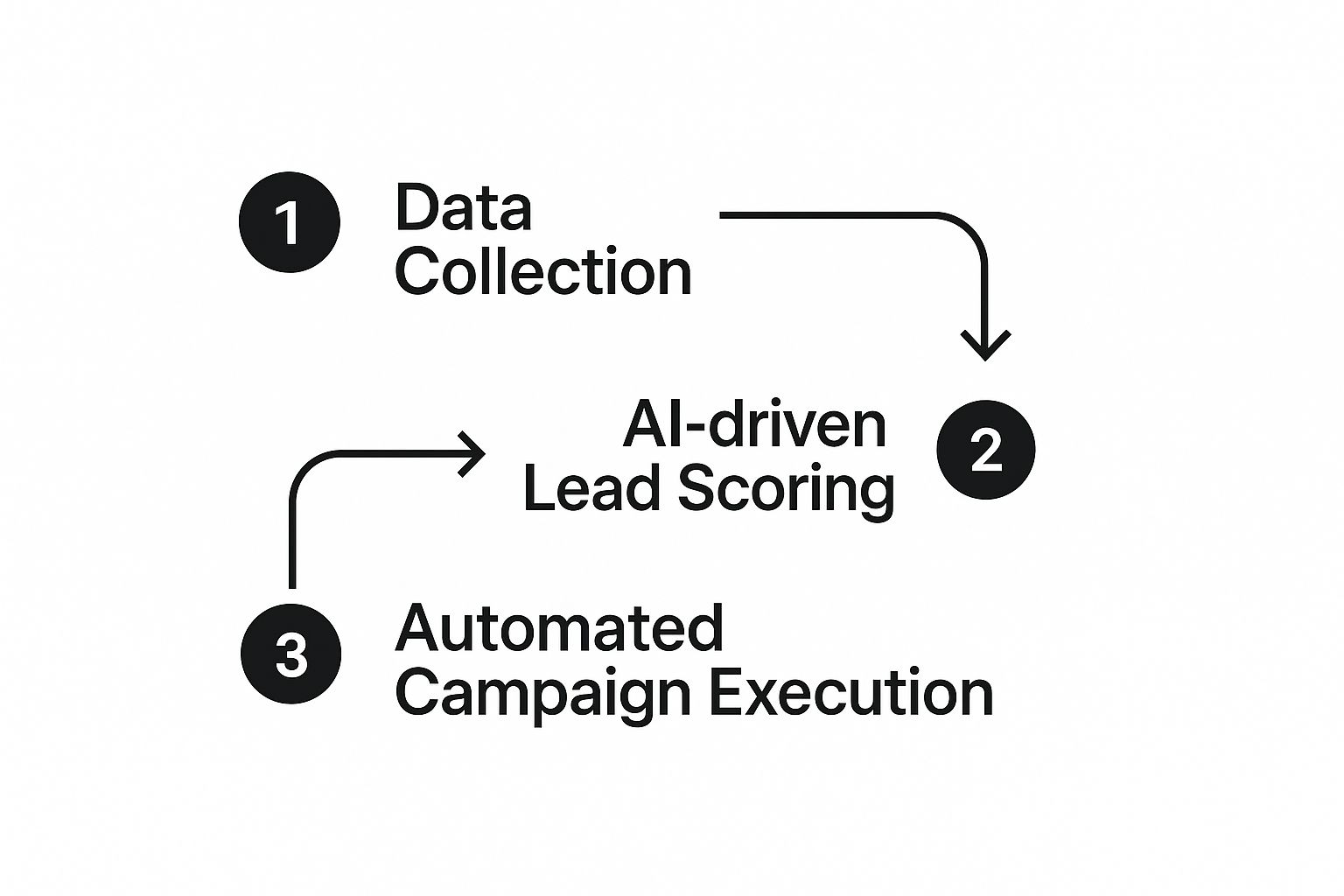
How to Use AI for Marketing Automation (Without Replacing Your Team)
Old-school marketing automation is like a sprinkler system on a timer. It turns on at 6 AM, waters the lawn for 20 minutes, and shuts off. It doesn't care if it rained all night or if it's 100 degrees out. It just follows the rules you set.
AI for marketing automation is totally different. It’s like a smart sprinkler system that checks the weather forecast, measures the moisture in the soil, and then decides how much water your garden actually needs. It learns, predicts, and adapts in real time.
The New Reality of AI in Marketing Automation
Let's be honest, the modern marketing world is drowning in data. It's getting harder and harder to cut through the noise and actually connect with people.
Traditional automation runs on rigid, "if-this-then-that" logic. If a user downloads an ebook, they get email sequence A. It works, sure, but it’s clumsy. It lacks any real foresight or flexibility.
This is where AI for marketing automation changes the game entirely. Instead of just following your pre-programmed commands, AI digs into massive datasets to figure out context, anticipate what a customer might need next, and make smart decisions all on its own. It effectively upgrades your marketing from a simple script-follower to a strategic partner that gets smarter over time.
From Static Rules to Dynamic Decisions
Think of it this way: traditional automation is a traffic light stuck on a fixed timer. It turns red every 60 seconds, no matter if there’s a traffic jam or an empty street.
AI-powered automation is more like a smart traffic grid that watches the flow of cars in real time, adjusting signals to clear accidents and manage rush hour on the fly. This dynamic approach creates much smoother, more efficient, and deeply personalized customer journeys. For a deeper look at how this plays out, the world of small business marketing automation offers some great, practical insights.
So, what does AI actually bring to the table that standard automation can't?
- Predictive Analytics: Standard automation can segment leads based on past actions (e.g., visited pricing page). AI can look at a lead's complete behavior and predict, with spooky accuracy, which ones are most likely to buy. This lets your sales team stop chasing ghosts and focus their energy where it will actually pay off.
- Hyper-Personalization: We're not just talking about adding a
{\{first_name\}}token. Traditional tools might let you segment an audience by location. AI can change website content, rewrite email copy, and adjust product recommendations for every single user in real-time, not just for broad segments. - Optimized Timing: Traditional automation sends an email when you tell it to (e.g., 24 hours after signup). AI figures out the absolute perfect moment to send that email or show that ad based on an individual's unique patterns of behavior. No more guessing.
The real shift here is moving from reactive, rule-based chores to proactive, data-driven strategy. AI doesn't just do what you tell it to; it uncovers what you should be doing to get the biggest impact.
How AI Fundamentally Changes Marketing Automation

Let's be honest. Traditional marketing automation is powerful, but it's also a bit rigid. It runs on a strict script you have to write yourself. It’s fantastic at executing pre-set "if-then" rules, but it can't improvise, understand nuance, or guess what a customer might do next.
Think of it like a spell-checker. It’s great at catching typos, but it has no idea if your sentence is actually persuasive.
Plugging AI into marketing automation isn't just an upgrade; it’s a complete rewrite of the rules. We're moving from a system that just follows commands to one that makes its own intelligent, autonomous decisions. AI doesn't just play by the rules you give it—it watches the entire game, predicts the other team's next move, and tells you the best way to win.
That’s the core difference. One system reacts. The other anticipates.
This leap forward is powered by a few key technologies that act as the "brain" of the operation. And they aren't just buzzwords; they're the engines driving real business results.
Moving From Static Workflows To Intelligent Systems
At its heart, this is about shifting from a static, fixed approach to a dynamic one. Old-school automation is brittle; AI-powered systems are fluid, constantly learning and adapting as new data pours in.
The market sees the enormous potential here. Revenue from AI in marketing is on track to blow past $107.5 billion by 2028—more than doubling in just a few years as businesses scramble to get smarter. You can dig into the numbers behind this explosive growth by exploring the latest AI marketing statistics.
This growth is really driven by three foundational AI concepts:
- Machine Learning (ML): This is the learning engine. ML algorithms chew through mountains of campaign data—email opens, click-through rates, purchase histories—to find patterns you’d never spot on your own. Instead of you manually creating a segment for "customers who bought Product X," machine learning finds clusters of users with subtle, shared behaviors that signal they're perfect candidates for Product Y, often with way more accuracy.
- Predictive Analytics: Building on ML, predictive analytics is about forecasting what comes next. It can score leads based on their probability of converting, flag customers who are about to churn, or estimate the lifetime value of a brand-new subscriber. This pulls your strategy out of the realm of guesswork and into data-backed foresight, letting you put your resources where they’ll have the biggest impact.
- Natural Language Processing (NLP): NLP is what gives automation the ability to actually understand human language. It's the tech behind a smart chatbot that can handle complex support questions, the sentiment analysis tools that tell you how people really feel about your brand on social media, and the systems that can perform a deep AI content analysis to make sure your messaging hits home.
The real change is that AI enables automation to answer the "why" and "what if" questions, not just execute the "if/then" commands. It transforms your platform from a task manager into a strategic advisor.
Practical Comparisons: Old vs. New
To make this less abstract, let’s look at how a simple abandoned cart email sequence gets handled in both worlds.
| Feature | Traditional Automation | AI-Powered Automation |
|---|---|---|
| Trigger | A user adds an item to their cart and leaves. A fixed timer (say, 1 hour) kicks off. | AI analyzes the user’s on-site behavior, past purchases, and cart value to decide the perfect time to send the first reminder. |
| Content | The email shows the exact product left behind with a generic "Complete your purchase!" message. | The email is dynamically personalized. It might offer a small, tailored discount for a high-value customer, suggest complementary products based on predictive models, or rewrite the subject line to match the user's perceived urgency. |
| Follow-Up | A rigid, pre-set sequence of 2-3 emails goes out at fixed intervals (e.g., 24 hours, 72 hours). | The follow-up cadence is adaptive. If the user comes back to the site, the sequence might pause. If they open an email but don’t click, the next message might get sent via SMS or a social media ad, depending on which channel they prefer. |
This side-by-side makes the upgrade crystal clear. Traditional automation is a one-size-fits-all sledgehammer. AI for marketing automation, on the other hand, crafts a unique, optimized journey for every single customer.
It scales true personalization in a way that was flat-out impossible before. That ability to learn, predict, and adapt is what truly sets it apart.
High-Impact Use Cases of AI in Automation

Alright, enough with the theory. Let's get down to brass tacks. Where does AI for marketing automation actually make a difference? The real magic isn't in some abstract concept; it's in the specific, tangible ways it helps you get better results.
We're going to look at a few examples that show a clear before-and-after picture. This isn't just about doing the same old things a little faster. It's about shifting from a manual, one-size-fits-all approach to a smart, adaptive strategy that feels personal to every single customer. This is how you get an edge.
Hyper-Personalized Email Campaigns
Email marketing is the backbone of most strategies, but let's be honest, it often hits a wall. AI blows right through that wall by enabling a kind of personalization that was pure fantasy just a few years ago.
The Old Way: You'd slice your audience into a few broad segments—maybe based on location or what they bought last year. You'd write a generic email, pop in a {\{first_name\}} tag to feel fancy, and blast it out. The results? Decent, but you know a ton of those emails just weren't hitting the mark.
The New Way (with AI): Forget broad strokes. An AI model is watching what each individual does in real time. It sees the pages they're browsing, knows when they're most active, and understands the products they keep coming back to. With that intel, the system automatically:
- Optimizes Send Times: It doesn't guess. It sends the email at the exact moment that specific person is most likely to open it, based on their past behavior.
- Generates Dynamic Content: The AI can rewrite subject lines, tweak headlines, and swap out product recommendations on the fly to perfectly match what that user is thinking about right now.
- Predicts Future Needs: It can even offer a discount on something they haven't looked at yet, but that thousands of similar customers ended up buying next.
You’re moving from a generic broadcast to a genuinely relevant, one-to-one conversation. That’s a huge leap.
AI-Driven Ad Spend Optimization
Running paid ad campaigns can feel like spinning plates. You're constantly juggling bids, tweaking targeting, and shifting budgets around. Without AI, it's a slow, reactive process full of guesswork.
By 2025, the AI industry is projected to hit a global market valuation of around $391 billion, with its annual growth rate hovering near 35.9%. This massive investment is driven by AI’s ability to deliver clear financial impact, as seen with Netflix generating an estimated $1 billion annually from its AI-powered recommendation engine alone.
AI brings a ruthless mathematical precision to your ad spend, making sure every dollar is pulling its weight.
The Old Way: A marketer logs into Google Ads, checks some reports, and sees an ad group is tanking. They manually lower the bids or change the audience settings. The problem is, by the time they've spotted the issue and fixed it, money has already been wasted.
The New Way (with AI): An AI platform crunches thousands of data points every second—competitor bids, time of day, user device, you name it. It predicts which clicks will actually convert and automatically shifts budget toward your most profitable channels, audiences, and ad creative. It's all done in real-time, maximizing your ROAS without you lifting a finger.
Dynamic Website Experiences
Think about it: a static website gives the exact same experience to a first-time visitor from a tiny startup as it does to a loyal enterprise customer. That makes no sense. AI turns your site into a living, breathing thing that adapts to each person.
| Aspect | Static Website (Before AI) | Dynamic Website (After AI) |
|---|---|---|
| Homepage Content | Everyone sees the same generic welcome, featured products, and CTAs. | The headline, hero image, and content morph based on the visitor's industry, referral link, or past behavior. |
| Product Recommendations | A static list of "best-sellers" that rarely changes. | Hyper-relevant recommendations powered by machine learning, based on what that specific user is likely to buy. |
| Lead Capture | The same pop-up form appears for everyone after 30 seconds. | A smart pop-up with a tailored offer appears at the precise moment AI predicts the user is about to leave or convert. |
Instant Lead Qualification with AI Chatbots
Not every lead is a good lead. Your sales team knows this better than anyone. Making them sift through every single form submission is a huge waste of time they could be using to close deals. AI chatbots take over that filtering process with terrifying speed and accuracy.
A great example of this is leveraging chatbots for marketing to handle initial conversations and guide users. These aren't the clunky bots of five years ago. They are sophisticated lead-scoring engines that can ask qualifying questions, understand intent, and route only the hottest leads straight to a sales rep's calendar.
(If you want to go deeper on this, we've got a whole playbook on https://marketbetter.ai/playbooks/ai-lead-scoring.)
Choosing the Right AI Marketing Automation Platform
Let's be honest, picking an AI marketing automation platform can feel like a chore. The market is flooded with tools, and every single one promises to change your world.
The real trick is to cut through the noise and find a platform that actually fits your business—your team, your tech stack, and where you plan to be in a couple of years.
Making the right call here is a big deal. You're not just buying software; you’re choosing the central hub for your entire marketing operation. Get it right, and it becomes an engine for growth. Get it wrong, and it’s an expensive headache.
Core Factors for Your Decision
Before you jump into a dozen demos, you need a clear checklist. Otherwise, you’ll get lost in flashy feature lists and slick sales pitches.
Focus on these three pillars to keep your search grounded.
- Business Model and Size: Are you B2B or B2C? A B2B company with a six-month sales cycle needs sophisticated lead scoring and nurturing. A B2C e-commerce brand, on the other hand, might care more about abandoned cart emails and personalizing offers for thousands of customers at once. Size matters, too. A startup needs something nimble and affordable, while an enterprise needs ironclad security and the power to scale.
- Integration Capabilities: Your marketing platform can't be a lone wolf. It has to play nice with the rest of your tech, especially your CRM (like Salesforce or HubSpot), your e-commerce store (like Shopify), and your analytics tools. Bad integrations create data silos, and that defeats the whole purpose of using AI in the first place.
- Scalability for Growth: The perfect tool today might hold you back in two years. Think about your growth plans. Can the platform handle 10x the contacts and campaigns without slowing to a crawl or jacking up the price? You need a partner that can grow with you, not one you’ll outgrow.
Comparing Top AI Marketing Automation Platforms
To make this tangible, let's look at a few of the big players. Each has its own vibe and is built for different kinds of teams. This isn't an exhaustive list, but it's a great starting point for figuring out where to look first. For a deeper dive, check out our Marketbetter vs. Warmly AI comparison for a real head-to-head breakdown.
This table breaks down how leading platforms stack up on AI features, who they're best for, and how well they connect with other tools. It's designed to help you quickly narrow down the options that make sense for your business.
Comparing Top AI Marketing Automation Platforms
| Platform | Key AI Features | Best For | Integration Capability |
|---|---|---|---|
| HubSpot | Predictive lead scoring, AI content assistant, adaptive testing, AI-powered chatbot builder. | Mid-market B2B and B2C companies seeking an all-in-one platform for marketing, sales, and service. | Excellent. Extensive native integrations with hundreds of popular apps and a robust API. |
| ActiveCampaign | Predictive sending, win probability models, automated segmentation, AI-driven content generation. | Small to mid-sized businesses (SMBs) that need powerful automation and personalization at an accessible price. | Strong. Connects well with most major e-commerce platforms, CRMs, and business tools. |
| Salesforce Marketing Cloud | Einstein AI for predictive engagement, journey optimization, and content personalization. | Enterprise-level B2C companies with large customer databases and complex, multi-channel journeys. | Very High. Deep native integration with the Salesforce ecosystem (Sales Cloud, Service Cloud) is its core strength. |
Each of these platforms offers a different flavor of AI automation, so the "best" one really depends on whether you're a scrappy SMB or a large enterprise with a complex, existing ecosystem.
The difference between sticking with manual workflows and switching to an AI-driven approach is night and day. It changes everything from your team's daily workload to your bottom line.
This infographic really drives the point home, showing just how dramatic the improvements are when you let AI handle the heavy lifting.
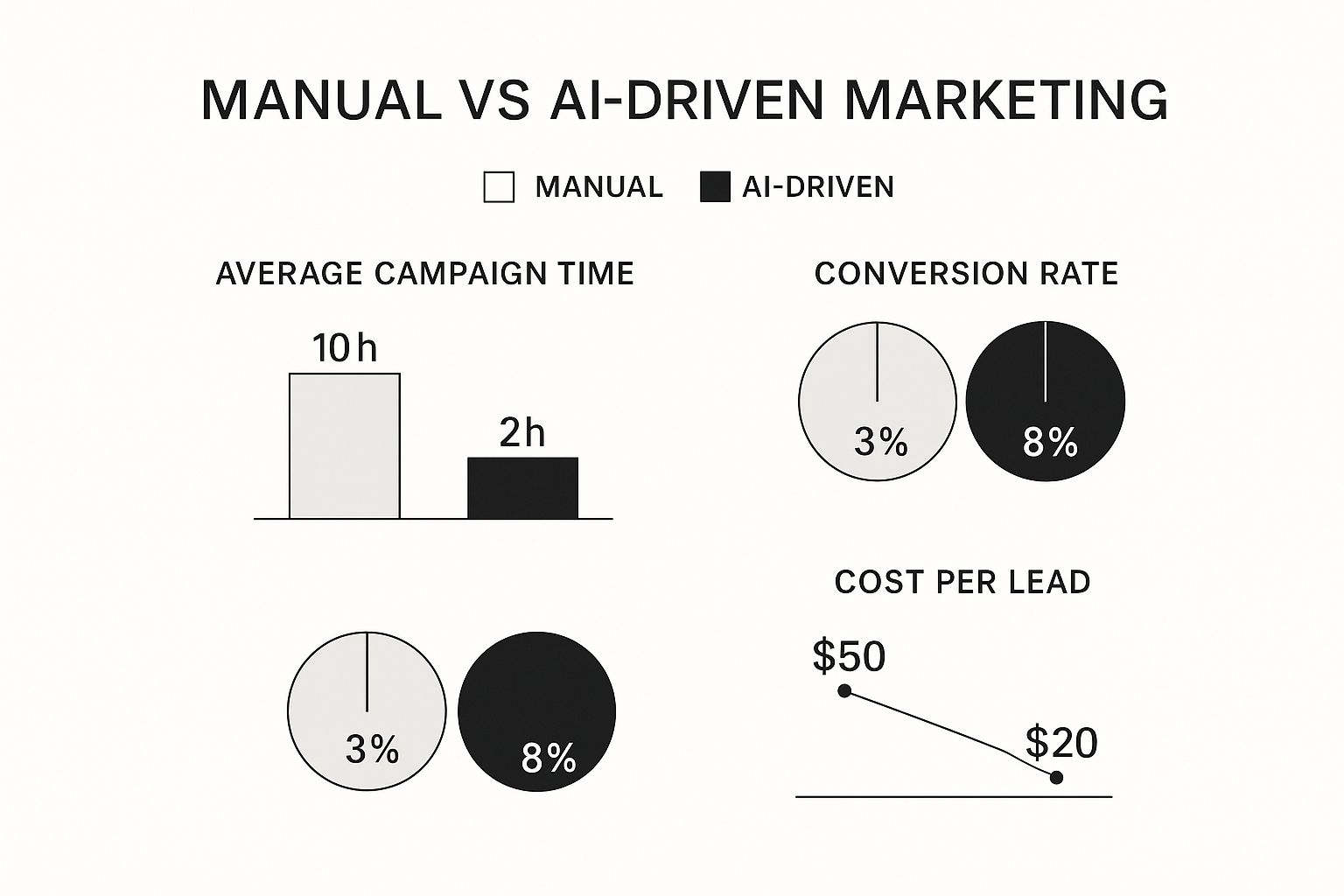
The numbers don't lie. This isn't about small, incremental gains. AI fundamentally rewires the economics of your marketing. Just the time saved lets your team stop clicking buttons and start thinking about strategy.
The ultimate goal is to choose a platform that not only automates what you're already doing but also gives you the AI-powered insights to do it better.
AI is quickly becoming non-negotiable for managing marketing workflows. A 2025 survey found that 93% of marketers using AI are leaning on it to create content faster for blogs, social posts, and ads. On top of that, about 90% say they make decisions faster because of AI's ability to process data.
Platforms like HubSpot and ActiveCampaign are embedding these tools directly into their systems, freeing marketers from the grind so they can focus on the big picture.
Picking the right platform is the first—and most important—step. If you carefully weigh your needs against what these tools can do, you'll find a system that doesn't just automate tasks but actually drives real, measurable growth.
Your 5-Step AI Implementation Plan
Bringing AI into your marketing stack isn't like flipping a switch. It's more like building a house—you don't start hammering without a blueprint. A lot of teams get tripped up here, buying a powerful tool only to see it gather dust because there was no real plan.
Think of this as your blueprint. It breaks the whole process down into five clear, manageable steps. Following this framework will help you sidestep the usual traps, like chasing vanity metrics or feeding your shiny new AI a diet of messy data. Let's get it right from the start.
Step 1: Define Your North Star (Goals and KPIs)
Before you even glance at a pricing page, you have to answer one question: What, specifically, are we trying to fix or improve?
"Get better at marketing" is a wish, not a plan. You need sharp, measurable goals. This is the single most important step. Without a clear destination, you're just driving, and you'll almost certainly end up somewhere you don't want to be. Your goals are your North Star for this entire journey.
Here’s what that looks like in the real world:
| Vague Wish | Sharp, Actionable KPI |
|---|---|
| "Increase leads" | "Boost MQL to SQL conversion rate by 15% in Q3 using predictive lead scoring." |
| "Personalize emails better" | "Lift email click-through rates by 20% by rolling out AI-driven dynamic content." |
| "Be more efficient" | "Cut 10 hours per week from campaign reporting with automated analytics." |
Step 2: Look Under the Hood (Audit Your Data and Tech)
AI runs on data. Period. If your data is a disaster—siloed, incomplete, or just plain wrong—your AI will spit out garbage. It's that simple.
So, before you plug anything new in, you have to do a serious audit of your data and current tech stack. Take an honest look at your CRM, your analytics tools, and wherever else customer information lives. Are they talking to each other? Is the data clean?
Trying to skip this is like putting cheap, dirty gas in a Ferrari. The engine will choke, and you'll go nowhere fast.
The Hard Truth: Your AI is only as smart as the data you feed it. The "garbage in, garbage out" rule is 10x truer for AI. Bad data doesn't just give you bad results; it wastes your entire investment.
Step 3: Start Small, Win Big (Launch a Pilot Project)
Don't try to boil the ocean. Seriously. Overhauling your entire marketing operation in one go is a surefire way to fail. The smart move is to start with a focused pilot project—something with a tight scope where you can score a quick, measurable win.
This builds momentum and proves the concept to everyone in the company.
A great place to start is an AI-powered email campaign. You can run a clean A/B test against your old, rules-based campaigns. Test things like AI-optimized send times, dynamic subject lines, or personalized content blocks. The results will be black and white, making it easy to show stakeholders exactly what the new tool is capable of.
Step 4: Don't Forget the People (Empower Your Team)
Dropping a powerful new tool on your team without proper training is just setting them—and your investment—up for failure. It's amazing how many companies spend a fortune on software but completely cheap out on teaching people how to actually use it.
Your team needs more than a one-hour demo. Give them real training that covers not just how to use the platform, but why you're using it. Connect the tool back to the strategic goals you set in Step 1. Show them how this AI for marketing automation is going to make their jobs easier and more impactful, not just add another login to their password manager.
Step 5: Measure, Tweak, Repeat (Analyze and Iterate)
Getting your AI running isn't the finish line. It's the starting line. This is a continuous loop: measure performance, analyze what's happening, and tweak your strategy based on what you learn.
Keep a close eye on those KPIs you defined back in Step 1. Are you hitting your numbers? Where are the surprising wins? Use the AI's own analytics to find insights you would have missed otherwise. This constant feedback loop is what separates the teams that get a little value from AI from the ones that completely transform their results.
Measuring Success and Proving ROI
Throwing money at AI for marketing automation is easy. The hard part? Proving it was worth it. The real test isn't about using shiny new toys—it's about whether they're actually making you money.
You have to connect your AI efforts directly to the bottom line, moving way past fuzzy wins like "time saved." This is how you build a rock-solid case for more budget instead of getting eye-rolls in your next meeting. It's about focusing on the metrics that actually signal business health and growth. Forget the vanity stuff and zero in on what matters.
Identifying Your Core AI-Driven KPIs
The right KPIs are your compass. They tell you if your AI strategy is pointed toward actual profit or just wandering around in the data wilderness. Don't get lost. Just concentrate on a few high-impact metrics that paint a crystal-clear picture of your return.
Here are the ones that count:
- Lower Customer Acquisition Cost (CAC): AI is brilliant at refining ad targeting and automating lead scoring. That means you spend less money and effort to get each new customer. If your CAC is dropping, your AI is making your marketing spend smarter, period.
- Higher Customer Lifetime Value (CLV): Through smart personalization and predicting what customers will do next, AI helps you keep them around longer and encourages them to buy again. An increasing CLV is a massive signal that your AI-driven retention plays are hitting the mark.
- Improved Conversion Rates: AI-powered A/B testing, dynamic website content, and optimized emails are all designed to do one thing: get more people to click, sign up, or buy. Tracking conversion rates at each stage of your funnel shows exactly how good your AI is at closing the deal.
A Simple Framework for Calculating ROI
Once you’re tracking the right KPIs, calculating the return is surprisingly straightforward. This isn’t just for the finance nerds; it’s how marketers prove they're a revenue center, not a cost center.
Here’s the basic formula everyone understands:
ROI (%) = [ (Gain from Investment - Cost of Investment) / Cost of Investment ] x 100
Let's break that down into real-world terms.
- Gain from Investment: This is the money you made or saved because of your AI. Tally up the added revenue from a higher CLV, the real dollars saved from a lower CAC, or the new profit you pocketed from better conversion rates.
- Cost of Investment: Add up everything you spent. This includes the obvious stuff like software subscription fees, but don't forget one-time implementation costs, training, and the hours your team spends managing the new system.
By consistently measuring these core metrics and running the numbers, you change the conversation from "AI is pretty cool" to "AI generated an extra $X in revenue last quarter." That's how you prove its worth.
Try our Marketing Plan Generator — generate a complete AI-powered marketing plan in minutes. No signup required.
Your Questions About AI Automation, Answered
Even with all the benefits laid out, I get it. Stepping into AI for marketing automation can feel like a huge leap. It’s totally normal to have questions about the nuts and bolts—the costs, who you need on your team, and the real-world headaches you might run into. Let’s clear the air on the most common ones.
Think of this as the final gut-check before you commit to a smarter way of doing marketing.
Do I Need a Data Scientist to Use AI in Marketing?
Nope. Not anymore. A few years back, this was a real concern, but modern AI marketing platforms are built for marketers, not data engineers. They’re all about user-friendly interfaces and no-code workflows that make the powerful stuff accessible to anyone.
Sure, having data skills on your team is always a bonus. But the core functions—like predictive lead scoring, personalizing content on the fly, and segmenting audiences—are all handled automatically behind the curtain. Your job is to focus on the strategy and the customer data; the platform does all the heavy lifting.
The biggest hurdle isn't technical skill. It's almost always the quality of the data you feed the AI. A model is only as smart as the information it learns from, which makes a solid data audit your most important first step.
How Much Does AI Marketing Automation Cost?
This is the classic "it depends" answer, but we can definitely put some real numbers on it. The price tag changes a lot based on your needs, how big your contact list is, and how fancy you want to get with the features.
Here's a rough breakdown:
- Entry-Level Tools: For small businesses or startups just getting their feet wet, some platforms with AI features start under $100 per month.
- Mid-Tier Platforms: This is the sweet spot for most growing businesses. Tools like HubSpot or ActiveCampaign will usually land somewhere between a few hundred to several thousand dollars a month.
- Enterprise Solutions: For the big players, these solutions are custom-quoted and can be a serious investment. But the ROI is built to scale right along with it.
The trick is to stop looking at it as just a cost and start comparing it to the potential return. If a platform can tangibly lower what you pay to acquire a customer or boost the lifetime value of the ones you have, it pays for itself.
What Is the Biggest Implementation Challenge?
Forgetting about data quality for a second, the next biggest roadblock is usually internal pushback or just not having a clear plan. Too many companies buy a powerful new tool without first deciding what they actually want to do with it. That’s a surefire recipe for failure.
You absolutely have to start with a clear implementation plan that kicks off with specific, measurable goals. As one expert from Harvard's Division of Continuing Education put it, your job won't be taken by AI, but by someone who knows how to use it. Success comes down to a smart strategy and a team that’s trained and ready to run with the new tech.
Ready to see how a truly integrated AI platform can transform your marketing from the ground up? marketbetter.ai combines content generation, campaign optimization, and deep customer personalization into one seamless system. Stop juggling point solutions and start driving real results. Explore what marketbetter.ai can do for you.