The 2026 Sales-Tech Repricing: 28 of 38 Pricing Pages Changed [2026]


Over the past eight weeks we re-verified the pricing of 38 B2B sales tools — CRMs, prospecting databases, sequencers, visitor identification platforms, and AI agent add-ons — directly against their own pricing pages, checkout flows, and official migration docs. Not against aggregator listicles, which we found stale more often than not.
28 of the 38 are selling something materially different than they were a year ago. Plans renamed. Free tiers deleted. Per-seat pricing swapped for pooled credits. Usage meters bolted onto AI features. In several cases the vendor's own meta tags still advertise a free plan that no longer exists.
Last year we published a study of pricing transparency across 70+ sales tools — who publishes pricing and who hides it. This is the sequel question: for the vendors who do publish pricing, how fast does it move? The answer: faster than your renewal cycle.
Here's the full change log, the five patterns behind it, and what to do about it if you're buying.
How we did this (and what counts as "changed")
- First-party sources only. Live pricing pages, embedded checkout JSON, official plan-migration help docs, vendor emails, earnings calls, and admin message-center notices. Where a pricing page blocks scrapers, we pulled the structured pricing data embedded in the page itself. Where a vendor's page conflicted with its own FAQ, we flagged it.
- Each fact carries a verification date (late September through November 16, 2026). Pricing this volatile goes stale; dated claims are the only honest kind.
- "Changed" means structural: a plan added, removed, renamed, or repriced; a free tier altered; a billing model swapped. Copy tweaks don't count.
- 38 tools came from re-verifying three of our highest-traffic roundups — free lead generation tools, pipeline management CRMs, and website visitor tracking — plus individual pricing rebuilds we shipped along the way.
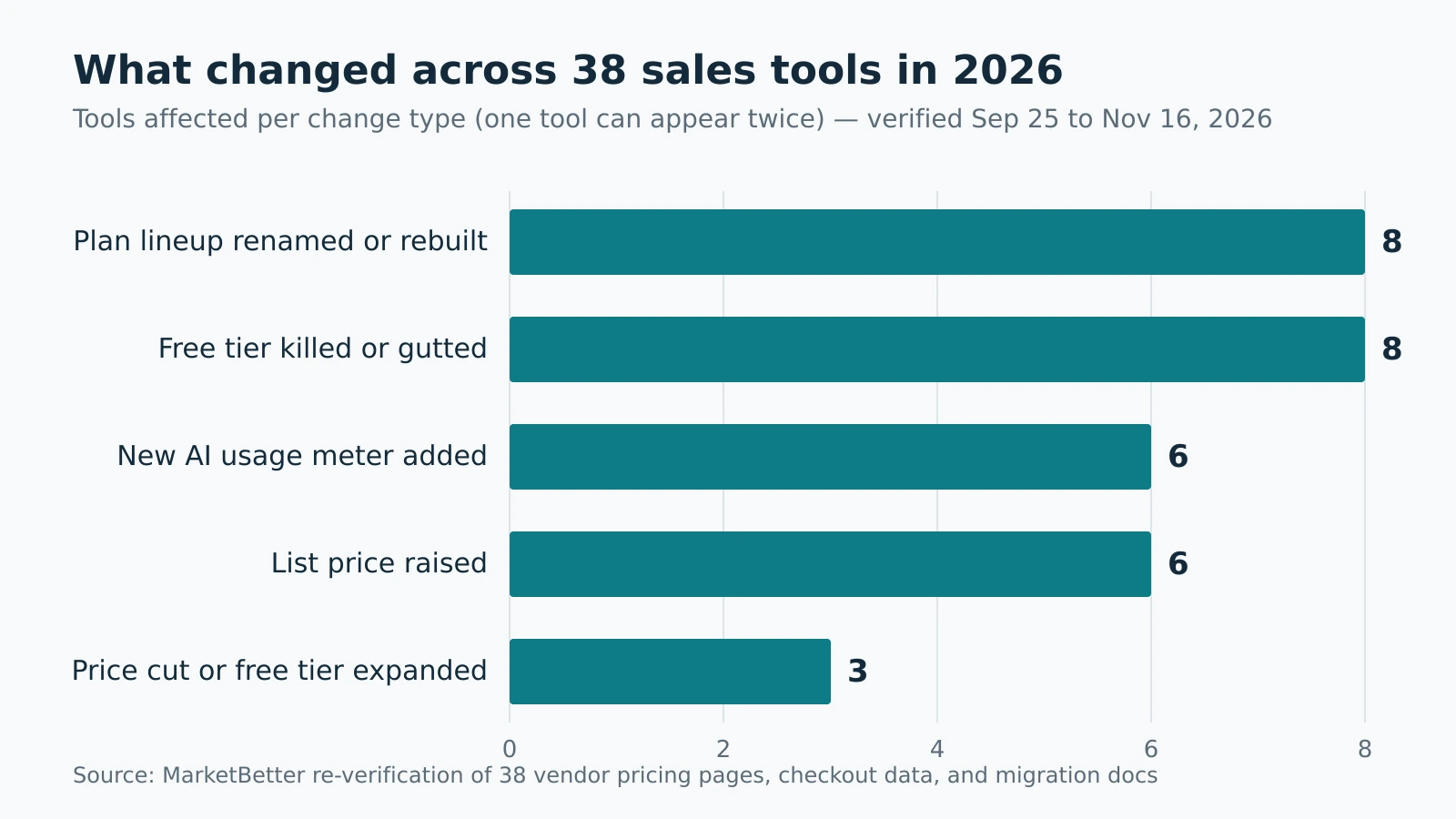
One tool can appear in more than one bar — Pipedrive, for instance, both renamed its lineup and raised prices inside the rename.
Pattern 1: The free-tier retreat
The clearest trend in the dataset: free tiers are being deleted or defanged.
- Freshsales removed its free plan entirely on July 21, 2026. The entry point is now a 21-day trial into Growth at $9/user/month. As of mid-November, Freshworks' own meta description still advertised the free plan.
- Kaspr ended unlimited free B2B emails — the free tier now includes 15 emails/month, and "unlimited" moved behind paid plans with annual export caps.
- 6sense discontinued its free Sales Intelligence tier on August 12, 2026.
- RB2B restructured in January 2026: the free tier lost person-level identification — the feature that made RB2B famous — and now returns company-level data only.
- Streak stripped pipelines out of its free plan (email tools remain) and killed its Solo plan.
- Seamless.AI free credits are now a one-time 50, not a monthly allowance.
- Apollo kept its generous 10,000-credit fair-use allowance on the renamed Starter (free) plan — but gated it behind a corporate email address. Sign up with a personal address and you get 100 credits/month, a 100x difference the pricing page doesn't exactly headline.
- Clearbit's free tools are simply gone — the standalone product shut down and resurfaced as HubSpot Breeze Intelligence, priced in HubSpot credits.
The notable counter-move: Hunter.io doubled its free tier to 50 credits/month and made sequencing free. When everyone else retreats, generosity is a differentiation strategy.
Why the retreat? Our read: free tiers were designed to convert humans, and in 2026 a growing share of signups are agents and scripts extracting data. When AI agents are doing the searching and the scraping, a free tier's unit economics break.
Pattern 2: Rename the lineup, move the price
Six vendors raised list prices in our dataset. The interesting part is how. The honest raise — same plan, higher number — is now the minority. The common move is a full lineup rename, with the raise hidden inside the migration map.
- Pipedrive retired all five of its long-standing plans (Essential, Advanced, Professional, Power, Enterprise) for a new four-plan lineup: Lite $14, Growth $39, Premium $59, Ultimate $79 per user/month annual. Per Pipedrive's own migration doc, Advanced customers map to Growth — a 57% price increase for roughly the same tier. Premium also took a quiet $49 to $59 raise on newer SKUs. Full details in our Pipedrive pricing rebuild.
- Clay rebuilt its plans in March 2026: Starter $149, Explorer $349, and Pro $800 became Launch $185 and Growth around $495, with credit expansion packs above that. Entry price up 24%, and the real money moved into credit expansions at roughly $880 per 20,000 credits.
- Attio raised Plus from $29 to $35 and Pro from $69 to $79 (annual) in July 2026 — a straightforward raise, verified against its embedded checkout data.
- LinkedIn Sales Navigator Core went from $99.99 to $119.99/month.
- Salesforce raised core Sales Cloud plans in August 2025 ($25/$100/$175/$350) and introduced the $550/user Agentforce 1 Sales bundle above them.
- Propensity doubled its entry price from roughly $1,000 to $2,000/month.
If you track vendor pricing by plan name — as most procurement teams do — a rename resets your baseline. That's not an accident.
Pattern 3: Seats are losing to pooled usage
Four vendors in the dataset abandoned classic per-seat pricing this year:
- Lusha retired per-user plans for account bundles: fixed plans with pooled credits and bundled seats (e.g., Pro at $69.90/month includes 600 pooled credits across 2 seats). Extra seats on Pro cost $49.90/month and add zero credits — the credits are the product now. Full breakdown.
- Woodpecker killed per-slot pricing for prospect-volume tiers ($35 to $159/month by contacted prospects) with unlimited seats and inboxes — you pay for reach, not people.
- Mixmax collapsed its plan ladder into a single plan priced by sequence recipients ($29/$89/$129 per user/month by volume) — every feature included, volume is the dial.
- Clay gives even free workspaces unlimited seats and meters everything through credits and actions.
The logic is sound from the vendor side: when AI does more of the work, seat counts stop growing — so vendors re-anchor on the thing that does grow, which is usage. For buyers it means the quoted price tells you almost nothing until you've modeled your volume.
Pattern 4: AI gets its own meter
Six vendors attached a new usage meter for AI features on top of existing subscriptions — none of them priced the same way:
| Vendor | AI meter | The math that matters |
|---|---|---|
| Salesforce Agentforce | $0.10 per action or $2 per conversation | Break-even between the two is about 20 actions per conversation — we ran the numbers |
| Microsoft Dynamics 365 | Copilot Credits, $0.01 each (or $200 per 25K) | Sales Development Agent burns 400-700 credits per worked lead; usage billing starts Dec 1, 2026 — details |
| HubSpot | Breeze credits | About 100 credits per AI-worked lead; a Pro allowance of 3,000 credits is roughly 30 leads/month — analysis |
| Freshworks | Freddy AI Agent sessions | $49 per 100 sessions, on top of plan pricing |
| Nutshell | Metered "AI outcomes" | New plan lineup meters AI usage separately |
| monday.com | AI credits bundled into plans | AI ARR hit $36M in Q3 FY2026, but it blends credits, agents, and bundled allowances |
The pattern inside the pattern: the subscription gets you the seat; the meter gets you the work. Every one of these meters prices an activity, not an outcome — you pay per action whether or not the lead was worth working. That's precisely backwards from how a sales team thinks, and it's why modeling credit burn before you commit is now a required step in buying, not an optional one.
Pattern 5: The barbell — cheaper self-serve, pricier contracts
The middle of the market is hollowing out in both directions:
Moving up: Warmly killed its roughly $700/month self-serve plan for annual contracts at $10K, $20K, and $30K per product line. Lead Forensics remains quote-only, with real contracts we found ranging from $6K to $95K/year. Leadfeeder's upper tiers went annual-only.
Moving down: Unify GTM went the other way — it killed its $700/month Growth plan and replaced it with free, $20/seat, and $60/seat self-serve tiers. RocketReach cut Essentials from $53 to $39 and Pro from $179 to $79. Hunter doubled its free tier.
Consolidation is part of the same story: Visitor Queue was acquired by Leadinfo (its site now redirects, with euro-denominated plans), and Clearbit's remnants live inside HubSpot. If your vendor's pricing page starts sprouting "talk to sales" where numbers used to be, that's the barbell pulling them upmarket — and your renewal is where you'll feel it.
The full change log
Every change we verified, with dates. "Verified" is when we last confirmed it against a first-party source.
| Tool | What changed | Effective | Verified |
|---|---|---|---|
| Pipedrive | 5 plans retired → Lite/Growth/Premium/Ultimate; Advanced→Growth = 57% raise | Rolling, 2025-2026 | Nov 5 |
| Freshsales | Free plan removed; Freddy AI sessions added | Jul 21, 2026 | Nov 5 |
| Copper | Starter plan killed → Basic $23/Pro $59/Business $99 | May 2, 2026 | Nov 4 |
| Streak | Solo plan dead; free plan lost pipelines | 2026 | Nov 4 |
| Nutshell | Rebuilt to 5 plans; metered AI outcomes | 2026 | Nov 4 |
| Salesforce | Core raise + $550 Agentforce 1 Sales bundle | Aug 2025 | Nov 4 |
| Sales Navigator | Core $99.99 → $119.99/mo | 2026 | Nov 2 |
| Clay | Plan rebuild; entry $149 → $185; credit expansions | Mar 11, 2026 | Nov 2 |
| Kaspr | Free unlimited emails → 15/mo | 2026 | Nov 2 |
| Hunter.io | Free doubled to 50 credits/mo + free sequencing | 2026 | Nov 2 |
| Apollo | Free renamed Starter; corporate-email gate on 10K credits | 2026 | Nov 2 |
| Lusha | Per-user plans → account bundles; phone lookups 10 → 5 credits | Feb-Sep 2026 | Nov 3 |
| RocketReach | Essentials $53 → $39; Pro $179 → $79 | 2026 | Nov 2 |
| Seamless.AI | Free credits now one-time 50 | 2026 | Nov 2 |
| Attio | Plus $29 → $35; Pro $69 → $79 annual | Jul 2026 | Sep 30 |
| Unify GTM | $700/mo Growth killed → Free/$20/$60 seats | 2026 | Oct 1 |
| Woodpecker | Per-slot plans → prospect tiers, unlimited seats | 2026 | Sep 25 |
| Mixmax | Plan ladder → one plan priced by sequence recipients | Oct 12, 2026 | Oct 13 |
| Warmly | Self-serve killed → $10K-$30K annual contracts | 2026 | Nov 15 |
| RB2B | Free tier lost person-level ID; new $79/$149/$199 ladder | Jan 22, 2026 | Nov 15 |
| Visitor Queue | Acquired by Leadinfo; site redirects; €69-€359 plans | 2026 | Nov 15 |
| Clearbit | Standalone dead → HubSpot Breeze Intelligence credits | Apr 2025 | Nov 15 |
| 6sense | Free Sales Intelligence tier discontinued | Aug 12, 2026 | Nov 15 |
| Propensity | Entry roughly doubled to $2K/mo | 2026 | Sep 28 |
| Leadfeeder | New lineup; upper tiers annual-only | 2026 | Nov 15 |
| HubSpot | Breeze credit meter added for AI leads | 2026 | Oct 5 |
| Microsoft D365 | SDA usage billing via Copilot Credits | Dec 1, 2026 | Nov 16 |
| monday.com | AI credits bundled; agents metered | 2026 | Nov 10 |
Stable, for the record: Close, Zoho, Salesflare, Insightly, Wiza, Snitcher, Salespanel, and HubSpot's core seat prices all matched our previous verification. Ten of 38.
What buyers should do with this
- Re-quote before every renewal, by feature list — not plan name. Plan names are now marketing surfaces that get repainted mid-contract. Pipedrive's Advanced→Growth map is the cautionary tale: same name tier, 57% more.
- Get grandfathering in writing. Clay grandfathered legacy plans; Pipedrive reprices you to list the moment you switch. Which policy your vendor follows belongs in your contract, not in a support thread.
- Model credit burn before buying any AI agent add-on. Divide the bundled allowance by the per-task burn rate. HubSpot's 3,000 Pro credits sound generous until it's 30 leads a month. Microsoft's 400-700 credits per worked lead means the included 1,000 credits cover about two.
- Treat free tiers as temporary. Eight of the tools we tracked cut or killed theirs this cycle. If your workflow depends on a free allowance, you're one pricing-page deploy away from a migration project.
- Date-stamp your own pricing research. Anything older than a quarter is suspect. Most of the third-party pricing content we cross-checked this fall — including some high-ranking aggregators — was selling retired plans.
Why we track this
We maintain pricing breakdowns for 70+ sales tools and re-verify the highest-traffic ones continuously — it's how we caught most of these changes within weeks. The same discipline runs our product: MarketBetter watches buying signals so your SDR team acts on what's true today, not what a stale database says.
If your 2027 budget is built on 2025 pricing screenshots, it's wrong. And if your outbound is built on stale signals, it's wrong the same way.
Want to see what signal-driven, up-to-date prospecting looks like? Book a demo →