A Modern Demand Gen Strategy That Drives Revenue

· 25 min read

A modern demand gen strategy isn't just a marketing plan; it's a full-funnel machine built to create predictable revenue. The goal is to shift from just capturing existing leads to proactively creating new demand for whatever you sell.

When you do this right, you build trust and become the obvious choice long before a buyer is even ready to talk to sales.

Beyond Lead Capture: A New Demand Gen Strategy

Let’s get one thing straight: the old playbook of just capturing leads at the bottom of the funnel is broken. A winning demand gen strategy doesn't obsess over the tiny fraction of your market that's ready to buy today. It focuses on educating and nurturing the massive portion who aren't, making your solution the one they think of first when the need finally hits.

This is a fundamental shift in thinking. Instead of pouring all your budget into "request a demo" CTAs, you build a comprehensive engine that informs, educates, and establishes your authority. This is how you align marketing and sales around a single shared goal: creating a pipeline filled with educated, high-intent buyers who are already sold on you.

The 95-5 Rule of B2B Marketing

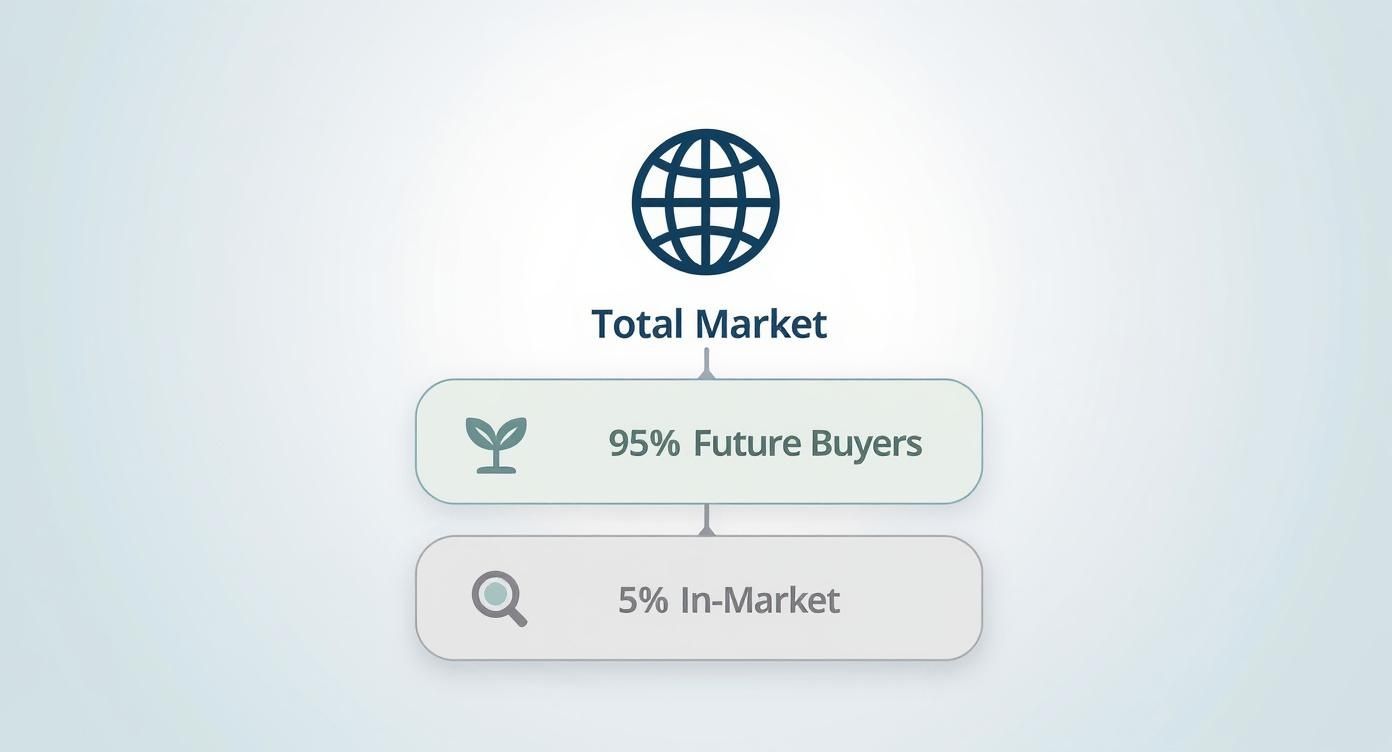
The entire philosophy of modern demand generation hangs on one critical market insight. Research consistently shows that only about 5% of your total addressable market is actively looking to buy at any given moment. The other 95% are future buyers who aren't in a purchasing cycle right now.

Any strategy that ignores 95% of its potential market is, by definition, broken. The real goal is to become the go-to vendor for that massive group, so when they eventually enter that 5% "in-market" segment, you're already their top choice.

This is where you move from chasing leads to building an audience.
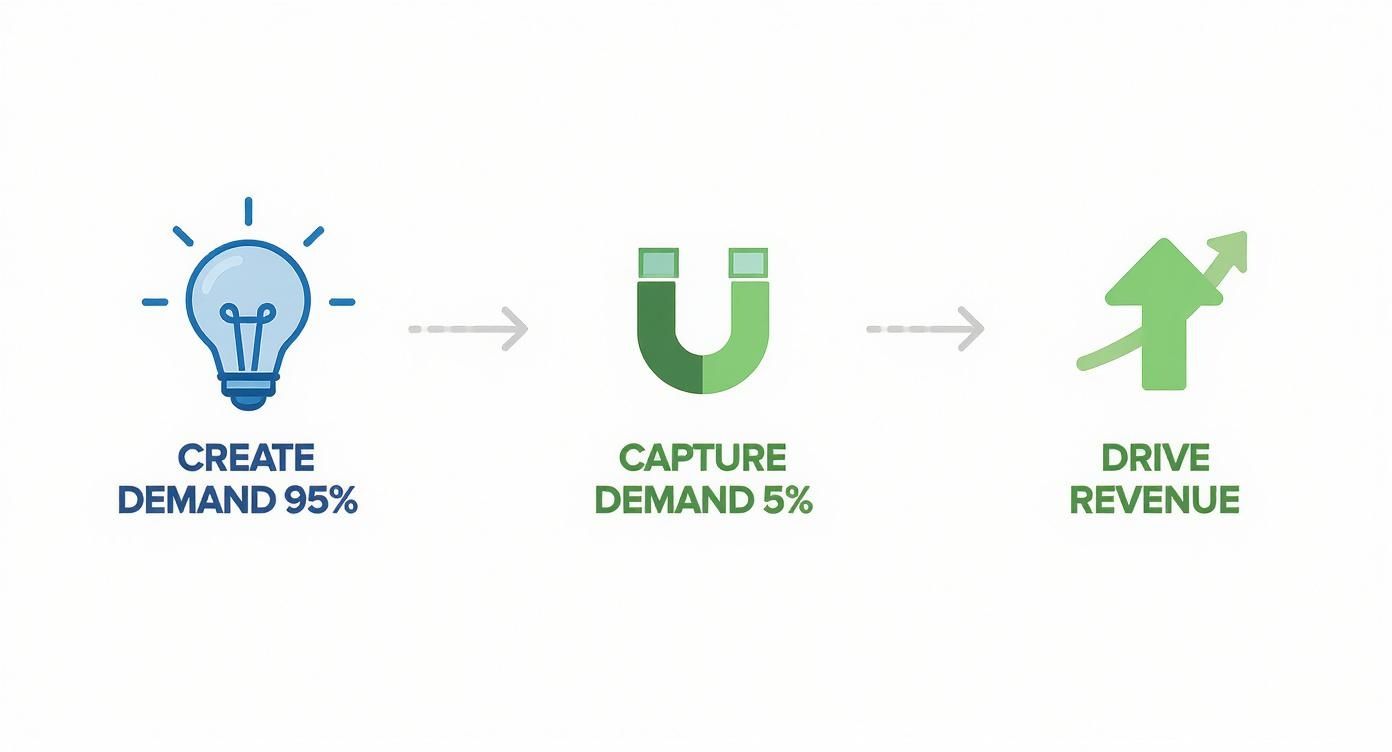
Diagram illustrating the three steps of demand generation: create, capture, and drive revenue.

As you can see, the process starts by creating broad awareness and interest before funneling that cultivated demand into actual revenue opportunities. You play the long game.

Demand Creation vs. Demand Capture

To make this work, you have to understand the two core pillars: creating demand and capturing it. They are two sides of the same coin, and you absolutely need both for a balanced, resilient strategy.

  • Demand Creation is your "educate and inform" motion. The goal is to make your audience aware of a problem they might not even know they have and position your solution as the answer. This is all about targeting that dormant 95%.
  • Demand Capture is the "convert" phase. Here, you're focused on prospects who are already problem-aware and actively looking for a solution. The goal is to intercept their buying journey and make it easy for them to choose you. This targets the in-market 5%.

To see how this plays out in the real world, it helps to put them side-by-side.

AttributeDemand CaptureDemand Creation
GoalConvert existing, high-intent interest into pipeline.Educate the market and build brand affinity over time.
AudienceThe 5% actively searching for a solution.The 95% who are not currently in-market.
ChannelsPaid search, G2, Capterra, SEO for bottom-funnel keywords.Social media, podcasts, content hubs, communities, events.
MetricsMQLs, SQLs, Demo Requests, Pipeline Generated, CAC.Share of voice, branded search volume, direct traffic, content engagement.

Both are essential. Without creation, your capture channels will eventually dry up. Without capture, all the brand awareness you build will never turn into revenue.

For a deeper look at the tactics involved, check out these practical B2B demand generation strategies. The key is balancing both creation and capture to build a revenue engine that works, no matter what the market is doing.

Defining Your Audience and Revenue Goals

A demand gen strategy without a laser-focused target is just wishful thinking. It's like having a map but no destination—you'll spend a lot of time, energy, and money going nowhere fast. Before you write a single line of copy or launch an ad, you need absolute clarity on two things: who you're talking to and what you want them to do.

This is the bedrock of a predictable revenue engine. Everything else builds on this foundation.

Two men discuss at a table with a laptop, next to a glass wall displaying 'Predictable Revenue Engine' diagram.

It all starts with your Ideal Customer Profile (ICP). This isn't just a list of industries or company sizes. A great ICP gets into the nitty-gritty: the specific business pains, the tech stack they use, the buying triggers that signal they need you now. It's about finding the companies that are a perfect fit for what you sell.

Move Beyond Personas to a Pinpoint ICP

Too many marketers get stuck on buyer personas—those semi-fictional profiles like "Marketing Mary." While personas are decent for nailing down your content's tone of voice, they miss the bigger picture. They don't have the business context you need for a winning demand gen strategy.

The ICP, on the other hand, is all about the account.

Think of it this way: a persona describes the person. An ICP describes the company where that person works. You absolutely need both, but the ICP has to come first. It tells you where to aim your budget.

Here’s how the two approaches stack up in the real world:

FeaturePersona-Led Approach (Broad)ICP-Led Approach (Focused)
FocusIndividual roles and their personal goals.Firmographics, technographics, and business challenges.
Example"Marketing managers who want to be more efficient.""B2B SaaS companies with 200-1000 employees, using Salesforce, and who recently hired a new VP of Marketing."
ActionCreate general content about marketing efficiency.Develop targeted campaigns addressing integration pains with Salesforce.
OutcomeHigh volume of low-quality, unqualified leads.Lower volume of high-quality, high-intent accounts.

Building a rock-solid ICP isn't guesswork. You need to get your hands dirty. Interview your best customers. Sit down with your sales team and find out what their best deals had in common. Dig through your CRM data for patterns. For a deeper dive, our guide to customer segmentation strategies can walk you through the process step-by-step.

Set Goals That Actually Drive Revenue

Once you know who you're after, you have to define what a "win" looks like. This is where most demand gen efforts go off the rails. They get fixated on vanity metrics—impressions, clicks, even raw Marketing Qualified Leads (MQLs)—that look good in a report but don't actually tie back to business growth.

A successful demand gen strategy is measured by its impact on pipeline and revenue, not by the volume of leads it generates. Shifting your focus from MQLs to revenue-centric KPIs is non-negotiable for long-term success.

Stop chasing a high MQL count. It’s a recipe for friction between sales and marketing. Instead, focus on goals the C-suite actually cares about. That’s how you prove marketing’s value and earn the right to ask for more budget.

Actionable Revenue-Focused KPIs to Track:

  • Pipeline-Influenced Revenue: This shows the total value of sales opportunities that marketing has touched. It’s about demonstrating influence, not just sourcing.
  • Customer Acquisition Cost (CAC): How much are you spending to bring in each new customer? Your goal is to keep this number well below their lifetime value.
  • Sales Cycle Length: A great strategy doesn't just find leads; it delivers more educated buyers to sales, which should shorten the time it takes to close a deal.
  • Marketing-Sourced Revenue: This is the ultimate metric. It’s the bottom-line number—the total revenue generated directly from opportunities your team created.

For example, a weak goal is "increase MQLs by 30%." A powerful, revenue-focused goal is to "generate $2 million in marketing-sourced pipeline this quarter with a target CAC of $5,000."

See the difference? That kind of goal aligns your team’s daily work directly with the company's financial objectives. It makes your demand gen strategy an indispensable part of the business, not just a cost center.

Your Content and Channel Playbook

Alright, you know who you’re talking to and what you want to achieve. Now for the fun part: building the engine that drives your entire demand gen strategy. I’m talking about your content and the channels you use to get it in front of the right people.

Content is the fuel for every single interaction, but it’s completely useless without a smart distribution plan. This is where we stop guessing and start building an actionable playbook—one that connects the right message with the right person at exactly the right time.

The goal isn't just to crank out more stuff. It's about creating the right stuff for each stage of the buyer's journey. A big-picture, thought leadership webinar is perfect for someone just realizing they have a problem. But a detailed, data-heavy case study? That's what you need for someone who's already deep in the consideration phase, comparing their options.

Mapping Content to the Buyer's Journey

A truly effective playbook doesn't just throw content at the wall to see what sticks. It strategically maps specific formats and channels to each stage of the buying cycle, guiding prospects from that first flicker of awareness all the way to a final decision. This approach is what keeps your efforts relevant and, just as importantly, efficient.

Here's a breakdown of how this actually looks in practice:

Buyer's StageContent FormatsPrimary ChannelsKey Metric
AwarenessBlog posts, podcasts, short-form video, infographics, industry reports, thought leadership articles.Organic social (LinkedIn), SEO/organic search, targeted display ads, industry publications.Website traffic, social engagement, reach, new subscribers.
ConsiderationWebinars, in-depth guides, comparison sheets, white papers, email mini-courses.Retargeting ads, email marketing, LinkedIn sponsored content, niche communities (Slack/Discord).MQLs, webinar registrations, content downloads, time-on-page.
DecisionCase studies, customer testimonials, ROI calculators, free trials, product demos, implementation guides.Direct email outreach, targeted search ads (branded keywords), sales-led conversations, review sites (G2/Capterra).Demo requests, trial sign-ups, sales qualified leads (SQLs), pipeline velocity.

As you can see, the key is to align every single piece of content with a specific purpose and audience mindset. Top-of-funnel content for the "Awareness" stage should be educational and problem-focused, never salesy. As prospects move into "Consideration," your content has to shift gears to be solution-oriented. Finally, at the "Decision" stage, you need assets that build trust and prove your solution works in the real world.

The most successful demand generation efforts don’t just happen; they are the result of strategic clarity and confidence. This allows marketing teams to allocate resources more intelligently and build personalized buyer experiences at scale.

This kind of clarity is mission-critical, especially as more companies double down on content and account-based marketing (ABM) to hit their growth targets. The top-performing teams know that a well-defined content map is non-negotiable, a fact underscored by the findings in the 2025 Demand Generation Benchmark Survey.

Choosing Your Channel Strategy

Picking the right distribution channels is just as critical as creating great content. One of the most common mistakes I see is teams trying to be everywhere at once. A focused, multi-channel approach that prioritizes the watering holes where your ICP actually spends their time is infinitely more effective.

Let's compare two common paths: the broad, high-volume shotgun blast versus a targeted, niche laser beam.

  • The Broad Strategy (Volume Play): This is where you push content across every major platform—LinkedIn, X (formerly Twitter), Facebook, broad industry pubs. The goal is maximum reach. While this might build some general brand awareness, it almost always leads to low engagement and a ton of unqualified traffic because the message is too generic.

  • The Targeted Strategy (Value Play): This approach zeroes in on a few key channels where your ideal customers are highly active and engaged. This could be a specific Slack community, a niche industry podcast, or hyper-targeted LinkedIn Ads aimed at a precise audience segment. The reach is smaller, sure, but the quality of engagement and the leads that come from it are dramatically higher.

For most B2B companies, the targeted strategy wins. Every. Single. Time. It's about depth, not breadth.

The Art of Repurposing Content

Let's be real: one of the biggest headaches for any marketing team is producing enough high-quality content consistently. The secret isn't working harder; it's working smarter by repurposing a single "pillar" piece of content into an entire ecosystem of assets. This maximizes your investment and squeezes every last drop of value out of your best ideas.

Imagine you just hosted a killer 60-minute webinar with an industry expert. That one event can fuel your content calendar for weeks.

Here's how to do it.

An Actionable Repurposing Playbook:

  1. The Pillar Piece: The full webinar recording. Host it on your website behind a simple email gate.
  2. Blog Posts: Write 2-3 detailed blog posts that dive deep into the key themes and takeaways. Don't forget to embed short video clips from the webinar directly into the posts for extra engagement.
  3. Social Media Videos: Edit the recording into 5-7 short, punchy video clips (30-90 seconds). Each clip should highlight one compelling insight or quote. These are gold for LinkedIn and YouTube Shorts.
  4. Quote Graphics: Create 10-15 slick, visually appealing graphics featuring powerful quotes from the speaker. Share them across all your social channels.
  5. In-Depth Guide: Combine the webinar transcript, slides, and some additional research into a comprehensive downloadable guide or eBook. This is a perfect mid-funnel asset.
  6. Email Nurture Sequence: Build a short email series that shares different webinar highlights over several weeks, driving traffic back to the full recording and the related blog posts.

By adopting this model, that one hour of effort can generate weeks of promotional material, making sure your demand gen strategy is both efficient and impactful. It’s a sustainable system for creating value without burning out your team.

Using AI and Automation to Scale Your Efforts

Let's be honest: trying to scale a modern demand gen strategy by hand is a losing game. To keep up with the market, you need technology—specifically, AI and automation—to work smarter, not just harder. These aren't just nice-to-have tools anymore; they are the core engine for executing at the pace and scale required to win.

This isn’t about replacing marketers. It's about augmenting their skills. It’s about automating the repetitive, soul-crushing tasks that drain their time and unlocking insights a human simply couldn't find in the noise. When you nail this, you free up your team to focus on what actually moves the needle: strategy, creativity, and building real relationships.

Shifting from Manual to AI-Driven Processes

The difference between a traditional, manual approach and an AI-powered one is night and day. It's the difference between guessing and knowing. Between reacting to the market and predicting its next move. A manual process is slow, riddled with human error, and struggles to adapt. An AI-driven one is fast, data-backed, and always learning.

Take a classic marketing function like lead scoring. The old way feels ancient by comparison.

FeatureManual Lead ScoringAI-Powered Predictive Scoring
MethodRelies on simple actions like email opens and form fills, tied to a rigid, arbitrary points system.Analyzes thousands of data points—behavioral signals, firmographics, and real-time buying intent.
FocusShows you who engaged, but often misses the subtle signals of true buying intent.Predicts which accounts are actually likely to convert, sometimes before they even engage with you.
SpeedSlow. Requires constant manual updates and rule tweaks from the marketing team.Happens in real-time and self-optimizes as new data flows in, no human intervention needed.
OutcomeSales ends up chasing low-quality leads, creating friction and wasting everyone's time.Delivers a prioritized, high-intent account list to sales, boosting conversion rates and efficiency.

This same shift applies across your entire strategy, from creating content to analyzing campaign results. If you want to go deeper, we've broken down more examples in our guide to AI for marketing automation.

Scaling Personalized Content with AI

One of the most powerful places to put AI to work is content creation. Gone are the days of a one-size-fits-all blog post. Tools like marketbetter.ai let you produce high-quality, genuinely personalized content at a scale that was impossible just a few years ago. You can finally create tailored blog posts, social media updates, and ad copy for dozens of micro-segments without burning out your entire team.

Here's a look at how a platform can help teams orchestrate their content and campaign planning in one place.

Overhead view of a modern workspace with a laptop displaying a calendar, a smartphone, and a 'Content Playbook' text.

This kind of centralized view is critical. It ensures every single piece of content, from a tweet to a whitepaper, is perfectly aligned with the broader demand gen strategy.

The results speak for themselves. We've seen AI-driven personalization boost customer engagement by up to 40%. In other cases, chatbot implementations have pushed conversion rates up by nearly 30%. By using AI to analyze massive datasets and spot behavior patterns, you stop guessing what your audience wants and start delivering it before they even ask.

Building Your Automation Tech Stack

Of course, none of this happens without the right tech stack. The goal isn't just to buy tools; it's to build an integrated system where data flows seamlessly, automating workflows and creating a single source of truth for your team.

Your tech stack should be a force multiplier for your strategy, not a messy garage full of disconnected tools. Pick platforms that automate the grunt work, deliver deep insights, and empower your team to do high-impact work.

A solid B2B demand gen stack usually includes a few core components:

  • Marketing Automation Platform (MAP): Your central hub for email, landing pages, and nurturing. Think HubSpot or Marketo.
  • Customer Relationship Management (CRM): The system of record for every customer and prospect interaction, like Salesforce.
  • AI Content Platform: The engine for scaling the creation and personalization of content across every channel (e.g., marketbetter.ai).
  • Analytics and Attribution Tool: To measure what's actually working and tie marketing efforts directly to revenue. This could be Google Analytics or a more dedicated attribution platform.
  • Intent Data Provider: To find accounts that are actively researching solutions like yours right now. Players like Bombora or 6sense are key here.

When you carefully select and integrate these tools, you're not just buying software. You're building a powerful, automated engine that scales your demand gen strategy efficiently and gives your team the freedom to become true drivers of business growth.

Measuring Performance That Ties to Revenue

Your demand gen strategy is an engine. But without a dashboard, you're driving blind. Is it actually working?

To prove it, you have to get past the surface-level metrics like clicks and impressions. It’s time to focus on the numbers the C-suite and your CFO actually care about. This is how you stop defending marketing as a cost center and start presenting it as a predictable revenue driver.

The goal is to build a tight feedback loop: analyze performance, find what's working, and double down on it to improve your return.

A person points at a computer screen displaying an 'AI Powered Scale' dashboard with data visualizations and charts.

From Vanity Metrics to Revenue KPIs

Too many marketing teams get stuck reporting on metrics that feel good but mean nothing to the bottom line. A spike in website traffic is nice, but if none of it converts into pipeline, who cares? The key is connecting every single activity to a real business outcome.

Don't just measure what's easy. Measure what matters. Your credibility hinges on drawing a clear, undeniable line from your team's efforts to the company's revenue goals.

This means obsessing over a handful of core metrics that tell the whole story.

The KPIs That Prove Your Worth:

  • Customer Acquisition Cost (CAC): This is the total spend across sales and marketing to land one new customer. An effective demand gen strategy should consistently drive this number down.
  • Lifetime Value (LTV): This is the total revenue you can expect from a single customer over their entire relationship with you. The gold standard is an LTV that's at least 3x your CAC—that’s the sign of a healthy, sustainable business.
  • Pipeline Velocity: How fast are deals moving from first touch to closed-won? A solid content strategy educates buyers before they even talk to sales, which should directly shorten your sales cycle and boost velocity.
  • Marketing-Sourced Revenue: This is the ultimate proof. It’s the total revenue generated from opportunities that came directly from your campaigns. There’s no ambiguity here—it’s the clearest measure of your team’s contribution.

Choosing the Right Attribution Model

Once you’re tracking the right things, the next question is: which activities get the credit? This is where attribution models come in, and getting this wrong is a huge risk. You could end up cutting budget from a channel that’s quietly doing the heavy lifting.

Let’s break down the two most common ways to look at this.

Attribution ModelFirst-Touch AttributionMulti-Touch Attribution
How it WorksGives 100% of the credit to the very first marketing interaction a prospect had.Spreads the credit across multiple touchpoints that influenced the buyer's journey.
Best ForSimple, top-of-funnel analysis. Good for seeing what generates initial awareness.Complex B2B sales cycles where people interact with lots of content over time.
The DownsideIgnores every other interaction that nurtured the lead, giving you a skewed, incomplete picture.Can be more complicated to set up and often requires better analytics tools to get right.

For any modern demand gen strategy, a multi-touch model is almost always the way to go. It reflects reality. A prospect might see a LinkedIn post, attend a webinar a month later, and finally book a demo after reading a case study. Each of those moments played a part.

A multi-touch model gives you the insight to invest wisely across the entire journey. If you’re ready to get more sophisticated, you can explore the different types of multi-touch attribution models to see which approach fits your business best.

Free Tool

Try our Marketing Plan Generator — generate a complete AI-powered marketing plan in minutes. No signup required.

Common Demand Gen Strategy Questions

Even with the best-laid plans, building a demand gen strategy always kicks up a few tricky questions. I've heard them all. Below, I’ll tackle the ones that come up most often, giving you straight answers and practical advice to help you build and scale your revenue engine with confidence.

How Is Demand Generation Different From Lead Generation

This is, without a doubt, the most common point of confusion. Getting this right is critical because they are two fundamentally different philosophies. One is about harvesting existing demand; the other is about creating it from scratch.

Think of it like fishing.

Lead generation is like dropping a baited hook in a well-stocked pond. You know the fish are there, you know they're hungry, and your only job is to catch them. This is all about targeting that small slice of your market—maybe 3-5%—who are actively looking for a solution right now.

Demand generation, on the other hand, is like building an entire, thriving lake ecosystem. You’re not just fishing; you’re cultivating the environment. You're making sure the water is clean, the food source is rich, and the habitat is perfect. It's a long-term play focused on educating your entire market, building trust, and becoming the only name people think of when they eventually get hungry.

A lead gen mindset asks, "How can we capture more demo requests today?" A demand gen mindset asks, "How can we become the undisputed authority in our space so the best buyers come to us automatically?"

What Is a Good Starting Budget

There’s no magic number here. Anyone who gives you one is just guessing. The right budget depends completely on your context: your industry, company stage, market competition, and how aggressive your growth goals are.

Instead of picking a number out of thin air, work backward from your revenue target. It's the only way to ground your budget in reality.

  1. Start with the Revenue Goal: Let’s say you need to generate $500,000 in new pipeline this quarter. That's your north star.
  2. Calculate Required Deals: If your average deal size is $25,000, you know you need to close 20 new customers.
  3. Factor in Your Close Rate: Maybe your sales team closes 20% of qualified opportunities. That means you need to generate 100 sales-qualified opportunities (SQOs) for them.
  4. Estimate Your Costs: Now you can start looking at channel costs. If you know from experience or industry benchmarks that a paid LinkedIn campaign costs roughly $5,000 per SQO, you suddenly have a real number to build a budget around.

A seed-stage startup might start lean, maybe $5,000 - $10,000 a month, focusing on just one or two channels to prove a concept. A more established scale-up trying to grab market share might invest $50,000+ per month across a more diverse playbook. The key is to start with a data-informed estimate and be ready to pivot as the real performance data rolls in.

How Long Until I See Results

This is where patience becomes a marketer’s greatest virtue. The timeline for seeing results from demand gen depends entirely on what you're doing. I find it helpful to think about this in two buckets.

  • Demand Capture (Short-Term Results): These are activities aimed at that 5% of the market actively buying now. Think Google Ads targeting bottom-funnel keywords or sponsoring a category on a software review site. With these tactics, you can often see qualified leads and meetings hitting the calendar within 30 to 90 days.

  • Demand Creation (Long-Term Results): This is the long game. You're playing to win over the other 95% who aren't in a buying cycle. Building authority with a podcast, a killer blog, or an industry community doesn't happen overnight. You’ll see leading indicators like more website traffic, branded searches, and social engagement within 3 to 6 months. But the real, tangible impact on pipeline often takes 6 to 12 months (or more) to fully kick in.

Your best bet is to run a balanced playbook. Use demand capture tactics to get some quick wins and keep the sales team happy, while your demand creation engine builds the foundation for predictable, long-term growth.

Which Channels Are Best for B2B Demand Generation

The "best" channels are simply wherever your ideal customers hang out to learn and connect with their peers. Don’t overcomplicate it. While every business is different, a few channels are consistently heavy hitters in the B2B world.

  • LinkedIn: It’s still unbeatable for targeting specific job titles, industries, and company sizes. Great for sharing thought leadership, running sponsored content, and even tasteful, direct outreach.

  • Organic Search (SEO): This is the ultimate long-term asset. Creating genuinely helpful content that solves your ICP's problems builds a competitive moat and delivers a steady stream of high-intent visitors who are literally searching for what you do.

  • Niche Communities: This could be a specific Slack group, an industry forum, or a subreddit. These are high-signal places where you can build real trust by providing value first and selling second (or never).

  • Podcasts: Whether you're a guest on a popular show in your space or you start your own, audio is an incredibly intimate way to build brand affinity. You're literally in your prospect's ear, establishing expertise while they walk the dog or commute to work.

My advice? Start small. Pick two channels you have a strong gut feeling about and run a focused experiment. Once you find a repeatable motion that works, you can earn the right to expand from there.


Ready to stop guessing and start building a predictable revenue engine? marketbetter.ai gives you the AI-powered tools to scale your content, personalize customer journeys, and prove your marketing's impact on the bottom line. See how you can accelerate your demand gen strategy by visiting https://www.marketbetter.ai.

The Modern B2B Inbound Lead Gen Playbook

· 25 min read

Inbound lead gen isn't about shouting into the void with cold outreach. It’s the art of attracting customers to your business with genuinely valuable content and experiences. Think of it as a magnetic approach that pulls interested prospects toward you, creating warmer, more qualified leads who are already looking for the exact solution you provide.

This shift—from pushing messages out to pulling an audience in—is the entire game for sustainable B2B growth.

Why Inbound Lead Gen Is Crushing It in B2B Today

Let's be real: B2B buyers are smarter and more self-sufficient than ever. They’re deep into their research online—reading blogs, comparing solutions, watching demos—long before they ever want to talk to a salesperson. This is precisely where inbound marketing shines. It meets buyers exactly where they are with helpful information, not an unsolicited pitch.

The philosophy is simple: earn attention, don't buy it.

An outbound strategy, like a mass cold email blast, is a pure interruption. You're fighting for a sliver of a prospect's time they never planned on giving you. Inbound, on the other hand, builds a lasting asset. When a potential customer stumbles upon your definitive guide that solves one of their biggest headaches, you're not just another vendor. You're a trusted authority.

Inbound vs. Outbound: The Core Difference

This difference in approach creates a massive difference in results. Sure, outbound can sometimes generate a quick spark of interest (often low-quality), but inbound builds a predictable engine for growth that runs for you. Let's compare the two head-to-head.

FeatureInbound Lead Gen (Magnetic)Outbound Lead Gen (Megaphone)
ApproachAttract prospects with valuable content (SEO, blogs, social).Interrupt prospects with direct outreach (cold calls, email blasts).
Lead QualityHigher quality; leads are actively researching a solution.Lower quality; leads are often unqualified and not in-market.
CostLower cost-per-lead over time as content assets compound.Higher cost-per-lead; requires constant manual effort and ad spend.
ScalabilityHighly scalable; a single blog post can generate leads for years.Difficult to scale; requires hiring more reps to make more calls.

Inbound marketing is about creating a system where your ideal customers find you, trust you, and actually want to do business with you. It transforms your marketing from a line item expense into a revenue-generating asset that appreciates over time.

The Real-World Impact on Your Pipeline

This isn't just a philosophical debate; the numbers don't lie.

Recent studies show inbound tactics generate 54% more leads than outbound marketing, all while slashing the cost per lead by a whopping 62%. The advantage gets even starker when you look at closing rates. SEO-driven leads, for instance, have a lead-to-close rate that is seven times higher than outbound leads.

To really make this work, you need to build an automated lead generation system that consistently pulls in, nurtures, and converts your ideal customers. That strategic foundation is what separates a few lucky wins from sustainable, cost-effective growth.

Defining Your Audience and Setting Clear Goals

Every great inbound lead gen program starts with a moment of intense clarity, not a flurry of content creation. Before you touch a keyboard to write a blog post or design a landing page, you have to be crystal clear on two things: who you're talking to and what you're trying to accomplish.

Without that foundation, you're just making noise.

Trying to market to everyone is the fastest way to resonate with no one. The real first step is nailing down a detailed Ideal Customer Profile (ICP). This goes way beyond surface-level details like company size or industry. A truly useful ICP defines the specific DNA of the companies that get the most value from what you sell—and, in turn, are the most profitable for you.

A laptop on a wooden desk displays a customer profile webpage with 'Ideal Customer PROFILE' text overlay.

Crafting a B2B Ideal Customer Profile

A weak ICP sounds like, "We sell to mid-market tech companies." That's not a profile; it's a guess.

A strong, actionable ICP gets surgically precise: "We target Series B to D SaaS companies with 200-1,000 employees, a dedicated marketing team of at least 10 people, and a clear need to improve content creation velocity."

See the difference? That level of detail is what allows you to actually target your marketing. Once you have that company-level foundation, you can start building out personas for the key people inside those accounts. You have to remember that in B2B, you're never selling to just one person.

The buying committee is a real thing, and each member has their own agenda.

  • The Champion (e.g., Content Marketing Manager): They're in the trenches, worrying about content quality and workflow headaches.
  • The Decision-Maker (e.g., CMO/VP Marketing): They live and die by ROI, campaign performance, and hitting board-level targets.
  • The Influencer (e.g., Marketing Ops): Their world is about smooth tech integrations and making sure the process doesn't break.

When you understand these distinct roles, you can stop creating generic content and start speaking directly to each person’s problems. A deep-dive guide on customer segmentation strategies in our guide, for example, is tailor-made for that marketing director trying to get their team to focus on the right accounts.

From Personas to Actionable SMART Goals

Okay, so you know exactly who you're talking to. Now what? You need to set goals that actually mean something. "Get more leads" isn't a goal; it's a wish. It’s useless for guiding a team.

This is where the SMART framework—Specific, Measurable, Achievable, Relevant, and Time-bound—comes in. It’s a classic for a reason. It forces you to turn vague ambitions into concrete targets that create real accountability.

The difference is night and day.

Vague GoalSMART Goal
Increase website conversions.Increase the conversion rate on our main demo request landing page from 2.5% to 4% by the end of Q3.
Generate more MQLs.Generate 150 new Marketing Qualified Leads (MQLs) from organic blog traffic in Q2.
Lower acquisition costs.Reduce our Customer Acquisition Cost (CAC) for inbound leads from $550 to $475 within the next six months.

These are goals you can build a plan around. They give your team a finish line to run toward, transforming your inbound strategy from a collection of random activities into a focused, data-driven growth engine.

The connection between a well-defined audience and sharp, measurable goals is the most critical link in any inbound lead gen strategy. One without the other is a recipe for wasted resources and disappointing results.

By anchoring your entire plan in who you're talking to and what success looks like, you create a powerful filter for every decision you make. Suddenly, every blog post, every ad campaign, and every dollar spent has a clear purpose: driving your business toward its most important objectives.

Creating Content That Attracts and Converts

Alright, you’ve defined your goals and you know exactly who you’re talking to. Now comes the fun part: building the engine for your entire inbound lead gen machine. I’m talking about content.

But let's be clear. This isn't about tossing random blog posts into the void and hoping someone bites. It's a calculated process. We're going to map specific content formats to each stage of the buyer's journey to attract, engage, and ultimately, get them to raise their hand.

Think of it like this: every piece of content you create has a job to do. It’s supposed to guide a prospect from one room to the next, building trust and momentum along the way. Your goal is a content calendar where every single asset—from a short video to a deep-dive whitepaper—is pulling its weight.

Mapping Content to the Buyer's Journey

The content that grabs the attention of someone just realizing they have a problem is worlds away from what a buyer needs when they're comparing you against two competitors. This is one of the most common places I see strategies fall apart. You can't offer a demo to someone who doesn't even have a name for their pain point yet.

Let's break down how to get this right:

  • Awareness Stage: Your ideal customer is feeling the pain, but they can't quite diagnose it. Your job here is to educate, not to sell. Think helpful blog posts like "5 Signs Your Manual Reporting is Costing You Money," easy-to-digest infographics, or short, sharp educational videos.
  • Consideration Stage: They've put a name to their problem and are now actively hunting for solutions. This is where you can start to introduce your brand as a credible answer. Webinars that go deep, detailed case studies, and comprehensive guides that compare different approaches are gold here.
  • Decision Stage: The prospect has a shortlist, and you're on it. Now, your content needs to scream, "Here's why you should choose us." This is the time to roll out the big guns: product demos, free trials, one-on-one consultations, and crystal-clear pricing pages.

The best inbound programs don’t just create content; they create a content experience. Each piece should feel like the natural next step, guiding a prospect from a vague problem to a clear solution—with your brand as the trusted expert.

From Brainstorming to a Repeatable Framework

So, how do you stop guessing what to write about and start creating things your audience is actually searching for? You need a system.

Start by talking to your sales and customer success teams. Seriously, book the time. They are on the front lines every single day, hearing the raw, unfiltered challenges your customers face. Their insights are your topic goldmine.

Once you have a list of ideas, fire up a keyword research tool to validate them. You're looking for phrases with decent search volume and an intent that perfectly matches your ICP's problems. This two-step dance—internal interviews plus external data—is the key to making sure your content is both relevant and discoverable. To really nail this down, check out this complete content marketing strategy guide.

B2B Content Funnel Mapping

To help you visualize this, here's a table that breaks down which content formats work best at each stage of the funnel. Think of it as your cheat sheet for matching the right asset to the right audience at the right time.

Funnel StagePrimary GoalEffective Content FormatsKey Metrics
Top of Funnel (Awareness)Attract & EducateBlog Posts, Infographics, Social Media, Short Videos, ChecklistsWebsite Traffic, Social Engagement, Keyword Rankings, Video Views
Middle of Funnel (Consideration)Build Trust & Provide SolutionsCase Studies, Webinars, Whitepapers, Ebooks, Comparison GuidesLead Magnet Downloads, Webinar Registrations, Time on Page
Bottom of Funnel (Decision)Convert & CloseDemos, Free Trials, Consultations, Pricing Pages, TestimonialsDemo Requests, Trial Sign-ups, Conversion Rate, Sales Inquiries

Using a map like this takes the guesswork out of your content calendar. You're no longer just creating "stuff"—you're strategically deploying assets designed to move people forward.

Comparing Content Distribution Tactics

Creating a brilliant piece of content is only half the job. A game-changing whitepaper that nobody ever sees is just a fancy PDF sitting on your server. Your distribution strategy is what turns that asset into a lead-generating powerhouse.

You've got a few key levers to pull, and a balanced approach usually wins.

ChannelPrimary Goal & Use CaseKey Advantage
SEOLong-term organic discovery. This is for grabbing people who are actively searching for answers to their problems.Builds a compounding asset that generates leads around the clock without you having to constantly feed it ad dollars.
LinkedInPrecise audience targeting. Perfect for pushing content to specific job titles, industries, and company sizes.There is simply no better platform for B2B targeting. You can put your content right on the screen of your ICP.
Email NewslettersNurturing existing contacts. Ideal for re-engaging your list and guiding them deeper into the funnel.You own this channel. It's a direct, reliable line to your warmest audience—people who have already said yes.

Ultimately, the right mix depends on your immediate goals. For sustainable, long-term growth, SEO is your bedrock. For hyper-targeted ABM plays, LinkedIn is your scalpel. And to get the most value from the audience you've already earned, email is your most trusted tool.

Building Your Lead Capture and Scoring Machine

Getting traffic to your site is a great start, but it's really just the first half of the inbound lead gen playbook. The real work begins when you have to turn that hard-won traffic into actual, actionable leads your sales team can run with. This is where you build the machine that separates anonymous visitors from qualified prospects.

It all starts with optimizing every single conversion point, from your landing pages and forms to the very first conversation a prospect has with your brand. A huge piece of this puzzle is using smart tools like lead generation chatbots to engage and qualify visitors 24/7. These bots can handle the initial questions and gather key info without any friction, keeping the momentum going even when your team is offline.

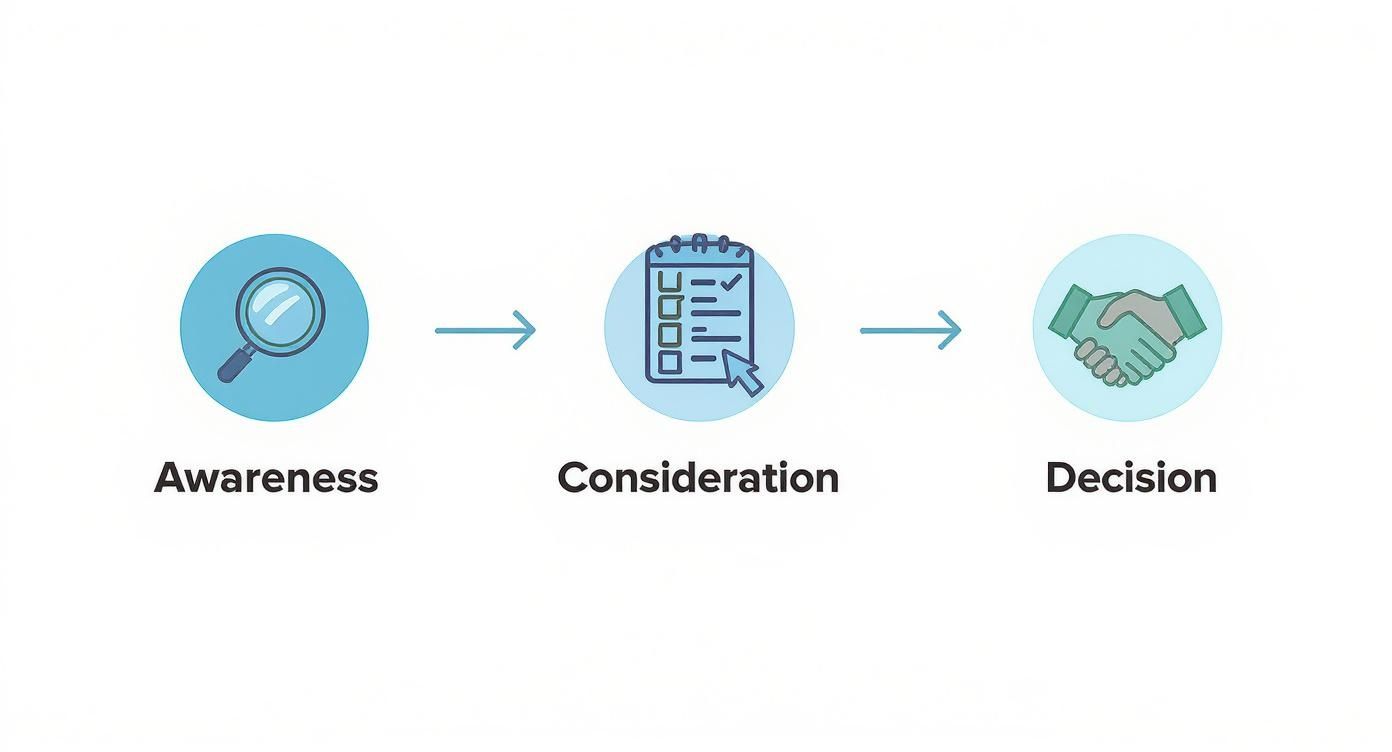
Think about the path a buyer takes—it's not a straight line. They move from being vaguely aware of a problem to actively considering solutions, and finally, making a decision.

A three-stage customer journey diagram with icons for Awareness (magnifying glass), Consideration (checklist), and Decision (handshake).

This journey underscores a critical point: your capture strategy needs to meet buyers where they are, offering the right thing at the right moment.

Designing Intelligent Forms and Landing Pages

Let's be honest, not all forms are created equal. Slapping the wrong one on a landing page is a surefire way to tank your conversion rates. The guiding principle is simple: the value of what you're offering must feel greater than the "cost" of filling out the form.

For a top-of-funnel asset—say, a quick checklist or an infographic—keep the barrier to entry almost nonexistent. Name and email. That's it. If you start asking for their phone number, company size, and job title right away, you’re creating friction for someone who's just kicking the tires.

This is where progressive profiling is a game-changer. When that same person comes back for a more substantial, middle-of-funnel piece like a detailed whitepaper or a case study, you can ask for a little more. Smart forms will recognize them and swap out the fields they've already filled in for new ones, letting you build a richer profile over time without being intrusive.

Form TypeBest ForTypical FieldsKey Benefit
Short-Stack FormTop-of-funnel assets (checklists, infographics)First Name, EmailMaximizes conversion volume by reducing friction.
Progressive ProfilingMid-funnel assets (webinars, case studies)Job Title, Company Size (on 2nd visit)Gathers deeper qualifying data without overwhelming new leads.
Long-Form / DemoBottom-of-funnel requests (demo, consultation)All relevant fields, including custom questionsCaptures high-intent leads with all necessary info for sales.

Setting Up a Practical Lead Scoring System

Okay, so the leads are coming in. Now what? You need a system to sift through them and separate the curious browsers from the people who are actually ready to talk to sales. That’s exactly what lead scoring is for. It's a method of assigning points to leads based on who they are and how they're interacting with you.

A solid scoring model ensures your sales team doesn't waste a single minute on unqualified leads and can pour all their energy into the opportunities most likely to close. It’s the critical bridge between marketing activity and sales results.

You can start by defining criteria that fall into two main buckets.

1. Firmographic and Demographic Data (Who They Are) This is all about how well a lead fits your Ideal Customer Profile (ICP). You assign points based on the explicit data they give you.

  • Job Title: A "VP of Marketing" might get +15 points, while a "Student" gets -10.
  • Company Size: If you target enterprise, a company with 1,000+ employees could be worth +20 points.
  • Industry: A lead from a target industry like "B2B SaaS" might get +10 points.

2. Behavioral Data (What They Do) This is where you track engagement to gauge their interest and intent. These actions signal they're actively researching a solution like yours.

  • High-Value Page Visits: Someone checking out your pricing page? That’s a strong signal. Give them +15 points.
  • Content Downloads: Downloading a "Decision Stage" case study is a big deal. That could be worth +20 points.
  • Email Engagement: If they’re consistently opening and clicking your emails, add +5 points for each action to reflect that interest.

Your lead scoring threshold—the magic number that turns a lead into a Marketing Qualified Lead (MQL) ready for sales—shouldn't be set in a vacuum. It needs to be a collaborative decision, the handshake agreement that gets marketing and sales perfectly aligned on what a "good" lead really looks like.

Building a model from scratch can feel complicated, but it's an essential part of an efficient inbound engine. If you're ready to go deeper, our playbook on AI-powered lead scoring offers a complete framework for building a predictive and highly effective system. When you combine firmographic fit with behavioral intent, you create a powerful machine that doesn’t just capture leads—it intelligently qualifies them to drive real revenue.

Turning Interest into Pipeline with Smart Nurture Sequences

Alright, so you’ve got a new lead in the system. Your content worked. But let’s be real for a second: 96% of the people who land on your website aren't ready to buy anything. Not even close.

This is the moment where your inbound lead gen machine shifts gears—from simply capturing a name and email to actually building a relationship. And smart automation is how you do this at scale without drowning your team in manual follow-ups.

The goal here isn't to blast them with sales pitches. It's about guiding them, giving them value, and building trust so that when they are ready to talk, they think of you first.

Desk flatlay with a smartphone, flowchart notebook, laptop, and a plant, illustrating 'AUTOMATED NURTURE'.

Different Leads Need Different Conversations

A generic, one-size-fits-all nurture sequence is a massive missed opportunity. The smartest thing you can do is match the follow-up to the action that triggered it. This simple shift is what makes your automation feel helpful instead of robotic.

Let’s look at two of the most common nurture campaigns you’ll build.

Campaign TypeWelcome SequenceTopic-Specific Drip
TriggerSomeone subscribes to your newsletter.Someone downloads a specific whitepaper (e.g., "AI in Marketing").
GoalIntroduce your brand, set expectations, build a foundation.Reinforce your expertise on that one topic and guide them deeper.
Content FocusYour "greatest hits" content, company story, what makes you unique.More on the original topic: case studies, related blogs, webinar invites.
Example Email #1"Welcome! Here’s What to Expect...""Your AI Whitepaper + 3 More Resources to Check Out"

See the difference? One is a handshake; the other is a direct follow-up to a conversation they already started.

How to Write Emails That Don't Get Ignored

Here’s the golden rule for nurturing: educate, don't sell. Your job in these early emails is to become a trusted advisor. If every message screams "Book a demo!", you're just training people to hit the delete button.

A few tips I’ve learned for writing emails that people actually open and read:

  • One Goal Per Email: Don't throw the kitchen sink at them. Don't cram five links and three CTAs into one email. Each message should have a single, clear purpose. Is it to share a case study? Invite them to a webinar? Stick to one thing.
  • Go Beyond [First Name]: Personalization is more than just a name merge. Use dynamic content in your marketing automation platform to reference the exact thing they downloaded or the industry they're in. It shows you're paying attention.
  • Write Like a Person: Ditch the corporate-speak. Use a conversational tone, ask questions, and make it feel like it came from a human, not an automation bot.

Your nurture emails should feel less like a marketing blast and more like a helpful colleague forwarding an article they know you'll find useful. That’s how you earn the right to eventually ask for their time.

A 5-Email Nurture Flow You Can Steal

Let’s make this real. Imagine someone just downloaded your "Ultimate Guide to B2B SEO." Here’s a simple, effective nurture sequence you can build out.

  1. Email 1 (Immediately): Deliver the Goods.

    • Subject: Here's your SEO Guide!
    • Content: Keep it simple. A quick thank you and a clear, can't-miss-it link to the guide. Nothing else. Just deliver on your promise, instantly.
  2. Email 2 (Day 2): Offer a Quick Win.

    • Subject: One quick SEO tip from the guide
    • Content: Pull out one super actionable tip from the guide and spell it out in the email. This adds value right away and encourages them to actually open that PDF.
  3. Email 3 (Day 4): Show, Don't Tell.

    • Subject: How [Client Name] grew organic leads by 45%
    • Content: A relevant case study is pure gold. It takes the ideas from the guide and makes them feel real and achievable for a company just like theirs.
  4. Email 4 (Day 7): Zoom Out a Little.

    • Subject: Is your content strategy ready for SEO?
    • Content: Connect their initial interest (SEO) to a related, bigger-picture challenge (content strategy). This starts to position you as a broader strategic partner. Link to a relevant blog post or webinar on the topic.
  5. Email 5 (Day 10): The Gentle Pivot (Soft CTA).

    • Subject: A simpler way to manage your SEO & content
    • Content: Now you can start to introduce your solution. Briefly explain how your product or service helps solve the challenges you've been talking about. Instead of a hard "Book a call" push, offer something lower commitment, like a short video demo or a free tool.

This isn't rocket science. It's a strategic flow that builds trust and qualifies interest over time, turning a cold download into a warm, sales-ready conversation. This is the engine that drives your whole inbound strategy.

Measuring and Optimizing Your Inbound Engine

An inbound strategy isn't a "set it and forget it" machine. The moment you stop measuring, you start losing ground. This is where you graduate from just doing marketing activities to running a predictable, data-driven system that proves its value to the business. It’s how a good strategy becomes a great one.

Your starting point has to be a dedicated marketing dashboard. This is your single source of truth, the place your entire team looks to understand what's working. We're not talking about tracking every vanity metric under the sun; we're focused on the handful of KPIs that draw a straight line from your marketing spend to actual revenue.

Core Funnel Conversion Metrics

To really get a feel for the health of your inbound engine, you have to watch how leads move through each stage. These three conversion rates are non-negotiable. They tell a powerful story about where your process is humming along and where it's breaking down.

  • Visitor-to-Lead Rate: How good are you at turning anonymous website traffic into actual contacts? A low number here is a red flag. It usually points to a mismatch between your content and your audience, or weak, uninspired calls-to-action.
  • Lead-to-MQL Rate: This tells you if you're attracting the right people. If this rate is tanking, your lead magnets might be great at pulling in a crowd, but it's the wrong crowd—one that doesn't fit your ideal customer profile.
  • MQL-to-SQL Rate: This is the ultimate test of your alignment with the sales team. A low conversion rate here screams that there's a disconnect. What marketing calls "qualified" and what sales considers "ready to talk" are two different things.

The numbers don’t lie. If your MQL-to-SQL rate is consistently below your target, it's time to pull a sales leader into a room and recalibrate your lead scoring model together. That alignment is the bedrock of an efficient pipeline.

Attribution and the Power of A/B Testing

Beyond just tracking the flow, you need to know which channels and content are actually pulling their weight. That's the whole point of marketing attribution. Is the company blog driving more qualified demos than your LinkedIn ad campaigns? Attribution models give you the data to answer these questions, so you can double down on what works and cut the dead weight.

This data-first mindset is absolutely critical, especially when you realize that more than 50% of marketers see lead generation as a top priority. With businesses pouring over 40% of their digital marketing budgets into this function, you have to be able to prove your ROI. You can explore more lead generation statistics and trends to see just how high the stakes are.

Once you have your baseline metrics locked in, the real fun begins: optimizing for incremental gains with A/B testing. This is all about making small, controlled changes to see what moves the needle. Don't try to test five things at once; you'll never know what actually worked. Focus on one variable at a time for clean, actionable results.

Element to TestExample A (Control)Example B (Variation)Potential Impact
Landing Page Headline"Our Industry-Leading Software""Cut Your Reporting Time by 50%"Conversion Rate
CTA Button Copy"Submit""Get Your Free Guide"Click-Through Rate
Email Subject Line"Company Newsletter - June""A quick question about your goals?"Open Rate

This constant cycle—measure, analyze, test, repeat—is what separates stagnant programs from high-growth inbound engines. Every test, win or lose, gives you a new insight that helps you build a smarter, more effective lead generation machine over time.

Free Tool

Try our AI Lead Generator — find verified LinkedIn leads for any company instantly. No signup required.

Got Questions About B2B Inbound? We've Got Answers.

Even if you’ve been running B2B marketing for years, inbound can feel like its own beast. Let's tackle a few of the questions I hear all the time from teams trying to get their inbound engine humming.

How Long Does This Inbound Thing Actually Take?

Look, if you need leads tomorrow, paid ads are your friend. But if you want a sustainable, compounding asset, you need to play the long game.

Expect it to take a solid six to nine months to see real, repeatable momentum from inbound. The first few months are all about laying the foundation—creating content, building topical authority, getting your SEO legs under you. Unlike outbound's sugar rush, inbound is about building trust and an audience that comes to you. It’s an investment that works for you 24/7 once it’s up and running.

MQL vs. SQL: Why the Jargon Matters

This one trips up a lot of teams and is a classic source of friction between sales and marketing. Getting it right is non-negotiable.

  • Marketing Qualified Lead (MQL): This is someone who fits your Ideal Customer Profile (ICP) and has shown interest. They downloaded your case study or signed up for a webinar. They’re a good fit, but they aren't ready for a sales call just yet.
  • Sales Qualified Lead (SQL): This is an MQL that the sales team has looked at, accepted, and agrees is ready for a direct conversation. They've crossed a threshold—defined by your lead scoring—that signals real buying intent.

The handoff from MQL to SQL isn't just a status change in your CRM; it's the most critical moment in your entire funnel.

"But Does Inbound Work for Our Super Niche Industry?"

Yes. In fact, it often works better.

When you're in a highly specialized B2B space, your goal isn’t to attract thousands of leads. It's to attract the right few dozen. Blasting a huge outbound list is a waste of time and money here.

Inbound lets you create incredibly specific content that speaks directly to the unique pains of that tiny, high-value market. You’re not shouting into a void; you’re whispering the exact right thing to the only people who need to hear it. This is how you become the go-to expert and pull in the deals that truly matter.


Ready to build an inbound engine that consistently delivers qualified leads? The marketbetter.ai platform gives you the tools to create high-performing content, automate nurture sequences, and measure your ROI with precision. See how it works at https://www.marketbetter.ai.

What Is Multivariate Testing A Practical Guide

· 23 min read

Multivariate testing (or MVT for short) is a powerful way to optimize a webpage by testing multiple changes across different elements all at the same time. Instead of running separate tests for each tiny change, you test them in combination to find the exact mix that delivers the best results.

Understanding Multivariate Testing in Plain English

A person points at a white wall next to a laptop displaying images, with 'MULTIVARIATE TESTING' text.

Think of it like tuning a high-performance engine. An A/B test is like swapping out the spark plugs to see if you get more power. It’s a simple, direct comparison: Part A vs. Part B. Good, but limited.

Multivariate testing is like having a full pit crew. You’re not just swapping one part; you’re simultaneously testing different fuel mixtures, tire pressures, and spoiler angles to find the absolute perfect combination for the fastest lap time.

MVT goes way beyond a simple "this vs. that" showdown. Its real magic is in showing you how different elements interact. You might discover your punchy new headline only works when it’s paired with a specific hero image—an insight a standard A/B test would never uncover.

The Core Idea and Historical Roots

While it feels like a modern marketing tactic, the fundamental concept is centuries old. The idea of testing multiple factors at once has been around for ages. One of the earliest examples comes from 1747, when Royal Navy surgeon James Lind tested different combinations of remedies to find a cure for scurvy. You can read more about MVT's history on AB Tasty's blog.

Today, MVT is the go-to tool for refining high-traffic pages without needing a total redesign. By making small, simultaneous tweaks to key elements, you can pinpoint the exact recipe that gets you the biggest wins.

Actionable Tip: Don't use MVT for a total page redesign. Use it to fine-tune an existing, high-performing page by testing the headline, CTA button, and hero image simultaneously to find the most powerful combination.

Testing Methods at a Glance

To really get what MVT is all about, it helps to see how it stacks up against other common testing methods. Each one has its place, and knowing when to use which is half the battle.

Here’s a quick rundown to help you choose the right tool for the job.

Testing MethodWhat It TestsBest ForTraffic Needs
A/B TestingA single element with one or more variations (e.g., Headline A vs. Headline B).Radical redesigns or testing one big, bold change to see which performs better.Low to Moderate
Multivariate TestingMultiple elements and their variations simultaneously to find the best combination.Fine-tuning high-traffic pages by optimizing the interaction between several elements.High
Split URL TestingTwo or more entirely different web pages hosted on separate URLs.Major overhauls, such as comparing a completely new landing page design against the original.Low to Moderate

Ultimately, your goal dictates the test. If you’re making a big, directional change and need a clear winner, A/B testing is your best bet. But if you want to scientifically squeeze every last drop of performance out of an already successful page, multivariate testing is the only way to go.

So, Which Test Should You Run? A/B or Multivariate?

Deciding between an A/B test and a multivariate test isn't just a technical detail—it's a strategic call. The right move depends entirely on what you're trying to achieve. Are you swinging for the fences with a bold new design, hoping for a massive win? Or are you meticulously polishing an already solid page, trying to squeeze out every last drop of performance?

Getting this choice right is the foundation of any good testing program.

Think of it this way: A/B testing is a duel. You pit your champion (the original page) against a single challenger (the new version) to see who comes out on top. It’s fast, the winner is obvious, and it's perfect for testing big, radical ideas.

Multivariate testing, on the other hand, is a team tournament. You're not just finding the best player; you're figuring out the dream team lineup. It analyzes how every player (headline, image, CTA) performs with every other teammate to find the single most powerful combination. It’s a slower, more data-hungry process, but the insights are incredibly deep.

When to Use A/B Testing: Go for Big Swings and Clear Answers

A/B testing really shines when you're testing significant, high-impact changes. It’s the tool you pull out when your hypothesis boils down to a single, pivotal question.

You should absolutely opt for an A/B test for things like:

  • Complete Redesigns: You’ve built a brand-new landing page from scratch and want to know if it crushes the old one.
  • Validating a New Offer: You're testing a fundamental shift in your value proposition or core messaging.
  • Major User Flow Changes: You want to pit two completely different checkout processes or signup funnels against each other.

Because A/B tests are just comparing a couple of distinct versions, they don't need a ton of traffic to get a clear, statistically significant result. That means you get answers fast. If you're new to this, it's worth understanding how to conduct A/B testing before diving into more complex experiments.

When to Use Multivariate Testing: For Incremental Gains and Deep Insights

Multivariate testing (MVT) is your go-to for optimization, not revolution. You use it on pages that are already performing pretty well but you know have more potential. MVT is all about fine-tuning the experience by finding the perfect recipe of smaller elements.

Consider firing up a multivariate test when you want to:

  • Refine a High-Traffic Page: Like your homepage, where you want to test the headline, hero image, and CTA button text all at once.
  • Improve a Key Landing Page: Testing different form field labels, button colors, and social proof elements to nudge lead generation higher.
  • Optimize Product Pages: Experimenting with product descriptions, image styles, and trust badges to get more people hitting "add to cart."

The real magic of MVT is its ability to uncover interaction effects—how changing your headline might suddenly make a different CTA button more effective. This is an insight A/B testing simply can’t give you, helping you build a much deeper, almost intuitive, understanding of what your audience really wants.

A/B Testing vs Multivariate Testing: Choosing Your Approach

To make this crystal clear, let's break down the strategic differences. Choosing the right method is about matching the tool to your goals, traffic, and the specific questions you need answered. Getting it wrong just leads to muddy results and wasted clicks.

This table should help you decide which approach fits your immediate needs.

AttributeA/B TestingMultivariate Testing (MVT)
Primary GoalFind a clear "winner" between two or more completely different versions.Identify the best combination of elements and see how they influence each other.
Best Use CaseRadical redesigns, testing a single big change, validating a bold new concept.Fine-tuning high-performing pages by testing multiple small changes simultaneously.
ComplexityLow. Simple to set up and the results are easy to read.High. Requires more careful planning, a more complex setup, and deeper analysis.
Traffic NeedsLow to moderate. You can get a statistically significant winner with less traffic.High. You need a lot of traffic to properly test every possible combination.
Speed to ResultsFast. You can often get a clear answer in a much shorter timeframe.Slow. Tests have to run longer to gather enough data across all the variations.

Ultimately, A/B and multivariate tests aren't rivals. They're complementary tools in your optimization arsenal.

Think of it this way: Use A/B testing to find the right forest. Then, use multivariate testing to find the perfect path through it.

How to Design a Powerful Multivariate Test

Alright, let's get our hands dirty. Moving from knowing what a multivariate test is to actually building one is where the real work begins. Designing a powerful test isn't about throwing spaghetti at the wall to see what sticks; it’s a disciplined process that starts way before you hit "launch."

The whole thing lives or dies by one single element: your hypothesis. A weak, fuzzy hypothesis gives you muddy, useless results. A sharp one is your North Star, guiding every single decision from here on out.

Start with a Strong, Measurable Hypothesis

Before you touch a single pixel on the page, you have to be crystal clear about what you think will happen and, more importantly, why. A real hypothesis isn't a vague question like, "Will a new headline work better?" That's not a plan; that's a wish.

Instead, your hypothesis needs to be a predictive statement connecting a specific change to a measurable outcome. It needs teeth.

Actionable Example: "By changing the CTA button text from 'Sign Up' to 'Get Started Free' and replacing the stock hero image with a customer testimonial video, we will increase trial sign-ups by 15% because the new combination will build more trust and create a lower-commitment entry point."

See the difference? It's specific. It's measurable (a 15% lift). And it gives you the "why." This structure forces you to think through the user psychology you're trying to influence. Even if the test fails to lift conversions, you still learn something valuable about your audience's motivations.

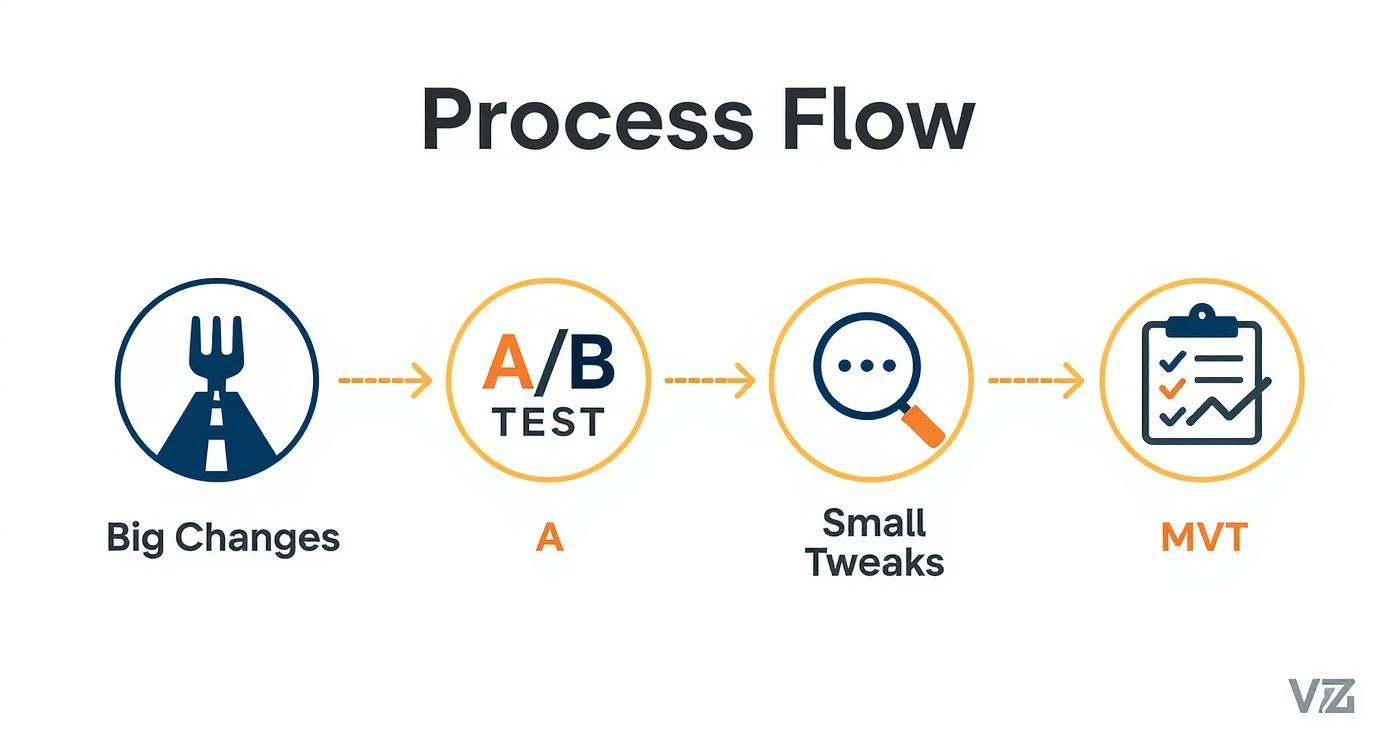
This visual gives you a simple gut-check on which testing path makes the most sense.

Process flow illustrating different testing methodologies: Big Changes, A/B Test, Small Tweaks, and MVT.

As you can see, if you're making a big, bold change to a page, an A/B test is your best friend. But when you’re ready to fine-tune the winning formula by testing smaller, interacting elements, MVT is the tool for the job.

Select High-Impact Variables and Variations

Hypothesis locked in? Good. Now you need to pick which page elements—the variables—you're actually going to test. The trick here is to resist the temptation to test everything. Focus your firepower on the components that are most likely to move the needle on your primary goal.

Common variables with real leverage include:

  • Headline and Subheadings: This is your value proposition in a nutshell. Get it wrong, and nothing else matters.
  • Hero Image or Video: It’s the first thing people see. It sets the emotional tone instantly.
  • Call-to-Action (CTA) Button: The words, the color, the placement—it can all dramatically change click-through rates.
  • Social Proof Elements: Things like testimonials, customer logos, or review scores are all about building trust and credibility.

For each variable you pick, you'll create different versions, or variations. For your headline, maybe you test a benefit-focused variation against a question-based one. For a CTA button, it could be "Get Started" vs. "Request a Demo." You're looking for meaningful differences that truly test your assumptions.

This is also a great place to bring in what you know about your audience. By understanding customer segmentation strategies, you can craft variations designed to resonate with the specific needs or mindsets of different user groups.

Understand Traffic and Time Commitments

Finally, a reality check. MVT is a powerful tool, but it's a hungry one. Because it has to test every single combination of your variations, it chews through a lot of traffic to get a clean result.

Think about it: a test with two variables that each have two variations creates four unique combinations. Now add a third variable with two variations of its own, and you've suddenly jumped to eight combinations. The math gets big, fast.

Before you go live, use a sample size calculator. Get a realistic estimate of the traffic you'll need and how long the test will have to run to reach statistical significance. If your page isn't getting thousands of conversions a month, MVT might not be the right move. A series of clean, focused A/B tests would likely serve you better. Setting these expectations upfront keeps you from pulling the plug too early and making bad decisions on shaky data.

Running and Analyzing Your Test for Actionable Insights

Launching your multivariate test is a great feeling, but it’s just the starting line. The real money is made in what comes next: carefully watching the experiment unfold and, more importantly, making sense of the data it spits out. This is where you turn raw numbers into powerful, lasting lessons about what actually gets your audience to act.

Success here isn’t about finding one “perfect” combination and calling it a day. It’s about understanding the specific influence of each headline, button, and image you tested. That’s the kind of granular insight that pays dividends across all your marketing, turning a single test into a wellspring of strategic intelligence.

Monitoring Your Campaign and Key Metrics

Once your test is live, the first rule is to have some patience. It’s so tempting to check the results every five minutes, but early data is a notorious liar. One variation might shoot out to an early lead purely by chance, only to fizzle out as more traffic comes in. You have to let the test run long enough to get a reliable signal from the noise.

And don't just stare at your main conversion goal, like sales or sign-ups. You need to track secondary metrics to get the full story of what users are really doing. These often reveal subtle but critical interaction effects.

  • Bounce Rate: Did that killer new headline grab attention but fail to deliver, causing people to hit the back button immediately?
  • Time on Page: Are users sticking around longer with a certain image and description pairing, even if they aren't converting right away? That's a sign of engagement.
  • Click-Through Rate on Secondary CTAs: Is one version of your main button so effective that it’s stealing clicks from other important links on the page?

Tracking these data points helps you build a much richer story. It’s the difference between knowing what worked and truly understanding why it worked.

Demystifying Statistical Significance

As the numbers roll in, you’re looking for one thing above all else: statistical significance. Put simply, this is a measure of confidence. When a result is statistically significant—usually at a 95% confidence level or higher—it means you can be pretty sure the outcome wasn't just a random fluke.

Think of it like a clinical trial. You wouldn't trust a new drug if only three out of five patients got better. You'd want to see consistent results across a huge group to be confident it actually works. Statistical significance is the mathematical proof for your marketing experiments.

Getting to that level of confidence takes time and traffic. In fact, many analytics providers find that to run a successful MVT campaign, you often need at least 10,000 visitors a month, with tests running for several weeks. It requires patience, but the payoff can be a 20-30% lift in conversions—far beyond what simpler tests typically achieve. You can dig into more multivariate testing benchmarks at AB Tasty.

Interpreting Data and Finding Actionable Insights

Once your test hits statistical significance, it’s analysis time. Your testing tool will show you which combinations won, but the real gold is in isolating the impact of individual elements. You might discover that one headline consistently crushed it, no matter which image it was paired with. That’s a huge win! It’s a portable insight you can now apply to other landing pages, email subject lines, and ad copy.

This is also where more advanced tools can help you spot patterns that aren't immediately obvious. Using predictive analytics in marketing, for instance, can help forecast the long-term impact of a winning combination across different customer segments.

Ultimately, the goal is to find concrete actions on how to improve website conversion rates across the board. Don't just anoint the winner and move on. Force yourself to answer these questions:

  1. What did we learn about our customers? Did they respond better to emotional language or to hard data?
  2. Which single element had the biggest impact? This tells you exactly where to focus your optimization efforts next.
  3. Were there any results that completely surprised us? Often, the tests that demolish our assumptions are the most valuable ones.

By asking these questions, you build a powerful feedback loop. Every test—whether it’s a runaway success or a total flop—becomes a valuable step toward mastering your marketing.

Real-World Examples of MVT Driving Growth

A desk with business documents, charts, a laptop, a pen, and a coffee cup, featuring 'MVT Case Studies'.

This is where the rubber meets the road. All the theory in the world doesn't mean much until you see how companies are actually using MVT to make smarter decisions and, frankly, make more money.

Multivariate testing isn't some abstract academic exercise. It’s a battle-tested tool that top teams use to uncover surprising truths about their customers. Let's look at a few examples of MVT in the wild.

How a SaaS Company Fixed Its Pricing Page

A B2B SaaS company had a classic "good problem" that was driving them crazy. Their pricing page was pulling in solid traffic, but the demo request form at the end felt like a brick wall. Conversions were totally flat.

Instead of throwing the whole page out and starting over—a classic A/B test move—they decided to get surgical with an MVT approach. They had a hunch that the problem wasn't one big thing, but a few small things working against each other.

Here’s what they decided to test simultaneously:

  • Variable 1 (The Plan Names):
    • Variation A: Standard stuff like "Basic," "Pro," and "Enterprise."
    • Variation B: More aspirational names like "Starter," "Growth," and "Scale."
  • Variable 2 (The Feature Bullets):
    • Variation A: A dry list of technical features.
    • Variation B: Benefit-focused bullets (e.g., "Save 10 hours per week").
  • Variable 3 (The CTA Button):
    • Variation A: The old standby, "Request a Demo."
    • Variation B: A lower-pressure option, "See it in Action."

The winning combo was a genuine surprise. "Growth" as the plan name, paired with the benefit-focused feature list and the "See it in Action" CTA, delivered a 22% lift in qualified demo requests.

The real gold was in the why. The "Growth" plan name subconsciously primed visitors to think about outcomes, which made the benefit-oriented descriptions hit that much harder. It was a masterclass in how aligning every little element around a single psychological message can create a huge impact.

Cracking the "Add to Cart" Code for an E-commerce Brand

An online apparel store was struggling with a key funnel metric: the add-to-cart rate. Shoppers were looking, but they weren't committing. The team suspected a combination of weak visuals, unclear urgency, and shipping anxiety was causing the hesitation. MVT was the perfect tool to untangle it all.

Their hypothesis was that showing the product in a real-world context, making the discount obvious, and removing shipping cost fears would be the one-two-three punch they needed.

They set up a test with these moving parts:

  • Variable 1 (Product Photos):
    • Variation A: Clean, product-on-white-background shots.
    • Variation B: Lifestyle photos showing models wearing the apparel.
  • Variable 2 (The Discount):
    • Variation A: Simple "25% Off" text.
    • Variation B: A "slash-through" price showing both the original and sale price.
  • Variable 3 (Shipping Info):
    • Variation A: Tucked away in fine print below the button.
    • Variation B: A big, can't-miss-it banner: "Free Shipping On Orders Over $50."

The results were immediate and massive. The combination of lifestyle photos, the slash-through price, and the prominent shipping banner boosted add-to-cart actions by a whopping 31%.

This is the kind of insight that goes way beyond a single page. These findings can inform all sorts of marketing personalization strategies, because now they know exactly which visual and value cues their audience responds to.

The big takeaway? While each change had a small positive effect on its own, their combined power was explosive. The lifestyle shots created desire, the price comparison proved the value, and the shipping banner erased the last bit of friction. It was a perfect storm of persuasion, discovered only through MVT.

Common MVT Mistakes and How to Avoid Them

Even the sharpest marketers can see a multivariate test go completely sideways. You end up with junk data that points you in the wrong direction, and that's worse than having no data at all. Think of this as your pre-flight checklist—the stuff you absolutely have to get right before launching.

The single most common mistake? Testing too many elements with too little traffic. It’s tempting, I get it. You want to test five headlines, four images, and three CTAs all at once. But that creates a ridiculous number of combinations, and your traffic gets spread so thin that no single version can prove its worth in a reasonable timeframe. You'll be waiting forever for a statistically significant result.

The fix is to be ruthless. Prioritize. Focus on just 2-3 high-impact elements at a time. This keeps the number of combinations under control and gives each one a fighting chance to get enough data to be reliable.

Letting Impatience Drive Decisions

Here's another classic blunder: calling a test too early. You see one combination shoot out to an early lead after a couple of days and the urge to declare a winner is almost overwhelming. Don't do it. Early results are often just statistical noise, not a true reflection of user preference.

You absolutely have to let the test run its course until you hit a statistical significance level of at least 95%. Just as important, let it run for a full business cycle—at least one full week, ideally two. This smooths out the weird fluctuations you see between weekday and weekend user behavior.

A test stopped prematurely is worse than no test at all. It gives you false confidence in a conclusion that is likely based on random chance, not genuine user insight.

The Right Way vs. The Wrong Way

Let's make this concrete. Seeing the difference between a sloppy test and a disciplined one is the key to getting answers you can actually trust.

The Common MistakeThe Actionable Solution
Spreading Traffic Too Thin: Testing 5 variables with 3 variations each (243 combinations).Focusing on Impact: Testing 3 high-impact variables with 2 variations each (8 combinations).
"Peeking" and Ending Early: Stopping the test after 3 days because one variation is ahead by 10%.Exercising Patience: Running the test for 2 full weeks until it reaches a 95% confidence level.
Ignoring External Factors: Not considering a concurrent social media campaign driving unusual traffic.Maintaining a Clean Environment: Pausing other major campaigns or segmenting traffic to isolate the test's impact.

Finally, a critical error people overlook is failing to account for outside noise. Did a massive email blast or a viral social post go live in the middle of your test? Events like that can flood your page with a totally different kind of visitor, polluting your data and making the results meaningless.

The best practice here is to create a controlled environment. If you can, avoid launching other big marketing initiatives that might contaminate your test traffic. If that's not possible, you'll need to use advanced segmentation to isolate and exclude that traffic from your results. This discipline is what makes sure the insights you get from understanding what is multivariate testing are clean, reliable, and genuinely actionable.

Free Tool

Try our Marketing Plan Generator — generate a complete AI-powered marketing plan in minutes. No signup required.

Your Multivariate Testing Questions, Answered

Alright, you've got the theory down. But when the rubber meets the road, real-world questions always pop up. Let's tackle the most common ones marketers ask right before they hit "launch."

Seriously, How Much Traffic Do I Need?

There’s no magic number, but the honest answer is: a lot more than you'd need for a simple A/B test. The traffic requirement is tied directly to your current conversion rate and, crucially, the number of combinations you’re testing.

Every new element you add to the mix multiplies the number of variations, slicing your audience into smaller and smaller groups. Each one needs enough data to be statistically sound.

Actionable Takeaway: Pages that see thousands of conversions per month are prime candidates for MVT. If your page gets less traffic, stick to a series of focused A/B tests. You'll get clearer answers much faster without spreading your traffic too thin.

Before you even think about building the test, plug your numbers into a sample size calculator. It's the best way to avoid running a test that was doomed from the start.

How Long Should a Test Run?

Patience is key here. Your test needs to run long enough to hit statistical significance (the industry standard is a 95% confidence level) and to cover a full business cycle. A bare minimum is one to two full weeks.

Why? Because this duration smooths out the weird dips and spikes you see on weekends versus weekdays. It also accounts for traffic from a weekly newsletter or a short-lived promotion that could throw off your results. Never, ever stop a test early just because one version is rocketing ahead. Early leads are often just random noise.

Can I Test More Than Three or Four Elements at Once?

You can, but it's rarely a good idea. Modern tools can handle the complexity, but your traffic probably can't. Every element you add exponentially increases the number of combinations, spreading your traffic dangerously thin.

Just look at the math:

  • 3 Elements, 2 Variations Each: 2 x 2 x 2 = 8 combinations
  • 4 Elements, 2 Variations Each: 2 x 2 x 2 x 2 = 16 combinations
  • 5 Elements, 2 Variations Each: 2 x 2 x 2 x 2 x 2 = 32 combinations

For most businesses, the sweet spot is testing 2-4 high-impact elements. This gives you rich, actionable data on how your most important page components work together, without demanding an impossible amount of traffic to get a reliable answer.


Ready to stop guessing and start winning? The marketbetter.ai platform uses AI to automate this entire process, analyzing countless combinations to find the precise formula that drives real growth. See how our AI-powered marketing platform can transform your campaigns at https://www.marketbetter.ai.
12 Best AI Tools for B2B Marketing to Scale Growth in 2026

· 35 min read

In today's B2B landscape, staying competitive means moving faster, personalizing at scale, and proving ROI with data-driven precision. Manual processes and siloed tools just can't keep up with the demands of complex buying cycles. The solution? Artificial intelligence. AI is fundamentally changing how marketers identify target accounts, create compelling content, and engage buyers across the entire customer journey. But with a crowded market, how do you choose the right AI tools for B2B marketing to build a modern, effective tech stack?

This guide cuts through the noise. We provide an in-depth, comparative analysis of the 12 best platforms designed to solve core B2B challenges, from account-based marketing (ABM) execution to sales intelligence and campaign optimization. For B2B teams, the right AI can be the difference between hitting a quota and falling short, especially when integrated into a well-defined sales process. Understanding the fundamentals of outreach remains critical; for a deeper dive on this, A Modern Outbound Lead Generation Playbook provides a solid framework for structuring these efforts.

This resource is designed to be actionable. Instead of generic marketing copy, you'll find a detailed breakdown of each tool, covering:

  • Primary use cases and ideal buyer personas.
  • Key features, honest pros and cons, and pricing tiers.
  • Actionable advice and comparisons to help you decide.

We'll help you navigate platforms like HubSpot, 6sense, and marketbetter.ai to select, pilot, and scale the technology that will drive measurable pipeline growth for your business this year.

1. marketbetter.ai

Best for: All-in-one revenue generation and pipeline acceleration.

marketbetter.ai positions itself not just as another tool, but as a comprehensive AI-native revenue engine designed to replace fragmented martech stacks. It’s a standout choice among ai tools for b2b marketing because it unifies intent data, AI-driven content generation, and multi-channel campaign automation into a single, cohesive platform. This integrated approach directly addresses a major pain point for B2B teams: managing multiple point solutions like Clay, Apollo, and n8n, which often leads to data silos and workflow inefficiencies. By consolidating these functions, it provides a single source of truth for go-to-market execution.

marketbetter.ai platform interface showing analytics and campaign performance

The platform automates the entire top-of-funnel process, from identifying anonymous website visitors and enriching account data to triggering personalized, multi-channel outreach sequences across email, LinkedIn, and even automated voice calls. Its AI continuously optimizes campaigns based on real-time analytics, ensuring that marketing efforts are always directed toward the highest-potential accounts.

Key Features and Differentiators

  • Unified Revenue Engine: Combines intent data, account enrichment, AI personalization, and automated multi-channel sequences in one place. This holistic system replaces the need for separate tools for data, sequencing, and analytics.
  • AI Content & Personalization: Generates hyper-personalized outreach content at scale, moving beyond simple mail-merge fields to create relevant messaging based on account fit, intent signals, and buyer personas.
  • AI Voice Assistant: A unique feature that automates lead qualification and meeting booking over the phone, freeing up sales development representatives (SDRs) to focus on high-value conversations.
  • Rapid Time-to-Value: Offers pre-built playbooks and no-cost, turnkey integrations with major CRMs (Salesforce, HubSpot) and collaboration tools (Slack, Teams), enabling teams to get started in minutes.

Actionable Use Case

A mid-market demand generation manager can use marketbetter.ai to instantly identify high-intent accounts visiting their pricing page. The platform automatically enriches these accounts with firmographic and contact data, scores their fit against the ideal customer profile, and triggers a personalized, multi-channel sequence. An AI-generated email is sent, followed by an automated LinkedIn connection request and a call from the AI voice assistant to qualify interest and book a demo, with every touchpoint logged back to Salesforce.

Pros and Cons

ProsCons
Consolidated Platform: Replaces multiple point tools, reducing martech bloat and providing a single source of truth.Opaque Pricing: No public pricing is available; tailored for mid-market and enterprise budgets, likely excluding smaller startups.
Proven ROI: Strong customer proof points report significant lifts in SQLs, booked meetings, and overall campaign ROI.Requires Change Management: Implementation involves replacing existing workflows and tools, which requires team buy-in.
Deep Automation: Automates up to 80% of outreach tasks, including AI voice calls, freeing up significant team resources.Compliance Considerations: Relies on IP tracking and automation, necessitating a thorough review of privacy and compliance policies.
Enterprise-Ready: Features enterprise-grade security, compliance controls, and strong customer validation (4.97 G2 rating).

Website: https://www.marketbetter.ai

2. HubSpot Marketing Hub

Best for: SMB and mid-market teams seeking a unified CRM and marketing automation platform.

HubSpot Marketing Hub has evolved from a popular inbound marketing tool into a comprehensive platform where AI is deeply embedded across the entire marketing and sales funnel. Unlike standalone AI content generators, HubSpot integrates its AI features directly with its native CRM, allowing B2B teams to create, automate, and analyze campaigns within a single, unified system. This makes it one of the most practical AI tools for B2B marketing for teams seeking an all-in-one solution.

HubSpot Marketing Hub

The platform's AI assists in everything from generating blog post ideas and drafting email copy to optimizing send times and predicting audience segments likely to convert. For B2B marketers, this means less time switching between tools and more time focusing on strategy, as the AI handles repetitive tasks while leveraging customer data for smarter decision-making.

Key Features and Use Cases

  • AI Content Assistant: Draft blog posts, social media updates, and marketing emails directly within the editor. It's particularly useful for overcoming writer's block and generating first drafts that are already SEO-optimized.
  • Predictive Lead Scoring: Automatically identifies and prioritizes high-quality leads based on behavioral data, helping sales teams focus their efforts where it matters most.
  • AI-Powered Reporting: Build custom reports and dashboards by simply asking questions in natural language, uncovering insights without needing to be a data analyst.
  • Smart Automation: The platform's AI optimizes marketing automation workflows by suggesting logical next steps and identifying engagement patterns. If you're looking to dive deeper, you can learn more about AI's role in marketing automation.

How it Compares & Actionable Advice

Compared to Salesforce (Pardot): HubSpot is generally considered more user-friendly and faster to implement, making it a better choice for teams without dedicated Salesforce administrators. Its all-in-one model with a native CRM contrasts with Pardot's reliance on a separate Sales Cloud instance.

Actionable Advice: If your team prioritizes ease of use and needs a single system for both marketing automation and CRM, HubSpot is your top contender. Start with the free tools to understand the ecosystem, and leverage HubSpot Academy's free courses to train your team before upgrading to a paid tier.

ProCon
All-in-one platform with native CRMContact-based pricing can become expensive
Strong educational resources (HubSpot Academy)Advanced AI features are locked in higher tiers
Excellent for teams needing quick time-to-valueLess customizable than some enterprise competitors

Official Website: https://www.hubspot.com/products/marketing/professional

3. Salesforce Marketing Cloud Account Engagement (formerly Pardot)

Best for: Salesforce-centric organizations needing deep marketing and sales alignment.

Salesforce Marketing Cloud Account Engagement, widely known by its former name Pardot, is a B2B marketing automation powerhouse deeply embedded within the Salesforce ecosystem. Its core strength lies in leveraging Einstein AI to bridge the gap between marketing activities and sales outcomes. Unlike more content-focused AI platforms, Pardot excels at using AI to analyze prospect behavior, predict sales readiness, and provide actionable insights directly within the CRM, making it one of the most effective AI tools for B2B marketing for revenue-focused teams.

Salesforce Marketing Cloud Account Engagement (formerly Pardot)

This tight CRM alignment means that every AI-driven insight is immediately actionable for the sales team. The platform moves beyond simple lead generation to focus on pipeline acceleration and proving marketing's contribution to revenue, a critical function for B2B organizations needing to justify their marketing spend. For companies already standardized on Salesforce, adopting Pardot is a natural extension that enriches their existing data with predictive intelligence.

Key Features and Use Cases

  • Einstein Behavior Scoring: Moves beyond traditional scoring by using AI to analyze engagement patterns and identify which prospects are most likely to convert. This allows sales teams to prioritize their outreach with precision.
  • Einstein Campaign Insights: Automatically monitors campaign performance and alerts marketers to significant trends or anomalies, such as an email performing better with a specific audience segment.
  • B2B Marketing Analytics: Provides sophisticated, AI-enhanced dashboards that connect marketing efforts directly to sales pipeline and revenue, enabling true ROI attribution.
  • Native Salesforce Integration: Ensures all data is unified between marketing and sales, eliminating data silos and creating a single source of truth for every customer interaction.

How it Compares & Actionable Advice

Compared to Marketo: Pardot offers tighter, more native integration with Salesforce Sales Cloud, making it the default choice for teams deeply invested in that ecosystem. Marketo provides greater flexibility to integrate with other CRMs and is often seen as more configurable for complex, non-linear nurture campaigns.

Actionable Advice: If "what's in Salesforce" is the ultimate source of truth for your business, Pardot is the most logical choice. Before purchasing, conduct an audit of your Salesforce data quality. Pardot's AI (Einstein) is only as good as the data it analyzes; clean data is a prerequisite for success.

ProCon
Seamless Salesforce CRM alignmentEntry price is higher than many SMB tools
Mature analytics for revenue attributionRequires Salesforce proficiency for best results
Strong governance for complex organizationsAI features are tied to specific, higher-cost editions

Official Website: https://www.salesforce.com/products/marketing-cloud/pricing/b2b-marketing-automation/

4. Adobe Marketo Engage

Best for: Enterprise B2B teams with complex, multi-channel buyer journeys.

Adobe Marketo Engage is an enterprise-grade marketing automation platform designed for complex, long-cycle B2B sales processes. While known for its robust lead management and nurturing capabilities, its AI features, particularly in the Prime tier, elevate it into a powerful tool for large-scale personalization and journey optimization. Unlike platforms built around a central CRM, Marketo focuses on deep marketing automation that integrates with various CRMs, making it a highly configurable hub for sophisticated demand generation teams.

Adobe Marketo Engage

For organizations managing intricate buyer journeys across multiple segments, Marketo's AI provides predictive insights to streamline campaign strategy. It analyzes engagement data to forecast the best content for specific audience segments, moving beyond simple rule-based automation. This makes it one of the more advanced AI tools for B2B marketing for enterprises needing precise control and governance over their marketing programs.

Key Features and Use Cases

  • Predictive Audiences: Utilizes AI to analyze behavioral and firmographic data to automatically identify and build high-potential audience segments for targeted campaigns.
  • AI-Driven Personalization: Powers dynamic content and offers on websites and in emails, ensuring that each prospect receives the most relevant messaging based on their real-time behavior and predictive profile.
  • Intelligent Journey Analytics: Moves beyond standard reporting by using AI to analyze customer journey maps, identifying bottlenecks and opportunities for optimization to accelerate the sales funnel.
  • Account-Based Marketing (ABM) Automation: Combines lead and account-level data to orchestrate complex, multi-touch ABM campaigns, with AI helping to prioritize the most engaged accounts.

How it Compares & Actionable Advice

Compared to HubSpot: Marketo is a more powerful and customizable platform but comes with a significantly steeper learning curve and higher cost. It's built for large marketing operations teams that require granular control over every aspect of their campaigns, whereas HubSpot is designed for broader ease of use.

Actionable Advice: Choose Marketo if you have a dedicated marketing operations team and a need for highly sophisticated, multi-touch nurture programs that span months or even years. To justify the investment, map out your most complex customer journey and use it as a benchmark during the demo process to see if Marketo can truly automate and optimize it.

ProCon
Highly configurable for sophisticated nurture programsPricing is sales-driven and can be significant
Strong ecosystem and enterprise-grade governanceSteeper learning curve than SMB-focused tools
Deep APIs for complex integrationsAI features are primarily in premium add-on packages

Official Website: https://business.adobe.com/products/marketo/value-add-ons

5. 6sense Revenue AI

Best for: Mature B2B teams executing a sophisticated account-based marketing (ABM) strategy.

6sense Revenue AI positions itself as a central nervous system for B2B go-to-market teams, moving beyond simple analytics to proactively identify and engage in-market accounts. Unlike many tools that focus on a single marketing function, 6sense uses AI to unify marketing and sales efforts around a critical metric: revenue. This platform excels at uncovering the "dark funnel" of anonymous buyer research, making it one of the most powerful AI tools for B2B marketing for companies pursuing a sophisticated account-based marketing (ABM) strategy.

6sense Revenue AI

The platform's core strength lies in its ability to predict which accounts are ready to buy, often before they ever fill out a form. For B2B marketers, this means shifting from a reactive, lead-based approach to a proactive, account-centric model. Instead of waiting for hand-raisers, teams can use 6sense's intent data to orchestrate timely, relevant outreach across multiple channels, from targeted ads to personalized emails.

Key Features and Use Cases

  • Predictive Intent and Account Discovery: The AI analyzes billions of data points to identify accounts actively researching solutions like yours. This allows teams to prioritize outreach and tailor messaging based on an account's specific stage in the buying journey.
  • AI Email Agents & Conversational Outreach: 6sense can deploy AI agents to handle initial email conversations, qualify interest, and schedule meetings, freeing up sales development representatives to focus on high-value interactions.
  • LinkedIn Ad Campaign Management: Directly activate and manage targeted LinkedIn ad campaigns based on 6sense's real-time intent data, ensuring ad spend is focused exclusively on accounts that are in-market.
  • Broad Ecosystem Integrations: The platform connects seamlessly with major CRM and MAP systems like Salesforce, HubSpot, and Marketo, making it a powerful layer of intelligence on top of your existing tech stack. For those interested in the mechanisms behind this, you can explore the role of predictive analytics in marketing.

How it Compares & Actionable Advice

Compared to Demandbase: Both are leaders in the ABM space. 6sense is often praised for the accuracy of its predictive analytics and its focus on uncovering anonymous intent signals. Demandbase offers a more integrated B2B advertising DSP (Demand-Side Platform), giving teams more direct control over their ad campaigns within the platform.

Actionable Advice: If your biggest challenge is identifying in-market accounts before they contact you, 6sense is a top contender. To build a business case, ask your sales team for their top 10 dream accounts, then ask the 6sense team to show you the intent signals for those specific accounts during a demo. This makes the value proposition tangible.

ProCon
Strong ABM results reported by usersNo public pricing; enterprise-oriented sales motion
Clear focus on agentic AI to improve GTM efficiencyRequires solid data foundations for best performance
Broad integrations with existing martech stacksCan have a steep learning curve for new users

Official Website: https://6sense.com/solutions/

6. Demandbase One

Best for: Enterprise GTM teams wanting an integrated ABM and advertising platform.

Demandbase One is a comprehensive B2B go-to-market platform built around account-based marketing (ABM) and powered by deep AI-driven account intelligence. Unlike tools focused solely on content or lead generation, Demandbase provides a unified view of target accounts, identifying buying signals across the web and orchestrating actions across sales and marketing channels. This makes it one of the most powerful AI tools for B2B marketing for mature organizations executing sophisticated ABM strategies.

Demandbase One

The platform's AI moves beyond simple lead scoring to map entire buying groups within target companies, tracking intent and engagement signals to pinpoint exactly when an account is ready to buy. For B2B teams, this means shifting from a broad, high-volume approach to a highly targeted, efficient strategy that aligns sales and marketing efforts on the accounts most likely to close.

Key Features and Use Cases

  • AI-Powered Account Intelligence: Identifies in-market accounts by analyzing third-party intent data, website engagement, and CRM activity. It helps marketers discover net-new opportunities and prioritize existing ones.
  • AI-Optimized Advertising: The platform’s B2B-native Demand-Side Platform (DSP) uses AI to target specific buying groups within accounts, optimizing ad spend to reach decision-makers, not just anyone at a target company.
  • Cross-Channel Orchestration: Triggers automated, personalized actions across advertising, sales outreach, and website experiences based on real-time account behavior, ensuring a consistent message.
  • Buying Group & Journey Mapping: AI automatically identifies key personas within a target account and maps their journey, giving sales and marketing teams a clear view of who to engage and when.

How it Compares & Actionable Advice

Compared to 6sense: Demandbase's key differentiator is its tightly integrated, B2B-focused DSP, providing a single platform for both identifying intent and activating advertising campaigns. Teams that want to manage their programmatic advertising in the same place they manage their account intelligence may prefer Demandbase.

Actionable Advice: If a significant portion of your marketing budget is dedicated to display advertising, Demandbase should be on your shortlist. During your evaluation, prepare a list of your top 20 target accounts and ask the vendor to demonstrate how their platform would build an audience and launch an ad campaign targeting the buying committee within those companies.

ProCon
Full-funnel ABM platform with integrated B2B DSPCustom pricing and discovery process required
Explainable AI with configurable scoring modelsBest suited for teams with existing ABM maturity
Strong native integrations with Salesforce and HubSpotCan be complex to implement without dedicated resources

Official Website: https://www.demandbase.com/products/

7. ZoomInfo MarketingOS

Best for: Teams needing a premium data foundation to fuel their ABM and sales campaigns.

ZoomInfo MarketingOS positions itself as an activation layer built directly on top of its industry-leading B2B data foundation. Unlike platforms that require separate data procurement and activation tools, ZoomInfo combines AI-powered audience building, advertising, and website personalization into a cohesive system. This makes it one of the most powerful AI tools for B2B marketing for teams focused on account-based marketing (ABM) who need to activate intelligence at scale.

ZoomInfo MarketingOS

The platform leverages AI to analyze vast datasets, identifying companies and contacts exhibiting purchase intent signals. For B2B marketers, this means moving beyond static lists to dynamic, AI-curated audiences that are actively in-market. This data-first approach ensures that advertising spend and marketing efforts are focused on high-potential accounts, directly connecting intelligence to execution within a single workflow.

Key Features and Use Cases

  • AI-Powered Audience Building: Uses buyer intent signals, predictive scoring, and website visitor tracking to automatically create and refine target account lists for campaigns.
  • Multi-Channel ABM Activation: Natively launch display and social advertising campaigns targeting your AI-generated audiences, ensuring consistent messaging across channels.
  • Website Personalization & Chat: Dynamically adapts your website content and chat experiences for visitors from target accounts, increasing engagement and conversion rates.
  • Data Enrichment & Workflows: Automatically enriches inbound leads from forms with comprehensive company and contact data, enabling faster and more effective follow-up. ZoomInfo is a foundational tool for teams looking to supercharge their outbound lead generation.

How it Compares & Actionable Advice

Compared to Apollo.io: ZoomInfo is the enterprise-grade choice, offering more comprehensive data, particularly for North American markets, and a broader suite of ABM activation features. Apollo.io is the more accessible, SMB-friendly option with transparent pricing and a stronger focus on sales sequencing.

Actionable Advice: If data accuracy and depth are your absolute top priorities and your primary market is North America, ZoomInfo is the industry standard. Before signing a contract, provide a sample list of 50 target contacts or accounts to your sales rep and ask for an enrichment report to validate the data quality against your own records.

ProCon
Vast U.S.-centric B2B data coverageNo public pricing; annual contracts can be costly
Single vendor for data and ABM executionUser feedback often cites strict contract terms
Strong integrations with major sales/marketing toolsData accuracy can vary outside of North America

Official Website: https://www.zoominfo.com/

8. Apollo.io

Best for: SMB and growth teams needing an affordable, all-in-one prospecting and engagement platform.

Apollo.io has positioned itself as an indispensable tool for B2B sales and marketing teams, integrating a massive contact database with powerful AI-driven engagement features. While primarily known for prospecting and data enrichment, its AI capabilities streamline the entire top-of-funnel process, from identifying ideal customers to crafting personalized outreach. This makes it one of the most effective AI tools for B2B marketing for teams focused on high-volume, data-driven outbound campaigns.

The platform's AI assists in writing personalized emails at scale, ensuring each message resonates without manual effort. For B2B marketers, Apollo.io consolidates prospecting, enrichment, and AI-powered sequencing into a single, affordable workflow. This integration allows growth teams to quickly build targeted lists, engage prospects with relevant messaging, and push qualified leads directly into their CRM.

Key Features and Use Cases

  • AI-Assisted Email Writing: Generates personalized email copy based on prospect data, helping teams create effective outreach sequences quickly and overcome writer's block.
  • Intent Data: Uses AI to identify accounts actively researching solutions like yours, allowing marketing and sales to prioritize outreach to the most engaged prospects.
  • Automated Prospecting and Sequencing: Finds contacts matching your Ideal Customer Profile (ICP) and enrolls them into automated, multi-channel sequences that include AI-optimized emails.
  • Data Enrichment and CRM Sync: Keeps your CRM data clean and up-to-date by automatically enriching contact and company records, ensuring your marketing campaigns are built on accurate information.

How it Compares & Actionable Advice

Compared to ZoomInfo: Apollo.io is the scrappy, high-value disruptor to ZoomInfo's enterprise dominance. It offers a very similar feature set (data, sequencing, enrichment) at a much more accessible price point, including a generous free tier. ZoomInfo generally has the edge on data quality, especially in the US, but Apollo is rapidly catching up.

Actionable Advice: If you are a startup or SMB, start with Apollo.io's free plan. It provides enough credits to test the data quality for your specific industry and persona. Use it to build a small, targeted list and run a test sequence. This no-cost pilot will tell you if the platform is a fit before you spend a dollar.

ProCon
Excellent value for SMB and mid-market teamsCredit-based system can become costly at scale
All-in-one prospecting and engagement platformData accuracy can vary and requires ICP validation
Generous free tier for getting startedLess focused on inbound/content than HubSpot

Official Website: https://www.apollo.io/

9. LinkedIn Marketing Solutions

Best for: Reaching specific B2B personas and decision-makers in a professional context.

LinkedIn Marketing Solutions has become an indispensable channel for B2B marketers, and its evolution into one of the most powerful AI tools for B2B marketing is driven by its deep integration of machine learning into its advertising platform. While not a standalone content tool, its AI optimizes ad delivery, audience targeting, and campaign bidding, making it essential for reaching professional audiences with unparalleled precision. The platform leverages AI to connect advertisers with the right buyer groups based on job titles, company data, and user behavior.

The core strength of LinkedIn's AI is its ability to learn from campaign performance in real-time. It automatically adjusts bids and audience delivery to maximize objectives like lead generation or brand awareness. For B2B teams, this means ad spend is more efficiently allocated to high-potential prospects, moving beyond simple demographic targeting to predictive audience optimization. This makes it a must-test paid channel for demand generation and account-based marketing (ABM) strategies.

Key Features and Use Cases

  • Predictive Audiences: AI-powered feature that finds new audiences similar to your existing high-performing customer segments, expanding reach to relevant professionals who are more likely to convert.
  • AI-Optimized Ad Formats: Includes Sponsored Content, Conversation Ads, and Lead Gen Forms. The platform’s AI determines the best ad format and placement to show each user to maximize engagement.
  • Dynamic Bidding Strategies: Automatically manages bids to achieve campaign goals, such as maximizing clicks or conversions, by predicting the likelihood of a user taking a desired action.
  • Creator Collaboration: The platform uses AI to help brands identify and collaborate with relevant industry creators and influencers through programs that enhance credibility and video inventory.

How it Compares & Actionable Advice

Compared to other ad platforms (Google/Meta): LinkedIn's primary advantage is its professional context and data. You can target users by job title, seniority, company size, and industry with a high degree of accuracy unmatched by other platforms. The trade-off is typically a higher cost-per-click (CPC) and cost-per-lead (CPL).

Actionable Advice: Don't just run ads; use LinkedIn's Matched Audiences feature. Upload a list of target accounts from your ABM platform (like 6sense or Demandbase) or your CRM. This allows you to focus your ad spend laser-precisely on the companies you already know are a good fit, dramatically improving your ROI.

ProCon
Unmatched B2B targeting and native lead-gen formsHigher CPMs/CPLs versus other social channels
Strong U.S. reach and brand-safe environmentSelf-serve platform has a significant learning curve
AI-driven audience expansion finds new prospectsManaged services are limited to larger ad spends

Official Website: https://www.linkedin.com/business/marketing

10. G2

Best for: Validating vendor claims with real-world user reviews and competitive analysis.

While not an AI tool itself, G2 is an indispensable resource for discovering, vetting, and comparing them. As the largest B2B software review marketplace, it serves as a critical first step for any marketing team building its tech stack. For those looking for AI tools for B2B marketing, G2 provides an aggregated view of the landscape, complete with user reviews, feature comparisons, and market presence grids that help teams shortlist vendors efficiently.

Instead of relying solely on vendor websites, marketers can use G2 to understand real-world user experiences and how different platforms perform in specific industries or company sizes. This peer-driven insight is invaluable for validating marketing claims and identifying potential drawbacks before committing to a demo or a purchase, making it a crucial due diligence platform.

Key Features and Use Cases

  • Category Grids and Peer Reviews: Use the filterable grids to compare tools based on user satisfaction and market presence. The reviews provide honest, actionable feedback on implementation, support, and feature effectiveness.
  • Price/Feature Summaries: Get a quick, high-level overview of a tool's capabilities and pricing tiers, which helps in creating an initial shortlist without visiting dozens of websites.
  • Vendor and Market Analysis: G2's reports and market presence indicators offer a strategic view of who the established leaders are versus emerging challengers in the AI marketing space.

How it Compares & Actionable Advice

Compared to Capterra: G2's review process is often considered more in-depth, and its Grid reports provide a clearer visualization of a tool's market position (Leader, High Performer, etc.). Capterra has a very broad catalog and is excellent for discovering a wide range of options, particularly for small businesses.

Actionable Advice: Don't just look at the overall score. Use G2's filters to read reviews from users at companies of a similar size and industry to your own. Pay close attention to reviews that mention "Implementation" and "Support," as these are often the areas where a tool's true colors show. Use the "Compare" feature to see a head-to-head breakdown of your top 2-3 choices.

ProCon
Up-to-date peer feedback and market indicatorsSponsored placements exist, so look beyond badges
Efficient research hub before contacting vendorsPricing information may be incomplete; verify on vendor sites
Direct comparisons between competing solutionsReviews can sometimes lack specific B2B context

Official Website: https://www.g2.com/categories/account-based-marketing

11. Capterra

Best for: Discovering a wide range of software options and creating an initial longlist.

While not an AI tool itself, Capterra is an indispensable resource for discovering and vetting them. It serves as a comprehensive B2B software marketplace where marketers can find, compare, and read verified user reviews on hundreds of AI-enabled platforms. For B2B teams just beginning to build their tech stack, it provides a structured way to survey the landscape of AI tools for B2B marketing, moving from broad categories to specific solutions.

The platform’s real value lies in its detailed filtering system and side-by-side comparison features. Marketers can shortlist tools based on pricing models, specific features like lead scoring or content generation, and suitability for small businesses versus enterprise clients. This makes the initial research phase far more efficient than relying on general search engine results.

Key Features and Use Cases

  • Advanced Filtering: Narrow down a vast catalog of AI tools by deployment type (cloud, on-premise), user rating, target business size, and specific marketing functions.
  • Verified User Reviews: Gain insights from real-world users, helping you understand a tool's practical strengths and weaknesses beyond the vendor's marketing copy.
  • Buyers Guides and Comparisons: Access curated reports and articles that break down software categories and directly compare leading products, helping you make an informed decision.
  • Direct Vendor Links: Once you’ve identified a promising tool, Capterra provides direct links to request a demo, start a free trial, or view the vendor’s pricing page.

How it Compares & Actionable Advice

Compared to G2: Capterra's interface is very user-friendly for discovery and is particularly strong for SMB software. Its strength is in the breadth of its listings. G2 provides deeper competitive analysis through its proprietary Grid scoring and is often the go-to for mid-market and enterprise software evaluation.

Actionable Advice: Use Capterra at the very beginning of your search. Start with a broad category like "AI Marketing Tools" and use the filters for "Business Size" and "Key Features" to create a longlist of 5-10 potential vendors. From there, you can visit vendor websites or dive deeper into reviews on a platform like G2.

ProCon
Broad coverage of AI marketing toolsListings can skew toward vendors with active profiles
Verified reviews provide authentic user feedbackTechnical detail varies significantly by listing
Useful for discovering niche or new AI solutionsLacks hands-on testing or expert deep dives

Official Website: https://www.capterra.com/ai-marketing-tools-software/

12. Salesforce AppExchange — Marketing Category

Best for: Salesforce customers looking to enhance their marketing capabilities with vetted, integrated apps.

For B2B teams already embedded in the Salesforce ecosystem, the AppExchange is less a single tool and more a curated gateway to hundreds of specialized applications. It functions as the official marketplace where marketers can find, vet, and install AI-powered apps that integrate seamlessly with Sales Cloud, Service Cloud, and Marketing Cloud. This makes it an essential resource for extending core Salesforce functionality with best-in-class AI tools for B2B marketing without complex integration projects.

Salesforce AppExchange — Marketing category

Unlike discovering tools in the open market, the AppExchange provides a layer of trust and security, as apps undergo a Salesforce security review. Marketers can confidently add capabilities like predictive analytics, account-based marketing intelligence, or advanced content personalization, knowing the data flows directly into their central CRM. This allows for a highly customized marketing stack built around a single source of truth.

Key Features and Use Cases

  • Curated and Vetted Apps: Discover marketing apps with detailed user reviews, ratings, and release histories. This is ideal for finding specialized AI solutions for lead scoring, data enrichment, or analytics that go beyond native Salesforce features.
  • Seamless Integration: Install applications directly into your Salesforce instance, often with just a few clicks. This drastically reduces implementation time and ensures data alignment across sales and marketing teams from day one.
  • Advanced Filtering: Users can filter apps by Salesforce edition, pricing models (including free trials), compliance standards, and specific cloud compatibility, making it easy to find solutions that fit both technical requirements and budget.
  • Consolidated Vendor Management: Procuring apps through the AppExchange simplifies billing and vendor relationships, as many can be managed through your existing Salesforce account.

How it Compares & Actionable Advice

Compared to open market tools: The biggest advantage is guaranteed, pre-built integration with Salesforce. The trade-off can sometimes be a more limited selection or higher cost compared to standalone tools. However, the time and resources saved on custom integration often outweigh the price difference.

Actionable Advice: Before searching the AppExchange, clearly define the specific capability you're missing in your native Salesforce setup (e.g., "We need better lead-to-account matching" or "We need predictive lead scoring"). Use these specific keywords in your search. Always check the "Reviews" and "Last Updated" date to ensure the app is actively maintained and well-regarded by other users.

ProCon
Trusted ecosystem with strong security alignmentBest value is exclusively for Salesforce customers
One-click installs simplify implementationApp overlap is possible; evaluate redundancy
Apps leverage existing CRM data for better ROIFinding the right app requires careful research

Official Website: https://appexchange.salesforce.com/category/marketing

Top 12 AI B2B Marketing Tools — Feature Comparison

ProductCore CapabilitiesUnique Strength ✨Target Audience 👥Pricing & Value 💰Quality ★
marketbetter.ai 🏆AI content, multi‑channel automation, personalization, real‑time analytics✨ Integrated AI revenue engine; AI voice assistant; turnkey CRM writeback👥 Mid‑market → Enterprise B2B marketing teams💰 Enterprise pricing (no public); high ROI focus★4.97 (G2) 🏆
HubSpot Marketing HubAI writing & SEO, automation, native CRM, reporting✨ CRM + marketing in one; large partner ecosystem👥 SMB → Enterprise B2B teams💰 Tiered plans + free tier; predictable pricing★4.5
Salesforce Marketing Cloud Account Engagement (Pardot)Einstein scoring, B2B analytics, lead nurturing✨ Tight Salesforce CRM alignment & governance👥 Salesforce‑centric mid → enterprise💰 Enterprise-priced; higher entry★4.3
Adobe Marketo EngageLead management, advanced nurturing, personalization✨ Highly configurable for complex buyer journeys👥 Enterprise B2B with sophisticated nurture needs💰 Sales‑driven pricing; can be significant★4.1
6sense Revenue AIPredictive intent, in‑market account discovery, AI email agents✨ Agentic AI for ABM & pipeline conversion👥 Midmarket & enterprise ABM teams💰 No public pricing; enterprise sales motion★4.2
Demandbase OneIntent & engagement scoring, B2B DSP, orchestration✨ Full‑funnel ABM + integrated B2B DSP👥 ABM‑mature mid → enterprise teams💰 Custom pricing; discovery required★4.0
ZoomInfo MarketingOSData enrichment, audience building, ad activation✨ Large U.S. B2B dataset + end‑to‑end ABM stack👥 Data‑driven sales & marketing teams💰 No public pricing; annual contracts common★4.1
Apollo.ioProspecting, sequences, enrichment, dialer, AI writing✨ Transparent, low‑entry pricing with free tier👥 SMB & growth/outbound teams💰 Low‑entry + free options; credit limits apply★4.3
LinkedIn Marketing SolutionsSponsored content, Conversation Ads, Lead Gen Forms✨ Unmatched B2B targeting & native lead gen👥 B2B demand gen & ABM advertisers💰 CPM/CPL higher; ROI depends on creative★4.4
G2Peer reviews, category grids, vendor links, buyer insights✨ Real‑time peer feedback & 'Best Of' signals👥 Buyers researching software vendors💰 Free research (vendor promos possible)★4.6
CapterraCatalog, filters, buyer guides, vendor links✨ Easy shortlist & SMB‑friendly discovery👥 SMB buyers & tool evaluators💰 Free to use★4.5
Salesforce AppExchange — MarketingCurated marketing apps, filters, installs, compliance✨ Trusted Salesforce marketplace & governance👥 Organizations on Salesforce💰 Varies by app; many trials available★4.2
Free Tool

Try our Marketing Plan Generator — generate a complete AI-powered marketing plan in minutes. No signup required.

Making Your Choice: A Framework for Selecting the Right AI Marketing Tool

We've explored a comprehensive landscape of AI tools for B2B marketing, from all-in-one platforms like HubSpot and Salesforce Marketing Cloud to specialized powerhouses like 6sense and Demandbase. The sheer number of options can feel overwhelming, but the central takeaway is clear: AI is no longer a futuristic concept but a present-day necessity for driving B2B growth, efficiency, and revenue. The right tool doesn't just automate tasks; it elevates your strategic capabilities.

The key is to move from a general understanding of "what's out there" to a specific diagnosis of "what we need right now." The most successful AI adoption stories begin not with a fascination for technology but with a deep-seated business problem. By anchoring your search in a real-world challenge, you transform a feature comparison exercise into a strategic investment decision.

Your Actionable Selection Framework

Choosing the right AI partner is a critical decision that will shape your marketing team's effectiveness for years to come. Instead of getting lost in feature lists, follow this structured, three-step approach to make a confident and impactful choice.

  1. Identify Your Single Biggest Bottleneck: Before you look at any more demos, look inward. Where is the most significant friction in your marketing funnel?

    • Is it Content Velocity? If your team struggles to produce high-quality, relevant content at scale, platforms with strong generative AI capabilities should be at the top of your list. For more granular guidance, reviewing detailed comparisons of AI marketing tools can offer deeper insights into which platforms excel specifically at content creation.
    • Is it Lead Quality and Intent? If your sales team is wasting cycles on unqualified leads, prioritize Account-Based Marketing (ABM) and intent data platforms like 6sense, Demandbase, or ZoomInfo. These tools are built to pinpoint in-market buyers with precision.
    • Is it Campaign Personalization? If your engagement metrics are flat due to generic messaging, look to tools like Marketo Engage or a unified platform like marketbetter.ai that use AI to deliver hyper-personalized experiences across channels.
    • Is it Proving ROI? If you struggle to connect marketing activities to revenue, you need a solution with robust analytics and attribution modeling, a core strength of integrated CRM and marketing automation platforms.
  2. Audit Your Existing Tech Stack: A new tool must enhance, not complicate, your current workflow.

    • Consolidate or Integrate? Does your team suffer from "tool fatigue"? An all-in-one platform like marketbetter.ai or HubSpot could consolidate costs and data, creating a single source of truth. Conversely, if you have a deeply embedded system like Salesforce, a specialized tool from the AppExchange that integrates seamlessly might be the smarter, lower-friction choice.
    • Check for Native Integrations: Always prioritize tools with pre-built, native integrations for your critical systems (CRM, sales engagement, data warehouses). Custom API work is expensive, time-consuming, and adds a long-term maintenance burden.
  3. Run a Focused Pilot Program: Avoid a full-scale, company-wide rollout from day one. Instead, design a small, controlled experiment to validate the tool’s value.

    • Define Clear Success Metrics: What does success look like in 90 days? Is it a 15% increase in MQL-to-SQL conversion rate? A 20% reduction in content production time? A 10% lift in pipeline from a target account list? Make it specific, measurable, and tied to a business outcome.
    • Select a Champion Team: Empower a small, motivated group of users to pilot the tool. Their feedback will be invaluable for identifying real-world challenges, refining workflows, and building a case for a wider rollout.

By methodically addressing your primary pain point, assessing your tech stack, and validating your choice with a disciplined pilot, you can confidently select and implement one of the powerful AI tools for B2B marketing from this list. This structured approach ensures your investment delivers tangible, measurable business impact and positions your marketing organization for a new era of intelligent growth.


Ready to unify your B2B marketing efforts and see how AI can drive real pipeline? marketbetter.ai integrates powerful AI across content creation, personalization, and analytics into a single, intuitive platform designed to eliminate tool fatigue and prove ROI. Discover how our solution can streamline your entire workflow by visiting marketbetter.ai today.

Top AI Content Marketing Tools for Enterprise Teams in 2026

· 29 min read

Welcome to your definitive, actionable guide to the top AI content marketing tools available today. We've gone beyond surface-level feature lists to provide a deep, comparative analysis tailored specifically for marketing decision-makers at mid-market and enterprise companies. This isn't just another list; it's a strategic resource built to solve a critical problem: identifying which AI solution will actually drive results for your specific business needs.

This guide is designed for practical application. For each of the 12 platforms reviewed, you will find:

  • Detailed feature analysis with screenshots for clarity.
  • Direct comparisons to help you differentiate between similar tools.
  • Integration and security notes for seamless tech stack adoption.
  • Actionable implementation tips to get you started quickly.

Whether you're a CMO focused on strategic impact, a content manager aiming for higher velocity, or a marketing operations leader optimizing your tech stack, this resource will help you navigate the crowded landscape. We'll compare point solutions like Jasper and Copy.ai against integrated platforms like HubSpot, helping you make an informed investment. For instance, while some tools excel at long-form content, others are essential for social media. To accelerate your professional networking, leveraging an AI LinkedIn Post Generator Playbook can significantly enhance your content strategy and engagement.

Our goal is to equip you with the insights needed to select the best AI content marketing tools that align with your team's workflow, security requirements, and business goals. Let's dive in.

1. marketbetter.ai

Best for: All-in-one, revenue-focused Go-to-Market execution.

For marketing and sales leaders seeking to consolidate their tech stack and directly tie AI efforts to revenue, marketbetter.ai stands out as our top choice. It’s an AI-native, end-to-end platform that moves beyond isolated content generation to orchestrate the entire go-to-market motion. Unlike single-point solutions like Jasper or Copy.ai that only write blog posts or social copy, marketbetter.ai integrates AI content creation with automated, multi-channel outbound sequencing, campaign optimization, and real-time analytics. This unified approach eliminates the tool sprawl common in marketing departments, with customers reporting the replacement of up to four separate tools.

This platform is one of the most comprehensive ai content marketing tools available, designed specifically for mid-market and enterprise B2B teams. It generates on-brand content for blogs, ads, and emails, but its real power lies in connecting that content directly to action. It automates prospect research, personalizes outreach across email, LinkedIn, and voice, and handles follow-ups and calendar handoffs, writing all activity back to your CRM.

marketbetter.ai

Key Features and Strategic Impact

What sets marketbetter.ai apart is its measurable impact on pipeline velocity. The platform reports significant lift for its users, including a 1.6× increase in inbound SQLs and a 2× rise in first meetings booked. This is achieved by creating a seamless, AI-driven workflow that turns market signals into qualified conversations.

  • Unified Content & Campaign Engine: Generate a blog post, then immediately create and launch a multi-channel distribution campaign with personalized emails and social copy targeting ideal customer profiles, all within one interface.
  • Automated Sequencing & Engagement: Go beyond static content by automating sequences across email, LinkedIn, and even voice calls. The AI manages follow-ups and hands off booked meetings directly to sales calendars, with full data sync to Salesforce, HubSpot, or Dynamics.
  • Enterprise-Grade & Secure: Built for serious B2B teams, it offers robust security features like encryption in transit and at rest, privacy compliance, and detailed audit logs.
  • Rapid Implementation: Deployment is fast. With a simple tracking code, pre-built templates, and no-cost integrations for tools like Slack, Gmail, and LinkedIn Ads, teams can be operational in minutes, not months.

Actionable Tip

A demand generation manager can use marketbetter.ai to identify a target account list, generate a hyper-relevant article, then instantly build a multi-touch sequence to engage key decision-makers at those accounts with personalized messaging derived from the article. The AI handles the outreach and follow-up, freeing up the team to focus on strategy while the platform generates and tracks meetings.

Pricing and Access

Marketbetter.ai does not list public pricing, opting for a demo-led sales process. This positions it for teams focused on ROI rather than the lowest upfront cost. You can get started with a free trial or by booking a demo to receive a custom quote.

FeatureDetails
Ideal UserMid-market to enterprise B2B marketing and sales teams.
Primary Use CaseConsolidating content generation, campaign automation, and sales engagement to accelerate pipeline and revenue.
IntegrationsSalesforce, HubSpot, Dynamics, Slack/Teams, Gmail/Outlook, LinkedIn Ads, webhooks (no extra cost).
Standout MetricSite-reported 3× higher campaign ROI and automation of 80% of outreach tasks.
LimitationsPricing requires a demo; may be too comprehensive for very small startups or teams without a defined go-to-market process.
Social ProofStrong customer testimonials (CallRail, Kajeet) and a 4.97/5 G2 rating.

Learn more at marketbetter.ai.

2. Jasper

Jasper is a generative AI platform built from the ground up for marketing and sales teams. Unlike general-purpose AI writers, Jasper excels at maintaining a consistent brand voice across all generated content, from blog posts and social media updates to ad copy and email campaigns. It serves as a central hub for planning, creating, and orchestrating multi-channel content, making it one of the most comprehensive ai content marketing tools for teams that require governance and scale.

Jasper pricing page screenshot

The platform’s key differentiator is its focus on enterprise-grade workflows. Compared to Copy.ai's self-serve model, Jasper is built for top-down brand governance. The Business plan introduces a no-code AI app builder and customizable AI agents, allowing marketing ops teams to create repeatable processes and automate campaign orchestration. This moves beyond simple text generation into true content operations.

Key Details & Recommendations

  • Best Use Case: Mid-market to enterprise marketing teams that need to enforce brand consistency across multiple writers and channels. The platform’s collaboration features and campaign-level tools are ideal for coordinated marketing efforts.
  • Actionable Tip: Start by thoroughly training Jasper on your brand voice. Upload your style guides, best-performing content, and product catalogs to create a robust knowledge base. This initial investment is critical for generating truly on-brand assets.
  • Pricing: The Pro plan is suitable for individuals, but teams needing collaboration, SSO, and governance features must opt for the custom-priced Business plan. A 7-day free trial is available. You can learn more about Jasper and other top AI platforms to compare which fits your budget.
  • Security: Jasper is SOC 2 compliant, a crucial consideration for enterprises handling sensitive customer or company data within their content workflows.

Website: https://www.jasper.ai/pricing

3. Copy.ai

Copy.ai positions itself as an AI-powered go-to-market platform designed for speed and efficiency. It combines a user-friendly chat interface with a powerful workflow builder, allowing marketing and sales teams to automate repeatable content tasks. Unlike platforms like Jasper that require extensive setup for brand voice, Copy.ai excels at rapid deployment for creating everything from blog briefs and social media posts to sales emails and ad copy, making it one of the most accessible ai content marketing tools for teams that prioritize self-serve onboarding.

Copy.ai

The platform’s core differentiator is its focus on workflow automation. Users can build custom "Agents" that connect to different data sources and execute multi-step content processes, like enriching leads from a CRM and then drafting personalized outreach sequences. This is a more technical approach than Writesonic's template-driven model, allowing for scalable, automated systems for common go-to-market activities—a significant advantage for lean teams looking to maximize output without increasing headcount.

Key Details & Recommendations

  • Best Use Case: Go-to-market teams (sales and marketing) in small to mid-sized businesses that need to automate repetitive content creation and outreach processes. Its strength lies in building simple, scalable workflows without needing deep technical expertise.
  • Actionable Tip: Start by identifying your most time-consuming, repeatable content task, such as writing weekly social media posts or drafting first-touch sales emails. Build a simple workflow for that single process to learn the platform and demonstrate immediate ROI before expanding to more complex automations.
  • Pricing: Offers a free plan for individuals and tiered paid plans (Pro, Team, Enterprise) that scale based on user seats and advanced features like workflow credits. The self-serve pricing model allows teams to get started quickly, with guided onboarding available for larger deployments.
  • Security: Copy.ai is SOC 2 Type II compliant, ensuring enterprise-grade security for teams that need to connect the platform to their CRM or other sensitive data sources.

Website: https://www.copy.ai/prices

4. Writesonic

Writesonic is an AI writing suite designed for speed and volume, particularly excelling at long-form content generation for SEO and e-commerce. It offers a broad toolkit with over 100 templates for articles, blogs, product descriptions, and social media posts. Unlike Jasper, which focuses heavily on brand voice management, Writesonic prioritizes rapid, bulk content creation, making it one of the most practical ai content marketing tools for teams and individuals under pressure to publish consistently.

Writesonic

The platform's main differentiator is its straightforward, output-focused interface combined with flexible pricing. While Jasper is built for enterprise-level brand governance, Writesonic appeals to users who need a powerful engine for drafting content quickly. Features like its bulk generation mode allow users to produce multiple articles or descriptions simultaneously, a significant time-saver for e-commerce stores or affiliate marketing sites.

Key Details & Recommendations

  • Best Use Case: Solo marketers, SEO specialists, and small teams that require a high volume of long-form content like blog posts and product descriptions. Its competitive entry pricing makes it accessible for those not needing enterprise-level collaboration.
  • Actionable Tip: Use the "Bulk Generate" feature for product descriptions to maintain a consistent structure across hundreds of SKUs. For blog posts, leverage the one-click article writer to create a first draft, then spend your time refining and adding unique insights.
  • Pricing: Writesonic offers a Free Trial and a Small Team plan starting at $19/month with user and word limits. The Business plan offers higher limits and more features, while the Enterprise plan provides custom pricing, SSO, and dedicated support. Audiosonic text-to-speech minutes are available as an add-on.
  • Security: The platform offers SOC 2 compliance on its Enterprise plan, making it a viable option for larger organizations that require verified data security and privacy controls for their content operations.

Website: https://writesonic.com

5. Semrush

Semrush is an established powerhouse in online visibility, and its platform now integrates powerful AI features directly into its SEO and content marketing workflows. Tools like ContentShake AI and the broader Content Marketing Toolkit allow teams to move seamlessly from data-driven keyword research to AI-assisted content creation and optimization. This direct link between SEO analytics and generative AI is what makes it one of the most effective ai content marketing tools for performance-focused marketers.

Unlike pure-play AI writers like Jasper or Writesonic, Semrush's strength lies in grounding every AI-generated draft in hard performance data. It helps you identify content gaps, analyze competitor strategies, and then use AI to create articles engineered to rank for specific keywords. With features like one-click WordPress publishing and AI-generated images, it streamlines the entire content production pipeline from ideation to publication.

Key Details & Recommendations

  • Best Use Case: SEO-led marketing teams who want to use AI to scale content production without sacrificing data-driven optimization. It is ideal for organizations where content performance is measured directly by organic traffic and keyword rankings.
  • Actionable Tip: Begin by using the Topic Research and Keyword Magic Tool to build a content plan based on opportunities. Feed these data-backed topics into ContentShake AI to ensure your AI-generated drafts are strategically aligned with your SEO goals from the start.
  • Pricing: Semrush offers modular pricing with separate plans for its different toolkits (SEO, Content Marketing, etc.). This can be cost-effective if you only need specific functions, but costs can accumulate for full-suite access and multiple user seats.
  • Integration: The platform’s one-click WordPress export is a significant time-saver for content teams. Beyond that, its App Center offers integrations with various third-party tools, extending its capabilities. You can discover how to align Semrush's tools with a broader strategy to maximize your investment.

Website: https://www.semrush.com

6. Surfer

Surfer bridges the gap between AI content creation and technical on-page SEO. Unlike Semrush, which offers a broad suite of marketing tools, Surfer is hyper-focused on producing articles optimized to rank in search engines from the moment they are published. It analyzes top-ranking pages for a target keyword to provide data-driven guidelines on structure, keyword density, and internal linking, making it one of the most effective ai content marketing tools for teams focused on organic traffic.

Surfer

The platform’s standout feature is its Content Editor, which integrates SERP analysis with LLM insights to guide writers in real-time. This actionable, data-first approach removes the guesswork from SEO, allowing marketing teams to create content that satisfies both user intent and search engine algorithms. Integrations with Google Docs and WordPress streamline the workflow from creation to publication.

Key Details & Recommendations

  • Best Use Case: SEO-focused content teams and agencies that need to produce high-volume, rank-ready articles consistently. It's ideal for organizations where organic search performance is a primary marketing KPI.
  • Actionable Tip: Use Surfer’s Audit tool on your existing high-value content first. This will identify immediate optimization opportunities and help you understand Surfer’s data-driven recommendations before you start creating new articles from scratch.
  • Pricing: Surfer operates on a subscription model supplemented by AI credits for article generation. These credits can be purchased in flexible bundles, allowing teams to scale content creation on-demand. However, unlocking the full feature set requires higher-tier plans.
  • Flexibility: The on-demand credit system offers a clear advantage for budget planning and scaling content velocity. Teams can purchase credits as needed for major content pushes without being locked into a higher monthly subscription.

Website: https://surferseo.com/ai

7. HubSpot Marketing Hub

HubSpot Marketing Hub is an AI-powered marketing automation platform that integrates content creation directly with its foundational CRM. While tools like marketbetter.ai focus on the entire Go-to-Market motion including sales, HubSpot embeds AI assistance across its marketing suite, from blogging and email to social media and landing pages. This unified approach makes it one of the most powerful ai content marketing tools for teams aiming to connect content performance directly to customer lifecycle data and revenue.

HubSpot Marketing Hub

The platform’s core advantage is its end-to-end operational view. Marketers can use AI to draft a blog post, then immediately build an automated email nurture sequence around it, and finally track every lead's interaction through the CRM. This tight integration provides clear attribution, connecting content efforts to closed deals in a way that standalone AI writers cannot.

Key Details & Recommendations

  • Best Use Case: Marketing teams already using or planning to adopt the HubSpot CRM. It’s ideal for organizations that want to centralize their marketing operations and leverage AI to enhance existing workflows rather than just generate text in isolation.
  • Actionable Tip: Leverage the native CRM data to personalize AI-generated content. Use smart rules and contact properties to inform the AI, creating dynamic email campaigns or landing page copy that adapts to specific audience segments for higher engagement.
  • Pricing: AI features are included across various tiers, from Starter to Enterprise. However, the true power of automation and advanced reporting is unlocked in the Professional and Enterprise plans, which come with significant monthly costs and often require onboarding fees.
  • Security: As an established enterprise platform, HubSpot offers robust security features, including SOC 2 and SOC 3 compliance, making it suitable for organizations with stringent data governance and privacy requirements.

Website: https://www.hubspot.com/products/marketing

8. Canva (Magic Studio / Canva Business)

Canva has evolved from a simple design tool into a comprehensive, AI-powered content creation platform. Its Magic Studio suite integrates generative AI directly into the visual editing workflow, allowing marketing teams to produce on-brand assets at an unprecedented speed. Unlike standalone AI image generators like Adobe Firefly, Canva combines text, design, and video creation with vast template libraries, brand kits, and a content planner, making it one of the most versatile ai content marketing tools for teams that prioritize visual content production.

Canva (Magic Studio / Canva Business)

The platform's primary advantage is its unified environment. A marketing manager can use Magic Write to draft social media copy, instantly convert it into a video script with Magic Video, and generate corresponding visuals with Magic Design, all without leaving the editor. This dramatically reduces the friction and tool-switching typically associated with multi-format content campaigns, making it a powerhouse for agile marketing operations.

Key Details & Recommendations

  • Best Use Case: Marketing teams focused on high-velocity social media, advertising, and presentation creation. The platform excels at empowering non-designers to produce professional, on-brand visual assets quickly.
  • Actionable Tip: Immediately configure your Brand Kit. Upload logos, color palettes, and fonts, and create branded templates. This ensures that every piece of AI-generated content adheres to company guidelines, maintaining consistency across all channels.
  • Pricing: While a free version exists, meaningful AI usage requires the Canva Pro or Canva for Teams plan. These paid tiers provide higher credit limits for Magic Studio features, Brand Kits, and the content planner. You can discover how Canva compares to other social media tools to find the best fit for your team.
  • Collaboration: The Canva for Teams plan offers real-time collaboration, approval workflows, and centralized asset management. This is essential for teams needing to streamline their review process and maintain a single source of truth for creative assets.

Website: https://www.canva.com

9. Adobe Firefly

Adobe Firefly is a family of creative generative AI models designed for the safe creation of commercial content. Unlike Canva's all-in-one approach, Firefly is a specialized image generator deeply integrated into Adobe's professional ecosystem, including Photoshop and Adobe Express. It excels at generating high-quality, commercially viable images, vectors, and text effects that align with existing design workflows.

Adobe Firefly

The platform’s key differentiator is its enterprise-ready governance and commercial safety. Since Firefly is trained on Adobe Stock's licensed library and public domain content, the outputs are designed to be commercially safe, indemnifying businesses from copyright claims. This makes it one of the few ai content marketing tools that provides a clear and defensible path for using AI-generated visuals in brand campaigns. The generative credit system offers predictable cost management, a crucial feature for teams at scale.

Key Details & Recommendations

  • Best Use Case: Enterprise and mid-market marketing teams that rely on Adobe Creative Cloud for design and content creation. It is ideal for producing on-brand visuals for social media, ad campaigns, and website assets without leaving the established Adobe workflow.
  • Actionable Tip: Leverage Firefly's integration within Adobe Express to empower non-designers on your marketing team. They can use text-to-image and generative fill features to create campaign assets that remain consistent with brand templates managed by the core design team.
  • Pricing: Firefly is included in many Creative Cloud plans with a set number of monthly generative credits. Standalone Premium plans are available, and credit packs can be purchased to supplement usage. A free tier is offered with a limited number of credits.
  • Security: As part of the Adobe ecosystem, Firefly benefits from enterprise-grade security and content credentialing, providing transparency and trust for all generated assets.

Website: https://www.adobe.com/products/firefly

10. Notion AI

Notion AI embeds generative AI capabilities directly within its connected workspace, transforming it from a mere documentation tool into an integrated content operations hub. Instead of using separate apps for planning and drafting, marketing teams can manage editorial calendars, write creative briefs, and generate first drafts all in one place. This consolidation is Notion AI’s core advantage over standalone AI writers like Jasper, as it keeps AI-driven creation tightly coupled with project management and knowledge bases.

Notion AI

The platform excels at contextual tasks like summarizing meeting notes into action items, expanding on brief outlines, or translating content into different languages directly on the page. For teams already using Notion for their content lifecycle management, adding the AI features eliminates the friction of context-switching, making it a powerful accelerator for brainstorming, research, and initial content production.

Key Details & Recommendations

  • Best Use Case: Marketing teams that have centralized their content operations, knowledge management, and project tracking within Notion. It’s ideal for streamlining the workflow from brief to draft without leaving the platform.
  • Actionable Tip: Create and save custom AI block templates for repeatable tasks like generating blog post outlines from a brief, writing social media posts from a long-form article, or creating standardized meeting summaries. This leverages Notion’s database structure for consistent AI-powered outputs.
  • Pricing: Notion AI is an add-on for $8 per member/month (billed annually) for all paid plans. It is included by default in the custom-priced Enterprise plan. Unlike some competitors, it is not available as a standalone purchase or for free plan users.
  • Security: Notion offers enterprise-grade security controls, including SAML SSO and advanced security features on its Enterprise plan. Data submitted to Notion AI is not used to train models for other customers.

Website: https://www.notion.so/product/ai

11. Grammarly for Work

While often seen as a grammar checker, Grammarly for Work has evolved into a comprehensive AI writing partner that enforces brand consistency wherever content is created. It moves beyond basic spelling and punctuation to provide real-time suggestions on clarity, tone, and brand style, acting as a distributed quality control layer across your entire marketing team’s digital footprint. Its generative AI features, including ideation, rewriting, and a conversational chat, make it a versatile tool for both polishing final drafts and kickstarting the creative process.

Grammarly for Work

Unlike dedicated AI writing platforms like Jasper that require users to work within a specific interface, Grammarly’s strength is its ubiquity. Through browser extensions, desktop apps, and deep integrations, it brings AI assistance directly into the tools your team already uses, from Google Docs and email clients to social media platforms. This seamless integration makes it one of the most practical ai content marketing tools for standardizing content quality at scale with minimal friction.

Key Details & Recommendations

  • Best Use Case: Enterprise marketing and sales teams that need to ensure brand and style guide compliance across a high volume of daily communications, from internal emails to external ad copy. It excels at improving the polish and consistency of content created by non-writers.
  • Actionable Tip: Invest time in setting up your brand style guide within the Business plan. Define your brand tones, add custom vocabulary (like product names), and create snippets for frequently used phrases. This centralizes governance and ensures every team member writes on-brand.
  • Pricing: Business plans are required for team-level features like style guides and centralized billing. Invoicing is available for teams with 10 or more seats purchasing an annual plan. It is also available via procurement channels like AWS Marketplace for streamlined purchasing.
  • Security: Grammarly is SOC 2 (Type 2) and ISO 27001/27017/27018 certified, providing enterprise-grade security and data privacy assurances for organizations that handle sensitive information.

Website: https://www.grammarly.com

12. AppSumo – AI Stack

AppSumo is not a single tool, but a marketplace where hundreds of emerging software companies, including many ai content marketing tools, launch with lifetime deals. Its "AI Stack" is a curated collection that allows marketing teams to discover and test niche applications for a one-time cost, providing an affordable way to experiment with new capabilities without committing to a monthly subscription. This makes it an excellent resource for finding specialized solutions for tasks like video repurposing, AI-powered SEO analysis, or unique creative generation.

AppSumo – AI Stack

The platform's primary value for marketing leaders is as an innovation pipeline. In contrast to investing in a single, comprehensive platform like HubSpot, teams can use AppSumo to acquire several single-purpose AI tools for the price of one month's subscription to a major vendor. While this approach carries risks regarding a tool's long-term viability, the user reviews and generous 60-day refund policy help mitigate poor investments. It is a strategic way to build a custom, cost-effective AI marketing stack.

Key Details & Recommendations

  • Best Use Case: Agile marketing teams and entrepreneurs looking to test new AI capabilities or find highly specific, low-cost solutions for tasks not covered by their core platforms. It's ideal for exploration and supplementing an existing toolset.
  • Actionable Tip: Vet each deal carefully. Read user reviews on AppSumo, check the company's external website and social media for signs of an active roadmap, and test the tool extensively within the 60-day refund window before integrating it into critical workflows.
  • Pricing: The main draw is the one-time payment for a lifetime deal (LTD), often ranging from $49 to $99. These deals are for a limited time. For established tools, AppSumo also offers annual subscription discounts.
  • Security: Due diligence is on the buyer. Since these are often newer companies, you must verify the security compliance (e.g., SOC 2, GDPR) of each individual tool you purchase, especially if you plan to process sensitive data.

Website: https://appsumo.com/collections/ai-stack/

Top 12 AI Content Marketing Tools Comparison

ProductCore features★ Quality💰 Price / value👥 Target audience✨ Unique selling point
marketbetter.ai 🏆AI content, campaign optimization, multichannel sequencing, CRM write‑back★ 4.97 (G2); enterprise‑ready💰 Demo / free trial; consolidates 4+ tools for ROI👥 Mid‑market & enterprise B2B marketing teams✨ Holistic AI stack: content → campaigns → engagement; fast time‑to‑value
JasperOn‑brand content apps, Canvas workspace, agents, visual suite★ High; SOC2 & enterprise features💰 Pro / Business tiers; 7‑day trial👥 Marketing teams needing brand workflows✨ Brand voice + visual generation + AI agents
Copy.aiChat, agents, workflow builder, model access★ Good; self‑serve UX💰 Self‑serve pricing; scalable credits👥 Teams & solo marketers automating content ops✨ Fast setup + workflow automation for repeatable tasks
WritesonicLong‑form articles, bulk generation, Audiosonic (TTS)★ Good for long‑form💰 Competitive entry pricing; credits/unlimited options👥 Solo marketers & small teams needing bulk content✨ Bulk long‑form generation + text‑to‑speech add‑on
SemrushContent Toolkit, SEO data, AI drafting & optimization★ High (SEO‑driven)💰 Modular pricing; add‑ons can raise cost👥 SEO‑focused marketing teams✨ Deep SEO data + AI optimization & 1‑click exports
SurferAI articles via credits, Content Editor, SERP/LLM insights★ Good (SEO optimization)💰 Credit‑based; flexible per‑article scaling👥 Content teams focused on ranking✨ On‑demand credits + SERP‑aware editor
HubSpot Marketing HubMarketing automation, CRM integration, analytics★ High (enterprise ops)💰 Tiered (Starter→Enterprise); onboarding fees👥 Mid→enterprise teams needing end‑to‑end platform✨ Native CRM + omnichannel automation & attribution
Canva (Magic Studio)Design editor, Magic Write/Design/Video, brand kits★ High (visual content)💰 Free → Pro/Business; higher AI limits on paid👥 Social & design teams, agencies✨ Fast on‑brand visuals with extensive templates
Adobe FireflyGenerative image/video, Photoshop/Express integration★ High (design quality); commercial use💰 Credit system; Pro integrations👥 Design teams using Adobe workflows✨ Adobe‑native generative tools + governed credits
Notion AIAI drafting, meeting notes, research mode, embedded blocks★ Good (collaboration + drafting)💰 Included in Business/Enterprise; limited on free👥 Teams centralizing briefs, editorial workflows✨ Embedded AI inside collaborative workspace
Grammarly for WorkReal‑time suggestions, brand style, AI chat, extensions★ Excellent (copy polish & consistency)💰 Seat‑based; invoice options for teams👥 Teams focused on writing quality & governance✨ Brand style controls + broad app integrations
AppSumo – AI StackMarketplace of AI deals, lifetime offers, curated collections★ Variable (deal‑dependent)💰 One‑time deals; potentially high value👥 Early‑stage teams, tool explorers✨ Discover niche tools & score lifetime bargains
Free Tool

Try our Marketing Plan Generator — generate a complete AI-powered marketing plan in minutes. No signup required.

Making Your Final Decision: How to Choose the Right AI Tool for Your Team

Navigating the expansive landscape of AI content marketing tools can feel overwhelming. We've explored a wide array of options, from comprehensive platforms like marketbetter.ai and HubSpot to specialized powerhouses like Surfer for SEO and Adobe Firefly for visuals. The central takeaway is clear: the "best" tool is not a one-size-fits-all solution. Instead, it is the one that most precisely aligns with your unique marketing workflow, strategic goals, and operational realities.

The right AI integration is a strategic force multiplier, capable of breaking down content bottlenecks, personalizing customer journeys at scale, and directly tying marketing efforts to revenue. Conversely, the wrong tool can become expensive "shelfware," adding complexity without delivering tangible ROI. Your final decision should hinge less on a flashy feature list and more on a deep understanding of your team's most significant challenges.

A Practical Framework for Selection

Before committing to a subscription, it's crucial to move from theoretical benefits to practical application. A structured evaluation process will ensure you invest in a solution that empowers your team rather than encumbering it. Follow these actionable steps to make an informed choice.

1. Audit Your Current Workflow and Identify Core Needs

First, map out your entire content lifecycle, from ideation to publication and analysis. Pinpoint the exact stages where your team experiences the most friction.

  • For Ideation & First Drafts: If your primary bottleneck is simply getting words on the page, generative AI tools like Jasper or Copy.ai excel at producing high-quality initial drafts and creative copy variations quickly.
  • For SEO & Performance: If your content struggles to rank and drive organic traffic, a specialized SEO tool is non-negotiable. Surfer and the SEO features within Semrush provide the data-driven insights needed to optimize content for search engines effectively.
  • For Unified Operations & Revenue Attribution: If your pain point is a disconnected martech stack and an inability to prove ROI, an integrated platform is the answer. A solution like marketbetter.ai is designed to connect content creation directly to your CRM and sales pipeline, providing a holistic view of performance that standalone writing tools cannot offer.

2. Run a Pilot Program with a Real-World Project

Demos are useful, but a hands-on trial is where you discover a tool's true value and limitations. Take advantage of the free trials offered by vendors.

  • Assemble a Small Team: Include a content writer, an SEO specialist, and a campaign manager.
  • Assign a Specific Task: Task the team with creating a complete content package, such as a blog post, corresponding social media captions, and an email newsletter announcement.
  • Measure Everything: Track the time saved, gauge the quality of the output, and note any difficulties with the user interface or integration. This provides concrete data for your business case.

3. Scrutinize Integration, Security, and Scalability

For mid-market and enterprise teams, a tool's ability to fit within the existing technology ecosystem is paramount.

  • Integration: Does the tool offer native integrations with your CRM (e.g., Salesforce), marketing automation platform, and communication tools (e.g., Slack)? A lack of seamless integration can create new data silos.
  • Security: Verify the vendor's security credentials. Look for SOC 2 compliance, GDPR adherence, and clear data privacy policies, especially when handling sensitive customer information.
  • Scalability: Consider your team's future needs. Can you easily add new users? Does the pricing model support growth, or will it become prohibitively expensive as you scale your content operations?

4. Calculate the True Total Cost of Ownership (TCO)

Look beyond the advertised monthly fee. The initial price is only one part of the equation.

  • Hidden Costs: Factor in potential one-time setup fees, charges for additional seats or usage credits, and the cost of any necessary training.
  • Consolidation Savings: Calculate the potential savings from replacing multiple niche tools. An all-in-one platform like HubSpot Marketing Hub or marketbetter.ai might have a higher initial cost but can deliver significant savings and operational efficiency by consolidating your stack.

As you integrate these powerful AI content marketing tools, maintaining brand authenticity and trust is vital. It's wise to consider how you will verify the originality and accuracy of AI-generated assets. For this purpose, you can use a solution like the aibusted platform to help ensure your content remains credible.

Ultimately, the goal is to choose a partner, not just a product. The right AI tool will evolve with you, empowering your team to not only create more content faster but to create smarter, higher-performing content that drives measurable business growth.


Ready to see how a unified AI platform can connect your content strategy directly to revenue? marketbetter.ai is the all-in-one solution designed for B2B marketing teams to plan, create, and measure content performance within a single, integrated workflow. Discover how marketbetter.ai can transform your content marketing ROI today.

What Is Audience Segmentation? A Practical Growth Guide

· 25 min read

Audience segmentation is the difference between shouting into a crowded stadium and having a real conversation. It's the actionable strategy that stops you from broadcasting one generic message to everyone and helps you start talking to smaller, specific groups about what they actually care about.

This shift ensures your marketing efforts land with the people who matter most, turning generic outreach into personalized, high-impact communication.

What Is Audience Segmentation and Why Does It Matter?

Imagine you run a high-end coffee shop. You've just sourced some incredible single-origin espresso beans and you need to sell them.

You could take out a generic ad targeting everyone in your city. That’s the "spray and pray" approach—a fantastic way to waste money. It's the equivalent of mass marketing, where the message is broad and the results are unpredictable.

Three business professionals discuss audience segmentation in a meeting room with a stadium view.

Now, what if you segmented your audience? This is where targeted marketing comes in. You could create a group called "Coffee Connoisseurs"—people who've bought premium beans before or attended your tasting events. Another group might be "Home Baristas," folks who recently bought an espresso machine.

You can now tailor your message. The connoisseurs get an email about a rare new bean. The home baristas get a guide on pulling the perfect shot. Suddenly, your marketing isn't just noise; it's genuinely useful. That’s the entire point of audience segmentation: treating different customers differently because you understand who they are.

The True Cost of Ignoring Segmentation

Skipping segmentation is like trying to fit a square peg in a round hole. You're blasting a one-size-fits-all message at diverse groups with unique problems and motivations. It doesn't just lead to poor results; it can actively annoy potential customers who feel like you don't get them at all.

This isn't just a theory; the numbers are staggering. Companies that get this right see a 760% jump in email revenue compared to those that don't. With 81% of consumers saying they're more likely to buy from brands that offer personalized experiences, the case is closed.

In fact, a massive 77% of marketing ROI comes directly from segmented, targeted campaigns. You can explore more data on audience segmentation's impact to see the full picture.

Audience segmentation isn't just a marketing tactic; it's a fundamental business strategy. It transforms your communication from a monologue into a dialogue, building stronger relationships and driving sustainable growth by showing customers you understand them.

Audience Segmentation At a Glance

To make this crystal clear, let's compare the before and after. This table sums up the core ideas behind audience segmentation and why it's a non-negotiable for any business that wants to connect with customers in a meaningful way.

ConceptDescriptionCore Benefit
WhoThe specific subgroups of your larger audience, defined by shared traits like behavior, location, or interests.Moves you from speaking to a faceless crowd to engaging with distinct groups of people.
WhatThe process of grouping these individuals using data from your CRM, website analytics, and customer feedback.Allows you to create targeted campaigns, content, and product offers that are highly relevant.
WhyTo deliver personalized experiences that increase engagement, boost conversion rates, and foster long-term loyalty.Improves marketing ROI by focusing resources on the most receptive and valuable customer segments.

At the end of the day, understanding audience segmentation means recognizing that relevance is the new currency in marketing. When you group your audience thoughtfully, you stop wasting time and money and start building real connections that drive your business forward.

The Four Core Segmentation Methods You Need to Know

Think of understanding your customers like getting to know a new friend. At first, you only know the basics—their name, where they live. That's surface-level stuff. To really get them, you need to understand how they think, what they care about, and what they actually do.

Audience segmentation works the same way. We start with the simple, observable facts and then layer on deeper insights to build a complete picture. These methods aren't just different ways to slice data; they're different lenses for seeing your audience. When you combine them, you move from guessing games to genuine, actionable understanding.

Demographic Segmentation: The "Who"

This is your starting point. Demographic segmentation is the most straightforward way to group people, answering the fundamental question: "Who, exactly, are we talking to?" It categorizes your audience based on objective, easily verifiable attributes.

It's like sorting a deck of cards by suit or number—clear, defined characteristics. For a business, that looks like:

  • Job Title: A B2B software company selling project management tools targets "Project Managers" or "Heads of Operations."
  • Company Size: An IT provider might create a segment for small businesses with 10-50 employees.
  • Age and Gender: A direct-to-consumer brand could target skincare products for women aged 45-60.
  • Income Level: A wealth management firm will focus on households earning over $250,000 annually.

Demographics are solid and easy to get, but they only tell you who is buying, not why.

Geographic Segmentation: The "Where"

Next up is geography, which answers the simple question: "Where are these people located?" This isn't just for brick-and-mortar stores. For digital businesses, location dictates everything from language and currency to cultural norms and legal rules.

Think about it: you wouldn't try to sell heavy winter coats to customers in Miami. And a global SaaS company knows that messaging that works in Silicon Valley might need a tweak for an audience in Berlin.

Common geographic data points include:

  • Country or Region: Crucial for localization, currency, and compliance.
  • Climate: Directly impacts demand for seasonal products.
  • Urban vs. Rural: A city-dweller's needs (food delivery, public transport) are wildly different from a rural customer's (gardening supplies, off-road vehicles).

Psychographic Segmentation: The "Why"

This is where it gets really interesting. If demographics are the skeleton, psychographics are the personality. This method digs into the why behind customer choices, grouping people by their values, attitudes, interests, and lifestyles.

Psychographics uncover what truly motivates someone to buy. You could have two people who look identical on paper—say, 35-year-old men with high incomes living in the same city. But one is a risk-averse saver who values security above all else, while the other is an adventurous thrill-seeker who spends his money on experiences. You can't reach both with the same message.

Key psychographic variables look at:

  • Values and Beliefs: A brand built on sustainability will naturally attract environmentally conscious consumers.
  • Lifestyle: A meal-prep delivery service is a perfect fit for busy professionals who value convenience.
  • Interests and Hobbies: A tech company knows to market its new gaming laptop to people who follow esports.

Behavioral Segmentation: The "What"

Finally, we have the most powerful method of all: behavioral segmentation. This one cuts through all the assumptions and focuses on what people actually do. It answers the question, "How is my audience interacting with my brand?"

This is pure, actionable data based on observed engagement. It’s the difference between what someone says they’ll do and their real-world actions.

There are many ways to approach advanced segmentation. While these four are the foundation, experts also look at things like technographic (what tech they use) or transactional data. The key is using the right lens for the job. You can learn more about these different segmentation approaches and see which ones fit your strategy.

Common behavioral data points include:

  • Purchase History: Separating frequent, high-value customers from one-time discount shoppers.
  • Website Activity: Creating a segment for users who abandoned their carts to send a targeted follow-up.
  • Feature Usage: A software company can identify power users of a specific feature and reach out for a case study.
  • Email Engagement: Rewarding your most engaged subscribers (the ones who open every email) with an exclusive offer.

Comparing The Four Core Segmentation Methods

To make it even clearer, here's a simple breakdown of how these four methods stack up against each other. Each one provides a different piece of the puzzle, and knowing when to use which is key to building a smart marketing strategy.

Segmentation TypeWhat It AnswersCommon Data PointsExample Use Case
DemographicWho are they?Age, job title, income, company sizeA B2B SaaS company targeting "Marketing Directors" at firms with 500+ employees.
GeographicWhere are they?Country, city, climate, urban/ruralA retailer promoting snow blowers to customers in the Northeastern US in October.
PsychographicWhy do they buy?Values, lifestyle, interests, beliefsA sustainable fashion brand targeting consumers who prioritize eco-friendly products.
BehavioralWhat do they do?Purchase history, website clicks, email opensAn e-commerce site sending a discount code to users who abandoned their shopping carts.

Ultimately, no single method tells the whole story. The real power comes from layering these approaches together to create a full, three-dimensional view of your customer.

The most effective strategies rarely rely on a single segmentation method. The magic happens when you layer them. A B2B company might target "Marketing Directors" (demographic) at "SaaS companies in North America" (geographic) who have "downloaded a whitepaper on AI" (behavioral). This creates a highly specific, relevant, and actionable audience segment.

Real World B2B Audience Segmentation Examples

Knowing the different ways to slice up an audience is one thing. Watching those slices turn into actual business results? That's another entirely. The real magic of segmentation happens when you stop thinking in theory and start applying it to solve tangible, everyday business problems. For B2B companies, especially, the shift away from generic, one-size-fits-all outreach can be dramatic.

So, let's get practical. I'm going to walk you through three real-world scenarios showing how B2B teams use segmentation to drive upgrades, sharpen their sales pitches, and find revenue hiding in plain sight.

Each example is broken down into a simple Problem, Solution, and Result. Think of it as a blueprint you can steal for your own challenges. They all build on the four core pillars of segmentation you see below—the different lenses we can use to understand who our customers are and what they need.

A concept map illustrating audience segmentation categories: demography, geography, psychography, and behavioral.

This map is a good reminder that you can view your audience through multiple lenses—from who and where they are to why and how they act.

SaaS Company Driving Upgrades with Behavioral Segmentation

The Problem: A mid-sized project management SaaS company had a problem. A huge chunk of their "Basic" tier users never even clicked on the more advanced features. This meant upgrade rates were flat, and worse, churn risk was high because these users weren't getting the full value. Their generic "Upgrade Now!" emails were going straight to the trash.

The Solution: They stopped blasting everyone and got smart with behavioral segmentation. They split their users into two simple, action-based groups right inside their platform:

  • "Power Users": These were the folks constantly hitting the limits of the Basic plan—running out of projects, maxing out storage. They were using every feature available to them.
  • "Under-Engaged Users": These customers logged in but stuck to just one or two basic functions, completely unaware of the more powerful tools they had access to.

"Power Users" got campaigns that felt like a secret handshake, showing them exactly how premium features would solve the bottlenecks they were already experiencing. Meanwhile, the "Under-Engaged Users" received gentle, educational content—like short video tutorials—highlighting a single advanced feature that would make their current workflow even better.

The Result: It worked. They saw a 35% increase in upgrades from the "Power Users" group in just three months. They also cut churn by 15% among the "Under-Engaged" segment, simply by helping them get more value from the product.

By focusing on what customers did (behavioral data) instead of just who they were, the company made every message feel relevant. They connected the dots between user actions and business outcomes.

Manufacturing Firm Tailoring Sales Pitches by Industry

The Problem: A manufacturer of industrial automation gear was spinning its wheels. Their sales team was pitching the same generic script to everyone, from car factories to pharmaceutical labs. The message wasn't landing because it failed to address the vastly different pain points and regulations in each sector.

The Solution: The marketing team switched gears to a firmographic segmentation strategy. They looked at their best customers and broke their target market into three core industries. Then, they built a completely separate playbook for each one.

  • The automotive segment saw case studies and emails all about boosting assembly line speed and cutting downtime.
  • The pharmaceutical segment got content that hammered on precision, FDA compliance, and sterile production—the things that actually keep them up at night.

The Result: By speaking each industry's language, the company boosted its marketing-qualified leads (MQLs) by a massive 50%. Even better, the sales cycle shrank by 20% because prospects were coming to the table already knowing the company understood their world.

Professional Services Firm Cross-Selling with Client History

The Problem: A digital marketing agency offered a full suite of services—SEO, PPC, content—but most clients only ever bought one. They knew they were sitting on a goldmine of cross-sell opportunities but had no systematic way to figure out who to approach and what to say.

The Solution: The agency dug into its own data, segmenting clients based on their transactional and behavioral history. They created a hyper-specific segment they called "SEO-Only Success Stories." These were clients who had seen a huge jump in organic traffic (a behavioral metric) from their SEO service (a transactional metric).

This group then received a highly personalized campaign. It showed them their own success and then explained how adding PPC could instantly capitalize on that newfound visibility to capture high-intent leads. They even wove in testimonials from similar clients, a tactic we break down in our guide on using voice of customer examples.

The Result: The campaign was a hit, converting 25% of those single-service clients into multi-service accounts. This dramatically increased their average client lifetime value without having to go out and find a single new customer.

How to Build Your Audience Segmentation Strategy

Alright, so we’ve covered the what and the why of segmentation. Now for the fun part: actually doing it. Moving from theory to a real, working strategy can feel like a huge leap, but it’s not. It's a step-by-step process, not some massive, all-at-once project.

Think of it like building with LEGOs. You don’t just dump the whole bin on the floor and hope a spaceship appears. You start with a plan, find the right pieces, and click them together thoughtfully. Let’s walk through the five essential steps to build your own strategy from the ground up.

A 'Segmentation Playbook' notebook on a wooden desk with a pen, plant, and laptop, showing a numbered list.

Step 1: Define Your Business Goals

Before you slice up your audience list, you have to answer one simple question: Why are we doing this? What's the business outcome you're trying to drive? Without a clear goal, you’ll end up with a bunch of interesting-but-useless segments.

This goal becomes your North Star. It guides every single decision you make from here on out. Are you trying to:

  • Increase customer lifetime value? Then you’ll probably segment based on purchase history to find juicy cross-sell opportunities.
  • Reduce churn? That means you'll want to segment by product usage to spot the accounts that are starting to drift away.
  • Improve lead conversion rates? Your focus would be on segmenting new leads by their industry or the specific pain point they came in with.

A well-defined goal—like "increase upgrade rates from our 'Freemium' user base by 15% in the next quarter"—provides the focus you need to build segments that actually move the needle. Start with the end in mind.

Step 2: Gather and Analyze Your Data

With your goal locked in, it’s time to find your LEGO bricks. This is all about pulling data from every place your customers interact with you. Good, clean data is the bedrock of any solid segmentation effort.

You’ll find gold in a few key places:

  • CRM: This is your home base for firmographics and basic account details like job titles, company size, and location.
  • Website Analytics: Tools like Google Analytics or Matomo are treasure troves of behavioral data. You can see which pages people visit, what features they click on, and how long they stick around.
  • Customer Surveys and Feedback: Don't be afraid to just ask. Direct feedback gives you rich psychographic insights into your customers' actual challenges, goals, and motivations that you can’t get anywhere else.

Once you have the data, you need to centralize it. For a deeper dive, there are great resources on building a data-driven customer segmentation strategy that can help you get this foundation right.

Step 3: Choose Your Segmentation Models

Now you get to decide how to group everyone. This is where you combine the different methods we talked about—demographic, behavioral, firmographic—to create segments that directly serve the goal you set in step one. A classic B2B starting point is to simply mix firmographics with behavior.

Actionable Comparison: Two Common Starting Models

Model NameDescriptionBest For
Value-Based SegmentationGroups customers by their economic value—past, present, or future. Think high-spend, mid-spend, and low-spend tiers.Businesses focused on maximizing revenue from existing customers and giving their high-value accounts the white-glove treatment.
Needs-Based SegmentationGroups customers based on the specific problems they're trying to solve or the benefits they want from your product.Companies with multiple products or features who need to make their marketing and sales messaging hyper-relevant.

The key is to start simple. Pick one or two models that make sense. You can always get fancier later.

Step 4: Develop Detailed Segment Profiles

Your segments can't just be rows in a spreadsheet. To be useful, they need to feel like real groups of people. This is where you build a simple profile or “persona” for each one, making it dead simple for your marketing and sales teams to know exactly who they’re talking to.

Give each segment a memorable name, like “Tech-Savvy Startups” or “Established Enterprise Accounts.” Then, flesh it out with their key characteristics, common pain points, and what motivates them. This is the step that turns raw data into a practical tool your whole company can rally around.

Step 5: Launch, Test, and Refine

Time to put your work into the wild. Pick one or two of your most promising segments and launch a targeted campaign. This could be anything from a tailored email sequence to a specific ad campaign on LinkedIn or even personalized content on your website.

And then? You measure everything. Track the metrics that matter for your goal—open rates, click-through rates, demo requests, conversion rates. Compare the results for each segment against your old, one-size-fits-all approach.

Segmentation isn't a "set it and forget it" project. It’s a living strategy. You’ll learn, you’ll tweak, and you’ll get better with every campaign. This is a cycle of continuous improvement.

How AI Is Reshaping Audience Segmentation

Manual audience segmentation has its place, but let's be honest—it has limits. It’s a bit like trying to sort a mountain of LEGO bricks by hand. You can group them by color and shape, but you'll miss the subtle patterns and the really interesting combinations.

AI is the supercomputer that sorts the entire pile in seconds, uncovering connections you never knew existed. It elevates segmentation from a static, rule-based chore into a dynamic, predictive engine. Instead of just looking at what customers have done, AI helps you see what they’re likely to do next.

A person in glasses views AI-powered data segments on a large interactive screen in a modern room.

This isn't just a minor tweak; it's a fundamental shift. We're moving beyond simple groupings to create fluid segments that adapt in real time as customer behavior changes.

And the market reflects this. The global AI market is on a trajectory to blast from $22.6 billion in 2020 to $190.6 billion by 2025. This explosive growth is driven by businesses like yours adopting AI-powered tools to make sense of overwhelmingly complex data.

From Reactive to Predictive Segmentation

The biggest change AI brings to the table is the move from being reactive to predictive.

Think about it. Machine learning algorithms can chew through massive datasets—purchase history, website clicks, support tickets, social media mentions—and spot hidden correlations a human analyst would almost certainly miss. The system learns which signals are most likely to predict a future action, like a purchase or, just as importantly, a cancellation.

This is the heart of predictive segmentation, a way of grouping customers based on their likelihood to do something.

  • Traditional Segmentation: "Let's pull a list of customers who haven't bought anything in 90 days." This is reactive. You're looking backward.
  • Predictive Segmentation: "Let's find customers who are showing the same behavioral red flags as the ones who churned last quarter—even if they just bought something yesterday." This is predictive. You're looking forward.

AI doesn't just categorize your audience; it forecasts their future needs. This lets you step in with the right message before a customer decides to look elsewhere or cancel their plan. It's a massive competitive advantage.

This analytical firepower is a game-changer for marketers. To see how this works under the hood, check out our guide on predictive analytics in marketing.

Hyper-Personalization at Scale

The other huge win from AI segmentation is hyper-personalization.

Traditional methods might let you personalize an email with a customer's name and recommend a product based on their last purchase. That’s a good start, but AI takes it leagues further. It can analyze an individual's entire journey with your brand and create a "segment of one."

This means the website content, product recommendations, and marketing messages can all change dynamically for each person. It’s the difference between a store clerk who remembers your last purchase and a personal shopper who knows your style, your budget, and what you’ll be looking for next season.

Comparing Personalization Approaches

AspectTraditional PersonalizationAI-Powered Hyper-Personalization
Data UsedBasic demographics, past purchasesEntire customer journey, real-time behavior, predictive scores
ExecutionManual, rule-based campaigns ("If this, then that")Automated, dynamic content that adapts to each user's actions
OutcomeRelevant content ("You bought X, you might like Y")Anticipatory experiences ("We know you like X, so here’s an exclusive look at Z before it launches")

This level of granular targeting used to be the exclusive domain of giants like Amazon or Netflix. Not anymore. Modern platforms are making it accessible for everyone.

For example, AI's impact extends well into lead generation, where it can dramatically improve how you segment and target prospects. It's why so many companies are now adopting AI-powered lead generation strategies to find high-value leads with far greater precision. This shift from broad targeting to individual engagement is how modern businesses build deeper, more profitable customer relationships.

Common Segmentation Mistakes to Avoid

So, you've decided to get serious about audience segmentation. That’s a huge step. But like any powerful strategy, there are a few classic ways it can go sideways. Knowing what segmentation is also means knowing where the landmines are buried.

Think of this as your field guide to sidestepping the traps that can turn a brilliant plan into a complicated mess. Nail these, and your segments will stay sharp, actionable, and tied directly to your business goals. Let's walk through the most common mistakes I've seen and a simple "Instead of This, Do That" fix for each one.

Over-Segmenting Your Audience

It’s tempting, I get it. You have all this data, and it feels productive to slice and dice your audience into a dozen or more hyper-specific groups. This is a classic rookie mistake. While it looks precise on a spreadsheet, you've just created a management nightmare. There's no way your team can create unique, meaningful campaigns for every single micro-segment.

Instead of: Creating 15 micro-segments that are impossible to manage. Do This: Focus on 4-6 high-impact segments that represent distinct, valuable groups. Prioritize quality and actionability over sheer quantity.

This approach lets you give each important segment the attention it deserves. It keeps you from letting the whole strategy collapse under its own weight.

Using Outdated or Stale Data

Your audience isn't frozen in time—people change, companies evolve, and priorities shift. A segment you built on data from six months ago might be completely useless today. Relying on old information is like navigating with an old map. You're going to get lost.

This is how you end up with misaligned messaging and wasted ad spend. The contact who was a "New Lead" last quarter might be a "Loyal Advocate" now. They need to be treated that way.

Stale vs. Fresh Data: The Bottom Line

MistakeThe Painful ConsequenceThe Simple Fix
Relying on old dataYour messaging feels tone-deaf and irrelevant, killing engagement and conversions.Refresh your data quarterly. Put a recurring reminder on your calendar to re-pull analytics and review your segment rules.
Ignoring real-time signalsYou miss golden opportunities to engage customers at critical moments, like right after a purchase.Integrate real-time behavioral triggers. Use marketing automation to move contacts between segments based on what they just did.

Creating Segments That Aren't Distinct

Here’s another common pitfall: building segments that bleed into each other. If your "Budget-Conscious SMBs" and your "Early-Stage Startups" groups are filled with mostly the same companies, your segments aren't different enough to matter. They lack clear lines.

Every segment should have unique DNA and require a distinct marketing angle. The sniff test is simple: if you can send the exact same email to two different segments, they probably shouldn't be two different segments.

  • Instead of: Having segments with 70% audience overlap.
  • Do This: Make sure each segment is clearly defined and mutually exclusive. Run a test on your criteria to confirm that less than 10% of your audience could reasonably fit into multiple segments. This clarity is what makes your targeting lethal.

By sidestepping these common errors, you're not just creating complexity. You're building a segmentation framework that’s tough, smart, and actually drives business results.

Free Tool

Try our Lookalike Company Finder — find companies similar to your best customers in seconds. No signup required.

A Few Common Questions on Audience Segmentation

Jumping into segmentation usually brings up the same handful of questions. Let's tackle them head-on so you can move from theory to practice with confidence.

How Many Segments Should I Actually Create?

It’s easy to fall into the trap of creating a dozen hyper-specific segments, but that just creates noise and a ton of extra work. A good rule of thumb? Start with three to five high-impact segments.

Focus on the groups that will move the needle the most. Think "High-Value Repeat Customers," "At-Risk Churn Accounts," or "New Leads from Top-Tier Industries." You can always get more granular later, once you’ve nailed the process of targeting these core groups.

Audience vs. Market Segmentation—What’s the Real Difference?

This is a big one, and the distinction is crucial. The easiest way to think about it is with an analogy.

  • Market Segmentation: This is like looking at a map of the entire country. You're dividing the total potential market into logical groups, including millions of people who have never even heard of your company.
  • Audience Segmentation: This is like looking at your personal address book. You're focused on dividing your known contacts—the people already in your world, like existing customers, leads, and email subscribers.

The key difference is scope. Market segmentation is for high-level strategy, like product development or new market entry. Audience segmentation is for tactical marketing and communication with the people you can already reach.

How Often Should I Revisit My Segments?

Your segments aren't a "set it and forget it" project. People's needs and behaviors change, so your segments need to keep up. A good rhythm is to review them quarterly or right after any major marketing campaign.

When you do, ask yourself a couple of simple questions: Are these groups still distinct from one another? Are they still driving the results we expect? This regular check-in keeps your strategy sharp and prevents you from making decisions based on old, outdated assumptions.


Ready to stop guessing and start targeting with precision? marketbetter.ai uses AI to uncover your most valuable audience segments, automate personalized campaigns, and drive real growth. Discover how our AI-powered marketing platform can transform your strategy at https://www.marketbetter.ai.
12 Best AI Tools for Marketers in 2026: An Actionable Guide

· 29 min read

The proliferation of AI has created a new class of challenges for marketing leaders. It's no longer about if you should adopt AI, but which tools will genuinely solve your most pressing problems, from scaling content production and optimizing ad spend to delivering hyper-personalized customer experiences. The market is saturated with options, making it difficult to distinguish game-changing platforms from overhyped software. This guide is designed to cut through that noise and provide a clear, actionable roadmap.
We have compiled a comprehensive list of the best AI tools for marketers to help you build a more intelligent and efficient tech stack. Instead of just listing features, we provide a strategic analysis of each platform. You will find detailed breakdowns covering:

  • Primary Use Cases: What specific marketing problems does this tool solve?
  • Standout Features: What makes it unique compared to competitors?
  • Honest Pros & Cons: A balanced look at its strengths and limitations based on real-world application.
  • Team-Fit Scenarios: Which roles and company sizes benefit most from this tool?
  • Pricing & Integration: Practical details to help you assess its fit within your budget and existing systems.

Each entry includes screenshots and direct links to help you evaluate these platforms quickly. Our goal is to empower you to make informed, ROI-driven decisions. For another comprehensive perspective, this guide on the 12 Best AI Tools for Marketing to Scale Growth in 2025 offers additional valuable insights. Let’s dive into the platforms that will define marketing success this year.

1. marketbetter.ai

Best for: Mid-market and enterprise B2B marketing teams seeking a unified, AI-native platform to replace fragmented point solutions.

marketbetter.ai earns its top spot by addressing a core challenge for modern marketing organizations: tool sprawl. Instead of forcing teams to manage separate AI tools for content generation, ad optimization, and analytics, it integrates these functions into a single, cohesive suite. This unified intelligence layer allows for more sophisticated, cross-channel strategies, making it one of the best AI tools for marketers aiming to scale operations efficiently.

An AI marketing platform dashboard showing graphs and metrics for campaign performance.

The platform is designed to connect the dots between creating content, launching campaigns, and proving ROI. For a Marketing Director launching a new product, this means the AI can generate blog posts and ad copy that are inherently optimized based on predictive performance data. The system then automatically A/B tests campaign elements and reallocates budget in real-time to maximize conversions, directly linking content efforts to revenue outcomes.

Standout Features & Differentiators

Unlike content-focused tools like Jasper or Copy.ai, marketbetter.ai extends its AI capabilities into campaign execution and analytics. Its key differentiator is applying a single AI brain across the entire workflow. For instance, insights from a high-performing email campaign can automatically inform the AI's topic suggestions for the next series of blog posts, creating a powerful feedback loop.

The platform is also more agile and AI-native than legacy marketing clouds like HubSpot or Salesforce. While those systems are adding AI features, marketbetter.ai was built from the ground up with AI at its core, enabling more deeply integrated automation, such as predictive lead scoring that adjusts dynamically based on multi-channel engagement signals. This approach reportedly delivers significant efficiency gains, including up to 5x faster content production and an average 15% lift in campaign conversions.

Evaluation and Pricing

  • Pros: Its holistic, integrated model reduces complexity and provides unified insights. The platform offers powerful automation for content creation, campaign optimization, and performance reporting, making it ideal for scaling teams.
  • Cons: The lack of public pricing and customer case studies requires direct engagement with their sales team. Its comprehensive nature may be excessive or cost-prohibitive for smaller businesses or startups.
  • Pricing: Pricing is not publicly listed. Prospective users must contact the sales team to request a demo and receive a custom quote, which is typical for enterprise-focused software.

Actionable Tip: When engaging with their sales team, ask for specific B2B case studies relevant to your industry. Request a sandbox environment or a guided pilot program to validate the claimed conversion uplift and content production speed with your own team and data before committing.

Visit marketbetter.ai

2. G2

Best for: Marketers in any size company who need to de-risk software investments by comparing options based on verified user reviews.

G2 isn't a single AI tool but an indispensable B2B software marketplace for discovering them. For marketers tasked with finding, vetting, and purchasing the best AI tools for marketers, G2 acts as a comprehensive evaluation platform. Where a vendor's website shows you the promise, G2's verified user reviews show you the reality. This comparison-driven approach allows you to de-risk your investment and ensure a better fit for your team's specific needs.

What makes G2 stand out is its granular, ever-expanding taxonomy of AI categories. It goes beyond broad terms like "AI Writing Assistant" to include emerging classes like Generative SEO (GEO) tools, AI SDRs, and Prompt Management platforms. This allows demand generation managers and CMOs to pinpoint solutions for highly specific marketing challenges. The side-by-side comparison feature is particularly actionable, letting you contrast products based on user ratings, company size, and specific features.

Key Use Cases and Features

  • Vendor Shortlisting: Use G2 Grids to quickly identify market leaders and high-momentum players in any AI marketing category.
  • Feature Validation: Compare vendor claims against real user feedback to understand how a tool performs in practice, not just in a demo.
  • Side-by-Side Comparisons: Filter and compare up to four tools simultaneously on criteria like ease of use, quality of support, and specific functionalities.
  • Emerging Tech Discovery: Monitor new AI categories to stay ahead of marketing technology trends and find innovative solutions.
ProsCons
Huge, up-to-date taxonomy for discovering niche AI marketing tools.Sponsored placements can skew initial search results.
Verified user reviews provide invaluable, real-world insights.The sheer number of categories can be overwhelming without specific filters.

Actionable Tip: Don't just look at the overall rating. Filter reviews by your company size and industry to get the most relevant feedback. For a deeper understanding of implementation, check out our guide on how to strategically integrate AI into your marketing stack.

Access: Free to browse and compare; premium features available for market intelligence.

Visit Website: https://www.g2.com

3. Capterra

Best for: Small to mid-sized business (SMB) marketers who need a quick, clear way to compare AI tools with transparent pricing.

While G2 is exhaustive, Capterra excels in simplicity, making it a critical software directory for marketers in SMBs. It functions as a buyer's guide, simplifying the evaluation of the best AI tools for marketers with straightforward category pages and user reviews. Think of Capterra as a more curated, SMB-focused alternative to G2, often providing clearer pricing information upfront.

What distinguishes Capterra is its SMB-centric approach. The platform features filters specifically designed for smaller team needs, such as deployment type (cloud vs. on-premise) and device compatibility. For a marketing manager at a startup who needs a reliable AI social media scheduler this week, Capterra’s curated "Top Rated" lists and comparison tools provide an actionable starting point without the information overload found on more expansive marketplaces.

Key Use Cases and Features

  • SMB-Focused Vetting: Use filters for pricing, features, and team size to find AI marketing tools that fit an SMB budget and workflow.
  • Educational Resources: Leverage buyer guides and articles to understand the fundamentals of different AI tool categories before making a purchase.
  • Direct Comparison: Compare software options based on real-time user ratings, review counts, and key feature checklists.
  • Category Exploration: Discover and evaluate tools within specific categories like AI Writing Assistants, Marketing Automation, and AI chatbot software.
ProsCons
Strong SMB focus with quick shortlists and clear pricing where available.Sponsored listings can rise to the top, potentially influencing initial visibility.
Helpful editorial explainers for first-time AI tool buyers.Some categories mix general marketing tools with specifically AI-assisted tools.

Actionable Tip: Use the "Compare" feature to create a custom, side-by-side view of up to four products. Pay close attention to the "Features" tab in the comparison to see exactly where each tool's AI capabilities differ. This is the fastest way to spot deal-breakers.

Access: Free to browse, review, and compare software.

Visit Website: https://www.capterra.com

4. Product Hunt

Best for: Innovative marketing teams looking to discover and test cutting-edge AI tools before they become mainstream.

Product Hunt is the daily launchpad for what’s new in tech, making it an essential discovery platform for marketers seeking cutting-edge AI tools. While G2 and Capterra help you evaluate established tools, Product Hunt is where you find the next big thing. It's where many of the best AI tools for marketers first appear, allowing you to spot emerging solutions before your competitors.

Product Hunt

What makes Product Hunt uniquely valuable for CMOs and marketing teams is its community-driven vetting process. Instead of relying solely on a vendor's pitch, you can gauge initial market traction through upvotes, comments, and authentic feedback from early adopters. It’s the ideal place to find a new AI content rephraser or a predictive analytics assistant that hasn't hit the enterprise radar yet, often with early-adopter deals.

Key Use Cases and Features

  • Emerging Tool Discovery: Monitor the daily launches and "Marketing" topic hub to find the newest AI-driven marketing products.
  • Community Vetting: Assess a new tool's potential and initial user sentiment by analyzing upvotes, maker comments, and early reviews.
  • Niche Solution Sourcing: Uncover highly specialized, early-stage AI tools for specific challenges like AI-powered lead scoring or automated A/B testing.
  • Trend Spotting: Observe what types of AI marketing tools are gaining the most traction to inform your own technology strategy.
ProsCons
Fast way to spot emerging AI tools and niche innovations.High noise-to-signal ratio; many launches are early-stage or low-effort.
Community signals help vet early traction and interest.Lacks the deep, structured reviews needed for enterprise due diligence.

Actionable Tip: Use the "Marketing" topic filter to cut through the noise. Pay close attention to the comments section where founders often answer direct questions—ask about their roadmap or a specific feature you need. This gives you insights you won't find on a marketing site.

Access: Free to browse and participate.

Visit Website: https://www.producthunt.com/topics/marketing?utm_source=openai

5. AppSumo

Best for: Startups, small businesses, and solo marketers aiming to build a powerful AI stack on a limited budget.

AppSumo is a crucial marketplace specializing in lifetime deals (LTDs) and steep discounts on emerging software. For budget-conscious teams, it provides a low-risk environment to test new AI-powered workflows. Unlike traditional subscriptions, AppSumo offers a chance to acquire a powerful tool for a one-time fee, often less than a few months of a competitor's service.

AppSumo

What makes AppSumo a unique resource is its community-driven vetting process. Each deal page features extensive user reviews and a Q&A section where you can directly ask the founders about roadmaps, features, and limitations. This transparency is invaluable, offering social proof that goes beyond a standard free trial. It's the perfect place to discover innovative AI solutions for niche tasks—from AI-driven video creation to automated ad copywriting—without committing to a recurring expense.

Key Use Cases and Features

  • Low-Cost AI Stack Building: Acquire a portfolio of AI marketing tools through lifetime deals, dramatically lowering long-term software costs.
  • Risk-Free Experimentation: Utilize the free trial to thoroughly test if a tool fits your team’s workflow and delivers on its promises.
  • Community Vetting: Leverage user reviews and Q&As on each deal page to assess tool quality, support responsiveness, and future potential.
  • Niche Tool Discovery: Uncover highly specialized AI applications for tasks like AI voiceovers, programmatic SEO, or personalized outreach that may not be on mainstream platforms yet.
ProsCons
Unbeatable low-cost entry point for trying new AI marketing tools.Some LTD tools may sunset or fail to deliver on their roadmap.
60-day refund policy significantly reduces the risk of a bad purchase.The quality of tools can be inconsistent; requires careful due diligence.

Actionable Tip: Before buying, search for the tool's regular website to compare the LTD offer against its standard plans. Also, check the founder's responsiveness in the Q&A section. An engaged founder is a strong indicator of a reliable long-term tool.

Access: Free to browse; deals are purchased individually.

Visit Website: https://appsumo.com

6. HubSpot App Marketplace

Best for: Marketing teams already using HubSpot who need to enhance their workflows with seamlessly integrated AI tools.

For teams embedded in the HubSpot ecosystem, its App Marketplace is the first and best place to find integrated AI solutions. It's a curated directory designed to extend HubSpot’s native capabilities. The key difference from a general marketplace like G2 is that every app here is built to connect directly to your HubSpot data, eliminating silos and clunky workflows.

Instead of generic AI tools, the marketplace focuses on apps that solve specific HubSpot-related challenges. You can find everything from AI-powered video personalization and advanced chatbot solutions to predictive lead scoring and content generation tools that work seamlessly within HubSpot’s interface. This makes it an essential resource for marketers looking to enhance their existing stack rather than replacing it, ensuring any new AI tool leverages their core customer data from day one.

HubSpot App Marketplace

Key Use Cases and Features

  • Seamless Integration: Discover AI apps certified to work with your HubSpot portal, ensuring data flows correctly between systems without custom development.
  • Workflow Enhancement: Find tools that add AI capabilities directly into HubSpot Workflows, such as AI-driven content creation or lead qualification steps.
  • Targeted Solutions: Browse curated collections for specific goals, like "AI Apps for Marketers" or "AI Chat," to quickly find relevant tools. For marketers heavily utilizing HubSpot, exploring Mindstamp's integration with the HubSpot App Marketplace could offer valuable interactive video capabilities.
  • Clear Compatibility: Each listing details which HubSpot subscription tiers are required, how many installs it has, and provides user reviews.
ProsCons
Tight integration with HubSpot data and workflows for smoother deployment.Many integrations require an existing HubSpot subscription to be useful.
Clear install requirements and tier compatibility information.App quality and the level of partner support can vary significantly.

Actionable Tip: Use the "Built on HubSpot" filter to find apps developed on HubSpot's own platform infrastructure, which often ensures deeper and more reliable integrations. To see how these tools fit into a broader strategy, explore our guide on AI-powered marketing automation tools.

Access: Free to browse; app pricing varies from free to enterprise-level subscriptions.

Visit Website: https://ecosystem.hubspot.com/marketplace

7. Salesforce AppExchange

Best for: Enterprise marketing teams operating in the Salesforce ecosystem who require secure, vetted, and deeply integrated AI solutions.

For marketing teams operating within Salesforce, the AppExchange is the most secure and integrated marketplace for extending their capabilities with AI. Think of it as the enterprise, security-first equivalent of the HubSpot Marketplace. Every application undergoes a rigorous security review, providing a layer of governance critical for enterprise deployments.

Salesforce AppExchange

This direct integration enables powerful use cases like AI-powered lead scoring, predictive segmentation, and personalized journey automation that leverage your core CRM data without complex API projects. For CMOs and CRM administrators, this vetting process significantly de-risks the adoption of new AI tools for marketers. The introduction of Agentforce/AgentExchange allows teams to deploy pre-built AI agents that can manage specific marketing tasks, such as qualifying leads or triggering campaigns, directly within established Salesforce workflows.

Key Use Cases and Features

  • Secure App Discovery: Browse over 260 marketing-specific apps with filters for cloud compatibility, pricing, and user ratings.
  • AI Agent Deployment: Use Agentforce/AgentExchange to find and deploy specialized AI agents for automating marketing and sales support tasks.
  • Deep Data Integration: Select tools that connect directly to your Salesforce objects for enhanced personalization, attribution, and segmentation.
  • Enterprise Governance: Rely on Salesforce's built-in security posture, including the Einstein Trust Layer and comprehensive audit trails, for safe AI adoption.
ProsCons
Enterprise-grade vetting, governance, and CRM alignment.Licensing and edition requirements can be complex.
Deep integration with Salesforce data for personalization.Pricing often requires contacting sales rather than transparent listings.

Actionable Tip: Use the "Edition" and "Cloud" filters to immediately narrow down the options to apps compatible with your specific Salesforce instance. This saves significant time by eliminating tools that won't work with your current subscription.

Access: Free to browse; app pricing varies (free, one-time, subscription), and many require a sales inquiry.

Visit Website: https://appexchange.salesforce.com/category/marketing/

8. Shopify App Store

Best for: Ecommerce marketers who need AI tools designed specifically for driving sales and optimizing online stores on the Shopify platform.

For ecommerce marketers, the Shopify App Store is a specialized arsenal. Unlike general AI platforms, these apps tap directly into your product catalog, customer data, and sales analytics, making them highly effective out of the box. The key advantage over external tools is the seamless, one-click installation and unified billing, which dramatically lowers the technical barrier to deployment.

Shopify App Store

You can find everything from AI-driven SEO tools that automatically generate alt-text and meta descriptions to AI assistants that help launch targeted social media ad campaigns, all managed within the familiar Shopify admin panel. This tight integration makes it the most direct path to leveraging AI for conversion-focused tasks in an ecommerce context.

Key Use Cases and Features

  • Ecommerce Content Automation: Use AI apps to instantly generate compelling product descriptions, blog posts, and email marketing copy.
  • Ad Campaign Launchers: Leverage AI to create ad creatives, write copy, and define targeting for platforms like Facebook and Google.
  • SEO & Store Optimization: Install apps that automatically fix SEO issues, optimize images, and improve site structure based on AI analysis.
  • Personalization Engines: Deploy AI-powered tools for personalized product recommendations and customer segmentation.
ProsCons
Fast installation and native integration with Shopify stores.Some AI apps are new or early‑stage; check support and update cadence.
Reviews often include store types and real use cases, providing context.Pricing can scale quickly with usage or as your store grows.

Actionable Tip: Before installing, read reviews from merchants with a similar business model or product catalog. Their feedback on performance, support, and actual impact on sales is far more valuable than the app's marketing claims. Filter by "Most relevant" to see what works for stores like yours.

Access: Varies by app; many offer free plans, free trials, or usage-based pricing.

Visit Website: https://apps.shopify.com

9. Google Workspace Marketplace

Best for: Marketing teams that operate heavily within Google Docs, Sheets, and Gmail and want to embed AI into their existing collaborative workflows.

The Google Workspace Marketplace transforms familiar applications into powerful marketing engines. For teams that live in Google Workspace, this marketplace eliminates context switching. Instead of exporting data to a third-party AI platform, you install an add-on to generate content or analyze data right where you work.

What sets the Marketplace apart is its low-friction approach. You can install an add-on like a GPT for Sheets function to enrich lead lists or generate meta descriptions in bulk. This makes it one of the best AI tools for marketers focused on efficiency. The rise of Gemini for Workspace integrations is further centralizing these capabilities, turning everyday productivity apps into a command center for AI-driven marketing tasks.

Google Workspace Marketplace

Key Use Cases and Features

  • In-App Content Generation: Install AI writers to generate blog outlines in Docs, social media posts in Sheets, or personalized email responses in Gmail.
  • Bulk SEO and Ad Copy: Use Sheet functions from AI add-ons to create hundreds of product descriptions, ad variations, or SEO titles at scale.
  • Data Analysis & Visualization: Leverage AI-powered add-ons to interpret marketing data directly within Google Sheets, creating charts and summaries automatically.
  • Streamlined Visual Creation: Access image and design generators inside Google Slides to quickly produce visuals for presentations and social media campaigns.
ProsCons
Operates where marketing teams already collaborate (Google Workspace).Add-on reliability and usage limits vary greatly; check reviews and last update dates.
Many low-friction trials and free tiers are available for easy testing.Enterprise controls may restrict installations on managed corporate accounts.

Actionable Tip: Always review the permissions an add-on requests before installing. Pay close attention to its data access policies to ensure it aligns with your company's security and privacy standards. Check the "Last Updated" date to avoid installing abandoned add-ons.

Access: Free to browse; individual add-ons have their own free, freemium, or subscription pricing.

Visit Website: https://workspace.google.com/marketplace

10. Microsoft AppSource

Best for: Enterprise marketing teams standardized on the Microsoft stack (Dynamics 365, M365) who need compliant, integrated AI tools.

For marketing teams deeply embedded in the Microsoft ecosystem, AppSource is the essential B2B marketplace for discovering vetted AI applications. It serves a similar purpose to the Salesforce AppExchange but for the Microsoft world, prioritizing enterprise governance, security, and seamless integration with Dynamics 365, Microsoft 365, and the Power Platform.

AppSource simplifies procurement within a controlled corporate environment. Instead of navigating individual vendor security reviews, marketers can leverage a centralized hub where apps have already met Microsoft's standards. This is particularly valuable for deploying AI-powered marketing automation, analytics, and sales intelligence tools that need to connect directly with sensitive customer data stored in Dynamics 365.

Microsoft AppSource

Key Use Cases and Features

  • Ecosystem Integration: Discover AI apps with pre-built connectors for Dynamics 365 Sales, Customer Insights, Power BI, and Teams.
  • Enterprise Vetting: Find solutions that meet Microsoft's security and compliance standards, reducing IT procurement friction.
  • Centralized Management: Deploy and manage applications directly through your organization's Microsoft tenant for better governance.
  • AI Solution Discovery: Browse categories like "AI & ML" and "Marketing" to find specialized tools for lead scoring, content generation, and analytics.
ProsCons
Centralized procurement and tenant governance for enterprise rollouts.Many listings require contacting vendors for non-transactable or custom quotes.
Strong security and compliance posture for all listed applications.Procurement and tenant admin approvals can lengthen deployment timelines.

Actionable Tip: Use the "Products" filter to narrow your search to apps compatible with your specific Microsoft software, such as "Dynamics 365 Customer Insights" or "Power Automate." This will immediately show you hyper-relevant AI enhancements for your existing workflows.

Access: Free to browse; app pricing varies from free trials to enterprise subscriptions.

Visit Website: https://appsource.microsoft.com

11. AWS Marketplace

Best for: Technical marketing leaders and marketing operations teams in companies that use AWS for their cloud infrastructure.

AWS Marketplace is a critical procurement hub that streamlines purchasing, deploying, and managing the best AI tools for marketers by consolidating everything under a single AWS bill. Its primary value is not discovery, but procurement efficiency and governance. It eliminates friction and accelerates adoption of new technologies, from personalization engines to generative AI content platforms.

AWS Marketplace

What distinguishes AWS Marketplace is its enterprise-grade control framework. Instead of navigating separate security reviews and legal contracts for each new AI vendor, marketing operations teams can leverage pre-vetted solutions. The ability to negotiate private offers and utilize existing AWS enterprise agreements allows for significant cost savings and simplified vendor management, making it indispensable for scaling a marketing tech stack securely.

Key Use Cases and Features

  • Consolidated Procurement: Purchase SaaS and other AI solutions directly through your AWS account, simplifying billing and vendor management.
  • Compliance & Security: Find AI marketing tools that have passed AWS security and compliance checks, reducing internal review cycles.
  • Enterprise Purchasing Controls: Utilize private offers and leverage existing AWS agreements to negotiate better terms and control spending.
  • Broad Ecosystem: Access a vast catalog of solutions, from niche AI-powered content agents to comprehensive marketing automation platforms.
ProsCons
Simplifies compliance, security reviews, and invoicing under AWS.Marketing-specific tools can be harder to discover without targeted search filters.
Wide breadth of vendor solutions and enterprise purchasing options.Some offers require private-offer requests or custom quotes, adding a step.

Actionable Tip: Use specific search terms like "AI personalization engine" or "generative content API" rather than broad marketing terms. Filter by "SaaS" and your preferred deployment model to narrow down the vast selection to actionable solutions for your technical team.

Access: Free to browse; purchases are billed through an existing AWS account.

Visit Website: https://aws.amazon.com/marketplace

12. Jasper

Best for: Enterprise and mid-market marketing teams that need to scale content creation without sacrificing brand consistency and quality.

Jasper is an AI content platform built for the needs of enterprise marketing teams. While many AI writers like ChatGPT are general-purpose, Jasper is a specialized marketing tool. Its core strength is combining generative AI with deep brand understanding, allowing teams to produce everything from ad copy and social media posts to complex campaign assets within a controlled, collaborative environment.

What sets Jasper apart is its emphasis on governance. It moves beyond a simple prompt-and-response interface by incorporating your brand’s unique voice, style guides, and product catalogs directly into the generation process. This ensures that every piece of content is aligned with your marketing strategy, making it one of the best AI tools for marketers focused on scaling content with quality control.

Jasper pricing plans, a key consideration for marketers evaluating AI tools.

Key Use Cases and Features

  • Brand Voice & Knowledge: Upload style guides, product catalogs, and company facts to create a central "brain" that informs all AI-generated content, ensuring consistency.
  • Marketing Agents & Campaigns: Use the Canvas workspace to orchestrate multi-asset campaigns, from initial brainstorming to final copy and image creation, all in one place.
  • No-Code AI App Builder: Empower non-technical team members to build custom, reusable AI templates tailored to specific marketing tasks like writing press releases or generating webinar titles.
  • Team Collaboration & Governance: Manage user permissions, review workflows, and maintain oversight to ensure brand safety and production quality at scale.
ProsCons
Designed for marketing teams with a focus on brand control and enterprise security (SOC 2).Higher price point than generic AI writers; requires team-wide adoption for best ROI.
Production-ready features like governance, API access, and team collaboration.The Business tier and most advanced features are behind a custom pricing wall.

Actionable Tip: Start by building a comprehensive Brand Voice and Knowledge Base. This initial investment significantly improves the quality and relevance of all subsequent content, drastically reducing the need for manual edits. Test it by asking the AI to write a paragraph about a specific product feature and see how accurately it performs. For a deeper dive, explore our complete Jasper review and alternatives.

Access: Paid plans for individuals, teams, and businesses.

Visit Website: https://www.jasper.ai/pricing?utm_source=openai

Top 12 AI Marketing Tools Comparison

ProductCore Capabilities ✨Target Audience 👥Value / Unique Selling PointsPricing & Quality 💰★
marketbetter.ai 🏆AI content gen, campaign optimization, personalization, real‑time analytics ✨Mid‑market & enterprise B2B marketing teams🏆 Unified AI layer across content + campaigns; 5x content speed; ~15% conv. uplift💰 Enterprise (contact sales) · ★★★★☆
G2Verified reviews, side‑by‑side comparisons, category grids ✨Buyers researching B2B softwareLarge review corpus for vendor validation and shortlists💰Free access · ★★★★
CapterraCategory pages, filters, buyer guides ✨SMBs & first‑time buyersClear shortlists and editorial explainers for buying decisions💰Free · ★★★★
Product HuntDaily launches, community votes & comments ✨Early adopters, product teamsFast discovery of cutting‑edge and niche AI marketing tools💰Free · ★★★☆☆
AppSumoTime‑boxed & lifetime deals, refundsSmall teams & budget‑conscious buyersLow‑cost trials and LTDs to test tools with limited risk💰Deep discounts/LTDs · ★★★★
HubSpot App MarketplaceHubSpot‑native AI apps, Breeze AgentsHubSpot customers & Marketing Hub usersTight CRM/workflow integration; clear compatibility info💰Varies; often requires HubSpot · ★★★★
Salesforce AppExchangeMarketing apps, Agentforce, enterprise governanceSalesforce Sales/Marketing Cloud customersEnterprise vetting, CRM alignment, strong governance💰Contact sales · ★★★★
Shopify App StoreNative ecommerce AI apps, transparent listingsShopify merchants & ecommerce teamsFast install, native billing, merchant reviews💰Transparent app pricing · ★★★★
Google Workspace MarketplaceDocs/Sheets/Gmail AI add‑ons, Gemini integrationsTeams using Google WorkspaceWorks inside collaboration tools; many low‑friction trials💰Free/paid tiers · ★★★★
Microsoft AppSourceApps/connectors for M365, Dynamics, Power PlatformMicrosoft‑standardized enterprisesCentralized procurement, strong compliance & governance💰Varies; enterprise quotes · ★★★★
AWS MarketplaceSaaS offers, private offers, consolidated billingEnterprise procurement & IT teamsSimplifies procurement/compliance and consolidated billing💰Consolidated billing · ★★★★
JasperBrand voices, governance, Canvas workspace, agentsMarketing teams needing brand‑safe content at scaleMarketing‑focused generation with governance and scale💰Paid tiers; business pricing · ★★★★☆
Free Tool

Try our Marketing Plan Generator — generate a complete AI-powered marketing plan in minutes. No signup required.

From Tools to Transformation: Activating Your AI Marketing Strategy

Navigating the expansive landscape of AI marketing technology can feel overwhelming. We've explored everything from comprehensive, integrated platforms like Jasper and marketbetter.ai to vast marketplaces such as G2, HubSpot App Marketplace, and Salesforce AppExchange. The goal was never to present a definitive, one-size-fits-all answer. Instead, this guide is designed to serve as your strategic compass, helping you move from a reactive search for tools to a proactive plan for transformation. The best AI tools for marketers are not just the ones with the most features; they are the ones that align perfectly with your unique challenges, integrate seamlessly into your existing workflows, and deliver measurable ROI.

The key takeaway is this: the right AI solution is a powerful amplifier. It takes your team's existing skills, creativity, and strategic insights and scales them exponentially. It automates the tedious, analyzes the complex, and personalizes at a level previously unimaginable.

Making the Right Choice: A Practical Framework

Choosing your first or next AI tool requires a methodical approach, not just a leap of faith. The platforms and tools we've detailed offer different paths to success. An enterprise CMO might find a unified solution like marketbetter.ai more compelling for its ability to consolidate data and streamline cross-functional collaboration, reducing vendor sprawl. In contrast, a demand generation manager at a mid-market company might prioritize a specialized app from the HubSpot or Salesforce marketplaces to solve a very specific lead scoring or content optimization problem.

To make an informed decision, ground your evaluation in these three pillars:

  1. Problem-First, Not Tool-First: Before you get dazzled by features, define the exact business problem you need to solve. Is it low content velocity? Poor lead conversion rates? Inefficient ad spend? A clear problem statement is your North Star. For example, if your problem is creating high-quality, on-brand blog posts at scale, a generative AI content tool like Jasper is a strong contender. If your issue is a disconnected customer journey across multiple channels, an integrated platform that connects analytics to personalization is a better fit.

  2. Pilot, Measure, and Validate: Never commit to a full-scale, company-wide rollout without a pilot program. Select a small, agile team to test your shortlisted tool on a specific project with predefined Key Performance Indicators (KPIs). Did the tool increase team efficiency by the target percentage? Did it improve campaign engagement rates? Concrete data from a pilot program builds a powerful business case for wider adoption and budget allocation.

  3. Prioritize Integration and Adoption: A powerful tool that sits unused is worthless. The best AI tools for marketers are those that integrate smoothly into the systems your team already uses daily, like your CRM, marketing automation platform, or project management software. During your evaluation, scrutinize the integration capabilities (native vs. third-party APIs) and the vendor's onboarding and support resources. A tool with a steep learning curve and poor support will create more friction than value.

Beyond the Tool: Building an AI-Powered Marketing Engine

Ultimately, AI is not a magic wand. It is a catalyst. The true transformation happens when these tools are embedded within a culture of experimentation, data-driven decision-making, and continuous learning. Encourage your team to explore new use cases, share their successes and failures, and think critically about how AI can augment their strategic thinking, not replace it. By starting with a clear business need, validating your choices with real-world data, and fostering a culture of adoption, you can harness the power of AI to build a more intelligent, efficient, and impactful marketing engine. The journey begins with a single, well-chosen tool, but it leads to a fundamental shift in how you connect with your audience and drive growth.


Ready to move beyond disconnected tools and build a unified, intelligent marketing strategy? marketbetter.ai is an integrated AI platform designed to help marketing teams streamline content creation, optimize campaign performance, and deliver personalized customer experiences all from one place. Discover how the best AI tools for marketers come together in a single, powerful solution by exploring marketbetter.ai today.

7 Actionable Account Based Marketing Campaign Examples to Win High-Value Accounts

· 25 min read

Account-Based Marketing (ABM) has moved from a novel strategy to a B2B essential. While many understand the concept, transitioning from theory to practice presents the real challenge. Marketers often get stuck on where to begin, how to select the right accounts, or how to execute personalization at a meaningful scale, preventing them from launching campaigns that deliver tangible ROI. For a foundational understanding of the strategic approach, you can delve into what exactly is Account-Based Marketing, but this guide is designed to move you directly into execution.

This article cuts through the noise. We will dissect 7 actionable account based marketing campaign examples, providing a detailed strategic blueprint for each one. You won't just see what successful companies did; you will understand why their approach worked and how to replicate their success. Each example offers a tactical playbook, a breakdown of key performance indicators (KPIs), and direct comparisons to make the strategies actionable for your team.

We will explore a diverse range of campaigns, from personalized multi-channel outreach and targeted advertising to executive engagement programs and custom content hubs. Throughout these real-world examples, we will also highlight how modern AI-powered platforms like marketbetter.ai can significantly accelerate every stage. You'll see how AI streamlines account selection, automates content personalization, and optimizes campaign orchestration, turning complex ABM strategies into achievable, revenue-driving outcomes. Let’s dive into the blueprints.

1. Personalized Multi-Channel Outreach Campaigns

Personalized Multi-Channel Outreach is a foundational ABM strategy that surrounds key decision-makers within a target account with consistent, tailored messaging across multiple touchpoints. Unlike traditional marketing which might send a generic message on one channel, this approach orchestrates a symphony of communication across email, LinkedIn, paid ads, and even direct mail. Each channel reinforces the others, building familiarity and trust with the buying committee.

This method stands as one of the most effective account based marketing campaign examples because it mirrors how modern B2B buyers research solutions. They don’t live in a single channel; they read emails, scroll through LinkedIn, see display ads, and attend webinars. A coordinated campaign ensures your value proposition is seen in all the places your ideal customer profile (ICP) spends their time, dramatically increasing message recall and engagement rates.

Strategic Breakdown

HubSpot provides a strong example of this in action. They often target marketing directors at mid-market tech companies with a coordinated campaign. A prospect might first see a sponsored LinkedIn post about marketing automation ROI, then receive a personalized email referencing their industry's specific challenges, followed by retargeting ads showcasing a relevant case study. The messaging is unified but adapted for each channel's context.

Key Insight: The power of multi-channel outreach isn't just about repetition; it's about progression. Each touchpoint should build on the last, guiding the prospect through a cohesive narrative that speaks directly to their pain points and business goals.

Actionable Takeaways & Replicable Strategy

To implement this strategy, focus on orchestration and personalization at scale.

  • Develop Core Messaging Pillars: Create 3-5 key messages tailored to a specific account or segment. For example, for a target in the healthcare industry, your pillars might be HIPAA compliance, patient data security, and EMR integration.
  • Create a Channel-Specific Playbook: Map out the sequence of touches.
    • Day 1: LinkedIn connection request & personalized InMail.
    • Day 3: Follow-up email referencing a shared connection or a recent company announcement.
    • Day 1-14: Launch targeted display ads on relevant industry sites.
    • Day 7: Send a high-value direct mail piece (like a book or custom report).
  • Leverage Automation: Use a platform to trigger actions based on engagement. If a prospect clicks a link in an email, automatically add them to a more targeted ad audience. This ensures your omnichannel marketing efforts are both efficient and timely. Learn more about creating a powerful omnichannel experience here.

Marketbetter.ai Accelerator: Use AI-powered content generation to create channel-specific messaging variations from your core pillars in seconds. The platform's segmentation and personalization engines can automatically tailor ad copy, email subject lines, and LinkedIn messages based on the target's industry, role, and recent activity, ensuring maximum relevance with minimal manual effort.

2. Account-Based Advertising and Retargeting

Account-Based Advertising and Retargeting is a precision-strike tactic that uses programmatic and display ads to engage specific, high-value accounts. Instead of casting a wide net with traditional advertising, this ABM approach focuses ad spend exclusively on the key decision-makers and influencers within your target account list. By identifying these individuals, you can serve them personalized ads on the websites, social platforms, and industry publications they already visit.

A desktop computer displays analytics and charts next to a smartphone with a checkmark, with 'TARGETED ADS' text overlay.

This method is one of the most powerful account based marketing campaign examples because it ensures marketing dollars are spent efficiently, reaching only the people who can influence a purchase decision. It amplifies other ABM efforts by creating a persistent, helpful presence that keeps your brand top-of-mind, warming up accounts before sales outreach even begins and supporting them throughout the entire buying journey.

Strategic Breakdown

Drift, a conversational marketing platform, excels at this strategy. They identify high-intent accounts visiting their website or competitors' sites and then launch highly targeted ad campaigns on platforms like LinkedIn. An IT Director from a target company might see a Drift ad showcasing a case study from a similar firm, followed by a different ad promoting a webinar on scaling customer support. The ad creative and messaging are dynamically adjusted based on the individual's role and the company's industry, making the content feel highly relevant.

Key Insight: The goal of account-based advertising isn't just clicks; it's air cover and influence. By consistently showing up with valuable content where your buyers are, you build brand affinity and educate the buying committee, making the sales conversation much smoother when it happens.

Actionable Takeaways & Replicable Strategy

To launch an effective account-based ad campaign, focus on targeting precision and creative relevance.

  • Define Your Ad Tiers: Not all accounts are equal. Use account scoring to segment your list into Tiers 1, 2, and 3. Allocate the highest ad spend and most personalized creative to Tier 1, your most valuable accounts.
  • Create a Sequential Ad Playbook: Plan a narrative arc for your ads rather than showing the same one repeatedly.
    • Impression 1-3 (Awareness): Serve an ad focused on a key industry pain point.
    • Impression 4-6 (Consideration): Retarget engaged users with a relevant case study or solution-focused video.
    • Impression 7-10 (Decision): Show a clear call-to-action, like a demo request or a free trial offer.
  • Integrate with Your CRM: Connect your ad platform (like LinkedIn or Terminus) to your CRM. This creates a feedback loop where sales can see ad engagement, and marketing can refine targeting based on sales activity and pipeline progression.

Marketbetter.ai Accelerator: Leverage AI-powered audience segmentation to automatically identify and build target account lists based on firmographic, technographic, and intent data. The platform’s dynamic creative optimization feature can generate and test hundreds of ad variations tailored to specific accounts, roles, and industries, ensuring your message always resonates and drives higher engagement without manual A/B testing.

3. Sales and Marketing Alignment Through Shared Account Lists

This foundational ABM practice involves sales and marketing teams co-creating and committing to a specific list of high-value target accounts. Instead of operating in silos where marketing generates leads and sales follows up, both teams work in lockstep, orchestrating plays, sharing intelligence, and measuring success against the same account-level goals. This synchronized approach eliminates friction and focuses the organization's full revenue-generating power on the accounts most likely to convert.

This strategy is one of the most crucial account based marketing campaign examples because it addresses the root cause of many failed B2B initiatives: misalignment. By establishing a shared framework for account selection, engagement, and measurement, it ensures every touchpoint is coordinated and purposeful. Effective ABM is impossible without tight integration, making it essential to understand how to master cross-departmental collaboration to build a unified revenue engine.

Strategic Breakdown

Salesforce provides a masterclass in this approach with their dedicated ABM initiative for enterprise accounts. Their sales development reps (SDRs), account executives (AEs), and field marketers form "account pods" that jointly own a small number of target accounts. The marketing team creates bespoke content and event invitations for these specific accounts, while sales uses that air cover to execute highly personalized outreach. Both teams review progress weekly in shared dashboards, tracking account engagement scores and pipeline velocity together.

Key Insight: True alignment isn't just about sharing a list; it's about shared accountability. When both sales and marketing are measured by the same KPIs, such as pipeline generated or revenue closed within target accounts, their strategies naturally converge toward a common goal.

Actionable Takeaways & Replicable Strategy

To build this powerful alignment, focus on process, communication, and shared technology.

  • Establish Tiers and Ownership: Collaboratively build your target account list, then segment it into tiers (e.g., Tier 1: 10 accounts with 1-to-1 personalization, Tier 2: 40 accounts with 1-to-few clustering). Assign a clear owner or "pod" to each account.
  • Create a Shared Playbook: Document the rules of engagement.
    • Cadence: Establish a weekly or bi-weekly alignment meeting to review account progress and plan next steps.
    • KPIs: Define shared success metrics like Account Engagement Score, Meetings Booked, and Pipeline Velocity per account.
    • Technology: Use a shared CRM or ABM platform to serve as the single source of truth for all account activity and intelligence.
  • Implement Joint Incentives: Structure compensation or bonus plans that reward team collaboration. A shared bonus for hitting a target account pipeline goal can be a powerful motivator for both sales and marketing.

Marketbetter.ai Accelerator: Use the platform's unified Account Hub to give sales and marketing a 360-degree view of every target account. AI-powered intent data signals and engagement scores are visible to both teams, ensuring everyone acts on the same real-time intelligence. The system can automatically flag accounts showing buying signals, triggering coordinated plays for both sales outreach and marketing ad campaigns simultaneously.

4. Executive Engagement and Relationship Building Programs

Executive Engagement and Relationship Building Programs are high-touch ABM campaigns designed to forge strong connections with C-suite leaders and key influencers within top-tier accounts. Instead of targeting managers or directors with product-focused messages, this strategy aims to build peer-to-peer relationships between your company's leadership and the target account's executives. The goal is to establish your brand as a strategic partner, not just a vendor.

This approach is one of the most powerful account based marketing campaign examples for large, strategic accounts where a single deal can significantly impact revenue. Winning these accounts often requires buy-in from the highest levels. By creating exclusive, high-value experiences like private roundtables, personalized briefings, and thought leadership forums, you gain direct access to the decision-makers who control budget and strategy, building trust that trickles down through their organization.

Strategic Breakdown

Gartner's executive briefing programs for CIOs are a prime example of this strategy executed flawlessly. Rather than sending generic sales pitches, Gartner invites CIOs from Fortune 500 companies to exclusive, closed-door sessions with their top analysts. These events focus on industry trends and strategic challenges, not a hard sell. This provides immense value to the executive, positions Gartner as an indispensable advisor, and opens the door for deeper, more strategic sales conversations driven by the CIO's own initiatives.

Key Insight: Executive engagement isn't about selling; it's about advising. C-level leaders are concerned with major business outcomes, not product features. The most successful programs focus on delivering strategic insights and facilitating peer connections, making your company an integral part of their success network.

Actionable Takeaways & Replicable Strategy

To build an effective executive engagement program, focus on exclusivity, value, and peer-to-peer connection.

  • Map the C-Suite: Identify the key executive decision-makers and influencers within your target accounts. Research their strategic priorities, speaking history, and recent publications to understand what they care about most.
  • Create Exclusive Experiences: Develop "white-glove" programs that are not open to the public.
    • Executive Roundtable: Host an intimate, invite-only dinner or virtual discussion for 5-10 non-competing executives to discuss a pressing industry challenge.
    • 1:1 Strategic Briefing: Have your CEO or a relevant C-suite member offer a personalized briefing to their counterpart at the target account, sharing unique data or insights relevant to their business.
    • Advisory Board: Invite key executives to join a customer advisory board, giving them a voice in your product direction and demonstrating their value as a partner.
  • Empower Your Leadership: Your executives must own these relationships. Equip them with detailed briefings on the target account's goals and the individual's background. This is a CEO-to-CEO or CRO-to-CRO play, not a task for the sales team alone.

Marketbetter.ai Accelerator: Leverage the AI-powered executive profiling feature to instantly gather data on a target C-suite member's strategic priorities, recent interviews, and published content. The platform can then generate personalized outreach templates for your own leadership to use, crafting compelling invitations that resonate with executive-level concerns and ensure your engagement efforts feel both authentic and highly relevant.

5. Content-Driven ABM with Personalized Resource Centers

Content-Driven ABM moves beyond sending one-off assets and instead creates a dedicated, personalized content hub for each target account. This "resource center" acts as a bespoke library, filled with whitepapers, case studies, and webinars that are hand-picked or created specifically for the account's industry, challenges, and key personnel. Instead of pushing content at them, you are inviting them into a curated educational experience.

This approach is one of the most powerful account based marketing campaign examples because it shifts the dynamic from vendor-prospect to trusted advisor. By providing a centralized location for high-value, relevant information, you demonstrate a deep understanding of the account's world. This builds credibility and keeps your brand top-of-mind as they navigate their buying journey, making it a highly effective strategy for complex, long-cycle sales.

A silver laptop on a wooden desk displaying an 'Account Hub' website, alongside an open book and a pen.

Strategic Breakdown

Cisco excels at this with its industry-specific resource centers for verticals like healthcare, manufacturing, and government. For a target hospital system, their hub won't feature generic networking case studies. Instead, it will be populated with content on securing patient data, IoT in healthcare, and network infrastructure for telehealth. Every asset speaks the language of the healthcare IT director.

Key Insight: A personalized resource center isn't just a folder of PDFs. It's a strategic environment. Tracking which assets are viewed and shared by different stakeholders provides invaluable intelligence on the account's priorities and internal champions.

Actionable Takeaways & Replicable Strategy

To build this, you must think like a librarian curating a special collection for a VIP client.

  • Audit and Map Your Content: Review your existing assets and tag them by industry, persona, and pain point. Identify where you have strong coverage and where you need to create new, account-specific content to fill the gaps.
  • Create a Templated Hub: Design a basic landing page template for your resource centers. This allows you to quickly spin up new, personalized hubs for different accounts by swapping out logos, messaging, and the curated content itself. The URL could even be personalized (e.g., yourcompany.com/for-acme-corp).
  • Develop a Content Promotion Plan:
    • Phase 1: Sales and marketing send a joint email to key contacts, introducing their personalized hub.
    • Phase 2: Run targeted LinkedIn ads to the buying committee, driving traffic to the hub's most relevant asset.
    • Phase 3: Monitor engagement. When a contact downloads a specific whitepaper, trigger a follow-up from the account executive referencing that topic.

Marketbetter.ai Accelerator: Use the platform's AI to analyze a target account's firmographic data and recent news to automatically recommend and assemble the most relevant content from your library for their personalized hub. Marketbetter.ai can also generate executive summaries and personalized introductions for each content piece, ensuring the experience is tailored from the first click.

6. Custom Event Experiences and Account-Specific Conferences

Custom Event Experiences are a high-touch ABM strategy that shifts away from broad, general-admission conferences to create exclusive, intimate gatherings for a select group of high-value accounts. Instead of a one-size-fits-all agenda, these events feature content, speakers, and networking opportunities tailored specifically to the challenges and goals of the attendees. This could be a VIP roundtable, an industry-specific workshop, or an executive track within a larger conference.

This method is one of the most powerful account based marketing campaign examples for building deep, meaningful relationships with key stakeholders. It demonstrates a profound investment in an account's success, moving the conversation beyond a simple sales pitch to a collaborative partnership. By creating a forum for peer-to-peer networking and direct access to your executives, you foster an environment of trust and strategic alignment that is nearly impossible to replicate digitally.

Strategic Breakdown

Salesforce excels at this with its World Tour events and exclusive executive briefings. While the main conference is large, they host private, invitation-only sessions for C-suite leaders from their most strategic accounts. These sessions address specific industry regulations, digital transformation challenges, or competitive pressures relevant only to that cohort. This creates an unparalleled sense of value and exclusivity, making attendees feel like true partners rather than just customers.

Key Insight: The goal of a custom event is not lead generation; it's relationship acceleration. Success is measured by the quality of conversations and the depth of strategic alignment achieved with the buying committee, not the number of badges scanned.

Actionable Takeaways & Replicable Strategy

To execute a successful custom event, focus on hyper-personalization and creating tangible value for your most important accounts.

  • Select a Thematic Focus: Choose a theme that directly addresses a shared, high-stakes challenge for a small group of target accounts (e.g., "Navigating AI Adoption in Financial Services").
  • Curate a VIP Guest List: Invite multiple stakeholders from each of your 10-15 target accounts. Getting the entire buying committee in one room dramatically shortens the sales cycle.
  • Craft a Bespoke Agenda:
    • Pre-Event: Send personalized invitations and pre-reading materials that frame the event's value.
    • During Event: Facilitate peer-led roundtables, offer 1-on-1 sessions with your own executives, and present custom research or product roadmaps relevant to their business.
    • Post-Event: Follow up with a summary of key takeaways, personalized action plans, and content that reinforces the solutions discussed.

Marketbetter.ai Accelerator: Use the platform's account intelligence features to identify the most pressing challenges and shared interests across your top-tier accounts. This data can inform your event theme and agenda. Leverage AI to generate personalized pre-event outreach, post-event summaries, and follow-up sequences, ensuring every communication feels tailored and continues the strategic conversation started at the event.

7. Account-Based Video Marketing and Personalized Video Campaigns

Account-Based Video Marketing uses personalized video content to engage key stakeholders within target accounts, cutting through the noise of traditional text-based outreach. Instead of generic demos or emails, this strategy delivers bespoke video messages, such as account-specific product walkthroughs, personalized sales pitches recorded via platforms like Loom, or welcome videos featuring the prospect's name on a whiteboard. This approach combines the high engagement rates of video with the precision of ABM personalization.

Person holding a tablet displaying a personalized video with a play button and two people.

This method is one of the most powerful account based marketing campaign examples because it creates an immediate human connection and demonstrates genuine effort. In a crowded inbox, a video thumbnail with a familiar face or company logo is nearly irresistible to click. It allows sales and marketing teams to convey tone, personality, and complex value propositions far more effectively than a block of text, leading to higher response rates and faster sales cycles.

Strategic Breakdown

Drift, a pioneer in conversational marketing, excels at this. Their sales team frequently uses personalized videos to follow up with high-value prospects who visit their website. A sales rep might record a quick screen-share video, addressing the prospect by name, navigating to their company's website to point out a specific opportunity, and then showing how Drift’s solution could directly address it. This hyper-relevant, visual approach feels less like a sales pitch and more like a helpful consultation.

Key Insight: The true value of personalized video is its ability to build rapport at scale. It’s not just about showing your product; it's about showing the prospect you’ve done your research and are invested in solving their unique problem before you even speak.

Actionable Takeaways & Replicable Strategy

To launch a video ABM campaign, focus on scalability and relevance. You don't need a production studio to start.

  • Segment Your Video Approach: Create different video "templates" for different stages.
    • Top-of-Funnel: A simple 60-second personalized introduction video for cold outreach.
    • Mid-Funnel: A 2-minute account-specific demo video highlighting 1-2 key features relevant to their pain points.
    • Bottom-of-Funnel: A "next steps" video from the account executive summarizing a recent call and outlining the proposal.
  • Establish a Simple Production Flow:
    • Day 1: Send a personalized connection request on LinkedIn.
    • Day 2: Record and send a Loom or BombBomb video via email, using a subject line like "A quick video for [Prospect Name] at [Company Name]."
    • Day 4: If they watch the video but don’t reply, follow up with a short message referencing a key point from the video.
  • Track Engagement: Monitor video views, watch time, and click-through rates to see what resonates. This data is crucial for refining your message and follow-up timing. Explore how to integrate this into your sales cadence with our video email automation playbook.

Marketbetter.ai Accelerator: Use our platform’s engagement triggers to automate your video follow-up. For instance, if a contact at a target account watches over 75% of your personalized demo video, automatically trigger a task for the account executive to call them within the hour. This ensures you capitalize on peak interest and connect when your message is top-of-mind.

Comparing ABM Campaign Examples: Which Strategy is Right for You?

Choosing the right ABM strategy depends entirely on your goals, resources, and the nature of your target accounts. A high-touch, resource-intensive approach like an Executive Engagement Program is perfect for a handful of whale accounts but impractical for 100 mid-market targets. This comparison table will help you make a more informed, actionable decision.

StrategyIdeal for...Key StrengthMain Challenge
Multi-Channel OutreachCreating broad, consistent presence in many accounts.Comprehensive reach and message reinforcement.High complexity in coordinating channels.
Account-Based AdsWarming up a large list of accounts efficiently.Scalability and precise targeting.Can be costly; risk of banner blindness.
Sales/Marketing AlignmentAny company starting or scaling ABM.FOUNDATIONAL: Boosts efficiency of all other plays.Requires cultural change and shared KPIs.
Executive EngagementWinning very large, strategic (Tier 1) accounts.Builds deep C-level relationships and trust.Extremely resource and time-intensive.
Personalized Resource CentersNurturing accounts with complex buying cycles.Positions you as a trusted, expert advisor.Requires a strong, relevant content library.
Custom EventsAccelerating late-stage deals or engaging top accounts.Creates memorable, high-impact experiences.Very high cost and logistical complexity.
Personalized VideoCutting through inbox noise for initial outreach.High engagement and humanizes communication.Can be difficult to scale personalization effectively.
Free Tool

Try our Lookalike Company Finder — find companies similar to your best customers in seconds. No signup required.

Activating Your Next ABM Campaign: A Strategic Summary

The journey through these seven distinct account based marketing campaign examples reveals a powerful, unifying truth: successful ABM is not a monolithic strategy but a dynamic, creative, and deeply personalized discipline. We've dissected everything from hyper-targeted advertising and custom video campaigns to executive engagement programs and bespoke event experiences. The common thread is a relentless focus on treating each target account as a market of one.

Moving beyond generic outreach to deliver true value requires a strategic synthesis of data, creativity, and technology. The most effective campaigns, as we've seen, are not just multi-channel; they are orchestrated, ensuring every touchpoint builds upon the last to create a cohesive and compelling narrative for the entire buying committee.

Synthesizing the Core Lessons

Reflecting on the diverse examples, several core principles emerge as non-negotiable for ABM success. First is the foundational importance of sales and marketing alignment. Campaigns like the shared account list and executive engagement programs are functionally impossible without a unified team, shared KPIs, and constant communication. This alignment ensures that marketing's air cover perfectly complements sales' ground-level engagement.

Second, personalization is the engine of ABM, but its form must match the objective. For broad awareness within a target account (like in account-based advertising), personalization might mean tailoring ad creative to an industry's pain points. In contrast, for a high-stakes executive engagement play, it demands deep, one-to-one personalization, referencing an executive's recent publications or company milestones. The key is to graduate the level of personalization based on the stage and importance of the relationship.

Finally, technology acts as the essential accelerator. Orchestrating a content-driven ABM play with personalized resource centers or launching a multi-faceted video campaign at scale would be a logistical nightmare without the right tech stack. Platforms that leverage AI for content generation, audience segmentation, and performance analytics are no longer a luxury; they are a necessity for executing these sophisticated strategies efficiently.

From Inspiration to Actionable Strategy

Viewing these account based marketing campaign examples should not be overwhelming. Instead, see them as a menu of strategic options. Your task is not to implement all seven at once but to choose the one that best aligns with your immediate business goals and resources.

To make this transition from learning to doing, follow these concrete next steps:

  1. Identify Your Primary Objective: Are you trying to break into net-new enterprise accounts, accelerate existing deals stalled in the pipeline, or expand your footprint within current customers? Your answer dictates the best starting campaign. For net-new penetration, an account-based advertising campaign paired with personalized outreach is a strong choice. For deal acceleration, an executive engagement program could be the key to unlocking a stubborn budget.
  2. Select a Pilot Campaign Type: Based on your objective, choose one playbook from this article to pilot. If your strength is content, the personalized resource center is a natural fit. If you have a charismatic sales leader, lean into a video marketing campaign. Start with a focused, manageable scope.
  3. Assemble Your Pilot Account List: Work directly with your sales counterparts to select a small, high-potential list of 5-10 target accounts. These should be accounts where you have some existing data or a clear, compelling business case for your solution. This focus is critical for measuring impact accurately.
  4. Define Your "Micro-Playbook": Document the specific tactics, channels, and personalized messaging you will use for your pilot. What content will you create? What data points will you use for personalization? Who on the buying committee are you targeting, and with what message? This plan is your guide for execution and a baseline for measurement.

Ultimately, mastering ABM is an iterative process. It's about launching a focused pilot, meticulously measuring the results (engagement rates, meetings booked, pipeline influence), and then refining your approach. The strategies detailed here are not just success stories; they are replicable frameworks. By adopting this mindset of continuous improvement and leveraging intelligent tools to scale your efforts, you can transform your go-to-market strategy from a wide net into a series of precision strikes, turning your most-wanted accounts into your most loyal customers.


Ready to move from theory to execution? marketbetter.ai is the AI-powered platform designed to orchestrate and optimize the very campaigns you've just explored. Stop guessing and start activating intelligent, data-driven ABM plays by visiting marketbetter.ai to see how you can build your next winning campaign in minutes, not months.

10 Actionable Best Practices for Email Campaigns in 2026

· 26 min read

In a world of overflowing inboxes, simply sending an email isn't enough. To truly capture attention and drive results, you need a strategy that's smart, targeted, and relentlessly optimized. The difference between a campaign that converts and one that’s ignored lies in the details-the nuanced tactics that build trust and compel action. This is where mastering the best practices for email campaigns becomes a critical differentiator, transforming your email program from a simple broadcast tool into a powerful revenue engine.

This guide cuts through the noise to deliver an authoritative collection of actionable strategies. We move beyond generic advice like "know your audience," providing specific comparisons and implementation checklists for everything from advanced segmentation and mobile-first creative to A/B testing protocols and compliance essentials. For instance, we'll compare the impact of a static, one-size-fits-all newsletter against a dynamically personalized one driven by user behavior, showing you exactly how to set up the latter.

Each practice is designed not just to be understood, but to be implemented immediately for measurable impact. You will learn how to clean your contact lists to improve deliverability, craft subject lines that demand to be opened, and design calls-to-action that guide subscribers seamlessly toward conversion. To master automated email sequences and customer journeys, a deeper dive into implementing effective drip campaign strategies can be highly beneficial. Let's explore the strategies that separate the campaigns that get deleted from the ones that drive real business growth.

1. Segmentation and Personalization: Treat Subscribers Like Individuals, Not a Monolith

One of the most critical best practices for email campaigns is to move beyond generic, one-size-fits-all email blasts. Segmentation is the practice of dividing your email list into smaller, more targeted groups based on specific criteria. Personalization then uses the data from those segments to tailor your message, making the recipient feel understood and valued.

Imagine the difference in impact. A generic campaign sends a 20% off coupon for all products to your entire list. In contrast, a segmented campaign sends a targeted offer: a 20% coupon for hiking boots only to subscribers who previously purchased outdoor gear or browsed hiking-related content on your site. The latter is far more likely to convert because it aligns directly with the recipient's demonstrated interests.

How to Implement Effective Segmentation

Start by defining meaningful segments based on the data you collect. Avoid overly broad categories; instead, get granular for maximum impact.

  • Behavioral Segmentation: Group users based on their actions (or inactions).

    • Actionable Step: Create a segment of "cart abandoners" who added an item to their cart in the last 48 hours but didn't complete the purchase. Send them a personalized reminder, perhaps with a small incentive.
    • Actionable Step: Identify "lapsed customers" who haven't purchased in six months and create a re-engagement campaign with a special "we miss you" offer.
  • Demographic Segmentation: Use basic information to tailor content.

    • Actionable Step: A clothing retailer can segment by gender to send promotions for menswear to men and womenswear to women. Another layer could be location, sending promotions for winter coats to subscribers in colder climates.
  • Purchase History Segmentation: Leverage past buying habits.

    • Actionable Step: If a customer frequently buys organic coffee beans, segment them into a "coffee enthusiast" group. Alert them first when a new single-origin blend arrives, reinforcing their VIP status.

Key Insight: The goal of segmentation isn't just to divide your list; it's to create an experience that feels like a one-on-one conversation. This approach transforms your email from an advertisement into a valuable service, drastically improving open rates, click-through rates, and overall ROI.

2. Mobile-Responsive Design: Guarantee a Flawless Experience on Every Screen

Ignoring mobile optimization is one of the fastest ways to lose subscriber engagement. A crucial element of best practices for email campaigns is ensuring every message is built with a mobile-responsive design. This approach uses flexible layouts and CSS media queries to automatically adapt your email's content to fit the screen it's being viewed on, from a wide desktop monitor to a narrow smartphone display.

A flat lay workspace showing a smartphone with 'MOBILE-READY EMAIL' text, surrounded by office supplies.

Comparison: An email that forces a mobile user to pinch, zoom, and scroll horizontally to read its content will be deleted in seconds. In contrast, a responsive email, like one from Airbnb showcasing travel deals, presents images, text, and call-to-action buttons in a clean, single-column layout that is effortless to navigate on a phone. This seamless experience respects the user's context and significantly boosts readability and interaction.

How to Implement Mobile-Responsive Design

Building for mobile-first doesn't mean sacrificing the desktop experience; it means creating a universal one. Modern email builders and frameworks like MJML handle much of the technical work, but marketers should still adhere to core principles.

  • Adopt a Single-Column Layout: While multi-column layouts work on desktop, they often become jumbled on mobile. A single-column structure stacks content vertically, creating a natural and intuitive scrolling experience for mobile users.

  • Use Large, Touch-Friendly Buttons: Small text links are difficult to tap accurately with a fingertip. Actionable Step: Design call-to-action (CTA) buttons that are at least 44x44 pixels to provide an ample touch target, reducing frustration and increasing click-through rates.

  • Optimize Fonts and Images: Use a legible font size (16px for body text is a good starting point) and compress images to ensure they load quickly on mobile networks. Actionable Step: Use an image compression tool like TinyPNG before uploading images to your email service provider.

  • Test Extensively Before Sending: Your email will look different in Gmail on an iPhone versus Outlook on a Windows desktop. Actionable Step: Use tools like Litmus or Email on Acid to preview and test your campaign across dozens of different devices and email clients to catch rendering issues before they reach your subscribers.

Key Insight: Mobile-responsive design is no longer an optional enhancement; it's a fundamental requirement for success. By prioritizing the mobile experience, you ensure your message is clear, accessible, and actionable for the majority of your audience, directly protecting your campaign's potential for engagement and conversion.

3. Subject Line Optimization: Crafting the Irresistible First Impression

The subject line is arguably the most crucial element of your email. It's the digital equivalent of a headline or a handshake; it's the gatekeeper that determines whether your carefully crafted message gets opened or ignored. Mastering this is one of the most impactful best practices for email campaigns you can implement, directly influencing your open rates and overall campaign performance.

Comparison: One email arrives with the subject "Our New Products Are Here." Another lands in your inbox saying, "Alex, Your Next Adventure Awaits [New Gear Inside]." The first is generic and easily overlooked, while the second uses personalization and curiosity to create a compelling reason to click. A great subject line makes a promise that the email content must deliver on.

How to Implement Effective Subject Line Optimization

Optimizing subject lines is both an art and a science. It requires creativity backed by rigorous testing to understand what resonates with your specific audience.

  • Clarity with a Hint of Curiosity: Your primary goal is to be clear, but that doesn't mean you have to be boring.

    • Comparison: Instead of "July Newsletter," try "5 Marketing Trends You Can't Ignore This July." The first is a label; the second is a benefit-driven hook.
  • Urgency and Exclusivity: Prompt immediate action by creating a sense of scarcity or importance, but use this tactic sparingly to avoid fatigue.

    • Actionable Step: For a limited-time offer, test subject lines like "Last Chance: 25% Off Ends Tonight" against a softer approach like "Your 25% Discount is Waiting."
  • Personalization and Relevance: Go beyond just using a first name. Reference past purchases, location, or recent behavior.

    • Actionable Step: Implement dynamic fields to reference a subscriber's local city or a product category they recently viewed. For more detail on this, explore these strategies to improve your email open rates.

Key Insight: Your subject line isn't just a label; it's the most powerful lever you have to earn a subscriber's attention in a crowded inbox. A/B test a single variable at a time, like a question versus a statement or the inclusion of an emoji, to continuously refine your approach and learn what truly motivates your audience to open.

4. Clear Call-to-Action (CTA): Guide Subscribers to the Next Step

An engaging email is only effective if it drives action. This is where the Call-to-Action (CTA) comes in, serving as the critical link between your message and the desired outcome. One of the most vital best practices for email campaigns is to design prominent, action-oriented CTAs that eliminate ambiguity and make it effortless for subscribers to know exactly what to do next.

Comparison: A vague email might end with a simple link that says "click here." In contrast, a well-designed email features a brightly colored, clickable button with clear, urgent text like "Shop the Flash Sale Now." The first creates confusion and friction, while the second creates a clear, compelling path to conversion, drastically improving click-through rates and campaign performance.

How to Implement Powerful CTAs

Your CTA's design and copy should be intentional, drawing the eye and inspiring an immediate click. Focus on clarity, visibility, and psychology.

  • Design for Visibility and Action: Your CTA button should be impossible to miss.

    • Actionable Step: Use a contrasting color for your CTA button that stands out from the email's background color. Use a tool like a color wheel to find a complementary but bold color.
    • Actionable Step: Place a "Shop Now" button both "above the fold" for immediate engagement and again at the end of the email to capture readers who scroll through the entire message.
  • Use Strong, Action-Oriented Copy: The text on your button should tell the user exactly what will happen when they click.

    • Comparison: Instead of a passive "Learn More," use the more engaging "Explore Classes." Similarly, "Start Clipping" is far more specific and benefit-driven than a generic "Submit."
    • Actionable Step: Test first-person language like "Claim My Discount" versus the standard "Claim Your Discount." This subtle shift can create a stronger sense of ownership and increase clicks.
  • Optimize for Mobile: A significant portion of emails are opened on mobile devices, where thumbs are the primary navigation tool.

    • Actionable Step: Ensure your CTA buttons are at least 44x44 pixels and have ample white space around them. This accommodates fingertip tapping and prevents frustrating mis-clicks.

Key Insight: A great CTA doesn't just ask for a click; it completes the narrative of your email. It should feel like the natural, logical, and exciting next step for the subscriber, transforming passive interest into active engagement and ultimately driving your campaign's success.

5. List Hygiene and Permission-Based Marketing: Quality Over Quantity

While a large email list might seem impressive, its value plummets if it's filled with invalid addresses and unengaged contacts. One of the most foundational best practices for email campaigns is prioritizing list quality through rigorous hygiene and a permission-based approach. This means only emailing people who have explicitly agreed to hear from you and regularly removing those who are no longer interested.

Comparison: A "dirty" list riddled with bounces and inactive subscribers signals to Internet Service Providers (ISPs) like Gmail and Outlook that you might be a spammer, severely damaging your sender reputation. In contrast, a clean, opted-in list with a 99%+ delivery rate ensures higher inbox placement, better engagement, and compliance with crucial regulations like GDPR and CAN-SPAM.

How to Implement Effective List Hygiene

Maintaining a healthy list is an ongoing process, not a one-time task. It involves both preventative measures and regular clean-up routines to protect your sender score and campaign performance.

  • Implement Double Opt-In: This is the gold standard for permission. After a user signs up, send a confirmation email requiring them to click a link to verify their address. This process confirms their interest and prevents typos or fake addresses from being added to your list.

  • Automate Bounce Management: Immediately remove hard bounces (permanent delivery failures, like an invalid email address) from your list. Actionable Step: Log into your Email Service Provider (ESP) and confirm that your account is set to automatically remove or suppress hard bounces.

  • Segment and Sunset Inactive Subscribers: Don't keep emailing contacts who never open your messages. Actionable Step: Create a segment of subscribers who haven't engaged (opened or clicked) in the last 6 months. Send them a final re-engagement campaign asking if they still want to hear from you. If there's no response, remove them. It’s better to have a smaller, engaged list than a large, silent one.

Key Insight: Think of your email list as a garden, not a warehouse. It requires regular weeding (removing inactive subscribers) and careful planting (gaining explicit permission) to flourish. A healthy list is the bedrock of successful email marketing, directly impacting deliverability, engagement, and ultimately, your return on investment.

6. Timing and Frequency Optimization: Send the Right Message at the Right Moment

Sending a perfectly crafted email is only half the battle; sending it at the wrong time or too often can render it completely ineffective. This is where optimizing your send time and frequency becomes one of the most crucial best practices for email campaigns. The goal is to land in the inbox when your subscriber is most likely to be engaged, without overwhelming them to the point of annoyance.

Comparison: A B2B newsletter with industry insights sent at 10 PM on a Saturday will likely be ignored. The same email sent at 10 AM on a Tuesday, when your audience is actively working and looking for professional content, has a much higher chance of being opened and read. Similarly, emailing a customer daily about a sale might feel aggressive, while a weekly curated digest feels helpful and welcome.

How to Implement Effective Timing and Frequency

Start with established industry benchmarks, but always test and adapt based on your specific audience's behavior. The ideal schedule is a moving target that requires continuous monitoring and adjustment.

  • Optimize Send Times: Don't guess when your audience is online; use data to make informed decisions.

    • Actionable Step: Review the last 10 campaigns in your ESP's analytics. Identify the days and times that consistently produced the highest open and click-through rates, and use that as a baseline for your next send.
    • Actionable Step: Leverage tools like Klaviyo or Mailchimp that offer send-time optimization features. These platforms analyze past engagement data for each individual subscriber and automatically send the email at the time they are most likely to open it.
  • Calibrate Send Frequency: Balance staying top-of-mind with respecting the inbox.

    • Actionable Step: Instead of blasting your entire list with every promotion, create segments. Send a "new arrivals" email once a week to your general audience, but send more frequent, targeted emails (like back-in-stock alerts) only to those who have explicitly signed up for them.
    • Actionable Step: Implement an email preference center where subscribers can choose how often they hear from you (e.g., daily, weekly, or only for major announcements). This gives them control and dramatically reduces unsubscribe rates.

Key Insight: Timing and frequency aren't about finding one perfect slot; they're about creating a communication cadence that aligns with your subscribers' routines and expectations. By respecting their time and inbox, you build trust and ensure your messages are seen as valuable resources rather than intrusive noise, directly boosting long-term engagement and loyalty.

7. Compelling Copy and Storytelling: Connect Emotionally to Drive Action

Beyond deliverability and design, the words you use are the heart of your email. One of the most vital best practices for email campaigns is crafting compelling copy that connects with subscribers on a human level. This means shifting from a purely transactional mindset, which focuses only on features and discounts, to a relational one that leverages storytelling and benefit-driven language.

Comparison: A generic email might say, "Our new CRM has a 128-bit encryption feature." A storytelling approach would frame it differently: "Worried about data security? Imagine the peace of mind knowing every client detail is protected by the same encryption trusted by global banks. That’s the security we built into our new CRM." The first states a fact; the second sells a feeling and a solution.

How to Implement Compelling Copywriting

Effective copy isn't about using fancy words; it's about using the right words to evoke emotion and inspire action.

  • Lead with Benefits, Not Features: Subscribers care about "what's in it for me?" Frame your message around the positive outcome they will experience.

    • Actionable Step: Before writing, list three features of your product. For each feature, write down the direct benefit it provides to the customer. Lead your copy with the benefit. (e.g., Feature: "Automated Reporting" -> Benefit: "Save 5 hours a week").
  • Adopt a Conversational Voice: Write like you speak. Use contractions (like "you're" and "it's") and avoid corporate jargon.

    • Actionable Step: Read your email copy out loud. If it sounds robotic or unnatural, rewrite it to sound more like a conversation you would have with a colleague or friend.
  • Use Storytelling and Social Proof: Humans are wired for stories. Weave narratives around your customers, your brand's mission, or the problem your product solves.

    • Actionable Step: For your next campaign, incorporate a short customer quote or a one-sentence testimonial near the call-to-action. This provides powerful social proof that builds trust with prospective buyers.

Key Insight: Great email copy doesn't just sell a product; it sells a transformation or a feeling. By focusing on your subscriber's needs, fears, and aspirations, you move from being a vendor in their inbox to a trusted partner, which is the ultimate key to driving conversions and long-term engagement.

8. Analytics and Performance Tracking: Measure What Matters to Improve Results

Executing an email campaign without tracking its performance is like navigating without a map. One of the most essential best practices for email campaigns is to rigorously measure key metrics to understand what's working, what isn't, and why. Analytics provides the data-driven feedback loop necessary for continuous improvement, turning guesswork into a predictable strategy for growth.

Comparison: Simply tracking open rate is a vanity metric; it tells you if your subject line worked but not if the business grew. In contrast, tracking conversion rate and revenue per email (RPE) are action metrics. They show exactly which campaigns generate the most revenue, allowing you to double down on successful tactics and refine underperforming ones.

A laptop screen displays marketing campaign metrics and data with charts, next to a coffee mug and phone.

How to Implement Effective Performance Tracking

Start by defining your key performance indicators (KPIs) and establishing a consistent review cadence. This isn't a one-time check; it's an ongoing process of analysis and optimization.

  • Track Core Engagement Metrics: Monitor the foundational health of your campaigns.

    • Actionable Step: If your open rate is 15% but your click-through rate (CTR) is only 0.5%, this indicates your subject line is effective at grabbing attention, but the content or call-to-action inside the email is failing. Your next action is to A/B test the email body, not the subject line.
    • Actionable Step: Create a simple spreadsheet to log the open rate, CTR, and unsubscribe rate for every campaign. Over time, this will reveal trends and benchmarks for your specific audience.
  • Measure Business-Oriented Outcomes: Connect email activity to tangible business results.

    • Actionable Step: Use UTM parameters in all email links to track user journeys in Google Analytics. This allows you to see not just which email drove a click, but what pages the user visited afterward and whether they ultimately converted.
    • Actionable Step: Calculate the revenue per email (RPE) for different campaign types. You might find that your educational newsletters have a higher RPE over time than your direct discount offers, informing a shift in content strategy.
  • Analyze List Health and Growth: Ensure your audience remains engaged and growing.

    • Actionable Step: Once a month, check your list growth rate against your unsubscribe rate. A healthy program should be acquiring new, engaged subscribers faster than it loses old ones.

Key Insight: Effective tracking is not just about reporting numbers; it's about asking "why" and using the answers to make smarter decisions. Consistently analyzing your performance data is the single most reliable way to increase the ROI of your email marketing program over time.

9. Value-First Content Strategy: Build Trust Before You Sell

A truly effective email program prioritizes the subscriber's needs over the company's immediate sales goals. This is the core of a value-first content strategy, a powerful addition to any list of best practices for email campaigns. Instead of constantly pushing products, you focus on delivering genuinely helpful, educational, or entertaining content that builds trust and establishes your brand as an authority.

Comparison: A purely promotional campaign constantly asks for a sale ("20% Off Today!"), which can lead to fatigue and unsubscribes. In contrast, a value-first campaign gives before it asks ("3 Ways to Improve Your Workflow This Week"). When a promotional email eventually arrives from the value-first brand, it's received from a trusted source, not just another vendor, making the sales pitch far more effective.

How to Implement a Value-First Content Strategy

The key is to shift your mindset from "What can we sell?" to "What can we solve for our audience?" A common guideline is the 80/20 rule: 80% of your content should provide value, while only 20% is directly promotional.

  • Educate and Inform: Share expertise that helps subscribers do their jobs better or solve a common problem.

    • Actionable Step: Brainstorm the top 5 questions your customers ask your sales or support teams. Turn each question into a helpful "how-to" email.
  • Provide Actionable Resources: Give your audience tools and insights they can use immediately.

    • Actionable Step: Create a simple checklist or template related to your industry (e.g., a financial reporting checklist, a business invoice template). Offer it as a free download in your next newsletter to provide immediate, tangible value.
  • Share Stories and Trends: Connect with your audience by sharing relatable customer stories or insightful analysis of industry news.

    • Actionable Step: For your next campaign, share a short success story of how a client used your product. This provides social proof and practical ideas simultaneously.

Key Insight: A value-first strategy transforms your email list from a simple marketing channel into a loyal community. By consistently delivering value, you earn permission to sell. This approach nurtures leads over the long term, resulting in higher customer lifetime value and stronger brand advocacy.

10. Compliance and Deliverability Best Practices: Building Trust and Hitting the Inbox

Often overlooked, technical compliance and deliverability are foundational best practices for email campaigns that determine whether your message is ever seen. This involves adhering to legal regulations like GDPR and CAN-SPAM while also implementing technical email authentication standards. It's the difference between landing in the primary inbox and being flagged as spam or, worse, facing legal penalties.

Comparison: Sending an email without authentication (SPF, DKIM) is like sending a letter with no return address; ISPs are likely to treat it as suspicious and send it to junk. An authenticated email acts as a digital passport, proving your emails are legitimate and not from a malicious sender. This distinction can mean the difference between a 99% inbox placement rate and a 50% one.

How to Implement Effective Compliance and Deliverability

Start with a two-pronged approach: legal adherence and technical setup. Both are critical for maintaining a high sender reputation, which directly impacts inbox placement.

  • Legal Compliance: Ensure every email respects subscriber rights and global regulations.

    • Actionable Step: Check your email footer right now. Does it contain a clear, one-click unsubscribe link and your physical business address? If not, add them immediately to comply with the CAN-SPAM Act.
    • Actionable Step: Review your sign-up forms. Do you clearly state what users are subscribing to? For GDPR compliance, ensure consent is explicit and provable, not hidden in terms and conditions.
  • Technical Authentication: Set up DNS records to verify your sending domain.

    • Actionable Step: Use a free online tool like MXToolbox to check if your domain has SPF, DKIM, and DMARC records properly configured. Your ESP will have guides on how to set these up with your domain provider.

Key Insight: Compliance and deliverability aren't just about avoiding trouble; they are about building a sustainable, trustworthy channel. A strong sender reputation is a valuable asset that directly translates to higher open rates and better campaign performance, making these non-negotiable best practices for any serious email marketer.

Top 10 Email Campaign Best Practices Comparison

ItemComplexity 🔄Resource Needs ⚡Expected Outcomes 📊⭐Ideal Use Cases 💡Key Advantages ⭐
Segmentation and PersonalizationHigh 🔄 — data, segmentation logic, ongoing maintenanceModerate–High ⚡ — CRM/ESP, analytics, data/marketing timeHigher open/CTR and conversions; ~+26% engagement 📊Cross-sell, retention, lifecycle campaigns 💡More relevant messaging; improved ROI ⭐
Mobile-Responsive DesignModerate 🔄 — responsive templates + device testingModerate ⚡ — design/dev time, testing toolsBetter mobile UX and conversions; reaches 50–60% mobile users 📊B2C promos, transactional emails, mobile-first audiences 💡Consistent display across devices; higher mobile CTR ⭐
Subject Line OptimizationLow–Moderate 🔄 — copy testing and iterationLow ⚡ — copywriters, A/B testing toolsSignificant open-rate lift (20–50%) quickly 📊Campaign launches, newsletters, re-engagement sends 💡Cost-effective, measurable improvements to opens ⭐
Clear Call-to-Action (CTA)Low–Moderate 🔄 — design + placement testingLow ⚡ — designers, simple testsHigher CTRs and conversions (20–50% improvement) 📊Conversion-focused emails and landing traffic drives 💡Directs user action; improves tracking and UX ⭐
List Hygiene & Permission-Based MarketingModerate 🔄 — ongoing cleanup and complianceModerate ⚡ — verification tools, maintenance effortImproved deliverability; reduced spam complaints (30–50% gains) 📊All programs, especially regulated markets 💡Protects sender reputation and reduces costs ⭐
Timing and Frequency OptimizationModerate–High 🔄 — analysis, automation & testingModerate ⚡ — analytics, send-time toolsOpen-rate lift (15–45%); fewer unsubscribes 📊Newsletters, promos, behavior-triggered sends 💡Maximizes engagement windows; respects preferences ⭐
Compelling Copy and StorytellingModerate 🔄 — strategy and skilled writingModerate ⚡ — content creators, editorial timeHigher engagement, loyalty, and conversions over time 📊Brand-building, nurture sequences, long-form emails 💡Builds trust and memorability; drives action emotionally ⭐
Analytics and Performance TrackingModerate–High 🔄 — tracking & attribution setupHigh ⚡ — analytics platforms, data analystsData-driven improvements and clear ROI benchmarks 📊Optimization programs, reporting, budget allocation 💡Measures impact and guides continuous testing ⭐
Value-First Content StrategyModerate 🔄 — content planning and consistencyModerate ⚡ — writers, content calendar, curationIncreased loyalty and LTV (+20–40%) long-term 📊Retention, educational series, thought leadership 💡Builds authority and reduces churn; long-term payoff ⭐
Compliance & Deliverability Best PracticesHigh 🔄 — technical setup + legal monitoringModerate–High ⚡ — IT, legal, monitoring toolsHigh inbox placement (95%+); lower legal/penalty risk 📊Global sends, regulated industries, large lists 💡Protects legally and technically; ensures deliverability ⭐
Free Tool

Try our AI Lead Generator — find verified LinkedIn leads for any company instantly. No signup required.

Turning Best Practices into Standard Practice

Navigating the intricate landscape of modern email marketing can feel overwhelming, but mastering it is not about finding a single silver bullet. Instead, it’s about the consistent, disciplined application of proven principles. The 10 strategies we've explored, from granular segmentation and mobile-first design to robust analytics and compliance, are not just isolated tactics; they are interconnected pillars that support a powerful, revenue-generating engine. Ignoring one, such as list hygiene, can directly undermine another, like your deliverability and, ultimately, your analytics. The true art lies in transforming these individual best practices for email campaigns into your team's standard operating procedure.

Comparison: An average marketer might A/B test a subject line once a quarter. A great marketer, however, builds a systematic testing calendar, treating every send as a learning opportunity. They don’t just personalize with a first name; they use dynamic content blocks based on purchase history, creating a unique experience for each subscriber segment. This evolution from occasional effort to ingrained habit is what separates stagnant programs from those that achieve exponential growth.

Your Actionable Roadmap: From Insight to Implementation

To prevent this guide from becoming just another bookmarked article, it's crucial to take immediate, deliberate action. Don't try to overhaul your entire program overnight. Instead, adopt a phased approach that builds momentum and demonstrates clear wins.

Here is a practical, step-by-step plan to get started this week:

  • Step 1: Conduct a Quick Audit (This Afternoon): Review your last three campaigns against our 10-point checklist. Where are the most significant gaps? Is your CTA buried? Is your mobile experience clunky? A quick, honest assessment will immediately reveal your lowest-hanging fruit.
  • Step 2: Choose Your "First-Fix" (Tomorrow): Pick one or two areas to prioritize. If your deliverability is a concern, start with list hygiene and authenticating your domain with SPF, DKIM, and DMARC. If engagement is low, focus on subject line optimization and implementing a more compelling storytelling approach in your copy.
  • Step 3: Leverage AI for Efficiency (This Week): The modern marketer's toolkit is increasingly powered by artificial intelligence. Instead of struggling to brainstorm dozens of subject line variations, use AI to generate creative options. To significantly enhance your content, you can even explore the best sources for ChatGPT prompts for marketing to guide AI in crafting persuasive copy, segmenting audiences, or even outlining entire campaign workflows. This allows you to focus on strategy while technology handles the tactical execution.
  • Step 4: Set a Micro-Goal and Measure (Next Week): Define a specific, measurable goal for your chosen "first-fix." For example: "Improve our open rate by 2% on the next campaign by A/B testing five new subject line formats," or "Reduce our unsubscribe rate by 0.1% by cleaning 500 inactive subscribers from our main list." This creates accountability and provides tangible proof of progress.

By consistently applying this "Audit, Prioritize, Implement, Measure" cycle, these best practices cease to be abstract concepts. They become a core part of your operational rhythm, driving predictable and sustainable results. Each optimized subject line, every cleaned email list, and each well-timed automated workflow is a small victory that compounds over time, building a resilient, engaging, and highly profitable email marketing program that your audience values and your business depends on.


Ready to turn best practices into effortless standard practice? marketbetter.ai integrates this entire framework directly into your workflow, using AI to automate segmentation, optimize copy, and predict the perfect send times. Stop guessing and start growing by visiting marketbetter.ai to see how our platform can transform your email campaigns today.

B2B Demand Generation in 2026: From Cold Outbound to Signal-Driven Pipeline

· 26 min read

Let's be real—most B2B marketing feels like trying to find a needle in a haystack. You're constantly chasing leads, hoping a few are actually ready to talk.

B2B demand generation flips that entire model on its head. Instead of just scrapping for the few buyers who are ready to pull the trigger right now, you play the long game. It's about building awareness and creating genuine desire across your entire market, so when they are ready to buy, you’re the only name they think of.

Why B2B Demand Generation Matters More Than Ever

Most B2B marketing teams are playing with a massive handicap and don't even know it. They pour their entire budget into capturing immediate leads, but this completely ignores how markets actually work.

Here’s the hard truth: only 5% of your total addressable market is actively 'in-market' at any given moment. That means a whopping 95% of your potential future customers are out there, but they just aren't ready to buy yet. This single stat should change how every B2B marketer thinks.

When you focus all your energy on that tiny 5%, you’re jumping into a hyper-competitive, high-cost cage match with every other company in your space. Everyone is bidding on the same keywords, targeting the same handful of prospects. The result? A mess of predictable problems that stall growth.

The Downfall of a Lead-Only Focus

When marketing's only job is to capture that 5%, you create a vicious cycle that burns out your team and your budget. This tunnel vision leads directly to:

  • Sky-High Acquisition Costs: The fierce competition for those few active buyers drives your ad spend and customer acquisition costs (CAC) through the roof, crushing your margins.
  • Sales Team Burnout: Marketing gets desperate and starts passing off low-quality, barely-qualified contacts just to hit a number. Your sales team wastes precious time chasing ghosts who have no real intent, leading to missed quotas and serious frustration.
  • Unpredictable Revenue: A pipeline that relies solely on the tiny fraction of the market buying today is shaky at best. It’s a recipe for wild, unpredictable swings in revenue.

A modern B2B demand generation strategy stops marketing from being a reactive cost center and turns it into a predictable revenue engine. You build a reservoir of future customers by educating and engaging the 95%, ensuring a steady, consistent flow of high-intent buyers for the long haul.

The first step is a mental shift. Stop asking, "How do we get more leads today?" Start asking, "How do we become the go-to solution for our entire market tomorrow?"

This is the philosophy that builds sustainable growth. To get a better handle on the fundamentals, it’s worth exploring what demand generation marketing entails. This approach builds brand equity and trust, so when the time is right, the sales conversation is a hell of a lot easier.

Creating Demand vs Capturing Demand

To build a B2B demand generation engine that actually works, you have to get one thing straight: the difference between creating demand and capturing demand. It’s the single most common blind spot I see. Too many marketers focus only on one side of the equation, which is like a farmer only showing up at harvest time without ever planting a single seed. A strategy that lasts requires you to master both.

Think of it like this: demand creation is the patient work of tilling the soil and planting seeds for a future harvest. It's about educating and building trust with the overwhelming majority of your market—the 95% of people who aren’t looking to buy today but will be someday.

On the flip side, demand capture is about harvesting the crops that are ripe for the picking right now. This is where you engage the tiny 5% of your market that is actively searching for a solution. They know they have a problem, and they're looking for a fix.

This breakdown isn't just a theory; it's how your market actually works.

Market segmentation diagram showing 95% future buyers and 5% in-market customers for B2B demand generation

That image makes it painfully clear. If you only focus on capturing the 5%, you're in a knife fight with every competitor for the smallest slice of the pie. The real, long-term growth comes from nurturing the other 95%.

How to Actually Create Demand

Demand creation is a long game. It's an investment in your brand’s authority and your audience’s trust. The goal isn't to get a lead today; it's to be the only company they think of when a problem comes up six months from now. This means showing up where your ideal customers hang out to learn, long before they're in a buying cycle.

Here’s an actionable plan to start:

  • Launch a Niche Podcast: Action: Identify 3 industry experts your ideal customers admire. Invite them to discuss a common pain point. This positions you as a connector and thought leader, not just a vendor.
  • Dominate Thought Leadership on LinkedIn: Action: Task your internal experts with sharing one non-promotional, genuinely helpful tip or insight each week. Engage in comments on other leaders' posts to build visibility and trust.
  • Build an Online Community: Action: Start a free Slack or Discord channel focused on a specific industry role (e.g., "B2B SaaS Marketers"). Your job is to facilitate valuable conversations and connections, not to pitch your product.

You don't measure these efforts in MQLs. You measure them with metrics that matter for brand building, like audience growth, share of voice, and direct traffic.

How to Actually Capture Demand

While you're building that future pipeline, you still need to hit this quarter's number. That's where demand capture comes in. These are the tactics aimed squarely at prospects who are waving their hands in the air, signaling they have a problem and are ready to talk solutions. The trick is to be right there, with the right message, the moment they're looking.

Here’s an actionable plan to start:

  • Run High-Intent Google Ads: Action: Instead of bidding on broad terms like "CRM software," bid on long-tail phrases that signal immediate need, such as "[Your Competitor] alternative" or "best CRM for small business."
  • Optimize Your G2 and Capterra Profiles: Action: Launch a campaign to get 10 new, positive reviews from happy customers this quarter. A profile packed with recent social proof is non-negotiable for buyers in the comparison stage.
  • Use Surgical Retargeting Ads: Action: Create a specific ad campaign targeting only visitors who viewed your pricing or demo pages in the last 14 days. This keeps you top of mind during their final decision-making window.

The core difference is timing and intent. Demand creation educates those who might have a problem in the future. Demand capture converts those who know they have a problem today.

The table below breaks down the practical differences in how you approach these two critical functions.

Comparing Demand Creation and Demand Capture Tactics

AspectDemand Creation (Targeting the 95%)Demand Capture (Targeting the 5%)
ObjectiveBuild brand awareness, trust, and authority over the long term. Educate the market.Convert existing buying intent into pipeline and revenue now.
ChannelsSocial media (LinkedIn), podcasts, communities (Slack), content hubs, organic search (informational).Paid search (Google Ads), review sites (G2, Capterra), retargeting, organic search (commercial).
Key KPIsAudience growth, share of voice, engagement rates, brand recall, direct & branded traffic.Cost per acquisition (CPA), conversion rates, pipeline value, sales cycle length.
Example Tactics- Hosting an industry podcast
- Publishing original research reports
- Building a thought leader's LinkedIn presence
- Bidding on "bottom-of-funnel" keywords
- Optimizing software review site profiles
- Running demo request landing pages

Ultimately, a winning B2B demand generation strategy doesn't choose between them—it balances them. You have to create future demand while you efficiently capture the demand that already exists. This dual focus is the only way to not only crush this quarter's target but also build a predictable revenue engine for years to come.

Your Playbook for High-Impact Channels and Tactics

Business workspace with laptop, spiral notebook with sketches, coffee cups, smartphone, and small plant on wooden desk

Alright, let's move from theory to action. A successful B2B demand generation program hinges on a smart playbook—picking the right channels and running tactics that build real authority and fill your pipeline.

Forget the old "spray-and-pray" method. The goal here is surgical precision. You need to show up exactly where your ideal customers are already learning, connecting, and making buying decisions. It’s about understanding the specific job each channel has, whether that's creating future demand or capturing the intent that’s already out there today.

Content Marketing: The Foundation of Authority

Content is the bedrock of any serious demand gen effort. It’s how you educate the 95% of your market that isn't actively buying right now, slowly but surely positioning your brand as the go-to expert.

A common mistake is creating content just to please search engines. This leads to sterile, keyword-stuffed articles that might rank but don't actually connect with a human reader. The real key is to build your content around pillar pages or content hubs.

Actionable Step: Identify the single biggest, most complex problem your ideal customer faces. Create a comprehensive "pillar page" that acts as the ultimate guide to solving it. Then, plan 5-7 "cluster" blog posts that dive deeper into specific sub-topics, all linking back to your main pillar. This strategy signals topical authority to search engines and provides immense value to your audience.

A winning B2B content strategy doesn't just answer questions; it shapes the entire conversation. Your content should be the resource your competitors' customers secretly use to get their jobs done better.

This is a long-term play, but the payoff is huge. Companies that keep up an active blog generate 67% more leads per month on average than those that don't.

LinkedIn: Dominating the B2B Social Sphere

For B2B marketers, LinkedIn isn't just another social network. It's the digital town square where your entire industry hangs out. Just posting company updates won’t move the needle. The real power is in activating the personal brands of your in-house subject matter experts.

Instead of your company page broadcasting messages, imagine your CEO, Head of Product, or a top engineer sharing genuine insights from their day-to-day. Have them ask thought-provoking questions and jump into real conversations in industry groups. This human-to-human connection builds trust in a way a corporate logo simply can't.

Actionable Step: Take your latest research report or webinar recording and have a subject matter expert repurpose the key takeaways into a 5-post LinkedIn series. Each post should share one valuable insight and ask a question to encourage comments. This multiplies the reach of your core content and puts it directly in front of a highly relevant audience.

Webinars and Virtual Events: Creating Fans, Not Just Leads

Webinars are still a powerhouse for demand generation, but the game has changed. The era of dry, hour-long product pitches is officially over. Today's best webinars feel more like live, educational shows.

These events should focus on a tangible problem and feature industry experts—not just your own team. Bringing in outside voices broadens your reach and adds a ton of credibility. The data backs this up: 53% of marketers say webinars are the top-of-funnel format that generates the highest quality leads.

Here’s a look at how the approach has shifted:

FeatureThe Old Way (Lead Gen Focus)The Modern Way (Demand Gen Focus)
Primary GoalCollect as many registrants (MQLs) as possible.Deliver an exceptional educational experience to the right audience.
Content FocusHeavily product-focused, often a thinly veiled sales demo.Focused on solving a specific audience pain point; the product is only mentioned for context.
Promotion"Register for our webinar" plastered everywhere.Promote the topic and the expert speakers to create genuine interest.
Success MetricNumber of MQLs passed to sales.Audience engagement, post-event feedback, and influence on the pipeline.

When you shift your focus from simply collecting emails to delivering real value, you don't just get a lead—you create a genuine fan of your brand.

This strategy is a cornerstone of many successful B2B demand generation programs. It works hand-in-glove with other efforts, like those we explore in our complete guide to inbound marketing and lead generation. Ultimately, the right channel mix depends on where your audience lives and how they like to learn, but these three pillars are a powerful and proven place to start.

Building Your B2B Demand Generation Tech Stack

Your tech stack shouldn't be a Frankenstein's monster of disconnected tools. Think of it as the central nervous system for your entire demand gen strategy. It's what connects data, automates the grunt work, and gives you the insights to make smarter bets with your budget.

Get it right, and everything flows. Get it wrong, and you're stuck with data silos, operational headaches, and a fuzzy picture of what's actually driving revenue.

Let's break it down with an analogy. Your Customer Relationship Management (CRM) is the brain, the single source of truth. Your Marketing Automation Platform (MAP) is the nervous system, executing the commands. And your Analytics tools are the eyes and ears, telling you what's happening in the real world. All three have to work together.

Wooden blocks displaying tech stack icons including CRM automation and analytics tools on office desk

Core Components of a Modern Stack

Every solid demand gen stack is built on a few non-negotiable pillars. These are the foundational tools for tracking engagement, nurturing relationships, and finally proving marketing's impact on the bottom line.

  • CRM (The Brain): This is where every piece of customer and prospect data lives—contact info, interaction history, deal stages, you name it. It has to be your single source of truth. Think HubSpot (often an all-in-one choice) and Salesforce.
  • Marketing Automation (The Nervous System): This is the engine that runs your campaigns. It handles email nurturing, builds landing pages, and powers your lead scoring models. Common players include Marketo, Pardot, and the automation built right into HubSpot.
  • Analytics and Attribution (The Eyes and Ears): These tools answer the golden question: "Is this working?" Google Analytics is the baseline for web traffic, but more advanced platforms like Dreamdata or HockeyStack connect the dots directly from a marketing touchpoint to a signed contract.

As you build out your stack, remember to account for specific channels. For example, if webinars are a key part of your strategy, choosing the best webinar software for small businesses ensures your content delivery is just as polished as your data tracking.

Comparing Stacks for Startups vs. Enterprises

The perfect tech stack isn't one-size-fits-all. It has to scale with your company's complexity and budget. What works for a lean startup would grind a global enterprise to a halt, and an enterprise stack would be overkill for a small team.

Company StageKey FocusExample Tech Stack
Lean StartupAffordability, ease of use, and all-in-one functionality. The goal is speed and efficiency.CRM/Automation: HubSpot Starter/Pro
Analytics: Google Analytics
Social: Buffer or Hootsuite
Established EnterpriseScalability, deep customization, and robust integrations. The goal is managing complex campaigns.CRM: Salesforce
Automation: Marketo or Pardot
Analytics: Dreamdata, Bizible
ABM: 6sense or Demandbase

For startups, an all-in-one platform like HubSpot is almost always the right call. It bundles the CRM, marketing automation, and analytics you need to get started, minimizing integration headaches and keeping costs down.

Enterprises, on the other hand, usually need best-in-class point solutions that can handle massive data volumes and complex workflows, even if it means a higher price tag and more heavy lifting on the integration front.

The most important principle is integration. Your tools must speak to each other seamlessly. A disconnected stack creates blind spots, making it impossible to see how a LinkedIn ad or a blog post ultimately influenced a closed-won deal.

The Rise of AI in the Tech Stack

AI isn't some futuristic concept anymore; it's a practical, powerful layer you can add to your stack right now. AI-powered tools are becoming essential for getting an edge in personalization and efficiency, analyzing huge datasets to spot patterns a human marketer could easily miss.

Here’s an actionable comparison of manual vs. AI-powered approaches:

TaskManual ApproachAI-Powered Approach
Lead ScoringRelies on simple demographic rules (e.g., company size, job title).Analyzes thousands of behavioral and firmographic signals for a predictive score.
Content PersonalizationCreate a few different landing pages for broad segments.Dynamically changes website copy and CTAs for each individual visitor in real-time.
Campaign OptimizationA marketer manually checks performance and adjusts ad bids weekly.The AI algorithm automatically adjusts bids and reallocates budget 24/7.

Getting started doesn't require ripping and replacing your entire system. You can explore a variety of AI marketing automation tools designed to plug right into your existing workflows, giving you an immediate boost without a massive overhaul.

Measuring What Matters for Revenue Growth

In B2B demand generation, what you measure is what you get. For too long, marketing teams celebrated vanity metrics like social media likes and website traffic that mean very little to the C-suite. To prove your value and secure bigger budgets, you have to start speaking the language of revenue.

This means shifting your focus from top-of-funnel activity to bottom-line business outcomes.

When you report on pipeline and customer acquisition cost instead of clicks, you completely change the conversation. Marketing is no longer seen as a cost center but as a primary driver of predictable business growth.

Ditching Vanity Metrics for Revenue KPIs

Vanity metrics feel good, but they don’t pay the bills. A spike in website visitors is meaningless if none of them are qualified buyers. True success in B2B demand generation is measured by its direct contribution to the sales pipeline and closed-won deals.

This isn't just a trend; it's a fundamental shift in how B2B marketing is held accountable. A recent study shows that 42% of B2B marketing teams now cite revenue generated as their top KPI—a stark contrast to the old days of clicks and impressions. With marketing budgets hovering around 7.7% of overall company revenue, the pressure is on to show a clear return on that investment. You can see more on these demand generation statistics and their impact here.

To demonstrate your impact, get laser-focused on these actionable metrics:

  • Marketing-Sourced Pipeline: This is the total dollar value of sales opportunities that came directly from marketing activities. It's the cleanest indicator of your team's contribution to future revenue.
  • Sales Cycle Length: Track how long it takes, on average, for a marketing-sourced lead to become a paying customer. An effective demand gen strategy should shorten this cycle by delivering better-educated, higher-intent leads to sales.
  • Customer Acquisition Cost (CAC): This is the total cost of your sales and marketing efforts divided by the number of new customers acquired. Your goal is to keep this number as low as possible while maintaining lead quality.

Comparing Old Metrics vs. New Metrics

The difference in focus is night and day. One approach reports on activity, while the other reports on actual business impact.

The Old Way (Vanity Metrics)The New Way (Revenue Metrics)
Website Traffic: "We had 10,000 visitors this month."Pipeline Contribution: "Marketing generated $500k in new sales pipeline this quarter."
Lead Volume: "We generated 500 MQLs."Lead-to-Customer Rate: "1 in 10 marketing-sourced leads became a paying customer."
Click-Through Rate (CTR): "Our ad campaign had a 3% CTR."Customer Acquisition Cost (CAC): "Our CAC from the ad campaign was $5,000."

This new approach aligns marketing directly with sales and executive goals, which is how you build trust and prove your team's indispensable role. You can explore a deeper dive into key performance indicators for lead generation to build out your own reporting dashboards.

A Deeper Look at Key Metrics

To make your reporting rock-solid, it helps to have a clear view of which KPIs tell the best story. Here's a breakdown of the metrics that truly matter.

Key B2B Demand Generation Metrics to Track

Metric (KPI)What It MeasuresWhy It Matters
Marketing Qualified Leads (MQLs)The number of leads deemed ready for sales follow-up based on their behavior (e.g., downloaded an ebook).Measures the volume of potential buyers your demand capture efforts are generating.
Sales Qualified Leads (SQLs)MQLs that the sales team has accepted as legitimate opportunities with real buying intent.Shows the quality of your MQLs and the alignment between marketing and sales.
MQL-to-SQL Conversion RateThe percentage of MQLs that become SQLs.This is a critical health check on your lead quality. A low rate signals a disconnect.
Pipeline ContributionThe total dollar value of sales opportunities that originated from marketing efforts.The single most important metric for proving marketing's direct impact on future revenue.
Customer Acquisition Cost (CAC)Total sales and marketing spend divided by the number of new customers acquired in a period.Measures the efficiency of your demand generation engine. Lower is better.
Customer Lifetime Value (CLV)The total revenue a business can expect from a single customer account throughout the relationship.Provides context for CAC. A high CLV justifies a higher acquisition cost.
Sales Cycle LengthThe average time it takes for a lead to become a paying customer.Effective demand generation should shorten this by delivering more educated, ready-to-buy leads.

Tracking these metrics gives you a 360-degree view of your performance, from initial interest all the way to closed revenue. It’s the difference between guessing and knowing.

Simple Revenue Attribution Models to Start With

You don’t need expensive, complicated software to start connecting marketing efforts to revenue. Revenue attribution is simply the practice of assigning credit to the marketing touchpoints a customer interacted with before they bought something.

While complex multi-touch models exist, you can get started with a simple, practical approach.

A great starting point is the First-Touch Attribution Model. This model gives 100% of the credit for a new customer to the very first marketing interaction they had with your brand.

Actionable Example: A prospect reads one of your blog posts they found through a Google search. Six months later, after attending a webinar and having multiple sales calls, they become a customer. With first-touch attribution, that blog post gets all the credit.

This model is simple to implement and powerfully demonstrates the value of your demand creation activities—like content and SEO—which often get overlooked. It helps you justify the long-term investments that build your brand and create future demand, proving that what you do today directly impacts the revenue you see tomorrow.

4-Phase Action Plan to Launch Your Demand Gen Engine

Alright, theory's one thing, but revenue comes from execution. Let's turn all this talk into a practical, step-by-step roadmap for launching or overhauling your B2B demand generation engine. I’ve broken this down into four clean phases designed to build momentum and get real results on the board.

Forget the "boil the ocean" approach. Trying to do everything at once is a recipe for wasted budget and burnout. This plan ensures you build a solid foundation first, then scale.

Phase 1: Build Your Foundation (Weeks 1-2)

Before you spend a single dollar on a campaign, you need absolute clarity on who you're talking to and what you're saying. This is the unsexy, non-negotiable work that makes everything else click. Skipping this step is the #1 reason demand gen initiatives die on the vine.

Your only mission here is to:

  • Nail Your Ideal Customer Profile (ICP): Action: Schedule 3-5 interviews with your best customers. Ask them about their "before" and "after" state, what triggered their search for a solution, and what other tools they considered.
  • Craft Your Core Messaging: Action: Based on those interviews, write a single paragraph that describes the problem you solve, for whom, and what makes your solution unique. Test this messaging with your sales team for feedback.

Phase 2: Kickstart Demand Creation (Weeks 3-8)

With your foundation poured and set, it's time to start creating some demand. This phase is all about planting seeds with the 95% of your market that isn't shopping today. The goal isn't lead capture; it's to build awareness, authority, and an audience that trusts you.

This isn’t about harvesting emails. It’s about building an audience that sees you as the go-to expert. Your first move should feel like a Trojan horse of value—give away so much insight that your brand becomes impossible to ignore.

Here’s where to start:

  • Launch a Content Series: Action: Pick one format you can execute consistently (e.g., a monthly webinar with guest experts). Commit to producing it for at least 3 months to build momentum and an audience.
  • Activate a Key Opinion Leader: Action: Choose one person inside your company with strong expertise. Their only goal for this phase is to post twice a week on LinkedIn, sharing insights from your content series and engaging in industry conversations.

Phase 3: Set Up Demand Capture (Weeks 9-10)

While you're building future demand, you can't ignore the people ready to buy right now. This phase is about setting up the plumbing to efficiently catch the 5% of the market that's actively looking for what you sell.

Phase 2 (Creation) FocusPhase 3 (Capture) Focus
Educating the marketConverting existing intent
Building an audienceGenerating qualified meetings
Long-term brand buildingNear-term pipeline impact

Your initial setup should be lean and mean:

  1. Targeted "Bottom-of-Funnel" Ads: Action: Launch one Google Ads campaign with a small budget ($500-$1000/mo). Target a maximum of 10 high-intent keywords like "[Your Competitor] alternatives" or "[Your Product Category] pricing."
  2. Conversion-Optimized Landing Pages: Action: Create a single, simple landing page for your ads. It should have a clear headline, 3-5 bullet points on value, and a form to request a demo. That's it.

Phase 4: Establish Your Measurement Framework (Weeks 11-12)

Finally, you need to prove it's all working. This last phase ensures you can track progress, show ROI, and make smarter decisions with real data. Start simple. Focus on the metrics that the C-suite actually cares about: pipeline and revenue.

  • Build a Core Metrics Dashboard: Action: In your CRM, create a dashboard with three reports: Marketing-Sourced Pipeline by Month, MQL-to-SQL Conversion Rate, and Average Sales Cycle Length for Marketing Leads. Review it weekly to track progress and identify bottlenecks.
Free Tool

Try our Marketing Plan Generator — generate a complete AI-powered marketing plan in minutes. No signup required.

A Few Common Questions

If you're digging into the world of B2B demand generation, a few practical questions always come up. Here are some straight answers to help you build a smarter strategy from day one.

What’s the Real Difference Between Demand Generation and Lead Generation?

It’s easy to get these two tangled up, but the distinction is critical. Think of it as the difference between farming and hunting.

AspectDemand Generation (Farming)Lead Generation (Hunting)
GoalCultivate the entire market over time, building awareness and desire.Identify and capture specific individuals who are ready to buy now.
TimeframeLong-term strategy focused on building a sustainable pipeline.Short-term tactic focused on hitting immediate targets.
AnalogyDemand generation is making the market hungry for what you sell.Lead generation is taking the order from those who are ready to eat.

One builds your future pipeline; the other harvests today's opportunities. A healthy strategy needs both.

How Long Does This Actually Take to Work?

Let's be clear: B2B demand generation is a long-term investment, not an overnight hack. The timeline really depends on where you're focusing your energy.

  • Demand Capture (like Paid Ads): You can start seeing direct responses—think demo requests or content downloads—within a few weeks. You're catching people who are already looking.
  • Demand Creation (Content, Brand, Community): This is the foundational work. Building real authority and trust takes time, and you should expect it to take 6-12 months before you see a significant, predictable impact on your sales pipeline and revenue.

But you don't have to wait a year to know if it's working. Look for early signs like an increase in your brand's search volume, more engagement from people at your target accounts on social, and your sales team telling you the quality of inbound leads is getting better. Those are the green shoots that prove your strategy is taking root.

How Can I Start Demand Generation if My Budget Is Tiny?

You don’t need a huge budget to get started—you need focus. The best first moves cost you time and expertise, not a ton of cash.

Actionable Plan for a Tiny Budget:

  1. Identify Your ICP: Get ruthlessly specific about the one type of company and role you want to reach.
  2. Choose One Channel: Don't try to be everywhere. Pick the one place your ICP hangs out most (for B2B, it's almost always LinkedIn).
  3. Activate One Expert: Find one person at your company with deep expertise. Their only job is to post two valuable, non-salesy insights on that channel per week.
  4. Repurpose Everything: Turn one blog post or customer story into five different social posts, a short video, and an email newsletter snippet. This maximizes your effort without creating net-new content.

Building authority this way is free, and it makes every dollar you eventually spend on paid ads infinitely more effective.


Ready to supercharge your entire marketing process with AI? The marketbetter.ai platform helps you create content 5x faster, improve campaign conversions, and prove your team's impact on revenue. Learn more about our AI-Powered Marketing Platform.