Champion Tracking vs Website Visitor Intelligence: Which Drives More Pipeline?

· 9 min read
sunder
Founder, marketbetter.ai

B2B sales teams are flush with signal options in 2026. Two of the most talked-about categories are champion tracking (knowing when past buyers change jobs) and website visitor intelligence (identifying anonymous companies visiting your site). Both promise warm leads and faster pipeline — but they work in fundamentally different ways and catch fundamentally different opportunities.

So which one drives more pipeline? Should you invest in one over the other? Or do you need both? In this article, we break down the mechanics, strengths, and limitations of each approach, and show you why the smartest teams in 2026 are combining them into a single unified strategy.

Clay Pricing 2026: $149–$800/mo Plans, Credits & Hidden Costs

· 6 min read

Clay's credit-based pricing sounds simple — pay for what you use, unlimited users. But once you calculate real-world usage for an SDR team, the numbers get complicated fast.

Here's everything you need to know about Clay's pricing in 2026, including the hidden costs most reviews skip.

Clay's Published Pricing Plans

PlanCredits/MonthMonthly PriceAnnual PriceCost per 1,000 Credits
Free100$0$0
Starter2,000$149$134/mo ($1,608/yr)~$75
Explorer10,000$349$314/mo ($3,768/yr)~$31
Pro50,000$800$720/mo ($8,640/yr)~$16
EnterpriseCustomContact salesContact salesVariable

All plans include unlimited users. Annual billing gets a 10% discount with all credits granted upfront. Credits roll over up to 2x your monthly allocation.

How Clay Credits Work (The Math That Matters)

Every action in Clay consumes credits. Here's where it gets tricky:

Basic enrichment actions (1-2 credits each):

  • Find email address
  • Enrich company data
  • LinkedIn profile lookup

Advanced actions (3-10+ credits each):

  • Phone number verification
  • Claygent AI research
  • Multi-provider waterfall enrichment
  • Website scraping and analysis

Real-World Scenario: 5-Person SDR Team

Let's say each SDR processes 50 new leads per day and runs a standard enrichment workflow:

StepCredits per LeadDaily Credits (5 SDRs × 50 leads)
Find email1250
Enrich company1250
Phone number2500
AI research (Claygent)3750
Daily total71,750
Monthly total~38,500

That's a Pro plan ($720-800/month) just for enrichment. And you haven't made a single call or sent a single email yet.

The Hidden Costs Clay Users Don't Expect

1. Clay Doesn't Include Execution Tools

Clay enriches data. It doesn't execute outbound. You still need:

Tool You'll NeedTypical CostWhy
Sales engagement (SalesLoft/Outreach)$100-180/user/monthTo actually run email sequences and cadences
Dialer (Orum, Nooks, or built into SEP)$100-150/user/monthTo call prospects
Website visitor ID (Clearbit, RB2B)$200-500/monthClay has no visitor tracking
AI chatbot (Drift, Qualified)$300-2,500/monthTo engage website visitors

Real total for a 5-SDR team:

  • Clay Pro: $720/month
  • SalesLoft (5 users): ~$750/month
  • Visitor ID tool: ~$300/month
  • Total: $1,770/month minimum

2. Credit Overages and Burnout

Clay credits don't roll over indefinitely — only up to 2x your monthly allocation. If you have a big prospecting push one month and burn through credits, you either:

  • Upgrade your plan mid-cycle
  • Stop enriching and lose momentum
  • Buy add-on credits at higher rates

3. Implementation Complexity

Multiple Clay reviews mention needing "Clay partners" or agencies for setup. Clay's Sculptor is powerful but requires RevOps expertise. If your team is SDRs and an SDR manager (not data engineers), budget $2,000-5,000 for initial setup help.

4. Data Provider Quality Varies

Clay aggregates 75+ data providers, but not all providers are equal. Email verification rates, phone number accuracy, and company data freshness vary by provider. You may spend credits on enrichment that returns unreliable data and need to re-enrich through different providers.

Clay Pricing Alternatives

If Clay's credit math doesn't work for your team, consider these alternatives:

MarketBetter — Best for SDR Teams That Need Action, Not Just Data

MarketBetter includes visitor identification, daily SDR playbook, smart dialer, email sequences, and AI chatbot in one platform. No credits to manage, no bolt-on tools required. Your SDRs get a prioritized task list every morning instead of a spreadsheet of enriched contacts.

Key difference: Clay answers "who are these leads?" MarketBetter answers "what should your SDRs do right now?"

See MarketBetter pricing →

Apollo.io — Best for Budget-Conscious Teams Needing Data + Outreach

Apollo combines a B2B contact database (270M+ contacts) with built-in email sequencing and a dialer. Pricing starts at $49/user/month with unlimited email credits on paid plans.

Key difference vs Clay: Per-seat pricing instead of per-credit, and includes outreach tools. Less enrichment depth but more complete for small teams.

ZoomInfo — Best for Enterprise Data Quality

ZoomInfo offers the largest B2B database with verified data, but pricing starts at $15,000+/year. If data accuracy is your top priority and budget isn't a constraint, ZoomInfo's verification process is industry-leading.

Key difference vs Clay: Higher quality data, dramatically higher price, no AI workflow builder.

Cognism — Best for European Market Data

Cognism specializes in GDPR-compliant European contact data with phone-verified mobile numbers. Pricing is quote-based but typically more expensive than Clay for comparable coverage.

Key difference vs Clay: Superior European data quality, especially mobile numbers, but less customizable workflows.

When Clay Is Worth the Price

Clay delivers genuine value for:

  • RevOps teams with technical talent who can build and maintain complex enrichment workflows
  • Marketing teams enriching CRM records for segmentation and targeting
  • Agencies managing outbound for multiple clients (unlimited users is a real advantage)
  • Teams already using SalesLoft/Outreach who just need better data feeding into existing workflows

When Clay Isn't Worth the Price

Clay is likely overkill or mismatched if:

  • Your SDRs need one platform for data + outreach + calling
  • You don't have RevOps engineering talent to build Clay workflows
  • You want website visitor identification integrated with your outbound
  • Your team measures meetings booked, not enrichment coverage rates
  • You're a team of 5-20 SDRs (Clay's value scales with volume; smaller teams may overpay)
Free Tool

Try our AI Lead Generator — find verified LinkedIn leads for any company instantly. No signup required.

The Bottom Line on Clay Pricing

Clay's credit-based pricing looks affordable at first glance. But for SDR teams, the real cost is Clay + a sales engagement platform + a dialer + a visitor ID tool + implementation help. That stack easily runs $2,000-4,000/month for a 5-person team.

Platforms like MarketBetter bundle everything SDRs need — data, prioritization, dialing, email, and visitor intelligence — into a single price with no credit math required.

The cheapest tool isn't the one with the lowest price. It's the one that replaces the most tools.

Compare MarketBetter's all-in-one pricing →

Common Room Review 2026: Signal Aggregation for GTM Teams — Worth the Investment?

· 7 min read

Common Room has carved out a unique position in the GTM tech stack as the platform that aggregates buying signals from 50+ sources into one unified view. For RevOps leaders and demand gen teams drowning in disconnected data, that pitch resonates.

But aggregating signals is only half the battle. The real question in 2026 is: does Common Room help your team act on those signals fast enough to win deals?

We reviewed verified user feedback from G2, analyst reports, and real-world case studies to give you a clear picture of what Common Room delivers — and where it falls short.

What Is Common Room?

Common Room positions itself as a customer intelligence platform built for signal-based GTM. The core idea: capture every digital interaction your prospects have with your brand — website visits, community activity, social mentions, product usage, G2 reviews — and surface actionable insights for sales teams.

Key capabilities include:

  • Signal capture from 50+ data sources (website, Slack, Discord, GitHub, social, intent providers)
  • Person-level identification matching anonymous signals to real contacts
  • Account scoring based on composite signal strength
  • AI-powered activation agents for automated outreach triggers
  • CRM sync with bi-directional Salesforce and HubSpot integration
  • Enrichment with contact data, firmographics, and technographics

Founded in 2020 and backed by $50M+ in funding (Greylock, Index Ventures), Common Room targets primarily B2B SaaS companies at Series B and beyond running product-led or community-led GTM motions.

Common Room Pricing

Common Room doesn't publish specific pricing on their website. Based on third-party sources and user reports:

PlanEstimated CostTarget Audience
Starter~$500-$800/monthSmall teams, limited signals
TeamCustom pricingMid-market, more integrations
EnterpriseCustom pricingLarge orgs, advanced features, SSO

Key pricing considerations:

  • Pricing scales based on the number of contacts tracked and signals ingested
  • Annual contracts are typical for Team and Enterprise tiers
  • No free plan available as of 2026
  • Additional costs for premium data enrichment and intent providers (6sense, Clearbit)

What Users Like About Common Room

1. Unified Signal View

The standout feature that earned Common Room its position in the market. Users consistently praise the ability to see website visits, community activity, social mentions, and intent signals in one place instead of toggling between 10 different tools.

"It brings together signals from across our stack — website visits, community activity, and more — into one unified view," writes one RevOps leader on G2.

2. Person-Level Identification

Unlike many intent data platforms that work at the account level only, Common Room attempts to identify individual people behind the signals. This matters for sales teams that need to know exactly which VP of Engineering visited your pricing page, not just "someone from Acme Corp."

3. Highly Customizable Workflows

Power users love Common Room's flexibility. You can create custom signal weightings, build complex scoring models, and trigger workflows based on specific signal combinations. For teams with a dedicated RevOps function, this granularity is valuable.

4. Strong Community/PLG Signal Capture

Common Room started in the community-led growth space, and it shows. If your GTM motion relies on developer communities, open-source projects, or Slack/Discord engagement, Common Room captures those signals better than almost any competitor.

5. Data Accuracy

Multiple reviewers highlight the accuracy of Common Room's identification and enrichment data, calling it "significantly better" than generic intent data providers.

What Users Criticize About Common Room

1. Complexity and Learning Curve

Common Room's flexibility comes at a cost: it's not simple. Multiple users report a steep onboarding period, and smaller teams without dedicated RevOps often struggle to configure the platform effectively.

"It took us 3-4 weeks to really understand the signal weighting and get meaningful output," one mid-market user noted.

2. Signal Overload Without Clear Actions

This is the most strategic critique: Common Room excels at showing you signals but struggles with telling you what to do about them. Users frequently describe dashboard fatigue — hundreds of scored accounts and signals, but no clear prioritized action list for SDRs.

One G2 reviewer put it bluntly: "We could see who was engaging, but our SDRs still had to figure out what to do with that information."

3. Pricing Scales Quickly

As your contact database grows and you add more signal sources, Common Room's costs can escalate rapidly. Several mid-market teams reported significant price increases at renewal when their usage grew beyond initial projections.

4. Best Suited for PLG/Community Motions

If your GTM strategy is purely outbound or account-based (not product-led), Common Room's strongest features become less relevant. The community and product usage signals that differentiate Common Room don't apply to every B2B sales motion.

5. Limited Execution Layer

Common Room is fundamentally a signal and intelligence platform, not an execution platform. You still need separate tools for email sequencing, phone calls, chatbots, and meeting scheduling. This adds integration complexity and cost to your stack.

Common Room vs. MarketBetter: Signals vs. Actions

This is where the distinction matters most for sales teams evaluating both platforms:

FeatureCommon RoomMarketBetter
Core PhilosophyAggregate signals, let humans interpretSurface signals AND prescribe actions
Signal Sources50+ (community, product, social, intent)Website visitors + intent + firmographic
Daily SDR Playbook❌ No prioritized task list✅ Tells SDRs exactly who to call and what to say
Smart Dialer❌ Not included✅ Built-in calling with warm scripts
AI Chatbot❌ Not included✅ Engages website visitors in real-time
Email Automation⚠️ Triggers only — needs separate tool✅ Full email sequencing built-in
Website Visitor ID✅ Company-level with some person-level✅ Company-level with contact enrichment
Community Signals✅ Best-in-class (Slack, Discord, GitHub)⚠️ Not a focus area
Ease of Setup⚠️ Complex, needs RevOps✅ Quick setup, immediate value
G2 Rating4.5/54.97/5
Best ForPLG/community-led GTM teamsSDR teams running outbound + inbound

The fundamental difference: Common Room tells you who is showing buying signals. MarketBetter tells you who AND what to do next — with the dialer, email sequences, and chatbot built right in.

If you have a dedicated RevOps team, complex PLG motions, and developer communities to monitor, Common Room is a strong signal aggregator. But if you need your SDRs executing faster with less interpretation, MarketBetter's daily playbook approach eliminates the gap between signal and action.

Who Should Consider Common Room?

Common Room is a strong fit if:

  • You run a product-led or community-led GTM motion
  • You have an active developer community (Slack, Discord, GitHub)
  • You have a dedicated RevOps team to configure and maintain the platform
  • You need to aggregate signals from many disparate sources (50+)
  • Signal analysis and scoring is more important to you than execution speed

Who Should Look Elsewhere?

Common Room may not be right if:

  • You're a lean sales team without dedicated RevOps
  • Your GTM is primarily outbound-driven (not community or PLG)
  • You need an all-in-one execution platform (email + dialer + chatbot)
  • You want SDRs to have a clear daily task list instead of a signal dashboard
  • Speed-to-action matters more than signal breadth to your sales process
Free Tool

Try our AI Lead Generator — find verified LinkedIn leads for any company instantly. No signup required.

The Bottom Line

Common Room does signal aggregation better than almost anyone in the market. If your challenge is "we have buying signals scattered across 15 tools and can't see them in one place," Common Room solves that problem well.

But aggregating signals and acting on them are different problems. For SDR-led teams that need to move from signal to action in minutes, not hours, a platform that prescribes the next step — not just surfaces the data — will drive more pipeline.

If your SDRs need a clear playbook, not another dashboard, MarketBetter is built for that.


Want to see signal-to-action in one platform? Book a demo with MarketBetter and go from 20 tabs to one SDR task list.

Conversation analytics software: Boost Sales with Data-Driven Insights

· 22 min read

Ever wish you could bottle up your best rep's magic and share it with the whole team? What if you had a game tape for every single sales call, ready to be broken down and analyzed? That’s exactly what conversation analytics software does.

This isn't just another tool in the tech stack. It’s a complete shift in how sales teams operate, moving coaching from gut-feel guesswork to a data-driven science. It records, transcribes, and dissects customer interactions to find out what really separates your top performers from everyone else.

What Is Conversation Analytics Software, Really?
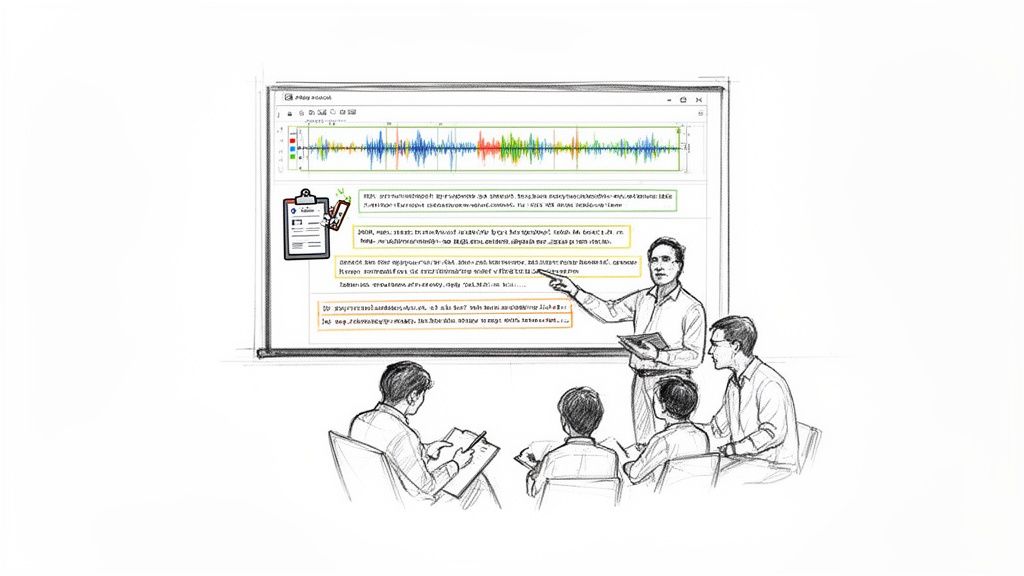
Sketch of a teacher presenting conversation analytics software with audio waveforms to students in a classroom.

For a long time, sales leaders have been flying blind. They could see who was closing deals, but they couldn't clearly see how. What specific words were they using? Which questions moved the conversation forward? How did they navigate tricky objections? Coaching sessions were often based on a rep's memory of a call, which is never the full story.

Conversation analytics software completely flips that script.

Think of it like an NFL team watching game film on Monday morning. Coaches and players don't just guess why a play worked or failed—they watch the tape, slow it down, and break down every single decision. This software brings that same level of analysis to your sales floor.

From Guesswork to Data-Driven Coaching

By automatically capturing and analyzing every conversation, this technology gives you an objective look at what’s actually being said. This is why the market is exploding—it’s projected to hit a $23.4 billion valuation in 2024, with 72% of Fortune 500 companies already using it to sharpen their sales and support playbooks.

Instead of offering vague advice like "be more confident," managers can now provide ultra-specific, actionable feedback based on real moments. This isn't just a nice-to-have anymore; it's a must-have for building a team that consistently hits its numbers.

Actionable Tip: Don't just coach on outcomes. Use conversation analytics to isolate the exact 30-second moment in a call where a deal went sideways. Share a direct link to that moment in your 1:1, turning a vague "what happened?" into a specific, "Let's break down how you handled this objection right here."

Why It's a Game-Changer

The single biggest benefit is clarity. You stop wondering what's happening on calls and start knowing. At its core, it's an evolution of foundational tech like call analytics, which focuses on the raw data of phone interactions. This new wave of software adds a layer of deep, qualitative insight.

Here’s a practical comparison of the old vs. new way of operating:

Old Way (Without Software)New Way (With Conversation Analytics)Actionable Outcome
Random Call Shadowing: Managers listen to live calls, hoping to catch a "coachable moment."Targeted Call Review: Managers get alerts for specific events, like a competitor mention or low customer sentiment.Coaches spend less time searching and more time providing precise, impactful feedback.
Subjective Feedback: Coaching is based on memory and "gut feel," e.g., "You sounded hesitant."Data-Backed Insights: Feedback is based on facts, e.g., "Your talk-to-listen ratio was 85:15 on this call."Reps receive objective, clear guidance they can immediately implement.
Slow Onboarding: New hires learn through trial and error over months.Curated Call Libraries: New hires study a "greatest hits" playlist of winning calls from day one.Ramp time is slashed, getting new reps productive in weeks, not months.

Ultimately, these platforms give you the intelligence needed to build a predictable revenue engine. And if you want to dig deeper into the technology that powers this, our guide on AI-powered sales meeting transcription is a great place to start.

What Features Actually Matter?
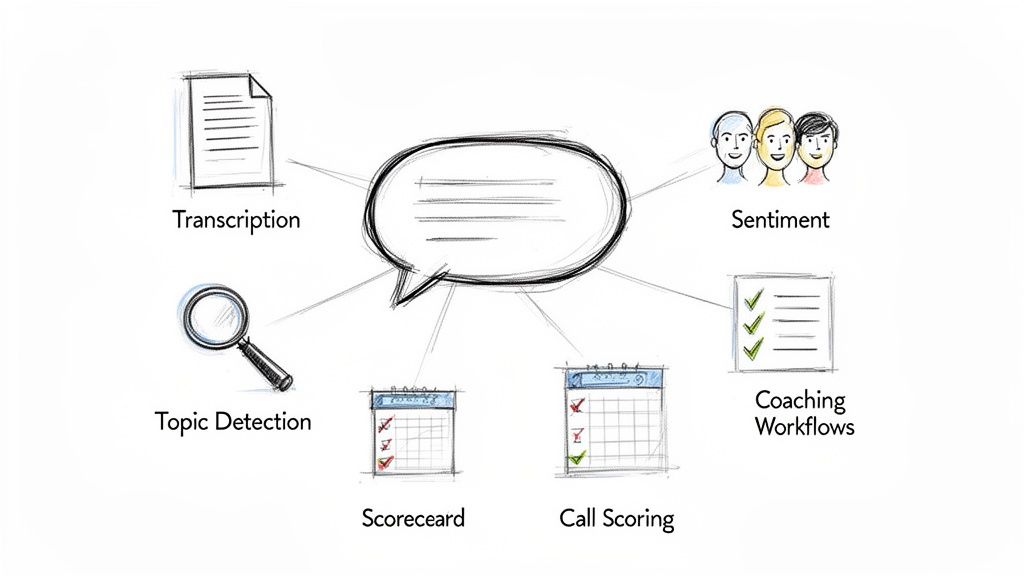
Diagram illustrating various conversation analytics features such as transcription, sentiment analysis, and topic detection.

To really get the value of conversation analytics software, you have to cut through the marketing fluff. A massive feature list is useless if it doesn't solve the real-world headaches your sales team faces every single day. Let's break down the functions that actually move the needle.

Think of it this way: for every blind spot you currently have in your sales process, there's a feature designed to replace guesswork with hard data. We're swapping the old, manual way of doing things for a smarter, data-driven approach.

Automated Transcription: The Team’s Searchable Brain

At its core, the most foundational feature is automated transcription. It turns every phone call and Zoom meeting into an accurate, searchable text file. Simple, but powerful.

The old way: Reps scribbling frantic notes, forgetting key details, and never being able to find that one specific thing a prospect said three weeks ago.

The new way: You have a perfect, searchable record of everything. A sales manager can instantly search every call from Q2 for "pricing objection" and see exactly how different reps are handling it. It ends the "he said, she said" arguments and gives you a single source of truth.

Sentiment Analysis: Reading the Virtual Room

This is where it gets interesting. Sentiment analysis uses AI to pick up on the emotional tone of a conversation. It flags moments of excitement, frustration, or hesitation in a buyer’s voice and word choice.

The old way: Reps flying blind, missing subtle buying signals, or steamrolling a prospect who is clearly getting annoyed.

The new way: A manager gets an alert when a rep's talk-to-listen ratio hits 80:20 and the customer's sentiment score plummets. This pinpoints a specific call that needs coaching on active listening. For a deeper cut, advanced AI tools for analyzing client communication styles can reveal nuances far beyond just positive or negative.

Actionable Tip: Create a "Sentiment Drop" smart alert. Set your software to notify you automatically whenever a customer’s sentiment score drops by more than 30% during a call. This is your early warning system for deals at risk and a perfect, real-time coaching opportunity.

Topic Detection and Keyword Spotting

This feature is your new intelligence officer. It automatically identifies and tags key topics that pop up in conversations, like competitor mentions, budget talks, or specific feature requests.

The old way: Relying on reps to remember to log competitor mentions in Salesforce (they won't). You have no real idea how often Competitor X comes up or which features get the most questions.

The new way: You can see trends as they emerge. It's the difference between basic keyword spotting and true topic detection.

Feature ComparisonBasic Keyword SpottingAdvanced Topic Detection
FunctionalityFlags predefined words like "competitor X" or "price".Understands context and groups related concepts like "budget," "cost," and "investment" together.
Actionable OutcomeGives you a simple count of keyword mentions.Uncovers the strategic themes of your sales calls, revealing trends you didn't even know to look for.

Imagine setting up a smart alert that pings your product team's Slack channel every single time a prospect mentions a key competitor’s new feature. That's real, actionable intel.

Call Scoring and Coaching Workflows

This is where the rubber meets the road. Automated call scoring objectively grades every call against a scorecard you build—one that reflects what a "good" call actually looks like according to your sales playbook. This ties directly into coaching workflows, which flag specific moments for managers to review.

The old way: Coaching is random, subjective, and rarely happens right after the call. Managers are too busy to listen to hour-long recordings.

The new way: A manager sets a rule to automatically flag any discovery call where the rep fails to ask about the prospect's decision-making process. The system sends the manager a link to that exact 30-second moment in the call, so they can hop in and leave a comment. Coaching goes from a time-sucking chore to a precise, scalable daily habit.

How It Benefits SDRs, Sales Leaders, and RevOps Teams
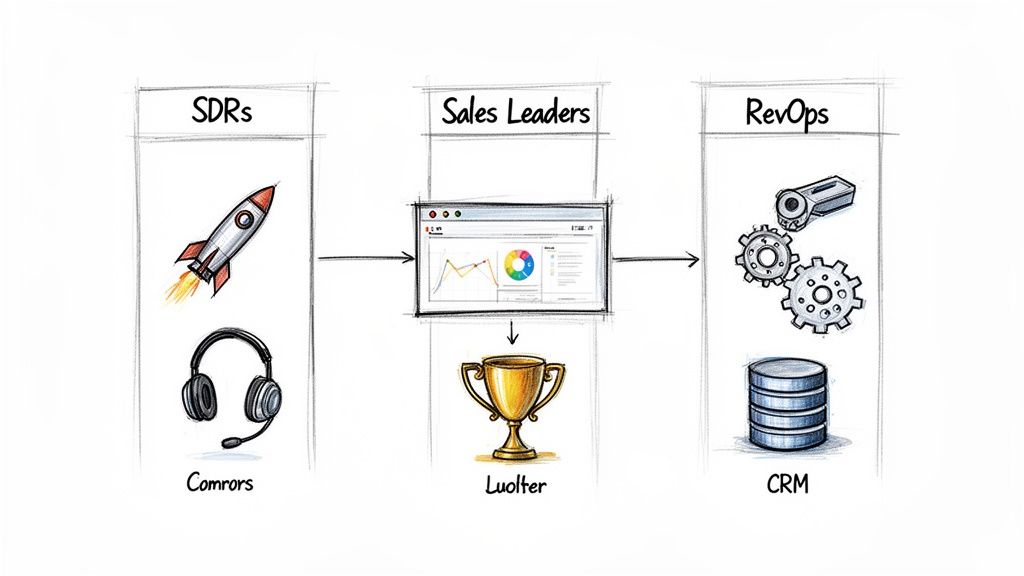
Diagram illustrates sales workflow: SDRs, Sales Leaders with analytics dashboard, and RevOps managing CRM data.

Conversation analytics isn't a one-trick pony. Its real power comes from how it serves the specific, day-to-day needs of different roles across the entire revenue team. For SDRs, sales leaders, and RevOps, the platform becomes a central hub that turns messy, raw conversations into clear, actionable insights for each of them.

By tackling the unique headaches each team faces, the software gets everyone on the same page, building strategy around the only thing that truly matters: the voice of the customer. Let's dig into what this actually looks like for each of these key players.

For Sales Development Representatives (SDRs)

SDRs are on the front lines, and the pressure to hit their numbers is relentless. Conversation analytics acts like a personal coach, helping them get up to speed faster, spot their own mistakes, and spend more time actually talking to prospects.

  • Slash Ramp Time: Instead of shadowing calls for weeks on end, a new SDR can dive into a curated playlist of "greatest hits" from your A-players. They can hear exactly how top reps navigate tricky objections or lock in meetings, basically cutting their learning curve in half.
  • Self-Coach on Demand: Reps don't have to wait for their 1:1 to get feedback anymore. They can review their own call transcripts and sentiment scores, see how their talk tracks stack up against the best, and start fixing bad habits themselves.
  • Kill the Admin Work: One of the biggest time-sucks for any SDR is manual data entry. The software automatically logs calls, spits out summaries, and pushes everything into the CRM. That's precious time they get back for actual outreach.

For Sales Leaders and Managers

Sales leaders have one of the toughest jobs out there: figuring out how to make success repeatable. They need to bottle the magic of their top reps and scale it across the whole team, but coaching based on "gut feelings" just doesn't work. Conversation analytics finally gives them the data to do it right.

And this isn't just a nice-to-have. In 2023, thousands of small and medium-sized businesses analyzed over 12 million customer interactions to figure out what works. The insights they pulled from call summaries and sentiment tracking directly solved the problem of reps drowning in busywork.

Actionable Tip for Leaders: Create a "Competitor Mentions" smart tracker. Set the system to flag every time a specific competitor is mentioned on a call. Once a week, review those moments with your team to collaboratively build and refine your battle cards based on what prospects are actually saying in the wild.

This technology turns coaching from an art into a science. Managers can pinpoint the exact moments that need attention without listening to hours of calls, make sure everyone is actually using the playbook, and build a consistent, high-performing sales machine.

For Revenue Operations (RevOps)

The RevOps team is the engine room of the sales organization. They own the processes, data, and tech that make predictable growth possible. For them, conversation analytics is a godsend for cleaning up data and building smarter sales processes.

Data Integrity and CRM Hygiene: Before and After

Without Conversation AnalyticsWith Conversation Analytics
Spotty, manual call loggingAutomated activity logging captures every single interaction.
Subjective deal notes from repsObjective call summaries and outcomes are synced right to the CRM.
Guesswork in activity reports100% accurate data on call volume, duration, and key topics.

This clean data changes everything. RevOps can finally trust what's in the CRM, which means more accurate forecasting based on what's actually being said on calls, not just a rep's wishful thinking. They can see which talk tracks lead to higher win rates and use that evidence to build playbooks grounded in reality.

For a deeper dive on connecting these dots, our guide on integrating these insights with Salesforce breaks it all down. By creating a rock-solid data foundation, RevOps gives the entire company the power to make smarter, faster decisions.

The Critical Difference: Analytics vs. Execution

When you start digging into conversation analytics software, you quickly realize not all tools are created equal. This is the single biggest trap I see teams fall into—they buy a platform that serves up beautiful data but doesn't actually help their reps do anything differently. The entire market really boils down to two distinct philosophies: analyzing what just happened versus driving what happens next.

Think of it like a football team. A pure analytics tool is the post-game analysis crew. They’ll give you a brilliant breakdown of the game after the final whistle, complete with slow-motion replays and a mountain of stats. It's fascinating stuff, but it’s all backward-looking.

An execution engine is the coach on the sidelines. They're watching the game unfold in real-time, using that information to call the very next play. They’re telling the quarterback exactly what to do to win the game right now. This distinction is everything when you're deciding which tool will actually boost your numbers.

Analytics Platforms: The Post-Game Report

Most of the big names in conversation intelligence, like Gong or Chorus, are masters of the post-game report. They record, transcribe, and dissect calls to give you a ton of insight after the fact.

Managers get dashboards showing performance trends, reps can listen back to their calls to self-critique, and RevOps can spot patterns in competitor mentions over a quarter. These tools are fantastic at answering one simple question: "What happened?"

This is incredibly helpful for:

  • Coaching: Spotting team-wide habits that need fixing.
  • Onboarding: Building a "greatest hits" library of amazing calls for new hires.
  • Strategy: Figuring out if that new pricing objection is a one-off or a real trend.

But that’s usually where it stops. The platform delivers the insight, then leaves it up to the rep to connect the dots and decide what to do next. This creates a huge gap between knowing something and doing something about it, leaving reps with just another dashboard to check instead of a better way to work.

Execution Engines: The Next Best Action

An execution-first platform, like marketbetter.ai, is built from the ground up to close that gap. It doesn't just analyze the past; it uses what it learns to immediately tell a rep what their next move should be. The whole approach is centered on answering the question, "Okay, what should I do now?"

So instead of just flagging that a prospect mentioned a key integration, an execution engine takes that signal and turns it into a concrete, prioritized task.

The philosophy here is simple: every piece of data should trigger an action. It transforms conversational insights from a passive report you review into an active engine that guides an SDR's every move.

For instance, an execution engine might:

  1. Spot a buying signal: The software hears the prospect get excited about a specific feature.
  2. Queue up the task: It instantly creates a "High-Priority Follow-Up" task in the SDR's workflow.
  3. Arm the rep: It then serves up an AI-generated email that references the exact feature they discussed, ready for the rep to review and send in one click.

This process turns fleeting buyer signals into immediate, structured action. All the guesswork and administrative grunt work that slows reps down is simply eliminated.

Analytics Platforms vs. Execution Engines: A Comparison

The difference really crystallizes when you put them side-by-side. While both platforms are powered by call data, their goals, outputs, and the way they impact your sales floor are worlds apart.

CapabilityPure Analytics Software (e.g., Gong, Chorus)Execution-First Engine (e.g., marketbetter.ai)
Primary FocusPost-call review and trend analysis.Real-time task generation and workflow automation.
Main OutputDashboards, reports, and call libraries.A prioritized list of "next best actions" for each rep.
Rep Experience"Here's what happened on your last call.""Here's the exact email to send or call to make next."
Value PropositionImproves coaching and strategic understanding.Increases rep activity, efficiency, and consistency.

At the end of the day, a pure analytics tool gives you the map, showing you all the roads you've already traveled. An execution engine is the GPS, giving you turn-by-turn directions on where to go next. For any team obsessed with driving consistent outbound motion and making their SDRs as productive as possible, closing that gap between insight and action isn't just a nice-to-have feature—it's the whole game.

A Practical Checklist for Choosing Your Software

Picking the right conversation analytics software can feel like you're lost in a maze of flashy dashboards and big promises. To cut through the noise, you need a solid game plan—one that looks past the feature list and hones in on how a tool will actually fit into your team's day-to-day grind. This checklist will arm you with the right questions to ask vendors.

Making the right call isn’t just about the tech itself. It's about finding a platform that truly aligns with how your team operates. A tool that spits out cool insights but buries your reps in administrative work is a step backward. The real goal is to find software that doesn't just show you the data but actively helps your team do their jobs better.

Foundational Must-Haves

Before you even think about the fancy, AI-driven features, you have to make sure any potential vendor has the basics locked down. These are the absolute deal-breakers that determine whether the software will slot neatly into your tech stack or just become another data silo nobody ever logs into.

  • Seamless CRM Integration: How deep does the integration with Salesforce or HubSpot actually go? Does it just dump a call log, or does it intelligently sync rich data—like call summaries, outcomes, and key moments—directly to the right contact or opportunity? A shallow integration just creates more manual work for your reps.
  • Data Accuracy and Language Support: What's the real transcription accuracy rate, especially when your reps are using industry jargon or have different accents? If you have a global team, does the platform genuinely support multiple languages and dialects, or is it just an afterthought?
  • Clear Implementation and Support: What does the onboarding really look like? Ask them for a detailed 90-day plan. Will you get a dedicated support manager, or are you just another ticket in a generic help desk queue? A clear, well-defined implementation path is a huge sign of a vendor's commitment to your success.

The market for these tools is exploding, so you need a partner who can grow with you. The global adoption of conversation analytics software is surging, with large enterprises expected to hold 55.6% of the market share by 2025. This rush to enterprise adoption proves just how critical robust integrations with complex CRMs like Salesforce and HubSpot have become. You can explore more about these market trends and what they mean for sales ops.

From Analytics to Action

Here’s where you separate the contenders from the pretenders. The single biggest difference between vendors is their philosophy on data. Do they just give you the analytics and wish you luck, or do they actually help your team act on them? This is the critical gap between a passive reporting tool and an active execution engine.

The diagram below shows the all-too-common disconnect between the insights you get after a call and the real-time actions your reps need to take right now.
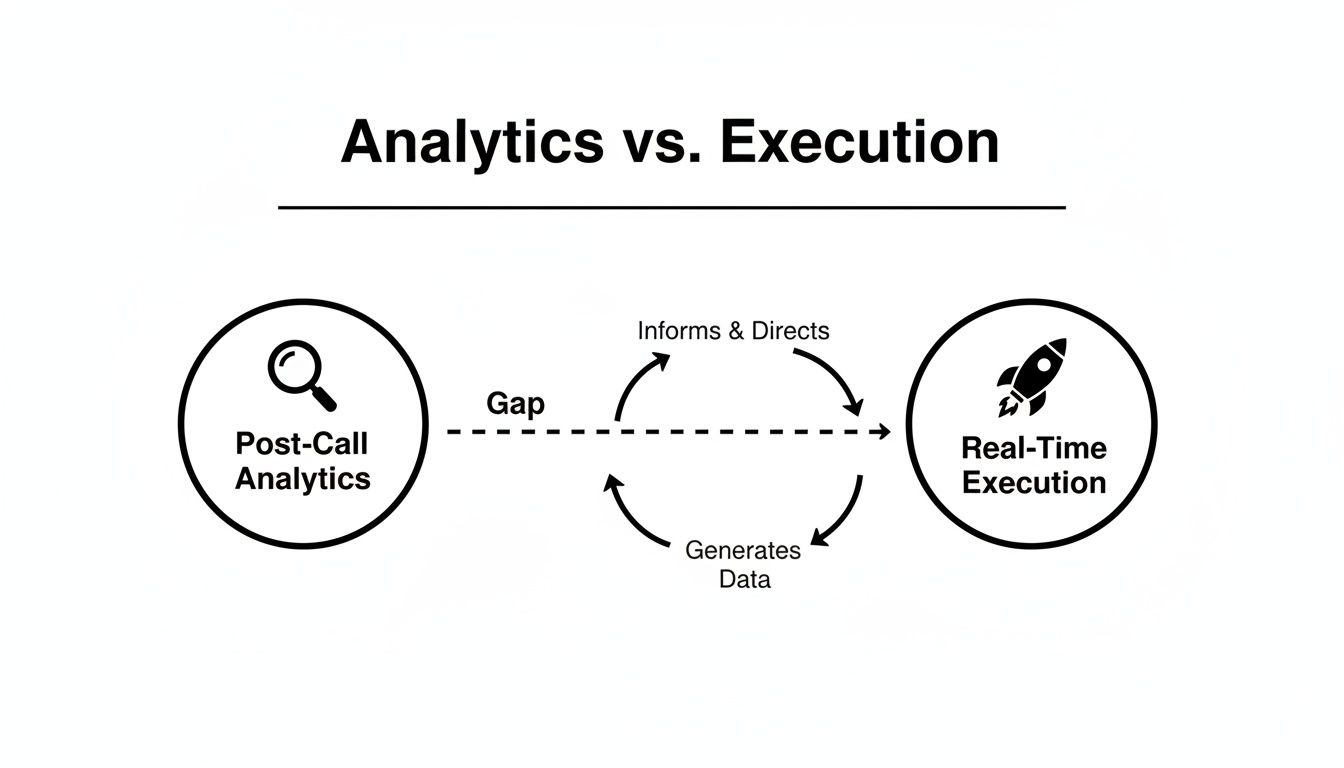
A diagram illustrating the gap between post-call analytics and real-time execution, showing data flow.

So many platforms serve up fantastic post-call insights but leave your reps hanging, forcing them to manually figure out what to do next.

When you're evaluating vendors, make them show you exactly how their software bridges that gap.

Key Question for Vendors: "Show me how an insight from a call automatically becomes the next prioritized task in a rep's workflow—without them ever having to leave their CRM or toggle between a dozen tabs."

This one question will instantly tell you whether you're looking at a pure analytics platform or a true execution engine. For teams measured on pipeline creation and outbound efficiency, finding a tool that drives action isn't a luxury; it's a necessity. Our buyer's guide on end-to-end AI sales platforms dives deeper into making this crucial distinction.

By keeping your evaluation laser-focused on real-world impact and workflow integration, you can confidently choose a solution that delivers a measurable return, not just another dashboard.

Frequently Asked Questions

Alright, let's get into the nitty-gritty. Even when you've got a handle on the technology, jumping into conversation analytics software for the first time always brings up some practical questions. We've pulled together the most common ones we hear from sales and RevOps leaders to give you direct answers and help you feel confident as you start looking around.

How Long Does Implementation Typically Take?

Good news: this isn't a massive, quarter-long project anymore. Most modern, cloud-based tools that plug right into your CRM can be up and running in just a few weeks. The real trick is to avoid a "big bang" rollout where you try to turn on every single feature at once.

A much better way to go is a phased approach:

  1. Start Small: Kick things off with a pilot team of your most bought-in reps.
  2. Focus on Core Value: Get call recording and transcription working first. This alone is a huge win and immediately shows the tool’s value by giving everyone visibility.
  3. Layer in Advanced Features: Once the team gets comfortable, you can start introducing the more powerful stuff like automated call scoring and coaching workflows.

This method gets your team used to the new system without overwhelming them and helps you see a return on your investment much faster.

How Do I Get Reps to Adopt a New Tool?

This all comes down to how you frame it. If your team thinks you’re installing "Big Brother" software to watch their every move, they'll push back. Hard. But if you introduce it as a personal performance coach—something designed to help them hit their number and make more money—they'll be all in.

The key is to constantly answer the "what's in it for me?" question. Show your reps exactly how the platform makes their day-to-day life easier. Point out how it kills off tedious admin work like manually logging calls in the CRM. Show them how they can build a library of their best calls to learn from. When reps see that the tool helps them do their job better, faster, and more profitably, adoption takes care of itself.

Does This Software Analyze Both Calls and Emails?

Yes, and honestly, it has to. The best platforms give you a complete picture of what's happening with a prospect by analyzing every interaction, whether it's a call or an email. A phone call might uncover a prospect’s main frustration, but the follow-up email could hold the keys to the kingdom—like details on the buying committee or their real budget.

Pro Tip: Look for a tool that offers unified analytics, combining insights from calls and emails into a single timeline for each prospect. This eliminates blind spots and provides a 360-degree view of the entire buyer journey, preventing crucial details from slipping through the cracks between different communication channels.

How Is This Different From a Sales Engagement Platform?

Fantastic question, because the lines between these tools are getting blurrier by the day. Historically, they played on the same team but had very different positions.

Platform TypePrimary FunctionCore Question It Answers
Sales Engagement Platform (e.g., Outreach)Automates and manages high-volume outreach sequences."How can my reps execute their outreach more efficiently?"
Conversation Analytics Software (e.g., Gong)Analyzes the quality and content of sales interactions."What is actually being said during that outreach?"

But now, a new type of execution-first tool is showing up. These platforms are designed to take the insights from conversation analytics and use them to directly inform and prioritize the tasks that reps execute in their sales engagement tools. It creates a powerful, closed loop between insight and action.


Ready to close the gap between analytics and execution? marketbetter.ai is the AI-Powered SDR Task Engine that turns buyer signals into prioritized tasks and helps your team execute faster with AI-written emails and a dialer that lives inside Salesforce and HubSpot.

Discover how marketbetter.ai can drive consistent outbound motion for your team.

The Hidden Cost of Champion Tracking Tools: What UserGems Won't Tell You

· 11 min read
sunder
Founder, marketbetter.ai

Champion tracking sounds like a simple proposition: monitor your contacts for job changes, get alerts when they move, and reach out to warm leads. Tools like UserGems charge $15,000–$30,000 per year for SMB and $50,000+ for enterprise to deliver this service. Champify offers a more affordable alternative at $6,000–$12,000 per year.

On the surface, these seem like reasonable investments — especially when champions convert at 3–5x the rate of cold outreach. But the sticker price of your champion tracking tool is just the tip of the iceberg. The real cost — the total cost of ownership — is something most vendors would prefer you didn't calculate until after you've signed the contract.

In this article, we pull back the curtain on every hidden cost associated with champion tracking tools, show you what the complete price tag looks like, and explain why a growing number of B2B sales teams are switching to all-in-one platforms that eliminate these hidden expenses.

Job Change Alerts vs Intent Signals: The Smarter Way to Find Warm Leads

· 10 min read
sunder
Founder, marketbetter.ai

Every B2B sales team is chasing the same thing: warm leads. Prospects who are more likely to take a meeting, more likely to engage, and more likely to buy. Two of the most popular approaches to finding warm leads in 2026 are job change alerts and intent signals — but they work on fundamentally different principles, and understanding those differences can make or break your pipeline strategy.

Job change alerts tell you when someone you know has moved to a new company. Intent signals tell you when someone you may not know is actively researching solutions like yours. One is a lagging indicator. The other is a leading indicator. And the smartest teams are using both.

MarketBetter vs Champify: Which Champion Tracker Actually Drives Pipeline?

· 7 min read
sunder
Founder, marketbetter.ai

Champion tracking is having a moment. Every sales leader wants to know when their best contacts move to new companies. But here's what most champion tracking tools get wrong: they stop at the alert.

Champify and MarketBetter both help you track champions. But they take fundamentally different approaches to what happens after you find one. Let's compare.

MarketBetter vs Clay: Data Enrichment vs SDR Workflow Automation [2026]

· 6 min read

MarketBetter vs Clay comparison — data enrichment vs SDR workflow automation

Clay has become one of the most talked-about tools in B2B sales. With 75+ data providers, AI-powered enrichment, and a credit-based system, it promises to transform how GTM teams prospect.

But there's a critical gap in Clay's approach that most reviews won't tell you: Clay enriches data. It doesn't tell your SDRs what to do with it.

MarketBetter takes the opposite approach. Instead of giving your team a spreadsheet of enriched contacts and hoping they figure out the next step, MarketBetter delivers a daily SDR playbook — a prioritized list of exactly who to contact, how to reach them, and what to say.

This isn't a better-or-worse comparison. It's a fundamentally different philosophy. Let's break it down.

What Clay Does Well

Clay is a data enrichment powerhouse. Here's what it brings to the table:

  • 75+ data providers — Access to contact, firmographic, technographic, and intent data from dozens of sources in one platform
  • Claygent (AI research agent) — Send AI to research leads, scan websites, and summarize findings automatically
  • Sculptor — Describe a workflow in plain language and Clay builds it for you
  • Credit-based pricing — Pay for what you use, not per seat (unlimited users on all plans)
  • Enrichment waterfall — Query multiple providers to maximize data coverage, often hitting 80-90% verified accuracy

If your team's primary bottleneck is finding and enriching leads, Clay is genuinely impressive.

Where Clay Falls Short for SDR Teams

Here's what G2 reviewers, Reddit users, and Trustpilot feedback consistently flag:

1. Steep Learning Curve

Clay isn't plug-and-play. Multiple reviews mention needing "Clay partners" for implementation. One common complaint: "Salespeople don't really use it" because the interface requires technical fluency that most SDRs don't have.

2. Credit Costs Add Up Fast

Clay's credit system sounds flexible until you do the math:

PlanMonthly CreditsMonthly CostCost per 1,000 Credits
Free100$0$0
Starter2,000$149~$75
Explorer10,000$349~$31
Pro50,000$800~$16
EnterpriseCustomContact salesVariable

A single enrichment action costs 1-5+ credits. An SDR team running 500 leads/week through a 3-step enrichment workflow could burn through 7,500+ credits monthly — that's the Explorer plan minimum. Add AI research and you're firmly in Pro territory.

3. Data Without Direction

This is the fundamental issue. Clay tells you who your prospects are. It doesn't tell you:

  • Which prospects to prioritize today
  • What channel to use (email, call, LinkedIn)
  • What message will resonate based on their behavior
  • When to follow up and how urgently

Your SDRs still need to interpret the data, build their own workflows, and decide what matters. That's the exact manual work you're trying to eliminate.

How MarketBetter Approaches It Differently

MarketBetter isn't a data enrichment tool. It's an SDR operating system that turns signals into action.

The Daily SDR Playbook

Every morning, each SDR gets a prioritized task list:

  • Who to contact (ranked by buying intent and fit)
  • Why they're worth contacting (visited pricing page, matched ICP, job change signal)
  • How to reach them (suggested channel, timing, message framework)
  • What to say (personalized talking points based on their activity)

Instead of "here's 500 enriched leads, figure it out," MarketBetter says: "Call Sarah at Acme Corp today. She visited your pricing page twice this week, her company matches your ICP, and here's what to say."

Website Visitor Identification

MarketBetter identifies companies visiting your website in real time — not just company name, but what they looked at, how long they stayed, and which pages signal buying intent. This data feeds directly into the playbook.

Clay doesn't have visitor identification. You'd need to bolt on a separate tool (like Clearbit Reveal or RB2B) and manually connect the data.

Built-In Execution Tools

MarketBetter includes the tools SDRs actually need to act on insights:

CapabilityMarketBetterClay
Website visitor identification✅ Built-in❌ Not available
Daily SDR playbook✅ Automated❌ Not available
Smart dialer✅ Built-in❌ Not available
Email sequences✅ Built-in✅ Sequencer (new)
AI chatbot✅ Built-in❌ Not available
Data enrichment✅ Integrated✅ 75+ providers
Intent signals✅ First-party + third-party✅ Third-party only
AI message generation✅ Built-in✅ Claygent
CRM integration✅ Native✅ HubSpot/Salesforce

The Core Difference

Clay = data enrichment layer (upstream of action) MarketBetter = SDR workflow engine (data → action → outcome)

Clay gives your team better data. MarketBetter gives your team better outcomes.

Pricing Comparison

Clay

  • Free: 100 credits/month ($0)
  • Starter: 2,000 credits/month ($149/mo or $134/mo annual)
  • Explorer: 10,000 credits/month ($349/mo or $314/mo annual)
  • Pro: 50,000 credits/month ($800/mo or $720/mo annual)
  • Enterprise: Custom pricing

Unlimited users on all plans. But credits burn fast — a team of 5 SDRs enriching 100 leads/day could easily need the Pro plan.

Hidden cost: Clay doesn't include a dialer, visitor identification, or playbook. You'll need SalesLoft/Outreach ($100-180/user/month) plus a visitor ID tool ($200-500/month) on top. Real cost for a 5-person SDR team: $2,000-4,000/month across the full stack.

MarketBetter

MarketBetter publishes transparent pricing on its website. Everything is included — visitor identification, playbook, dialer, email sequences, AI chatbot, and enrichment. No per-credit surprises, no bolt-on tools needed.

See current MarketBetter pricing →

When to Choose Clay

Clay is the right choice if:

  • Your team has technical RevOps talent who can build and maintain complex enrichment workflows
  • Your primary bottleneck is data quality, not SDR productivity
  • You already have a sales engagement platform (SalesLoft, Outreach) and just need better data feeding into it
  • You want maximum customization and are willing to invest time in setup
  • Your use case is marketing enrichment (enriching CRM records, audience building) rather than SDR outbound

When to Choose MarketBetter

MarketBetter is the right choice if:

  • Your SDRs are drowning in tabs and need a single task list
  • You want visitor identification + outbound in one platform
  • You need a smart dialer built for warm outbound calls
  • Your team needs to know what to do, not just who to target
  • You want to go live in days, not weeks of workflow building
  • You're measuring speed-to-lead and meetings booked, not credits consumed
Free Tool

Try our AI Lead Generator — find verified LinkedIn leads for any company instantly. No signup required.

The Bottom Line

Clay and MarketBetter solve different problems at different stages of the sales workflow.

Clay answers: "Who are these leads and what do we know about them?" MarketBetter answers: "Here's exactly what your SDRs should do right now to book meetings."

If your team already has a system for turning data into action and just needs better inputs, Clay is excellent. If your team needs the full workflow — from signal detection to prioritized action to execution — MarketBetter eliminates the gap between data and revenue.

The question isn't which tool has more data providers. It's whether your SDRs know what to do when they sit down at 8 AM.

See how MarketBetter's playbook works →

MarketBetter vs Outreach.io: AI-Powered SDR Platform vs Legacy Sales Engagement [2026]

· 8 min read

MarketBetter vs Outreach.io comparison

Outreach.io is one of the most established sales engagement platforms on the market, with over 3,500 G2 reviews and a presence in most enterprise sales stacks. But being established isn't the same as being the best fit for your team in 2026.

MarketBetter takes a fundamentally different approach. Instead of giving SDRs a powerful tool and leaving them to figure out who to contact and what to say, MarketBetter tells them exactly what to do next — every single day.

This comparison breaks down both platforms across features, pricing, ease of use, and actual pipeline impact so you can make the right decision.

The Core Difference: Execution Engine vs. Automation Toolbox

Outreach.io is a sales engagement platform. It gives your SDR team sequences, a dialer, email analytics, and deal tracking. Reps still need to decide who to reach out to, build their own sequences, and interpret data dashboards.

MarketBetter is an AI-powered SDR operating system. It identifies who's visiting your website, tells your SDRs exactly who to contact, generates personalized outreach, and manages the entire workflow in one daily playbook.

Think of it this way:

  • Outreach gives your SDR a Swiss Army knife and says "go hunt"
  • MarketBetter hands them a list that says "call Jane at Acme at 2pm — she visited your pricing page 3 times this week, here's the talk track"

Feature-by-Feature Comparison

Sales Sequences and Email Automation

Outreach.io:

  • Multi-step sequences across email, phone, LinkedIn, and SMS
  • Templates with merge fields and snippets
  • A/B testing on sequences
  • Trigger-based automations
  • Advanced scheduling and throttling

Outreach's sequencing engine is mature and powerful. For teams that already know who to target and have playbooks built, it executes well.

MarketBetter:

  • AI-generated hyper-personalized email sequences
  • Sequences triggered automatically by intent signals (website visits, page views, return visits)
  • Dynamic personalization that references actual prospect behavior
  • Automated follow-up cadences

MarketBetter's sequences aren't just automated — they're intelligent. Instead of SDRs manually building sequences for each prospect, the platform generates personalized outreach based on what each prospect actually did on your website.

Verdict: Outreach has more granular sequence controls for power users. MarketBetter sequences are smarter out of the box because they're driven by real-time intent data, not manual setup.

Website Visitor Identification

Outreach.io:

  • No native website visitor identification
  • Requires third-party tools (Clearbit, 6sense, Demandbase) for visitor intelligence
  • Additional cost and integration complexity

MarketBetter:

  • Built-in website visitor identification
  • Identifies companies visiting your site in real time
  • Shows which pages they viewed, how long they stayed, and how many times they returned
  • Automatically matches visitors to SDR territories and triggers outreach

This is the single biggest differentiator. Outreach can't tell you who's looking at your website right now. MarketBetter can — and it turns that signal into action immediately.

Verdict: MarketBetter wins decisively. You need an entirely separate tool stack to get this capability with Outreach.

The Daily SDR Playbook

Outreach.io:

  • Dashboard shows tasks, sequence steps, and follow-ups
  • SDRs manage their own task queue
  • Manual prioritization required

MarketBetter:

  • AI-generated daily playbook: "Here are your top 15 prospects today, ranked by intent"
  • Specific action items: call, email, LinkedIn connect — with context for each
  • Priority scoring based on website behavior, engagement, and fit signals
  • Real-time updates as new visitors appear

Outreach gives SDRs a to-do list. MarketBetter gives them a strategy.

Verdict: MarketBetter. No other tool on the market generates a daily, prioritized action plan from live intent signals.

Smart Dialer

Outreach.io:

  • Built-in dialer with local presence
  • Call recording and transcription
  • Live call monitoring for managers
  • AI-powered call summaries via Kaia
  • Voice add-on pricing ($120/user/year for US Standard)

Outreach's dialer is solid and the Kaia AI assistant adds value for coaching.

MarketBetter:

  • Integrated smart dialer built for warm outbound
  • Click-to-call from the daily playbook
  • Automatic call logging to CRM
  • Warm calling: SDRs call prospects who have already visited the website, so conversations start from context, not cold

Verdict: Outreach has a more feature-rich dialer with advanced call intelligence. MarketBetter's dialer is purpose-built for warm calls, which have significantly higher connect and conversion rates than traditional cold calling.

AI and Intelligence

Outreach.io (Amplify):

  • AI Revenue Agent for prospecting and enrichment
  • AI Deal Agent for pipeline insights
  • AI Research Agent for account intel
  • Credit-based consumption model for AI features
  • Kaia conversation intelligence for meetings

Outreach is investing heavily in AI, but it's bolt-on to an existing platform. The AI agents require credits, adding cost complexity.

MarketBetter:

  • AI is the foundation, not an add-on
  • AI-powered visitor identification
  • AI-generated personalized outreach
  • AI chatbot that engages every website visitor 24/7
  • AI-driven account scoring and prioritization

Verdict: Outreach has more AI features for deal management and forecasting. MarketBetter's AI is more focused on the SDR workflow — identification, prioritization, and personalized outreach — which is where pipeline actually starts.

Deal Management and Forecasting

Outreach.io:

  • Deal health scoring
  • Pipeline dashboards
  • AI-powered forecasting with scenario modeling
  • Deal grid for visual pipeline management

MarketBetter:

  • Pipeline tracking through CRM integration
  • Focus on top-of-funnel pipeline generation rather than mid-funnel deal management

Verdict: Outreach wins for mid-funnel and forecasting. MarketBetter is focused on filling the top of the funnel — getting more qualified meetings booked.

CRM Integration

Outreach.io:

  • Deep Salesforce integration (bi-directional sync, custom objects)
  • HubSpot integration (but users report sync issues)
  • Microsoft Dynamics support

MarketBetter:

  • HubSpot integration (native, real-time sync)
  • Salesforce integration
  • Activity logging and contact sync

Verdict: Outreach has a stronger Salesforce integration. MarketBetter's HubSpot integration is cleaner and more reliable. Choose based on your CRM.

Pricing Comparison

Outreach.io Pricing

Outreach doesn't publish pricing. Based on Vendr negotiation data and user reports:

ComponentEstimated Cost
Engage (base)~$100-$140/user/month
Voice add-on~$120/user/year
Meet (Kaia)Additional per-user fee
Deal moduleAdditional per-user fee
Forecast moduleAdditional per-user fee
Amplify (AI)Credit-based, variable
Implementation$5,000-$25,000+

For a 10-person SDR team: Expect $15,000-$30,000+/year before AI credits and add-ons. A Vendr analysis showed a 50-user deployment at list price runs ~$72,000/year for Engage alone.

MarketBetter Pricing

MarketBetter publishes transparent pricing starting at a fraction of Outreach's cost. The platform includes visitor identification, email automation, smart dialer, AI chatbot, and daily playbook in one package — no add-on taxes.

For a 10-person SDR team: Significantly less than Outreach, with no hidden module fees or AI credit costs.

See current MarketBetter pricing →

The Hidden Cost Problem

With Outreach, you don't just pay for Outreach. You need:

  • A visitor identification tool ($500-$2,000+/month)
  • A data enrichment tool ($300-$1,000+/month)
  • An AI chatbot ($200-$500+/month)
  • Implementation and training ($5,000-$25,000)

MarketBetter bundles all of this. The TCO difference is often 40-60% less than an Outreach-centered stack.

What Real Users Say

Outreach.io (from G2 and community reviews)

What users like:

  • Powerful sequencing engine
  • Strong analytics and reporting
  • Good for large, mature SDR teams

Common complaints:

  • "Pricing is not transparent — I felt pressured into an annual contract"
  • "The UI is overwhelming for new SDRs; steep learning curve"
  • "HubSpot integration is buggy"
  • "Customer support is slow; escalations go unanswered for days"
  • "Annual contracts with auto-renewal — hard to cancel"

MarketBetter (from G2, 4.97 rating)

What users like:

  • "It tells us exactly who to contact — game changer for daily workflow"
  • "Setup took hours, not weeks"
  • "The daily playbook replaced 20 browser tabs"
  • "Best support I've ever experienced with a SaaS tool"

When to Choose Outreach.io

Outreach is the better fit if:

  • You have a 50+ person SDR team with established playbooks
  • You're deeply invested in Salesforce and need advanced CRM sync
  • You need deal management and forecasting alongside engagement
  • You have dedicated sales ops to manage and optimize sequences
  • Budget isn't a primary concern

When to Choose MarketBetter

MarketBetter is the better fit if:

  • You want to know who's on your website and act on it immediately
  • Your SDRs waste time deciding who to call and what to say
  • You want one platform instead of 5+ tools stitched together
  • You're a startup or mid-market team (5-50 SDRs) that needs speed
  • You want transparent pricing with no module-by-module upsells
  • Speed-to-lead is your competitive advantage
Free Tool

Try our AI Lead Generator — find verified LinkedIn leads for any company instantly. No signup required.

The Bottom Line

Outreach.io is a powerful, enterprise-grade sales engagement platform. It's been the category leader for years, and for large organizations with mature sales ops, it still delivers.

But the market has shifted. In 2026, SDR teams don't just need better tools — they need platforms that tell them what to do. MarketBetter collapses the entire SDR workflow into one daily playbook: identify website visitors, prioritize by intent, generate personalized outreach, and execute across email, phone, and chat.

If your team is spending more time managing tools than selling, MarketBetter might be the answer.

Ready to see the daily playbook in action?

Book a demo →


Related reading:

MarketBetter vs SalesLoft: Legacy Sales Engagement vs AI-Powered SDR Platform [2026]

· 6 min read

MarketBetter vs SalesLoft comparison — legacy sales engagement vs AI SDR platform

SalesLoft has been a pillar of sales engagement for years. Thousands of sales teams rely on it for cadences, call recording, deal management, and pipeline forecasting.

But here's the uncomfortable truth about SalesLoft in 2026: it automates the workflow, not the thinking.

SalesLoft helps you execute sequences faster. It doesn't tell you which sequences to run, who deserves attention today, or what to say when a prospect just visited your pricing page three times. That intelligence gap is where MarketBetter lives.

What SalesLoft Does Well

SalesLoft earned its reputation for good reasons:

  • Cadences — Multi-step, multi-channel outreach sequences that automate follow-ups across email, call, and social
  • Conversation Intelligence — Records and analyzes sales calls for coaching and pattern recognition
  • Deal Management — Tracks pipeline, highlights at-risk deals, and forecasts revenue
  • Revenue Intelligence — AI-driven insights from CRM data and seller activity
  • CRM Sync — Deep integrations with Salesforce and HubSpot
  • Enterprise Scale — Built for 50-500+ seat deployments with admin controls, compliance, and SSO

For enterprise revenue teams running complex, multi-touch sales processes, SalesLoft is a proven platform.

Where SalesLoft Falls Short for Growing SDR Teams

1. Pricing Is Enterprise-Level (and Opaque)

SalesLoft doesn't publish pricing. Based on Vendr data and public benchmarks:

AspectWhat You'll Actually Pay
Advanced Plan (50 seats)$108,000/year list price ($180/user/month)
Dialer add-on$7,500/year for 25 users (not included by default)
Negotiated discount35-45% typical (bringing to ~$75K-76K for 50 seats)
Bionic Chatbot add-on$10,000/year (12,000 replies)
Effective per-user cost$100-180/user/month depending on negotiation

For a 10-person SDR team, you're looking at $12,000-21,600/year before add-ons. The dialer — a core SDR tool — costs extra. The chatbot costs extra. International calling costs extra.

2. No Website Visitor Identification

SalesLoft has no idea who's visiting your website. It can't tell your SDRs "three people from Acme Corp looked at your pricing page this morning." You need a completely separate tool (Clearbit, 6sense, or similar) bolted on, plus manual workflows to connect that data to SalesLoft cadences.

3. Cadences ≠ Intelligence

SalesLoft cadences are powerful but dumb. They fire on a schedule, not on intent. An SDR running a 14-day cadence sends the same sequence whether a prospect is actively researching solutions or completely disengaged.

There's no built-in mechanism to:

  • Prioritize by real-time website activity
  • Adjust messaging based on pages visited
  • Surface warm leads before cold ones
  • Tell an SDR "skip the email, call her now — she just looked at pricing"

4. Built for the Sequence, Not the Day

SalesLoft organizes work around cadences. SDRs manage multiple sequences, check analytics dashboards, review coaching insights, and try to figure out what matters most.

What's missing: a single prioritized view that says "here are your 20 most important actions today, ranked by likelihood to convert."

How MarketBetter Approaches It Differently

Signal-Driven Prioritization

MarketBetter doesn't wait for SDRs to check dashboards. Every morning, it delivers a daily playbook — a ranked list of actions based on real buying signals:

  • Website visitor identification (who's looking at your site right now)
  • Page-level intent (pricing page = hot, blog = warm, careers = skip)
  • ICP fit scoring (automatic)
  • Cross-channel signal aggregation

The playbook isn't a static list. It re-ranks throughout the day as new signals come in.

Everything Included, No Add-Ons

CapabilityMarketBetterSalesLoft
Email sequences✅ Included✅ Included
Smart dialer✅ Included💰 $7,500/yr add-on
Website visitor ID✅ Included❌ Not available
AI chatbot✅ Included💰 $10,000/yr add-on
Daily SDR playbook✅ Core feature❌ Not available
Intent-based prioritization✅ Built-in❌ Not available
Conversation intelligence❌ Not included✅ Included
Revenue forecasting❌ Not included✅ Included (Premier)
Deal management❌ Not included✅ Included
AI message personalization✅ Built-in✅ Available
CRM integration✅ HubSpot native✅ Salesforce + HubSpot

MarketBetter includes the dialer, chatbot, visitor ID, and playbook in every plan. SalesLoft charges $17,500+/year in add-ons for comparable functionality.

Speed to Value

SalesLoft implementations typically take 2-4 weeks for mid-market teams — CRM sync configuration, cadence setup, dialer provisioning, user training, admin policies.

MarketBetter is designed for faster deployment. Connect your domain, install the visitor tracking snippet, import your ICP criteria, and your SDRs have a working playbook within days.

Where SalesLoft Wins

Let's be honest about where SalesLoft has the edge:

  • Conversation intelligence — Call recording, transcription, and AI coaching is mature and genuinely useful. MarketBetter doesn't offer this yet.
  • Enterprise deal management — If you need pipeline visibility, forecasting, and at-risk deal alerts across a 100+ person sales org, SalesLoft's Deals product is purpose-built for it.
  • Revenue forecasting — SalesLoft Premier includes AI-driven revenue predictions. MarketBetter focuses on the top of funnel, not the forecast.
  • Ecosystem maturity — SalesLoft integrates with virtually every sales and marketing tool. Deeper Salesforce integration than most competitors.
  • Scale — For organizations with 200+ sellers, SalesLoft's admin controls, compliance features, and enterprise infrastructure are battle-tested.

Who Should Choose Which

Choose SalesLoft If:

  • You have 50+ sellers and need enterprise-grade administration
  • Conversation intelligence and call coaching are critical to your team's development
  • You need revenue forecasting and pipeline management in the same platform
  • Your team already runs complex multi-touch cadences and just needs better execution tools
  • You're a Salesforce-heavy org that needs deep native integration
  • Budget isn't a primary concern

Choose MarketBetter If:

  • Your SDRs spend too much time figuring out who to call next
  • You want website visitor identification without adding another tool
  • You need a smart dialer included in your platform (not a $7,500/yr add-on)
  • Your team is 5-50 people and you want everything in one platform
  • You measure success by meetings booked and speed-to-lead, not cadence completion rates
  • You want transparent pricing without enterprise sales negotiations
Free Tool

Try our AI Lead Generator — find verified LinkedIn leads for any company instantly. No signup required.

The Fundamental Difference

SalesLoft is built around the assumption that your team already knows what to do — it just helps them do it faster and at scale.

MarketBetter is built around the assumption that knowing what to do is the hard part — and the platform should figure that out for your team.

SalesLoft: "Here are your cadences, your analytics, and your pipeline. Go execute." MarketBetter: "Here are your 20 highest-priority actions for today. Start with Sarah at Acme — she hit your pricing page twice and matches your ICP."

Both approaches work. The question is which problem your team actually has: execution speed or prioritization intelligence.

Most SDR teams we talk to? It's the second one.

See how MarketBetter's daily playbook works →