
Build Audiences Your Way — Multi-Provider Enrichment with Fiber, Lusha & Exa

The best go-to-market teams have a dirty secret: they never rely on a single data source.
They know that no single provider covers every company, every contact, every industry vertical with equal depth. One provider nails tech company firmographics. Another has stronger coverage in healthcare. A third catches the long-tail companies that everyone else misses.
The problem has always been the workflow. You run a search in one tool, export the CSV, run another search somewhere else, export that CSV, then spend an afternoon in Google Sheets deduplicating, cross-referencing, and trying to merge records that use slightly different company name formats. By the time you have a clean list, your signals are stale and your SDRs have moved on.
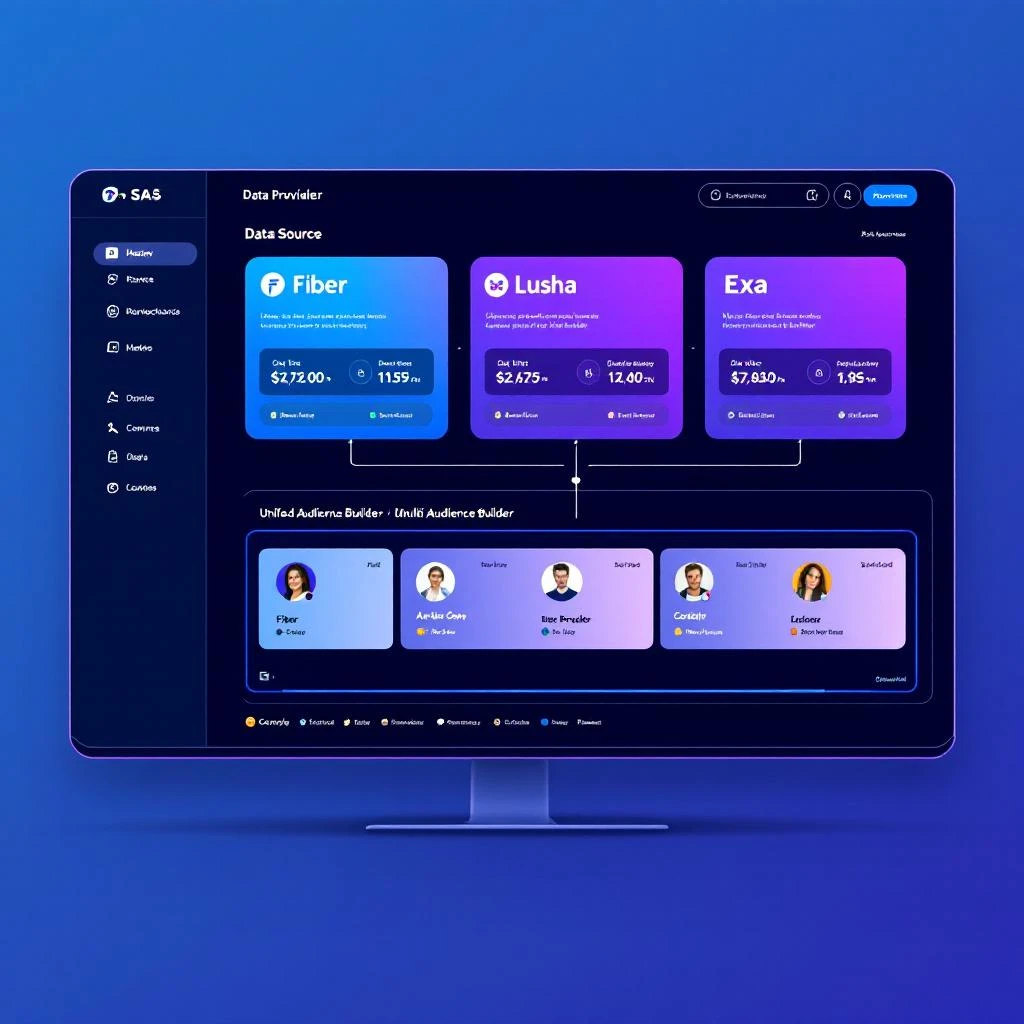
MarketBetter just eliminated that entire workflow. You can now build audiences from Fiber, Lusha, and Exa Websets — all from one platform, all in one step.
Why Single-Provider Enrichment Falls Short
If you have been building audiences with a single data provider, you already know the gaps. You have probably run a search, been happy with the results, then realized halfway through outreach that 30% of your contacts had outdated emails. Or that an entire segment of mid-market companies simply did not appear because your provider's coverage skews enterprise.
This is not a provider quality problem — it is a coverage geometry problem. Every data provider has strengths:
- Fiber delivers deep company and contact data with strong coverage across technology companies and startups. Their real-time verification keeps bounce rates low.
- Lusha brings robust direct-dial phone numbers and verified business emails, with particular strength in European markets and mid-market companies.
- Exa Websets takes an entirely different approach — AI-powered web search that finds companies and contacts based on semantic criteria rather than database lookups. This catches companies that structured databases miss entirely.
When you combine them, gaps disappear. The contact that Fiber does not have, Lusha covers. The niche startup that neither traditional database indexes, Exa's AI web search surfaces.
Multi-provider enrichment is not about having more data. It is about having the right data for every account in your target market.
The Enrichment Column Picker: Total Control Over Your Data
Here is where it gets interesting. MarketBetter does not just let you query multiple providers — it gives you a Clay-style enrichment column picker that puts you in full control of exactly which fields come from which source.
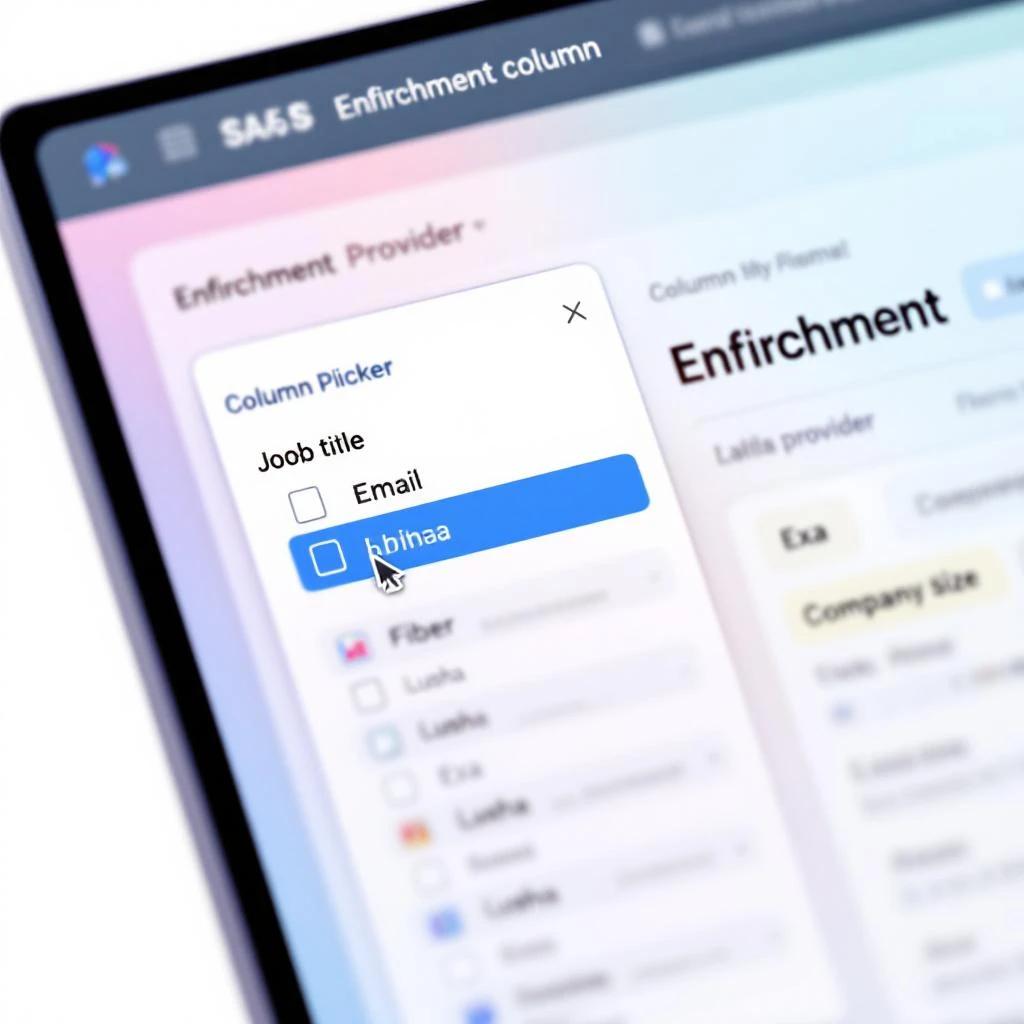
Think of it like building a custom dataset, column by column. You might want:
- Job titles and seniority from Lusha, because their role taxonomy matches your ICP definitions
- Company technographics from Fiber, because their tech stack detection is the most current
- Company descriptions and market positioning from Exa Websets, because AI-extracted summaries are richer than static database fields
Each column is a deliberate choice. You are not taking a provider's entire output and hoping it is good enough — you are selecting the best field from the best source for each data point that matters to your outreach.
This is the same philosophy that made Clay popular with data-savvy GTM teams. The difference is that MarketBetter connects enrichment directly to your audience builder, your outreach sequences, and your campaign orchestration — no export step, no integration middleware, no broken sync.
Credit Cost Estimation: No Surprises Before You Search
One of the quiet frustrations with enrichment tools is running a search and discovering after the fact that it consumed half your monthly credits. Especially when you are experimenting with filters or testing a new ICP definition, unpredictable costs make teams conservative — and conservative teams build small, incomplete audiences.
MarketBetter now shows you the estimated credit cost before you execute a search. You see the provider breakdown, the estimated number of records, and the credit impact — before you commit.
This changes how teams approach audience building:
- Experiment freely. Test narrow ICP definitions without worrying about burning credits on a bad filter combination.
- Compare provider costs. See that enriching 500 contacts through Provider A costs 200 credits while Provider B costs 350 — and decide based on both coverage and economics.
- Budget with confidence. Operations leaders can plan monthly enrichment spend against actual usage patterns, not rough estimates.
Transparency in credit costs sounds like a small feature. In practice, it removes the single biggest friction point that stops teams from building better audiences.
TAM Builder: Map Your Total Addressable Market at the Company Level
Individual contact enrichment is essential for outbound execution. But before you can build contact lists, you need to answer a bigger question: which companies should you be targeting in the first place?
The new TAM Builder lets you create company-level audiences that map your total addressable market. Define your criteria — industry, headcount, revenue range, technographics, geography, funding stage — and MarketBetter builds a company-level audience across all your enabled data providers.
This is not just a filter on a static database. The TAM Builder synthesizes results from Fiber, Lusha, and Exa to produce the most complete company universe possible. A company that appears in only one provider's database still gets included. Cross-provider matching ensures you are not double-counting companies that appear in multiple sources under slightly different names.
Once you have your TAM mapped at the company level, you can drill into any segment to build contact-level audiences for outreach. The workflow becomes:
- Define your market — company-level TAM with broad criteria
- Prioritize segments — filter and score companies by fit signals
- Build contact audiences — enrich specific segments with the right contacts for outreach
- Launch campaigns — move directly into sequenced outreach without leaving the platform
This top-down approach is how the best GTM teams operate. Instead of starting with a random list of contacts and hoping they are at the right companies, you start with the right companies and build precision contact lists from there.
Cross-Audience Overlap Checks: Stop Double-Tapping Your Prospects
Here is a scenario every outbound team has experienced: two SDRs, two different audiences, same prospect getting two different sequences in the same week. The prospect is annoyed. Your brand looks disorganized. Worse, the deal that was warming up just went cold because you spammed them.

MarketBetter now includes cross-audience overlap detection. Before you launch outreach on a new audience, you can check it against your existing active audiences to see exactly how many contacts overlap.
The overlap check shows you:
- Which contacts appear in multiple audiences — with details on which audiences they belong to
- What outreach they are already receiving — so you can decide whether to exclude them or adjust messaging
- Overlap percentages — giving you a quick read on whether two audiences are too similar to run simultaneously
This is not just a deduplication tool. It is an outreach coordination layer. When you are running five audiences across three SDRs, overlap detection is the difference between a coordinated GTM motion and a prospect experience that feels like spam.
For teams that have been managing this manually — exporting lists, running VLOOKUP in Excel, maintaining suppression spreadsheets — this replaces hours of weekly list hygiene with a single check before launch.
The New /chat Page: Conversational Audience Building
The entire audience builder has moved to a dedicated /chat page with a completely redesigned AI-powered interface. Instead of navigating through form fields and filter dropdowns, you can now build audiences through natural conversation.
Tell the AI what you are looking for: "I need VP-level marketing leaders at SaaS companies with 50-200 employees that use HubSpot and raised a Series A in the last 18 months." The AI translates your intent into the right combination of filters, provider selections, and enrichment columns — then shows you the estimated results and credit cost before executing.
This is not a gimmick bolted onto a traditional interface. The conversational approach fundamentally changes who can build sophisticated audiences. Previously, getting the most out of multi-provider enrichment required understanding each provider's data model, filter syntax, and enrichment options. Now, anyone on the team can describe their ideal customer and get a production-quality audience back.
The /chat page also maintains conversation context, so you can iterate. "Actually, expand that to include companies up to 500 employees." Or: "Remove anyone already in our Enterprise Q2 audience." Each refinement updates the audience in real time.
What This Means for Your GTM Stack
If you are currently using two or three different data tools and stitching results together manually, the math on consolidation is straightforward. Beyond the time savings — which are significant — there are three structural advantages to running multi-provider enrichment through a single platform:
Consistent identity resolution. When the same contact appears in Fiber and Lusha with slightly different data, MarketBetter resolves the identity and merges the best fields from each source. You get one clean record, not two conflicting ones.
Unified audience governance. Overlap checks, suppression rules, and outreach coordination work across all your audiences regardless of which provider sourced the data. You cannot get this when audiences live in separate tools.
Direct-to-outreach workflow. Enriched audiences flow directly into MarketBetter's campaign orchestration — email sequences, LinkedIn outreach, call tasks — without an export-import step. The gap between "audience built" and "outreach live" drops from hours to minutes.
The broader shift here is about data strategy. The best GTM teams in 2026 are not asking "which data provider should we use?" They are asking "how do we combine multiple providers to eliminate coverage gaps while keeping our workflow simple?" Multi-provider enrichment is the answer to that question.
Getting Started
Multi-provider enrichment is available now for all MarketBetter customers. Head to the new /chat page to start building audiences with Fiber, Lusha, and Exa Websets. If you are already using one of these providers, your existing credits and configuration carry over — just start selecting additional providers in the enrichment column picker.
For teams evaluating MarketBetter, book a demo to see multi-provider enrichment in action with your actual ICP criteria.
Related reading: