
Best B2B Buying Signal Tools for Sales Teams [2026]

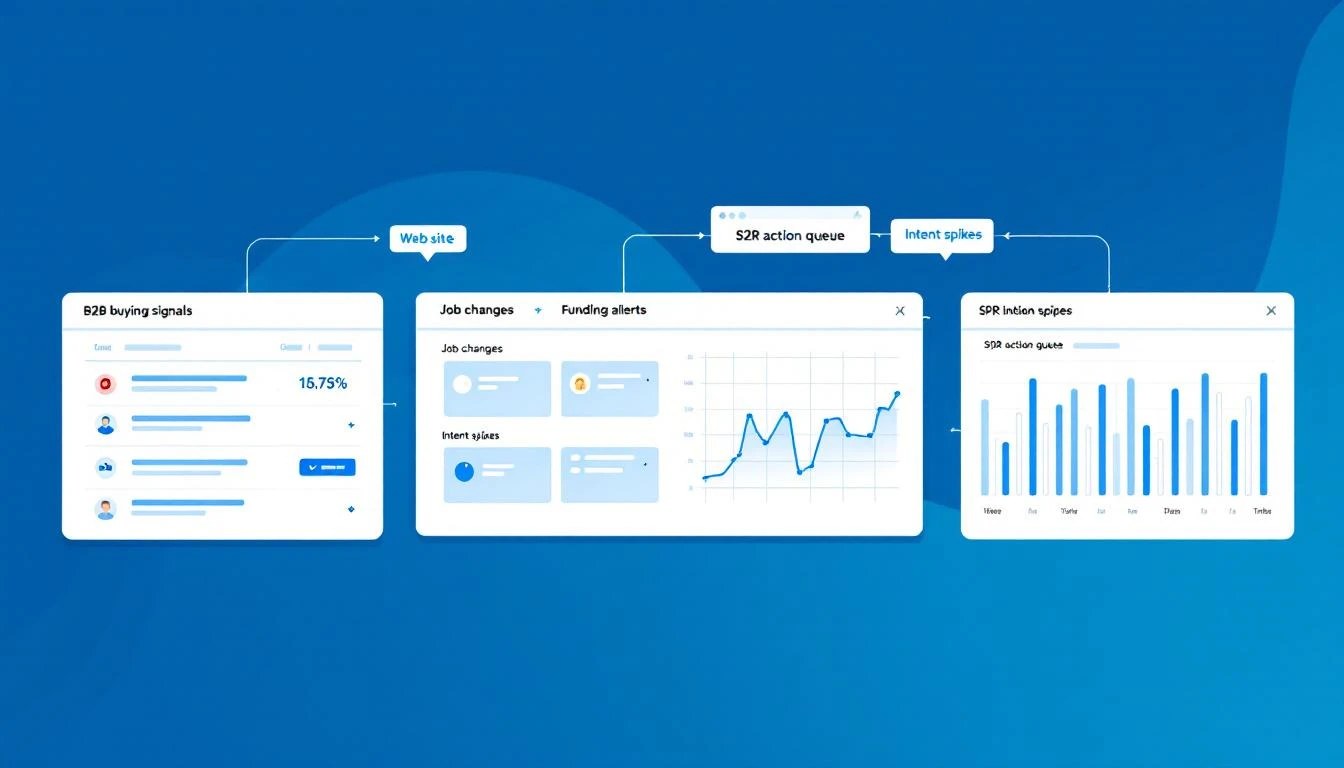
Your SDRs are working from static lists. Meanwhile, your best prospects are visiting your pricing page, hiring for roles you solve, and researching your competitors — right now. Without buying signal tools, your team misses these windows entirely.
Buying signal tools capture real-time indicators that an account is in-market: website visits, job changes, funding rounds, technology adoption, content consumption, and competitive research. The difference between a cold call and a warm outreach often comes down to whether you caught the signal in time.
We evaluated 12 platforms across signal types, data freshness, action layer, and total cost of ownership. Here's what actually works for SDR teams in 2026.
What Are B2B Buying Signals?
Buying signals are observable behaviors that indicate a company or contact is actively evaluating solutions in your category. They fall into several categories:
- First-party signals: Website visits, pricing page views, content downloads, chatbot interactions, demo requests
- Third-party intent signals: Research activity across publisher networks on topics relevant to your product
- Job change signals: When a champion or buyer moves to a new company (and might bring your tool with them)
- Firmographic signals: Funding rounds, hiring spikes, technology changes, company growth
- Engagement signals: Email opens, ad clicks, event attendance, social interactions
The best tools combine multiple signal types and — critically — tell your SDRs what to DO with those signals, not just show a dashboard of data.
How We Evaluated
| Criteria | What We Looked For |
|---|---|
| Signal Coverage | How many signal types (first-party, intent, job change, firmographic) |
| Data Freshness | Real-time vs. daily vs. weekly signal delivery |
| Action Layer | Does it just show signals or tell reps what to do next? |
| Integration Depth | CRM, email, dialer, Slack connectivity |
| Pricing Transparency | Can you find pricing without a demo? |
| SDR Workflow Fit | Built for reps or for data analysts? |
1. MarketBetter — Signals + SDR Playbook in One Platform
Best for: SDR teams that want signals converted into daily action items, not another dashboard to monitor.
MarketBetter doesn't just surface buying signals — it turns them into a daily SDR playbook. Website visitor identification, intent signals, email engagement, and chatbot interactions feed into a prioritized task list that tells each rep exactly who to contact, through which channel, and with what message.
Signal types covered:
- Website visitor identification (company-level)
- Chatbot engagement signals
- Email open/click/reply tracking
- Content download intent
- Conference attendee signals
- Champion job change tracking
What sets it apart: Most signal tools stop at "Company X is showing intent." MarketBetter goes further: "Call Sarah at Company X about their pricing page visit yesterday — here's a talk track based on what they viewed." The daily playbook eliminates the interpretation gap between signal and action.
Key capabilities:
- AI-powered daily SDR playbook with prioritized accounts
- Smart dialer for warm outbound calls
- AI chatbot that engages visitors in real-time
- Hyper-personalized email sequences triggered by signals
- Multi-channel orchestration (email + phone + LinkedIn)
- Conference scraper for event-based prospecting
Pricing: $99/user/month with full signal access. Standard plan at $1,500/month adds the SDR dashboard and expanded actions. No per-signal fees.
Integrations: Salesforce, HubSpot, major email providers, LinkedIn, Slack
2. Common Room — Community and Product Signal Aggregation
Best for: Product-led growth companies tracking community activity alongside traditional intent.
Common Room aggregates signals from community platforms (Slack, Discord, GitHub, Stack Overflow), product usage, social media, and traditional intent sources into unified account profiles. It's designed for companies where community engagement is a meaningful buying signal.
Signal types covered:
- Community activity (Slack, Discord, GitHub contributions)
- Product usage patterns
- Social media mentions and engagement
- Website visits (via integrations)
- Third-party intent data (via Bombora partnership)
Strengths: Unique community signal layer that no other platform offers. Strong for developer-focused companies where GitHub stars and Slack activity predict purchasing intent.
Limitations: The signal-to-action gap is real. Common Room shows you who's active but relies on your team to decide what to do. No built-in dialer, email sequencing, or automated playbook generation. You'll need additional tools to act on the signals.
Pricing: Free tier available. Team plan starts around $500/month. Enterprise pricing requires a demo.
3. UserGems — Champion Tracking and Job Change Signals
Best for: Teams with a strong customer base who want to re-engage buyers when they change jobs.
UserGems specializes in one signal type and does it exceptionally well: job changes. When your champion or power user moves to a new company, UserGems alerts your team so you can re-engage them before a competitor does. This "follow the buyer" motion generates some of the highest-converting outbound.
Signal types covered:
- Champion job changes (primary focus)
- Past-customer new-company alerts
- Hiring pattern signals
- Organizational changes
Strengths: The champion tracking data is among the most accurate in the market. The signal is inherently warm — you're reaching out to someone who already knows and used your product.
Limitations: Narrow signal coverage. If you need website visitor ID, intent data, or engagement tracking, you'll need additional tools alongside UserGems. Pricing reflects the premium positioning.
Pricing: Revv Up plan starts at $12,000/year for tracking up to 10,000 contacts. Cruise plan starts at $18,000/year for broader account coverage. Add-ons available for org charts and database cleanup.
4. Warmly — AI-Powered Website Visitor Orchestration
Best for: Teams focused primarily on website visitor identification with automated outreach.
Warmly identifies website visitors at the company and contact level, then uses AI agents to automate initial outreach. It combines visitor data with third-party intent signals from Bombora to prioritize accounts showing multiple buying indicators.
Signal types covered:
- Website visitor identification (company + contact level)
- Third-party intent data (Bombora)
- Social media signals
- CRM engagement history
Strengths: Strong visitor identification accuracy with the AI agent layer that can automate initial chat and email sequences. Good for teams that want hands-off top-of-funnel engagement.
Limitations: No smart dialer. No daily playbook that prioritizes and sequences actions for SDRs. The AI agent approach works for initial engagement but lacks the human-in-the-loop workflow that experienced SDR teams need. Limited conference and event signal coverage.
Pricing: Starts around $700/month. Enterprise tiers go significantly higher based on traffic volume and features.
5. 6sense — Enterprise Intent Data and ABM Orchestration
Best for: Large enterprise teams running sophisticated ABM programs with big budgets.
6sense uses AI to predict which accounts are in-market based on third-party intent signals, firmographic data, and engagement patterns. The platform assigns buying stage predictions and intent scores that marketing and sales teams use to orchestrate multi-channel campaigns.
Signal types covered:
- Third-party intent data (proprietary network)
- Buying stage predictions (Awareness → Decision)
- Technographic data
- Firmographic changes
- Advertising engagement
Strengths: The buying stage model is genuinely useful for large teams coordinating between marketing and sales. Predictive capabilities help prioritize accounts across massive TAMs. Strong ABM advertising integration.
Limitations: Enterprise pricing puts it out of reach for most SMB teams ($50,000-$100,000+/year). The platform requires significant setup and a dedicated RevOps resource. Intent data is aggregated at the account level — you still need contact data from another source to actually reach someone. The signal-to-action gap is wide: 6sense tells you an account is in-market but doesn't build your rep's daily task list.
Pricing: Starts around $50,000/year. Most implementations run $75,000-$120,000/year with full feature access. Contact-level data and advertising features are add-ons.
6. ZoomInfo — B2B Data + Intent Signal Layer
Best for: Teams that need contact data AND intent signals in one database.
ZoomInfo combines one of the largest B2B contact databases with intent data signals through their partnership with Bombora and their own browsing data. The platform lets you build prospect lists filtered by both firmographic criteria and active intent signals.
Signal types covered:
- Third-party intent data (Bombora + proprietary)
- Website visitor identification (via WebSights)
- Hiring signals
- Technology install data
- Funding and financial signals
Strengths: Unmatched contact database depth. The ability to filter by intent score alongside firmographic data means you can build highly targeted lists of contacts at in-market accounts. ZoomInfo Copilot adds AI-powered signal prioritization.
Limitations: Intent data is an add-on requiring Advanced or Elite tiers ($25,000-$40,000+/year). The platform is optimized for list-building, not daily SDR workflow management. You get data to work with, not a playbook to follow. Annual contracts with auto-renewal and significant price increases are common pain points in reviews.
Pricing: Base plans start around $15,000/year. Intent features require Advanced ($25,000+) or Elite ($40,000+) tiers. Per-credit pricing for enrichment and exports.
7. Bombora — The Intent Data Infrastructure Layer
Best for: Teams that want raw intent data to feed into existing CRM and sales tools.
Bombora is the intent data layer behind many platforms on this list. Their Data Co-op aggregates content consumption signals across 5,000+ B2B publisher websites to identify which companies are actively researching specific topics. Many platforms (ZoomInfo, 6sense, Common Room) license Bombora data.
Signal types covered:
- Third-party content consumption intent (primary)
- Topic surge scores
- Historical intent trends
Strengths: The largest consent-based B2B intent data co-op. Topic-level granularity lets you see exactly what subjects an account is researching. Clean API for feeding signals into any system.
Limitations: Pure data play — no workflow, no dialer, no email, no playbook. You need to build the action layer yourself. Company-level only; no contact-level identification. Pricing requires significant minimum commitment.
Pricing: Starts around $25,000/year for direct access. Volume-based pricing scales with account coverage.
8. Apollo.io — Affordable Data + Engagement Signals
Best for: Budget-conscious teams that need basic intent signals alongside a contact database and email sequencing.
Apollo combines a 200M+ contact database with buyer intent signals, engagement tracking, and built-in email sequencing. It's the most affordable option for teams that want signals and outreach tools in one platform.
Signal types covered:
- Buyer intent signals (via Bombora partnership)
- Email engagement tracking
- Website visitor identification (basic)
- Job change alerts
- Company news signals
Strengths: Incredible value for money. The free tier includes basic signals. Paid plans start at $49/user/month with intent data included at higher tiers. Built-in email sequencing means you can act on signals without switching tools.
Limitations: Intent data depth doesn't match 6sense or ZoomInfo. Contact data accuracy varies — heavy reliance on community-contributed data. No smart dialer (phone verification is a paid add-on). The platform tries to do everything, which means nothing is as deep as specialized tools.
Pricing: Free tier available. Basic: $49/user/month. Professional: $79/user/month. Organization: $119/user/month (intent data included at this tier).
9. Leadfeeder (now Dealfront) — Website Visitor Intent for European Markets
Best for: European companies that need GDPR-compliant website visitor identification.
Dealfront (formerly Leadfeeder + Echobot) identifies website visitors and combines them with European B2B data for prospecting. Strong GDPR compliance makes it the go-to for EU-headquartered teams.
Signal types covered:
- Website visitor identification
- European company database signals
- Web activity tracking
- CRM engagement correlation
Strengths: Best-in-class European data coverage and GDPR compliance. Simple setup with Google Analytics integration. Clean interface that doesn't overwhelm smaller teams.
Limitations: Primarily a visitor identification tool. No intent data, no job change tracking, no champion monitoring. North American data coverage is weaker than US-focused competitors. No built-in outreach tools — you need separate email and dialer platforms.
Pricing: Free tier (limited visitors). Paid plans from €99/month based on identified companies.
10. Cognism — GDPR-First Signals with Phone-Verified Data
Best for: SDR teams doing cold calling that need verified mobile numbers alongside intent data.
Cognism combines a phone-verified B2B contact database with Bombora intent data. Their Diamond Data verification process delivers 87%+ connect rates on mobile numbers — a significant advantage for phone-heavy SDR teams.
Signal types covered:
- Third-party intent data (via Bombora)
- Hiring signals
- Technology install changes
- Funding and financial signals
Strengths: Phone-verified contact data is genuinely differentiated. For SDR teams where phone outreach is primary, Cognism's connect rates save significant time. Strong European coverage with built-in GDPR compliance (DNC list checking, consent tracking).
Limitations: Intent data is Bombora-sourced (same as many competitors). No website visitor identification. No daily playbook or action prioritization — you get data, not workflow. Pricing is not publicly available and typically runs $15,000-$30,000/year.
Pricing: Not publicly listed. Reports suggest $15,000-$30,000/year depending on seat count and data volume.
11. LoneScale — Real-Time Job Change and Hiring Signals
Best for: Teams that want to automate outreach based on hiring and job change triggers.
LoneScale monitors hiring patterns and job changes to surface buying signals in real time. When a company starts hiring for roles your product serves, or when a champion changes jobs, LoneScale triggers automated sequences.
Signal types covered:
- Job change signals
- Hiring pattern alerts
- Technology adoption changes
- Company growth signals
Strengths: Real-time signal delivery (not batched weekly). Strong automation layer that connects signals directly to email sequences and CRM workflows. Clean, focused product that does a few things well.
Limitations: Narrow signal coverage — no website visitor ID, no third-party intent data, no engagement tracking. Useful as a complement to broader platforms, not as a standalone signal solution.
Pricing: Growth plan starts at $600/month. Enterprise pricing available for larger teams.
12. LeadIQ — Prospecting with Signal-Driven Prioritization
Best for: Individual SDRs who want signals embedded in their prospecting workflow.
LeadIQ captures contact data from LinkedIn Sales Navigator and enriches it with buying signals like job changes, company news, and technology changes. The platform is built for individual rep productivity rather than team-level orchestration.
Signal types covered:
- Job change alerts
- Company news and trigger events
- Technology changes
- LinkedIn engagement signals
Strengths: Tight LinkedIn Sales Navigator integration. AI-powered email personalization that references signals in outreach. Affordable per-seat pricing.
Limitations: Individual rep tool, not a team-level signal platform. No website visitor identification. No daily playbook or multi-channel orchestration. Signal depth doesn't match enterprise platforms.
Pricing: Free tier available. Essential: $36/user/month. Pro: $79/user/month. Enterprise pricing available.
Buying Signal Tool Comparison Matrix
| Tool | Website Visitor ID | Intent Data | Job Change | Action Layer | Starting Price |
|---|---|---|---|---|---|
| MarketBetter | ✅ | ✅ | ✅ | Full Playbook | $99/user/month |
| Common Room | Via integration | ✅ (Bombora) | ❌ | Dashboard only | $99/user/month |
| UserGems | ❌ | ❌ | ✅ (Best) | Alerts + CRM | $12,000/yr |
| Warmly | ✅ (Best) | ✅ (Bombora) | ❌ | AI Agent chat | ~$700/mo |
| 6sense | ❌ | ✅ (Best) | ❌ | ABM orchestration | ~$50,000/yr |
| ZoomInfo | ✅ (WebSights) | ✅ (Bombora+) | ✅ | Data export | $15,000/yr |
| Bombora | ❌ | ✅ (Source) | ❌ | API/Data only | ~$25,000/yr |
| Apollo | Basic | ✅ (Bombora) | ✅ | Built-in sequences | Free / $49/user |
| Dealfront | ✅ | ❌ | ❌ | Dashboard only | €99/mo |
| Cognism | ❌ | ✅ (Bombora) | ✅ | Data + verify | ~$15,000/yr |
| LoneScale | ❌ | ❌ | ✅ | Automation | $600/mo |
| LeadIQ | ❌ | ❌ | ✅ | LinkedIn capture | Free / $36/user |
How to Choose the Right Buying Signal Tool
By Team Size
Solo SDR or small team (1-5 reps): Apollo or LeadIQ. You need affordable access to signals without enterprise overhead. Apollo's free tier lets you start immediately.
Growing SDR team (5-15 reps): MarketBetter or Warmly. You need a platform that turns signals into workflow, not just data. MarketBetter's daily playbook eliminates the "what do I do with this data?" problem.
Enterprise team (15+ reps): 6sense or ZoomInfo for signal coverage, but pair with an execution platform for the action layer. Or MarketBetter's Enterprise plan for an all-in-one approach.
By Primary Signal Need
Website visitors: MarketBetter, Warmly, or Dealfront (EU) Intent data: 6sense, Bombora, or ZoomInfo Job changes: UserGems or LoneScale All-in-one: MarketBetter or Apollo
By Budget
Under $500/month: Apollo (paid tier) or LeadIQ $500-$2,000/month: MarketBetter (best signal-to-action ratio) $2,000-$5,000/month: Warmly or Common Room + add-ons $5,000+/month: 6sense, ZoomInfo, or enterprise stacks
The Signal-to-Action Gap: Why It Matters
Most buying signal tools have a fundamental problem: they show you data but don't tell you what to do with it. Your SDR sees that Company X has high intent — great. Now what? Which contact? Which channel? What message? When?
This gap is where deals die. Signals decay fast. A website visit is warm for 24 hours, not two weeks. A job change is actionable for 30 days, not six months. If your team can't move from signal to outreach within hours, you're leaving pipeline on the table.
The tools that bridge this gap — converting raw signals into prioritized, channel-specific, personalized outreach — deliver dramatically higher ROI than platforms that just surface data and leave the interpretation to already-overloaded SDRs.
That's why MarketBetter built the SDR playbook. Signals are inputs. Actions are outputs. Your SDRs shouldn't be data analysts.
Try our AI Lead Generator — find verified LinkedIn leads for any company instantly. No signup required.
Bottom Line
The buying signal tool you choose should match your team's execution capability. If you have a mature RevOps team that can build workflows and interpret data, platforms like 6sense or ZoomInfo give you raw signal power. If your SDRs need a daily action plan built from signals, MarketBetter closes the gap between insight and execution.
The worst outcome isn't picking the wrong tool — it's paying for signals and never acting on them fast enough to matter.
Ready to turn buying signals into booked meetings? See MarketBetter in action →