
How Benefits Distribution Companies Scale Their SDR Team with AI-Powered Territory Signals [2026]

Benefits distribution is one of the most relationship-driven corners of B2B sales. You're not selling a tool that gets deployed and forgotten — you're selling a platform that touches every employee in an organization, handles sensitive personal data, and sits at the intersection of HR, payroll, compliance, and employee experience. The sales cycle is long, the stakeholders are many, and the difference between a good lead and a waste of time often comes down to knowing exactly which type of deal you're pursuing before you ever pick up the phone.
And yet, most benefits distribution companies still run their outbound motion like it's 2019: a couple of SDRs splitting accounts alphabetically, running the same sequences regardless of whether they're targeting a 50-person startup or a 5,000-employee enterprise, and hoping that volume eventually produces pipeline.
This is the story of how one benefits distribution platform transformed its SDR operation — scaling from two reps to three, defining six distinct ICP deal types, implementing territory-based routing by US state, and building a pipeline machine powered by AI signals instead of gut instinct.
The Benefits Distribution Sales Problem: Six Deals, One Playbook
Here's what makes selling benefits distribution software uniquely challenging: not all deals are the same deal.
A mid-market employer looking for a benefits administration platform has fundamentally different needs, buying triggers, sales cycles, and decision-makers than a large enterprise evaluating a consolidated benefits marketplace. A broker partnership deal looks nothing like a direct-to-employer sale. A renewal expansion is a different motion than net-new acquisition.
The company we're looking at had identified six distinct ICP deal types — ranging from small-group employer direct sales to enterprise broker channel partnerships. Each type had different:
- Decision-makers (HR Director vs. VP of Total Rewards vs. Benefits Broker)
- Sales cycle length (30 days for small group, 6+ months for enterprise)
- Buying triggers (open enrollment season, broker RFP cycles, compliance changes)
- Competitive displacement opportunities (legacy platforms vs. manual spreadsheet operations)
The problem? Their two SDRs were running the same outreach playbook for all six. A sequence designed for a 200-person company's HR manager was being sent to enterprise VP-level contacts at organizations with 10,000+ employees. The messaging was generic enough to be inoffensive — and too generic to convert.
The result: reply rates under 2%, demo-to-opportunity conversion around 15%, and a frustrating sense that they were working hard but not working smart.
Why Traditional SDR Models Break in Benefits Distribution
Before we get into what changed, it's worth understanding why the standard SDR playbook fails so specifically in this vertical.
1. Territory Complexity Is Real
Benefits distribution is heavily influenced by state-level regulatory differences. A company headquartered in California has different compliance requirements than one in Texas. Small-group market rules vary by state. Some states mandate specific coverage types. SDRs who don't understand the regulatory nuances of their territory sound uninformed at best and untrustworthy at worst.
When you split accounts alphabetically — or worse, round-robin them randomly — you get SDRs calling into states they don't understand, referencing compliance frameworks that don't apply, and missing regional buying patterns entirely.
2. Seasonality Creates Narrow Windows
Benefits distribution has one of the most seasonal sales cycles in B2B. Open enrollment drives purchasing decisions for the majority of employer-direct deals. Broker RFP cycles cluster in Q2 and Q3. Miss the window, and you're waiting 12 months for the next opportunity.
Generic outreach doesn't account for this. A signal-blind SDR might spend February hammering accounts that won't make a decision until August — while ignoring accounts in active evaluation right now because they don't know what "active evaluation" looks like for this vertical.
3. The Broker Channel Adds a Layer
Many benefits distribution companies sell both direct-to-employer and through broker partnerships. These are fundamentally different motions:
- Direct: You're selling to HR. The pitch is efficiency, employee experience, compliance.
- Broker: You're selling to insurance brokers. The pitch is commission management, client retention, platform differentiation.
Running both through the same sequence with the same messaging is like using a screwdriver as a hammer. It technically makes contact, but it doesn't drive anything home.
What Changed: Signal-Based Selling with Territory Intelligence
The transformation happened in three phases, and the results compounded over about 90 days.
Phase 1: Territory-Based Routing by US State
The first change was structural: every account was assigned to an SDR based on geography, not alphabet.
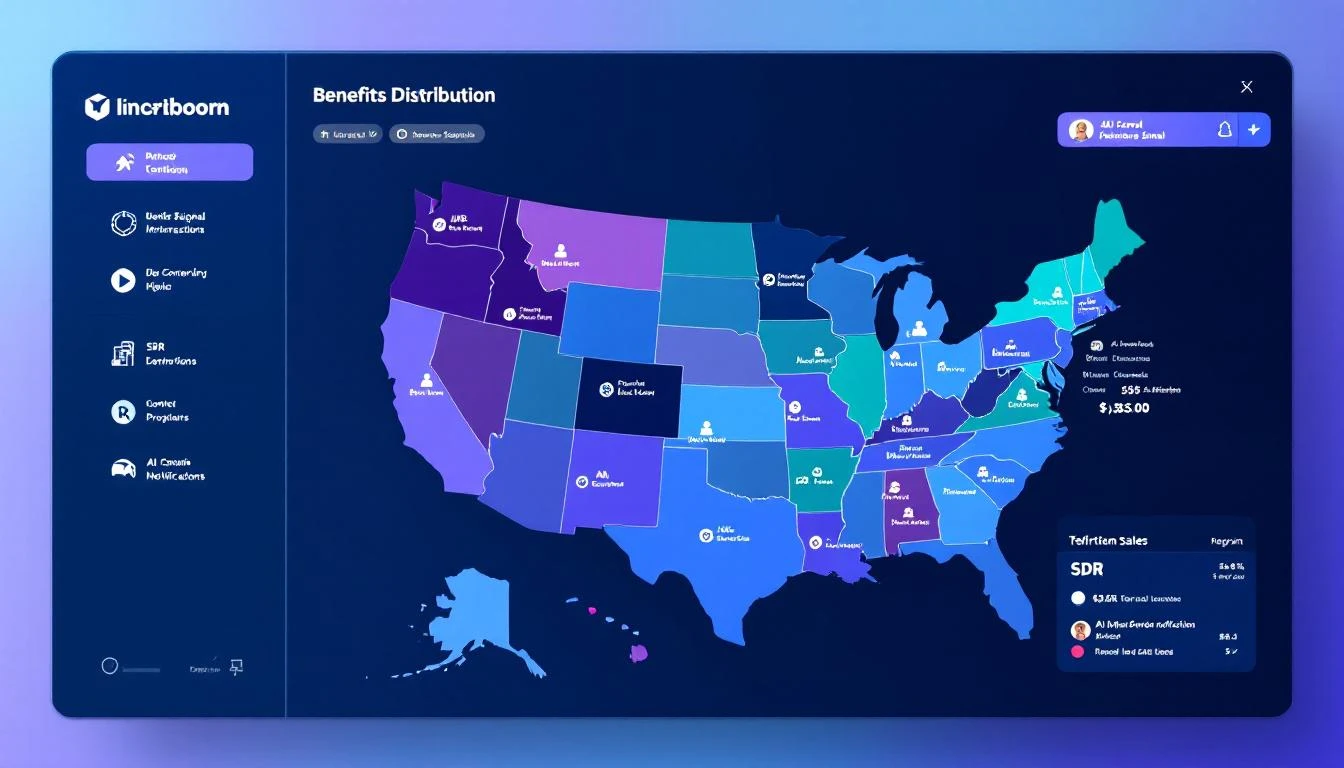
With the addition of a third SDR, the company carved the US into three territory zones — roughly West, Central, and East — with each rep owning specific states. This wasn't arbitrary; it was based on:
- Regulatory clustering (states with similar benefits compliance requirements grouped together)
- Existing customer density (SDRs inherited territories where the company already had reference customers)
- Time zone alignment (so reps could make calls during business hours without scheduling gymnastics)
The territory-based routing ensured that when a signal fired — a website visit, a champion job change, an intent spike — it went to the SDR who actually knew that market. A visitor from a Texas-based employer hit the SDR who understood Texas small-group regulations, not whoever happened to be next in the round-robin.
Phase 2: Six ICP Deal Types, Six Outreach Playbooks
With territories defined, the team built distinct outreach sequences for each of their six ICP deal types:
- Small-group employer direct (under 200 employees) — short cycle, HR manager, focus on simplicity and compliance
- Mid-market employer direct (200–2,000 employees) — VP of HR or Total Rewards, focus on consolidation and employee experience
- Enterprise employer direct (2,000+ employees) — C-suite and VP-level, focus on scale, integration, and ROI
- Broker partnership — independent — solo brokers or small agencies, focus on client retention and technology differentiation
- Broker partnership — agency — large brokerage firms, focus on commission management and enterprise features
- Renewal expansion — existing customers approaching open enrollment, focus on upsell and cross-sell
Each playbook had different:
- Email templates (language matched to the persona and deal type)
- Call scripts (objection handling specific to the buyer's context)
- Timing cadence (aligned to the buying cycle for that deal type)
- Content assets (case studies and ROI calculators relevant to the segment)
The key insight: personalization at this level isn't about inserting {first_name} into a template. It's about speaking to the specific business problem each buyer type actually has.
Phase 3: AI-Powered Signal Layer
The structural changes (territories + ICP playbooks) were necessary but not sufficient. The multiplier came from layering AI-powered buying signals on top.
Here's what the signal stack looked like:
Website Visitor Identification Using visitor identification technology, the company could see exactly which employers and brokers were visiting their website — and which pages they were hitting. A broker landing on the "Partner Program" page is a fundamentally different signal than an HR director reading a "Benefits Administration ROI Calculator" blog post.
Each identified visitor was automatically routed to the correct SDR based on territory, then matched to the appropriate ICP playbook based on company size and visitor behavior.
Champion Job Change Tracking Benefits distribution buyers move jobs frequently — and when a champion moves to a new company, they often bring their technology stack with them. The system tracked job changes across all contacts in the CRM and flagged when a former customer or engaged prospect landed at a new organization.
These signals were gold: a warm intro to someone who already knows and trusts the product, at a company that's likely evaluating alternatives during the transition.
Open Enrollment Timing Signals The most vertical-specific signal: tracking when target accounts were approaching open enrollment season based on publicly available renewal dates, job postings for benefits coordinators, and HR conference attendance. SDRs could see which accounts were 60–90 days from decision-making and prioritize accordingly.
Intent Signals from Content Engagement Beyond website visits, the system tracked engagement with the company's content marketing — downloads of compliance guides, views of comparison pages, engagement with demand generation content. High-intent behaviors triggered immediate outreach from the territory-assigned SDR.
The Daily Playbook: How It Actually Works
Here's what a typical morning looked like for each SDR after the transformation:
8:00 AM — Open the daily playbook Instead of opening a CRM and deciding who to call, each SDR opens a prioritized task list. The AI-powered daily playbook has already sorted every signal from overnight into a ranked list:
- Hot signals first: Website visitors who hit the pricing page + match an ICP deal type
- Champion moves: Former buyers who just changed companies — within the SDR's territory
- Engagement sequences: Contacts who opened 3+ emails in the last week
- Seasonal priorities: Accounts approaching open enrollment in the next 60 days
- New territory accounts: Fresh companies assigned from enrichment that match the ICP
8:15 AM — Work the hot signals The SDR clicks into the first signal — a 1,500-employee employer in Ohio (Central territory) that had three visitors on the platform comparison page yesterday. The system has already identified the ICP deal type (mid-market employer direct), pulled the matching sequence, and suggested a call script focused on consolidation and employee experience.
9:00 AM — Champion follow-up A former buyer who left a current customer just started as VP of Total Rewards at a 3,000-employee company in the SDR's territory. The system flags this as a "warm re-engagement" — the SDR calls with a personalized reference to their previous experience with the product.
10:00 AM — Sequence management The SDR reviews active sequences across all six deal types, pausing any that have gone cold and advancing any where engagement signals suggest readiness for the next touch.
This is the difference between signal-based selling and traditional outbound: every action is informed by data, every conversation is relevant to the buyer, and no time is wasted on accounts that aren't showing intent.
Results After 90 Days
The numbers told the story:
| Metric | Before | After 90 Days |
|---|---|---|
| SDR headcount | 2 | 3 |
| Reply rate | 1.8% | 6.2% |
| Demo-to-opportunity conversion | 15% | 38% |
| Qualified pipeline (monthly) | $120K | $380K |
| Average deal cycle (small group) | 45 days | 28 days |
| Territory coverage | ~60% of target states | 100% |
The most striking number: qualified pipeline more than tripled while only adding one SDR. The efficiency gain came entirely from better routing, better messaging, and better signal intelligence.
The deal cycle compression was equally significant. When SDRs reached out at the right moment (approaching open enrollment, champion just moved, active website research), conversations started further down the funnel. Prospects didn't need the "why benefits technology matters" pitch — they were already researching solutions. The SDR's job shifted from creating awareness to facilitating evaluation.
What Benefits Distribution Companies Should Do Now
If you're running an SDR team in the benefits distribution or HR tech space, here's the playbook:
1. Define Your ICP Deal Types Before You Hire
Don't add SDR headcount until you know exactly which deal types you're pursuing. Most benefits companies have at least three to four distinct motions (employer direct by size + broker channel). Map them out, build separate sequences for each, and only then determine how many reps you need and how to divide territories.
2. Route by Territory, Not Round-Robin
State-level regulatory knowledge matters in this vertical. Your SDRs should own geographic territories they can deeply understand — compliance nuances, regional broker networks, local conference circuits. The right SDR tools make territory-based routing automatic.
3. Layer Signals on Top of Structure
Structure (territories + ICP types) is the foundation. Signals (visitor ID, champion tracking, intent data) are the intelligence layer that tells your SDRs where to focus. Neither works well without the other. Territories without signals mean your reps still don't know who's actually in-market. Signals without territories mean hot leads go to reps who don't know the market.
4. Align Outreach to Open Enrollment Cycles
This is the single biggest timing advantage in benefits distribution sales. If you know when target accounts are entering their evaluation window, you can be the first vendor in the conversation instead of the fifth. Track renewal dates, monitor job postings for benefits administration roles, and time your sequences to arrive 60–90 days before decision deadlines.
5. Don't Sleep on Champion Tracking
HR and benefits leaders change jobs frequently. A VP of Total Rewards who loved your platform at their last company is your warmest possible lead at their new one. Intent data and champion tracking should be running in the background constantly, flagging every job change across your CRM contact database.
6. Measure by Deal Type, Not Just Overall
Your small-group direct motion will have different conversion rates, cycle times, and revenue per deal than your enterprise broker channel. If you're measuring everything in one bucket, you can't optimize anything. Break your metrics down by ICP deal type and territory — that's where the insights hide.
The Bottom Line
Benefits distribution companies don't need more SDRs. They need smarter SDRs working a smarter system. Territory-based routing ensures every rep owns a market they understand. ICP deal type segmentation ensures every conversation is relevant. And AI-powered signals ensure every outreach happens at the right moment.
The company we profiled went from two reps running generic sequences to three reps running six precision playbooks — and tripled their qualified pipeline in 90 days. They didn't hire an army. They didn't buy an expensive data vendor. They built a system where signals, structure, and specialization compound on each other.
If you're in benefits distribution, HR tech, or any vertical with complex deal types and territory dynamics, the question isn't whether to adopt signal-based selling. It's how fast you can implement it before your competitors figure it out.
Ready to see how AI-powered signals and territory routing can transform your benefits distribution sales pipeline? Book a demo with MarketBetter and see your first visitor intelligence report in under 10 minutes.