
Auto dialer programs: Boost Sales with Smarter Dialing & CRM
Auto dialer programs are software that automatically dials phone numbers for your sales team, connecting them only when a live human picks up. This simple change gets rid of the soul-crushing, time-wasting task of manual dialing and lets reps do what they do best: talk to people.
How Auto Dialer Programs Supercharge Your Sales Workflow
Picture your best sales reps, burning hours every day listening to dial tones, hitting voicemails, and then pecking away at their keyboards to log the outcome. It's a massive waste of talent. Every minute they spend on that busywork is a minute they aren't actually selling.
Modern auto dialer programs are the cure for this common sales headache. Think of them as a smart assistant for your team.
At its core, the value is dead simple: the software automates the entire dialing process. No more looking up a number, fumbling to type it in, and then waiting. This one tweak has a huge domino effect, often letting a single rep make three to five times more calls every single day. More calls mean more conversations, and more conversations are the fuel for a healthy pipeline.
From Manual Drudgery to Automated Efficiency
The jump from manual dialing to using an auto dialer is like switching from a hand drill to a power drill. Sure, both can make a hole, but one is ridiculously more efficient and lets you build things you couldn't before.
Here's a direct comparison of a rep's day with and without an auto dialer:
| Daily Task | Manual Dialing Workflow | Auto Dialer Workflow |
|---|---|---|
| Placing a Call | Look up number > Type it in > Wait for ring/voicemail. | Click a button > Dialer connects you to a live person. |
| Call Logging | Switch to CRM > Find record > Type notes > Select outcome. | Log outcome with one click > All data syncs automatically. |
| Downtime | Significant time wasted between calls. | Near-zero downtime; the next call is dialed instantly. |
This isn't just a small tweak; it's a fundamental change in how a sales team operates. To see how these dialers fit into the bigger picture, it's worth exploring the different types of best outbound call center software available today.
The real power of an auto dialer isn't just about speed. It's about creating a consistent, measurable, and scalable outbound process. It turns the art of cold calling into a science.
Quick Benefits of Auto Dialer Programs by Role
This isn't just a tool for reps. When you automate the dialing process, everyone from the front lines to the C-suite sees the benefits. It creates a ripple effect of efficiency and visibility across the entire sales organization.
| Role | Primary Benefit |
|---|---|
| Sales Rep | More time talking to prospects, less time on manual tasks, leading to higher commissions. |
| Sales Manager | Clearer visibility into team activity, better coaching opportunities based on real data. |
| Sales Leader (VP/CRO) | More predictable pipeline generation and accurate forecasting based on call metrics. |
| RevOps | Cleaner CRM data, easier reporting, and a more streamlined sales tech stack. |
Ultimately, a good dialer aligns the whole team around a more productive and data-driven process, making everyone's job a little easier and a lot more effective.
The Modern Approach: In-CRM Dialing
The best auto dialer programs today aren't clunky, standalone apps. They plug directly into the CRMs your team already lives in, like Salesforce and HubSpot.
This in-CRM approach is a game-changer. Reps can click-to-call, log call outcomes, and jump to the next task without ever toggling between windows. This seamless workflow is what separates tools that get adopted from those that just gather dust.
The market is voting with its dollars on this kind of smart automation. The global auto dialer market, valued at USD 1.5 billion, is on track to hit USD 3.0 billion by 2033. It’s clear that businesses are doubling down on tools that make their sales teams more productive.
Choosing Your Dialing Mode for Maximum Impact
Picking the right auto dialer isn't a one-size-fits-all kind of deal. The best choice hangs entirely on your sales motion, how good your contact list is, and what you’re trying to achieve with your outbound campaign. Think of it like a toolbox: you wouldn't grab a sledgehammer to hang a picture frame.
Different dialing modes are built to optimize for one of two things: sheer call volume or the quality of the conversation. Understanding that trade-off is the first real step toward building a sales machine that actually works.
Let's break down the four core dialing modes every sales leader should have in their back pocket.
Preview Dialer: The Researcher's Tool
The Preview Dialer is the most controlled and methodical of the bunch. It’s like having a dedicated research assistant for your reps, serving up a contact's entire record before the call is ever placed.
That pause is gold. It gives the rep a crucial window to scan notes, check past CRM interactions, and nail their opening line. This mode is perfect for complex B2B sales where every conversation is high-value and context is king.
- Best For: Strategic outbound, account-based sales, and any follow-up where personalization makes or breaks the deal.
- Downside: It’s the slowest of the auto dialer programs. You're trading volume for quality, plain and simple.
Power Dialer: The Workhorse
A Power Dialer is all about efficiency without throwing agent control out the window. The second a rep hangs up, the dialer is already ringing the next number on the list. No preview, no delay—just a seamless flow from one call to the next.
This mode is built for teams that need to churn through a list but still want a live agent on every single connected call. It kills the dead time spent manually dialing and waiting for an answer, keeping reps locked in and productive.
This little flowchart helps clarify when an auto dialer really makes sense for a team.
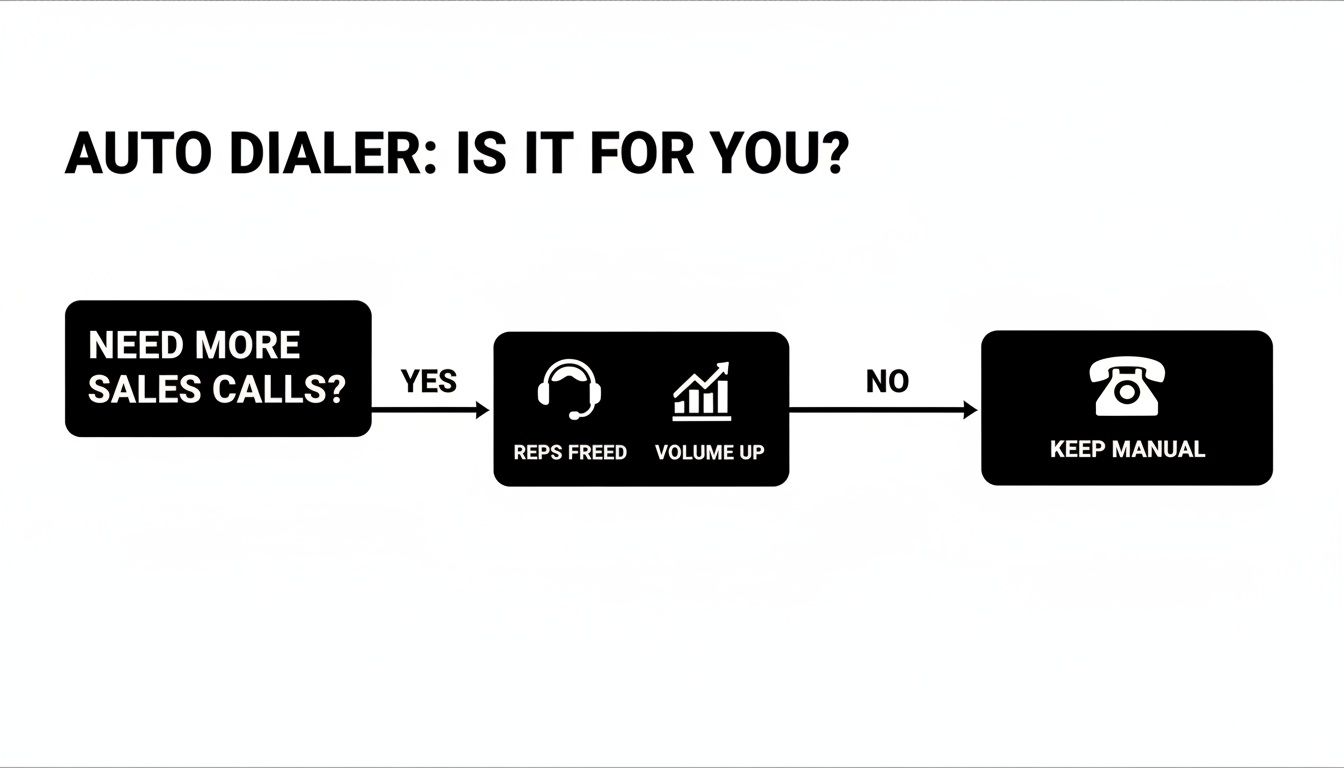
As you can see, if the goal is just to make more calls, an auto dialer frees up reps to do exactly that.
Progressive Dialer: A Smart Balance
The Progressive Dialer is a close cousin to the Power Dialer, but with one critical tweak. It only dials the next number once it confirms an agent is actually free and ready. This simple change guarantees zero risk of dropped calls—that awkward moment when a prospect answers to dead air because no rep was available.
It strikes a fantastic balance between the speed of a power dialer and the quality control of a preview dialer. For a ton of sales teams, this is the sweet spot between high volume and a good customer experience.
Predictive Dialer: The Assembly Line
The Predictive Dialer is the undisputed champ of high-volume outreach. It’s built for one thing: pure, unadulterated speed. Using an algorithm, it dials multiple numbers at once for each available agent, essentially predicting when someone is about to pick up. The whole point is to have a live person on the line the very second a rep becomes free, slashing idle time to almost nothing.
This mode is an absolute powerhouse for B2C campaigns, lead qualification, or any time you need to blitz through a massive contact list.
But that speed comes with a calculated risk. If two people answer at the same time, the system has to drop one of the calls. Those "abandoned calls" can damage your brand's reputation and create compliance headaches if you're not careful.
Still, the market for these intelligent dialers is exploding. The predictive dialer market, a brainy subset of auto dialer programs, is forecasted to jump from USD 3.12 billion to USD 6.1 billion by 2034. These systems are getting smarter, helping teams crush their numbers. If you want to dig into the numbers, you can learn more about these predictive dialer findings.
Comparing Your Options: An Actionable Guide
So, which one is right for you? It all comes down to matching the tool to the job. A high-velocity B2C team has completely different needs than a strategic B2B account executive.
Use this table to make a quick decision based on your team's primary goal:
| Dialer Mode | Ideal Use Case | Pros | Cons | Actionable Advice: |
|---|---|---|---|---|
| Preview | High-value, complex B2B sales | Maximum personalization, higher quality conversations. | Slowest pace, lowest call volume. | Choose this if your reps need to research each contact for 2+ minutes before calling. |
| Power | General B2B/B2C outreach | Increases efficiency, no dropped calls, good balance. | No time for pre-call research. | Choose this for high-velocity teams where every call needs a live agent, but minimal prep is required. |
| Progressive | Quality-focused outbound | Efficient, 100% no dropped calls, good agent experience. | Slightly slower than a power dialer. | Choose this if you prioritize customer experience above all else and cannot risk dropped calls. |
| Predictive | High-volume B2C campaigns | Highest possible call volume, maximum agent talk time. | Risk of dropped calls, potential compliance issues. | Choose this only for large teams working low-value leads where maximizing agent talk time is the single most important metric. |
Once you get these distinctions, you can pick an auto dialer program and tune it to perfectly match your sales strategy. That’s how you drive real impact and get results you can actually measure.
What to Look For: The Must-Have Features of a High-Performing Sales Dialer
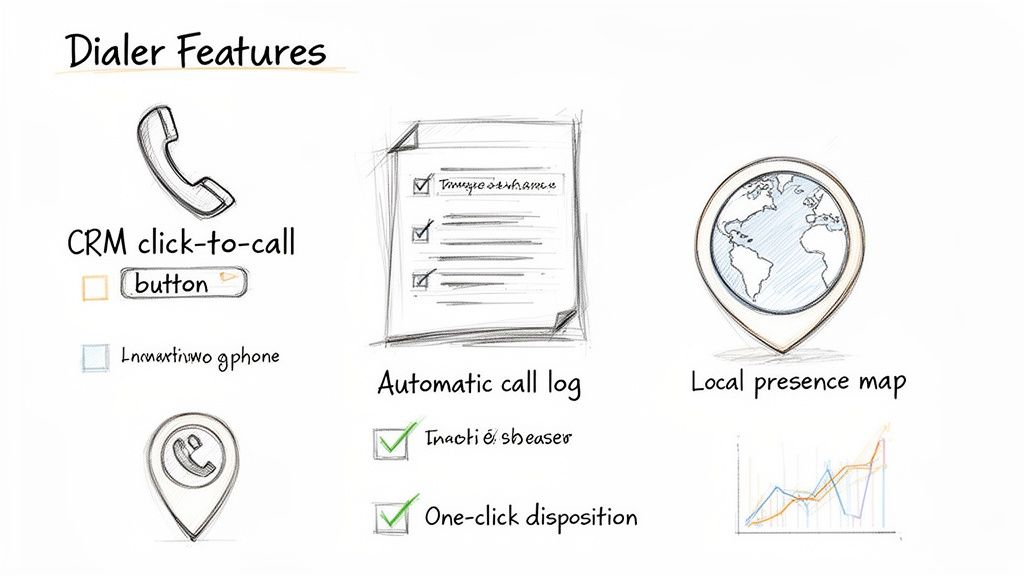
Knowing the different dialing modes is a great start, but the specific features baked into auto dialer programs are what really separate a productivity engine from a workflow nightmare. A good sales dialer does a whole lot more than just place calls; it's designed to obliterate the tiny, soul-crushing tasks that bleed a rep's day dry.
Think of it like this: a basic dialer gets you on the highway. A high-performing one gives you cruise control, GPS, and lane assist. It anticipates what you need and handles the boring stuff so you can just focus on driving.
Let’s get into the non-negotiable features you should be looking for.
Click-to-Call Functionality
This one is table stakes. Click-to-Call is the ability for a sales rep to click any phone number inside their CRM—whether it's on a contact record, a lead list, or an account page—and have the dialer instantly start the call. It’s a simple concept with a massive impact.
Without it, your team is stuck in the copy-paste-dial routine. It’s not just slow; it's a breeding ground for misdials and frustration. The entire point is to keep your team living inside their main system, not bouncing between browser tabs.
Action Step: When you're evaluating a dialer, don't just ask if it has Click-to-Call. Ask them to show you a live demo from the exact spot in your CRM your team works from most (like a Salesforce Contact record). You're looking for a seamless, native, one-click experience. Anything less is a compromise.
Fully Automated Call Logging
This is where a lot of auto dialer programs trip up. A truly great dialer doesn’t just place the call; it meticulously logs every single detail back to the CRM without the rep having to lift a finger. For any RevOps or sales leader who relies on accurate data, this is a game-changer.
The difference is night and day:
| Feature Aspect | A Legacy Dialer | A Modern, In-CRM Dialer |
|---|---|---|
| Call Activity | Rep has to manually log that a call was even made. | Every dial, connection, and call duration is logged automatically. |
| Call Outcome | Rep types notes and picks a disposition from memory. | Offers one-click buttons that automatically update CRM fields. |
| Data Accuracy | Riddled with human error, forgotten logs, and messy data. | 100% accurate activity data becomes the single source of truth for reporting. |
Automated logging transforms messy, unreliable activity data into a strategic asset you can actually use for forecasting and coaching. It's the plumbing that ensures your follow-up strategy doesn't spring a leak, which is everything for lead nurturing. You can see this in action by checking out our playbook on how to build a system where you never miss a follow-up again.
Local Presence Dialing
Let's be honest, have you ever ignored a call from a random, out-of-state number? Of course you have. Your prospects do, too. Local Presence is a feature that automatically shows a local area code on the prospect's caller ID, even if your rep is calling from across the country.
This simple tweak can boost connection rates by as much as 300%. It creates instant familiarity and breaks down that initial wall of skepticism, making people far more likely to pick up the phone. It's easily one of the highest-impact features you can add to any outbound campaign.
One-Click Call Dispositions
So the call ends. What happens next? A great dialer makes this step instant. One-click dispositions let a rep click a single button—like "Left Voicemail," "Meeting Set," or "Not a Fit"—to log the outcome and trigger the next step.
This does two incredibly important things:
- It Saves Reps Time: It replaces frantic typing with a single click, getting them onto the next call in seconds.
- It Structures Your Data: It guarantees that outcomes are logged consistently, making it dead simple to run reports and figure out which call results are most common.
These aren't just shiny bells and whistles. They are the core parts of an efficient sales machine, turning a simple dialing tool into a powerful engine for productivity and clean, reliable data.
Why Seamless CRM Integration Is Non-Negotiable
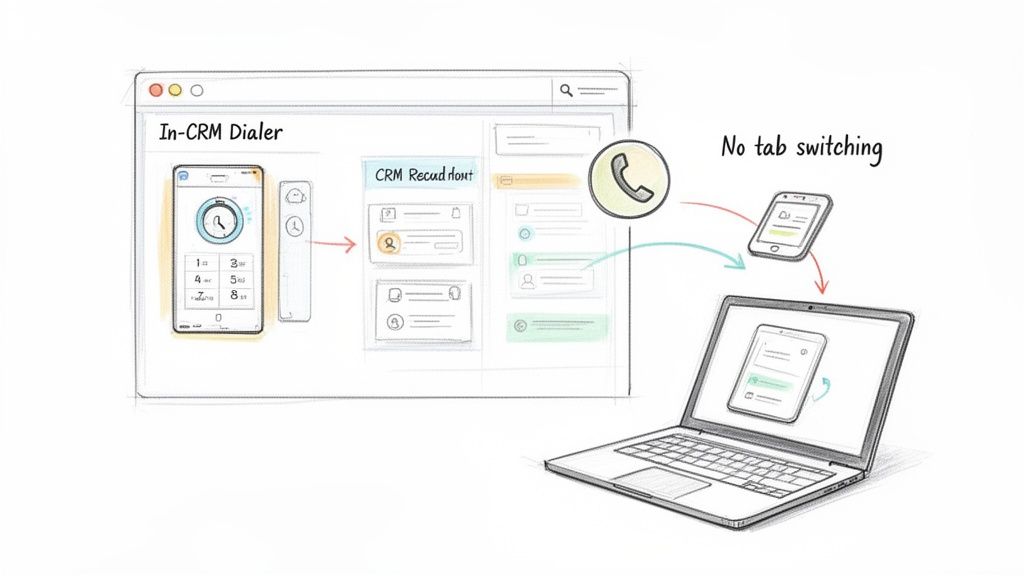
Let's be blunt: an auto dialer that lives outside your CRM is a recipe for disaster. It creates a clunky, disjointed workflow that forces your reps to constantly jump between browser tabs—one for the dialer, one for your system of record. This isn't just a minor annoyance; it's a productivity killer that guarantees your team will hate using it.
The single most critical factor for getting any value out of a dialer is how deeply it connects to your CRM. When reps have to leave their primary workspace to make calls, you create friction, data gets lost, and you lose sight of what's actually happening on the front lines. The whole thing becomes a chore that reps will find any excuse to avoid.
A truly great dialer doesn't feel like a separate tool at all. It should feel like a natural part of your CRM, embedded right where your team already works—on lead, contact, and account records.
The Hidden Cost of Context Switching
Every time a rep flips from their CRM to a standalone dialer, a little bit of focus dies. They find the contact in one system, switch to the other, place the call, then have to remember to tab back and log everything. This constant back-and-forth, known as context switching, is a massive drain on mental energy.
Studies have shown it can take over 20 minutes for someone to fully get their head back in the game after an interruption. A tab switch might seem small, but add it up over dozens of calls a day, and the effect is staggering. It leads to frustration, burnout, and a huge drop in the number of quality conversations your team can actually have.
The goal of a modern sales dialer isn't just to automate clicks. It's to erase every possible point of friction between a rep and their next conversation. If it forces them to change their workflow, it has already failed.
An in-CRM dialer, on the other hand, makes this entire problem disappear. The rep stays on one screen, clicks a number, makes the call, and logs the outcome in one seamless motion. This keeps them in a state of flow, letting them move from one productive conversation to the next without a single wasted click.
Comparing In-CRM vs. Standalone Dialers
The difference between a dialer that works inside your CRM and one that runs in a separate window is night and day. It affects everything from rep productivity and data quality to a manager's ability to coach their team. Here’s a side-by-side look at what that really means.
| Feature/Aspect | In-CRM Dialer (e.g., MarketBetter.ai) | Standalone Dialer |
|---|---|---|
| Workflow | Reps never leave the CRM. They click-to-call directly from contact records. | Requires constant tab-switching between the CRM and the dialer application. |
| Data Capture | 100% of call activity is logged automatically and instantly to the correct record. | Relies on reps to manually log calls and outcomes, leading to errors and gaps. |
| Adoption Rate | High, because it enhances the existing workflow instead of disrupting it. | Low, as reps often revert to manual dialing to avoid the hassle of using two systems. |
| Manager Visibility | Provides a real-time, accurate view of team performance inside the CRM. | Creates a "black box" where true activity levels are unknown or inaccurate. |
| Bottom Line | Enhances productivity and data integrity. | Creates friction and unreliable data. |
Choosing a dialer that lives in your CRM isn't just about convenience; it's a strategic move. It guarantees your CRM remains the single source of truth for all sales activities, which is the foundation for accurate reporting, forecasting, and keeping your RevOps team happy. You can explore how different auto dialer integrations make this happen to see the principle in action.
Why Data Integrity Is a Leadership Issue
When call data isn't captured automatically, you can't trust your reports. Period. Sales leaders end up making critical decisions based on incomplete or just plain wrong information. Are reps making enough calls? Which campaigns are actually working? Who on the team needs coaching? Without clean data, the answers are just expensive guesses.
An in-CRM dialer fixes this by turning every single call into a reliable data point. This gives sales leaders an accurate, real-time picture of team performance without ever having to chase reps for updates. It’s how you build a scalable and predictable sales engine.
Staying Compliant and Protecting Your Call Reputation
Using an auto dialer gives your sales team a massive advantage, but it’s not the Wild West. That power comes with some serious responsibility. If you ignore the rules, you’re not just risking a slap on the wrist—you’re looking at hefty fines that can cripple a business and a damaged brand reputation that’s hard to fix.
On top of that, you have to battle the dreaded "Spam Likely" flag. This is the modern-day kiss of death for outbound sales, killing your connect rates before a rep even gets a word in.
To successfully scale your outbound sales, you have to master both the legal and the technical sides of calling. It's about ensuring your calls are not just legal, but also welcome—or at least, not immediately flagged as suspicious by carriers. The good news is that modern dialers are built to help you navigate this minefield.
Navigating the Key Compliance Rules
The regulatory world for calling can feel overwhelming, but a few core principles will keep you out of trouble. In the U.S., the big one is the Telephone Consumer Protection Act (TCPA). It’s the primary law governing telemarketing calls, and it sets strict rules around getting consent and using automated dialing systems.
Think of these as your compliance pillars:
- Do-Not-Call (DNC) Lists: This is non-negotiable. You must always respect both national and internal DNC lists. Any decent auto dialer program will have built-in scrubbing features to automatically check your lists against these databases before a single call is placed.
- Express Written Consent: This is a big one. For marketing calls to mobile numbers using an auto dialer, you generally need express written consent from the person you're calling. That’s a high bar, so it’s critical to know exactly where your lists are coming from.
- Time of Day Restrictions: Common sense, but also the law. You’re typically prohibited from making telemarketing calls before 8 a.m. or after 9 p.m. in the recipient's local time zone.
Staying compliant isn’t a one-and-done task; it's an ongoing effort. Regulations can also vary by location, so it’s wise to stay informed on region-specific rules, for example, by understanding cold calling legality in Texas.
Protecting Your Call Reputation
Here’s the frustrating part: even if your calls are 100% compliant, carriers can still flag your numbers as spam if their algorithms detect suspicious calling patterns. This is a technical problem that demands a technical solution. Once your numbers are burned, your answer rates will nosedive.
Modern auto dialers fight this with proactive reputation management features. One of the most effective tools in the arsenal is phone number rotation. Instead of blasting hundreds of calls from a single number, the software automatically cycles through a pool of numbers. This spreads the call volume out, dramatically reducing the risk of any one number getting flagged. Some platforms even monitor the "health" of your numbers and will automatically rest any that start to show a poor reputation.
Think of your phone numbers like a starting pitcher rotation in baseball. You wouldn't make your ace pitch every single day—they'd get worn out. Rotating your numbers keeps them "fresh" and effective, ensuring they don't get burned out and flagged by the carriers.
The rules are always evolving. For instance, TCPA updates post-2020 have pushed teams toward smarter, more targeted dialing practices instead of just dialing for volume. For SDR and BDR teams, adapting to this means fewer wasted hours. With the right dialer, reps can handle 3-5x more calls daily, and with auto-logging, RevOps gets a crystal-clear view into what’s actually working.
By pairing smart technology with a firm commitment to compliance, you can scale your outbound efforts safely and effectively, keeping your reps talking and your pipeline growing.
Your Step-by-Step Plan to Implement an Auto Dialer
Buying an auto dialer is the easy part. Turning that software into a real asset for your sales team? That’s where the real work begins. This isn't just about flipping a switch; it's about launching a program that delivers measurable results from day one.
Think of it like building a house. You don't just show up with a hammer and hope for the best. You need a blueprint. This phased plan is your blueprint for a smooth rollout, moving from vendor demos to full team adoption without the usual headaches.
Phase 1: The Evaluation Checklist
Before you even think about signing a contract, you have to ask the right questions. A slick demo can easily hide a world of workflow pain, so it’s your job to dig deeper into the details that actually matter. The best dialer is one that fits into your process, not one that forces you to break it.
Use this checklist when you're comparing vendors:
- CRM Integration Depth: Don't just ask if it integrates. Make them show you exactly how call data logs back to your CRM. Is it automatic? Instant? Does it capture call dispositions, duration, and notes without the rep lifting a finger?
- Onboarding and Training: What does their onboarding actually look like? Are you getting live training for your team, or are they just going to point you to a library of help articles and wish you luck?
- Ongoing Support: When things go wrong—and they will—what’s their support response time? Do you get a dedicated person to call, or are you just another ticket in a faceless queue?
Getting straight answers here is how you separate the true partners from the basic software providers.
Phase 2: The Pilot Program
Whatever you do, don't roll out a new tool to your entire team at once. Start small. Pick a dedicated pilot group of 3-5 reps. This gives you a controlled environment to work out the kinks, gather unfiltered feedback, and build a process you can actually scale.
Your pilot group isn't just testing software; they're co-creating your new sales workflow. Their feedback is gold. Use it to fine-tune call scripts, disposition lists, and best practices before you go live with everyone else.
This is the time to get your hands dirty. Adjust the settings, confirm the CRM integration is flawless, and document the new workflow. The early wins from this small group will build the momentum you need and create internal champions for the new system.
Phase 3: Setting Goals and Measuring ROI
To prove the value of your shiny new auto dialer program, you have to define what success looks like from the very beginning. Vague goals like "improving efficiency" won't cut it. You need specific, measurable targets tied directly to business objectives.
Define your key performance indicators (KPIs) before you start:
- Activity Metrics: Get specific. A great goal is "increase connected calls per rep by 30%" within the first 60 days.
- Outcome Metrics: Tie it to revenue. Aim to "book 15% more meetings" from cold calls by the end of the quarter.
- Efficiency Metrics: Track the hours saved. Measure the reduction in time spent on manual dialing and administrative busywork.
These numbers become the foundation for your ROI calculation. They help you build a rock-solid business case and show leadership exactly how the dialer is impacting the bottom line. Getting this right is a key part of optimizing your entire marketing technology stack for better performance and crystal-clear attribution.
Got Questions About Auto Dialers?
Even after you've done the research, a few practical questions always pop up when you're about to pull the trigger on a new sales tool. Let's get right to the most common ones I hear from sales leaders.
What's This Going to Cost Me?
Pricing is all over the map, but you can bet it'll be a per-user, per-month fee. Your basic power dialers might run you around $50 per user. For the more advanced predictive dialers that live inside your CRM, you’re looking at $100 to $150+ per user.
But here’s the real trick: look at the total cost. Some companies will hit you with a low base price, then charge extra for dialer access as an add-on. Others bake it into their pricier plans. Always, always ask for a full cost breakdown so you don’t get blindsided by overages on calling minutes or surprise integration fees.
Does This Thing Work With My Old Phone System?
Honestly, that’s not really the right question anymore. Most modern auto dialer programs are cloud-based and run on VoIP (Voice over Internet Protocol), so they couldn't care less about your traditional phone lines. They’re software, plain and simple.
The question you should be asking is how well it works with your CRM. A dialer that’s built directly into Salesforce or HubSpot is worth its weight in gold. Why? Because it automatically logs every call and keeps your reps focused in a single workflow, instead of making them jump between tabs. That’s where the real productivity gains come from.
Are We Going to Get Flagged as Spam?
It's a huge concern, and for good reason. The good news is that any reputable provider is just as worried about this as you are. The best auto dialer programs have features specifically designed to protect your call reputation and actually get people to pick up the phone.
Here are a couple of must-haves:
- Local Presence: This is a game-changer. The software dials prospects using a phone number with their local area code, which can seriously boost answer rates.
- Number Rotation: Instead of burning out a single phone number, the system automatically cycles through a whole pool of them. This is key to avoiding those spam filters.
Of course, the tech is only half the battle. Your team still needs to be smart—keep call volume reasonable and treat your Do Not Call list like it's sacred.
Tired of wasting your reps’ time on manual dials and busywork? The marketbetter.ai SDR Task Engine embeds an AI-powered dialer and email writer right into your CRM. It turns buyer signals into perfectly timed outreach so you can have more conversations that matter. See how to get more pipeline with less effort at https://www.marketbetter.ai.