
10 Actionable Cold Calling Best Practices for SDRs in 2026
Cold calling isn't dead; ineffective cold calling is. In an era saturated with automated emails and social media noise, a well-executed, human-to-human phone call can be a powerful differentiator. The game has changed, however. The old approach of high-volume, low-quality dials with generic scripts no longer builds a reliable pipeline. Today’s top-performing Sales Development Representatives (SDRs) operate more like strategic consultants. They research with precision, listen with intent, and treat every dial as a chance to build trust, not just book a meeting.
This guide moves beyond theory to provide 10 battle-tested cold calling best practices designed for modern B2B sales teams. We will break down actionable frameworks, compare outdated tactics with new-school strategies, and provide concrete steps to operationalize each practice. The goal is to transform your outbound motion from a guessing game into a predictable revenue engine. For a complete blueprint to navigating the evolving landscape of outbound outreach, consult this comprehensive cold calling guide.
Throughout this listicle, we’ll explore how to master everything from pre-call research and objection handling to CRM discipline and performance analytics. You will learn how to turn dreaded dials into meaningful conversations that lead to qualified opportunities. We will also highlight how specific tools, like MarketBetter.ai's SDR Task Engine, can supercharge each step, turning these best practices into consistent, daily execution for your team. Let's dive in.
1. Research and Personalize Before Dialing
The days of dialing down a list with a generic, one-size-fits-all script are over. One of the most critical cold calling best practices is to conduct targeted research before you ever pick up the phone. This means going beyond simply knowing a prospect's name and title. It involves understanding their specific role, recent company news, and potential business challenges to craft a highly relevant and personalized opening.
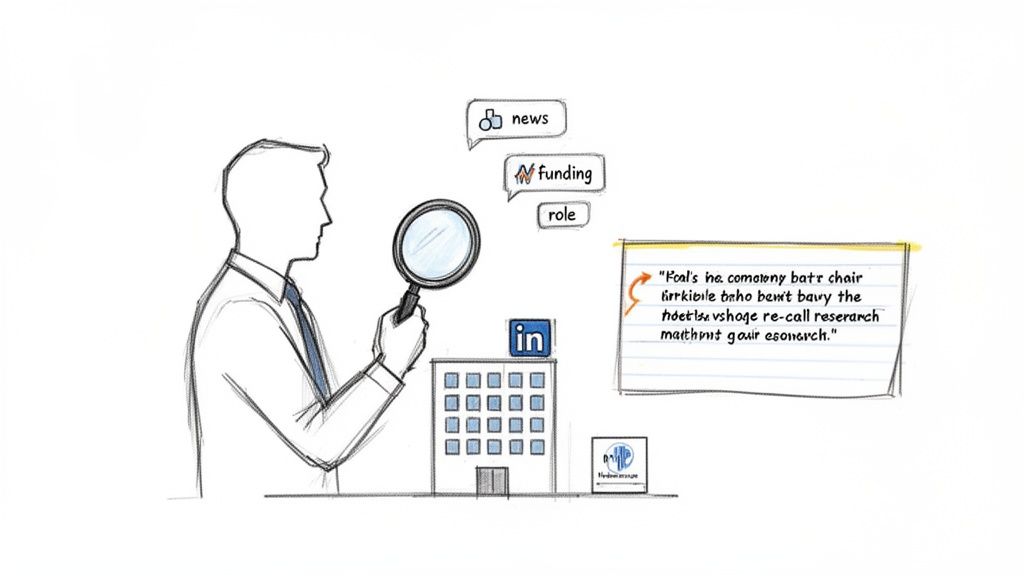
Unlike a purely volume-based approach that relies on luck, a research-first strategy positions the SDR as a thoughtful problem-solver, not just another salesperson. This shift dramatically improves your chances of capturing a busy prospect’s attention in the crucial first 30 seconds.
How to Implement Pre-Call Research
Effective personalization requires gathering specific intelligence. Instead of just confirming a job title on LinkedIn, look for actionable trigger events or relevant context.
- Trigger Events: Has their company recently received funding, announced a new product, or posted an earnings report? These events create compelling reasons to call. For example: "I saw your recent Series B announcement and noticed you're expanding your engineering team, which is why I'm calling..."
- Role-Specific Challenges: What are the common pain points for a Director of Marketing versus a VP of Operations? Tailor your value proposition to their specific world.
- Intent Data: Leverage tools that signal buying intent, such as website visits, content downloads, or webinar attendance. These "warm" signals provide a natural and timely entry point.
Actionable Tips for Success
To make this practice scalable, integrate it directly into your workflow.
- Use an AI-Powered Task Engine: Platforms like MarketBetter.ai can auto-generate research summaries and prioritize high-intent prospects, feeding reps the key talking points they need without manual effort.
- Create a 30-Second "Hook": Based on your research, script a concise opening that immediately explains why you are calling them specifically, right now.
- Log Research Notes: Keep detailed notes in your CRM (Salesforce, HubSpot) so the entire team can see what research patterns lead to successful conversations. This creates a powerful feedback loop for ongoing personalization strategies. For more detail, you can explore marketing personalization strategies in our recent article.
2. Create and Use Proven Call Scripts and Talk Tracks
The idea of a "call script" often brings to mind robotic, inflexible monologues that kill genuine conversation. However, a modern approach to scripting is one of the most effective cold calling best practices. The goal isn't a rigid, word-for-word document but a flexible talk track: a proven framework that guides reps through openings, value propositions, and objection handling while allowing for natural conversation.
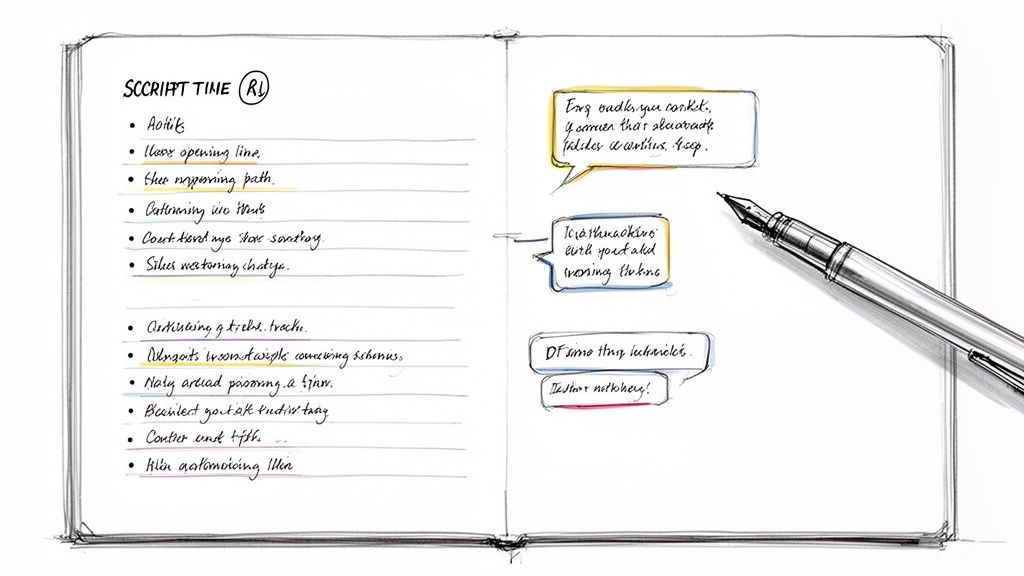
Unlike an improvised call, a well-designed talk track ensures every SDR communicates a consistent, powerful message tailored to specific buyer personas and market segments. It provides a reliable foundation, freeing up the representative's mental energy to actively listen and engage with the prospect, rather than scrambling for what to say next.
How to Implement Talk Tracks
Effective talk tracks are living documents, continuously refined based on call outcomes and feedback. They are built around key conversation milestones, not just a single pitch.
- Segment-Specific Frameworks: Develop different talk tracks for different industries or company sizes. The pain points of a startup CTO are vastly different from those of a Fortune 500 marketing director, and your script must reflect that.
- Opening Variations: Don't rely on a single opening line. Create 3-5 variations and test them systematically to see which ones consistently lead to longer conversations. Track conversion rates in your CRM to let data guide your script evolution.
- Objection Handling Playbooks: The most common objections ("bad timing," "we already use a competitor," "not interested") are predictable. Build your talk track with proven, empathetic responses for each, turning a potential rejection into a new line of discovery.
Actionable Tips for Success
To make this practice effective, integrate it into your team's core sales enablement and coaching rhythm.
- Practice with Role-Play: Before using a new talk track on live calls, conduct role-play sessions with managers or peers. This builds muscle memory and helps reps internalize the flow so it sounds natural and confident.
- Build an 8-12 Second Opener: Your initial hook should be concise and impactful. It must include: (1) your name and company, (2) the specific reason for your call (based on research), and (3) a potential benefit relevant to their role.
- Use AI for Dynamic Talking Points: Instead of a static document, leverage tools like MarketBetter.ai. Its AI Cold Call Workflow can automatically generate persona-specific talking points and objection frameworks based on real-time data, giving reps a dynamic guide for every call.
- Review Call Recordings: Platforms like Gong and Chorus are invaluable for identifying what language works. Regularly review top-performing calls to extract powerful phrases and objection-handling techniques, then incorporate them back into your team's official talk tracks.
3. Practice Active Listening and Strategic Questioning
The most common cold calling mistake is treating the call as a monologue. A successful interaction isn't about delivering a perfect pitch; it's about starting a genuine conversation. This is where active listening and strategic questioning come in, shifting the dynamic from a sales pitch to a consultative discovery session. This approach builds trust and uncovers the critical business context needed to qualify a prospect effectively.
Unlike a pitch-focused approach that often leads to immediate rejection, consultative questioning demonstrates genuine interest in the prospect's challenges. As data from platforms like Gong shows, top-performing reps consistently talk less and listen more, asking thoughtful questions that guide the conversation toward the prospect's true pain points. This is a core component of modern cold calling best practices.
How to Implement Strategic Questioning
Effective discovery involves moving beyond surface-level queries to questions that reveal deeper business needs. Methodologies like SPIN Selling (Situation, Problem, Implication, Need-Payoff) provide a proven framework for this.
- Understand the Situation: Start with broad, open-ended questions to grasp their current environment. For example: "Could you walk me through your current process for managing new inbound leads?"
- Identify the Problem: Once you understand the situation, probe for specific challenges or inefficiencies. Ask: "What are the biggest bottlenecks you're facing with that process?"
- Explore the Implication: Help the prospect connect the problem to its broader business impact. A powerful question is: "How does that delay in lead follow-up affect your team's ability to hit its pipeline targets?"
- Present the Need-Payoff: Guide them to see the value of a solution by asking about the positive outcomes. For instance: "If you could automate lead routing and cut response time by 50%, what would that mean for your Q4 revenue goals?"
Actionable Tips for Success
To make this practice a core part of your calling motion, focus on preparation and in-call awareness.
- Plan 3-5 Core Discovery Questions: Before each call, prepare a short list of open-ended questions tailored to the prospect's role and industry.
- Follow the 60/40 Rule: Aim to spend 60% of the call listening and only 40% talking. This simple ratio forces you to ask more questions and avoid dominating the conversation.
- Confirm Your Understanding: After the prospect shares a key challenge, repeat it back to them. For example: "So if I'm hearing you correctly, the main issue is a lack of visibility into your team's activity... is that accurate?"
- Log Discovery Insights: Use your CRM to capture the key pain points, goals, and challenges uncovered during the call. This context is invaluable for the next-step conversation with an Account Executive.
4. Timing and Sequencing: Call at the Right Time with Strategic Follow-Up
Dialing a prospect at the wrong time is as ineffective as calling without research. One of the most impactful cold calling best practices involves strategic timing and a structured follow-up sequence. This means understanding when your ideal buyer is most likely to answer their phone and building a multi-channel cadence that maintains momentum without overwhelming them.
Unlike a random, high-volume approach that burns through leads, a time-aware strategy maximizes the connect rate for every dial. By coordinating calls with emails and social touches, SDRs create a persistent, professional presence that increases the likelihood of engagement over time.
How to Implement Strategic Timing and Sequencing
Effective sequencing moves beyond just picking a "good" time to call. It involves building a repeatable multi-touch playbook that guides prospects through an engagement journey.
- Optimal Calling Windows: Landmark research from InsideSales.com and others shows connect rates peak on Tuesdays, Wednesdays, and Thursdays between 10-11 AM and 3-4 PM in the prospect's local time. Mondays are often lost to internal meetings, while Fridays see decreased focus.
- Structured Follow-Up Cadence: A successful sequence often involves 8-12 touches over 4-6 weeks. A common "call-then-email" tactic involves calling first to create a touchpoint, then immediately sending a concise follow-up email that references the call and summarizes your value proposition.
- Intent-Based Triggers: The best time to call is right after a prospect shows interest. If a lead visits your pricing page or downloads a whitepaper, that action should trigger an immediate follow-up task in your sales engagement platform.
Actionable Tips for Success
To operationalize this, build timing and sequencing directly into your team's daily workflow.
- Use an AI-Driven Task Sequencer: Platforms like MarketBetter.ai can auto-create and prioritize daily call tasks based on optimal times and intent signals, ensuring reps always contact the warmest prospects when they are most receptive.
- Build a Multi-Channel Cadence: Design a clear follow-up sequence, such as: Day 1 (Call + Email), Day 3 (Call), Day 5 (LinkedIn Connection Request), Day 8 (Call). This ensures you never miss a follow-up.
- Track Your Own Data: While industry benchmarks are a great starting point, use your CRM to track connect rates by day and hour. Identify your team's unique "sweet spot" and adjust your calling blocks accordingly. You can learn more about how to ensure you never miss a follow-up with a structured playbook.
5. Optimize Call-to-Email Integration for Maximum Response
Relying on a single outreach channel is a recipe for low engagement. Modern cold calling best practices demand a multi-channel approach where calls and emails work in tandem. Calls alone suffer from low connect rates, while emails are easily ignored. When combined, they create a powerful synergy: a call builds familiarity, and a follow-up email provides a tangible, easy-to-digest resource that keeps the conversation moving forward.
Unlike isolated outreach attempts, an integrated call-to-email sequence positions your outreach as a persistent, professional effort. This coordinated strategy, championed by platforms like Salesloft and Outreach, has been shown to lift meeting conversion rates by over 25% compared to email-only campaigns. It turns a cold touchpoint into a warm, ongoing dialogue.
How to Implement Call-to-Email Integration
The key is to make the transition from call to email seamless and context-aware. The email should feel like a natural continuation of the phone conversation, not a separate, generic marketing blast.
- Immediate Follow-Up: After a call (whether you connect, leave a voicemail, or get a quick brush-off), send a relevant email within a few hours. This reinforces your message while the call is still fresh in the prospect's mind.
- Contextual Reference: Your email must directly reference the call. For example: "Following up on our brief chat about managing your ad spend..." or "As promised, here is the case study I mentioned on the phone..."
- Templated Workflows: Create pre-built email templates for common call outcomes like "Connected, interested," "Left voicemail," or "Overcame objection." This ensures consistency and speed across the team.
Actionable Tips for Success
To operationalize this practice, embed it directly into your sales engagement tools.
- Use an Integrated Dialer: A platform like MarketBetter.ai allows reps to dial directly from Salesforce and then use AI to instantly draft a follow-up email based on the call's context. This closes the loop with a single click.
- Test Call-Referencing Subject Lines: A/B test subject lines like "Following up from our call" or "Quick note, [Prospect Name]" which often have significantly higher open rates than generic alternatives.
- Map Email Content to Call Outcomes: If a prospect mentioned a specific pain point, your follow-up email should lead with a resource addressing that exact problem. If they were busy, keep it short with a clear call-to-action to book time later. This level of personalization is crucial for effective multi-channel selling.
6. Establish Clear Objection Handling Frameworks
Objections are not rejections; they are requests for more information. One of the most critical cold calling best practices is to treat prospect hesitation as an opportunity to build credibility and deepen the conversation. Rather than relying on rigid, scripted rebuttals, effective frameworks use empathy, clarifying questions, and evidence-based responses to address the underlying concerns behind common objections.
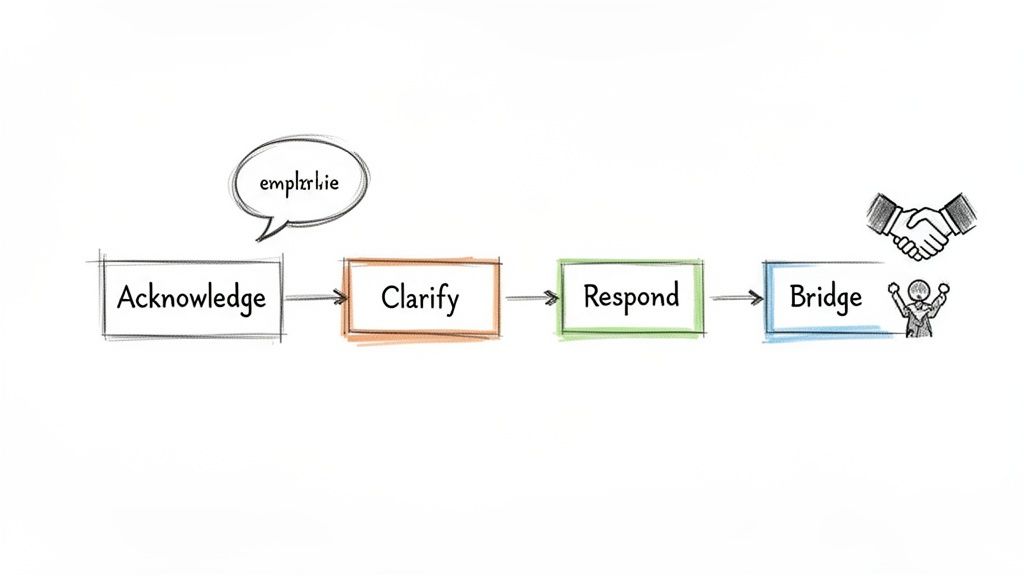
Unlike an unprepared rep who stumbles and ends the call, an SDR with a structured approach can confidently navigate pushback. This skill turns potential roadblocks into productive discussions, increasing conversion rates and extending call lengths by building trust and demonstrating expertise.
How to Implement Objection Handling Frameworks
A powerful framework addresses the most common objections ('no budget,' 'bad timing,' 'we use a competitor') with predictable, yet flexible, responses. The goal is to acknowledge the concern, reframe the situation, and guide the prospect to the next logical step.
- "We use [Competitor]": Acknowledge their existing solution, then pivot to a gap. "That's great, so you're already addressing [use case]. What we're finding is that [Competitor] often struggles with Y, which leads to [specific problem]. Would it be worth 15 minutes to explore that gap?"
- "I'm not interested": Don't accept this at face value; instead, add curiosity and evidence. "I understand. Most people aren't initially. Leaders at [similar company] found they were overlooking X until we showed them [specific metric]. Could I share a quick case study on that?"
- "Bad timing / No budget": Instead of ending the call, pivot to a future action. "Totally get it. Would it make sense to set up a brief call in [specific month] when budgets typically reopen? I'll send a quick summary so it’s fresh."
Actionable Tips for Success
To make this practice second nature, build a system for continuous improvement. Mastering the art of Overcoming Objection in Sales requires preparation and iteration.
- Create an "Objection Playbook": Document your top 5-7 objections and develop 2-3 validated responses for each. Every response should include empathy, a clarifying question, a reframe, and a bridge to the next step.
- Conduct Weekly Role-Plays: Practice handling objections in a live setting. Record these sessions and use them as coaching material to highlight what works and what doesn't.
- Leverage AI-Powered Insights: Use a tool like MarketBetter.ai to surface common objections specific to an industry or persona and get data-backed response suggestions directly in your workflow.
- Never Argue: Acknowledge the prospect's concern as valid, even if you disagree. Start with phrases like, "That's a fair point, and I hear that often..." to disarm defensiveness and open the door for a real conversation.
7. Build Credibility Through Social Proof and Brand References
Cold calls inherently start from a position of low trust. To overcome a prospect's natural skepticism, one of the most effective cold calling best practices is to build immediate credibility using social proof. This involves referencing well-known customers, quoting specific results, and citing third-party validation to quickly establish that your solution is a safe and proven choice.
Unlike making abstract claims about your product's benefits, social proof provides tangible evidence from a source the prospect trusts: their peers. This approach, rooted in Robert Cialdini's principles of persuasion, shifts the conversation from "Why should I believe you?" to "How did you help a company like mine?" This single change can reduce initial objections and significantly increase meeting conversion rates.
How to Implement Social Proof
Effective social proof is not just name-dropping; it's about delivering relevant evidence that resonates with the prospect’s specific context. The key is to match your proof points to their industry, size, and challenges.
- Industry-Specific Logos: Mentioning customers in the same vertical immediately builds relevance. For example: "We've helped over 50 B2B SaaS teams like Acme Corp and TechCorp increase their SDR productivity..."
- Quantifiable Results: Vague claims are forgettable, but hard numbers are compelling. Instead of saying you "improve efficiency," say, "A similar-sized company, Techco Corp, increased their meeting conversions from 8% to 15% in just three months with our platform."
- Third-Party Validation: Leverage external credibility from trusted sources. For instance: "Gartner recently recognized us as a leader in Sales Engagement platforms, specifically for our AI-driven task prioritization..."
Actionable Tips for Success
To make social proof a natural part of your talk track, prepare specific references for each target segment.
- Create a "Proof Sheet": For each target account, pre-identify their industry, size, and potential challenges. Then, map them to your most relevant customer story, case study, or analyst report.
- Lead with Logos: Introduce credibility within the first 30 seconds. A simple line like, "The reason I'm calling is that we work with other industry leaders like [Competitor] and [Similar Company]..." immediately establishes legitimacy.
- Leverage Mutual Connections: A warm introduction is the strongest form of social proof. Try, "I noticed you're connected to John Smith at [Reference Company]. He actually led their SDR transformation with us last year."
- Utilize Your Tech Stack: Use tools like MarketBetter.ai to surface account details and automatically suggest similar customers and relevant outcomes, arming you with customized social proof for every single call.
8. Implement CRM Discipline and Immediate Call Logging
Even the most effective cold call is a wasted effort if the data disappears the moment you hang up. A cornerstone of modern cold calling best practices is implementing religious CRM discipline, where every call outcome is logged immediately and accurately. Without real-time data entry, managers lose visibility into activity, forecasting becomes guesswork, and crucial follow-ups are inevitably missed.
This practice transforms cold calling from a series of isolated conversations into a measurable, scalable process. It provides the data foundation for coaching, performance tracking, and seamless handoffs between SDRs and Account Executives, ensuring no lead falls through the cracks.
How to Implement CRM Discipline
Effective call logging goes beyond simply marking a task as complete. It involves capturing specific outcomes and insights that inform future actions and strategy, turning raw activity into business intelligence.
- Standardized Call Dispositions: Define a clear taxonomy for call outcomes. Instead of just "Called," use specific dispositions like "Connected - Not Interested," "Left Voicemail," "Scheduled Meeting," or "Wrong Person." This creates clean data for reporting.
- One-Click Logging: The primary barrier to CRM discipline is friction. Platforms like Outreach and Salesloft often enforce logging before the next dial is available, creating compliance. An even better approach is embedding the process directly into the workflow.
- Data-Driven Accountability: High-performing teams use CRM data to fuel their RevOps dashboards. They track the entire outbound funnel in real-time: 200 dials → 30 connects (15% connect rate) → 8 qualified meetings booked → 3 deals moved to the pipeline.
Actionable Tips for Success
To make CRM logging an unbreakable habit, build it directly into your sales motion and technology stack.
- Use a Dialer Inside Your CRM: A platform like MarketBetter.ai, with its dialer built directly inside Salesforce, can auto-populate call outcomes, duration, and dispositions with a single click. This eliminates the friction of manual data entry.
- Log Calls Within 15 Minutes: Insist that all call notes are logged immediately after the conversation ends. This ensures details about objections, pain points, and next steps are captured while they are still fresh.
- Create Mandatory Note Templates: Structure your call notes with required fields in your CRM. Include sections for the value proposition offered, the prospect’s key response, any objections raised, and the confirmed next step with a follow-up date.
9. Develop Confidence and Resilience Through Consistent Practice
Cold calling is a psychological marathon, not a sprint. Success demands handling constant rejection, managing call anxiety, and maintaining motivation when conversion rates are low. One of the most essential cold calling best practices is building mental resilience and confidence through consistent, structured practice and a supportive team culture.
Unlike a purely outcome-focused approach that can crush morale, a process-oriented mindset reframes rejection as a necessary part of the sales funnel, not a personal failure. This shift, championed by sales leaders like Jeb Blount, creates high-performing teams that embrace activity and view each dial as a learning opportunity, leading to higher motivation and tenure.
How to Implement a Culture of Resilience
Building this psychological strength requires deliberate, team-wide effort. It involves creating systems that normalize rejection and celebrate the consistent actions that lead to results.
- Peer Shadowing: New SDRs can sit with top performers for their first week to absorb cadence, language, and objection-handling techniques in a live environment. This accelerates confidence faster than any training manual.
- Role-Play Sessions: Dedicate weekly time for structured role-play. Focus on one specific skill per session, like navigating a gatekeeper or handling the "we're not interested" objection, to build muscle memory.
- Celebrate Activity Metrics: Publicly recognize reps for hitting daily dial or connect goals, not just for booking meetings. This reinforces that consistent effort is valued and essential for long-term success.
Actionable Tips for Success
To embed resilience into your team’s DNA, integrate these practices directly into your daily and weekly sales cadence.
- Set Realistic Daily Goals: Use your CRM data to establish achievable activity targets. When reps see a clear connection between their effort (dials) and outcomes (meetings), their work feels more meaningful.
- Publicly Recognize Small Wins: Use daily stand-ups or a team leaderboard to give shout-outs for hitting activity milestones. This consistent positive reinforcement maintains momentum.
- Debrief Difficult Calls: Encourage reps to share and analyze tough calls with a manager or mentor. This normalizes the experience and transforms rejection into a coachable moment.
- Provide Access to Call Recordings: Use tools like a Salesforce dialer to log all calls. Create a "greatest hits" library of recordings from top performers that new reps can study on-demand.
10. Measure, Analyze, and Iterate on Outbound Performance
A "dial and hope" strategy is unpredictable and unscalable. Top-performing sales organizations treat cold calling not as an art but as a science, which means consistent measurement and data-driven iteration are core to the process. This practice involves tracking the right KPIs, analyzing which behaviors and messages drive outcomes, and running short experiments to continuously improve performance.
Unlike simply monitoring activity volume (like dials per day), an analytical approach connects specific actions to results. This transforms outbound dialing from a guessing game into a predictable engine for revenue, allowing managers to diagnose issues and scale what works. It's the difference between telling a rep to "make more calls" and telling them to "use this specific opening line because it improved our meeting rate by 12% last week."
How to Implement a Data-Driven Iteration Cycle
Building a feedback loop requires a clear framework for measuring, analyzing, and acting on performance data. The goal is to make small, incremental improvements that compound over time.
- Establish Key Metrics: Track a balanced mix of leading indicators (dials, connects, conversations) and lagging indicators (meetings booked, pipeline influenced). RevOps can build dashboards in your CRM to visualize the funnel from dials → connects → meetings for each rep and sequence.
- Run A/B Tests: Isolate one variable and test its impact. For example, run a two-week experiment where half the team uses one opening line and the other half uses a new one. Measure the connect-to-meeting conversion rate for each to find the statistical winner.
- Leverage Speech Analytics: Use call intelligence tools like Gong or Chorus to identify the exact phrasing and objection-handling techniques used by top performers. These insights can then be standardized and scaled across the team through updated playbooks and coaching sessions.
Actionable Tips for Success
To make this practice sustainable, embed it into your team's weekly operating rhythm.
- Focus on a Few Core KPIs: Don't overwhelm reps with dozens of metrics. Focus on 2-3 leading indicators (e.g., conversations per day) and one primary lagging indicator (meetings booked) to keep the team aligned.
- Maintain CRM Hygiene: Data integrity is everything. Enforce consistent use of call dispositions, required note fields, and tags for experiments so your analysis is based on clean, reliable data.
- Use an AI-Powered Reporting Engine: Platforms like MarketBetter.ai can connect intent data signals directly to call outcomes, helping you prioritize the behaviors that actually influence pipeline and showing which reps are most effective at converting high-intent leads. For a deeper dive, explore our guide on essential marketing performance metrics.
- Turn Insights into Action: Review metrics in weekly team meetings. For each rep, identify one specific insight and turn it into a concrete coaching action for the following week.
10-Point Cold Calling Best-Practices Comparison
| Technique | 🔄 Implementation Complexity | 💡 Resource Requirements | ⭐ Expected Effectiveness | 📊 Ideal Use Cases | ⚡ Key Advantages |
|---|---|---|---|---|---|
| Research and Personalize Before Dialing | Medium–High — ongoing research workflows, filtering required | Intent data, account intelligence tools, CRM integration, time for prep | ⭐⭐⭐⭐ — higher connects & richer conversations | Account-based selling, high-value or enterprise prospects, intent-triggered outreach | Faster relevance per dial; higher connect-to-meeting conversion |
| Create and Use Proven Call Scripts and Talk Tracks | Low–Medium — build, test, and maintain playbooks | Script templates, call recordings, enablement platform, coaching hours | ⭐⭐⭐⭐ — consistent messaging and faster ramp | Onboarding new reps, scaling teams, segment-specific outreach | Consistency across reps; accelerates ramp and coaching |
| Practice Active Listening and Strategic Questioning | Medium — behavioral change and training needed | Sales coaching, role-play, call analytics, time-per-call investment | ⭐⭐⭐⭐⭐ — better qualification and trust, higher conversion quality | Consultative sales, discovery calls, complex deals | Uncovers real pain; reduces wasted demos and improves handoffs |
| Timing and Sequencing: Call at the Right Time with Strategic Follow-Up | Medium — requires orchestration and experimentation | Cadence tools, timezone/intent data, multi-channel coordination | ⭐⭐⭐⭐ — significantly higher connect and response rates | High-volume SDR programs, multi-region outreach, intent-based follow-ups | Reduces wasted dials; increases connect rate and sequencing ROI |
| Optimize Call-to-Email Integration for Maximum Response | Low–Medium — align templates and timing, automate sends | Dialer-CRM integration, email templates, tracking, automation | ⭐⭐⭐⭐ — improved response and meeting bookings | Multi-touch cadences, follow-up-heavy workflows, PQLs | Boosts recall and action; higher combined channel conversions |
| Establish Clear Objection Handling Frameworks | Medium — develop playbook and practice for natural delivery | Objection playbooks, case studies, role-play sessions, coaching | ⭐⭐⭐⭐ — longer conversations; more "not now" → "next step" moves | Competitive deals, budget/timing objections, early qualification | Converts objections into dialogue; shortens qualification time |
| Build Credibility Through Social Proof and Brand References | Low–Medium — curate and personalize proof points | Case studies, customer permissions, analyst references, collateral | ⭐⭐⭐⭐ — reduces skepticism; increases meeting conversion | Cold outreach to skeptical buyers, new-market entry, corporate buyers | Shortens sales cycle; increases trust quickly with minimal effort |
| Implement CRM Discipline and Immediate Call Logging | Medium — process changes + tooling enforcement | CRM dialer, one-click logging, disposition taxonomy, governance | ⭐⭐⭐⭐ — reliable activity data; better follow-ups | Scaling teams, RevOps-driven organizations, high-volume outbound | Real-time visibility; faster follow-ups and accurate forecasting |
| Develop Confidence and Resilience Through Consistent Practice | Low–Medium — culture + regular coaching required | Manager time, role-play programs, leaderboards, mental-health support | ⭐⭐⭐⭐ — higher persistence and long-term performance | High-activity SDR teams, onboarding cohorts, high-rejection contexts | Increases rep persistence, reduces churn, accelerates skill growth |
| Measure, Analyze, and Iterate on Outbound Performance | High — instrumentation, experiments, and governance needed | Dashboards, A/B testing framework, speech analytics, clean data | ⭐⭐⭐⭐⭐ — data-driven improvements and predictable scaling | Teams optimizing playbooks, RevOps, enterprise scale growth | Prioritizes high-impact tactics; speeds optimization and forecasting |
Putting It All Together: Your Blueprint for Outbound Excellence
Mastering the art and science of cold calling isn't about memorizing a single perfect script or discovering a "secret" time to dial. As we've explored, achieving sustainable outbound success is about building a comprehensive, repeatable system. The ten cold calling best practices detailed in this guide are not isolated tactics; they are interconnected pillars that support a powerful and predictable pipeline-generation engine.
Think of it like building a high-performance race car. Having a powerful engine (a compelling script) is useless without a strong chassis (solid research), responsive steering (active listening), and a skilled driver (a confident SDR). Each component is critical, and they must work in harmony. A brilliant opening line falls flat without a structured objection-handling framework. A perfectly timed call loses its impact without an integrated, value-driven email follow-up. True excellence lies in the consistent, disciplined execution of these fundamentals, call after call, day after day.
From Disparate Tactics to an Integrated System
The critical shift for any sales team is moving from a tactical, ad-hoc approach to a strategic, integrated one. Let's compare the two mindsets:
-
The Tactical Approach (Common but Ineffective): This team focuses on volume above all. SDRs make hundreds of dials using a generic script, log calls when they remember, and handle objections with improvised, inconsistent responses. They might have a good day here and there, but performance is unpredictable, burnout is high, and there is no clear path to improvement because there's no reliable data to analyze.
-
The Strategic Approach (Your New Blueprint): This team sees each practice as part of a whole.
- Pre-call research directly informs the personalization in the opening line.
- Active listening provides the exact ammunition needed for the objection handling framework.
- CRM discipline and immediate logging create clean data that feeds into performance analysis.
- This data-driven iteration then helps refine call scripts and talk tracks for the entire team.
This integrated system transforms cold calling from a frustrating numbers game into a measurable, scalable science. It creates a feedback loop where every action informs the next, driving continuous improvement and predictable results.
Your Actionable Next Steps
The journey to mastering these cold calling best practices begins with a single, deliberate step. Don't try to overhaul your entire process overnight. Instead, focus on incremental gains that build momentum.
- Conduct a Self-Audit: Review the ten practices outlined. Where is your team strongest? Where are the most significant gaps? A simple team survey or review of call recordings can reveal immediate opportunities for improvement, whether it's weak opening lines or inconsistent CRM logging.
- Choose One Area of Focus: Pick one practice to master this month. For example, dedicate the next four weeks to implementing a rigorous pre-call research checklist for every A-tier prospect. Or, focus exclusively on improving CRM hygiene by enforcing immediate call dispositions.
- Leverage Technology to Accelerate Progress: Manual processes are the enemy of consistency. The friction of toggling between LinkedIn, your CRM, and your dialer slows reps down and discourages best practices. This is where modern sales tools become indispensable. Platforms like MarketBetter.ai are built to operationalize this blueprint by automating the tedious work. AI-powered call prep surfaces key insights, a native Salesforce dialer eliminates manual logging, and prioritized task queues ensure reps are always focused on the most impactful next action.
By adopting this systematic approach, you elevate your outbound function from a cost center to a strategic growth driver. You build a culture of excellence, empower your reps with the confidence to succeed, and create a predictable pipeline that fuels the entire organization. The path is clear; the only remaining step is to begin.
Ready to transform your team's cold calling from a guessing game into a science? See how marketbetter.ai embeds these best practices directly into your SDRs' workflow with AI-driven prep, a native Salesforce dialer, and intelligent task prioritization. Explore marketbetter.ai and build your blueprint for outbound excellence today.