
What Is Dynamic Content? A Practical Guide to Personalization
So, what exactly is dynamic content? At its core, it’s digital material that changes on the fly based on who's looking at it—their behavior, their preferences, their location. Instead of blasting everyone with the same generic message, it creates a personalized experience by adapting what someone sees on a website, in an email, or inside an app.
Understanding Dynamic Content in Simple Terms
Picture walking into your favorite coffee shop. The barista greets you by name and asks, "The usual today?" That small, personal touch feels good. It builds a connection and makes you want to come back.
Dynamic content brings that exact feeling to the digital world. It transforms a website from a static billboard into a living, responsive conversation.
It works by using data—like your location, browsing history, or past purchases—to show you things you'll actually care about. If you want to go a bit deeper on the mechanics, this is a great explainer on What Is Dynamic Content?. The goal is simple: make every interaction more relevant and ditch the one-size-fits-all approach for good.
Static vs Dynamic Content
The easiest way to really get what dynamic content is all about is to put it side-by-side with its opposite: static content. A static website is like a printed brochure. Every single person who picks it up sees the exact same information, images, and offers. It's fixed. Unchanging.
Dynamic content, on the other hand, is like a personal shopper. It quickly figures out who you are and what you might be looking for, then presents you with the perfect options. This isn't just a gimmick; it's a cornerstone of modern marketing.
The fundamental difference is simple: Static content speaks at an audience, while dynamic content speaks to an individual. It’s the shift from broadcasting a single message to having millions of personalized conversations at once.
Static Content vs Dynamic Content at a Glance
Let’s lay out the key differences in a table to make it crystal clear. Think of static content as that billboard on the highway everyone sees, while dynamic content is the personal shopper who knows your style.
| Feature | Static Content (The Billboard) | Dynamic Content (The Personal Shopper) |
|---|---|---|
| User Experience | Uniform, one-size-fits-all. Everyone sees the same thing. | Unique journey tailored to each visitor’s interests and needs. |
| Personalization | Impossible. The message is fixed. | Built around personalization, showing relevant offers or messages. |
| Performance | Can load quickly but often has lower engagement. | Drives higher engagement, conversions, and long-term loyalty. |
| Use Cases | Basic info pages, blogs, company "About Us" sections. | E-commerce recommendations, targeted ads, personalized emails. |
This side-by-side view really highlights why the shift toward dynamic experiences is so critical for any brand that wants to connect with its customers, not just talk at them.
Here are the practical takeaways:
-
User Experience: Static is predictable and impersonal. Dynamic creates a unique journey for every single person based on their interests.
-
Personalization: With static content, you can't personalize anything. Dynamic content is built for it, using data to show relevant products or messages. To see how this plays out in the real world, check out our guide on effective marketing personalization strategies.
-
Performance: A static page might have a slight edge on initial load speed, but dynamic content absolutely crushes it in the metrics that matter—engagement, conversion rates, and customer loyalty.
This distinction isn't just academic. It directly shapes how customers see your brand and whether they decide you're worth their time and money.
The Engine Behind Personalized Experiences
Ever wonder how a retailer's website knows to show you a winter coat in January while a visitor in Florida sees swimsuits? It’s not magic. It’s a well-oiled machine humming just beneath the surface. To really get what dynamic content is, you need to peek under the hood at the three core parts that make it all happen.
Think of it like a simple conversation: listening, thinking, and then speaking. First, the system "listens" by gathering clues about the user. Next, it "thinks" by applying a set of rules to that information. Finally, it "speaks" by delivering the perfect piece of content.
This diagram breaks down that simple but powerful flow—from raw user data to a perfectly timed, personalized message.
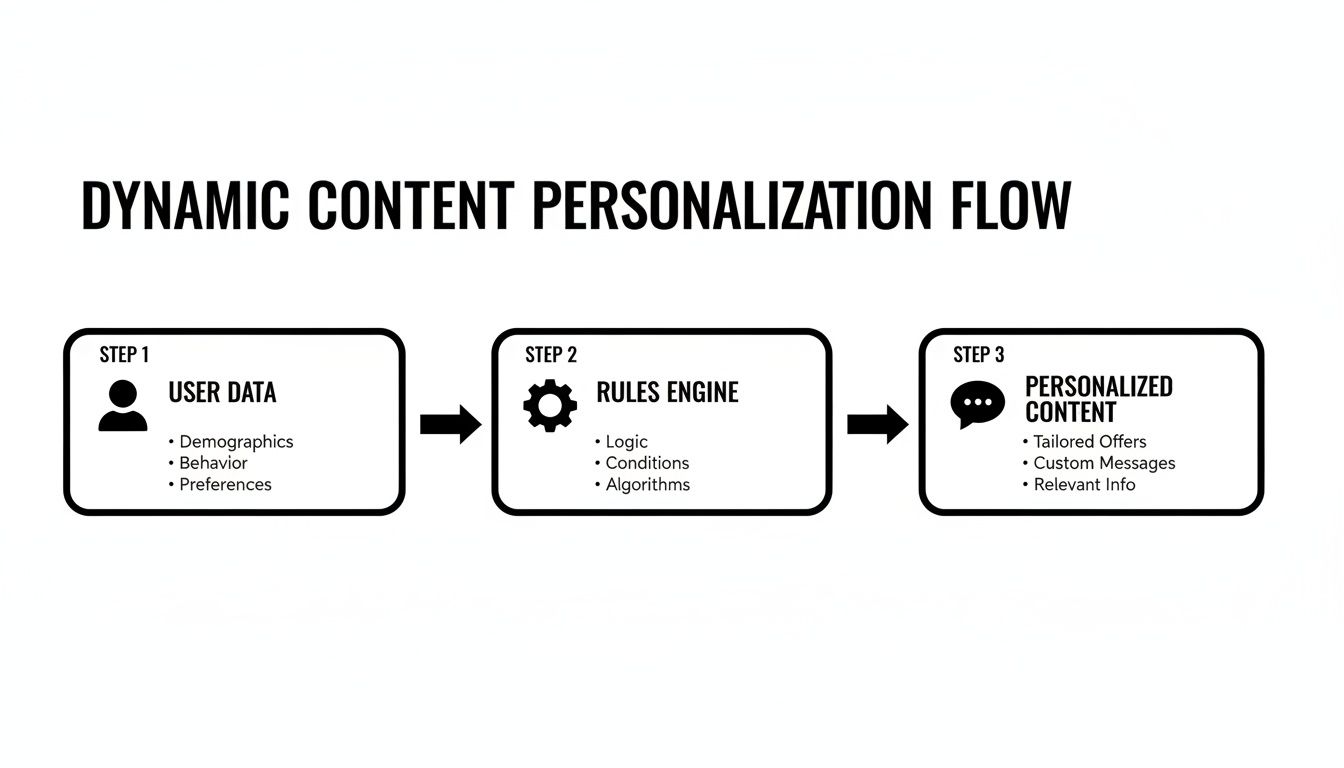
As you can see, the process is all about turning anonymous data points into a relevant, one-to-one experience by filtering them through a decision-making engine.
Step 1: Data Collection — The Listening Phase
Every dynamic interaction starts with data. This is the "listening" phase, where your website or app is quietly collecting clues about who the visitor is and what they're looking for. This information can stream in from all over the place.
Some of the most valuable data points include:
- Behavioral Data: Which pages did they visit? What products did they click on? Did they ditch a full shopping cart?
- Contextual Data: What’s their geographic location? Are they browsing on a phone or a desktop? What time of day is it?
- Demographic Data: For known users, this could be their age, industry, or job title, often pulled straight from your CRM.
To get even sharper, marketers often look at external signals, like intent data, to understand what topics a user is actively researching across the wider web. It adds another layer of insight.
Step 2: Rules Engine — The Thinking Brain
Once the data is in, it’s fed into the "thinking" brain of the operation: the rules engine. This is where the logic lives. A rules engine runs on simple "if-then" statements that you get to define.
For example, a rule might be as basic as:
- IF a visitor is from Canada, THEN show them the winter collection banner.
- IF a visitor is a returning customer, THEN greet them with a "Welcome Back" message and personalized recommendations.
These rules can be straightforward or incredibly complex, layering multiple conditions to create hyper-targeted audience segments. The engine’s job is to instantly check a user’s data against these rules and decide which content variation to serve up.
The rules engine is the critical bridge between raw data and a relevant experience. It’s where abstract information like location or click history is translated into a concrete, actionable decision about what content to display.
This is where you can start getting sophisticated. A basic engine just follows the commands you set. But more advanced systems use AI and machine learning to analyze data and make predictive decisions on their own, without you having to write an "if-then" rule for every possible scenario.
Step 3: Content Delivery — The Speaking Part
The final piece is content delivery—the "speaking" part. After the rules engine makes its split-second decision, the system serves the right content to the user in real time. The generic homepage banner gets swapped for the personalized version, and the user is none the wiser.
This whole process happens in the blink of an eye. The visitor never sees the logic whirring in the background; they just get a webpage that feels like it was made just for them. It’s this seamless execution that makes dynamic content so powerful. To pull this off effectively, you need a solid handle on your data, which is where a strong customer data platform integration becomes essential.
Bringing Dynamic Content to Life in Your Marketing
Knowing the theory is great, but seeing dynamic content actually drive results? That's the real win. It's time to move from concepts to concrete plays and look at how these strategies transform generic marketing messages into powerful, personalized experiences that actually work.
Every single use of dynamic content should tie back to a real business goal—whether that's more conversions, better engagement, or just earning some long-term loyalty. The trick is to start with a clear "why" and then figure out the "how."
This isn't about one-off tricks. Effective personalization is a sequence of targeted touchpoints, each designed to guide a user through their own unique journey with your brand.
Dynamic Website Personalization
Your website is your digital storefront. It's often the first real impression someone gets. Instead of laying out a generic welcome mat for everyone, you can create a tailored experience from the moment they land. And this goes way beyond just plugging in their first name.
Think about these practical examples:
- Smarter Hero Banners: A B2B software company could show a hero image that speaks directly to a visitor's industry. Someone from a healthcare company sees a hospital case study, while a visitor from the finance world sees a testimonial from a bank. Same page, completely different feel.
- Location-Based Offers: A retail brand can instantly show a promotion for the nearest physical store or highlight products that are trending in the visitor's city. It makes the offer feel immediate and far more relevant.
- Custom CTA Buttons: The call-to-action can change based on where someone is in their journey. A brand-new visitor might see a "Learn More" button, but a returning lead who has already downloaded a guide sees "Request a Demo." It’s a simple, smooth way to guide them down the funnel.
When you swap static elements for dynamic ones, your website stops being a passive brochure and becomes an active participant in the sales conversation. It starts anticipating what users need instead of just waiting for them to find it.
Hyper-Personalized Email Campaigns
Email is where dynamic content really flexes its muscles. It's the difference between a generic email blast that gets instantly archived and a one-to-one conversation that people actually open and click.
Here’s a quick breakdown of a static vs. dynamic email:
| Email Element | Static Approach (Everyone gets this) | Dynamic Approach (Personalized for you) |
|---|---|---|
| Subject Line | "Our Weekly Newsletter Is Here!" | "John, Here Are 3 Products You'll Love" |
| Product Section | Shows the same 5 best-sellers to all subscribers. | Displays products the user previously viewed but didn't buy. |
| Offer | A generic 10% off coupon for everyone. | A special offer on an item left in the user's abandoned cart. |
The difference is night and day. The dynamic approach speaks directly to what you know about the user, making the content impossible to ignore. It’s not just a hunch; dynamic strategies can generate three times more leads per dollar than paid ads and boost email open rates by a whopping 26%.
Dynamic In-App and Ad Content
This thinking shouldn't be confined to your website or inbox. You can (and should) extend this personalized strategy to your in-app messages and digital ads to create a single, seamless experience everywhere your brand shows up.
Here’s how to put it into action:
- Custom In-App Notifications: If a user hasn't tried a key feature in your app, you can send a push notification with a quick tutorial. It’s a smart way to re-engage them based on their actual behavior inside the product.
- Smarter Retargeting Ads: Go beyond showing a generic ad to everyone who visited your site. Instead, serve up a dynamic ad that features the exact product someone looked at. It’s a powerful reminder that brings their interest right back to the forefront.
- Lifecycle-Aware Banners: Inside a SaaS app, a brand-new user might see a banner with links to onboarding guides. A seasoned power user, on the other hand, could see an invitation to a webinar on advanced features.
Many of these complex, data-driven campaigns are now managed through advanced platforms. If you're curious about the tech making this possible, you can learn more about how AI is used for marketing automation in our detailed guide.
When you start implementing these strategies, you stop broadcasting and start communicating. Every dynamic element you add works to build a stronger, more relevant connection with your audience—and that has a direct impact on engagement and your bottom line.
Measuring the Real-World Impact of Your Strategy
A great strategy is only as good as the results it delivers. Rolling out dynamic content just feels right, but to get budget and keep stakeholders happy, you need to back up that gut feeling with cold, hard data. It’s time to move past assumptions and connect your personalization efforts to actual business outcomes.
The goal here is simple: translate fuzzy benefits like "better engagement" into specific, measurable wins. Instead of just hoping for the best, you need a clear way to track the key performance indicators (KPIs) that prove your strategy is actually working.
Key Metrics That Prove Your Success
When you swap a static, one-size-fits-all experience for a dynamic one, you’re fundamentally changing how people interact with your brand. The right metrics will tell that story for you, showing exactly where personalization is paying off.
Focus on tracking these core performance indicators:
- Engagement Metrics: Are people sticking around? Look for a lower bounce rate and a higher time on page. These are the clearest signs that your content is relevant enough to hold attention.
- Conversion Metrics: This is where the money is. Keep a close eye on your click-through rate (CTR) for personalized calls-to-action and, most importantly, the overall conversion rate for your main goals, whether that's a sign-up or a sale.
- Loyalty and Revenue Metrics: For the long game, track Customer Lifetime Value (CLV). A truly personalized journey encourages repeat business and builds loyalty, directly boosting how much each customer is worth to you over time.
Comparing Dynamic vs Static with A/B Testing
To build an undeniable business case, you have to put your new dynamic approach head-to-head with the old static version. This is where A/B testing becomes your secret weapon. It’s the cleanest way to isolate the impact of personalization and show a direct return on your investment.
Here’s a simple framework to get your tests running:
- Isolate One Variable: Don't try to boil the ocean. Start small by testing a single dynamic element, like a personalized hero banner or a targeted call-to-action.
- Define Your Audience Split: Serve the static version (Control Group A) to 50% of your audience and the new dynamic version (Test Group B) to the other 50%.
- Set a Clear Goal: Decide what success looks like before you start. Is it a higher CTR on the banner? More form submissions?
- Run the Test and Analyze: Let it run long enough to get statistically significant results, then compare the performance of Group A versus Group B. The numbers won't lie.
A well-structured A/B test kills all the guesswork. It gives you clear, quantitative proof that showing the right message to the right person drives a better outcome than a generic blast.
There’s a reason the content analytics market is projected to grow at an 18.9% CAGR. Companies that use these insights to deliver truly personalized experiences are seeing a 20% uplift in engagement. You can discover more insights about content analytics on Grand View Research. By measuring what matters, you can confidently prove the real-world impact of your dynamic content strategy.
Building Your First Dynamic Content Campaign
Alright, let's move from theory to action. Getting your first dynamic content campaign off the ground can feel like a huge lift, but it’s really about breaking the process down into manageable chunks. This is your roadmap for getting started.
Success here doesn’t start with cool tech. It starts with strategy—knowing exactly what you want to accomplish and who you're talking to.
Step 1: Define Your Goals and Audience Segments
Before you touch a line of code or design a single graphic, you have to nail two questions: What business result are we chasing? And who, specifically, are we trying to influence? Without sharp answers, you're just making noise.
Your goals need to be concrete. "Increase engagement" is a wish. "Reduce bounce rate by 15% on our pricing page for enterprise visitors" is a goal. It's specific, measurable, and gives you a clear target.
Once you have that goal, think about the distinct groups of people who will see different versions of your content. These are your segments.
For example, a B2B software company might slice its audience like this:
- By Industry: Show a healthcare-focused case study to visitors clicking in from a hospital network.
- By Company Size: Display an enterprise pricing plan to someone whose IP address traces back to a Fortune 500 company.
- By Behavior: Offer a product demo popup to a user who has visited the pricing page three times this week.
Step 2: Organize Your Data and Pick Your Tools
With your goals and segments clear, it's time to check the fuel tank: your data. What information are you actually collecting on your customers, and is it organized in a way that’s usable? This data is what your system will use to decide which content to show to whom.
This is also the perfect time to look at your tech stack. It doesn’t need to be some complicated, multi-headed beast, but it must be able to execute the rules you plan on setting.
Here’s a quick way to think about your options:
| Tool Category | Best For | Key Function |
|---|---|---|
| Email Service Provider (ESP) | Basic email personalization (e.g., first name, city). | Segmenting lists and inserting simple dynamic fields. |
| All-in-One Marketing Platform | Website and email personalization based on known data (like a lead's lifecycle stage). | Connecting website behavior to your CRM for a single view of the customer. |
| Dedicated Personalization Engine | Advanced, real-time personalization for anonymous and known visitors. | Using AI and complex rule sets to deliver hyper-relevant experiences on the fly. |
The right tool depends entirely on your ambition. A simple name-merge in an email? Your ESP is fine. Real-time website changes based on browsing behavior? You’ll need a dedicated engine.
Step 3: Create and Launch Your Content Variations
Now for the fun part. You get to create the different versions of content—the headlines, images, and calls-to-action—that each of your segments will see. The magic is in making each variation speak directly to that specific group's pain points or context.
Let’s say you’re personalizing the hero section of your homepage for different industries. You’d create:
- A headline, image, and CTA for the Finance segment.
- A different headline, image, and CTA for the Healthcare segment.
- And a default version for anyone who doesn't fit a defined segment.
Always, always have a default version of your content. This is your safety net. It ensures any visitor who doesn't match a specific rule still gets a coherent, functional experience, preventing any weird gaps or broken pages.
Once your variations are built and the rules are plugged into your platform, you're ready to go live. But this isn't the end. It's the beginning.
Step 4: Test and Optimize Continuously
Launching the campaign isn't the finish line; it’s the starting gun. The best dynamic content strategies are built on a relentless cycle of testing and optimization. You have to measure everything.
Run A/B tests to get clean, data-backed answers. Is your personalized CTA actually getting more clicks than the generic one? Did that industry-specific banner really lower the bounce rate? Let the numbers guide your next move. This process of launching, measuring, and refining is how you turn a good campaign into a great one.
Inspiring Examples of Dynamic Content in Action
Theory is one thing, but seeing how the pros do it is where the real lightbulbs go off. Let's look at how some of the biggest brands use dynamic content to build real connections with their customers. These aren't just clever tricks; they're proven strategies that turn generic broadcasts into personal handshakes.
Think of this as a playbook you can borrow from for your own marketing.
We'll break down how these companies use data to create experiences that feel like they were made just for you, stacking them up against the old-school static approach to really show the difference.
Amazon: The Recommendation Powerhouse
It's impossible to talk about this stuff without mentioning Amazon. Their product recommendation engine is the gold standard—it’s like having a personal shopper who knows what you want before you do.
- The Old Way (Static): An e-commerce site shows every single visitor the same "Top Sellers" or "New Arrivals" list. It’s a one-size-fits-all approach that completely ignores individual tastes.
- The Amazon Way (Dynamic): Amazon is always watching. It tracks your browsing history, past purchases, and even the items you hover over but don't buy. With that data, it populates your homepage with sections like "Inspired by your shopping trends" and "Frequently bought together," making the entire store feel like it was curated for you and you alone.
The Takeaway: Amazon’s strategy isn’t just about showing you more stuff; it’s about anticipating your needs. They use behavioral data to create a discovery loop that keeps you clicking, drives up the average order value, and makes you want to come back.
Netflix: The Art of the Personalized Thumbnail
Netflix has figured out that the image you see can be the deciding factor in whether you click "play." They’ve turned thumbnail selection into a data-driven art form, using dynamic content to grab your attention in a sea of options.
So how do they pick the perfect image for you? It all comes down to your viewing history.
| If You Watch... | You Might See a Thumbnail Featuring... |
|---|---|
| Lots of action movies | An explosion or a high-speed car chase. |
| Dramas with strong female leads | A powerful close-up of the main actress. |
| Stand-up and sitcoms | A shot of the cast in a laugh-out-loud moment. |
This isn't just guesswork. Netflix runs thousands of A/B tests to see which thumbnail gets the most clicks from different audience segments. It's why you and a friend can look at the exact same movie title and see completely different artwork, each one optimized to match your viewing habits.
Skyscanner: The Localized Travel Companion
Travel sites like Skyscanner have perfected the art of using contextual data to make life easier for their users. Their whole game is about removing friction and getting you the right information, faster.
Here’s what that looks like in practice:
- The Clunky Way (Static): You land on the homepage and have to manually type in your departure city every single time. It’s a small hassle, but it adds up and feels repetitive.
- The Smart Way (Dynamic): Skyscanner uses your IP address to guess your location. It then automatically pre-fills the "From" field with your nearest major airport, saving you a step and making the whole process feel way more intuitive.
This simple use of location data shows a deep respect for the user's time. By anticipating a basic need, Skyscanner builds a little bit of trust and smooths the path to booking a flight. When people ask what is dynamic content at its best, it's this—a tool for creating smarter, more helpful, and ultimately more profitable customer experiences.
Try our Lookalike Company Finder — find companies similar to your best customers in seconds. No signup required.
Questions We Hear All the Time
So, you're sold on the idea, but the practical side of things is still a bit fuzzy. That’s perfectly normal. Let's tackle the most common questions marketers have when they're getting ready to make the switch from static to dynamic.
Do I Need a Ton of Data to Get Started?
Honestly, you can get going with a lot less than you'd think. Forget massive data warehouses for a minute. The best first steps use simple, powerful data points you probably already have.
- User Location: Easy win. Show different store hours or offers based on a visitor's city or country.
- Visitor Status: Is this their first visit? Greet them with an intro offer. Are they a returning customer? Welcome them back by name.
- Device Type: Optimize the layout and buttons for someone tapping on a phone versus clicking on a desktop.
The trick is to start small and focused. Pick one audience segment, set a clear goal, and prove the concept works with the data you have. Once you see the lift, you’ll have the business case to scale up.
Is This Going to Wreck My SEO?
This is a big one, but the short answer is no—when done right, it actually helps. Modern personalization platforms are smart enough to show a stable, default version of your page to search engine crawlers like Googlebot. This means your core content always gets indexed without a hitch.
But here's the real magic: dynamic content sends positive signals that search engines absolutely love.
When you give people a more relevant experience, they stick around longer. Your bounce rates drop and time-on-page goes up. Those are powerful signals that tell Google your site is high-quality, which can give your rankings a nice boost over time.
Wait, Isn't This Just A/B Testing?
I get this question all the time. It's a common mix-up, but they serve two completely different—and complementary—purposes. Think of it like this: A/B testing is about finding the best message, while dynamic content is about delivering it to the right person.
A/B testing is a hunt for the single best "winner." You show random groups of people different versions of a page to see which one performs best overall. The goal is to find one universally superior option for everyone.
Dynamic content isn't looking for one winner. Its whole job is to serve up different, highly relevant experiences to different people at the same time. Visitor A sees one version, Visitor B sees another, and both are "correct" because they're personalized.
Simply put: A/B testing finds the best generic message. Dynamic content delivers the right message to the right individual.
Ready to stop broadcasting one message and start having millions of personalized conversations? marketbetter.ai is the integrated AI platform that makes creating, managing, and scaling dynamic content straightforward. Explore how marketbetter.ai can elevate your marketing strategy today.