
Build Your Modern Marketing Technology Stack: An Actionable Guide
Your marketing technology stack is the collection of software you use to get your job done—planning campaigns, running them, and figuring out if they actually worked. Think of it less like a random toolbox and more like a custom-built workshop. Each tool has a specific job, but they all work together to build your marketing engine.
What Is a Marketing Technology Stack
Imagine trying to build a house with only a hammer. You might get a wall up, but it would be slow, painful, and probably fall over. Running a modern marketing department without the right set of tools is pretty much the same. A marketing technology stack, or “martech stack,” is the integrated system of technologies that helps you manage, measure, and optimize everything you do.
A good stack isn't just a list of software subscriptions. It's a living system where each tool talks to the others. This creates a single, cohesive view of the entire customer journey. The real goal here is to stop doing things in isolation and start running a data-driven operation. For example, insights from your website analytics should directly inform who you target in your next email campaign.
The Explosive Growth of Marketing Technology
The pressure to build a smart martech stack has grown because the number of tools available has absolutely skyrocketed. A little over a decade ago, marketers had a handful of options. Today, the choices are overwhelming.
This chart from Scott Brinker at Chiefmartec.com shows just how dramatically the landscape has expanded.
What started as a small corner of the software world has ballooned into a massive industry. We've gone from 150 tools in 2011 to a projected 15,384 by 2025. This explosion makes it critical to have a strategy. You can't just collect shiny new objects; you have to pick tools that solve real problems. You can explore the full history of this growth in these martech landscape insights from WebFX.
To put this into perspective, let's look at the core functions a well-built stack should handle for your business.
Core Functions of a Modern Martech Stack
A modern stack isn't just about sending emails or posting on social media. It’s a complete system designed to manage the entire customer lifecycle. Here’s a breakdown of the primary jobs your martech stack should be doing for you, along with a comparison of popular tools for each job.
| Function | Description | Example Tools & Comparison |
|---|---|---|
| Attraction & Acquisition | Tools that help you find new audiences and bring them to your website or properties. | SEMrush (SEMrush) vs. Ahrefs (Ahrefs): Both are excellent for SEO, but SEMrush offers broader digital marketing features, while Ahrefs is often praised for its superior backlink data. |
| Engagement & Nurturing | Software for communicating with leads and customers to build relationships. | HubSpot (HubSpot) vs. ActiveCampaign (ActiveCampaign): HubSpot is an all-in-one platform great for teams wanting a unified system. ActiveCampaign offers more powerful automation at a lower price point. |
| Conversion & Sales | Platforms that turn interested leads into paying customers. | Salesforce (Salesforce) vs. Drift (Drift): Salesforce is the industry-standard CRM for managing the entire sales pipeline. Drift specializes in conversational marketing to convert website visitors in real-time. |
| Analytics & Data | Tools that measure performance, track behavior, and provide insights for optimization. | Google Analytics (Google Analytics) vs. Hotjar (Hotjar): Google Analytics gives you the quantitative "what" (e.g., page views). Hotjar provides the qualitative "why" with heatmaps and session recordings. |
| Retention & Advocacy | Systems designed to keep customers happy and turn them into fans of your brand. | Zendesk (Zendesk) vs. Gainsight (Gainsight): Zendesk is focused on reactive customer support (solving tickets). Gainsight is a proactive customer success platform designed to prevent churn. |
Ultimately, a strong stack gives you a command center for growth, connecting every marketing activity back to real business results.
Why a Cohesive Stack Is No longer Optional
Years ago, having a few marketing tools gave you an edge. Today, it’s table stakes. A messy, disconnected set of tools creates data silos, endless manual work, and a fractured view of your customer. In contrast, an integrated stack gives you a single source of truth.
A great martech stack isn't about having the most tools; it's about having the right tools working together seamlessly to achieve specific business outcomes.
This synergy is what separates high-performing teams from the rest. It allows you to:
- Automate Repetitive Tasks: Free up your team from soul-crushing work like data entry or lead routing so they can focus on strategy and creative thinking.
- Deliver Personalized Experiences: Use unified customer data to create relevant, timely interactions that don't feel creepy or generic.
- Make Data-Driven Decisions: Get a clear, complete picture of campaign performance to optimize your budget and improve ROI.
- Achieve Scalable Growth: Build efficient, repeatable processes that can support business growth without needing to hire an army of people to manage it all.
The Building Blocks of a Powerful Martech Stack
A great martech stack isn't just a folder of software subscriptions; it's a living system where every tool has a job and works with the others. Think of it like building a high-performance car. You need an engine for power (your content and automation), a chassis for structure (your CRM), a GPS for direction (your analytics), and diagnostic tools to check performance. Every part is essential, and they have to sync up perfectly to win the race.
Most successful stacks are built around a few foundational jobs that mirror the customer journey. You have to attract new audiences, engage them with something valuable, nurture those relationships, and analyze everything to get smarter. It’s a simple, powerful framework.
This diagram shows how these core pillars—Attract, Engage, and Delight—fit together.
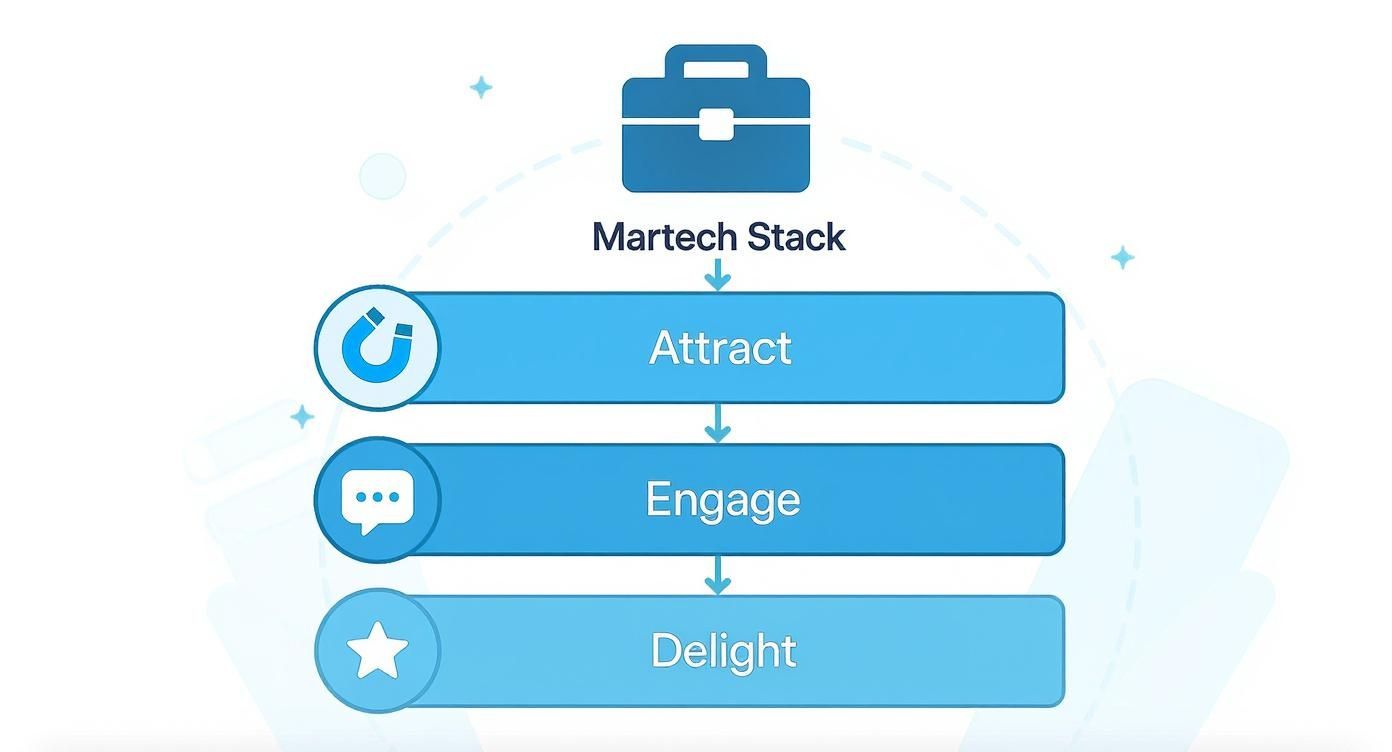
As you can see, a unified stack is the base that supports everything. It's not just a collection of tools, but a connected system designed to move people from stranger to loyal customer.
Attract Tools for Audience Acquisition
First things first: you have to get in front of the right people. This is the top of your funnel, where your tools are all about discovery and generating demand. If you can't nail this "Attract" layer, even the world's best product will sit on a digital shelf collecting dust.
This category is all about driving traffic and sparking that initial flicker of interest.
- Search Engine Optimization (SEO) Tools: You can't be found if you don't know what people are searching for. Platforms like Ahrefs or SEMrush are your eyes and ears, helping with keyword research, tracking your rankings, and peeking at what your competitors are doing to win on Google.
- Paid Advertising Platforms: This is where you pay to play. Google Ads is the king of search advertising, while platforms like LinkedIn Ads or Meta Ads are invaluable for targeting specific demographics and job titles on social media.
- Content Management Systems (CMS): Your website is your home base. A CMS like WordPress is the engine that runs it, letting you publish the blog posts, landing pages, and resources that draw people in organically. It's absolutely foundational.
Engage and Nurture with Communication Tools
Okay, you've got their attention. Now what? The "Engage" and "Nurture" layers of your stack are where you build a real relationship. This is where you turn anonymous visitors into known leads and start guiding them toward making a decision. It’s all about communication and delivering a great experience.
These tools handle the crucial middle-of-the-funnel dance. A classic point of comparison here is the difference between a simple email tool and a full marketing automation platform.
| Tool Category | Primary Function | Ideal For | Example |
|---|---|---|---|
| Email Service Provider (ESP) | Simple email broadcasting and list management. | Businesses focused on one-way communication like newsletters. | Mailchimp |
| Marketing Automation | Complex, trigger-based workflows and multi-channel nurturing. | Companies needing to manage sophisticated customer journeys. | HubSpot, Pardot |
An ESP is like a megaphone—it’s great for blasting one message out to a big crowd. A marketing automation platform, on the other hand, is like having thousands of personalized conversations at once, responding to what people do with the perfect next message.
Analyze Performance with Data Platforms
The last layer is arguably the most important: analytics. This is the brain of your entire marketing operation. It collects data from all your other tools to tell you what's working, what's a waste of money, and why. Without this, you're just guessing.
Your analytics tools are your single source of truth. They connect all your hard work—every click, every email, every ad—to the metrics that actually matter: revenue and customer lifetime value.
These are the platforms that turn raw data into smart decisions:
- Web Analytics: Google Analytics is the industry standard for a reason. It tracks website traffic, shows you how users behave, and measures conversion rates. It answers fundamental questions like, "Where are people coming from?" and "Which pages actually turn visitors into leads?"
- Customer Relationship Management (CRM): A CRM like Salesforce acts as the central database for every lead and customer. It tracks every single interaction, from their first visit to the final sale, giving your marketing and sales teams a complete, unified picture.
- Customer Data Platforms (CDP): A CDP kicks data management up a notch. It pulls information from multiple sources to build a single, unified profile for each customer that gets richer over time. For any business serious about true personalization at scale, understanding customer data platform integration is a non-negotiable step toward building an advanced, future-proof stack.
How to Choose the Right Martech Tools
With thousands of tools out there, picking the right ones for your stack can feel like navigating a maze in the dark. It’s overwhelming. But a little structure turns this beast of a task into a strategic advantage. It’s not about grabbing the most popular software; it’s about finding the right tools that solve your specific problems and actually move the needle.
The secret? Start with the destination. Before you even glance at a vendor’s website, you need to be crystal clear on what you’re trying to achieve. Are you gunning for more qualified leads? Trying to keep the customers you have? Or maybe just trying to get content out the door without burning out your team? Your goals are your compass.
Define Your Goals and Audit Your Current Stack
First things first: anchor everything to your business objectives. Don't start by asking, "What cool new tool should I buy?" That’s a recipe for a bloated, expensive stack that doesn’t do much. Instead, ask, "What problem are we trying to solve right now?" This simple shift saves you from chasing shiny objects that add zero real value.
Once you know what you're aiming for, take a hard look at the tools you already have. You’d be surprised how many teams have overlapping software or are paying for premium features they never touch. An honest audit shines a light on both gaps and redundancies.
Here’s a simple, actionable audit plan you can execute this week:
- List Every Tool: Create a spreadsheet with columns for Tool Name, Monthly Cost, Owner, and Primary Function.
- Assign an Owner: Who is responsible for this thing? If no one owns it, that's a red flag.
- Define its Job: What problem does this tool solve? (e.g., "Sends weekly newsletters," "Tracks website visitors.") Be specific.
- Evaluate Performance: Add columns for "Usage Frequency (Low/Med/High)" and "Is It Working? (Yes/No)". Have the owner fill them out honestly.
- Check for Overlap: Sort by "Primary Function." Do you have three different tools that basically do the same thing? Time to consolidate.
This audit gives you a data-backed map of where you need to invest and, just as importantly, where you can cut costs.
All-in-One Platform vs. Best-of-Breed Solution
This is one of the biggest forks in the road you'll hit. Do you build your stack around a single, all-in-one platform, or do you assemble a custom kit of specialized "best-of-breed" tools? Each path has its pros and cons. An all-in-one suite like HubSpot promises simplicity, while a best-of-breed approach gives you best-in-class functionality for every single task.
There’s no universally “correct” answer here. The right choice is all about your team's size, budget, technical chops, and where you see the business going.
Choosing between a platform and point solutions is a classic trade-off between convenience and capability. A platform simplifies your life with everything under one roof, while a best-of-breed approach lets you pick the absolute best tool for every single job.
To help you decide, let's look at how they stack up.
Platform vs. Point Solution: A Comparison for Your Stack
Deciding between an integrated marketing suite and a collection of specialized tools is a critical step. An all-in-one platform offers a unified experience, while a best-of-breed stack provides unparalleled depth in specific areas. This table breaks down the key factors to consider.
| Factor | All-in-One Platform (e.g., HubSpot) | Best-of-Breed Solution (e.g., Mailchimp + Salesforce) |
|---|---|---|
| Integration | Natively integrated, ensuring seamless data flow between modules. | Requires manual integration (often via tools like Zapier), which can be complex. |
| Functionality | Often provides broad but less deep features. A "jack of all trades, master of none." | Delivers specialized, powerful features for a specific task. |
| User Experience | A single, consistent user interface makes training and adoption easier. | Multiple interfaces can create a disjointed experience and a steeper learning curve. |
| Cost | Typically involves a single, predictable subscription fee. Can be more cost-effective upfront. | Costs are spread across multiple vendors, which can add up and be harder to track. |
| Flexibility | You're locked into one vendor's ecosystem, which can limit your ability to adapt. | Allows you to swap out individual tools as your needs change without disrupting the entire stack. |
Ultimately, this choice comes down to your priorities. If you value simplicity and unified data above all else, a platform might be your best bet. If your team needs top-tier performance in every marketing function and has the resources to manage integrations, a best-of-breed approach offers more power and control.
Prioritize Integration and Total Cost of Ownership
No matter which path you take, seamless integration is absolutely non-negotiable. A pile of powerful but disconnected tools just creates data silos and soul-crushing manual work. It completely defeats the purpose of having a "stack." When you're talking to vendors, ask tough questions about their APIs and native integrations with the other tools you can't live without, especially your CRM.
Finally, you have to look beyond the sticker price and understand the Total Cost of Ownership (TCO). The monthly subscription is just the beginning. Hidden costs can easily double your real investment over time.
Think about these factors before signing any contract:
- Implementation Fees: What are the one-time setup and configuration costs?
- Training and Onboarding: How much time and money will it take to get your team up to speed?
- Ongoing Maintenance: Will you need to hire a dedicated admin or bring in developer support?
- Integration Costs: Will you have to pay for middleware like Zapier just to get your tools talking to each other?
Making the right call means looking at the whole picture. A detailed marketing automation tools comparison can be a lifesaver here, helping you weigh the pros and cons based on these crucial factors. This way, you build a stack that’s not just powerful today, but sustainable for the long haul.
Comparing Real-World Martech Stack Examples
Theory is great, but seeing how martech stacks work in the wild is where it all clicks. The honest truth is there’s no such thing as a "perfect" stack—it's not a one-size-fits-all solution. The tools a scrappy startup cobbles together are worlds away from what a global e-commerce giant needs to run its operation.
To make this real, let's walk through three different blueprints. Each one is built for a specific kind of business, giving you a practical model you can borrow from for your own setup.

The Scrappy Startup Stack
When you're an early-stage startup, every penny is precious. The name of the game is speed, affordability, and finding that elusive product-market fit. This stack is all about free or dirt-cheap tools that are easy to pick up without needing a dedicated team to run them.
The goal here is simple: cover the absolute basics. You need to get people to your site, capture some leads, and see what’s working, all without burning through your cash. Integrations are usually just the native ones or whatever you can rig up with simple automation, because speed beats complexity at this stage.
Key Strategy: Squeeze every drop of value out of free plans and easy-to-learn tools. Get the maximum impact for the minimum spend.
Here’s what that often looks like:
- Analytics: Google Analytics is the bedrock. It's free, powerful, and gives you all the essential data on your website traffic and user behavior. It’s non-negotiable.
- Content & SEO: WordPress is the go-to for a flexible CMS. Pair it with a freemium tool like Ahrefs' Webmaster Tools to handle basic site audits and keep an eye on your keywords.
- Communication: The free plan from Mailchimp is perfect for building your first email list and getting newsletters out the door.
- Social Media: A simple scheduler like Buffer is a lifesaver. It lets you manage and schedule posts across all your platforms from one place, saving you a ton of time.
The B2B Growth Engine Stack
Once a B2B company starts to scale, the focus shifts from just getting by to building a repeatable machine for generating and nurturing high-quality leads. This kind of stack is built around a muscular CRM and marketing automation platform, which acts as the central hub for everything marketing and sales touches.
Data from 2025 backs this up. The most common setup for mid-market B2B companies (50-500 employees) is a combination of HubSpot, LinkedIn Ads, and Google Analytics, used by a whopping 28.5% of them. For the bigger players, Salesforce-centric stacks are the favorite, with 19.8% adoption among companies with over 500 employees. You can dig into more of the numbers behind these popular B2B martech stack configurations here.
A typical B2B growth stack includes:
- Core Platform: This is usually HubSpot or Salesforce with Pardot. It becomes your single source of truth, handling your CRM, email campaigns, and landing pages.
- Targeted Ads: LinkedIn Ads is absolutely critical for reaching people with specific job titles and in certain industries, especially for account-based marketing (ABM) plays.
- Analytics: Google Analytics is still in the mix, giving you that crucial top-of-funnel view of your traffic and conversions.
- Sales Enablement: Tools like Drift or Intercom get layered on to engage website visitors in real-time, helping you convert high-intent prospects right when they're most interested.
The Enterprise E-commerce Stack
For a massive e-commerce business, the entire game is about personalization at scale. This stack is built to process millions of customer data points to deliver unique, one-to-one experiences that build loyalty and maximize customer lifetime value.
It’s a "best-of-breed" world here. Instead of one tool that does everything okay, they pick the absolute best tool for each specific job and then integrate them into a powerful, unified system.
| Category | Tool Example | Strategic Purpose |
|---|---|---|
| Customer Data | Segment (CDP) | To pull data from every single touchpoint and build a unified, 360-degree view of every customer. |
| Personalization | Optimizely | For running sophisticated A/B tests and dynamically changing content and product recommendations on the fly. |
| Email & SMS | Klaviyo | To run incredibly advanced email and SMS campaigns that are triggered by customer behavior, like purchase history or site activity. |
| Analytics & BI | Tableau | For diving deep into the data, building custom dashboards, and spotting complex trends that basic analytics tools would miss. |
This kind of enterprise stack is all about deep functionality and the ability to handle enormous amounts of data. It gives the business the power to fine-tune every single step of a very complex customer journey.
Weaving AI Into Your Martech Stack
Artificial intelligence isn't some far-off concept anymore—it's the engine running under the hood of the smartest marketing stacks out there. Bringing AI into the mix isn't about chasing the latest shiny object; it’s a strategic move to work smarter, understand customers on a deeper level, and get way more out of your campaigns. The right AI tools act as a force multiplier for your team.
Think of it like giving a smart assistant to every person on your crew. It can spin up a dozen ad variations in minutes, tell you which leads are actually hot, or tailor a website experience for thousands of individual visitors at the same time. This frees up your people to focus on what they do best: big-picture strategy, creative breakthroughs, and building real customer relationships.

Putting AI to Work in Your Stack
The adoption of AI in marketing is moving at lightning speed. Recent survey data shows 68.6% of companies are already using generative AI, making it the sixth most popular martech category just a couple of years after it hit the mainstream. This isn't just hype; it's driving real change, with 62.1% of marketers saying they use more tools now than two years ago, mostly because of new AI features.
This explosion in use points to a few no-brainer ways to apply AI.
- Generative AI for Content Creation: This is where most teams dip their toes in first. Instead of wrestling with a blank page, your team can use AI to kickstart blog outlines, draft a batch of social media posts, or generate killer email subject lines. The trick is to use it for speed and scale, then have a human editor polish it to match your brand's voice and quality standards.
- Predictive Analytics for Lead Scoring: A lot of modern CRMs use AI to sift through customer behaviors and past data to predict who's most likely to buy. This helps your sales team stop guessing and start focusing their time on prospects who are actually ready to talk, which can dramatically boost conversion rates.
- Hyper-Personalization at Scale: AI algorithms can watch how a user behaves in real-time to serve up dynamic website content, recommend the perfect next product, or send a message at the exact moment it will land best. We've moved way beyond just dropping a first name into an email—this is about creating a true one-to-one experience for everyone.
AI-Enhanced vs. Traditional Tools: What's the Real Difference?
The gap between a standard tool and an AI-powered one is the difference between doing the work yourself and having an intelligent partner do it for you. A traditional analytics dashboard shows you what happened. An AI-enhanced one tells you why it happened and what you should do next.
| Feature | Traditional Marketing Tool | AI-Enhanced Marketing Tool |
|---|---|---|
| Content Creation | Manual drafting, requires serious human time for every single piece. | Generates initial drafts, outlines, and variations in a matter of seconds. |
| Lead Scoring | Relies on simple, rule-based triggers (e.g., they visited the pricing page). | Uses predictive models that analyze hundreds of signals to gauge real intent. |
| Campaign Targeting | Based on broad demographic segments that treat everyone the same. | Creates dynamic micro-segments based on what people are doing right now. |
The true power of AI in your marketing stack is its ability to chew through massive amounts of data to spot patterns and make predictions that are simply beyond what a human can do. It elevates your stack from a simple system of record to a genuine system of intelligence.
To really nail this, you have to understand the role of AI in a modern data stack. At the end of the day, clean and accessible data is the fuel that makes any AI initiative run.
How to Spot Real AI in Martech Platforms
When you're shopping for new tools or looking at your current ones, don't get fooled by a simple "AI" sticker on the box. You need to dig deeper and figure out what it actually does. Cut through the marketing fluff by asking vendors specific, action-oriented questions. Our guide on using AI for marketing automation can help you identify features that deliver real-world value.
- Ask for the "How": Don't be shy. How does this AI feature actually work? Is it learning from your company’s unique data, or is it just a generic model?
- Focus on the Outcome: What specific marketing headache does this solve? Can they show you how it will demonstrably save time, cut costs, or increase conversions?
- Check for Control: Can you step in and fine-tune or override the AI's suggestions? The best tools are a partnership, combining machine intelligence with human oversight.
By zeroing in on these practical applications and asking the right questions, you can build a marketing technology stack that isn't just powerful, but genuinely intelligent.
Managing Your Stack for Long-Term Success
Getting your marketing technology stack assembled is a huge first step, but the real work starts the day after you launch it. Think of your stack less like a finished building and more like a garden. It needs constant tending—weeding, pruning, and feeding—if you want it to actually produce results. The most powerful stacks aren't the ones with the most logos; they're the ones that are actively managed and refined over time.
This ongoing management is where you’ll find your true return on investment. A neglected stack quickly turns into a tangled mess of outdated data, redundant tools, and frustrated users. A little proactive oversight makes sure your ecosystem runs smoothly, adapts as your business changes, and keeps delivering a real impact.
Establish a Single Source of Truth
The most common point of failure in any martech stack is data chaos. It’s a classic story: your CRM, email platform, and analytics tool all have slightly different versions of the same customer's journey. When that happens, you can't make smart decisions. This is why establishing a single source of truth (SSoT) isn't just a good idea—it's non-negotiable.
Your SSoT is the one platform that holds the master record for all customer data. This is usually your CRM or a dedicated Customer Data Platform (CDP). Every other tool in your stack either pushes data into it or pulls data from it. The goal is simple: make sure everyone is working from the same playbook.
A single source of truth breaks down data silos and builds a unified customer profile. It’s the foundation you need for reliable reporting, effective personalization, and getting marketing and sales to finally speak the same language.
Create Seamless Workflows with Integration
A stack is only as strong as its weakest connection. You can have the most powerful, best-of-breed tools on the market, but they’re almost useless if they can’t talk to each other. This is where integration tools become critical for creating a cohesive workflow instead of just a collection of siloed apps.
Let's look at the two ways data gets moved around:
| Method | Description | Best For |
|---|---|---|
| Manual Data Transfer | Exporting CSV files from one tool and uploading them to another. | Very small teams with minimal data. It’s a recipe for errors and just doesn't scale. |
| Automated Integration | Using tools like Zapier or native APIs to build "if-this-then-that" automations. | Any team that's serious about efficiency. Think: "When a new lead fills out a form, automatically create a contact in Salesforce." |
Automating these handoffs saves countless hours and, more importantly, eliminates the human errors that always creep into manual data entry.
Foster Team Adoption and Clear Ownership
At the end of the day, technology is only half the battle. The human element is just as critical. The best tools in the world won’t do you any good if your team doesn't know how—or why—to use them.
To make sure your stack actually gets used, you have to nail adoption and governance.
- Assign Clear Ownership: Every single tool needs a designated owner. This is the go-to person for managing the vendor, training users, and making sure the tool is actually delivering value. No exceptions.
- Provide Ongoing Training: A one-and-done onboarding session isn't enough. Tools evolve, features get added, and team members change. Continuous education is the only way to get the most out of your investment.
- Regularly Measure Effectiveness: You have to connect your tools to actual performance metrics. Our guide on how to measure marketing effectiveness offers a few frameworks for this. Tying your stack's output to real business results is how you prove its value and justify the ongoing cost.
Try our Tech Stack Detector — instantly detect any company's tech stack from their website. No signup required.
Got Questions About Your Martech Stack? You're Not Alone.
Jumping into the world of marketing technology can feel like alphabet soup. CRM, MAP, CDP… it’s a lot. Getting a handle on the fundamentals helps you build a stack that actually works, making sure every dollar and every hour you invest pays off.
Let's clear up some of the most common questions marketers have.
How Much Should I Actually Budget for This Stuff?
There’s no magic number here, but a solid rule of thumb is to set aside 20-30% of your total marketing budget for technology. But don't get hung up on that exact figure. An e-commerce brand will naturally spend more on analytics and personalization tools, while a B2B company might pour its resources into a killer CRM and marketing automation platform.
The real key? Start with your goals. Figure out your biggest pain points and prioritize the tools that solve those problems first. Don't chase a percentage; chase results.
How Often Should I Re-Evaluate My Stack?
You absolutely need to do a full-blown audit of your marketing technology at least once a year. Things change fast, and what worked last year might be dead weight today.
A more practical rhythm is a quick check-in every quarter. This lets you see what’s being used, spot any tools doing the same job (a classic budget-killer), and make sure everything still lines up with where the business is headed. Regular check-ins are your best defense against "stack bloat"—that sneaky state where you're paying for a bunch of software nobody even logs into.
What's the Real Difference Between a CRM and Marketing Automation?
This one trips people up all the time, but it's pretty simple when you think about it. They work together, but they have very different jobs.
-
A CRM (Customer Relationship Management) is your system of record. Think of it as your entire customer universe in one place. It stores all your customer data and tracks every single interaction, giving your sales and service teams one definitive source of truth. It's all about managing the relationship.
-
Marketing Automation is the engine that acts on that data. It takes all that rich info from the CRM and uses it to run marketing campaigns at scale—things like sending personalized email sequences or showing a specific visitor a unique offer on your website. It’s all about managing communication.
Bottom line: Your CRM holds the "who," and your marketing automation platform handles the "how" and "when" of reaching them.
How Can a Small Business Build a Stack Without Breaking the Bank?
You don't need a Fortune 500 budget to build a powerful martech stack. It’s all about being strategic and starting lean.
The trick is to prioritize ruthlessly and take full advantage of freemium tools. Start with the absolute essentials that offer great free plans. We're talking about tools like Google Analytics for data, Mailchimp for email, and WordPress for your website. Focus on solving one core problem at a time—maybe it’s capturing leads or just understanding your website traffic—and then expand from there.
Ready to build an intelligent, efficient marketing engine? The marketbetter.ai platform integrates AI-powered content creation, campaign optimization, and personalization to help you drive real results and prove your marketing impact. Learn more at marketbetter.ai.