
12 Best AI Marketing Tools You Should Know
Finding the right AI marketing tools can feel overwhelming. With countless platforms emerging, each promising to revolutionize your workflow, it's difficult to separate genuine game-changers from fleeting trends. This guide cuts through the noise. We provide a detailed, actionable breakdown of the best AI marketing tools available today, helping you make an informed decision based on your specific needs, whether you're a CMO, a demand generation manager, or an entrepreneur.
This isn't just another list. We dive deep into each platform, offering honest assessments of their pros and cons, practical use-case scenarios, and critical implementation considerations. You’ll find direct comparisons, pricing details, and screenshots to see exactly how each tool functions. Our goal is to equip you with the insights needed to select and implement technology that drives real results, from automating content creation to optimizing ad spend and personalizing customer journeys.
We will explore everything from comprehensive marketing clouds like HubSpot and Salesforce to specialized content generators like Jasper and Copy.ai. For a broader perspective on the overall landscape of AI in marketing, you can delve into additional resources covering the best AI tools for marketers. Let’s get started.
1. marketbetter.ai
Best For: B2B marketing and sales teams in mid-market to enterprise companies seeking a unified, AI-driven Go-To-Market platform.
marketbetter.ai secures its top position as a standout choice among the best AI marketing tools by offering a holistic platform that masterfully unifies content creation, campaign optimization, and lead engagement. It's engineered specifically for B2B marketers who need to move beyond fragmented toolsets and accelerate their entire GTM strategy. The platform empowers teams to generate high-quality, multi-channel content for email, social, and video up to 5x faster, freeing up valuable time for strategic planning.
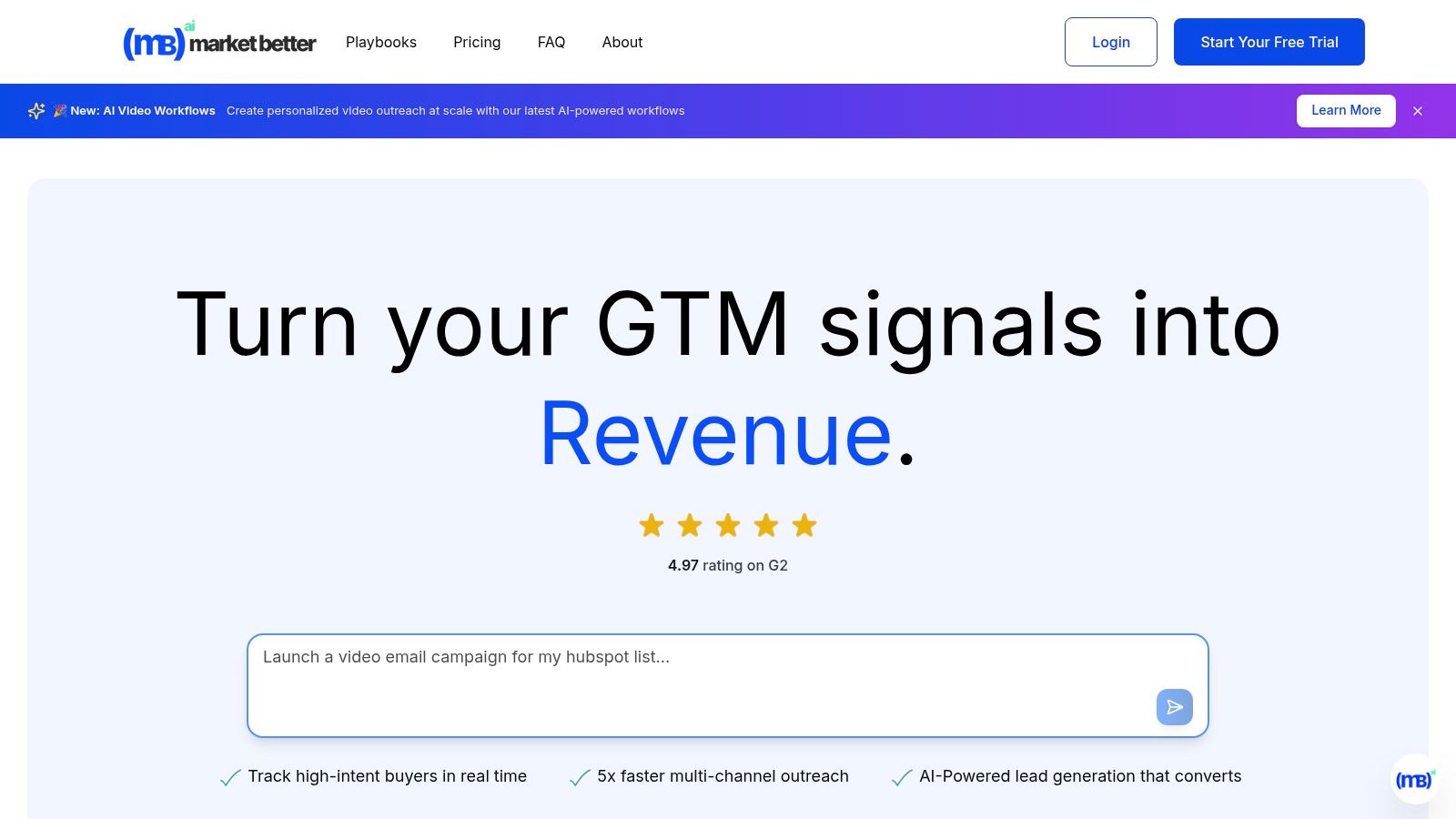
Unlike competitors like HubSpot or Marketo that often require separate modules or add-ons for advanced AI, marketbetter.ai provides a comprehensive suite that connects marketing signals directly to revenue from day one. Its predictive analytics engine doesn't just suggest optimizations; it automates A/B testing and personalizes outreach at scale, leading to a documented 15% improvement in campaign conversions.
Standout Features and Use Cases
One of its most innovative features is the AI voice assistant, which handles inbound lead qualification and schedules meetings with a natural, conversational flow. This drastically reduces follow-up times from days to minutes, ensuring high-intent leads are engaged immediately.
Another key advantage is its seamless, no-extra-cost integration with essential platforms like Salesforce, HubSpot, and LinkedIn Ads. This deep integration allows the platform to pull GTM signals and push actionable insights directly into your existing workflows, creating a powerful, cohesive ecosystem. Teams looking to refine their qualification process can explore advanced strategies with marketbetter.ai's playbook on AI-powered lead scoring.
Practical Assessment
| Category | Analysis |
|---|---|
| Usability | The platform offers popular workflow templates for effortless deployment, allowing teams to see initial results within minutes. However, unlocking its full potential may require dedicated onboarding for teams new to comprehensive AI marketing suites. |
| Integration | Its native, deep integrations with major CRMs and communication tools are a significant advantage, eliminating the data silos common with other point solutions. |
| Security | Offers enterprise-grade security and compliance, a critical consideration for larger organizations handling sensitive customer data. |
Pros:
- 5x faster multi-channel content creation and outreach
- 15% improved campaign conversions via predictive analytics
- Seamless integration with Salesforce, HubSpot, and LinkedIn Ads
- AI voice assistant for instant lead qualification and meeting scheduling
Cons:
- Pricing is not publicly available, requiring a direct sales consultation.
- The extensive feature set may have a steeper learning curve for smaller teams.
Website: https://www.marketbetter.ai
2. HubSpot – Marketing Hub
Best For: Teams of all sizes seeking an all-in-one platform where AI features are embedded directly into their daily marketing, sales, and service workflows.
HubSpot’s Marketing Hub has evolved from a powerful marketing automation platform into a comprehensive AI-driven ecosystem. It stands out by embedding AI directly into the tools marketers already use daily, from content creation to lead nurturing. Instead of requiring users to switch to a separate AI tool, HubSpot integrates features like its AI Content Assistant across its blog, email, and social media composers, making it one of the best AI marketing tools for teams seeking efficiency within a unified platform.
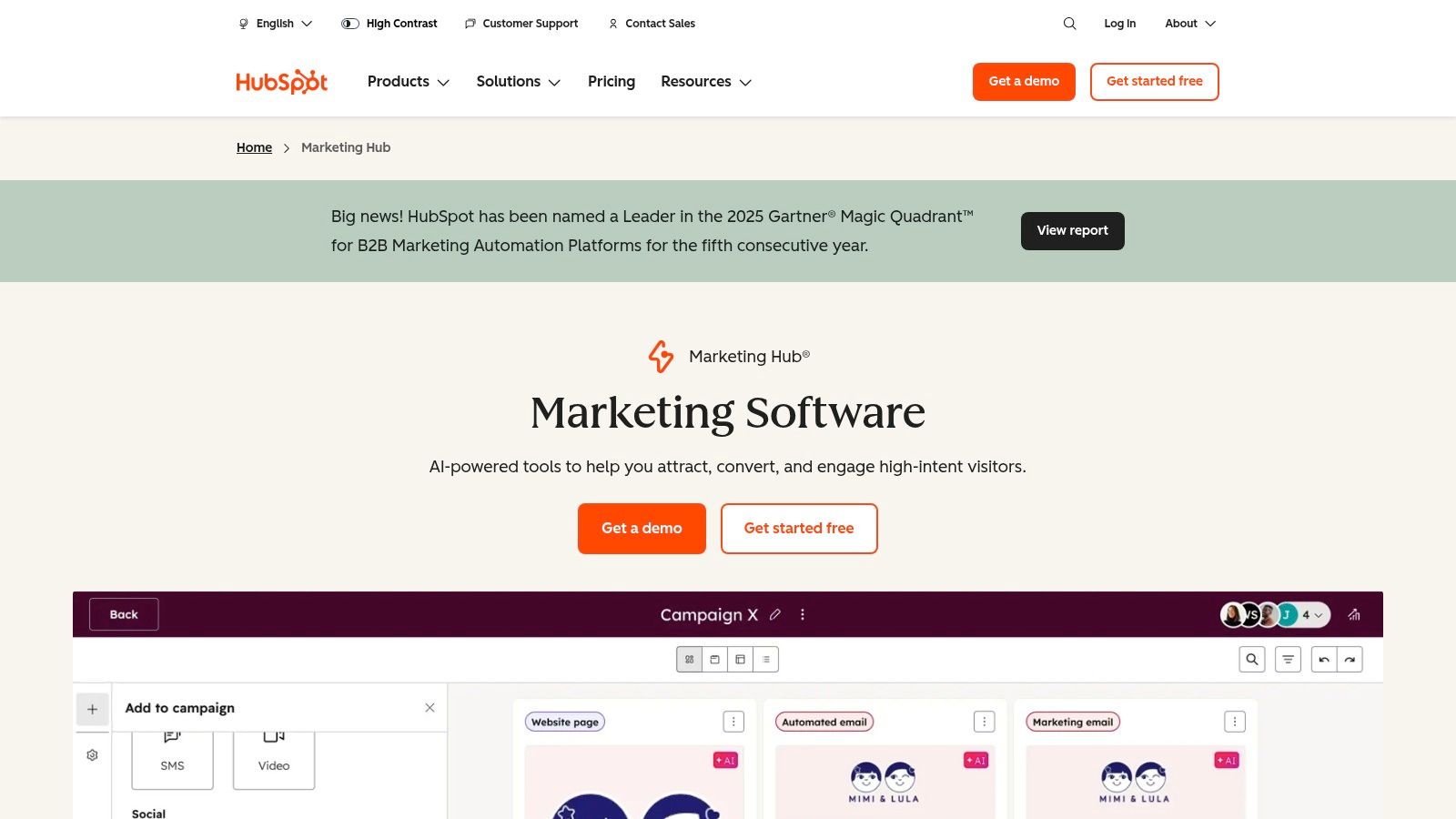
Compared to standalone AI copy generators like Jasper, HubSpot’s AI leverages the deep contextual data within its CRM. This allows for hyper-personalized email campaigns and predictive lead scoring that is far more accurate than systems without integrated customer data. For example, you can use its AI to automatically segment audiences based on predicted lifetime value, then generate targeted social ad copy for that specific segment, all within the same interface.
Key Features & Use Cases
| Feature | Best Use Case | Actionable Tip |
|---|---|---|
| AI Content Assistant | Drafting blog posts, social media updates, and email copy directly within the platform. | Action: Use the "rephrase" or "change tone" function to quickly create multiple variations of an ad creative for A/B testing without leaving the ad composer. |
| Predictive Analytics | Identifying high-value leads and forecasting campaign performance. | Action: Build a workflow that automatically enrolls contacts with a high predictive lead score into an aggressive nurturing sequence with personalized offers. |
| AI-Powered SEO | Generating topic clusters and optimizing on-page content. | Action: Let the AI suggest pillar page topics based on your existing content, then use it to outline the corresponding cluster content to build topical authority faster. |
Pros:
- All-in-One System: Reduces tool sprawl by integrating AI marketing, sales, and service functions with a robust CRM.
- Excellent Onboarding: HubSpot Academy offers extensive free training, making complex features accessible.
Cons:
- Cost Creep: Pricing is based on marketing contact tiers, and costs can escalate quickly with add-ons and mandatory onboarding fees for higher plans.
Website: https://hubspot.com/products/marketing
3. Salesforce – Marketing Cloud
Best For: Large enterprises that need to leverage massive datasets for hyper-personalized, multi-channel customer journeys at scale, especially those already in the Salesforce ecosystem.
Salesforce Marketing Cloud stands as an enterprise-grade powerhouse, embedding its "Einstein" AI deep within its suite to manage complex, multi-channel customer journeys at scale. Unlike platforms like HubSpot that focus on inbound marketing, Salesforce integrates predictive intelligence directly into its journey builder and personalization engines to serve enterprise B2C and B2B needs. This approach makes it one of the best AI marketing tools for large organizations needing to align marketing efforts tightly with extensive sales and service data already living within the Salesforce ecosystem.
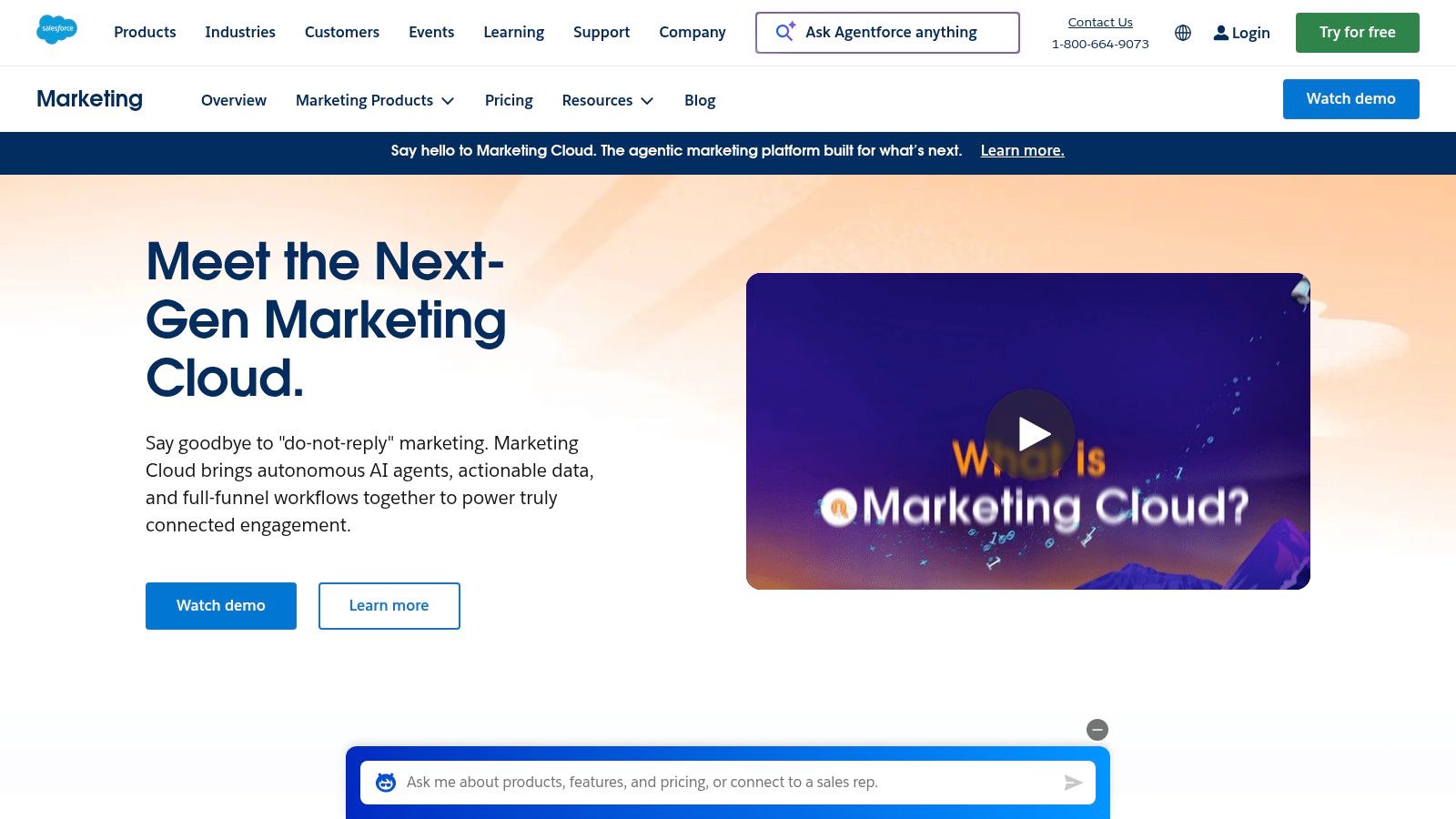
Where simpler tools might use AI for content creation, Marketing Cloud’s Einstein AI focuses on predictive decisioning. It analyzes vast datasets from the core CRM and Data Cloud to determine the optimal time, channel, and message for every individual contact. For instance, it can predict which customers are likely to unsubscribe from an email list and automatically suppress them from a campaign, instead targeting them with a tailored mobile push notification or ad to re-engage them.
Key Features & Use Cases
| Feature | Best Use Case | Actionable Tip |
|---|---|---|
| Einstein 1:1 Personalization | Delivering hyper-relevant product and content recommendations across web and email. | Action: Use Einstein Engagement Splits in Journey Builder to let the AI decide the next best action for a contact based on their real-time behavior (e.g., send an SMS vs. an email). |
| Cross-Channel Journey Builder | Orchestrating complex customer journeys that adapt based on predictive insights. | Action: Create a journey path that uses Einstein's Send Time Optimization (STO) to ensure emails arrive when each contact is most likely to open them, maximizing engagement. |
| AI-Powered Audience Segmentation | Identifying and segmenting audiences based on predicted engagement or conversion likelihood. | Action: Build a "Predicted to Churn" audience segment and enroll them in a dedicated re-engagement journey with exclusive offers, triggered automatically by the AI. |
Pros:
- Enterprise Scalability: Built to handle the massive data volumes and compliance needs of large, regulated organizations.
- Mature Ecosystem: Deep integration with Sales Cloud and Service Cloud provides a true 360-degree customer view.
Cons:
- High Cost & Complexity: Enterprise-level pricing and a significant learning curve often require certified implementation partners.
Website: https://salesforce.com/marketing
4. Adobe Marketo Engage
Best For: Enterprise B2B marketing teams with complex, account-based marketing (ABM) strategies and long sales cycles that require deep analytics and revenue attribution.
Adobe Marketo Engage is a heavyweight marketing automation platform designed for the complex needs of enterprise B2B organizations. Its AI capabilities focus less on generative content and more on predictive audiences and journey optimization. Within the Adobe Experience Cloud, Marketo uses AI to analyze vast datasets, enabling marketers to orchestrate highly sophisticated, multi-channel nurturing campaigns and account-based marketing (ABM) programs at scale, making it one of the best AI marketing tools for teams with mature data strategies.
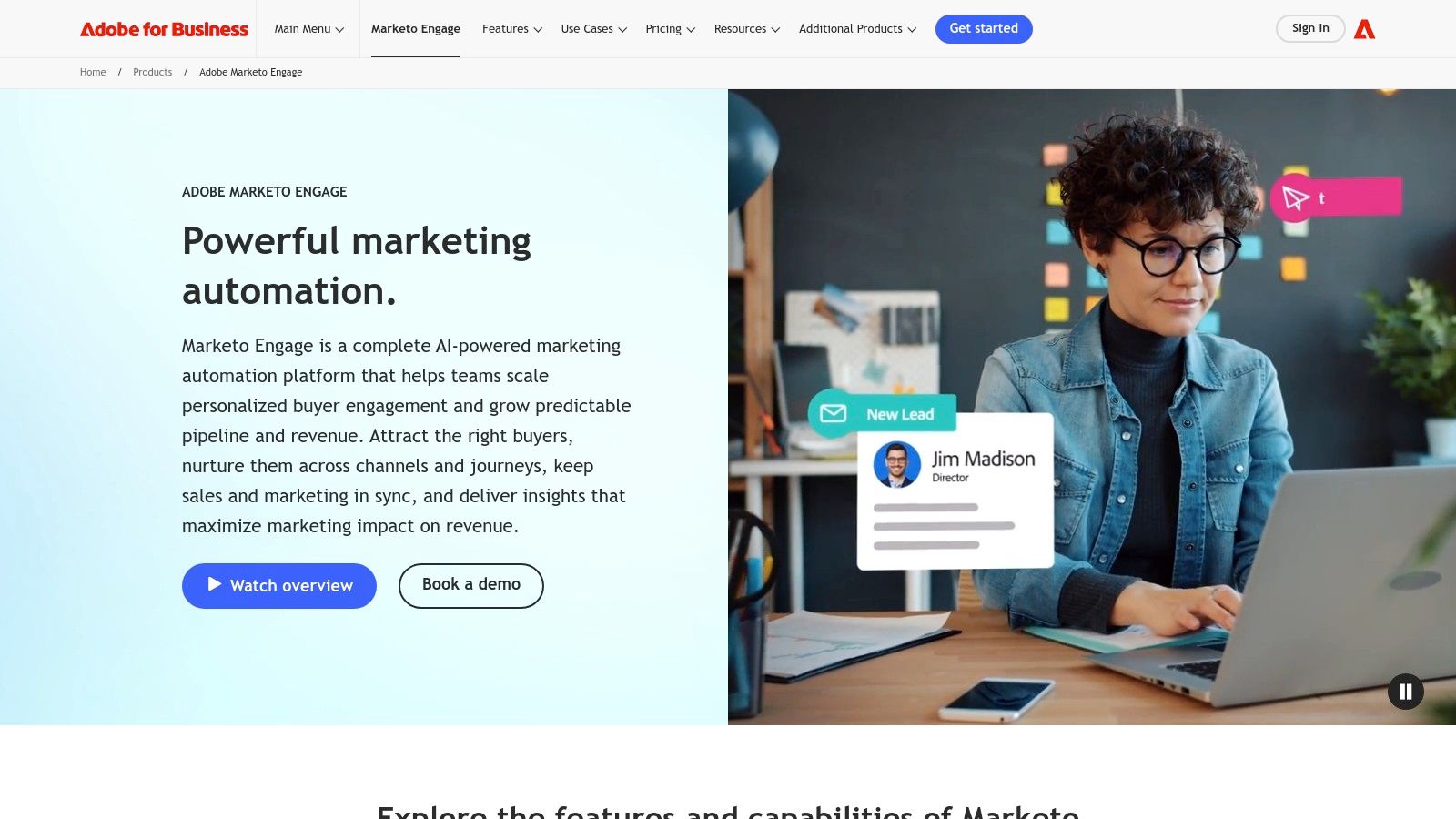
Where a tool like HubSpot might excel at inbound lead generation for a broad audience, Marketo applies its AI to the entire B2B lifecycle, focusing on target accounts. For instance, its AI can predict which accounts are most likely to convert and then automatically personalize website content and ad creative for key decision-makers within those accounts. This deep integration with sales cycles via CRMs like Salesforce allows for a level of AI-driven sales and marketing alignment that standalone tools cannot match.
Key Features & Use Cases
| Feature | Best Use Case | Actionable Tip |
|---|---|---|
| Predictive Audiences | Building hyper-targeted segments for complex ABM campaigns. | Action: Use the AI to build a lookalike audience based on your top 10 highest-value closed-won accounts from the past year to focus your ad spend effectively. |
| Journey Analytics | Identifying the most effective marketing touchpoints and attributing revenue. | Action: Create a workflow that alerts the sales team via their CRM when a contact from a target account engages with a high-value, AI-identified touchpoint like a pricing page visit. |
| Dynamic Content | Personalizing web pages, emails, and landing pages based on user behavior. | Action: Set up dynamic content blocks on your pricing page that show different case studies based on the visitor’s industry, as identified by the AI, to increase relevance. |
Pros:
- Powerful for B2B: Excels at complex lead nurturing, ABM, and multi-touch revenue attribution.
- Deep Analytics & Scalability: Built to handle enterprise-level data and program complexity with robust reporting.
Cons:
- Premium Pricing: Custom pricing is available only via sales consultation and is positioned at the high end of the market.
- Steep Learning Curve: Requires significant training and resources to implement and manage effectively compared to SMB-focused tools.
Website: https://business.adobe.com/products/marketo
5. Jasper
Best For: Marketing and content teams that need to produce a high volume of on-brand copy across multiple channels while maintaining strict brand consistency.
Jasper has established itself as a premier AI marketing tool focused on generating on-brand content at scale. It excels by allowing teams to upload brand voice guidelines, style guides, and product catalogs, ensuring every piece of generated content is consistent and accurate. This deep brand context moves it beyond a simple text generator like ChatGPT into a strategic content creation platform, ideal for marketing teams that prioritize brand integrity across all channels.
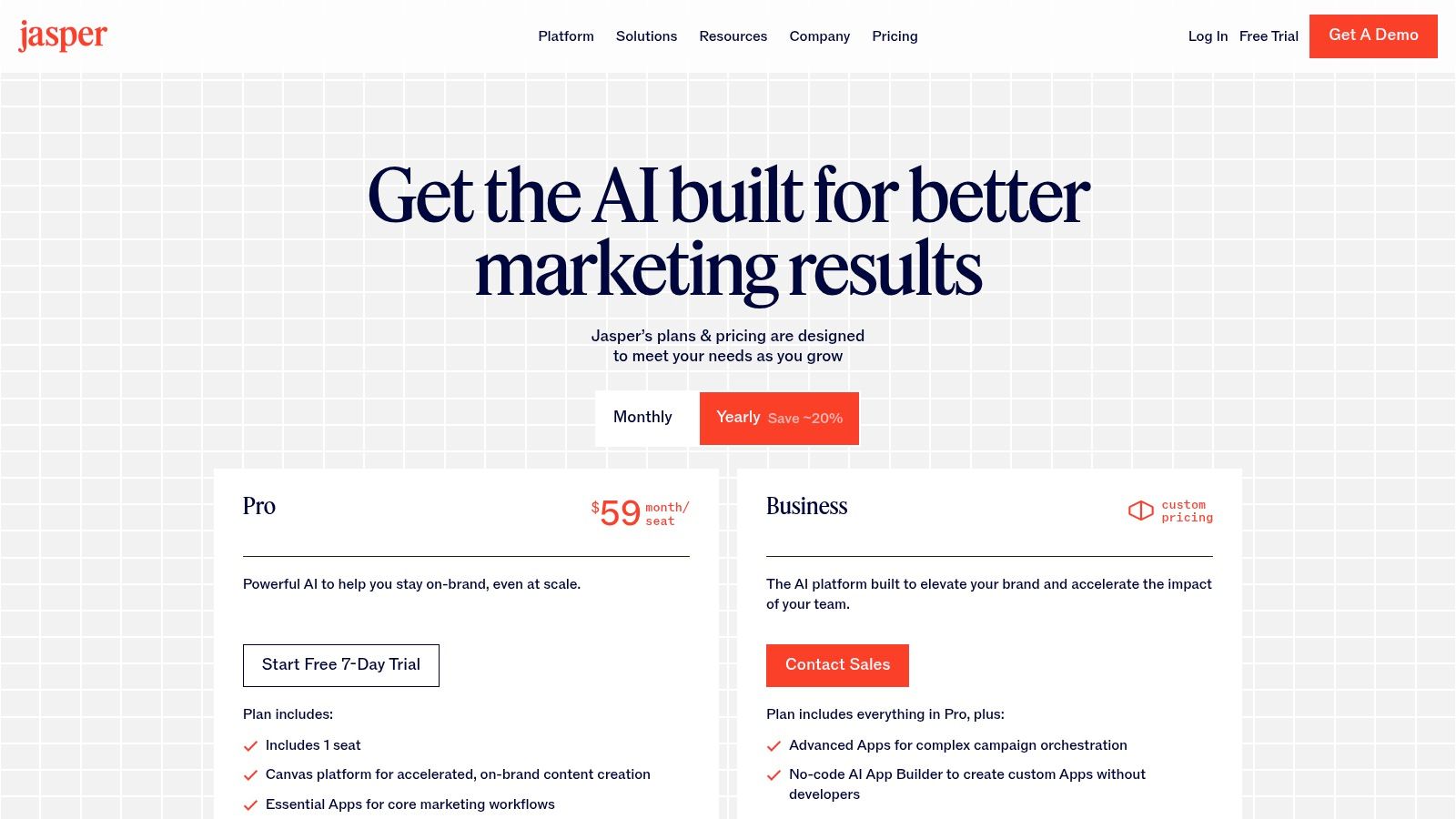
Compared to Copy.ai, which focuses more on GTM workflows, Jasper’s strength lies in its "Brand Voice" and "Knowledge" features that enable it to learn a company’s specific tone, facts, and messaging. This allows a marketing manager to create an entire multi-channel campaign—from ad copy and social media posts to a landing page and email sequence—all perfectly aligned with their brand's unique style. While Jasper is a powerful choice for content generation, you might also want to explore other leading AI content writing tools to find the perfect fit for your specific needs.
Key Features & Use Cases
| Feature | Best Use Case | Actionable Tip |
|---|---|---|
| Brand Voice & Knowledge | Maintaining brand consistency across all marketing content. | Action: Upload your top-performing blog posts and marketing emails to the knowledge base so Jasper can learn and replicate your most effective messaging and tone. |
| Campaign Creation | Developing cohesive assets for a marketing campaign from a single brief. | Action: Start a new campaign with a simple brief and let Jasper generate initial drafts for your ads, social posts, and blog outlines simultaneously for a faster launch. |
| Templates & Workflows | Streamlining repetitive content tasks like writing social media posts or product descriptions. | Action: Save a custom workflow (called a "Recipe") for your weekly newsletter creation process to automate the entire drafting and formatting sequence in one click. |
Pros:
- Strong Brand Controls: Excellent for teams needing brand safety, consistency, and collaborative content creation.
- Trial Available: The Pro plan offers a 7-day free trial to test its full capabilities.
Cons:
- Expensive for Large Teams: The per-seat pricing model can become costly as you scale your marketing team.
- Key Features Gated: Advanced enterprise governance and API access are reserved for custom Business plans.
Website: https://jasper.ai/pricing
6. Copy.ai
Best For: Go-to-market teams that want to move beyond content generation and automate entire multi-step marketing and sales processes.
Copy.ai positions itself as more than just a content generator; it's an AI-powered automation platform for go-to-market teams. It excels by combining a user-friendly chat interface with powerful, customizable workflow "Agents" that streamline complex marketing and sales operations. Unlike simpler writing tools, Copy.ai allows users to access multiple AI models (like those from OpenAI, Anthropic, and Google) and build automated processes, making it one of the best AI marketing tools for teams aiming to scale their content operations efficiently.
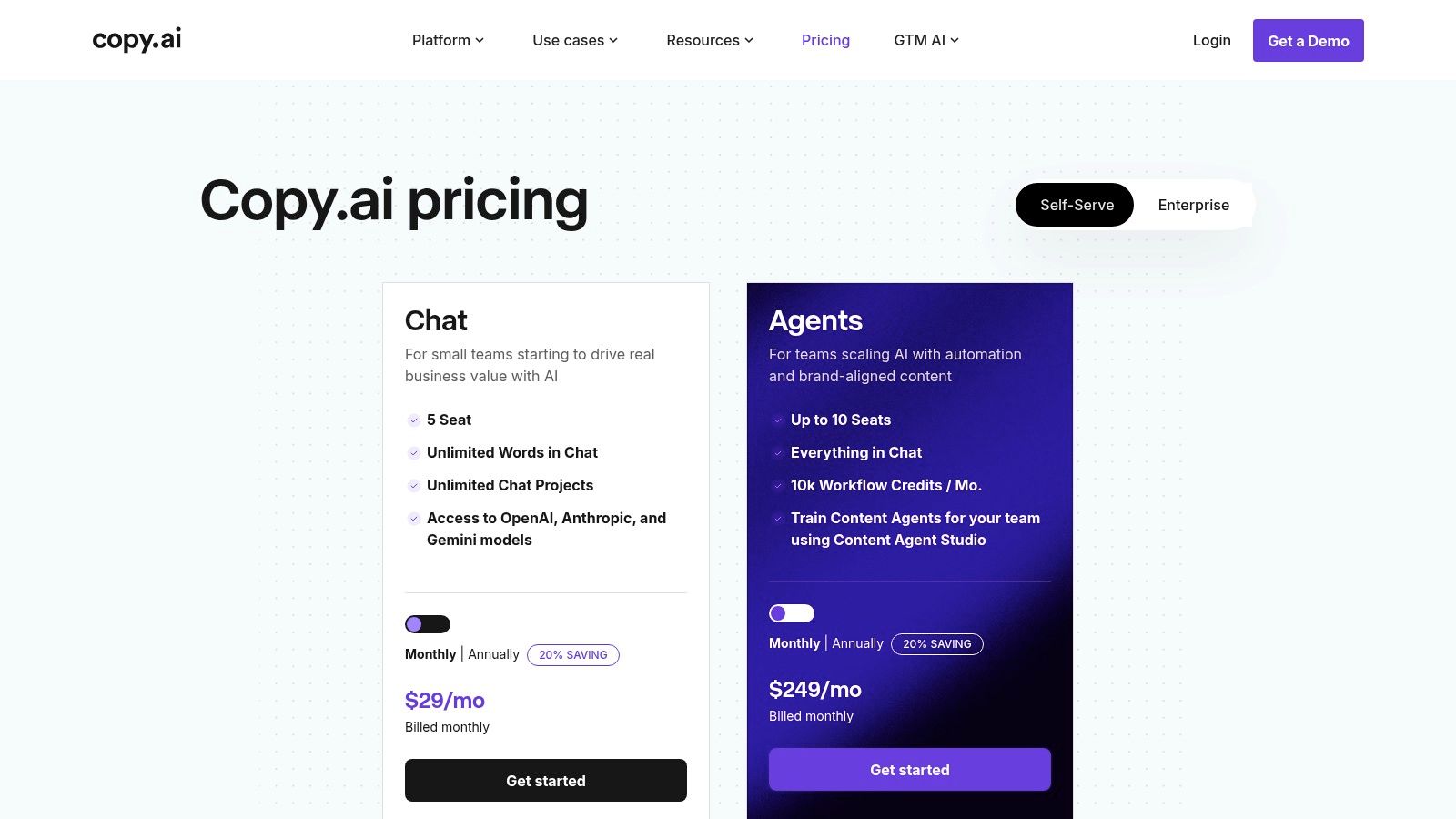
Where platforms like Jasper focus heavily on creative content generation, Copy.ai differentiates itself with its emphasis on operational workflows. For instance, a marketing team can build an Agent that automatically scrapes new lead data from a CRM, enriches it with public information, drafts a personalized outreach email sequence based on a defined brand voice, and then pushes it back into their sales engagement tool. This moves beyond simple copy creation into true process automation.
Key Features & Use Cases
| Feature | Best Use Case | Actionable Tip |
|---|---|---|
| Multi-Model Access | Finding the best AI model for specific tasks, such as creative writing vs. data analysis. | Action: Test the same prompt using different models (e.g., GPT-4o vs. Claude 3 Opus) in the Chat to see which one delivers better results for your specific use case. |
| Workflow Agents | Automating repetitive, multi-step GTM tasks like lead enrichment and personalized outreach. | Action: Create an Agent to monitor your company's press mentions. Have it summarize the article and draft a social media post to share it, all without manual input. |
| Brand-Aligned Content | Ensuring all AI-generated copy, from chat to workflows, adheres to your company's unique voice. | Action: Upload your style guides, key messaging documents, and best-performing content examples to train the AI on your specific brand identity. |
Pros:
- Simple Entry Plan: The free and low-cost tiers provide an accessible starting point for small teams and individuals.
- Scales to Automation: Moves beyond basic writing to automate entire marketing and sales processes with its Agents feature.
Cons:
- Workflow Credit Limits: Mid-tier plans have credit limits on automation, which can restrict the volume of tasks you can run.
- Requires Setup: Getting the most value from Workflow Agents requires an initial investment of time to design and configure your processes.
Website: https://copy.ai/prices
7. Semrush (plus the Semrush App Center)
Best For: SEO specialists and digital marketing agencies who need a data-rich platform that combines competitive intelligence with AI-driven content optimization tools.
Semrush is a titan in the SEO and competitive intelligence space, but its evolution into one of the best AI marketing tools comes from both its core platform enhancements and its expansive App Center. While known for its unparalleled data, Semrush now infuses AI into its content workflows, offering AI-powered suggestions for optimizing copy and generating content outlines. This integration streamlines the journey from keyword research to content creation.
What truly differentiates Semrush is its App Center, which allows marketers to bolt on specialized AI capabilities. Unlike all-in-one platforms where you get a fixed set of features, Semrush offers a marketplace model. For instance, you can add the "AI Social Assistant" to generate social media calendars and post copy, or use other third-party AI apps for advanced reporting and ad creation, paying only for the specific tools you need. This makes it a flexible, modular alternative to more rigid suites like HubSpot.
Key Features & Use Cases
| Feature | Best Use Case | Actionable Tip |
|---|---|---|
| AI Content Workflows | Optimizing existing articles and generating data-driven content outlines. | Action: Run a target keyword through the SEO Content Template tool, and use the AI-generated brief to guide your writer for maximum ranking potential. |
| App Center | Expanding core functionality with specialized AI tools for social media, PPC, or content. | Action: Connect the "AI Social Assistant" app to draft a month's worth of social media content based on your top-performing blog posts, saving hours of manual work. |
| Competitive Intelligence | Analyzing competitors' AI-driven content strategies and ad campaigns. | Action: Use the "AdClarity" integration to analyze competitor video ad creatives and use those insights to inform your own AI-generated video scripts. |
Pros:
- Broad Marketing Toolkit: Combines top-tier SEO/SEM data with growing AI features in a single subscription.
- Modular AI Expansion: The App Center lets you add specific AI capabilities without paying for an entirely new platform.
Cons:
- Costly Add-ons: Plan limits can be tight, and costs for the main subscription plus multiple App Center apps can add up quickly.
- Steep Learning Curve: Mastering the full suite of features requires a significant time investment.
Website: https://semrush.com/pricing
8. Mailchimp
Best For: Small and medium-sized businesses (SMBs) looking for an accessible, user-friendly platform to scale their email and multichannel marketing with easy-to-use AI features.
Mailchimp has long been a go-to for email marketing, but its evolution into an AI-powered platform makes it a strong contender among the best AI marketing tools for small and growing businesses. It excels by making sophisticated AI features, like predictive segmentation and content optimization, highly accessible. Instead of overwhelming users with complex data science, Mailchimp’s Creative Assistant automatically generates on-brand designs and copy suggestions, simplifying the creation of effective multichannel campaigns.
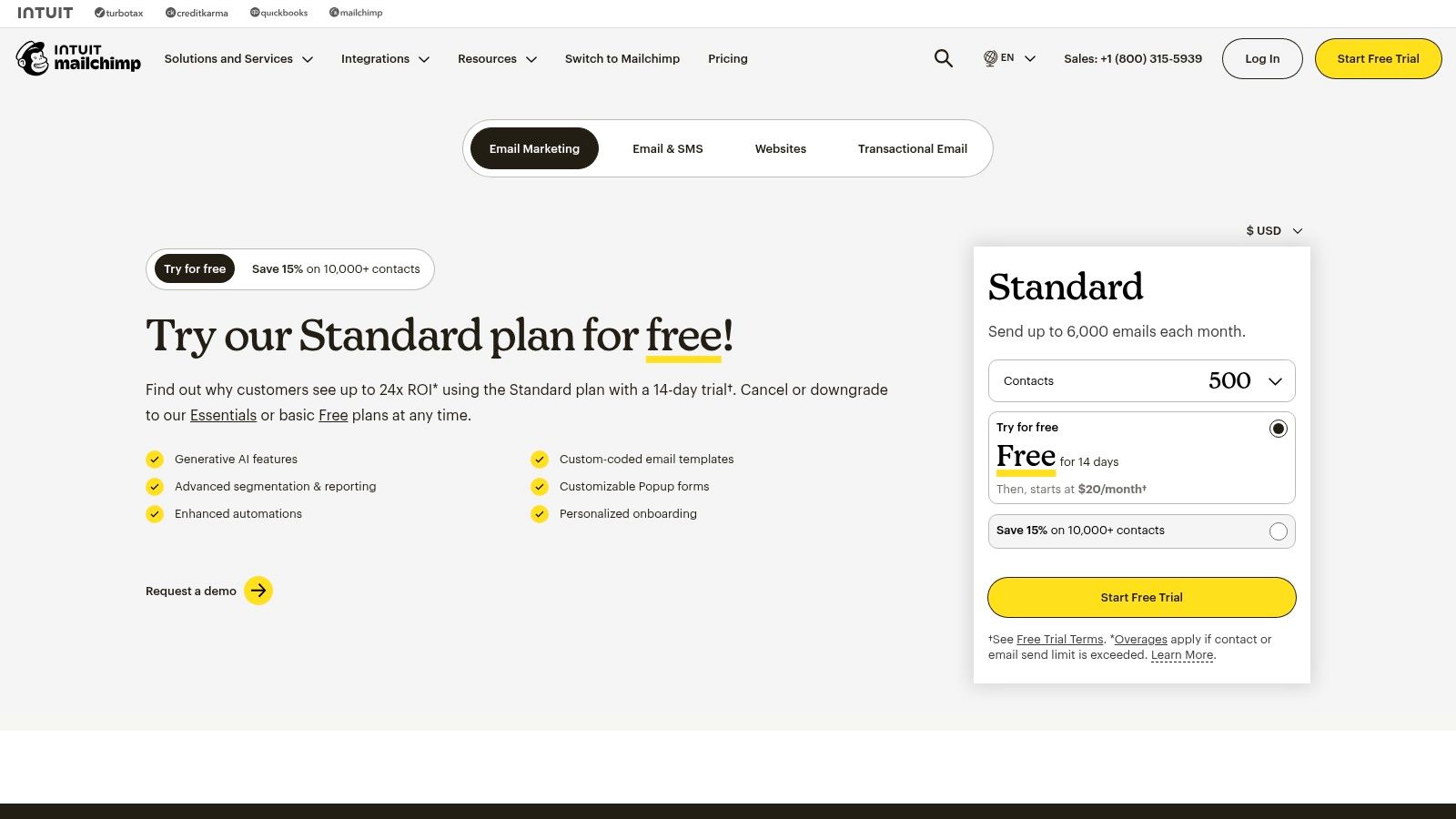
Unlike more enterprise-focused platforms like Marketo, Mailchimp’s AI is designed for immediate impact with minimal setup. The platform uses its vast dataset to predict customer lifetime value and likelihood to purchase, allowing marketers to build automated journeys that target high-potential segments without manual analysis. For instance, you can automatically send a special offer to contacts the AI identifies as having a high purchase likelihood, directly improving conversion rates.
Key Features & Use Cases
| Feature | Best Use Case | Actionable Tip |
|---|---|---|
| Creative Assistant | Generating on-brand email and social media designs and copy variations quickly. | Action: Use the AI to instantly resize a single design for email, Instagram, and Facebook, ensuring brand consistency across channels with one click. |
| Predictive Segmentation | Identifying and targeting contacts based on predicted purchase likelihood and lifetime value. | Action: Create a segment of customers with a high predicted lifetime value and enroll them in an exclusive loyalty campaign journey to foster retention. |
| Customer Journey Builder | Automating multichannel communication paths based on user behavior and AI insights. | Action: Start a journey with an email and add a rule that sends a follow-up social ad only to contacts who didn't open the initial email, increasing your touchpoints. |
Pros:
- Accessible Onboarding: An intuitive interface and extensive template library make it easy for beginners to get started.
- Strong for SMBs: Well-suited for businesses building their contact lists and scaling their email marketing efforts.
Cons:
- Gated Features: Some of the most powerful AI and automation tools are reserved for higher-priced subscription tiers.
Website: https://mailchimp.com/pricing
9. Hootsuite (with OwlyWriter AI)
Best For: Social media managers and marketing teams who need to streamline content creation, scheduling, and community management across multiple social platforms.
Hootsuite has long been a staple for social media management, but the integration of its OwlyWriter AI transforms it into a powerful content-creation engine. While many platforms offer scheduling, Hootsuite’s AI is specifically designed to overcome creative roadblocks inherent to social media marketing. It excels at generating platform-specific post ideas, captions, and relevant hashtags, making it one of the best AI marketing tools for teams looking to streamline their multi-channel social media workflow from a single, mature platform.
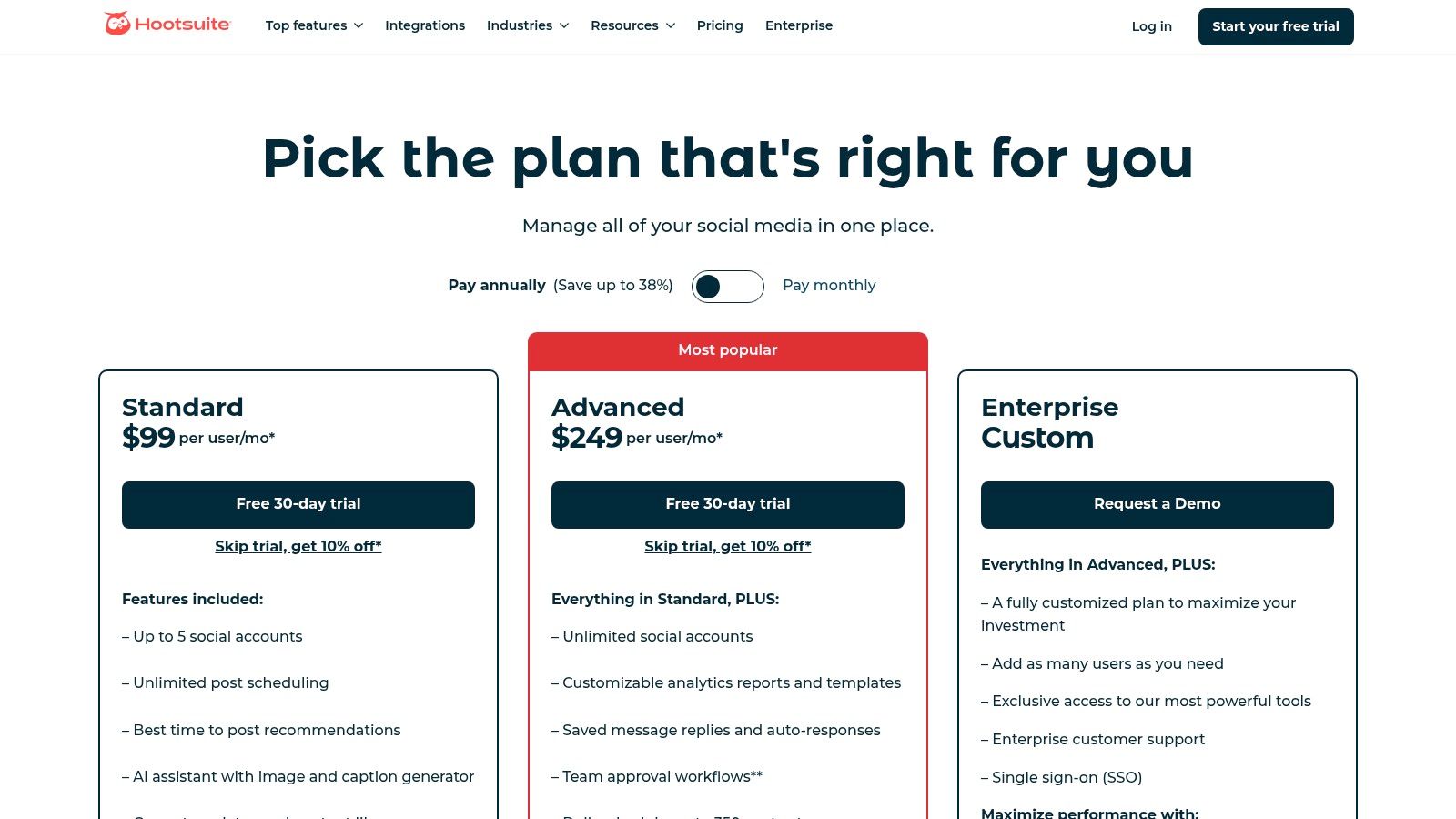
Unlike generic AI writers like ChatGPT, OwlyWriter AI operates within the context of social media best practices. You can input a simple link or prompt, and it will generate various caption styles—from professional to witty—tailored for platforms like LinkedIn or Instagram. This allows content teams to quickly produce high-quality, on-brand copy, schedule it across all channels, and analyze its performance without ever leaving the Hootsuite dashboard, a significant efficiency gain compared to using separate tools for AI writing and social scheduling.
Key Features & Use Cases
| Feature | Best Use Case | Actionable Tip |
|---|---|---|
| OwlyWriter AI | Generating social media captions, content ideas, and relevant hashtags. | Action: Use the "Repurpose Post" feature on your top-performing organic content to quickly create unique variations for other social networks, maximizing its reach. |
| Unified Inbox & Automations | Managing comments and direct messages from all social channels in one place. | Action: Set up an automated rule to assign any message containing the word "issue" or "problem" directly to your customer support team member for faster resolution. |
| Scheduling & Analytics | Planning content calendars and tracking performance against competitors. | Action: Use the "Best Time to Publish" feature to schedule posts, then cross-reference the engagement data in your analytics report to refine future timing for peak performance. |
Pros:
- Mature Platform: A robust, all-in-one solution for multi-channel social media operations, from creation to analytics.
- Content Efficiency: OwlyWriter AI significantly speeds up the process of drafting and repurposing social media posts.
Cons:
- Advanced Tiers: Pricing can increase notably for teams needing more users or advanced analytics and listening features.
Website: https://hootsuite.com/plans
10. Shopify App Store – AI-Powered Marketing Apps
Best For: E-commerce businesses running on Shopify who need a customized stack of AI tools for specific tasks like ad creation, on-site personalization, and product description writing.
For e-commerce businesses running on Shopify, the platform’s App Store is a goldmine of specialized AI marketing tools designed for seamless integration. Instead of a single, all-encompassing AI suite, Shopify offers a curated marketplace where merchants can pick and choose from hundreds of apps. This allows for a highly customized marketing stack, from AI-powered ad creators to intelligent search and personalization engines that tap directly into your store's product catalog and customer data.
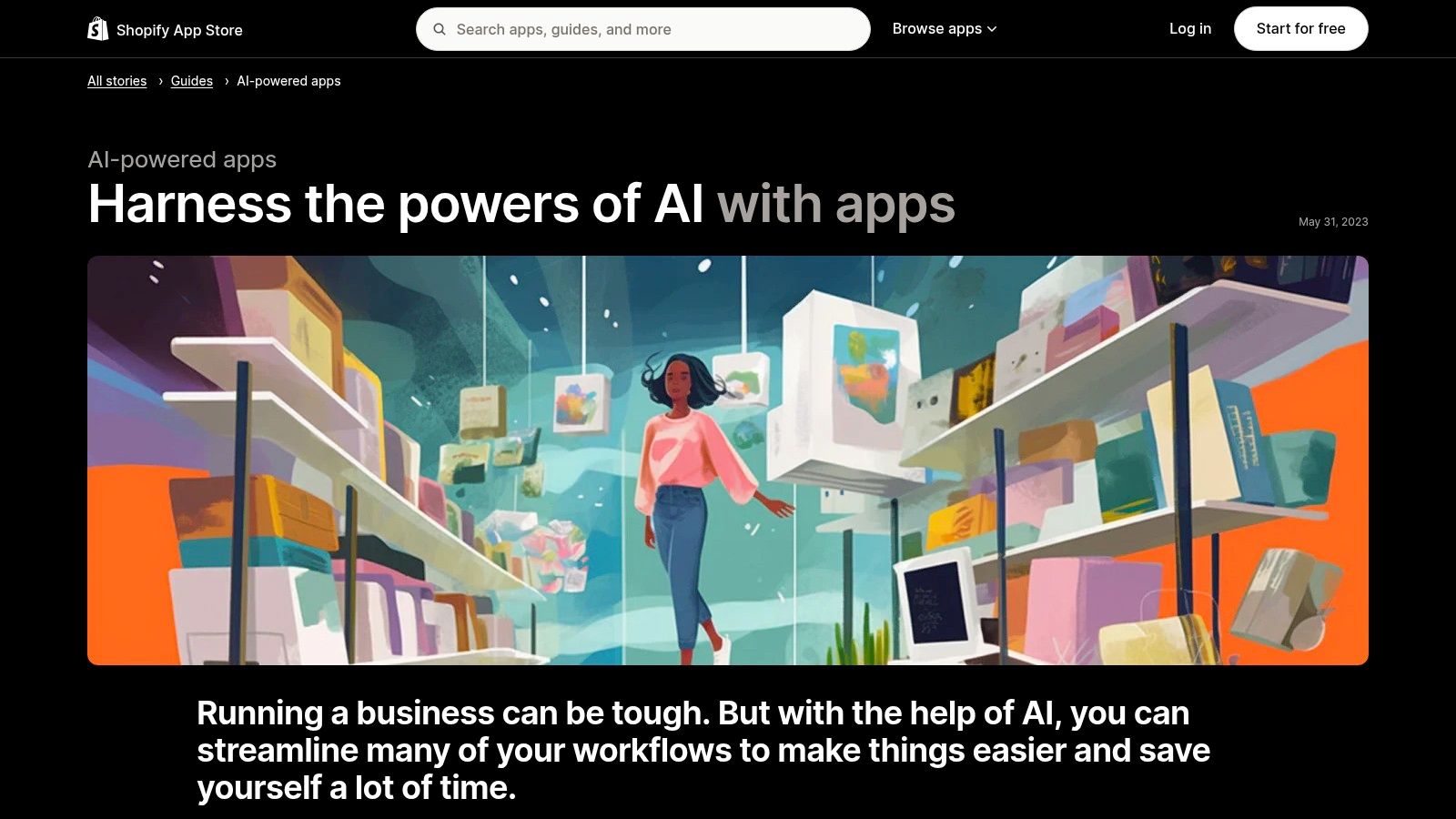
This à la carte approach differs significantly from monolithic platforms like HubSpot. Rather than adopting one system, you can select best-in-class solutions for specific tasks, such as an AI video generator for social ads and a separate AI for optimizing product descriptions. The key advantage is that these apps are built specifically for the Shopify ecosystem, ensuring deep data integration for things like abandoned cart recovery, personalized product recommendations, and automated ad campaign generation based on your best-selling items.
Key Features & Use Cases
| Feature | Best Use Case | Actionable Tip |
|---|---|---|
| AI Ad & Video Creators | Generating social media video ads and campaign copy directly from product listings. | Action: Use an app like AdScale or Veda to instantly turn your product images and details into multiple video ad variants for Meta and TikTok, ready for A/B testing. |
| On-Site AI Search | Improving product discovery and personalizing the on-site shopping experience. | Action: Install a smart search app to provide visual search, personalized recommendations, and "frequently bought together" bundles to increase average order value. |
| Automated Social Posting | Maintaining an active social media presence by automatically creating and scheduling posts. | Action: Connect an app like 'Post Studio' to auto-post new products or highlight items with low stock to create urgency and drive sales without manual effort. |
Pros:
- Direct Shopify Integration: Apps seamlessly access product, customer, and order data for superior targeting and automation.
- Wide Range of Tools: A massive selection of specialized AI marketing applications for almost any e-commerce need.
Cons:
- Accumulating Costs: While many apps have free tiers, managing multiple paid subscriptions can become expensive and complex.
Website: https://apps.shopify.com/stories/guide-ai-powered-apps
11. G2 – AI-enabled Marketing Categories and Grids
Best For: Marketing leaders and procurement teams conducting due diligence to compare AI tools based on verified user reviews and objective market data.
While not a tool itself, G2 is an indispensable resource for discovering and vetting the best AI marketing tools on the market. It functions as a meta-tool, providing peer-sourced reviews, detailed feature comparisons, and dynamic "Grid" reports that map out vendors based on market presence and user satisfaction. This platform is crucial for navigating the rapidly expanding and often confusing AI marketing landscape, moving beyond vendor marketing claims to see how tools perform in real-world scenarios.
Unlike a simple blog list, G2's structured data allows you to filter potential tools by specific AI capabilities, company size, pricing models, and user ratings. For example, a demand generation manager can filter for "AI Lead Scoring" tools used by mid-market companies and directly compare the top three contenders based on recent user reviews. This makes it an essential first step in the due diligence process before committing to demos or trials.
Key Features & Use Cases
| Feature | Best Use Case | Actionable Tip |
|---|---|---|
| Peer Reviews & Scores | Vetting vendor claims and understanding real user experiences before a demo. | Action: Filter reviews by your company size and role (e.g., "Small Business," "Marketing Manager") to find feedback from users with similar needs and challenges. |
| Category Grids | Visualizing the competitive landscape to identify market leaders and niche innovators. | Action: Look for tools in the "High Performers" quadrant for solutions with high satisfaction but smaller market presence—these can be hidden gems. |
| Feature Filtering | Shortlisting tools that meet specific, non-negotiable technical requirements. | Action: Create a "comparison" list within G2 for your top 2-3 choices to see a side-by-side feature and review breakdown before you even contact a sales rep. |
Pros:
- Fresh User Feedback: Provides up-to-date insights for effective due diligence.
- Excellent Discovery Tool: Helps uncover emerging AI marketing categories and specialized solutions.
Cons:
- Sponsored Placements: Be aware that sponsored listings can influence visibility, so don't equate top placement with best fit.
Website: https://www.g2.com/categories/ai-agents/f/sales-marketing
12. Capterra – AI Marketing Tool Roundups and Category Comparisons
Best For: Small and mid-market business owners who need to quickly create a shortlist of AI marketing tools by comparing features and pricing side-by-side.
While not an AI tool itself, Capterra serves as an essential meta-resource for any team vetting the best AI marketing tools. It provides curated roundups, user reviews, and direct vendor comparisons that help cut through marketing noise. Its strength lies in aggregating vast amounts of user-generated data and presenting it in a scannable format, allowing marketers to quickly assess a tool’s suitability based on real-world feedback and transparent pricing snapshots.
Compared to G2, which often has a more enterprise focus, Capterra excels at surfacing solutions for SMBs. This is particularly useful for identifying niche or budget-friendly tools that might not appear in broader tech publications. For instance, you can filter AI content generators by user rating, business size, and specific features like "brand voice analysis" to find a perfect-fit tool that a simple search might miss.
Key Features & Use Cases
| Feature | Best Use Case | Actionable Tip |
|---|---|---|
| Tool Roundups & Comparisons | Creating a shortlist of potential AI marketing platforms to evaluate. | Action: Use the "Compare" feature to select up to four tools and generate a side-by-side chart of features, pricing, and ratings to quickly identify the best value. |
| User Ratings & Reviews | Validating vendor claims and understanding a tool's real-world pros and cons. | Action: Filter reviews by job role or company size to see feedback from users with a similar profile to your own, ensuring the insights are relevant. |
| Cost & Plan Breakdowns | Getting a quick, high-level overview of a tool's pricing structure. | Action: Look for the "Starting Price" and "Pricing Details" sections to quickly disqualify tools that are outside your budget before investing time in a demo. |
Pros:
- Easy to Scan: Quickly compare pricing, key features, and user sentiment across dozens of tools in one place.
- Broad Tool Coverage: Excellent resource for discovering SMB-focused and emerging AI solutions.
Cons:
- Verify Information: Some content can be periodically outdated; always cross-reference pricing and features on the vendor's official site.
- Sponsored Profiles: Be aware that sponsored listings can influence search result placement.
Website: https://www.capterra.com/resources/ai-marketing-tools/
Top 12 AI Marketing Tools Feature Comparison
| Platform | Core Features & AI Capabilities | User Experience & Quality ★ | Value & Pricing 💰 | Target Audience 👥 | Unique Selling Points ✨ |
|---|---|---|---|---|---|
| 🏆 marketbetter.ai | AI content 5x faster, predictive analytics, multi-channel campaigns | ★★★★★ 4.97 on G2 | Consult for pricing, ROI focused | Mid-market to enterprise B2B marketing teams | AI voice assistant, seamless CRM integrations, real-time insights |
| HubSpot – Marketing Hub | AI content, journey orchestration, CRM integrated | ★★★★☆ strong onboarding | Tiered pricing, onboarding fees | SMB to enterprise marketing teams | Large app ecosystem, all-in-one automation stack |
| Salesforce – Marketing Cloud | 1:1 personalization, cross-channel journeys, AI decisioning | ★★★★☆ mature, scalable | Enterprise pricing, implementation | Mid-market to large enterprises | Deep CRM alignment, AI-driven personalization |
| Adobe Marketo Engage | Lead nurturing, ABM, AI personalization, CRM integrations | ★★★★☆ deep analytics | Premium, by sales contact | Complex B2B programs | Advanced analytics, scalable account-based marketing |
| Jasper | Brand voice control, multi-channel campaigns | ★★★★☆ strong brand safety | Per-seat pricing, trial available | Content teams focused on brand consistency | Brand safety, API & enterprise governance |
| Copy.ai | Multi-model AI, branded workflows, integrations | ★★★☆☆ scalable workflows | Affordable entry; credits limit automation | Small to mid-size marketing teams | Workflow Agents, multiple AI models |
| Semrush (plus App Center) | SEO/SEM data, AI content workflows, agency tools | ★★★☆☆ broad toolkit | Add-ons increase cost | Agencies and marketers needing broad AI tools | App Center with specialized AI marketing apps |
| Mailchimp | AI copy/design, customer journeys, multichannel | ★★★☆☆ accessible onboarding | Free tier limits; paid plans vary | SMBs and early-stage marketers | Creative Assistant, predictive segmentation |
| Hootsuite (OwlyWriter AI) | AI caption/hashtag generation, scheduling, analytics | ★★★★☆ mature social platform | Pricing rises at advanced tiers | Social media teams managing multi-channel | AI-powered content ideas, competitor benchmarking |
| Shopify App Store – AI Apps | AI ads, personalization, auto-posting, trials | ★★★☆☆ specialized apps | Pay-per-app, potential app overlap | E-commerce stores using Shopify | Wide variety of AI marketing apps, direct Shopify integration |
| G2 – AI Marketing Categories | Peer reviews, market presence, vendor rankings | ★★★★☆ fresh user feedback | Free access | Buyers researching AI marketing tools | Real user reviews, trial links, category awards |
| Capterra – AI Marketing Roundups | Tool lists, pricing snapshots, reviews | ★★★☆☆ easy to scan summaries | Free access | SMB and mid-market buyers | Side-by-side vendor comparisons, cost snapshots |
Try our Marketing Plan Generator — generate a complete AI-powered marketing plan in minutes. No signup required.
Final Thoughts
Navigating the landscape of AI marketing tools can feel overwhelming, but as we've explored, the right platform can revolutionize your strategy. We've journeyed through comprehensive suites like HubSpot and Salesforce, which centralize operations with their powerful AI features, to specialized content creators like Jasper and Copy.ai that refine your messaging. This guide was designed to move beyond simple feature lists, providing a strategic framework for finding the best AI marketing tools for your unique business needs.
The key takeaway is that there is no single "best" tool for everyone. The ideal choice hinges entirely on your specific goals, existing tech stack, and team size. A startup might find immense value in the agile, AI-powered apps available through the Shopify App Store, whereas an enterprise-level demand generation manager will likely lean towards the robust, scalable solutions offered by Adobe Marketo Engage.
How to Choose Your AI Marketing Toolkit
Selecting the right tool requires careful consideration. Before committing to a platform, focus on these critical steps to ensure a successful implementation and a strong return on investment:
-
Define Your Primary Use Case: Are you trying to solve a content creation bottleneck, automate lead nurturing, or gain deeper insights from customer data? A content-focused tool like Jasper won't solve a CRM data analysis problem, just as Salesforce Marketing Cloud might be overkill for a small team needing blog post ideas. Be specific about the problem you need AI to solve.
-
Audit Your Existing Stack: How will a new tool integrate with your current systems? A platform with seamless integrations into your existing CRM, like HubSpot's Marketing Hub, will provide more immediate value and less friction than a standalone tool that requires complex, custom API work. Review the integration capabilities of any potential solution.
-
Consider Your Team's Skillset: Some of the best AI marketing tools are incredibly user-friendly, while others require a steeper learning curve. Factor in the time and resources required for training. A tool like Mailchimp with intuitive AI features is perfect for teams that need to get up and running quickly, while more complex platforms may require a dedicated administrator.
-
Start with a Pilot Program: Instead of a full-scale rollout, identify a small, specific project to test your chosen tool. For instance, use an AI copywriter for a single email campaign or leverage an AI analytics tool to analyze one quarter's worth of data. This allows you to measure impact, gather feedback, and build a business case for wider adoption without significant upfront risk.
The true power of AI in marketing isn't just about automation; it's about augmentation. These tools are designed to empower your team, freeing them from repetitive tasks to focus on strategy, creativity, and building genuine customer relationships. By thoughtfully selecting and implementing the right solutions, you can build a more efficient, data-driven, and ultimately more effective marketing engine.
Ready to unify your marketing efforts and drive measurable results with a purpose-built AI platform? Discover how marketbetter.ai combines predictive analytics, content automation, and campaign optimization into one intuitive solution. Explore marketbetter.ai to see how our targeted AI can help you connect with the right customers at the right time.