
Sales Phone Call Script: 8 Proven Templates to Boost SDR Results
In a world of automated emails and LinkedIn messages, a well-executed phone call is a significant competitive advantage for B2B sales teams. Yet, many SDRs rely on rigid, outdated scripts that feel robotic and kill conversations before they even start. The problem isn't the script itself, it's the type of script. Most traditional templates force reps into a one-way pitch, ignoring the prospect's context and instantly triggering their defenses. In contrast, an actionable, modern sales phone call script is a flexible framework that guides conversation, adapting to real-time objections and prospect tone.
This guide moves beyond those generic, fill-in-the-blank templates. We are breaking down eight scenario-specific sales phone call script frameworks designed for today's skeptical and time-poor buyer. Each example is built to be a flexible, actionable playbook focused on one thing: creating genuine conversations that uncover pain and build qualified pipeline. Forget the monotonous monologues; these are conversation starters.
Instead of just providing text to read, we'll dissect the strategy behind each script. You'll learn:
- Specific phrasing to navigate common scenarios, from handling gatekeepers to overcoming objections like "we already use a competitor."
- Actionable tactics for personalizing your opener and booking a meeting without sounding pushy.
- Strategic comparisons between different approaches, like a pain-first opener versus a value-forward one, so you can choose the right script for the right situation.
We'll also show how tools like MarketBetter’s in-CRM talk-tracks and AI-powered call prep can turn these frameworks into a scalable, coachable system for your entire team. Prepare to replace "just checking in" with strategic, high-impact calls that prospects actually want to take.
1. The Discovery Call: Identifying Pain Points & Building Rapport
The discovery call is less a script and more a strategic framework for conversation. Unlike a rigid pitch which broadcasts features, its goal is to diagnose before you prescribe. A successful discovery call script guides the conversation, allowing the sales development representative (SDR) to listen more than they talk, uncover critical business challenges, and position their solution as a genuine remedy. This consultative approach builds trust and transforms a cold interaction into a collaborative partnership.

This method shines during initial conversations with qualified leads who have shown some intent, such as visiting your website or downloading a resource. It's about validating their interest by understanding the underlying "why" behind their actions.
Example Discovery Questions & Strategic Breakdown
Here’s how this sales phone call script works in practice, tailored for different personas:
Scenario A: Call with a Head of SDR
- Question: "How are your SDRs currently spending their time between actual calls and prep work?"
- Strategic Goal: This open-ended question is more effective than a simple "yes/no" question because it prompts a quantitative or qualitative response about team efficiency. It directly probes for administrative burdens, a common and costly pain point.
- Potential Follow-up: "If they're spending 40% of their day on admin, what's the impact on their quota attainment and pipeline generation?"
Scenario B: Call with a VP of Sales
- Question: "From your perspective, how consistently are reps logging their call activity and notes in Salesforce?"
- Strategic Goal: VPs care about data integrity for forecasting and strategic planning. This question targets a high-level, systemic issue that impacts the entire revenue organization. Inconsistent logging means unreliable data, a problem MarketBetter's auto-logging directly solves.
- Potential Follow-up: "When you pull a pipeline report, how confident are you that it reflects every single touchpoint?"
Actionable Takeaways & Tips
- Leverage Customer Insights: To ask truly insightful questions, you must understand your prospect's world. By actively collecting and analyzing the Voice of Customer, you can build a discovery script that resonates deeply because it's rooted in real-world challenges your target audience already faces.
- Use MarketBetter's Pre-Call Prep: Before dialing, use MarketBetter’s call-prep feature to review recent intent signals. A question like, "I noticed someone from your team was looking at our CRM integration page yesterday, which often happens when teams struggle with data hygiene. Is that a priority for you right now?" is far more powerful than a generic opener.
- Qualify with a Framework: Structure your questions around a qualification methodology like BANT (Budget, Authority, Need, Timeline) or MEDDIC. This ensures you cover all bases to determine if the prospect is a good fit.
- Listen for Key Phrases: Pay attention to words like "frustrating," "bottleneck," "time-consuming," and "inaccurate." Use MarketBetter’s talk-track feature to log these keywords in real-time, creating an instant summary of pain points.
2. The Pain-First Opener: Leading with SDR Team Challenges
The Pain-First Opener is an assertive sales phone call script that flips the traditional model on its head. Instead of a slow build-up about who you are and what your company does, this approach leads with a highly specific, research-backed hypothesis about a prospect's most pressing challenge. By immediately addressing a known pain point, you cut through the noise, demonstrate relevance, and earn the right to continue the conversation.
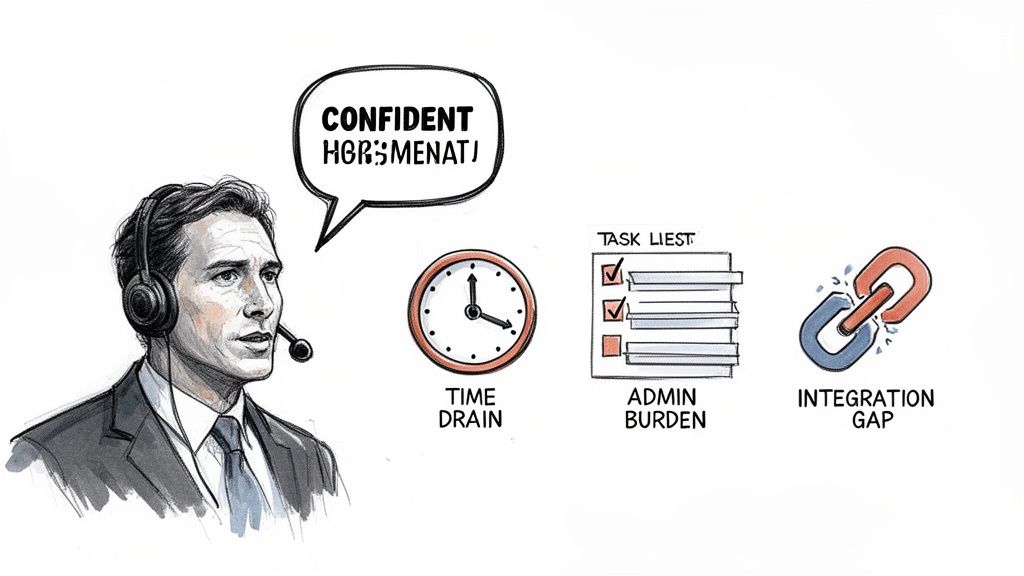
This tactic is most effective when you have some context about the company, such as its size, recent sales hires, or signals indicating outbound challenges. It positions the SDR not as a generic seller, but as a specialist who understands the unique operational hurdles that come with the prospect's role and industry.
Example Pain-First Openers & Strategic Breakdown
Here’s how to deploy this script effectively for different decision-makers:
Scenario A: Call with a VP of Sales at a growing SaaS company
- Opener: "Most sales leaders we work with at companies your size tell us their SDRs spend over two hours a day just figuring out what to do next and updating Salesforce. I'm guessing your team is facing something similar?"
- Strategic Goal: This opener is powerful because it's specific ("two hours a day"), relatable (references "companies your size"), and directly ties to the VP's core concerns: productivity and pipeline. It's a calculated risk that pays off with an immediate nod of recognition, opening the door to discuss MarketBetter's task automation.
- Potential Follow-up: "How is that admin time impacting your team's ability to hit its meeting-setting targets?"
Scenario B: Call with a RevOps Leader
- Opener: "We've noticed most Salesforce-first teams struggle with dialer adoption because it lives outside the CRM, which skews activity data. Is that showing up in your call logs?"
- Strategic Goal: This speaks directly to the RevOps mandate for data integrity and tech stack efficiency. It highlights a common system-level flaw (poor integration) and its consequence (unreliable data), immediately positioning MarketBetter’s native Salesforce dialer as the logical solution.
- Potential Follow-up: "When your sales leaders look at their dashboards, how confident are they that the call data is 100% accurate?"
Actionable Takeaways & Tips
- Arm Yourself with Data: Use MarketBetter's customer data and case studies to ground your hypothesis. An opener like, "Our customers report a 35% reduction in admin time after the first month," adds credibility and quantifies the potential value from the very first sentence.
- Tailor Pain to the Persona: The most effective pain-first sales phone call script is role-specific. For an SDR Manager, focus on ramp time and coaching. For a VP of Sales, emphasize pipeline and forecast consistency. For RevOps, lead with data quality and tech consolidation.
- Prepare a Pivot: If the prospect responds, "Actually, that's not an issue for us," don't panic. Pivot smoothly by asking, "I appreciate that clarity. In that case, what is the biggest bottleneck your team faces right now?" This keeps the conversation moving and shows you're there to solve their actual problem.
- Keep it Conversational: The goal is to sound like an informed peer, not an aggressive interrogator. Your tone should be collaborative and consultative. Log the prospect's response in MarketBetter's talk-track feature to capture their exact language for follow-ups.
3. The Warm Intro / Referral Script: Leveraging Social Proof & Existing Relationships
A referral is the gold standard of sales leads, instantly elevating a cold call to a warm, trusted conversation. This sales phone call script is designed to capitalize on that existing trust by leveraging the credibility of a mutual connection. Unlike a cold call where you must fight for attention, you start the call with built-in social proof, which significantly lowers the prospect's guard and accelerates the path to a meaningful discussion about their business needs.
This approach is most effective when a current customer, a partner, or a trusted industry peer has recommended your solution. The key is to move from the introduction to discovery seamlessly, using the referrer’s context as a bridge to uncover specific pain points. It transforms the dynamic from a sales pitch into a recommended solution from a trusted source.
Example Referral Questions & Strategic Breakdown
Here’s how this sales phone call script works in practice, tailored for different referral sources:
Scenario A: Referral from an Existing Customer
- Script: "Hi [Prospect Name], Jane from [Competitor/Peer Company] suggested I reach out. She just rolled out our AI call coaching workflow and mentioned you're also focused on scaling your SDR team this year. She thought you'd want to see how they cut new hire ramp time in half."
- Strategic Goal: This immediately establishes relevance and social proof with a tangible, impressive result (cutting ramp time in half). By naming a direct competitor or peer, you create a sense of urgency and FOMO (fear of missing out).
- Potential Follow-up: "Given your team is scaling, what does your current ramp-up process look like for new SDRs?"
Scenario B: Warm Intro from a Sales Peer/Partner
- Script: "Hi [Prospect Name], Mike from [Partner Company] and I were discussing how RevOps teams are consolidating their tech stacks. He knows we helped his other clients replace three tools with our integrated platform, and thought it’d be worth a quick chat given your current Outreach and separate dialer setup."
- Strategic Goal: This script demonstrates insider knowledge of the prospect's tech stack, showing the referrer provided specific, valuable context. It frames the conversation around a common industry pain point (tool consolidation) and positions your solution as a direct remedy.
- Potential Follow-up: "How much time is your team spending syncing data between those separate systems right now?"
Actionable Takeaways & Tips
- Confirm the Introduction: Always get permission from the referrer before using their name. A quick email or message like, "Would you be comfortable with me mentioning your name when I reach out to [Prospect Name]?" protects the relationship.
- Open with Gratitude and Context: Start by thanking the referrer (e.g., "Jane was kind enough to connect us"). Immediately follow with the specific context they provided, such as, "She mentioned you were struggling with...." This proves the call is not random.
- Acknowledge the Referrer's Credibility: Validate the introduction's value. A phrase like, "Mike wouldn't have recommended this call if he didn't think it was highly relevant to your goals" shows you respect both the prospect's time and the referrer's judgment.
- Have a Pivot Plan: If the prospect doesn't immediately recall the referrer, don't force it. Gracefully pivot to a standard pain-based discovery question. For instance, "No problem at all. The main reason he connected us was the work we're doing around improving sales data hygiene. Is that a priority for you?"
4. The Objection Handler: Overcoming 'We Already Use Outreach/Salesloft'
Facing a well-entrenched competitor is one of the most common hurdles in SaaS sales. This sales phone call script is a strategic framework for turning a reflexive objection into a discovery opportunity. Instead of trying to replace an established tool like Outreach or Salesloft, the goal is to reposition your solution as a complementary execution layer that fills critical gaps they don't address, such as task prioritization, in-CRM dialing, and automated activity logging.
This approach transforms a competitive roadblock into a nuanced conversation about workflow efficiency. It’s most effective when an SDR hears, "We're already set," because it allows them to pivot from a "rip-and-replace" mentality to a "plug-and-enhance" value proposition. By agreeing with the prospect and then probing on specific workflow pain points, you can uncover hidden needs that the incumbent platform isn't solving.
Example Objection Responses & Strategic Breakdown
Here’s how to navigate this common objection with different angles:
Scenario A: Prospect says, "We're happy with Outreach."
- Response: "That's great to hear, they're a solid platform. Quick question for my own understanding: when your reps are planning their day, how do they decide which prospect to call first? Are they working out of Outreach tasks or building views back in Salesforce?"
- Strategic Goal: This question is a surgical probe. It acknowledges the competitor's value while shifting the focus to a specific, often inefficient, part of the SDR workflow: daily task prioritization. Most teams admit this is a manual, time-consuming process that happens outside their primary engagement tool.
- Potential Follow-up: "Most teams we talk to say that decision-making layer is a real bottleneck. MarketBetter actually sits inside Salesforce to prioritize those tasks, so reps just click and dial with all the right context. Is that something your team has automated today?"
Scenario B: Prospect says, "We already pay for Salesloft; we don't have the budget."
- Response: "I completely understand not wanting to add another line item. We actually don't replace Salesloft; we make the reps using it more effective. They're likely using it for email sequences, right? We handle the moment before the call with task prioritization and the moment after with auto-logging. Think of us as the execution engine that maximizes your current investment."
- Strategic Goal: This response reframes the conversation from cost to ROI. By positioning MarketBetter as an enhancement, not a replacement, you sidestep the budget objection and focus on amplifying the value of their existing tech stack. It’s about making their current tools more productive.
- Potential Follow-up: "What if you could increase your reps' call volume and connect rates by 15% without changing their email cadences? That’s the gap we fill."
Actionable Takeaways & Tips
- Never Disparage the Competitor: The golden rule is to agree and pivot. Phrases like "That makes sense" or "They're a great tool" build rapport. Then, immediately follow up with a specific, workflow-related question that highlights a known gap in their process.
- Focus on the "Gaps": Your script should be built around questions that expose the pain points your product solves uniquely. For MarketBetter, these are:
- "How do you prioritize which tasks each rep should tackle first?" (Targets manual prioritization).
- "Are your reps dialing through Salesloft or a separate click-to-dial tool?" (Targets disconnected dialing).
- "How consistently are call notes and dispositions making it back into Salesforce?" (Targets poor data hygiene).
- Offer a Low-Risk Pilot: De-risk the decision. Suggest a pilot for a small group, like one SDR for 30 days, focused on a single metric like improving connect rates. This makes the commitment feel manageable and data-driven.
- Leverage Social Proof: Use MarketBetter's talk-track feature to have a pre-loaded phrase ready, such as: "We have over a dozen customers who use both MarketBetter and Outreach side-by-side to solve this exact challenge." This validates your "complementary" positioning.
5. The Account-Based Selling (ABS) Script: Multi-Threaded Discovery for Enterprise Deals
The Account-Based Selling (ABS) script is a sophisticated, multi-layered approach designed for complex enterprise deals. In contrast to a standard script focused on a single point of contact, it’s a series of interconnected conversations with different stakeholders within a target account, such as the VP of Sales, SDR Manager, and RevOps leader. The goal is to build a comprehensive business case by understanding and aligning the unique pain points and value drivers of each member of the buying committee. This strategy transforms a linear sales process into a web of influence, creating internal champions for your solution.
This script is crucial when selling high-value, complex solutions into large organizations where decisions are made by committee. It requires thorough research and a consultative mindset, moving beyond a single point of contact to orchestrate a unified narrative across the entire account. When developing an Account-Based Selling (ABS) script, a deep understanding of the Target Account Selling definition is fundamental for multi-threaded discovery and enterprise deals.
Example Multi-Threaded Questions & Strategic Breakdown
Here’s how this sales phone call script is threaded across different roles within one target account:
Scenario A: Initial Call with a VP of Sales
- Statement & Question: "We're seeing teams like yours cut SDR ramp time by 40% and add 2-3 extra conversations per rep per day. For your 15-person team, that's over 150 extra qualified conversations monthly. How does that align with your pipeline acceleration goals for Q4?"
- Strategic Goal: This frames the conversation around high-level business impact: revenue and pipeline growth. It uses specific, quantified value to grab the attention of a leader focused on the bottom line, opening the door to a broader strategic discussion.
- Potential Follow-up: "Who on your team is directly responsible for new hire onboarding and daily rep consistency?" (This directly tees up the next call).
Scenario B: Follow-up Call with an SDR Manager
- Question: "Your VP mentioned that pipeline acceleration is a key priority. I've seen that one of the biggest drags on that is ramp time. What's your typical timeline for a new hire to become fully productive, and how does that impact team quota?"
- Strategic Goal: This conversation connects the VP's high-level goal to the SDR Manager's daily operational pain. It positions MarketBetter as an enablement and coaching tool that directly helps the manager hit their team-specific targets, creating another internal advocate.
- Potential Follow-up: "If we could get your reps productive 3 weeks faster by automating their prep work, what would that mean for your team's morale and performance?"
Actionable Takeaways & Tips
- Map the Buying Committee First: Before your first call, use LinkedIn and company org charts to identify 3-4 key stakeholders. Use MarketBetter’s pre-call prep to gather intel on each person’s role, responsibilities, and recent company initiatives.
- Connect the Dots Between Calls: Start each new conversation by referencing previous ones. For example: "When I spoke with Sarah in RevOps, she mentioned data integrity in Salesforce was a challenge. How does that impact your ability to coach your reps effectively?" This shows you're building a cohesive understanding of their business.
- Assign Value Metrics to Each Role: Tailor your value proposition. For the VP, it's pipeline growth. For the SDR Manager, it's rep consistency and ramp time. For RevOps, it's data quality and tool consolidation.
- Create a Discovery Summary: After speaking with all key stakeholders, consolidate your notes into a single document. Share this with your champion to validate your findings and use it to schedule a joint demo that addresses every person's specific concerns.
6. The Value-Forward Script: Leading with ROI & Quantified Business Impact
This metrics-driven script flips the traditional sales model. Unlike a discovery script that probes for pain, this one leads with quantifiable business outcomes. It’s designed for conversations with ROI-focused buyers, especially when budgets are tight or procurement is involved. The core principle is to make the cost of inaction more painful than the cost of your solution by presenting an undeniable, data-backed case for investment.
This approach is most effective when engaging with senior leaders (VPs, CFOs) who are accountable for financial performance and operational efficiency. It preemptively answers the "So what?" question by translating your service into the language of revenue, cost savings, and productivity gains.
Example Value-Forward Statements & Strategic Breakdown
Here’s how this sales phone call script translates into a powerful, numbers-driven conversation:
Scenario A: Call with a CFO or Procurement Head
- Statement: "Based on your team size of 20 SDRs, a conservative 15% increase in daily dials with our platform translates to over 100 more conversations a month. At your average deal size and close rate, that's a direct path to an additional $375k in annual pipeline, with a payback period on our software of just under five weeks."
- Strategic Goal: This statement presents a complete, albeit high-level, ROI calculation upfront. It connects a specific activity (dials) to a top-line business outcome (pipeline), making the value tangible and immediately justifying the cost.
- Potential Follow-up: "Would you agree that investing $15k to generate a potential $375k in new pipeline is a priority worth exploring?"
Scenario B: Call with a VP of Sales
- Statement: "I noticed your team is hiring three new SDRs. Our data shows that better coaching, enabled by our auto-logging feature, can cut ramp time by three weeks per rep. For your team, that means reclaiming nine weeks of full productivity this quarter alone. What would that mean for hitting your Q3 target?"
- Strategic Goal: This ties the solution directly to a current, observable business activity (hiring). It quantifies the cost of the status quo in terms of lost productivity, creating a sense of urgency that is highly relevant to a sales leader’s goals.
- Potential Follow-up: "How are you currently measuring the time it takes for a new hire to become a consistent contributor?"
Actionable Takeaways & Tips
- Build a Live ROI Calculator: Don't just present numbers; build them collaboratively. Use key questions to populate a model in real-time. Ask: "How many SDRs are on the team?" "What's your average deal size?" Use MarketBetter’s talk-track feature to input these variables directly into a pre-built ROI template during the call.
- Frame the Cost of Inaction: The most powerful ROI argument is often what a prospect is losing by not changing. Frame your value proposition around stopping the bleed. A line like, "Every month you continue with manual logging, you're leaving an estimated $30,000 in potential pipeline on the table," is far more compelling than a list of features.
- Prepare Industry-Specific Case Studies: Have concrete ROI data from a similar company ready to go. Saying, "A mid-market SaaS company just like yours saw a 22% increase in meetings booked within 60 days," provides social proof and makes the potential results feel achievable.
- Offer a Pilot ROI Scenario: De-risk the decision by proposing a limited, metrics-focused trial. Suggest, "Let's measure these three KPIs on one team for 30 days. If you don't see a 15% improvement, we'll refund the pilot cost." This shows confidence and focuses the evaluation on tangible results.
7. The Product-Specific Deep Dive: The AI-Powered Call Coaching Script
When a prospect moves beyond initial interest and wants to understand the "how" behind your product, a standard sales phone call script falls short. The AI-powered call coaching script is a feature-focused walkthrough, designed to demonstrate tangible value by showcasing a specific workflow. Instead of just telling them you can improve coaching, you show them exactly how your platform, like MarketBetter, transforms a rep’s day-to-day process and a manager's strategic oversight.
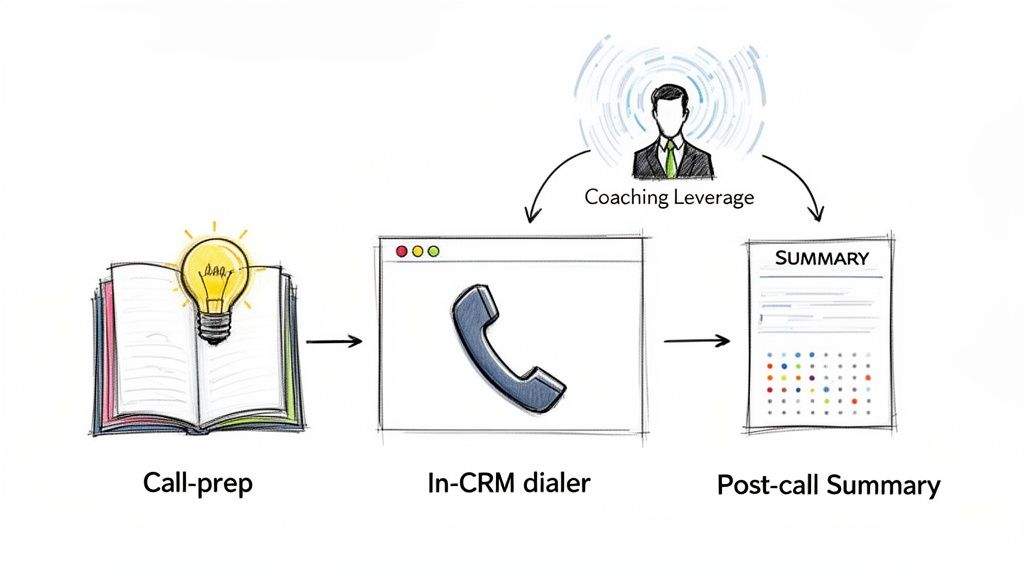
This approach is perfect for mid-funnel conversations with leads who have already engaged with high-level content and are now evaluating specific capabilities. It connects the dots between a feature (AI call coaching) and its direct impact on efficiency, rep development, and revenue goals.
Example Scripts & Strategic Breakdown
Here’s how to tailor this workflow-centric script for different stakeholders:
Scenario A: Call with a Sales Enablement Manager
- Script: "Let’s walk through the workflow. This morning, your rep pulls up a prospect in Salesforce. MarketBetter's AI instantly auto-generates 4-5 talking points based on recent company news and their persona. It also flags 2-3 likely objections with proven responses from your top performers. The rep reviews this for 3 minutes, then calls through our dialer. After the call, we auto-log the disposition and generate a summary. You see patterns across all calls, like 'objection X came up 12 times this week,' and can coach proactively."
- Strategic Goal: This narrative focuses on the entire lifecycle of a call, from prep to post-call analysis. It highlights time savings (3 minutes of prep vs. 15) and scalability, which are core concerns for enablement leaders responsible for rep productivity.
Scenario B: Call with a VP of Sales
- Script: "Instead of listening to random call recordings, you'll see a dashboard of all calls this week grouped by outcome. You can drill into 'lost deals' calls and immediately see the common threads. Let's say you notice reps are struggling with our new pricing objection. You listen to 2-3 calls, pull the best response from another rep's call, and that response auto-generates into the talking points for next week. That's how you scale coaching from a 1-to-1 task to a 1-to-many strategy."
- Strategic Goal: This script speaks directly to a VP's strategic priorities: data-driven decision-making and performance leverage. It contrasts the old, inefficient method (random call reviews) with a new, systemic approach to improving team-wide performance and hitting revenue targets.
Actionable Takeaways & Tips
- Show, Don't Just Tell: If possible, conduct this conversation as a live screen share. Walk them through an actual MarketBetter call prep screen and post-call summary. Use a real company as an example: "Let's pretend we're calling Acme Corp. Here’s what MarketBetter's AI would show your rep right now."
- Quantify the Time Savings: Frame the value in concrete numbers. "Instead of 5-10 minutes of manual research per call, reps get tailored talking points in 30 seconds. Across a team of 20 SDRs, that's over 30 hours of selling time reclaimed each week."
- Emphasize the Coaching Multiplier: The core benefit isn't just better calls; it's scalable coaching. Highlight how managers shift from reactive, individual feedback to proactive, team-wide improvements. MarketBetter’s talk-track feature helps identify these patterns automatically.
- Address AI Quality Concerns: Be direct. Explain that the AI-generated points aren't generic. "Our talking points are grounded in specific, real-time account context and your own team's past successes, not generic templates."
8. The Follow-Up Sequence Script: From Initial Call to Demo to Close
A single call rarely closes a complex deal. The follow-up sequence is a strategic, multi-touch framework designed to nurture interest, build value, and maintain momentum between the initial conversation and a final decision. In contrast to one-off, reactive check-ins, this sales phone call script structures a series of purposeful interactions, each adding a new layer of value and guiding the prospect closer to a commitment.
This approach is crucial for prospects who show initial interest but aren't ready for a demo, often because of timing, competing priorities, or the need for internal alignment. A well-executed sequence prevents leads from going cold by transforming follow-ups from "just checking in" to "here’s another reason why we should talk."
Example Follow-Up Sequence & Strategic Breakdown
Here’s a multi-touch sequence designed to guide a VP of Sales from initial discovery to a demo commitment:
Scenario: Nurturing a VP of Sales After a Brief Discovery Call
-
Call 1 (Day 0 - Initial Contact): "I understand from our initial chat you're focused on scaling the SDR team without tripling your budget. Let's book a 20-minute call next week to explore how you can increase outbound efficiency."
-
Strategic Goal: Acknowledge their primary challenge (scaling efficiently) and secure a low-commitment next step. The goal isn't a demo; it's simply to continue the conversation.
-
Call 2 (Day 4 - Pre-Call Value Add): "Ahead of our call, I shared a case study about a team that grew their pipeline by 40% with the same headcount. They focused on automating non-selling tasks. On our call, I'd love to ask, what's the single biggest bottleneck you see for your reps right now?"
-
Strategic Goal: This call frames the upcoming conversation around a proven success story. By providing value (the case study) before asking for more information, you build reciprocity and position yourself as a helpful resource, not just a seller.
-
Call 3 (Day 7 - ROI-Focused): "Based on our last chat, I used our ROI calculator with your numbers. With 20 SDRs making just two extra qualified conversations per day, you’re looking at a potential pipeline uplift of over $400k monthly. Would it be valuable to see a live breakdown of how that's possible?"
-
Strategic Goal: Shift the conversation from abstract problems to concrete financial impact. Tying the solution directly to a tangible ROI creates urgency and makes the decision to see a demo a logical next step.
Actionable Takeaways & Tips
- Map Every Touchpoint: Don't improvise your sequence. Plan the purpose of each call, email, and LinkedIn message in advance. Use MarketBetter’s pipeline view to set reminders and log notes for each stage of the sequence, ensuring no prospect falls through the cracks.
- Add Value, Don't Just Ask for Updates: Each follow-up must provide something new: a relevant blog post, a short video testimonial, a custom ROI calculation, or an industry benchmark. This keeps the conversation moving forward and reinforces your expertise.
- Vary Your Messaging: Use different angles for each touchpoint. One call might focus on efficiency gains, the next on data integrity for forecasting, and another on SDR ramp time. This multi-pronged approach helps you uncover which pain point resonates most.
- Know When to Qualify Deeper: A follow-up sequence is an extended discovery process. As you learn more, continuously refine your understanding of the prospect's needs. This aligns perfectly with the principles of how to properly qualify sales leads throughout the entire sales cycle.
Comparison of 8 Sales Phone Call Scripts
| Script / Approach | Implementation Complexity 🔄 | Resource Requirements ⚡ | Expected Outcomes ⭐ | Ideal Use Cases 📊 | Key Advantages 💡 |
|---|---|---|---|---|---|
| The Discovery Call: Identifying Pain Points & Building Rapport | Medium 🔄 — consultative skill + script practice | Low–Medium ⚡ — trained SDRs, prep research, 12–15m per call | ⭐⭐⭐⭐ — strong qualification and rapport; follow-up often required | Cold outreach to VP Sales / SDR Managers; relationship-first engagement | Builds trust, uncovers real pain, natural transition to demo |
| The Pain-First Opener: Leading with SDR Team Challenges | Low–Medium 🔄 — short, researched opener; execution-sensitive | Low ⚡ — quick role/company research; concise script | ⭐⭐⭐⭐ — grabs attention; shortens commitment time | High-velocity cold calls with prior signals or intent data | Immediate relevance, reduces "not interested", faster outcomes |
| The Warm Intro / Referral Script: Leveraging Social Proof | Low 🔄 — simple script but reliant on referrer | Low ⚡ — coordination with referrer; minimal prep | ⭐⭐⭐⭐⭐ — highest answer and trust rates; faster progression | Referral/warm leads, ABM, upsell or targeted outreach | High trust, shorter sales cycle, lower objection rate |
| The Objection Handler: Overcoming "We Already Use Outreach/Salesloft" | Medium–High 🔄 — requires competitor knowledge and nuance | Medium ⚡ — competitor playbooks, RevOps alignment, pilot offers | ⭐⭐⭐ — preserves conversations; dependent on incumbent gaps | Prospects entrenched with Outreach/Salesloft who show resistance | Repositions as complementary execution layer; enables low-risk pilots |
| The Account-Based Selling (ABS) Script: Multi-Threaded Discovery | High 🔄 — multi-stakeholder coordination and messaging | High ⚡ — senior sellers, multiple 20–60m calls, org research | ⭐⭐⭐⭐⭐ — significantly increases enterprise win probability | Enterprise deals with buying committees (VPs, RevOps, Enablement) | Builds multiple champions, uncovers hidden objections, strategic positioning |
| The Value-Forward Script: Leading with ROI & Quantified Impact | Medium–High 🔄 — accurate ROI modeling and data validation | Medium–High ⚡ — ROI calculator, case studies, finance-ready 1-pagers | ⭐⭐⭐⭐ — accelerates budget approval and procurement buy-in | CFO/procurement-led deals or price-sensitive buyers | Quantifies payback, reduces cost objections, enables executive buy-in |
| The Product-Specific Deep Dive: AI-Powered Call Coaching | High 🔄 — feature-depth demo; technical credibility required | High ⚡ — live demo, product experts, call recordings, integrations | ⭐⭐⭐⭐ — builds confidence in capability for Enablement/RevOps | Prospects already engaged who want detailed product validation | Demonstrates differentiation, shows day‑to‑day workflows, reduces implementation anxiety |
| The Follow-Up Sequence Script: From Initial Call to Demo to Close | Medium 🔄 — multi-touch cadence with tailored messaging | Medium ⚡ — sequencing, tailored content, disciplined follow-through | ⭐⭐⭐⭐ — improves conversion and pipeline hygiene over time | Leads not ready to demo; SDRs managing nurture pipelines | Maintains momentum, surfaces real objections, stages path to demo/pilot |
Try our AI Lead Generator — find verified LinkedIn leads for any company instantly. No signup required.
From Script to System: Making Every Call Count
Throughout this guide, we've dissected a variety of high-impact sales phone call script examples, moving far beyond simple word-for-word templates. We’ve explored how to lead with pain points in a discovery call, how to leverage a warm referral for maximum impact, and how to confidently handle the "we already use a competitor" objection. Each script, from the highly targeted ABS approach to the ROI-centric value proposition, serves as a strategic blueprint, not a restrictive set of lines.
The core lesson is this: a powerful sales phone call script is not a cage; it's a launchpad. It provides the structure for consistency while demanding the flexibility of genuine human interaction. The goal is to internalize these frameworks so you can adapt, pivot, and personalize in real-time, transforming a potential monologue into a productive, two-way dialogue.
Key Takeaways: From Framework to Fluent Conversation
The difference between a good SDR and a great one often lies in their ability to transition from reciting a script to owning the conversation. Let's recap the foundational principles that enable this shift:
- Customization is Non-Negotiable: A generic sales phone call script is a dead end. As we saw in the "Pain-First Opener" and "Account-Based Selling" examples, deep personalization based on role, industry, and known business challenges is what earns you the right to a conversation.
- Context Over Content: The why behind your call is more important than the what. The "Warm Intro" script works because it immediately establishes context and credibility. Always lead with relevance to disarm skepticism and build immediate rapport.
- Objections are Opportunities: An objection isn't a rejection; it's a request for more information. Our script for handling competitor objections demonstrated that the best response is to reframe the conversation around undiscovered value or gaps in their current solution, not to attack the competitor directly.
- Value Must Be Quantified: Vague promises don't book meetings. The "Value-Forward Script" emphasized leading with specific, quantifiable business impact. Tying your solution to tangible ROI from the very first sentence is your most powerful tool.
Actionable Next Steps: Systematize Your Success
Reading about a great sales phone call script is one thing; consistently executing it under pressure is another. The ultimate goal is to bridge the gap between knowing what to do and actually doing it on every single call. This is where process and technology become critical.
- Audit and Adapt Your Scripts: Take the templates from this article and benchmark them against your current call scripts. Identify one or two key scripts, like your primary cold call opener or a common objection handler, and begin adapting them. Role-play these new versions with your team to build muscle memory.
- Build a Centralized Playbook: Don't let your best scripts live in scattered documents. Create a centralized, living playbook (in a tool like Notion, Confluence, or directly within your sales engagement platform) that your entire team can access and contribute to.
- Embed Scripts into Your Workflow: The most effective scripts are those that are seamlessly integrated into the SDR's daily process. This is where tools like MarketBetter transform theory into practice. By embedding dynamic "talk tracks" and call-prep notes directly into your CRM and dialer, you equip reps with the right words at the right moment, eliminating friction and boosting confidence.
- Analyze, Coach, and Iterate: A script is never truly "finished." Use call recordings and analytics to understand what’s working and what isn’t. Are reps consistently getting stuck at the gatekeeper? Is a certain value proposition falling flat? Use this data to refine your scripts, provide targeted coaching, and continuously improve performance.
Ultimately, mastering the sales phone call script is about creating a scalable system for excellence. It's about empowering every rep, from the new BDR to the seasoned veteran, with a proven framework for success. By combining strategic scripts with intelligent technology, you can ensure that every dial has a purpose, every conversation creates value, and your pipeline grows predictably and consistently.
Ready to turn your best sales phone call script into a repeatable system? marketbetter.ai embeds dynamic talk-tracks and AI-powered prep notes directly into your team's workflow, ensuring every rep executes flawlessly. See how you can systematize your sales process by visiting marketbetter.ai today.