Email Follow Ups That Book Meetings: Proven Tactics (email follow ups)
It’s a familiar feeling for any sales rep. You pour time into crafting the perfect outreach email, hit send, and then… nothing. Just dead air. The silence can be discouraging, but the truth is, most initial emails don't get a reply. Relying on a single touchpoint is one of the biggest mistakes you can make.
Why Your First Email Is Just the Starting Point
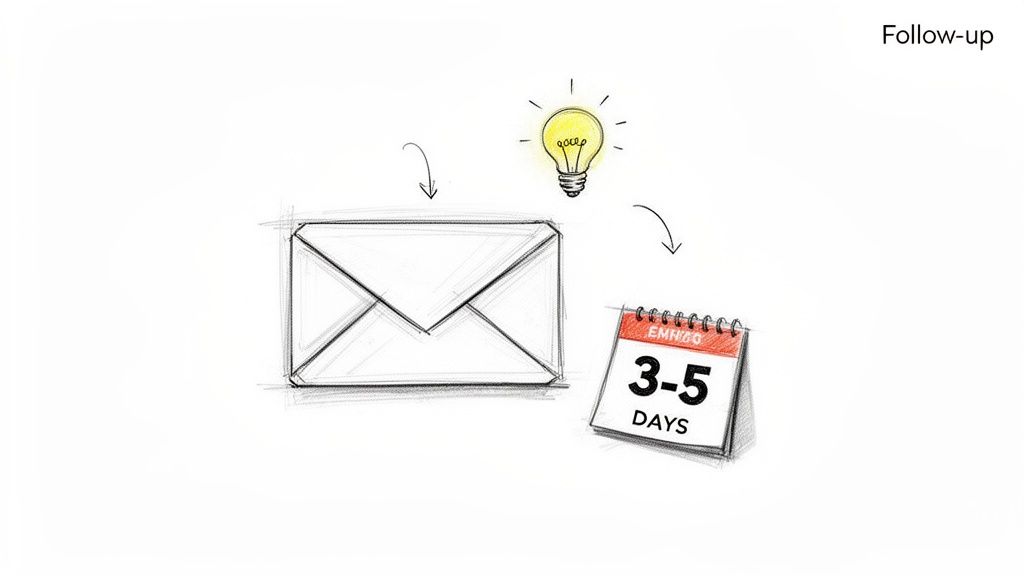
Sending an email and just hoping for a response isn’t a strategy—it’s a lottery ticket. What separates the top performers from everyone else is a systematic plan for email follow ups. This is how you shift from passively waiting for a reply to proactively earning a conversation. The goal isn’t to pester people; it’s to professionally navigate their chaotic schedules and show you’re serious.
When a prospect doesn't reply, it's rarely personal. They aren't ignoring you because they dislike you. They're just busy. Your email was likely one of hundreds that flooded their inbox that day.
The Real Reasons for No Reply
Understanding why you didn't get a response is the key to framing your follow-up. It's almost never a hard "no." More often than not, it's one of these simple, everyday scenarios:
- Bad Timing: Your email landed right in the middle of a chaotic morning or just before a massive deadline.
- Information Overload: The average professional gets over 120 emails a day. It’s incredibly easy for yours to get buried.
- Quick Triage: Many executives scan their inboxes and archive anything that isn’t on fire at that exact moment.
- They Simply Forgot: It happens. They might have read your email, fully intended to reply, and then got pulled into their next meeting.
This context is everything. It reframes your follow-up from an interruption into a helpful, timely reminder that actually respects their workflow. By the way, if you want to nail that first impression, our detailed guide on how to write cold emails is a great place to start.
The Data-Backed Case for Persistence
Let's compare two mindsets. The first is the "one-and-done" approach, where a lack of reply feels like rejection. The second is what I call professional persistence, which views that first email as just the opening move in a strategic conversation.
The data is overwhelmingly on the side of persistence.
Consider this: 70% of sales emails require at least one follow-up to get any reply at all. Even more telling, a staggering 80% of sales require a minimum of five follow-up attempts after the first contact before a deal is closed. You can dig into more of these stats on why follow-ups are critical for sales success.
A follow-up isn't a sign of failure; it's a core component of a successful sales process. It shows you're serious, professional, and genuinely believe you can solve a prospect's problem.
This distinction is crucial. When you see follow-ups as an integral part of your job, you stop feeling like you're bothering people and start acting like a trusted advisor who is simply trying to connect. Each follow-up is another chance to provide value, build familiarity, and catch your prospect at the exact right moment.
The first email is just the introduction. The real work—and the real results—happen in the follow-ups.
Designing a High-Conversion Follow Up Sequence
An effective follow-up strategy isn't just about sending a bunch of random pings and hoping for the best. It's a science. Building a sequence that actually gets a response requires a smart approach to timing, frequency, and the value you bring to every single message. The real goal is to stay top-of-mind without being annoying, turning persistence into a genuine conversation.
To really nail this, you need to ground your approach in solid sales cadence best practices. This isn't about templates; it's about a framework where every touchpoint builds on the last, earning you the right to stay in their inbox.
Finding the Right Cadence Frequency
Let's be real: the timing between your email follow ups can make or break your entire effort. Come on too strong with messages packed too closely together, and you look desperate. Wait too long, and you're ancient history. A balanced cadence is the sweet spot—it respects their time while keeping the momentum going.
Let's compare two common but flawed approaches with a more strategic one:
- The Aggressive Approach (Every Day): This feels desperate and almost guarantees you'll be marked as spam. It doesn't give the prospect any breathing room.
- The Passive Approach (Weekly): Waiting a full week between early follow-ups is too long. You lose all momentum and make it easy for them to forget who you are.
- The Strategic Approach (Balanced Intervals): This is the sweet spot. You give them a couple of days between the first few messages, then slightly increase the gap. It's persistent but professional.
A multi-touch sequence that spans about two weeks often hits the mark. It gives you enough runway to connect without completely flooding their inbox.
Here’s a simple, actionable framework to use as your starting point:
- Day 1: The initial outreach.
- Day 3: First follow-up.
- Day 6: Second follow-up.
- Day 10: Third follow-up.
- Day 14: The "break-up" email.
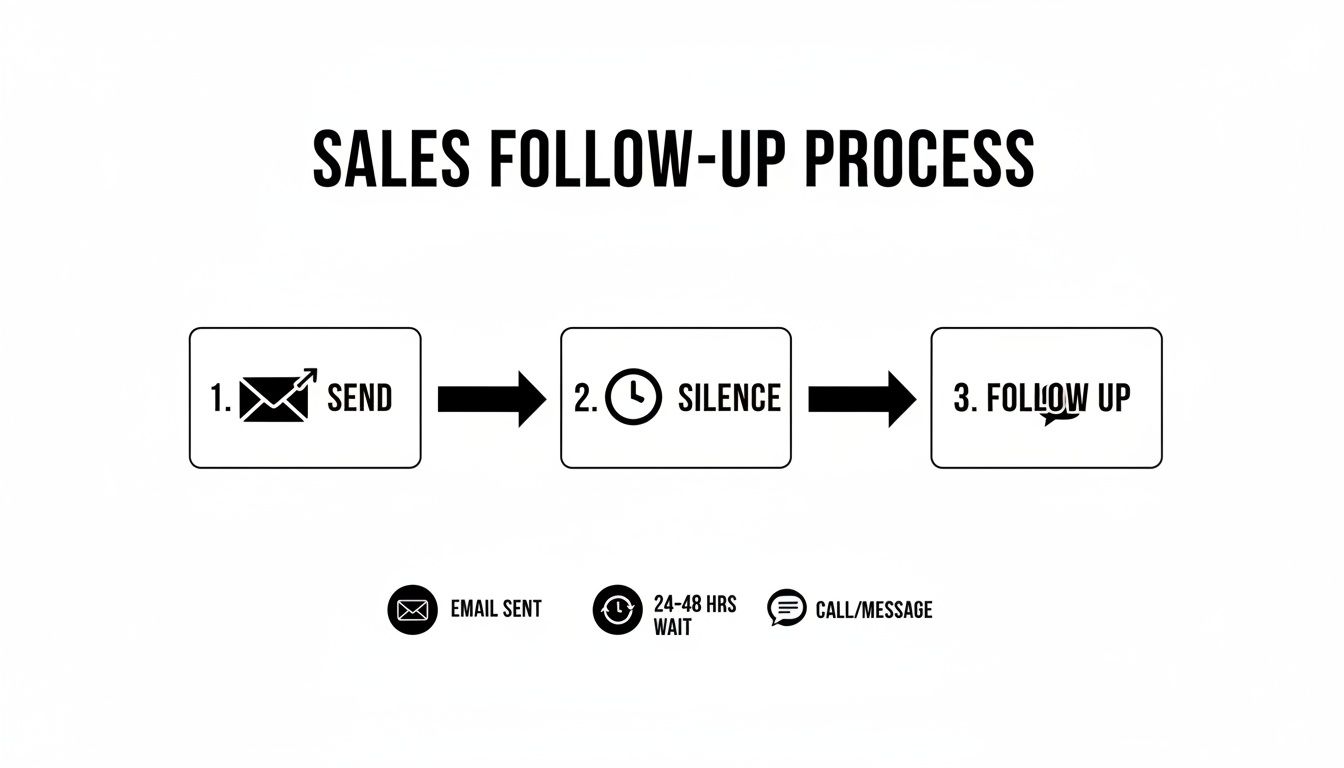
This process flow highlights a critical, often-overlooked step: the wait. Patience isn't just a virtue here; it's a strategic part of any outreach that gets results.
A Blueprint for a 10-Day Follow Up Cadence
Every email in your sequence needs a job to do. Just firing off messages without a clear purpose is a fast track to the spam folder. A well-designed cadence makes sure each follow-up logically moves the conversation forward. Think of it as telling a short, compelling story over several days.
Here's a practical, multi-touch blueprint that balances persistence with genuine value.
Actionable 10-Day Follow Up Cadence Blueprint
| Day | Action/Channel | Purpose of Message | Example CTA |
|---|---|---|---|
| 1 | Clearly state your value prop and the problem you solve. | "Worth a 15-min chat next week to explore this?" | |
| 3 | Re-state value prop from a new angle; gentle reinforcement. | "Just wanted to bring this back to the top of your inbox." | |
| 5 | View profile & send a connection request (no pitch). | N/A (Passive engagement) | |
| 7 | Introduce social proof or a new piece of value (case study, stat). | "Here's how we helped [Similar Company] solve this." | |
| 10 | Shift to a direct, low-friction question to gauge interest. | "Is solving [problem] a priority for your team this quarter?" |
By assigning a specific role to each touchpoint, you build a cohesive narrative that guides the prospect toward a decision. It’s methodical, respectful, and a world away from just "checking in." This is how you stay persistent with a purpose.
Follow Up Templates That Actually Get Opened
What’s the difference between a follow-up that lands a meeting and one that gets instantly archived? Clarity. It’s that simple.
Your prospect’s inbox is a warzone of long, feature-heavy emails that are exhausting to read. Your job is to be a breath of fresh air. Think concise, relevant, and respectful of their time. Get straight to the point.
Let’s compare two email styles:
- The "Wall of Text": A long, multi-paragraph follow-up with three different links and four value props. Action Required: The prospect has to decipher what you want. Result: Instant archive.
- The "Surgical Strike": A two-sentence email with a single, clear question. Action Required: A simple yes/no or a quick thought. Result: Higher chance of a reply.
The psychology here is pretty straightforward: short emails with a single, clear call-to-action are just easier for a busy brain to process. They signal confidence and make it dead simple for the person on the other end to know what you want.
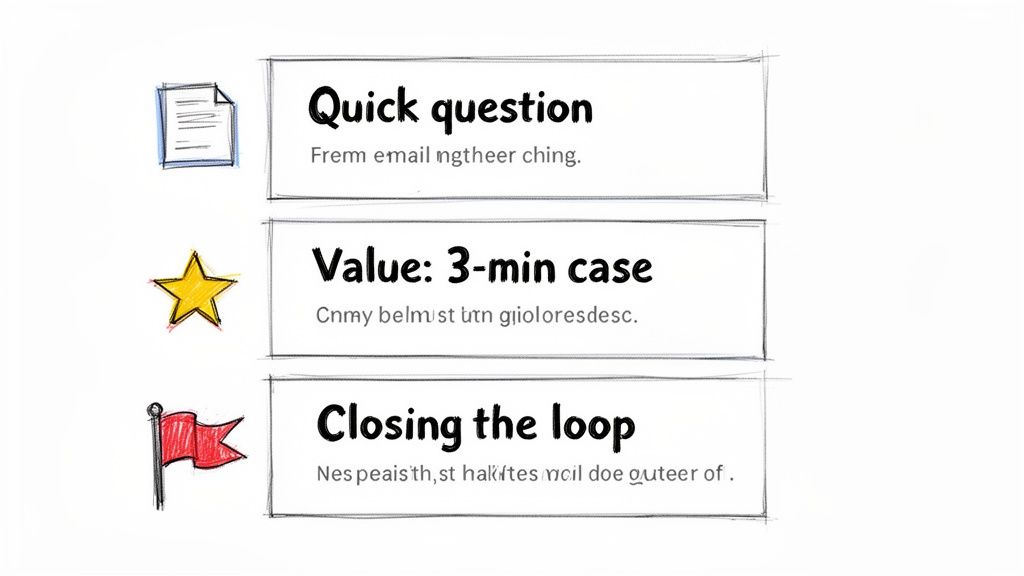
This guide from MarketBetter breaks down how to use different templates for different goals, from a quick check-in to a value-packed case study. Every single one is designed to be direct and actionable, which is exactly what a good follow-up needs to be.
The Gentle Nudge After No Response
This is the one we all send the most. You’ve shot your shot, and now you’re hearing crickets. The goal here is to be polite and professional, gently bumping your message back to the top of their inbox without being annoying. Drop the guilt-tripping language like, "Did you see my last email?"
It's a low-pressure way to re-establish contact. You're just giving them a simple reminder without demanding a complicated reply.
Actionable Tip: Test these subject lines to see which performs best for your audience.
- A/B Test 1: Re: Original Subject Line
- A/B Test 2: Quick question about [Company Name]
- A/B Test 3: Bringing this to the top of your inbox
Template: Hi [Prospect Name],
Just wanted to bring my previous email to the top of your inbox. We help sales leaders like you solve [specific problem] by [one-sentence value prop].
Worth a quick chat next week?
Best, [Your Name]
Re-Emphasizing Value with Social Proof
If the first nudge didn't land, it's time to bring something new to the table. Just repeating your original pitch is a wasted email. Instead, drop in some social proof—a killer case study or a compelling statistic—to show you're the real deal.
This tactic shifts the conversation from "here's what I think I can do" to "here's what we've already done for people just like you." If you need more inspiration for subject lines that grab attention, check out our guide on witty email subject lines.
Actionable Tip: Experiment with different formats for social proof.
- A/B Test 1: A direct quote from a happy client.
- A/B Test 2: A single, powerful data point (e.g., "30% increase in meetings").
- A/B Test 3: A link to a full case study.
Template: Hi [Prospect Name],
I was thinking about your team and wanted to share how we helped [Similar Company/Client Name] achieve [specific outcome, e.g., a 30% increase in meetings booked].
We helped them fix [specific problem], and I thought you might find their story relevant.
Is this a priority for you right now?
Best, [Your Name]
Pro Tip: Keep the social proof bite-sized. Link out to the full case study, but pull the single most impressive result directly into the email itself. Don't make them hunt for the value.
The "Break-Up" Email to Re-Engage Cold Leads
Alright, you've tried a few times with no response. It's time to professionally close the loop. The "break-up" email is a surprisingly powerful psychological tool. It taps right into the fear of missing out (FOMO) and often jolts people into making a decision.
This isn't about being passive-aggressive. It's about respecting their time—and more importantly, yours. I've seen it time and again: this is one of the highest-response email follow ups you can have in your sequence.
Actionable Tip: A/B test the tone of your break-up email.
- A/B Test 1 (Helpful Tone): "Permission to close your file?"
- A/B Test 2 (Direct Tone): "Closing the loop"
- A/B Test 3 (Goal-Oriented): "Is [goal] still a priority?"
Template: Hi [Prospect Name],
I’ve reached out a few times about how we help companies like yours with [problem] but haven’t heard back. This usually means it's not a priority right now.
I’m closing your file for now, but please feel free to reach out if things change.
Best, [Your Name]
Adding Personalization That Cuts Through the Noise
Let’s be honest: generic email follow ups are a one-way ticket to the trash folder. Every prospect's inbox is a battlefield, flooded with soulless, automated blasts. In that environment, personalization isn't just a nice touch—it's the only proof you've done your homework and are worth 30 seconds of their time.
A truly personalized email feels like it was written for an audience of one. That’s what gets replies.
The good news? This doesn't mean you have to sink an hour into researching every single prospect. The real secret is building a scalable framework that strikes the right balance between efficiency and a genuine human touch. It all comes down to knowing the two levels of personalization and when to deploy each.
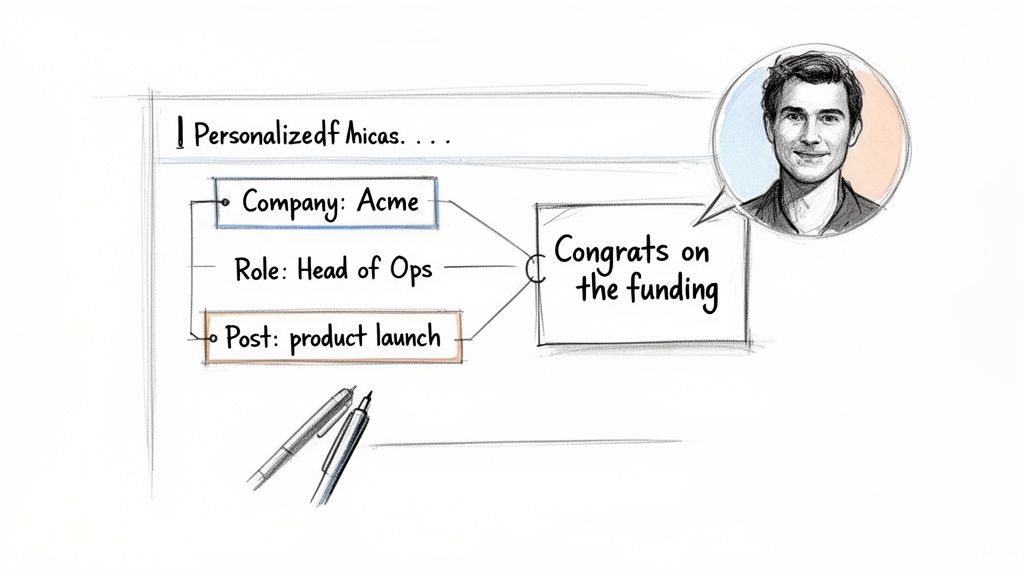
Comparing Light vs. Deep Personalization
Not all personalization is created equal, and the right move depends entirely on the account's value and where the prospect is in your sequence.
Let's break down the two main strategies.
| Personalization Level | What It Is | When to Use It | Actionable Example |
|---|---|---|---|
| Light Personalization | Using easy-to-find info like their name, company, and job title. | Perfect for early-stage nudges or lower-tier accounts where a deep dive isn't practical. | "Hi John, saw you're the VP of Sales at Acme..." |
| Deep Personalization | Referencing specific, timely events—a funding round, a recent LinkedIn post, a mutual connection. | Your go-to for high-value target accounts or later-stage follow-ups to re-engage a quiet prospect. | "Congrats on the new product launch you posted about on LinkedIn yesterday..." |
Think of light personalization as your baseline. It shows you aren't a spam bot. But deep personalization? That’s your secret weapon. It proves you're a sharp, observant human who’s actually paying attention to their world.
A Scalable Framework for Meaningful Outreach
Doing this at scale is where most teams fall down. Manually scouring LinkedIn and company news for every single prospect is a recipe for burnout. This is where a smart workflow, powered by the right tools, makes all the difference.
The goal is to find a "trigger"—a specific piece of information that makes your email feel timely and hyper-relevant.
Here’s an actionable checklist of where to look for those triggers:
- Company News: Did they just announce a funding round, launch a new product, or hire a key executive? That’s absolute gold for a congratulatory follow-up.
- LinkedIn Activity: Did your prospect post an article, share an opinion, or comment on a relevant thread? Referencing it shows you’re tuned in.
- Job Postings: If a company is hiring for a role you can help with (like hiring more SDRs when you sell sales software), it’s a massive signal of their current pain points.
- Mutual Connections: Nothing builds instant credibility faster than mentioning a shared connection. It’s the ultimate shortcut to trust.
The most effective personalization connects their recent activity directly to the problem you solve. It’s not just about name-dropping their latest post; it's about explaining why that post made you think of a solution specifically for them.
Using AI to Accelerate Personalization
This is where modern tools completely change the game. Instead of you spending hours on manual research, an AI-powered engine can do the heavy lifting.
For example, MarketBetter’s SDR Task Engine automatically surfaces these crucial account insights and triggers. It can spot that a target account just landed its Series B funding and instantly generate a personalized snippet for your follow-up.
Here’s what that workflow looks like in practice:
- AI Surfaces an Insight: The system flags that "Acme Corp just announced a new integration with Salesforce."
- AI Generates a Snippet: It drafts a line like, "Saw the news about your new Salesforce integration—congrats! Scaling up often puts a strain on CRM data hygiene..."
- You Add the Human Touch: You grab that AI-assisted line and weave it into your follow-up, making sure the tone feels authentic to you.
This approach gives you the best of both worlds: the raw speed of automation combined with the irreplaceable authenticity of human oversight. You're no longer just sending another email; you're delivering a relevant, timely message that makes your follow-up impossible to ignore.
Automating and Tracking Follow Ups Like a Pro
A killer follow-up strategy is worthless if you don't execute it consistently. This is where the real work happens—inside your CRM. Managing your email follow ups in a system like Salesforce or HubSpot is non-negotiable for staying organized, but let's be honest, the manual process can quickly become a bottleneck that absolutely kills your selling time.
Even a well-organized manual workflow is better than chaos, but it’s still loaded with friction. Every single click, from creating a task to logging an email, pulls you away from what you should be doing: talking to prospects. Let's compare that old-school grind to a modern, automated approach.
Manual vs Automated Workflows: A Side-By-Side Look
The difference between a manual and an automated process isn't just about saving a few minutes here and there. It’s about completely changing where your SDRs spend their energy. One path is reactive and buried in admin tasks; the other is proactive and laser-focused on selling.
Take a look at how the two workflows stack up against each other. The contrast is pretty stark.
Actionable Comparison: Manual vs. Automated Follow Up Workflow
The table below breaks down the daily reality for a sales rep. On one side, you have the click-heavy, memory-dependent traditional process. On the other, a system that does the heavy administrative lifting for you.
| Task | Manual Process (in Salesforce/HubSpot) | Automated Process (with MarketBetter) | The Impact |
|---|---|---|---|
| Task Creation | You have to remember to create a "Follow Up" task for a specific date after sending an email. | A task is auto-created and prioritized in your inbox based on a trigger (e.g., "no reply after 3 days"). | No leads fall through the cracks. |
| Daily Prioritization | You stare at a long, unfiltered task list, trying to guess which lead to contact next. | The system serves up a clear 'next best action' based on account fit, timing, and engagement signals. | Reps work on the highest-value tasks first. |
| Email Drafting | You hunt for a template, copy-paste it, and then manually dig through records for personalization details. | AI generates a context-aware follow-up email using account and persona data, ready for your review. | Time spent drafting is cut by over 90%. |
| Activity Logging | You have to manually log the email activity, copy the text, and update the contact record. Tedious. | The email is sent and all activity is auto-logged to the correct Salesforce or HubSpot record instantly. | Perfect CRM data hygiene with zero effort. |
This comparison shines a spotlight on the core problem: the manual process forces reps to waste a huge chunk of their day on low-value admin work. All those clicks add up, devouring the time that could be spent having actual conversations that generate pipeline.
The goal of automation isn't to replace the seller. It's to eliminate the tedious, repetitive tasks that prevent the seller from doing what they do best: selling.
How an SDR Task Engine Changes the Game
This is exactly where a tool like MarketBetter's SDR Task Engine completely flips the script. Instead of you chasing down what to do next, the system intelligently serves up the next best action. It basically turns buyer signals into a prioritized, actionable to-do list.
Imagine this actionable scenario: the engine sees that a prospect hasn't replied to your first email after three days. It doesn't just send you a reminder; it gets to work.
- Auto-Creates a Prioritized Task: A new "Follow-Up" task for that specific contact pops to the top of your queue. You don't have to remember a thing.
- Provides Full Context: The task is packed with the prospect's details, your previous email history, and key account insights so you're not flying blind.
- Generates an AI-Written Draft: With a single click, MarketBetter’s AI drafts a concise, relevant follow-up email. It references your last touchpoint and is ready for you to quickly tweak and send.
This approach ensures your CRM hygiene is perfect because every single action is logged automatically. But more importantly, it frees you from the decision fatigue of figuring out who to follow up with and what to say. The system handles the "when" and the "what," so you can focus on the "how"—adding that critical human touch that actually closes deals.
For a deeper dive into this, you can learn more about how marketing automation workflows can supercharge your entire sales process.
Try our AI Lead Generator — find verified LinkedIn leads for any company instantly. No signup required.
Common Questions About Email Follow Ups
Even with the best playbook, you'll run into situations that feel like a gray area. When you're juggling dozens of prospects, knowing the right move isn't just helpful—it's what separates the pros from the pests.
Here are the straight-up answers to the questions our sales teams get asked the most about nailing the follow-up.
How Many Email Follow Ups Is Too Many?
There’s no magic number, but all the data—and my own experience—points to a sweet spot: a multi-channel sequence of 5 to 7 touches. But honestly, the number isn't the point. It's the value and tone of each message that matters.
Sending the same "just checking in" email seven times is just spam with extra steps. But if each follow-up offers a new insight, a relevant case study, or a helpful resource? You've earned the right to stay in their inbox.
Think about it this way:
- The Annoying Approach: "Hi, following up again." "Hi, just checking in on my last email." This adds zero value and instantly tags you as a nuisance.
- The Value-Add Approach: "Hi, thought you'd find this article on [pain point] useful." or "Hi, here's how we helped a similar company solve [problem]." Now you're a helpful advisor, not a salesperson chasing a commission.
Actionable takeaway: End your sequence with a "break-up" email. It politely closes the loop and, you'd be surprised, often gets a high response rate from busy people who just appreciate the professional courtesy. And always, always watch your engagement. If you see zero opens after 3-4 attempts, it’s a pretty clear signal to move on.
What Is the Best Time to Send a Follow Up?
You’ve probably seen the studies pointing to mid-morning (10 AM) and mid-afternoon (2 PM) on Tuesdays. That advice is so generic it’s almost useless. The "best" time is completely different depending on the industry, role, and time zone. An East Coast CFO’s workflow is nothing like a West Coast marketing manager's.
Your own data is your best friend here. But an even better strategy is to follow up based on when your prospect is actually active.
An email sent at a "good enough" time consistently is far more effective than an email sent at the "perfect" time inconsistently. Don't let perfectionism kill your execution.
Actionable takeaway: Use tools with real-time engagement alerts. If a prospect opens your email at 8 PM on a Wednesday, that’s a massive clue about their work habits. Schedule your next touchpoint for a similar time to massively boost your odds of catching them when you're already top-of-mind.
Should I Mention My Previous Email in a Follow Up?
Yes, but do it with finesse. The goal is to re-establish context, not to remind them they ignored you. Whatever you do, avoid the cliché and slightly passive-aggressive phrase, "I'm just following up on my email below." It feels like you're pointing a finger.
Instead, just briefly and professionally reference the core idea of your last message.
What to Avoid (Passive-Aggressive): "Did you get a chance to read my last email?" (This implies they owed you something.)
What to Do Instead (Professional Context): "When I last reached out, I mentioned how we help sales leaders fix their CRM data problem..." (It's quick, professional, and gets right back to the value.)
Actionable takeaway: Ensure every follow-up can stand on its own. The recipient shouldn't have to go digging through their inbox to figure out what you're talking about. Briefly restate the value, connect it to their world, and give them a clear, simple call-to-action.
Stop letting your SDRs drown in manual admin work. MarketBetter turns buyer signals into a prioritized task list and helps your reps execute faster with an AI email writer and dialer that lives right inside Salesforce and HubSpot. See how you can book more meetings, not more busywork. Learn more at marketbetter.ai.