
A Guide to Overcoming Sales Objections and Closing More Deals
Overcoming sales objections isn't about having the perfect comeback for everything. It’s the art of turning a prospect’s hesitation into a real conversation. The difference between average and elite performers is that the latter treats an objection not as a rejection, but as a request for more information.
The whole game is about diagnosing the true concern—is this really about need, urgency, trust, or budget?—and addressing that with genuine understanding. Forget the scripted rebuttals. An actionable approach means listening first, then guiding the conversation based on what you hear.
How to Diagnose the Real Sales Objection
This is where most reps get it wrong. They treat objections like roadblocks to bulldoze through. They hear "it's too expensive" and immediately launch into a defense of the price. That reactive approach just creates friction and misses the entire point. In contrast, an actionable, diagnostic approach builds trust.
A sales objection isn't a "no." It's an invitation to dig deeper. When a prospect raises a concern, they're handing you a clue about what’s holding them back. Your first job isn't to talk—it's to listen and diagnose.
From Generic Scripts to Accurate Diagnosis
Think about the difference between a generic, scripted response and a tailored, diagnostic one. A generic script is like a one-size-fits-all prescription; it rarely addresses the specific ailment. Top-performing reps act more like a doctor; they ask questions to understand the root cause before recommending a solution.
This diagnostic mindset is everything in modern objection handling.
Instead of trying to memorize dozens of canned responses, focus on categorizing pushback into four fundamental types. This actionable step makes your life way simpler and helps you get to the heart of the issue fast.
You’ll find nearly every objection falls into one of these buckets:
- Need: The prospect just doesn't see how your solution solves a problem they actually care about.
- Urgency: They might see the problem, but don’t think it’s pressing enough to solve right now.
- Trust: The prospect is skeptical of you, your company, or the results you're promising.
- Budget: They believe the financial investment is bigger than the value they'll get in return.
This decision tree gives you a simple flow for slotting objections into these four core types.
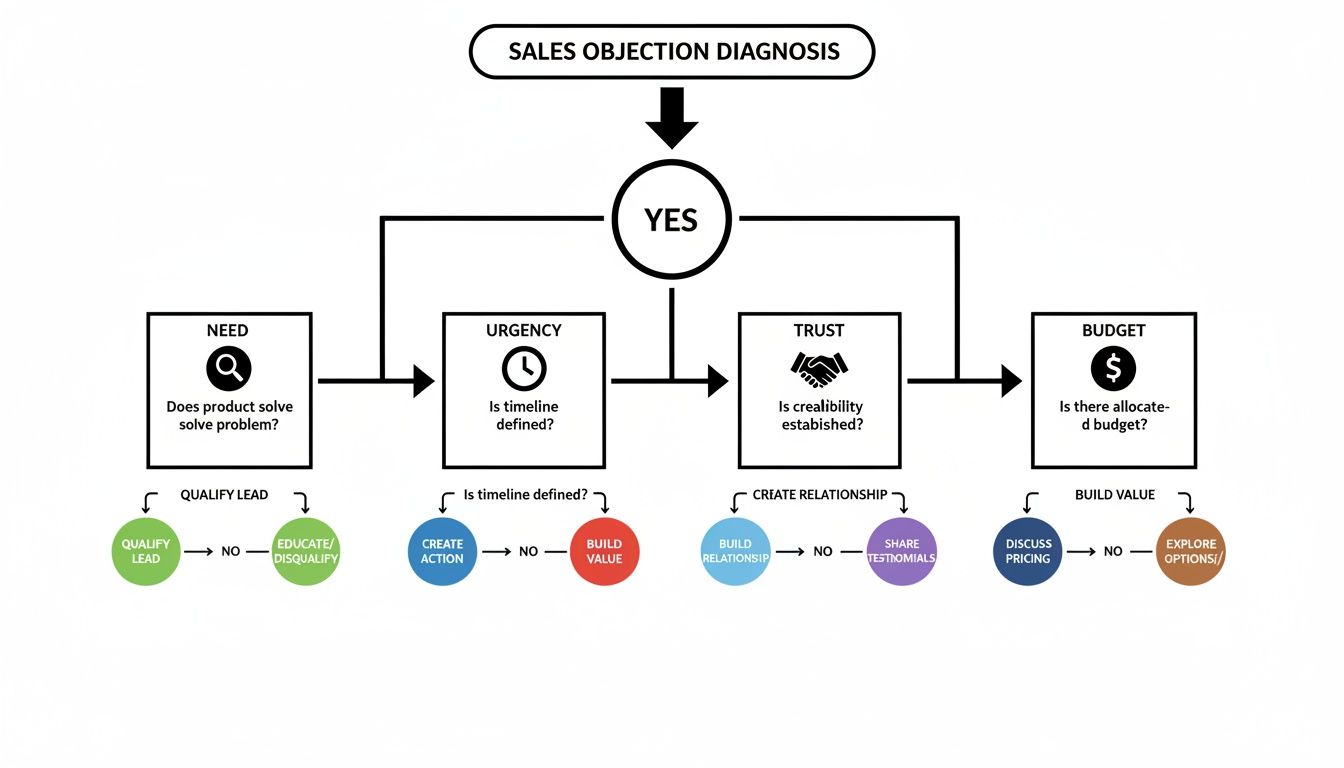
When you can visualize the path from hearing an objection to pinpointing its true nature, you train yourself to pause and think strategically instead of just reacting. This is a practical, actionable skill that improves with every call.
Diagnosing the Four Core Types of Sales Objections
Here’s a quick cheat sheet to help you categorize pushback on the fly and figure out what’s really going on under the surface. This turns diagnosis into a repeatable action.
| Objection Type | Common Phrases You'll Hear | What It Really Means | Your Actionable Goal |
|---|---|---|---|
| Need | "We don't need this." "We're happy with what we have." | "I don't see a problem big enough to solve." "You haven't connected to my pain." | Uncover a hidden or undervalued business pain. Connect your solution to their goals. |
| Urgency | "Call me next quarter." "Now isn't a good time." | "This isn't a top priority." "I have bigger fires to put out right now." | Attach a real cost to their inaction. Show them why waiting is more painful than acting. |
| Trust | "I've never heard of you." "Send me some info." | "I'm not sure if you're credible." "Can your solution actually deliver?" | Build credibility with social proof, relevant case studies, or a low-risk next step. |
| Budget | "It costs too much." "It's not in the budget." | "I don't see enough value to justify the price." "The ROI isn't clear to me." | Reframe the conversation around value and return on investment, not just price. |
Once you get good at this, you'll stop hearing objections and start seeing opportunities to clarify your value.
Why Pausing Before You Pounce Is a Superpower
The data backs this up: the best reps diagnose, they don't just react. An analysis by Gong found that just five common sales objections account for a massive 74% of all objections. The biggest one? Situational issues like timing, which make up 42.6% of the total.
For B2B tools like marketbetter.ai's AI-powered SDR engine, which plugs right into Salesforce and HubSpot, those "not right now" objections are best handled with a bit of patience.
High-performing reps pause an average of 2.5 seconds longer after an objection before they say a word. In contrast, low-performers often jump in immediately. That pause gives them just enough time to process the real concern. You can find more insights on this at Leads at Scale.
The goal isn't to win an argument; it's to understand the hesitation. An objection is just a signal that there's a gap—in understanding, value, or trust. Your job is to find that gap and help the prospect cross it.
Actionable Frameworks That Actually Work
Once you’ve figured out what kind of objection you're dealing with, you need a reliable, actionable framework to frame your response. This isn't about memorizing a magic phrase. It's about having a process that turns a defensive moment into a productive conversation.
If you just react with a counterpoint, you almost always lose. Why? Because it immediately puts you and the prospect on opposite sides of the table. A confrontational approach versus a collaborative one yields drastically different results.
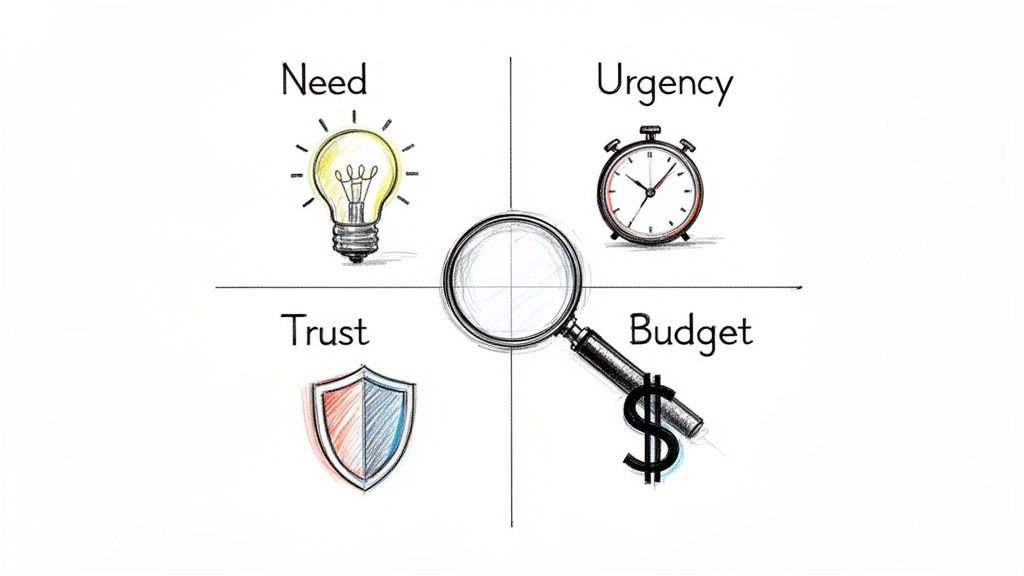
The goal is to shift from a monologue to a dialogue. Instead of just pushing back, the best frameworks help you unpack the prospect's real concern with them. That's how you build trust and get to the heart of the issue.
The LAER Model Explained
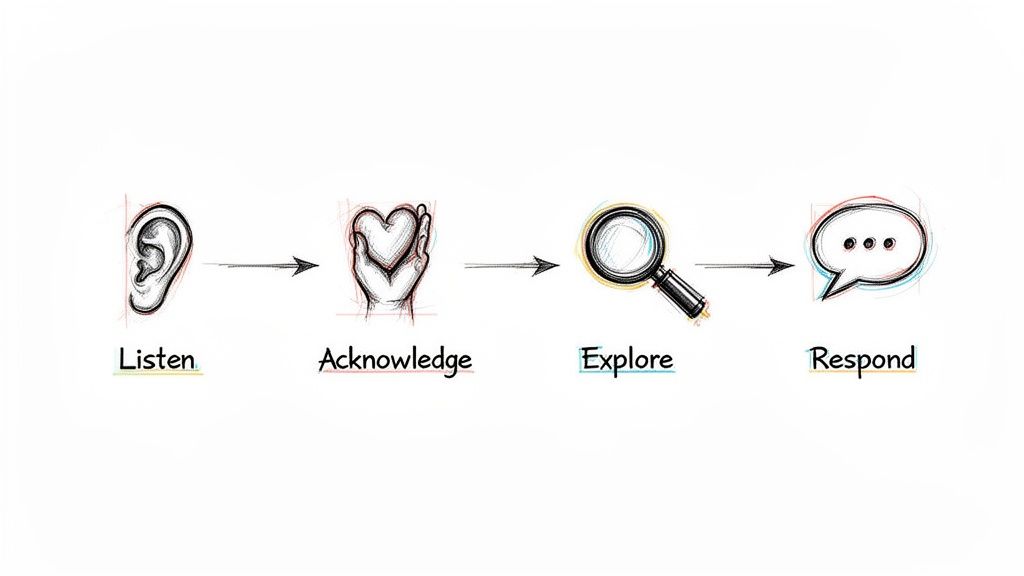
One of the most effective and easy-to-remember frameworks I’ve seen is LAER: Listen, Acknowledge, Explore, Respond. It's a simple, four-part process that forces you to understand before you try to be understood.
Let's break it down into actionable steps:
- Listen: This is more than just staying quiet while the prospect talks. It’s actively processing what they’re saying—and what they aren't saying. Don't plan your rebuttal. Just listen until they are completely finished. Action: Mute yourself to resist interrupting.
- Acknowledge: Verbally confirm you heard their concern. You're not agreeing with them; you're just showing them you were paying attention. Action: Use phrases like, "That's a fair point," or "I can see why you'd feel that way." This simple step works wonders to disarm tension.
- Explore: This is the most important step, and it's the one most reps skip. Before you jump in with a solution, ask a few clarifying questions to dig deeper. Action: Ask an open-ended question like, "Could you tell me more about that?" This is where you find the root cause hiding behind that initial objection.
- Respond: Only after you’ve listened, acknowledged, and explored should you offer a concise, relevant response. This response should address the real issue you just uncovered, not the smoke screen they threw up first.
This structure stops you from making the classic mistake: responding to the surface-level objection instead of the problem underneath.
LAER in Action: A Real-World Comparison
Theory is one thing; seeing it in action is another. Let’s compare a typical, weak response with a strong, actionable one built on the LAER model.
The Objection: "We're already working with one of your competitors, and we're pretty happy with them."
Here’s how two different reps might handle this common pushback.
The Weak Response (Reactive)
A knee-jerk reaction almost always sounds defensive. It immediately tries to discredit the competitor or force a feature-by-feature comparison, which just creates friction and shuts the conversation down.
SDR: "Actually, we're a lot different. Our AI engine is built directly into Salesforce, which means your reps never have to leave their workflow. We also provide much better task prioritization."
This response fails because it assumes the prospect cares about your features without first understanding their world. It’s a monologue, not a dialogue. It completely blows past the Listen, Acknowledge, and Explore steps.
The Strong Response (LAER Framework)
A strong response uses LAER to open up the conversation and re-center it around the prospect's problems, not your product's bells and whistles.
SDR:
- (Listen): [Pauses, lets the prospect finish their thought.]
- (Acknowledge): "That’s great to hear you have a solution in place that you're happy with. Makes total sense to stick with what's working."
- (Explore): "Just so I understand a bit better, how is your team currently handling the handoff from identifying an account to a rep actually making the first call or sending the first email? How do they decide what to do next?"
- (Respond): "Got it. The reason I ask is that many teams we work with also use a sales engagement tool, but they use MarketBetter as the 'brain' inside Salesforce that tells reps which tasks to execute and when, ensuring they act on the most important signals without manual work."
The difference is night and day. The LAER response validates the prospect, asks an intelligent, actionable question that gets them thinking, and then gently pivots to a unique value prop that complements, rather than attacks, their current setup.
This is how you transform overcoming sales objections from a battle into a collaborative discovery process.
Handling Price Objections and Competitor Mentions
Alright, let's talk about the two objections that make even seasoned SDRs break a sweat: price and the competitor card. These aren't just simple brush-offs; they feel like a direct shot at your product's value. But here’s the secret: the best reps don't get defensive. They get curious.
When a prospect says, "it's too expensive," your gut reaction is probably to jump in and justify the cost. Don't do it. That objection is almost never about the number itself. It’s a huge flashing sign that you haven't connected that number to a big enough problem.
Deconstructing the "Too Expensive" Objection
Your job is to pivot the entire conversation away from cost and toward the cost of doing nothing. Stop defending your price tag and start getting them to calculate the price they’re already paying by ignoring the problem. This single, actionable move reframes the whole discussion from an expense into an investment.
Here's how you make that happen:
- Find the Value Gap: Ask questions that put a number on their current pain. "What's the real cost of an SDR spending five hours a week just logging activities in the CRM instead of actually calling prospects?"
- Turn Time into Dollars: Connect that operational drag to a real financial outcome. A great follow-up is, "If each of your SDRs could make 50 more calls every week, what would that realistically do to your pipeline?"
- Focus on ROI, Not Price: Position your solution as the bridge from their current, expensive reality to a much more profitable one.
Price objections pop up all the time, but they're usually just a smokescreen for a value gap. The data is clear: reps who successfully reframe these moments around ROI close deals 2.3x more effectively. A Harte Hanks study analyzing thousands of sales calls found that pricing came up in over 30% of conversations. This is especially true in crowded markets where prospects are quick to say, "We already have Outreach or Salesloft."
For a tool like MarketBetter.ai, the response has to be grounded in hard numbers. We know our AI-driven workflows slash manual prep time by hours every day, freeing reps up for 20-30% more outbound actions.
Navigating the "We Already Use a Competitor" Objection
This one feels like hitting a brick wall, but it’s actually a huge opportunity. The prospect just confirmed they have the problem your product solves. Your mission isn't to tear down their current tool; it's to find a specific, painful gap it doesn't fill.
The absolute worst thing you can do is get into a feature-by-feature battle. Instead, position your solution as a critical "execution layer" that makes their existing tools smarter and more effective.
For example, if a prospect says they use a traditional sales engagement platform, you can respond with: "That's great, they're a solid platform for sequencing. Where we come in is as the 'brain' inside Salesforce that tells your reps exactly which tasks to execute and when, so they stop being just busy and start being truly effective."
This is the key. When a rep can see exactly what to do next without ever leaving the CRM, you eliminate the friction and tab-switching that kills productivity.
Comparing Traditional Tools to a Native Task Engine
To really land this point, it helps to show prospects a side-by-side comparison. It instantly clarifies your unique value instead of letting them lump you in with every other tool they've seen.
This table breaks down the core difference between the old way of doing things and an execution-first workflow built directly inside the CRM.
| Feature | Traditional Sales Engagement | MarketBetter.ai (SDR Task Engine) |
|---|---|---|
| Primary Workflow | Reps live in a separate platform, syncing data back to the CRM. | Reps work directly from a prioritized task list inside Salesforce. |
| Task Creation | Manual sequence building and tedious prospect importing. | Automated task creation from real-time buyer signals. |
| Rep Focus | Managing sequences and toggling between platforms. | Executing the next best action (call or email) with full context. |
| CRM Hygiene | Often creates duplicate records and requires manual clean-up. | Automatic logging and clean data, since all actions are native. |
The table makes it obvious: you're not just another platform creating more work; you're the engine that makes their primary system of record—the CRM—actually work for them.
The goal isn't to prove your competitor is bad; it's to show that your solution solves a different, more fundamental problem. When you shift from replacement to enhancement, you change the entire dynamic of the conversation.
This approach is a game-changer, especially when a prospect is generally happy with their current tool but still feels the pain of low productivity and messy data. You're not asking them to rip everything out. You're offering to make their entire stack more powerful.
If you want to go deeper on competitive positioning, our guide on AI pricing intelligence and competitor tracking is a great next step.
Building a Modern Objection Handling Playbook
Individual tactics are great for winning a single conversation, but a scalable strategy is what wins the quarter. For sales leaders, the goal isn't just to teach reps how to sidestep a one-off objection; it's to build a living, breathing system that gets smarter with every single call.
A modern playbook isn't a static document collecting dust in a shared drive. It’s a dynamic feedback loop that completely transforms how your team handles pushback.
The entire system is built on your CRM. It has to be more than a digital rolodex. Your CRM needs to become the single source of truth for what's actually happening on the front lines. This starts with a simple—but crucial—discipline: logging and categorizing every objection your team runs into.
From Manual Logging to Intelligent Insights
Let's be honest, the traditional way is a grind. Reps hang up, manually log call outcomes, and pick an objection type from a dropdown in Salesforce or HubSpot. It's tedious, but that discipline is the first step toward seeing the bigger picture.
Are "no budget" objections suddenly spiking at the end of the quarter? Is one competitor's name popping up way more often in a specific industry? Without this data, you're flying blind, just going off of anecdotes in your one-on-ones. With it, you can finally start making decisions backed by real numbers.
But the real breakthrough happens when you layer in AI to automate this whole process. This is what shifts your playbook from a historical record into a real-time intelligence engine.
Think about the difference in workflow:
- The Old Way: A rep finishes a call, spends five minutes trying to remember the prospect's exact phrasing, picks a generic "Disposition," and types out a quick, often incomplete, note.
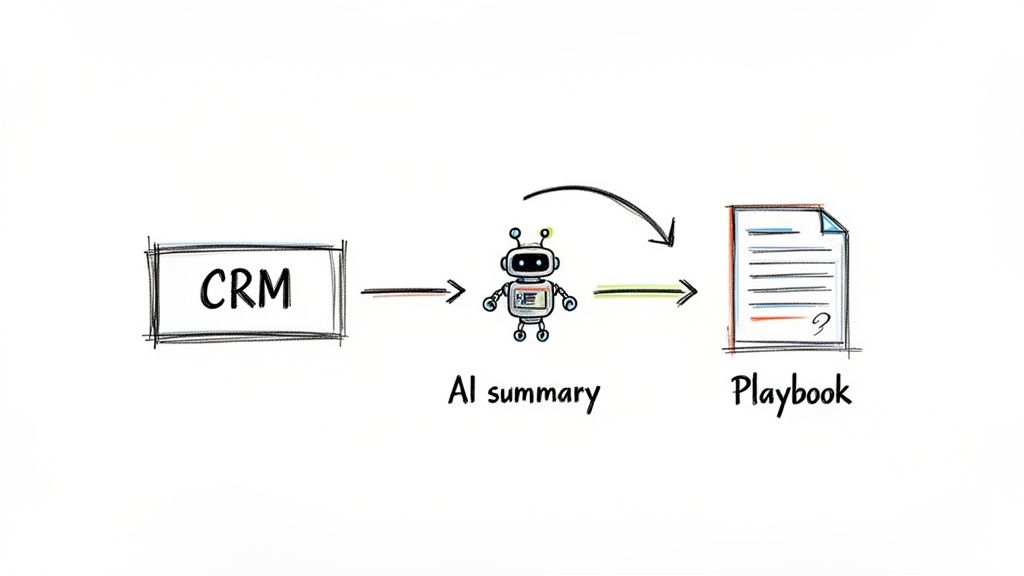
- The Modern Way: An AI tool hooked into your dialer automatically records, transcribes, and summarizes the call. It instantly pinpoints the key objection, categorizes it (like "Competitor Mention - Outreach"), and pushes the summary right into the correct CRM field. The rep doesn't have to lift a finger.
This isn't just about saving time. It creates a dataset that is exponentially more accurate and detailed than any manual process could ever hope to be. You can see how to build a system like this with an AI objection handling battlecard generator.
Creating a Powerful Feedback Loop
Once you have clean, structured objection data flowing into your CRM, you can build an incredibly powerful feedback loop. This system continuously refines your team's talk tracks and tactics based on what's working in the real world, turning reactive skills into a proactive strategy.
Here’s how all the pieces connect in an actionable cycle:
- Capture and Analyze: Your AI automatically grabs and tags objections from every call, feeding a dashboard of real-time trends. You can see in a glance which objections are most common, listen to how your top performers handle them, and identify which talk tracks are falling flat.
- Refine and Distribute: Use those insights to update your team’s battlecards and scripts. The AI can even help generate new talking points or email templates based on the specific language that’s proven to work. These aren't generic scripts from a blog post; they're battle-tested responses crafted from your own team's wins.
- Execute and Measure: Reps take these updated assets into their next calls. Since everything is tracked in the CRM, you can measure the impact directly. Did the new response to the "no budget" objection actually increase your meeting booking rate by 15%? Now you know for sure.
This cycle transforms coaching from subjective advice to data-backed guidance. As you're building out your playbook, it's also smart to pull in outside perspectives on developing effective sales strategies to make sure your approach is well-rounded.
A modern objection handling playbook is a closed-loop system. It uses real call data to find what works, AI to scale those learnings across the team, and CRM tracking to measure the results. This is how you stop guessing and start engineering better outcomes.
How to Coach Your Team for Better Results
Great objection handling isn’t a talent someone is born with. It’s a skill, and like any other, it’s sharpened and perfected through consistent, high-quality coaching. For sales leaders and enablement managers, the real work starts after the playbook is written. The mission? To shift your coaching from gut-feel feedback to a data-backed system for getting better.
This is how you scale excellence across the entire team. It’s how new reps ramp faster and seasoned reps stay on top of their game. It’s about building a culture where objections aren’t confrontations; they’re just part of the craft.
Beyond Script Reading to Real-World Simulation
Let's be honest: the classic role-playing session usually falls flat. Reps read scripts to each other in a safe, low-stakes room, which does almost nothing to prep them for a real call with a skeptical prospect. To actually work, coaching needs to feel like the real world.
Forget just reading lines. Run sessions that mimic the chaos and unpredictability of an actual sales call.
- Pressure-Test Scenarios: Make one rep the "prospect" but give them a secret, underlying objection they aren't supposed to reveal easily. This forces the SDR to use real discovery skills to dig for the truth, not just spit back a canned response.
- Rapid-Fire Rounds: Hit a rep with five minutes of non-stop, common objections. The goal isn't a perfect answer every time. It’s to train their mental reflexes so they can pull the right framework from memory without panicking.
This moves the focus from memorization to application—a much, much more valuable skill in the trenches.
Comparing Coaching Methods: Old vs. New
The way we coach has to evolve. Leaning on memory and what you think you heard on a call isn't good enough anymore, not when technology can give you objective, detailed insights on every single conversation.
| Coaching Aspect | Traditional Approach | Modern Data-Backed Approach |
|---|---|---|
| Feedback Source | Manager's subjective memory of a few live calls. | AI-powered analysis of all recorded calls. |
| Role-Play Realism | Scripted and predictable scenarios. | Scenarios built from real, recent objections logged in the CRM. |
| Performance Metrics | Based on lagging indicators like meetings booked. | Tracks leading indicators like Patience Score and objection types. |
| Scalability | Limited to one-on-one time and manager availability. | AI summaries and trend reports allow for targeted group coaching. |
The modern approach doesn’t replace the manager. It just gives them the data to be a much more effective coach.
Using Call Recordings for Actionable Feedback
Call recordings are a coaching goldmine, but only if you know what you’re looking for. Nobody has time to listen to a 30-minute call just to find one coachable moment. This is exactly where AI summaries become a manager’s best friend.
A good AI tool can transcribe calls and flag key moments, like when an objection popped up and how the rep handled it. Instead of giving vague feedback like, "You need to sound more confident," you can get incredibly specific.
For example, you can point to the exact moment a rep fumbled on price and say, "Right here, you immediately started defending the price. Next time, try acknowledging their concern first. Then, pivot to a question that explores the value gap, like, 'What's the cost of your team spending five hours a week on manual logging?'" Now that is feedback a rep can actually use.
Key Metrics to Track Improvement
To know if your coaching is actually making a difference, you need to track the right metrics. Moving beyond just "meetings booked" gives you a far clearer picture of how your team's skills are developing.
Here are a few critical metrics to keep an eye on:
- Conversation-to-Meeting Rate: This shows how good your reps are at turning a real conversation into a concrete next step, especially after navigating objections.
- Objection Handling Success Rate: Start tracking which objections are consistently shut down versus those that kill the conversation. This tells you exactly where to focus your next team training.
- Patience Score: A metric highlighted in Gong studies, this measures the pause a rep takes after hearing an objection. Top performers wait longer, giving them time to diagnose the real issue instead of just reacting.
Sales performance data shows that successfully handling multiple objections boosts success rates to 64%. That's a huge jump from the 37% success rate when only one objection is addressed. Prospects rarely have just one concern. Using a CRM-integrated tracker, you can spot these trends and train your team to dig deeper with questions like, "What specifically concerns you about that?" to uncover everything that’s holding them back.
Coaching isn’t about fixing every mistake. It’s about finding the one or two key behaviors that, if improved, will have the biggest impact on a rep's performance and giving them the tools and data to get there.
For managers looking to help their team not just handle objections but also bring in more business, exploring proven strategies to get coaching clients can offer valuable insights. And remember, a strong coaching program is a core piece of any successful sales enablement strategy.
Frequently Asked Questions
Even with the best frameworks, the real world always throws a curveball. Here are some of the most common questions that pop up in the trenches when you're turning tough conversations into real opportunities.
What Is the Single Biggest Mistake Reps Make?
Easy. Responding too quickly. It's a gut reaction. The moment a prospect raises an issue, the impulse is to jump in with a perfectly crafted rebuttal.
But that almost always backfires. It tells the prospect you weren't really listening; you were just waiting for your turn to talk. Instead of digging into the real problem, you end up shadowboxing with a surface-level comment, which just makes them dig their heels in.
Just pausing for two seconds before you speak can completely change the tone of the entire conversation.
How Do I Handle an Objection I’ve Never Heard Before?
When you get hit with something totally new, your goal isn't to have the perfect answer—it's to understand the question.
This is where you lean hard into the "Explore" step of the LAER framework. Get curious. A simple, honest response works wonders: "That's a really good question. So I can make sure I understand, could you tell me a bit more about what's driving that concern?"
This does three things at once: it buys you time, it shows you're actually engaged, and it helps you uncover the real issue before you even try to solve it.
An objection you've never heard before isn't a test of your knowledge; it's an opportunity for discovery. Treat it as a chance to learn something new about your prospect's world and what they truly value.
Can You Over-Prepare for Objections?
Absolutely, especially if you prepare the wrong way. The biggest trap is trying to memorize dozens of word-for-word scripts for every possible objection. It’s a fast track to sounding robotic and completely inauthentic.
Think of it like this:
| Aspect | Ineffective Preparation (Memorizing) | Effective Preparation (Internalizing) |
|---|---|---|
| Focus | Knowing the exact words to say. | Understanding the why behind the objection. |
| Outcome | Sounds scripted and disconnected. | Sounds natural, curious, and confident. |
| Goal | To win the point. | To open a productive dialogue. |
The key is to internalize the frameworks, not memorize the lines. When you truly grasp the principles of Listen, Acknowledge, Explore, and Respond, you can adapt to anything on the fly, in your own words. The goal is confident agility, not robotic recitation.
Ready to stop letting objections derail your pipeline? The marketbetter.ai SDR Task Engine turns buyer signals into prioritized tasks and helps your team execute flawlessly with AI-powered emails and a dialer that lives directly inside Salesforce and HubSpot. See how it works at https://www.marketbetter.ai.