
How to Build an Online Content Plan That Actually Drives Revenue
An online content plan isn't a list of blog ideas; it's your strategic playbook. It maps out what content you’re creating, who it’s for, and exactly how it will hit your sales numbers. It’s what separates teams that are just making noise from those building a predictable engine for growth.
Defining the Foundation of Your Online Content Plan
Before you write a single word, you need to get the foundation right. The most common mistake is brainstorming topics first. This reactive approach—chasing trends or competitor content—results in a blog full of content that gets clicks but never attracts a single qualified buyer. A strategic plan ensures every piece of content has a job to do.
This is about moving past fuzzy goals like "increase brand awareness" and tying your work directly to sales outcomes. Instead of just "awareness," an actionable goal is to "generate 20% more MQLs from our VP of Sales persona this quarter." This simple shift forces you to connect every marketing dollar to real revenue.
From Business Goals to Content KPIs
The first step is translating big-picture business objectives into sharp, measurable content KPIs. A classic mistake is getting hung up on vanity metrics like page views or social shares. They feel good, but they don't tell you if you're actually making money. A much more effective approach is to compare leading indicators (like traffic) with lagging indicators (like pipeline).
Let's compare generic goals with actionable, KPI-driven goals:
-
Generic Goal: Get more traffic to our blog.
-
Actionable Goal: Increase organic traffic from our target ICPs by 30% by creating content that ranks for their specific, problem-aware keywords. Action Step: Use a tool like Ahrefs or Semrush to identify 10 high-intent, low-competition keywords your ICP is searching for.
-
Generic Goal: Create more content.
-
Actionable Goal: Publish two in-depth guides per month designed to capture leads from Heads of SDRs, with a target of 100 new contacts per guide. Action Step: Create a content brief for each guide that outlines the target persona, pain points, and the primary call-to-action (e.g., "Download the SDR Coaching Template").
An online content plan without clear, sales-aligned KPIs is like a ship without a rudder. The goal is to create a direct line of sight between every content asset and its impact on the sales pipeline.
Deeply Understanding Your Audience
Once your goals are locked in, the next piece is your audience. This goes beyond basic demographics. For a plan that works, you must map out the specific pain points, daily challenges, and motivations for each of your key buyer personas.
A company targeting a "Head of SDR" and a "VP of Sales" is speaking to two different worlds. The SDR leader worries about rep productivity and ramp time. The VP of Sales focuses on pipeline coverage and forecast accuracy. Your content must address these distinct needs.
Action Step: Interview one sales rep and one customer service agent this week. Ask them: "What are the top three questions you get from the [target persona]?" Use their answers to build a list of real-world content ideas that solve actual problems.
If you need a hand dialing this in, our guide on how to create buyer personas breaks down a structured process.
Building Your Foundational Framework
When you combine sales-aligned goals with a deep understanding of your audience, you have a powerful starting point. You’re no longer just creating content; you’re building a system designed to start specific, valuable conversations for your sales team.
To solidify this groundwork, this practical guide on how to create a content strategy offers some great additional frameworks. Getting this foundation right is what ensures your plan doesn't just create noise, but systematically drives real business results.
Mapping Content Formats to the B2B Sales Funnel
You've got your goals and know who you're talking to. Now, what do you actually create? A common mistake is treating content as a random assortment of blog posts and videos. A smarter, more actionable approach is to map your content directly to the B2B sales funnel. Think of it as a guided tour, where each piece has a job to do, moving a prospect from "Who are you?" to "Where do I sign?"
Let's compare a random approach to a funnel-based one:
- Random Approach: "Let's make a video this week because video is popular." The result is an asset without a clear purpose or audience.
- Funnel-Based Approach: "Our goal is to increase MQLs. Let's create a MoFu webinar for our Head of SDR persona that addresses their main objection: scaling outreach."
Top of Funnel: Attracting the Right Attention
At the top of the funnel (ToFu), your audience isn't looking for you. They're looking for answers. Your job is to show up with helpful, educational content that builds trust without a hard sell. For a company like marketbetter.ai, this means zeroing in on the headaches that keep SDR leaders up at night—abysmal call connection rates and messy CRM data.
Effective ToFu formats usually include:
- Blog Posts: SEO-driven articles that tackle common questions, like "How to Improve SDR Call Connection Rates."
- Short Videos: Punchy, shareable clips for LinkedIn that highlight a common industry pain point.
- Infographics: Clean, visual summaries of data that simplify complex topics.
Action Step: Identify the top 5 questions your target persona types into Google before they even know solutions like yours exist. Create one ToFu blog post for each question.
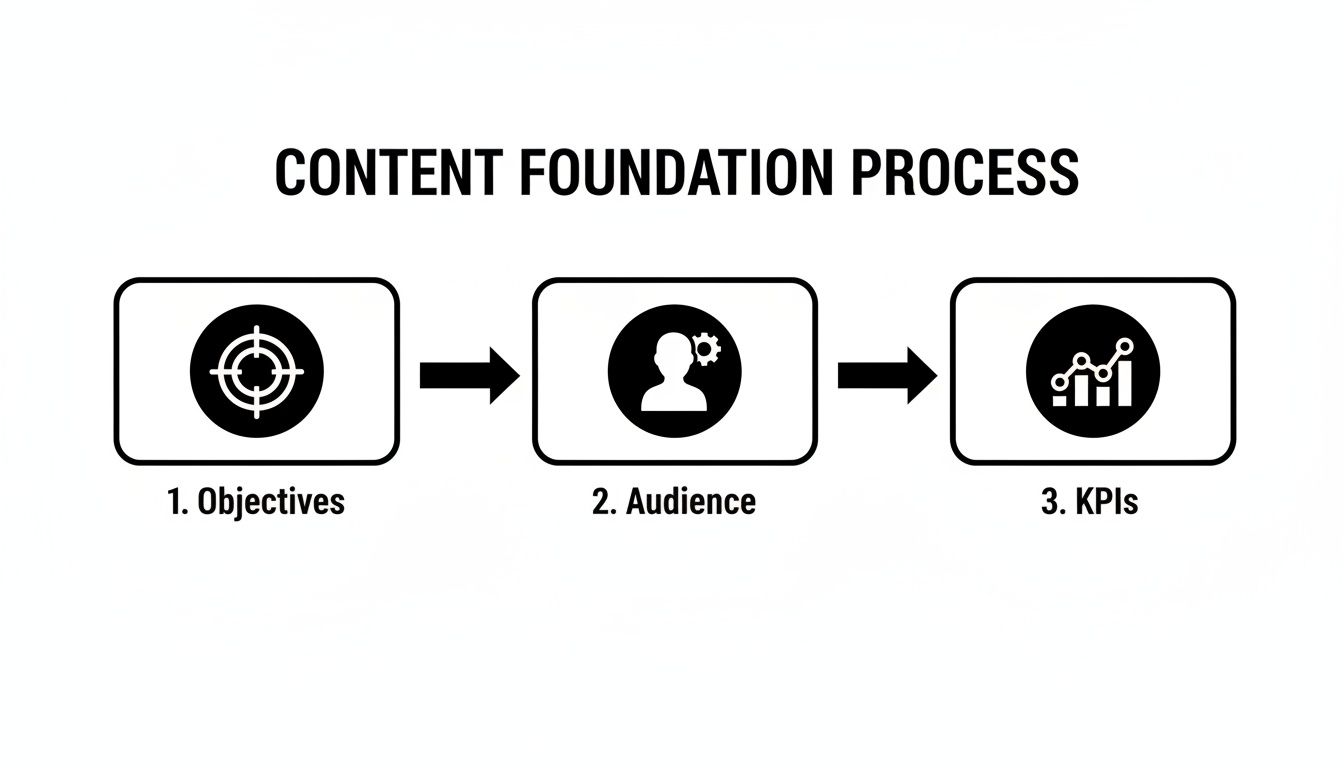
As this diagram shows, everything flows from those initial goals and audience definitions. Your ToFu content is the first touchpoint that brings that strategy to life.
Middle of Funnel: Building Trust and Credibility
Once a prospect moves into the middle of the funnel (MoFu), they are actively evaluating different solutions. This is where you transition from a helpful resource to a credible expert. Your content needs to get more specific, shifting the conversation from the "what" to the "how," and positioning your methodology as the smartest path forward.
Shifting from ToFu to MoFu content means moving from broad industry education to specific, actionable guidance. You’re no longer just discussing the problem; you're showing them the path to a solution.
Common MoFu content formats are:
- In-Depth Guides and eBooks: Meaty resources that walk readers through solving a major challenge.
- Webinars: Live sessions that offer practical training and engage potential buyers.
- Case Studies: Real-world proof that shows how you helped a similar company crush their goals.
Bottom of Funnel: Driving the Final Decision
At the bottom of the funnel (BoFu), your prospect is on the one-yard line, comparing vendors. Your content must be laser-focused on your product, dismantling any lingering objections. It's time to be direct. For marketbetter.ai, this is the moment to roll out a comparison sheet showing why its native Salesforce dialer beats the competition on user adoption.
Key BoFu formats include:
- Comparison Sheets: Head-to-head, feature-by-feature breakdowns against your main competitors.
- Product Demos: Guided tours showing exactly how your tool solves their specific problems.
- ROI Calculators: Interactive tools that help champions build the internal business case.
Action Step: Create a two-column "Us vs. Them" checklist comparing your top three features against your main competitor. Arm your sales team with it this week.
Content Format vs Sales Funnel Stage
| Funnel Stage | Goal | Primary Persona | Effective Content Formats | Example Topic (for marketbetter.ai) |
|---|---|---|---|---|
| Top of Funnel (ToFu) | Build awareness, educate | Head of SDRs | Blog Posts, Short Videos, Infographics | "5 Reasons Your SDRs Aren't Hitting Quota" |
| Middle of Funnel (MoFu) | Build trust, demonstrate expertise | VP of Sales | Webinars, Case Studies, In-depth Guides | "The Playbook for Scaling SDR Outreach Without Chaos" |
| Bottom of Funnel (BoFu) | Drive decision, overcome objections | CRO, RevOps Leader | Product Demos, Comparison Sheets, ROI Calculators | "marketbetter.ai vs. Outreach: A Feature-by-Feature Breakdown" |
This strategic mapping is what separates high-performing content programs from those that just make noise. For a deeper dive, this content mapping guide is a fantastic resource. While statistics show content marketing generates 3X more leads than outbound while costing 62% less, only 47% of B2B marketers have a documented strategy. This funnel-based approach is how you join that top half.
Building an Editorial Calendar That Actually Works
A brilliant plan is useless without a system to bring it to life. Your editorial calendar is command central, but a great one does far more than just track publish dates. Think of it less as a simple calendar and more as the dynamic blueprint for your entire content engine.
Let's compare a basic calendar with a strategic one:
- Basic Calendar: A spreadsheet with two columns: "Topic" and "Publish Date." It tracks output but not impact.
- Strategic Calendar: A project management tool (like Asana, Trello, or Airtable) that ties every asset back to a business goal, persona, and funnel stage.
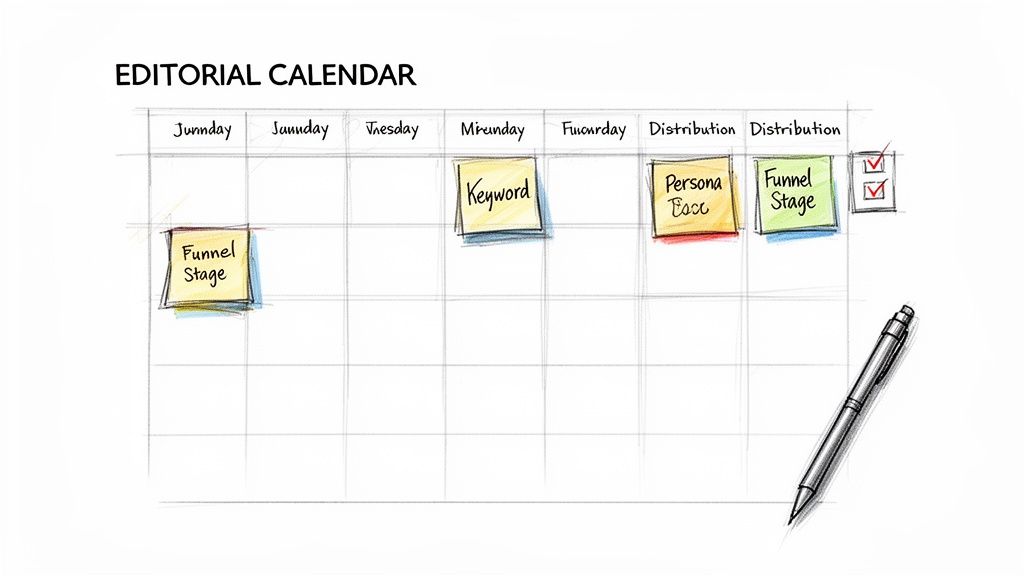
Beyond Dates and Deadlines
To turn your calendar into a strategic weapon, it needs to be the single source of truth for your team.
Action Step: Add the following fields to your calendar template today:
- Target Persona: Who is this for? (e.g., Head of SDR).
- Funnel Stage: What's the job-to-be-done? (ToFu, MoFu, or BoFu).
- Primary Keyword: The main SEO term this piece is built around.
- Content Owner: Who is responsible for getting this across the finish line?
- Status: Where is it? (e.g., Ideation, Drafting, Review, Published).
- Distribution Checklist: A link to the tactical playbook for promotion.
This detail guarantees every piece of content ships with a clear mission. If you're starting from scratch, our content marketing strategy template provides a rock-solid foundation.
Choosing Your Content Production Workflow
With your calendar structured, the next question is: who makes the content? The right workflow depends on your team's size, budget, and expertise.
A centralized in-house team offers maximum control and brand consistency. Your creators live and breathe your product, leading to higher-quality, more authentic content. The downside? It's expensive and can lack deep expertise on niche topics.
In contrast, an outsourced freelance model offers flexibility and access to specialists. Need a technical whitepaper on AI in sales forecasting? You can hire an expert for that one project. The tradeoff is the management overhead required to maintain a consistent brand voice.
The right workflow isn't about which model is "best"—it's about which one fits your company's current stage. Many successful teams run a hybrid model: a core in-house strategist managing a trusted stable of freelancers. It’s the sweet spot between control and scale.
Here's how the two main models stack up.
| Workflow Model | Pros | Cons | Best For |
|---|---|---|---|
| Centralized In-House | High brand consistency, deep product knowledge, better collaboration | Higher fixed costs, limited niche expertise, can be slow to scale | Companies with established marketing teams and a need for deep, consistent brand messaging. |
| Outsourced Freelance | Scalable, access to specialists, lower overhead costs | Requires more management, potential for inconsistent voice, less product immersion | Startups and teams needing to produce diverse content types quickly or requiring specific subject matter expertise. |
Setting Up for Success
No matter the model, the system lives or dies on clarity. Set realistic deadlines that include time for research, writing, design, and a multi-stage review cycle.
Action Step: Define your review process now. Identify who needs to provide feedback (e.g., subject matter expert, legal, marketing lead) and set a firm 48-hour turnaround time for their input to prevent bottlenecks.
This is your blueprint. It’s how your online content plan evolves from a static document into a humming engine that consistently produces high-impact assets.
SEO and Distribution: Getting Your Content in Front of the Right Eyeballs
Creating great content is only half the job. Your online content plan is incomplete without a clear strategy for getting that content in front of the right people. Without smart SEO and distribution, even the most brilliant guide is just shouting into the void.
This is where you stop being a creator and start being a marketer. It’s a game of amplification—making sure every article is findable on Google and actively pushed into the channels where your buyers actually live.
Keyword Research Is Really Buyer Research
Good SEO starts with understanding the exact words your customers use to solve a problem. Keyword research is about digging into the real questions your target personas are typing into search engines.
A Head of SDR isn't searching for "AI-powered sales task engine." They're searching for "how to improve SDR call connection rates" or "best cold email templates for tech sales." These longer, more specific long-tail keywords are gold because they signal real intent and usually have less competition.
The whole point of keyword research is to find that sweet spot where your audience's problems and your product's solutions overlap. It’s less about raw search volume and more about relevance. A single click from the right person is worth a thousand from the wrong ones.
Once you’ve found these core topics, weave them naturally into your title, headings, and body copy in a way that feels helpful, not forced.
Don't Just Publish—Distribute with a Purpose
Hitting "publish" and hoping for the best is a recipe for failure. You need to actively push your content out across multiple channels. The trick is to match the channel to the content format and your audience's habits.
| Distribution Channel | Best For | Why It Works | Actionable SDR Enablement Angle |
|---|---|---|---|
| Short videos, infographics, thought leadership posts | The undisputed champ for reaching specific B2B personas in a professional setting. It's perfect for sparking conversations and driving top-of-funnel traffic. | Arm your SDRs with pre-written LinkedIn posts to share marketing content. They can use likes and comments as triggers for personalized outreach. | |
| Email Newsletter | In-depth guides, case studies, webinar invites | This is a highly engaged audience that already trusts you. It's the ideal channel for nurturing leads down the funnel. | Create a monthly "sales-only" newsletter that highlights the best new content and provides talking points for using it in outreach. |
| Sales Enablement Platform | Comparison sheets, battle cards, one-pagers | This is about arming your sales team with the exact ammo they need to handle objections, crush competitor talk tracks, and close deals. | Action Step: For every new piece of BoFu content you create, also create a one-sentence summary and a sample email snippet for sales to use. |
Bridging the Marketing and Sales Divide
Ultimately, your distribution strategy should empower your sales development team. Content is a core part of the sales process. A whopping 82% of businesses now use it for a reason. With nearly 50% of buyers reading a company's blog during their evaluation, your prospects are showing up to the first call more informed than ever. You can dig into more stats on the rise of content in B2B sales from seoprofy.com.
Your online content plan has to close the loop. When a prospect downloads your eBook, an SDR needs to be ready with a follow-up email that references a key insight from that guide. That’s the kind of contextual, value-first outreach that separates top-performing teams.
How to Scale Your Content Plan with AI
Manual effort can only take your content plan so far. To keep up, you have to bring in technology. AI isn't just a buzzword; it's a force multiplier that helps you produce more, research faster, and connect your content directly to what the sales team is doing. This is about letting AI handle repetitive tasks so your team can focus on high-level strategy.
Where AI Fits: Content Creation vs. Sales Execution
AI's impact on your online content plan is huge, but it's crucial to compare the two main types of tools: content generation and sales execution.
Content Generation Tools like Jasper or Copy.ai are fantastic for getting you off the starting blocks. They help brainstorm blog titles, knock out first drafts, and bust through writer's block. They are built for volume, fueling your top-of-funnel awareness.
Sales Execution Tools like marketbetter.ai are focused on what happens next. They take signals from your content—like a whitepaper download—and use AI to tee up the next best action for a sales rep. They turn passive readers into active sales conversations.
| Tool Type | Primary Function | Key Benefit for Your Plan | Best For |
|---|---|---|---|
| AI Content Generators | Creates written and visual content | Scales the creation of blog posts, social updates, and ad copy. | Fueling top-of-funnel awareness and SEO volume. |
| AI Sales Execution Engines | Interprets engagement and generates outreach | Connects content engagement to prioritized sales tasks and personalized emails. | Turning marketing-qualified leads into sales-qualified pipeline. |
The real magic happens when you use both. One fills the top of your funnel; the other ensures that traffic turns into business opportunities.
From Blank Page to First Draft in Minutes
Instead of staring at a blinking cursor, you can ask an AI writing assistant to generate five different outlines for a blog post based on a target keyword. Pick the best one, then prompt it to write the first draft. Your in-house expert can then add their unique insights and brand voice, cutting the drafting process from hours to minutes.
AI should handle the 80% of content creation that's foundational—the research, structure, and initial draft. This frees up your human experts to add the critical 20%—the unique perspective, personal stories, and strategic nuance that AI can't replicate.
This isn't a future trend. As of 2025, 81% of marketers are already using AI for content tasks, and 68% of companies report a higher ROI because of it. For sales teams, with 54% of B2B marketers citing a lack of resources as their biggest challenge, tools that research accounts and generate contextual outreach are a game-changer. You can find more data on the impact of AI in B2B marketing from themxgroup.com.
Closing the Gap Between a Click and a Conversation
A great article is only half the battle. You need a system to act on the engagement it creates. This is what a platform like marketbetter.ai is built for. It doesn’t just tell you who read your blog; it uses AI to translate that click into a prioritized task for an SDR, complete with a generated email that references the content.
Here’s an actionable playbook to implement this:
- Identify Trigger Content: Tag your highest-intent assets (pricing page, demo requests, BoFu guides) as priority signals.
- Automate the Task: Set up a workflow so that engagement with this trigger content automatically creates a high-priority task in your SDRs' queue.
- Generate Contextual Outreach: Use an AI engine to draft the follow-up. For example: "Saw you were checking out our guide on improving SDR call connection rates. Tip #3 on call timing is often a game-changer for teams we work with."
By weaving AI into both content production and sales execution, your plan evolves from a simple publishing schedule into a dynamic, revenue-generating system.
Measuring Content Performance and Proving ROI
An online content plan without a measurement framework is just a collection of expensive hopes. To keep your budget, you must draw a straight line from every piece of content to a tangible business result. This means you stop caring about what feels popular and start obsessing over what actually grows the business.
A blog post with 10,000 views is a failure if it doesn’t attract a single qualified lead. A niche whitepaper with 50 downloads is a massive win if it helps close a six-figure deal. Outcome is everything.
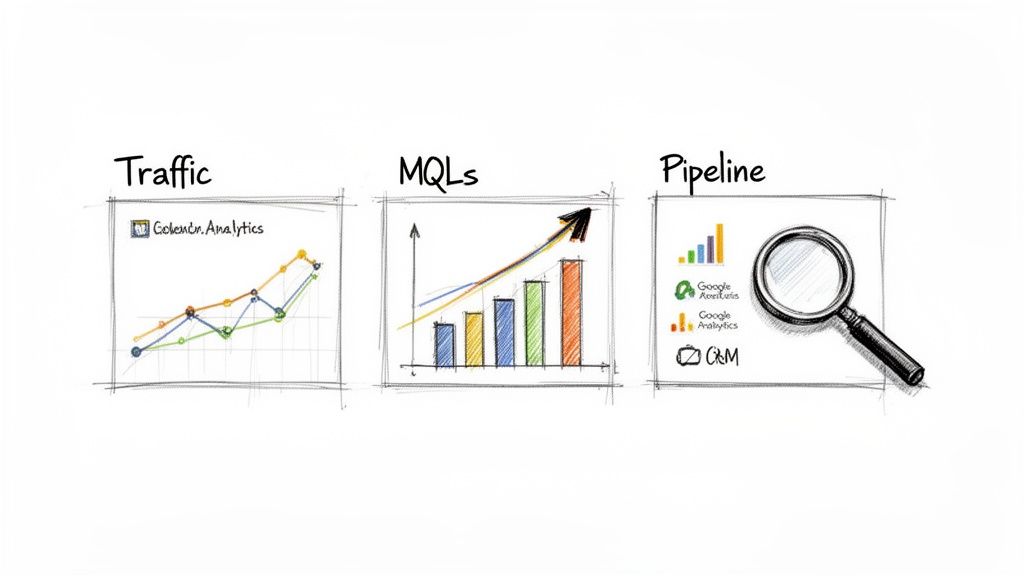
From Vanity Metrics to Pipeline Impact
First, redefine "success." Focus on the KPIs your CRO and sales leaders care about by tracking metrics across the entire funnel. It's critical to compare leading and lagging indicators to understand the full picture.
Here’s how to think about the two sides of the coin:
| Metric Type | Examples | What It Really Tells You |
|---|---|---|
| Leading Indicators (Top of Funnel) | Organic Traffic, Time on Page, Bounce Rate, Keyword Rankings | "Are we getting in front of our audience and keeping their attention?" These are health checks for your visibility and engagement. |
| Lagging Indicators (Bottom of Funnel) | MQLs, SQLs, Demo Requests, Content-Influenced Pipeline, CPL | "Is our content actually generating qualified leads and helping sales close deals?" This is what gets you more budget. |
Both are valuable, but your primary focus must be on lagging indicators. They are the ultimate proof that your content isn't just an expense—it's a revenue driver.
Setting Up Your Measurement Stack
To track these metrics, you need to get your marketing and sales data talking. This means connecting your website analytics platform (like Google Analytics) with your CRM (like Salesforce or HubSpot).
Actionable Setup Checklist:
- [ ] Set Up Goal Tracking in Google Analytics: Create conversion goals for every key action (guide downloads, demo requests). This shows which content drives high-intent actions.
- [ ] Enforce Campaign Tagging (UTMs): Be relentless about using UTM codes on every link you share to attribute traffic and conversions back to specific channels.
- [ ] Integrate Your CRM: When a lead converts, you must be able to see exactly what content they consumed right before. This is how you build reports on content-influenced pipeline.
A truly data-driven content plan doesn't just measure what happened; it uses that data to predict what to do next. When you can say, "Our case studies have influenced $500k in pipeline this quarter," you've earned your seat at the strategy table.
Conducting Regular Content Audits
Your content plan must be a living document. Keep it sharp by running quarterly content audits. This is a strategic review of what's actually working.
Your Quarterly Audit Action Plan:
- Identify High-Performers: Pinpoint the top 20% of content driving traffic, leads, and pipeline. What topics and formats do they have in common? Action: Plan to create more of what works.
- Analyze Underperformers: Find the content that's gathering dust. Action: Decide whether to update it with fresh data and better SEO, or merge it with a stronger piece.
- Spot Content Gaps: Based on performance data and keyword research, what questions are buyers asking that you still haven’t answered? Action: Add these topics to next quarter's calendar.
This cycle of measuring, analyzing, and refining is what separates a good content plan from a great one. For a deeper dive, learn more about calculating content marketing ROI in our detailed guide.
Try our Marketing Plan Generator — generate a complete AI-powered marketing plan in minutes. No signup required.
Common Questions About Building an Online Content Plan
Even the best playbook has gaps. Let's tackle a few of the most common hurdles leaders run into when building an online content plan.
How Long Should Our Content Plan Be?
This is a classic trap. A rigid 12-month plan is a recipe for irrelevance, as the market will inevitably shift. On the flip side, a 90-day plan feels tactical and lacks a clear, long-term direction.
Here’s the hybrid approach that actually works:
- Set high-level annual themes: What are the big stories you want to own this year? What are the major product launches or industry events that will be your tentpoles?
- Get granular quarterly: This is where you flesh out the details—specific blog topics, keyword targets, and campaigns for the next 90 days.
This gives you a North Star for the year but the agility to adapt every quarter based on performance data.
Should We Prioritize Quality or Quantity?
The honest answer? It's not an either/or choice. The right approach depends on your strategic goal.
Let's compare two scenarios:
- Scenario A: New Brand Building SEO. You need a higher volume of targeted content to build an initial SEO footprint. Here, quantity is a prerequisite for being found.
- Scenario B: Established Brand Targeting Enterprise. One deeply researched, authoritative whitepaper is worth more than a dozen generic blog posts. Here, quality is what a buying committee will actually read and share.
Don't think of it as a choice between one or the other. Think of it as strategic allocation. Use higher-volume, "good-enough" content for your top-of-funnel awareness goals. But save your A-team—your best writers, designers, and subject matter experts—for those high-impact, bottom-of-funnel assets that directly drive revenue.
How Do We Get Sales to Actually Use the Content?
Marketing can create brilliant assets, but if your sales team doesn't use them, the ROI is zero. The number one reason sales reps ignore content is friction. If it’s not dead simple to find and share within their existing workflow, it might as well not exist.
Compare these two methods of sharing content with sales:
- Ineffective Method: Dropping links in a shared Google Drive or a Slack channel. This forces reps to leave their workflow, search for assets, and context-switch.
- Effective Method: Embedding your content library directly where the sales team lives—their CRM and sales enablement tools. An SDR can pull the perfect case study right from inside Salesforce without missing a beat.
Action Step: This quarter, integrate your content library with your CRM. Make it a goal that sales reps can find and share any piece of content in under 30 seconds.
A truly effective online content plan doesn't just stop at creation; it closes the loop to execution. marketbetter.ai is built to bridge this gap, turning content engagement into prioritized SDR tasks with AI-generated outreach, all inside your CRM. See how we make your content start conversations at https://www.marketbetter.ai.