
The Top 10 Best Practices for Landing Page Design in 2026
In B2B marketing, a landing page isn't just a webpage; it's your digital sales pitch, working 24/7 to turn clicks into qualified pipeline. With buyer attention spans shrinking and competition intensifying, a generic design no longer drives meaningful results. The critical difference between a page that converts prospects and one that merely consumes ad spend lies in the deliberate, strategic application of proven design principles. A high-performing page anticipates user intent and guides them seamlessly to a single conversion goal, while a weak one creates friction, confusion, and ultimately, a bounce.
This guide moves beyond generic advice to provide a prioritized, actionable roundup of the 10 best practices for landing page design, specifically tailored for demanding mid-market and enterprise sales funnels. We will break down what works versus what falls flat, comparing high-impact elements like problem-centric hero sections against vague value propositions. You won't just learn what to do; you'll learn how to implement it.
Inside, you'll find A/B testing recipes, performance benchmarks, and clear implementation tips to help you build landing pages that don't just look good but consistently drive results. Whether you're a Head of SDR, a demand generation manager, or a VP of Sales, these principles will equip you to transform your landing pages from simple information hubs into powerful conversion machines. We will explore everything from structuring your value proposition and leveraging social proof to optimizing form fields and handling objections before they even arise.
1. Clear Value Proposition Above the Fold
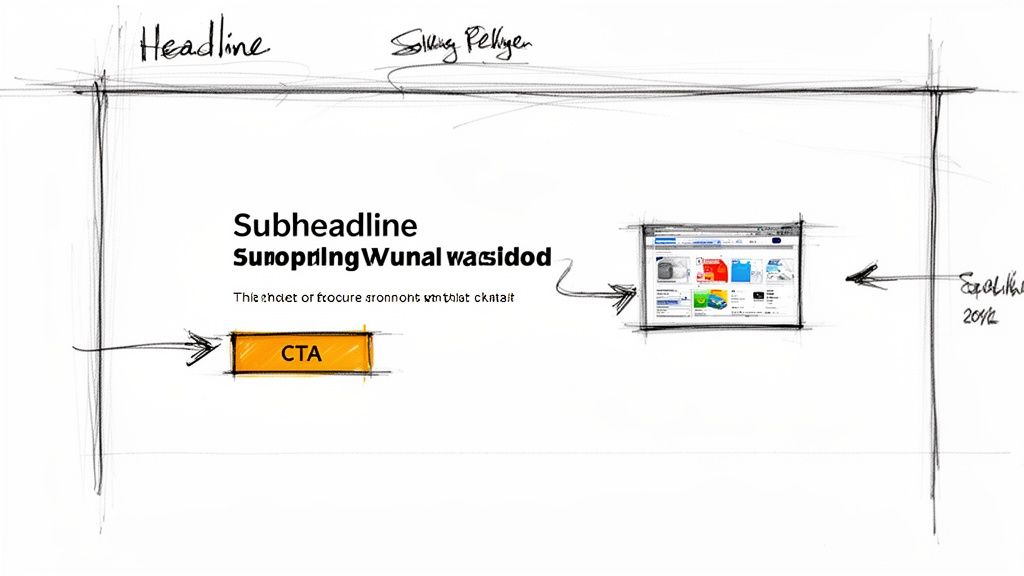
A visitor should understand what you offer, who it's for, and why they should care within five seconds of landing on your page. This immediate clarity is achieved with a strong value proposition placed "above the fold," meaning it's fully visible without any scrolling. This isn't just a best practice for landing page design; it's the foundation upon which all other conversion elements are built. A visitor who is confused about your core offer will never reach your call-to-action.
Why It's Crucial
Your headline and subheadline are your one chance to make a first impression. They must immediately resonate with the visitor's pain point and promise a clear, desirable outcome.
- Ineffective Comparison: A headline like "AI-Powered Sales Tool" is weak because it describes a feature. It forces the user to figure out the benefit.
- Effective Comparison: A much stronger, outcome-focused headline is: "Turn Buyer Signals into Qualified Pipeline, Instantly." This version sells a result that every VP of Sales wants. This single element is often the highest-impact variable you can test to improve performance.
Actionable Implementation Steps
To craft a compelling value proposition, focus on your target audience's specific needs.
- Action: Audit your current headline. Does it describe a feature or a benefit? Rewrite it to focus on the outcome your ideal customer profile (ICP) desires. For an SDR Manager, use phrases like "eliminate manual research" and "ensure CRM hygiene."
- Action: Anchor your solution to a concrete workflow. Instead of a vague promise like "Improve Sales," be specific: "Prioritize SDR Tasks Inside Salesforce." This makes your solution tangible.
- Action: Set up an A/B test today. Pit your new benefit-driven headline against a pain-point-focused one (e.g., "Stop Wasting Time on Bad Leads"). Allocate at least 20% of your paid traffic to the test to get statistically significant results quickly.
Crafting the perfect headline is a critical step in your conversion strategy. For a deeper dive into methodical testing and optimization, check out our comprehensive conversion rate optimization checklist.
2. Problem-Centric Hero Section (Before/After or Pain Validation)
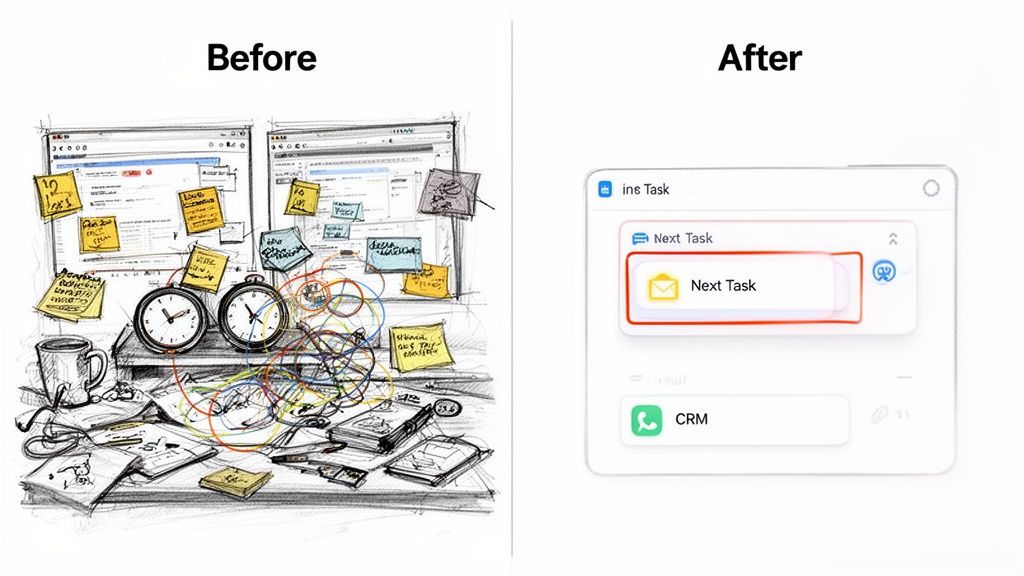
Instead of leading with your solution, a problem-centric hero section immediately validates the visitor's primary business pain. It demonstrates a deep understanding of their challenges, building trust and credibility before you ever mention a feature. This approach shifts the conversation from "what our product does" to "we understand your world," which is a far more powerful opening for complex B2B sales cycles and a cornerstone of effective landing page design.
Why It's Crucial
Your value proposition resonates more strongly when it's framed as the direct answer to a well-articulated problem.
- Ineffective Comparison: A landing page that simply states "AI-Powered Sales Dialer" is forgettable and competes on features alone.
- Effective Comparison: A hero section leading with a stat like "SDRs spend 3+ hours daily on research and admin, not selling" immediately grabs the attention of any Sales VP. This pain validation technique, popularized by frameworks like StoryBrand, makes your solution feel less like a product and more like a necessary resolution.
Actionable Implementation Steps
To build a compelling problem-centric hero, immerse yourself in your customer's daily workflow.
- Action: Create a "Before/After" visual. Show a graphic of an SDR juggling multiple tabs (LinkedIn, CRM, dialer) next to a clean interface of your tool. This makes the pain tangible and the solution clear.
- Action: Add a quantified pain point to your hero copy. Use an industry stat or internal data like "67% of SDRs say poor dialer integration kills adoption" to add authority and validate the problem.
- Action: A/B test different pain points. Run one hero section focused on wasted research time against another focused on low CRM adoption. This will reveal which problem is the most powerful motivator for your audience.
By first proving you understand the problem better than anyone else, you earn the right to present your solution. For more on creating narratives that drive action, explore Donald Miller's insights on the StoryBrand marketing framework.
3. Social Proof and Trust Signals (Logos, Reviews, Case Studies)
For B2B buyers, especially in the mid-market to enterprise space, skepticism is the default setting. A landing page must quickly overcome the "another tool that won't stick" objection. Social proof and trust signals serve as the most effective antidote, providing third-party validation that your solution is credible, adopted by peers, and delivers real-world results. This isn't just about adding a few logos; it's a strategic element of landing page design that directly addresses perceived risk.
Why It's Crucial
Your claims about turning "buyer signals into qualified pipeline" are just that: claims. They gain credibility only when backed by evidence from existing customers. For a sales leader evaluating a tool like MarketBetter, seeing logos of well-known, sales-driven organizations or a testimonial from a VP of Sales at a similar company instantly builds a bridge of trust.
- Ineffective Comparison: A page with no trust signals feels like an empty restaurant; it creates doubt.
- Effective Comparison: A page with strong, relevant proof feels like the most in-demand spot in town. It shifts the conversation from "Does this work?" to "This works for them, so it could work for us."
Actionable Implementation Steps
Strategically deploy social proof to build momentum as a visitor scrolls down the page.
- Action: Replace vague testimonials ("We love the tool") with quantified outcomes. Reach out to a happy customer and ask for a specific metric: "MarketBetter reduced our SDRs' prep time by 2 hours a day."
- Action: Segment your logo bar. If your landing page targets B2B SaaS companies, create a dedicated section showing only logos from that vertical. This demonstrates industry expertise.
- Action: Prominently display your G2 or Capterra rating. Add a badge with your star rating (e.g., "4.7/5 stars on G2") near your CTA to act as an unbiased stamp of approval.
- Action: A/B test social proof formats. Test a static logo bar against a rotating carousel of detailed, quote-based testimonials to see which format drives more conversions for your specific audience.
Building this layer of trust is a fundamental component of effective landing page design, transforming a simple marketing page into a compelling business case. For more insights on building a narrative with customer evidence, explore our guide on crafting high-impact case studies.
4. Feature-to-Benefit Translation (Show the Workflow, Not Just the Tech)
Prospective buyers don't purchase features; they invest in solutions that solve specific, often painful, problems within their daily workflow. Simply listing what your product does, such as "Salesforce Dialer" or "AI-written emails," forces the visitor to connect the dots themselves. Effective landing pages close this gap by translating technical features into tangible business outcomes and workflow improvements. This approach shifts the focus from "what it is" to "what it does for me."
Why It's Crucial
Your landing page must function as a bridge between your product's capabilities and the visitor's desired future state. A sales development representative (SDR) doesn't just want a dialer; they want to stop switching between browser tabs, log calls automatically, and make more dials per hour.
- Ineffective Comparison: A weak feature description like "AI Cold Email" is a tool.
- Effective Comparison: A stronger, workflow-focused benefit is: "Generate on-brand, context-specific cold emails that earn higher reply rates, eliminating hours of manual research and subject-line testing." This is a direct solution to a major productivity bottleneck.
Actionable Implementation Steps
To implement this principle, map your core features directly to the "job to be done" for your target audience.
- Action: Restructure your features section around 3-5 core workflows. Instead of a feature grid, create sections like "Automate Task Prioritization," "Streamline Outreach," and "Improve CRM Hygiene."
- Action: Use "Before/After" copy. For each workflow, describe the old, inefficient way ("Manually searching for prospect data") and contrast it with the new, streamlined process your tool enables ("Get AI-surfaced insights in one click").
- Action: Convert a feature into an outcome. Take a feature like "Call Recording" and rewrite its description to focus on the benefit for a manager: "Allow sales coaches to QA rep calls asynchronously, providing targeted feedback without having to sit in on every single conversation."
By focusing on the workflow, you embed your product into the visitor's reality, making the value proposition both undeniable and immediately understandable. This is a key best practice for landing page design that directly addresses the user's core needs.
5. Friction Reduction: Single CTA, Clear Next Step, Minimal Form Fields
Every decision you ask a visitor to make introduces friction, a form of cognitive load that can stop a conversion dead in its tracks. Effective landing page design is a masterclass in reducing this friction. The goal is to create a seamless, intuitive path from visitor to lead by presenting one primary call-to-action (CTA), clarifying what happens next, and asking for the absolute minimum amount of information required. A visitor who feels the process is simple and transparent is far more likely to convert.
Why It's Crucial
Decision paralysis is real. Offering a visitor too many choices, like "Schedule a Demo," "Start a Trial," "Download Whitepaper," and "Watch a Video" on the same page, creates confusion. The visitor doesn't know which path is right for them and often chooses none.
- High-Friction Comparison: A form with ten fields feels like a major commitment and an invasion of privacy. It screams "we're going to spam you."
- Low-Friction Comparison: A form with just three fields feels easy and low-risk. Simplifying from eight fields to four can directly increase lead volume.
Actionable Implementation Steps
To minimize friction, streamline every element of the conversion process. Focus on making the desired action feel effortless.
- Action: Unify your CTA. Choose the single most valuable action (e.g., "Schedule a Demo") and make it your primary CTA. If you must offer a secondary option ("Watch a 3-Minute Walkthrough"), make it a text link instead of a button to reduce its visual weight.
- Action: Shrink your form today. Audit your form fields and remove at least one. Do you really need their phone number right now? Start with Name, Work Email, and Company. Use data enrichment tools later.
- Action: Add expectation-setting microcopy. Below your form, add a simple sentence: "You'll receive a calendar link within 15 minutes. No sales call required to book." This builds trust and clarifies the next step.
Reducing friction is one of the most powerful levers you can pull to improve performance. For a step-by-step guide on applying these principles, you can learn more about how to create a high-converting landing page.
6. Mobile-First Responsive Design (Not an Afterthought)
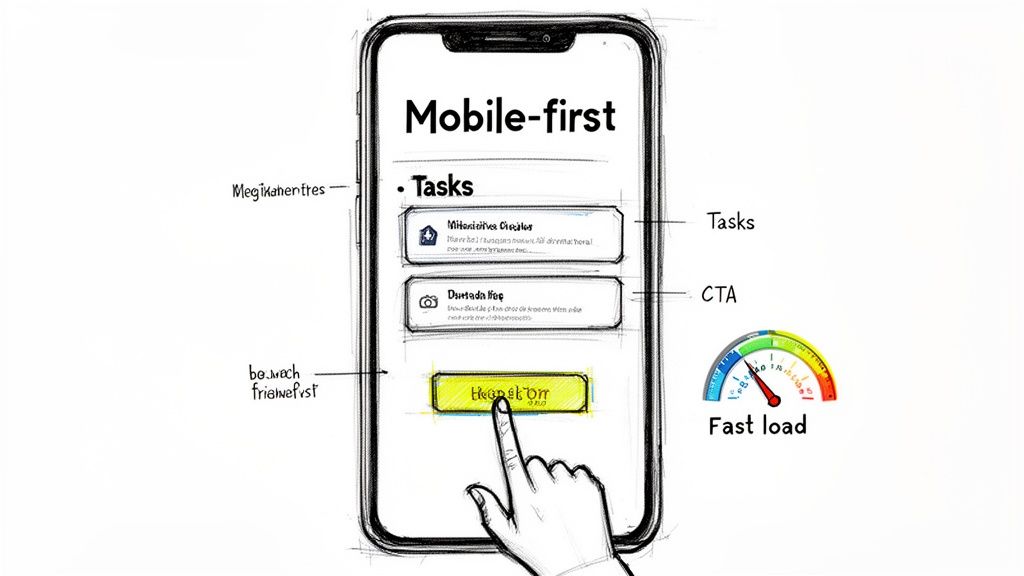
In today's B2B landscape, treating the mobile experience as a secondary concern is a critical mistake. A mobile-first approach means you design the landing page for the smallest screen first, then adapt it for larger screens like desktops. This isn't just a technical detail; it's a strategic imperative. Many of your target buyers, from VPs of Sales checking emails between meetings to SDRs browsing on the go, will first encounter your brand on their phone. A clunky, slow, or broken mobile page immediately signals a lack of attention to detail and can kill a potential lead instantly.
Why It's Crucial
Google's mobile-first indexing means your mobile page performance directly impacts your search ranking. Beyond SEO, however, is the user experience.
- Ineffective Comparison: A desktop design shrunk down to mobile, requiring pinching and zooming to fill out a form, will be abandoned immediately.
- Effective Comparison: Companies like Slack and HubSpot excel here; their mobile landing pages are clean, fast, and feature a single-column layout with a prominent, "thumb-friendly" CTA, ensuring the experience is seamless. This focus is a core part of effective landing page design.
Actionable Implementation Steps
Shifting to a mobile-first mindset requires practical changes to your design and development workflow.
- Action: Test your mobile speed now. Use Google's PageSpeed Insights and aim for a score of 90+. Compress all images using a tool like TinyPNG and remove any non-essential scripts.
- Action: Redesign UI for touch. Stack elements like CTAs vertically on mobile instead of placing them side-by-side. Ensure buttons are at least 44x44 pixels to create ample tap targets and avoid user frustration.
- Action: Test on a real device. Open your landing page on your own phone. Try to fill out the form. If it's frustrating for you, it's a conversion killer for your prospects.
- Action: Optimize media for mobile. Replace auto-playing videos with a static image thumbnail and a play button. This saves bandwidth, improves load times, and gives the user control.
A robust mobile experience is no longer optional. For guidance on optimizing every aspect of your funnel, explore our detailed lead generation strategy guide for advanced techniques.
7. Customer Testimonial and Case Study Depth (Specific Metrics and Quotes)
Generic testimonials like "Great product!" are easily ignored and do little to build trust. One of the most effective best practices for landing page design in a B2B context is to showcase social proof with verifiable depth. This means featuring testimonials and case study summaries that are packed with specific, quantifiable results, company context, and quotes from identifiable professionals. It transforms vague praise into a compelling, evidence-backed narrative that allows prospects to see a clear path to their own success.
Why It's Crucial
A vague testimonial is forgettable, but a specific, metric-driven outcome is persuasive. When a VP of Sales sees that a peer at a similar company increased their pipeline by 35% using your tool, it builds instant credibility and relevance.
- Ineffective Comparison: A generic quote like "MarketBetter helped our sales team." is a platitude with zero impact.
- Effective Comparison: A powerful, specific alternative is: "MarketBetter’s Salesforce integration helped our SDRs increase daily outreach by 40% while cutting prep time in half." The second is a business case that directly addresses a prospect's KPIs.
Actionable Implementation Steps
To leverage deep social proof, focus on weaving specific, persona-aligned results into your landing page.
- Action: Add quantifiable outcomes to every testimonial. Go beyond percentages and include metrics like "generated $250k in new pipeline," "saved 10 hours per rep per week," or "improved data quality by 60%."
- Action: Provide context and credibility. Add the person's name, title, a professional headshot, and their company logo to every quote. This is non-negotiable for building trust.
- Action: Align case studies with page personas. If the page targets VPs of Sales, feature a case study summary focused on pipeline creation. If it targets SDR Managers, feature one focused on activity metrics and efficiency gains.
For a comprehensive guide on building a repository of customer stories that fuel your marketing efforts, explore our detailed resource on creating a customer evidence program.
8. Visual Hierarchy and Scannable Content (Not Dense Paragraphs)
B2B buyers are busy and goal-oriented; they don't read landing pages, they scan them. A wall of dense text is an immediate conversion killer. Implementing a strong visual hierarchy guides the visitor’s eye to the most critical information, making your page instantly digestible. This isn't just about aesthetics; it's a fundamental principle of user experience design that directly impacts whether a visitor understands your offer or bounces in confusion.
Why It's Crucial
A scannable layout allows prospects to quickly find the sections most relevant to their specific role or pain point.
- Ineffective Comparison: A single, dense block of text forces all visitors—from a Sales Leader to a RevOps Manager—to parse the same information, much of which may be irrelevant to them.
- Effective Comparison: Pages from SaaS leaders like Stripe and HubSpot use minimal copy, strong headings, and clear section breaks to direct attention. This respects the user's time and makes the solution feel more accessible.
Actionable Implementation Steps
To transform a text-heavy page into a scannable, high-converting asset, focus on structure and visual cues.
- Action: Break up your content. Go through your page and ensure every section has a clear H2 or H3 heading. For MarketBetter, change a long paragraph about features into an H2 like 'How MarketBetter Works' with three distinct H3s: Prioritize Tasks, Automate Emails, and Log Calls.
- Action: Convert prose to lists. Find any sentence that lists three or more items and convert it into a bulleted list. This simple format change can dramatically improve readability.
- Action: Increase whitespace. Add 20-30% more vertical padding between sections. This reduces cognitive load and helps your calls-to-action stand out more effectively.
Testing different layouts, such as comparing a paragraph-based section to a bulleted one, is essential. For more insights on structuring these experiments, explore our guide on how to conduct A/B testing.
9. FAQ/Objection Handling Section (Preempt Buyer Doubts)
Even the most persuasive landing page can leave a high-intent prospect with lingering questions or doubts. A dedicated FAQ section strategically addresses these common objections head-on, reducing friction and preventing visitors from abandoning the page to seek answers elsewhere. This isn't just a list of questions; it's a critical conversion tool that builds trust and preemptively handles the "but what about..." thoughts that can derail a decision. A visitor who finds answers to their specific concerns is far more likely to convert.
Why It's Crucial
Your prospects are silently running through a checklist of potential deal-breakers: cost, implementation effort, compatibility with existing tools, and security. Failing to address these directly creates uncertainty.
- Ineffective Comparison: Ignoring a key objection like “We already have Outreach/Salesloft. Why do we need this?” lets the prospect disqualify you on their own.
- Effective Comparison: Addressing it head-on with an answer like, "MarketBetter isn't a replacement; it’s the decision engine that lives inside Salesforce, turning buyer signals into prioritized tasks that your existing sales engagement platform can then execute," re-frames your product from a competitor to a complementary, value-add layer.
Actionable Implementation Steps
To build an effective objection-handling section, source questions directly from your sales and customer success teams.
- Action: Survey your sales reps for the top 5 questions they get on discovery calls. Common ones include: “Will our SDRs actually use this?” and “What if our Salesforce instance is messy?” Build your FAQ around these.
- Action: Use a collapsible accordion format. This keeps the page clean and allows visitors to find the specific information they need without being overwhelmed by text. Place this section right before the final CTA to resolve last-minute doubts.
- Action: Turn objections into benefits in your answers. For "How long does implementation take?", provide a phased timeline: "Start with core task management in under 2 weeks, then layer in our AI coaching module." This transforms a potential negative into a positive (fast time-to-value).
By proactively answering questions, you control the narrative and build the confidence a prospect needs to take the next step. For more on crafting persuasive copy that overcomes objections, explore our detailed guide on writing high-converting landing page copy.
10. Video or Animated Demo (Not Just Screenshots)
A static screenshot can show a feature, but a dynamic video or animated demo tells a story and demonstrates value. For complex products, showing the actual workflow in action is far more compelling than simply describing it with text and images. This approach builds trust by showcasing the real product, reduces the user's perceived complexity, and significantly boosts engagement by making your solution tangible and easy to understand.
Why It's Crucial
Words can be misinterpreted, but a well-executed video demo provides undeniable proof of your product's capabilities.
- Ineffective Comparison: A static screenshot shows a single screen, forcing the user to imagine the workflow.
- Effective Comparison: A short video shows exactly how an SDR transitions from receiving a prioritized signal to logging an AI-summarized call in Salesforce. This visual evidence of efficiency answers key questions before they're asked. Companies like Loom and Calendly master this by turning abstract benefits into concrete results.
Actionable Implementation Steps
To create an effective demo, focus on showcasing a high-value workflow rather than a generic product tour.
- Action: Script a problem-solution story. Instead of clicking through menus, script a 90-second video that shows a user's complete workflow: starting with the problem (a messy task list) and ending with the solution (an AI-prioritized task executed and logged).
- Action: Add on-screen captions. A significant portion of viewers watch with the sound off. Use clear text overlays or subtitles to ensure your message lands even without audio.
- Action: Run an A/B test. Create two versions of your landing page—one with the video and one with a static hero image. Track form fill conversion rates to measure the video's direct impact on your pipeline. Ensure the video is user-initiated with a play button, as autoplay can be disruptive.
For more on this topic, explore these strategies for creating compelling product videos that convert.
10-Point Landing Page Design Comparison
| Item | 🔄 Implementation Complexity | ⚡ Resource Requirements | 📊 Expected Outcomes | 💡 Ideal Use Cases | ⭐ Key Advantages |
|---|---|---|---|---|---|
| Clear Value Proposition Above the Fold | Low–Medium — copy + design and iterative A/B tests | Small team: copywriter, designer, analytics | Faster visitor qualification; lower bounce | Top-of-funnel pages, paid ads, first-touch traffic | Immediate clarity; reduced cognitive load |
| Problem-Centric Hero Section (Before/After or Pain Validation) | Medium — needs research-driven copy and visuals | Designer, copywriter, customer insight/research | Higher engagement and empathy; stronger relevance signals | Pages targeting known pain points or persona-specific campaigns | Builds trust by validating buyer pain |
| Social Proof and Trust Signals (Logos, Reviews, Case Studies) | Low–Medium — asset collection and placement | Customer success, legal approvals, design | Increased credibility; better enterprise conversion | Mid-market/enterprise targeting and late-stage buyers | Reduces perceived adoption risk with real proof |
| Feature-to-Benefit Translation (Show the Workflow) | Medium — mapping features to workflows and visuals | Product, PM, copy, designer, UX | Better comprehension across personas; clearer ROI links | Complex products, multi-stakeholder buying processes | Shows how features drive real outcomes |
| Friction Reduction: Single CTA, Minimal Forms | Low — design/form changes and copy tweaks | CRO specialist, dev, analytics | Higher conversion rates; lower form abandonment | Demo/trial signups and high-intent landing pages | Simplifies path to conversion; faster user action |
| Mobile-First Responsive Design (Not an Afterthought) | Medium–High — responsive build and performance work | Front-end dev, QA, performance tools | Higher mobile conversions; SEO and load-time improvements | Mobile-heavy audiences (SDRs on-the-go) | Better UX on mobile; signals product maturity |
| Customer Testimonial and Case Study Depth | Medium–High — interviews, write-up, design | Customer interviews, content team, design, approvals | Stronger trust and faster sales decisions; proven ROI | RevOps, VP Sales, procurement evaluations | Specific metrics and contextual credibility |
| Visual Hierarchy and Scannable Content | Low–Medium — content restructuring and layout | Copywriter, designer, UX reviewer | Increased time-on-page and comprehension; easier scanning | Any landing page where visitors skim content | Reduces cognitive load; improves information discovery |
| FAQ/Objection Handling Section | Low — collating common objections into concise answers | Sales input, copy, UX, links to resources | Fewer pre-sale objections; faster qualification | Consideration-stage traffic and technical buyers | Preempts concerns and reduces friction |
| Video or Animated Demo (Not Just Screenshots) | Medium — production and periodic updates | Video producer, product demo lead, hosting, captions | Higher engagement; lowers perceived complexity | Demonstrating workflows to SDRs, RevOps, and execs | Shows product in action; reusable marketing asset |
Try our Marketing Plan Generator — generate a complete AI-powered marketing plan in minutes. No signup required.
Putting It All Together: Your Blueprint for a Conversion-Focused Landing Page
We’ve journeyed through the ten pillars of high-performance landing page design, moving from the crucial first impression above the fold to the final, reassuring details in your FAQ section. But these are not just items on a checklist; they are interconnected components of a single, conversion-focused machine. The true power of these best practices for landing page design is unlocked when they are integrated into a cohesive and persuasive user journey.
Think of your landing page as your best digital salesperson. A top-performing sales development representative (SDR) doesn't just list product features; they listen to a prospect's pain points, validate their challenges, and then frame the solution in terms of tangible outcomes. Your landing page must do the same. A problem-centric hero section (Principle #2) hooks the visitor by acknowledging their specific struggle, while feature-to-benefit translation (Principle #4) shows them, step-by-step, how your solution resolves that pain.
From Good to Great: The Synthesis of Strategy
The difference between a landing page that gets a few leads and one that consistently fuels your pipeline lies in the synthesis of these principles. For example, robust social proof (Principle #3) and in-depth testimonials (Principle #7) are not just decorative elements. They are strategic tools that directly support your value proposition (Principle #1) and preemptively handle objections (Principle #9).
Let’s compare two approaches:
- The "Good Enough" Page: This page has a clear CTA and lists features. It might get some conversions from high-intent visitors, but it fails to persuade those on the fence. It often relies on a single screenshot and generic testimonials like "Great product!" which lack credibility.
- The High-Conversion Page: This page tells a story. It uses a video demo (Principle #10) to illustrate a workflow, not just a static interface. It features a testimonial with specific metrics like, "Reduced our manual data entry by 15 hours per week," providing concrete proof. This page is built with a mobile-first mindset (Principle #6), ensuring the experience is seamless for the 50%+ of users on mobile devices, and uses a scannable layout (Principle #8) to guide the reader’s eye.
By embracing this more holistic approach, you move beyond merely presenting information to actively persuading and guiding your audience.
Your Actionable Next Steps
Mastering the art and science of landing page optimization is an ongoing process, not a one-time project. Don’t get overwhelmed by trying to implement all ten practices at once. Instead, adopt an iterative, data-driven methodology:
- Audit Your Current Page: Score your primary landing page against the ten principles discussed. Where are the biggest gaps? Is your CTA singular and clear? Are your form fields minimal (Principle #5)?
- Prioritize and Hypothesize: Select two or three high-impact areas for improvement. A good starting point is often strengthening your value proposition and adding metric-driven social proof. Formulate a clear hypothesis, such as: "By replacing our generic hero image with a short video demo showing the 'before and after' workflow, we believe we can increase form submissions by 15%."
- Test and Measure: Run an A/B test on your changes. Let the data tell you what resonates with your audience. Track not just conversion rates, but also metrics like scroll depth and time on page to understand user behavior more deeply.
By continually testing and refining, you transform your landing page from a static digital brochure into a dynamic, intelligent conversion engine. For a deeper, step-by-step walkthrough that puts these ideas into practice, this guide on how to build landing pages that convert provides an excellent technical framework. Ultimately, a well-optimized landing page doesn't just generate leads; it delivers highly qualified prospects to your sales team, shortening sales cycles and accelerating revenue growth.
Ready to turn those hard-earned landing page conversions into qualified pipeline? marketbetter.ai automates the tedious SDR tasks that follow a form submission, so your team can focus on selling. See how our AI-powered engine can help you engage, qualify, and book meetings with leads instantly by visiting marketbetter.ai.