
Real-Time Competitive Intel Alerts with OpenClaw + Claude [2026]
Your competitors launched a new feature last week. Changed their pricing yesterday. Hired a VP of Sales this morning.
You found out... just now, reading this.
In fast-moving markets, competitive intelligence isn't a quarterly report—it's a real-time feed. This guide shows you how to build an automated competitive intel system using OpenClaw and Claude that monitors competitors 24/7 and alerts your team the moment something changes.
Why Real-Time Competitive Intel Matters
The traditional approach to competitive intelligence:
- Sales rep hears something on a call
- Mentions it in Slack (maybe)
- Product marketing adds it to a doc (eventually)
- Battlecard gets updated (quarterly, if lucky)
Result: Your team learns about competitor changes weeks or months after they happen.
The Cost of Slow Intel
| Scenario | Impact |
|---|---|
| Competitor drops pricing | Lost deals while you're priced higher |
| New feature announcement | Sales team blindsided on calls |
| Key hire at competitor | Strategic move you missed |
| Customer case study published | They're winning your prospects |
| Positioning change | Your battlecards are outdated |
Real-time intel changes the game. Instead of quarterly catch-up, you get:
- Immediate Slack alerts when competitors update pricing pages
- Daily summaries of competitor blog posts and announcements
- Automatic battlecard updates with new objection handling
- Early warning on strategic moves (funding, hiring, partnerships)
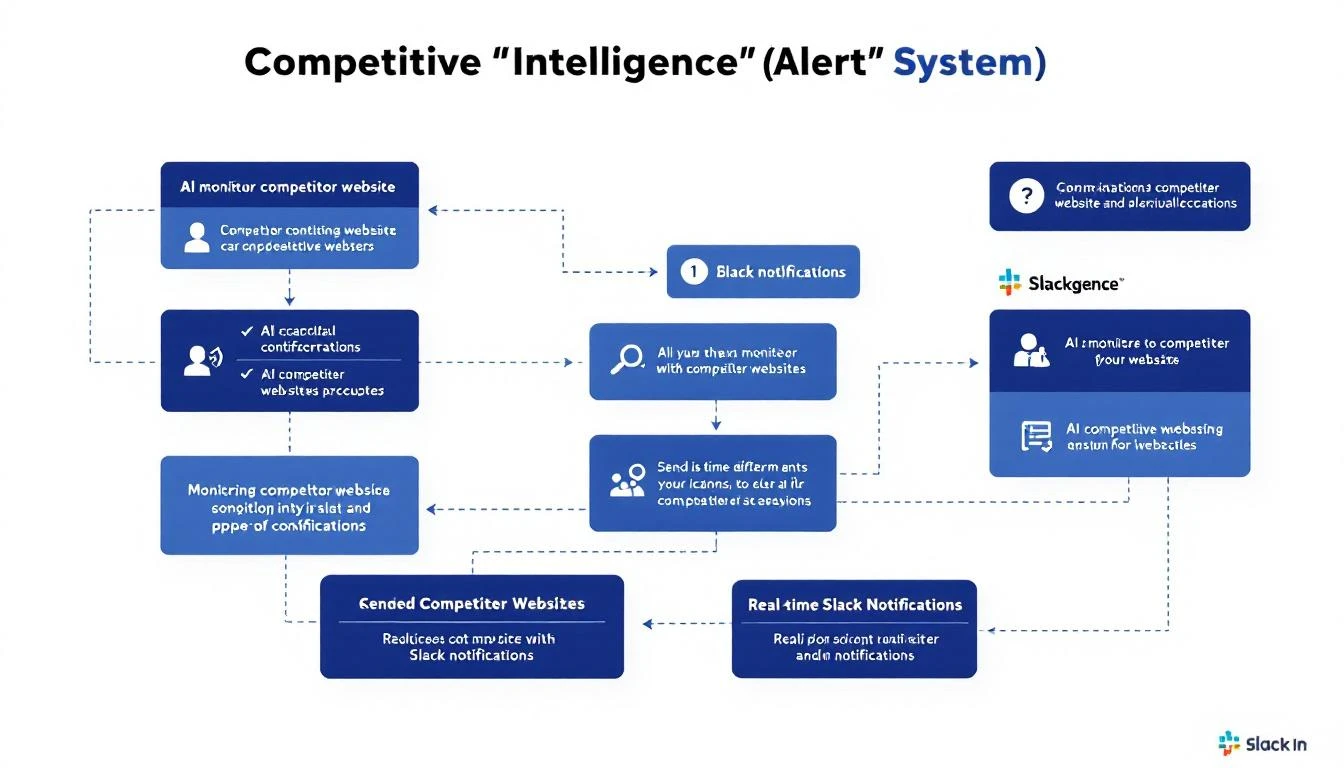
The Architecture
Here's what we're building:
[Competitor Websites] → [OpenClaw Monitors] → [Claude Analysis] → [Alerts]
        ↓                      ↓                    ↓              ↓
   - Pricing pages         - Browser               - Change        - Slack
   - Feature pages         - Cron jobs             - Summarize     - Email
   - Blog/News             - Snapshots             - Assess        - CRM
   - LinkedIn                                      - Recommend
   - Job postings
Step 1: Define What to Monitor
Start by listing your top competitors and what to track:
# competitors.yml
competitors:
  warmly:
    name: "Warmly"
    website: "https://warmly.ai"
    monitors:
      - type: pricing
        url: "https://warmly.ai/pricing"
        check: daily
        alert_on: any_change
      - type: features
        url: "https://warmly.ai/features"
        check: daily
        alert_on: new_content
      - type: blog
        url: "https://warmly.ai/blog"
        check: hourly
        alert_on: new_posts
      - type: linkedin
        url: "https://linkedin.com/company/warmly-ai"
        check: daily
        alert_on: new_posts, employee_changes
      - type: jobs
        url: "https://warmly.ai/careers"
        check: weekly
        alert_on: new_roles

  sixsense:
    name: "6sense"
    website: "https://6sense.com"
    monitors:
      - type: pricing
        url: "https://6sense.com/pricing"
        check: daily
      # ... etc
Priority Monitoring Matrix
Not all intel is equal. Prioritize:
| Monitor Type | Priority | Alert Speed | Why |
|---|---|---|---|
| Pricing changes | Critical | Immediate | Direct deal impact |
| New product features | High | Same day | Battlecard update |
| Leadership hires | High | Same day | Strategic signal |
| Blog posts | Medium | Daily digest | Content/positioning |
| Job postings | Low | Weekly | Long-term signals |
Step 2: Build the Monitoring Agent
Create an OpenClaw agent dedicated to competitive intelligence:
# agents/recon.md - Competitive Intelligence Agent

You are Recon 🔭, MarketBetter's competitive intelligence specialist.

## Your Mission

Monitor competitors and surface actionable intelligence for the GTM team.

## What You Track

- Pricing pages (changes, new tiers, discounts)
- Feature announcements (new capabilities, deprecations)
- Blog content (positioning, case studies, thought leadership)
- Job postings (what roles = what they're building)
- LinkedIn activity (announcements, key hires)
- Funding/M&A news
- Customer wins/losses

## Daily Routine

1. Check all competitor pricing pages for changes
2. Scan competitor blogs for new posts
3. Review LinkedIn company pages
4. Search news for competitor mentions
5. Summarize findings in #competitive-intel Slack channel

## Alert Priorities

🚨 IMMEDIATE (Slack + ping team):
- Pricing changes
- Major feature launches
- Funding announcements
- Key executive hires

📊 DAILY DIGEST:
- New blog posts
- Minor feature updates
- Job posting changes
- LinkedIn activity

📋 WEEKLY SUMMARY:
- Positioning shifts
- Content strategy analysis
- Market share signals

## Output Format

For each finding:
1. What changed (be specific)
2. Why it matters (business impact)
3. Recommended action (update battlecard, adjust messaging, etc.)
Step 3: The Monitoring Cron Jobs
Set up OpenClaw cron jobs for each monitoring frequency:
// cron-config.js - Competitive monitoring schedule

const monitors = [
  {
    name: "pricing-monitor",
    schedule: "0 */4 * * *", // Every 4 hours
    task: `
      Check these competitor pricing pages for changes:
      - https://warmly.ai/pricing
      - https://6sense.com/pricing
      - https://apollo.io/pricing

      Compare to last snapshot. If ANY pricing, tier, or feature change detected:
      1. Summarize what changed
      2. Assess competitive impact
      3. Alert #competitive-intel immediately
      4. Update competitor database
    `
  },
  {
    name: "blog-monitor",
    schedule: "0 */2 * * *", // Every 2 hours
    task: `
      Check competitor blogs for new posts:
      - https://warmly.ai/blog
      - https://6sense.com/resources/blog
      - https://apollo.io/blog

      For new posts:
      1. Summarize key points
      2. Identify positioning/messaging themes
      3. Note any customer mentions or case studies
      4. Add to daily digest
    `
  },
  {
    name: "linkedin-monitor",
    schedule: "0 9 * * *", // Daily at 9am
    task: `
      Check competitor LinkedIn pages for:
      - New announcements
      - Employee count changes
      - Key hire announcements
      - Customer testimonial posts

      Flag anything significant for review.
    `
  },
  {
    name: "jobs-monitor",
    schedule: "0 9 * * 1", // Weekly on Monday
    task: `
      Analyze competitor job postings:
      - What roles are they hiring for?
      - What skills/technologies mentioned?
      - What does hiring pattern suggest about strategy?

      Summarize strategic implications.
    `
  }
];
Step 4: Page Change Detection
Use OpenClaw's browser capabilities to detect changes:
// competitor-monitor.js

const monitorPricingPage = async (competitor) => {
  const { url, name } = competitor;

  // Fetch current page content
  const browser = await openclaw.browser.launch();
  const page = await browser.newPage();
  await page.goto(url);

  // Get pricing content
  const content = await page.evaluate(() => {
    // Extract pricing-specific elements
    const pricing = document.querySelectorAll('[class*="pricing"], [class*="plan"], [class*="tier"]');
    return Array.from(pricing).map(el => el.textContent).join('\n');
  });

  // Get previous snapshot
  const previousSnapshot = await db.getSnapshot(name, 'pricing');

  // Compare with Claude
  if (previousSnapshot) {
    const analysis = await claude.analyze({
      prompt: `
        Compare these two versions of ${name}'s pricing page.

        PREVIOUS:
        ${previousSnapshot.content}

        CURRENT:
        ${content}

        Identify:
        1. Any pricing changes (amounts, tiers, features per tier)
        2. New or removed plans
        3. Messaging/positioning changes
        4. New social proof or customer logos

        If significant changes found, format as an ALERT.
        If no meaningful changes, respond with "NO_CHANGES"
      `
    });

    if (!analysis.includes('NO_CHANGES')) {
      await alertTeam(name, 'pricing', analysis);
    }
  }

  // Save current snapshot
  await db.saveSnapshot(name, 'pricing', content);

  await browser.close();
};
Step 5: Claude Analysis Layer
Raw change detection isn't enough. Claude adds the "so what?":
// analyze-change.js

const analyzeCompetitorChange = async (competitor, changeType, rawChange) => {
  const context = await db.getCompetitorContext(competitor);

  const analysis = await claude.messages.create({
    model: "claude-sonnet-4-20250514",
    max_tokens: 1500,
    messages: [{
      role: "user",
      content: `
        You are a competitive intelligence analyst for MarketBetter.

        COMPETITOR: ${competitor}
        CHANGE TYPE: ${changeType}

        CHANGE DETECTED:
        ${rawChange}

        COMPETITOR CONTEXT:
        ${JSON.stringify(context, null, 2)}

        Provide analysis in this format:

        ## Summary
        [One sentence: what changed]

        ## Business Impact
        [How does this affect MarketBetter competitively?]

        ## Recommended Actions
        - [Action 1 with owner]
        - [Action 2 with owner]

        ## Talking Points for Sales
        [2-3 bullet points sales can use immediately]

        ## Battlecard Update
        [Specific text to add/update in battlecard]
      `
    }]
  });

  return analysis.content[0].text;
};
Step 6: Alert System
Send alerts through the right channels:
// alert-system.js

const alertTeam = async (competitor, changeType, analysis) => {
  const severity = getSeverity(changeType);

  // Slack alert
  await slack.send('#competitive-intel', {
    text: `${severity.emoji} Competitive Intel: ${competitor}`,
    blocks: [
      {
        type: "header",
        text: {
          type: "plain_text",
          text: `${severity.emoji} ${competitor}: ${changeType.toUpperCase()} Change Detected`
        }
      },
      {
        type: "section",
        text: {
          type: "mrkdwn",
          text: analysis
        }
      },
      {
        type: "divider"
      },
      {
        type: "context",
        elements: [{
          type: "mrkdwn",
          text: `Detected at ${new Date().toISOString()} | <${competitor.website}|View page>`
        }]
      }
    ]
  });

  // If critical, also ping key people
  if (severity.level === 'critical') {
    await slack.send('#sales-leadership', {
      text: `🚨 @channel Competitor pricing change detected: ${competitor}. Check #competitive-intel for details.`
    });
  }

  // Log to database for trending
  await db.logCompetitorChange({
    competitor,
    changeType,
    analysis,
    severity: severity.level,
    timestamp: new Date()
  });
};

const getSeverity = (changeType) => {
  const severities = {
    pricing: { level: 'critical', emoji: '🚨' },
    features: { level: 'high', emoji: '⚡' },
    leadership: { level: 'high', emoji: '👔' },
    blog: { level: 'medium', emoji: '📝' },
    jobs: { level: 'low', emoji: '💼' }
  };
  return severities[changeType] || { level: 'low', emoji: 'ℹ️' };
};
Step 7: Automatic Battlecard Updates
The best intel system updates sales materials automatically:
// battlecard-updater.js

const updateBattlecard = async (competitor, analysis) => {
  // Get current battlecard from Notion/Google Docs
  const battlecard = await notion.getPage(competitor.battlecardId);

  // Have Claude suggest specific updates
  const updates = await claude.analyze({
    prompt: `
      Current battlecard for ${competitor}:
      ${battlecard.content}

      New intelligence:
      ${analysis}

      Suggest SPECIFIC edits to the battlecard:
      1. What to add
      2. What to update
      3. What to remove (if outdated)

      Format as diff-style changes.
    `
  });

  // Create draft update (human reviews before publish)
  await notion.createComment(competitor.battlecardId, {
    text: `🤖 Suggested updates based on new intel:\n\n${updates}\n\n_Review and apply as needed._`
  });

  // Notify product marketing
  await slack.send('@product-marketing', {
    text: `Battlecard update suggested for ${competitor}. Check Notion for details.`
  });
};
Daily Digest Format
Aggregate lower-priority intel into a daily digest:
# 📊 Competitive Intel Digest - Feb 9, 2026

## Pricing Changes
None detected today ✅

## New Content
- **Warmly**: "How We Helped Acme Corp 3x Pipeline" (case study)
  - Key claim: 3x pipeline in 60 days
  - Our counter: Our average is 2.5x in 30 days with playbook

- **6sense**: "The Death of the MQL" (thought leadership)
  - Positioning: Intent data makes MQLs obsolete
  - Our angle: Intent without action is just noise

## Job Postings
- **Apollo**: Hiring 5 SDR positions in EMEA
  - Signal: Expanding European presence
  - Action: Monitor for EMEA pricing/features

## LinkedIn Activity
- **Warmly** CEO posted about "exciting news coming next week"
  - Monitor closely for announcement

---
*Generated by Recon 🔭 | Next digest: Tomorrow 9am*
Connecting to MarketBetter
MarketBetter's competitive intelligence goes deeper than monitoring:
- Real-time battlecards in the SDR playbook
- Competitive mentions flagged from call recordings
- Win/loss analysis tied to specific competitors
- Rep coaching on competitor objection handling
Your SDRs don't check a separate doc—competitive intel is embedded in their daily workflow.
See how MarketBetter arms your team against competitors →
Try our Tech Stack Detector — instantly detect any company's tech stack from their website. No signup required.
Implementation Checklist
Ready to build your competitive intel system?
- List top 5-10 competitors to monitor
- Identify pages to track (pricing, features, blog, jobs)
- Set up OpenClaw agent with monitoring prompts
- Configure cron jobs for each monitor type
- Build change detection with browser automation
- Add Claude analysis layer
- Set up Slack alerts by severity
- Create daily digest template
- Connect to battlecard system
- Test with manual changes
The best competitive intel isn't collected—it's automated. With OpenClaw + Claude, your team knows about competitor moves in hours, not months.
Building more GTM automation? Check out our guides on pricing intelligence automation and training custom AI agents.