
What Is an SDR in Sales and How Do They Drive Revenue?
Unpacking The SDR Role In Sales
So, what exactly is a Sales Development Representative? Think of an SDR as the special forces of a modern sales team. Their entire mission is to generate a steady, predictable pipeline of qualified leads. They're the ones on the front lines, identifying and connecting with potential customers before handing them off to a closer, like an Account Executive (AE).
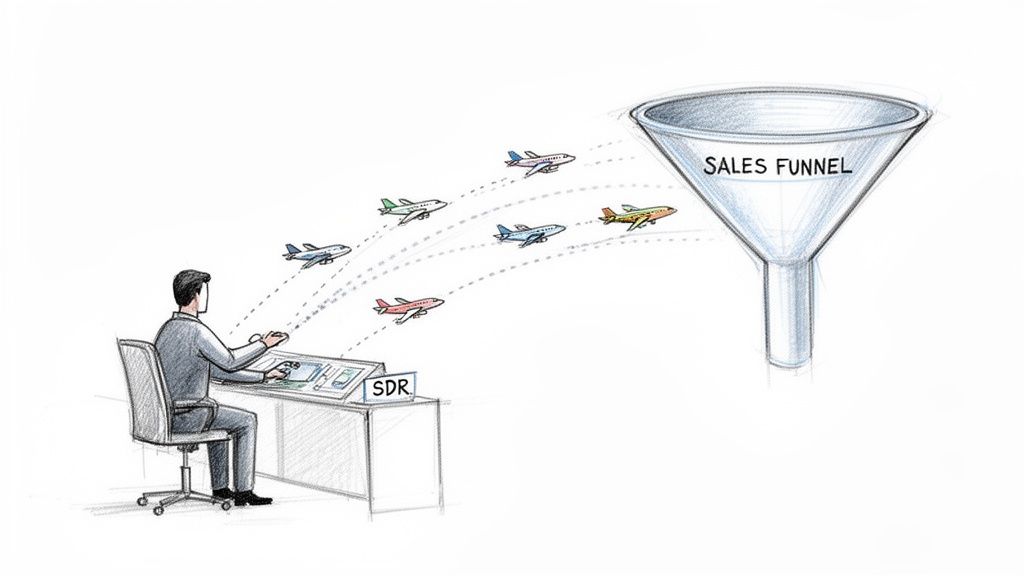
Here's a good way to picture it: an SDR is the air traffic controller for your sales funnel. While the Account Executive is the pilot focused on landing one specific plane (closing the deal), the SDR is managing the entire airspace. They're spotting incoming aircraft (prospects), talking them down to understand their destination and readiness (qualification), and then guiding only the approved flights into the final approach for the AE to take over.
This division of labor is what makes a modern sales org hum. Without SDRs, your most expensive talent—your closers—would spend most of their days digging for leads and talking to people who were never going to buy. It's an incredibly inefficient use of time and skill, much like asking a brain surgeon to also handle front-desk scheduling. The surgeon is far more valuable operating, just as an AE is far more valuable closing deals.
The Core Mission: Prospect And Qualify
The SDR’s entire world revolves around the very top of the sales funnel. It's crucial to understand: they don’t close deals; they create opportunities. Their day-to-day is a blend of strategic outreach and detective work, all driving toward a single goal: booking a qualified meeting for an Account Executive.
To give you a clearer picture, here's a quick rundown of what an SDR actually does all day.
SDR Core Responsibilities at a Glance
This table breaks down the main tasks that define the SDR role. As you'll see, everything they do is focused on fueling the top of the pipeline with high-quality opportunities.
| Responsibility | Description | Impact on Sales Pipeline |
|---|---|---|
| Prospecting | Using tools and research to identify companies and contacts that fit the ideal customer profile (ICP). | Builds the initial list of potential leads to engage with. |
| Outreach | Engaging prospects through a mix of cold calls, personalized emails, and social media touches (like LinkedIn). | Starts the initial conversation and puts the company on the prospect's radar. |
| Qualification | Asking smart, targeted questions to see if a prospect has a real business problem, the budget, and the authority to buy. | Filters out unqualified leads so AEs only spend time on deals that can actually close. |
| Booking Meetings | Scheduling a qualified discovery call or demo between the prospect and an AE. | This is the primary handoff point and a key success metric for the SDR. |
Ultimately, their job is to tee up at-bats for the rest of the team. They ensure the pipeline never runs dry.
An SDR’s value isn’t measured by revenue closed but by the quality and quantity of the pipeline they build. They are the engine of predictable growth, ensuring the rest of the sales team always has a steady stream of viable opportunities to pursue.
A Modern, Data-Driven Role
Over the last decade, the SDR role has exploded in B2B tech sales, evolving from basic "smile-and-dial" cold calling into a sophisticated, data-driven discipline. Specialization won out because it just works better.
Today, with a median base salary of $60,000 and on-target earnings hitting $85,000, the role attracts ambitious, tech-savvy professionals. They master the art and science of effective outbound lead generation and, in doing so, free up Account Executives to do what they do best: run meetings and close deals.
A Day in the Life of a High-Performing SDR
To really get what an SDR does, you have to walk a mile in their shoes. But not just any SDR—a top performer. Their day isn't a chaotic scramble of random calls and emails. It's a structured, high-intensity sprint focused on one thing: creating qualified opportunities.
This is a game of disciplined execution, where every minute is an investment.
The day doesn't kick off with a headset on and a dialer humming. It starts with quiet focus. A high-performing SDR carves out their first hour for sharp, targeted research, not mindless scrolling. They're hunting for "trigger events"—a fresh funding announcement, a key executive hire popping up on LinkedIn, or a prospect's company getting a mention in the news. This isn't about collecting trivia; it's about finding a damn good reason to reach out right now.
The Morning Power Block
Morning is go-time. This is prime territory for strategic outreach. While an average rep might just start hammering a list from top to bottom, a top performer executes a planned, multi-touch sequence.
- 9:00 AM - 10:30 AM: Strategic Calling. This block is reserved for the highest-priority accounts they just researched. The goal isn't just to talk to anyone who picks up. It's about navigating past gatekeepers and leaving voicemails that are short, relevant, and directly reference the trigger event they found earlier.
- 10:30 AM - 12:00 PM: Personalized Emails. Right after the calls, they follow up with hyper-personalized emails. These are not templates. Each one hits on a specific pain point relevant to the prospect's role or industry, tying it all back to that initial trigger event.
This thoughtful approach is the polar opposite of the old "spray and pray" method. While one rep sends 100 generic emails and maybe gets one bite, the high-performer sends 20 highly personalized ones and books two meetings.
The Afternoon Grind And Wind-Down
The afternoon is all about persistence and preparation. After lunch, the energy shifts from kicking down doors to methodically following up and handling the admin that comes with the territory.
The real challenge for any SDR is the constant context switching. Jumping from a live call, to email writing, to updating the CRM, to researching the next prospect is mentally draining and a huge productivity killer.
This is where true discipline makes or breaks a rep. A great SDR doesn't let the administrative tasks pile up. They update the CRM immediately after every call or email, making sure the data is clean and actionable for everyone else. The last hour of the day isn't for coasting—it's for planning the next day's attack, teeing up the top accounts so they can hit the ground running tomorrow morning.
This constant battle against manual data entry and task juggling is exactly where modern tools make all the difference. By slashing the time spent on busywork, they free up the SDR to focus more of their day on the one thing that actually generates pipeline: having meaningful conversations with potential customers.
SDR vs. BDR vs. Account Executive: A Clear Comparison
In the sales world, the acronyms can feel like a bowl of alphabet soup. SDR, BDR, AE… what’s the difference? If you’re building a real growth engine, you have to get this right. While they all work together toward the same goal, their actual missions, daily grinds, and how they get paid are worlds apart.
Think of your sales process like a relay race. The BDR and SDR are your opening runners, but they start in slightly different lanes.
A Sales Development Rep (SDR) usually handles inbound leads. These are the folks who've already shown some interest—maybe they downloaded a whitepaper or filled out a "request a demo" form. The SDR's job is to qualify that interest, making sure the lead is a genuine fit before passing the baton. The SDR is a filter.
A Business Development Rep (BDR), on the other hand, is a pure hunter. They’re all about outbound prospecting, digging up opportunities from cold accounts that have never heard of you. BDRs are on the front lines, creating demand where none existed before. The BDR is a miner.
The Critical Handoff
The Account Executive (AE) is the anchor on this relay team. They don’t even start running until an SDR or BDR has qualified a lead and put a meeting on their calendar. The AE’s entire focus is on the back half of the sale: running discovery calls, giving killer product demos, negotiating contracts, and, ultimately, closing the deal. The AE is a closer.
The handoff from an SDR or BDR to an AE is one of the most fragile moments in the entire sales cycle. A clean handoff gives the AE all the context they need for a great conversation. A sloppy one forces the prospect to repeat themselves and kills all momentum.
This workflow shows how a top-performing SDR structures their day to create those perfect handoff opportunities.
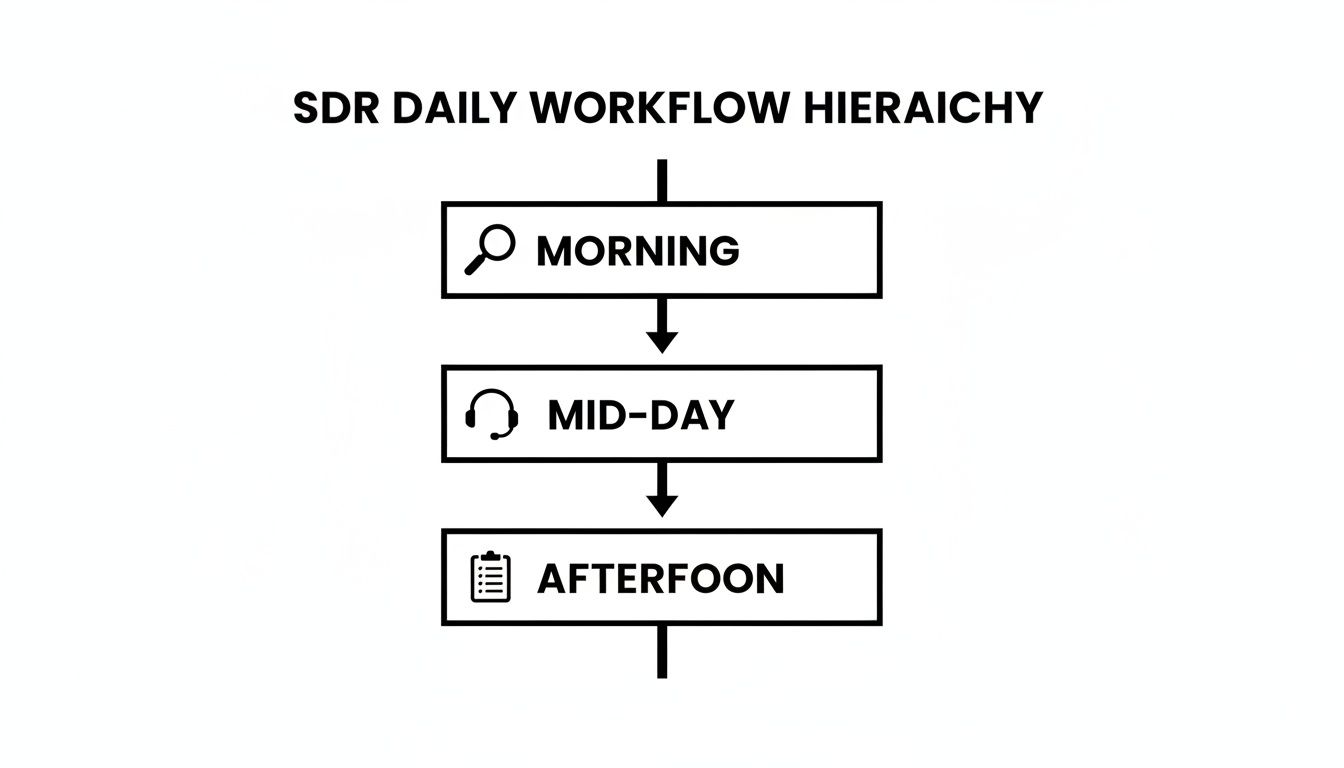
As you can see, the day is highly structured, moving from research and prep in the morning to heavy outreach in the middle of the day, and finally wrapping up with admin tasks. It’s all geared toward one thing: booking qualified meetings.
SDR vs. BDR vs. Account Executive Role Breakdown
To make it even clearer, let’s break down exactly how these roles stack up against each other in a typical sales org.
| Attribute | Sales Development Rep (SDR) | Business Development Rep (BDR) | Account Executive (AE) |
|---|---|---|---|
| Primary Goal | Qualify inbound marketing leads. | Generate new opportunities via outbound prospecting. | Close qualified deals and generate revenue. |
| Lead Source | Primarily inbound (MQLs, demo requests). | Primarily outbound (cold calling, emailing, social). | Qualified leads handed off from SDRs/BDRs. |
| Core Activities | Following up on form fills, qualifying webinar attendees, responding to inquiries. | Building target account lists, cold calling, writing personalized emails, social selling. | Leading discovery calls, running product demos, creating proposals, negotiating contracts. |
| Key Metrics | Meetings booked, Sales Qualified Leads (SQLs) accepted by AEs. | Net-new opportunities created, meetings booked from cold outreach. | Quota attainment, closed-won revenue, average deal size. |
Getting these roles straight is the first step to building a team where everyone knows their job and executes it without tripping over each other. The SDR is the gatekeeper, the BDR is the explorer, and the AE is the closer. Each one is essential for a high-functioning sales machine.
The Essential Skills and KPIs for SDR Success
What separates an SDR who just gets by from a top performer who consistently crushes their quota? It’s not just about hammering the phones harder. Elite SDRs are a potent mix of specific soft skills and a sharp focus on the metrics that actually move the needle.
The job is a high-stakes balancing act of resilience and strategy. SDRs face a tidal wave of rejection, so the ability to shake off a string of "no's" and get right back in the game is non-negotiable. This unshakeable resilience is the bedrock of success in this role.
But grit alone isn't enough. The best reps are intensely coachable. They don't just take feedback; they actively hunt for it. They're constantly tweaking their scripts, trying new angles, and treating every lost opportunity as a data point to refine their process. It's not a failure, it's a lesson.
The Core Competencies of an Elite SDR
While resilience and coachability are the foundation, a few other skills are critical for turning effort into qualified meetings day in and day out.
- Active Listening: This is a classic for a reason. Top SDRs listen more than they talk, period. They aren't just waiting for their turn to pitch; they're digging for pain points, keywords, and buying signals that let them connect their solution to a real problem.
- Masterful Time Management: A great SDR’s day is a clinic in prioritization. They know which accounts to call first thing, when to switch over to email campaigns, and how to block out research time without falling down a rabbit hole. It’s about managing your energy, not just your calendar.
- Sharp Business Acumen: You can't solve a problem you don't understand. Having a genuine grasp of a prospect's industry, business model, and common challenges elevates an SDR from a generic salesperson to a credible advisor.
Metrics That Truly Matter
Vanity metrics like "meetings booked" are dangerous because they don't tell the whole story. A successful SDR and their manager track a more balanced scorecard to understand what’s really working. They focus on the quality and efficiency of their outreach, not just raw volume.
The reality of the role is tough; recent data shows that only 57.3% of SDRs hit their quota. A big reason is that many reps simply aren't getting enough at-bats—a staggering 66.7% contact 250 or fewer prospects a month, which severely limits their chances. You can explore more sales performance statistics and learn about this trend.
To stay on the right side of those numbers, top teams measure the leading indicators that predict success. These include:
- Dials-to-Connect Ratio: How many calls does it take just to get a human on the line? A low ratio is a red flag—it might point to bad data, poor timing, or a busted script.
- Email Reply Rate: Are people opening your emails? More importantly, are they responding? This metric is a direct reflection of how well your personalization and messaging are landing.
- Conversations-to-Meeting Ratio: Of all the actual conversations you have, how many turn into a qualified meeting? This is where an SDR's skill in navigating objections and qualifying interest really shines through.
- Sales Qualified Leads (SQLs): This is the ultimate bottom line. It measures how many meetings booked are actually accepted by an Account Executive. An SQL confirms the lead is high-quality and ready for a real sales conversation. Check out our guide on the most important KPIs for lead generation for a deeper dive.
Navigating the SDR Career Path and Compensation
Think of the Sales Development Representative role less as a destination and more as a high-intensity training ground. It's the launchpad for a serious career in tech sales. Most successful SDRs put in 12 to 24 months on the front lines, mastering the art of prospecting, qualifying leads, and building resilience before they move up.
That time in the trenches builds the foundation for almost any customer-facing role you can imagine. Once you've proven you can consistently generate pipeline, several clear and compelling career paths open up. It’s one of the most reliable ways to break into the tech industry.
Common Career Trajectories
The skills you sharpen as an SDR are gold. They're directly transferable, paving the way for a few common next steps.
- Account Executive (AE): This is the classic path. After spending a year or two teeing up deals, you’re perfectly positioned to learn how to close them yourself. It just makes sense.
- SDR Manager or Team Lead: If you’ve got a knack for process and a passion for coaching, leadership is a natural move. You take your hard-won experience and use it to train the next wave of reps.
- Customer Success Manager (CSM): An SDR develops a deep, firsthand understanding of customer pain points. That empathy is priceless when it comes to helping existing clients get real value from a product.
- Marketing Roles: The daily feedback loop from prospects gives SDRs a unique gut feeling for what messaging actually works. That's a skill that's incredibly valuable in demand generation or product marketing.
Understanding SDR Compensation
SDR pay is built to reward hustle. The structure is typically based on On-Target Earnings (OTE), which is a mix of a fixed base salary and variable, performance-based commissions. You eat what you hunt.
The average base salary for an SDR often lands between $51,375 and $66,960. But that’s only half the story. When you factor in commissions, the median OTE jumps to around $85,000. Top performers can even pull in up to $127,955.
Location matters, too. For instance, SDRs in Seattle average $95,000, while reps in other major tech hubs like San Francisco and New York see OTEs closer to $75,000.
When you're ready to make your next move, framing your accomplishments correctly is key. If you're looking for guidance on how to showcase your impact, this guide for building a medical sales resume has some great, transferable tips for highlighting metrics.
Ultimately, tools that help SDRs get their daily work done more efficiently are what drive those commission numbers. Think of an AI-powered task engine that tells a rep exactly what to do next to hit their goals.
This kind of focused workflow helps SDRs crush their activity and meeting targets faster, which translates directly to a fatter paycheck.
How AI Is Reshaping the SDR Workflow
The old-school SDR playbook—endless manual research, copy-pasting templates, and hours of administrative grunt work—is officially dead. AI isn't just tweaking the process; it's completely rewriting it. The role is shifting from a high-volume grind into a strategic, high-impact position by automating the monotonous tasks that SDRs hate but are critical for hitting quota.
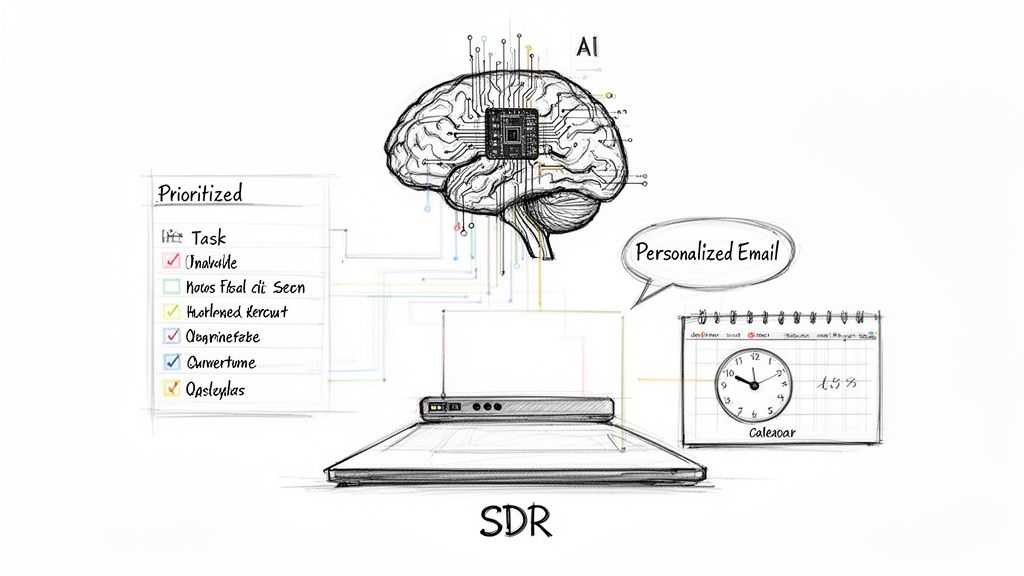
Think of it this way: AI sifts through all the noise—the buyer signals, the CRM data, the social activity—and then hands the SDR a clear, actionable game plan. Instead of guessing who to call next, reps are guided by an intelligent co-pilot.
No More Guesswork—Just Prioritized Action
One of the biggest time-sinks for any SDR is simply figuring out what to do next. Do I call this person? Research that company? Follow up on an old email?
AI-powered task engines wipe that indecision off the map. They analyze countless buyer signals—like website visits, content downloads, or previous interactions stored in your CRM—to build a perfectly prioritized workflow for the day. Every single action an SDR takes is the most valuable one they could be taking at that moment.
For managers, this is huge. It builds a consistent, repeatable outbound motion across the entire team. No more rogue reps spending half their day on LinkedIn research while others make random cold calls. This focused approach drives up team activity and, more importantly, pipeline—without burning everyone out.
The point of AI isn't to replace the human SDR. It's to amplify their skills. AI handles the robotic, time-sucking work so reps can focus on what they do best: having high-quality conversations and building relationships.
Personalization at Scale (Without Losing Your Mind)
Here's the classic SDR dilemma: personalize every single email and only reach a handful of prospects, or blast a generic template to hundreds and get ignored? Generative AI finally solves this.
AI can draft hyper-relevant emails and call scripts in seconds, pulling context from a prospect’s LinkedIn profile, recent company news, or their activity history in your CRM. The result is outreach that feels specific and human, not like it came off an assembly line.
The difference in output is staggering. A human might struggle to truly personalize 20 emails in an hour. An AI can generate 200 with that same level of detail. The SDR’s job then shifts from writer to editor, giving each message a final human check before it goes out. This is a core part of how AI-powered marketing automation is changing the game entirely.
When execution-first platforms like marketbetter.ai plug directly into tools like Salesforce or HubSpot, every call, email, and note gets logged automatically. This kills the friction of manual data entry and gives sales leaders a clean, real-time view of what's actually working. The SDR role transforms from a black box of activity into a transparent, data-driven engine for growth.
Common Questions About the SDR Role
Even after you get the basics down, a few practical questions always pop up. Here are the straight answers to the things I hear most often from new and aspiring SDRs.
What's the Biggest Challenge for a New SDR?
It’s a dead heat between two things: handling the constant rejection and just trying to manage your time. The job pulls you in two directions at once—you need massive outreach volume, but you also need to make every touch feel personal. That balancing act can feel totally overwhelming at first.
Honestly, learning to stay resilient when you hear "no" all day long is the most important skill for survival. It's a mental game just as much as it is a numbers game.
How Long Should Someone Stay in an SDR Role?
Most reps spend somewhere between 12 and 24 months in the seat. That's usually the sweet spot to really master prospecting, qualifying leads, and handling objections without hitting a wall and burning out.
Once they've proven they can consistently hit their numbers, high-performing SDRs usually get promoted to an Account Executive role. Other common moves are stepping up to an SDR Team Lead spot or shifting into a related field like Customer Success or Marketing.
The SDR role is a foundational step, not a final destination. Its primary value is in building the skills, discipline, and business acumen needed to excel in more advanced sales or customer-facing positions.
Can You Be a Successful SDR Without Cold Calling?
You can certainly generate some leads through email and social selling, but trying to succeed without picking up the phone is like fighting with one hand tied behind your back. Cold calling is still one of the fastest ways to cut through all the digital noise and have a real conversation.
Look at any top performer—I guarantee they're using a mix of channels, and the phone is a critical piece of that puzzle. It's just the best tool for building rapport quickly. If you decide not to call, you're leaving a huge amount of opportunity on the table that other reps are happy to pick up.
Ready to eliminate the busywork and let your SDRs focus on what they do best? marketbetter.ai turns buyer signals into a prioritized task list and helps reps execute faster with an AI-powered dialer and email writer directly inside Salesforce and HubSpot. Discover how to build a consistent outbound motion today.