
Your Guide to a Winning AI Driven Marketing Strategy
An AI-driven marketing strategy is what happens when you let machine learning and artificial intelligence make the tough calls. It’s a move away from gut feelings and manual guesswork toward a system that predicts what customers will do next, automates outreach, and fine-tunes your approach on the fly.
This isn't about replacing your team; it's about giving them a serious upgrade. Think of it as a way to make every single marketing action smarter, faster, and more impactful.
What an AI-Driven Marketing Strategy Really Means
Let's cut through the buzzwords. An AI-driven marketing strategy doesn't mean you fire your team and plug in a robot. It means you’re giving them a co-pilot—one that can sift through mountains of data to find the quickest route to a closed deal.
Imagine you’re planning a cross-country road trip with a paper map. You’ve got a general direction, sure, but you have no way of knowing about the traffic jam just ahead or the brand-new shortcut that just opened. Your decisions are stuck in the past. That's traditional marketing: building campaigns on broad personas and old data, which leads to a whole lot of hoping and guessing.
Now, think about that same trip using a real-time GPS. It’s analyzing thousands of data points every second—traffic, accidents, construction—to constantly find you the absolute best path. That’s the core of an AI-driven approach. It turns raw information from your CRM, website, and other buyer signals into clear, actionable intelligence that tells your team exactly what to do next.
From Manual Guesswork to Intelligent Execution
The biggest change here is the shift from being reactive to proactive.
Instead of your SDRs burning hours manually digging through leads to decide who to call, an AI-driven system serves up a prioritized list for them. It answers the questions that actually matter:
- Actionable Step: Implement a lead scoring model that weighs real-time behaviors (like visiting the pricing page) higher than static demographic data. This immediately focuses your team on leads showing active interest.
- Which lead is hot right now and most likely to convert?
- What’s the single most relevant thing I can say to this specific person?
- When is the perfect time to reach out to get their attention?
This kind of intelligent guidance lets your team deliver personalization at a scale that was pure fantasy just a few years ago. Every email, call, and touchpoint is informed by real data, making your outreach incredibly relevant and effective. You can learn more about the specific benefits of AI in marketing in our detailed guide.
An AI strategy isn’t just another piece of software; it's an integrated system that connects data, insights, and actions. It builds a stronger sales pipeline by focusing your team's effort where it will generate the most value.
This isn’t some far-off trend; it’s happening right now. The market for AI in marketing is exploding, expected to hit $47.32 billion in 2025 and more than double to a staggering $107.5 billion by 2028. This growth shows that businesses everywhere are betting on AI to fuel their growth, especially for things like creating persona-specific cold emails that build pipeline without bloating headcount. You can find more data on AI marketing trends on seo.com.
Traditional vs AI-Driven Marketing At a Glance
To really get the difference, it helps to see things side-by-side. Traditional marketing isn't "wrong," it's just outgunned. It relies on human intuition alone, while an AI-powered strategy pairs that same intuition with machine-speed analysis.
This table breaks down that fundamental shift.
| Aspect | Traditional Marketing (The Paper Map) | AI-Driven Marketing (The Real-Time GPS) |
|---|---|---|
| Decision-Making | Based on historical data and intuition. | Driven by real-time data and predictive models. |
| Personalization | Broad segments and general personas. | Hyper-personalization for individual customers. |
| Efficiency | Manual, repetitive tasks consume team time. | Automated workflows and prioritized task lists. |
| Lead Scoring | Static rules that quickly become outdated. | Dynamic, predictive scoring that adapts to behavior. |
| Outcomes | Inconsistent results and slow feedback loops. | Optimized for ROI with measurable, immediate insights. |
At the end of the day, a well-executed AI strategy empowers your team to work smarter, not just harder. It transforms your sales and marketing functions from a cost center into a predictable revenue engine that delivers better customer experiences and real, tangible growth.
Building Your AI Marketing Framework
Jumping into an AI-driven strategy isn't about buying the shiniest new software. It’s about building a high-performance engine. You can't just drop a turbocharger into an old sedan and expect it to win races. You need the right chassis, a solid fuel system, and a driver who knows how to handle all that power.
It's the same with AI. A winning framework is built on four interconnected pillars. Each one is critical for turning raw data into a predictable pipeline and making your sales team deadly effective. If one pillar is wobbly, the whole structure underperforms.
This map gives you a visual for how it all connects. Think of AI as the central brain, branching out to power personalization, prediction, and pure efficiency across all your marketing efforts.
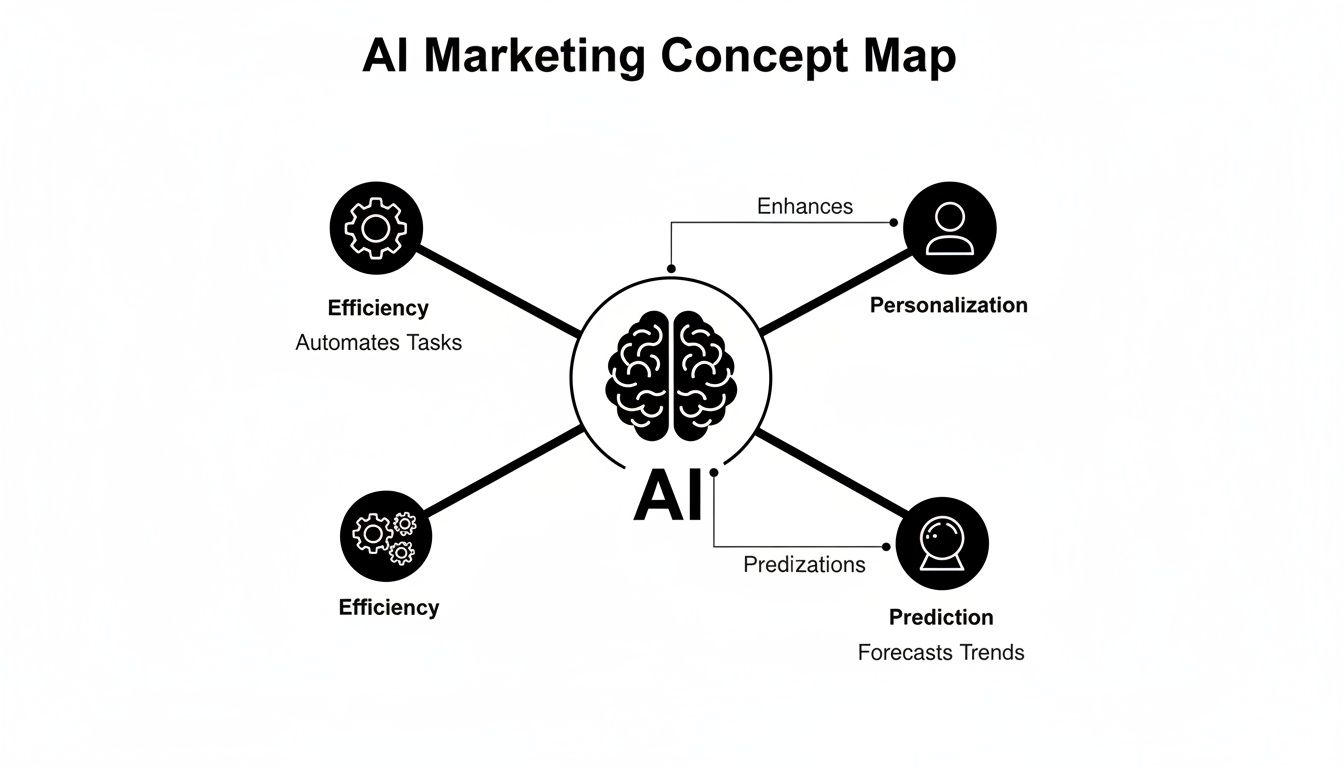
This shows that AI isn’t just some add-on feature. It's the core capability that levels up every single part of a modern marketing strategy.
Pillar 1: The Data Foundation
Your AI is only as smart as the data you feed it. Period. The first, most critical pillar is creating a unified data foundation. This means knocking down the walls between your systems and pulling all that siloed information into a single source of truth your AI can actually use.
Think about an SDR trying to prep for a call by toggling between three different screens—one for CRM contacts, another for website visits, and a third for support tickets. It's a clunky, inefficient mess. A solid data foundation stitches all that information together automatically.
Here’s how to get started:
- Actionable Step: Start with one key integration. Connect your marketing automation platform (like HubSpot or Marketo) with your CRM. This creates an immediate, unified view of a lead's journey from first click to sales conversation, providing instant context for your team.
- Unify CRM Data: Start with your core customer data—Leads, Contacts, Accounts. Get it clean and standardized. This is non-negotiable.
- Integrate Intent Signals: Pipe in data from sources that show a buyer is interested, like G2 intent data, website analytics, or engagement scores.
- Incorporate Engagement Metrics: Pull in data on how prospects are interacting with your emails, content, and sales team. This context is gold.
With a unified view, the AI can see the whole story. It can flag a contact from a target account who just visited your pricing page twice this week and instantly create a high-priority task for an SDR. No more missed opportunities.
Pillar 2: The AI Models
Once your data is in one place, you can bring in the AI models to start making sense of it all. You don’t need a Ph.D. in data science to get this. Just think of these models as specialized assistants, each with a very specific job.
The point of AI models in sales isn't just to analyze data—it's to recommend the next best action. They turn a sea of information into a clear, prioritized to-do list for every single rep.
For an AI-driven marketing strategy, two types of models are absolutely essential:
- Predictive Scoring: This is lightyears beyond old-school lead scoring. Instead of rigid rules like "job title = VP gets 10 points," predictive models analyze thousands of historical data points to spot the subtle patterns that indicate which new leads are actually likely to convert. It's the difference between a simple checklist and an expert's intuition.
- Natural Language Processing (NLP): This is the tech that lets AI understand and generate human language. In sales, NLP is the magic behind tools that can draft a personalized cold email based on a prospect's LinkedIn profile or summarize a 30-minute sales call into three key takeaways.
Pillar 3: Tooling and Integration
How you deliver these AI insights to your team is just as important as the insights themselves. This is where a lot of strategies fall flat. The key is to pick tools that slide right into your team's existing workflow, not ones that force them to learn a new one.
Native CRM Tools vs. Standalone Platforms
| Feature | Native CRM Tools (e.g., marketbetter.ai) | Standalone AI Platforms |
|---|---|---|
| Workflow | Embedded directly in Salesforce/HubSpot. Reps never leave the CRM, driving sky-high adoption. | Requires switching between tabs. This friction kills productivity and leads to terrible adoption. |
| Data Sync | Real-time and automatic. All activities are logged instantly and accurately in the CRM. | Often delayed or requires manual syncing. This creates incomplete data and broken reporting. |
| Setup | Faster implementation. Plugs directly into your existing CRM data and objects. | Complex integration. Requires a heavy lift to map data fields and workflows. |
Choosing a tool that lives inside the CRM is non-negotiable for adoption. If an SDR has to open another tab to use an AI dialer or email writer, they just won't do it. This is one of the biggest reasons shiny new tech rollouts fail.
- Actionable Step: During your next software evaluation, make "native CRM integration" a mandatory requirement, not just a "nice-to-have." Ask vendors for a live demo showing exactly how their tool operates inside a standard Salesforce or HubSpot environment.
Pillar 4: People and Process
At the end of the day, technology is just an enabler. A true AI-driven marketing strategy demands a shift in how your team operates. You have to invest in upskilling your people and tweaking your processes to actually take advantage of these new powers. For a deeper look, check out our guide on AI-powered marketing automation.
This means training SDRs not just on how to click a new button, but on how to trust and interpret the AI's recommendations. Their day is no longer about randomly picking leads; it's guided by an AI-prioritized task list. The job shifts from manual research to high-value conversations. That kind of change requires clear communication, hands-on training, and a constant focus on how AI helps them crush their quota faster.
- Actionable Step: Launch a pilot program with a small group of your most adaptable SDRs. Let them champion the new AI workflow, document their wins, and then use their success stories to train the rest of the team. Peer-to-peer advocacy is far more powerful than a top-down mandate.
Putting AI Into Action for B2B Sales
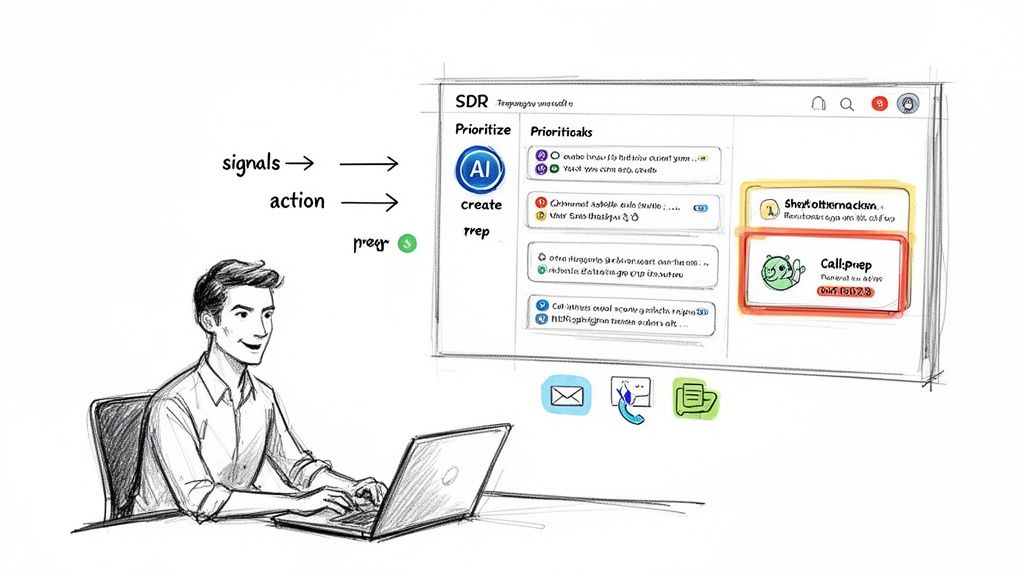
Theory is great, but an AI-driven marketing strategy is only as good as the action it creates. For B2B sales teams, this is where the rubber meets the road—translating abstract data into a repeatable process for building pipeline. The goal is to weld intelligence directly into a sales rep's daily life, turning their CRM from a dusty filing cabinet into an active co-pilot.
This isn't about giving your reps yet another tab to keep open. It’s about solving their biggest headaches right where they already work. Instead of drowning in admin tasks or firing off generic emails that get ignored, a smart AI workflow empowers them to act with speed and relevance.
AI-Powered Task Prioritization
An SDR’s real problem isn't a lack of leads; it's a lack of clarity. When you have hundreds of contacts to your name, the only question that matters is, "What should I do right now?" Sorting a spreadsheet by "last activity date" is a hopelessly outdated answer.
AI-powered prioritization completely changes the game. Think of it as a central nervous system that ingests thousands of signals—website visits, content downloads, intent data spikes, job changes—and turns all that noise into a simple, ranked to-do list.
Traditional Prioritization vs. AI-Driven Prioritization
| Aspect | Traditional Method | AI-Driven Method |
|---|---|---|
| Focus | Manual, based on static fields (e.g., last activity). | Automated, based on real-time buying signals and predictive scores. |
| Efficiency | Reps spend hours on research and guesswork. | Reps get an instant "what to do next" list with context. |
| Outcome | Missed opportunities and wasted effort on cold leads. | Higher engagement rates by focusing on the right accounts at the right time. |
This means an SDR starts their day not with an overwhelming sea of contacts, but with a curated list of high-impact actions. For instance, the system might pop a task to the top of the queue: "Call Jane Doe at Acme Corp. She just viewed your pricing page for the second time this week." That single action immediately surfaces the hottest opportunity, ensuring nothing important slips through the cracks.
- Actionable Step: Configure your AI tool to create an automated "Hot Leads" task queue in your CRM. Set the trigger to prioritize any contact who visits a high-intent page (like pricing or demo request) more than once in a 7-day period.
AI-Assisted Content Creation
Once a rep knows who to contact, the next hurdle is what to say. We all know generic, copy-pasted emails go straight to the trash. But crafting truly personal outreach for every single prospect is impossible at scale.
This is where AI-assisted content creation becomes a secret weapon. An AI engine that’s connected to your CRM can generate outreach that actually hits home because it’s grounded in real data. Unlike generic tools, it can pull from specific context:
- Account Context: What industry are they in? What’s their company size? Any recent news?
- Persona Context: What’s the prospect’s job title and what do they likely care about?
- Trigger Context: What specific action or signal prompted this outreach in the first place?
The email to a VP of Sales at a manufacturing firm who downloaded a case study should be fundamentally different from one sent to a Director of Operations in tech who attended a webinar. The AI drafts a relevant, punchy first touchpoint that the SDR can then review and tweak in seconds, blending machine speed with a human touch.
The move toward AI in content is undeniable. Reports show 90% of content marketers are expected to use AI in 2025, driving 42% more monthly content output. That efficiency gives sales teams better ammo and drives higher conversion.
AI-Driven Call Preparation
For SDRs hitting the phones, prep time is a massive productivity killer. Manually researching a prospect’s company, LinkedIn profile, and recent activity can burn 10-15 minutes per call. With AI, that entire process is crunched down to seconds.
An AI-driven call prep system surfaces the most important talking points right inside the CRM contact record, exactly when the rep needs them.
Actionable Insights Provided by AI Call Prep:
- Key Talking Points: A quick summary of the prospect’s likely pain points based on their role and industry.
- Recent Signals: The exact activity that triggered the task (e.g., "Visited competitor comparison page").
- Objection Handling: Smart suggestions for handling common objections for their specific persona.
- Company News: Recent press releases or funding announcements to use as a natural icebreaker.
This workflow doesn't just save time; it dramatically improves the quality of the calls. Reps are more confident and sound more relevant, which leads to better conversations and more meetings booked. This is how you unlock true rep productivity and drive real pipeline growth. To get there, it pays to understand the building blocks, like the various AI SEO strategies to dominate search rankings that can feed the top of your funnel.
How to Measure Your AI Marketing ROI
Throwing money at an AI tool is easy. Proving it's actually making you money? That's the hard part.
If you want to build a real business case for an AI-driven marketing strategy, you have to cut through the noise. Forget vanity metrics. The only numbers that matter are the ones your leadership team already has pinned to their dashboards.
Measuring the return isn't about inventing some new, complicated formula. It’s about drawing a straight line from what the AI does to the core KPIs that define success for your business. We see this break down into four key areas: getting more efficient, getting more effective, cleaning up your operations, and fueling real growth.
Quantifying Efficiency Gains
The first, most immediate win you'll see from AI is a massive productivity boost. It takes all the tedious, repetitive junk work off your team's plate—the stuff that grinds sales development reps (SDRs) to a halt—and frees them up to do what they're actually paid for: talking to people.
Think about it. The contrast is stark.
| Metric | Without AI (The Old Way) | With AI (The Smart Way) |
|---|---|---|
| Daily Outbound Actions | Reps are buried in research and prep, squeezing in a few calls and emails. | AI serves up a prioritized list of who to call next and what to say, turning downtime into selling time. |
| CRM Data Entry | Reps scramble to log notes after calls, creating a mess of inconsistent, unreliable data. | AI handles all the activity logging automatically, keeping your CRM pristine. |
How to Measure It: This is simple. Just track the average number of calls or emails an SDR makes in a day. If a rep goes from making 40 calls to 70 calls using an AI-powered dialer, that’s not a small improvement. It’s a huge, quantifiable lift in raw output.
Formula: (Actions with AI - Actions without AI) / Actions without AI = % Increase in Activity
Calculating Effectiveness Lifts
Of course, being busy isn't the same as being effective. More activity is just noise if it doesn’t lead to better outcomes. A good AI tool doesn't just make your reps faster; it makes them smarter by giving them the right information at precisely the right moment. For a deeper dive into evaluating your campaigns, check out this guide on how to measure marketing ROI for real growth.
Look at these two metrics:
- Connect Rate: How often do your reps actually get a live person on the phone? AI pushes this number up by figuring out the best times to call and digging up direct-dial numbers.
- Conversation Rate: Of those connections, how many turn into real conversations? AI is a massive help here, serving up instant call prep with talking points and answers to common objections.
When your conversation rate climbs, it's a dead giveaway that your reps are having better, more relevant discussions. That’s AI effectiveness in action.
- Actionable Step: Create a dashboard in your CRM comparing the connect and conversation rates for AI-initiated activities versus manually selected activities. This will give you hard data on the quality lift from AI prioritization.
Measuring Operational Excellence
Here’s a benefit everyone underestimates: the impact on your operational backbone—the CRM. Bad data is the silent killer of growth. It makes accurate reporting and attribution a complete fantasy.
When your AI tool lives inside your CRM and auto-logs every single touchpoint, you solve the data hygiene problem by default. This is a massive win for any RevOps leader who's tired of wrestling with messy, manually entered data. For the first time, you can actually trust your reports, which means you can make much smarter strategic decisions.
Proving Strategic Impact
Ultimately, the long-term value of your AI driven marketing strategy is measured by its effect on the big-picture business goals. These are the metrics that get the C-suite to sit up and pay attention.
Key Strategic Metrics:
- Faster SDR Ramp Time: New hires get up to speed in a fraction of the time when AI is there to tell them exactly what to do next and how to say it.
- Increased Pipeline Generation: This is the one that truly matters. By making your team more efficient and more effective, AI directly translates into more qualified meetings booked and a much healthier sales pipeline.
By connecting the dots across these four value drivers, you can build an airtight case for your AI investment. If you need to brush up on the basics, our complete guide on how to calculate marketing ROI is a great place to start.
Common AI Implementation Mistakes to Avoid
Look, even the most brilliant AI driven marketing strategy can faceplant during the rollout. The hype around AI is massive, and the pressure from the C-suite to show results yesterday is even bigger. It’s no surprise that while 92% of marketers are optimistic about AI, a staggering 80% feel intense pressure to score quick wins. This kind of urgency almost always leads to predictable, expensive mistakes.
That rush to the finish line causes serious stumbles. For instance, 56% of marketers admit they would prioritize AI speed over customer experience just to keep up with the competition, a trend Invoca’s research on AI in marketing highlights well. Knowing how to sidestep these common pitfalls is what separates a successful launch from another pricey piece of shelfware.
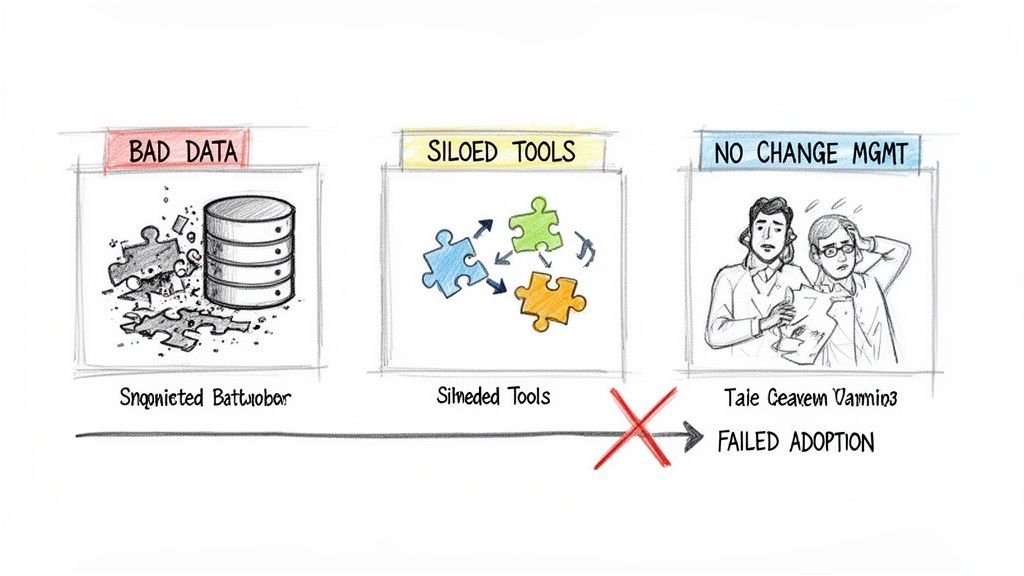
Mistake 1: Bad Data In, Bad AI Out
The single most common point of failure is feeding your shiny new AI engine a diet of messy, unreliable data. An AI isn't a mind reader; it's a pattern-matching machine. If your CRM is a graveyard of duplicate contacts, stale information, and inconsistent field entries, the "insights" your AI spits out will be worthless.
Think of it like cooking. You can have a Michelin-star recipe and the world's most advanced oven, but if you start with rotten ingredients, you’re still getting a garbage meal. The same exact principle applies here.
How to avoid it: Don’t try to boil the ocean by cleaning your entire CRM at once. Instead, pick a single, high-value workflow where the data is already in decent shape. A great place to start is prioritizing leads based on engagement data from your marketing automation platform, which is usually far more structured. As your team starts using AI tools that auto-log activity, your data quality will start to improve on its own.
Mistake 2: Choosing Siloed Tools That Kill Adoption
So many companies buy standalone AI tools that live completely outside their core CRM. This forces reps to constantly toggle between tabs—one for Salesforce, another for the AI dialer, a third for the AI email writer. That friction is the number one killer of user adoption.
If a tool isn't embedded where your team already works, they simply won't use it. The best AI strategy in the world is worthless without adoption.
How to avoid it: Make it a priority to find AI tools that are native to your CRM. An AI-powered task list or dialer that works right inside a Salesforce or HubSpot record is infinitely more useful than a slightly more powerful tool that lives in a separate app. The goal is to make AI feel like a natural part of the workflow, not another chore.
Mistake 3: Focusing on Content Without Execution
AI content generators are everywhere, promising to spin up perfect emails and call scripts on demand. But this is a classic trap. Teams get stuck endlessly generating copy without any clear plan to actually use it. An AI-written email is just digital noise if it never gets sent because the rep couldn't figure out who to send it to first.
Comparison of AI Focus
| Ineffective Approach: Content-First | Effective Approach: Execution-First |
|---|---|
| Starts with: "Let's generate some emails." | Starts with: "Who is the best person to contact right now?" |
| Result: A folder full of unused drafts. | Result: A prioritized task list that drives immediate action. |
How to avoid it: Flip the script. Start with an AI-powered task engine that tells your reps who to contact and why. Once that priority is crystal clear, then give them the AI-assisted content to execute that specific action. This connects the "what" with the "how," turning a good idea into actual outbound activity.
Common Questions (and Straight Answers) About AI in Marketing
Even with the best roadmap, turning an AI-driven marketing strategy from a slide deck into reality brings up some tough questions. Getting your team on board, keeping your brand voice sharp, and dealing with a messy CRM are the real-world hurdles. Here are the direct, no-fluff answers we give sales and marketing leaders every day.
How Do I Get My Sales Team to Actually Use a New AI Tool?
Adoption lives and dies inside your CRM. Simple as that. The number one killer of new tech is forcing reps to jump between browser tabs all day. Any AI tool that doesn't feel native to their primary workspace—whether that's Salesforce or HubSpot—is dead on arrival.
The trick is making the tool a natural part of their existing routine, not another annoying task. An AI dialer that works right from a Salesforce contact record is 10x more likely to be used than one floating in a separate window. The value also has to be immediate. If a tool saves a rep thirty minutes of mind-numbing call prep on day one, you can bet they’ll be back tomorrow.
To get it right, follow this simple playbook:
- Start with one high-impact workflow. Don't try to boil the ocean. Kick things off with something like an AI-powered task list that tells reps exactly who to call next and why.
- Make the value obvious. The tool needs to solve a real headache, like getting rid of manual research or automating call logging.
- Automate the data flow. If reps have to manually log every little thing, they won't. Automation isn't a nice-to-have; it's the foundation of adoption.
Will AI-Generated Emails Sound Generic and Hurt Our Brand?
This is a totally valid fear. We've all seen those first-generation AI writers that spit out robotic, bland copy. The difference between a helpful AI sidekick and a useless content machine comes down to a single word: context.
A generic AI writer just scrapes the public internet and gives you back the same predictable mush as everyone else. But a smart AI engine built for B2B sales works differently. It’s grounded in specific, relevant data points pulled straight from your systems.
A truly effective AI email generator doesn’t just write; it synthesizes. It pulls together account data, persona details, and recent buying signals to craft outreach that feels timely and personal, not automated.
Think of it this way: the AI’s job is to create a solid first draft, not the final word. It should generate a short, punchy, and relevant email that gets a conversation started. The SDR then swoops in, adds their human touch, and personalizes it in seconds. This combo of AI speed and human oversight is how you get higher-quality outreach at a scale you could never hit manually.
Our CRM Data Is a Mess. Do We Need to Fix It All Before Using AI?
Waiting for a perfectly clean CRM is a classic recipe for analysis paralysis. You don't need pristine data to get started; you just need a reliable starting point. A phased approach is always better than trying to fix a decade of data debt all at once.
Instead of putting your AI plans on ice, find one or two key workflows where the data is decent enough and structured.
The Smart Way vs. The "Fix-It-All" Trap
| Aspect | "Fix-It-All" Approach (Leads to Inaction) | Phased Approach (Drives Momentum) |
|---|---|---|
| Initial Step | A massive, multi-quarter data cleanup project that puts AI on the back burner indefinitely. | Identify one reliable data source, like engagement scores from your marketing platform, to power an initial AI workflow. |
| Team Impact | Reps see zero immediate value and stick to their old, inefficient habits. | Reps get an AI task engine that provides clear value from day one, improving their daily output immediately. |
| Data Quality | Data hygiene stays a theoretical goal, with little actual progress made. | As reps use AI tools that auto-log their activities, the CRM data starts getting cleaner on its own, creating a virtuous cycle. |
This iterative process—start small, prove the value, and use that momentum to drive bigger improvements—is the only practical way forward. The AI actually becomes a tool for improving your data hygiene over time. Better activity tracking leads to better data, which fuels smarter AI recommendations.
Ready to turn your buyer signals into a prioritized and automated outbound motion? marketbetter.ai embeds an AI-powered task engine, email writer, and dialer directly inside Salesforce and HubSpot so your reps can execute with speed and precision. See how it works at marketbetter.ai.