
Master the Craft of Using AI for Content Creation: A Practical Framework for ROI
Using AI for content creation isn't about flipping a switch and letting the machines takeover. It’s about being smart—pairing human creativity with machine efficiency. To make this work, you need an actionable framework.
Think of it as a system. The AI handles the grunt work: the initial research, the first drafts, the SEO optimization. This frees up your team to focus on what they do best: high-level strategy, sharp editing, and injecting your unique brand personality into every single piece.
Building a Strategic AI Content Foundation
Jumping into AI without a plan is like sailing without a map. You'll definitely move, but probably in circles. The teams I see winning with this stuff aren't the ones hitting "generate" and walking away. They’re building a solid human-in-the-loop model. It's a simple but powerful idea: AI is a collaborator, not a replacement. And that collaboration consistently produces better, more authentic work.
This all starts with your business goals. Before you write a single prompt, you need to know what you're trying to achieve. Are you aiming to slash content production costs by 40%? Do you need to scale up SEO topic clusters to drive more organic traffic? Or is the goal to churn out thousands of unique product descriptions for your e-commerce site? A clear grasp of how AI-powered content creation can serve these goals is what separates the dabblers from the serious players.
The biggest mistake I see marketers make is treating AI like a magic button. Real success comes when you see it as a strategic lever—a tool to amplify your team's expertise, accelerate your workflow, and hit your business goals faster than you ever could before.
This goal-first approach is what turns AI from a shiny new toy into a core part of your growth engine.
Pinpointing High-Impact Opportunities
Once you know your "why," the next step is to look at your current content workflow and find the bottlenecks. Where are things slow, expensive, or just plain tedious? An honest audit here will show you exactly where AI can make the biggest, fastest impact.
Here are a few actionable scenarios comparing the old way to the new AI-powered approach:
- The B2B SaaS Company: Their lifeblood is lead gen through organic search.
- Before AI: A content strategist spends a week manually researching competitor content and keyword gaps for a single topic cluster.
- With AI: The same strategist uses an AI tool to analyze competitor content, identify keyword gaps, and generate detailed outlines for the entire cluster in a single afternoon. Action Step: Audit your content research process. How many hours are spent on keyword analysis per article? Aim to cut that time by 75% using an AI SEO tool.
- The E-commerce Brand: They're staring down the barrel of writing unique, SEO-friendly descriptions for a catalog of 5,000 products.
- Before AI: A soul-crushing manual project projected to take three months and thousands of dollars in writer fees.
- With AI: They generate compelling, varied descriptions from a simple spreadsheet of product specs, completing the project in a week and boosting search visibility. Action Step: If you have over 100 products, test an AI generator on a small batch. Create a template prompt that includes your brand voice, target keywords, and product specs.
- The Lean Marketing Team: A small crew needs to look bigger than they are, maintaining a constant presence across blogs, social media, and email.
- Before AI: One long-form blog post takes a full day to write, and another half day to manually repurpose for social media.
- With AI: AI takes the final blog post and instantly generates a dozen social media updates, a newsletter summary, and even a script for a short video. Action Step: Take your next published article and use an AI tool specifically for repurposing. Challenge yourself to create 10 pieces of micro-content from it in under 30 minutes.
This isn't just a niche trend; it's a fundamental shift. By 2025, a staggering 90% of content marketers plan to use AI in their strategies, a huge jump from 64.7% in 2023. This adoption is directly tied to results, too. Only 21.5% of teams using AI report underperforming strategies, compared to 36.2% of teams who aren't.
Comparing Manual vs. AI-Assisted Content Workflows
| Workflow Stage | Traditional Manual Approach | AI-Assisted Approach | Key Benefit of AI |
|---|---|---|---|
| Strategy & Research | Days of manual keyword research & competitor analysis. | Hours to generate topic clusters, keyword maps, and outlines. | Speed & Scale |
| Drafting | Writers spend 80% of time on the "blank page" problem. | AI generates a solid first draft in minutes for human refinement. | Efficiency |
| Optimization | Manual SEO checks, readability scores, and edits. | Real-time suggestions for SEO, tone, and grammar. | Consistency |
| Repurposing | Manually creating social posts, summaries, scripts. | One-click transformation of long-form content into multiple formats. | Asset Velocity |
| Personalization | Generic content or extremely time-consuming segmentation. | Dynamically generate thousands of personalized variations. | Scalable Relevance |
The takeaway is clear: AI doesn't just make the old process faster; it enables an entirely new, more agile way of working.
Ultimately, your strategy has to be your own. The key is aligning your AI efforts with a well-defined plan, like the one in our content marketing strategy guide, to ensure you're driving real, measurable growth. Stop thinking about "using AI" and start thinking about how to deploy it for maximum business impact.
Designing Your AI-Powered Content Workflow
A solid strategy is your North Star, but a repeatable workflow is the engine that gets you there. This is where you turn big ideas into a steady stream of high-quality content.
An effective AI-powered process isn't about just plugging in a tool and hitting "go." It’s about building a smart system where human creativity and machine efficiency amplify each other. Think of it like a modern assembly line for content. Each stage—from ideation to distribution—has a specific job, and the right AI tool makes that job faster, better, and more data-driven.
This is the high-level view: goals first, then the tools to hit them, and finally, measuring the growth. It’s a simple but critical sequence.
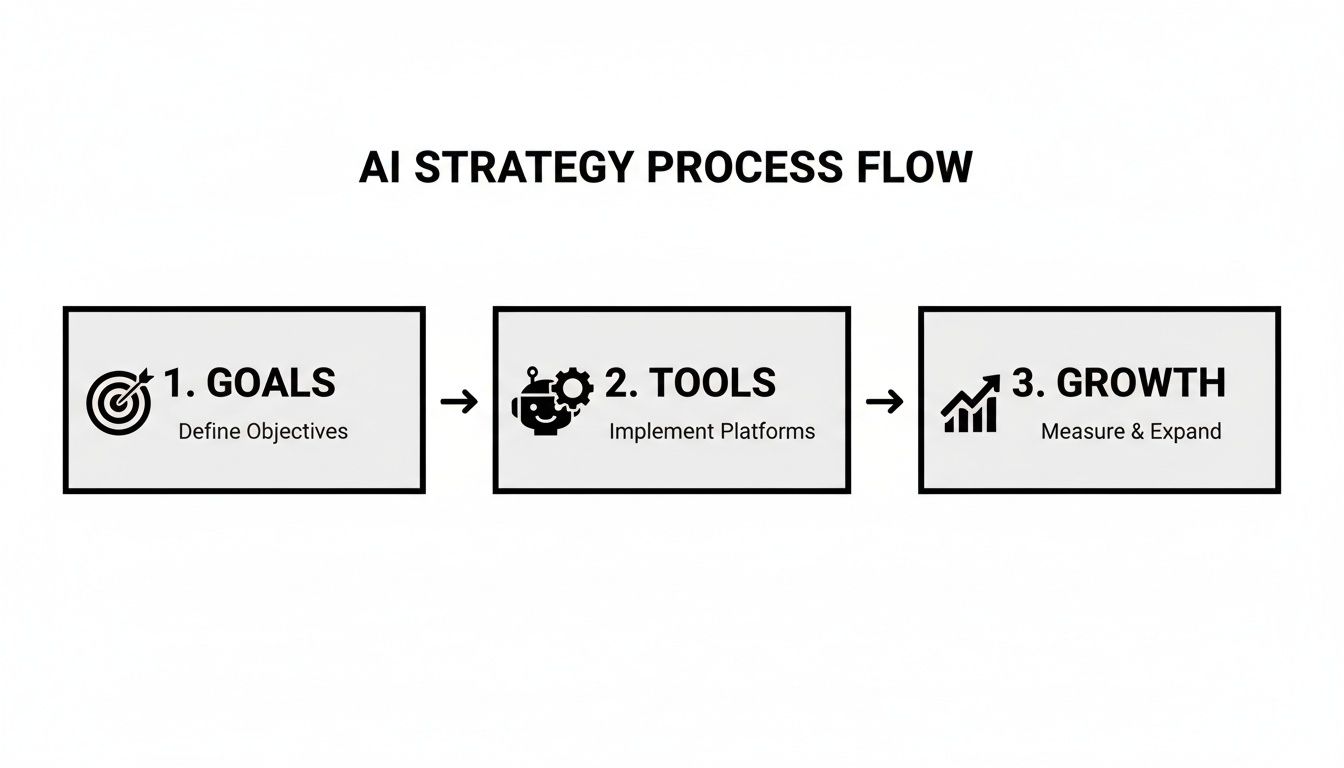
Your tools must serve your goals. Always. This principle is the foundation of the workflow we're about to build.
Phase 1: Ideation and Research
This is the hunt for opportunity. Before AI, this meant spending hours—sometimes days—buried in keyword tools, manually sifting through competitor blogs, and trying to spot patterns. Now, you can supercharge this discovery phase.
SEO platforms with AI baked in, like Surfer SEO or MarketMuse, can do the heavy lifting for you. They’ll analyze the top-ranking content for any keyword and instantly spit out common themes, likely user intent, and the exact subtopics you need to cover. You're not guessing what Google wants; you're getting a data-backed blueprint.
Here's an actionable comparison of the research process:
- The Old Way: Manually pull keyword lists from a tool like Ahrefs, export them to a spreadsheet, then spend hours reading the top 10 articles, trying to synthesize what makes them tick. It’s slow and riddled with personal bias.
- The AI-Assisted Way: Plug your target keyword into an AI SEO tool. In minutes, it generates a comprehensive outline, pinpoints key entities to mention, and even lists related questions people are asking. This can easily cut your research time by over 75%.
Phase 2: Drafting and Generation
With a solid, data-informed brief, it's time to get a first draft on the page. This is where generative AI models like Jasper or ChatGPT absolutely shine, but only if you use them correctly.
The goal is not a final, publish-ready article in one click. It's about obliterating the "blank page" problem. The AI generates a structured, well-researched draft that acts as raw material for a skilled human writer to shape and elevate.
This is where your best writers come in. They take that AI-generated text and inject what the machine can't: unique insights, personal anecdotes, and a compelling brand voice.
Your best writers shouldn't be spending their time summarizing facts they found on Google. Let the AI handle that. Free them up to do the high-value work: weaving in original stories, expert opinions, and the unique perspective that makes your content worth reading.
This shift in focus dramatically boosts content velocity without sacrificing the human touch that actually builds an audience.
Phase 3: Editing and Optimization
That first draft is just the starting line. The editing phase is where you refine quality and lock in performance. AI-powered editors are your secret weapon here, acting as a tireless second pair of eyes.
Tools like Grammarly go way beyond just catching typos. They analyze tone, flag clunky sentences for clarity, and ensure the writing aligns with your predefined brand style. For larger teams trying to maintain a consistent voice across dozens of articles, this is a godsend. It's scalable quality control.
Here’s how to make this phase actionable:
- For SEO: Don't just write and hope. Action: Drop your draft into Surfer SEO for a real-time content score, getting specific suggestions on which keywords to add or adjust to maximize its ranking potential.
- For Brand Voice: Don't leave tone to chance. Action: Configure a platform like Grammarly Business with your specific style guide to automatically flag words, phrases, or tones that are off-brand.
The Evolving Roles On Your Content Team
When you implement a workflow like this, job descriptions naturally start to change. It's an evolution, not a replacement.
Writers become more like creative directors, guiding the AI tools and then infusing the drafts with true personality and perspective. Editors shift into quality assurance specialists, verifying every fact and ensuring the final piece is perfectly aligned with the brand.
And a new, absolutely critical role is emerging: the Prompt Engineer. This person is a master communicator—but their audience is the AI. They design, test, and refine the prompts used to generate drafts, ensuring the output is as accurate, relevant, and on-brand as possible from the very first pass. A great prompt engineer is the difference between generic, robotic filler and a high-quality draft that saves your team hours.
Mastering Prompt Engineering for High-Quality Output
The real engine driving your AI content isn't the software—it's the quality of your instructions. I can't stress this enough: mastering prompt engineering is the single most important skill for anyone using AI to create content. It’s what separates generic, unusable filler from a high-quality draft that's already 80% of the way home.
Think of your AI model as an incredibly smart and fast, but very literal, intern. Give it a vague request, and you'll get a vague result back. But give it a specific, context-rich command, and you'll get exactly what you need. This is why you have to move beyond simple commands to structured, repeatable frameworks.

From Good Prompts to Great Prompts: A Comparison
You'd be surprised how small tweaks to your prompts can lead to dramatically different outcomes. It's all about giving the model enough context and constraints to work within, so it doesn't have to guess.
Let’s look at a real-world comparison.
| A Good (But Basic) Prompt | A Great (Actionable) Prompt | |
|---|---|---|
| Request | "Write a blog post about email marketing." | "Act as an expert B2B marketing strategist. Write a 1,200-word blog post outline titled 'Beyond the Open Rate: 5 Advanced Email Marketing Metrics to Track.' The target audience is marketing managers at mid-market SaaS companies. The tone should be authoritative but accessible. Include sections for Engagement Metrics, Conversion Metrics, and Revenue Metrics, with 2-3 specific examples under each." |
| Why it Works Better | The great prompt assigns a role (expert strategist), specifies the format (outline), gives a precise topic and title, defines the audience and tone, and dictates the structure. This leaves nothing to chance. |
This level of detail is a game-changer. It forces the AI to produce something that’s immediately more relevant and aligned with your strategy. To get you started, check out this curated list of the best AI marketing tools that are built to handle detailed prompting like this.
Building Your AI Brand Voice Guide
Consistency is everything for a strong brand. If you plan to use AI to scale content, you need to teach it how to sound like you. The best way to do this is by creating a dedicated Brand Voice & Style Guide specifically for your AI prompts.
This isn't just a simple list of dos and don'ts. Think of it as a comprehensive document you can reference or even paste directly into your more complex prompts.
Action Step: Create your own AI Style Guide with these elements:
- Core Tone Words: Define your voice with 3-5 adjectives (e.g., "Authoritative, helpful, concise, witty").
- Vocabulary Rules: List words to always use (e.g., "clients," not "customers") and words to banish (e.g., "leverage," "streamline").
- Sentence Structure: Specify your preferences. Do you like short, punchy sentences or more complex ones? Stick to the active voice?
- Formatting Guidelines: Detail how you use headings (H2, H3), bold text, bullet points, and blockquotes.
- Exemplars: Provide 2-3 short paragraphs of your best content as a "gold standard" example for the AI to copy.
A detailed AI style guide is the single most effective way to scale brand-aligned content. It turns a generic writing tool into a specialized assistant that truly gets your brand’s communication style.
Actionable Prompt Templates You Can Use Today
Ready to get started? Here are a few templates you can copy, paste, and adapt right now. Notice how each one incorporates a clear role, format, audience, and specific constraints.
1. For a Blog Post Outline
Act as an expert SEO content strategist. Create a comprehensive outline for a blog post titled "[Your Blog Post Title]". The target audience is [Your Target Audience]. The goal is to rank for the keyword "[Your Primary Keyword]". The tone should be [Your Brand Tone]. The outline must include an introduction hook, at least 4 main sections with 3-4 bullet points each covering key subtopics, and a concluding call-to-action to [Desired Action].
2. For a LinkedIn Post
You are a social media expert for a B2B SaaS company. Write a LinkedIn post of approximately 150 words announcing our new blog post titled "[Blog Post Title]". Start with a compelling hook or question to grab attention. Summarize the main takeaway in 2-3 sentences. End with a clear call-to-action encouraging people to read the article. Include these 3 relevant hashtags: #[Hasag1], #[Hashtag2], #[Hashtag3]. The tone is professional yet engaging.
3. For an Email Newsletter Snippet
Act as a senior email marketer. Write a 75-word snippet for our weekly newsletter introducing our latest case study: "[Case Study Title]". The audience is current customers and warm leads. Focus on the single most impressive result from the case study. The tone should be informative and value-driven. End with a link to "Read the full story".
Even with prompts this good, a human in the loop is non-negotiable. Recent data shows that marketing teams are editing 86% of AI-generated outputs to nail the brand voice and double-check the facts. This really drives home the point that AI content works best as a partnership between human and machine.
And as AI-driven search becomes the norm, understanding concepts like Answer Engine Optimization (AEO) is critical to making sure your content actually gets found and trusted.
Building a Quality Control Framework That Scales
So, you're cranking out content with AI. The volume is great, but a new, bigger risk just walked in the door: losing the quality and authenticity your audience actually trusts. Pushing the "generate" button isn't the finish line. You absolutely need a quality control (QC) framework to make sure every article, post, and script is accurate, sounds like you, and is genuinely useful.
Think of this system as your brand's last line of defense against robotic, generic, or flat-out wrong content.
The point of a good QC process isn't to slow you down. It's to build a repeatable system that keeps your standards high, even as you 10x your output. It shifts your experts from being writers to being strategic reviewers and polishers—a much smarter use of their time. This is where AI-assisted content creation really hits its stride.
The Essential Human Editor Checklist
Your human editors are the guardians of your brand's integrity. Their entire job is to put every AI-generated draft through its paces before it ever gets published. This checklist isn't a suggestion; it's the final gatekeeper for everything you produce.
Action Step: Implement this checklist for every piece of AI-assisted content:
- Factual Accuracy: This is non-negotiable. Has every single claim, statistic, and data point been checked against a primary source? AI models are notorious for "hallucinating" facts, so this is the most critical step.
- Brand Voice & Tone: Does it feel like you? This is way more than just word choice. It’s about sentence rhythm, your brand of humor, and the personality that makes you different from everyone else in the feed.
- SEO Best Practices: Is the main keyword there, but not stuffed? Are secondary keywords and related ideas woven in naturally? Does the structure actually match the SEO brief it started from?
- Originality & Plagiarism: Every piece has to pass a plagiarism check with a tool like Copyscape. AI can sometimes spit out text that's a little too close to its training data, even by accident.
- Uniqueness of Insight: Did the AI just rehash the top Google results, or is there a unique angle, a piece of hard-won advice, or a fresh take? It’s the editor's job to inject that "aha" moment that only a human can.
This review process guarantees that while the first draft is machine-generated, the final product is 100% human-vetted and strategically sharp.
Comparing Quality Control Models: In-House vs. Freelance
Once you have your checklist, you need to decide who’s going to wield it. Most teams go one of two ways: they build an in-house editing team or they tap into a network of specialized freelancers. Neither is universally "better"—it all depends on your company's DNA.
| Feature | In-House Editing Team | Specialized Freelancers |
|---|---|---|
| Brand Immersion | They live and breathe the company culture. The brand voice is second nature. | They need detailed briefs and some ramp-up time to really get the nuances right. |
| Consistency | Super high. You get the same editorial eye across every single piece of content. | Can vary between freelancers. A rock-solid style guide is essential here. |
| Scalability & Cost | Less flexible. You have fixed salary costs and can't easily scale up for a big push. | Extremely flexible. The pay-per-project model lets you scale with demand instantly. |
| Availability | Dedicated, but typically limited to business hours. | You can access a global talent pool for quick turnarounds and even 24/7 coverage. |
If your brand voice is incredibly specific and complex, an in-house team is usually the safer bet. But if you’re focused on moving fast and staying lean, a vetted pool of freelance editors gives you a level of agility that’s tough to beat.
A hybrid model is often the sweet spot. Have an in-house content lead who owns the strategy and manages a small team of trusted freelancers for the day-to-day execution. You get the best of both worlds: strategic oversight and scalable muscle.
Managing Enterprise-Level Concerns
For bigger companies, quality control goes way beyond spelling and brand voice. Suddenly, things like data security and regulatory compliance are front and center, especially when AI is in the mix.
First, lock down your data governance. Make it crystal clear that no proprietary or sensitive company information ever gets fed into a public AI model's prompt. For anything that requires higher security, you should be looking at private AI instances or enterprise-grade platforms that offer better data protection.
Second, if you're in a regulated industry like finance or healthcare, every piece of AI-generated content needs a compliance review. Period. This means creating a specific compliance checklist for your legal or regulatory team to sign off on. It ensures no claims are being made that could land you in hot water. This structured process is what allows you to scale up without scaling up your risk.
Measuring the Real ROI of Your AI Content Engine
Churning out more content with AI feels productive, but that feeling doesn't show up on a balance sheet. To get buy-in and justify what you’re spending on new tools and training, you have to connect the dots between your AI efforts and real business results.
That means looking past vanity metrics. It’s time to focus on the numbers that actually matter to the bottom line.
A smart AI content strategy isn’t just about producing more; it's about producing more of what works. And to prove that, you need a way to measure both the efficiency gains and the performance lift. Only then do you get the full picture of your return on investment.
Shifting from Old-School Metrics to AI-Driven KPIs
Traditional content analytics often get stuck on lagging indicators like page views or time on page. Useful, but they don't tell the whole story. When AI is powering your content creation, you need to start tracking the leading indicators that show just how fast and efficient your entire operation has become.
This is a fundamental shift. You stop asking, "How did this one article do?" and start asking, "How effective is our entire content machine?"
Here are the core KPIs you should have on your dashboard:
- Content Velocity: How fast can you get from a raw idea to a published piece? Higher velocity means you’re jumping on trends and out-maneuvering the competition.
- Cost Per Article (CPA): This is your all-in cost—tools, salaries, freelance fees—divided by the number of articles you produce. AI should send this number plummeting by slashing the human hours required for each piece.
- Organic Traffic Growth: Are the articles you’re creating with AI actually bringing in more of the right search traffic? This directly links your production speed to a core marketing goal.
- Conversion Rate: What percentage of visitors from AI-assisted content are taking the next step, whether that's signing up for a demo or downloading an ebook?
A Real-World ROI Calculation
Let's walk through an example. Picture a mid-sized B2B tech company.
-
Before AI: They were paying freelance writers about $500 per article to produce 10 high-quality blog posts a month. That’s $5,000 out the door. Each of those articles brought in an average of 2 marketing qualified leads (MQLs).
-
After AI: They implement an AI-assisted workflow. Their internal team can now pump out 30 articles a month. Their AI tool costs $1,000 per month. Even factoring in the time for a human editor, their new Cost Per Article drops to roughly $150.
The numbers here aren't just theoretical. A recent survey found that 73% of AI adopters have successfully cut agency and content creation costs. And a whopping 93% of marketers point to faster content generation as the single biggest benefit—which is exactly what our example company just experienced.
The ROI Breakdown: The company is now getting 3x the content for a fraction of the cost. More importantly, those 30 articles are generating 60 MQLs per month instead of just 20. The real ROI isn't just the $3,500 they saved on freelance fees; it's the massive jump in lead generation and their newfound ability to dominate more search topics. This is how you build a business case that gets noticed.
This is the kind of hard data that secures budget and proves the strategic value of weaving AI into your content process. To go a level deeper on this, check out our guide on how to calculate marketing ROI for campaigns like this.
Key Metrics for AI Content ROI
To bring it all together, you need a dashboard that tracks the right things. The table below outlines the essential KPIs for measuring the financial and strategic impact of your AI content efforts. These metrics help you move beyond "we're faster" to "we're more profitable."
| Metric | What It Measures | How to Calculate It | Why It Matters for AI |
|---|---|---|---|
| Content Velocity | The speed of your content pipeline from idea to publication. | (Total Content Published in a Period) / (Time Period) | AI drastically shortens research, drafting, and editing cycles, directly boosting this number. |
| Cost Per Article (CPA) | The total, all-in cost to produce one piece of content. | (Total Content Costs) / (Number of Articles Produced) | This is the clearest measure of pure efficiency gain from AI tools and workflows. |
| Content-Sourced Leads | The number of leads generated directly from AI-assisted content. | Track conversions (form fills, downloads) with attribution to specific content URLs. | Proves that speed isn't coming at the expense of quality and business impact. |
| Organic Traffic Lift | The increase in search traffic attributed to new content. | Compare traffic for AI-produced articles vs. baseline or pre-AI content. | Shows if your scaled content is effectively capturing search intent and ranking. |
| Pipeline Contribution | The dollar value of sales opportunities influenced by your content. | Use CRM data to tie content touches to deals in the sales pipeline. | The ultimate metric that connects content creation directly to revenue generation. |
Tracking these KPIs gives you a bulletproof argument. It’s not just about saving money; it’s about building a more powerful, scalable, and profitable marketing engine.
Got Questions About AI Content? You're Not Alone.
As soon as teams start using AI for more than just brainstorming, the real-world questions pop up fast. It’s one thing to talk theory, but it's another thing entirely when you're trying to execute day-to-day. How do you keep your brand from sounding like a robot? Is this stuff even original?
These aren't just details; they're the hurdles that separate a failed experiment from a genuine competitive advantage. Let's tackle them head-on with practical advice, not fluffy theories.
How Do I Keep My Brand Voice From Getting Lost?
This is probably the biggest fear marketers have, and for good reason. The last thing you want is for your content to sound generic and soulless. The good news? It’s completely avoidable if you put the right guardrails in place.
You wouldn’t let a new writer start without a style guide, examples of your best work, and a ton of feedback. You have to treat your AI the same way—as a new team member that needs to be trained. It’s all about being intentional.
Here's a comparison of two common approaches:
| The Common (Ineffective) Approach | The Strategic (Effective) Approach |
|---|---|
| Writing basic prompts like, "Write a blog post in a friendly tone." | Building a detailed AI Brand Voice & Style Guide that you feed into every single prompt. |
| Hoping the AI "gets it" and then spending ages fixing the tone in post-edits. | Defining specific rules for vocabulary, sentence structure, and even when to use humor. |
| Getting inconsistent output that feels different every single time. | Providing the AI with "gold standard" examples of your best content to emulate, locking in consistency. |
That strategic approach is where the magic happens. Your AI style guide becomes a core asset, a personality profile for your AI assistant. Whether you're whipping up a quick social post or a long-form article, the output will feel like it came from you.
Is AI-Generated Content Considered Plagiarism?
This is a critical one, and the answer isn't a simple yes or no. Good AI models are designed to generate new combinations of words, not just copy and paste from their training data. But let's be realistic—the risk of "unintentional plagiarism" isn't zero.
Especially on well-worn topics, an AI might spit out a sentence that’s uncomfortably close to something already out there. This is precisely why human quality control is non-negotiable.
Actionable Rule: Every piece of AI-assisted content must be run through a plagiarism checker like Copyscape before it sees the light of day. No exceptions. It’s a simple step that protects your brand and ensures you're publishing truly original work.
This isn’t just about avoiding a slap on the wrist from Google. It’s about respecting your audience and delivering real value. Ultimately, the responsibility for originality falls on the publisher—the human—not the tool.
What's the Right Amount of Human Oversight?
Finding that sweet spot between AI automation and human expertise is the final piece of the puzzle. Lean too heavily on automation, and quality tanks. But too much manual work, and you lose all the efficiency gains you were after.
The key is to match the level of oversight to the importance of the content. Not everything needs a fine-toothed comb.
An Actionable Framework for Human Involvement:
-
High-Stakes Content (Cornerstone blog posts, white papers, case studies): This needs heavy human involvement. An expert should guide the strategy from the start. AI can help generate the first draft, but a seasoned editor must come in to add unique insights, personal stories, and nuance. Think of AI as the research assistant, not the author.
-
Mid-Level Content (Standard blog posts, email newsletters): This is the perfect place for a balanced human-in-the-loop model. Let the AI handle the heavy lifting of drafting from a detailed brief. A skilled editor can then focus their time on polishing, fact-checking, and making sure the brand voice is spot-on.
-
Low-Stakes Content (Social media updates, basic product descriptions): Here, you can lean much more on AI with a light human review. The goal is speed and volume. A quick check for accuracy and tone is usually all you need before hitting publish.
At the end of the day, using AI for content creation is about augmenting your team, not replacing it. You're automating the grunt work so your human experts can focus on what they do best: strategy, creativity, and connecting with your audience.
Ready to build a smarter, faster, and more effective marketing engine? The marketbetter.ai platform integrates AI across your entire workflow, from content creation to campaign optimization. See how you can achieve 5x faster content creation and a 15% improvement in campaign conversions. Start optimizing with marketbetter.ai today!