
A Guide to Content Marketing ROI
Let's be honest. Content marketing ROI is just a fancy way of asking: "Is all this blogging, video-making, and social media stuff actually making us money?"
It’s the simple calculation that compares the revenue your content brings in against what you spent to create and share it. Getting a handle on this number is the single most important step in turning your content from a creative "nice-to-have" into a predictable, revenue-driving machine.
Why You Must Measure Content Marketing ROI
Too many marketers get hung up on vanity metrics. Page views, likes, shares—they feel good, but they don't pay the bills. Think of your content like a stock portfolio. You wouldn't just throw money at stocks and hope for the best; you'd track their performance obsessively. The same exact logic applies here.
Measuring your content marketing ROI is the only way to know if your investment is actually growing your business.
Without that data, you're just marketing in the dark. It’s the classic "spray and pray" approach, and it’s a fast track to wasted budgets and missed opportunities. When you start focusing on ROI, you shift to a data-backed strategy where every piece of content has a purpose and a measurable financial goal.
Shifting from Cost to Investment
The moment you start seeing content as an investment instead of an expense, everything changes. An expense is money gone. An investment is money you expect to see again, with friends. This mindset shift is fundamental.
- Smarter Budgeting: When you know that your webinar series delivered a 300% ROI compared to the 50% ROI from your last blog post sprint, you know exactly where to put your next dollar. No more guessing games.
- Proving Marketing's Value: Nothing gets an executive's attention like a clear ROI figure. Comparing a marketing-sourced revenue report to your department's budget is the ultimate proof that marketing isn't just a cost center—it's a growth engine. This is how you justify your budget and secure more for the future.
- Predictable Growth: Once you start tracking ROI consistently, you can compare performance over time to build a repeatable system for success. Content stops being a series of one-off campaigns and becomes a reliable source of leads and sales.
Measuring content marketing ROI isn't about justifying your job. It's about building a strategic framework that turns creative work into a predictable, scalable source of revenue. It’s the compass that points every decision toward profit.
The Financial Impact of a Strong Strategy
And this isn't just theory. When done right, content marketing delivers serious financial returns. A comprehensive, decade-long analysis found that the average yearly ROI for a well-run content campaign is a staggering $984,000. That number shows the incredible potential waiting for businesses that track and optimize their content for performance. Discover more about these industry ROI statistics.
Ultimately, getting a firm grip on content marketing ROI is non-negotiable for any serious marketer. It gives you the clarity to make smart decisions, prove your team’s value, and build a content program that directly fuels the bottom line.
How to Calculate Your Content ROI
Alright, let's get down to brass tacks. Moving from theory to practice is where you see if your content is actually pulling its weight. Calculating your content marketing ROI isn't some dark art—it’s a straightforward process that brings a ton of clarity to your strategy.
At its heart, the formula is simple. It gives you a clean percentage that shows you exactly what you’re getting back.
((Return - Investment) / Investment) x 100% = Content Marketing ROI
Think of it this way: if you generated $25,000 in new business from a content campaign that cost you $5,000 to create and promote, your ROI would be a very healthy 400%. That means for every single dollar you put in, you got five dollars back. Simple enough, right?
The real work isn't the math. It's in nailing down exactly what counts as "Return" and what counts as "Investment."
This visual map helps break down that journey, showing how a smart investment flows all the way through to a real business impact.
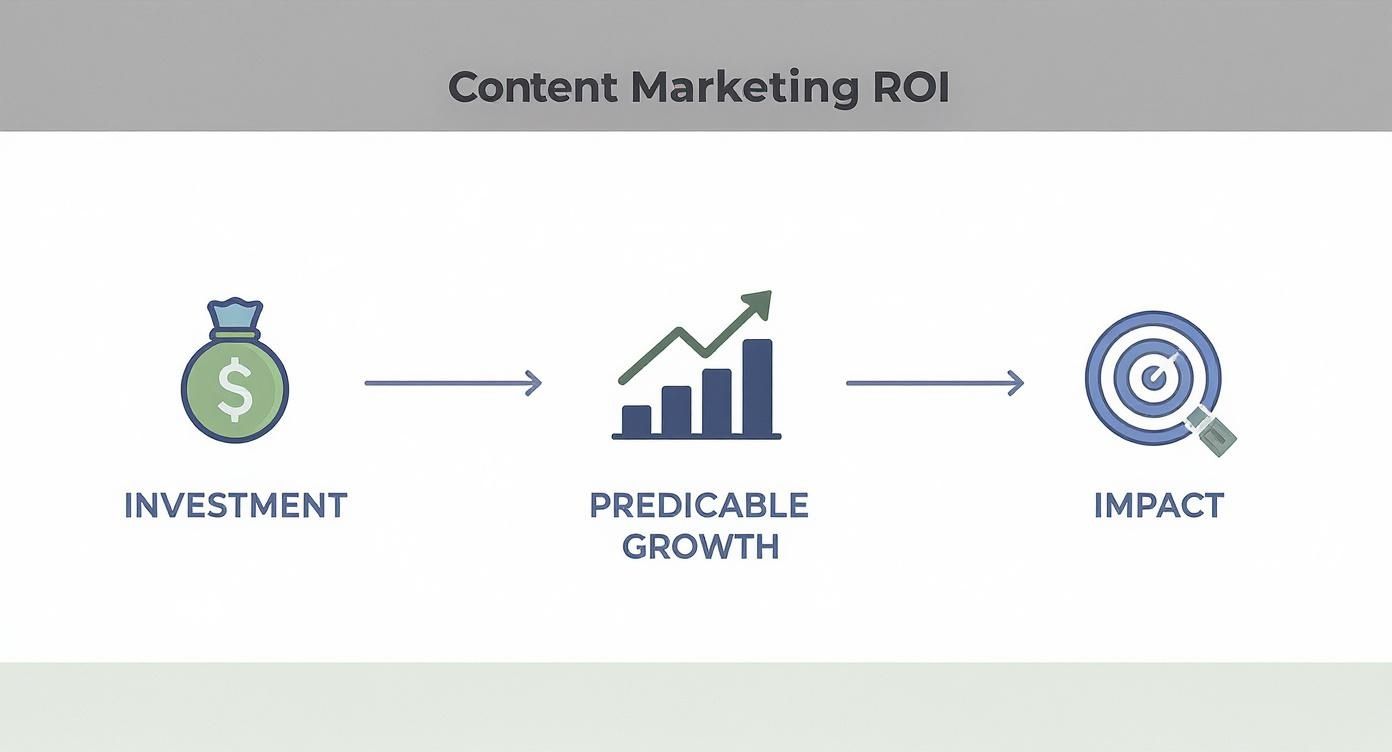
The key takeaway here is that you're not just spending money and hoping for the best. You're building a system for predictable growth that you can tie directly to your bottom line.
Nailing Down Your Total Investment
To get a real ROI figure, you have to count everything. Too many marketers make the mistake of only counting the obvious stuff, like the invoice from a freelance writer. That just leads to vanity metrics and an inflated sense of success.
Your total investment needs to include all the moving parts:
- Creation Costs: This is the big one. It covers salaries for your in-house writers, designers, and videographers, or what you pay out to agencies and freelancers.
- Tools & Software: Don't forget the monthly subscriptions for your tech stack. Think SEO tools like Ahrefs, analytics platforms, social media schedulers like Buffer, and your CMS.
- Promotion & Distribution: Any cash you put behind paid social ads, search ads, or influencer campaigns to get more eyeballs on your content counts.
Actionable Tip: Create a simple spreadsheet to track these costs. Assign a portion of your monthly tool subscriptions and team salaries to your content budget. For example, if you pay $150 a month for an SEO tool and you publish 10 articles, attribute $15 of that tool's cost to each piece. Getting granular like this is what separates a guess from a true calculation.
Quantifying Your Financial Return
This is where things get a little trickier, but it’s also where the magic happens. The "Return" side of the equation is more complex because content influences revenue in so many different ways. The goal is to connect your content to tangible business outcomes, not just traffic spikes.
It's a step that a surprising number of businesses miss—one study found that a whopping 53% don't tie their content efforts directly to revenue goals. To measure your return properly, you have to track specific conversions and put a dollar value on them.
Attributing Revenue and Leads
- Direct Sales: If you're running an e-commerce store, this is as direct as it gets. Actionable Step: Use UTM parameters in the URLs you share on social media or in newsletters. This allows you to track in Google Analytics exactly how many sales came from a click on a specific blog post or social update.
- Lead Value: For B2B or service businesses, leads are the name of the game. But what’s a lead worth? Actionable Step: To figure it out, talk to your sales team to find two numbers: your average lead-to-customer conversion rate and the lifetime value (LTV) of a customer. If 1 in 10 leads becomes a customer worth $5,000, then every single lead you generate is worth $500.
- Customer Lifetime Value (LTV): Good content doesn't just bring in new customers; it keeps the ones you have. If your tutorials or case studies are helping reduce churn, that's a real return you can and should factor in.
Cost and Return Analysis for Different Content Types
Not all content is created equal. Some formats require a heavy upfront investment of time and money but can deliver massive SEO returns over the long haul. Others are quick to produce and great for generating immediate leads. This table breaks down the typical trade-offs.
| Content Type | Typical Investment | Primary Return Metric | Time to See ROI |
|---|---|---|---|
| Blog Posts | Low-Medium (Time-intensive writing) | SEO Traffic, Organic Leads | 3-6 months |
| Ebooks/Whitepapers | Medium (Writing, design, promotion) | Gated Lead Generation | 1-3 months |
| Video Content | High (Production, editing, gear) | Brand Awareness, Engagement | 2-4 months |
| Webinars | Medium-High (Platform, promotion, prep) | High-Quality MQLs | Immediate to 1 month |
| Case Studies | Medium (Interviews, writing, approval) | Sales Enablement, Conversion | 1-2 months |
Understanding these dynamics helps you build a balanced content strategy. You can mix long-term plays like SEO-focused blog posts with short-term wins from a high-impact webinar to keep the pipeline full.
Calculation Examples in the Wild
Let's look at how two different businesses might run the numbers on their content marketing ROI.
A SaaS Company Example: A SaaS company drops $8,000 on a series of deep-dive guides. That campaign brings in 50 demo requests. The sales team is solid, closing 20% of those leads, which lands them 10 new customers. If the LTV of each customer is $3,000, the total return is a sweet $30,000.
- ROI Calculation: (($30,000 - $8,000) / $8,000) x 100 = 275%
An E-commerce Store Example: An online store invests $3,000 in a video marketing campaign showing off its products. They track everything with custom links and see the campaign directly drives $12,000 in sales.
- ROI Calculation: (($12,000 - $3,000) / $3,000) x 100 = 300%
Sure, these are simplified, but they show just how critical it is to connect your content to real money. If you want to go deeper on this, you can learn more about how to calculate marketing ROI and apply the same thinking to your content program.
When you diligently track both your full investment and the return you can attribute to it, you can finally answer the question everyone in the C-suite is asking: "Is our content actually making us money?"
Essential Tools for Tracking Content ROI
Let's be honest: you can't measure ROI with guesswork and spreadsheets. To really get a grip on your content marketing ROI, you need the right tech stack. These tools are what connect the dots between someone reading a blog post and that same person eventually becoming a paying customer. They’re your source of truth, turning fuzzy metrics into a cold, hard financial picture.
Building this stack isn't about buying every flashy tool on the market. It’s about covering three critical jobs: seeing how people behave on your site, managing the relationships you build, and tracking your organic search footprint. When these systems talk to each other, you get a powerful feedback loop that makes your entire content strategy smarter.
Analytics Platforms for Web Traffic and Conversions
Everything starts with a solid analytics platform. This is mission control for understanding how people find and use your content. Without it, you're flying blind, unable to link a piece of content to a meaningful action.
There's a reason Google Analytics 4 (GA4) is the default for most marketers. Its event-based model is built for tracking the specific steps that lead to a conversion. You’re not just counting pageviews; you’re tracking PDF downloads, demo requests, and newsletter sign-ups—the actions that actually matter.
Actionable Tip: In GA4, set up a custom conversion event for your most valuable bottom-of-funnel action, like a "Contact Us" form submission. By tracing the user paths that lead to that conversion, you can see which blog posts or landing pages pushed them over the line. That creates a direct data trail for your ROI calculation.
CRM Systems for Connecting Content to Revenue
Analytics tells you what users are doing. A Customer Relationship Management (CRM) system tells you who they are and connects their activity to actual money. This is the most crucial link in the chain for proving financial return, especially in B2B where sales cycles can drag on for months.
Platforms like HubSpot or Salesforce become the central nervous system for every lead and customer interaction. When someone fills out a form on your blog to get an ebook, their info lands in the CRM. From that moment on, every touchpoint—every email opened, every sales call—is logged.

This is where you strike gold. You can definitively say that a new $10,000 customer first found you through a specific blog post three months ago. You’re no longer just reporting on leads; you’re reporting on revenue. To get a better handle on how different pieces of content contribute to a final sale over time, it's worth understanding the various multi-touch attribution models that a good CRM makes possible.
A CRM transforms your content metrics from "we got 50 leads" to "this blog post generated $50,000 in pipeline." It’s the tool that finally allows you to speak the same language as your sales team and executives.
SEO and Social Tools for Measuring Growth and Reach
A huge chunk of content's value is its long-term power to pull in organic traffic and build your brand's authority. SEO tools are non-negotiable for putting a number on that contribution to your content marketing ROI.
Tools like Ahrefs or Semrush let you track keyword rankings, see who is linking to you, and even estimate the dollar value of your organic traffic. For example, if your blog post hits #1 for a keyword that would cost $5,000 a month to target with paid ads, that's a tangible return. It’s a direct cost saving and a sustainable traffic source you own.
Likewise, you need to track what's happening on social media. Using a comprehensive social media analytics dashboard is the smart way to gather data for ROI calculations across different platforms. These tools help you measure engagement, click-throughs, and actual conversions that started with a social post.
Building a Strategy for Higher Content ROI
Great content marketing ROI isn't a happy accident—it’s engineered from the ground up. Pumping out more content without a clear plan is just a recipe for burning through your budget. A high-ROI approach, in contrast, focuses on creating fewer, better assets that are precisely targeted and ruthlessly optimized.

Think of it like building a house versus just piling up bricks. A high-ROI strategy is the architectural blueprint. It ensures every blog post, video, and case study serves a distinct purpose and contributes to the final structure: generating revenue. Without that blueprint, you're just making noise.
This proactive approach is what separates the top-tier marketing teams from everyone else. Data from Semrush shows that 79% of companies considered "very successful" in their marketing dedicate more than 10% of their total marketing budget to content. Even more telling? 80% of these successful teams have a formal content strategy, directly linking intentional planning to better financial outcomes. You can find more trends about successful content marketing strategies and what they have in common.
Aligning Content with the Sales Funnel
Your audience's needs shift dramatically as they move from "I have a problem" to "I'm ready to buy." A winning strategy maps your content directly to these stages, ensuring you're delivering the right message at exactly the right time. This alignment is everything when it comes to maximizing conversions and, ultimately, your ROI.
- Top of Funnel (TOFU): This is the awareness stage. Your goal is to attract a broad audience with educational, problem-focused content that doesn't feel like a sales pitch. Think blog posts, infographics, and social media updates that answer common questions.
- Middle of Funnel (MOFU): Now they're in the consideration stage. Prospects know they have a problem and are actively looking for solutions. Your content should position your brand as a credible expert. This is where webinars, case studies, and deep-dive guides really shine.
- Bottom of Funnel (BOFU): This is the decision stage. The audience is ready to buy, and your content needs to give them that final nudge. Use product demos, free trials, and detailed comparison pages to seal the deal.
Trying to hit someone with a demo (BOFU) when they're just starting their research (TOFU) is like trying to sell a car to someone who’s just starting to think about learning to drive. It's the wrong message at the wrong time, and it tanks your conversion potential.
Targeting Commercial Intent Keywords
Let's be clear: not all keywords are created equal. To juice your content marketing ROI, you have to prioritize keywords that signal a user is getting close to pulling out their wallet. This is the difference between attracting casual readers and attracting future customers.
Think about the gap between "what is content marketing" and "best content marketing software for small business." The first is purely informational, targeting a TOFU audience. The second one screams commercial intent, attracting a BOFU audience that is actively looking for a solution to buy.
Focusing on commercial intent keywords ensures your content creation efforts are directly tied to revenue-generating opportunities. It's about attracting traffic that is far more likely to convert into leads and sales.
Actionable Step: Use your SEO tool to filter for keywords containing modifiers like:
- Best (e.g., "best CRM for startups")
- Alternatives (e.g., "HubSpot alternatives")
- Vs (e.g., "Ahrefs vs Semrush")
- Pricing (e.g., "Salesforce pricing plans")
Building content around these terms puts you squarely in the path of motivated buyers, dramatically shortening the path from click to conversion.
Creating Content Clusters for Topical Authority
Search engines reward expertise. A "content cluster" strategy is a powerful way to demonstrate deep knowledge in a specific area, helping you rank higher and drive more qualified organic traffic. It’s all about creating a central "pillar page" on a broad topic and linking it to multiple, in-depth "cluster pages" that cover related subtopics.
For example, your pillar page might be a massive guide to email marketing. Your cluster pages could then dive into the nitty-gritty, like "email list segmentation," "writing effective subject lines," and "email A/B testing best practices."
This structure signals to Google that you are an authority on the topic, boosting the SEO performance of all the related content. More importantly, it creates a seamless user experience, guiding visitors to the exact information they need and keeping them engaged on your site for longer. To get this right, you can follow a detailed content marketing strategy guide that walks through the process of building real authority.
Proven Tactics to Maximize Content Returns
Having a solid strategy is your blueprint, but disciplined execution is what actually builds the house. If you want to really crank up your content marketing ROI, you have to treat every single piece of content like a valuable asset. That means actively managing it, not just hitting "publish" and hoping for the best. That's a surefire recipe for disappointment.
The sharpest marketers I know get that creation is only half the battle. They work tirelessly to squeeze every drop of value out of their investment by focusing on promotion, optimization, and repurposing. It’s about multiplying the impact of their efforts long after the content goes live.
This isn't a small side project for most businesses anymore. In fact, a whopping 58% of companies now invest between $5,000 and $10,000 every single month on content. The numbers back it up: businesses that blog consistently see 55% more website visitors than those who don’t, which opens up a ton more opportunities to convert.
Amplify Your Reach with Smart Promotion
Your content can't generate a return if nobody sees it. It's that simple. A smart, multi-channel promotion strategy is non-negotiable for getting your work in front of the right audience and stretching its lifespan. Think of it as giving your content the rocket fuel it needs to take off.
- Email Marketing: Your email list is a direct line to your most loyal audience. Announce new content to your subscribers to drive a quick burst of traffic and re-engage people who already know and trust your brand. It's a low-cost, high-return channel that you completely own.
- Paid Promotion: Don't be afraid to put some money behind your best work. Actionable Step: Instead of boosting every post, identify your top 5 converting blog posts from the last quarter and put a small paid budget behind them on LinkedIn to target your ideal customer profile.
- Social Media Distribution: Share your content across all your relevant platforms, but tailor the message for each one. A short video clip for Instagram, a thought-provoking question for LinkedIn, and a slick, eye-catching graphic for X (formerly Twitter) will go a lot further than a generic "new blog post" update.
Optimize for Conversions
Getting traffic feels good, but turning that traffic into leads or sales is what actually drives ROI. This is where Conversion Rate Optimization (CRO) comes in—it’s the science of methodically tweaking your content to guide more visitors toward taking the action you want them to take. It’s all about turning passive readers into active participants.
A huge piece of this puzzle is implementing clear and compelling Calls-to-Action (CTAs). Ditch the generic "Contact Us" and try something specific and value-driven, like "Get Your Free Content Audit."
Effective CTAs bridge the gap between your content and your business goals. They provide a clear next step, transforming an informational asset into a conversion tool and directly boosting your content marketing ROI.
Just as critical is a smart internal linking strategy. By linking to relevant product pages, case studies, or other bottom-of-funnel content, you create a natural pathway for readers to move deeper into your world, dramatically increasing the chances they'll convert.
Multiply Your Impact with Content Repurposing
Why create ten new assets from scratch when you can turn one great piece into ten different formats? Content repurposing is one of the most efficient tactics for maximizing your content marketing ROI, bar none. It lets you reach new audiences on different platforms and hammer your message home without starting over.
The amount of time and resources this saves is massive. For example, a single, in-depth webinar can be spun into gold.
| Original Asset | Repurposed Formats | Target Audience |
|---|---|---|
| 60-Minute Webinar | A series of short blog posts, a downloadable slide deck, quote graphics for social media, a podcast episode, and short video clips for TikTok and YouTube Shorts. | Extends reach from live attendees to blog readers, social media followers, and podcast listeners. |
This whole approach breathes new life into your existing work, extending its value far beyond the day it was first published. To get even more mileage from your videos, converting YouTube video to text with AI is a killer tactic for turning spoken words into a fully readable and SEO-friendly blog post.
By making these tactics part of your standard process, you ensure every piece of content you create works a whole lot harder for your business.
Still Have Questions About Content Marketing ROI?
Even with the best strategy, some questions about content marketing ROI just keep coming up. Let's tackle the most common ones I hear from marketers so you can get back to measuring with confidence.
How Long Does This Actually Take to Work?
Let's get one thing straight: content marketing is a long game. It’s a marathon, not a sprint. Compare it to paid ads, where you see results (and costs) immediately. Content marketing is an asset that appreciates over time.
You might see some early signs of life—a little more traffic, a few more social shares—within 3-6 months. But a real, meaningful financial return? You're usually looking at 6-12 months, sometimes even longer.
Think of it like planting a tree. It feels slow at first, but once it takes root, it provides value for years with very little extra work. Content works the same way. It compounds over time as your articles start ranking for keywords and pulling in a steady stream of organic traffic long after you hit "publish."
What's a "Good" Content Marketing ROI Anyway?
If you're looking for a number to aim for, the industry benchmark that gets tossed around most is a 5:1 ratio. That’s a 400% ROI, or earning $5 for every $1 you put in.
But here’s the thing: chasing some universal number is a distraction. What really matters is setting your own baseline and then consistently beating it, quarter after quarter. A high-margin SaaS company might hit a 10:1 ratio, while a business in a different space might be thrilled with 3:1. Focus on your own growth.
How Do I Measure ROI for Top-of-Funnel Blog Posts?
This is the classic headache. How do you tie a blog post about "10 Tips for X" directly to a closed deal? The short answer is, you don't—not directly, anyway.
Trying to force a direct sales connection for top-of-funnel (TOFU) content is a recipe for frustration. Instead, you need to look at leading indicators and proxy metrics that show its value.
- Contribution to Pipeline: Use a multi-touch attribution model in your analytics tool or CRM. This lets you see how many of your eventual customers first found you through that "fluffy" TOFU piece. It’s often more than you think.
- Key Performance Indicators: Track the metrics that prove the content is doing its job. Are you seeing more organic traffic? Ranking for new keywords? Getting more newsletter sign-ups from those posts? Is your branded search volume going up? These are all signs of a healthy top of funnel.
What Are the Biggest Mistakes People Make When Calculating ROI?
Even sharp marketers can trip up here. I see the same few mistakes pop up again and again.
- Ignoring Hidden Costs: The most common error is forgetting to include everything. Team salaries, software subscriptions, and your ad spend for promotion all count. Miss these, and your ROI will look way better than it actually is.
- Relying Only on Last-Touch Attribution: This model is the enemy of content marketing. It gives 100% of the credit to the last thing a person did before converting, completely ignoring the five blog posts they read that got them there in the first place.
- Having No Clear Conversion Goals: If you don't define what a "conversion" is for a piece of content (like a demo request or an ebook download), you’re just measuring traffic and vibes. You have nothing concrete to measure against your investment.
- Giving Up Too Soon: This one hurts to see. Pulling the plug on your content strategy after three months because you aren't seeing a massive return is the fastest way to guarantee a negative ROI. You have to give it time to mature.
Ready to stop guessing and start engineering a higher ROI? The marketbetter.ai platform uses AI to help you create high-performing content, optimize campaigns, and prove your marketing's impact with clear, data-backed insights. Discover how to maximize your content returns today.