
What Is Marketing Attribution? 6 Models Compared + Which to Use [2026]
Ever wonder which part of your marketing is actually working? That’s the million-dollar question, and marketing attribution is how you answer it. It’s the framework for figuring out which ads, emails, or social posts get the credit for a sale, so you can stop wasting money and double down on what drives results.
So, What Is Marketing Attribution, Really?

Think about a game-winning shot in basketball. Does the player who sank the basket get all the glory? Of course not. You have to credit the point guard who made the perfect pass and the center who set a killer screen. Marketing works the exact same way.
Instead of slapping 100% of the credit on the very last ad a customer clicked before buying, attribution looks at the entire chain of events—the complete "customer journey." And let’s be honest, that journey is never a straight line.
A real-world path might look something like this:
- The Spark: A potential customer scrolls through social media and sees one of your ads. They’d never heard of you before, but now you’re on their radar.
- Building Trust: A few weeks go by. They search for a solution on Google, find one of your blog posts, and sign up for your newsletter.
- The Final Nudge: After getting a couple of emails, a promo offer catches their eye. They click, and finally, they buy.
Without attribution, you might mistakenly think the email campaign did all the heavy lifting. But what about the social ad that started it all? Or the blog post that proved you knew your stuff? Each touchpoint played a part, and figuring out how much of a part is the core job of marketing attribution.
Moving From Guesswork to Proof
At its heart, attribution is about swapping out assumptions for cold, hard data. It gives you a way to answer the tough questions that decide where your budget goes.
For instance, which channel is your opener, and which one is your closer? A "first-touch" model would give all the credit to that initial social media ad. A "last-touch" model would hand it all to the email. The truth, as always, is somewhere in the middle. The actionable insight here is realizing that some channels are great for starting conversations while others are built to close deals.
Marketing attribution is what turns your budget from a blind expense into a strategic investment. It draws a straight line from every dollar you spend to the revenue it brings in, proving marketing’s value to the rest of the business.
By looking at the whole journey, you start to see how different channels team up. This is where the magic happens. You can finally allocate your budget with confidence, doubling down on what works at each stage of the funnel. It’s the difference between just buying ads and funding a high-performance marketing engine that you know gets results.
The Journey From Last-Click To Modern AI Attribution
To really get what marketing attribution is today, you have to know where it came from. The story starts in a much simpler time, with a philosophy that was easy to understand but often dead wrong: the last-click wins.
In a last-click world, the very last thing a customer did before buying got 100% of the credit.
Imagine a customer sees your ad on Instagram, reads your blog a week later, then finally clicks a Google ad to make a purchase. The last-click model gives all the glory to that Google ad, completely ignoring the fact that Instagram and your blog did the heavy lifting to get them there. It was simple, but it created a totally distorted picture of what was actually working. Marketers ended up pouring money into bottom-of-the-funnel tactics and starving the channels that built awareness in the first place.
The Rise of Multi-Touch Models
As the internet exploded in the late ‘90s and early 2000s, the game changed. Suddenly we had search engines, email, and social media. Customer journeys weren’t a straight line anymore; they were a tangled web. It became painfully obvious that the last click wasn't the whole story.
This complexity forced a new way of thinking. Today, that need is baked into modern marketing—surveys show that around 76% of all marketers now use attribution or plan to within a year. You can explore more about the historical importance of marketing attribution to see how these trends took shape over time.
This evolution gave us multi-touch attribution models. The core idea was to acknowledge that multiple interactions lead to a sale and to try and split the credit more fairly. A few popular flavors emerged:
- Linear Model: This one’s simple. It splits credit equally across every single touchpoint. The problem? It treats a two-second glance at a social post with the same value as an in-depth product demo.
- Time-Decay Model: This model is a bit smarter. It gives more credit to the touchpoints that happen closer to the conversion. It rightly assumes that the interactions leading right up to the purchase were probably more influential.
- Position-Based (U-Shaped) Model: This gives the most credit to the very first touch (the introduction) and the very last touch (the decision), then divides the rest among everything in the middle. It values both how someone found you and what finally convinced them to buy.
Entering The Era of Privacy and AI
While multi-touch models were a huge leap forward, they still had a fundamental flaw: they were based on rules that humans made up. More recently, two massive forces have shoved attribution into its next phase: privacy regulations and artificial intelligence.
The death of third-party cookies and a massive consumer push for data privacy have made it much harder to track users across different websites and apps. This data scarcity is forcing everyone to move away from rigid, rule-based models and toward smarter, privacy-first solutions.
This is where AI and machine learning come in. Instead of following a set of predefined rules, modern attribution systems analyze enormous amounts of data—from both customers who converted and those who didn’t—to build custom models on the fly.
Here's the key comparison: a rule-based model like Linear follows a strict, unchanging formula, while an AI model learns and adapts to your specific customer behavior. The AI can tell you why certain touchpoints matter more, not just that they do. They can spot the true influence of each channel without human bias getting in the way and even start to predict future outcomes. This journey, from a simplistic "last-click" view to a predictive, AI-driven analysis, shows just how much attribution has grown up to handle the messy reality of modern marketing.
Comparing The Most Common Marketing Attribution Models
Picking an attribution model is a lot like picking the right tool for a job. A hammer is great for a nail, but it’s completely useless for a screw. In the same way, the right model depends entirely on your business goals, sales cycle, and how your customers actually behave.
Let’s break down the most common ones and put them head-to-head.
This infographic gives you a quick visual on how attribution has evolved—from dead-simple Last-Click models all the way to the more sophisticated Multi-Touch and AI-driven approaches we have today.
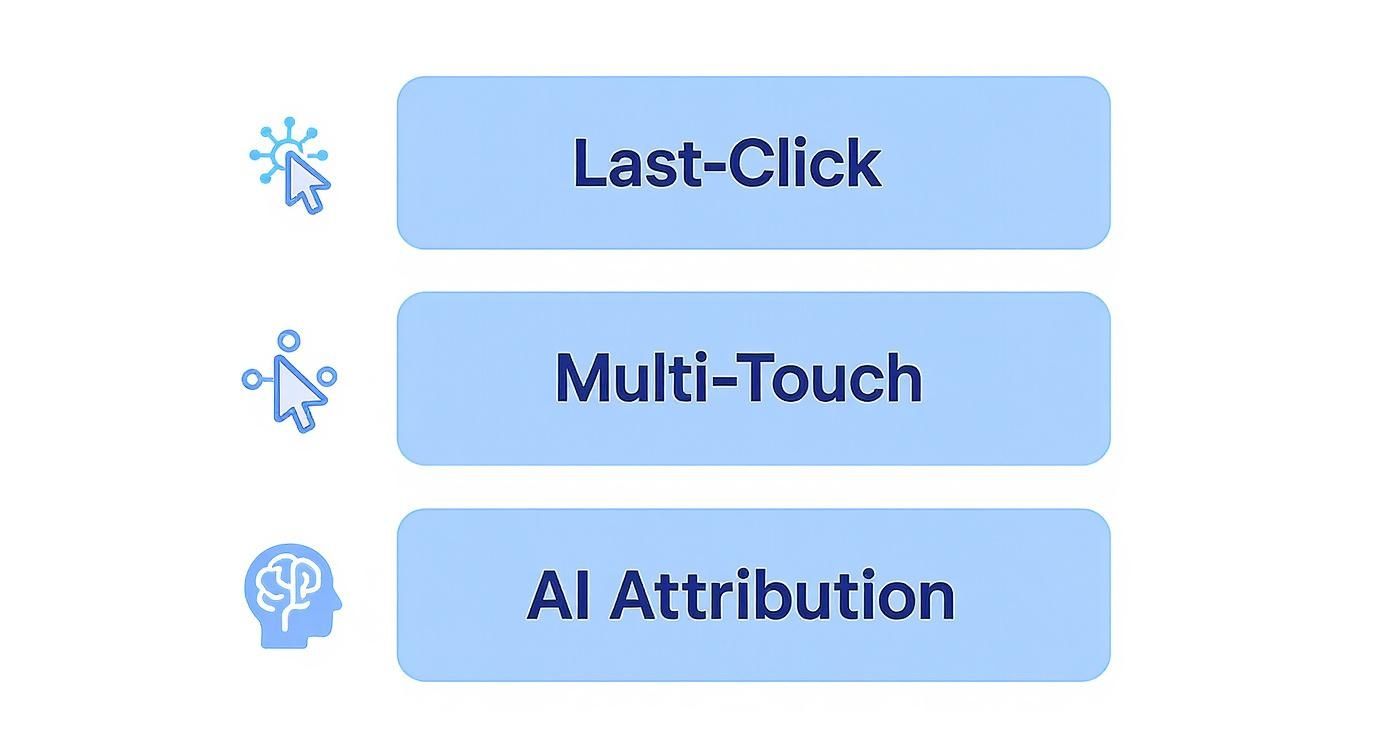
You can see a clear progression here. Each new tier builds on the last, giving marketers a much sharper, more complete picture of the customer journey.
To help you sort through the options, we’ve put together a simple comparison table.
Marketing Attribution Model Comparison
This table offers a side-by-side look at the most common models. Use it to understand how each one works, its strengths and weaknesses, and where it fits best in your marketing strategy.
| Model Type | How It Works | Pros | Cons | Best For |
|---|---|---|---|---|
| First-Click | Gives 100% of the credit to the very first touchpoint. | Simple to implement; highlights top-of-funnel channels. | Ignores all subsequent interactions that nurture the lead. | Brand awareness campaigns where the initial discovery is key. |
| Last-Click | Gives 100% of the credit to the final touchpoint before conversion. | Easy to track; shows what closes the deal. | Overvalues bottom-funnel channels and ignores what built initial interest. | Short sales cycles, like e-commerce flash sales. |
| Linear | Splits credit equally across all touchpoints in the journey. | Provides a balanced view; ensures no channel is ignored. | Assumes all touchpoints are equally important, which is rarely true. | Marketers wanting a baseline, holistic view of all channel contributions. |
| Time-Decay | Gives more credit to touchpoints closer to the conversion. | Emphasizes the interactions that push a prospect over the finish line. | Can undervalue the crucial top-of-funnel activities that started the journey. | Longer sales cycles where late-stage nurturing is critical (e.g., B2B). |
| U-Shaped | Splits credit between the first and last touchpoints, usually 40% each. The middle 20% is shared. | Values both the initial discovery and the final conversion action. | Minimizes the role of mid-funnel nurturing touchpoints. | Lead-generation focused businesses where first and last touches are vital. |
| W-Shaped | Assigns 30% credit each to the first touch, lead creation, and opportunity creation. The last 10% is shared. | Gives significant weight to key B2B conversion milestones. | Requires sophisticated tracking to identify specific funnel stages accurately. | Sales-driven B2B organizations with a clearly defined sales funnel. |
Each model tells a different story about your marketing performance. The trick is to choose the one that tells the truest story for your specific business.
Single-Touch Models: The Sprinters
Single-touch models are the simplest of the bunch. They assign 100% of the conversion credit to a single interaction. They're fast, easy to wrap your head around, and often the default setting in many analytics platforms.
-
First-Click Attribution: This model is all about the introduction. It gives every bit of credit to the very first touchpoint a customer had with your brand. Think of it as rewarding the channel that brought someone to the party.
- Best For: Companies laser-focused on top-of-funnel growth and brand awareness. If your main goal is figuring out what brings new people in the door, this model is your guide.
- Drawback: It’s blind to everything that happens next. It completely ignores every interaction after that initial discovery, which could be dozens of crucial nurturing steps.
-
Last-Click Attribution: As the polar opposite, this model gives all the glory to the final touchpoint right before a conversion. It’s built to answer one question: "What was the last thing they did before buying?"
- Best For: Businesses with lightning-fast sales cycles, like an e-commerce store running a flash sale. In those cases, the last ad a customer clicked is probably the most influential one.
- Drawback: It massively overvalues bottom-of-the-funnel channels (like branded search) and gives zero credit to the channels that built the initial interest and trust.
Multi-Touch Models: The Marathon Runners
Let's be real—most customer journeys aren't a sprint. They're a marathon with multiple key moments along the way. Multi-touch models get this. They distribute credit across various touchpoints, offering a much more balanced and realistic view.
Here are the most common multi-touch approaches:
- Linear Model: This is the most straightforward multi-touch model. It simply splits credit equally among all touchpoints. If a customer had five interactions before converting, each one gets 20% of the credit.
- Best For: Getting a general, holistic view of all the channels involved in a conversion. It’s a solid starting point if you just want to make sure no channel is being completely ignored.
- Drawback: Its biggest weakness is assuming all touchpoints are equally important, which is almost never true. A quick glance at a social media post gets the same credit as an in-depth product demo.
By moving from single-touch to multi-touch, you shift from asking "Which one channel worked?" to "How did my channels work together?" This is a fundamental step toward more strategic marketing.
-
Time-Decay Model: This model operates on the idea that recent interactions are more valuable. It gives more credit to touchpoints that happened closer to the conversion. An interaction one day before the sale gets more weight than one from three weeks prior.
- Best For: B2B companies or any business with a longer consideration period. In these cases, the final interactions are often what seal the deal.
- Drawback: It can undervalue those critical top-of-funnel activities that were absolutely essential for getting the journey started in the first place.
-
U-Shaped (Position-Based) Model: This popular model gives 40% of the credit to the first touchpoint (the discovery) and another 40% to the lead-creation touchpoint. The remaining 20% is distributed evenly among all the interactions that happened in between.
- Best For: Businesses where generating qualified leads is a primary goal. It correctly values both how a lead was found and what specific action turned them into a qualified prospect.
- Drawback: It tends to minimize the importance of the nurturing touchpoints that happen between that initial contact and the final lead conversion.
-
W-Shaped Model: Taking it a step further, the W-Shaped model assigns 30% credit to the first touch, 30% to the lead-creation touch, and 30% to the opportunity-creation touch. That last 10% is then split among any other interactions.
- Best For: Sales-driven organizations, especially in B2B, where the journey from a simple lead to a qualified sales opportunity is a distinct and critical stage.
- Drawback: This one requires more sophisticated tracking. You need to be able to accurately identify that specific "opportunity creation" touchpoint in your sales process.
Want to go deeper on this? To really get into the mechanics, you can explore our comprehensive guide on multi-touch attribution models and see which one aligns best with your customer journey.
How To Implement Your First Attribution Model

Alright, let's move from theory to practice. Getting started with attribution can feel like a massive jump, but it really doesn't have to be. The secret is to think crawl, walk, run.
Forget about building a perfect, hyper-complex system from day one. The real win is starting with the data and tools you already have. This approach keeps things manageable, lets you build a solid foundation, and helps you score some quick wins without getting bogged down by expensive software or massive integration projects.
The goal here is simple: start small, prove the value, and then scale up.
The Crawl Phase: Start With Your Goals
Before you even think about data, you need to be crystal clear on what you're trying to achieve. An attribution model is just a tool to measure what's working—so first, you have to define what "working" actually means for your business.
Are you trying to generate new leads? Drive e-commerce sales? Or maybe just get your name out there?
Your answer points directly to your Key Performance Indicators (KPIs). These are the hard numbers that tell you if you're hitting your goals.
- For lead generation: You're probably obsessed with Cost Per Lead (CPL) or the raw number of marketing-qualified leads.
- For e-commerce sales: Your world revolves around Return on Ad Spend (ROAS), Conversion Rate, and Average Order Value (AOV).
- For brand awareness: You might track metrics like new website visitors, social media engagement, or branded search volume.
Actionable Step: Write down your top 1-2 marketing goals for this quarter. Next to each, list the exact KPI you will use to measure success. This document is now the foundation of your attribution strategy.
The Walk Phase: Gather Your Tools and Data
With your goals locked in, it's time to figure out where the data lives. The good news? Most businesses already have the basic building blocks in place.
1. Identify Your Core Platforms
Your most valuable data is likely scattered across a few key systems:
- Website Analytics: This is non-negotiable. Google Analytics (GA4) is the standard starting point, giving you a powerful look into user behavior, traffic sources, and on-site conversions.
- Customer Relationship Management (CRM): Your CRM (think HubSpot or Salesforce) is where the money is. It connects your marketing campaigns to actual leads, deals, and revenue.
- Advertising Platforms: The dashboards in Google Ads, Meta Ads, and LinkedIn Ads are goldmines for campaign performance, click data, and impressions.
2. Master Your Tracking Mechanisms
Clean, consistent tracking is the absolute backbone of good attribution. Two things are critical here:
- UTM Parameters: These are simple tags you add to your URLs to tell your analytics platform exactly where traffic came from. A disciplined UTM strategy is arguably the single most important thing you can do for accurate channel tracking.
- Tracking Pixels: These are little snippets of code from platforms like Meta or Google that you place on your site. They’re essential for tracking conversions and linking them back to specific ad campaigns.
Pulling all this data together is where the magic happens. A solid plan for customer data platform integration can be a game-changer, giving you a single, unified view of the entire customer journey.
The Run Phase: Analyze and Iterate
Now it’s time to put your data to work. Don't overcomplicate it. Start with a simple model that's already built into a tool you use, like Google Analytics.
The Model Comparison Tool in GA4 is a fantastic place to begin. It lets you instantly see how different models—like Last-Click versus Linear or Time-Decay—would assign credit for the same conversion.
This simple comparison can be an eye-opener. You might discover that your organic social media, which looks worthless in a Last-Click model, is actually a key player in introducing new people to your brand when you look at it through a First-Click lens.
Actionable Step: Log in to GA4. Go to Advertising > Attribution > Model comparison. Compare "Last click" with "First click" for a key conversion event. Note which channels over-perform or under-perform between the two models. This is your first attribution insight.
But don't just set it and forget it. Your initial findings are a launchpad for asking smarter questions. "Why is paid search so good at closing deals but terrible at creating initial awareness?" or "Which of our blog posts are doing the heavy lifting in the middle of the journey?"
This cycle of analyzing, questioning, and tweaking is what transforms basic tracking into a real strategic advantage. By starting small and building momentum, you turn attribution from an intimidating concept into an actionable part of how you grow.
Overcoming Today's Biggest Attribution Challenges
Even with the best tools, marketing attribution is rarely a straight shot. It’s a powerful way to prove ROI, sure, but the path to clear insights is almost always bumpy. Marketers are up against some serious hurdles that can derail even the most carefully laid plans. Learning to navigate these obstacles is what separates basic reporting from a true strategic advantage.
The biggest challenge by far? The seismic shift in data privacy. The old days of tracking every user across every corner of the web are officially over.
The New Reality of Data Privacy
Growing privacy concerns from consumers, the introduction of GDPR back in 2018, and Apple’s App Tracking Transparency framework have completely changed the game. The firehose of user-level data has slowed to a trickle, forcing everyone to rethink traditional attribution.
Despite this, 76% of marketers still see attribution as absolutely essential for measuring ROI. They're just adapting to the new privacy rules. You can discover more about the evolution of marketing attribution to see how modern methods are stepping up to estimate channel impact without relying on creepy individual tracking.
This privacy-first world creates a few key headaches:
- Fragmented Customer Journeys: Without third-party cookies, piecing together a user's journey across their laptop, phone, and work computer is incredibly difficult.
- Signal Loss: Platforms like Meta and Google are working with less data, which means their built-in conversion tracking isn't as sharp as it used to be.
The modern attribution puzzle isn't about finding a single source of truth anymore. It's about blending different data signals—some precise, some directional—to build the most complete picture possible.
Tackling Common Implementation Roadblocks
Beyond the privacy landscape, a few practical challenges consistently trip up marketing teams. If you don't tackle these head-on, you're building your attribution house on a shaky foundation.
One of the most common culprits is messy data. You have to learn how to improve data quality, because inaccurate or incomplete information makes any model worthless. It leads to flawed conclusions and, ultimately, wasted budget.
Here’s a look at the usual suspects and how to solve them:
| Challenge | Why It's a Problem | Actionable Solution |
|---|---|---|
| Cross-Device Tracking | A customer sees an ad on their phone but buys on their laptop. Without a link, you credit the wrong channel. | Implement a unified ID system. The easiest way is to encourage user logins on your site or app, which connects their activity across devices into a single view. |
| Offline Conversion Lag | An online ad drives an in-store purchase, but the sale isn't logged for days, breaking the attribution chain. | Use CRM data integration. Connect your point-of-sale system to your CRM to match in-store purchases back to online campaigns using customer emails or phone numbers. |
| Data Silos | Marketing has ad data, sales has CRM data, and support has interaction data. None of it talks. | Champion a centralized data platform. Tools like a Customer Data Platform (CDP) or a data warehouse pull all that info into one place, creating a single source of truth. |
| Long Sales Cycles | For B2B companies, a deal might take six months to close, making it tough to connect the sale to the marketing that started it all. | Focus on intermediate KPIs. Instead of only tracking the final sale, give credit to key milestones along the way, like demo requests, whitepaper downloads, or trial sign-ups. |
The Future of Attribution With AI and Machine Learning
While the classic attribution models give us a solid rulebook, the future of attribution is way smarter and more adaptive. It's driven by artificial intelligence, and it’s a massive leap from the rigid, one-size-fits-all systems of the past.
This approach is often called algorithmic or data-driven attribution. Instead of a marketer deciding which touchpoints get the most credit, machine learning algorithms dig into your unique customer data and build a custom model from scratch.
Here's the key difference: AI doesn't just look at the journeys of customers who converted. It also analyzes the paths of everyone who didn't convert. By comparing the two, it learns which touchpoints genuinely influence a decision and which ones are just noise along the way. This removes human bias and creates a far more honest picture of what’s actually working.
Beyond Rules to Real Insights
Moving to an AI-powered system isn't just about getting a slightly more accurate report. It’s about fundamentally changing how you understand—and even predict—customer behavior.
An AI model can tell you that for a specific customer segment, your blog posts have a 15% higher impact when they’re seen before a video ad. That’s a powerful, nuanced insight a U-shaped model would completely miss. It takes you beyond simple credit scores and starts revealing the complex relationships between your channels.
AI-driven attribution is the answer to the data scarcity problem created by modern privacy rules. By analyzing patterns and probabilities, it can intelligently fill the gaps left by disappearing third-party cookies, giving you a much clearer view of performance.
Making AI Actionable
This isn't just for mega-corporations with huge data science teams anymore. Modern platforms are making these powerful capabilities more accessible, giving any business a serious competitive edge.
- Predictive Budgeting: AI models can forecast what will happen if you shift your budget from one channel to another. This lets you optimize your spending before you commit a single dollar. You can see how this works by exploring predictive analytics in marketing.
- Real-Time Optimization: The system can spot an underperforming campaign as it’s happening and suggest adjustments, turning insights into immediate action. And as technology evolves, new approaches are constantly emerging for unlocking low-latency analytics and GenAI.
By embracing machine learning, marketing attribution stops being a backward-looking report card and becomes a forward-looking strategic engine that guides every decision you make.
Try our Marketing Plan Generator — generate a complete AI-powered marketing plan in minutes. No signup required.
Frequently Asked Questions About Marketing Attribution
Even after you get the hang of the basics, some very practical questions always pop up. Let's tackle a few of the most common ones I hear from teams trying to put attribution into practice.
Marketing Attribution vs. Marketing Mix Modeling
This is probably the biggest point of confusion out there. People hear "marketing measurement" and lump Marketing Attribution and Marketing Mix Modeling (MMM) together, but they’re built for totally different jobs. They operate on different scales and answer different questions.
Here’s a side-by-side comparison to make it clear:
| Feature | Marketing Attribution | Marketing Mix Modeling (MMM) |
|---|---|---|
| Focus | User-level, granular (clicks, views) | High-level, aggregated (total sales) |
| Timeframe | Short-term (days, weeks) | Long-term (months, years) |
| Channels | Primarily digital | Online, offline (TV, radio), external factors |
| Question It Answers | "Which digital campaign drove this conversion?" | "How did our TV budget impact overall revenue?" |
| Actionable Outcome | Tactical campaign optimization | Strategic annual budget allocation |
Think of it this way: Attribution helps you tune the engine of your race car during the race. MMM helps you decide whether to build a race car or a pickup truck next year. Both are essential, but for very different purposes.
How Can I Get Started with a Small Business Budget?
You absolutely do not need a five-figure software budget to get started. The key is to begin with the tools you probably already use and just get disciplined with your data.
Your first, most actionable step? Perfect your UTM parameter strategy. Seriously. Consistently tagging every single link in your emails, social posts, and ads is the most powerful thing you can do to clean up your data.
Once that’s locked in, you can jump into the free Model Comparison Tool in Google Analytics 4. This lets you instantly compare how a Last-Click model values your channels versus a Linear or First-Click model. You'll uncover immediate insights without spending a dime.
How Often Should We Change Our Attribution Model?
My advice is simple: don't. Or at least, not often. Constantly switching your model is like changing the rules of a game halfway through—it makes it impossible to compare performance over time, which completely defeats the purpose of having historical data. A good rhythm is to review your model’s effectiveness quarterly or maybe semi-annually.
Only think about a change if something fundamental shifts in your business. Things like:
- Launching a major new marketing channel.
- Seeing a radical change in how your customers typically buy from you.
- Your data consistently shows the model is just plain wrong about crediting important touchpoints.
The goal is consistency for reliable reporting. Your model should reflect your business strategy, so it should only change when that strategy does.
Ready to move beyond basic models and unlock the true potential of your marketing data? marketbetter.ai uses AI-powered attribution to give you a clear, predictive view of what's driving revenue. Stop guessing and start optimizing with a platform built to deliver actionable insights and measurable ROI. Learn how marketbetter.ai can transform your marketing strategy today.