10 Actionable Social Media Engagement Strategies for 2025
In a saturated digital marketplace, a high follower count offers little more than vanity. True influence isn't measured in passive likes; it's built through active, meaningful interactions. Comments, shares, direct messages, and saves are the currency of modern social media, signaling to algorithms that your content is valuable and worth amplifying. Moving beyond superficial metrics is no longer optional; it is the core of a successful digital presence. Without genuine engagement, even the largest audience is just shouting into a void, yielding minimal impact on brand loyalty or revenue.
This article cuts through the noise of generic advice. We will provide a comprehensive breakdown of 10 proven social media engagement strategies designed to transform passive followers into a vibrant community of brand advocates. Each strategy is presented with actionable implementation steps, real-world examples, and a clear comparison of its strengths and best-use cases. You will learn how to launch compelling User-Generated Content (UGC) campaigns, leverage interactive polls for instant feedback, and build authority through value-first educational content.
We'll explore everything from influencer collaborations and live streaming to the nuanced art of social listening and community building. These tactics are foundational for any business, regardless of size. For a comprehensive understanding of leveraging social media for your business, consult this actionable guide to social media marketing. Whether you're a B2B marketing professional aiming to generate qualified leads or a B2C brand focused on cultivating customer loyalty, the following strategies will provide a clear roadmap to achieving tangible business results through powerful online engagement.
1. User-Generated Content (UGC) Campaigns
User-Generated Content (UGC) campaigns are among the most powerful social media engagement strategies because they shift the focus from the brand to the customer. Instead of creating all your own content, you encourage your audience to create and share content featuring your products, services, or brand experience. This approach transforms passive followers into active brand advocates, leveraging their authentic voices to build trust and community far more effectively than traditional advertising.

Unlike brand-created content, which is often polished and can feel distant, UGC is raw, relatable, and serves as powerful social proof. When potential customers see real people enjoying your products, it resonates more deeply than a carefully crafted ad. A UGC campaign is a more scalable approach compared to influencer marketing, as it sources content from hundreds of fans rather than a handful of paid creators. Think of Apple's iconic #ShotOniPhone campaign, which turns everyday customers into celebrated photographers, or GoPro’s adventure-fueled feeds, which are almost entirely composed of thrilling customer-shot videos.
How to Implement a UGC Campaign
Successfully launching a UGC initiative requires a clear framework that makes it easy for your audience to participate. The goal is to inspire creation, not to demand it. Here’s how to take action.
- Actionable Step 1: Create a Unique Hashtag. Develop a simple, memorable, and unique branded hashtag for your campaign. This acts as a digital filing system, making it easy to track submissions and for others to discover the content. Coca-Cola's #ShareACoke is a classic example of a hashtag that became a cultural phenomenon.
- Actionable Step 2: Set Clear Guidelines & Offer Incentives. Clearly communicate what you're looking for. Are you running a photo contest? A video challenge? Outline the rules and offer a compelling reason to participate, such as a chance to be featured on your page, win a prize, or receive a discount. An incentive is crucial to overcome initial inertia.
- Actionable Step 3: Always Ask for Permission. Before reposting anyone's content, you must get their explicit permission. A simple direct message asking if you can feature their photo or video (and credit them) is professional and legally sound.
- Actionable Step 4: Engage and Amplify. Publicly thank and engage with every user who contributes. Featuring their content on your feed is the ultimate reward and encourages others to join in.
By building a system that celebrates your customers, you create a sustainable engine for authentic content. To explore this topic further, you can dive deeper into implementing effective user-generated content strategies to empower your audience as brand advocates.
2. Interactive Content & Polls
Interactive content is one of the most direct social media engagement strategies because it actively invites users to participate rather than just passively consume. This approach includes polls, quizzes, Q&As, and surveys that require a click, a tap, or a typed response. It transforms the one-way communication of a standard post into a two-way dialogue, instantly boosting interaction rates and signaling to social media algorithms that your content is valuable and engaging.

Unlike static posts that followers can easily scroll past, interactive elements create a "micro-commitment" that holds attention. When a user votes in a poll or answers a question, they become more invested in your brand and the outcome. This strategy offers a lower barrier to entry compared to UGC, as it requires only a click from the user, not content creation. Think of Spotify's wildly successful annual "Wrapped" campaign, which provides users with personalized, shareable data quizzes, or Netflix using Instagram Story polls to let audiences vote on potential plot points for interactive shows.
How to Implement Interactive Content
Deploying interactive content effectively requires a blend of creativity and strategic planning. The goal is to make participation feel effortless and rewarding for your audience. Here are actionable steps.
- Actionable Step 1: Leverage Platform-Specific Features. Use built-in tools like Instagram and Facebook Story polls, quizzes, and question stickers for quick, 24-hour engagement spikes. On Twitter, polls are a simple yet powerful way to gather opinions.
- Actionable Step 2: Ask Simple, Compelling Questions. Frame questions that are easy to answer but still provide value. Dunkin' effectively uses Twitter polls to let customers vote on new donut flavors, making followers feel like part of the decision-making process.
- Actionable Step 3: Share the Results. Always follow up by sharing the results of your polls or quizzes. This closes the feedback loop, validates user participation, and makes them more likely to engage with future interactive content. Failing to do this can make the interaction feel pointless.
- Actionable Step 4: Mix Entertainment with Market Research. Use fun quizzes, like Buzzfeed's famous personality tests, to drive shares and brand awareness. Simultaneously, use practical surveys to gather crucial insights about customer preferences that can inform your product development or content strategy.
By turning your social media feed into an interactive space, you not only increase engagement metrics but also gather valuable, zero-party data directly from your most dedicated followers.
3. Influencer Partnerships & Collaborations
Influencer partnerships are one of the most effective social media engagement strategies for reaching new, highly targeted audiences through a trusted source. This approach involves collaborating with individuals who have established credibility and a dedicated following in a specific niche. By leveraging the authentic connection an influencer has with their community, brands can introduce their products or services in a way that feels like a genuine recommendation rather than a disruptive advertisement.
This strategy's power lies in borrowed trust. When an influencer that followers know and respect endorses a brand, that credibility is transferred, making the audience more receptive to the message. Compared to traditional ads, which audiences are often trained to ignore, an influencer's post feels native to the platform and more trustworthy. The collaborations between Gymshark and fitness influencers, or Dunkin's partnership with TikTok star Charli D'Amelio, which boosted app downloads by 57%, showcase how these alliances can generate massive engagement and tangible business results.
When selecting partners, it's crucial to look beyond follower counts and analyze engagement rates, as this data reveals the true influence and connection an individual has with their audience. The following infographic provides a quick reference for typical engagement rates across different influencer tiers.
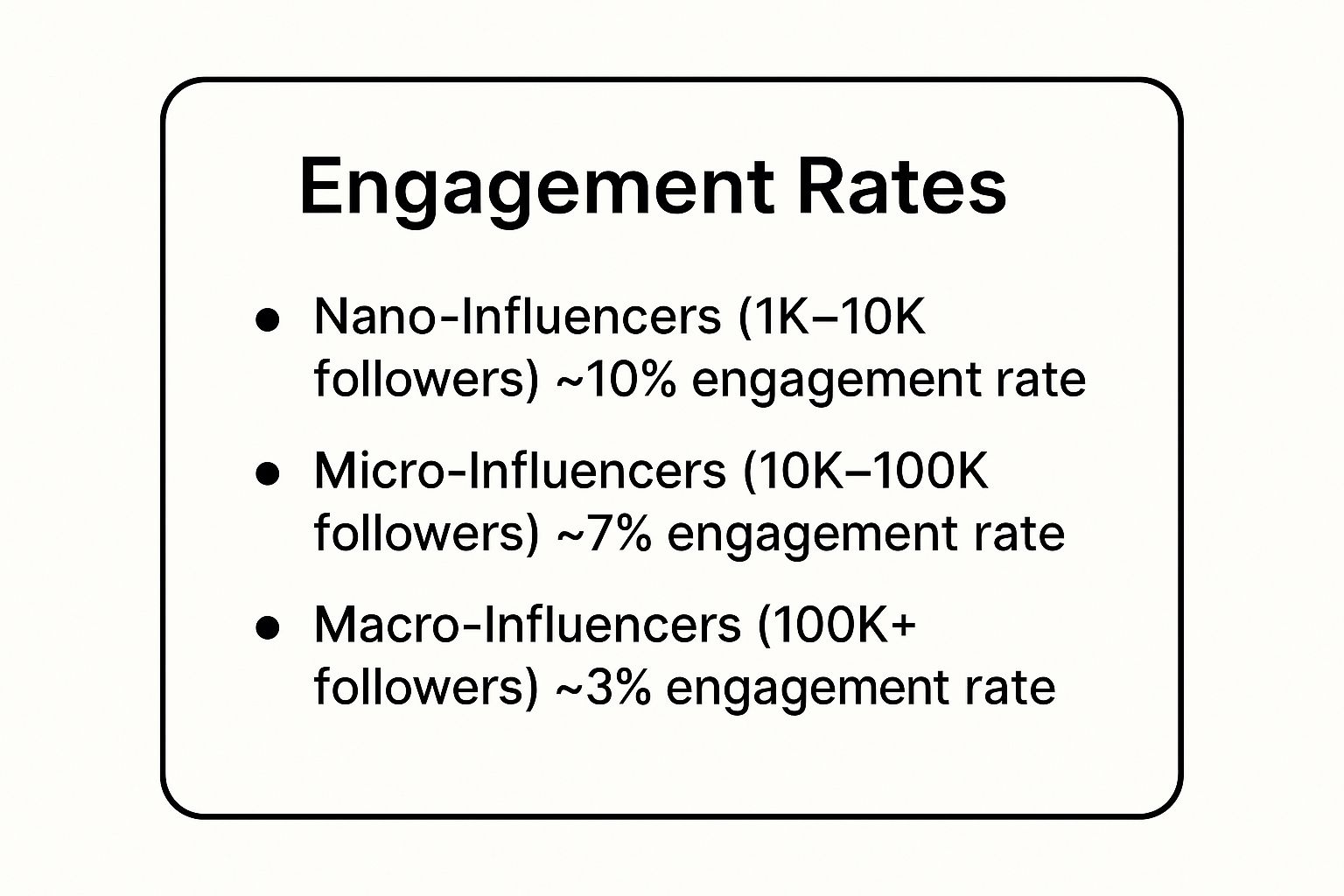
The data clearly shows that smaller, more niche influencers often deliver a higher engagement rate, providing a better return on investment and a more authentic connection for brands. This makes partnering with several micro-influencers a potentially more effective and affordable strategy than hiring one mega-influencer.
How to Implement Influencer Partnerships
A successful influencer collaboration is built on mutual respect, clear communication, and shared goals. It's about building a genuine relationship, not just a transactional exchange. Follow these steps to get started.
- Actionable Step 1: Prioritize Alignment Over Reach. Choose influencers whose values, audience demographics, and content style align perfectly with your brand. A small, engaged, and relevant audience is far more valuable than a large, mismatched one. Use tools like SparkToro or Upfluence to find influencers based on audience data, not just vanity metrics.
- Actionable Step 2: Start with Micro-Influencers. For brands new to this strategy, micro-influencers (10K-100K followers) often provide the best balance of reach, engagement, and affordability. Their recommendations are often perceived as more authentic and trustworthy.
- Actionable Step 3: Grant Creative Freedom. Provide clear campaign guidelines and objectives, but allow the influencer creative control to present your product in their unique voice. This ensures the content feels natural to their audience and not like a forced script.
- Actionable Step 4: Track and Measure ROI. Use unique discount codes, affiliate links, or dedicated landing pages to track the performance of each collaboration. This data is essential for measuring effectiveness and optimizing future campaigns.
By treating influencers as true partners, you can build long-term relationships that drive consistent and authentic brand advocacy. To integrate these partnerships into a broader growth plan, explore how they fit within a comprehensive demand generation strategy to attract and convert new customers.
4. Story-Driven Content & Behind-the-Scenes
Story-driven content and behind-the-scenes glimpses are powerful social media engagement strategies that pull back the curtain on your brand. Instead of only showcasing polished final products, this approach shares the authentic narrative of your company: its people, processes, values, and even its challenges. It humanizes your brand, transforming it from a faceless entity into a relatable group of individuals working toward a common goal, fostering a much deeper emotional connection with your audience.

Unlike polished ad campaigns that often feel distant and create a barrier, behind-the-scenes content builds trust through transparency. When followers see the genuine effort, creativity, and passion that goes into your work, they feel more invested in your success. Brands like Patagonia excel at this by sharing their environmental activism and supply chain journey, while Buffer gained a loyal following through its radical transparency, openly sharing revenue metrics and employee salaries. This unfiltered view makes a brand feel more authentic and trustworthy compared to competitors who only show a perfect facade.
How to Implement Story-Driven Content
Effectively sharing your brand's story requires a commitment to authenticity and consistency. The goal is to invite your audience into your world, making them feel like insiders. Here’s how to make it happen.
- Actionable Step 1: Utilize Ephemeral Content. Use Instagram and Facebook Stories for raw, unedited daily snapshots. Document a day in the life of an employee, show the product development process, or share candid moments from a team meeting. The temporary nature encourages immediate viewing.
- Actionable Step 2: Humanize Your Brand. Regularly feature your team members. Employee takeovers, interviews, or simple spotlights help put a face to your brand, making it far more relatable than a logo.
- Actionable Step 3: Show the Full Picture. Don't just share your victories. Documenting challenges and even failures makes your journey more compelling and your brand more authentic. This transparency builds a strong, trust-based relationship with your audience.
- Actionable Step 4: Create Recurring Content Series. Develop a consistent series, like "Maker Monday" or "Team Tuesday," to give your audience something to look forward to. This creates a predictable rhythm and keeps them coming back for more.
By integrating storytelling and transparency into your social media engagement strategies, you build a community, not just a customer base. This approach creates a narrative that people can connect with and support, turning followers into loyal advocates who are invested in your brand's journey.
5. Social Listening & Real-Time Engagement
Social listening and real-time engagement represent one of the most proactive social media engagement strategies available. It moves beyond simply posting content and waiting for reactions; instead, it involves actively monitoring digital conversations for mentions of your brand, competitors, and industry keywords. This is a reactive strategy, compared to the proactive nature of a content calendar, allowing you to turn passive mentions into meaningful interactions.
This strategy is about being present and agile. It transforms your social media channels from a broadcast monologue into a dynamic dialogue with your community. Think of Oreo's legendary "You can still dunk in the dark" tweet during the 2013 Super Bowl blackout or Wendy's viral roasts that originated from monitoring brand mentions. These moments weren't planned in a content calendar; they were born from listening to the digital landscape and seizing an opportunity to connect in a relevant, timely manner.
How to Implement Social Listening
Effective real-time engagement requires a structured approach to monitoring and a clear plan for responding. The key is to be prepared to act quickly without sacrificing brand voice or quality. Here's your action plan.
- Actionable Step 1: Establish a Monitoring Framework. Use tools like Sprout Social or Brandwatch to track not just your brand name but also common misspellings, product names, executive names, and key industry hashtags. Monitoring competitors also provides invaluable insight into their customer sentiment and uncovers opportunities you can leverage.
- Actionable Step 2: Develop a Response Matrix. Not every mention requires the same response. Create guidelines that empower your team to act decisively. For example, a customer complaint might trigger a move to DMs, a positive mention could earn a public thank you and a reshare, while a neutral question receives a quick, helpful answer.
- Actionable Step 3: Set Response Time Goals. In today's fast-paced digital world, speed matters. Aim to respond to urgent issues, like customer service complaints, in under an hour. For general mentions, a goal of a few hours is reasonable. This demonstrates that you are attentive and value your audience's input.
- Actionable Step 4: Empower Your Team. Real-time opportunities disappear fast. Waiting for multiple layers of approval will cause you to miss the moment. Empower your social media team with the autonomy to engage within the established brand guidelines, trusting them to make smart, timely decisions.
By actively listening and participating in conversations as they happen, you show your audience that you are more than just a brand; you are a responsive and engaged member of their community. This builds immense trust and fosters a loyal following.
6. Video Content & Live Streaming
Video content and live streaming are cornerstones of modern social media engagement strategies, capitalizing on platform algorithms that heavily favor dynamic media. This approach involves a multimedia mix of short-form vertical videos (Reels, TikToks), long-form content, and interactive live broadcasts. Video is uniquely effective at capturing attention, conveying emotion and personality, and simplifying complex information far more efficiently than static images or text.
Unlike a simple photo post, video allows you to tell a story, demonstrate a product in action, and build a deeper human connection with your audience. While a polished, long-form video requires significant production resources, a live stream can be raw and immediate, offering a lower-effort way to leverage video. Think of Duolingo's viral TikToks featuring its mascot, which turned language learning into entertainment, or Sephora's makeup tutorials that provide genuine value and drive sales simultaneously. These brands prove that video isn't just content; it's a powerful tool for community building and brand storytelling.
How to Implement Video Content & Live Streaming
A successful video strategy requires consistency and an understanding of what resonates with your audience. The goal is to stop the scroll and provide content that either educates, entertains, or inspires.
- Actionable Step 1: Prioritize Short-Form Vertical Video. Platforms like TikTok, Instagram Reels, and YouTube Shorts reward content in a 9:16 aspect ratio. Hook viewers within the first three seconds to prevent them from swiping away.
- Actionable Step 2: Always Add Captions. A staggering 85% of social media video is watched without sound. Adding captions makes your content accessible and ensures your message lands, even in silent-play environments. Use tools like CapCut or Premiere Rush to add captions easily.
- Actionable Step 3: Schedule Live Streams to Build Hype. Don't just go live spontaneously. Announce your live session in advance to build anticipation and maximize attendance. Use the session for Q&As, product launches, or behind-the-scenes tours.
- Actionable Step 4: Engage and Repurpose. During live streams, actively respond to comments to foster a real-time conversation. Afterward, repurpose your long-form videos by clipping the best moments into multiple short-form posts to extend their reach and value.
By embracing a video-first mindset, you align your brand with current user behavior and algorithmic preferences. Creating this content is more accessible than ever with the right set of social media content creation tools designed to simplify your workflow.
7. Value-First Educational Content
The value-first educational content strategy prioritizes giving your audience genuinely useful information over making a direct sale. Instead of promotional posts, you share content that solves their problems, answers their questions, or teaches them a new skill. This approach fundamentally shifts your brand’s role from a seller to a trusted advisor, building deep, long-lasting relationships and establishing industry authority.
Unlike sales-focused content that often gets ignored, educational content attracts an audience actively seeking solutions. This is one of the most effective social media engagement strategies for fostering loyalty because it proves you care about your audience's success, not just their wallet. Compared to fleeting trends, educational content is often evergreen, providing value and driving traffic for months or even years. Think of HubSpot's extensive library of marketing blogs and guides, which has become an indispensable resource for professionals, or Home Depot's DIY video tutorials that empower homeowners to tackle projects themselves.
How to Implement a Value-First Educational Content Strategy
Creating valuable content requires understanding your audience's pain points and delivering solutions in an accessible format. The goal is to become their go-to resource. Here’s an actionable plan.
- Actionable Step 1: Answer Common Questions. Create content that directly addresses your most frequently asked customer questions. This not only provides immediate value but also reduces the burden on your support team. A simple "How to..." guide can generate significant engagement.
- Actionable Step 2: Use the 80/20 Rule. Dedicate 80% of your content to providing pure educational value and only 20% to promotional material. This balance ensures your audience stays engaged without feeling constantly sold to.
- Actionable Step 3: Develop Content Pillars. Identify core areas of your expertise and build a content strategy around them. For example, a financial advisor might focus on pillars like "Investing Basics," "Retirement Planning," and "Debt Management," creating consistent, authoritative content for each.
- Actionable Step 4: Make Complex Topics Simple. Break down industry jargon and complicated subjects into easy-to-understand formats. Use Instagram carousels for step-by-step tutorials, LinkedIn articles for in-depth analysis, or short videos for quick tips.
- Actionable Step 5: Repurpose and Amplify. Extend the life of your best educational content by repurposing it across different platforms. A detailed blog post can be transformed into a video tutorial, an infographic, a podcast episode, and a series of social media tips.
8. Community Building & Exclusive Groups
One of the most effective social media engagement strategies involves shifting from a public broadcast model to fostering a dedicated community. Creating exclusive groups on platforms like Facebook, LinkedIn, Discord, or dedicated forums allows you to nurture your most loyal followers in a private, intimate space. This approach transforms your brand from a content publisher into a community facilitator, building deep-rooted loyalty and a powerful sense of belonging that public feeds rarely achieve.
Unlike a public page where you speak at your audience, an exclusive group is a space where you can speak with them. This strategy is higher-effort but yields higher-quality engagement compared to broadcasting to a general audience. It's where your super-fans can connect, share experiences, and feel like true insiders. Think of Peloton's official member group, where users share milestones and encouragement, or Sephora's Beauty Insider Community, a hub for millions of makeup enthusiasts to swap tips and reviews. These spaces create an ecosystem where the brand is the common ground, but the members are the stars.
How to Implement a Community Building Strategy
Building a thriving community requires more than just creating a group; it demands active participation and a commitment to providing genuine value. The goal is to make members feel seen, heard, and rewarded for their loyalty.
- Actionable Step 1: Establish Clear Guidelines & Purpose. Define the group's purpose and set clear rules for participation from day one. This ensures conversations stay on-topic, positive, and constructive. Your community guidelines should protect the space and make everyone feel welcome.
- Actionable Step 2: Offer Exclusive Perks. Give members a compelling reason to join and stay. This could include early access to new products, exclusive discounts, behind-the-scenes content, or direct Q&A sessions with your team. Exclusivity is a powerful motivator.
- Actionable Step 3: Facilitate, Don't Dominate. Your role is to spark conversations, not control them. Ask open-ended questions, create regular discussion prompts, and encourage member-to-member interactions. The community's real power comes from the connections members build with each other.
- Actionable Step 4: Recognize and Empower Super-Fans. Identify your most active and helpful members. Publicly acknowledge their contributions, feature their content, or even invite them to become community moderators or brand ambassadors. This empowers advocates and encourages others to get more involved.
9. Strategic Timing & Consistency
One of the most impactful yet often overlooked social media engagement strategies is mastering the art of timing and consistency. This data-driven approach involves publishing content precisely when your audience is most active and maintaining a predictable posting schedule. This dual focus ensures maximum visibility for your posts and signals to platform algorithms that your account is a reliable source of fresh content, often rewarding it with better reach.
Simply creating great content isn't enough; it needs to be seen. Posting at 3 AM when your audience is asleep is a wasted effort, while posting during peak hours can dramatically increase likes, comments, and shares. This is a foundational strategy; without it, the impact of all other strategies is diminished. For example, B2B brands often find success on LinkedIn between 9 AM and 11 AM on weekdays, while a fashion brand on Instagram might see higher engagement from 7 PM to 9 PM when users are unwinding. The goal is to align your publishing schedule with your audience's daily digital habits.
How to Implement Strategic Timing & Consistency
A successful timing strategy is built on data, not guesswork. It requires a commitment to analyzing performance and establishing a sustainable workflow that prioritizes both quality and regularity.
- Actionable Step 1: Analyze Your Platform Analytics. Dive into the native analytics on Instagram, Facebook, TikTok, and other platforms. Most have an "Audience" or "Insights" tab that shows the exact days and hours your followers are most active online. This is your starting point.
- Actionable Step 2: Establish a Consistent Cadence. Determine a realistic posting frequency for each platform and stick to it. Whether it's daily on Twitter or three times a week on LinkedIn, consistency builds audience expectation and satisfies algorithms.
- Actionable Step 3: Batch and Schedule Content. To avoid last-minute scrambling, dedicate time to create content in batches. Use scheduling tools like Buffer or Hootsuite to plan your posts in advance, ensuring your calendar is filled and your timing is precise.
- Actionable Step 4: Test and Refine. Your initial data provides a baseline, but don't be afraid to experiment. Test posting 30 minutes before or after a peak time and track the performance. Continuously refine your schedule based on what the engagement data tells you.
By synchronizing your content delivery with audience behavior, you ensure your message lands with maximum impact. You can learn more about how to pinpoint these optimal times by exploring guides on the best times to post on social media to fine-tune your schedule.
10. Personalization & Audience Segmentation
Personalization and audience segmentation are advanced social media engagement strategies that move beyond a one-size-fits-all approach. Instead of broadcasting the same message to everyone, this method involves dividing your audience into smaller, specific groups based on demographics, behaviors, or interests. By tailoring content to these segments, you deliver a message that feels more relevant and personal, dramatically increasing its impact and fostering a stronger connection with your followers.
This targeted approach transforms your social media feed from a megaphone into a one-on-one conversation. When content directly addresses a follower's specific needs or passions, they are far more likely to engage. Compare this to a generic post that tries to appeal to everyone and ends up resonating with no one. Think of Spotify’s "Discover Weekly" playlists, which are so hyper-personalized they feel like a gift from a friend, or Netflix's customized artwork and recommendations that cater to individual viewing habits. These platforms prove that relevance is the key to retention and engagement.
How to Implement Personalization & Segmentation
Effective segmentation requires a data-informed approach to understand who your audience is and what they care about. The goal is to create content that resonates with distinct subgroups within your broader follower base.
- Actionable Step 1: Identify and Define Your Segments. Use your social media analytics to identify natural audience clusters. Start with basic segmentation like location, age, or expressed interests. You can then create more detailed buyer personas for each major segment to guide your content creation.
- Actionable Step 2: Create Tailored Content Streams. Develop content pillars that speak directly to the pain points and interests of each segment. For example, a fitness brand might create separate content for marathon runners versus yoga enthusiasts. Use platform features like Instagram's "Close Friends" list or targeted ads to deliver this content to the right people.
- Actionable Step 3: Personalize at Scale. Use dynamic content in ads that changes based on the viewer’s data, such as showing different products to users in different cities. Address your audience directly in your copy, making them feel seen and understood. Always test your personalized content against more general posts to measure the lift in engagement.
- Actionable Step 4: Respect Privacy. While using data to personalize, it is crucial to be transparent about how you use it and to respect user privacy. Building trust is paramount for this strategy to be effective long-term.
By speaking directly to the individuals within your audience, you make your brand more relatable and valuable. You can learn more about how to group your audience effectively by exploring different customer segmentation strategies to refine your approach.
Top 10 Social Media Engagement Strategies Comparison
| Strategy | Implementation Complexity 🔄 | Resource Requirements ⚡ | Expected Outcomes 📊 | Ideal Use Cases 💡 | Key Advantages ⭐ |
|---|---|---|---|---|---|
| User-Generated Content (UGC) Campaigns | Medium: Requires moderation, permissions management | Low to Medium: Mainly community management | Increased trust, engagement, and reach | Brands wanting authentic peer recommendations and fresh content | Cost-effective, high trust, continuous fresh content |
| Interactive Content & Polls | Low: Easy to create, requires consistent follow-up | Low: Minimal content creation effort | Higher engagement and valuable audience insights | Quick feedback, boosting engagement, market research | Fast engagement, real-time insights, algorithm-friendly |
| Influencer Partnerships & Collaborations | High: Vetting, negotiation, ongoing management | High: Potentially expensive depending on influencer tier | Credibility, targeted reach, authentic content | Targeted promotion via trusted voices, brand awareness | High ROI (especially micro-influencers), authentic endorsements |
| Story-Driven Content & Behind-the-Scenes | Medium to High: Requires consistent content creation | Medium: Content creation and employee participation | Deep emotional connection, trust, differentiation | Humanizing brands, building emotional resonance | Builds strong emotional ties, transparency, high engagement |
| Social Listening & Real-Time Engagement | High: Needs dedicated staff and clear protocols | Medium to High: Monitoring tools and staff time | Crisis management, customer relationships, trend participation | Brands needing proactive customer service and reputation management | Timely responses, customer insights, crisis prevention |
| Video Content & Live Streaming | High: Technical skills, equipment, production time | High: Production costs, editing, live support | Higher shares, retention, FOMO, emotional connections | Brands leveraging visual storytelling and product demos | Superior engagement, multiple formats, algorithm prioritization |
| Value-First Educational Content | Medium to High: Requires expertise and time | Medium to High: Content development and research | Authority building, SEO benefits, long-term trust | Brands focusing on thought leadership and problem-solving | Builds credibility, evergreen content, high saves/shares |
| Community Building & Exclusive Groups | High: Ongoing moderation and engagement required | Medium to High: Moderation and management effort | Brand loyalty, user advocacy, organic content | Brands wanting deeper interactions and advocacy | Strong loyalty, user-generated content, lower acquisition cost |
| Strategic Timing & Consistency | Medium: Requires analysis and scheduling tools | Low to Medium: Use of analytics and scheduling | Improved reach, engagement, follower growth | Maximizing impact via posting time optimization | Maximizes organic reach, audience routine building |
| Personalization & Audience Segmentation | High: Data analysis, sophisticated content creation | High: Tools and expertise for segmentation | Higher engagement, conversion, customer lifetime value | Brands targeting multiple customer demographics | Precise targeting, improved conversions, relevant messaging |
Turning Strategy into Action: Your Next Steps for Higher Engagement
You now possess a robust playbook of ten powerful social media engagement strategies, moving beyond generic advice to actionable, results-driven tactics. We've navigated the creative power of User-Generated Content (UGC), the immediate feedback loop of Interactive Polls, the amplified reach of Influencer Partnerships, and the authentic connection built through Story-Driven Content. This is more than a list; it's a strategic framework for transforming your social media from a broadcast channel into a dynamic community hub.
The core lesson is this: engagement isn't a single action, but a comprehensive philosophy. It’s the difference between posting a video (a tactic) and launching a live stream Q&A session based on social listening (a strategy). It’s the contrast between simply sharing a customer photo and building a full-fledged UGC campaign with a unique hashtag and incentives. True engagement is proactive, responsive, and deeply rooted in providing value before asking for anything in return.
From Knowledge to Execution: A Phased Approach
The sheer number of options can feel overwhelming. The key is not to implement all ten strategies simultaneously. A scattered approach yields scattered results. Instead, a focused, phased implementation is your best path to measurable success. Think of it like a marketing sprint rather than a marathon with no finish line.
Your immediate next steps should be methodical:
-
Establish Your Baseline: Before implementing any new strategy, conduct a thorough audit of your current social media performance. What is your average engagement rate? Which content formats perform best? Where are the most significant drop-offs? You cannot measure improvement without a clear starting point.
-
Prioritize Based on Resources and Audience: Select two or three strategies from this list that align most naturally with your brand identity and available resources. A B2B tech company might prioritize Value-First Educational Content and Personalization, while a direct-to-consumer fashion brand might find more immediate success with UGC Campaigns and Influencer Collaborations.
-
Commit to a Test Period: Dedicate one full business quarter to executing your chosen strategies. Consistency is critical. A single poll or one behind-the-scenes story won't move the needle. You need to commit to a sustained effort to gather meaningful data and give the strategy a fair chance to work.
Comparing Paths: UGC vs. Influencers, Community vs. Content
Consider the trade-offs. A UGC campaign is cost-effective and builds immense social proof, but it requires a pre-existing, motivated audience to contribute content. In contrast, influencer partnerships can deliver immediate, targeted reach to a new audience, but often require a significant budget and careful vetting to ensure brand alignment. Neither is inherently better; the "right" choice depends on whether your current goal is to activate your existing community or acquire a new one.
Similarly, compare Community Building in an exclusive group with creating broad-appeal Educational Content. A Facebook Group fosters deep loyalty and provides invaluable customer insights, but its impact is concentrated on a smaller, dedicated audience. A viral educational video or infographic, however, can generate massive top-of-funnel awareness but may not create the same level of brand advocacy. Your strategic choice here depends on whether you need to nurture leads or generate them.
Ultimately, mastering these social media engagement strategies is about transforming your brand from a passive announcer to an active participant in your audience's conversation. It's about building relationships, fostering trust, and creating a community that not only buys from you but advocates for you. The result isn't just higher engagement metrics; it's a stronger brand, a more loyal customer base, and a direct impact on your bottom line.
Ready to scale your engagement efforts with precision and intelligence? marketbetter.ai uses advanced AI to help you analyze audience data, automate personalized content creation, and track the ROI of your social media engagement strategies in real time. Visit marketbetter.ai to see how you can turn these powerful strategies into predictable business growth.