
2 posts tagged with "b2b marketing metrics"

View All Tags

B2B Marketing Analytics: Your Actionable Guide to Growth

· 24 min read

Let’s get one thing straight: B2B Marketing Analytics isn't just about collecting data. It’s the art and science of turning that raw data—from every campaign, click, and customer chat—into a strategic weapon. For any B2B company navigating long sales cycles and crowded buying committees, it’s the only way to figure out what’s actually moving the needle on revenue.

Decoding B2B Marketing Analytics

Picture your marketing strategy as a complex, cross-country road trip. You could just start driving and hope for the best, but you’ll probably get lost. B2B marketing analytics is your advanced GPS—giving you real-time data, turn-by-turn directions, and traffic alerts to make sure you get where you’re going efficiently.

It’s the engine that transforms a messy spreadsheet of numbers into a clear, strategic roadmap.

Instead of obsessing over surface-level metrics like clicks or social media likes, this discipline zeroes in on what directly connects your work to business outcomes. It’s about answering the tough questions that keep marketers up at night:

  • Which channels are really bringing in qualified leads?
  • How did that webinar series actually impact pipeline speed and deal size?
  • What’s the true ROI on our ad spend this quarter?

This is what moves a team from making decisions on gut feelings to making them based on hard evidence.

Why It’s Non-Negotiable Today

The modern B2B buyer’s journey is a maze. The sales cycle has stretched out, and there are more people and touchpoints involved than ever before. In fact, research shows a typical B2B deal now involves an average of 62 or more touchpoints over six months, with at least seven decision-makers weighing in. You can dig into more of these trends with these 2025 statistics.

Trying to navigate this without analytics is like flying blind. You’d have no idea that a prospect first read a blog post, then attended a webinar a month later, and finally clicked a retargeting ad right before they agreed to a sales call. Each of those interactions is a critical piece of the puzzle.

B2B marketing analytics isn't just about reporting what happened; it’s about understanding why it happened and predicting what will happen next. It provides the proof needed to justify budgets, align with sales, and build a predictable engine for growth.

The Actionable Difference: B2B vs. B2C Analytics

Sure, both B2B and B2C marketers use analytics, but they are playing entirely different games. B2C analytics is often a sprint, focused on high-volume, short-term conversions like an immediate online purchase. It's a numbers game where success is often measured by cost per acquisition for a single transaction.

B2B marketing analytics, on the other hand, is a marathon. It’s built to track long, complex journeys that can span months or even years. The focus here is on lead quality over quantity, and success is measured with metrics like pipeline generation, customer lifetime value (CLV), and account-level engagement—not just one-off transactions. That strategic depth is what separates guesswork from predictable success.

The Essential B2B Marketing Metrics to Track

Let's cut through the noise. Too many teams get lost chasing vanity metrics that look good in a slide deck but don't actually move the needle. True B2B marketing analytics is about focusing on what drives revenue, period.

This section breaks down the core metrics by funnel stage, helping you turn your dashboard from a simple report into a decision-making machine.

Think of it like this: your strategy is the blueprint. That blueprint dictates what data you collect, which in turn generates the insights you need to grow.
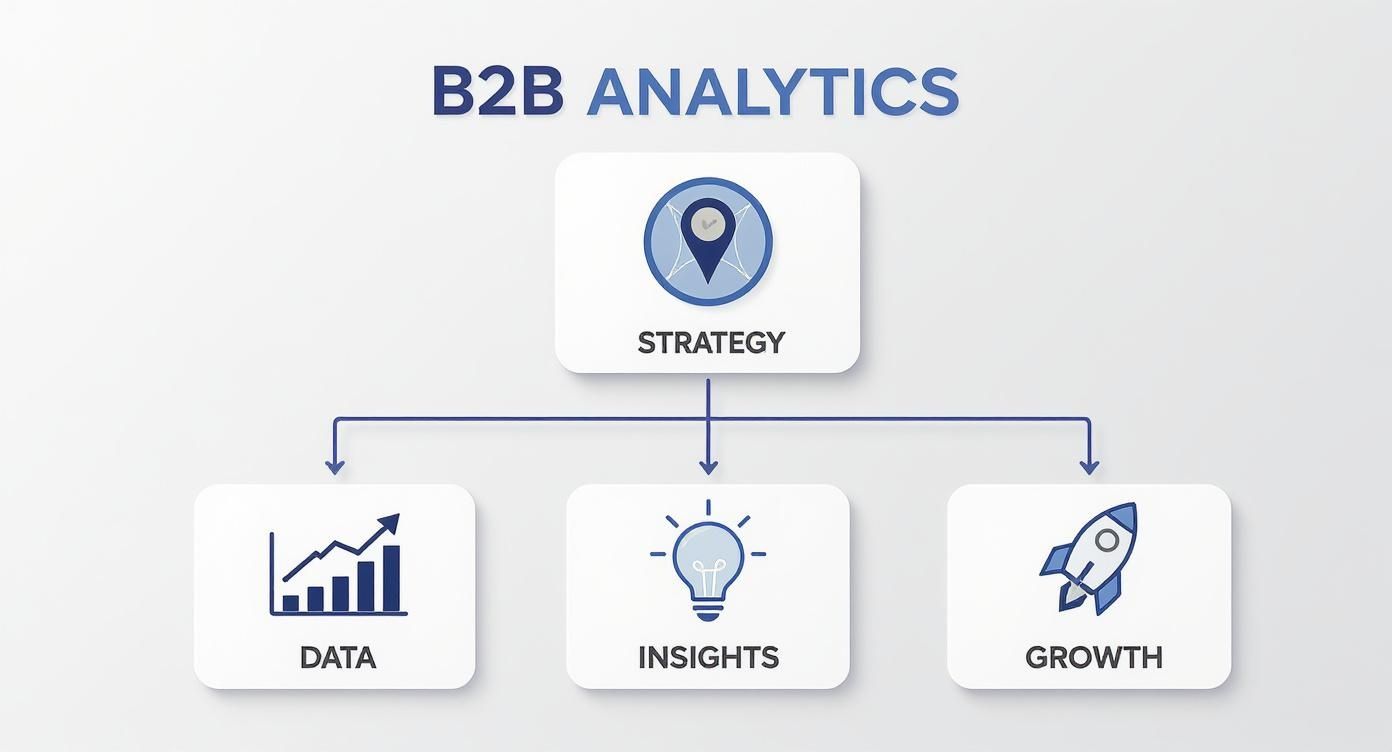
Infographic about b2b marketing analytics

This whole process starts with a solid strategy, which guides your data capture, fuels your insights, and ultimately powers real, scalable growth.

Top Of Funnel Metrics

At the top of the funnel, it's all about awareness and initial interest. These metrics tell you which channels are attracting the right prospects. Forget raw traffic; focus on metrics that signal genuine intent.

Key metrics to watch here are MQLs, organic traffic quality, and paid channel performance.

  • Marketing Qualified Leads (MQLs): This is your first real signal of interest. Are people raising their hands by downloading a guide or signing up for a webinar?
  • Organic Traffic: This isn't just about volume. Track which specific blog posts or landing pages generate the most leads to understand which SEO efforts connect with your audience's problems.
  • Paid Traffic: This measures the immediate impact of your ad spend. Compare Cost Per Click (CPC) against Cost Per MQL to see which campaigns are not just cheap, but effective.

Here’s an actionable comparison of these top-of-funnel metrics:

MetricWhat It Really Tells YouHow to Improve It
MQLsLead volume and the quality of your sources.Action: A/B test your landing page headlines and simplify form fields to two or three essential questions.
Organic TrafficKeyword relevance and content reach.Action: Identify your top 5 lead-generating blog posts and create more content around those core topics.
Paid TrafficAd targeting and message-market fit.Action: Pause your bottom 10% of performing ads (by cost per MQL) and reallocate that budget to the top performers.

If your MQL conversion rate dips below 5%, that’s a red flag. It might be time to test a new lead magnet or simplify your forms. A small, data-driven tweak here can boost engagement before you even think about scaling your budget.

But remember, volume alone isn't the goal. Quality is what matters next.

Middle Of Funnel Metrics

Once you have their attention, the middle of the funnel is where you deepen engagement and figure out who is genuinely a good fit. These metrics track the interactions that turn casual interest into qualified conversations.

  1. Sales Qualified Leads (SQLs): These are the MQLs that sales has vetted and accepted. It's the critical handoff point and the ultimate measure of lead quality.
  2. Content Engagement: Are people actually consuming your stuff? Track downloads, video views, and webinar attendance to see what resonates. Compare engagement rates between different content formats (e.g., webinars vs. whitepapers).
  3. Email Open and Click Rates: This shows which nurture sequences are working and which are falling flat. If open rates are high but click rates are low, your subject line works but your call-to-action is weak.

Mid-funnel insights are your secret weapon. They help you optimize your messaging and timing long before a deal is even on the table.

These numbers tell you exactly which assets and channels are moving leads closer to a sale. For instance, if you notice that webinar attendance drives a 20% lift in SQLs compared to ebook downloads, it's a no-brainer—allocate more budget to live events and the follow-up sequences that support them.

Bottom Of Funnel Metrics

This is where the rubber meets the road. Bottom-of-funnel metrics connect your marketing efforts directly to revenue and the speed at which you close deals.

One of the most critical numbers for any B2B marketer to master is their customer acquisition cost (CAC).

  • Customer Acquisition Cost (CAC): How much does it really cost you to win a new customer? This grounds your strategy in financial reality.
  • Customer Lifetime Value (CLV): This reveals the long-term revenue you can expect from each account, telling you who your most valuable customers are. Your goal should be a CLV:CAC ratio of at least 3:1.
  • Pipeline Velocity: How fast are deals moving through your sales stages? This is a key indicator of your sales cycle's health.

A healthy pipeline velocity often means shorter deal cycles. As a rule of thumb, aim to move deals through each stage in under 30 days to maintain momentum. If things are stalling, you know exactly where to look.

To really connect these numbers to overall business performance, check out our guide on calculating marketing ROI.

Best Practices For Metric Management

Knowing the metrics is one thing; managing them effectively is another. Here are actionable steps to take.

  • Talk to sales weekly. Review MQL-to-SQL conversion rates together to spot trends and align on lead quality. Ask them "Why was this lead rejected?" to get direct, actionable feedback.
  • Benchmark your financials monthly. Keep a close eye on CAC and CLV to find opportunities for cost optimization. If CAC is rising, analyze channel performance to cut inefficient spend.
  • Monitor pipeline velocity daily. This allows you to catch bottlenecks before they derail a whole quarter. If deals are stuck in one stage, investigate with sales immediately.
  • Visualize everything. Use simple dashboards to communicate what matters to stakeholders and non-technical teams at a glance.

A metric measured is a metric improved.

Pro Tip: Schedule a standing monthly analytics review with your sales team. This single meeting can solve a ton of cross-departmental friction and uncover powerful insights.

For example, one SaaS firm I know improved its pipeline velocity by 25% in a single quarter just by tightening its SQL criteria based on feedback from these meetings.

By tracking these key metrics, you transform analytics from a reporting chore into a proactive engine for growth.

Building Your B2B Analytics Tech Stack

Your B2B marketing analytics are only as good as the tools you use to collect and connect the data. Building a tech stack isn't about buying the most expensive software on the shelf; it's about creating a single, interconnected system where information flows freely. This gives you a complete, honest picture of the customer journey.

Think of it like assembling a high-performance engine—each part has to work perfectly with the others.

The goal is to build a single source of truth and tear down the data silos that keep your teams guessing. When your web analytics platform, CRM, and marketing automation software are all talking to each other, you can finally connect a blog post someone read six months ago to the deal they just signed today. That unified view is where effective B2B marketing analytics truly begins.

Screenshot from https://analytics.google.com/analytics/web/

A dashboard like this from Google Analytics is ground zero. It lets you see which channels are actually bringing in engaged users, helping you decide where to put your budget and what kind of content to create next.

The Core Pillars of Your Analytics Stack

A powerful, no-nonsense stack is built on four essential tool categories. Each one plays a distinct role, but their real magic is unlocked when they're all hooked together.

  1. Web Analytics Platforms: This is your top-of-funnel lens. Tools like Google Analytics 4 (GA4) are non-negotiable for understanding how people find and interact with your website. They answer critical questions like, "Which blog posts are generating the most MQLs?" or "Why are people bouncing from our pricing page?"

  2. Customer Relationship Management (CRM): Your CRM is the heart of the entire operation. Platforms like Salesforce or HubSpot act as the central database for every lead and customer. This is where you track every touchpoint a contact has with your sales team, from the very first email to the final signature.

  3. Marketing Automation Platforms: This is where you connect marketing actions to actual lead behavior. Tools like Marketo or the automation suites built into HubSpot handle things like lead nurturing, email campaigns, and scoring. They tell you which leads are warming up and are actually ready for a sales conversation.

  4. Business Intelligence (BI) Tools: Once you have data flowing from the other three pillars, you need to make sense of it. BI tools like Looker Studio or Tableau are designed to visualize that data. They pull everything into unified dashboards that make complex information easy for anyone in the company to understand at a glance.

Your tech stack should tell a cohesive story. If your CRM shows a new customer just signed, but your web analytics has no idea where they originally came from, you have a massive blind spot in your B2B marketing analytics strategy.

Choosing Tools That Actually Fit Your Needs

The right tools depend entirely on your company's size, budget, and the complexity of your sales cycle. A startup's needs are a world away from a global enterprise's.

Here’s a practical look at how that breaks down:

Company SizeWeb AnalyticsCRM & Marketing AutomationBI Tool
Small Business / StartupGoogle Analytics 4 (Free)An all-in-one like HubSpot StarterLooker Studio (Free)
Mid-Market CompanyGA4 / MatomoSalesforce integrated with Pardot or MarketoTableau / Power BI
EnterpriseAdobe AnalyticsSalesforce (highly customized) with a dedicated automation platformCustom BI solution

The real key here is integration. A small business running on HubSpot can see a contact's entire journey—from their first ad click to their latest sales call—all in one place. An enterprise, on the other hand, might need a more sophisticated setup to connect a dozen different systems. For a closer look at tying it all together, see our guide on customer data platform integration.

At the end of the day, the best stack isn't the one with the most bells and whistles. It's the one your team actually uses—one that provides clear, actionable insights that get marketing and sales working from the same playbook. Start with your core needs, pick tools that play well together, and build from there.

Choosing the Right B2B Analytics Framework

Having the right tools and metrics is one thing, but they're just pieces of the puzzle. To really turn raw data into a predictable growth engine, you need a strategic framework. Think of it as the operating system for your entire marketing analytics effort, the thing that connects your day-to-day actions directly to business outcomes.

It’s a bit like building a house. Your tech stack is the toolkit, and your metrics are the raw materials—the lumber, pipes, and wires. But the framework? That’s the blueprint. It tells you how to put everything together to build something that actually stands up. Without that blueprint, all you've got is an expensive pile of wood.

In modern B2B, two dominant frameworks shape how we measure success: Multi-Touch Attribution (MTA) and Account-Based Marketing (ABM) analytics. The right choice for you comes down to your business model, how long your sales cycle is, and your overall go-to-market strategy.

Multi-Touch Attribution: Unpacking the Entire Journey

Multi-Touch Attribution (MTA) sets out to solve one of marketing's oldest headaches: figuring out which of your many, many efforts actually helped close a deal. Instead of dumping all the credit on the very last click—like a demo request form—MTA spreads that credit across multiple touchpoints along the buyer's journey.

This is absolutely critical in B2B, where a single deal can involve dozens of interactions stretched out over months. An MTA framework helps you finally see the value in everything, from that first blog post a prospect read six months ago to the webinar they attended right before signing up.

There are several ways to slice this pie, and each model tells a slightly different story:

  • Linear Model: Simple and democratic. It gives equal credit to every single touchpoint along the path. Use this when: Your sales cycle is long and you want to understand the general impact of all channels.
  • U-Shaped Model: Puts the spotlight on two key moments, giving 40% of the credit to the first touch and 40% to the lead conversion touch. The remaining 20% is sprinkled across all the interactions in between. Use this when: Lead generation is your primary marketing goal.
  • W-Shaped Model: Similar to the U-shaped model but adds a third major milestone—the opportunity creation. It gives 30% credit to the first touch, 30% to opportunity creation, and 30% to the close. Use this when: You want to give equal weight to marketing and sales handoff points.

To really get under the hood of how these work in the real world, check out our detailed guide on Multi-Touch Attribution models. Picking the right one helps you see which "assists" are just as valuable as the final "goal."

Account-Based Marketing Analytics: Focusing on High-Value Targets

While MTA is all about the individual's journey, Account-Based Marketing (ABM) analytics flips the script entirely. It focuses all measurement on a hand-picked list of high-value accounts, not individual leads. The core question isn't, "Which channels are generating the most leads?" It’s, "Are we successfully engaging and penetrating our most important target accounts?"

This framework is a perfect fit for companies selling big-ticket items to large organizations with complex buying committees. Here, success isn't about the sheer volume of MQLs; it’s about the depth of engagement across a target account.

Key ABM metrics you'll live and breathe include:

  • Target Account Engagement: Are the key contacts at your target companies actually interacting with your content, ads, and salespeople?
  • Account Penetration: How many of the decision-makers within a single target account have you managed to engage?
  • Pipeline Velocity: How quickly are your target accounts moving from one stage to the next?

This razor-sharp focus is what helps align sales and marketing teams so they can move as one.

Comparing Analytics Frameworks: Multi-Touch Attribution vs. ABM

The debate between MTA and ABM isn't about which one is "better"—it's about which one is better aligned with your strategy. To make the choice clearer, let's put them side-by-side.

FeatureMulti-Touch Attribution (MTA)Account-Based Marketing (ABM) Analytics
Primary FocusTracking the impact of every touchpoint in a lead's journey.Measuring engagement and penetration within high-value target accounts.
Unit of MeasureIndividual leads and conversions.Target accounts and the buying committee within them.
Best ForCompanies with a high volume of inbound leads and diverse marketing channels.Businesses selling high-ticket items to a limited number of large accounts.
Key Question"Which marketing channels are most effective at driving conversions?""Are we deepening our relationships with our most important accounts?"

The rise of AI is also changing how these frameworks get put into practice. A 2025 study found that 62% of B2B marketers are already using AI for brainstorming and content creation, which fuels both the broad-reach campaigns measured by MTA and the highly-targeted plays tracked by ABM. You can dig into more stats on how AI is shaping B2B marketing strategies on seoprofy.com.

Ultimately, the best framework is the one that gives you the clarity to make smarter, data-driven decisions. It’s about turning your analytics into a predictable, repeatable source of revenue.

Common B2B Analytics Mistakes to Avoid

Even with the right tools and a solid framework, a few common pitfalls can completely derail your B2B marketing analytics. I've seen it happen time and again. Knowing what these mistakes are is the first step to sidestepping them and turning potential failures into the kind of learnings that actually sharpen your strategy.

A person looking at a complex chart, representing the challenge of B2B analytics

Think of this section as your troubleshooting guide. We'll walk through the classic blunders that undermine analytics and give you clear, actionable ways to keep your data-driven engine running smoothly.

Focusing on Vanity Metrics Over Revenue

This is probably the most common trap: mistaking activity for progress. It feels great to celebrate a big spike in social media followers or a jump in website traffic, but those numbers are hollow if they don’t connect back to revenue.

The Mistake: Reporting on "impressions" and "likes" instead of "marketing-sourced pipeline" and "cost per SQL." The Fix: Tie every marketing KPI back to a sales outcome. Constantly ask yourself, "How does this metric tie to pipeline?" Instead of just reporting on traffic, report on the traffic that converts to leads. Don't just celebrate ebook downloads; track which of those downloads actually progress to a sales opportunity.

Letting Data Live in Silos

Data silos are the silent killers of any good analytics strategy. When your web analytics, HubSpot CRM, and marketing automation platform aren't talking to each other, you're looking at a fractured, incomplete picture of the customer journey.

The Mistake: Analyzing channel performance in separate platforms without a unified view. You see a Google Ad drove a form fill, but miss the five blog posts and two webinars they engaged with first. The Fix: Make your CRM the central hub. Ensure it pulls in data from all other platforms to create a single, unified customer record that tracks every interaction. This is the only way to see the complete journey from first touch to final sale.

The only solution is integration. Your tech stack needs to operate like a single, cohesive system. Make sure your CRM is the central hub, pulling in data from all your other platforms to create one unified customer record that tracks every single interaction, from the first touch to the final sale.

Suffering From Analysis Paralysis

With so much data at our fingertips, it's incredibly easy to get overwhelmed. Analysis paralysis is what happens when you spend so much time digging through data that you never actually get around to taking action. It's a classic case of majoring in the minors.

The Mistake: Building a dashboard with 50 different charts and trying to monitor everything at once. The Fix: Create focused, role-based dashboards. Your CMO needs a high-level view of ROI and pipeline. A content manager needs to see blog performance and MQLs. They do not need to see the same things.

Actionable Tip: Start each week by identifying one key question you want your data to answer. For example, "Which channel produced the most sales-qualified leads last month?" This targeted approach turns an overwhelming sea of data into a single, actionable insight.

Putting Your B2B Analytics Into Action

A report gathering dust on a drive does no one any good. You need to weave your analytics into daily routines so data becomes your company’s compass rather than just another file in a folder.

This shift moves B2B analytics from a marketing afterthought into a strategic asset that shapes decisions across the board. It takes time, patience, and a clear set of steps—but the payoff is huge.

From Dashboards To Decisions

A dashboard nobody looks at is like a map you never unfold. If the charts confuse more than they clarify, they’ll collect virtual cobwebs.

Focus on role-specific views. Not everyone needs every data point.

  • Leadership Dashboards: Show the link between spend and revenue—pipeline growth, marketing ROI, CAC and CLV trends.
  • Sales Views: Highlight top-performing lead sources and the MQL quality they deliver.
  • Marketing Specialist Panels: Drill into campaign metrics, channel performance, and content engagement for everyday tweaks.

Each team gets a dashboard that feels built just for them. That way, data moves from curiosity to action.

Fostering A Test And Learn Mindset

A mature data culture treats every campaign like a lab experiment. You don’t launch and hope—you state a clear hypothesis, measure the outcome, then iterate.

Say you roll out a new email sequence. Instead of “Let’s see if it works,” frame it this way: “We believe adding a customer story at the mid-funnel stage will boost demo requests by 15%.”

Hit the target? Great. Miss it? You’ve still learned something vital. Data becomes the impartial judge, not a weapon for blame.

The goal is to use data to prove or disprove ideas, not to prove who was right. This approach sparks curiosity, not defensiveness.

Creating Data-Driven Rituals

Insights vanish if they’re not revisited. Build regular check-ins where data is front and center.

Meeting TypeFrequencyAttendeesPrimary Goal
Weekly Stand-upWeeklyMarketing TeamReview last week’s top metrics and make tactical tweaks.
Monthly Strategy ReviewMonthlyMarketing & Sales LeadershipAssess MQL-to-SQL conversion and plan for the next cycle.

Think of these sessions as a habit loop. Weekly stand-ups keep you nimble; monthly reviews align long-term strategy. Over time, your teams will instinctively reach for the data first—no reminders needed.

By turning analytics into a shared practice, you build an organization that learns and adapts. Every major choice hinges on clear, actionable insights, not gut feelings.

Got Questions About B2B Marketing Analytics? We've Got Answers.

Jumping into B2B marketing analytics can feel like trying to drink from a firehose. But once you get a handle on a few core ideas, everything starts to click. Let's tackle the questions that come up most often, with answers you can actually put to work.

How Do I Choose Between Lead-Based and Account-Based Analytics?

This decision comes down to your sales motion, pure and simple. Think of it as the difference between fishing with a wide net and fishing with a spear.

Lead-based analytics is your wide net. It's the right call when your main job is to pull in a high volume of individual leads from every channel you can. Here, you're obsessed with metrics like MQLs per channel and your cost per lead. This approach is ideal for businesses with a shorter sales cycle and a broad target market.

On the other hand, account-based analytics is like spearfishing. You've already picked out your big-game targets. Your goal isn't volume; it's measuring how deeply you're engaging with those specific accounts. You'll be tracking things like account penetration (how many key contacts have we touched?) and pipeline velocity for your named accounts. This is best for companies with a long sales cycle, high contract values, and a defined set of target companies.

What's a Good MQL-to-SQL Conversion Rate?

Look, benchmarks are all over the place, but a healthy MQL-to-SQL rate usually lands somewhere between 10% and 30%. But honestly, the exact number is less important than its trend. Is it going up or down?

If your rate is dipping below 10%, that's a big red flag for misalignment between marketing and sales. It probably means your MQL definition is way too loose, or the content you're creating just isn't hitting the mark with the right people.

Actionable Fix: Set up a weekly meeting with your sales team. Pull up the list of rejected leads and ask one simple question: Why? That single conversation will give you more actionable insight than a dozen dashboards and help you dial in your targeting almost overnight.

How Often Should I Check My Analytics Dashboards?

Trying to watch everything, every day, is a fast track to burnout. You'll get lost in the noise and miss what actually matters. Instead, use a tiered approach so you're looking at the right data at the right time.

  • Daily Check-ins (5 minutes): This is just for pacing. Focus on your paid campaigns. Are you on track to hit your budget and lead goals for the month? This is all about catching fires before they get out of control.
  • Weekly Reviews (30 minutes): Now you can dig into channel performance. Which blog posts, ads, or emails drove the best engagement last week? This is where you make your tactical tweaks.
  • Monthly & Quarterly Strategy Sessions (1-2 hours): Time to zoom out and look at the big picture. Analyze your Customer Acquisition Cost (CAC), pipeline velocity, and marketing-sourced revenue. These are the meetings that shape your strategy and budget for the next quarter.

This rhythm makes sure you’re reacting quickly to small things while saving the big strategic calls for when you have enough data to move with confidence.


Ready to stop guessing and start building a predictable marketing engine? The marketbetter.ai platform uses AI to connect your data, optimize your campaigns, and give you the clear, actionable insights you need to drive real growth. See how you can transform your B2B marketing analytics by visiting https://www.marketbetter.ai.

8 Marketing KPIs B2B Companies Must Track in 2025

· 30 min read

In B2B marketing, the pressure to prove value and contribute directly to the bottom line is immense. While vanity metrics like social media likes or impressions might feel good, they don't resonate in the boardroom. VPs of Sales and CMOs want to see tangible results: pipeline growth, revenue generation, and operational efficiency. The key to demonstrating this impact lies in tracking the right performance indicators. Focusing on the correct marketing KPIs for B2B is what separates high-growth, data-driven teams from those just spinning their wheels on low-impact activities.

This comprehensive guide moves beyond simple definitions. We will break down the eight most critical KPIs that every B2B marketing and sales leader should have on their dashboard. For each metric, we'll provide actionable comparisons, realistic benchmarks to aim for, and practical strategies you can implement immediately to improve your numbers. You won't find generic advice here; instead, you'll get a clear framework for measuring what truly matters.

Whether your goal is to justify a budget increase, optimize your demand generation engine, or align more closely with sales, this listicle provides the data-backed insights you need. By the end, you will understand not only what to measure but also how to use these KPIs to make smarter strategic decisions, prove marketing’s contribution to revenue, and build a more predictable growth model. Let's dive into the metrics that genuinely move the needle.

1. Marketing Qualified Leads (MQLs)

A Marketing Qualified Lead (MQL) is more than just a contact; it's a prospect who has actively shown interest in your brand and fits your ideal customer profile. These individuals have engaged with your marketing materials, such as downloading a whitepaper or attending a webinar, signaling they are ready to learn more but are not yet prepared for a direct sales conversation. Tracking MQLs is one of the most fundamental marketing kpis b2b because it directly measures the effectiveness of your top-of-funnel activities in generating high-potential prospects.

Marketing Qualified Leads (MQLs)

This KPI bridges the gap between marketing efforts and sales readiness. By defining what constitutes an MQL, you create a clear handoff point, ensuring the sales team receives leads who have already been warmed up and vetted. This alignment, pioneered by platforms like HubSpot and formalized by frameworks like the SiriusDecisions Demand Waterfall, is critical for efficient B2B growth.

How to Implement and Track MQLs

Implementing an MQL system involves a combination of demographic, firmographic, and behavioral data. A simple lead scoring model is the best place to start. Assign points for attributes that match your ideal customer (e.g., industry, company size, job title) and actions that indicate interest (e.g., pricing page visits, demo requests).

  • Define Your Criteria: Work directly with the sales team to create a universally agreed-upon definition of an MQL. Actionable Step: Hold a joint workshop and document the final definition in a shared Service Level Agreement (SLA).
  • Set a Threshold: Determine a point score at which a lead officially becomes an MQL and is passed to the sales team. For instance, a lead might need to accumulate 100 points to qualify. Actionable Step: Start with a conservative threshold and adjust it based on the MQL-to-SQL conversion rate feedback from sales.
  • Automate the Process: Use your CRM or marketing automation platform to track lead scores automatically. Set up workflows to notify sales representatives as soon as a lead hits the MQL threshold.

Key Insight: A common mistake is setting MQL criteria and never revisiting them. Your ideal customer profile and their buying signals will evolve. Review and adjust your lead scoring rules at least quarterly based on which MQLs successfully convert into sales opportunities.

Actionable Tips for MQL Optimization

To maximize the value of your MQLs, focus on continuous refinement and quality control. For example, Salesforce improved MQL accuracy by 40% using predictive lead scoring, which analyzes historical data to identify the attributes of high-converting leads.

  • Implement Negative Scoring: Penalize actions that signal a poor fit, such as a student email address or visits to your "Careers" page. Actionable Step: Create a list of disqualifying criteria with your sales team and assign a negative score (e.g., -50 points) to each in your marketing automation platform.
  • Use Lead Decay: Automatically reduce a lead's score if they go inactive for a specific period (e.g., 30 or 60 days) to keep your pipeline fresh. Actionable Step: Set up an automation rule to subtract 10 points for every 30 days of inactivity.
  • Track MQL-to-SQL Conversion: This is the ultimate test of MQL quality. If this rate is low (e.g., below 10%), it’s a clear sign your MQL criteria are too broad and need to be tightened. If it's very high (e.g., above 50%), your criteria might be too strict, and you could be missing opportunities.

By focusing on the quality and not just the quantity of MQLs, you provide the sales team with a stronger pipeline, reduce wasted effort, and accelerate the sales cycle. To explore this topic further, you can get more details about lead generation KPIs on Marketbetter.ai.

2. Customer Acquisition Cost (CAC)

Customer Acquisition Cost (CAC) measures the total expense incurred to acquire a new customer, including all marketing and sales costs. This metric encompasses everything from ad spend and content creation to salaries and software subscriptions. Tracking CAC is fundamental among marketing kpis b2b because it directly assesses the financial efficiency of your entire go-to-market engine, ensuring your growth is not just rapid but also profitable.

A healthy CAC is the bedrock of a scalable B2B business model. By calculating this figure, you gain a clear understanding of the resources required to win a customer, which allows for smarter budget allocation and strategic planning. The concept was heavily popularized by venture capitalists like David Skok and thought leaders like Jason Lemkin (SaaStr), who emphasized the importance of unit economics in building sustainable SaaS companies.

How to Implement and Track CAC

To implement CAC tracking, you must meticulously account for all expenses related to sales and marketing over a specific period and divide that total by the number of new customers acquired in the same timeframe. This includes salaries, commissions, software tools, ad spend, and overhead.

  • Define Your Formula: The basic formula is (Total Sales & Marketing Expenses) / (Number of New Customers Acquired). Ensure your finance, sales, and marketing teams agree on which costs are included for consistency.
  • Segment Your Data: Don't stop at a single, blended CAC. Actionable Step: Calculate CAC for each marketing channel (e.g., Paid Search CAC vs. Content Marketing CAC). This comparison will reveal your most profitable acquisition pathways.
  • Establish a Tracking Cadence: Monitor CAC on a monthly and quarterly basis. Given the long sales cycles in B2B, quarterly trends often provide more meaningful insights than short-term fluctuations. To further refine your understanding and tracking of this vital metric, you can master the cost of customer acquisition calculation.

Key Insight: A common mistake is ignoring the B2B sales cycle lag. A marketing expense in Q1 might not result in a new customer until Q3. When evaluating CAC, factor in your average sales cycle length to more accurately attribute costs to the customers they helped acquire.

Actionable Tips for CAC Optimization

Reducing CAC is about improving efficiency, not just cutting costs. For example, Dropbox famously lowered its CAC from over $300 to under $40 by implementing a viral referral program that turned its user base into a powerful acquisition channel.

  • Focus on High-LTV Segments: Identify the customer segments with the highest Lifetime Value (LTV) and double down on the channels that most effectively reach them. Actionable Step: Use an LTV:CAC ratio of at least 3:1 as your benchmark for a healthy acquisition model. If a channel's ratio is 1:1, it's losing money.
  • Optimize Your Funnel: Improve conversion rates at each stage of the buyer's journey. Actionable Step: A 5% increase in your MQL-to-SQL conversion rate means your marketing spend is working more efficiently, which directly lowers CAC without cutting the budget.
  • Invest in Retention: It's almost always cheaper to retain an existing customer than acquire a new one. Strong customer retention increases LTV, which in turn justifies a higher CAC for strategic growth initiatives.

By diligently tracking and optimizing CAC, you ensure that every dollar spent on growth generates a sustainable return. For a deeper dive, explore how to use a Customer Acquisition Cost calculator to model different scenarios.

3. Pipeline Velocity

Pipeline Velocity is a compound metric that measures the speed at which qualified leads travel through your sales pipeline to become revenue. It calculates this by multiplying the number of opportunities by your average deal value and win rate, then dividing the total by the length of your sales cycle. This is one of the most powerful marketing kpis b2b because it offers a holistic view of sales efficiency, moving beyond static metrics to show the true momentum of your revenue engine.

Pipeline Velocity

Unlike KPIs that focus on a single variable like lead volume or deal size, Pipeline Velocity synthesizes four critical factors into one actionable number. A high velocity is better than a low velocity, indicating a healthier and more efficient revenue engine. This allows you to forecast revenue more accurately and pinpoint specific bottlenecks in your process. The concept, popularized by Ken Krogue of InsideSales.com, provides a dynamic health score for your entire sales and marketing operation.

How to Implement and Track Pipeline Velocity

To track Pipeline Velocity, you first need to reliably measure its four components: number of opportunities, average deal value, win rate, and sales cycle length. The core formula is: (# Opportunities × Average Deal Value × Win Rate) / Sales Cycle Length (in days).

  • Gather Your Data: Pull these four metrics from your CRM for a specific period (e.g., the last quarter). Ensure your data is clean and your deal stages are clearly defined.
  • Calculate Your Baseline: Run the formula to establish your current Pipeline Velocity. This number represents the amount of revenue your pipeline is generating per day.
  • Monitor and Segment: Track this KPI weekly or monthly to spot trends. Actionable Step: Compare the velocity of inbound-sourced deals vs. outbound-sourced deals. You may find inbound deals have a shorter sales cycle and higher win rate, resulting in much higher velocity.

Key Insight: A common mistake is focusing on improving just one component, like increasing the number of opportunities. True acceleration comes from making incremental improvements across all four variables simultaneously. Even a small lift in win rate and a slight reduction in sales cycle length can have an exponential impact on your velocity.

Actionable Tips for Pipeline Velocity Optimization

Improving velocity requires a coordinated effort between marketing and sales to influence each variable. For instance, Salesforce increased its pipeline velocity by 50% by reducing its average sales cycle from 6 to 4 months through better lead qualification and process refinement.

  • Reduce Sales Cycle Length: Implement a stricter lead qualification framework (like BANT or MEDDIC) to ensure sales only works on high-intent leads. Actionable Step: Create a one-page sales enablement guide that answers the top 5 customer questions at the consideration stage to remove friction.
  • Increase Win Rates: Develop competitive intelligence battle cards and provide ongoing product training. Actionable Step: Use tools like Gong.io to analyze sales calls from won vs. lost deals and replicate the behaviors of top-performing reps.
  • Grow Average Deal Value: Train your sales team on value-based selling, upselling, and cross-selling techniques. Actionable Step: Create bundled packages or tiered pricing that encourages larger initial purchases and present them on your pricing page.
  • Generate More Qualified Opportunities: Focus marketing efforts on channels and campaigns that historically produce high-converting leads. Refine your MQL criteria to ensure a better handoff to the sales team.

4. Marketing Sourced Revenue

Marketing Sourced Revenue is the ultimate measure of accountability, tracking the total revenue generated from deals where marketing created the initial opportunity. Unlike marketing-influenced revenue, which includes any deal marketing touched, this KPI isolates the opportunities that originated directly from marketing activities like campaigns, content, or inbound channels. Tracking Marketing Sourced Revenue is one of the most powerful marketing kpis b2b because it proves marketing's direct contribution to the bottom line and justifies budget allocation to executive leadership.

This KPI moves the conversation from leads and clicks to dollars and cents, aligning marketing directly with the company's primary financial goals. It answers the crucial question: "How much new business did marketing bring in?" This focus on origination, heavily promoted by frameworks from SiriusDecisions and thought leaders like Craig Rosenberg, empowers marketers to demonstrate their role not just as a support function but as a primary revenue engine.

How to Implement and Track Marketing Sourced Revenue

Accurately tracking sourced revenue requires a clear attribution model and a tightly integrated CRM and marketing automation platform. A first-touch attribution model is the most straightforward way to assign "source" credit, attributing the opportunity to the very first interaction a prospect had with your brand.

  • Define "Marketing Sourced": Create a formal Service Level Agreement (SLA) with sales that clearly defines what constitutes a marketing-sourced lead and opportunity. For example, any inbound lead from a demo request form that becomes an opportunity is "marketing sourced."
  • Automate Source Tracking: Use your CRM (like Salesforce) and marketing platform (like HubSpot) to automatically tag leads with their original source (e.g., "Organic Search," "Paid Social," "Webinar"). This field should be locked once set.
  • Build Custom Reports: Create a dashboard in your CRM that filters for all closed-won opportunities where the "Original Source" field contains a marketing channel. Sum the value of these deals to calculate your total Marketing Sourced Revenue.

Key Insight: A common mistake is to only track sourced revenue. While critical, it doesn't tell the whole story. Report on both Marketing Sourced and Marketing Influenced revenue to provide a complete picture of marketing’s impact. For example, Marketing Sourced might be 30% of revenue, while Marketing Influenced could be 70%, showing broad impact across the entire customer journey.

Actionable Tips for Sourced Revenue Optimization

To maximize marketing’s sourced revenue, you need to prove which channels are most effective at generating new business. For example, account-based marketing firm Terminus demonstrated that its ABM programs generated twice as much marketing-sourced revenue as traditional demand generation tactics, proving the value of a targeted approach.

  • Exclude Non-Marketing Sources: Ensure your reporting explicitly excludes deals sourced by sales (e.g., outbound prospecting, referrals) or partners to maintain the integrity of your KPI.
  • Set Realistic Targets: For many B2B companies, achieving 30-40% of total revenue from marketing-sourced opportunities is a strong benchmark. This figure can vary based on your sales model and industry. A sales-led organization might be lower, while a product-led growth company might be much higher.
  • Analyze Channel Performance: Actionable Step: Create a quarterly report comparing the Marketing Sourced Revenue from each channel (e.g., SEO, PPC, Webinars). If you find that SEO sources 50% of your marketing revenue but only receives 20% of the budget, it’s a clear signal to reallocate funds.

By meticulously tracking and analyzing Marketing Sourced Revenue, you shift the perception of marketing from a cost center to a predictable revenue driver, earning a strategic seat at the executive table. For a deeper dive into attribution models, check out the resources from pioneers like Full Circle Insights.

5. Website Conversion Rate

The Website Conversion Rate measures the percentage of visitors who complete a desired action on your site, such as filling out a form, downloading a resource, or requesting a demo. In the B2B world, where sales cycles are long and decisions are complex, this KPI is a direct indicator of how effectively your website transforms anonymous traffic into identifiable leads. It’s one of the most critical marketing kpis b2b because it assesses the performance of your most valuable digital asset.

Website Conversion Rate

This metric connects your content and user experience directly to lead generation. While B2B conversion rates are typically lower than B2C counterparts (often 1-3% for B2B vs. 3-5%+ for B2C), each conversion holds significantly higher value. Optimizing this rate, a practice championed by platforms like Unbounce and Optimizely, means you are not just getting more traffic but getting more value from the traffic you already have.

How to Implement and Track Website Conversion Rate

To track this KPI, you must define what a "conversion" means for your business and set up goal tracking in your analytics platform, like Google Analytics. The calculation is straightforward: (Number of Conversions / Total Visitors) × 100.

  • Define Conversion Goals: Identify key actions that signal prospect interest. This could be a "Contact Us" form submission, a whitepaper download, or a free trial signup. Create distinct goals for each.
  • Set Up Tracking: Use a tool like Google Tag Manager to implement conversion tracking pixels or event tracking for specific button clicks and form submissions on your website.
  • Segment Your Data: Actionable Step: In Google Analytics, compare the conversion rate of Organic traffic vs. Paid traffic. This helps you understand which audience is more engaged and allows you to tailor landing pages for each source.

Key Insight: A common mistake is sending all campaign traffic to the homepage. Dedicated landing pages with a single, clear call-to-action consistently outperform homepages. For example, Crazy Egg increased its conversion rate by a staggering 363% simply by simplifying its landing page to focus on one primary CTA.

Actionable Tips for Conversion Rate Optimization

Continuous testing and refinement are key to improving your conversion rate. Small changes can lead to significant gains in lead generation without increasing your marketing spend. For instance, Databox boosted trial signups by 127% by adding social proof and removing unnecessary form fields.

  • Reduce Form Friction: Each additional form field can decrease conversions. Actionable Step: Run an A/B test on your demo request form. Test a version with 3 fields (Name, Email, Company) against your current version with 6 fields and measure the lift in submissions.
  • Leverage Social Proof: Add testimonials, client logos, case studies, and trust badges near your CTAs to build credibility and reduce hesitation.
  • Optimize High-Traffic Pages First: Prioritize your optimization efforts on pages that already receive the most visitors to see the biggest impact quickly.
  • Test Your CTAs: A/B test your call-to-action copy, color, and placement. Actionable Step: Test a benefit-oriented CTA like "Get Your Free Audit" against a generic one like "Submit" to see which drives more clicks.

By methodically optimizing your website's conversion points, you directly enhance the efficiency of your entire marketing funnel, ensuring your traffic generation efforts translate into tangible business leads.

6. Marketing Return on Investment (ROI)

Marketing Return on Investment (ROI) is the ultimate measure of accountability, calculating the revenue generated from marketing activities compared to the cost of those activities. This fundamental KPI answers the critical question: "For every dollar spent on marketing, how much revenue did we generate?" In B2B, where sales cycles are long and deal values are high, proving ROI is essential for justifying budgets and securing executive buy-in. It is one of the most vital marketing kpis b2b because it translates marketing efforts directly into financial impact.

This KPI moves beyond vanity metrics like clicks and impressions to provide a clear, bottom-line assessment of marketing's contribution to the business. By accurately calculating ROI, marketing teams can demonstrate their value, make smarter investment decisions, and align their goals with the company's overall financial health. This concept has been championed by organizations like Forrester Research, which developed frameworks to help B2B marketers prove their worth.

How to Implement and Track ROI

Implementing a system to track marketing ROI requires disciplined financial tracking and a robust attribution model. The basic formula is: [(Revenue Attributed to Marketing - Marketing Cost) / Marketing Cost] × 100. The challenge lies in accurately attributing revenue and accounting for all costs.

  • Define Your Costs: Catalog all marketing expenses, including ad spend, technology subscriptions, content creation, agency fees, and even a portion of team salaries.
  • Establish Attribution Rules: Work with sales and finance to agree on a multi-touch attribution model (e.g., linear, U-shaped, W-shaped) that fairly distributes revenue credit across various marketing touchpoints.
  • Use Your Tech Stack: Leverage your CRM and marketing automation platform to connect campaign costs to the leads, opportunities, and closed-won deals they influence.

Key Insight: A common pitfall is ignoring the B2B sales cycle length. Calculating ROI too soon can make effective, long-term strategies look like failures. Implement time-lagged analysis, measuring ROI over 6, 12, or even 18 months to give deals enough time to close and accurately reflect marketing's impact. For example, content marketing ROI may take 12+ months to materialize, while a PPC campaign's ROI can be measured in weeks.

Actionable Tips for ROI Optimization

To maximize your marketing ROI, you must be strategic about where you allocate your budget and ruthless about cutting what doesn't work. For example, Snowflake demonstrated an impressive 8:1 ROI on its account-based marketing program by focusing its budget on high-value enterprise accounts rather than broad, less-efficient campaigns.

  • Calculate ROI by Channel: Don't just measure overall ROI. Actionable Step: Break it down by channel (e.g., content marketing, paid search, events) to identify your most profitable activities. If paid search has a 2:1 ROI and content marketing has a 7:1 ROI, you know where to reallocate your budget.
  • Aim for a 5:1 Ratio: While benchmarks vary, a common B2B target is a 5:1 ROI, meaning $5 in revenue for every $1 spent. Anything less may warrant re-evaluation, while a ratio of 10:1 or higher indicates a highly effective program.
  • Track Both Campaign and Program ROI: Measure the short-term ROI of individual campaigns (e.g., a webinar series) and the long-term ROI of overarching programs (e.g., your entire content marketing strategy). This comparison prevents you from cutting long-term, high-value programs in favor of short-term wins.

By focusing on a clear and consistent ROI calculation, you can shift the conversation from marketing as a cost center to marketing as a revenue engine. For a deeper dive into measuring the effectiveness of your marketing spend, consider reading this guide on understanding marketing return on investment. To further refine your approach, you can learn more about how to measure marketing effectiveness on Marketbetter.ai.

7. Sales Cycle Length

Sales Cycle Length measures the average time from the first contact with a prospect to closing a deal. This KPI is especially critical in B2B marketing because extended sales cycles directly impact cash flow, revenue predictability, and resource planning. Tracking this metric helps marketing teams identify bottlenecks, create more effective nurturing programs, and better align content with the buyer's journey. A shorter cycle is often a strong indicator of an efficient sales process and effective marketing enablement.

This KPI provides a direct feedback loop on the efficiency of your entire go-to-market motion. By analyzing how long deals take to close, you can diagnose issues in lead quality, sales processes, or product-market fit. Methodologies like MEDDIC and thought leaders such as Jacco van der Kooij have popularized the focus on sales velocity, where shortening the sales cycle is a key component for accelerating revenue growth.

How to Implement and Track Sales Cycle Length

Tracking sales cycle length requires consistent data entry within your CRM. The most common calculation is the sum of the days for all won deals (from first contact to close date) divided by the total number of won deals. This gives you a clear baseline to work from.

  • Establish Clear Stage Definitions: Ensure your CRM has clearly defined deal stages, and sales reps consistently update them. This allows you to measure the time spent in each stage.
  • Segment Your Data: Do not rely on a single, blended average. Actionable Step: Compare the sales cycle length for leads from different sources. You may find that webinar-sourced leads close 30% faster than trade show leads, indicating a higher level of initial education and intent.
  • Automate Reporting: Use your CRM's reporting and dashboard features to track sales cycle length automatically. Set up alerts for deals that stagnate in a particular stage for too long.

Key Insight: A common mistake is only tracking the cycle length for won deals. Analyzing the cycle length of lost deals is equally important. If you're losing deals after a long and resource-intensive cycle (e.g., 90+ days), it often points to a fundamental flaw in your qualification process early in the funnel. Losing deals quickly is far more efficient.

Actionable Tips for Sales Cycle Optimization

To actively shorten your sales cycle, you must diagnose and address the specific stages where deals stall. For example, Outreach.io reduced its own sales cycle by 33% by using its platform to automate follow-ups and better qualify leads, preventing stalled conversations.

  • Strengthen Lead Qualification: Improve MQL criteria to ensure sales starts with higher-intent prospects. Use qualification frameworks like BANT or MEDDIC to disqualify poor-fit opportunities earlier.
  • Create Sales Enablement Content: Actionable Step: If you see deals stalling in the proposal stage, create a "Why Us vs. Competitor X" one-sheet and an ROI calculator to help your champions sell internally. This directly addresses friction points.
  • Map the Buying Process: Create content that helps your champions build an internal business case, navigate procurement, and get stakeholder buy-in, as this is often where B2B deals slow down.
  • Identify Pipeline Bottlenecks: Analyze which stage takes the longest. If deals stall at the proposal stage, perhaps your pricing is too complex. If they stall after the demo, your value proposition may not be clear enough.

8. Marketing Qualified Lead to Sales Qualified Lead Conversion Rate (MQL-to-SQL)

The MQL-to-SQL Conversion Rate measures the percentage of marketing-generated leads that the sales team accepts and qualifies for their pipeline. This metric is a direct reflection of the alignment between marketing and sales, serving as a crucial quality check at the most important handoff point in the funnel. Tracking this as one of your core marketing kpis b2b reveals whether marketing is not just generating leads, but generating the right leads.

This KPI is foundational to efficient revenue operations because a low conversion rate signals a disconnect. It means marketing's definition of a "good lead" doesn't match what sales considers a viable opportunity. A healthy MQL-to-SQL rate (e.g., 15-30%) indicates strong alignment, whereas a low rate (e.g., less than 10%) suggests marketing efforts are being wasted on leads sales won't pursue. This concept was central to the SiriusDecisions Demand Waterfall, which standardized the definitions of funnel stages like MQL and SQL to create a more predictable revenue engine.

How to Implement and Track MQL-to-SQL Conversion Rate

Calculating this rate is straightforward: (Total Sales Qualified Leads / Total Marketing Qualified Leads) × 100. The real work lies in establishing the processes that make this metric meaningful. It requires tight collaboration and clear, documented definitions.

  • Establish a Service Level Agreement (SLA): Formally document the specific criteria for both an MQL and an SQL. This agreement should also define the expected follow-up time from sales and the process for accepting or rejecting leads.
  • Automate Lead Status Updates: Use your CRM to create distinct lifecycle stages. When a sales rep accepts an MQL, they should change its status to "SQL," allowing you to track the conversion automatically.
  • Systemize Rejection Reasons: Actionable Step: Implement a mandatory dropdown field in your CRM for sales to select a reason when rejecting an MQL (e.g., "Not in buying cycle," "Wrong contact," "Budget not a fit"). This provides actionable data for marketing.

Key Insight: Don't view a low MQL-to-SQL rate as a marketing failure. Instead, treat it as a diagnostic tool. Consistent feedback from sales, especially through structured rejection reasons, is the most valuable data you have for refining lead scoring models and campaign targeting.

Actionable Tips for MQL-to-SQL Optimization

To improve your conversion rate, focus on feedback loops and data-driven refinement. For instance, 6sense boosted its MQL-to-SQL conversion from 18% to 35% by using AI-powered intent data to prioritize accounts actively researching solutions, ensuring sales focused on the hottest prospects.

  • Hold Weekly MQL Reviews: Actionable Step: Dedicate 30 minutes each week for marketing and sales leads to review a sample of recently accepted and rejected MQLs. Discuss why some worked and others didn't to create an immediate feedback loop.
  • Segment by Source: Analyze your MQL-to-SQL rate by channel, campaign, and content asset. Actionable Step: Compare the conversion rate from webinar leads (40%) vs. tradeshow leads (15%). This insight tells you to invest more in webinars or better pre-qualify leads at events.
  • Implement a Lead Recycling Program: For MQLs rejected for timing reasons ("Not ready yet"), place them into a long-term nurture sequence. Don't let these potential future opportunities go cold.

Key Metrics Comparison of Top 8 B2B Marketing KPIs

KPI / MetricImplementation Complexity 🔄Resource Requirements ⚡Expected Outcomes 📊Ideal Use Cases 💡Key Advantages ⭐
Marketing Qualified Leads (MQLs)Medium - Requires lead scoring and CRM integration with ongoing refinementModerate - Marketing automation tools and data analytics neededBetter lead prioritization and sales efficiency; clearer marketing-to-sales handoffLead nurturing and qualification in B2B demand generationImproves sales efficiency, prioritizes high-conversion leads
Customer Acquisition Cost (CAC)High - Complex cost tracking and accurate attribution neededHigh - Requires detailed financial and sales data integrationInsight into marketing and sales efficiency; budgeting and financial planningBudget allocation, investor reporting, strategy optimizationClear visibility into acquisition costs and channels
Pipeline VelocityHigh - Composite metric needing multiple data points and accurate calculationHigh - Sales data, CRM, and analytics platforms requiredPredictive revenue generation, identifies bottlenecks, accelerates salesRevenue forecasting and sales process optimizationHolistic sales performance insight and revenue acceleration
Marketing Sourced RevenueMedium - Needs reliable attribution and CRM data linkageModerate - Attribution systems and data integrationDemonstrates direct marketing contribution to revenue and ROI justificationMarketing budget justification and campaign evaluationClear accountability of marketing impact on revenue
Website Conversion RateLow to Medium - Basic tracking via analytics platformsLow - Standard web analytics tools typically sufficientMeasures website effectiveness in lead generation and user experienceWebsite and landing page optimizationQuick feedback on website effectiveness and easy to measure
Marketing Qualified Lead to Sales Qualified Lead Conversion Rate (MQL-to-SQL)Medium - Needs CRM tracking and agreed definitionsModerate - CRM and lead management toolsReveals lead quality alignment between marketing and salesMarketing-sales handoff quality measurement and SLA enforcementStrengthens marketing-sales alignment and lead quality accountability
Marketing Return on Investment (ROI)High - Requires accurate revenue attribution and cost trackingHigh - Integration of financial data with marketing performanceQuantifies marketing effectiveness and informs budget decisionsExecutive reporting, budget planning, campaign performanceUniversal metric understood by finance and leadership
Sales Cycle LengthMedium - Tracking deal stages and time intervals in CRMModerate - Sales CRM and reporting toolsImproves forecasting, cash flow, and identifies process bottlenecksSales efficiency measurement and pipeline managementHelps optimize sales process and resource allocation

From Data to Decisions: Activating Your B2B Marketing KPIs

Navigating the complex B2B landscape without the right key performance indicators is like sailing a ship without a compass. You might be moving, but you have no real way of knowing if you are heading toward your destination. Throughout this article, we've explored eight foundational marketing KPIs B2B teams must master, from top-of-funnel indicators like Marketing Qualified Leads (MQLs) to bottom-line metrics such as Marketing Sourced Revenue and ROI.

Merely tracking these numbers in a spreadsheet, however, is not the endgame. The true power lies in transforming this raw data into strategic action. These KPIs are not isolated figures; they are interconnected pieces of a much larger puzzle that, when assembled correctly, reveal a clear picture of your marketing engine's health and performance. The goal is to move beyond passive reporting and into a mode of active, data-informed decision-making.

Connecting the Dots: From Isolated Metrics to a Cohesive Strategy

The real magic happens when you start analyzing these KPIs in relation to one another. This comparative analysis is what separates high-performing marketing teams from the rest. It allows you to diagnose issues with precision and identify opportunities for optimization that would otherwise remain hidden.

Consider these diagnostic scenarios:

  • Scenario 1: High MQLs, Low MQL-to-SQL Conversion Rate: Your top-of-funnel content and lead generation efforts are working brilliantly, attracting a large volume of leads. However, a significant drop-off when passing them to sales signals a critical misalignment. Actionable Step: Schedule an immediate workshop with sales leadership to review the MQL definition and scoring criteria. Use the "rejected MQL" data from your CRM to pinpoint the exact reasons for the low acceptance rate and adjust your targeting or scoring accordingly.

  • Scenario 2: High Customer Acquisition Cost (CAC), Low Marketing ROI: If you're spending heavily to acquire each new customer but seeing a poor return, it's a clear sign of channel inefficiency. Actionable Step: Conduct a channel-by-channel audit. Compare the CAC and ROI for each major channel (e.g., paid search, LinkedIn ads, content marketing). Pause spending on the lowest-performing channel for one month and reallocate that budget to the highest-performing channel to see if overall ROI improves.

  • Scenario 3: Long Sales Cycle Length, Low Pipeline Velocity: When deals are taking too long to close and moving slowly through the pipeline, it's a major red flag for revenue predictability. This indicates friction in the buyer's journey. Actionable Step: Analyze your CRM data to identify which deal stage is the longest. If deals consistently stall after the demo, create a specific piece of sales enablement content, like a targeted case study or an ROI calculator, to help prospects build an internal business case and move to the next stage.

Key Insight: Individual KPIs tell you what is happening. Connected KPIs tell you why it's happening. The "why" is where strategic advantage is born.

Building a Predictable Revenue Engine

Ultimately, the consistent monitoring and activation of these marketing KPIs for B2B is about building a predictable revenue engine. When you understand your conversion rates at each stage, your sales cycle length, and the true cost of customer acquisition, you can forecast future revenue with greater accuracy. This predictability is invaluable, not just for the marketing department, but for the entire organization, enabling smarter budgeting, hiring, and strategic planning.

By moving from a reactive "what were last month's numbers?" approach to a proactive "how can this data improve next month's strategy?" mindset, you elevate marketing from a cost center to a proven driver of business growth. You can confidently walk into any executive meeting armed with data that tells a compelling story of marketing’s direct contribution to the bottom line, justifying budget requests and securing your team's seat at the strategic table. This is the ultimate value of mastering your B2B marketing KPIs: turning data into dialogue, dialogue into decisions, and decisions into demonstrable revenue.


Ready to move from complex spreadsheets to clear, actionable insights? marketbetter.ai unifies all your B2B marketing KPIs into a single, intuitive dashboard, using AI to surface the critical connections between your metrics. Stop guessing and start making data-driven decisions that prove your marketing's value by visiting marketbetter.ai to see how you can build a more predictable revenue engine today.