10 Actionable Examples of Omnichannel Marketing for SDRs in 2025
In today's crowded B2B landscape, a single-channel approach is a recipe for being ignored. Prospects are bombarded across email, LinkedIn, and countless other platforms. For Sales Development Representatives (SDRs), breaking through the noise requires more than just high activity volume; it demands a seamless, intelligent, and coordinated strategy. This is where omnichannel marketing principles, adapted for sales development, become a game-changer for any SDR. It's about meeting buyers where they are with a consistent, context-aware message that builds on each previous touchpoint, whether that's a call, an email, or a social interaction.
This guide moves beyond theory and dives into 10 practical, actionable examples of omnichannel marketing designed specifically for the modern SDR. You will learn how to transform your outreach from a series of disjointed actions into a unified, high-impact campaign that generates more pipeline with less wasted effort. We'll break down replicable workflows that bridge the gap between sales and marketing, ensuring your message is not only heard but also remembered.
Each example will provide a strategic blueprint for execution, covering everything from integrating native CRM dialers and orchestrating LinkedIn sequences to leveraging AI for personalized cold emails and real-time task prioritization. For SDRs, the benefit is clear: less time on manual admin and more time engaging high-intent prospects with the right context. We'll explore how tools like MarketBetter.ai can operationalize these strategies, turning complex buyer signals into a simple, prioritized task list that empowers your team to execute flawlessly inside your CRM. This article provides the specific tactics SDRs need to stop just sending emails and start orchestrating conversations that lead to closed deals.
1. Salesforce Native Dialer Integration for Omnichannel SDR Execution
The foundation of many powerful examples of omnichannel marketing and sales strategies, particularly for B2B, is a seamlessly integrated tech stack. A Salesforce-native dialer epitomizes this by embedding a crucial communication channel, voice, directly into the central nervous system of a sales organization: the CRM.
This integration eliminates the productivity-killing “context switch,” where a Sales Development Representative (SDR) must toggle between their CRM, a separate dialer application, and note-taking software. Instead, an SDR can research a prospect on a Salesforce record, click a button to initiate a call, and log the outcome, notes, and disposition, all within a single unified interface. This turns a fragmented, multi-step process into a streamlined, single-workflow action.
Strategic Breakdown & Execution
For an SDR, this is a game-changer. Rather than spending valuable time on administrative tasks like manual call logging or cross-referencing phone numbers, their focus shifts entirely to execution and conversation quality. The dialer automatically logs every call attempt, outcome, and recording, creating a rich data trail that informs the entire omnichannel sequence.
Key Insight: The true power isn't just making calls faster. It's about creating a real-time feedback loop. For an SDR, a call outcome (e.g., "Connected - Demo Booked") can instantly trigger an automated follow-up email, update the lead's score, and notify the Account Executive, orchestrating a multi-channel response from a single action. This is a massive benefit compared to a non-integrated dialer where these steps would be manual, slow, and prone to error.
Actionable Takeaways & Scaling with AI
To implement this effectively, SDRs and their managers should follow a phased approach:
- Phase 1 (Foundation): Implement click-to-dial functionality and enforce consistent use of call disposition codes (e.g., Connected, Left Voicemail, Not a Fit). This creates clean data from day one, which is the foundation for all future optimization.
- Phase 2 (Optimization): Use call recordings for coaching. Managers can review calls to identify patterns in objections or successful talk tracks, providing targeted feedback to SDRs. This turns every call into a potential learning moment for the entire team.
- Phase 3 (AI-Powered Scaling): Leverage AI tools like MarketBetter to enhance the workflow. Its platform can analyze call recordings for sentiment, identify winning phrases, and provide real-time talk track suggestions, ensuring every SDR benefits from the team's collective learnings directly within their CRM.
2. AI-Powered Intent Signal-to-Task Workflow for Demand Generation SDRs
This strategy moves beyond traditional lead scoring to create one of the most powerful examples of omnichannel marketing for modern B2B sales. Instead of waiting for a lead to fill out a form, this system captures "dark funnel" buyer intent signals like website visits from target accounts (via tools like 6sense or Clearbit), content downloads, and high-value page views. It then uses AI to instantly convert these high-confidence signals into prioritized tasks for Sales Development Representatives (SDRs).
This workflow bridges the gap between marketing's demand generation efforts and sales execution. It ensures that the hottest, most engaged prospects are actioned within hours, not days, through a coordinated sequence of calls, emails, and LinkedIn touches. The system essentially tells an SDR, "This person from a target account just researched our pricing page; here is their contact info, a pre-built email template, and a call script. Engage now."
Strategic Breakdown & Execution
For an SDR, this system transforms the nature of their work from cold prospecting to warm, context-aware outreach. Rather than guessing who to call next from a massive list, their day is structured around a queue of AI-prioritized tasks, each enriched with the specific intent data that triggered it. This means every outreach is relevant and timely, dramatically increasing connection and conversion rates.
This approach effectively operationalizes account-based marketing (ABM) at scale. Marketing defines the Ideal Customer Profile (ICP) and the key signals, while sales executes with precision. A mid-market IT services firm, for example, used this workflow to reduce their time-to-first-contact from three days down to just four hours, leading to a significant lift in qualified meetings.
Key Insight: The strategy's success hinges on speed and context. A prospect who just visited your integration page is far more receptive to a message about API capabilities than a generic cold email. The benefit for an SDR is weaponizing that momentary interest, turning a fleeting digital footprint into a direct sales conversation, a stark comparison to the traditional method of working through a static, often outdated lead list.
Actionable Takeaways & Scaling with AI
Implementing this requires a disciplined, phased approach to avoid overwhelming SDRs with low-quality signals.
- Phase 1 (Foundation): Start with 3-5 high-confidence intent signals, such as visits to a pricing page or a demo request page from an ICP account. Define your ICP tightly; a poor definition will flood the queue with irrelevant tasks for SDRs.
- Phase 2 (Optimization): Build multi-touch task templates for your SDR team that include a sequence of actions (e.g., Email 1 + LinkedIn Connection + Call 1) rather than single, isolated touches. Review task conversion rates weekly to see which signals and sequences generate the most meetings.
- Phase 3 (AI-Powered Scaling): Integrate a platform like MarketBetter to act as the execution layer. Its AI can analyze which signals lead to the best outcomes and automatically adjust task priority, ensuring SDRs are always working on the highest-potential activities. It also closes the attribution loop by feeding task outcomes back to marketing platforms, refining the entire demand generation engine.
3. Brand-Consistent AI Cold Email with Account-Based Personalization
The next evolution in high-volume outreach, and another crucial component in our list of examples of omnichannel marketing, is the strategic use of AI to generate highly personalized cold emails. This approach moves beyond simple mail-merge fields like {{first_name}} and {{company}} to craft messages grounded in real-time, account-specific data such as recent funding rounds, new job postings, or quotes from an earnings call.
This method empowers Sales Development Representatives (SDRs) to execute outreach that feels like it was manually researched and written for each individual prospect, but at a scale that is humanly impossible. It ensures brand voice consistency across the entire team, eliminating the variance in quality that often occurs with manual personalization efforts. For an SDR, this means less time researching and more time managing positive replies and booking meetings.
Strategic Breakdown & Execution
The core strategy is to fuse the precision of account-based marketing with the velocity of programmatic outreach. Instead of an SDR spending 15 minutes researching a single account for one personalized email, an AI can analyze hundreds of data points for an entire list of target accounts in seconds. It then generates unique, relevant, and short-form copy for each contact, referencing a specific trigger event that makes the outreach timely and valuable.
Key Insight: The goal isn't just automation; it's hyper-relevance at scale. The benefit for an SDR is clear: an email that starts with "Saw your company just launched its new integration with HubSpot..." is exponentially more effective than a generic "I help companies like yours." This AI-driven approach makes every first touch feel warm and informed, which is a massive competitive advantage.
Actionable Takeaways & Scaling with AI
Implementing AI-powered email requires a structured, data-first approach that SDR teams can follow.
- Phase 1 (Foundation): Define your Ideal Customer Profile (ICP) and identify 3-5 key "trigger events" (e.g., hiring a new VP of Sales, mentioning "efficiency" in a 10-K report, posting a relevant job). Start with simple, 3-step sequences based on these triggers for your SDRs to execute.
- Phase 2 (Optimization): A/B test different elements systematically. Test your trigger events, value propositions, and calls-to-action (CTAs). For example, does referencing a funding announcement yield more replies than referencing a new product launch for your ICP? Use this data to refine your SDR playbooks.
- Phase 3 (AI-Powered Scaling): Use tools like MarketBetter to operationalize this entire workflow. Its platform can monitor for trigger events, automatically generate brand-aligned email copy based on your predefined rules, and launch sequences. This allows SDRs to focus exclusively on engaging with interested prospects, transforming them from manual researchers into strategic pipeline managers.
4. Omnichannel SDR Task Inbox with Real-Time Prioritization Across Email, Call, and LinkedIn
Modern sales development requires navigating a complex mix of channels, and a prioritized task inbox is one of the most effective examples of omnichannel marketing execution for SDRs. This system consolidates every required touchpoint, whether it's an email, call, or LinkedIn interaction, into a single, unified queue.
This approach transforms the SDR's day from a chaotic guessing game of "who should I contact next?" into a clear, strategic sequence of high-impact actions. Instead of manually sifting through CRM views, email inboxes, and social media, the SDR is presented with a continuously prioritized list. Tasks are ordered based on real-time signals like account fit, buyer intent data, and prospect engagement, ensuring the next best action is always at their fingertips.
Strategic Breakdown & Execution
For an SDR, this is the ultimate workflow enhancement. It eliminates decision fatigue and ensures that their finite time is spent engaging with the most promising prospects across the most relevant channels. The system serves up not just the task, but the full context needed for execution: recent prospect activity, account research, and persona insights are embedded directly within the task interface.
Key Insight: The strategy moves beyond simple task management to intelligent orchestration. A high-intent signal (e.g., a prospect visiting the pricing page) can automatically create and elevate a "priority call" task to the top of the SDR's list. The benefit for the SDR is ensuring timely follow-up when the buyer is most engaged, which is far more effective than the standard practice of working chronologically through a list.
Actionable Takeaways & Scaling with AI
To implement this, SDR managers should focus on building a smart, scalable framework that guides SDR activity without stifling their autonomy.
- Phase 1 (Foundation): Establish a simple prioritization rule, such as combining ICP fit score with a recent high-intent signal. Implement task templates for different scenarios (e.g., "First Touch - High Intent," "Follow-Up After Voicemail") to ensure SDR consistency.
- Phase 2 (Optimization): Introduce recency weighting, prioritizing a signal from two hours ago over one from two days ago. Begin tracking the task-to-meeting conversion rate to identify which outreach types and channels are most effective for your SDRs. You can learn more about how to never miss a follow-up with a structured system.
- Phase 3 (AI-Powered Scaling): Use an AI-driven platform like MarketBetter to automate the entire process. Its SDR-specific task inbox can dynamically adjust priorities based on thousands of data points, ensuring reps consistently engage the right accounts with the right message at the perfect moment, maximizing pipeline generation.
5. AI Call Prep and Post-Call Coaching for Omnichannel Sales Conversations
Beyond just making calls, the most effective examples of omnichannel marketing ensure every conversation is strategic and data-driven. AI-powered call preparation and coaching create a complete workflow that treats voice as a central, measurable channel, not an isolated activity. This approach equips Sales Development Representatives (SDRs) with crucial context before they dial and provides actionable insights after they hang up.
This end-to-end system transforms a potentially inconsistent channel into a highly optimized one. Before a call, an SDR receives AI-generated talking points, anticipated objections, and relevant company news, all within their workflow. Post-call, the AI transcribes, summarizes, and analyzes the conversation, providing managers with objective coaching opportunities and feeding structured data directly back into the CRM to inform the next touchpoint in the sequence, whether it’s a personalized email or a LinkedIn message.
Strategic Breakdown & Execution
For an SDR, this system eliminates guesswork and boosts confidence. Instead of manually researching each prospect from scratch, they are armed with precisely what they need to have a relevant conversation. This is especially critical for new reps, shortening their ramp time significantly. The AI acts as a co-pilot, guiding their preparation and turning every call into a learning opportunity.
Key Insight: The omnichannel power here is the continuous improvement loop. For SDR leadership, a failed call isn't just a lost opportunity; it's a data point. When AI identifies that the "no budget" objection is trending upwards, leadership can adjust messaging and retrain the SDR team. Compare this to a traditional approach where such trends might go unnoticed for months, costing valuable pipeline.
Actionable Takeaways & Scaling with AI
To implement this, focus on building a structured process for your SDRs that AI can enhance over time.
- Phase 1 (Foundation): Standardize pre-call prep by creating talk track templates based on ICP and persona. Pre-populate 5-7 common objections with concise, 2-3 sentence responses to guide SDRs without sounding scripted.
- Phase 2 (Optimization): Use call recordings and summaries from top-performing SDRs as a training library. Have new hires listen to "what great calls sound like" to accelerate their development and standardize successful techniques.
- Phase 3 (AI-Powered Scaling): Deploy a tool like MarketBetter to automate this entire process. Its platform can deliver real-time pre-call briefs, analyze call sentiment, and provide post-call summaries with next-step recommendations, ensuring every SDR on the team operates with the intelligence of a top performer.
6. HubSpot + Salesforce Synced Omnichannel Outreach for Multi-CRM Sales Teams
For many growing organizations, especially those with distinct sales and marketing or customer success teams, operating a single CRM isn't always feasible. This creates operational silos, but savvy companies turn this challenge into one of the most practical examples of omnichannel marketing by using a bidirectional sync to bridge platforms like Salesforce and HubSpot, ensuring seamless Sales Development Representative (SDR) execution.
This integration layer ensures that when an SDR logs a call in Salesforce, the activity, notes, and outcome are instantly mirrored on the corresponding contact record in HubSpot, and vice-versa. It eliminates the dreaded "swivel chair" problem where reps must manually update two systems, which wastes time, creates data inconsistencies, and breaks attribution. For an SDR, this means they can execute their outreach sequences confidently, knowing every email, call, and social touchpoint is logged centrally, regardless of which CRM their colleagues use.
Strategic Breakdown & Execution
The strategic advantage here is maintaining a single source of truth for all prospect and customer interactions, even with a split tech stack. An SDR working leads in Salesforce can see the full marketing engagement history from HubSpot (e.g., ebook downloads, webinar attendance) without ever leaving their primary workspace. This context is crucial for personalizing outreach and improving conversation quality.
Key Insight: This isn't just about data hygiene; it's about enabling uninterrupted momentum. For an SDR team during a CRM migration, a sync layer allows them to maintain full outbound velocity. The benefit is preventing costly pipeline freezes, which is a major risk compared to a "big bang" migration approach where operations often halt.
Actionable Takeaways & Scaling with AI
Implementing a dual-CRM strategy requires a methodical approach to ensure a smooth workflow for SDRs.
- Phase 1 (Foundation): Start by mapping standard and critical custom fields between both platforms. Define strict ownership rules, such as "Salesforce is the owner of all Sales Qualified Leads," and document the sync logic for your RevOps team to support the SDR workflow.
- Phase 2 (Optimization): Run a pilot program with a small group of SDRs to test the bidirectional sync. Monitor for any conflicts or data lags, and refine your conflict resolution rules (e.g., "Salesforce update wins if fields are changed simultaneously").
- Phase 3 (AI-Powered Scaling): Use a purpose-built platform like MarketBetter as the "middleware" to manage the sync. Its AI can help identify data inconsistencies and suggest rule optimizations, while its core platform ensures SDR tasks, calls, and sequence statuses are perfectly aligned across both CRMs, effectively creating a unified execution layer.
7. Account-Based Sales Development (ABM-Driven SDR Workflows) for Enterprise Outreach
Shifting from a broad, volume-based prospecting model to a targeted, account-centric approach is a hallmark of mature examples of omnichannel marketing. Account-Based Marketing (ABM) workflows empower Sales Development Representatives (SDRs) to operate like strategic operators, orchestrating personalized outreach across multiple channels to a select group of high-value accounts.
This strategy flips the traditional sales funnel on its head. Instead of casting a wide net for individual leads, SDRs focus on penetrating entire buying committees within target companies. They use a coordinated mix of email, calls, LinkedIn engagement, and insights from targeted advertising to build relationships with multiple stakeholders, from influencers to decision-makers, turning a cold outreach into a warm, multi-threaded conversation.
Strategic Breakdown & Execution
For an SDR, this model replaces the high-volume, low-conversion grind with a highly strategic, research-driven mission. Their success is no longer measured by raw call volume but by their ability to generate meaningful engagement within a named account list. This involves mapping the buying committee, understanding each individual's role, and tailoring messaging to their specific pain points and priorities.
Key Insight: The omnichannel power of ABM lies in orchestration, not just activity. An SDR's personalized email to a VP of Engineering is supported by targeted ads that person’s team is seeing. Compare this surround-sound effect to a single-threaded approach; the ABM method builds familiarity and credibility before a single call is even made, dramatically increasing the odds of a positive response.
Actionable Takeaways & Scaling with AI
Implementing an ABM-driven SDR workflow requires a shift in mindset and tooling.
- Phase 1 (Foundation): Define a clear Ideal Customer Profile (ICP) and use it to build a tiered list of target accounts. Assign top-tier accounts to individual SDRs for deep focus and map the key personas within the typical buying committee (e.g., Economic Buyer, Champion, Technical User).
- Phase 2 (Optimization): Develop account-specific plays for SDRs to run. Create multi-channel sequences that engage different personas with relevant messaging over a 30-day period. Use tools like LinkedIn Sales Navigator to track job changes and company news, turning these events into timely, relevant outreach triggers.
- Phase 3 (AI-Powered Scaling): Employ AI platforms like MarketBetter to supercharge the process. Its AI can analyze intent data to identify which accounts are actively in-market, surface key talking points from earnings calls, and even generate personalized email drafts based on a prospect’s LinkedIn profile, allowing SDRs to execute highly personalized outreach at scale.
8. Omnichannel LinkedIn Orchestration + Email + Call Sequencing for B2B Outreach
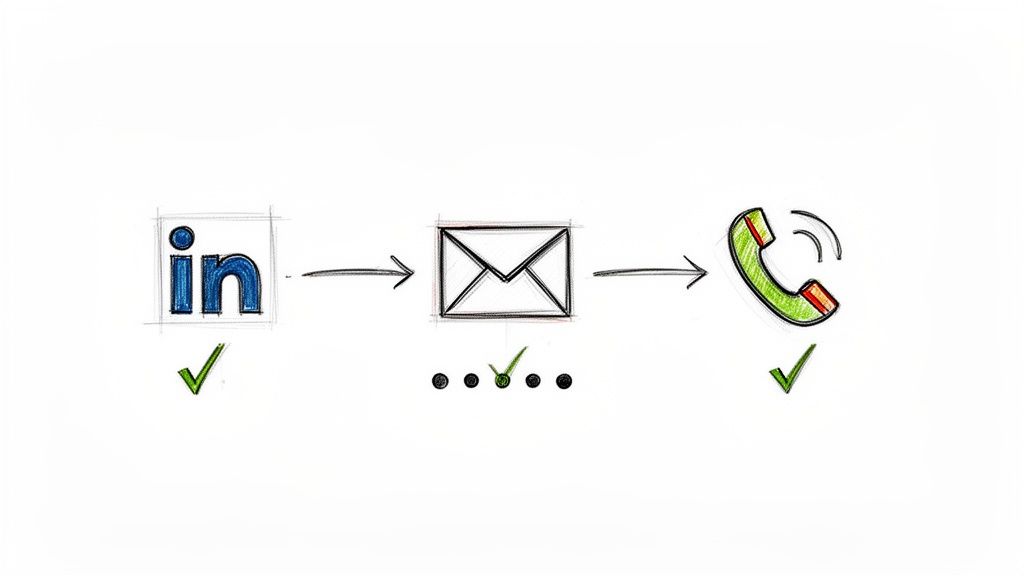
Modern B2B outreach requires more than just a single-channel blitz. One of the most effective examples of omnichannel marketing for sales teams is a strategic sequence that layers LinkedIn engagement, personalized email, and targeted phone calls. This approach moves beyond isolated touchpoints to create a cohesive narrative that warms up prospects before a direct ask.
This strategy uses each channel for its specific strength. LinkedIn serves as the initial, low-friction "handshake" to build familiarity and credibility. Email follows to deliver deeper value and context, while the phone call becomes the high-intent channel to have a meaningful conversation. This multi-threaded engagement model dramatically increases the chances of breaking through the noise compared to relying solely on cold calls or emails.
Strategic Breakdown & Execution
For a Sales Development Representative (SDR), this orchestrated sequence transforms a "cold" prospect into a "warm" one. By the time the SDR makes a call, the prospect has likely seen their name, face, and company multiple times. This pre-built familiarity lowers defensive barriers and turns a potentially intrusive call into a more welcome, context-aware discussion.
This method is popularized by sales engagement platforms like Salesloft and Outreach, which allow reps to build and automate these multi-step, multi-channel sequences. For instance, a sequence could start with a LinkedIn profile view, followed by a connection request, then an automated email two days later, and finally a call task for the SDR.
Key Insight: The power lies in psychological sequencing. Each step is a micro-commitment that makes the next one feel less abrupt. For an SDR, the benefit is clear: a LinkedIn connection is a soft opt-in, the email provides value based on that connection, and the call capitalizes on the established recognition. This is a much higher-percentage play than a brute-force cold call.
Actionable Takeaways & Scaling with AI
Implementing this requires discipline and a focus on personalization over pure volume from your SDR team.
- Phase 1 (Foundation): Start with a simple three-step sequence. Step 1: Send a personalized LinkedIn connection request (mention a shared connection or recent post). Step 2: After acceptance, send a value-driven email (not a sales pitch). Step 3: A few days later, make a call referencing both prior touchpoints.
- Phase 2 (Optimization): A/B test different channel orders and timing. Does a LinkedIn message perform better than an InMail? Is it more effective to call before the second email? Track engagement metrics for each step to refine the SDR sequence. When orchestrating outreach across multiple channels, utilizing effective LinkedIn mention tracker tools is crucial for SDRs to monitor conversations.
- Phase 3 (AI-Powered Scaling): Use AI tools like MarketBetter to supercharge this workflow. The platform can help generate hyper-personalized connection messages and email copy based on a prospect's LinkedIn profile and company news, ensuring each touchpoint is relevant and compelling while saving the SDR valuable research time.
9. Omnichannel Sales Enablement with AI-Generated Collateral for Rapid SDR/AE Scaling
Scaling a sales team quickly is one of the biggest challenges for growing businesses, making effective sales enablement a critical part of any list of examples of omnichannel marketing. This strategy moves beyond static playbooks and leverages AI to generate and distribute dynamic sales collateral, ensuring every new SDR and AE is equipped with consistent, on-brand messaging from day one. It's about arming reps with the right content, for the right channel, at the right time.
This approach creates a unified content ecosystem where battlecards, one-pagers, email templates, and call scripts are centrally managed and instantly accessible. Instead of a new SDR spending weeks hunting for information or developing their own ad-hoc messaging, they tap into a repository of AI-generated, expert-vetted materials. This drastically cuts down ramp time, from a typical eight weeks to as little as four, by ensuring message consistency across every touchpoint, from initial email outreach to follow-up calls.
Strategic Breakdown & Execution
For a rapidly scaling SDR team, this system is transformative. It eliminates the guesswork and inconsistency that plagues new hires. An AI-powered platform can generate persona-specific talking points or create a battlecard comparing your solution to a new competitor that just emerged. This content is then pushed directly into their sales engagement platform, like SalesLoft, or made available via a knowledge base like Guru. This seamless integration means the SDR never has to leave their workflow to find the perfect response or relevant case study. This also presents an opportunity to integrate other tools; for example, exploring how AI-powered Microsoft 365 tools can provide further intelligence to supercharge your operations.
Key Insight: The true advantage is not just creating content faster, but creating smarter content that adapts. The benefit for SDR leadership is a system that can analyze which email templates have the highest reply rates or which battlecard is used most frequently in won deals, creating a data-driven feedback loop that continuously refines and improves the entire team's messaging.
Actionable Takeaways & Scaling with AI
Begin by addressing the most immediate needs of your SDRs and then expand the scope of your AI-driven enablement.
- Phase 1 (Foundation): Use AI to generate content for your team's top three pain points. Start with battlecards for your top two competitors and an objection-handling guide for the most common roadblocks SDRs face.
- Phase 2 (Optimization): Create persona-specific content. Generate unique email templates and call scripts tailored to different buyer roles, such as a CFO versus a VP of Operations, ensuring SDR messaging resonates with each audience.
- Phase 3 (AI-Powered Scaling): Employ tools like MarketBetter to automate the entire process. Its platform can generate and update entire SDR playbooks, analyze performance data to recommend which content is most effective, and integrate these assets directly into the sales team’s daily workflow. You can learn more about the benefits of AI in marketing to further enhance your strategies.
10. Omnichannel Attribution and Pipeline Visibility for SDR Task-to-Revenue Tracking
Effective examples of omnichannel marketing and sales are not just about execution; they are about understanding what truly drives results. A comprehensive attribution system that connects an SDR’s daily tasks directly to revenue is the ultimate feedback loop, transforming outbound activities from a black box into a transparent, data-driven engine.
This approach moves beyond simple activity metrics like "dials made" or "emails sent." It links specific actions, like a call, a personalized email, or a LinkedIn message, to concrete pipeline outcomes: meetings booked, opportunities created, and deals closed. This provides leadership with a clear view of which SDRs, channels, and messaging sequences are sourcing the most valuable pipeline, closing the gap between effort and revenue impact.
Strategic Breakdown & Execution
For SDRs and their managers, this level of visibility is transformative. Instead of guessing which channel is most effective, they can see precisely that a first-touch email consistently yields the highest meeting-to-opportunity conversion rate or that a follow-up call after a LinkedIn view leads to faster deal cycles. This allows for the dynamic reallocation of an SDR's time to the highest-impact activities.
Key Insight: The goal is to move from a volume-based to a value-based outbound model. By tracking task-to-revenue, an SDR manager can identify that one rep’s 20 highly-researched emails are generating more qualified pipeline than another’s 100 generic calls. This benefit—data-driven coaching—enables a strategic shift in team-wide best practices, a massive improvement over managing by activity alone.
Actionable Takeaways & Scaling with AI
To build this pipeline visibility, SDR leaders should start by connecting their tools and then layer in deeper analysis.
- Phase 1 (Foundation): Integrate your sales engagement platform (e.g., Outreach, Salesloft) with your CRM (e.g., Salesforce). Ensure that SDR tasks, call outcomes, and email replies are logged automatically against contact and opportunity records. This creates the foundational data link.
- Phase 2 (Optimization): Build dashboards that track SDR-sourced pipeline by channel and task type. Analyze which first-touch channel leads to the most meetings and which combination of touches results in the highest-velocity deals. For a deeper understanding, explore different multi-touch attribution models.
- Phase 3 (AI-Powered Scaling): Utilize AI tools like MarketBetter to automate this analysis at scale. The platform can instantly identify which omnichannel sequences are driving the most revenue, flag underperforming channels, and provide prescriptive recommendations to help SDRs optimize their daily execution for maximum pipeline impact.
10 Omnichannel Marketing Examples: Side-by-Side Comparison
| Solution | 🔄 Implementation Complexity | ⚡ Resource & Data Requirements | 📊 Expected Outcomes | 💡 Ideal Use Cases | ⭐ Key Advantages |
|---|---|---|---|---|---|
| Salesforce Native Dialer Integration for Omnichannel SDR Execution | Medium — Salesforce admin + dialer config (2–8 wks) | High — Salesforce instance, VoIP reliability, RevOps/admin time | 📊 Auto-logging, improved data quality, faster ramp; reduced rep admin | CRM-native sales teams needing unified outbound workflow | ⭐ Keeps reps in CRM; real-time coaching; consistent activity logging |
| AI-Powered Intent Signal-to-Task Workflow for Demand Generation SDRs | High — intent ingestion + prioritization engine, tuning | High — intent vendors (6sense/DB), clean CRM, RevOps & integration | 📊 Faster TTFC (≈60–70%↓), conversion lift (≈25–35%), prioritized follow-up | Demand-gen heavy orgs & ABM teams that must act on high-intent leads | ⭐ Automates prioritization; closes demand→SDR gap; reduces research work |
| Brand-Consistent AI Cold Email with Account-Based Personalization | Medium — AI copy + brand training + CRM integration | Medium — firmographic/intent data, CRM hygiene, copy review | 📊 Higher open/reply rates (open 30–40% for account-personalized); faster sends | High-volume outbound, account-personalized campaigns, startups scaling email | ⭐ Consistent brand voice; speeds email creation; enables A/B testing |
| Omnichannel SDR Task Inbox with Real-Time Prioritization | Medium–High — prioritization rules + CRM/task sync, UI work | High — ICP definition, intent data, templates, RevOps tuning | 📊 +30–40% activity per rep; +20–25% task→meeting conversion; less context-switching | SDR teams needing next-best-action and centralized task execution | ⭐ Unified inbox; reduces decision paralysis; improves completion rates |
| AI Call Prep and Post-Call Coaching for Omnichannel Sales Conversations | Medium — call recording/transcription + AI models, compliance checks | Medium — VoIP/dialer integration, AI transcription, manager review | 📊 Prep time ↓60–70%; post-call notes saved; improved connect & meeting rates | Teams focused on call quality, coaching, and faster ramp for new reps | ⭐ Pre-populates context; auto summaries; standardized dispositions for CRM |
| HubSpot + Salesforce Synced Omnichannel Outreach for Multi-CRM Teams | High — bidirectional mapping, conflict rules, testing (4–8 wks) | High — RevOps, middleware (sync tool), mapping & ongoing maintenance | 📊 Eliminates duplicate logging; unified attribution; smoother migrations | Organizations running both CRMs or transitioning between platforms | ⭐ Keeps both CRMs aligned; supports migrations; central reporting |
| Account-Based Sales Development (ABM-Driven SDR Workflows) | High — account orchestration, multi-stakeholder sequencing | High — account intelligence (ZoomInfo/Terminus), marketing coordination | 📊 Higher conversion (+30–50%), larger deals (+20–30%), better pipeline quality | Enterprise outreach targeting high-value accounts and buying committees | ⭐ Coordinated multi-touch; stronger AE handoffs; higher win rates |
| Omnichannel LinkedIn Orchestration + Email + Call Sequencing for B2B Outreach | Medium — cross-channel sequencing logic and timing rules | Medium — LinkedIn licenses, email tooling, template design, manual limits | 📊 Improved response: connections 35–50%, multi-channel conversion 5–10% | Relationship-led outreach to executives and where credibility matters | ⭐ Warms prospects via LinkedIn; builds credibility before email/call |
| Omnichannel Sales Enablement with AI-Generated Collateral for Rapid Scaling | Medium — content generation + review workflows, playbook distribution | Medium — content owners, manager QA, enablement platform | 📊 Ramp time ↓40–50%; content production time ↓ significantly; consistent messaging | Rapid-hire teams and orgs needing consistent, scalable messaging | ⭐ Faster content creation; consistent playbooks; quicker new-rep productivity |
| Omnichannel Attribution and Pipeline Visibility for SDR Task-to-Revenue | High — multi-source integration, attribution model design, reporting | High — clean CRM, data engineering/RevOps, integration of tasks→opps→wins | 📊 Clear SDR-sourced pipeline, supports forecasting & fair comp; slower due to sales cycle | RevOps and leadership needing ROI, forecasting, and performance attribution | ⭐ Proves SDR ROI; enables data-driven coaching and hiring decisions |
From Examples to Execution: Building Your SDR Omnichannel Engine
Throughout this guide, we've dissected ten distinct and powerful examples of omnichannel marketing tailored specifically for the modern Sales Development Representative (SDR). We moved beyond generic theories to showcase real-world applications, from integrating native Salesforce dialers to orchestrating complex, AI-driven sequences across email, phone, and LinkedIn. The central lesson is undeniable: the era of siloed, high-volume, low-context outreach is over.
Winning in today’s competitive landscape isn't about forcing SDRs to make 100 cold calls and send 200 templated emails. It's about empowering them with a unified system that translates buyer intent into focused, prioritized action. The most effective strategies, as we've seen, don’t add another tool to a rep's already cluttered workflow. Instead, they embed intelligence directly into their primary environment, like Salesforce or HubSpot, to guide them toward the next best action with the right prospect at the precisely the right moment.
The Core Pillars of a Successful SDR Omnichannel Strategy
Reflecting on the examples provided, a few core principles emerge as non-negotiable for building a high-performing SDR engine. These are the strategic threads that connect everything from AI-powered call prep to account-based sales development.
- Integration Over Aggregation: A successful omnichannel approach isn't just about using multiple channels; it's about making them talk to each other. The HubSpot + Salesforce sync example highlighted the necessity of a single source of truth. The benefit for SDRs is clear: when data flows seamlessly, they don't waste time toggling between systems and can engage with a complete, 360-degree view of the prospect's journey.
- Intelligence-Driven Prioritization: The days of working down a static list from top to bottom are gone. The examples of AI-powered intent signals and real-time task inboxes demonstrate a fundamental shift. The new mandate is to focus SDR effort where it matters most: on accounts actively showing buying signals, ensuring that high-value activities always take precedence.
- Consistency as a Force Multiplier: Brand voice and messaging must remain consistent, whether it's an AI-generated cold email, a LinkedIn connection request, or a live call. This consistency builds trust and recognition. When an SDR's outreach feels like a cohesive, personalized conversation across all touchpoints, it breaks through the noise far more effectively than disjointed, one-off messages.
Making It Actionable: Your First Steps Toward Omnichannel Mastery
Reading through these examples of omnichannel marketing is the first step, but implementation is what drives revenue. The gap between knowing and doing is where most SDR teams falter. The key is to start small, prove value, and scale what works. Don't try to boil the ocean by launching a nine-channel, AI-orchestrated sequence overnight.
Instead, choose one critical pain point and apply an omnichannel solution.
- Is your SDR CRM data a mess? Start with the native dialer integration. This simple step cleans up activity logging, improves data hygiene, and provides a clear baseline for performance metrics.
- Are your SDRs wasting time on cold accounts? Implement an AI-powered intent-to-task workflow. Focus your team’s energy on the 10% of accounts that are in-market, and measure the immediate lift in meeting conversion rates.
- Is your team struggling with multi-channel follow-up? Begin with a simple LinkedIn + Email + Call sequence. Use a platform that orchestrates these tasks within a single view to ensure no follow-up is missed and the outreach feels connected.
The ultimate goal is to build an invisible engine that runs in the background, eliminating administrative friction and surfacing high-priority opportunities. This transforms the SDR role from a manual activity-logger to a strategic, conversation-driven revenue generator. By focusing on execution-first platforms that unify these channels within the CRM, you close the loop between high-level strategy and the daily tasks that create a pipeline. The future of sales development is here, and it is focused, integrated, and incredibly efficient. It's time to build your machine.
Ready to turn these examples of omnichannel marketing into your team's daily reality? marketbetter.ai is the execution-first platform designed to embed these workflows directly into Salesforce, turning buyer signals into prioritized SDR tasks across email, call, and social. Stop chasing metrics and start building pipeline by visiting marketbetter.ai to see how you can build your own omnichannel engine today.