A Practical Guide to Generating Inbound Leads
Generating inbound leads boils down to a single, powerful idea: attract, don't chase. It's about creating content and experiences so genuinely valuable that your ideal customers are pulled toward you, turning strangers into your biggest fans. The alternative—outbound marketing—relies on interrupting prospects with cold calls and emails, a strategy that's not only more expensive but often less effective.
Building Your Inbound Lead Generation Foundation
Before you write a single blog post or launch a campaign, you need a solid foundation. Jumping straight into content creation without a clear plan is like building a house with no blueprint—it’s going to be a mess. Effective inbound marketing isn't about guesswork. It's a calculated process that starts with knowing, truly knowing, who you're trying to reach.
The goal here is to get so specific that your ideal customers feel like your content was made just for them. This initial groundwork is what makes every marketing dollar and every hour you spend actually count toward bringing in high-quality leads.
This is the core flow: define your audience, map their journey, and then—and only then—create your content blueprint.
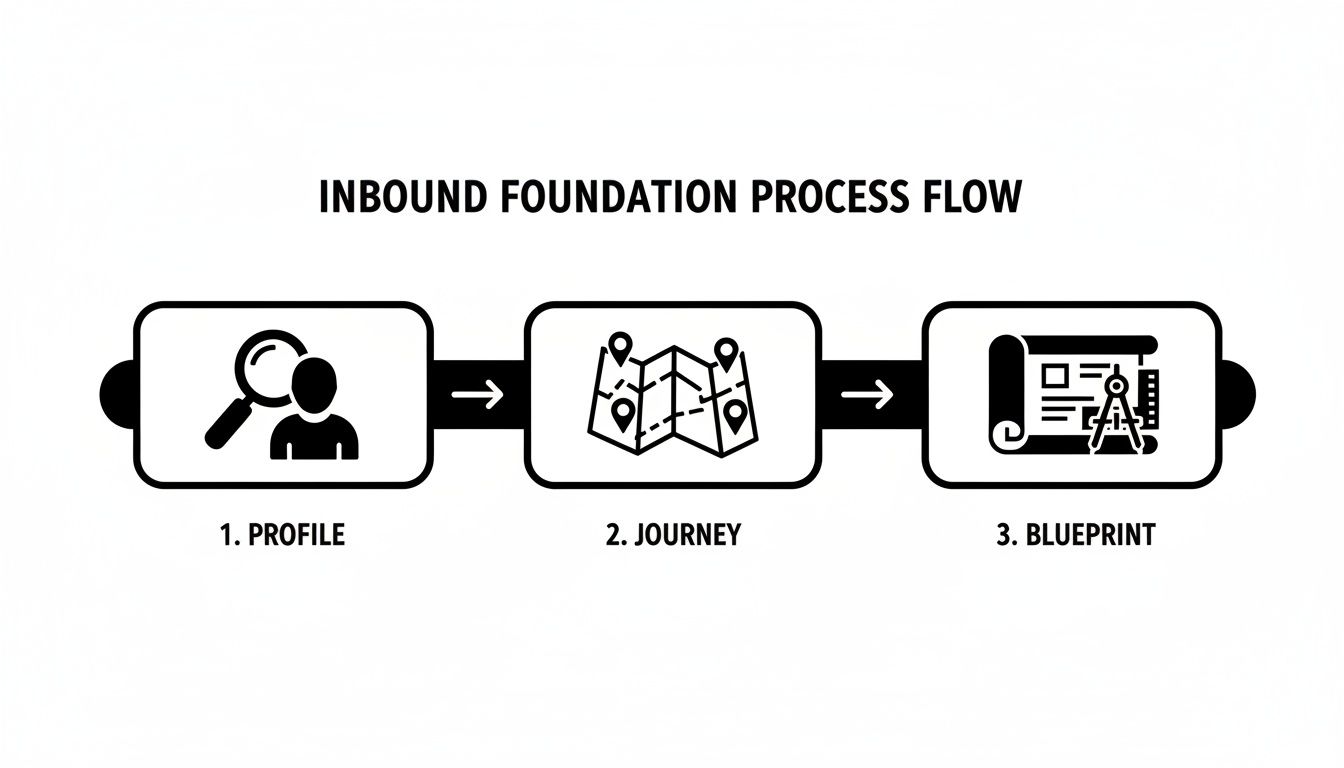
As you can see, each step builds on the last. It’s a logical progression that roots your entire marketing plan in a deep understanding of your customer.
From Vague Persona to Data-Backed ICP
Too many marketers get stuck on buyer personas—fictional characters like "Marketing Mary." It’s a decent starting point, but it often lacks the teeth you need to drive real results. A far better approach is to develop a data-backed Ideal Customer Profile (ICP).
An ICP isn't a guess. It’s a razor-sharp description of the company that gets the most value from your product. You build it by looking at your actual best customers, not by imagining a perfect one.
Action Step: Build Your ICP in 3 Steps
- Export Your Customer List: Pull a list of your top 10-20 clients (by revenue, lifetime value, or product usage).
- Identify Commonalities: Look for patterns across firmographics (industry, company size, location), technographics (tools they use), and behavioral data (highest LTV, lowest churn).
- Write a Definition: Synthesize this data into a clear statement. For example, instead of "Marketing Mary," your ICP becomes: "B2B SaaS companies with 50-200 employees in North America using Salesforce."
This exercise shifts your focus from a vague idea to an actionable target, making it a critical first step to generating inbound leads that are actually a good fit. If you're looking for more advanced methods, our guide on effective customer segmentation strategies offers a deeper dive.
Key Takeaway: A persona describes a person, which is great for copywriting. An ICP describes a company, which is essential for targeting and qualification. You need both, but the ICP has to come first.
Mapping the Entire Buyer Journey
Once you know exactly who you're targeting, you need to map their journey. B2B prospects don't just wake up one morning and decide to buy your software. They go through a deliberate, often lengthy, process of research and evaluation. Your content needs to meet them at every single stage.
The journey typically breaks down into three core phases.
1. Awareness Stage At this point, your prospect is feeling a pain but might not have a name for it yet. They're searching for educational content to help them understand their challenge.
- Their Questions: "Why is my sales team missing targets?" or "How to improve marketing efficiency?"
- Actionable Content: Create blog posts like "5 Signs Your Lead Nurturing is Broken," helpful infographics, and broad industry reports.
2. Consideration Stage Now they've defined their problem and are actively researching solutions. They're comparing different approaches, methodologies, and categories of tools.
- Their Questions: "Best CRM software for small business" or "HubSpot vs. Salesforce comparison."
- Actionable Content: Offer in-depth guides, comparison whitepapers, webinars, and case studies that show how others solved the exact same problem.
3. Decision Stage The finish line is in sight. Your prospect has decided on a solution category and is now evaluating specific vendors—including you. They're looking for proof that you're the right choice.
- Their Questions: "marketbetter.ai pricing" or "marketbetter.ai implementation timeline."
- Actionable Content: Get straight to the point with free trials, live demos, customer testimonials, and clear, detailed pricing pages.
Mapping this journey isn't just an academic exercise. It ensures you create content with a purpose—guiding prospects from one stage to the next and systematically generating qualified inbound leads for your sales team.
Designing a Content and SEO Engine That Converts
Once you’ve locked in who you’re talking to, it's time to build the machine that actually brings them to your door. This isn’t about throwing content at the wall and seeing what sticks. It's about architecting a smart content and SEO strategy that consistently attracts, engages, and converts your ideal customers into real leads.
A solid strategy turns your website from a static brochure into your hardest-working salesperson. Every article, guide, and video you create has a job to do—answering your ICP’s most urgent questions and building trust with every click. This is where you translate deep customer knowledge into assets that generate pipeline.
It’s a serious investment, no doubt. But the payoff is massive. Leads coming from SEO close at a 14.6% rate, completely eclipsing the 1.7% from outbound efforts. That’s not a small difference; it’s a total game-changer. On top of that, businesses that blog regularly get 67% more leads, and a wild 82% of marketers who blog see positive ROI. The numbers don't lie.
Choosing Your Content Architecture
Before a single word is written, you need a blueprint. Two models dominate the conversation for a reason: they work. They help you build the topical authority that Google craves and users trust. The right choice really comes down to your resources and how complex your core topics are.
Pillar-and-Cluster Model
Think of this like a hub-and-spoke system for your knowledge. You create one massive, comprehensive "pillar" page on a big topic (like "AI in Marketing"). This pillar then links out to shorter, more focused "cluster" articles on specific subtopics ("Using AI for Email Copywriting," "AI-Powered Ad Optimization"). Every cluster post links back to the pillar, creating a powerful, interconnected web that signals deep expertise to search engines.
- Best for: Companies going after broad, competitive keywords where you need to prove you’re the definitive resource to even have a chance at ranking.
- Actionable Example: Create a pillar page on "Marketing Automation." Then, write cluster articles on "Setting Up Your First Email Nurture Sequence" and "Lead Scoring Best Practices," making sure each links back to the main pillar.
Hub-and-Spoke Model
This is a slightly different flavor. The "hub" page here acts more like a resource library or a table of contents, rather than a single long-form article. It’s less of a narrative and more of a curated collection, linking out to various related "spoke" articles.
- Best for: Businesses that cover several distinct but related topics. It’s perfect for building out a resource center where users might want to jump between different, but equally important, subjects.
- Actionable Example: A project management tool could build a "Project Management Methodologies" hub page. The spokes would be deep-dive articles on "Scrum," "Kanban," "Agile," and "Waterfall," all pointing back to the central hub.
Our Take: For most B2B companies trying to own a specific niche, the Pillar-and-Cluster model is the way to go. It’s just more effective at creating that tight-knit content ecosystem that search engines reward, helping you dominate your topic from all angles.
Aligning Content to Buyer Intent
Now, let's connect your content model back to the buyer's journey. The keywords you target and the format you use absolutely must match where someone is in their decision-making process. Miss this, and you’re just creating noise.
Awareness Stage Content
- Their Mindset: Informational. They're asking "what," "why," and "how" questions to understand their problem.
- Keywords: Go for long-tail, question-based phrases. Think "how to improve lead quality" or "signs of an inefficient sales process." The search volume might be lower, but the intent is crystal clear.
- Formats: This is all about being helpful. Create educational blog posts, checklists, and infographics. A title like "5 Data-Backed Ways to Increase Your MQL to SQL Conversion Rate" is perfect—it solves a problem, no sales pitch needed.
Consideration Stage Content
- Their Mindset: Commercial Investigation. They know the problem and are now actively comparing solutions.
- Keywords: This is where you get more specific. Target terms like "best CRM for small business," "marketbetter.ai alternatives," or "email automation software comparison."
- Formats: They need more depth now. Produce in-depth guides, webinars, and case studies. A downloadable asset like "The Ultimate Guide to Choosing Marketing AI" speaks directly to their need to evaluate options and make an informed choice.
Decision Stage Content
- Their Mindset: Transactional. They’re ready to pull the trigger.
- Keywords: Target your own branded terms. Things like "marketbetter.ai pricing" or "marketbetter.ai demo."
- Formats: Get out of the way and make it easy for them. This is where clear pricing pages, frictionless free trial sign-ups, and compelling customer testimonials do the heavy lifting. Your job is to remove any last-minute friction.
Building this content engine is a marathon, not a sprint. But it's the only truly sustainable way to generate high-quality inbound leads over the long haul. As you ramp up, you'll need a system to keep the machine running smoothly. For that, check out our guide on how to scale content marketing without letting quality slip.
Creating Lead Magnets People Actually Want
Let’s be honest: traffic is just a vanity metric if it doesn’t turn into actual conversations. To really nail inbound, you have to master the art of the value exchange. This is where you stop begging for sign-ups with generic "Subscribe to Our Newsletter" buttons and start offering something so damn useful that your ideal prospects want to give you their email.
That's the entire point of a great lead magnet. It's the handshake that turns an anonymous visitor into a known contact. It’s your first real chance to solve a small, specific problem for them, show off your expertise, and earn the right to talk to them again. A killer lead magnet makes the conversion feel like a no-brainer for the prospect, not a favor they're doing for you.
High-Impact Lead Magnet Types
Not all lead magnets are created equal. The right one depends entirely on your audience, where they are in their buying journey, and what you can realistically create. The whole game is matching the format to their immediate pain point.
To help you decide where to focus, here’s a quick look at how different lead magnets stack up in the real world.
Lead Magnet Effectiveness Comparison
| Lead Magnet Type | Creation Effort | Typical Conversion Rate | Best For (Journey Stage) |
|---|---|---|---|
| Checklist/Template | Low | High (20-40%) | Awareness/Consideration |
| Ebook/Whitepaper | Medium | Medium (15-25%) | Consideration |
| Webinar/Workshop | High | High (25-45%) | Consideration/Decision |
| Free Tool/Calculator | Very High | Very High (30-50%+) | All Stages |
A simple checklist often converts better than a dense whitepaper because it offers an immediate win. Someone can download it and use it right now. A webinar, on the other hand, is a bigger ask—it requires a real time commitment. But the leads you get are far more engaged and usually much closer to making a decision.
Actionable Assets That Actually Drive Conversions
The best lead magnets solve a specific, nagging problem for your ICP. They're tactical, not theoretical. Nobody wants to read another 50-page ebook on "The Future of Marketing." They want a template that saves them three hours of work this afternoon.
- Checklists: Got a great "how-to" blog post? Turn the steps into a printable checklist. An "On-Page SEO Audit Checklist" is infinitely more useful than an article that just talks about doing an audit.
- Templates: Give them a shortcut. A B2B software company could offer a "Quarterly Business Review (QBR) PowerPoint Template" that a sales manager can download and use in their next meeting. Instant value.
- Webinars: Don't just lecture; teach a specific skill. A webinar titled "How to Build Your First Lead Scoring Model in 30 Minutes" will crush one called "The Importance of Lead Scoring." One is an outcome, the other is a lecture.
Pro Tip: Your lead magnet’s title is 80% of the battle. It has to scream value and promise a specific, tangible outcome. Think action verbs and clear benefits.
Designing Landing Pages That Convert
You can have the greatest lead magnet in the world, but if the landing page sucks, it's all for nothing. A high-converting landing page has one job and one job only: get the person to fill out the form. Every single element on that page should serve that goal.
1. Nail the Value Prop Instantly Your headline and subheadline have about five seconds to answer two questions: "What is this?" and "Why should I care?" Be specific and focus on the benefit. Instead of "Download Our Ebook," try "Get the 5-Step Framework to Double Your MQLs This Quarter."
2. Make the Form Frictionless Only ask for what you absolutely need. For a top-of-funnel checklist, a name and email are plenty. Remember, every extra field you add can slash your conversion rate by as much as 11%. Don't get greedy.
3. Show, Don't Just Tell (Social Proof) People are herd animals. Show them others have already found value. Add testimonials, logos of companies that have downloaded it, or the total number of downloads. If it's a webinar, add some urgency by saying "Only 50 spots left." It's a simple psychological trigger that works wonders.
Turning Interest Into Action: Nurture and Automate Your Leads
Getting a new lead is just the first handshake. The real work—and where the money is made—is in what happens next. This is your chance to turn a fleeting moment of curiosity into a genuine, trusting relationship.
It's not about carpet-bombing their inbox with sales pitches. It’s about being the helpful expert who shows up with the right advice at the right time. Smart automation is how you do this at scale without sounding like a robot. You're guiding them from "I'll download this checklist" to "I need to talk to these people."
A well-oiled system makes prospects feel seen and understood, not just targeted.
Crafting Smart Email Nurture Sequences
So, someone just downloaded your "On-Page SEO Audit Checklist." Now what? A generic "Thanks for your download!" is a dead end. The best nurturing campaigns start immediately, acknowledging exactly what they did and delivering something that builds on it.
This is where you get surgical with segmented email sequences.
Action Step: Build a 3-Part Nurture Sequence Let’s use the SEO checklist example. Instead of one generic drip campaign for everyone, build a specific journey for that person.
- Email 1 (Day 1): "Subject: Here's Your Checklist + A Quick Tip." Deliver the PDF, but also add a simple, actionable tip they can use right away. You're instantly adding value beyond the download.
- Email 2 (Day 3): "Subject: 3 SEO Mistakes We See (and How to Fix Them)." Send a short blog post or video that helps them sidestep common screw-ups. You're proving your expertise.
- Email 3 (Day 5): "Subject: Case Study: How We Doubled Organic Traffic for [Similar Company]." Now you connect the dots. You show them a real-world success story that links their problem (SEO) to your solution.
This isn't just theory—it’s wildly efficient. Content marketing produces three times more leads per dollar spent than paid search. And it gets cheaper over time. After just five months of this kind of inbound marketing, the average cost per lead can plummet by 80%.
Comparing Automation Tools and Tactics
To make all this happen without losing your mind, you need the right tech. Marketing automation platforms are the engine room for your entire lead nurturing strategy.
Here’s a quick breakdown of where to start.
| Tactic/Tool | Best For | Key Advantage | Potential Downside |
|---|---|---|---|
| Email-Only Tools (e.g., Mailchimp, ConvertKit) | Startups & Solopreneurs | Simple and affordable for getting basic email sequences and segmentation up and running. | They hit a wall fast. No deep CRM sync, lead scoring, or multi-channel capabilities. |
| All-in-One Platforms (e.g., HubSpot, Marketo) | Growing & Established Businesses | A single source of truth for email, landing pages, CRM, chatbots, and powerful analytics. | Can be expensive, and there's a definite learning curve to unlock their full potential. |
While email is your foundation, don't sleep on other automation plays. On-site chatbots are a huge win for engaging visitors in real-time. Instead of a boring contact form, a bot can ask smart qualifying questions and book meetings directly on a sales rep's calendar—24/7. For smaller operations, implementing small business marketing automation is a total game-changer for punching above your weight.
Key Takeaway: Automation isn't about replacing people. It's about freeing them up. Automate the repetitive follow-ups so your team can focus on the high-value human conversations that actually close deals.
Using Lead Scoring to Find the Hot Prospects
Let's be real: not every lead is a good lead. The person who downloaded a top-of-funnel checklist is worlds away from the one who hit your pricing page three times and watched your entire demo video.
Lead scoring is how you quantify that interest and automatically separate the curious from the committed.
It’s a simple points system where you assign value to who they are (fit) and what they do (interest).
Action Step: Set Up a Basic Lead Scoring Model
- Define Firmographic Rules (Fit):
- Job Title: VP of Marketing (+20 points), Marketing Manager (+10 points)
- Company Size: 100-500 employees (+15 points, if that’s your sweet spot)
- Industry: B2B SaaS (+10 points)
- Define Behavioral Rules (Interest):
- Visited Pricing Page: +15 points
- Downloaded a Case Study: +10 points
- Opened 5+ Emails: +5 points
- Unsubscribed: -50 points (and an automatic removal from the sequence)
- Set an MQL Threshold: Decide on a score (e.g., 100 points) that triggers a handoff to sales.
You set a threshold—let's say 100 points. Once a lead hits that number, your automation platform flags them as a Marketing Qualified Lead (MQL) and instantly routes them to sales. This stops your reps from wasting time on tire-kickers and lets them focus 100% of their energy on the prospects who are actually ready to talk.
Amplifying Your Content for Maximum Reach
Look, creating great content is only half the job. The old "if you build it, they will come" fantasy is just that—a fantasy. Unless you have a smart, repeatable system for getting that content in front of the right eyeballs, you're just shouting into the void.
This is all about moving past the "publish and pray" mindset. You need a distribution engine that multiplies the impact of every blog post, guide, and video you create. It’s how you make sure your best insights don't get buried.
Repurpose Your Content Into Micro-Assets
Think of a single 2,000-word blog post as a goldmine. Instead of just tweeting the link and calling it a day, you need to break it down into bite-sized pieces for different platforms. This massively increases your content's surface area, making it discoverable in more places by more of your ideal customers.
Action Step: The "Content Atomization" Checklist For one single blog post, you can create:
- 3-5 Quote Graphics: Pull out the most powerful sentences for LinkedIn or X.
- 1 Short Video Clip: Explain the main point in under 60 seconds for Shorts or Reels.
- 1 Infographic: Summarize key data or steps for Pinterest and blog embeds.
- 1 LinkedIn Carousel or X Thread: Break down the core argument into a multi-part post.
This is just about respecting how people actually use these platforms. Nobody’s reading a novel-length post on Instagram, but they’ll absolutely swipe through a smart carousel that teaches them something valuable in seconds.
Paid Promotion: Google Ads vs. LinkedIn Ads
When you need to get results faster, paid promotion is your accelerator. For most B2B companies trying to generate inbound leads, the conversation boils down to Google Ads vs. LinkedIn Ads. They're both powerful, but they solve very different problems.
Here’s how they stack up for B2B lead gen:
| Feature | Google Ads (Search) | LinkedIn Ads |
|---|---|---|
| Targeting | Based on keyword intent. You’re reaching people actively looking for a solution right now. | Based on professional firmographics. You reach people by job title, company size, or industry. |
| Lead Quality | Usually higher intent. These users are problem-aware and hunting for answers. | Can be lower intent. You’re interrupting their scroll, so they aren't always in "buy" mode. |
| Cost Per Click | Generally lower, but can get pricey for highly competitive keywords. | Significantly higher. Expect to pay 2-3x more per click than you would on Google Search. |
| Best Use Case | Capturing active, bottom-of-funnel demand. Think of it as harvesting. | Building top-of-funnel brand awareness and reaching precise decision-makers. Think of it as farming. |
Actionable Tip: Don't treat this as an either/or choice. Use them together. Run LinkedIn Ads to introduce your brand and high-value content to a cold but perfectly defined ICP. Then, use Google Ads to retarget everyone who visited your site, catching them the moment they start searching for solutions like yours. That's a full-funnel strategy that makes every dollar work harder.
Measuring What Matters in Your Inbound Funnel
 If you're not measuring your inbound efforts, you're not marketing—you're just guessing. A data-driven approach is the only way to build a sustainable machine that generates leads predictably. It's how you go from hoping for results to actually engineering them.
Your goal isn't to build some monster dashboard. It's to get an honest, real-time look at what’s actually working. Without it, you're just pouring money into content that looks great but fails to produce a single qualified lead.
Core KPIs for Your Inbound Dashboard
Forget drowning in vanity metrics. You only need a handful of key performance indicators (KPIs) to really understand the health of your funnel. These are the numbers that connect your content directly to business outcomes.
Start with these three essentials:
- Landing Page Conversion Rate: This is the purest measure of your offer’s pull. If 1,000 people hit your webinar landing page and 100 sign up, your conversion rate is 10%. A low rate here usually screams that there's a disconnect between your ad copy and your page, or that your value prop just isn't landing.
- Cost Per Lead (CPL): This one keeps your ad spend honest. Just divide your total campaign spend by the number of leads you got. If you spent $500 on LinkedIn ads and got 25 leads, your CPL is $20. Simple as that.
- Lead-to-Customer Conversion Rate: Here it is—the bottom-line metric. What percentage of the leads you generate actually become paying customers? If you bring in 100 leads in a month and 5 of them sign a contract, your rate is 5%.
These metrics tell a story together. A cheap CPL is great, but not if your lead-to-customer rate is zero. To go deeper on this, check out our guide on the most important lead generation key performance indicators you should be watching.
The Inbound vs. Outbound Cost Smackdown
Once you start tracking CPL, the financial upside of inbound marketing becomes painfully obvious. Inbound slashes the cost per lead by 61-62% compared to old-school outbound methods. Some data even shows inbound leads are 62% cheaper, saving companies an average of $14 for every new customer they land.
This is exactly why 34% of all leads marketers generate now come from inbound. The efficiency is just too good to ignore.
A lower CPL from inbound isn't just a cost saving; it's a strategic advantage. It means you can acquire more customers for the same budget, giving you the fuel to outpace competitors still stuck on expensive outbound tactics.
Simple A/B Testing to Juice Your Performance
Data doesn't just tell you what happened; it tells you what to do next. A/B testing is your secret weapon for making small tweaks that lead to huge gains over time.
Don't overcomplicate it. Start with simple, high-impact tests on your landing pages.
Here are two dead-simple A/B tests you can run today:
- Headline vs. Headline: Pit a benefit-driven headline ("Double Your MQLs This Quarter") against a more direct one ("Get Our Free Guide to MQL Generation"). Your headline is the first thing people see. A small change here can make or break your conversion rate.
- CTA Button Copy: Test a generic CTA like "Submit" against something more specific and action-oriented like "Get My Free Checklist" or "Save My Spot." Specificity almost always wins because it reminds the user of the value they're about to get.
At the end of the day, your inbound funnel's success hinges on your ability to measure marketing ROI and prove you're making a tangible impact on the business.
Common Questions About Generating Inbound Leads
Even with the best playbook in hand, a few questions always come up. The world of inbound marketing is full of nuance, so let's tackle the practical hurdles and concerns I hear most often from teams on the ground.
How Long Does It Take to See Results?
This is the big one, and the honest-to-goodness answer is: it’s a marathon, not a sprint. Sure, you can spin up a paid promotion campaign and see some initial leads trickle in within the first 1-3 months. That's renting an audience.
Building a real, predictable engine from organic search takes more time. Think of it like buying an asset instead of renting one. It takes longer to build, but it pays dividends for years to come. For most B2B companies, you should expect to see a meaningful, consistent flow of organic leads after about 6 to 12 months of focused, high-quality work.
Key Takeaway: Inbound marketing results compound. The blog post you publish today could very well be your top lead generator two years from now. A paid ad can never do that.
What Is the Difference Between Inbound and Outbound Leads?
The entire difference boils down to one simple question: Who started the conversation? Answering that tells you everything you need to know about the model and why inbound leads are so much more valuable.
- Inbound Leads (Pull): These are the people who find you. They stumbled upon your blog, watched your demo video, or found you through a Google search. They're reaching out because they have a problem and suspect you might have the solution.
- Outbound Leads (Push): This is when your company finds them. Think cold calls, cold emails, or direct mail. You're initiating contact based on a hypothesis that they might be a good fit.
This distinction in who makes the first move directly impacts lead quality. An inbound lead is already halfway there—they've self-identified a need and shown genuine interest in how you solve it. That's a conversation worth having.
Ready to build an inbound machine that works smarter, not harder? marketbetter.ai uses AI to help you create high-quality content, automate personalized journeys, and prove your marketing ROI with confidence. Explore the platform today.