A Guide to Measuring Marketing Effectiveness
So, what does “measing marketing effectiveness” actually mean?
It’s about figuring out if your marketing is actually doing its job—if it’s hitting your business goals. It's the only way to draw a straight line from what you spend on a campaign to the real money it brings in. Think of it as the ultimate proof that marketing isn't just a cost center, but a revenue driver.
Why Measuring Marketing Effectiveness Matters

Let's kill a bad idea right now: marketing is not just another line item on a budget. When it’s done right—and measured properly—marketing is the engine for sustainable growth. But without measurement, you’re just guessing. You're spending money and hoping something good happens.
Imagine your marketing strategy is a ship setting sail. Effectiveness isn’t about how fast the ship is moving, which you might track with things like social media likes, ad impressions, or website clicks. Those are vanity metrics. They look impressive on a report, but they don't tell you if you're actually headed in the right direction.
True effectiveness is about whether you’re actually reaching your destination: concrete business goals like more revenue, a bigger slice of the market, and fiercely loyal customers.
Shifting from Activity to Impact
In a world drowning in data, you can't afford to guess anymore. Measuring marketing effectiveness is non-negotiable. It’s the only way to justify your budget, prove your team’s value to the C-suite, and build a tight feedback loop that makes every campaign better than the last. The entire goal is to connect every dollar spent to a tangible business outcome.
Measuring success and allocating budget are two sides of the same coin. In order to make wise budget allocation decisions, we must understand which efforts have been successful and which have not.
This forces a critical conversation about the numbers we choose to watch. Not all metrics are created equal.
Vanity Metrics vs. Business-Impact Metrics
It's easy to get distracted by numbers that feel good but mean very little. Let's compare the two so you can take action and focus on what really moves the needle.
| Metric Category | Examples | What It Actually Tells You | Actionable Takeaway |
|---|---|---|---|
| Vanity Metrics | Social Media Likes, Impressions, Page Views | This shows surface-level activity. It tells you people saw your content, but offers zero insight into whether it changed their behavior or convinced them to buy. | Use these as secondary health indicators, but never as your primary measure of success. High impressions with low clicks means your creative or targeting is off. |
| Business-Impact Metrics | Customer Acquisition Cost (CAC), Return on Ad Spend (ROAS), Customer Lifetime Value (CLV) | This directly links your marketing spend to revenue and profit. It tells you if your campaigns are actually generating real, sustainable growth for the business. | Make these the headlines of your reports. If ROAS is low, you have a clear mandate: pause the ad, change the offer, or re-evaluate the channel. |
See the difference? One makes you feel busy, while the other makes the business money.
The Foundation for Smart Decisions
At the end of the day, a serious commitment to measuring marketing effectiveness lets you answer the big questions. Which channels are bringing in our most profitable customers? How much should we really invest in that new campaign to hit our revenue targets? Which ad copy is actually working?
Without this data, you’re steering the ship with a blindfold on. This guide is your compass. We’re going to move past the surface-level noise and uncover the metrics that signal true business impact and drive smart, forward-thinking decisions.
Choosing the Right KPIs for Your Marketing Goals
So you're convinced that measuring marketing matters. Great. Now comes the hard part: what, exactly, should you be measuring? It’s incredibly easy to get lost in a sea of data, staring at dozens of dashboards that tell you everything and nothing at the same time.
A focused approach is the only way to win. You need to pick the Key Performance Indicators (KPIs) that actually line up with your real business goals. Think of them as your guideposts—the specific numbers that turn a fuzzy objective like "grow the brand" into something you can actually track and improve.
Your KPIs are the turn-by-turn directions on your GPS. Your business goal is the destination. Without the right directions, you're just driving in circles, burning fuel and getting nowhere. Whether you’re trying to build brand awareness, generate high-quality leads, or keep your existing customers happy, your KPIs have to connect directly to that outcome.
Aligning KPIs with Business Objectives
Different goals demand different yardsticks. A campaign designed to get your name out there is going to look very different on a spreadsheet than one built to drive immediate sales. Let's break down how to map the right KPIs to the right job with actionable steps.
-
Goal: Brand Awareness Your mission is to get your brand in front of a wider, relevant audience. Forget just counting impressions—that's a vanity metric. Instead, focus on numbers that suggest people are actually paying attention.
- Actionable KPIs: Look at social media engagement rate (not just likes), share of voice (how often your brand is mentioned compared to competitors), and tangible increases in direct and branded search traffic.
- How to Act on It: If branded search traffic is flat, your awareness campaigns aren't memorable enough. It's time to A/B test your core messaging.
-
Goal: Lead Generation Here, we shift from eyeballs to action. Cost Per Lead (CPL) is a classic starting point, but it's dangerously incomplete. A low CPL doesn't mean much if the leads are junk. The real metric to obsess over is the Lead-to-Customer Conversion Rate. This tells you about lead quality.
- Actionable KPIs: Track CPL, Lead-to-Customer Rate, and Marketing Qualified Leads (MQLs).
- How to Act on It: Compare the conversion rates from different channels. A channel with a higher CPL but a much higher lead quality is often a better investment. You'd much rather have 10 leads that convert at 50% than 100 leads that convert at a measly 1%.
-
Goal: Customer Retention & Loyalty It's almost always cheaper to keep a customer than to find a new one. To see how you're doing here, you need to be tracking Customer Lifetime Value (CLV), churn rate (the percentage of customers who leave you over a period), and your repeat purchase rate.
- Actionable KPIs: Monitor CLV, churn, and repeat purchase rate.
- How to Act on It: If your churn rate ticks up, immediately survey departing customers to find out why. Is it a product issue? A pricing problem? Use that feedback to prevent more customers from leaving.
Practical KPI Comparisons in Action
The "right" KPIs are completely dependent on your business model. A B2B SaaS company and a direct-to-consumer e-commerce brand are playing two totally different sports, even if they're both running digital ads.
Let's compare two scenarios:
| Campaign Scenario | B2B SaaS Company (Free Trial Campaign) | E-commerce Brand (Holiday Sale) |
|---|---|---|
| Primary Goal | Acquire qualified product users who will eventually pay. | Drive as much revenue as possible in a short, competitive window. |
| Key KPIs | • Trial Signup Rate • Trial-to-Paid Conversion Rate • Customer Acquisition Cost (CAC) | • Return on Ad Spend (ROAS) • Average Order Value (AOV) • Conversion Rate |
| Actionable Decision | If the Trial-to-Paid Conversion Rate is low, the problem isn't marketing—it's the product onboarding. Time to work with the product team. | If ROAS is below your target, immediately reallocate budget from the worst-performing ad set to the best-performing one. Don't wait. |
This shows why you need a tailored measurement dashboard. Stop tracking dozens of metrics. Find the handful that give you a crystal-clear, honest view of how you're performing against your specific goals.
Today, digital channels dominate marketing budgets, but measuring their true impact means looking past simple clicks. It's about connecting what you do with what the business earns. It’s no surprise that 89% of top-performing marketers use strategic metrics like gross revenue, market share, and customer lifetime value (CLV) to prove their campaigns work.
When picking your KPIs, understanding the difference between ROI vs ROAS is absolutely critical. ROAS measures the gross revenue you get back for every dollar you spend on ads, while ROI takes all your costs into account to show you the real profit. Getting this right is the key to making smart, sustainable budget decisions.
Navigating the Wild World of Attribution Models
So, how do you give credit where it’s due?
Imagine this: a customer sees your Facebook ad on Monday, clicks a Google search result on Thursday, and finally pulls the trigger after opening a promo email on Saturday. Which touchpoint gets the high-five for the sale? This is the exact puzzle that marketing attribution solves.
Think of it like a soccer team scoring a goal. The striker who kicks the ball into the net gets the glory, but what about the midfielders who passed it up the field? Or the defender who started the play? Each one played a part. Attribution is just the process of figuring out how much each player contributed.
Without it, you might give all the credit to the last email and slash the budget for the Facebook ad that started the whole journey. Bad move. Good attribution helps you see the entire field, not just the final kick.
From Simple Guesses to Strategic Insights
Attribution models run the gamut from dead-simple to seriously complex. Each one tells a different story about your customer’s path, and picking the right one boils down to your business goals and how long it takes for someone to buy from you. Let's compare the two most basic models.
- First-Touch Attribution: This one’s easy. It gives 100% of the credit to the very first interaction a customer had with you.
- Actionable Use: Use this model to identify which channels are best at generating initial awareness. If you need to fill the top of your funnel, optimize the channels that win here.
- Last-Touch Attribution: This is the most common model because it's the easiest to track. It hands 100% of the credit to the final touchpoint right before the conversion.
- Actionable Use: Perfect for understanding which channels are your best "closers." If you need to boost end-of-quarter sales, double down on the channels that score high with last-touch.
But here’s the catch: both of these single-touch models have tunnel vision. They completely ignore everything that happens in the middle of the journey—which, let's be honest, is often where the real magic happens.
Attribution isn't just about counting clicks; it's about understanding influence. The real goal is to see the complete picture of how all your channels work together to turn a stranger into a customer.
The Power of Multi-Touch Attribution
If you’re not selling impulse-buy items, you need a clearer view. For businesses with longer sales cycles, multi-touch attribution provides a much more balanced and accurate picture of what’s actually working. These models spread the credit across multiple touchpoints, acknowledging the reality that most sales are the result of a series of nudges, not a single tap.
This decision tree helps visualize how different goals—like building awareness, generating leads, or driving sales—demand different ways of measuring success.
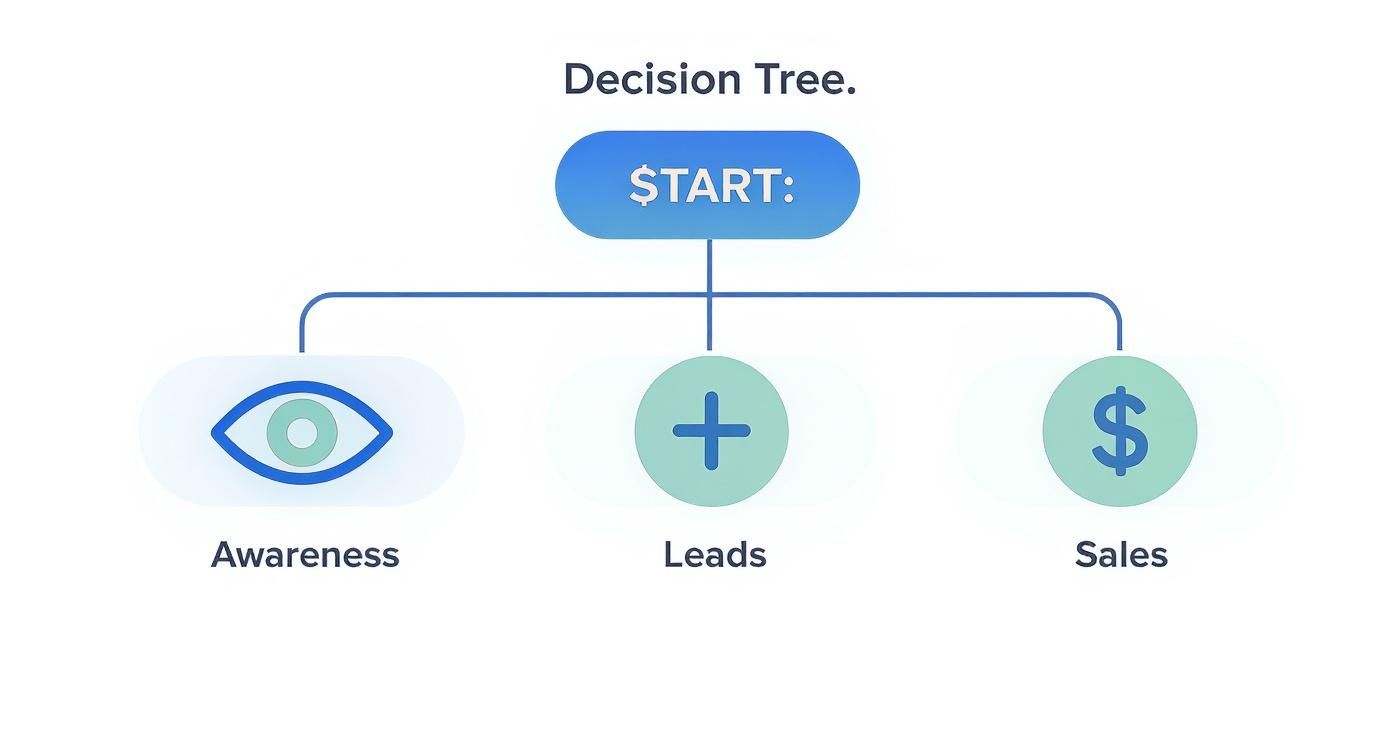
As you can see, your main business objective points you down a specific measurement path, making sure you’re tracking the right numbers at every stage of the funnel.
Which Marketing Attribution Model Is Right for You?
Choosing the right model is a big deal. It dictates where you put your budget and how you measure your team's success. To help you figure out what fits, here's a quick comparison of the most common multi-touch models. Each one offers a unique lens through which to view your customer journey.
| Attribution Model | How It Works | Best For | Actionable Insight |
|---|---|---|---|
| Linear | Spreads credit evenly across every single touchpoint. A simple, democratic approach. | B2B companies with long sales cycles where every interaction plays a role in nurturing the lead. | Reveals your "workhorse" channels that consistently contribute across the entire journey, even if they don't open or close the deal. |
| Time-Decay | Gives more credit to the interactions that happened closer to the sale. | Short-term promotional campaigns or B2C sales cycles where recent touchpoints are most influential. | Helps you optimize the final steps of the buyer journey by highlighting what nudges people over the finish line. |
| U-Shaped | Gives 40% credit to the first touch, 40% to the last, and divides the remaining 20% among the middle touches. | Businesses that highly value both lead generation (the first touch) and conversion (the last touch). | If a channel appears often in the middle but gets little credit, it might be a great nurturing channel that you're undervaluing. |
At the end of the day, there’s no single "best" model that works for everyone. The right choice is the one that best reflects how your customers actually buy. An e-commerce brand with a three-day sales cycle might be perfectly fine with a Last-Touch or Time-Decay model. But a B2B software company with a six-month sales process? They’d get far more truth from a Linear or U-Shaped model.
For a deeper dive into these frameworks, check out our complete guide to multi-touch attribution models.
Advanced Measurement Frameworks for a Holistic View
Attribution models are fantastic, but they're starting to tell an incomplete story. In a world where privacy rules are getting tighter and third-party cookies are disappearing, leaning entirely on user-level tracking is becoming a risky bet. It’s time to zoom out and bring in frameworks that give you the full, top-down picture of what’s really working.
Think of digital attribution like tracking individual plays in a football game—it shows you who passed the ball and who scored. That's crucial stuff. But these advanced frameworks are like the post-game analysis from the skybox, revealing how things like weather, crowd noise, and even team morale influenced the final score. You absolutely need both perspectives to understand what truly drives a win.
These broader methods help you measure the stuff that’s historically been a black box, like the real impact of a billboard or a TV ad, and see how all your marketing efforts sing together.
Marketing Mix Modeling: The Privacy-First Powerhouse
One of the most powerful top-down approaches is Marketing Mix Modeling (MMM). At its core, this is a statistical method that digs through your historical data—sales numbers, ad spend across every single channel, and even external factors—to measure how much each piece contributed to your revenue.
Instead of tracking individuals, MMM looks at aggregated data over time. It’s built to answer the big, strategic questions like, "For every dollar we put into YouTube ads last quarter, how many dollars in sales did we actually get back?" It also cleverly accounts for all the real-world variables that attribution models completely ignore, such as:
- Seasonality: How do holiday rushes or summer slumps really affect our sales?
- Promotions: What was the actual sales lift from our 20% off sale, beyond what we would have sold anyway?
- Competitor Actions: Did our rival's massive new ad campaign put a dent in our performance?
- Economic Trends: How is something like inflation impacting what our customers are willing to spend?
This kind of analysis is becoming non-negotiable as old-school digital attribution hits a wall. A recent EMARKETER study found that over 61% of marketers are actively trying to improve their measurement with better and faster MMM solutions. That’s a huge signal that the industry is shifting. You can dive deeper into the latest measurement trends and find more great insights over at Analytic Edge.
Incrementality Testing: Uncovering True Causal Impact
While MMM gives you that crucial 30,000-foot view, Incrementality Testing is all about answering a much more direct question: did my marketing campaign cause an increase in sales that wouldn't have happened otherwise? It’s designed to isolate the true "lift" your ads generated.
The most common way to do this is with a classic A/B test or a lift study. Here’s the simple version: you split your target audience into two groups. The "test group" sees your ad, while the "control group" doesn't. By comparing the conversion rates between the two, you can measure the real, causal impact of that specific campaign.
Incrementality moves you beyond correlation to pure causation. It’s the difference between knowing sales went up while your ad was running, and knowing sales went up because your ad was running.
This is the gold standard for proving the worth of channels that are notoriously tough to measure with last-click attribution, like brand awareness campaigns on social media or video platforms.
Combining Frameworks for a 360-Degree View
So, which one is right for you: attribution, MMM, or incrementality? The real answer is, you need all three. They aren't competing with each other; they're answering different questions at different altitudes, giving you a complete measurement toolkit.
Here’s a comparison of how to put them into action:
| Measurement Framework | Primary Question Answered | Actionable Use Case | Key Limitation |
|---|---|---|---|
| Attribution Modeling | Which touchpoints deserve credit for a specific conversion? | Use daily to tweak bids in Google Ads or optimize creative in your social campaigns for better immediate performance. | Struggles with offline channels and is increasingly hamstrung by data privacy. |
| Marketing Mix Modeling (MMM) | How did my total marketing budget and outside factors impact overall sales? | Use quarterly for high-level budget planning. Decide if you should shift 10% of your budget from paid search to connected TV next year. | Less granular and slower to produce insights compared to digital attribution. |
| Incrementality Testing | Did this specific campaign cause a real lift in conversions? | Use for major campaign launches to prove the real value of a new channel or strategy before you scale the budget. | Can be complex and expensive to run for every single marketing activity you do. |
When you weave these frameworks together, you create a powerful, multi-layered measurement strategy. Use MMM for your high-level budget planning, attribution for the daily grind of digital optimization, and incrementality tests to validate the true impact of your most important campaigns. This integrated approach is how you finally get that holistic view of your marketing effectiveness you've been looking for.
Common Measurement Pitfalls and How to Avoid Them

Even with the slickest frameworks and best intentions, it's dangerously easy to fall into a few classic measurement traps. These aren't just small errors; they're the kinds of mistakes that warp your perception of what's working, leading you to pour money into the wrong channels and starve the ones that are actually driving growth.
Good measurement isn't about getting a number—it's about getting the right number. It's about finding the truth. Let's walk through the most common blunders marketers make and, more importantly, how you can sidestep them.
Confusing Correlation with Causation
This is the big one. It's the oldest trap in the book. You launch a new social media campaign, and sales go up. The campaign must have worked, right?
Not so fast. Maybe a competitor fumbled their inventory. Maybe a good news story about your industry created a halo effect. Correlation just means two things happened around the same time. Causation means one thing made the other happen.
How to Fix It: Stop guessing and start proving. Run incrementality tests (like an A/B test) to isolate the true impact of a campaign.
- Actionable Step: For your next big Facebook campaign, work with their platform to run a brand lift study. Show your ads to a test group but hold them back from a control group. The difference in their behavior is the real, causal lift your marketing generated.
"The goal is to move beyond observing what happened and start proving what you made happen. That shift from correlation to causation is where true measurement confidence is born."
Getting Trapped by Data Silos
Your customer data is everywhere. It’s in Google Analytics, your CRM, social ad platforms, your email tool—a dozen different systems that don't talk to each other. This creates a horribly fragmented view of the customer journey. You see a new lead pop up in Salesforce, but you have no clue which ad, blog post, or email chain brought them there.
This isn’t just messy; it’s misleading. Nielsen data famously revealed that while marketers often rank radio near the bottom for performance, it frequently delivers some of the highest ROI. Why the disconnect? Because last-click attribution on digital channels is easy to see, so we overvalue it and ignore the bigger picture. You can see more of these surprising ROI findings on Nielsen.com.
Overvaluing Short-Term Wins
Metrics like Cost Per Click (CPC) and daily sign-ups are addictive. They give you that instant hit of feedback. But focusing only on these short-term numbers can trick you into killing your most valuable long-term plays.
A top-of-funnel brand campaign isn't meant to drive a sale today. Its job is to build the awareness and trust that fuels all of your other channels tomorrow. If you judge it by immediate conversions, you’ll always conclude it's a failure and cut the budget, kneecapping your future growth.
How to Fix It: Use a balanced scorecard. Judge each marketing activity by its actual goal.
- Actionable Comparison:
- Brand Building (e.g., YouTube Pre-Roll): Track things like share of voice, branded search volume, and social engagement. Goal: Increase branded search by 15% this quarter.
- Direct Response (e.g., Google Search Ad): Here you can focus on ROAS, CPA, and immediate conversion rates. Goal: Achieve a 4:1 ROAS on this campaign.
Ignoring the Offline World
This is a huge blind spot for digital-first teams: if it doesn't have a tracking pixel, it didn't happen. That thinking can be catastrophic.
Imagine you run a podcast sponsorship that’s absolutely killing it. But because your attribution model can't connect listens to purchases, it looks like a zero on your dashboard. So you cut it. You just killed a high-performing channel because it didn't fit into your neat, pixel-based world.
How to Fix It: Get creative with bridging the offline-to-online gap.
- Actionable Step: For your next podcast ad, use a unique promo code (
PODCAST20) and a vanity URL (yoursite.com/podcast). Ask "How did you hear about us?" in your checkout form. Compare the data from all three sources to get a much truer picture of the campaign's impact.
The Future of Marketing Measurement with AI
The frameworks we've covered are solid, but the next chapter in measuring marketing is already being written, and the author is Artificial Intelligence. AI is taking measurement from a backward-looking chore to a forward-looking strategic weapon. It’s making the whole process smarter, faster, and more predictive than ever before.
Imagine running a complex Marketing Mix Model (MMM) not at the end of a quarter, but almost in real-time. That's the kind of power AI puts on the table. AI-powered platforms can chew through colossal datasets to automate analyses that once took data science teams weeks to finish, handing you insights at the speed you actually need them.
This isn't a small tweak. It fundamentally changes how marketers work.
From Reporting to Predicting
The old way of doing things is looking at last month's report to figure out what broke. AI flips that script completely. The game is shifting from reacting to past performance to proactively shaping future outcomes. We're no longer just asking what happened, but what will happen next.
This is possible because AI is a master at spotting patterns and forecasting what comes next. The future of measurement will lean heavily on predictive modeling techniques supercharged by AI, allowing us to anticipate trends with startling accuracy. Marketers can now make calls based not just on history, but on probable futures.
AI doesn't just show you a dashboard of the past; it gives you a roadmap for the future. It’s the difference between looking in the rearview mirror and having a GPS that sees traffic jams before you hit them.
Actionable AI-Powered Optimization
The real magic of AI in marketing measurement isn't just the data—it's the ability to deliver clear, actionable recommendations. It’s about decision intelligence.
Here’s a practical comparison of the old way vs. the AI way:
| Task | Old Way (Manual & Reactive) | AI Way (Automated & Proactive) |
|---|---|---|
| Budget Allocation | You spend hours in spreadsheets trying to guess the best mix for next quarter based on last quarter's data. | Before you spend a dollar, AI runs thousands of budget scenarios to show you the likely ROI of shifting 15% of spend from paid search to Connected TV. |
| Campaign Optimization | You notice at the end of the week that a social media campaign's CPA has climbed. You pause it after the money is already spent. | AI monitors your campaigns in real-time, spots the underperforming ad, and pings you with a recommendation to reallocate funds to a rising star before you waste more budget. |
At the end of the day, AI isn’t here to replace the marketer. It's the indispensable partner we’ve been waiting for. It handles the heavy computational lifting, freeing up human minds to focus on what we do best: creativity, brand storytelling, and high-level strategy. By automating complex measurement and offering predictive insights, AI empowers us to make truly intelligent, data-backed decisions that drive real business growth. Learn more about how you can get ahead with our guide to predictive analytics in marketing.
A Few Common Questions We Hear
Even with the best game plan, the real world throws curveballs. Once you start digging into the numbers, practical questions pop up fast. Here are a few of the most common hurdles marketers face, along with some straight talk on how to clear them.
"How in the world do I measure my radio ads or print campaigns?"
Measuring offline marketing can feel like shouting into the void and hoping for the best. But you don't have to guess. The trick is to build a simple, trackable bridge from the physical world to your digital one.
The goal is to give people a unique path to follow. For example, a radio ad could mention a specific URL like yoursite.com/radio that you don't link to anywhere else. Anyone who lands there came from that ad. Simple.
Here’s a comparison of ineffective vs. actionable tracking methods:
| The Old Way (Low Visibility) | The Smart Way (High Visibility) |
|---|---|
| Running a generic ad and hoping for a sales bump. | Using a unique promo code (RADIO20) so you can directly attribute sales. |
| Putting your main phone number on a billboard. | Setting up a dedicated, trackable phone number just for that billboard campaign. |
| Just telling people to visit your homepage. | Adding a QR code that sends them to a specific, measurable landing page. |
By creating these dedicated pathways, you're making the invisible impact of your offline channels show up loud and clear in your analytics.
"I have a small team and an even smaller budget. Where do I even start?"
You don't need a massive budget or a data science team to get this right. In fact, trying to track everything at once is the fastest way to get overwhelmed and do nothing. The key is ruthless focus.
Start with the basics. Google Analytics 4 is free and an absolute powerhouse for understanding your website traffic and what people are doing there. It's your ground zero.
The most important first step? Define your one, single, most critical conversion. Is it a purchase? A demo request? A newsletter signup? Whatever it is, focus all your energy on tracking that one action flawlessly before you do anything else.
Once that’s locked in, you can start layering on other metrics. But for a small team, victory comes from nailing the essentials, not from building a dashboard that looks like a spaceship cockpit.
"What’s more important to track—brand awareness or lead generation?"
This is the classic marketing tug-of-war, but it’s a false choice. You don't pick one. You measure both, but you measure them differently, with different yardsticks. Judging a brand campaign by how many leads it generated today is like judging a fish by its ability to climb a tree.
It's much smarter to create two separate scorecards.
- Actionable Plan for Brand Awareness: Keep an eye on things like branded search volume (are more people Googling your name?), social media engagement, and direct traffic. Set a quarterly goal to increase branded search queries by 10%.
- Actionable Plan for Lead Generation: This is where you get clinical. Track the hard numbers: Cost Per Lead (CPL), Lead-to-Customer Conversion Rate, and, of course, Return on Ad Spend (ROAS). Set a monthly goal to keep your CPL below $50.
A healthy marketing engine needs both. Your brand-building efforts fill the top of your funnel, which makes all your lead generation work down the line cheaper and far more effective. They work together.
Stop guessing and start optimizing. marketbetter.ai uses AI to connect your marketing spend to real revenue, giving you the clarity to make smarter budget decisions and prove your impact. Discover how our AI-powered platform can transform your marketing measurement.