7 Actionable Account Based Marketing Campaign Examples to Win High-Value Accounts
Account-Based Marketing (ABM) has moved from a novel strategy to a B2B essential. While many understand the concept, transitioning from theory to practice presents the real challenge. Marketers often get stuck on where to begin, how to select the right accounts, or how to execute personalization at a meaningful scale, preventing them from launching campaigns that deliver tangible ROI. For a foundational understanding of the strategic approach, you can delve into what exactly is Account-Based Marketing, but this guide is designed to move you directly into execution.
This article cuts through the noise. We will dissect 7 actionable account based marketing campaign examples, providing a detailed strategic blueprint for each one. You won't just see what successful companies did; you will understand why their approach worked and how to replicate their success. Each example offers a tactical playbook, a breakdown of key performance indicators (KPIs), and direct comparisons to make the strategies actionable for your team.
We will explore a diverse range of campaigns, from personalized multi-channel outreach and targeted advertising to executive engagement programs and custom content hubs. Throughout these real-world examples, we will also highlight how modern AI-powered platforms like marketbetter.ai can significantly accelerate every stage. You'll see how AI streamlines account selection, automates content personalization, and optimizes campaign orchestration, turning complex ABM strategies into achievable, revenue-driving outcomes. Let’s dive into the blueprints.
1. Personalized Multi-Channel Outreach Campaigns
Personalized Multi-Channel Outreach is a foundational ABM strategy that surrounds key decision-makers within a target account with consistent, tailored messaging across multiple touchpoints. Unlike traditional marketing which might send a generic message on one channel, this approach orchestrates a symphony of communication across email, LinkedIn, paid ads, and even direct mail. Each channel reinforces the others, building familiarity and trust with the buying committee.
This method stands as one of the most effective account based marketing campaign examples because it mirrors how modern B2B buyers research solutions. They don’t live in a single channel; they read emails, scroll through LinkedIn, see display ads, and attend webinars. A coordinated campaign ensures your value proposition is seen in all the places your ideal customer profile (ICP) spends their time, dramatically increasing message recall and engagement rates.
Strategic Breakdown
HubSpot provides a strong example of this in action. They often target marketing directors at mid-market tech companies with a coordinated campaign. A prospect might first see a sponsored LinkedIn post about marketing automation ROI, then receive a personalized email referencing their industry's specific challenges, followed by retargeting ads showcasing a relevant case study. The messaging is unified but adapted for each channel's context.
Key Insight: The power of multi-channel outreach isn't just about repetition; it's about progression. Each touchpoint should build on the last, guiding the prospect through a cohesive narrative that speaks directly to their pain points and business goals.
Actionable Takeaways & Replicable Strategy
To implement this strategy, focus on orchestration and personalization at scale.
- Develop Core Messaging Pillars: Create 3-5 key messages tailored to a specific account or segment. For example, for a target in the healthcare industry, your pillars might be HIPAA compliance, patient data security, and EMR integration.
- Create a Channel-Specific Playbook: Map out the sequence of touches.
- Day 1: LinkedIn connection request & personalized InMail.
- Day 3: Follow-up email referencing a shared connection or a recent company announcement.
- Day 1-14: Launch targeted display ads on relevant industry sites.
- Day 7: Send a high-value direct mail piece (like a book or custom report).
- Leverage Automation: Use a platform to trigger actions based on engagement. If a prospect clicks a link in an email, automatically add them to a more targeted ad audience. This ensures your omnichannel marketing efforts are both efficient and timely. Learn more about creating a powerful omnichannel experience here.
Marketbetter.ai Accelerator: Use AI-powered content generation to create channel-specific messaging variations from your core pillars in seconds. The platform's segmentation and personalization engines can automatically tailor ad copy, email subject lines, and LinkedIn messages based on the target's industry, role, and recent activity, ensuring maximum relevance with minimal manual effort.
2. Account-Based Advertising and Retargeting
Account-Based Advertising and Retargeting is a precision-strike tactic that uses programmatic and display ads to engage specific, high-value accounts. Instead of casting a wide net with traditional advertising, this ABM approach focuses ad spend exclusively on the key decision-makers and influencers within your target account list. By identifying these individuals, you can serve them personalized ads on the websites, social platforms, and industry publications they already visit.
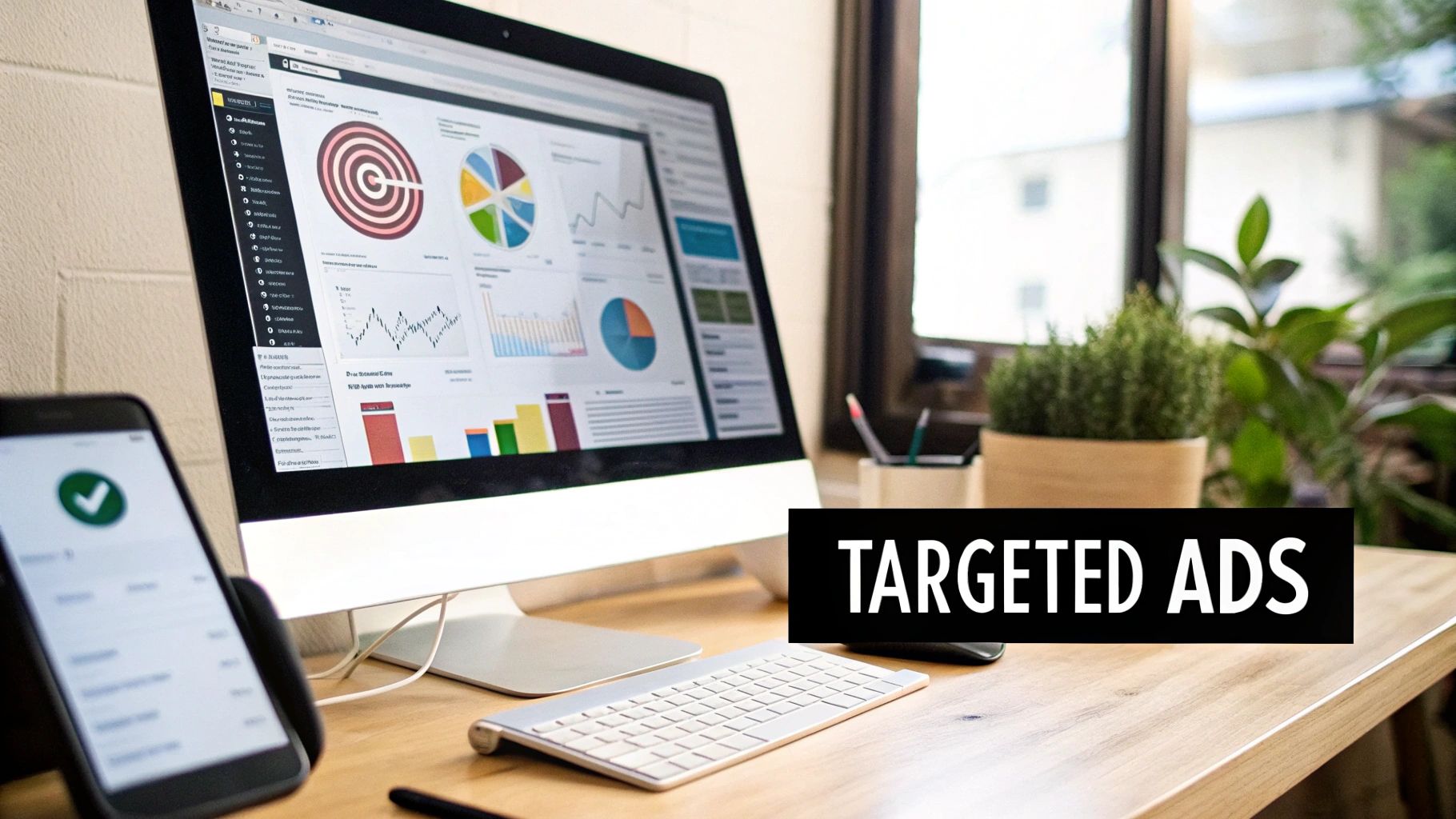
This method is one of the most powerful account based marketing campaign examples because it ensures marketing dollars are spent efficiently, reaching only the people who can influence a purchase decision. It amplifies other ABM efforts by creating a persistent, helpful presence that keeps your brand top-of-mind, warming up accounts before sales outreach even begins and supporting them throughout the entire buying journey.
Strategic Breakdown
Drift, a conversational marketing platform, excels at this strategy. They identify high-intent accounts visiting their website or competitors' sites and then launch highly targeted ad campaigns on platforms like LinkedIn. An IT Director from a target company might see a Drift ad showcasing a case study from a similar firm, followed by a different ad promoting a webinar on scaling customer support. The ad creative and messaging are dynamically adjusted based on the individual's role and the company's industry, making the content feel highly relevant.
Key Insight: The goal of account-based advertising isn't just clicks; it's air cover and influence. By consistently showing up with valuable content where your buyers are, you build brand affinity and educate the buying committee, making the sales conversation much smoother when it happens.
Actionable Takeaways & Replicable Strategy
To launch an effective account-based ad campaign, focus on targeting precision and creative relevance.
- Define Your Ad Tiers: Not all accounts are equal. Use account scoring to segment your list into Tiers 1, 2, and 3. Allocate the highest ad spend and most personalized creative to Tier 1, your most valuable accounts.
- Create a Sequential Ad Playbook: Plan a narrative arc for your ads rather than showing the same one repeatedly.
- Impression 1-3 (Awareness): Serve an ad focused on a key industry pain point.
- Impression 4-6 (Consideration): Retarget engaged users with a relevant case study or solution-focused video.
- Impression 7-10 (Decision): Show a clear call-to-action, like a demo request or a free trial offer.
- Integrate with Your CRM: Connect your ad platform (like LinkedIn or Terminus) to your CRM. This creates a feedback loop where sales can see ad engagement, and marketing can refine targeting based on sales activity and pipeline progression.
Marketbetter.ai Accelerator: Leverage AI-powered audience segmentation to automatically identify and build target account lists based on firmographic, technographic, and intent data. The platform’s dynamic creative optimization feature can generate and test hundreds of ad variations tailored to specific accounts, roles, and industries, ensuring your message always resonates and drives higher engagement without manual A/B testing.
3. Sales and Marketing Alignment Through Shared Account Lists
This foundational ABM practice involves sales and marketing teams co-creating and committing to a specific list of high-value target accounts. Instead of operating in silos where marketing generates leads and sales follows up, both teams work in lockstep, orchestrating plays, sharing intelligence, and measuring success against the same account-level goals. This synchronized approach eliminates friction and focuses the organization's full revenue-generating power on the accounts most likely to convert.
This strategy is one of the most crucial account based marketing campaign examples because it addresses the root cause of many failed B2B initiatives: misalignment. By establishing a shared framework for account selection, engagement, and measurement, it ensures every touchpoint is coordinated and purposeful. Effective ABM is impossible without tight integration, making it essential to understand how to master cross-departmental collaboration to build a unified revenue engine.
Strategic Breakdown
Salesforce provides a masterclass in this approach with their dedicated ABM initiative for enterprise accounts. Their sales development reps (SDRs), account executives (AEs), and field marketers form "account pods" that jointly own a small number of target accounts. The marketing team creates bespoke content and event invitations for these specific accounts, while sales uses that air cover to execute highly personalized outreach. Both teams review progress weekly in shared dashboards, tracking account engagement scores and pipeline velocity together.
Key Insight: True alignment isn't just about sharing a list; it's about shared accountability. When both sales and marketing are measured by the same KPIs, such as pipeline generated or revenue closed within target accounts, their strategies naturally converge toward a common goal.
Actionable Takeaways & Replicable Strategy
To build this powerful alignment, focus on process, communication, and shared technology.
- Establish Tiers and Ownership: Collaboratively build your target account list, then segment it into tiers (e.g., Tier 1: 10 accounts with 1-to-1 personalization, Tier 2: 40 accounts with 1-to-few clustering). Assign a clear owner or "pod" to each account.
- Create a Shared Playbook: Document the rules of engagement.
- Cadence: Establish a weekly or bi-weekly alignment meeting to review account progress and plan next steps.
- KPIs: Define shared success metrics like Account Engagement Score, Meetings Booked, and Pipeline Velocity per account.
- Technology: Use a shared CRM or ABM platform to serve as the single source of truth for all account activity and intelligence.
- Implement Joint Incentives: Structure compensation or bonus plans that reward team collaboration. A shared bonus for hitting a target account pipeline goal can be a powerful motivator for both sales and marketing.
Marketbetter.ai Accelerator: Use the platform's unified Account Hub to give sales and marketing a 360-degree view of every target account. AI-powered intent data signals and engagement scores are visible to both teams, ensuring everyone acts on the same real-time intelligence. The system can automatically flag accounts showing buying signals, triggering coordinated plays for both sales outreach and marketing ad campaigns simultaneously.
4. Executive Engagement and Relationship Building Programs
Executive Engagement and Relationship Building Programs are high-touch ABM campaigns designed to forge strong connections with C-suite leaders and key influencers within top-tier accounts. Instead of targeting managers or directors with product-focused messages, this strategy aims to build peer-to-peer relationships between your company's leadership and the target account's executives. The goal is to establish your brand as a strategic partner, not just a vendor.
This approach is one of the most powerful account based marketing campaign examples for large, strategic accounts where a single deal can significantly impact revenue. Winning these accounts often requires buy-in from the highest levels. By creating exclusive, high-value experiences like private roundtables, personalized briefings, and thought leadership forums, you gain direct access to the decision-makers who control budget and strategy, building trust that trickles down through their organization.
Strategic Breakdown
Gartner's executive briefing programs for CIOs are a prime example of this strategy executed flawlessly. Rather than sending generic sales pitches, Gartner invites CIOs from Fortune 500 companies to exclusive, closed-door sessions with their top analysts. These events focus on industry trends and strategic challenges, not a hard sell. This provides immense value to the executive, positions Gartner as an indispensable advisor, and opens the door for deeper, more strategic sales conversations driven by the CIO's own initiatives.
Key Insight: Executive engagement isn't about selling; it's about advising. C-level leaders are concerned with major business outcomes, not product features. The most successful programs focus on delivering strategic insights and facilitating peer connections, making your company an integral part of their success network.
Actionable Takeaways & Replicable Strategy
To build an effective executive engagement program, focus on exclusivity, value, and peer-to-peer connection.
- Map the C-Suite: Identify the key executive decision-makers and influencers within your target accounts. Research their strategic priorities, speaking history, and recent publications to understand what they care about most.
- Create Exclusive Experiences: Develop "white-glove" programs that are not open to the public.
- Executive Roundtable: Host an intimate, invite-only dinner or virtual discussion for 5-10 non-competing executives to discuss a pressing industry challenge.
- 1:1 Strategic Briefing: Have your CEO or a relevant C-suite member offer a personalized briefing to their counterpart at the target account, sharing unique data or insights relevant to their business.
- Advisory Board: Invite key executives to join a customer advisory board, giving them a voice in your product direction and demonstrating their value as a partner.
- Empower Your Leadership: Your executives must own these relationships. Equip them with detailed briefings on the target account's goals and the individual's background. This is a CEO-to-CEO or CRO-to-CRO play, not a task for the sales team alone.
Marketbetter.ai Accelerator: Leverage the AI-powered executive profiling feature to instantly gather data on a target C-suite member's strategic priorities, recent interviews, and published content. The platform can then generate personalized outreach templates for your own leadership to use, crafting compelling invitations that resonate with executive-level concerns and ensure your engagement efforts feel both authentic and highly relevant.
5. Content-Driven ABM with Personalized Resource Centers
Content-Driven ABM moves beyond sending one-off assets and instead creates a dedicated, personalized content hub for each target account. This "resource center" acts as a bespoke library, filled with whitepapers, case studies, and webinars that are hand-picked or created specifically for the account's industry, challenges, and key personnel. Instead of pushing content at them, you are inviting them into a curated educational experience.
This approach is one of the most powerful account based marketing campaign examples because it shifts the dynamic from vendor-prospect to trusted advisor. By providing a centralized location for high-value, relevant information, you demonstrate a deep understanding of the account's world. This builds credibility and keeps your brand top-of-mind as they navigate their buying journey, making it a highly effective strategy for complex, long-cycle sales.
Strategic Breakdown
Cisco excels at this with its industry-specific resource centers for verticals like healthcare, manufacturing, and government. For a target hospital system, their hub won't feature generic networking case studies. Instead, it will be populated with content on securing patient data, IoT in healthcare, and network infrastructure for telehealth. Every asset speaks the language of the healthcare IT director.
Key Insight: A personalized resource center isn't just a folder of PDFs. It's a strategic environment. Tracking which assets are viewed and shared by different stakeholders provides invaluable intelligence on the account's priorities and internal champions.
Actionable Takeaways & Replicable Strategy
To build this, you must think like a librarian curating a special collection for a VIP client.
- Audit and Map Your Content: Review your existing assets and tag them by industry, persona, and pain point. Identify where you have strong coverage and where you need to create new, account-specific content to fill the gaps.
- Create a Templated Hub: Design a basic landing page template for your resource centers. This allows you to quickly spin up new, personalized hubs for different accounts by swapping out logos, messaging, and the curated content itself. The URL could even be personalized (e.g., yourcompany.com/for-acme-corp).
- Develop a Content Promotion Plan:
- Phase 1: Sales and marketing send a joint email to key contacts, introducing their personalized hub.
- Phase 2: Run targeted LinkedIn ads to the buying committee, driving traffic to the hub's most relevant asset.
- Phase 3: Monitor engagement. When a contact downloads a specific whitepaper, trigger a follow-up from the account executive referencing that topic.
Marketbetter.ai Accelerator: Use the platform's AI to analyze a target account's firmographic data and recent news to automatically recommend and assemble the most relevant content from your library for their personalized hub. Marketbetter.ai can also generate executive summaries and personalized introductions for each content piece, ensuring the experience is tailored from the first click.
6. Custom Event Experiences and Account-Specific Conferences
Custom Event Experiences are a high-touch ABM strategy that shifts away from broad, general-admission conferences to create exclusive, intimate gatherings for a select group of high-value accounts. Instead of a one-size-fits-all agenda, these events feature content, speakers, and networking opportunities tailored specifically to the challenges and goals of the attendees. This could be a VIP roundtable, an industry-specific workshop, or an executive track within a larger conference.
This method is one of the most powerful account based marketing campaign examples for building deep, meaningful relationships with key stakeholders. It demonstrates a profound investment in an account's success, moving the conversation beyond a simple sales pitch to a collaborative partnership. By creating a forum for peer-to-peer networking and direct access to your executives, you foster an environment of trust and strategic alignment that is nearly impossible to replicate digitally.
Strategic Breakdown
Salesforce excels at this with its World Tour events and exclusive executive briefings. While the main conference is large, they host private, invitation-only sessions for C-suite leaders from their most strategic accounts. These sessions address specific industry regulations, digital transformation challenges, or competitive pressures relevant only to that cohort. This creates an unparalleled sense of value and exclusivity, making attendees feel like true partners rather than just customers.
Key Insight: The goal of a custom event is not lead generation; it's relationship acceleration. Success is measured by the quality of conversations and the depth of strategic alignment achieved with the buying committee, not the number of badges scanned.
Actionable Takeaways & Replicable Strategy
To execute a successful custom event, focus on hyper-personalization and creating tangible value for your most important accounts.
- Select a Thematic Focus: Choose a theme that directly addresses a shared, high-stakes challenge for a small group of target accounts (e.g., "Navigating AI Adoption in Financial Services").
- Curate a VIP Guest List: Invite multiple stakeholders from each of your 10-15 target accounts. Getting the entire buying committee in one room dramatically shortens the sales cycle.
- Craft a Bespoke Agenda:
- Pre-Event: Send personalized invitations and pre-reading materials that frame the event's value.
- During Event: Facilitate peer-led roundtables, offer 1-on-1 sessions with your own executives, and present custom research or product roadmaps relevant to their business.
- Post-Event: Follow up with a summary of key takeaways, personalized action plans, and content that reinforces the solutions discussed.
Marketbetter.ai Accelerator: Use the platform's account intelligence features to identify the most pressing challenges and shared interests across your top-tier accounts. This data can inform your event theme and agenda. Leverage AI to generate personalized pre-event outreach, post-event summaries, and follow-up sequences, ensuring every communication feels tailored and continues the strategic conversation started at the event.
7. Account-Based Video Marketing and Personalized Video Campaigns
Account-Based Video Marketing uses personalized video content to engage key stakeholders within target accounts, cutting through the noise of traditional text-based outreach. Instead of generic demos or emails, this strategy delivers bespoke video messages, such as account-specific product walkthroughs, personalized sales pitches recorded via platforms like Loom, or welcome videos featuring the prospect's name on a whiteboard. This approach combines the high engagement rates of video with the precision of ABM personalization.
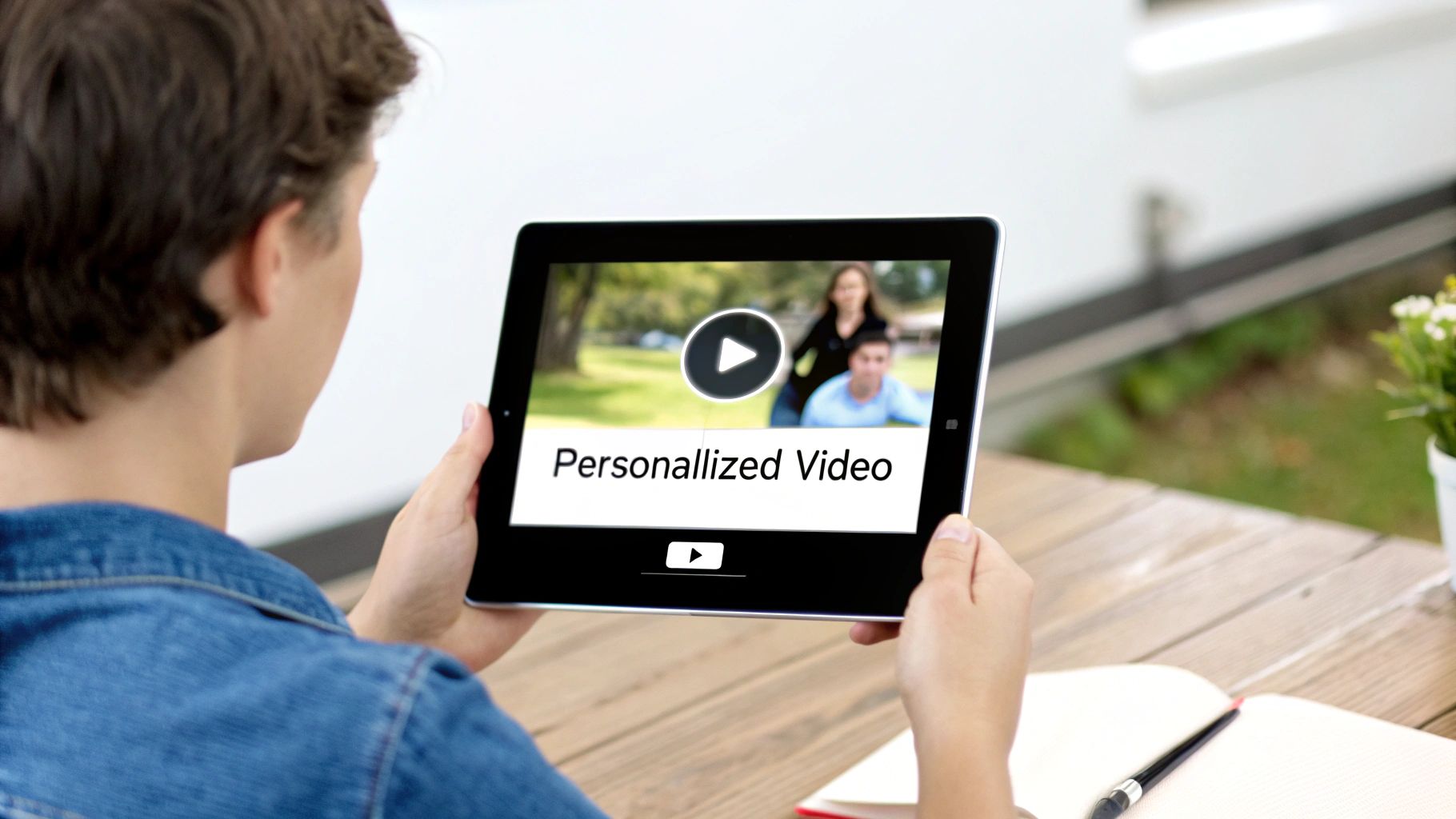
This method is one of the most powerful account based marketing campaign examples because it creates an immediate human connection and demonstrates genuine effort. In a crowded inbox, a video thumbnail with a familiar face or company logo is nearly irresistible to click. It allows sales and marketing teams to convey tone, personality, and complex value propositions far more effectively than a block of text, leading to higher response rates and faster sales cycles.
Strategic Breakdown
Drift, a pioneer in conversational marketing, excels at this. Their sales team frequently uses personalized videos to follow up with high-value prospects who visit their website. A sales rep might record a quick screen-share video, addressing the prospect by name, navigating to their company's website to point out a specific opportunity, and then showing how Drift’s solution could directly address it. This hyper-relevant, visual approach feels less like a sales pitch and more like a helpful consultation.
Key Insight: The true value of personalized video is its ability to build rapport at scale. It’s not just about showing your product; it's about showing the prospect you’ve done your research and are invested in solving their unique problem before you even speak.
Actionable Takeaways & Replicable Strategy
To launch a video ABM campaign, focus on scalability and relevance. You don't need a production studio to start.
- Segment Your Video Approach: Create different video "templates" for different stages.
- Top-of-Funnel: A simple 60-second personalized introduction video for cold outreach.
- Mid-Funnel: A 2-minute account-specific demo video highlighting 1-2 key features relevant to their pain points.
- Bottom-of-Funnel: A "next steps" video from the account executive summarizing a recent call and outlining the proposal.
- Establish a Simple Production Flow:
- Day 1: Send a personalized connection request on LinkedIn.
- Day 2: Record and send a Loom or BombBomb video via email, using a subject line like "A quick video for [Prospect Name] at [Company Name]."
- Day 4: If they watch the video but don’t reply, follow up with a short message referencing a key point from the video.
- Track Engagement: Monitor video views, watch time, and click-through rates to see what resonates. This data is crucial for refining your message and follow-up timing. Explore how to integrate this into your sales cadence with our video email automation playbook.
Marketbetter.ai Accelerator: Use our platform’s engagement triggers to automate your video follow-up. For instance, if a contact at a target account watches over 75% of your personalized demo video, automatically trigger a task for the account executive to call them within the hour. This ensures you capitalize on peak interest and connect when your message is top-of-mind.
Comparing ABM Campaign Examples: Which Strategy is Right for You?
Choosing the right ABM strategy depends entirely on your goals, resources, and the nature of your target accounts. A high-touch, resource-intensive approach like an Executive Engagement Program is perfect for a handful of whale accounts but impractical for 100 mid-market targets. This comparison table will help you make a more informed, actionable decision.
| Strategy | Ideal for... | Key Strength | Main Challenge |
|---|---|---|---|
| Multi-Channel Outreach | Creating broad, consistent presence in many accounts. | Comprehensive reach and message reinforcement. | High complexity in coordinating channels. |
| Account-Based Ads | Warming up a large list of accounts efficiently. | Scalability and precise targeting. | Can be costly; risk of banner blindness. |
| Sales/Marketing Alignment | Any company starting or scaling ABM. | FOUNDATIONAL: Boosts efficiency of all other plays. | Requires cultural change and shared KPIs. |
| Executive Engagement | Winning very large, strategic (Tier 1) accounts. | Builds deep C-level relationships and trust. | Extremely resource and time-intensive. |
| Personalized Resource Centers | Nurturing accounts with complex buying cycles. | Positions you as a trusted, expert advisor. | Requires a strong, relevant content library. |
| Custom Events | Accelerating late-stage deals or engaging top accounts. | Creates memorable, high-impact experiences. | Very high cost and logistical complexity. |
| Personalized Video | Cutting through inbox noise for initial outreach. | High engagement and humanizes communication. | Can be difficult to scale personalization effectively. |
Activating Your Next ABM Campaign: A Strategic Summary
The journey through these seven distinct account based marketing campaign examples reveals a powerful, unifying truth: successful ABM is not a monolithic strategy but a dynamic, creative, and deeply personalized discipline. We've dissected everything from hyper-targeted advertising and custom video campaigns to executive engagement programs and bespoke event experiences. The common thread is a relentless focus on treating each target account as a market of one.
Moving beyond generic outreach to deliver true value requires a strategic synthesis of data, creativity, and technology. The most effective campaigns, as we've seen, are not just multi-channel; they are orchestrated, ensuring every touchpoint builds upon the last to create a cohesive and compelling narrative for the entire buying committee.
Synthesizing the Core Lessons
Reflecting on the diverse examples, several core principles emerge as non-negotiable for ABM success. First is the foundational importance of sales and marketing alignment. Campaigns like the shared account list and executive engagement programs are functionally impossible without a unified team, shared KPIs, and constant communication. This alignment ensures that marketing's air cover perfectly complements sales' ground-level engagement.
Second, personalization is the engine of ABM, but its form must match the objective. For broad awareness within a target account (like in account-based advertising), personalization might mean tailoring ad creative to an industry's pain points. In contrast, for a high-stakes executive engagement play, it demands deep, one-to-one personalization, referencing an executive's recent publications or company milestones. The key is to graduate the level of personalization based on the stage and importance of the relationship.
Finally, technology acts as the essential accelerator. Orchestrating a content-driven ABM play with personalized resource centers or launching a multi-faceted video campaign at scale would be a logistical nightmare without the right tech stack. Platforms that leverage AI for content generation, audience segmentation, and performance analytics are no longer a luxury; they are a necessity for executing these sophisticated strategies efficiently.
From Inspiration to Actionable Strategy
Viewing these account based marketing campaign examples should not be overwhelming. Instead, see them as a menu of strategic options. Your task is not to implement all seven at once but to choose the one that best aligns with your immediate business goals and resources.
To make this transition from learning to doing, follow these concrete next steps:
- Identify Your Primary Objective: Are you trying to break into net-new enterprise accounts, accelerate existing deals stalled in the pipeline, or expand your footprint within current customers? Your answer dictates the best starting campaign. For net-new penetration, an account-based advertising campaign paired with personalized outreach is a strong choice. For deal acceleration, an executive engagement program could be the key to unlocking a stubborn budget.
- Select a Pilot Campaign Type: Based on your objective, choose one playbook from this article to pilot. If your strength is content, the personalized resource center is a natural fit. If you have a charismatic sales leader, lean into a video marketing campaign. Start with a focused, manageable scope.
- Assemble Your Pilot Account List: Work directly with your sales counterparts to select a small, high-potential list of 5-10 target accounts. These should be accounts where you have some existing data or a clear, compelling business case for your solution. This focus is critical for measuring impact accurately.
- Define Your "Micro-Playbook": Document the specific tactics, channels, and personalized messaging you will use for your pilot. What content will you create? What data points will you use for personalization? Who on the buying committee are you targeting, and with what message? This plan is your guide for execution and a baseline for measurement.
Ultimately, mastering ABM is an iterative process. It's about launching a focused pilot, meticulously measuring the results (engagement rates, meetings booked, pipeline influence), and then refining your approach. The strategies detailed here are not just success stories; they are replicable frameworks. By adopting this mindset of continuous improvement and leveraging intelligent tools to scale your efforts, you can transform your go-to-market strategy from a wide net into a series of precision strikes, turning your most-wanted accounts into your most loyal customers.
Ready to move from theory to execution? marketbetter.ai is the AI-powered platform designed to orchestrate and optimize the very campaigns you've just explored. Stop guessing and start activating intelligent, data-driven ABM plays by visiting marketbetter.ai to see how you can build your next winning campaign in minutes, not months.