10 Actionable Best Practices for Email Campaigns in 2025
In a world of overflowing inboxes, simply sending an email isn't enough. To truly capture attention and drive results, you need a strategy that's smart, targeted, and relentlessly optimized. The difference between a campaign that converts and one that’s ignored lies in the details-the nuanced tactics that build trust and compel action. This is where mastering the best practices for email campaigns becomes a critical differentiator, transforming your email program from a simple broadcast tool into a powerful revenue engine.
This guide cuts through the noise to deliver an authoritative collection of actionable strategies. We move beyond generic advice like "know your audience," providing specific comparisons and implementation checklists for everything from advanced segmentation and mobile-first creative to A/B testing protocols and compliance essentials. For instance, we'll compare the impact of a static, one-size-fits-all newsletter against a dynamically personalized one driven by user behavior, showing you exactly how to set up the latter.
Each practice is designed not just to be understood, but to be implemented immediately for measurable impact. You will learn how to clean your contact lists to improve deliverability, craft subject lines that demand to be opened, and design calls-to-action that guide subscribers seamlessly toward conversion. To master automated email sequences and customer journeys, a deeper dive into implementing effective drip campaign strategies can be highly beneficial. Let's explore the strategies that separate the campaigns that get deleted from the ones that drive real business growth.
1. Segmentation and Personalization: Treat Subscribers Like Individuals, Not a Monolith
One of the most critical best practices for email campaigns is to move beyond generic, one-size-fits-all email blasts. Segmentation is the practice of dividing your email list into smaller, more targeted groups based on specific criteria. Personalization then uses the data from those segments to tailor your message, making the recipient feel understood and valued.
Imagine the difference in impact. A generic campaign sends a 20% off coupon for all products to your entire list. In contrast, a segmented campaign sends a targeted offer: a 20% coupon for hiking boots only to subscribers who previously purchased outdoor gear or browsed hiking-related content on your site. The latter is far more likely to convert because it aligns directly with the recipient's demonstrated interests.
How to Implement Effective Segmentation
Start by defining meaningful segments based on the data you collect. Avoid overly broad categories; instead, get granular for maximum impact.
-
Behavioral Segmentation: Group users based on their actions (or inactions).
- Actionable Step: Create a segment of "cart abandoners" who added an item to their cart in the last 48 hours but didn't complete the purchase. Send them a personalized reminder, perhaps with a small incentive.
- Actionable Step: Identify "lapsed customers" who haven't purchased in six months and create a re-engagement campaign with a special "we miss you" offer.
-
Demographic Segmentation: Use basic information to tailor content.
- Actionable Step: A clothing retailer can segment by gender to send promotions for menswear to men and womenswear to women. Another layer could be location, sending promotions for winter coats to subscribers in colder climates.
-
Purchase History Segmentation: Leverage past buying habits.
- Actionable Step: If a customer frequently buys organic coffee beans, segment them into a "coffee enthusiast" group. Alert them first when a new single-origin blend arrives, reinforcing their VIP status.
Key Insight: The goal of segmentation isn't just to divide your list; it's to create an experience that feels like a one-on-one conversation. This approach transforms your email from an advertisement into a valuable service, drastically improving open rates, click-through rates, and overall ROI.
2. Mobile-Responsive Design: Guarantee a Flawless Experience on Every Screen
Ignoring mobile optimization is one of the fastest ways to lose subscriber engagement. A crucial element of best practices for email campaigns is ensuring every message is built with a mobile-responsive design. This approach uses flexible layouts and CSS media queries to automatically adapt your email's content to fit the screen it's being viewed on, from a wide desktop monitor to a narrow smartphone display.
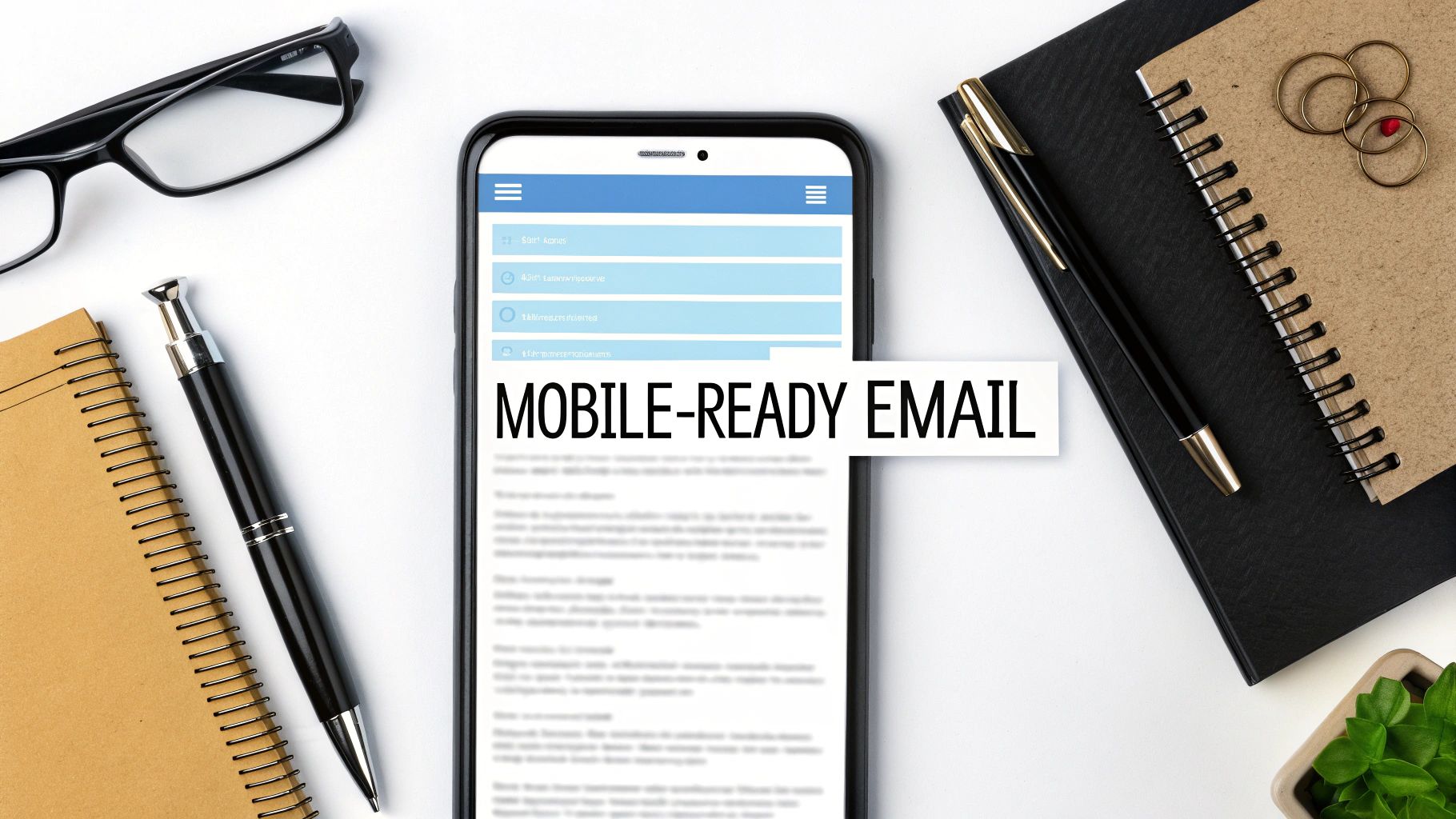
Comparison: An email that forces a mobile user to pinch, zoom, and scroll horizontally to read its content will be deleted in seconds. In contrast, a responsive email, like one from Airbnb showcasing travel deals, presents images, text, and call-to-action buttons in a clean, single-column layout that is effortless to navigate on a phone. This seamless experience respects the user's context and significantly boosts readability and interaction.
How to Implement Mobile-Responsive Design
Building for mobile-first doesn't mean sacrificing the desktop experience; it means creating a universal one. Modern email builders and frameworks like MJML handle much of the technical work, but marketers should still adhere to core principles.
-
Adopt a Single-Column Layout: While multi-column layouts work on desktop, they often become jumbled on mobile. A single-column structure stacks content vertically, creating a natural and intuitive scrolling experience for mobile users.
-
Use Large, Touch-Friendly Buttons: Small text links are difficult to tap accurately with a fingertip. Actionable Step: Design call-to-action (CTA) buttons that are at least 44x44 pixels to provide an ample touch target, reducing frustration and increasing click-through rates.
-
Optimize Fonts and Images: Use a legible font size (16px for body text is a good starting point) and compress images to ensure they load quickly on mobile networks. Actionable Step: Use an image compression tool like TinyPNG before uploading images to your email service provider.
-
Test Extensively Before Sending: Your email will look different in Gmail on an iPhone versus Outlook on a Windows desktop. Actionable Step: Use tools like Litmus or Email on Acid to preview and test your campaign across dozens of different devices and email clients to catch rendering issues before they reach your subscribers.
Key Insight: Mobile-responsive design is no longer an optional enhancement; it's a fundamental requirement for success. By prioritizing the mobile experience, you ensure your message is clear, accessible, and actionable for the majority of your audience, directly protecting your campaign's potential for engagement and conversion.
3. Subject Line Optimization: Crafting the Irresistible First Impression
The subject line is arguably the most crucial element of your email. It's the digital equivalent of a headline or a handshake; it's the gatekeeper that determines whether your carefully crafted message gets opened or ignored. Mastering this is one of the most impactful best practices for email campaigns you can implement, directly influencing your open rates and overall campaign performance.
Comparison: One email arrives with the subject "Our New Products Are Here." Another lands in your inbox saying, "Alex, Your Next Adventure Awaits [New Gear Inside]." The first is generic and easily overlooked, while the second uses personalization and curiosity to create a compelling reason to click. A great subject line makes a promise that the email content must deliver on.
How to Implement Effective Subject Line Optimization
Optimizing subject lines is both an art and a science. It requires creativity backed by rigorous testing to understand what resonates with your specific audience.
-
Clarity with a Hint of Curiosity: Your primary goal is to be clear, but that doesn't mean you have to be boring.
- Comparison: Instead of "July Newsletter," try "5 Marketing Trends You Can't Ignore This July." The first is a label; the second is a benefit-driven hook.
-
Urgency and Exclusivity: Prompt immediate action by creating a sense of scarcity or importance, but use this tactic sparingly to avoid fatigue.
- Actionable Step: For a limited-time offer, test subject lines like "Last Chance: 25% Off Ends Tonight" against a softer approach like "Your 25% Discount is Waiting."
-
Personalization and Relevance: Go beyond just using a first name. Reference past purchases, location, or recent behavior.
- Actionable Step: Implement dynamic fields to reference a subscriber's local city or a product category they recently viewed. For more detail on this, explore these strategies to improve your email open rates.
Key Insight: Your subject line isn't just a label; it's the most powerful lever you have to earn a subscriber's attention in a crowded inbox. A/B test a single variable at a time, like a question versus a statement or the inclusion of an emoji, to continuously refine your approach and learn what truly motivates your audience to open.
4. Clear Call-to-Action (CTA): Guide Subscribers to the Next Step
An engaging email is only effective if it drives action. This is where the Call-to-Action (CTA) comes in, serving as the critical link between your message and the desired outcome. One of the most vital best practices for email campaigns is to design prominent, action-oriented CTAs that eliminate ambiguity and make it effortless for subscribers to know exactly what to do next.
Comparison: A vague email might end with a simple link that says "click here." In contrast, a well-designed email features a brightly colored, clickable button with clear, urgent text like "Shop the Flash Sale Now." The first creates confusion and friction, while the second creates a clear, compelling path to conversion, drastically improving click-through rates and campaign performance.
How to Implement Powerful CTAs
Your CTA's design and copy should be intentional, drawing the eye and inspiring an immediate click. Focus on clarity, visibility, and psychology.
-
Design for Visibility and Action: Your CTA button should be impossible to miss.
- Actionable Step: Use a contrasting color for your CTA button that stands out from the email's background color. Use a tool like a color wheel to find a complementary but bold color.
- Actionable Step: Place a "Shop Now" button both "above the fold" for immediate engagement and again at the end of the email to capture readers who scroll through the entire message.
-
Use Strong, Action-Oriented Copy: The text on your button should tell the user exactly what will happen when they click.
- Comparison: Instead of a passive "Learn More," use the more engaging "Explore Classes." Similarly, "Start Clipping" is far more specific and benefit-driven than a generic "Submit."
- Actionable Step: Test first-person language like "Claim My Discount" versus the standard "Claim Your Discount." This subtle shift can create a stronger sense of ownership and increase clicks.
-
Optimize for Mobile: A significant portion of emails are opened on mobile devices, where thumbs are the primary navigation tool.
- Actionable Step: Ensure your CTA buttons are at least 44x44 pixels and have ample white space around them. This accommodates fingertip tapping and prevents frustrating mis-clicks.
Key Insight: A great CTA doesn't just ask for a click; it completes the narrative of your email. It should feel like the natural, logical, and exciting next step for the subscriber, transforming passive interest into active engagement and ultimately driving your campaign's success.
5. List Hygiene and Permission-Based Marketing: Quality Over Quantity
While a large email list might seem impressive, its value plummets if it's filled with invalid addresses and unengaged contacts. One of the most foundational best practices for email campaigns is prioritizing list quality through rigorous hygiene and a permission-based approach. This means only emailing people who have explicitly agreed to hear from you and regularly removing those who are no longer interested.
Comparison: A "dirty" list riddled with bounces and inactive subscribers signals to Internet Service Providers (ISPs) like Gmail and Outlook that you might be a spammer, severely damaging your sender reputation. In contrast, a clean, opted-in list with a 99%+ delivery rate ensures higher inbox placement, better engagement, and compliance with crucial regulations like GDPR and CAN-SPAM.
How to Implement Effective List Hygiene
Maintaining a healthy list is an ongoing process, not a one-time task. It involves both preventative measures and regular clean-up routines to protect your sender score and campaign performance.
-
Implement Double Opt-In: This is the gold standard for permission. After a user signs up, send a confirmation email requiring them to click a link to verify their address. This process confirms their interest and prevents typos or fake addresses from being added to your list.
-
Automate Bounce Management: Immediately remove hard bounces (permanent delivery failures, like an invalid email address) from your list. Actionable Step: Log into your Email Service Provider (ESP) and confirm that your account is set to automatically remove or suppress hard bounces.
-
Segment and Sunset Inactive Subscribers: Don't keep emailing contacts who never open your messages. Actionable Step: Create a segment of subscribers who haven't engaged (opened or clicked) in the last 6 months. Send them a final re-engagement campaign asking if they still want to hear from you. If there's no response, remove them. It’s better to have a smaller, engaged list than a large, silent one.
Key Insight: Think of your email list as a garden, not a warehouse. It requires regular weeding (removing inactive subscribers) and careful planting (gaining explicit permission) to flourish. A healthy list is the bedrock of successful email marketing, directly impacting deliverability, engagement, and ultimately, your return on investment.
6. Timing and Frequency Optimization: Send the Right Message at the Right Moment
Sending a perfectly crafted email is only half the battle; sending it at the wrong time or too often can render it completely ineffective. This is where optimizing your send time and frequency becomes one of the most crucial best practices for email campaigns. The goal is to land in the inbox when your subscriber is most likely to be engaged, without overwhelming them to the point of annoyance.
Comparison: A B2B newsletter with industry insights sent at 10 PM on a Saturday will likely be ignored. The same email sent at 10 AM on a Tuesday, when your audience is actively working and looking for professional content, has a much higher chance of being opened and read. Similarly, emailing a customer daily about a sale might feel aggressive, while a weekly curated digest feels helpful and welcome.
How to Implement Effective Timing and Frequency
Start with established industry benchmarks, but always test and adapt based on your specific audience's behavior. The ideal schedule is a moving target that requires continuous monitoring and adjustment.
-
Optimize Send Times: Don't guess when your audience is online; use data to make informed decisions.
- Actionable Step: Review the last 10 campaigns in your ESP's analytics. Identify the days and times that consistently produced the highest open and click-through rates, and use that as a baseline for your next send.
- Actionable Step: Leverage tools like Klaviyo or Mailchimp that offer send-time optimization features. These platforms analyze past engagement data for each individual subscriber and automatically send the email at the time they are most likely to open it.
-
Calibrate Send Frequency: Balance staying top-of-mind with respecting the inbox.
- Actionable Step: Instead of blasting your entire list with every promotion, create segments. Send a "new arrivals" email once a week to your general audience, but send more frequent, targeted emails (like back-in-stock alerts) only to those who have explicitly signed up for them.
- Actionable Step: Implement an email preference center where subscribers can choose how often they hear from you (e.g., daily, weekly, or only for major announcements). This gives them control and dramatically reduces unsubscribe rates.
Key Insight: Timing and frequency aren't about finding one perfect slot; they're about creating a communication cadence that aligns with your subscribers' routines and expectations. By respecting their time and inbox, you build trust and ensure your messages are seen as valuable resources rather than intrusive noise, directly boosting long-term engagement and loyalty.
7. Compelling Copy and Storytelling: Connect Emotionally to Drive Action
Beyond deliverability and design, the words you use are the heart of your email. One of the most vital best practices for email campaigns is crafting compelling copy that connects with subscribers on a human level. This means shifting from a purely transactional mindset, which focuses only on features and discounts, to a relational one that leverages storytelling and benefit-driven language.
Comparison: A generic email might say, "Our new CRM has a 128-bit encryption feature." A storytelling approach would frame it differently: "Worried about data security? Imagine the peace of mind knowing every client detail is protected by the same encryption trusted by global banks. That’s the security we built into our new CRM." The first states a fact; the second sells a feeling and a solution.
How to Implement Compelling Copywriting
Effective copy isn't about using fancy words; it's about using the right words to evoke emotion and inspire action.
-
Lead with Benefits, Not Features: Subscribers care about "what's in it for me?" Frame your message around the positive outcome they will experience.
- Actionable Step: Before writing, list three features of your product. For each feature, write down the direct benefit it provides to the customer. Lead your copy with the benefit. (e.g., Feature: "Automated Reporting" -> Benefit: "Save 5 hours a week").
-
Adopt a Conversational Voice: Write like you speak. Use contractions (like "you're" and "it's") and avoid corporate jargon.
- Actionable Step: Read your email copy out loud. If it sounds robotic or unnatural, rewrite it to sound more like a conversation you would have with a colleague or friend.
-
Use Storytelling and Social Proof: Humans are wired for stories. Weave narratives around your customers, your brand's mission, or the problem your product solves.
- Actionable Step: For your next campaign, incorporate a short customer quote or a one-sentence testimonial near the call-to-action. This provides powerful social proof that builds trust with prospective buyers.
Key Insight: Great email copy doesn't just sell a product; it sells a transformation or a feeling. By focusing on your subscriber's needs, fears, and aspirations, you move from being a vendor in their inbox to a trusted partner, which is the ultimate key to driving conversions and long-term engagement.
8. Analytics and Performance Tracking: Measure What Matters to Improve Results
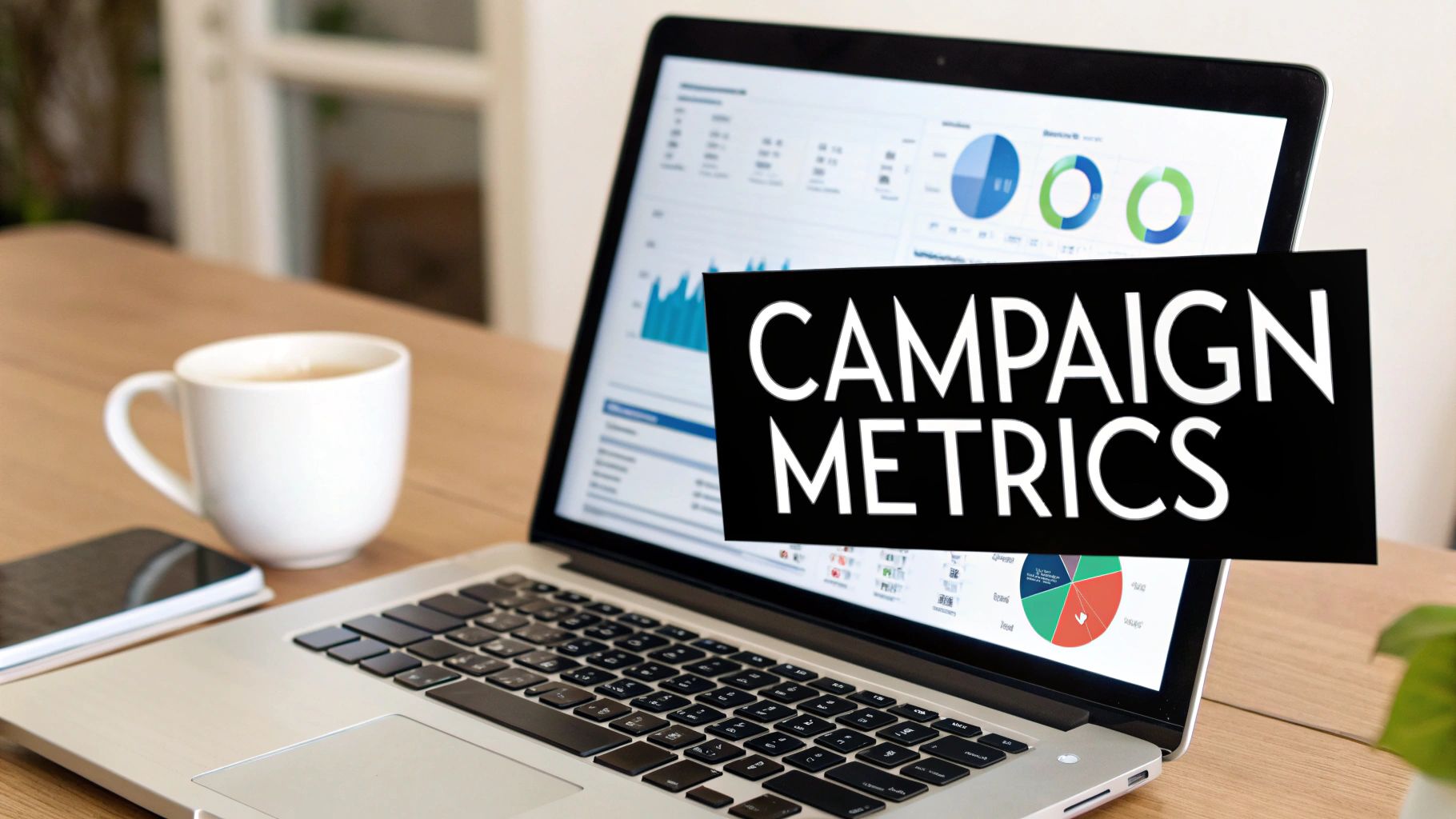
Executing an email campaign without tracking its performance is like navigating without a map. One of the most essential best practices for email campaigns is to rigorously measure key metrics to understand what's working, what isn't, and why. Analytics provides the data-driven feedback loop necessary for continuous improvement, turning guesswork into a predictable strategy for growth.
Comparison: Simply tracking open rate is a vanity metric; it tells you if your subject line worked but not if the business grew. In contrast, tracking conversion rate and revenue per email (RPE) are action metrics. They show exactly which campaigns generate the most revenue, allowing you to double down on successful tactics and refine underperforming ones.
How to Implement Effective Performance Tracking
Start by defining your key performance indicators (KPIs) and establishing a consistent review cadence. This isn't a one-time check; it's an ongoing process of analysis and optimization.
-
Track Core Engagement Metrics: Monitor the foundational health of your campaigns.
- Actionable Step: If your open rate is 15% but your click-through rate (CTR) is only 0.5%, this indicates your subject line is effective at grabbing attention, but the content or call-to-action inside the email is failing. Your next action is to A/B test the email body, not the subject line.
- Actionable Step: Create a simple spreadsheet to log the open rate, CTR, and unsubscribe rate for every campaign. Over time, this will reveal trends and benchmarks for your specific audience.
-
Measure Business-Oriented Outcomes: Connect email activity to tangible business results.
- Actionable Step: Use UTM parameters in all email links to track user journeys in Google Analytics. This allows you to see not just which email drove a click, but what pages the user visited afterward and whether they ultimately converted.
- Actionable Step: Calculate the revenue per email (RPE) for different campaign types. You might find that your educational newsletters have a higher RPE over time than your direct discount offers, informing a shift in content strategy.
-
Analyze List Health and Growth: Ensure your audience remains engaged and growing.
- Actionable Step: Once a month, check your list growth rate against your unsubscribe rate. A healthy program should be acquiring new, engaged subscribers faster than it loses old ones.
Key Insight: Effective tracking is not just about reporting numbers; it's about asking "why" and using the answers to make smarter decisions. Consistently analyzing your performance data is the single most reliable way to increase the ROI of your email marketing program over time.
9. Value-First Content Strategy: Build Trust Before You Sell
A truly effective email program prioritizes the subscriber's needs over the company's immediate sales goals. This is the core of a value-first content strategy, a powerful addition to any list of best practices for email campaigns. Instead of constantly pushing products, you focus on delivering genuinely helpful, educational, or entertaining content that builds trust and establishes your brand as an authority.
Comparison: A purely promotional campaign constantly asks for a sale ("20% Off Today!"), which can lead to fatigue and unsubscribes. In contrast, a value-first campaign gives before it asks ("3 Ways to Improve Your Workflow This Week"). When a promotional email eventually arrives from the value-first brand, it's received from a trusted source, not just another vendor, making the sales pitch far more effective.
How to Implement a Value-First Content Strategy
The key is to shift your mindset from "What can we sell?" to "What can we solve for our audience?" A common guideline is the 80/20 rule: 80% of your content should provide value, while only 20% is directly promotional.
-
Educate and Inform: Share expertise that helps subscribers do their jobs better or solve a common problem.
- Actionable Step: Brainstorm the top 5 questions your customers ask your sales or support teams. Turn each question into a helpful "how-to" email.
-
Provide Actionable Resources: Give your audience tools and insights they can use immediately.
- Actionable Step: Create a simple checklist or template related to your industry (e.g., a financial reporting checklist, a business invoice template). Offer it as a free download in your next newsletter to provide immediate, tangible value.
-
Share Stories and Trends: Connect with your audience by sharing relatable customer stories or insightful analysis of industry news.
- Actionable Step: For your next campaign, share a short success story of how a client used your product. This provides social proof and practical ideas simultaneously.
Key Insight: A value-first strategy transforms your email list from a simple marketing channel into a loyal community. By consistently delivering value, you earn permission to sell. This approach nurtures leads over the long term, resulting in higher customer lifetime value and stronger brand advocacy.
10. Compliance and Deliverability Best Practices: Building Trust and Hitting the Inbox
Often overlooked, technical compliance and deliverability are foundational best practices for email campaigns that determine whether your message is ever seen. This involves adhering to legal regulations like GDPR and CAN-SPAM while also implementing technical email authentication standards. It's the difference between landing in the primary inbox and being flagged as spam or, worse, facing legal penalties.
Comparison: Sending an email without authentication (SPF, DKIM) is like sending a letter with no return address; ISPs are likely to treat it as suspicious and send it to junk. An authenticated email acts as a digital passport, proving your emails are legitimate and not from a malicious sender. This distinction can mean the difference between a 99% inbox placement rate and a 50% one.
How to Implement Effective Compliance and Deliverability
Start with a two-pronged approach: legal adherence and technical setup. Both are critical for maintaining a high sender reputation, which directly impacts inbox placement.
-
Legal Compliance: Ensure every email respects subscriber rights and global regulations.
- Actionable Step: Check your email footer right now. Does it contain a clear, one-click unsubscribe link and your physical business address? If not, add them immediately to comply with the CAN-SPAM Act.
- Actionable Step: Review your sign-up forms. Do you clearly state what users are subscribing to? For GDPR compliance, ensure consent is explicit and provable, not hidden in terms and conditions.
-
Technical Authentication: Set up DNS records to verify your sending domain.
- Actionable Step: Use a free online tool like MXToolbox to check if your domain has SPF, DKIM, and DMARC records properly configured. Your ESP will have guides on how to set these up with your domain provider.
Key Insight: Compliance and deliverability aren't just about avoiding trouble; they are about building a sustainable, trustworthy channel. A strong sender reputation is a valuable asset that directly translates to higher open rates and better campaign performance, making these non-negotiable best practices for any serious email marketer.
Top 10 Email Campaign Best Practices Comparison
| Item | Complexity 🔄 | Resource Needs ⚡ | Expected Outcomes 📊⭐ | Ideal Use Cases 💡 | Key Advantages ⭐ |
|---|---|---|---|---|---|
| Segmentation and Personalization | High 🔄 — data, segmentation logic, ongoing maintenance | Moderate–High ⚡ — CRM/ESP, analytics, data/marketing time | Higher open/CTR and conversions; ~+26% engagement 📊 | Cross-sell, retention, lifecycle campaigns 💡 | More relevant messaging; improved ROI ⭐ |
| Mobile-Responsive Design | Moderate 🔄 — responsive templates + device testing | Moderate ⚡ — design/dev time, testing tools | Better mobile UX and conversions; reaches 50–60% mobile users 📊 | B2C promos, transactional emails, mobile-first audiences 💡 | Consistent display across devices; higher mobile CTR ⭐ |
| Subject Line Optimization | Low–Moderate 🔄 — copy testing and iteration | Low ⚡ — copywriters, A/B testing tools | Significant open-rate lift (20–50%) quickly 📊 | Campaign launches, newsletters, re-engagement sends 💡 | Cost-effective, measurable improvements to opens ⭐ |
| Clear Call-to-Action (CTA) | Low–Moderate 🔄 — design + placement testing | Low ⚡ — designers, simple tests | Higher CTRs and conversions (20–50% improvement) 📊 | Conversion-focused emails and landing traffic drives 💡 | Directs user action; improves tracking and UX ⭐ |
| List Hygiene & Permission-Based Marketing | Moderate 🔄 — ongoing cleanup and compliance | Moderate ⚡ — verification tools, maintenance effort | Improved deliverability; reduced spam complaints (30–50% gains) 📊 | All programs, especially regulated markets 💡 | Protects sender reputation and reduces costs ⭐ |
| Timing and Frequency Optimization | Moderate–High 🔄 — analysis, automation & testing | Moderate ⚡ — analytics, send-time tools | Open-rate lift (15–45%); fewer unsubscribes 📊 | Newsletters, promos, behavior-triggered sends 💡 | Maximizes engagement windows; respects preferences ⭐ |
| Compelling Copy and Storytelling | Moderate 🔄 — strategy and skilled writing | Moderate ⚡ — content creators, editorial time | Higher engagement, loyalty, and conversions over time 📊 | Brand-building, nurture sequences, long-form emails 💡 | Builds trust and memorability; drives action emotionally ⭐ |
| Analytics and Performance Tracking | Moderate–High 🔄 — tracking & attribution setup | High ⚡ — analytics platforms, data analysts | Data-driven improvements and clear ROI benchmarks 📊 | Optimization programs, reporting, budget allocation 💡 | Measures impact and guides continuous testing ⭐ |
| Value-First Content Strategy | Moderate 🔄 — content planning and consistency | Moderate ⚡ — writers, content calendar, curation | Increased loyalty and LTV (+20–40%) long-term 📊 | Retention, educational series, thought leadership 💡 | Builds authority and reduces churn; long-term payoff ⭐ |
| Compliance & Deliverability Best Practices | High 🔄 — technical setup + legal monitoring | Moderate–High ⚡ — IT, legal, monitoring tools | High inbox placement (95%+); lower legal/penalty risk 📊 | Global sends, regulated industries, large lists 💡 | Protects legally and technically; ensures deliverability ⭐ |
Turning Best Practices into Standard Practice
Navigating the intricate landscape of modern email marketing can feel overwhelming, but mastering it is not about finding a single silver bullet. Instead, it’s about the consistent, disciplined application of proven principles. The 10 strategies we've explored, from granular segmentation and mobile-first design to robust analytics and compliance, are not just isolated tactics; they are interconnected pillars that support a powerful, revenue-generating engine. Ignoring one, such as list hygiene, can directly undermine another, like your deliverability and, ultimately, your analytics. The true art lies in transforming these individual best practices for email campaigns into your team's standard operating procedure.
Comparison: An average marketer might A/B test a subject line once a quarter. A great marketer, however, builds a systematic testing calendar, treating every send as a learning opportunity. They don’t just personalize with a first name; they use dynamic content blocks based on purchase history, creating a unique experience for each subscriber segment. This evolution from occasional effort to ingrained habit is what separates stagnant programs from those that achieve exponential growth.
Your Actionable Roadmap: From Insight to Implementation
To prevent this guide from becoming just another bookmarked article, it's crucial to take immediate, deliberate action. Don't try to overhaul your entire program overnight. Instead, adopt a phased approach that builds momentum and demonstrates clear wins.
Here is a practical, step-by-step plan to get started this week:
- Step 1: Conduct a Quick Audit (This Afternoon): Review your last three campaigns against our 10-point checklist. Where are the most significant gaps? Is your CTA buried? Is your mobile experience clunky? A quick, honest assessment will immediately reveal your lowest-hanging fruit.
- Step 2: Choose Your "First-Fix" (Tomorrow): Pick one or two areas to prioritize. If your deliverability is a concern, start with list hygiene and authenticating your domain with SPF, DKIM, and DMARC. If engagement is low, focus on subject line optimization and implementing a more compelling storytelling approach in your copy.
- Step 3: Leverage AI for Efficiency (This Week): The modern marketer's toolkit is increasingly powered by artificial intelligence. Instead of struggling to brainstorm dozens of subject line variations, use AI to generate creative options. To significantly enhance your content, you can even explore the best sources for ChatGPT prompts for marketing to guide AI in crafting persuasive copy, segmenting audiences, or even outlining entire campaign workflows. This allows you to focus on strategy while technology handles the tactical execution.
- Step 4: Set a Micro-Goal and Measure (Next Week): Define a specific, measurable goal for your chosen "first-fix." For example: "Improve our open rate by 2% on the next campaign by A/B testing five new subject line formats," or "Reduce our unsubscribe rate by 0.1% by cleaning 500 inactive subscribers from our main list." This creates accountability and provides tangible proof of progress.
By consistently applying this "Audit, Prioritize, Implement, Measure" cycle, these best practices cease to be abstract concepts. They become a core part of your operational rhythm, driving predictable and sustainable results. Each optimized subject line, every cleaned email list, and each well-timed automated workflow is a small victory that compounds over time, building a resilient, engaging, and highly profitable email marketing program that your audience values and your business depends on.
Ready to turn best practices into effortless standard practice? marketbetter.ai integrates this entire framework directly into your workflow, using AI to automate segmentation, optimize copy, and predict the perfect send times. Stop guessing and start growing by visiting marketbetter.ai to see how our platform can transform your email campaigns today.