B2B Demand Generation Proven Growth Strategies
Let's be real—most B2B marketing feels like trying to find a needle in a haystack. You're constantly chasing leads, hoping a few are actually ready to talk.
B2B demand generation flips that entire model on its head. Instead of just scrapping for the few buyers who are ready to pull the trigger right now, you play the long game. It's about building awareness and creating genuine desire across your entire market, so when they are ready to buy, you’re the only name they think of.
Why B2B Demand Generation Matters More Than Ever
Most B2B marketing teams are playing with a massive handicap and don't even know it. They pour their entire budget into capturing immediate leads, but this completely ignores how markets actually work.
Here’s the hard truth: only 5% of your total addressable market is actively 'in-market' at any given moment. That means a whopping 95% of your potential future customers are out there, but they just aren't ready to buy yet. This single stat should change how every B2B marketer thinks.
When you focus all your energy on that tiny 5%, you’re jumping into a hyper-competitive, high-cost cage match with every other company in your space. Everyone is bidding on the same keywords, targeting the same handful of prospects. The result? A mess of predictable problems that stall growth.
The Downfall of a Lead-Only Focus
When marketing's only job is to capture that 5%, you create a vicious cycle that burns out your team and your budget. This tunnel vision leads directly to:
- Sky-High Acquisition Costs: The fierce competition for those few active buyers drives your ad spend and customer acquisition costs (CAC) through the roof, crushing your margins.
- Sales Team Burnout: Marketing gets desperate and starts passing off low-quality, barely-qualified contacts just to hit a number. Your sales team wastes precious time chasing ghosts who have no real intent, leading to missed quotas and serious frustration.
- Unpredictable Revenue: A pipeline that relies solely on the tiny fraction of the market buying today is shaky at best. It’s a recipe for wild, unpredictable swings in revenue.
A modern B2B demand generation strategy stops marketing from being a reactive cost center and turns it into a predictable revenue engine. You build a reservoir of future customers by educating and engaging the 95%, ensuring a steady, consistent flow of high-intent buyers for the long haul.
The first step is a mental shift. Stop asking, "How do we get more leads today?" Start asking, "How do we become the go-to solution for our entire market tomorrow?"
This is the philosophy that builds sustainable growth. To get a better handle on the fundamentals, it’s worth exploring what demand generation marketing entails. This approach builds brand equity and trust, so when the time is right, the sales conversation is a hell of a lot easier.
Creating Demand vs Capturing Demand
To build a B2B demand generation engine that actually works, you have to get one thing straight: the difference between creating demand and capturing demand. It’s the single most common blind spot I see. Too many marketers focus only on one side of the equation, which is like a farmer only showing up at harvest time without ever planting a single seed. A strategy that lasts requires you to master both.
Think of it like this: demand creation is the patient work of tilling the soil and planting seeds for a future harvest. It's about educating and building trust with the overwhelming majority of your market—the 95% of people who aren’t looking to buy today but will be someday.
On the flip side, demand capture is about harvesting the crops that are ripe for the picking right now. This is where you engage the tiny 5% of your market that is actively searching for a solution. They know they have a problem, and they're looking for a fix.
This breakdown isn't just a theory; it's how your market actually works.
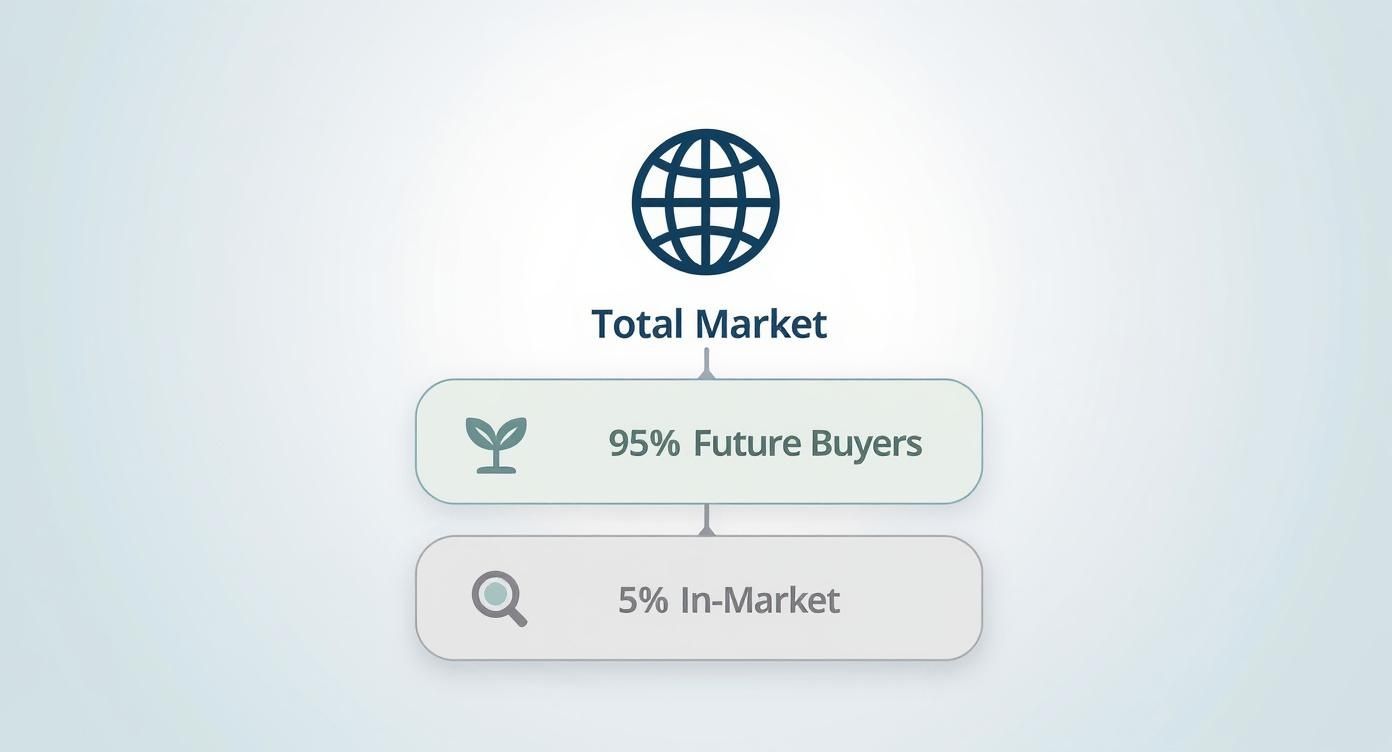
That image makes it painfully clear. If you only focus on capturing the 5%, you're in a knife fight with every competitor for the smallest slice of the pie. The real, long-term growth comes from nurturing the other 95%.
How to Actually Create Demand
Demand creation is a long game. It's an investment in your brand’s authority and your audience’s trust. The goal isn't to get a lead today; it's to be the only company they think of when a problem comes up six months from now. This means showing up where your ideal customers hang out to learn, long before they're in a buying cycle.
Here’s an actionable plan to start:
- Launch a Niche Podcast: Action: Identify 3 industry experts your ideal customers admire. Invite them to discuss a common pain point. This positions you as a connector and thought leader, not just a vendor.
- Dominate Thought Leadership on LinkedIn: Action: Task your internal experts with sharing one non-promotional, genuinely helpful tip or insight each week. Engage in comments on other leaders' posts to build visibility and trust.
- Build an Online Community: Action: Start a free Slack or Discord channel focused on a specific industry role (e.g., "B2B SaaS Marketers"). Your job is to facilitate valuable conversations and connections, not to pitch your product.
You don't measure these efforts in MQLs. You measure them with metrics that matter for brand building, like audience growth, share of voice, and direct traffic.
How to Actually Capture Demand
While you're building that future pipeline, you still need to hit this quarter's number. That's where demand capture comes in. These are the tactics aimed squarely at prospects who are waving their hands in the air, signaling they have a problem and are ready to talk solutions. The trick is to be right there, with the right message, the moment they're looking.
Here’s an actionable plan to start:
- Run High-Intent Google Ads: Action: Instead of bidding on broad terms like "CRM software," bid on long-tail phrases that signal immediate need, such as "[Your Competitor] alternative" or "best CRM for small business."
- Optimize Your G2 and Capterra Profiles: Action: Launch a campaign to get 10 new, positive reviews from happy customers this quarter. A profile packed with recent social proof is non-negotiable for buyers in the comparison stage.
- Use Surgical Retargeting Ads: Action: Create a specific ad campaign targeting only visitors who viewed your pricing or demo pages in the last 14 days. This keeps you top of mind during their final decision-making window.
The core difference is timing and intent. Demand creation educates those who might have a problem in the future. Demand capture converts those who know they have a problem today.
The table below breaks down the practical differences in how you approach these two critical functions.
Comparing Demand Creation and Demand Capture Tactics
| Aspect | Demand Creation (Targeting the 95%) | Demand Capture (Targeting the 5%) |
|---|---|---|
| Objective | Build brand awareness, trust, and authority over the long term. Educate the market. | Convert existing buying intent into pipeline and revenue now. |
| Channels | Social media (LinkedIn), podcasts, communities (Slack), content hubs, organic search (informational). | Paid search (Google Ads), review sites (G2, Capterra), retargeting, organic search (commercial). |
| Key KPIs | Audience growth, share of voice, engagement rates, brand recall, direct & branded traffic. | Cost per acquisition (CPA), conversion rates, pipeline value, sales cycle length. |
| Example Tactics | - Hosting an industry podcast - Publishing original research reports - Building a thought leader's LinkedIn presence | - Bidding on "bottom-of-funnel" keywords - Optimizing software review site profiles - Running demo request landing pages |
Ultimately, a winning B2B demand generation strategy doesn't choose between them—it balances them. You have to create future demand while you efficiently capture the demand that already exists. This dual focus is the only way to not only crush this quarter's target but also build a predictable revenue engine for years to come.
Your Playbook for High-Impact Channels and Tactics

Alright, let's move from theory to action. A successful B2B demand generation program hinges on a smart playbook—picking the right channels and running tactics that build real authority and fill your pipeline.
Forget the old "spray-and-pray" method. The goal here is surgical precision. You need to show up exactly where your ideal customers are already learning, connecting, and making buying decisions. It’s about understanding the specific job each channel has, whether that's creating future demand or capturing the intent that’s already out there today.
Content Marketing: The Foundation of Authority
Content is the bedrock of any serious demand gen effort. It’s how you educate the 95% of your market that isn't actively buying right now, slowly but surely positioning your brand as the go-to expert.
A common mistake is creating content just to please search engines. This leads to sterile, keyword-stuffed articles that might rank but don't actually connect with a human reader. The real key is to build your content around pillar pages or content hubs.
Actionable Step: Identify the single biggest, most complex problem your ideal customer faces. Create a comprehensive "pillar page" that acts as the ultimate guide to solving it. Then, plan 5-7 "cluster" blog posts that dive deeper into specific sub-topics, all linking back to your main pillar. This strategy signals topical authority to search engines and provides immense value to your audience.
A winning B2B content strategy doesn't just answer questions; it shapes the entire conversation. Your content should be the resource your competitors' customers secretly use to get their jobs done better.
This is a long-term play, but the payoff is huge. Companies that keep up an active blog generate 67% more leads per month on average than those that don't.
LinkedIn: Dominating the B2B Social Sphere
For B2B marketers, LinkedIn isn't just another social network. It's the digital town square where your entire industry hangs out. Just posting company updates won’t move the needle. The real power is in activating the personal brands of your in-house subject matter experts.
Instead of your company page broadcasting messages, imagine your CEO, Head of Product, or a top engineer sharing genuine insights from their day-to-day. Have them ask thought-provoking questions and jump into real conversations in industry groups. This human-to-human connection builds trust in a way a corporate logo simply can't.
Actionable Step: Take your latest research report or webinar recording and have a subject matter expert repurpose the key takeaways into a 5-post LinkedIn series. Each post should share one valuable insight and ask a question to encourage comments. This multiplies the reach of your core content and puts it directly in front of a highly relevant audience.
Webinars and Virtual Events: Creating Fans, Not Just Leads
Webinars are still a powerhouse for demand generation, but the game has changed. The era of dry, hour-long product pitches is officially over. Today's best webinars feel more like live, educational shows.
These events should focus on a tangible problem and feature industry experts—not just your own team. Bringing in outside voices broadens your reach and adds a ton of credibility. The data backs this up: 53% of marketers say webinars are the top-of-funnel format that generates the highest quality leads.
Here’s a look at how the approach has shifted:
| Feature | The Old Way (Lead Gen Focus) | The Modern Way (Demand Gen Focus) |
|---|---|---|
| Primary Goal | Collect as many registrants (MQLs) as possible. | Deliver an exceptional educational experience to the right audience. |
| Content Focus | Heavily product-focused, often a thinly veiled sales demo. | Focused on solving a specific audience pain point; the product is only mentioned for context. |
| Promotion | "Register for our webinar" plastered everywhere. | Promote the topic and the expert speakers to create genuine interest. |
| Success Metric | Number of MQLs passed to sales. | Audience engagement, post-event feedback, and influence on the pipeline. |
When you shift your focus from simply collecting emails to delivering real value, you don't just get a lead—you create a genuine fan of your brand.
This strategy is a cornerstone of many successful B2B demand generation programs. It works hand-in-glove with other efforts, like those we explore in our complete guide to inbound marketing and lead generation. Ultimately, the right channel mix depends on where your audience lives and how they like to learn, but these three pillars are a powerful and proven place to start.
Building Your B2B Demand Generation Tech Stack
Your tech stack shouldn't be a Frankenstein's monster of disconnected tools. Think of it as the central nervous system for your entire demand gen strategy. It's what connects data, automates the grunt work, and gives you the insights to make smarter bets with your budget.
Get it right, and everything flows. Get it wrong, and you're stuck with data silos, operational headaches, and a fuzzy picture of what's actually driving revenue.
Let's break it down with an analogy. Your Customer Relationship Management (CRM) is the brain, the single source of truth. Your Marketing Automation Platform (MAP) is the nervous system, executing the commands. And your Analytics tools are the eyes and ears, telling you what's happening in the real world. All three have to work together.

Core Components of a Modern Stack
Every solid demand gen stack is built on a few non-negotiable pillars. These are the foundational tools for tracking engagement, nurturing relationships, and finally proving marketing's impact on the bottom line.
- CRM (The Brain): This is where every piece of customer and prospect data lives—contact info, interaction history, deal stages, you name it. It has to be your single source of truth. Think HubSpot (often an all-in-one choice) and Salesforce.
- Marketing Automation (The Nervous System): This is the engine that runs your campaigns. It handles email nurturing, builds landing pages, and powers your lead scoring models. Common players include Marketo, Pardot, and the automation built right into HubSpot.
- Analytics and Attribution (The Eyes and Ears): These tools answer the golden question: "Is this working?" Google Analytics is the baseline for web traffic, but more advanced platforms like Dreamdata or HockeyStack connect the dots directly from a marketing touchpoint to a signed contract.
As you build out your stack, remember to account for specific channels. For example, if webinars are a key part of your strategy, choosing the best webinar software for small businesses ensures your content delivery is just as polished as your data tracking.
Comparing Stacks for Startups vs. Enterprises
The perfect tech stack isn't one-size-fits-all. It has to scale with your company's complexity and budget. What works for a lean startup would grind a global enterprise to a halt, and an enterprise stack would be overkill for a small team.
| Company Stage | Key Focus | Example Tech Stack |
|---|---|---|
| Lean Startup | Affordability, ease of use, and all-in-one functionality. The goal is speed and efficiency. | CRM/Automation: HubSpot Starter/Pro Analytics: Google Analytics Social: Buffer or Hootsuite |
| Established Enterprise | Scalability, deep customization, and robust integrations. The goal is managing complex campaigns. | CRM: Salesforce Automation: Marketo or Pardot Analytics: Dreamdata, Bizible ABM: 6sense or Demandbase |
For startups, an all-in-one platform like HubSpot is almost always the right call. It bundles the CRM, marketing automation, and analytics you need to get started, minimizing integration headaches and keeping costs down.
Enterprises, on the other hand, usually need best-in-class point solutions that can handle massive data volumes and complex workflows, even if it means a higher price tag and more heavy lifting on the integration front.
The most important principle is integration. Your tools must speak to each other seamlessly. A disconnected stack creates blind spots, making it impossible to see how a LinkedIn ad or a blog post ultimately influenced a closed-won deal.
The Rise of AI in the Tech Stack
AI isn't some futuristic concept anymore; it's a practical, powerful layer you can add to your stack right now. AI-powered tools are becoming essential for getting an edge in personalization and efficiency, analyzing huge datasets to spot patterns a human marketer could easily miss.
Here’s an actionable comparison of manual vs. AI-powered approaches:
| Task | Manual Approach | AI-Powered Approach |
|---|---|---|
| Lead Scoring | Relies on simple demographic rules (e.g., company size, job title). | Analyzes thousands of behavioral and firmographic signals for a predictive score. |
| Content Personalization | Create a few different landing pages for broad segments. | Dynamically changes website copy and CTAs for each individual visitor in real-time. |
| Campaign Optimization | A marketer manually checks performance and adjusts ad bids weekly. | The AI algorithm automatically adjusts bids and reallocates budget 24/7. |
Getting started doesn't require ripping and replacing your entire system. You can explore a variety of AI marketing automation tools designed to plug right into your existing workflows, giving you an immediate boost without a massive overhaul.
Measuring What Matters for Revenue Growth
In B2B demand generation, what you measure is what you get. For too long, marketing teams celebrated vanity metrics like social media likes and website traffic that mean very little to the C-suite. To prove your value and secure bigger budgets, you have to start speaking the language of revenue.
This means shifting your focus from top-of-funnel activity to bottom-line business outcomes.
When you report on pipeline and customer acquisition cost instead of clicks, you completely change the conversation. Marketing is no longer seen as a cost center but as a primary driver of predictable business growth.
Ditching Vanity Metrics for Revenue KPIs
Vanity metrics feel good, but they don’t pay the bills. A spike in website visitors is meaningless if none of them are qualified buyers. True success in B2B demand generation is measured by its direct contribution to the sales pipeline and closed-won deals.
This isn't just a trend; it's a fundamental shift in how B2B marketing is held accountable. A recent study shows that 42% of B2B marketing teams now cite revenue generated as their top KPI—a stark contrast to the old days of clicks and impressions. With marketing budgets hovering around 7.7% of overall company revenue, the pressure is on to show a clear return on that investment. You can see more on these demand generation statistics and their impact here.
To demonstrate your impact, get laser-focused on these actionable metrics:
- Marketing-Sourced Pipeline: This is the total dollar value of sales opportunities that came directly from marketing activities. It's the cleanest indicator of your team's contribution to future revenue.
- Sales Cycle Length: Track how long it takes, on average, for a marketing-sourced lead to become a paying customer. An effective demand gen strategy should shorten this cycle by delivering better-educated, higher-intent leads to sales.
- Customer Acquisition Cost (CAC): This is the total cost of your sales and marketing efforts divided by the number of new customers acquired. Your goal is to keep this number as low as possible while maintaining lead quality.
Comparing Old Metrics vs. New Metrics
The difference in focus is night and day. One approach reports on activity, while the other reports on actual business impact.
| The Old Way (Vanity Metrics) | The New Way (Revenue Metrics) |
|---|---|
| Website Traffic: "We had 10,000 visitors this month." | Pipeline Contribution: "Marketing generated $500k in new sales pipeline this quarter." |
| Lead Volume: "We generated 500 MQLs." | Lead-to-Customer Rate: "1 in 10 marketing-sourced leads became a paying customer." |
| Click-Through Rate (CTR): "Our ad campaign had a 3% CTR." | Customer Acquisition Cost (CAC): "Our CAC from the ad campaign was $5,000." |
This new approach aligns marketing directly with sales and executive goals, which is how you build trust and prove your team's indispensable role. You can explore a deeper dive into key performance indicators for lead generation to build out your own reporting dashboards.
A Deeper Look at Key Metrics
To make your reporting rock-solid, it helps to have a clear view of which KPIs tell the best story. Here's a breakdown of the metrics that truly matter.
Key B2B Demand Generation Metrics to Track
| Metric (KPI) | What It Measures | Why It Matters |
|---|---|---|
| Marketing Qualified Leads (MQLs) | The number of leads deemed ready for sales follow-up based on their behavior (e.g., downloaded an ebook). | Measures the volume of potential buyers your demand capture efforts are generating. |
| Sales Qualified Leads (SQLs) | MQLs that the sales team has accepted as legitimate opportunities with real buying intent. | Shows the quality of your MQLs and the alignment between marketing and sales. |
| MQL-to-SQL Conversion Rate | The percentage of MQLs that become SQLs. | This is a critical health check on your lead quality. A low rate signals a disconnect. |
| Pipeline Contribution | The total dollar value of sales opportunities that originated from marketing efforts. | The single most important metric for proving marketing's direct impact on future revenue. |
| Customer Acquisition Cost (CAC) | Total sales and marketing spend divided by the number of new customers acquired in a period. | Measures the efficiency of your demand generation engine. Lower is better. |
| Customer Lifetime Value (CLV) | The total revenue a business can expect from a single customer account throughout the relationship. | Provides context for CAC. A high CLV justifies a higher acquisition cost. |
| Sales Cycle Length | The average time it takes for a lead to become a paying customer. | Effective demand generation should shorten this by delivering more educated, ready-to-buy leads. |
Tracking these metrics gives you a 360-degree view of your performance, from initial interest all the way to closed revenue. It’s the difference between guessing and knowing.
Simple Revenue Attribution Models to Start With
You don’t need expensive, complicated software to start connecting marketing efforts to revenue. Revenue attribution is simply the practice of assigning credit to the marketing touchpoints a customer interacted with before they bought something.
While complex multi-touch models exist, you can get started with a simple, practical approach.
A great starting point is the First-Touch Attribution Model. This model gives 100% of the credit for a new customer to the very first marketing interaction they had with your brand.
Actionable Example: A prospect reads one of your blog posts they found through a Google search. Six months later, after attending a webinar and having multiple sales calls, they become a customer. With first-touch attribution, that blog post gets all the credit.
This model is simple to implement and powerfully demonstrates the value of your demand creation activities—like content and SEO—which often get overlooked. It helps you justify the long-term investments that build your brand and create future demand, proving that what you do today directly impacts the revenue you see tomorrow.
4-Phase Action Plan to Launch Your Demand Gen Engine
Alright, theory's one thing, but revenue comes from execution. Let's turn all this talk into a practical, step-by-step roadmap for launching or overhauling your B2B demand generation engine. I’ve broken this down into four clean phases designed to build momentum and get real results on the board.
Forget the "boil the ocean" approach. Trying to do everything at once is a recipe for wasted budget and burnout. This plan ensures you build a solid foundation first, then scale.
Phase 1: Build Your Foundation (Weeks 1-2)
Before you spend a single dollar on a campaign, you need absolute clarity on who you're talking to and what you're saying. This is the unsexy, non-negotiable work that makes everything else click. Skipping this step is the #1 reason demand gen initiatives die on the vine.
Your only mission here is to:
- Nail Your Ideal Customer Profile (ICP): Action: Schedule 3-5 interviews with your best customers. Ask them about their "before" and "after" state, what triggered their search for a solution, and what other tools they considered.
- Craft Your Core Messaging: Action: Based on those interviews, write a single paragraph that describes the problem you solve, for whom, and what makes your solution unique. Test this messaging with your sales team for feedback.
Phase 2: Kickstart Demand Creation (Weeks 3-8)
With your foundation poured and set, it's time to start creating some demand. This phase is all about planting seeds with the 95% of your market that isn't shopping today. The goal isn't lead capture; it's to build awareness, authority, and an audience that trusts you.
This isn’t about harvesting emails. It’s about building an audience that sees you as the go-to expert. Your first move should feel like a Trojan horse of value—give away so much insight that your brand becomes impossible to ignore.
Here’s where to start:
- Launch a Content Series: Action: Pick one format you can execute consistently (e.g., a monthly webinar with guest experts). Commit to producing it for at least 3 months to build momentum and an audience.
- Activate a Key Opinion Leader: Action: Choose one person inside your company with strong expertise. Their only goal for this phase is to post twice a week on LinkedIn, sharing insights from your content series and engaging in industry conversations.
Phase 3: Set Up Demand Capture (Weeks 9-10)
While you're building future demand, you can't ignore the people ready to buy right now. This phase is about setting up the plumbing to efficiently catch the 5% of the market that's actively looking for what you sell.
| Phase 2 (Creation) Focus | Phase 3 (Capture) Focus |
|---|---|
| Educating the market | Converting existing intent |
| Building an audience | Generating qualified meetings |
| Long-term brand building | Near-term pipeline impact |
Your initial setup should be lean and mean:
- Targeted "Bottom-of-Funnel" Ads: Action: Launch one Google Ads campaign with a small budget ($500-$1000/mo). Target a maximum of 10 high-intent keywords like "[Your Competitor] alternatives" or "[Your Product Category] pricing."
- Conversion-Optimized Landing Pages: Action: Create a single, simple landing page for your ads. It should have a clear headline, 3-5 bullet points on value, and a form to request a demo. That's it.
Phase 4: Establish Your Measurement Framework (Weeks 11-12)
Finally, you need to prove it's all working. This last phase ensures you can track progress, show ROI, and make smarter decisions with real data. Start simple. Focus on the metrics that the C-suite actually cares about: pipeline and revenue.
- Build a Core Metrics Dashboard: Action: In your CRM, create a dashboard with three reports: Marketing-Sourced Pipeline by Month, MQL-to-SQL Conversion Rate, and Average Sales Cycle Length for Marketing Leads. Review it weekly to track progress and identify bottlenecks.
A Few Common Questions
If you're digging into the world of B2B demand generation, a few practical questions always come up. Here are some straight answers to help you build a smarter strategy from day one.
What’s the Real Difference Between Demand Generation and Lead Generation?
It’s easy to get these two tangled up, but the distinction is critical. Think of it as the difference between farming and hunting.
| Aspect | Demand Generation (Farming) | Lead Generation (Hunting) |
|---|---|---|
| Goal | Cultivate the entire market over time, building awareness and desire. | Identify and capture specific individuals who are ready to buy now. |
| Timeframe | Long-term strategy focused on building a sustainable pipeline. | Short-term tactic focused on hitting immediate targets. |
| Analogy | Demand generation is making the market hungry for what you sell. | Lead generation is taking the order from those who are ready to eat. |
One builds your future pipeline; the other harvests today's opportunities. A healthy strategy needs both.
How Long Does This Actually Take to Work?
Let's be clear: B2B demand generation is a long-term investment, not an overnight hack. The timeline really depends on where you're focusing your energy.
- Demand Capture (like Paid Ads): You can start seeing direct responses—think demo requests or content downloads—within a few weeks. You're catching people who are already looking.
- Demand Creation (Content, Brand, Community): This is the foundational work. Building real authority and trust takes time, and you should expect it to take 6-12 months before you see a significant, predictable impact on your sales pipeline and revenue.
But you don't have to wait a year to know if it's working. Look for early signs like an increase in your brand's search volume, more engagement from people at your target accounts on social, and your sales team telling you the quality of inbound leads is getting better. Those are the green shoots that prove your strategy is taking root.
How Can I Start Demand Generation if My Budget Is Tiny?
You don’t need a huge budget to get started—you need focus. The best first moves cost you time and expertise, not a ton of cash.
Actionable Plan for a Tiny Budget:
- Identify Your ICP: Get ruthlessly specific about the one type of company and role you want to reach.
- Choose One Channel: Don't try to be everywhere. Pick the one place your ICP hangs out most (for B2B, it's almost always LinkedIn).
- Activate One Expert: Find one person at your company with deep expertise. Their only job is to post two valuable, non-salesy insights on that channel per week.
- Repurpose Everything: Turn one blog post or customer story into five different social posts, a short video, and an email newsletter snippet. This maximizes your effort without creating net-new content.
Building authority this way is free, and it makes every dollar you eventually spend on paid ads infinitely more effective.
Ready to supercharge your entire marketing process with AI? The marketbetter.ai platform helps you create content 5x faster, improve campaign conversions, and prove your team's impact on revenue. Learn more about our AI-Powered Marketing Platform.