Boost Growth With AI for B2B Marketing
AI for B2B marketing taps into advanced algorithms to sift through complex customer data and automate critical tasks at scale. AI systems can spot high-value leads, craft tailored campaigns, and even replace those endless manual spreadsheets. This guide walks you from static lists to live, actionable insights—complete with head-to-head comparisons, clear action steps, and next steps you can implement today.
Why AI Transforms B2B Marketing

Picture a B2B team juggling half a dozen disconnected spreadsheets. Each one feels like its own silo—data everywhere but nowhere in sync.
AI steps in as the conductor, pulling in streams of metrics, spotting hidden patterns, and steering campaigns on the fly.
- Predictive segmentation replaces manual contact lists
- Dynamic creatives outpace one-size-fits-all templates
- Budget shifts in real time versus fixed allocations
At the same time, early adoption bumps like data silos and integration hurdles must be tackled head-on.
Comparing Manual Vs AI-Driven Processes
Old-school workflows drag campaign timelines and mask the insights you need. AI platforms gather every metric under one roof and automate the next best action, slashing cycle times by more than half.
Key takeaway AI-driven B2B marketing boosts efficiency by up to 40% and improves lead conversion.
Action Steps:
- Audit existing campaign workflows and identify 2 manual pain points.
- Benchmark current cycle times and set target reductions.
- Pilot an AI-driven segment or creative test in one campaign.
Adoption speeds differ across teams—often because of where data lives and how smoothly tools connect. Start by:
- Mapping existing data sources and tagging missing fields
- Choosing a pilot with obvious ROI potential
- Monitoring performance weekly and tuning your models
These feedback loops let you refine your approach before scaling up.
Next In This Guide
Up next, we’ll unpack core AI concepts, weigh different implementation methods, and share real-world success stories.
You’ll discover how to gauge shifts in pipeline velocity and content engagement, building a data-driven case for a wider AI rollout.
Pro Tip Align AI metrics with sales KPIs to secure and sustain executive support.
With clear comparisons and a structured roadmap, you’ll deliver measurable results from AI initiatives in B2B marketing.
Understanding AI Concepts for B2B Marketing
Before you dive into vendor demos or write a single line of code, it helps to sketch out a clear picture of AI for B2B marketing. Picture AI as a toolkit brimming with specialized instruments—not a mysterious black box.
At its foundation, AI in this space breaks down into three main approaches:
- Machine Learning
- Natural Language Processing
- Generative AI
Each of these fits specific use cases—from predictive lead scoring to automated content drafts—and choosing the right one starts with matching its strengths to your goals.
Machine Learning As Data Analyst
Machine Learning thrives on data pulled in from your CRM, web analytics, and engagement logs. Over time, it spots patterns in customer behavior and generates lead scores based on things like click paths and firmographic details.
For instance, an ML model might surface accounts with climbing engagement metrics as prime targets.
Key Takeaway
Machine Learning helps you invest in leads where the data signals are loudest—and that focus often translates into higher conversion rates.
Natural Language Processing As Translator
When you’re swimming in customer feedback, email threads, or social media chatter, NLP steps in to make sense of all that unstructured text. By applying sentiment analysis, it identifies enthusiastic advocates and critical detractors.
You could, for example:
- Tag email sentiment to speed up urgent replies
- Run social listening to catch emerging industry trends
- Analyze chatbot transcripts to sharpen automated responses
Generative AI As Creative Partner
Generative AI serves as your idea factory. Feed it brand guidelines and a tone brief, then let it produce:
- Blog post outlines
- Ad copy variations
- Email subject line experiments
Having multiple drafts on tap can dramatically speed up your content workflow.
AI Workflow From Data To Automation
A solid AI workflow ties data capture to real-world action. Here’s the sequence most teams follow:
- Data Ingestion: Gather CRM entries, web analytics, and third-party data.
- Model Training: Run your cleaned data through ML algorithms to detect patterns.
- Model Validation: Compare predictions against actual outcomes and tweak parameters.
- Decision Automation: Push lead scores and content suggestions into campaign tools.
- Continuous Monitoring: Keep an eye on performance, retrain models, and adjust triggers as new data flows in.
Pro Tip
A tidy, well-structured dataset at the ingestion stage can make or break your model’s accuracy—and the relevance of your campaigns.
According to a survey, 75% of B2B marketers globally already use AI tools for content creation, data analysis, and campaign optimization. 90% report productivity gains, 39% say content performance improved, and 12% note mixed results on quality. Learn more about these insights in the survey on SurferSEO.
To truly leverage AI, B2B marketers must first grasp how it transforms raw data into actionable insights, enabling them to master competitive marketing intelligence.
Check out our guide on predictive analytics in marketing for a detailed workflow from data ingestion to decision automation.
Action Steps
- Map your top 3 use cases to ML, NLP, and Generative AI.
- Audit your data sources for completeness and quality.
- Define success metrics (e.g., lift in conversion rate or time saved).
This framework sets you up to compare different AI approaches side by side—and choose the one that fits your objectives like a glove. Stay tuned for practical checklists and tips coming up next.
Comparing AI Approaches For B2B Marketing
Choosing the right AI tool is like picking the right lens for a camera—you need clarity on what you want to capture. Do you need pinpoint lead scoring or a high-volume content engine? Your objectives and resources should steer the decision.
Below, you’ll find a concept map that lays out three pillars of AI in B2B marketing: machine learning, natural language processing, and generative AI.
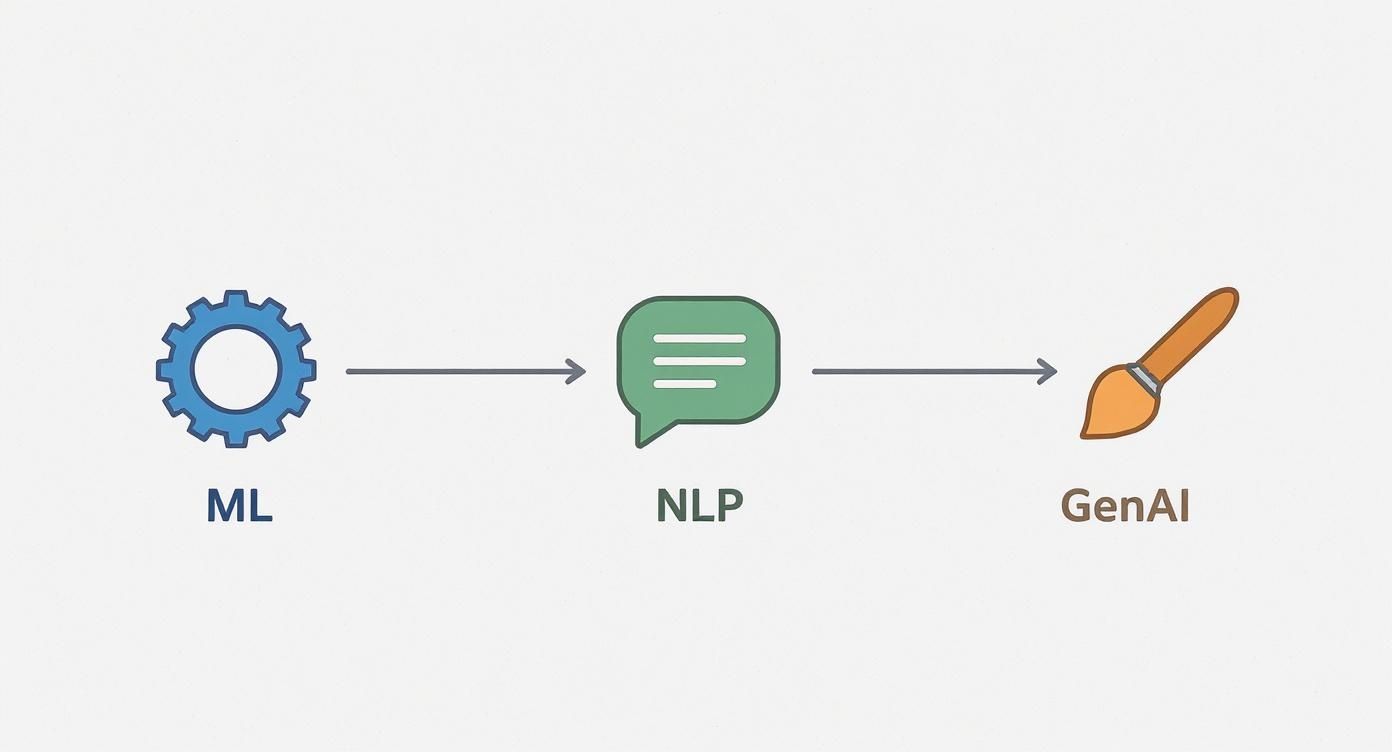
This visual highlights how ML digs into data patterns, NLP handles conversational text, and Gen AI powers large-scale content creation.
Comparison Of AI Approaches
Here’s a side-by-side look at three distinct methods. Use this snapshot to spot which approach matches your goals, budget, and team skills.
| Approach | Use Case | Pros | Cons |
|---|---|---|---|
| Rule-Based AI | Lead qualification, workflow automation | Predictable outcomes; quick setup | Rigid rules; struggles with nuance |
| Machine Learning | Demand forecasting, account scoring | Learns over time; tackles complexity | Needs clean data; less transparent |
| Generative AI | Scalable content creation, personalization | Endless variations; creative flexibility | Quality varies; higher compute cost |
Use this table as your quick reference before you dive into vendor pitches.
Real-World Pros And Insights
Rule-based systems often win on speed to launch. Think of simple “if-then” triggers that qualify leads in minutes. A tech firm might set a form-response rule and instantly sort high-value prospects—but if your scenarios shift, those rules can crack.
On the flip side, machine learning layers in adaptability. One B2B team used ML on engagement logs and saw conversion rates climb by 18% over three months. The catch? You’ll need a steady stream of quality data and someone to tune the models.
Generative AI feels a bit like having a junior copywriter on demand. Marketing teams have spun out 50+ email or ad variations in under ten minutes. Still, you’ll want a human in the loop to fact-check and keep the tone on-brand.
And here are a few industry benchmarks to keep in mind:
- 73% of B2B marketers lean on ML for predictive insights, improving forecast accuracy by 20%
- Generative AI adoption climbed 45% last year, slashing content production time by half
- 62% of companies rely on rule-based workflows for basic lead qualification
Decision Checklist
- Define Budget Range – Compare implementation and ongoing costs.
- Assess Data Readiness – Confirm your CRM and analytics data are clean and tagged.
- Evaluate Vendor Expertise – Look for case studies in your vertical.
- Pilot A Small Use Case – Start with lead scoring or a few content snippets.
- Review Scalability – Make sure the platform grows with your volume and complexity.
Key Takeaway: Match the approach to your team’s data maturity and outcome targets to boost ROI in AI for B2B marketing.
Action Steps
- Pilot ML vs Gen AI: run both on a sample dataset and compare accuracy and speed.
- Score rule-based workflows against machine-learned scores to measure lift.
- Define vendor evaluation criteria based on pros, cons, and benchmarks above.
Vendor Selection Tips
- Test integration with your CRM (for example, Salesforce or HubSpot) and CMS in a sandbox before signing on
- Look for security certifications like SOC 2 or ISO 27001 to safeguard sensitive information
- Confirm access to responsive support and training materials for faster onboarding
- Compare customization options so you can tweak AI models to your marketing playbook
- Scan community forums and peer reviews for real-world feedback, warts and all
With these insights and practical steps, you’ll be ready to pick the AI approach that delivers real, measurable value in your next B2B marketing campaign. Next, roll out your pilot, track key metrics, and iterate toward peak performance.
Implementing AI Personalization And Automation
Driving growth in B2B marketing isn’t just about more data—it’s about the right data, at the right time, for the right person. Personalization fuels engagement, and automation keeps your team focused on strategy rather than spreadsheets.
Here’s how to move from raw inputs to campaign-ready audiences:
- Gather Data Sources: Pull CRM records, web behavior logs, and third-party intent feeds.
- Segment With AI Models: Group contacts by browsing patterns and firmographic signals.
- Build Dynamic Workflows: Automate emails, landing pages, and ads that shift based on real-time triggers.
- Integrate Platforms: Connect your CRM and marketing stack for seamless data flow.
- Monitor And Adjust: Track performance metrics, retrain models, and enforce privacy measures.
Think of your data as puzzle pieces. Alone, they don’t show much—but when AI spots the edges and corners, suddenly you see the big picture. Timestamped website clicks, whitepaper downloads and form fills often hint at buying intent days before a salesperson even reaches out.
Once your data is in place, AI-driven segmentation carves your audience into hyper-relevant cohorts. Each micro-segment then gets messaging crafted to its exact journey stage—no more guessing which email or offer will stick.
Building Real-Time AI Workflows
Dynamic workflows are where the magic happens: content adapts on the fly, delivering exactly what a prospect needs in that very moment. Picture a user who downloads your ROI case study—within seconds, they’re served a landing page packed with testimonials from companies just like theirs.
- Select Triggers: Identify actions such as link clicks or form submissions.
- Design Rules: Map those triggers to specific content variants and offers.
- Configure Tools: Implement on platforms like Marketo or Pardot for execution.
- Test Thoroughly: Run A/B experiments to confirm which variants perform best.
- Launch And Scale: Start small, then widen the net as you monitor engagement.
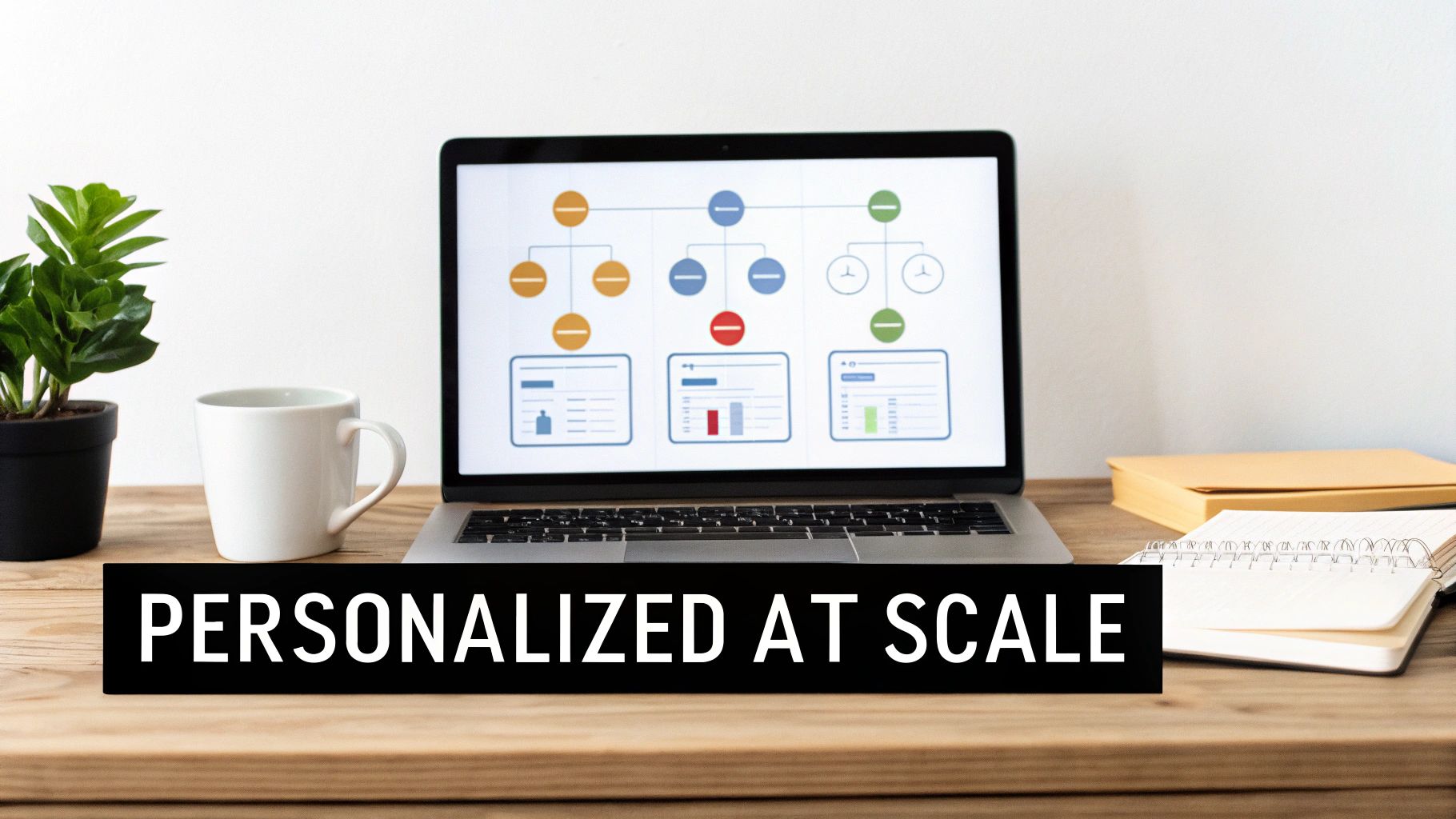
With workflows live, your CRM becomes the central hub. Native connectors in Salesforce or HubSpot push AI scores and segment tags straight into contact records—no manual imports needed.
Always encrypt data at rest and in transit. And don’t skip regular audits of your model inputs to guard against bias or inadvertent PII exposure.
Tracking Key Metrics
Success hinges on clear KPIs: think conversion rate lift, average deal size, and engagement uplift. Start by comparing email click-through rates or account engagement scores before and after AI deployment.
83% of businesses say AI lets them scale personalization more effectively, and 87% agree it boosts automation efficiency. Organizations using AI-powered segmentation see higher engagement rates and are seven times more likely to exceed their goals compared to those without AI. Discover more insights about B2B marketing trends on Adobe
To practically apply ai for b2b marketing, exploring the best sales chatbot platforms can boost conversions and enhance customer interactions.
Check out our guide on AI marketing automation tools for a deep dive into platform comparisons and integration tips.
But remember—over-automation can feel robotic. Build in human reviews and set throttle points so every outreach still sounds like it came from a real person.
Rollout Checklist
- Pilot Segment – Start with 500 high-intent accounts for initial testing.
- Weekly Reviews – Measure engagement lift, click rates, and automation health.
- Data Audit – Confirm segmentation tags, purge stale or duplicate records.
- Human Oversight – Schedule spot checks on automated messages.
- Privacy Compliance – Validate encryption, consent logs, and data-flow rules.
- Scale Gradually – Broaden cohorts once KPIs show 15% lift in engagement.
- Document Findings – Share performance reports and lessons learned.
- Continuous Optimization – Iterate workflows and segments quarterly based on new insights.
Action Steps
- Map your key triggers and design 3 workflow scenarios.
- Test a dynamic email and landing page variation side by side.
- Schedule bi-weekly performance reviews to refine triggers and content.
Evaluating Financial Impact Of AI In B2B Marketing
Investing in AI without hard figures can leave your finance team uneasy. In B2B marketing, you need clear benchmarks to justify every dollar.
For instance, swapping manual segmentation for AI-driven personalization often cuts campaign costs and lifts close rates. With that kind of proof, allocating budget becomes a whole lot easier.
- Revenue Increase: Average uplift of 15–30% from predictive lead scoring
- Cost Reduction: Automated workflows trim marketing spend by 20–25%
- Lead Volume Boost: AI chatbots drive 10–20% more net leads
Financial Impact Metrics For AI Adoption
Key ROI figures, revenue growth percentages, cost savings, and market projections in one view.
| Metric | Value | Source |
|---|---|---|
| Revenue Increase | 15–30% | Industry Benchmarks |
| Cost Savings | 20–25% | Market Surveys |
| Market Size Projection | $107.5B by 2028 | DBS Website |
| Chatbot Adoption | 57% of B2B | DBS Website |
| Lead Volume from Chatbots | 10–20% boost | DBS Website |
These numbers aren’t pulled from thin air. They come from surveys and market studies showing how AI reshapes budgets and performance.
Expert polls reveal that 65% of organizations report higher revenue after rolling out AI in marketing and sales. At the same time, 41% of teams see spending dip, and 26% of chatbot adopters note a 10–20% lift in leads. For the full breakdown, learn more about these findings.
Statistical Highlight
65% revenue growth and 41% cost reduction underscore AI’s measurable impact on marketing budgets.
Building Your Business Case
To get the green light, model different scenarios so stakeholders can see projected returns side by side with costs. Factor in everything: licensing, integration, training, even ongoing maintenance.
Budgets vary by company size. Small teams often plan for $50K–$100K a year. Midsize firms might set aside $200K–$500K, and enterprises frequently budget $1M+.
Follow these steps when you craft your proposal:
- Calculate licensing and subscription fees
- Estimate integration and customization expenses
- Factor in internal training hours and vendor support
- Account for maintenance, updates, and retraining
For a deeper dive on putting these figures into your spreadsheet, check out our guide on how to calculate marketing ROI.
Scenario Modeling Tips
Start by mapping current marketing costs across each channel. Then layer in AI-related expenses and forecast the gains you expect.
- Licensing: Compare annual fees and seat-based models
- Integration: Include setup, testing, and customization costs
- Training: Estimate internal hours plus vendor-led workshops
- Maintenance: Plan for periodic retraining and software updates
Run best-case and worst-case scenarios to show how swings in performance affect ROI. A simple sensitivity analysis can reveal which variables matter most.
Tip
Test small shifts—like a 5% change in lead volume—and see how your overall ROI adjusts.
With well-structured scenarios, your finance team will view AI investment as a low-risk, high-reward decision. Keep revisiting these models quarterly, involve sales, IT, and operations, and update your assumptions. That transparency ensures your AI initiatives stay on track as market conditions evolve.
Real World AI Case Studies In B2B Marketing

There’s nothing like seeing AI in motion to bridge the gap between idea and impact. Below are three stories—one from a mid-sized SaaS vendor, one from a global manufacturer, and one from a boutique consultancy. Each walks through goals, rollout steps, results, and the single insight you can apply right away.
Predictive Lead Scoring For Tech Provider
A mid-sized SaaS company was wrestling with a slow MQL-to-SQL funnel. Their fix? An AI-driven scoring model built on 20 variables spanning firmographics, engagement signals, and buying intent.
- Data Cleansing: Unified fields, purged duplicates
- Model Training: Fed historical pipeline data into a supervised ML engine
- CRM Integration: Pushed fresh scores into Salesforce every 24 hours
In just three months, conversion rates jumped by 18%, and the average hand-off time fell by 30%. The big lesson: without clean, well-labeled data and routine drift checks, even the smartest model will underperform.
Automated Support With Chatbots
A global manufacturing firm faced a torrent of support tickets and sluggish response times. Their answer was an AI chatbot for first-level queries on web and mobile.
They assembled a knowledge base of 5,000 FAQs, trained the bot on past tickets, then linked it to CRM and ERP systems.
“The chatbot handles 65% of incoming questions without any human handoff,” says their operations director. “That freed our engineers to tackle the tough stuff.”
The outcome? A 45% drop in escalations and a shift from 4-hour resolutions to 1.5-hour averages. The secret: continuous updates fueled by agent feedback keep the bot sharp.
Generative AI For Consultancy Content
A boutique B2B consultancy needed to ramp up thought leadership without blowing its budget. They turned to a generative AI platform to draft blogs, white papers, and social posts.
Feed in brand voice guidelines and example articles, and the system spit out first drafts for 50+ assets in under a week.
- Content Briefing: Defined tone, style, and audience
- Draft Generation: Automated outlines and supporting copy
- Human Review: Editors refined facts and brand alignment
This slashed writing time by 70% and tripled output, delivering a 60% cost cut per asset versus an all-manual process. The key? A human-in-the-loop step ensures quality never takes a back seat.
Practical Steps To Adapt These Cases
- Audit Data Sources – Confirm your datasets are clean and tagged.
- Pilot One Workflow – Start with lead scoring or a chatbot trial.
- Embed Human Oversight – Schedule review checkpoints to catch issues early.
- Measure Key Metrics – Track conversion lift, resolution times, and content velocity.
- Scale Gradually – Expand once you’ve demonstrated ROI.
- Review Models Quarterly – Guard against performance drift with retraining.
Key Takeaway: Effective AI in B2B marketing thrives on data readiness, phased pilots, and ongoing human checks.
Best Practices And Next Steps For AI Integration
Starting an AI initiative without a clear plan is like setting off on a road trip without a map—you’ll burn through resources and still wonder where you’re headed. Here, we’ll walk through how to pilot, govern, and scale AI in your B2B marketing efforts, step by step.
First, get everyone aligned on strategic goals before touching any data or code. That shared vision becomes your decision-making compass and prevents costly detours.
Think of your AI roadmap as a GPS: pick a destination, choose the fastest route, and follow the directions.
“When strategy and technology move in sync, your AI investment turns into an engine, not an expense.”
Pilot Projects And Team Setup
Every major AI deployment should begin with a tight pilot. It helps you validate assumptions fast and spot unexpected hurdles.
Pull together a cross-functional crew—marketing, IT, data science—and secure an executive sponsor who can clear roadblocks.
- Define Pilot Scope: Select 1–2 high-impact use cases with clear KPIs.
- Assign Roles: Who handles data ingestion? Who trains models? Who runs campaigns?
- Set Timelines: Aim for a 6–8 week minimum viable test phase.
“A focused pilot with concrete success criteria accelerates buy-in and minimizes risk.”
– AI Strategy Lead
Once you’ve demonstrated value, evolve that team into a dedicated AI Center of Excellence. This hub will govern standards, share best practices, and oversee multiple projects.
- AI Program Manager: Coordinates across teams.
- Data Engineer: Keeps data pipelines clean.
- ML Engineer: Tunes models and tracks performance.
A Center of Excellence ensures consistency and speeds up growth.
Governing Data And Model Monitoring
Healthy data and robust models require ongoing attention. Without governance, models drift and campaigns plateau.
| Element | Focus Area | Frequency |
|---|---|---|
| Data Quality Checks | Completeness & Accuracy | Weekly |
| Bias Audits | Fairness & Ethical Risks | Monthly |
| Performance Reviews | Key Metrics & ROI | Quarterly |
Set up automated alerts for sudden dips in lead scores or relevance. That way, your AI stays sharp and reliable.
Vendor Evaluation And Change Management
Choosing the right AI vendor can make or break your initiative. Rather than chasing features, match platforms to your priorities and workflows.
- Identify Must-Have Features: segmentation, predictive analytics, content generation.
- Check Security Certifications: SOC 2, ISO 27001.
- Request Case Studies: find examples in your industry.
- Pilot Integrations: test connectors in your CRM/CMS sandbox.
- Negotiate SLAs: agree on uptime and support commitments.
Rolling out new tech also means winning hearts and minds:
- Communicate benefits early and often.
- Provide hands-on training sessions.
- Gather feedback and iterate quickly.
| Criteria | Importance | Notes |
|---|---|---|
| Integration | High | Native CRM connectors required |
| Cost | Medium | Factor TCO over 2 years |
| Support | High | Response time under 4 hrs |
Continuous Improvement And Ethical Oversight
Adopting AI is a marathon, not a sprint. After launch, establish a cycle of learning and optimization.
- Quarterly Reviews: Measure results against your baseline.
- Model Retraining: Refresh algorithms with new datasets.
- Stakeholder Feedback: Collect input from sales and customer success.
- Governance Updates: Tighten privacy and ethics policies.
Privacy must be baked in from day one:
- Consent Audits: Verify opt-in status every quarter.
- Legal Review: Ensure GDPR and CCPA compliance.
- Audit Logs: Track data access and processing events.
Think of your AI like a garden—it needs regular watering and weeding to thrive. Ethical guardrails keep you from harvesting bias.
Set realistic timelines based on your maturity level:
| Maturity Level | Timeline | Goals |
|---|---|---|
| Early | 3–6 months | Pilot and initial team formation |
| Intermediate | 6–12 months | Deploy multiple use cases |
| Advanced | 12+ months | Full Center of Excellence and enterprise scale |
By combining structured pilots, strong governance, and continuous iteration, you’ll build a marketing engine that delivers real, lasting AI impact.
Ready to accelerate your marketing with AI? Experience how marketbetter.ai streamlines content creation, campaign optimization, and customer personalization. Start Your Free Trial today and unlock your AI advantage.