A Guide to AI in Content Creation
Let’s be real for a second. When you hear “AI in content creation,” it’s easy to picture robots churning out soulless blog posts. Forget that. The reality is far more practical and, honestly, more exciting.
Think of AI less as a replacement for your creativity and more as the ultimate co-pilot. It’s the tireless assistant that handles the grunt work—the endless research, the first-pass drafting, the mind-numbing data sifting. This frees you up to do what humans do best: focus on strategy, nail the nuance, and build a genuine connection with your audience.
The New Content Creation Playbook is Here
This guide isn't about sci-fi futures; it's about showing you exactly how artificial intelligence fits into your workflow today. We’re going to break down how the sharpest content teams are using AI to scale their output and stay ahead in a ridiculously crowded digital world.
The core idea is simple. Let the machine manage the repetitive, time-sucking tasks, while you steer the ship. A classic example is keyword research. The old way involved manually digging through spreadsheets for hours. The new, actionable approach? Use an AI tool to generate a list of high-potential topics with search volumes and difficulty scores in under five minutes. It’s a no-brainer.
Your Role is Shifting from Writer to Content Director
This is the most important change to grasp. Adopting AI fundamentally flips your job description on its head. Instead of spending 80% of your time on the nitty-gritty of drafting and only 20% on strategy, you get to reverse that.
Your expertise becomes the most valuable part of the equation. You're the one directing the AI, refining its output, and making sure every piece of content perfectly captures your brand’s voice and hits its strategic goals.
This shift is what makes true scalability possible. Compare these two scenarios: you need 100 unique product descriptions for a new launch.
- Traditional Method: A human writer could be tied up for weeks, writing each one from scratch.
- AI-Assisted Method: An AI generates the initial drafts for all of them in an afternoon, leaving you with the much faster job of reviewing, refining, and adding a human touch.
Before we go any further, it helps to know a little about the engine driving all this. If you want a quick primer, this simple guide explains What is Generative AI? and how the technology actually works.
The numbers don't lie, either. The generative AI market is on a tear, hitting a global value of $63 billion by 2025. With North America making up over 40% of that revenue and the market projected to grow at a compound annual rate of 42%, it’s clear this isn’t just a trend—it's a fundamental business shift.
The Real-World Benefits of Bringing AI into Your Workflow
This is about more than just moving faster. It's about creating smarter, more effective content. Here are the biggest wins, compared to traditional methods:
- Serious Scalability: Instead of being limited by human hours, you can produce high volumes of content—from social posts to in-depth articles—without needing to hire an army of writers.
- Off-the-Charts Efficiency: Automate tasks that drain your time, like research and outlining. This turns production timelines from days into hours, allowing you to react faster to market trends.
- Data-Driven Decisions: Manually analyzing data is slow and prone to error. Use AI to chew through performance data and spot content gaps so your strategy is always guided by what your audience actually cares about.
Think of AI as your creative co-pilot. It crunches the data and draws the map, but you're still the one in the captain's chair, steering the ship to its final destination. This human-machine partnership is the future of content.
How AI Is Rewriting the Content Lifecycle
Let's get one thing straight: AI isn't just another tool you pull out for one part of the job. It’s a collaborator that plugs into every single stage of the content lifecycle. What used to be a slow, step-by-step march from idea to published piece is now a fast, dynamic cycle. This shift helps you move quicker, make smarter calls, and ultimately, create content that actually hits the mark.
The whole game changes before you even write a single word. Traditionally, topic research was a mix of guesswork and manual keyword tool analysis. With AI, tools can chew through massive amounts of data—search trends, what your competitors are doing, audience engagement—to find topic opportunities a human would almost certainly miss. This isn't about guesswork anymore; it's about focusing your energy on what your audience is already telling you they want.
This new partnership between creator and machine is reshaping how modern content teams operate. This infographic gives you a good look at how AI jumps in to help with everything from research and drafting to optimization.
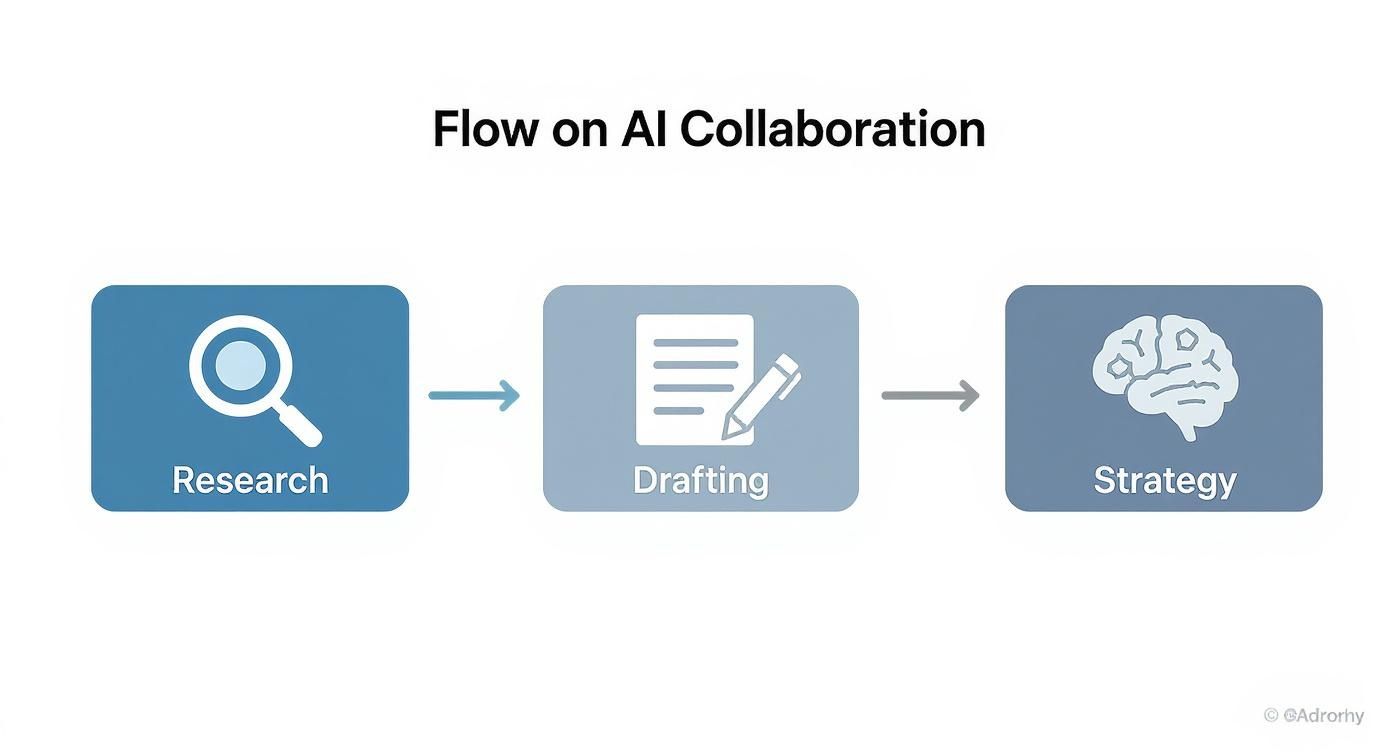
As you can see, AI acts like a force multiplier at every stage. It turns tedious manual tasks into automated processes, freeing up humans to focus on strategy and creativity.
From Blank Page To First Draft
Once you've landed on a winning topic, AI puts the drafting process into overdrive. The terror of the blank page? Gone. You can generate a structured outline in seconds, complete with H2s, H3s, and the main talking points you need to cover. This gives you a solid skeleton to build on, so you can pour your time into adding your own unique insights, telling great stories, and providing real expert analysis.
Let's compare the old way versus the new way:
- Old: Spend hours researching and structuring an outline, then more hours writing a messy first draft from scratch.
- New: Generate a data-informed outline in 60 seconds. Use that outline to prompt an AI for a first draft, handling the foundational work. Your job shifts from writer to strategic editor.
AI fundamentally changes the starting line for content creation. Instead of beginning with zero, you start with a structured, well-researched draft that’s ready for your expertise and refinement.
This isn't some future-gazing prediction; it's happening right now. In 2025, a massive 76% of marketers are using generative AI for content creation, with 71% leaning on it for creative inspiration. The proof is in the output, too, with 74.2% of new webpages published in 2025 including AI-generated content. But—and this is a big but—the human touch is still critical. 86% of marketers report editing AI outputs to match their brand voice and hit quality standards.
Optimizing And Repurposing At Scale
Once the draft is solid, AI slips into its optimizer role. These tools can scan your text for SEO, suggesting keywords, flagging readability issues, and even checking the emotional tone. This step is all about making sure every piece is fine-tuned to perform, whether that’s ranking on Google or connecting with a specific audience on social media.
But the real magic happens when it’s time to repurpose. This is where AI becomes a game-changer. It makes it almost ridiculously easy to spin one core piece of content into a dozen different assets.
- Actionable Tip: Blog Post to Social Media. Feed your article to an AI with the prompt: "Create an 8-tweet thread from this article. Make the first tweet a strong hook and the last one a question to drive engagement."
- Actionable Tip: Webinar to Email Series. Use an AI transcription tool on your webinar recording. Then prompt it: "Based on this transcript, write a 3-part email nurture sequence highlighting the most valuable takeaways."
- Article to Audio: The tech is getting incredibly good at multimedia, too. Understanding models like OpenAI's Whisper AI for speech recognition shows just how far we've come in turning text into high-quality audio.
This ability to repurpose content on the fly is a massive win for any team trying to maximize its reach. By automating the grunt work of converting content from one format to another, you can scale content marketing without having to scale your team or budget. It’s about getting your message in front of your audience, wherever they happen to be.
Let's be honest, the real "aha!" moment with AI in content creation happens when you put it side-by-side with the old way of doing things. The difference is night and day. It’s not just about going faster; it’s a complete overhaul of the entire production line, turning a manual marathon into a strategic sprint.
This shift changes everything—it redefines roles, crushes timelines, and unlocks a scale that most teams could only dream of before.
Think about the classic process for writing a solid blog post. It always started with hours of grunt work: digging through SERPs, pulling stats, and vetting sources. Then came the slow, painful process of outlining, followed by the even slower staring contest with a blank page. After all that, you still had editing, proofing, and SEO optimization. It was a linear, exhausting slog that could easily eat up a full day (or more) for one quality piece.
Now, let's look at the AI-assisted workflow. Forget hours of research; an AI tool can analyze the top-ranking content and spit out a data-driven brief in minutes. That terrifying blank page? It’s gone, replaced by a solid first draft built from that brief.
This frees up the writer to do what they do best. Their role flips from assembly-line worker to strategic director—guiding the AI, injecting unique expertise, and polishing the final piece until it shines.

The Creator’s Role Gets an Upgrade
When AI handles the heavy lifting, the content creator is suddenly free to focus on high-value work. Your brainpower is no longer wasted on basic drafting. Instead, you're refining, fact-checking, and adding the human insight that AI simply can't replicate. You become the editor, the strategist, and the final quality gatekeeper.
This isn’t about replacing creativity. It’s about amplifying it.
Imagine an e-commerce brand that needs to write 500 unique product descriptions for a new launch. Traditionally, that's a soul-crushing project. A human writer might get through twenty in a good day. With an AI partner, the first drafts for all 500 can be generated in the time it takes to write just a handful, leaving the team to focus on perfecting the copy that actually sells.
A Head-to-Head Workflow Comparison
The practical differences in speed, cost, and output are stark. What once took a full day can now be done in a fraction of the time, leading to a massive return on your investment.
To make this crystal clear, here’s a direct comparison that shows how the workflows stack up on key performance indicators.
AI-Assisted vs Traditional Content Workflow Comparison
| Metric | Traditional Workflow | AI-Assisted Workflow | Impact |
|---|---|---|---|
| Research Time | 2-4 hours | 15-30 minutes | Over 85% reduction in manual research time |
| Drafting Time | 3-5 hours | 1 hour | Frees up hours for strategic editing and refinement |
| Total Time-to-Publish | 8-12 hours | 2-4 hours | 3x faster content delivery and increased velocity |
| Cost Per Article | High (based on hourly rates) | Low (fixed subscription cost) | Drastically reduces content production expenses |
| Scalability | Limited by team size | Nearly unlimited | Enables mass content production without hiring more staff |
The numbers don't lie. An AI-assisted approach doesn't just speed up the old process; it creates an entirely new, more efficient model for getting content out the door.
The real win here is how you reallocate your team's talent. Instead of spending 80% of their time on manual tasks like research and first drafts, creators can now invest that time in strategy, creativity, and adding unique value—the very things that make content great.
At the end of the day, bringing AI into your content process lets your team produce more, publish faster, and operate with a sharper strategic focus. It empowers creators to break free from the constraints of manual labor and hit a level of output and quality that was once completely out of reach.
Putting AI to Work in the Real World
Theory is great, but the real magic happens when you see how actual businesses are using AI in content creation to solve problems they face every single day. This is where the rubber meets the road.
These aren't just hypotheticals. We’re talking about marketing agencies doubling their output and SaaS companies finally getting a handle on their technical documentation. Let's dig into some concrete examples of companies winning with AI right now.
Scaling SEO Content for a Marketing Agency
Picture a boutique marketing agency hitting a wall. They're good at what they do—maybe too good. Their client list is growing, but their ability to produce high-quality SEO content isn't keeping pace. The manual grind of creating detailed content briefs and writing first drafts was a serious bottleneck, capping how many clients they could actually serve.
Their solution? Weave AI into their core workflow with these actionable steps:
- Automated Brief Generation: First, they used an AI tool to scope out the competition. It analyzed the top-ranking articles for a target keyword and, in minutes, spit out a comprehensive brief—complete with word count targets, key topics, semantic keywords, and a suggested outline.
- AI-Powered First Drafts: With that detailed brief in hand, a generative AI model knocked out a solid first draft. This handled all the heavy lifting of basic research and structure.
- Strategic Human Refinement: This is the key part. Their expert writers then stepped in to transform the AI draft into something great. They fact-checked, added unique insights, sprinkled in the client's brand voice, and polished it until it shined.
The results were immediate. The agency sliced its content production time by over 50%. Suddenly, they could handle twice the client work without hiring more people. This shifted their writers from content grinders to strategic editors, which not only improved job satisfaction but also the final product.
Automating Technical Documentation for a SaaS Company
For any fast-growing SaaS company, keeping technical docs up-to-date is a nightmare. Engineers are busy building the product; writing documentation feels like a chore. This common problem leads to outdated guides, frustrated customers, and a support team drowning in preventable tickets.
They got clever and built an AI-powered system that created documentation straight from developer notes.
By plugging AI directly into their development cycle, they saved hundreds of engineering hours each quarter and saw a 30% drop in support tickets related to documentation. The AI essentially became the translator between technical jargon and user-friendly guides.
The process was deceptively simple. Whenever a developer committed new code, their technical notes were automatically piped into a custom-trained AI. This model was taught to turn dense, technical language into clear, step-by-step instructions, perfectly formatted for their knowledge base. Just like that, their documentation was always in sync with the product—a feat that was nearly impossible to achieve manually.
Repurposing Content for a Media Publisher
A digital media publisher was creating fantastic long-form articles but struggling to get the most out of them. Manually turning one great article into a video script, a social media thread, and an email newsletter was a huge time sink. They were leaving a ton of audience engagement on the table.
So, they turned to AI to become a content repurposing machine. After publishing a big article, they would feed it into an AI tool with specific, actionable prompts:
- For Video: "Create a 3-minute video script from this article, focusing on the most compelling points. Include visual suggestions."
- For Social Media: "Turn this article into an engaging 8-part Twitter thread. Start with a strong hook and end with a question."
- For Email: "Draft a concise email newsletter summarizing the key takeaways from this article for our subscriber list."
This simple change allowed them to spin a single piece of content into a full-blown multi-channel campaign in less than an hour. If you want to see this strategy in action, there are many social media content creation tools that can help automate the process. Their reach and engagement shot up across all platforms, all without adding to the team's workload. It’s a perfect example of how AI can amplify your best work.
Building Your AI Content Strategy From Scratch
Jumping into AI in content creation without a plan is like trying to build furniture without the instructions. You might end up with something, but it probably won’t be the sturdy, functional piece you imagined. A real strategy is what separates teams generating soulless, generic copy from those producing high-quality content that actually moves the needle.
The goal here isn't just "using AI." It's about weaving it so seamlessly into your workflow that it becomes a natural extension of your team's own talent. This means getting past the fun of just playing with prompts and taking a more deliberate approach. You need to spot the right opportunities, pick the right tech, and set up clear rules to protect your brand.
Here’s a practical, step-by-step roadmap to get you started without turning your content process upside down.
Start Small and Target High-Impact Areas
The single biggest mistake you can make is trying to automate everything all at once. That's a recipe for chaos. A much smarter approach is to find a low-risk, high-impact area to dip your toes in. This lets your team get comfortable with the tools and see some early wins before you go all-in.
Think about the most grinding, repetitive tasks in your current workflow. Those are your prime candidates for a first experiment. Here’s an actionable list to choose from:
- Blog Topic Ideation: Instead of staring at a blank page, use an AI to analyze search trends and see what your competitors are ranking for. You'll get a list of data-backed ideas in minutes.
- Social Media Captions: Ask an AI to generate 5 or 10 different captions for a single post. Test them out and see what your audience actually responds to.
- Meta Descriptions: Automate the creation of SEO-friendly meta descriptions for your blog posts or product pages. It’s a small task that adds up to a ton of saved time.
Starting with these smaller tasks lets you prove the value of AI in content creation on a manageable scale. You build momentum and get team buy-in by showing results, not just making promises.
Choose the Right Tools for Your Team
Let's be clear: not all AI tools are created equal. The market is absolutely flooded with options, and each has its own strengths, weaknesses, and quirks. The "best" tool isn't the one with the flashiest features; it's the one that fits your team's specific needs, budget, and existing tech stack.
When you're kicking the tires on different platforms, use this actionable checklist to compare them:
- Functionality: Does this thing do one thing really well (like writing), or is it more of an all-in-one suite with features for SEO, image generation, and analytics?
- Ease of Use: How steep is the learning curve? A super-powerful tool is worthless if your team finds it too confusing to actually use.
- Integration: Can it talk to the tools you already rely on, like your CMS or project management software? You want to reduce friction, not create more of it.
- Cost: Does the pricing model—per-user, per-word, or a flat subscription—make sense for how much you'll use it?
Take the time to actually compare your options. For a deep dive, this guide on the best AI marketing tools is a great resource for seeing how different platforms stack up against each other. Making the right choice upfront will save you a world of headaches later on.
Create Your AI Rulebook
Before you hand over the keys and let your team run wild with generative AI, you need to establish some guardrails. Think of it as your "AI Rulebook"—a clear set of guidelines for maintaining your brand's voice, ensuring accuracy, and just generally using the tech responsibly.
Your AI rulebook isn't about restricting creativity; it's about protecting quality. It ensures that every piece of content, whether human- or AI-assisted, meets your brand's high standards.
This document should give clear, simple answers to the big questions. Here are actionable items to include in your rulebook:
- Brand Voice: How do you make sure the AI's output doesn't sound like a generic robot? Provide it with concrete examples of your tone and build a style guide for it to follow.
- Fact-Checking: What's the non-negotiable process for verifying every statistic, claim, and quote the AI produces?
- Disclosure: Will you tell your audience when AI was used? If so, when and how?
- Human Oversight: Which steps in the content process must have a human review and final sign-off? (Hint: it’s probably more than you think.)
This rulebook becomes the single source of truth for your team. It’s not set in stone, either. Treat it as a living document that you update as you learn what works and what doesn't.
The Future Is Human and AI Collaboration

As we look at the horizon of AI in content creation, one thing is becoming crystal clear: this isn't about humans being replaced. Not even close. It's about collaboration—a powerful, symbiotic partnership between creator and machine.
The future belongs to the people who learn to treat AI less like a vending machine for words and more like a strategic partner. A partner that can amplify their vision and execute on ambitious ideas that were, until recently, just too time-consuming or complex to even attempt. It’s a shift from just generating text to building a sophisticated, AI-assisted workflow.
The real magic of AI won't come from letting it run wild. It comes from skillfully guiding it. Your expertise, your creativity, and your strategic oversight are what turn a generic AI output into something truly exceptional.
This partnership model is essential. Why? Because while AI crushes speed and scale, it has zero lived experience. It can't feel empathy or build a genuine connection with your audience. That’s your job. You provide the context, the nuance, and the storytelling that resonates. The AI provides the raw processing power to bring those ideas to life at a pace we've never seen before.
The Next Wave of Content Innovation
The evolution of AI in content is speeding up, pushing the boundaries of what’s possible every single day. There are two huge trends you need to have on your radar right now. Getting ahead of them will give you a serious advantage.
First up is hyper-personalization at scale. Think about tailoring every blog post, every email, every social update to the specific interests of each individual user. That's always been the dream, but it was manually impossible. AI makes it feasible. You can finally create content that feels uniquely personal to every single person in your audience.
Second, AI is moving way beyond just text. We're seeing the automation of video and audio creation, where AI can generate scripts, create visuals, and even produce shockingly realistic voiceovers.
The difference between the old way and the new way is stark.
| Task | Traditional Method | AI-Assisted Method |
|---|---|---|
| Video Scripting | Days of writing and review | Minutes to generate drafts |
| Voiceover Recording | Hours in a recording studio | Seconds with realistic AI voices |
| B-Roll Sourcing | Hours searching stock sites | Automated selection based on script |
The message here is simple: the future is a partnership. The best way to prepare is to start experimenting with the tools available today. Get your hands dirty. Learn what works, sharpen your prompting skills, and position yourself at the front of this massive shift. The creators who embrace this collaborative spirit are the ones who will lead the next wave of content innovation.
Got Questions About AI in Content Creation?
Let’s be honest, jumping into AI feels a bit like stepping into the deep end. It's natural to have questions. The good news is the answers are usually simpler than you'd expect. Let's clear up some of the most common ones.
Will AI Replace Content Writers?
No, but it will absolutely change the job description. Think of it less as a replacement and more as a promotion.
Compare the roles: A traditional writer spends most of their time on research and drafting. An AI-powered writer spends most of their time on strategy, editing, and adding unique insights. AI handles the grunt work, freeing up human writers to focus on what really moves the needle. The future belongs to creators who learn to work with AI, not the ones trying to outrun it.
How Do I Make Sure My AI Content Is Actually Original?
Originality comes down to one thing: your oversight. AI models are trained on the internet, so there's always a chance they'll spit out something that sounds a little too familiar. The golden rule is to treat AI output as a starting point, never a finished product.
Here’s an actionable playbook:
- Run it through a plagiarism checker. Always. No exceptions.
- Inject your own secret sauce. Weave in your personal stories, proprietary data, and expert opinions that an AI could never dream up.
- Rewrite and refine. Never just copy and paste. Your job is to take the clay the AI gives you and shape it into something that sounds like you.
What's the Best Way for a Small Business to Start?
Start small and solve one specific problem. Don't try to overhaul your entire content machine on day one.
A perfect first step is using an AI tool for ideation. Ask it to generate a list of blog topics or social media post ideas based on a few of your target keywords. It’s a low-risk, high-reward way to see the value immediately without getting bogged down in a steep learning curve. Actionable step: Sign up for a free trial of an AI writer and give it this prompt: "Generate 10 blog post ideas for a [your business type] targeting [your ideal customer]."
Can AI Really Capture My Brand Voice?
Not right out of the box, no. But with a little coaching, it can get surprisingly close.
The trick is to give the AI a crystal-clear "brand voice" brief. This isn't just a vague instruction; it's a detailed prompt that includes your tone (e.g., "witty and informative," "professional and authoritative"), who you're talking to, and specific words you love or hate. Actionable tip: Create a document with examples of your best-performing content and feed it to the AI as context before asking it to write. When you feed it this prompt consistently, you're effectively training the AI to mimic your style over time.
Ready to stop guessing and start building a smarter content engine? The marketbetter.ai platform puts powerful AI across your entire workflow, from first idea to final polish. See how you can scale your content strategy today.