How to Segment Email Lists for Higher Engagement
If you're still sending the same email blast to your entire list, you're basically shouting into a crowded room hoping someone listens. It's the marketing equivalent of a generic flyer—easily ignored and quickly forgotten.
The secret to getting results is shifting your mindset from broadcasting a message to starting a conversation. And that starts with segmentation—slicing your subscriber list into smaller, more focused groups based on what you know about them. Send them something that's actually relevant, and they'll not only listen, they'll act.
Why Personalized Emails Always Beat Generic Blasts
The days of "one-size-fits-all" email marketing are long gone. Your subscribers expect you to know who they are and what they care about. If you don't deliver, you're just noise in their inbox, leading to dismal open rates, a spike in unsubscribes, and a sender reputation that takes a nosedive.
Segmentation is the bridge between what you want to say and what your audience actually wants to hear. It’s the practical first step to stop annoying the masses and start delighting targeted groups.

This is how you move from just sending emails to building real connections that drive your business forward.
The Real-World Impact on Engagement and Revenue
Put yourself in your customer’s shoes. Which email are you more likely to open?
- Email A: "20% Off Everything! Shop Now!"
- Email B: "New Arrivals in a Category You Love - Plus 20% Off"
Email A feels like spam. Email B feels genuinely helpful. The second email wins every time because it's relevant.
The numbers don't lie. Segmented campaigns consistently outperform generic ones, seeing 30% higher open rates and a massive 50% more click-throughs. More than that, sending relevant content keeps people on your list. We've seen unsubscribe rates drop by around 20% just by getting this right.
"Sending one message to everyone guarantees that the message will be irrelevant to most people. Segmentation ensures your communication is a welcome arrival, not just more noise in their inbox."
Comparing Generic vs. Targeted Campaigns
Let’s look at a quick, actionable comparison for an online clothing store.
-
The Generic Blast: The team sends an email to their entire list announcing a "Flash Sale on All Summer Styles!" This goes to everyone—customers in Alaska, people who only buy winter coats, and new subscribers who haven't even made a purchase. Result: Low open rates, a few sales, and a spike in unsubscribes from people who found the email irrelevant.
-
The Segmented Campaign: This time, they get smart. They create a segment of customers who have bought swimwear in the past and live in warm-weather states. The email headline? "Your Favorite Swim Styles Are on Sale." Result: Engagement and sales from this targeted email blow the generic blast out of the water because it’s a perfect match for the recipient's interests and immediate context.
This is exactly why digging into powerful marketing personalization strategies is a non-negotiable for any modern marketer. When you stop talking to a crowd and start having specific conversations, you build a much more loyal—and profitable—audience.
Gathering the Data You Need for Smart Segmentation
Great email segmentation isn't about guesswork; it's built on a foundation of solid data. But don't let that scare you. The goal is to ethically and strategically collect the right information from the start, so you can turn a simple contact list into a powerful engine for engagement.
The best data is almost always the information your subscribers give you directly. Your job is to make that process feel natural and valuable for them, not like an interrogation. This starts the moment they sign up and continues all the way through their journey with your brand.
Where to Find Actionable Data
A smart data collection strategy pulls information from several key touchpoints. Think of it like building a complete picture of your customer—each source adds another layer of understanding, from what they tell you outright to what their actions reveal.
Here are the goldmines you should be focusing on:
- Smart Signup Forms: Don't just ask for an email. Add one optional field that gives you immediate insight. For a B2B audience, this could be "Company Size." For an e-commerce store, something like "Primary Interest" (e.g., Men's Apparel, Women's Apparel) is perfect. Actionable Tip: Keep it to one extra field to avoid reducing sign-up rates.
- Preference Centers: This is huge. Let your subscribers tell you exactly what they want. A good preference center allows people to choose content categories (e.g., "Product Updates," "Weekly Tips," "Sales Alerts") and how often they want to hear from you. It's the cleanest, most direct data you can get for segmenting by interest.
- Purchase and On-site Behavior: Actions speak louder than words. Track what your customers buy, what pages they linger on, and what articles they read. This behavioral data is probably the single most powerful predictor of what they'll be interested in next. It's the key to creating dynamic, responsive segments that feel incredibly personal.
Smart segmentation comes down to a simple principle: listen to what your customers tell you, both with their words and their actions. The more you listen, the more relevant your emails will become.
Auditing and Maintaining Your Data Quality
Having a ton of data is one thing; having clean, usable data is another entirely. A regular audit of your contacts is non-negotiable. You need to hunt down outdated information, typos in form fields, and profiles that are only half-filled out.
To keep everything organized and accessible, you absolutely need a good system. This is where the best CRM solutions become essential for managing your customer information effectively.
Here's an actionable checklist for data hygiene:
- Standardize Your Fields: Make sure your data is consistent. Instead of a free-text field for "Country," use a dropdown. This prevents you from ending up with a mess of "USA," "U.S.," and "United States" that you have to clean up later.
- Run Re-engagement Campaigns: Identify subscribers who haven't opened an email in 90 days. Send them a targeted "win-back" campaign asking if they still want to hear from you. If they don't respond, it's time to remove them. This improves your sender reputation and list quality.
- Integrate Your Systems: Your e-commerce platform, CRM, and email marketing tool should all be talking to each other. When they're synced up, you get a single, unified view of each customer. For more complex setups, learning about customer data platform integration can show you how to get all your data working together seamlessly.
By focusing on these core practices, you build a robust framework. This is what lets you move beyond basic list-blasting and start creating the kind of sophisticated segments that actually drive results.
Choosing the Right Email Segmentation Models
Okay, you've got the data. Now for the fun part: figuring out how to slice and dice it into meaningful groups.
This isn't a one-size-fits-all game. The way an e-commerce brand segments its audience will look completely different from how a B2B SaaS company approaches it. The real secret is picking a model that actually supports your business goals and helps you have the right conversations with the right people.
It’s time to shift from being a list manager to thinking like a strategist. Stop asking, "Who's on my list?" and start asking, "What groups on my list can I help in a very specific way?" The answers almost always come from combining different data points to build a richer, more complete picture of your subscribers.
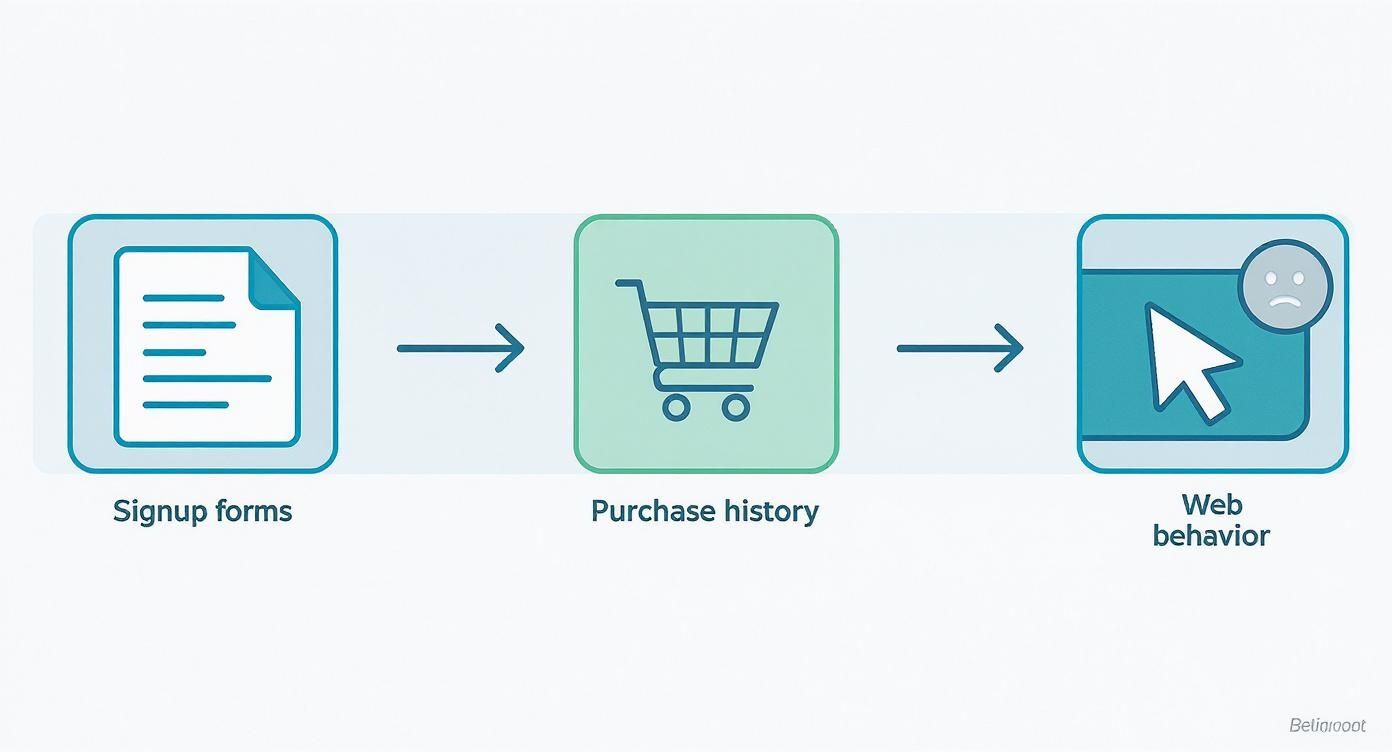
This flowchart really nails it. It shows how every touchpoint a customer has with your brand gives you another layer of insight you can use to build smarter, more effective segments.
Comparison of Email Segmentation Models
The best email strategies rarely stick to just one model. Instead, they layer different approaches to create hyper-relevant audience pockets. Let’s break down the most common models to see how they compare and where they fit.
This table provides a high-level look at the four primary segmentation models, helping you decide which ones make the most sense for your immediate goals.
| Segmentation Model | Core Focus | Example Data Points | Best For | Potential Challenge |
|---|---|---|---|---|
| Demographic | Who they are (objective facts) | Age, gender, location, language, income | Broad targeting, location-based offers, gender-specific products | Can feel impersonal; risk of stereotyping |
| Behavioral | What they do (actions) | Purchase history, email opens/clicks, pages visited, cart abandonment | Timely, responsive campaigns like cart recovery or re-engagement | Requires robust tracking and can be complex to set up |
| Psychographic | Why they do it (lifestyle/values) | Hobbies, interests, brand affinities, personal values | Building brand affinity and delivering value-aligned content | Data can be difficult and expensive to collect accurately |
| Firmographic | Who they work for (B2B focus) | Company size, industry, job title, revenue | Highly targeted B2B campaigns, account-based marketing (ABM) | Niche and not applicable for most B2C businesses |
Each model offers a unique lens through which to view your audience. While demographic data is a good starting point, behavioral and psychographic insights are where you can really start moving the needle on engagement.
Putting the Models into Action
Let's dig into how these actually work in the real world.
Demographic Segmentation
This is your foundational layer, grouping subscribers by straightforward, factual attributes. It's segmentation 101.
- Common Data Points: Age, gender, location, language, and income level.
- Actionable Example: A clothing retailer sends a promotion for its new winter coats, but only to subscribers living in colder climates. Simple, effective, and avoids annoying people in Miami.
- Best Use: Great for broad targeting, especially with location-specific offers or gendered products. It’s a solid starting point but lacks nuance on its own.
Behavioral Segmentation
This is where things get powerful. You're grouping people based on their direct interactions with your brand—what they actually do, not just who they are on paper.
- Common Data Points: Purchase history, website pages visited, email engagement (opens/clicks), and cart abandonment.
- Actionable Example: An e-commerce store automatically creates a segment for anyone who viewed the "running shoes" category three times this week but didn't buy. Action: Send them an email showcasing your top-rated running shoes and a customer testimonial.
- Best Use: Perfect for creating timely, automated campaigns. Think cart abandonment reminders, re-engagement emails for subscribers who've gone quiet, or product recommendations based on past purchases.
Behavioral segmentation is often the highest-impact model because it's based on recent, demonstrated intent. A user's actions are one of the strongest predictors of their future needs.
Psychographic Segmentation
This model goes deeper into the "why" behind your subscribers' actions, grouping them by interests, values, and lifestyle choices.
- Common Data Points: Hobbies, personal values, brand affinities, and interests (this data is gold, often gathered from surveys or a preference center).
- Actionable Example: A travel company segments its list into "adventure travelers" and "luxury resort seekers." Action: The adventure group gets an email about a new trekking package in Patagonia, while the luxury group sees an offer for an all-inclusive spa retreat in Bali.
- Best Use: Forging a genuine connection with your audience. This is ideal for content marketing that resonates with their values and makes them feel like you truly get them.
Finding the Right Mix for Your Business
For most B2C companies, the sweet spot is a blend of demographic and behavioral data. You can target users in a specific region (demographic) who have also recently bought a certain product (behavioral). This two-layer approach ensures your message is both relevant and timely.
In the B2B world, firmographic segmentation is non-negotiable. You might target Marketing Directors (job title) at SaaS companies (industry) with over 100 employees (company size). When you combine that with behavioral data—like who attended your last webinar—you create an incredibly potent segment to nurture.
The ultimate goal isn't to pick one model but to create a layered strategy. By exploring various customer segmentation strategies in more detail, you can build a flexible framework that adapts as you learn more about your audience. Start with the data you have, test a few models, and let the results tell you where to go next.
How to Build Your First Segments
Alright, your data is sorted and you've chosen your models. Now it’s time to take action.
Whether you're in Mailchimp, Klaviyo, or HubSpot, creating segments is less about being a tech wizard and more about thinking like your customer. The whole point is to turn what you know about people into practical groups that you can market to intelligently.
At its core, segmentation is just creating a set of rules that automatically filter your contacts. This is where you'll get comfortable with simple "AND/OR" logic to create laser-focused audiences. For instance, you could target 'subscribers who live in New York AND have purchased in the last 90 days'. It’s that straightforward.
Static vs. Dynamic Segments: A Practical Comparison
Your first big decision is whether to build a static or dynamic segment. These sound technical, but the difference is simple and has a huge impact on your workflow.
- Static Segments: Think of this as a one-time snapshot. You create a list based on criteria at a specific moment, and it never updates automatically. A list of 'all attendees from our October webinar' is a perfect example of a static segment. It’s fixed in time.
- Dynamic Segments: These are living, breathing lists. They automatically update as your contacts meet—or no longer meet—your criteria. A segment for 'contacts who haven't opened an email in 60 days' is dynamic because people will constantly cycle in and out of that group.
When to use which? Use static segments for one-off campaigns, like a follow-up to an event. Use dynamic segments for 90% of your marketing, especially for ongoing automated flows like welcome series, re-engagement campaigns, and VIP customer promotions.
Building Your First High-Value Segment: A Step-by-Step Guide
Let’s walk through building a classic, high-impact segment: your "Engaged Subscribers." This group is your most valuable asset. They open your emails, click your links, and are most likely to buy. Sending them exclusive offers or early access is a fantastic way to reward that loyalty.
Here’s how you’d build it using simple rules inside your email platform:
- Create a New Segment: Name it "Engaged Subscribers (90 Days)".
- Set the First Rule:
Email activityISOpened an emailin the last90 days. - Add a Condition: Choose the
ORoperator. This is key because you want people who meet either condition. - Set the Second Rule:
Email activityISClicked a linkin the last90 days. - Save the Segment: Your platform will now automatically keep this list updated.
That’s it. This simple logic creates a powerful, self-updating segment. Anyone who opens or clicks an email automatically lands in this "Engaged" group, making sure your best content always goes to your most interested readers—without you lifting a finger.
This isn’t just busywork; it directly impacts the bottom line. Research shows that segmented email lists are responsible for 25% of overall revenue from email marketing. You can dig into more of these numbers in recent email segmentation findings. Creating this one segment is your first step to claiming your piece of that revenue.
Measuring and Refining Your Segmentation Strategy
So you’ve built your segments. That’s a great start, but it’s just the beginning.
The real magic happens when you treat segmentation not as a one-and-done task, but as a living, breathing cycle of measuring, learning, and tweaking. How do you know if those beautifully crafted segments are actually moving the needle? You let the data tell the story.
This isn’t about chasing vanity metrics. It's about drawing a straight line from a specific segment to a tangible business result. The goal is to prove the ROI of your efforts so you can make smarter decisions with every campaign you send.

Key Metrics to Monitor for Each Segment
Stop looking at your overall email performance. From now on, you need to analyze key metrics per segment. This is where the real insights are hiding. If one segment has a killer open rate and another is dead in the water, that tells you something powerful about relevance.
Get laser-focused on these core indicators:
- Open Rate: Are your subject lines hitting the mark with this specific group? Compare: Is the open rate for your "VIP Customers" segment significantly higher than your "New Subscribers" segment? If so, your VIP messaging is working.
- Click-Through Rate (CTR): This tells you if the content inside the email is doing its job. A high open rate but a pathetic CTR is a classic sign of a mismatch between your subject line's promise and the email's content.
- Conversion Rate: The big one. Are subscribers in this segment actually taking the action you want—making a purchase, downloading a guide, booking a demo? This is your ultimate measure of success.
- Unsubscribe Rate: A sudden spike in unsubscribes from one segment is a massive red flag. It’s a clear signal that you're sending the wrong stuff to the wrong people.
By tracking these on a segment-by-segment basis, you can pinpoint exactly where your strategy is crushing it and where it needs a tune-up.
Segmentation without measurement is just organized guessing. The data is what transforms your assumptions into a predictable engine for growth, showing you precisely what resonates with each part of your audience.
A Simple Framework for A/B Testing
Once you have your baseline metrics, you can start refining your approach with simple A/B testing. This is your chance to pit different messages against each other to see what a particular segment responds to.
Here’s an actionable test to run:
- Segment: "Cart Abandoners"
- Goal: Increase purchase completion rate.
- A/B Test Idea:
- Version A (Discount Offer): "Complete Your Purchase and Get 15% Off!"
- Version B (Urgency Offer): "Your Cart Expires Soon - Don't Miss Out!"
- Action: Send Version A to 50% of the segment and Version B to the other 50%. Measure which email drives more conversions, and then use that winning approach for your cart abandonment flow going forward.
This constant cycle of testing and measuring is where personalization really starts to pay off. And the impact is huge: emails with personalized subject lines can boost open rates by 50%. According to the latest email marketing performance statistics, it's one of the most reliable ways marketers see significant lifts across the board.
Common Questions About Email Segmentation
As you start slicing up your email lists, you're going to run into questions. A few hurdles will pop up. Don't sweat it—that's a completely normal part of the process. Getting straight answers to these common sticking points is the key to moving forward with confidence instead of getting bogged down in the details.
The goal isn't to build a perfect, wildly complex system overnight. It's about starting smart, getting some quick wins, and building momentum. Here are the questions we hear most often from marketers who are just getting serious about a more focused email strategy.
How Many Segments Should I Create?
Honestly, there's no magic number here. The single biggest mistake is creating too many segments too soon, which leads to a messy workflow. The better approach? Start small and focus on impact.
Begin with just 3 to 5 high-value segments built on clear, reliable data. Here's a comparison of a good vs. bad starting point:
- Bad Start: 15 segments for every product variation and location. (Too complex)
- Good Start: 3-5 foundational segments like:
- New Subscribers: Joined in the last 30 days. Action: Send a welcome series.
- Repeat Customers: Bought more than once. Action: Send loyalty offers.
- Inactive Contacts: Haven't opened an email in 90 days. Action: Send a re-engagement campaign.
It's far better to have a handful of highly engaged, well-defined segments than dozens of overlapping, poorly managed ones. Once you get comfortable and start gathering more data, you can always build out more specific groups.
What Is the Difference Between a Segment and a Tag?
This one trips people up, but the distinction is crucial. They are two different tools for organizing your contacts.
A tag is a static label you manually apply to a contact (e.g., "Attended_Webinar"). A segment is a dynamic list that automatically pulls in contacts based on rules you set—which often include tags. Tags are the building blocks; segments are the smart lists you create with them.
Actionable Example:
- You apply the tag "Attended_October_Webinar" to everyone who registered. This tag is now a fixed piece of information on their profile.
- You then build a dynamic segment of "everyone who has the 'Attended_October_Webinar' tag AND lives in North America."
- If a new person from Canada gets that tag tomorrow, they automatically join the segment. The segment updates itself, but the tag doesn't.
Can I Segment My List If I Have Very Little Data?
Absolutely. You don't need a mountain of data to get started. Even with just the most basic engagement metrics, you can create meaningful segments that will easily outperform a generic blast to your entire list.
If you're starting from scratch, here is an actionable first step:
- Create Segment 1: "Engaged Subscribers": Anyone who has opened or clicked an email in the last 90 days. Action: Send your primary campaigns and best offers to this group.
- Create Segment 2: "Unengaged Subscribers": Anyone who has not opened an email in the last 90 days. Action: Send a specific re-engagement campaign to this group to try and win them back or remove them from your list.
This simple split immediately lets you protect your sender reputation by sending your best content to your most interested audience, while addressing inactive subscribers separately.
Ready to move beyond basic segmentation? marketbetter.ai uses AI to automatically identify high-value customer segments and personalize your campaigns at scale, helping you achieve a 15% improvement in conversions. Explore our AI-powered marketing platform today and see how quickly you can turn data into revenue.