Demand Generation Strategies That Fuel Growth
Demand generation is all about creating genuine interest and awareness for what you do. It's not just a fancy term for collecting email addresses. It’s about building a brand and an audience that actively seeks you out, turning casual browsers into loyal fans who are actually excited to hear from you.
Done right, this approach moves you away from unpredictable, one-off campaigns and toward building a reliable engine for long-term revenue growth. To make that happen, you need an actionable plan.
What Is Demand Generation and Why It Matters Now
Let's use an analogy. Imagine your business is a new band trying to make it.
You could stand on a street corner, shoving flyers into the hands of everyone who walks by. That's a lot like traditional lead generation—a pure numbers game focused on grabbing as many contacts as possible, hoping a few are a good fit. This approach is reactive and volume-based.
Demand generation is different. It’s like booking a gig, dialing in your sound, and playing music so good that a crowd starts to form on its own. People are drawn in. They start talking about you. They want to know when your next show is and where they can buy your album. You're creating a buzz, a genuine demand, not just interrupting people. This strategy is proactive and quality-based.
This isn’t just a marketing tactic; it's a complete shift in mindset. Today's B2B buyers are smarter and more skeptical than ever. They’ve done their research. They don't want a cold call or a hard sell. They want answers to their problems. A solid demand generation program focuses on educating and helping your ideal customers, building trust long before a sales rep ever enters the picture.
The Big Difference: Demand Generation vs. Lead Generation
It’s easy to get these two mixed up, but they play very different roles in getting a customer from "who are you?" to "take my money."
-
Demand Generation (The "Why"): This is the long game. It’s about building brand awareness and positioning your company as the go-to expert in your space. It answers the question, "Why should I even care about this company or their solution?" The goal is to make the market aware of a problem and excited about your way of solving it.
- Actionable Step: Start a podcast series interviewing industry leaders about the biggest challenges in your field. Don't mention your product; just provide value.
-
Lead Generation (The "Who"): This is much more direct and short-term. It's about capturing the contact information of people who have shown interest. It answers the question, "Who is interested right now?" The goal is to convert that existing interest into a qualified name and email for your sales team to follow up with.
- Actionable Step: Offer a downloadable checklist, like "10 Things to Look for in a New SaaS Vendor," behind a simple email form on your highest-trafficked blog post.
Think of it this way: demand generation creates the fertile ground where high-quality leads can actually grow. To see how that second piece works in practice, you can dig into some effective B2B lead generation strategies.
The Evolution Toward a Smarter Funnel
Demand generation has come a long way from just stuffing the top of the funnel with as many names as possible. Over the last decade, it’s matured from a simple volume play into a sophisticated, data-driven strategy that spans the entire customer journey. It's now laser-focused on lead quality and tight alignment with sales.
The massive shift to digital, especially after 2020, cemented this change. Personalized digital experiences became the standard, forcing marketing efforts to be more precise and genuinely helpful than ever before.
The Core Pillars of a Modern Demand Strategy
To build a machine that consistently drums up interest, you need a blueprint. The best demand generation strategies aren't a single action item on a checklist; they're a structured system built on three core pillars: Attract, Engage, and Delight. This isn't just marketing jargon—it’s a framework for moving customers from "Who are you?" to "Where do I sign up?"
Each pillar has a specific job, and each one builds on the last. Think of the Attract stage as your opening act, Engage as the main performance, and Delight as the unforgettable encore that has the crowd chanting your name.
This visual shows you exactly how the pieces fit together—creating awareness, sparking real interest, and ultimately building a sales pipeline you can count on.
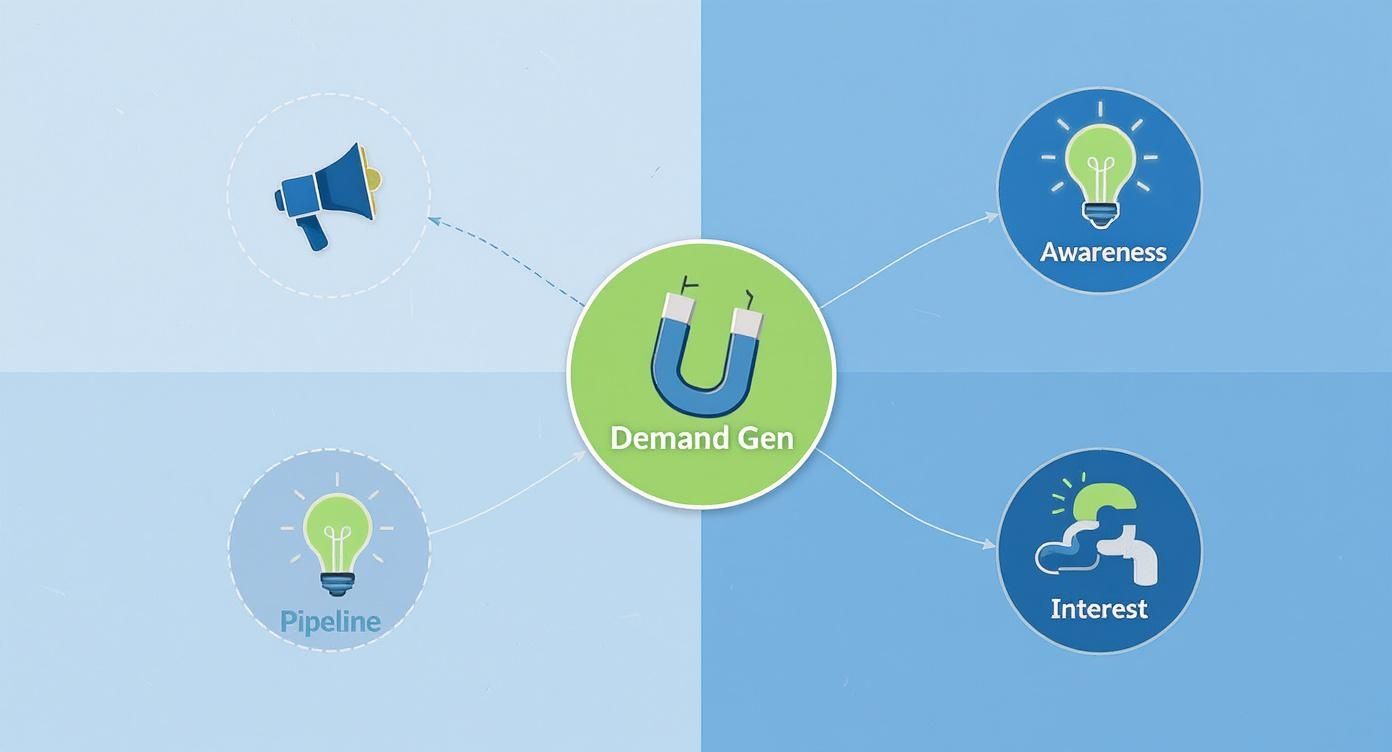
As you can see, a central demand generation engine is what fuels awareness. That awareness then cultivates genuine interest, which in turn feeds a healthy, predictable sales pipeline. It’s a flywheel, not a funnel.
Attract Your Ideal Customers
The first pillar, Attract, is all about capturing attention at the very top of the funnel. This is where you connect with people who might not even realize they have a problem yet, let alone know that you sell the solution. The goal isn't a sales pitch; it's to be genuinely helpful.
Forget about the old-school outbound tactics that interrupt people’s day. This is about drawing them in naturally by solving their problems with valuable, ungated content that proves you know your stuff. Every B2B company that consistently shows up on page one of Google for helpful searches is nailing this pillar.
Key tactics to put to work here include:
- SEO-Optimized Blog Content: Write articles that directly answer the questions your ideal customers are typing into search engines. This makes you a trusted expert from the very first click.
- Social Media Advocacy: Get your team involved. When your own experts share company content and their insights on platforms like LinkedIn, it comes across as authentic and builds trust way faster than a branded post.
- Podcast Appearances or Hosting: Share your knowledge on industry podcasts. It’s a fantastic way to reach new, highly relevant audiences who are already dialed into topics in your niche.
Engage and Nurture Interest
Once you have their attention, the Engage pillar takes over. This is where you turn that flicker of curiosity into a real relationship. You do this by offering even more valuable resources that help prospects dig deeper into their challenges and explore potential solutions.
This stage is all about building trust and showing off your expertise in a more direct way. It's the difference between someone stumbling upon a single blog post versus them subscribing to your newsletter because they can't afford to miss what you say next.
The trick to demand generation is to have no expectation of anything back from your prospects. Only the knowledge that you’re creating a good feeling between them and your brand.
To really nail the engage phase, you have to provide undeniable value. This often means offering more in-depth content or interactive experiences, usually in exchange for a little bit of information, like an email address.
This quick table breaks down the crucial differences between the broad approach of demand gen and the more targeted action of lead gen. Understanding this distinction is key to building a balanced strategy.
Demand Generation vs Lead Generation: A Strategic Comparison
| Aspect | Demand Generation (Building an Audience) | Lead Generation (Capturing Contacts) |
|---|---|---|
| Primary Goal | Create awareness and educate the market about problems and solutions. | Identify and capture contact information from interested prospects. |
| Audience Focus | Broad; targets an entire ideal customer profile (ICP). | Narrow; targets individuals who have shown specific buying signals. |
| Core Tactics | SEO, blogging, social media, podcasts, brand advertising. | Gated content (eBooks, webinars), contact forms, free trials, demos. |
| Measurement | Website traffic, brand search volume, social engagement, share of voice. | Leads, MQLs, SQLs, cost per lead (CPL), conversion rates. |
| Funnel Stage | Top of the Funnel (TOFU). | Middle of the Funnel (MOFU) and Bottom of the Funnel (BOFU). |
| Timeline | Long-term relationship building; a continuous process. | Short-term results-focused; often campaign-based. |
In short, demand generation makes people want your solution, while lead generation gives them a way to get it. You can't have one without the other.
Delight and Convert with Proof
The final pillar is Delight. This is where you transform that nurtured interest into real, qualified opportunities for your sales team. By now, your prospects know they have a problem and are aware of the solutions out there. Your job is to convince them that your solution is the best one.
This is all about proof. You stop talking about theoretical problems and start showing how you've solved them for real companies just like them.
Great delight tactics make the decision to talk to sales feel like the obvious next step, not a risky leap. This is where you bring out the heavy hitters: compelling case studies, tailored product demos, and customer testimonials that provide the social proof needed to turn a warm prospect into a new customer.
Building Your Content Engine for Demand
Content is the fuel for every great demand generation strategy. It’s the real, tangible value you give your audience long before they even think about buying. A solid content engine isn't about just churning out random articles; it’s about systematically creating assets that attract, educate, and pull your ideal customer through their entire decision-making process.
Think of it like building a library. A single book is nice, but a well-stocked library with sections covering every possible interest? That becomes an indispensable resource for the entire community. Your content needs to do the same thing—become the go-to resource in your industry, the one future customers learn to depend on.
This requires a real plan, not just a sporadic publishing schedule. You have to map your content to where people are in their journey, from the moment they first realize they have a problem to the point where they’re actively comparing vendors like you.

Matching Content to the Buyer's Journey
The sharpest content engines align every single asset with a clear purpose. You wouldn’t hand a dense, technical whitepaper to someone who isn’t even sure they have an issue yet. That’s just a waste of everyone’s time. Matching the content format to the funnel stage is how you build real momentum.
Here’s a simple way to break it down:
- Top of Funnel (Awareness): Your goal here is to attract a broad audience and teach them about the problems you solve—not your product. The content should be easy to find and even easier to share. Think blog posts that nail common questions, snappy short-form videos for social, or infographics that make complex ideas simple.
- Middle of Funnel (Consideration): Okay, now your audience knows they have a problem and they're starting to look for answers. This is your chance to offer deeper, more practical value. Host webinars, publish detailed guides or eBooks, and create interactive tools like checklists that help them sort through their options.
- Bottom of Funnel (Decision): By now, they're solution-aware and are sizing you up against the competition. Your content needs to build trust and prove you're the right choice. This is prime time for compelling case studies, customer testimonials, product demos, and no-fluff comparison guides.
Choosing the Right Content Format
Picking between a blog post, a video, or a podcast isn't just a matter of taste. It's a strategic decision based on your audience and what you're trying to achieve. Each format has its own strengths, and making the right call can be the difference between content that lands and content that flops.
A classic debate is video versus written content. They're both incredibly powerful, but they shine in different scenarios.
Comparing Video vs. Blog Posts
| Factor | Video Content | Blog Posts (Written Content) |
|---|---|---|
| Engagement | Delivers a higher emotional punch and grabs attention fast. Perfect for product demos and storytelling. | Lets readers skim for highlights or dive deep. Better for technical details, data, and complex info. |
| SEO Value | A powerhouse for YouTube and Google video results. Descriptions and transcripts can be packed with keywords. | The foundation of traditional SEO. It's much easier for search engines to crawl and index for a huge range of keywords. |
| Complexity | Best for showing how something works and building a personal connection with the presenter. | Ideal for explaining complex ideas with charts, data, and step-by-step instructions readers can follow at their own pace. |
| Action Step | Use video to walk someone through your product's UI or to feature powerful customer stories. | Use blog posts to create the definitive guide on a topic or to break down industry trends with hard data. |
When you get these differences, you can build a much more dynamic and effective content plan. To get even deeper into structuring this, check out our complete guide on building a powerful content marketing strategy.
Scaling Your Content Creation Workflow
Creating great content consistently is tough. The solution? A scalable workflow. It’s what turns the chaos of reactive content creation into a predictable, efficient system that just works.
Here are the four steps to get it done:
- Ideation and Research: Start a central backlog for every content idea that pops up. Use tools to dig into keywords and see what your competitors are doing to spot the gaps you can fill.
- Prioritization: Score your ideas based on their potential impact, relevance to your audience, and how well they line up with your business goals. A simple scoring system keeps you focused on the topics that will actually move the needle.
- Creation and Review: Assign topics to your creators with crystal-clear briefs. Outline the target audience, keywords, and the main takeaways. Set up a straightforward review process to keep quality high and your brand voice consistent.
- Distribution and Promotion: Your job isn't over when you hit "publish." That's when the real work starts. Have a distribution checklist for every piece—share it on social, send it to your email list, and think about how you can slice it up into other formats.
The data is clear: content is the absolute cornerstone of modern demand generation. A 2024 survey found that 83% of marketers see content marketing as their single most effective demand gen tactic.
This isn't a niche opinion. 73% of businesses around the world say content is a critical piece of their overall strategy. The most popular formats? Blogs and videos, used by about 95% of marketers, with case studies right behind at 90%. You can dig into more trends and stats on the future of demand generation.
At the end of the day, building a content engine is an investment. You're creating a long-term asset. Every article, video, and guide you create acts like a digital salesperson, working for you 24/7 to attract and educate the customers you haven't even met yet.
Amplifying Your Reach with Multi-Channel Distribution
Creating incredible content is only one side of the coin. The other, arguably more important side, is making sure the right people actually see it. This is where so many strategies fall flat. A "publish and pray" approach just doesn't cut it anymore. Real growth comes from a smart, multi-channel distribution plan that squeezes every last drop of value out of the assets you work so hard to create.
Think of your content as a powerful message you've crafted. You wouldn't just write it down and leave it on your desk, right? Of course not. You need to broadcast it across every channel where your ideal customers are already hanging out. It’s time to stop waiting for them to find you and start actively pushing your content into their world.
SEO vs. Paid Social: A Tale of Two Channels
Two of the heaviest hitters in your distribution arsenal are organic search (SEO) and paid social media. They’re both incredibly powerful, but they play completely different games. Figuring out their unique roles is the key to spending your time and money wisely.
SEO is the long game. It’s all about capturing intent. When someone types a query into Google, they are actively hunting for an answer or a solution to a problem they have right now. By ranking for those keywords, you put your brand directly in their path at the exact moment of need. It's a slow burn, but it builds lasting authority and a steady stream of highly qualified traffic.
- Actionable Step: Use a keyword research tool to find a long-tail question your customers ask, like "how to integrate CRM with marketing automation," and write the most comprehensive blog post on the internet about it.
Paid social, on the other hand, is built for precision. Platforms like LinkedIn let you bypass the waiting game and put your content directly in front of people based on their job title, industry, or company size. These are folks who perfectly fit your ideal customer profile but probably aren't searching for you... yet. It's the perfect tool for creating awareness and getting in front of niche audiences, fast.
- Actionable Step: Take your best-performing blog post and run a LinkedIn ad campaign targeting job titles that match your ideal customer, driving traffic to that ungated content.
The secret isn't picking one over the other. The best demand gen programs use SEO to capture existing demand and paid social to create new demand—at the same time.
Expanding Your Distribution Playbook
While SEO and paid ads are your cornerstones, a truly dominant strategy uses a mix of channels to create a surround-sound effect for your brand. This is how you connect with your audience across multiple touchpoints, making your brand feel familiar and credible.
Here’s how a few other channels fit into the puzzle:
- Email Marketing: This is your home turf. You own this channel, and it’s the best place to nurture the relationships you've already started. Use it to send out your latest blog posts, promote upcoming webinars, or deliver hyper-relevant resources to specific audience segments.
- Community Engagement: Stop just broadcasting on social media and start participating. Dive into relevant LinkedIn Groups, Slack communities, and niche forums where your audience is already asking questions. Share your content when it’s genuinely helpful, not just as a cheap plug.
- Strategic Partnerships: Team up with non-competing companies that serve the same audience. Co-hosting a webinar or co-authoring a guide lets you tap into their hard-won audience, giving you an instant reach and a powerful dose of third-party credibility.
A truly integrated strategy weaves these channels together into a seamless customer journey. For a closer look at how the pros pull this off, you can check out these detailed omnichannel marketing examples to see how leading brands connect all the dots.
Key Demand Generation Channels and Their Primary Role
Making smart decisions about where to invest your energy starts with understanding what each channel is best at. This table gives you a quick breakdown of where each channel delivers the most punch in your demand generation funnel.
| Channel | Primary Funnel Stage | Key Objective | Actionable Tip |
|---|---|---|---|
| SEO & Blogging | Top of Funnel (TOFU) | Attract users actively searching for solutions and build organic authority. | Create a "pillar page" on a core topic and surround it with related blog posts. |
| Paid Social Media | Top/Middle of Funnel | Target specific personas with educational content to generate awareness and interest. | Retarget website visitors with an invitation to a relevant, high-value webinar. |
| Email Marketing | Middle/Bottom of Funnel | Nurture existing contacts with valuable content and guide them toward a decision. | Set up a 5-day email course that solves a specific problem for your subscribers. |
| Community & Forums | Top/Middle of Funnel | Establish expertise and build trust by answering questions in relevant online spaces. | Spend 15 minutes a day answering one question in a key LinkedIn Group or subreddit. |
| Partnerships & Co-Marketing | Top of Funnel (TOFU) | Access a new, relevant audience and borrow credibility from a trusted partner. | Identify one partner and pitch a joint webinar on a topic you both care about. |
At the end of the day, a multi-channel approach isn't about being everywhere all at once. It's about being in the right places with the right message, creating a consistent and valuable presence that makes you the only logical choice when your audience is finally ready to buy.
Measuring Demand Generation That Drives Revenue
Creating great content and pushing it out across a dozen channels is a strong start, but it's only half the story. If you can't connect your demand generation strategy to the bottom line, you're just flying blind. It's time to stop chasing vanity metrics like social media likes and start focusing on the KPIs that prove your marketing is actually making the cash register ring.
This isn't just about justifying your budget to the CFO. It's about making smarter, data-backed decisions. By tracking the right key digital marketing performance metrics, you can see exactly what's working, kill what isn't, and fine-tune your entire engine for predictable growth.

From Leads to Revenue: The Metrics That Matter
To really get a grip on performance, you have to follow the money. That means tracking a prospect's entire journey, from their very first interaction with your brand all the way to the final sale. The sharpest demand gen teams are obsessed with a handful of core metrics that draw a straight line from marketing activity to sales outcomes.
Here are the essentials you should have on your dashboard:
- Marketing Qualified Leads (MQLs): This isn't just any lead. It's a prospect who has taken a specific action—like downloading an eBook or joining a webinar—that signals they're more likely to become a customer. They've raised their hand.
- Sales Qualified Leads (SQLs): An SQL is an MQL that the sales team has looked at and agreed is a legitimate opportunity worth pursuing. That handoff is a make-or-break moment, and the MQL-to-SQL conversion rate tells you how well marketing is setting sales up for the win.
- Pipeline Velocity: Think of this as the speedometer for your sales process. It measures how quickly leads are zipping through your pipeline and becoming revenue. A faster velocity means a shorter sales cycle and a more efficient money-making machine.
- Customer Acquisition Cost (CAC): This is the bottom-line number: the total cost of your sales and marketing efforts divided by the number of new customers you brought in. A healthy demand gen strategy should constantly be pushing your CAC down.
A rookie mistake is treating every lead the same. The real win isn't just generating more leads; it's generating leads that convert faster and cost less to acquire. That's how you drive profitability.
Multi-Touch Attribution: The Key to True Insight
For years, marketers lived in a "last-click" world. If a prospect requested a demo after clicking a Google Ad, the ad got 100% of the credit for the sale. Simple, right? But it's also dangerously wrong. This model completely ignores all the other crucial steps, like the blog post that first caught their eye or the webinar that built their trust.
This is where multi-touch attribution changes the game. It’s a way of looking at the entire customer journey and giving credit to the multiple touchpoints that influenced the final decision. It gives you a much clearer, more honest picture of what’s actually working.
Comparing Attribution Models: Last-Click vs. Multi-Touch
| Factor | Last-Click Attribution | Multi-Touch Attribution |
|---|---|---|
| Focus | Gives 100% credit to the final touchpoint before conversion. | Distributes credit across multiple touchpoints in the buyer's journey. |
| Insight Level | Simple to track but highly misleading. Overvalues bottom-funnel tactics. | Complex to set up but provides a true, holistic view of what works. |
| Impact on Strategy | Leads to over-investment in direct-response channels like search ads. | Allows you to justify and optimize top-of-funnel investments like content and social. |
| Actionable Step | Use for basic, directional insights if you're just starting out. | Your Goal: Implement a U-shaped or W-shaped model to properly value both the first and last touches, as well as key mid-journey interactions. |
Imagine a buyer who reads three of your blog posts, follows you on LinkedIn for a month, and then finally clicks a retargeting ad to book a demo. Last-click gives all the glory to the ad. A multi-touch model recognizes that the blog and social media work were absolutely essential in getting them to that point.
This kind of insight is a superpower for budget allocation. You might discover that your top-of-funnel content, while not a direct conversion driver, is the secret ingredient filling your pipeline with qualified buyers. To go deeper, you can explore various multi-touch attribution models and find the one that fits your business. Once you understand the whole journey, you can double down on the strategies that deliver real value, every step of the way.
How to Align Sales and Marketing for a Seamless Funnel
Let's be honest. Even the slickest demand generation strategy will completely fall apart if your sales and marketing teams are speaking different languages. When they're not in sync, it's not just a small hiccup—it's a critical failure that bleeds qualified leads, stalls deals, and kills momentum.
The only real fix is to stop thinking of them as two separate departments. You need one unified revenue team, plain and simple.
This whole process kicks off with getting on the same page about what a "good lead" actually is. If marketing's definition is different from sales', you're already set up to fail. This is where a Service Level Agreement (SLA) becomes your best friend.
Forging a Service Level Agreement
Think of an SLA as a peace treaty. It’s a formal contract between sales and marketing that lays out exactly who is responsible for what. This isn't about pointing fingers; it's about creating crystal-clear expectations.
A solid SLA should nail down the specific criteria for a Marketing Qualified Lead (MQL) and what, exactly, sales has to do once that lead is handed over.
A strong SLA must include:
- A Bulletproof MQL Definition: Get granular. What are the exact demographic, firmographic, and behavioral signals that say a lead is truly ready for a sales conversation?
- The Handoff Protocol: Map out the literal process of moving a lead from your marketing automation tool into the sales CRM. No gray areas.
- The Follow-up Cadence: Agree on how fast and how many times sales will attempt to contact each MQL.
This simple document gets rid of the classic back-and-forth—"marketing's leads are junk" versus "sales never follows up." It swaps out assumptions for firm, mutual commitments.
Creating a Unified System
Once you're speaking the same language, it's time to build transparency with the right tech and processes. A shared CRM isn't a nice-to-have; it's non-negotiable. It becomes the single source of truth, giving both teams a complete, real-time picture of every prospect’s journey.
Marketing finally sees which campaigns are creating leads that actually close. And sales gets the full backstory on a lead's every interaction.
This shared view is what makes consistent feedback possible. Sales needs a dead-simple way to give feedback on lead quality right inside the CRM. That data flows back to marketing, who can then sharpen their targeting and messaging. Your demand engine gets smarter with every cycle.
Without this, you're just throwing leads into a black hole. Misalignment is incredibly wasteful; stats show that 44% of sales reps feel they're too swamped to follow up on leads, and old-school tactics are DOA when 97% of people flat-out ignore cold calls. Tightly integrated demand generation strategies are the only way forward. You can dig deeper into these challenges over at Exploding Topics.
Got Questions About Demand Generation? You're Not Alone.
Even with the best plan laid out, you're going to hit a few forks in the road when you start running a real demand generation playbook. It happens.
Here are straight answers to the two questions that come up most often, designed to give you clarity and keep you moving forward.
How Long Does This Stuff Actually Take to Work?
It's the million-dollar question, and I'll give you the honest answer: it's not an overnight fix. If you're looking for instant form fills, you're thinking about lead gen. Demand gen is a different game entirely—it’s about building an asset, not just running a transaction.
I like to think of it like this:
- Lead Generation is picking a flower. You get an immediate, tangible result. You run an ad, you get a lead. Simple.
- Demand Generation is planting a tree. It takes time to grow roots. You have to consistently show up, publish great content, build real authority, and earn the trust of your audience.
You'll see the first green shoots—like more website traffic and better social engagement—within 3-6 months. But the real harvest, the impact on metrics like sales pipeline and customer acquisition cost, usually takes 9-12 months of sticking with it. The reward for your patience? A predictable, sustainable engine that brings you high-quality opportunities month after month.
Should I Gate My Content or Let It All Run Free?
Ah, the great gate debate. The truth is, it's not a simple "either/or" choice. The smart move is "both, but strategically." It all boils down to your goal for a specific piece of content and where your buyer is on their journey.
Let's break it down.
Gated vs. Ungated: The Simple Breakdown
| Approach | Ungated Content | Gated Content |
|---|---|---|
| Your Main Goal | Getting your name out there, building brand awareness, and being genuinely helpful. | Pinpointing interested buyers and getting their contact info. |
| When to Use It | Perfect for top-of-funnel stuff that educates and attracts: blog posts, infographics, short-form videos. | Best for high-value, deep-dive assets that signal buying intent: eBooks, webinars, detailed case studies. |
| The Bottom Line | Leave it ungated when you want to reach the widest possible audience and position your brand as the go-to expert. | Gate it when you're offering something so valuable that someone is willing to trade their email for it. This tells you they're serious. |
The most effective demand generation strategies don't pick a side; they use both. Ungated content builds your audience. Gated content helps you identify the people in that audience who are ready to talk business.
Ready to stop guessing and start growing? The marketbetter.ai platform uses AI to help you create better content faster, optimize your campaigns for revenue, and personalize every customer interaction. See how you can build a smarter demand engine at https://www.marketbetter.ai.