How to Use AI for Marketing to Outsmart the Competition
Using AI for marketing isn't about chasing the next shiny object. It’s about making your efforts smarter, faster, and more personal. The actionable goal is to integrate intelligent tools to finally stop the repetitive grunt work and start delivering experiences that actually move the needle.
Putting AI to Work in Your Marketing Strategy
AI in marketing isn't a far-off concept anymore; it's a practical toolkit that gives businesses a serious competitive advantage right now. The core idea is to shift from manual guesswork to data-driven automation. Instead of blasting one generic campaign to thousands, AI lets you create thousands of personalized variations, one for each individual.
This completely changes how marketing teams operate. Mundane tasks—data entry, slicing up email lists, scheduling social media posts—can be handed off to AI. This frees up your team to do what they do best: think strategically and get creative.
But the real magic is in its predictive power.
From Reactive to Proactive Marketing: A Core Comparison
Traditionally, marketers have been reactive. An action (a customer buys something) triggers a reaction (you send a follow-up email). An AI-powered approach flips the script by anticipating what a customer needs before they even know they need it. It analyzes browsing patterns and past purchases to predict their next move, letting you slide the perfect offer in front of them at the perfect moment.
Actionable Tip: To start, identify one reactive process in your marketing (e.g., a generic "welcome" email series). Brainstorm how you could make it proactive using data you already have, like what product category a new subscriber first viewed on your site. Then, find a tool that can automate that personalized first touchpoint.
Understanding how AI-powered advertising strategies can reshape your entire game plan is a great starting point.
The industry is jumping on this, and fast. The AI in marketing market is pegged at roughly $47.32 billion in 2025—a massive leap from just $12.05 billion back in 2020. That explosive growth shows just how quickly businesses are getting on board, with forecasts projecting the market will hit $107.5 billion by 2028.
"Your job will not be taken by AI. It will be taken by a person who knows how to use AI."
This line gets thrown around a lot, but it perfectly nails the current reality. Learning how to use AI for marketing is no longer optional if you want to stay relevant. It's about becoming sharper and more effective at your job.
The Foundational Pillars of AI in Marketing
Bringing AI into your world isn't just about buying new software; it's about fundamentally rethinking your workflow. Most practical applications fall into a few key buckets:
- Content Creation: Churn out drafts for blogs, social posts, and ad copy in minutes, not hours.
- Personalization at Scale: Serve up unique website experiences and product recommendations for every single visitor.
- Campaign Optimization: Let the AI automatically shift ad spend to the channels and audiences that are actually delivering results.
- Customer Insights: Dig through massive datasets to uncover hidden trends and understand what truly motivates your customers.
Actionable Tip: Pick the one pillar that represents your biggest bottleneck. If content is slow, start there. If ad spend is inefficient, focus there. Trying to implement AI across all four at once is a recipe for failure. Master one, show the ROI, and then expand.
Scale Your Content Creation with AI Assistance
The content treadmill never stops. The constant pressure for more—blog posts, social updates, videos—is overwhelming. This is where learning how to use AI for marketing goes from a "nice to have" to a core survival skill.
AI isn't here to replace your writers. Think of it as a force multiplier—a powerful assistant that handles the grunt work, freeing up your team to focus on what humans do best: strategy, creativity, and connecting with your audience.
Imagine planning your next quarter's entire editorial calendar in a single afternoon. With the right AI tools, you can take a single topic and explode it into a full-blown topic cluster, complete with detailed blog outlines, social media hooks, and even rough video scripts. What used to take weeks of brainstorming can now be done in a few focused hours.
From Blank Page to Polished Draft in Record Time
The old way of creating content is slow: manual keyword research, competitor analysis, outlining, drafting, and endless edits. AI doesn't skip these steps, but it puts them on hyperdrive.
The industry has already caught on. Recent data shows that a staggering 88% of marketers are now using AI in their day-to-day work. Digging deeper, 51% of marketing teams are specifically using AI to sharpen their content creation, from initial keyword discovery all the way to crafting hyper-relevant messages for specific audience segments.
This infographic nails the fundamental workflow.
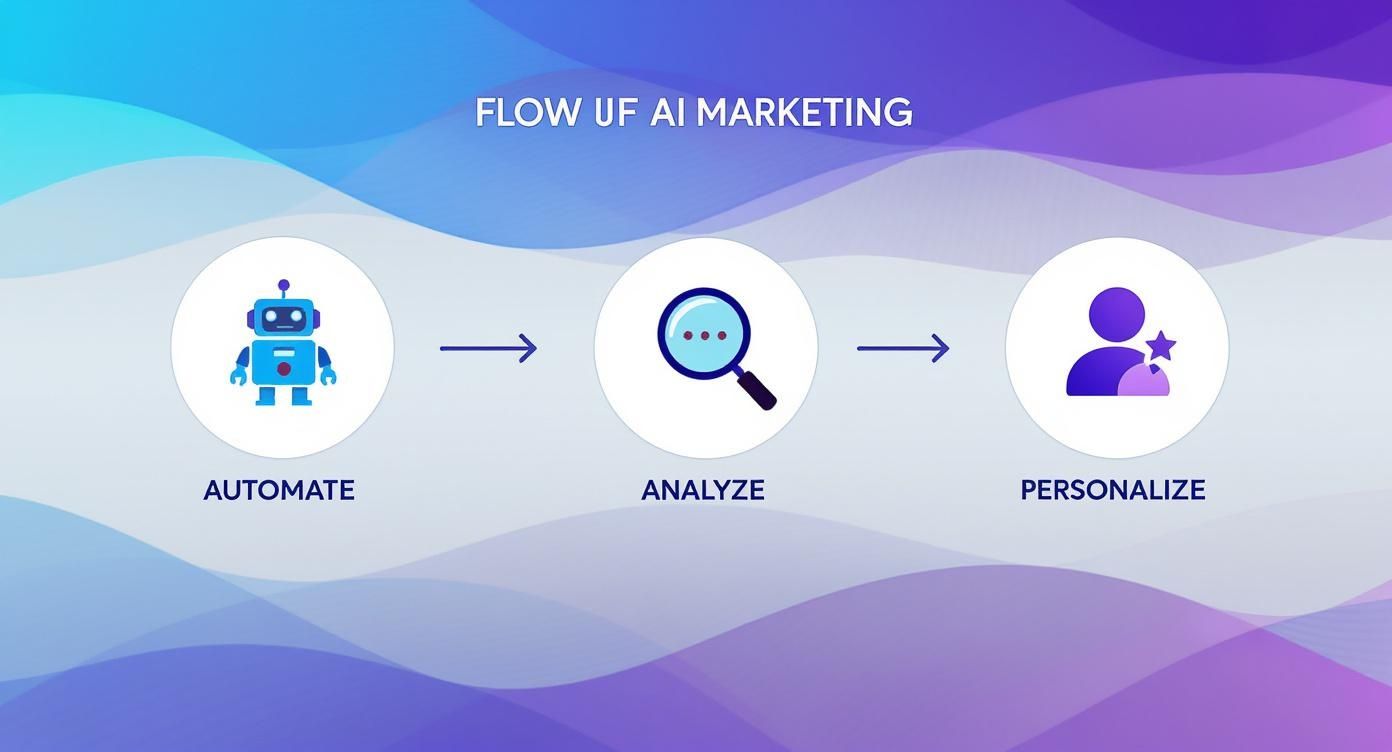
It’s a simple but powerful flow: AI helps automate the tedious parts, analyzes the data to find what’s working, and then enables you to personalize your message at scale. Each stage builds on the last, creating a smarter, more efficient marketing engine.
Manual vs AI-Assisted Content Creation Workflow
The best way to see the impact is to compare the old and new workflows for producing a single, well-researched blog post. The difference is stark.
| Task | Manual Approach (Time Est.) | AI-Assisted Approach (Time Est.) | Key Benefit of AI |
|---|---|---|---|
| Topic Brainstorming & Keyword Research | 2-4 hours | 30 minutes | Instantly generates hundreds of ideas and validates search intent. |
| Outline & Structure Creation | 1-2 hours | 15 minutes | Creates a logical, SEO-friendly structure in seconds. |
| First Draft Writing | 4-6 hours | 1-2 hours | Produces a solid draft, overcoming writer's block. |
| SEO & Readability Optimization | 1 hour | 20 minutes | Analyzes content and suggests improvements in real-time. |
| Total Time | 8-13 hours | ~2-3 hours | Frees up ~75% of your team's time for high-value work. |
The takeaway isn't just about moving faster. It's about reallocating your team's brainpower. When AI handles initial research and drafting, your best strategists can pour their energy into refining arguments and adding unique industry insights.
Actionable Tip: Take the table above and create your own. Track the time your team spends on each stage of content creation for one week (the manual way). The following week, introduce an AI content tool for the same tasks. The time-saved data you collect will be the most compelling argument for wider adoption.
If you're ready to make this shift, check out a curated list of the top AI tools for content marketing to find the right platform.
Crafting Hyper-Personalized Customer Journeys
The days of blasting the same message to everyone are over. Today's customers expect you to know who they are and what they need. This is where AI marketing stops being about saving time and starts being about building loyalty.
True personalization isn't just dropping a {{first_name}} into an email. It's about using AI to crunch mountains of customer data in real time: browsing history, past purchases, content clicks, and more. This is how you go from a generic "We miss you!" email to one that says, "Hey, we saw you checking out our winter coats last week. A new style just landed in your size." One is spam, the other is a service.
From Static Pages to Dynamic Experiences
Picture this: two people hit your homepage. One is a new visitor from a social media ad. The other is a loyal customer. Should they see the exact same page? No way. AI is what makes dynamic content more than just a buzzword.
| Aspect | The Old Way (Static Website) | The New Way (AI-Powered) |
|---|---|---|
| Homepage Content | Everyone sees the same generic banners and best-sellers. | The new visitor gets an intro offer; the loyalist sees new arrivals from their favorite brand. |
| Product Recommendations | "Most Popular" items are shown to all users. | Suggestions are based on what that specific user viewed, carted, or bought before. |
| User Experience | A one-way street. The site just sits there, presenting info. | A two-way conversation. The site reacts and adapts to what the user does. |
This isn't a small tweak. It changes your site from a static catalog into a personal shopper.
A Real-World Example: Turning Data Into Revenue
Let's make this tangible. An online clothing store uses an AI tool like MarketBetter.ai to pinpoint customers who are about to churn. The AI isn't just guessing; it's analyzing concrete signals like:
- Purchase Recency: How long since their last order?
- Engagement Drop-off: Are they suddenly ignoring emails?
- Browsing Patterns: Are they looking but never adding to their cart?
Once the AI flags a customer as "high-risk," it kicks off an automated, hyper-personal "win-back" campaign. Maybe it sends an email with a unique discount on an item that person just viewed but didn’t buy.
The goal isn't just to stop a customer from leaving. It's about reminding them why they liked you in the first place by showing you’re actually paying attention.
Actionable Tip: Map out your current customer journey. Identify three key touchpoints (e.g., first website visit, post-purchase, cart abandonment). For each one, write down one way you could use AI-driven personalization to make that specific interaction more relevant and valuable. Start with the easiest one to implement.
Optimizing Ad Campaigns with Predictive Analytics
This is where you turn your ad spend from a guessing game into a calculated investment. Instead of launching campaigns based on past performance and gut instinct, predictive analytics gives you an advantage before a single dollar is spent. AI algorithms dig through mountains of data—past campaigns, competitor performance, market trends—to forecast which ad creatives, audiences, and platforms are most likely to deliver.
Intelligent Budget Allocation in Real Time
One of the most immediate pay-offs is intelligent budget allocation. In a typical campaign, you set a budget and check in weekly, making manual tweaks. It’s slow, and you’re leaving money on the table.
AI changes this by watching campaign performance around the clock. The second it spots an ad set or audience segment that's pulling ahead, it automatically shifts more budget toward that winner in real time. This ensures every cent of your ad spend is working as hard as possible.
This isn't a fringe tactic. A global survey found that 80% of companies are using AI in their marketing measurement. To see just how deep this trend runs, you can explore more on how AI will shape the future of marketing.
With predictive analytics, you stop funding underperforming ads and double down on what’s working—often within hours, not weeks.
AI-Driven Multivariate Testing vs. Traditional A/B Testing
For years, A/B testing was the gold standard. You'd test one variable—a headline, an image—and see which version won. It works, but it's slow and limited. AI-driven multivariate testing blows the old model out of the water.
| Feature | Traditional A/B Testing | AI-Driven Multivariate Testing |
|---|---|---|
| Variables Tested | Tests one or two variables at a time (e.g., headline A vs. B). | Simultaneously tests thousands of variations (headlines, images, copy, CTAs). |
| Speed to Insight | Can take weeks or months to gather statistically significant data. | Pinpoints winning combinations in a fraction of the time. |
| Optimization | Identifies a single "best" version from a limited pool. | Discovers the optimal formula of elements for specific audiences. |
Think of it this way: A/B testing helps you choose between two paths. AI-powered multivariate testing explores every possible path at once to find the absolute fastest route to your goal.
Actionable Tip: Take your next planned A/B test. Before you launch it, use an AI ad copy generator to create 10 alternative headlines and 5 alternative call-to-actions. Instead of a simple A/B test, run a multivariate test with these new variations. Compare how quickly you find a winning combination versus your traditional A/B test timeline.
Building Your AI Marketing Tech Stack
With a tidal wave of AI tools on the market, figuring out where to start is overwhelming. The key is to sidestep the hype and build a toolkit that solves your actual problems.
Actionable First Step: Don't start by shopping for tools. Start by identifying your single biggest bottleneck. Is it slow content creation? A lack of personalization? An ad budget that feels like a black hole? Your answer is your compass. Not every company needs a massive AI platform. A few specialized tools that play nicely together can deliver more value, faster.
Categorizing Your AI Marketing Tools
Most AI marketing software fits into one of three buckets. Knowing the difference helps you spot gaps and avoid paying for the same feature twice.
- Comprehensive Platforms: These are the all-in-one marketing clouds like HubSpot or Salesforce. They pack in AI-driven features, from email automation to deep analytics. They’re great for larger teams needing a single source of truth but come with a steep learning curve and price tag.
- Point Solutions: These are specialists that do one thing incredibly well. Tools like Jasper for generating content fall into this category. They’re usually easier to get started with and can plug a specific hole in your workflow almost instantly.
- Feature Integrations: This is AI baked into tools you probably already use, like Canva’s Magic Write or Google Analytics' insights. These are fantastic for dipping your toes into AI without adding new software.
To get these tools talking to each other, look at their marketing automation APIs. These connectors let your CRM, email platform, and ad tools share data, turning a collection of separate tools into a cohesive system.
AI Marketing Tool Evaluation Checklist
Choosing the right tool demands discipline. Use a consistent checklist to compare contenders based on what actually matters to your business.
Here’s a simple framework to get you started.
| Evaluation Criteria | Tool A (e.g., Jasper) | Tool B (e.g., MarketBetter.ai) | Tool C (e.g., HubSpot AI) |
|---|---|---|---|
| Primary Use Case | Best for high-volume content generation (blogs, social). | An integrated platform for content, campaigns, and personalization. | A full marketing and sales suite with embedded AI features. |
| Integration | Connects with many tools via API but is a standalone product. | Designed for deep integration with existing CRMs and ad platforms. | Tightly integrated within its own ecosystem. Can be limited with outside tools. |
| Pricing Model | Tiered subscription based on word count and user seats. | Tiered subscription based on features and contact volume. | Included in higher-tier Professional and Enterprise plans. |
| Ideal User | Content marketing managers needing to scale production. | B2B marketing teams focused on ROI and campaign efficiency. | Businesses already invested in the HubSpot ecosystem. |
This table makes it clear that there’s no single "best" tool—only the best tool for a specific job.
The most important question isn't "What's the best AI tool?" but rather "What's the best AI tool for us?" Your business goals, existing software, team skills, and budget should be the ultimate deciding factors.
For a deeper look, check out our updated list of the best AI marketing tools to find the right fit for your strategy.
Common Questions Holding Marketers Back from AI
Even when you see the potential, diving into AI can feel like a big leap. Many marketers assume you need a massive budget or a team of data scientists. Let's dismantle those common myths.
Do I Need a Data Science Degree to Use Marketing AI?
Absolutely not. This is the biggest misconception holding people back. Modern AI marketing tools are built for marketers, not coders. All the complex algorithms and data lifting happen under the hood.
Think of it this way: you don't need to be a mechanic to drive a car. You just need to know where you're going. You bring the marketing strategy—your goals, your audience, your campaign ideas—and the AI becomes the engine that gets you there faster.
What's a Realistic AI Budget for a Small Business?
You can put the "we need an enterprise budget" myth to rest. The cost of entry has dropped dramatically, with powerful options at almost every price point.
Here’s a quick comparison:
- Single-Task Tools: For solving one specific problem like generating social media copy, expect to start in the $20-$50 per month range.
- Built-in AI Features: Many platforms you already use—think Mailchimp or Canva—now have AI features in existing plans, often starting around $100 per month.
- All-in-One Platforms: For comprehensive suites, a realistic starting point for a small business could be anywhere from $100 to $300 per month.
The smartest way to start is small. Find your single biggest pain point and find one tool that fixes it. The ROI from that first win will often pay for the next tool.
Measuring the ROI of your AI marketing efforts isn't some mystical art. It’s simple arithmetic: compare the "before" and "after" with cold, hard numbers.
Actionable Tip: The 3-Step ROI Proof Plan
- Benchmark: Before you start, benchmark your current performance. What's your average cost per lead? How many hours does it take to write a blog post? Get that baseline number.
- Implement & Track: Let the AI tool run for a full quarter.
- Compare & Report: Run the numbers again. The proof is in the KPIs:
- Time Saved: How many hours did your team get back?
- Performance Lift: Did your click-through rates, conversions, or engagement go up? By how much?
- Revenue Impact: Can you draw a straight line from an AI-driven campaign to a closed deal?
This data-first approach takes the guesswork out of it. You're no longer feeling like AI is working; you're proving its direct contribution to your bottom line.
Ready to stop guessing and start growing? marketbetter.ai integrates powerful AI across your content, campaigns, and customer journeys to deliver measurable results. See how our AI-powered marketing platform can transform your strategy today.