A Practical Guide to AI-Powered Marketing Automation
AI-powered marketing automation uses intelligent software to handle marketing tasks, predict customer behavior, and personalize experiences at scale. It’s a massive leap beyond the simple, rules-based automation of the past. Instead of just following a script, AI-powered marketing automation uses data-driven insights to adapt and optimize campaigns in real time.
The New Era of Marketing Is Already Here
Let's be honest. Modern marketing is a complex web of channels, data streams, and high customer expectations. Juggling all of that manually isn't just difficult—it's impossible. This is where AI-powered marketing automation steps in, acting as an intelligent conductor for your marketing efforts.
To understand what AI adds, you first need to grasp foundational marketing automation. Traditional automation runs on rigid "if-this-then-that" logic. For example, if a user downloads an ebook, they receive a pre-written email sequence. It works, but it's inflexible and can't think for itself.
From Rigid Rules to Intelligent Systems
AI changes the entire game. Instead of just following a pre-set script, AI-powered systems learn, predict, and adapt. The technology moves marketing away from simple triggers and toward creating truly dynamic customer journeys. It analyzes historical behavior, monitors real-time actions, and uses lookalike audience data to make autonomous, intelligent decisions.
This isn't just a buzzword; it's a fundamental shift. This intelligent-first mindset is fueling significant industry growth. The global AI marketing market is projected to grow from $20 billion in 2022 to $40 billion by 2025, with AI poised to add up to $15.7 trillion to the global economy by 2030.
The real difference is the switch from reactive to proactive marketing. Traditional automation reacts to a trigger you've set. AI automation proactively anticipates a customer's next move and customizes the experience before they even make it.
Here’s a practical comparison to make it actionable:
- Traditional Automation (Reactive): It’s like a basic sprinkler system on a timer. It turns on at 6 AM every day, whether it’s a scorching hot day or a rainstorm. It follows the rule, regardless of conditions.
- AI-Powered Automation (Proactive): This is a smart sprinkler system connected to a weather app. It knows it’s going to rain, so it skips watering today to save water. It adapts based on real-time data to achieve a better outcome.
This guide will show you how to apply that adaptive power to drive measurable growth for your business.
How AI Makes Smart Automation Genius
Think of traditional marketing automation like a set of dominoes. You line them up, push the first one, and they all fall in a pre-set, unchangeable sequence. It works, but it's rigid. It just follows the path you laid out.
AI-powered marketing automation is more like a chess grandmaster. It doesn’t just follow a script. It anticipates moves, learns from every single interaction, and adapts its strategy in real-time to win. This isn't just an upgrade; it's a completely different game.
This massive leap forward is all thanks to machine learning algorithms. They analyze enormous amounts of data to spot patterns, make predictions, and trigger actions that a human—or a simple rule-based system—could never see coming.
From Following Rules to Making Decisions
The real difference is the "brain" behind the scenes. Traditional automation is reactive; it blindly follows "if-then" rules. An AI-powered system is proactive. It makes its own decisions based on what the data is telling it right now.
This shift is why the market is exploding. The global marketing automation space, overwhelmingly driven by AI, was valued at $6.65 billion in 2024 and is on track to hit $15.58 billion by 2030. That growth tells you one thing: businesses need smarter, more effective marketing.
Traditional automation executes a command. AI-powered marketing automation understands the intent behind the command and finds the best way to get there, even when things change.
To make this actionable, let’s look at a direct, side-by-side comparison.
Traditional Automation vs AI-Powered Marketing Automation
The table below breaks down the core differences. On one side, you have the fixed, rule-based approach. On the other, a dynamic system that thinks for itself.
| Feature | Traditional Automation (Rule-Based) | AI-Powered Automation (Adaptive) | Actionable Takeaway |
|---|---|---|---|
| Lead Scoring | Assigns static points (e.g., opened email = 5 points). Rigid and often inaccurate. | Dynamically adjusts scores based on real-time behavior and predicts conversion likelihood. | Action: Use AI to automatically prioritize your hottest leads for the sales team, so they stop wasting time on cold prospects. |
| Content Personalization | Sends the same pre-written content to everyone in a segment. | Personalizes content, images, and offers for each individual user, on the fly. | Action: Let AI dynamically change the hero image on your homepage based on a visitor's industry or past browsing history to boost engagement. |
| Campaign Optimization | Runs basic A/B tests on two variations, requiring manual analysis to pick a winner. | Continuously runs multi-variate tests and automatically shifts budget to the winning combinations. | Action: Instead of manually checking A/B test results, let the AI automatically reallocate your ad spend to the best-performing creative in real time. |
| Adaptability | Follows a fixed path. It can't adapt if a customer does something unexpected. | Learns from every interaction, adjusting workflows and messages instantly. | Action: Build customer journeys that adapt. If a user ignores three emails about a product, the AI can automatically switch tactics to a different offer. |
The key takeaway is simple: AI transforms static workflows into living, breathing campaigns that get smarter over time.
Putting It All Into Action
Let's use a classic e-commerce example: a customer abandons their shopping cart.
- A traditional automation system waits 24 hours and sends a generic, "You left something behind!" email. It’s better than nothing, but not by much.
- An AI-powered marketing automation system instantly analyzes that customer’s entire profile. It sees they usually buy on sale and have been browsing a specific category. A few hours later—right when that person is most likely to be online—it sends a personalized email with a 10% discount specifically on the items in their cart.
That's the difference. The AI turns a routine task into a powerful, data-driven conversion opportunity.
By using predictive analytics in marketing, the system can forecast what a customer will do next and proactively engage them with the perfect message. It’s not just about doing things faster; it’s about doing the right things smarter.
Essential Features of Top AI Marketing Tools
When you're shopping for an AI powered marketing automation platform, it's easy to get lost in buzzwords. To cut through the noise, focus on the core capabilities that actually drive results. These are the non-negotiables that separate powerful tools from merely functional ones. A top-tier platform does more than automate tasks; it helps you make smarter strategic decisions.
Here's how to think about it:
- A basic tool can send an email.
- A great tool tells you who to email, what to say, and when to send it for maximum impact.
Predictive Analytics and Forecasting
First on the list is predictive analytics. This is the crystal ball of marketing. It uses historical and real-time data to forecast what your customers will do next. It doesn’t just report on what happened; it tells you what’s likely to happen.
Actionable Use Case: Implement churn prediction. The AI can identify customers showing subtle signs of leaving (e.g., lower engagement, fewer logins) and automatically trigger a retention campaign. This might be a personalized discount or a "how can we help?" email, turning a potential loss into a loyal customer. By improving your marketing workflow automation, you can act on these insights instantly.
AI Driven Content and Personalization
Next, you need an AI-driven content engine. This is about crafting hyper-personalized messages at scale. The AI analyzes individual user data to dynamically change email copy, website headlines, and product recommendations for every visitor.
Standard Tool vs. AI Tool: A standard tool might segment users by location. An AI-powered tool segments them by their predicted intent, showing different content to "just browsing" visitors than it does to "ready to buy" shoppers.
Using AI to optimize content is becoming standard practice—it's now the top use case for AI in marketing. In fact, using AI for lead generation can boost conversion rates by 25% while slashing manual work by 15% or more.
Natural Language Processing For Sentiment Analysis
Finally, look for tools with Natural Language Processing (NLP). This technology allows software to understand human language from sources like support chats, product reviews, and social media comments. It’s like having a team of analysts reading every customer interaction, 24/7.
Actionable Use Case: Monitor brand sentiment in real time. If the AI detects a wave of negative comments about a new feature on Twitter, it can alert the product team immediately. This lets you get ahead of problems instead of waiting for your next quarterly survey. You can also pair these platforms with specialized tools, like the best AI landing page builder tools, to fine-tune your results.
Choosing Your AI Marketing Platform
Picking the right platform for AI-powered marketing automation can feel overwhelming. The secret? Ignore the endless feature lists. The best tool isn't the one that does everything; it's the one that solves your biggest business problem.
Start by asking the right questions. Are you a small business needing an all-in-one system for emails and ads? Or are you a large B2B enterprise focused on complex lead scoring and nurturing sequences? Your answer will immediately narrow the field.
Comparing The Top Contenders
To make this actionable, let's compare three heavy hitters: HubSpot AI, Salesforce Einstein, and Adobe Marketo Engage. We'll focus on who they're built for.
Think of it like choosing a vehicle:
- HubSpot: A versatile SUV perfect for a growing business that needs to handle a bit of everything.
- Salesforce: A heavy-duty truck designed for an enterprise's industrial-scale sales and marketing operations.
- Marketo: A finely tuned race car for a specialized, high-performance marketing team.
The goal is to find a platform that feels like a natural extension of your team. It should simplify your existing workflows and open up new strategic possibilities, not force you into a system that doesn’t fit your business model.
A critical piece of the puzzle is integration. Your data must flow seamlessly. For a deeper dive, our guide on customer data platform integration will help ensure you're set up for success from day one.
AI Marketing Platform Feature Comparison
The right choice depends on your unique goals, team size, and budget. This comparison table cuts through the marketing fluff to highlight what really separates these platforms, helping you map your needs to the right solution.
| Platform | Key AI Feature | Ideal For | Pricing Model |
|---|---|---|---|
| HubSpot AI | Content Assistant & Predictive AI. Excellent for creating marketing content at scale and predicting lead behavior within an easy-to-use interface. | Small to Mid-Sized Businesses. Perfect for teams needing an all-in-one, user-friendly platform that combines CRM, marketing, and sales. | Tiered Subscription. Starts with free tools and scales up with different hubs and feature levels, making it accessible for growing companies. |
| Salesforce Einstein | Predictive Lead Scoring & Opportunity Insights. Deeply integrated with its CRM to provide sales teams with advanced, data-driven recommendations. | B2B Enterprises. Best for large organizations with established sales teams that need to optimize complex sales cycles and prioritize high-value leads. | Per-User, Per-Month. Often bundled with Salesforce Sales Cloud or Service Cloud, making it an add-on to an existing enterprise investment. |
| Adobe Marketo Engage | Behavioral Targeting & Journey Analytics. Delivers hyper-personalized customer journeys by analyzing intricate behavioral data across multiple channels. | Marketing-Centric B2B & B2C. Suited for companies with sophisticated marketing teams focused on delivering personalized experiences at every touchpoint. | Custom/Quote-Based. Pricing is based on the size of your contact database and specific feature needs, reflecting its enterprise focus. |
In the end, the process is simple. First, identify what you need to fix or improve. Then, find the platform whose AI is purpose-built to solve that exact problem. That's how you choose a partner that doesn't just automate tasks, but actively helps you grow.
Your Step-by-Step Implementation Plan
Let's be clear: switching to AI-powered marketing automation isn't like flipping a switch. It’s a strategic process. Treat it as a series of controlled upgrades, not a massive overhaul, to prevent overwhelm and see returns quickly.
The first step has nothing to do with technology. Define your primary business goal. Don't ask, "What can this fancy AI do?" Instead, ask, "What's our single biggest marketing problem right now?"
Are you drowning in bad leads? Is customer churn killing growth? Is your content team stuck? Pinpointing a specific, high-impact problem gives your entire plan a laser focus.
Stage 1: Foundational Setup
With a clear goal, your next move is a data audit. This is non-negotiable. AI is only as smart as the data you feed it. You must ensure your customer data is clean, centralized, and accessible. Messy, siloed data is the #1 reason AI projects fail.
Once your data is in order, pick a pilot project. Don't try to implement AI across the entire marketing department at once. Find one focused area to score a quick, visible win.
Actionable Pilot Project Ideas:
- Predictive Lead Scoring: Ditch manual point systems. Use AI to identify which leads are actually ready to buy based on thousands of subtle behavioral patterns. Your Action: Have the AI automatically create a "Hot Leads" list in your CRM that updates daily.
- Email Campaign Optimization: Let an AI test and tweak subject lines, send times, and content on the fly to maximize performance. Your Action: Set up an AI-powered "send time optimization" feature for your next newsletter to reach subscribers when they are most likely to open.
- Chatbot Implementation: Start simple. Put a chatbot on your pricing page to answer common questions and qualify visitors 24/7. Your Action: Program the bot to ask three qualifying questions and then automatically book a demo for qualified leads on a sales rep's calendar.
Starting small with a pilot is critical. It lets you prove ROI, build confidence with your team, and iron out the kinks in a low-risk environment before you go all-in.
Stage 2: Rollout and Adoption
After your pilot project delivers results, you can plan a wider rollout. But remember, the tech is the easy part. The most important piece is getting your team on board.
Your marketers don't need to become data scientists. They just need to understand how to work with the new tools.
Focus training on practical, day-to-day applications. Show them exactly how AI can take over repetitive tasks, freeing them up for the strategic work they were hired to do—like campaign creative, deep analysis, and talking to customers. Foster a mindset where AI is a helpful assistant, not a replacement.
Finally, set up a continuous feedback loop. Create a dedicated Slack channel or a weekly meeting for your team to share what’s working, what isn’t, and new opportunities. AI marketing isn't a "set it and forget it" solution. It's an evolving system that gets smarter with ongoing human guidance. This iterative loop ensures your investment keeps paying off as your business grows.
Frequently Asked Questions
Jumping into AI-powered marketing automation is a big step, and it's natural to have questions. Let's tackle some of the most common ones.
This quick visual breaks down the core stages for a smart AI marketing rollout.
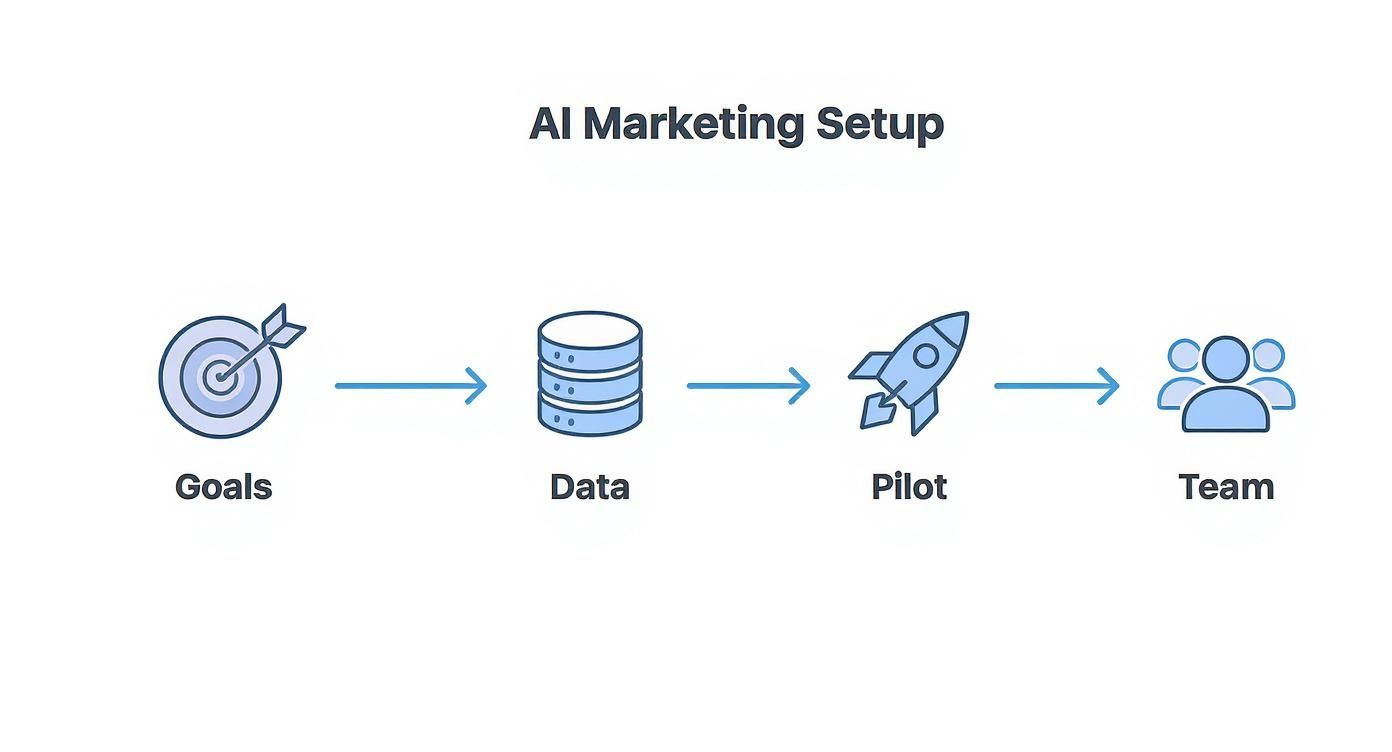
The key takeaway is simple: a solid implementation starts with clear goals and good data before you even think about launching a pilot project.
Will AI Replace My Marketing Team?
This is the big one. The short answer is no—it’s going to make them better. A marketer who knows how to use AI will be more valuable than one who doesn't. The technology is brilliant at handling repetitive, data-heavy tasks that slow humans down.
This shift frees up your team to focus on irreplaceable, high-value work:
- Strategy: Using AI-driven insights to make smarter decisions on campaigns and budgets.
- Creativity: Developing compelling brand stories and creative concepts that connect with people.
- Customer Connection: Building genuine human relationships that an algorithm can't replicate.
Think of AI as the ultimate assistant. It handles the grunt work, giving your team more time for strategic thinking and creative execution.
How Much Does AI Automation Cost?
The price can vary dramatically. A small business might get started with a tool like HubSpot AI for a few hundred dollars a month. On the other end, a global enterprise could invest tens of thousands in a platform like Salesforce Einstein, customizing it for a complex sales motion.
The key isn't the dollar amount but the fit. The most actionable approach is to match the platform's cost and capabilities to your specific business goals and expected return on investment. Start by identifying the financial impact of the problem you want to solve (e.g., lost revenue from churn) and choose a tool priced to deliver a clear positive ROI.
Ready to see how an integrated AI platform can drive real growth? The marketbetter.ai platform unifies content creation, campaign optimization, and customer personalization into a single, intelligent system. Discover how marketbetter.ai can help your business today.