Top AI Tools for Content Marketing in 2025: Boost Your Strategy
The landscape of content marketing is rapidly evolving, driven by powerful AI that goes far beyond simple text generation. In 2025, winning teams aren't just creating content faster; they're using AI to strategize, optimize, personalize, and measure impact across the entire customer journey. The challenge is no longer if you should use AI, but which ai tools for content marketing provide the right capabilities to solve your specific pain points.
This guide moves past the hype to deliver an actionable, in-depth comparison of the top platforms available today. We dissect their core strengths, reveal practical use cases, and provide honest assessments of their limitations, empowering you to choose the right platform to drive measurable growth and efficiency. Before diving into specific applications, understanding what is generative AI provides crucial context for how these tools are transforming content marketing from ideation to distribution.
Our goal is to help you find the best solution for your unique needs, whether you're a CMO scaling a global team, a demand generation manager focused on SEO, or an entrepreneur needing to do more with less. We'll explore everything from comprehensive content hubs like HubSpot and Semrush to specialized writing assistants like Jasper and Grammarly.
Each platform profile includes detailed feature analysis, screenshots, direct links, and pricing breakdowns to make your decision process straightforward and effective. This resource is designed to be your definitive guide for integrating the most effective ai tools for content marketing into your 2025 strategy and beyond.
1. marketbetter.ai
As our featured choice, marketbetter.ai stands out as a premier end-to-end platform among AI tools for content marketing, specifically engineered for mid-market to enterprise B2B teams. It moves beyond single-point solutions like content generators or simple schedulers by providing a fully integrated, AI-native ecosystem. This unified approach connects content creation, campaign optimization, and personalized customer engagement into a cohesive and powerful workflow, eliminating the data silos and inefficiencies common with a fragmented MarTech stack.
Core Strengths and Use Cases
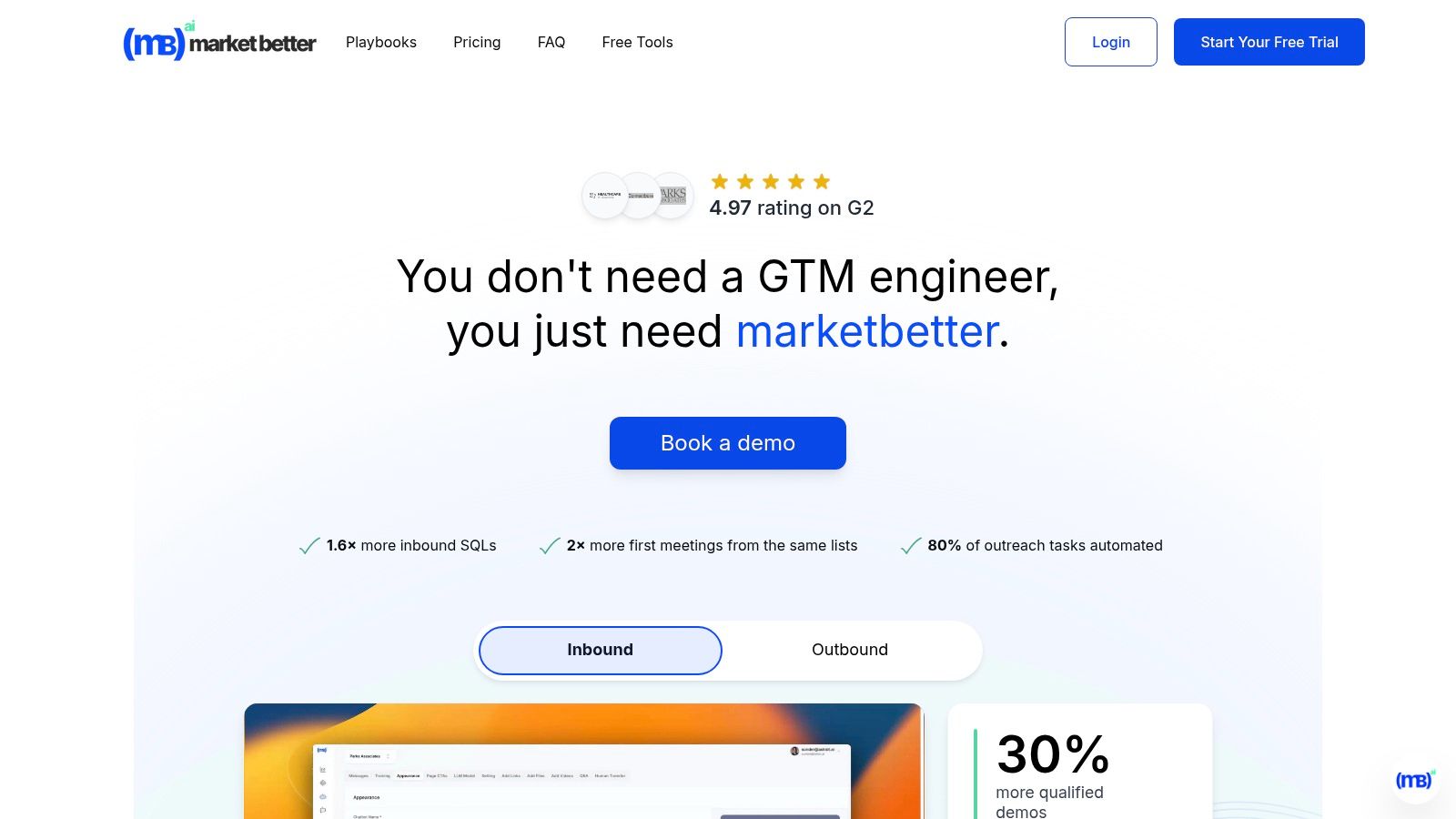
What truly distinguishes marketbetter.ai is its ability to translate go-to-market signals into actionable pipeline. The platform's predictive analytics engine helps demand generation managers identify high-intent accounts and optimize budget allocation before a campaign even launches. For content teams, it offers up to 5x faster production of high-quality, on-brand assets, from blog posts to email sequences, all informed by real-time performance data. Where tools like HubSpot connect content to CRM data, marketbetter.ai focuses specifically on linking GTM signals to revenue, providing a clearer line-of-sight on ROI for B2B teams.
A key practical benefit is its automation capability, which handles up to 80% of manual outreach tasks. This includes prospect research, crafting personalized multichannel messages, and executing follow-up sequences, freeing up sales and marketing teams to focus on strategic initiatives rather than repetitive work. For a deeper dive into their methodology, explore their guide on how to scale content marketing with AI.
Implementation and User Experience
marketbetter.ai is built for seamless integration with essential CRMs like Salesforce and HubSpot, ensuring a smooth transition and a single source of truth for GTM teams. While the platform is robust, its dashboards are designed for clarity, providing advanced attribution modeling that CMOs and VPs of Sales can use to measure ROI accurately. Its high rating on G2 (4.97/5) reflects strong customer satisfaction, particularly praising its impact on generating qualified demos and accelerating the sales cycle.
| Feature Analysis | marketbetter.ai | Typical Point Solutions |
|---|---|---|
| Workflow Integration | Unified content, campaign, & outreach in one platform | Requires multiple tools, manual data sync, and API keys |
| Content Generation | AI-driven, on-brand, and tied to performance analytics | Generic output, often disconnected from campaign goals |
| Audience Targeting | Predictive segmentation based on real-time GTM signals | Static lists or basic demographic filtering |
| ROI Measurement | Advanced attribution modeling across the full funnel | Limited to channel-specific metrics (e.g., open rates) |
Pricing and Onboarding
Pricing for marketbetter.ai is provided through customized quotes, a common practice for enterprise-grade solutions tailored to specific business needs. This approach ensures you only pay for the capabilities you require but does necessitate a direct sales conversation. The platform's superior customer support is frequently highlighted in reviews, assisting with onboarding and helping users navigate any initial learning curve when moving from disparate legacy systems.
- Pros:
- All-in-one platform integrating content creation, campaign management, and customer engagement.
- Proven to accelerate pipeline with measurable lifts in SQLs and qualified demos.
- Seamless, cost-free integrations with major CRMs and marketing tools.
- Cons:
- Lack of public pricing can be a barrier for initial evaluation.
- May present a learning curve for teams accustomed to simpler, single-function tools.
Website: https://www.marketbetter.ai
2. Jasper
Jasper positions itself as a premier AI co-pilot specifically for marketing teams, moving beyond simple text generation to offer a comprehensive, brand-aligned content production environment. Its core strength lies in its ability to maintain brand consistency at scale, a critical challenge for growing organizations. Unlike more generalist AI writing assistants like ChatGPT, Jasper is built with team collaboration and governance at its center, making it one of the most effective ai tools for content marketing for enterprise use.
The platform's standout features, Brand Voice and Knowledge, allow users to upload brand guides, product documentation, and style guidelines. The AI then uses this information to generate content that is consistently on-brand, accurate, and relevant to a specific audience profile. This grounding mechanism significantly reduces the need for extensive editing and fact-checking, which is a common pain point with other generative AI tools.
Key Features and Use Cases
- Campaign Workflows: Jasper's "Canvas" feature provides a collaborative space where teams can map out entire campaigns, from initial brainstorming to final asset creation and repurposing. For instance, a marketing manager can create a workflow that takes a webinar transcript, turns it into a blog post, generates social media updates, and drafts an email newsletter, all within one interconnected project.
- Brand Voice & Knowledge: Upload your style guides, messaging pillars, and product catalogs to create a centralized knowledge base. This ensures that every piece of content, whether a Facebook ad or a technical blog post, adheres to your company's unique tone and factual accuracy.
- Team Collaboration & Governance: The platform includes robust user management, content review workflows, and admin controls. This is ideal for larger teams needing to maintain quality and consistency across all contributors.
Pricing and Implementation
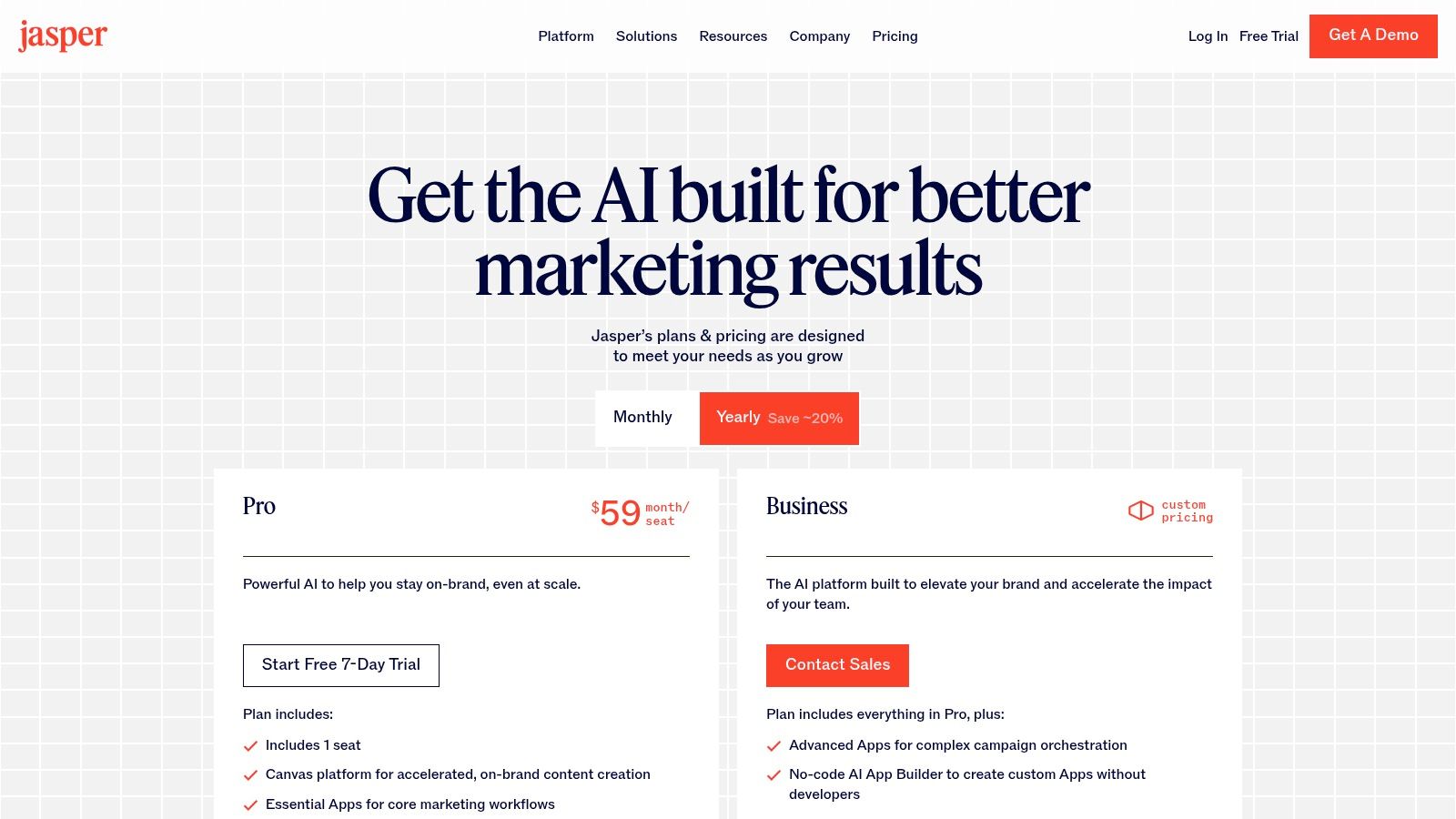
Jasper offers several tiers, with pricing structured on a per-seat basis.
- Creator: Ideal for individual entrepreneurs and marketers.
- Pro: Starts at $59/seat/month (billed annually) and unlocks Brand Voices, collaboration features, and a 7-day free trial.
- Business: Custom pricing for organizations needing advanced features like API access, custom AI models, and enterprise-grade security.
Actionable Tip: To maximize Jasper's value, invest time upfront in building a comprehensive Brand Voice and Knowledge base. Upload your top-performing blog posts, company one-pagers, and style guides to give the AI a rich data set to learn from. This initial setup is key to achieving high-quality, on-brand outputs.
Pros & Cons
| Pros | Cons |
|---|---|
| Excellent for maintaining brand consistency | Business tier pricing requires a custom quote |
| Purpose-built for marketing team collaboration | Per-seat model can become costly for large teams |
| 7-day free trial for the Pro plan | Advanced features are locked behind enterprise plans |
Website: https://www.jasper.ai/pricing
3. Copy.ai
Copy.ai positions itself as a highly accessible yet powerful platform, excelling in both on-demand content generation and automated marketing workflows. Its unique value proposition is the combination of an intuitive chat interface with a sophisticated "Agents" feature, allowing teams to automate repetitive content tasks. While Jasper focuses on enterprise-level brand governance, Copy.ai provides an excellent on-ramp for smaller teams and solo marketers looking to scale operations, making it one of the most versatile ai tools for content marketing.
The platform stands out by offering access to multiple large language models (LLMs) through its chat interface, allowing users to choose the best engine for a specific task. However, its true power lies in the Workflow builder, where users can create custom "Agents" to automate processes like generating blog briefs from keywords, repurposing content for different channels, or creating product descriptions in bulk.
Key Features and Use Cases
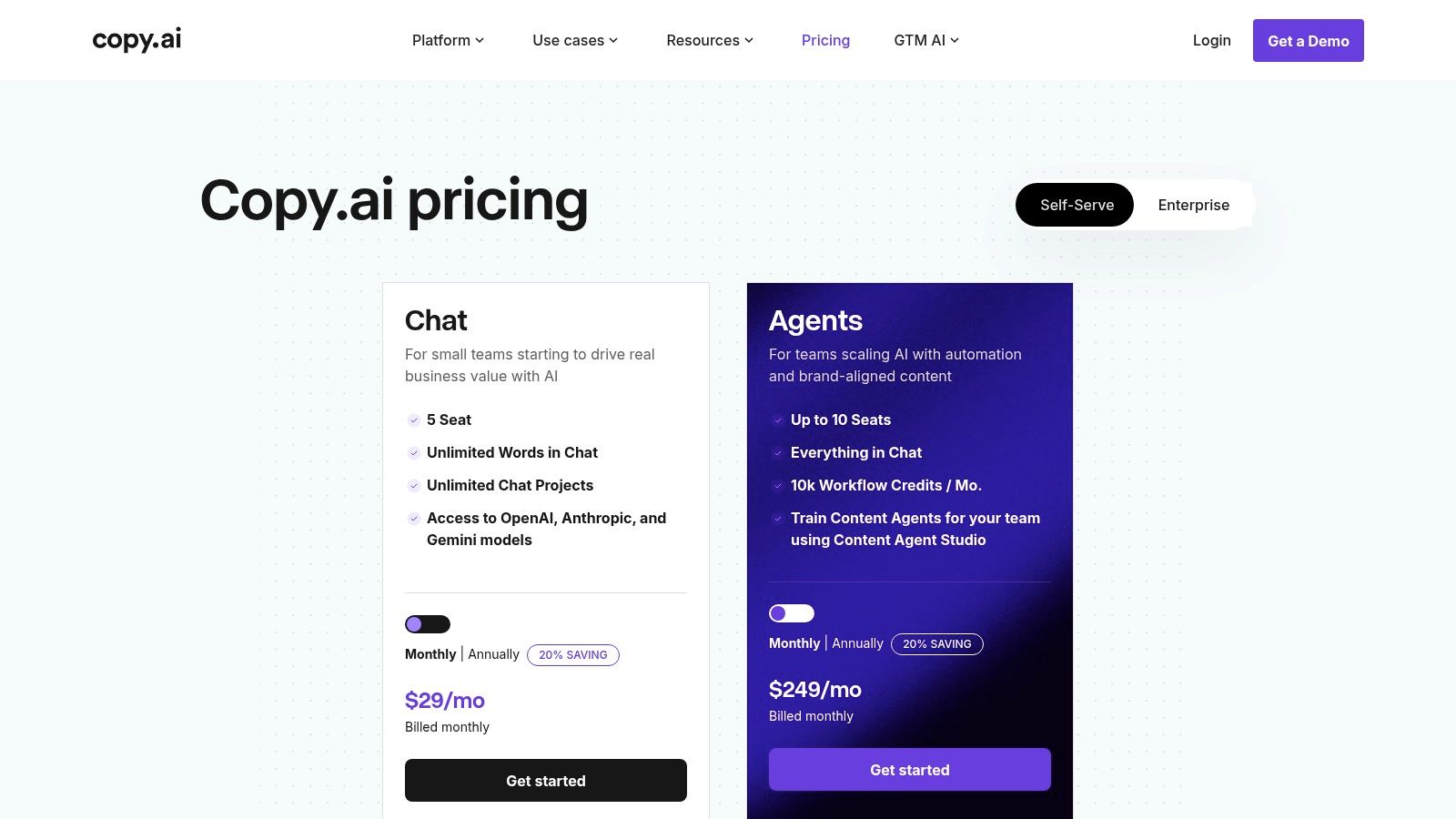
- Chat by Copy.ai: An intuitive interface offering unlimited words and access to multiple LLMs. It's ideal for quick-turnaround tasks like writing social media posts, drafting emails, or brainstorming blog post ideas without worrying about word count limits.
- Workflow Automation: Build custom "Agents" that perform multi-step content tasks automatically. For example, a content manager can create an agent that takes a target keyword, researches competitors, generates a detailed brief, and then writes a first draft of an SEO-optimized blog post.
- Brand Voice: Similar to other platforms, you can input brand information, style guides, and key messaging. This ensures that whether you're using the chat or an automated workflow, the output aligns with your company’s established tone and voice.
Pricing and Implementation
Copy.ai offers a simple pricing structure with a free tier for individuals.
- Free: For one user, offering 2,000 words in the editor and limited chat functionality.
- Pro: Starts at $36/month (billed annually) for 5 seats, providing unlimited words in chat and a set number of workflow credits.
- Agent: Starts at $300/month (billed annually) for 20 seats, designed for teams needing to scale automation with a higher allocation of workflow credits.
Actionable Tip: Start by identifying your most time-consuming, repetitive content task. Use the Workflow builder to create a simple agent for that specific process, such as turning customer testimonials into social media posts. This provides a clear proof-of-concept for its automation capabilities before you invest heavily in more complex workflows.
Pros & Cons
| Pros | Cons |
|---|---|
| Simple on-ramp with an accessible Pro plan | Workflow credits may require add-ons as usage grows |
| Multi-model access provides flexibility | Agent tier for advanced automation is a significant price jump |
| Powerful workflow automation for scaling content | Less focus on deep team governance than enterprise tools |
Website: https://www.copy.ai/prices
4. HubSpot Content Hub + Breeze AI
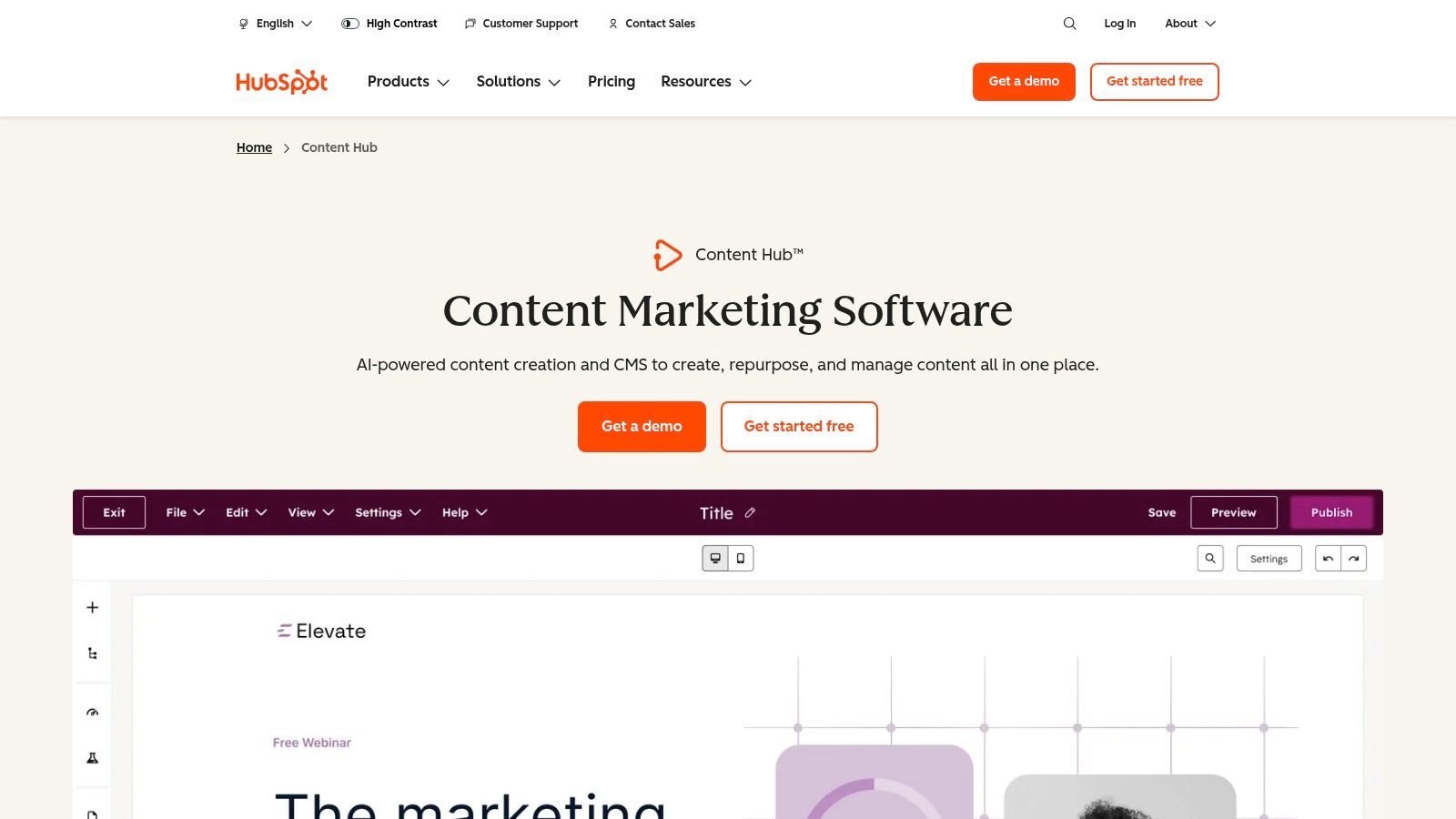
HubSpot Content Hub integrates its new Breeze AI agents directly into its marketing, CMS, and CRM platform, creating a unified ecosystem for content creation, management, and performance analysis. This all-in-one approach is its key differentiator; rather than being a standalone tool, it uses CRM data to inform content strategy and measure ROI. For teams already invested in the HubSpot ecosystem, this makes it one of the most powerful and seamless ai tools for content marketing available, as it connects content generation directly to lead generation and customer data.
The platform's strength lies in its ability to manage the entire content lifecycle within a single environment. While marketbetter.ai focuses on integrating GTM signals for B2B pipeline, HubSpot's advantage is its deep integration across marketing, sales, and service hubs, providing a complete view of the customer journey. From generating a blog post to tracking its influence on deals, the workflow is entirely interconnected.
Key Features and Use Cases
- CRM-Grounded Content Creation: Use Breeze AI to generate blog posts, landing pages, and emails that are informed by your CRM data. For example, you can create content personalized for specific customer segments or based on insights from high-performing sales sequences.
- Content Remix: This feature allows you to instantly repurpose existing assets. Turn a long-form blog post into a series of social media updates, a knowledge base article, or an email newsletter, all while maintaining brand consistency with the Brand Voice feature.
- End-to-End Campaign Management: The beta content agent allows for the assembly of entire campaigns from a single brief. Describe your campaign goal, and the AI can generate a core pillar page, related blog posts, and promotional emails, streamlining the entire content production process.
Pricing and Implementation
HubSpot Content Hub is available in several tiers, with AI features scaling up with each plan.
- Starter: Begins at $15/seat/month (billed annually) with basic content and AI tools.
- Professional: Starts at $450/month (includes 3 seats) and unlocks more advanced features like Content Remix and deeper analytics.
- Enterprise: Starts at $1,500/month (includes 5 seats) for comprehensive governance, reporting, and advanced AI capabilities.
Actionable Tip: Connect your HubSpot CRM and website analytics from day one. Use the performance data of your existing, non-AI content to identify top-performing topics and formats. Then, use Breeze AI's Content Remix to scale what already works, creating variations of your most successful assets for different channels.
Pros & Cons
| Pros | Cons |
|---|---|
| Deeply integrated into CMS/CRM for distribution | Most powerful AI features are in Pro/Enterprise tiers |
| End-to-end content lifecycle management | Platform breadth can be overwhelming for small teams |
| Enterprise-ready governance and multi-channel publishing | Higher price point compared to standalone AI tools |
Website: https://www.hubspot.com/products/content-hub
5. Semrush
Semrush evolves from its roots as a premier SEO platform into a comprehensive content marketing suite by integrating powerful AI capabilities. Its unique proposition is the deep connection between SEO data and content creation, allowing marketers to draft and optimize content within the same ecosystem where they conduct keyword research and competitive analysis. Unlike standalone AI writers like Jasper, Semrush’s tools are inherently data-informed, making it one of the most strategic ai tools for content marketing for teams focused on organic growth.
The platform's strength lies in its Content Marketing Toolkit, which uses AI to guide the entire content lifecycle. It helps ideate topics based on real-time search data and then provides AI-driven assistance to write and optimize the content for search engines. This seamless workflow closes the gap between SEO strategy and content execution, ensuring every article is crafted with a clear path to ranking from the very beginning.
Key Features and Use Cases
- Content Marketing Toolkit: This suite allows users to find keyword-driven topic ideas, generate AI article drafts, and then optimize them for search. A content manager can use it to identify a competitor's ranking weakness, generate a comprehensive article outline, draft the content with AI, and then refine it using real-time SEO suggestions.
- SEO Writing Assistant: This feature provides on-the-fly recommendations within your text editor (integrates with Google Docs, WordPress, and MS Word). It analyzes your content for readability, tone of voice, keyword usage, and originality, ensuring it meets SEO best practices before you publish.
- AI-Powered Idea Generation: Semrush uses AI to analyze SERPs and suggest content topics and questions your audience is actively searching for. This is perfect for brainstorming blog posts, FAQs, or pillar pages that are virtually guaranteed to have audience interest.
Pricing and Implementation
Semrush plans bundle various tools, with AI features often included in higher-tier plans.
- Pro: Starts at $129.95/month, focused on core SEO and research tools.
- Guru: Starts at $229.95/month, includes the Content Marketing Platform and more extensive limits.
- Business: Starts at $499.95/month for agencies and large enterprises with the highest limits and API access.
Actionable Tip: Use the SEO Writing Assistant integration for Google Docs. Before handing off a draft to an AI writer, create a new document, paste in your target keywords, and run the Semrush add-on. This gives your AI tool a pre-optimized template to work from, ensuring the generated content is aligned with SEO goals from the start.
Pros & Cons
| Pros | Cons |
|---|---|
| Seamlessly integrates SEO data with AI writing | AI features require more expensive Guru or Business plans |
| Centralizes the entire SEO and content workflow | AI writing credits and limits can be restrictive on lower tiers |
| Integrates directly into Google Docs and WordPress | The platform can be complex for beginners not focused on SEO |
Website: https://www.semrush.com/
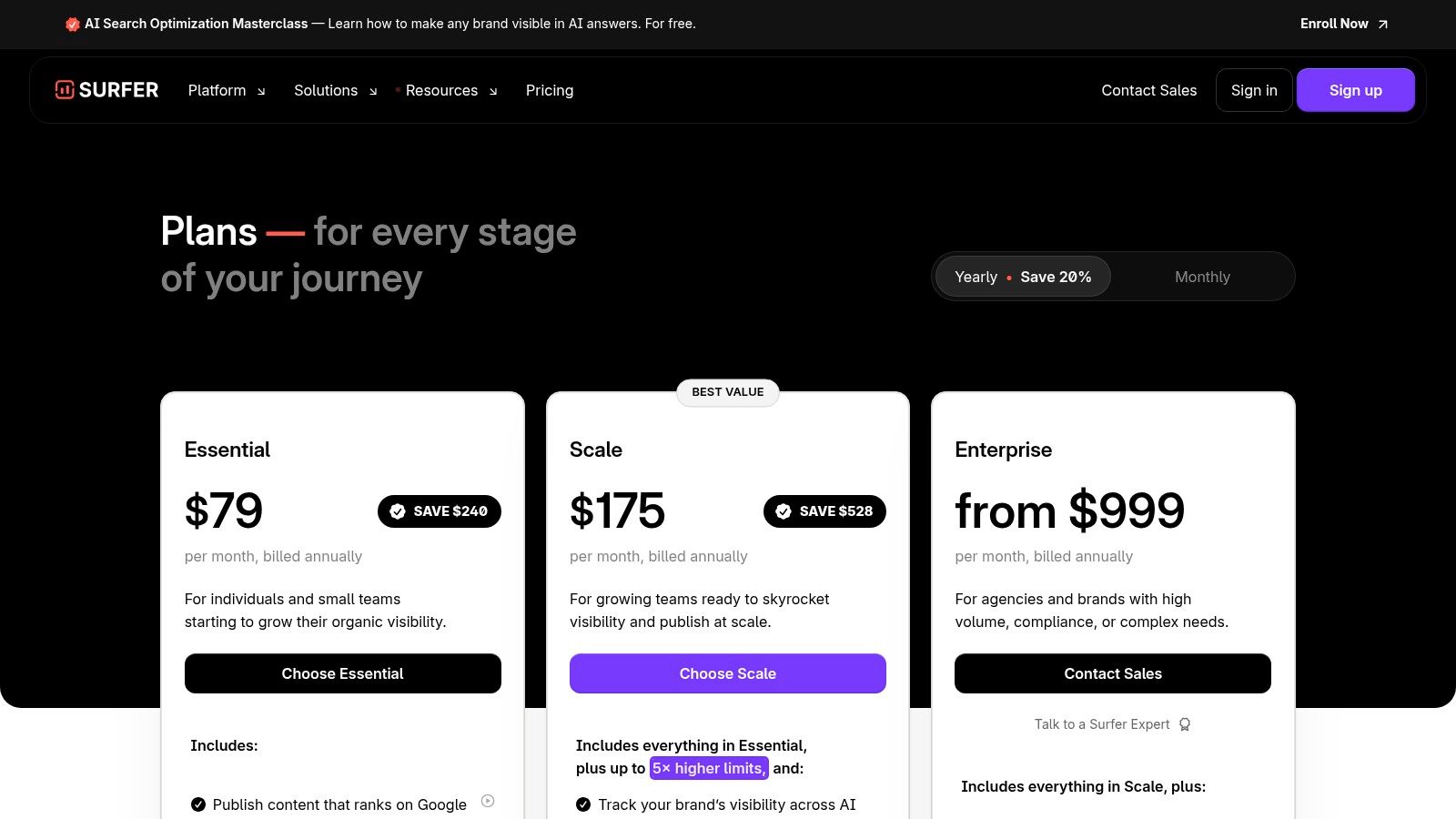
6. Surfer
Surfer bridges the gap between AI-driven content creation and data-backed on-page SEO optimization. It distinguishes itself by focusing explicitly on what it takes to rank on Google, analyzing top-performing pages to provide a clear, actionable roadmap for content creation and optimization. While Semrush offers a broader marketing toolkit, Surfer provides a more targeted, specialist approach to on-page SEO. This makes it one of the most effective ai tools for content marketing for teams aiming for organic traffic growth.
The platform provides a data-centric environment where writers and SEOs can collaborate to create content engineered to meet search engine expectations. Surfer’s AI analyzes competing articles for structure, keyword density, and topical relevance, then presents these insights in an easy-to-use editor. This reverse-engineering approach removes much of the guesswork from SEO content creation, providing a clear path to improving search visibility.
Key Features and Use Cases
- Content Editor with Scoring: The primary feature where users write or paste content to receive a real-time optimization score from 0-100. It offers specific suggestions on keyword usage, heading structure, and word count based on a direct analysis of top-ranking competitors for a target query.
- Content Audit: Run an existing URL through the Audit tool to get actionable on-page SEO recommendations. This is perfect for content refresh campaigns, identifying missing keywords and internal link opportunities to boost the performance of older posts.
- Topic Discovery & Keyword Research: Surfer helps generate clusters of related topics and keywords around a central theme, allowing marketers to build out comprehensive pillar pages and content hubs that establish topical authority.
Pricing and Implementation
Surfer’s pricing is based on feature access and usage credits for its tools.
- Essential: Starts at $89/month (billed annually) for individuals and small teams.
- Advanced: At $179/month (billed annually), it includes more credits and team management features.
- Max: At $299/month (billed annually), it offers the highest credit limits and API access.
Actionable Tip: Use the Google Docs or WordPress integration to streamline your workflow. This allows your writers to work in their preferred environment while still getting live SEO feedback from Surfer's Content Editor, reducing the friction between content creation and optimization.
Pros & Cons
| Pros | Cons |
|---|---|
| Clear guidance on what to optimize based on SERP data | Most value realized at higher-tier Scale or Enterprise plans |
| Excellent for both new content creation and existing audits | Learning curve for users new to SEO optimization tools |
| Integrates directly with Google Docs and WordPress | Can promote an over-reliance on scores vs. user intent |
Website: https://surferseo.com/pricing/
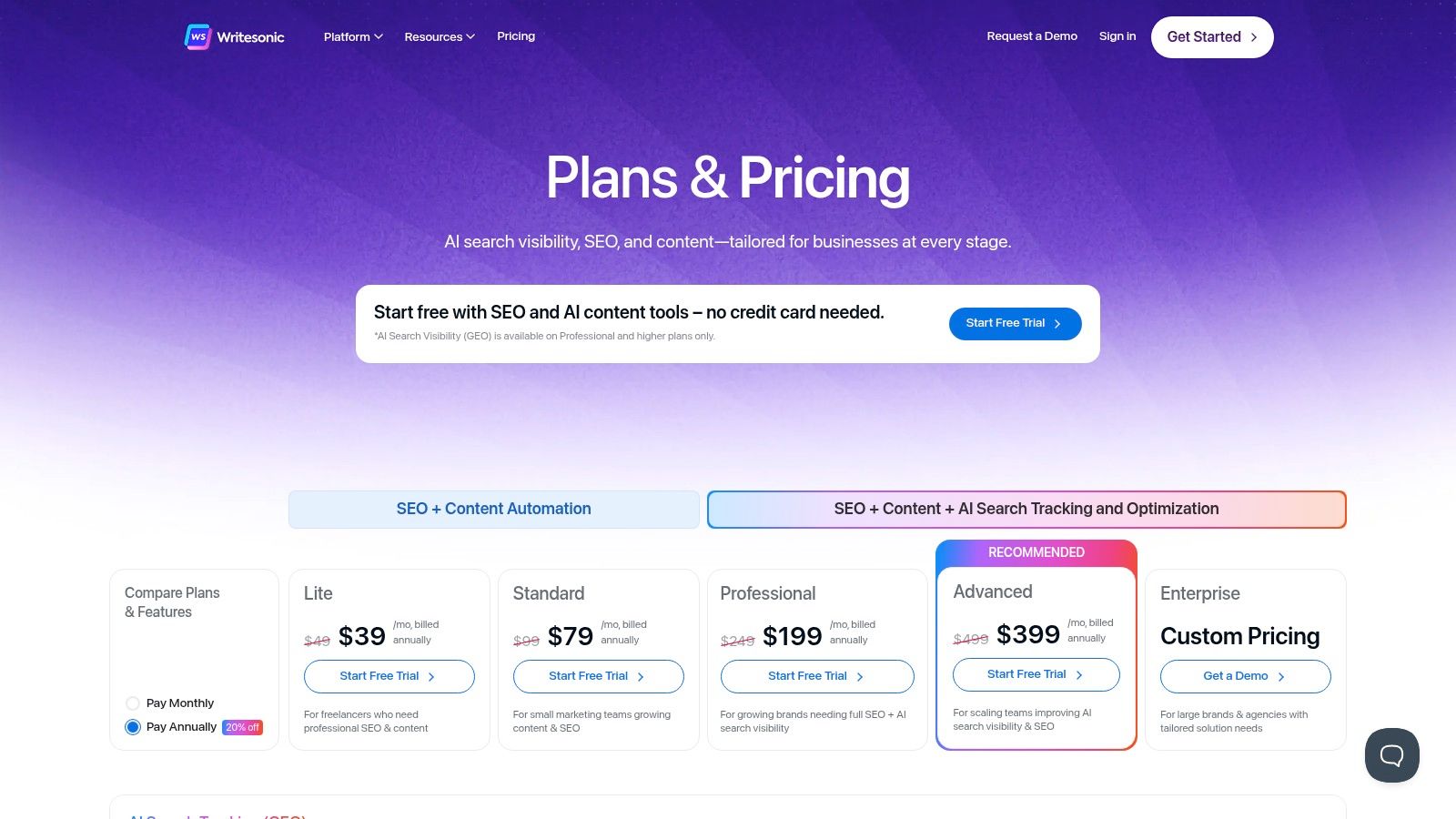
7. Writesonic
Writesonic positions itself as an all-in-one AI-powered marketing suite, aiming to consolidate the content creation and SEO optimization tool stack. Its primary differentiator is its breadth, combining a powerful AI article writer with SEO research, optimization tools, and performance tracking. Where Surfer and Semrush are SEO tools that added AI writing, Writesonic feels more like an AI writer that has built a robust SEO toolkit around it. This makes it a compelling option for marketers looking to manage the entire content lifecycle within a single platform.
The platform's versatility is enhanced by its support for multiple AI models, including GPT-4o and Claude, allowing users to select the best engine for their specific task. This multi-model approach gives content creators more flexibility and control over the output's style, tone, and quality, which can be a significant advantage over single-model platforms.
Key Features and Use Cases
- AI Article Writer & Optimization: The core feature allows users to generate SEO-friendly articles of up to 5,000 words. It incorporates real-time SERP data to inform content structure and includes an optimization engine similar to SurferSEO, providing a content score and suggestions for improvement.
- SEO Audits and Fixes: Writesonic can perform technical and on-page SEO audits of your entire website. It identifies issues like broken links, missing meta descriptions, and slow page speed, often providing AI-driven suggestions for quick fixes.
- GEO Tracking & AI Bot Monitoring: For businesses focused on local SEO, the platform offers rank tracking by geographical location. It also includes tools to identify and monitor AI bot traffic, helping to maintain data accuracy in analytics.
Pricing and Implementation
Writesonic offers various plans based on word count, features, and user seats.
- Free Trial: A limited free plan is available to test the platform.
- Business: Starts at $19/month for one user, providing access to premium features and higher-quality word generation.
- Enterprise: Custom pricing for larger teams needing unlimited usage, advanced security features, and dedicated support.
Actionable Tip: When using the AI Article Writer, always start by analyzing the top-ranking competitor articles within the tool itself. Writesonic pulls this data in, allowing you to identify content gaps and structure your brief more effectively before you ask the AI to generate the full draft. This initial research step drastically improves the first draft's relevance and quality.
Pros & Cons
| Pros | Cons |
|---|---|
| Broad feature set reduces the need for multiple tools | Pricing and plan complexity can be confusing |
| Multi-model AI support (GPT-4o, Claude) | The best features are locked behind higher-tier plans |
| Integrated SEO optimization and auditing tools | Per-user costs can add up for larger teams |
Website: https://writesonic.com/pricing
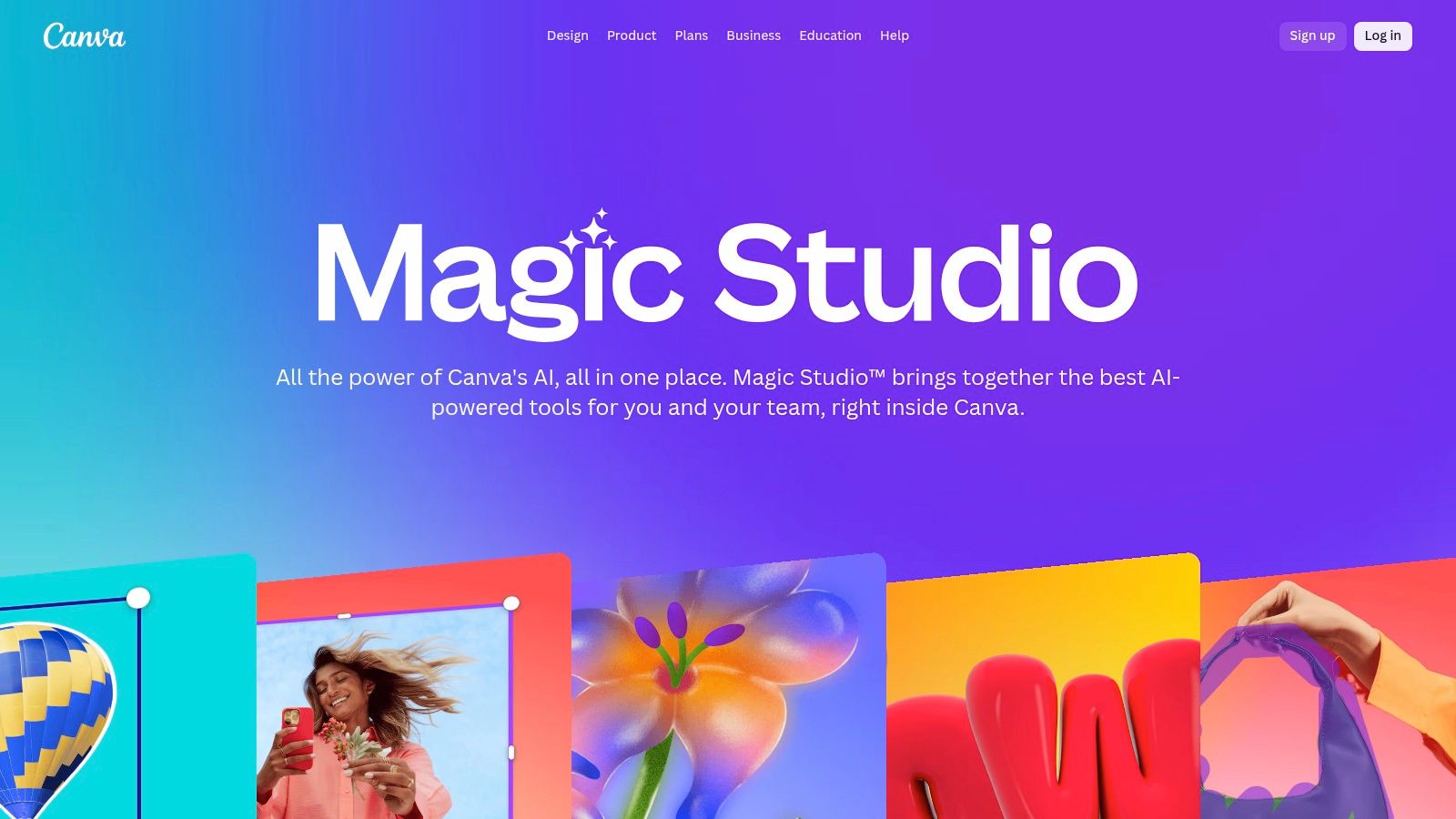
8. Canva Magic Studio (Magic Write)
Canva has evolved from a graphic design tool into a comprehensive visual communication platform, with Magic Studio at its core. It integrates powerful AI copywriting and design features directly into the creation workflow, making it an indispensable tool for teams that prioritize visually-led content. Unlike standalone AI writers like Jasper or Copy.ai, Canva's strength is its ability to generate both text and visuals simultaneously, streamlining the creation of social media posts, ads, and presentations from start to finish. This makes it one of the most efficient ai tools for content marketing for producing high volumes of visual assets.
Magic Studio’s key feature, Magic Write, allows users to generate copy with a defined Brand Voice, ensuring that text inside designs remains consistent. This integration is a significant advantage over workflows that require copy-pasting text from a separate AI tool into a design platform. It bridges the gap between copywriting and design, enabling a single creator to manage the entire content lifecycle. For those looking to streamline their visual content, discover more about powerful social media content creation tools that can amplify your strategy.
Key Features and Use Cases
- Integrated Copy and Design: Use Magic Write to instantly generate headlines, body copy, or calls-to-action directly within a social media template or presentation slide. This is ideal for quickly creating multiple ad variations or social posts for A/B testing.
- Brand Voice Management: Set up a Brand Kit with your logos, colors, fonts, and tone of voice guidelines. Magic Write will use this to generate copy that aligns with your brand identity, ensuring consistency across all visual content.
- Content Repurposing: The Magic Switch feature (formerly Magic Resize) allows you to transform one asset into many. For instance, you can turn a long-form presentation into a summary document, a blog post, or a series of LinkedIn carousel posts with a single click, saving hours of manual reformatting.
Pricing and Implementation
Canva offers a generous free plan with limited Magic Studio uses.
- Free: Includes limited uses of Magic Studio tools.
- Pro: Starts at $14.99/month for one person, with significantly more Magic Studio credits and access to premium features.
- Teams: Starts at $29.99/month for the first 5 people, providing centralized brand management, collaboration tools, and pooled credits.
Actionable Tip: Use the "Bulk Create" app to streamline repetitive design tasks. Prepare your copy variations in a CSV file (e.g., different testimonials or product features) and upload it to Canva to automatically generate dozens of unique social media graphics from a single template.
Pros & Cons
| Pros | Cons |
|---|---|
| All-in-one platform for visual and text creation | Not a dedicated SEO or long-form blog writing tool |
| Excellent for social media and ad content | Team pricing can be costly for smaller businesses |
| Generous free tier for AI feature testing | AI features are credit-based, which may limit high-volume users |
Website: https://www.canva.com/magic/
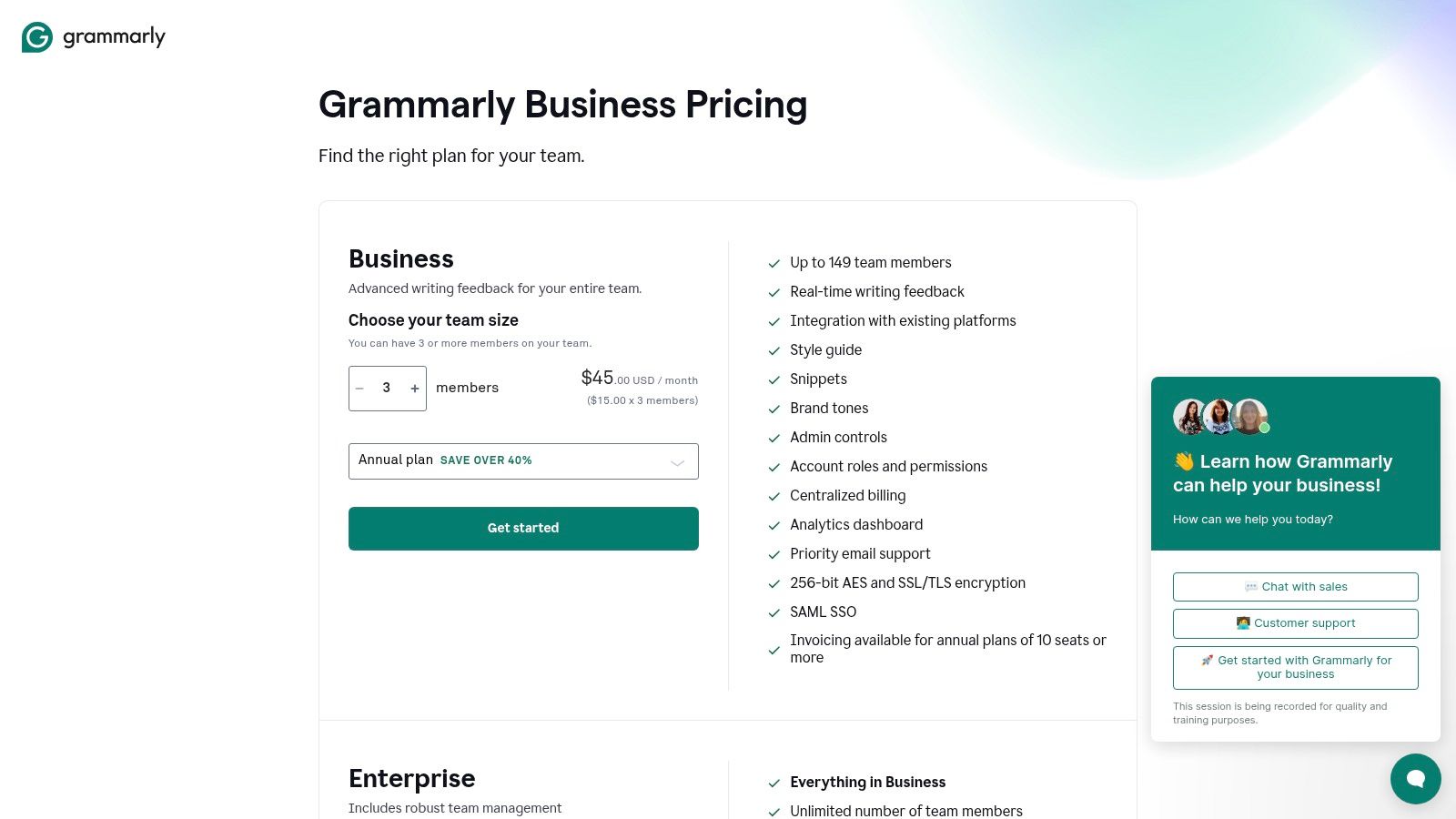
9. Grammarly Business
Grammarly Business elevates the popular AI-powered writing assistant into a comprehensive tool for ensuring content quality and brand consistency across an entire organization. While many AI tools focus on content generation, Grammarly excels at the crucial final steps of polishing and refining copy. It acts as an ever-present editor, ensuring every email, social post, and blog article meets a high standard of correctness, clarity, and on-brand tone. For teams focused on quality control over speed, it is one of the most foundational ai tools for content marketing.
The platform's strength lies in its low-friction integration and its ability to enforce a consistent writing style at scale. Unlike platforms focused purely on creation, Grammarly integrates directly into the tools your team already uses, from Google Docs to your CRM. The Business plan adds centralized management features like Style Guides and Brand Tones, allowing a marketing leader to define specific rules (e.g., "always use sentence case in headlines") that are then suggested to every team member in real-time.
Key Features and Use Cases
- Style Guides & Brand Tones: A content manager can codify brand-specific terminology, capitalization rules, and stylistic preferences. This ensures that a new hire's client email sounds just as on-brand as a veteran marketer's blog post, automatically enforcing consistency.
- Real-Time Writing Assistance: Beyond simple spell-checking, the AI provides suggestions for clarity, conciseness, tone (e.g., confident, analytical), and engagement. This helps polish everything from ad copy to internal communications.
- Team Analytics and Management: Admins can view usage statistics and common writing challenges across the team, identifying opportunities for targeted training. Centralized billing and user management simplify onboarding and administration for growing teams.
Pricing and Implementation
Grammarly Business uses a per-user pricing model, requiring a minimum number of seats.
- Premium: For individuals, starting at $12/month.
- Business: Starts at $15/user/month (billed annually) for teams of 3 to 149. Includes Style Guides, Brand Tones, and analytics.
- Enterprise: Custom pricing for larger organizations needing advanced security (SAML SSO), a dedicated success manager, and enhanced controls.
Actionable Tip: Implement the Style Guide feature immediately. Start by adding your company name, key product names, and common industry jargon to prevent misspellings. Then, add rules for common stylistic errors you frequently correct, such as a preference for the Oxford comma or specific headline capitalization, to automate your editing process.
Pros & Cons
| Pros | Cons |
|---|---|
| Seamless integration across browsers and apps | Not a primary content generation or SEO tool |
| Improves baseline quality of all written content | Per-seat model requires a minimum of 3 users |
| Easy to deploy and adopt across a team | Generative AI features are less advanced than dedicated tools |
Website: https://www.grammarly.com/business/pricing
10. Notion AI
Notion AI transforms the popular collaborative workspace into a powerful content engine, embedding generative AI directly into the tools marketing teams already use for planning and documentation. Where standalone AI writers focus solely on creation, Notion AI's strength is its integration within a unified content operations hub. For teams that live in Notion for project management, it is an indispensable ai tool for content marketing for streamlining the entire content lifecycle, from ideation and briefing to drafting and final review, all in one place.
The platform excels at applying AI to structured data within its databases and project pages. Unlike tools that only generate text in a blank document, Notion AI can summarize meeting notes, draft content briefs based on database properties, translate text blocks, and even autofill database columns. This contextual AI capability dramatically reduces manual work and ensures consistency across related content assets.
Key Features and Use Cases
- Integrated Writing and Summarization: Instantly draft outlines, write first drafts of blog posts, or summarize long research documents directly within a Notion page. A content manager can highlight notes from a strategy session and ask the AI to generate a content brief, complete with target keywords and audience profiles.
- Database Autofill: Automate metadata creation in your content calendar. Use AI to generate social media captions, SEO meta descriptions, or content summaries for each item in your database, saving hours of repetitive data entry.
- Contextual Q&A: Notion's "Q&A" feature acts like a personalized search engine for your workspace. A team member can ask, "What are our key messaging points for the Q3 campaign?" and the AI will scan relevant documents to provide a direct, synthesized answer.
Pricing and Implementation
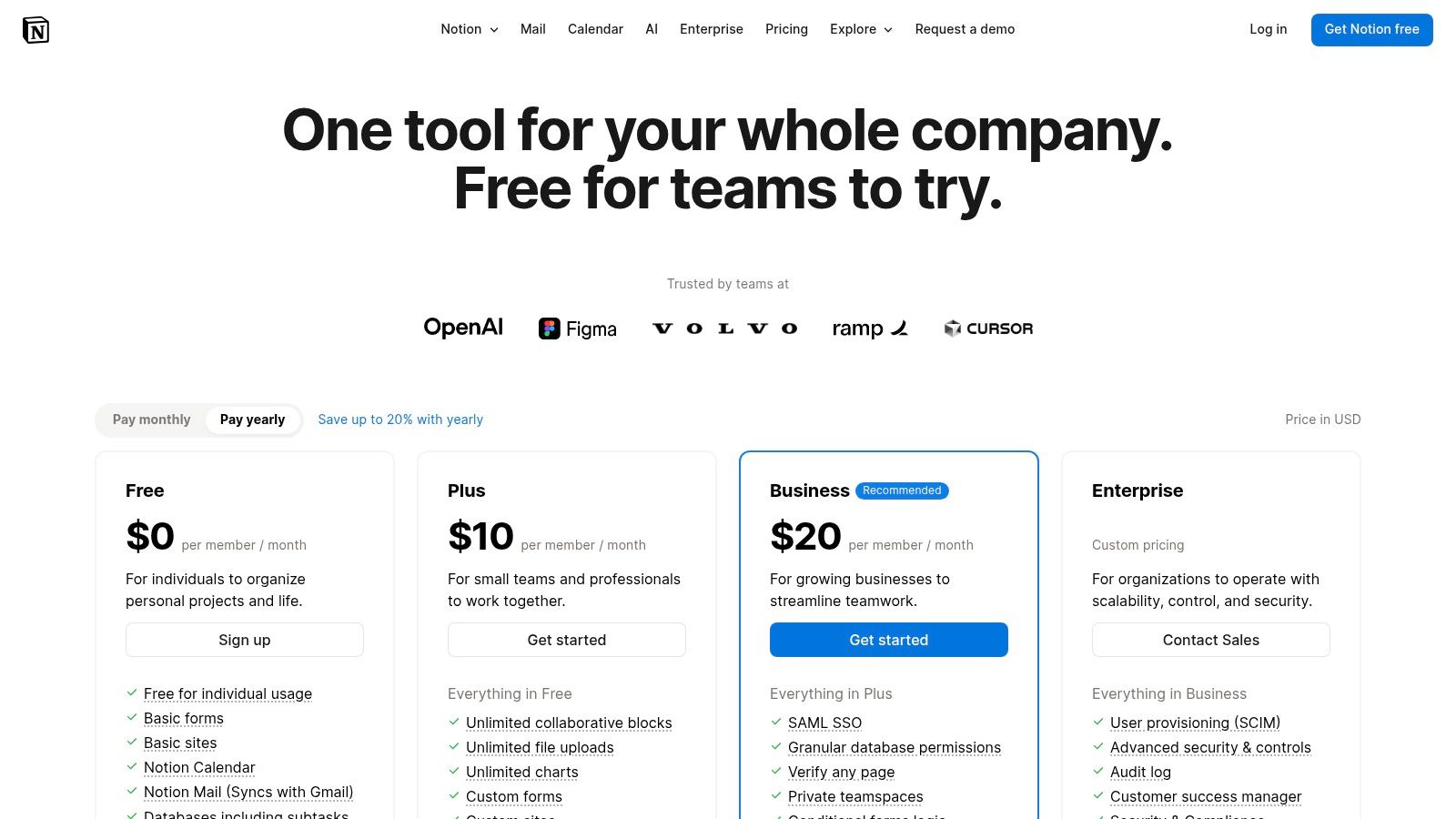
Notion includes the AI add-on with its higher-tier plans for new customers, with options for existing users.
- Plus: Starts at $10/user/month (billed annually) and serves as the base for the AI add-on.
- Business: Starts at $18/user/month and includes the Notion AI features.
- Enterprise: Custom pricing for advanced controls, security, and dedicated support.
Actionable Tip: Create database templates for your core content types (e.g., blog posts, case studies) with an "AI Summary" property. Set up a button automation that, when clicked, uses Notion AI to read the page content and populate that summary field automatically, creating at-a-glance overviews for your content calendar.
Pros & Cons
| Pros | Cons |
|---|---|
| Unifies content strategy, planning, and creation | AI features are tied to more expensive plans |
| AI is applied directly to structured workflows and data | Recent pricing changes can be confusing for existing users |
| Excellent for team collaboration and documentation | Not as feature-rich for pure writing as dedicated AI tools |
Website: https://www.notion.so/pricing
11. OpenAI ChatGPT (Plus/Business/Enterprise)
OpenAI's ChatGPT has evolved from a general-purpose conversational AI into a robust workspace that marketers can leverage for a wide array of content tasks. It serves as a highly versatile assistant for everything from initial audience research and brainstorming to drafting copy, repurposing content, and creating custom workflows. Unlike specialized platforms like Surfer or Jasper, its strength lies in its flexibility, making it one of the most adaptable ai tools for content marketing for teams that need a multipurpose solution.
The platform's Business and Enterprise tiers add crucial layers of collaboration, administration, and data privacy, transforming it from a solo tool into a secure team environment. Features like shared workspaces and admin controls allow marketing leaders to manage usage and maintain oversight. This makes it a powerful supplement to a core marketing stack, filling gaps in ideation, rapid drafting, and strategic analysis. It is an excellent starting point for teams looking to understand how to use AI in marketing before committing to more specialized tools.
Key Features and Use Cases
- Custom GPTs: Teams can build specialized internal tools without coding. For example, a content manager could create a "Blog Brief GPT" trained on the company's SEO guidelines and audience personas to standardize content outlines for all writers.
- Data Analysis & Research: Users can upload spreadsheets of market research, keyword data, or performance metrics and ask the AI to identify trends, summarize findings, or generate charts. This is useful for quickly analyzing campaign results to inform the next content cycle.
- Team Workspace & Admin Controls: The Business and Enterprise plans provide a central environment where team members can collaborate on projects. Admins can manage user access and ensure data from conversations is not used for model training, which is critical for compliance.
Pricing and Implementation
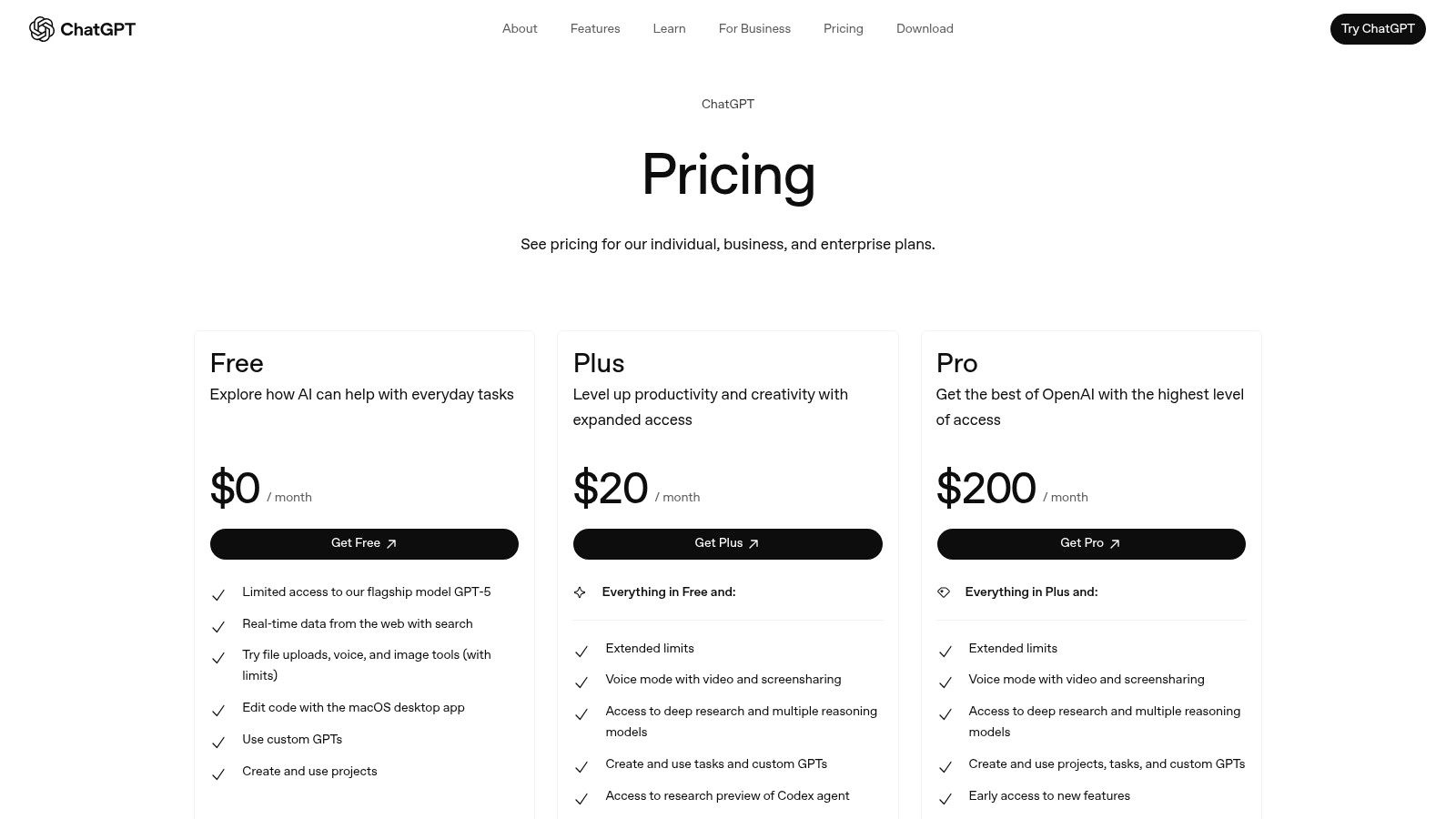
ChatGPT offers several plans catering to different user needs.
- Free: Access to the base model with usage limits.
- Plus: $20/user/month for individuals needing access to advanced models like GPT-4, DALL-E 3, and data analysis.
- Business/Enterprise: Custom pricing for teams requiring collaboration features, enhanced security, admin controls, and higher usage limits.
Actionable Tip: Use the Custom GPTs feature to build a "Brand Voice & Tone Checker." Feed it your style guide, examples of on-brand copy, and a list of words to avoid. Your team can then run their drafts through this custom GPT for a quick consistency check before publishing.
Pros & Cons
| Pros | Cons |
|---|---|
| Highly versatile for ideation and drafting | Not a dedicated SEO or content management platform |
| Enterprise-grade controls for teams | Usage limits can vary by plan |
| Custom GPTs allow for tailored workflows | Requires manual brand voice governance |
Website: https://openai.com/pricing
12. G2 - AI Writing Assistants category
While not a tool itself, G2's AI Writing Assistants category is an indispensable research hub for any marketing leader evaluating software. It serves as a comprehensive marketplace, aggregating real user reviews, detailed feature comparisons, and up-to-date rankings. Instead of relying solely on vendor marketing, G2 provides a peer-validated starting point, making it one of the most strategic resources for discovering and shortlisting ai tools for content marketing that fit specific organizational needs.
The platform excels at helping users cut through the noise of a rapidly growing market. By leveraging its powerful filtering and comparison grids, marketing managers can quickly identify top-rated solutions based on company size, industry, or specific feature requirements. This data-driven approach allows teams to compare alternatives side-by-side, understand user-reported limitations, and make more informed purchasing decisions without extensive manual research.
Key Features and Use Cases
- Peer Reviews & Comparison Grids: Directly compare the top AI writing platforms on features, ease of use, and quality of support based on feedback from verified users. A demand generation manager could use this to compare Jasper and Copy.ai based on ratings from mid-market B2B tech companies.
- Quarterly Reports & Rankings: Access G2's "Grid" reports, which plot tools based on market presence and customer satisfaction. This is useful for identifying established leaders versus high-momentum "challenger" tools.
- Discovery of Niche Tools: Beyond the big names, the platform helps uncover emerging or specialized AI tools that might be a better fit for a unique use case, like AI-powered video scriptwriting or technical documentation.
Pricing and Implementation
G2 is a free resource for software buyers. Access to all reviews, comparison tools, and reports does not require a paid subscription. Vendors may have sponsored listings, which are clearly marked.
Actionable Tip: Use the filtering options to narrow down choices to your specific industry and company size. Reviews from users with a similar profile are far more relevant than the overall score. Pay close attention to reviews mentioning integration capabilities with your existing martech stack (e.g., HubSpot, Salesforce).
Pros & Cons
| Pros | Cons |
|---|---|
| Aggregates verified, real-world user feedback | Sponsored placements can influence visibility |
| Excellent for comparing features side-by-side | Niche or newer tools may have very few reviews |
| Free to use for research and shortlisting | Review quality can be inconsistent |
Website: https://www.g2.com/categories/ai-writing-assistant
AI Content Marketing Tools Comparison
| Platform | Core Features & Capabilities | User Experience & Quality ★ | Value Proposition & Pricing 💰 | Target Audience 👥 | Unique Selling Points ✨ |
|---|---|---|---|---|---|
| marketbetter.ai 🏆 | End-to-end AI marketing: content, campaigns, CRM | ★★★★★ (4.97/5), top-rated on G2 | Customized pricing; ROI-focused, 5x faster content, 15% better conversions | Mid-market to enterprise B2B marketing teams | Unified AI across content, campaigns & engagement; 80% outreach automation |
| Jasper | Brand-safe AI content, campaign workflows | ★★★★☆, strong governance | Quote-based pricing; per-seat may add costs | Marketing teams needing brand control | Brand Voices, No-code AI App Builder |
| Copy.ai | AI chat content creation, workflow automation | ★★★★☆ | Low monthly start; workflow credit system | Small marketing teams scaling content | Multi-model AI and scalable agents |
| HubSpot Content Hub + Breeze AI | AI blog, email, website generation; CRM integration | ★★★★☆ Enterprise-grade | Best AI features in higher tiers | Enterprise marketing teams | Deep CRM/automation integration |
| Semrush | SEO-focused AI writing & optimization tools | ★★★★ | Higher tiers/add-ons for full AI features | SEO-driven content marketers | SEO data + AI writing combined |
| Surfer | AI content creation & on-page SEO optimization | ★★★★ | Scale and Enterprise plans unlock full value | SEO specialists focusing on Google ranking | GEO tracking & AI visibility insights |
| Writesonic | SEO research, article writing & optimization | ★★★★ | Complex pricing; add-on costs | Broad content & SEO marketers | Multi-model AI including GPT-4o |
| Canva Magic Studio (Magic Write) | AI copywriting with design & brand voice | ★★★★ | Freemium available; team plans costly | Social media & visual content creators | Bulk content & repurposing; extensive templates |
| Grammarly Business | AI writing assistant focused on clarity & style | ★★★★☆ | Per-seat pricing; team minimums | Teams focused on quality and consistency | Brand style enforcement & real-time feedback |
| Notion AI | AI-enhanced collaborative workspace | ★★★★ | AI in Business/Enterprise plans | Cross-team content planners | AI for structured content & workflows |
| OpenAI ChatGPT (Plus/Business/Enterprise) | Versatile AI assistant & custom GPT workflows | ★★★★ | Subscription tiers; usage limits apply | Marketers needing flexible AI assistant | Custom GPTs & advanced collaboration features |
| G2 - AI Writing Assistants category | User reviews & rankings of AI marketing tools | N/A | Free access | Buyers researching marketing AI tools | Peer reviews & comprehensive comparisons |
Making Your Choice: From Content Velocity to Business Velocity
Navigating the expansive landscape of AI tools for content marketing can feel overwhelming, but the journey from exploration to implementation is a strategic one. We've dissected a dozen powerful platforms, from all-in-one campaign engines to specialized SEO assistants and nimble content generators. The core takeaway is clear: the "best" tool doesn't exist in a vacuum. It exists in the context of your team's specific bottlenecks, strategic goals, and operational maturity.
The shift from manual content creation to an AI-augmented workflow is no longer just about increasing content velocity. It's about achieving business velocity. It's about collapsing the time between ideation and revenue, between a blog post and a closed deal, and between data analysis and a winning campaign pivot.
From Tool-Specific Skills to Strategic Integration
The tools we've covered represent distinct philosophies. Platforms like Jasper, Copy.ai, and Writesonic are masters of generation, empowering teams to overcome the blank page and produce high volumes of creative copy. They are the specialists you hire for a specific, critical task: writing.
In contrast, SEO-centric tools like Semrush and Surfer act as your strategic advisors. They don't just write; they provide the data-driven blueprint for what to write, ensuring your content has the best possible chance to rank and attract organic traffic. Similarly, tools like Grammarly Business and Canva Magic Studio integrate AI into existing workflows, enhancing quality and visual appeal without requiring a complete process overhaul.
Then there are the integrated ecosystem players. HubSpot Content Hub and Notion AI embed AI directly into the platforms where your marketing and business operations already live. This approach prioritizes seamless workflows and centralized knowledge over best-in-class, single-point solutions.
A Framework for Your Decision
To make the right choice, move beyond feature-for-feature comparisons and ask these critical questions about your organization's primary needs:
- Is our biggest challenge proving ROI? If your C-suite constantly asks, "How is marketing driving revenue?" then a platform that connects content directly to the sales funnel is essential. An integrated solution like marketbetter.ai, which links content assets to lead generation and sales outcomes, provides the attribution and reporting needed to justify your budget and demonstrate impact.
- Is our primary bottleneck content creation speed? If your team struggles to keep up with the content calendar, a dedicated AI writer is your best bet. A tool like Jasper with its robust templates and brand voice features, or Copy.ai with its workflow automation, can dramatically increase your team’s output.
- Is our main goal to dominate search rankings? For teams where organic traffic is the lifeblood of lead generation, an SEO-focused platform is non-negotiable. The deep keyword research, competitive analysis, and on-page optimization guidance from Semrush or Surfer will provide a far greater return than a generic writing tool.
- Do we need better team collaboration and governance? If your content process is chaotic, with inconsistent branding and multiple disconnected tools, consider a platform that unifies the workflow. Notion AI can centralize planning and drafting, while enterprise-grade solutions offer the governance features needed to maintain brand integrity at scale.
Ultimately, selecting the right AI tools for content marketing is an act of strategic self-assessment. Identify your most significant point of friction, whether it's creation, optimization, management, or measurement. The right platform won't just help you create more content faster; it will transform your entire marketing engine into a more efficient, predictable, and powerful driver of business growth.
Ready to move beyond simple content generation and connect your marketing efforts directly to revenue? marketbetter.ai is the AI-powered platform designed to manage your entire content-to-close funnel, providing the clear attribution you need to prove ROI. See how our integrated approach makes marketbetter.ai one of the most strategic ai tools for content marketing by exploring our platform today.