A Modern Guide to Inbound Lead Generation
Inbound lead generation isn't about chasing customers. It's about drawing them in.
Think of it as earning attention instead of renting it. In a world saturated with interruptive ads and cold calls, an inbound lead generation strategy focuses on creating genuinely helpful content and experiences that solve your ideal customers' problems. This approach builds trust from the very first interaction, turning strangers into interested prospects and laying the foundation for a sustainable growth engine.
The Magnetic Approach to Attracting Customers
Let's be honest, old-school marketing often feels like shouting into a void. You blast out a generic message and just hope someone, somewhere, is listening. This is the core of outbound: pushing a message out.
Inbound is the polar opposite. It’s a powerful magnet. It pulls in the right people—the ones who are already out there actively searching for the exact solutions you offer. Instead of shoving a sales pitch in their face, you're offering up a helping hand, a useful piece of advice, a solution. You build a relationship first.
This shift completely changes the customer's journey. They find you on their own terms, which makes them far more receptive to what you have to say. It’s a trust-based approach that doesn’t just get you a lead; it creates a loyal customer who might just become your biggest fan.
The Three Stages of the Inbound Flywheel
The whole inbound methodology is powered by a simple, continuous cycle with three stages. Each part is designed to build on the last, creating momentum and a seamless experience that keeps people coming back.
-
Attract: This is all about pulling in the right crowd. You’re not trying to get just any traffic; you want the people who are a perfect fit for your business. Your action item: Start by building a content plan around the problems your ideal customers are trying to solve. Use tools like AnswerThePublic or Google's "People also ask" feature to find the exact questions they're typing into search engines. This is the foundation for valuable blog posts, social media updates, and smart SEO strategies.
-
Engage: Okay, you've got their attention. Now what? The goal here is to offer solutions that line up perfectly with their needs and goals. This is where you might offer a compelling ebook, a deep-dive webinar, or a helpful template in exchange for their contact info. It's the start of a real conversation. Your action item: For every "Attract" stage blog post you create, design a corresponding "Engage" stage asset. For a post on "10 Social Media Tips," offer a downloadable "Social Media Content Calendar Template."
-
Delight: The job isn't done once they become a customer. This final stage is about delivering such an incredible experience that they can't help but tell others about you. Your action item: Set up an automated check-in email 30 days post-purchase asking for feedback or offering advanced tips. This simple action turns a transaction into a relationship and fuels positive reviews.
This chart gives you a real-world look at how this plays out, showing what can happen with an initial 10,000 website visitors as they move through the funnel.
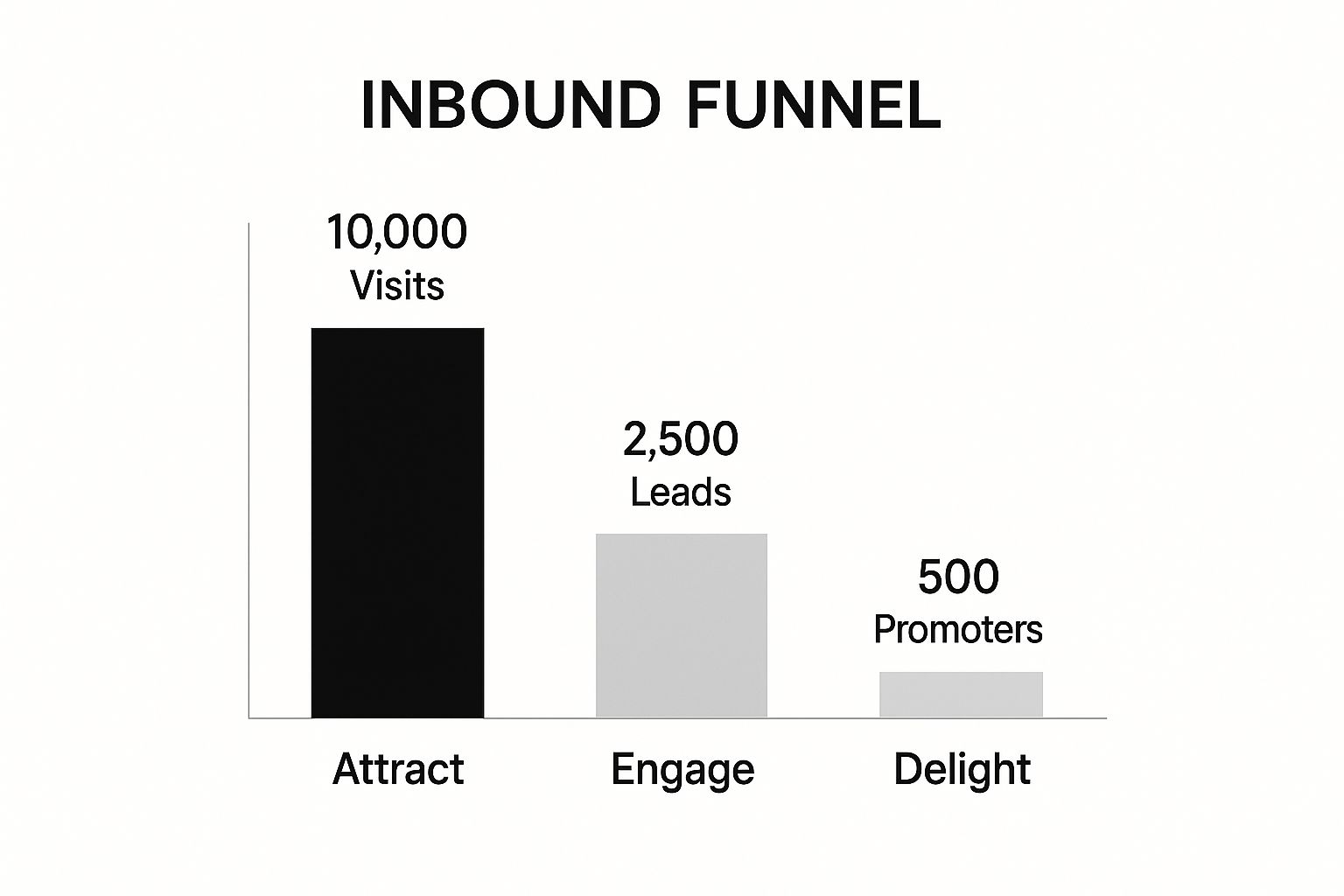
As you can see, people naturally drop off at each stage. That's totally normal. But it also shows just how critical it is to nail every single interaction, turning more of those initial visitors into leads, and eventually, into your most passionate brand advocates.
Choosing Your Approach: Inbound vs. Outbound
When you're trying to fill your pipeline, every dollar counts. Getting a handle on the core difference between inbound and outbound lead generation is the first step to spending your budget wisely.
Think of it this way: inbound is a magnet, and outbound is a megaphone.
Inbound marketing acts like a magnet, pulling in prospects who are already out there looking for answers you can provide. Outbound marketing is the megaphone, blasting your message out to a broad audience, hoping to catch the attention of a few.
Both can work, sure. But their methods, costs, and the kind of value they create over time couldn't be more different. An outbound strategy is all about initiating contact—think cold calls, email blasts, or paid ads that interrupt someone's day. It's designed for immediate, if sometimes unpredictable, results.
On the other hand, an effective inbound lead generation strategy is about building valuable assets. We're talking about blog posts, in-depth guides, and webinars that organically attract people who have a problem you can solve. This approach isn't just about getting a lead; it's about building trust and positioning yourself as the go-to expert.
Evaluating Key Business Factors
So, where do you put your money? It really comes down to the quality and longevity you're after.
Outbound campaigns, especially things like paid ads, have a simple on/off switch. The second you stop pumping money into them, the leads dry up. You're essentially renting attention.
Inbound marketing is different. It's about building assets that pay dividends for years. A single, high-ranking blog post can keep attracting qualified leads month after month, long after you hit publish. This is why content marketing consistently delivers three times more leads than traditional marketing, and at a much lower cost. It's an investment that compounds.
The real split is between permission and intent. Inbound leads come to you—they’ve raised their hands by downloading your guide or reading your blog. Outbound often means showing up uninvited, forcing you to convince someone they have a problem in the first place.
This distinction has a massive impact on lead quality. Inbound leads have already done their homework. They've found you. They're naturally warmer and more educated, which almost always leads to shorter sales cycles and better conversion rates than you'll see from a cold outbound list.
A Strategic Comparison of Inbound vs. Outbound Lead Generation
To really nail down which approach (or what mix) is right for you, it helps to see them side-by-side. This table breaks down the core differences between inbound and outbound marketing across key business metrics to inform your strategic planning.
| Metric | Inbound Lead Generation (The Magnet) | Outbound Lead Generation (The Megaphone) |
|---|---|---|
| Approach | Attracts interested prospects by providing valuable content and solutions. The buyer initiates contact. | Proactively reaches out to a broad audience, often interrupting their day. The company initiates contact. |
| Lead Quality | Leads are generally higher-quality and more qualified as they have self-identified a need. | Leads are often colder and require significant nurturing and qualification to determine interest. |
| Cost-Effectiveness | Tends to be more cost-effective over time, with a lower cost per lead as content assets mature. | Can be expensive, with costs directly tied to campaign activity (e.g., ad spend, call volume). |
| Long-Term Value | Creates sustainable, long-lasting marketing assets (SEO, content) that generate leads continuously. | Provides short-term results that typically stop when the campaign ends. It doesn't build lasting assets. |
| Scalability | Highly scalable. A single piece of content can serve thousands of prospects without increased effort. | Can be resource-intensive to scale, often requiring more budget or a larger sales team to expand reach. |
| Buyer Control | Empowers the buyer, allowing them to research and engage on their own terms, building trust. | The seller is in control of the interaction, which can sometimes feel intrusive or pushy to the buyer. |
Ultimately, a strong marketing engine often uses a blend of both. But understanding where each one shines helps you build a smarter, more sustainable plan for growth.
The Three Pillars of an Inbound Strategy

A powerful inbound lead generation engine isn’t something you just switch on. It’s built on three core pillars that have to work in lockstep: Search Engine Optimization (SEO), Content Marketing, and Social Media Engagement.
Think of it like a three-legged stool. If one leg is shaky or missing entirely, the whole thing topples over. To build a system that reliably pulls in qualified leads, you need to understand how these three elements feed and amplify each other.
Pillar 1: Search Engine Optimization
SEO is what makes you discoverable. It’s the foundation. Without it, the most brilliant content on earth is just shouting into the void. The mission is simple: when your ideal customer types a problem into Google, you need to be one of the first solutions they see.
This work starts way before you write a single headline. The first step is to perform effective keyword research. This isn't just about chasing high-volume terms; it's about getting inside your audience's head to understand the exact questions, pain points, and phrases they use.
For instance, a keyword like "marketing software" is a battleground. But a more specific, high-intent phrase like "AI-powered content creation for B2B tech" is much more likely to attract someone who has a real, immediate need.
Actionable On-Page SEO Checklist
Once you know what terms you're targeting, you have to optimize your content. Here’s a quick checklist to run through for every piece you publish:
- Title Tag: Get your main keyword in there, preferably near the start. But make it sound human—it needs to earn the click.
- Meta Description: This doesn't directly impact rankings, but it's your sales pitch in the search results. Write it to persuade someone to choose your link over the nine others on the page.
- Headings (H1, H2, H3): Use your primary keyword in the main H1 heading. Sprinkle variations throughout your subheadings (H2s, H3s) to give the page a logical structure for both people and search engines.
- Internal Linking: Weave in links to other relevant blog posts and service pages on your site. This shows search engines how your content is connected and keeps visitors on your site longer.
Pillar 2: Content Marketing
If SEO is the foundation, content is the actual house you build on it. This is where you deliver real value that turns a random visitor into a genuine lead. Here’s the secret to inbound lead generation: great content isn't about selling your product; it's about solving your audience's problems.
The trick is to create different assets for different stages of their journey. A prospect who is just starting to realize they have a problem needs something very different from someone who's already comparing vendors. This is where knowing your audience becomes non-negotiable. To nail this, you have to master identifying and understanding your audience segments. Our guide on customer segmentation strategies is a great place to start.
Creating valuable content isn’t a one-off task; it’s a commitment to becoming the most trusted resource in your industry. When you consistently answer your audience’s questions, they stop seeing you as a vendor and start seeing you as a partner.
Your content library needs variety. Blog posts are fantastic for pulling in top-of-funnel traffic, but you need meatier assets to actually capture leads. Action item: Map your existing content to the buyer's journey (Awareness, Consideration, Decision). You'll likely find you have plenty of "Awareness" content (blogs) but are thin on "Consideration" (comparison guides) or "Decision" (case studies). This gap analysis instantly builds your next content calendar.
- Ebooks and Whitepapers: These offer a deep dive into a specific topic and are perfect for gating behind an email sign-up form.
- Webinars: A live, interactive training session establishes your authority like nothing else and lets you engage directly with potential customers.
- Templates and Checklists: Give away practical, hands-on tools that solve an immediate problem for your audience. They're incredibly effective lead magnets.
Pillar 3: Social Media Engagement
Social media is the megaphone for your content and the handshake for your brand. And for B2B companies, one platform consistently punches above its weight for inbound leads: LinkedIn.
This is where you graduate from just dropping links. It’s about building authority, joining real industry conversations, and funneling highly relevant traffic back to your website. Unlike other platforms built for entertainment, LinkedIn is where professionals and decision-makers go looking for solutions.
The numbers don't lie. Content marketing can generate three times more leads than old-school marketing, and it does so at up to 62% less cost. Pair that with LinkedIn, where 89% of B2B marketers go to generate leads, and you've got a powerhouse combination. In fact, LinkedIn's own Lead Gen Forms boast an average conversion rate of 13%—more than five times higher than what you'd typically see on a landing page.
Here’s how to put it into action:
- Share Content with Context: Never just post a link and walk away. Pull out a juicy quote, a surprising stat, or a challenging question to kickstart a conversation.
- Engage in Relevant Groups: Find the LinkedIn Groups where your ideal customers hang out. Answer questions and offer real insights, but don't be spammy.
- Activate Your Team: Encourage your sales and leadership teams to share company content and build their own professional brands. A post from a person will almost always get more reach than a post from a company page.
Your Essential Inbound Lead Generation Toolkit

Trying to run a modern inbound strategy without the right tech is like trying to build a house with only a hammer. You might get a few boards nailed together, but you’re not building anything that will last. If you want to scale your efforts, manage relationships effectively, and actually prove your ROI, you need to stock your toolbox.
Building the perfect tech stack isn’t about grabbing the most expensive software off the shelf. It’s about picking tools that actually talk to each other, automate the grunt work, and give you clear insights. For any serious B2B team, there are three non-negotiables: a CRM, SEO tools, and Marketing Automation software.
Choosing Your Core CRM Platform
Think of your CRM as the central nervous system for your entire inbound machine. It’s the single source of truth where every bit of lead data lives—from their first anonymous website visit to their most recent call with sales. Getting this decision right is foundational; it impacts everyone.
HubSpot vs. Salesforce: A Quick Comparison
| Feature | HubSpot | Salesforce (Marketing Cloud) |
|---|---|---|
| Core Strength | An all-in-one platform built from the ground up for inbound marketers. It just works. | An incredibly powerful and customizable platform built for complex, large-scale enterprises. |
| Best For | SMBs and mid-market companies that need a single, unified solution for marketing, sales, and service. | Large enterprises with dedicated admin teams who need deep customization and complex integrations. |
| Learning Curve | Low. The interface is intuitive, so teams can get up and running fast without tons of training. | High. You often need a certified administrator just to set it up and manage it properly. |
For most teams just dipping their toes into inbound lead generation, HubSpot is usually the path of least resistance. Its real power is how seamlessly everything is integrated. The marketing, sales, and service hubs feel like one cohesive system because they were built that way. Salesforce is a beast, but it can often feel like you’re duct-taping different systems together, which takes a lot more technical know-how.
Mastering Visibility with SEO Tools
You can pour your heart into creating the best content in your industry, but if no one can find it, it might as well not exist. SEO tools are your eyes and ears on the ground. They show you what your audience is actually searching for, how your competitors are ranking, and where your biggest opportunities are hiding.
The two heavyweights in this arena are Ahrefs and SEMrush. They both cover the basics—keyword research, backlink analysis, site audits—but they each have their own personality.
- Ahrefs: This is the gold standard for backlink data. If your strategy is heavily focused on building links and reverse-engineering your competitors' link profiles, Ahrefs gives you an undisputed advantage. It's a specialist's tool.
- SEMrush: This platform is more of a comprehensive digital marketing suite. It has powerful features that go beyond SEO, covering PPC, content marketing, and social media analytics. It’s a great pick if you want an all-in-one platform to manage your online visibility.
Your choice really comes down to focus. Are you a link-building purist? Go with Ahrefs. Do you need a versatile toolkit that covers the whole marketing landscape? SEMrush is your powerful generalist.
Scaling Engagement with Marketing Automation
If your CRM is the nervous system, marketing automation is the engine that drives everything forward. This is the software that lets you deliver the right message to the right person at the right time, turning lukewarm leads into sales-ready prospects without you having to lift a finger for every email.
It's no surprise the demand for this tech is exploding. The lead generation solutions market in North America was valued at over US$1.22 billion in 2021 and is projected to hit US$3.62 billion by 2028. This growth is being driven by AI-powered lead scoring and automation that makes the whole process more efficient. You can see more on the growth of lead generation technology on growthlist.co.
Automation isn't about replacing the human touch. It's about saving it for the moments that truly matter. It handles the repetitive follow-ups so your team can focus on building real relationships with your most engaged leads.
This is where AI is really starting to shine, especially with intelligent lead scoring. By crunching thousands of data points, these platforms can predict which leads are most likely to buy, helping your sales team focus their energy where it counts. To go deeper, check out our guide on how predictive analytics in marketing is changing the game.
Tools like Marketo or Pardot (now Marketing Cloud Account Engagement) are leaders here, giving you the power to build complex nurturing workflows and align tightly with sales for a seamless handoff.
Measuring Your Inbound Marketing Success
Running an inbound strategy is one thing. Proving it actually works? That’s a whole different ballgame.
To show the real value of all that content, SEO, and social media effort, you have to look past the easy-to-find vanity metrics. Things like social media likes or raw website traffic feel good, but they don't pay the bills. The real focus needs to be on Key Performance Indicators (KPIs) that tie directly to business growth.
Think of it like this: website traffic is just the number of people window-shopping at your store. It’s nice to have a crowd, but it doesn’t tell you who’s actually ready to buy. True measurement for inbound lead generation hones in on the actions that turn those window shoppers into paying customers.
To really nail this, you have to learn how to measure SEO success beyond rankings. It’s a critical shift in mindset that moves the conversation from "Are we visible?" to "Are we profitable?"
Key Metrics That Actually Matter
To get a clear picture of your inbound ROI, you need a dashboard that tracks the right stuff. Forget the noise and start with these three core metrics. Together, they tell the full story, from a prospect's first click to the final sale.
-
Lead Conversion Rate: This is your gut check. It’s the percentage of visitors who take the action you want them to, like filling out a form for an ebook. It tells you flat-out if your content and landing pages are hitting the mark. A low rate? Your offer might be weak, or your form is a pain to fill out.
-
Cost Per Lead (CPL): This one is simple but powerful. It’s how much you’re spending to get one new lead. Just divide your total marketing spend by the number of new leads you generated in that period. This is how you spot which channels are efficient and which ones are just eating your budget.
-
Customer Acquisition Cost (CAC): Here it is—the metric that matters most to your CFO. CAC measures the total cost of winning a new customer, blending all your marketing and sales expenses. For a business to be healthy, your CAC has to be way lower than the lifetime value (LTV) of a customer. No exceptions.
From Metrics to Business Impact
Tracking these numbers is just step one. The real magic happens when you connect them to actual revenue, and that’s where a good CRM is non-negotiable.
There’s a reason 67.8% of marketers use a CRM to store and track their leads. They’re trying to close the gap. While 91% of marketers say lead generation is their top priority, a sobering 80% of those new leads never become customers. That’s a massive disconnect between effort and results.
Let's look at two common scenarios that show why connecting the dots is so important:
| Scenario | Marketing's Focus | The Problem | The Fix |
|---|---|---|---|
| Scenario A | Driving huge traffic numbers to the blog. | Traffic is high, but no one's converting. The sales team complains the leads are junk. | Stop chasing traffic. Focus on Lead Conversion Rate. Go back to your top-performing posts and add stronger calls-to-action and better lead magnets. |
| Scenario B | Generating a high volume of leads. | The lead count is up, but the Customer Acquisition Cost is through the roof. Deals are taking forever to close. | Stop treating all leads equally. Use lead scoring to flag the ones ready to talk and use nurturing workflows to warm up the rest. |
When you analyze these metrics together, you can diagnose what's broken and make decisions based on data, not guesswork. If your CPL is low but your CAC is high, that’s a red flag waving over the handoff between your marketing and sales teams.
For a deeper dive into setting up these tracking systems, our guide on essential lead generation key performance indicators has you covered. This is how you turn your marketing from a cost center into a predictable revenue engine.
How to Build Your Inbound Lead Generation Plan
Alright, let's get practical. Moving from inbound theory to an actual, documented plan is where the magic happens. A killer inbound lead generation strategy isn't something you stumble into; it’s built, piece by piece, with a clear framework. This is the process that turns your big-picture goals into daily tasks your team can actually run with.
Think of your plan as the architectural blueprint for your marketing engine. Without one, you're just bolting random parts together and hoping for the best. A solid plan ensures every blog post, every keyword, and every email serves a purpose.
Start with Your Ideal Customer Profile
Before you write a single headline, you have to know exactly who you're talking to. Your Ideal Customer Profile (ICP) is more than a vague persona—it’s a razor-sharp portrait of the perfect-fit customer for your business. This is your north star.
To make an ICP that actually works, you have to go deeper than the usual demographics. Dig into the real-world details that define a high-value account for your company.
- Firmographics: What's the sweet spot for company size, industry, and annual revenue? Are they all in a specific region?
- Technographics: What’s in their tech stack right now? Are they using tools that compete with yours, or ones that complement it?
- Pain Points: This is the big one. What specific, nagging business problems are they dealing with that your product was built to solve?
An unfocused plan tries to be everything to everyone and ends up being nothing to anyone. A sharp ICP ensures your resources are aimed at prospects who are most likely to convert, stay, and grow.
The most common mistake I see is an ICP that’s way too broad. "Mid-sized tech companies" is a starting point, not a target. Contrast that with something like: "B2B SaaS companies in North America with 50-200 employees, using Salesforce, who are struggling with slow, inconsistent content creation." Now that gives your team a clear target to aim for.
Audit and Map Your Content
With your ICP locked in, it's time to take stock of your content arsenal. A content audit isn't about judging what you've done in the past. It's a strategic look at what you already have, what you can repurpose, and where the glaring holes are. The whole point is to map every piece of content to a specific stage of the buyer's journey.
Actionable Content Mapping Checklist:
- Inventory Your Assets: Get a spreadsheet going and list everything you've got—blog posts, whitepapers, case studies, webinars, the works.
- Align with Buyer Stages: Tag each piece of content with its corresponding buyer stage: Awareness, Consideration, or Decision. Does that blog post answer a high-level question? Or does that case study help someone compare their options?
- Find the Gaps: Now, where are the holes? It's common to find you're flush with awareness-stage blog posts but have almost nothing for the consideration stage, like comparison guides or ROI calculators. This is your new to-do list.
- Build a Content Calendar: Map out your content creation for the next quarter. Assign topics, formats, and due dates to fill the gaps you just found. This ensures you’re consistently publishing valuable stuff for your ICP, no matter where they are in their journey.
Design Your Lead Nurturing Workflow
So, a prospect just downloaded your ebook. Great! But the journey has just begun. A lead nurturing workflow is your automated system for guiding them from that initial interest toward a real sales conversation. This is where your marketing automation platform really earns its keep.
Your workflow needs to feel like a conversation, not a sales pitch. Instead of just spamming them with product features, deliver more value that builds on why they came to you in the first place. For instance, if someone downloaded an ebook on "SEO Basics," your nurture sequence could follow up with an invite to a webinar on "Advanced Link Building," and then maybe offer a free "Content Audit Template."
This step-by-step approach builds trust and quietly qualifies leads over time. By the time that person gets handed off to sales, they're not cold—they're educated, engaged, and ready for a much more productive chat. And that, right there, is how you dramatically improve your conversion rates.
Got Questions? We've Got Answers.
Switching to an inbound strategy always kicks up a few big questions. That's a good thing. Getting clear on the timeline, budget, and team dynamics upfront is the difference between a program that flies and one that fizzles out. Let's tackle the questions that come up most often when B2B teams start this journey.
How Long Until This Inbound Thing Actually Works?
This is always the first question, and the answer requires a total mindset shift. You're not flipping a switch on a paid ad; you're planting an orchard.
You can expect to see the first green shoots—some initial traction—within 3-6 months. But for a predictable, steady harvest of leads, you’re looking at the 6-12 month mark. Why so long? The first few months are all foundational work: deep keyword research, publishing your first pillar pages and blog posts, and getting your lead capture forms dialed in.
Think of it like this: Outbound is a sugar rush. It gives you a quick spike, but it's gone the second you stop spending. Inbound is building a lead-generating asset that works for you 24/7, compounding its value month after month, long after you hit "publish."
How Do We Even Budget for This?
Budgeting for inbound isn't like buying media. You're investing in assets, not ad space. The two biggest line items are almost always talent and technology.
- Content Creation: This is the fuel for your entire engine and your biggest variable. Are you using in-house experts? Hiring freelance writers? Partnering with an agency? Don't skimp here. Top-tier, genuinely helpful content is non-negotiable.
- Technology Stack: You'll need a solid CRM and marketing automation platform (like HubSpot), an SEO tool for insights (like Ahrefs or SEMrush), and maybe a few other tools for design or video.
- Team Resources: You need real people to steer the ship—to manage the strategy, create the content, analyze what's working, and talk to people on social media.
The classic mistake is buying a Ferrari of a tech stack and then trying to run it on lawnmower gas. A powerful platform is useless without high-quality content to feed it.
How Do We Get Marketing and Sales to Actually Work Together?
This is where the rubber meets the road. If marketing is high-fiving over 1,000 new leads but sales is complaining they're all junk, your program is dead on arrival.
The single most powerful thing you can do is lock both teams in a room until they hammer out a Service Level Agreement (SLA).
This isn't just another corporate document. It’s a peace treaty. It forces everyone to agree on a crystal-clear definition of a "qualified lead" and dictates exactly how and when sales will follow up. It replaces finger-pointing with a shared playbook and is the absolute bedrock of any inbound program that actually drives revenue.
Ready to stop chasing leads and start attracting them? marketbetter.ai uses an integrated AI approach to accelerate content creation and scale your inbound efforts. Discover how our platform can help you build a predictable revenue engine by visiting https://www.marketbetter.ai.