10 Actionable Customer Segmentation Strategies for 2025
In 2025, generic marketing messages are just noise. To capture attention and drive revenue, businesses must understand their customers on a deeper, more actionable level. This isn't about simply knowing who they are, but why they buy, how they behave, and what they truly need. The key to unlocking this understanding lies in deploying effective customer segmentation strategies.
This guide moves beyond surface-level definitions to provide an actionable, comparative roundup of the 10 most powerful approaches available today. We will dissect each strategy, compare its strengths and weaknesses, provide real-world examples, and offer step-by-step guidance on implementation. You will learn not just what each model is, but when to use it, how it compares to others, and the specific data required to make it work.
We will cover everything from foundational models like demographic and behavioral segmentation to more advanced approaches such as value-based and technographic segmentation. Each item is designed to provide a clear, practical framework for immediate application. To gain further insights into applying these methods, especially in a SaaS context, consider exploring this article on Top Customer Segmentation Strategies for SaaS. By the end of this comprehensive listicle, you'll have a clear roadmap for choosing and applying the right segmentation models to personalize your marketing, optimize your campaigns, and achieve measurable, sustainable growth.
1. Demographic Segmentation
Demographic segmentation is one of the most foundational and widely used customer segmentation strategies. It involves dividing your market into distinct groups based on observable, statistical characteristics. This approach operates on the principle that individuals with similar demographic profiles often share similar purchasing habits, needs, and media consumption patterns.
The primary variables used in this method include:
- Age and Life Cycle Stage: Needs change dramatically from toddler to teenager to adult.
- Gender: Certain products are inherently marketed differently to men and women.
- Income and Occupation: Disposable income and professional roles heavily influence spending power and priorities.
- Education Level and Family Size: These factors can impact lifestyle choices and product needs.
By leveraging this data, which is often readily available through surveys, census data, or analytics platforms, businesses can create broad but effective audience profiles.
When to Use Demographic Segmentation
This strategy is an excellent starting point for nearly any business. It’s particularly effective for mass-market products where broad trends are important. For example, a luxury car brand like Mercedes-Benz targets high-income individuals, while a toy company like LEGO focuses on households with children in specific age brackets. Similarly, AARP tailors its services exclusively for people aged 50 and over, a classic use of age-based demographic segmentation.
Key Insight: While powerful for initial targeting, demographic data reveals who is buying, but not why they are buying. For deeper insights, it must be combined with other segmentation types like psychographic or behavioral.
Actionable Tips for Implementation
- Go Beyond the Obvious: Instead of just segmenting by "age," create a segment for "Millennials entering homeownership" which combines age with a life-cycle stage for more precise targeting.
- Combine and Conquer: Layer demographic data with behavioral or geographic insights. A high-income urban Millennial behaves differently from a high-income suburban Gen X-er.
- Keep Data Fresh: Demographics are not static. People age, change jobs, and move. Regularly update your customer data to ensure your segments remain accurate and relevant.
The following summary box visualizes how key demographic variables can be broken down for analysis.
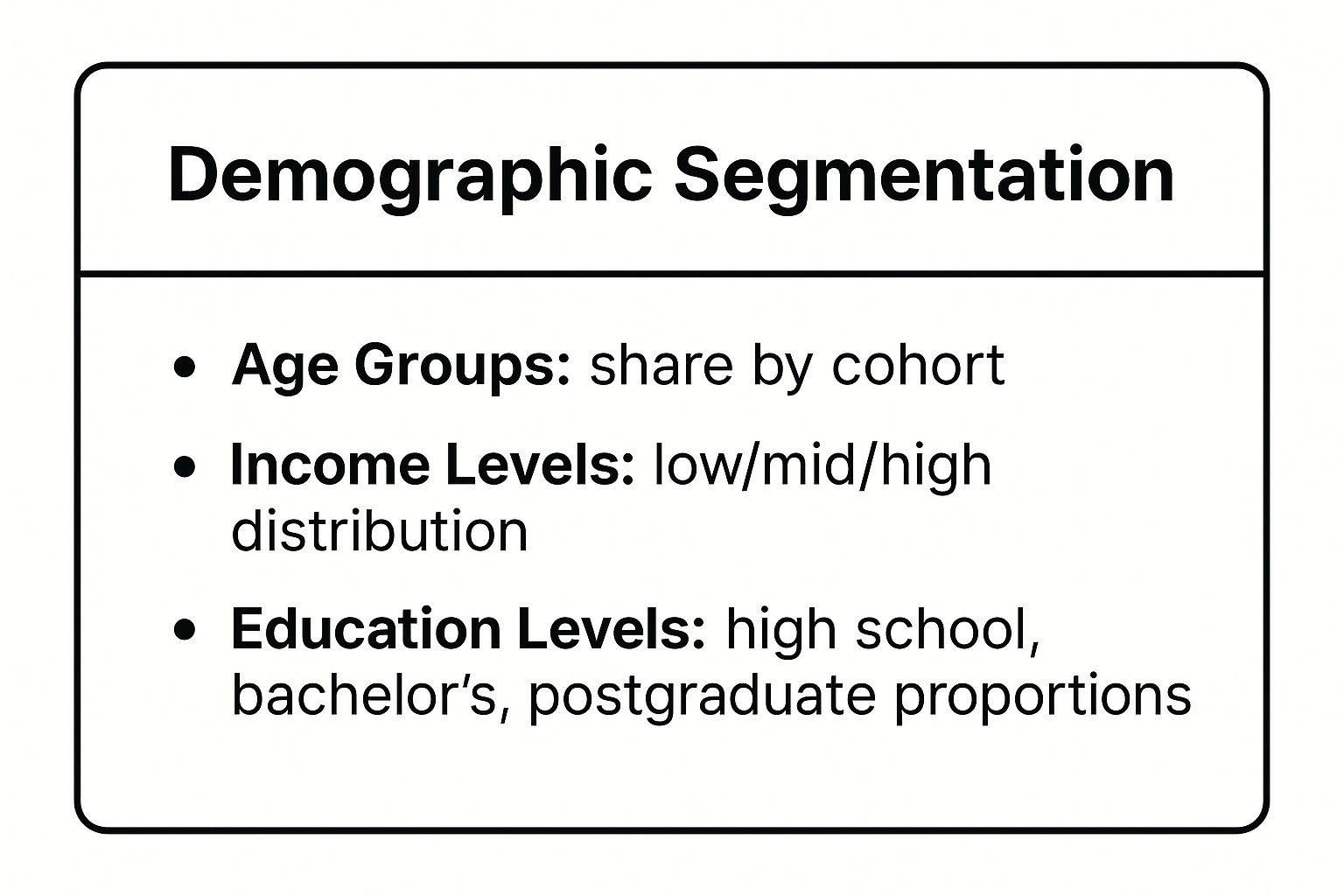
This visual breakdown highlights how a market can be segmented into distinct, quantifiable groups, allowing marketers to allocate resources more effectively. These clear distinctions form the basis of many successful customer segmentation strategies.
2. Psychographic Segmentation
Psychographic segmentation moves beyond the "who" of demographics to uncover the "why" behind consumer behavior. It categorizes customers based on psychological attributes like personality, values, attitudes, interests, and lifestyles (often summarized as AIO variables: Activities, Interests, and Opinions). Where demographics provide a skeleton, psychographics add the personality and motivation.
The primary variables used in this method include:
- Lifestyle: How a person spends their time, from hobbies and entertainment to daily routines.
- Values and Beliefs: Core principles that guide a person's decisions, such as environmentalism, family, or tradition.
- Personality Traits: Characteristics like being an introvert, adventurer, or innovator.
- Interests and Opinions: Attitudes towards social issues, politics, business, and specific products.
By analyzing these deeper motivations, businesses can craft messaging that resonates on an emotional and personal level, fostering stronger brand loyalty.
When to Use Psychographic Segmentation
This strategy is exceptionally powerful for brands in crowded markets where emotional connection is a key differentiator. It's ideal for products tied to identity, status, or personal values. For instance, Patagonia’s success is built on appealing to environmentally conscious outdoor enthusiasts who value sustainability. Similarly, Harley-Davidson targets a specific persona of freedom-seeking individualists, a psychographic profile that transcends age or income. Whole Foods Market also uses this approach by targeting consumers who prioritize health, wellness, and social responsibility in their purchasing decisions.
Key Insight: Psychographic segmentation provides the rich, qualitative context that demographic data lacks. It explains why a high-income, 30-year-old urban professional chooses a specific brand over its direct competitors, revealing their core motivations.
Actionable Tips for Implementation
- Conduct In-Depth Research: Use surveys with Likert scale questions (e.g., "On a scale of 1-5, how important is sustainability in your purchases?") to quantify attitudes.
- Leverage Social Media Insights: Monitor social media conversations and followings related to your brand to understand the interests and opinions of your audience.
- Use Established Frameworks: Consider models like the VALS (Values and Lifestyles) framework as a structured starting point for classifying consumers into psychographic types.
- Create Rich Personas: Build out your customer personas with psychographic details. Instead of just "Jane, 35," define "Eco-Conscious Jane," who values sustainability and community.
3. Behavioral Segmentation
Behavioral segmentation is one of the most powerful customer segmentation strategies, as it groups customers based on their actions and interactions with your brand. Unlike psychographics, which focuses on internal motivations, this method analyzes observable actions. It operates on the core principle that past behavior is one of the strongest predictors of future actions.
The primary variables used in this data-driven approach include:
- Purchase History: What products they buy, how often, and the average order value.
- Usage Rate: How frequently they use a product or service (heavy, medium, or light users).
- Brand Loyalty: Their level of commitment to your brand versus competitors.
- Benefits Sought: The specific value they look for in a product, such as convenience, price, or quality.
- Customer Journey Stage: Where they are in the lifecycle, from awareness to loyal advocate.
This method allows businesses to move beyond assumptions and create hyper-personalized marketing campaigns that resonate with demonstrated customer habits.
When to Use Behavioral Segmentation
This strategy is exceptionally effective for e-commerce, SaaS, and any business with a digital footprint where user actions can be easily tracked. For instance, Amazon's recommendation engine is a masterclass in behavioral segmentation, suggesting products based on a user's browsing and purchase history. Similarly, Spotify creates personalized playlists like "Discover Weekly" by analyzing listening habits, while the Starbucks Rewards program segments users by visit frequency and spending to offer tailored rewards.
Key Insight: Behavioral segmentation directly links marketing efforts to measurable actions. It reveals the why behind a purchase by focusing on the triggers and patterns that lead to conversion, making it highly actionable for personalization and retention campaigns.
Actionable Tips for Implementation
- Implement RFM Analysis: For e-commerce, use Recency, Frequency, and Monetary value to identify your most valuable customers. Target high-RFM customers with loyalty perks and low-RFM customers with re-engagement offers.
- Track Customer Lifecycle Stages: Segment users based on where they are in their journey. A new user needs onboarding content, while a long-time loyal customer might appreciate an exclusive preview.
- Leverage Abandoned Cart Data: Create specific, automated email campaigns for users who abandon their carts, offering a reminder, a small discount, or social proof to encourage them to complete the purchase.
4. Geographic Segmentation
Geographic segmentation divides a market based on location, recognizing that customer needs and purchasing habits often vary significantly depending on where they live. While simpler than behavioral or psychographic methods, it provides essential context for product offerings and messaging. It operates on the principle that local culture, weather, and regulations directly influence consumer behavior.
The primary variables used in this customer segmentation strategy include:
- Location: Ranging from global regions (e.g., North America, Southeast Asia) down to specific neighborhoods or postal codes.
- Climate and Season: Weather conditions dictate demand for products like air conditioners, snow blowers, and seasonal apparel.
- Population Density: Urban, suburban, and rural consumers have vastly different lifestyles, accessibility to stores, and needs.
- Cultural Preferences: Local traditions and tastes can impact everything from product flavors to marketing messages.
By analyzing these geographic factors, businesses can make their products and campaigns more relevant to the people in a specific area, increasing engagement and sales.
When to Use Geographic Segmentation
This strategy is essential for businesses operating in multiple regions, whether nationally or internationally. It is particularly powerful for retail, food and beverage, and automotive industries. For instance, a fast-food chain like McDonald's adapts its menu to local tastes, offering the McSpicy Paneer in India and the Teriyaki McBurger in Japan. Similarly, The Home Depot stocks hurricane supplies in coastal Florida but prioritizes snow removal equipment in northern states like Minnesota. This approach ensures product offerings align with immediate, location-specific needs.
Key Insight: Geographic segmentation is about more than just language translation; it's about cultural and environmental translation. True success comes from understanding how a location shapes a customer's daily life and purchasing decisions.
Actionable Tips for Implementation
- Combine with Demographics: Create "geodemographic" segments. For example, target high-income urban dwellers in New York City differently from high-income families in a Dallas suburb.
- Leverage Localized Marketing: Run geo-targeted ad campaigns on platforms like Google Ads or Facebook to show specific offers to users within a certain radius of your store.
- Adapt Products and Services: Don't assume a one-size-fits-all product will succeed everywhere. Analyze local climate, preferences, and regulations to make necessary adjustments.
- Monitor Regional Economics: Keep an eye on local economic conditions, such as employment rates or housing market trends, as they directly affect the purchasing power within a segment.
5. Firmographic Segmentation (B2B)
Firmographic segmentation is the business-to-business (B2B) equivalent of demographic segmentation. It involves classifying organizations into distinct groups based on shared, observable company characteristics. While demographics focus on people, firmographics focus on organizations, providing a crucial framework for B2B targeting.
The primary variables used in this B2B-focused method include:
- Industry: Classifying companies by their sector (e.g., SaaS, manufacturing, healthcare).
- Company Size: Measured by annual revenue or number of employees.
- Location: Geographic concentration, from country and state down to a specific city or region.
- Organizational Structure: Such as privately held, publicly traded, or non-profit.
By leveraging firmographic data, B2B marketers can move beyond a one-size-fits-all approach and tailor their messaging, product offerings, and sales outreach to the specific context of their target accounts.
When to Use Firmographic Segmentation
This strategy is essential for any B2B company looking to implement an efficient and scalable sales or marketing motion. It is the cornerstone of Account-Based Marketing (ABM) and is crucial for creating Ideal Customer Profiles (ICPs). For instance, Salesforce offers distinct CRM solutions for small businesses versus global enterprises, a classic application of segmentation by company size. Similarly, a cybersecurity firm might focus its efforts on financial services and healthcare companies, industries where data security is a high-stakes priority.
Key Insight: Firmographic data tells you which companies to target, but not who within those companies holds the buying power or what technologies they currently use. It provides the "where to look," but must be layered with other data for precision.
Actionable Tips for Implementation
- Build Your Ideal Customer Profile (ICP): Define the firmographic attributes of your best customers (e.g., "SaaS companies with 50-200 employees in North America") to focus your acquisition efforts.
- Segment by Growth Stage: A fast-growing startup has different needs and a more agile buying process than a mature, established enterprise. Tailor your outreach accordingly.
- Leverage B2B Data Tools: Use platforms like ZoomInfo, Clearbit, or the filters within LinkedIn Sales Navigator to gather accurate firmographic data. You can learn more about how to do this with LinkedIn prospecting automation.
- Combine with Technographic Data: Enhance firmographic segments by layering in technographic data (the technologies a company uses). Targeting companies that use a complementary or competitive technology stack is a highly effective tactic.
6. Value-Based Segmentation
Value-based segmentation shifts the focus from who the customer is to what they are worth to the business. This highly strategic approach groups customers according to their economic value, which is typically measured by metrics like profitability, revenue potential, and most importantly, customer lifetime value (CLV). Unlike behavioral segmentation, which tracks actions, this model focuses solely on the financial impact of those actions.
The primary variables used in this method include:
- Customer Lifetime Value (CLV): A prediction of the total profit a business will make from a customer throughout their entire relationship.
- Average Order Value (AOV): The average amount a customer spends per transaction.
- Purchase Frequency: How often a customer makes a purchase within a specific timeframe.
- Profitability per Customer: The net profit attributed to a customer after accounting for all associated costs.
By analyzing these financial metrics, businesses can allocate resources, like marketing spend and customer service attention, much more effectively.
When to Use Value-Based Segmentation
This strategy is indispensable for businesses with varying customer profitability, especially in industries with high customer acquisition costs. It’s perfect for companies looking to optimize their loyalty programs, premium service offerings, and account management resources. For example, an airline’s tiered loyalty program (Silver, Gold, Platinum) is a classic application, offering superior perks to travelers who spend the most. Similarly, financial institutions provide private banking services with dedicated advisors exclusively for their high-net-worth clients, ensuring top-tier retention.
Key Insight: Value-based segmentation allows you to treat your best customers best. It moves marketing away from a one-size-fits-all model toward a system where investment is directly proportional to expected returns.
Actionable Tips for Implementation
- Develop a CLV Model: Build a robust model that incorporates purchase history, frequency, and churn rate. A crucial aspect of value-based segmentation involves accurately estimating each customer's long-term potential, and further insights can be found on embedding domain knowledge for estimating customer lifetime value.
- Create Tiered Service Levels: Design exclusive benefits, priority support, or special access for your top-tier customers, as Sephora does with its VIB Rouge program. This enhances loyalty and encourages lower-tier customers to spend more.
- Identify High-Potential Customers Early: Use predictive analytics and AI-powered tools to spot new customers who exhibit behaviors similar to your existing high-value segment. Discover how you can implement this with AI-powered lead scoring.
- Target Win-Back Campaigns: Don’t just focus on current high-value customers. Create targeted campaigns to re-engage previously valuable customers who have become inactive.
7. Needs-Based Segmentation
Needs-based segmentation is a powerful customer-centric strategy that groups customers based on the specific problems they are trying to solve or the benefits they are seeking. Instead of focusing on who the customers are (demographics) or what they have done (behavioral), this approach prioritizes the why behind their purchase decisions. It is built on the understanding that customers "hire" products or services to get a job done.
This method requires a deep understanding of customer motivations, pain points, and desired outcomes. Key variables include:
- Functional Needs: The practical, tangible requirements a customer has (e.g., a car that is fuel-efficient).
- Emotional Needs: The feelings a customer wants to experience (e.g., feeling secure or successful).
- Social Needs: How a customer wants to be perceived by others (e.g., seen as environmentally conscious).
- Specific Pain Points: The frustrations or challenges a customer is currently facing.
By identifying these core needs, businesses can align product development, messaging, and service delivery to provide maximum value to distinct customer groups.
When to Use Needs-Based Segmentation
This strategy is exceptionally effective for product innovation, value proposition design, and competitive markets where differentiation is key. It helps businesses move beyond feature-based competition to create solutions that genuinely resonate. For example, Airbnb successfully caters to diverse traveler needs: budget-conscious backpackers, families needing space, business travelers seeking amenities, and luxury seekers wanting unique experiences. Similarly, Nike offers distinct product lines for various athletic needs, from elite marathon runners to casual gym-goers.
Key Insight: Needs-based segmentation uncovers the true "job" a customer is trying to accomplish. This shifts the focus from selling a product to providing a solution, which builds stronger customer loyalty and pricing power.
Actionable Tips for Implementation
- Embrace the "Jobs-to-be-Done" Framework: Use this theory, popularized by Clayton Christensen, to uncover the underlying progress your customers are trying to make when they buy your product.
- Conduct Voice-of-Customer Research: Use in-depth interviews, surveys, and focus groups to directly ask customers about their challenges, goals, and frustrations.
- Map Features to Needs: Create a clear matrix that links each of your product's features to the specific customer needs it fulfills. This helps prioritize development and refine marketing messages.
- Build Need-Based Personas: Develop customer personas that are defined by their goals and pain points rather than just their demographic profiles. Understanding these motivations allows for more effective person-level identification and targeting.
The video below offers a deeper dive into the "Jobs-to-be-Done" theory, which is a cornerstone of effective needs-based customer segmentation strategies.
By understanding the "why," you can create more compelling offers and build a more resilient brand that is anchored in solving real customer problems.
8. Technographic Segmentation
Technographic segmentation groups customers based on the technology they use, from their hardware and software stack to their preferred digital platforms. This modern approach is crucial in a tech-driven world, especially for B2B companies, SaaS providers, and digital agencies. It provides a technical layer of insight that firmographic data alone cannot, showing how a company works, not just what it is.
The primary variables used in this method include:
- Software Stack: CRM, ERP, marketing automation, or analytics platforms currently in use.
- Hardware: Server infrastructure, mobile devices, or other physical tech.
- Digital Adoption: Usage of social media platforms, cloud services, or e-commerce technologies.
- Technical Sophistication: From early adopters of cutting-edge tech to laggards using legacy systems.
By analyzing this data, businesses can pinpoint opportunities, predict needs, and tailor their messaging to a prospect's specific technological environment.
When to Use Technographic Segmentation
This strategy is indispensable for technology companies and B2B marketers. It enables highly targeted and relevant outreach that speaks directly to a prospect’s existing infrastructure. For instance, a cybersecurity firm can target companies using specific cloud platforms known to have certain vulnerabilities. Similarly, HubSpot can identify businesses using a competitor’s marketing automation tool and create a campaign highlighting its superior features and seamless migration process. A Shopify app developer would use it to target merchants who already have a complementary app installed, ensuring a perfect product fit.
Key Insight: Technographic data tells you how a customer operates. This is a powerful advantage over competitors using broader strategies, as it allows you to frame your product not just as a solution, but as the next logical step in their technology evolution.
Actionable Tips for Implementation
- Leverage Data Tools: Use platforms like BuiltWith, Datanyze, or Clearbit to uncover the technology stacks of your target accounts without manual research.
- Target Complementary Tech: Identify companies using technologies that integrate well with your own. If you sell a specialized analytics tool, target users of CRMs that you have a native integration with.
- Segment by Adoption Curve: Classify prospects based on Everett Rogers' "Diffusion of Innovation" theory. Target "early adopters" for beta programs and "early majority" for scalable, proven solutions.
- Create Competitive Campaigns: Directly target users of competing software. Highlight your key differentiators, offer competitive pricing, or showcase an easier user interface to encourage them to switch.
9. Generational Segmentation
Generational segmentation divides a market based on the shared life experiences of different birth cohorts. This strategy operates on the idea that historical events, technological changes, and cultural shifts during a person's formative years create distinct values, attitudes, and purchasing behaviors. It's a specific application of demographic (age) and psychographic (values) segmentation, combining them into powerful, culturally relevant profiles.
The primary variables in this method group people by their shared context:
- Baby Boomers (born ~1946-1964): Shaped by post-war optimism and economic growth.
- Generation X (born ~1965-1980): Known for independence and skepticism, having grown up during a time of social change.
- Millennials (born ~1981-1996): The first digitally native generation, valuing experiences and authenticity.
- Generation Z (born ~1997-2012): True digital natives, prioritizing social responsibility, inclusivity, and short-form content.
By analyzing these generational lenses, businesses can tailor messaging, product features, and communication channels to resonate more deeply with each group’s core motivations.
When to Use Generational Segmentation
This approach is highly effective for brands whose products or messaging rely heavily on cultural relevance, values, or communication styles. For instance, TikTok’s entire platform is built around the short-form, trend-driven video content that appeals directly to Gen Z. In contrast, AARP successfully serves Baby Boomers by focusing its products and content on retirement, health, and financial security, which are key concerns for that generation. It's also useful for financial services, where Robinhood captured Millennial and Gen Z investors with its mobile-first, commission-free trading model that challenged traditional brokerage firms.
Key Insight: Generational segmentation provides a powerful cultural context that demographic age data alone lacks. However, it's crucial to avoid broad stereotypes, as individual behavior within a generation can vary significantly.
Actionable Tips for Implementation
- Avoid Stereotypes: Use generational traits as a starting point, not a rigid rule. A Millennial parent has different needs than a Millennial just entering the workforce.
- Adapt Communication Channels: Engage Gen Z on platforms like TikTok and Instagram, Millennials through social media and email, and Baby Boomers via Facebook and more traditional channels.
- Focus on Core Values: Align your brand’s message with the values that define a generation. For Gen Z, this might mean highlighting sustainability and ethical practices.
- Layer with Other Segments: Combine generational insights with behavioral or psychographic data for a more nuanced and accurate customer profile. A high-income, urban Millennial will have different priorities than a rural one.
10. Occasion-Based Segmentation
Occasion-based segmentation is a powerful strategy that groups customers based on specific moments or situations when they purchase or use a product. This approach moves beyond who the customer is (demographics) or what they think (psychographics) to focus on the context of their buying decision. It is a subset of behavioral segmentation, but it focuses specifically on the timing and triggers of behavior rather than on long-term patterns.
The primary variables in this method revolve around timing and context:
- Time of Day/Week/Year: Promoting different meal types at different times (e.g., breakfast vs. late-night snacks).
- Life Events: Targeting customers during major milestones like weddings, graduations, or anniversaries.
- Holidays and Seasons: Aligning marketing with specific holidays like Valentine's Day or seasonal needs like summer travel.
- Usage Situation: Differentiating between a product used for a routine personal need versus one purchased as a special gift.
By understanding the context of a purchase, businesses can deliver highly relevant offers and messages precisely when customers are most receptive. This is a key element of effective customer segmentation strategies.
When to Use Occasion-Based Segmentation
This strategy is exceptionally effective for industries where context heavily influences purchasing decisions, such as retail, food and beverage, and travel. For example, a greeting card company like Hallmark segments its entire business around occasions: birthdays, holidays, and sympathy. Similarly, Coca-Cola markets its products differently for a family meal compared to a large social party or on-the-go refreshment. Hotels also use this by targeting business travelers with different packages during the week and leisure travelers on weekends.
Key Insight: Occasion-based segmentation focuses on the purchase trigger rather than the customer profile. It answers the question, "When and why are they buying right now?" This allows for real-time marketing that can capture immediate intent.
Actionable Tips for Implementation
- Create an Occasion Map: Brainstorm and map out all the potential occasions, both common and unique, where customers might use your product or service.
- Develop Contextual Messaging: Craft advertising copy, promotions, and creative assets that speak directly to the specific occasion. A "back-to-school" campaign should look and feel different from a "summer vacation" one.
- Use Predictive Analytics: Leverage data to anticipate upcoming occasions. For instance, send an anniversary promotion to a customer who bought an engagement ring a year ago.
- Bundle for the Moment: Create product bundles or packages tailored for specific events, like a "game day snack pack" or a "new home essentials kit," to increase the average order value.
Customer Segmentation Strategies Comparison
| Segmentation Type | 🔄 Implementation Complexity | ⚡ Resource Requirements | 📊 Expected Outcomes | 💡 Ideal Use Cases | ⭐ Key Advantages |
|---|---|---|---|---|---|
| Demographic Segmentation | Low - straightforward data gathering | Low - census & market research | Basic groupings by age, gender, income; easy targeting | Consumer packaged goods, retail, financial services | Simple, cost-effective, data easily available |
| Psychographic Segmentation | High - deep qualitative research | High - surveys, interviews, analysis | Rich insights into motivations and values | Luxury, lifestyle brands, automotive, travel, hospitality | Deeper customer understanding; emotional connections |
| Behavioral Segmentation | Medium - requires robust tracking | Medium to High - analytics tools | Actionable, data-driven targeting based on behavior | E-commerce, SaaS, subscriptions, retail | Highly measurable; tied to revenue and conversions |
| Geographic Segmentation | Low - location-based data | Low to Medium - GIS, geofencing | Localized marketing; adapts to climate and culture | Retail chains, restaurants, real estate, tourism | Cost-effective; supports logistics and local adaptation |
| Firmographic Segmentation | Medium - B2B company data collection | Medium - public & proprietary data | Targeted B2B marketing and account prioritization | B2B software, professional services, industrial equipment | Focused on company traits; supports account-based sales |
| Value-Based Segmentation | High - requires sophisticated analytics | High - predictive modeling tools | Maximized ROI by focusing on high-value customers | Subscription services, financial, luxury, B2B | Optimizes resource allocation; improves profitability |
| Needs-Based Segmentation | High - deep customer research needed | High - interviews, ethnography | Customer-centric product innovation and value offers | Product development, SaaS, healthcare, diverse markets | Aligns offerings directly with customer needs |
| Technographic Segmentation | Medium to High - tech usage tracking | Medium to High - data tools | Understanding tech stack and digital maturity | B2B SaaS, tech vendors, marketing agencies, IT services | Precise targeting for tech compatibility and adoption |
| Generational Segmentation | Low - based on birth cohorts | Low - demographic data | Cultural and behavioral targeting by generation | Consumer goods, media, education, financial services | Captures cultural context; guides communication styles |
| Occasion-Based Segmentation | Medium - requires timing & context insight | Medium - predictive analytics | Timely, context-relevant marketing; increased frequency | Retail, hospitality, restaurants, event-driven products | Supports seasonal/event campaigns; enhances relevance |
From Strategy to Action: Implementing Your Segmentation Plan
We’ve explored a comprehensive roundup of the most effective customer segmentation strategies available today, from the foundational demographic and geographic models to the more nuanced behavioral, psychographic, and value-based approaches. Each strategy offers a unique lens through which to view your customer base, providing the clarity needed to move beyond generic, one-size-fits-all marketing.
The core takeaway is this: customer segmentation is not about choosing a single, perfect model. Instead, the most powerful and profitable strategies emerge from the intelligent combination of multiple approaches. True market leadership is achieved not by just knowing about demographic or behavioral segmentation, but by layering them to create a multi-dimensional, actionable customer persona. For example, a B2B company might start with firmographic data (company size, industry) and then layer on technographic insights (what CRM they use) and behavioral signals (which C-level executives engaged with a recent webinar) to identify its most qualified leads.
Synthesizing Your Segmentation Approach
The journey from understanding these strategies to implementing them requires a clear, goal-oriented plan. Simply collecting data is not enough; the value lies in its strategic application. Ask yourself: what business outcome are we trying to achieve? Is it to reduce churn, increase customer lifetime value, or break into a new market? Your answer will determine which segmentation model serves as your foundation.
- For Boosting Retention: Start with Behavioral Segmentation. Identify at-risk customers based on declining engagement, product usage, or purchase frequency. Then, layer in Value-Based Segmentation to prioritize your efforts on retaining your most profitable customers first.
- For Acquiring High-Value Customers: Begin with Psychographic and Needs-Based Segmentation. Understand the core motivations, pain points, and desired outcomes of your ideal customer profile. Use this to craft resonant messaging that speaks directly to their aspirations, rather than just their demographic profile.
- For Driving Cross-Sells and Upsells: A combination of Behavioral and Value-Based Segmentation is key. Analyze past purchase history to identify customers who have bought complementary products before. From there, you can build predictive models to target similar segments with personalized offers.
Putting Your Plan into Action: A Quick Guide
Transitioning from theory to practice can feel daunting, but it can be broken down into manageable steps. The key is to embrace an iterative process of testing, learning, and refining. Segmentation is not a static, "set it and forget it" project.
- Define Clear, Measurable Goals: What does success look like? Be specific. "Increase conversion rates for our premium tier by 15% in Q3" is a much stronger goal than "get more customers."
- Gather and Consolidate Your Data: Pull information from your CRM, analytics platforms, customer surveys, and sales team feedback. Centralize this data to get a single, unified view of your customer.
- Choose Your Primary and Secondary Models: Select a primary segmentation model that aligns directly with your goal. Then, choose one or two secondary models to add depth and precision.
- Develop Segment-Specific Campaigns: Create tailored messaging, offers, and content for each of your top 2-3 priority segments. Don't try to target everyone at once.
- Test, Measure, and Iterate: Launch your campaigns and closely monitor the results. Use performance data to validate your segments and refine your approach. Did your "high-value, tech-savvy" segment respond as expected? If not, why? Use these insights to continuously improve your customer segmentation strategies.
By moving from abstract knowledge to concrete action, you transform customer data from a passive repository of information into a dynamic engine for sustainable growth. This strategic focus is what separates market leaders from the rest, allowing you to build deeper relationships, deliver exceptional value, and ultimately drive superior business results.
Ready to move beyond manual analysis and unlock the full potential of your customer data? marketbetter.ai uses advanced AI to automate the entire segmentation process, from identifying your most valuable customer groups to launching personalized campaigns at scale. Turn insight into action and see measurable results faster by visiting marketbetter.ai to learn more.